

ISO/IEC 10026-3:1998
(Main)Information technology — Open Systems Interconnection — Distributed Transaction Processing — Part 3: Protocol specification
General Information
- Abstract
This part of ISO/IEC 10026 provides a) a statement (clauses 6 to 11) of the nature of the automaton giving the necessary behaviour of each of the participating entities which are providing the OSI TP Service, covering 1) the actions to be taken on receiving request and response primitives issued by a TP Service user invocation; 2) the actions to be taken on receiving indication and confirm primitives issued by the presentation service-provider; 3) the actions to be taken as a result of certain events within the local system; 4) the actions to be taken as a result of interactions with other ASEs; b) the definition (clause 12) of the abstract syntax required to convey the TP protocol control information; c) the conformance requirements to be met by implementations of this protocol (clause 13). The scope of this part of ISO/IEC 10026 is limited to the interconnection of systems; it does not specify or restrict the implementation of possible interfaces within a computer system.
- Status
- Published
- Publication Date
- 19-Dec-1998
- Technical Committee
- ISO/IEC JTC 1 - Information technology
- Drafting Committee
- ISO/IEC JTC 1 - Information technology
- Current Stage
- 9093 - International Standard confirmed
- Start Date
- 26-Sep-2003
- Completion Date
- 29-Aug-2026

Overview
ISO/IEC 10026-3:1998, titled Information technology - Open Systems Interconnection - Distributed Transaction Processing - Part 3: Protocol specification, is an international standard published by the International Organization for Standardization (ISO) and the International Electrotechnical Commission (IEC). This standard is a key component of the OSI Distributed Transaction Processing (OSI TP) suite, focusing specifically on the protocol specification for distributed transaction management within open systems interconnection environments.
The primary purpose of ISO/IEC 10026-3 is to define the behavior and communication requirements for systems participating in distributed transaction processing. This includes outlining protocol mechanisms, defining the necessary abstract syntax for control information exchange, and specifying conformance criteria for implementations. The focus is on enabling interoperable, reliable management of transactions across interconnected systems, without imposing restrictions on internal interfaces within individual computer systems.
Key Topics
Protocol Automata & Behavior:
- Describes the expected actions of each participating entity in response to various service primitives (requests, indications, responses, and confirms).
- Covers handling of events from the TP Service user, presentation service-provider, local system events, and interactions with other Application Service Elements (ASEs).
Abstract Syntax for Protocol Control:
- Specifies the format and encoding of protocol control information required for OSI TP operations.
Conformance Requirements:
- Details the mandatory behaviors and features that must be implemented to achieve compliance with this protocol standard.
Model & Execution Rules:
- Documents the model of the protocol machine (PM), state management, dialogue establishment, channel control, and error handling.
Service Primitive Mapping:
- Explains mapping between Transaction Processing Application Service Elements (TP-ASE), Association Control Service Element (ACSE), Commitment, Concurrency, and Recovery (CCR) services, and the Presentation Layer.
Procedures and State Transitions:
- Outlines steps for beginning, managing, and terminating distributed transactions, including handling abnormal events such as aborts and errors.
- Defines procedures for log management, recovery contexts, and dialogue management.
Applications
ISO/IEC 10026-3:1998 is essential for organizations and developers involved in:
- Middleware and Transaction Monitors:
- Ensuring consistent and reliable distributed transaction management in middleware products.
- Interoperable Enterprise Systems:
- Facilitating data integrity and transactional consistency in multi-vendor, multi-platform environments.
- Financial Services Infrastructure:
- Supporting atomic transactions in banking, trading, and other mission-critical financial systems.
- Telecommunications and Networking:
- Managing complex transaction-based services in networked telecommunications infrastructure.
- Cloud and Distributed Computing Environments:
- Providing a standard approach for transaction processing in modern distributed and cloud-based architectures.
By conforming to ISO/IEC 10026-3, implementers can develop solutions that are interoperable with other compliant systems, reducing integration complexity and supporting open systems strategies in distributed computing.
Related Standards
- ISO/IEC 10026-1: Framework and reference model for distributed transaction processing.
- ISO/IEC 10026-2: OSI TP Service definition.
- ISO/IEC 10026-4: Implementation guidelines for distributed transaction processing.
- ISO/IEC 10026-5: Protocol implementation conformance statement (PICS) proforma.
- ISO/IEC 8822: Presentation Layer protocol specification within OSI.
- ISO/IEC 8650: Association Control Service Element (ACSE) protocol specification.
Conclusion
ISO/IEC 10026-3:1998 plays a foundational role in standardizing distributed transaction processing protocols, promoting reliable communication across heterogeneous systems. Its careful specification of protocol behaviors, state management, and conformance benchmarks ensures consistent and interoperable transaction management - making it a vital resource for architects, system integrators, and developers operating in distributed and open systems environments.
Relations
- Effective Date
- 15-Apr-2008
Get Certified
Connect with accredited certification bodies for this standard

BSI Group
BSI (British Standards Institution) is the business standards company that helps organizations make excellence a habit.

NYCE
Mexican standards and certification body.
Sponsored listings
Frequently Asked Questions
ISO/IEC 10026-3:1998 is a standard published by the International Organization for Standardization (ISO). Its full title is "Information technology — Open Systems Interconnection — Distributed Transaction Processing — Part 3: Protocol specification". This standard covers: This part of ISO/IEC 10026 provides a) a statement (clauses 6 to 11) of the nature of the automaton giving the necessary behaviour of each of the participating entities which are providing the OSI TP Service, covering 1) the actions to be taken on receiving request and response primitives issued by a TP Service user invocation; 2) the actions to be taken on receiving indication and confirm primitives issued by the presentation service-provider; 3) the actions to be taken as a result of certain events within the local system; 4) the actions to be taken as a result of interactions with other ASEs; b) the definition (clause 12) of the abstract syntax required to convey the TP protocol control information; c) the conformance requirements to be met by implementations of this protocol (clause 13). The scope of this part of ISO/IEC 10026 is limited to the interconnection of systems; it does not specify or restrict the implementation of possible interfaces within a computer system.
This part of ISO/IEC 10026 provides a) a statement (clauses 6 to 11) of the nature of the automaton giving the necessary behaviour of each of the participating entities which are providing the OSI TP Service, covering 1) the actions to be taken on receiving request and response primitives issued by a TP Service user invocation; 2) the actions to be taken on receiving indication and confirm primitives issued by the presentation service-provider; 3) the actions to be taken as a result of certain events within the local system; 4) the actions to be taken as a result of interactions with other ASEs; b) the definition (clause 12) of the abstract syntax required to convey the TP protocol control information; c) the conformance requirements to be met by implementations of this protocol (clause 13). The scope of this part of ISO/IEC 10026 is limited to the interconnection of systems; it does not specify or restrict the implementation of possible interfaces within a computer system.
ISO/IEC 10026-3:1998 is classified under the following ICS (International Classification for Standards) categories: 35.100.70 - Application layer. The ICS classification helps identify the subject area and facilitates finding related standards.
ISO/IEC 10026-3:1998 has the following relationships with other standards: It is inter standard links to ISO/IEC 10026-3:1996. Understanding these relationships helps ensure you are using the most current and applicable version of the standard.
ISO/IEC 10026-3:1998 is available in PDF format for immediate download after purchase. The document can be added to your cart and obtained through the secure checkout process. Digital delivery ensures instant access to the complete standard document.
Standards Content (Sample)
INTERNATIONAL ISO/IEC
STANDARD 10026-3
Third edition
1998-12-15
Information technology — Open Systems
Interconnection — Distributed Transaction
Processing —
Part 3:
Protocol specification
Technologies de l'information — Interconnexion de systèmes ouverts
(OSI) — Traitement transactionnel réparti —
Partie 3: Spécification du protocole
Reference number
B C
ISO/IEC 10026-3 : 1998 (E)
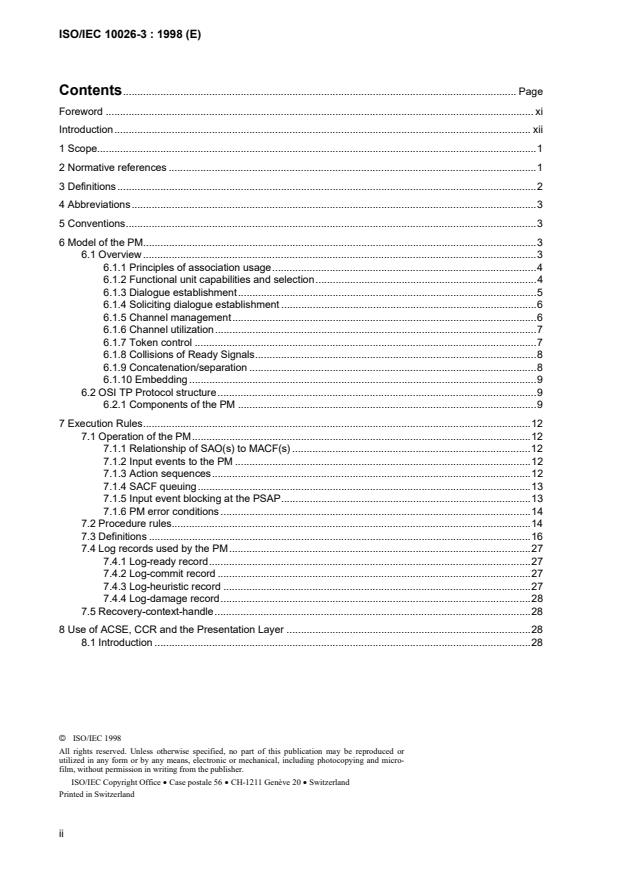
Contents. Page
Foreword . xi
Introduction. xii
1 Scope.1
2 Normative references .1
3 Definitions.2
4 Abbreviations.3
5 Conventions.3
6 Model of the PM.3
6.1 Overview.3
6.1.1 Principles of association usage.4
6.1.2 Functional unit capabilities and selection.4
6.1.3 Dialogue establishment.5
6.1.4 Soliciting dialogue establishment .6
6.1.5 Channel management.6
6.1.6 Channel utilization.7
6.1.7 Token control .7
6.1.8 Collisions of Ready Signals.8
6.1.9 Concatenation/separation .8
6.1.10 Embedding .9
6.2 OSI TP Protocol structure.9
6.2.1 Components of the PM .9
7 Execution Rules.12
7.1 Operation of the PM.12
7.1.1 Relationship of SAO(s) to MACF(s) .12
7.1.2 Input events to the PM .12
7.1.3 Action sequences.12
7.1.4 SACF queuing.13
7.1.5 Input event blocking at the PSAP.13
7.1.6 PM error conditions .14
7.2 Procedure rules.14
7.3 Definitions .16
7.4 Log records used by the PM.27
7.4.1 Log-ready record.27
7.4.2 Log-commit record .27
7.4.3 Log-heuristic record .27
7.4.4 Log-damage record.28
7.5 Recovery-context-handle.28
8 Use of ACSE, CCR and the Presentation Layer .28
8.1 Introduction .28
© ISO/IEC 1998
All rights reserved. Unless otherwise specified, no part of this publication may be reproduced or
utilized in any form or by any means, electronic or mechanical, including photocopying and micro-
film, without permission in writing from the publisher.
ISO/IEC Copyright Office • Case postale 56 • CH-1211 Genève 20 • Switzerland
Printed in Switzerland
ii
©
ISO/IEC ISO/IEC 10026-3 : 1998 (E)
8.2 Use of ACSE Service primitives.28
8.2.1 Use of the A-ASSOCIATE parameters .29
8.2.2 Use of the A-RELEASE parameters .29
8.2.3 Use of the A-ABORT and A-P-ABORT parameters.30
8.3 Use of CCR Service primitives.30
8.4 Use of the Presentation Layer .32
8.4.1 Use of Presentation Service primitives .32
8.4.2 Mapping of C-ROLLBACK-RI to Presentation .32
8.5 Association Management.32
8.5.1 Introduction.32
8.5.2 Association/dialogue compatibility.33
8.5.3 Association/channel compatibility.33
8.5.4 Initiating an association establishment.34
8.5.5 Receiving an association establishment indication .35
8.5.6 Responding to association establishment.36
8.5.7 Receiving confirmation of association establishment.37
8.5.8 Initiating an association release .38
8.5.9 Aborting an association.38
8.5.10 Initiating a dialogue solicitation.38
8.5.11 Responding to a dialogue solicitation.38
8.5.12 Receiving a rejection of a dialogue solictation .39
8.5.13 Successful dialogue solicitation.39
9 TP-ASE description .39
9.1 Introduction .39
9.2 AF Service Definition .40
9.2.1 AF-BEGIN-DIALOGUE .40
9.2.2 AF-BID.41
9.2.3 AF-END-DIALOGUE .41
9.2.4 AF-U-ERROR.41
9.2.5 AF-ABORT .41
9.2.6 AF-GRANT-CONTROL.41
9.2.7 AF-REQUEST-CONTROL .41
9.2.8 AF-HANDSHAKE .41
9.2.9 AF-HANDSHAKE-AND-GRANT-CONTROL.42
9.2.10 AF-DEFER .42
9.2.11 AF-BEGIN-TRANSACTION .42
9.2.12 AF-PREPARE .42
9.2.13 AF-REPORT .42
9.2.14 AF-ABORT-AND-REPORT.42
9.2.15 AF-NOCHANGE.43
9.2.16 AF-EARLY-EXIT.43
9.2.17 AF-RECOVER.43
9.2.18 AF-TOKEN-GIVE .43
9.2.19 AF-TOKEN-PLEASE.43
9.2.20 AF-SOLICIT-DIALOGUE.43
9.3 AF-Services and TP APDUs: parameters and field Mappings.43
9.3.1 AF-BEGIN-DIALOGUE request/indication/response/confirm, TP-BEGIN-
DIALOGUE-RI/-RC APDU.43
9.3.2 AF-BID request/indication/response/ confirm, TP-BID-RI/-RC APDU.46
9.3.3 AF-END-DIALOGUE request/ indication/response/confirm, TP-END-DIALOGUE-
RI/-RC APDU .47
9.3.4 AF-U-ERROR request/indication/response/confirm, TP-U-ERROR-RI/-RC APDU.47
9.3.5 AF-ABORT request/indication, TP-ABORT-RI APDU.48
9.3.6 AF-GRANT-CONTROL request/ indication, TP-GRANT-CONTROL-RI APDU.49
9.3.7 AF-REQUEST-CONTROL request/ indication, TP-REQUEST-CONTROL-RI
APDU.49
9.3.8 AF-HANDSHAKE request/indication/ response/confirm, TP-HANDSHAKE-RI/-RC
APDU.49
iii
©
ISO/IEC 10026-3 : 1998 (E) ISO/IEC
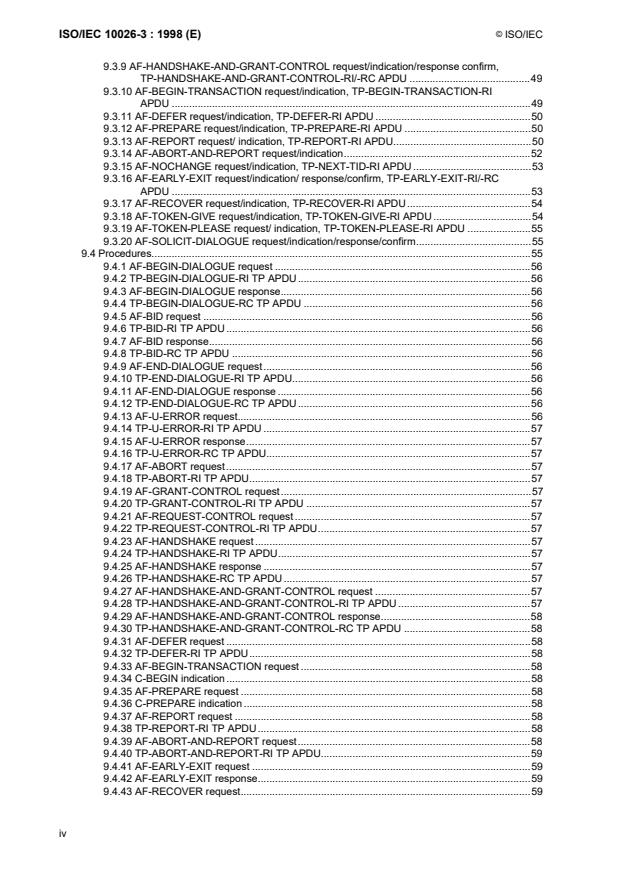
9.3.9 AF-HANDSHAKE-AND-GRANT-CONTROL request/indication/response confirm,
TP-HANDSHAKE-AND-GRANT-CONTROL-RI/-RC APDU .49
9.3.10 AF-BEGIN-TRANSACTION request/indication, TP-BEGIN-TRANSACTION-RI
APDU .49
9.3.11 AF-DEFER request/indication, TP-DEFER-RI APDU .50
9.3.12 AF-PREPARE request/indication, TP-PREPARE-RI APDU .50
9.3.13 AF-REPORT request/ indication, TP-REPORT-RI APDU.50
9.3.14 AF-ABORT-AND-REPORT request/indication.52
9.3.15 AF-NOCHANGE request/indication, TP-NEXT-TID-RI APDU .53
9.3.16 AF-EARLY-EXIT request/indication/ response/confirm, TP-EARLY-EXIT-RI/-RC
APDU .53
9.3.17 AF-RECOVER request/indication, TP-RECOVER-RI APDU.54
9.3.18 AF-TOKEN-GIVE request/indication, TP-TOKEN-GIVE-RI APDU .54
9.3.19 AF-TOKEN-PLEASE request/ indication, TP-TOKEN-PLEASE-RI APDU .55
9.3.20 AF-SOLICIT-DIALOGUE request/indication/response/confirm.55
9.4 Procedures.55
9.4.1 AF-BEGIN-DIALOGUE request .56
9.4.2 TP-BEGIN-DIALOGUE-RI TP APDU.56
9.4.3 AF-BEGIN-DIALOGUE response.56
9.4.4 TP-BEGIN-DIALOGUE-RC TP APDU .56
9.4.5 AF-BID request .56
9.4.6 TP-BID-RI TP APDU .56
9.4.7 AF-BID response.56
9.4.8 TP-BID-RC TP APDU .56
9.4.9 AF-END-DIALOGUE request.56
9.4.10 TP-END-DIALOGUE-RI TP APDU.56
9.4.11 AF-END-DIALOGUE response .56
9.4.12 TP-END-DIALOGUE-RC TP APDU.56
9.4.13 AF-U-ERROR request.56
9.4.14 TP-U-ERROR-RI TP APDU .57
9.4.15 AF-U-ERROR response.57
9.4.16 TP-U-ERROR-RC TP APDU.57
9.4.17 AF-ABORT request.57
9.4.18 TP-ABORT-RI TP APDU.57
9.4.19 AF-GRANT-CONTROL request.57
9.4.20 TP-GRANT-CONTROL-RI TP APDU .57
9.4.21 AF-REQUEST-CONTROL request .57
9.4.22 TP-REQUEST-CONTROL-RI TP APDU.57
9.4.23 AF-HANDSHAKE request .57
9.4.24 TP-HANDSHAKE-RI TP APDU.57
9.4.25 AF-HANDSHAKE response .57
9.4.26 TP-HANDSHAKE-RC TP APDU .57
9.4.27 AF-HANDSHAKE-AND-GRANT-CONTROL request .57
9.4.28 TP-HANDSHAKE-AND-GRANT-CONTROL-RI TP APDU .57
9.4.29 AF-HANDSHAKE-AND-GRANT-CONTROL response.58
9.4.30 TP-HANDSHAKE-AND-GRANT-CONTROL-RC TP APDU .58
9.4.31 AF-DEFER request .58
9.4.32 TP-DEFER-RI TP APDU.58
9.4.33 AF-BEGIN-TRANSACTION request .58
9.4.34 C-BEGIN indication .58
9.4.35 AF-PREPARE request .58
9.4.36 C-PREPARE indication .58
9.4.37 AF-REPORT request .58
9.4.38 TP-REPORT-RI TP APDU.58
9.4.39 AF-ABORT-AND-REPORT request.58
9.4.40 TP-ABORT-AND-REPORT-RI TP APDU.59
9.4.41 AF-EARLY-EXIT request .59
9.4.42 AF-EARLY-EXIT response.59
9.4.43 AF-RECOVER request.59
iv
©
ISO/IEC ISO/IEC 10026-3 : 1998 (E)
9.4.44 C-RECOVER indication.59
9.4.45 A-ABORT indication .59
9.4.46 C-ROLLBACK indication .59
9.4.47 C-ROLLBACK confirm .60
9.4.48 AF-NOCHANGE request.60
9.4.49 C-NOCHANGE indication .60
9.4.50 C-NOCHANGE confirm.60
9.4.51 C-COMMIT indication.60
9.4.52 C-COMMIT confirm .61
9.4.53 C-RECOVER confirm.61
9.4.54 P-TOKEN-GIVE (sync-minor) indication .61
9.4.55 AF-TOKEN-GIVE request .61
9.4.56 P-TOKEN-PLEASE (sync-minor) indication.61
9.4.57 AF-TOKEN-PLEASE request.61
9.4.58 AF-SOLICIT-DIALOGUE request.61
9.4.59 TP-SOLICIT-DIALOGUE-RI TP APDU .61
9.4.60 AF-SOLICIT-DIALOGUE response.61
9.4.61 TP-SOLICIT-DIALOGUE-RC TP APDU.62
9.5 Mapping .62
10 SACF description.63
10.1 Introduction .63
10.2 SACF states.63
10.3 Service definitions for SAF services .64
10.3.1 SAF-DETACH-ASSOCIATION request .64
10.3.2 SAF-ASSOCIATION-LOST indication.65
10.3.3 SAF-SOLICIT-DIALOGUE request/indication/response/confirm .65
10.4 Procedures for SAF primitives .65
10.4.1 SAF-DETACH-ASSOCIATION request .65
10.4.2 SAF-SOLICIT-DIALOGUE request .66
10.4.3 SAF-SOLICIT-DIALOGUE response .66
10.5 Procedures for TP-ASE, CCR, ACSE, and Presentation Service Primitives.66
10.5.1 AF-BEGIN-DIALOGUE request .66
10.5.2 AF-BEGIN-DIALOGUE indication .68
10.5.3 AF-BEGIN-DIALOGUE response.69
10.5.4 AF-BEGIN-DIALOGUE confirm.69
10.5.5 AF-BID indication .69
10.5.6 AF-BID confirm.70
10.5.7 AF-END-DIALOGUE request.71
10.5.8 AF-END-DIALOGUE indication.71
10.5.9 AF-END-DIALOGUE confirm .71
10.5.10 AF-U-ERROR request.71
10.5.11 AF-U-ERROR indication .71
10.5.12 AF-U-ERROR confirm.71
10.5.13 AF-ABORT request .72
10.5.14 AF-ABORT (provider, abortRI) indication.72
10.5.15 AF-ABORT (user, dataRI) indication.72
10.5.16 A-ABORT request .72
10.5.17 A-RELEASE (Result=affirmative) response.72
10.5.18 A-[P-]ABORT indication or A-RELEASE (Result=affirmative) confirm.73
10.5.19 AF-GRANT-CONTROL request.73
10.5.20 AF-GRANT-CONTROL indication.73
10.5.21 AF-REQUEST-CONTROL request .73
10.5.22 AF-REQUEST-CONTROL indication.73
10.5.23 AF-HANDSHAKE request .73
10.5.24 AF-HANDSHAKE indication.74
10.5.25 AF-HANDSHAKE confirm .74
10.5.26 AF-HANDSHAKE-AND-GRANT-CONTROL request .74
10.5.27 AF-HANDSHAKE-AND-GRANT-CONTROL indication .74
v
©
ISO/IEC 10026-3 : 1998 (E) ISO/IEC
10.5.28 AF-HANDSHAKE-AND-GRANT-CONTROL confirm.74
10.5.29 AF-DEFER request .74
10.5.30 AF-DEFER indication .75
10.5.31 AF-PREPARE request .75
10.5.32 AF-PREPARE indication .75
10.5.33 AF-REPORT (commitRC) indication, or AF-REPORT (recoverDoneRC)
indication .75
10.5.34 C-BEGIN request or AF-BEGIN-TRANSACTION request.75
10.5.35 C-BEGIN indication or AF-BEGIN-TRANSACTION indication.75
10.5.36 C-BEGIN confirm .76
10.5.37 C-READY indication.76
10.5.38 C-COMMIT indication or C-COMMIT+C-BEGIN indication.76
10.5.39 AF-ABORT (user, commitRI) indication or AF-ABORT (user, commitRC)
indication .76
10.5.40 C-COMMIT confirm.76
10.5.41 AF-ABORT-AND-REPORT (commitRC) indication.76
10.5.42 C-ROLLBACK request .77
10.5.43 C-ROLLBACK indication .77
10.5.44 AF-ABORT-AND-REPORT request or AF-REPORT request.78
10.5.45 AF-ABORT-AND-REPORT (dataRI) indication or AF-REPORT (user, dataRI)
indication .78
10.5.46 AF-ABORT (user/provider,rollbackRI) indication, AF-ABORT-AND-REPORT
(rollbackRI) indication, AF-REPORT (rollbackRI) indication or AF-EARLY-EXIT
indication .78
10.5.47 C-ROLLBACK confirm, AF-REPORT (rollbackRC) indication, AF-ABORT
(user/provider, rollbackRC) indication or AF-ABORT-AND-REPORT
(rollbackRC) indication .79
10.5.48 AF-NOCHANGE request or C-NOCHANGE request.79
10.5.49 C-NOCHANGE indication or AF-NOCHANGE indication .79
10.5.50 C-NOCHANGE confirm.79
10.5.51 AF-EARLY-EXIT confirm.79
10.5.52 AF-RECOVER indication .79
10.5.53 C-RECOVER request or AF-RECOVER request.80
10.5.54 C-RECOVER indication .80
10.5.55 C-RECOVER confirm.80
10.5.56 U-ASE request .80
10.5.57 U-ASE indication .80
10.5.58 AF-TOKEN-GIVE (regular) indication .80
10.5.59 AF-TOKEN-GIVE (keep) indication.81
10.5.60 AF-TOKEN-GIVE (two-way-recovery) request .82
10.5.61 AF-TOKEN-GIVE (two-way-recovery) indication .82
10.5.62 P-TOKEN-GIVE (sync-minor) indication .82
10.5.63 AF-TOKEN-PLEASE request.83
10.5.64 AF-TOKEN-PLEASE indication.83
10.5.65 P-TOKEN-PLEASE indication.83
10.5.66 AF-SOLICIT-DIALOGUE indication .84
10.5.67 AF-SOLICIT-DIALOGUE confirm.84
10.5.68 Protocol error .84
10.5.69 Other service primitives.84
10.6 SACF internal events.85
10.6.1 Unsolicited BID reject.85
10.7 Concatenation.85
10.7.1 Mapping precedence.85
10.7.2 Concatenation rules .85
10.8 Routeing.87
11 MACF description .87
11.1 Introduction .87
11.2 CAF service definition.88
vi
©
ISO/IEC ISO/IEC 10026-3 : 1998 (E)
11.2.1 CAF-PLEASE request.88
11.2.2 CAF-GIVE indication .88
11.2.3 CAF-FAIL indication .89
11.2.4 CAF-DETACH request .89
11.2.5 CAF-RECOVER indication.90
11.3 Main procedures .90
11.3.1 TP-BEGIN-DIALOGUE request .90
11.3.2 AF-BEGIN-DIALOGUE indication (TPPM and CPM).91
11.3.3 TP-BEGIN-DIALOGUE response.92
11.3.4 AF-BEGIN-DIALOGUE (accepted) confirm on a Dialogue .93
11.3.5 AF-BEGIN-DIALOGUE (rejected, dataRI) confirm on a Dialogue.94
11.3.6 AF-BEGIN-DIALOGUE (rejected(user), rollbackRI) confirm.95
11.3.7 AF-BEGIN-DIALOGUE (rejected(user), rollbackRC) confirm .96
11.3.8 AF-BEGIN-DIALOGUE confirm (CPM) .96
11.3.9 SAF-ASSOCIATION-LOST indication.96
11.3.10 SAF-ASSOCIATION-LOST indication (CPM) .97
11.3.11 TP-END-DIALOGUE request.97
11.3.12 AF-END-DIALOGUE indication.98
11.3.13 AF-END-DIALOGUE indication (CPM) .100
11.3.14 TP-END-DIALOGUE response .100
11.3.15 AF-END-DIALOGUE confirm .100
11.3.16 TP-U-ERROR request.100
11.3.17 AF-U-ERROR indication .100
11.3.18 AF-U-ERROR confirm.101
11.3.19 TP-U-ABORT request .101
11.3.20 AF-ABORT (user, dataRI) indication.105
11.3.21 Protocol error, internal error, A[-P]-ABORT indication, AF-ABORT (provider,
abortRI) indication, A-ABORT request, A-RELEASE (Result=affirmative)
response, or A-RELEASE (Result=affirmative) confirm on a dialogue.107
11.3.22 Protocol error, internal error, A[-P]-ABORT indication, AF-ABORT (provider,
abortRI) indication, A-ABORT request, A-RELEASE (Result=affirmative)
response, or A-RELEASE (Result=affirmative) confirm on a channel .109
11.3.23 Protocol error, internal error, A[-P]-ABORT indication, AF-ABORT (provider,
abortRI) indication, A-RELEASE (Result=affirmative) response, or A-RELEASE
(Result=affirmative) confirm (CPM).110
11.3.24 TP-GRANT-CONTROL request.110
11.3.25 AF-GRANT-CONTROL indication.110
11.3.26 TP-REQUEST-CONTROL request .111
11.3.27 AF-REQUEST-CONTROL indication.111
11.3.28 TP-HANDSHAKE request .111
11.3.29 AF-HANDSHAKE indication.111
11.3.30 TP-HANDSHAKE response .112
11.3.31 AF-HANDSHAKE confirm .112
11.3.32 TP-HANDSHAKE-AND-GRANT-CONTROL request .112
11.3.33 AF-HANDSHAKE-AND-GRANT-CONTROL indication .112
11.3.34 TP-HANDSHAKE-AND-GRANT-CONTROL response.113
11.3.35 AF-HANDSHAKE-AND-GRANT-CONTROL confirm.113
11.3.36 TP-BEGIN-TRANSACTION request .113
11.3.37 C-BEGIN indication or AF-BEGIN-TRANSACTION indication.114
11.3.38 C-BEGIN confirm .115
11.3.39 TP-DATA request.115
11.3.40 U-ASE indication .115
11.3.41 TP-DEFERRED-END-DIALOGUE request.116
11.3.42 TP-DEFERRED-GRANT-CONTROL request.116
11.3.43 AF-DEFER indication .116
11.3.44 TP-PREPARE request .117
11.3.45 TP-COMMIT request.117
11.3.46 AF-PREPARE indication .118
11.3.47 C-READY indication.119
vii
©
ISO/IEC 10026-3 : 1998 (E) ISO/IEC
11.3.48 C-COMMIT indication or C-COMMIT+C-BEGIN indication.119
11.3.49 AF-ABORT (user, commitRI) indication .120
11.3.50 TP-DONE request.120
11.3.51 C-COMMIT confirm or AF-REPORT (commitRC) indication .121
11.3.52 AF-ABORT (user, commitRC) indication or AF-ABORT-AND-REPORT
(commitRC) indication .122
11.3.53 TP-ROLLBACK request .123
11.3.54 C-ROLLBACK indication or AF-REPORT (rollbackRI) indication .123
11.3.55 C-CANCEL indication.124
11.3.56 AF-ABORT (user/provider, rollbackRI) indication or AF-ABORT-AND-REPORT
(rollbackRI) indication.124
11.3.57 C-ROLLBACK confirm or AF-REPORT (rollbackRC) indication .126
11.3.58 AF-ABORT (user/provider, rollbackRC) indication or AF-ABORT-AND-
REPORT (rollbackRC) indication .127
11.3.59 AF-REPORT (dataRI) indication or AF-ABORT-AND-REPORT (dataRI)
indication .128
11.3.60 TP-ONE-PHASE request .129
11.3.61 TP-READ-ONLY request .130
11.3.62 AF-NOCHANGE indication or C-NOCHANGE indication .131
11.3.63 TP-EARLY-EXIT request .132
11.3.64 AF-EARLY-EXIT indication .132
11.3.65 AF-EARLY-EXIT confirm.133
11.3.66 CAF-RECOVER (ready) indication .134
11.3.67 C-RECOVER (ready) indication or AF-RECOVER (ready) indication (CPM) .136
11.3.68 C-NOCHANGE confirm or AF-ABORT (user, nochangeRC) indication.
...