


ISO/IEC 24764:2010
(Main)Information technology — Generic cabling systems for data centres
Information technology — Generic cabling systems for data centres
ISO/IEC 24764:2010(E) specifies generic cabling that supports a wide range of communications services for use within a data centre. It covers balanced cabling and optical fibre cabling. It is based upon and references the requirements of ISO/IEC 11801 and contains additional requirements that are appropriate to data centres in which the maximum distance over which communications services have to be distributed is 2 000 m.
Technologies de l'information — Systèmes de câblage générique des centres de données
General Information
- Status
- Withdrawn
- Publication Date
- 29-Apr-2010
- Withdrawal Date
- 29-Apr-2010
- Technical Committee
- ISO/IEC JTC 1/SC 25 - Interconnection of information technology equipment
- Current Stage
- 9599 - Withdrawal of International Standard
- Start Date
- 21-Nov-2017
- Completion Date
- 14-Feb-2026
Relations
- Effective Date
- 31-Jul-2021
- Effective Date
- 05-Nov-2015

Get Certified
Connect with accredited certification bodies for this standard

BSI Group
BSI (British Standards Institution) is the business standards company that helps organizations make excellence a habit.

NYCE
Mexican standards and certification body.
Sponsored listings
Frequently Asked Questions
ISO/IEC 24764:2010 is a standard published by the International Organization for Standardization (ISO). Its full title is "Information technology — Generic cabling systems for data centres". This standard covers: ISO/IEC 24764:2010(E) specifies generic cabling that supports a wide range of communications services for use within a data centre. It covers balanced cabling and optical fibre cabling. It is based upon and references the requirements of ISO/IEC 11801 and contains additional requirements that are appropriate to data centres in which the maximum distance over which communications services have to be distributed is 2 000 m.
ISO/IEC 24764:2010(E) specifies generic cabling that supports a wide range of communications services for use within a data centre. It covers balanced cabling and optical fibre cabling. It is based upon and references the requirements of ISO/IEC 11801 and contains additional requirements that are appropriate to data centres in which the maximum distance over which communications services have to be distributed is 2 000 m.
ISO/IEC 24764:2010 is classified under the following ICS (International Classification for Standards) categories: 35.200 - Interface and interconnection equipment. The ICS classification helps identify the subject area and facilitates finding related standards.
ISO/IEC 24764:2010 has the following relationships with other standards: It is inter standard links to ISO/IEC 24764:2010/Amd 1:2014, ISO/IEC 11801-5:2017. Understanding these relationships helps ensure you are using the most current and applicable version of the standard.
ISO/IEC 24764:2010 is available in PDF format for immediate download after purchase. The document can be added to your cart and obtained through the secure checkout process. Digital delivery ensures instant access to the complete standard document.
Standards Content (Sample)
ISO/IEC 24764
Edition 1.0 2010-04
INTERNATIONAL
STANDARD
Information technology – Generic cabling systems for data centres
All rights reserved. Unless otherwise specified, no part of this publication may be reproduced or utilized in any form
or by any means, electronic or mechanical, including photocopying and microfilm, without permission in writing from
either IEC or IEC's member National Committee in the country of the requester.
If you have any questions about ISO/IEC copyright or have an enquiry about obtaining additional rights to this
publication, please contact the address below or your local IEC member National Committee for further information.
IEC Central Office
3, rue de Varembé
CH-1211 Geneva 20
Switzerland
Email: inmail@iec.ch
Web: www.iec.ch
About the IEC
The International Electrotechnical Commission (IEC) is the leading global organization that prepares and publishes
International Standards for all electrical, electronic and related technologies.
About IEC publications
The technical content of IEC publications is kept under constant review by the IEC. Please make sure that you have the
latest edition, a corrigenda or an amendment might have been published.
ƒ Catalogue of IEC publications: www.iec.ch/searchpub
The IEC on-line Catalogue enables you to search by a variety of criteria (reference number, text, technical committee,…).
It also gives information on projects, withdrawn and replaced publications.
ƒ IEC Just Published: www.iec.ch/online_news/justpub
Stay up to date on all new IEC publications. Just Published details twice a month all new publications released. Available
on-line and also by email.
ƒ Electropedia: www.electropedia.org
The world's leading online dictionary of electronic and electrical terms containing more than 20 000 terms and definitions
in English and French, with equivalent terms in additional languages. Also known as the International Electrotechnical
Vocabulary online.
ƒ Customer Service Centre: www.iec.ch/webstore/custserv
If you wish to give us your feedback on this publication or need further assistance, please visit the Customer Service
Centre FAQ or contact us:
Email: csc@iec.ch
Tel.: +41 22 919 02 11
Fax: +41 22 919 03 00
ISO/IEC 24764
Edition 1.0 2010-04
INTERNATIONAL
STANDARD
Information technology – Generic cabling systems for data centres
INTERNATIONAL
ELECTROTECHNICAL
COMMISSION
PRICE CODE
R
ICS 35.200 ISBN 978-2-88910-836-7
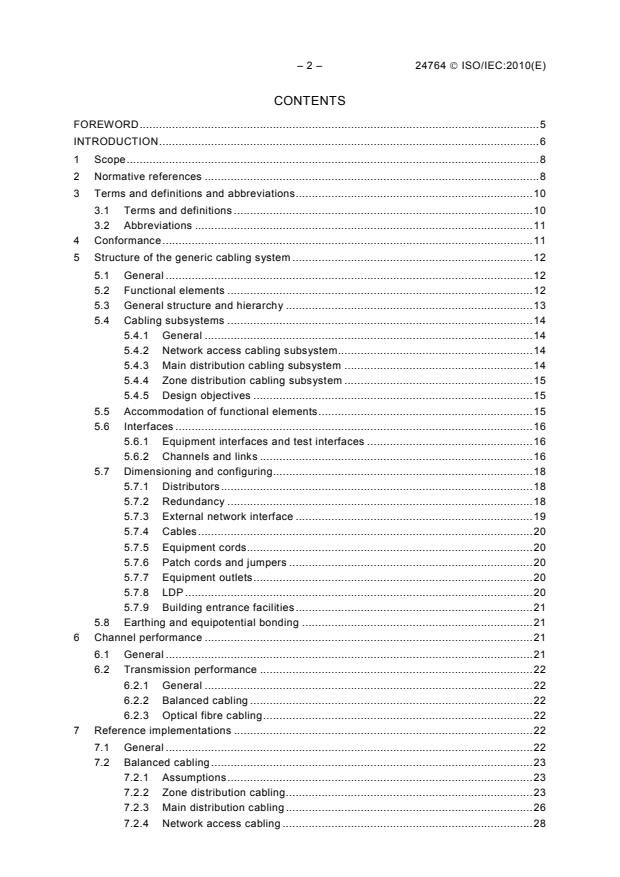
– 2 – 24764 © ISO/IEC:2010(E)
CONTENTS
FOREWORD.5
INTRODUCTION.6
1 Scope.8
2 Normative references .8
3 Terms and definitions and abbreviations.10
3.1 Terms and definitions .10
3.2 Abbreviations .11
4 Conformance.11
5 Structure of the generic cabling system .12
5.1 General .12
5.2 Functional elements .12
5.3 General structure and hierarchy .13
5.4 Cabling subsystems .14
5.4.1 General .14
5.4.2 Network access cabling subsystem.14
5.4.3 Main distribution cabling subsystem .14
5.4.4 Zone distribution cabling subsystem .15
5.4.5 Design objectives .15
5.5 Accommodation of functional elements.15
5.6 Interfaces .16
5.6.1 Equipment interfaces and test interfaces .16
5.6.2 Channels and links .16
5.7 Dimensioning and configuring.18
5.7.1 Distributors.18
5.7.2 Redundancy .18
5.7.3 External network interface .19
5.7.4 Cables.20
5.7.5 Equipment cords.20
5.7.6 Patch cords and jumpers .20
5.7.7 Equipment outlets.20
5.7.8 LDP .20
5.7.9 Building entrance facilities.21
5.8 Earthing and equipotential bonding .21
6 Channel performance .21
6.1 General .21
6.2 Transmission performance .22
6.2.1 General .22
6.2.2 Balanced cabling .22
6.2.3 Optical fibre cabling.22
7 Reference implementations .22
7.1 General .22
7.2 Balanced cabling.23
7.2.1 Assumptions.23
7.2.2 Zone distribution cabling.23
7.2.3 Main distribution cabling .26
7.2.4 Network access cabling .28
24764 © ISO/IEC:2010(E) – 3 –
7.3 Optical fibre cabling .30
7.3.1 Assumptions.30
7.3.2 Component choice.30
7.3.3 Optical fibre cabling channel lengths .30
8 Cable requirements .31
8.1 General .31
8.2 Balanced cables .31
8.3 Optical fibre cables.31
9 Connecting hardware requirements .31
9.1 General requirements.31
9.1.1 Overview .31
9.1.2 Applicability .31
9.1.3 Location .31
9.1.4 Design.31
9.1.5 Operating environment .31
9.1.6 Mounting .31
9.1.7 Installation practices.32
9.1.8 Marking and colour coding.32
9.2 Connecting hardware for balanced cabling .32
9.2.1 General requirements .32
9.2.2 Performance marking .32
9.2.3 Mechanical characteristics.32
9.3 Connecting hardware for optical fibre cabling .35
9.3.1 General requirements .35
9.3.2 ENI requirements.35
9.3.3 EO requirements .35
9.3.4 Optical fibre assignments at the EO.35
9.3.5 Other connecting hardware.36
10 Requirements for cords and jumpers .37
10.1 Jumpers .37
10.2 Balanced cords .37
10.3 Optical fibre cords .37
Annex A (normative) Link performance limits .38
A.1 General .38
A.2 Balanced cabling .39
A.3 Optical fibre cabling.40
Annex B (informative) Usage of high density connecting hardware within optical fibre
cabling.41
B.1 General .41
B.2 Structure of cabling subsystems .41
Bibliography.44
Figure 1 – Relationship between generic cabling standards .7
Figure 2 – Structure of generic cabling within a data centre .13
Figure 3 – Hierarchical structure of generic cabling within a data centre .14
Figure 4 – Example of accommodation of functional elements .15
Figure 5 – Test and equipment interfaces .17
– 4 – 24764 © ISO/IEC:2010(E)
Figure 6 – Connection of functional elements providing redundancy .19
Figure 7 – Examples of external service cabling connections to the ENI .20
Figure 8 – Example of a channel with 4 connections .21
Figure 9 – Example of a system showing the location of cabling interfaces .22
Figure 10 – Zone distribution cabling models .24
Figure 11 – Main distribution cabling models .27
Figure 12 – Network access cabling models.29
Figure 13 – Pin grouping and pair assignments at the EO .34
Figure 14 – Optical fibre assignments at the EO, front view of fixed connector.36
Figure A.1 – Link options .39
Figure B.1 – Examples of high density connecting hardware within main distribution
cabling.42
Figure B.2 – Examples of high density connecting hardware at the LDP and EO within
zone distribution cabling .43
Table 1 – Zone distribution cabling – length assumptions for balanced cabling .25
Table 2 – Zone distribution channel length equations.26
Table 3 – Main distribution cabling – Length assumptions for balanced cabling .27
Table 4 – Main distribution channel length equations .28
Table 5 – Network access cabling channel equations.30
Table 6 – Connecting hardware of the type used at the ENI .32
Table 7 – Connecting hardware of the type used at the EO.33
24764 © ISO/IEC:2010(E) – 5 –
INTERNATIONAL ELECTROTECHNICAL COMMISSION
______________
INFORMATION TECHNOLOGY –
GENERIC CABLING SYSTEMS FOR DATA CENTRES
FOREWORD
1) ISO (International Organization for Standardization) and IEC (International Electrotechnical Commission) form the
specialized system for worldwide standardization. National bodies that are members of ISO or IEC participate in
the development of International Standards. Their preparation is entrusted to technical committees; any ISO and
IEC member body interested in the subject dealt with may participate in this preparatory work. International
governmental and non-governmental organizations liaising with ISO and IEC also participate in this preparation.
2) In the field of information technology, ISO and IEC have established a joint technical committee, ISO/IEC JTC 1.
Draft International Standards adopted by the joint technical committee are circulated to national bodies for voting.
Publication as an International Standard requires approval by at least 75 % of the national bodies casting a vote.
3) The formal decisions or agreements of IEC and ISO on technical matters express, as nearly as possible, an
international consensus of opinion on the relevant subjects since each technical committee has representation
from all interested IEC and ISO member bodies.
4) IEC, ISO and ISO/IEC publications have the form of recommendations for international use and are accepted
by IEC and ISO member bodies in that sense. While all reasonable efforts are made to ensure that the
technical content of IEC, ISO and ISO/IEC publications is accurate, IEC or ISO cannot be held responsible for
the way in which they are used or for any misinterpretation by any end user.
5) In order to promote international uniformity, IEC and ISO member bodies undertake to apply IEC, ISO and
ISO/IEC publications transparently to the maximum extent possible in their national and regional publications.
Any divergence between any ISO/IEC publication and the corresponding national or regional publication
should be clearly indicated in the latter.
6) ISO and IEC provide no marking procedure to indicate their approval and cannot be rendered responsible for
any equipment declared to be in conformity with an ISO/IEC Publication.
7) All users should ensure that they have the latest edition of this publication.
8) No liability shall attach to IEC or ISO or its directors, employees, servants or agents including individual experts
and members of their technical committees and IEC or ISO member bodies for any personal injury, property
damage or other damage of any nature whatsoever, whether direct or indirect, or for costs (including legal fees)
and expenses arising out of the publication of, use of, or reliance upon, this ISO/IEC publication or any other IEC,
ISO or ISO/IEC publications.
9) Attention is drawn to the normative references cited in this publication. Use of the referenced publications is
indispensable for the correct application of this publication.
10) Attention is drawn to the possibility that some of the elements of this International Standard may be the subject of
patent rights. ISO and IEC shall not be held responsible for identifying any or all such patent rights.
International Standard ISO/IEC 24764 was prepared by subcommittee 25: Interconnection of
information technology equipment, of ISO/IEC joint technical committee 1: Information
technology.
ISO/IEC 24764 is to be read in conjunction with International Standard ISO/IEC 11801:2002,
its Amendment 1 (2008) and Amendment 2 (2010).
This International Standard has been approved by vote of the member bodies, and the voting
results may be obtained from the address given on the second title page.
This publication has been drafted in accordance with the ISO/IEC Directives, Part 2.
– 6 – 24764 © ISO/IEC:2010(E)
INTRODUCTION
Within premises, the importance of the information technology cabling infrastructure is similar
to that of other fundamental building utilities such as heating, lighting and mains power. As
with other utilities, interruptions to service can have serious impact. Poor quality of service
due to lack of design foresight, use of inappropriate components, incorrect installation, poor
administration or inadequate support can threaten an organisation's effectiveness.
Cabling within data centres comprises both application-specific and multipurpose networks
that are mission-critical. Generic cabling designs in accordance with ISO/IEC 11801 have
supported the development of high data rate applications based upon a defined cabling
model. This International standard recognizes the benefit of generic cabling to provision
multiple services and to connect large quantities of equipment within the limited space of data
centre premises, and is to be used in conjunction with ISO/IEC 11801.
This International Standard provides:
a) data centre users with an application independent generic cabling system capable of
supporting a wide range of applications;
b) data centre users with a flexible cabling scheme such that modifications are both easy and
economical;
c) data centre professionals (for example, data centre architects) with guidance allowing the
accommodation of cabling before specific requirements are known; that is, in the initial
planning either for construction or refurbishment;
d) industry and applications standardization bodies with a cabling system which supports
current products and provides a basis for future product development.
This International Standard specifies multi-vendor cabling, and is related to:
• the associated standard covering general requirements for generic cabling within premises
(ISO/IEC 11801);
• standards for cabling components developed by technical committees of the IEC;
• standards for the quality assurance, installation and administration of information
technology cabling (ISO/IEC 14763-2 ) and testing of installed cabling (IEC 61935-1 and
ISO/IEC 14763-3);
• applications developed by the technical committees of IEC, subcommittees of
ISO/IEC JTC 1 and study groups of ITU-T .
It is anticipated that the generic cabling system meeting the requirements of this International
Standard will have a life expectancy of up to ten years.
This International Standard has taken into account requirements specified in application
standards listed in Annex F of ISO/IEC 11801:2002 and Amendment 2 (2010). It refers to
International Standards for components and test methods whenever appropriate International
Standards are available.
___________
Until ISO/IEC 14763-2 is published, relevant information may be found in ISO/IEC 18010.
International Telecommunication Union – Telecommunications Standardization Sector.
24764 © ISO/IEC:2010(E) – 7 –
Figure 1 shows the schematic and contextual relationships between the standards produced
by ISO/IEC JTC 1/SC 25 for information technology cabling, namely this and other generic
cabling design standards (ISO/IEC 11801), cabling installation standards (ISO/IEC 14763-2 ),
testing of installed cabling (IEC 61935-1 and ISO/IEC 14763-3).
ISISO/O/IECIEC 24724764: In64: Inffoorrmmaattiion tecon technohnollooggyy::
GeGenenerriic cac cabblliinng syg syststeemms s foforr Da Dattaa
CCententresres
IEC IEC 61961935-35-1: G1: Genereneriicc c caabblliinngg s syyssttememss:
ISOISO/IE/IEC 1C 118011801: Inf: Infoormrmatiatioon tecn techhnnoollooggyy: : ISOISO/IEC/IEC 14 14763763-2:-2: Info Inforrmmatiation on
SpecSpeciiffiiccaattiionsons ffoorr th the teste testiing ofng of
GGeneeneriricc ca cablbliing fng foor cusr custtomeomerr p prrememiisseses tectechnohnollooggyy.: Q Qualualiitty asy asssuurarancnce, e,
balbalananceced cd coommmmuniuniccaatitionon cabl cabliinngg
iinnststalalllaattiion aon and and addmmiininissttraratitioonn
ISOISO//IIEEC C 180118010: I0: Innffoormrmaattiion teon techchnolnolooggyy. . :
ISISOO/IE/IECC 14 14763763-3: -3: InInffoorrmmaattion ion
PaPathwathwayyss an and sd spacpaceses fo for cur custstoommerer
tteechchnnoollogyogy: Te: Teststiinng og off op opttiiccaall fi fibbrree
prprememiisseses c cablabliinngg
cacabblinlingg
IEIECC 60 60336644--11:: E Ellececttrriiccalal i innssttalalllaattiionons os off
bbuuiillddiingsngs: F: Fundundaammenenttaall priprinncciiplpleses, ,
aasssseessmssmenent t ofof ge generneralal c characharacteteririssttiicscs,,
ddeeffiininititionsons
Scheme of the relationship between cabling standards such as ISO/IEC 11801 and other
standards relevant for information technology cabling systems.
Figure 1 – Relationship between generic cabling standards
___________
Until ISO/IEC 14763-2 is published, relevant information may be found in ISO/IEC 18010.
– 8 – 24764 © ISO/IEC:2010(E)
INFORMATION TECHNOLOGY –
GENERIC CABLING SYSTEMS FOR DATA CENTRES
1 Scope
This International Standard specifies generic cabling that supports a wide range of
communications services for use within a data centre. It covers balanced cabling and optical
fibre cabling.
This International Standard is based upon and references the requirements of ISO/IEC 11801.
This International Standard contains additional requirements that are appropriate to data
centres in which the maximum distance over which communications services have to be
distributed is 2 000 m. The principles of this International Standard may also be applied to
data centre installations that do not fall within this range.
In addition to the requirements of ISO/IEC 11801, this International Standard specifies:
a) a modified structure and configuration for generic cabling within data centres used to
support existing and emerging applications;
b) a reference implementation specific to data centre infrastructures.
Data centres have specific pathway and space requirements that are specified in
ISO/IEC 14763-2. Until ISO/IEC 14763-2 is published, relevant information may be found in
ISO/IEC 18010 (see Bibliography).
Safety (electrical safety and protection, fire, optical power etc.) and electromagnetic
compatibility (EMC) requirements are outside the scope of this International Standard and are
covered by other standards and regulations. However, information given in this International
Figure 1 can be of assistance in meeting these other
Standard and those identified in
standards and regulations.
2 Normative references
The following referenced documents are indispensable for the application of this document.
For dated references, only the edition cited applies. For undated references, the latest edition
of the referenced document (including any amendments) applies.
ISO/IEC 11801 2002, Information technology – Generic cabling for customer premises
Amendment 1(2008)
Amendment 2(2010).
ISO/IEC 14763-3, Information technology – Implementation and operation of customer
premises cabling – Part 3: Testing of optical fibre cabling
IEC 60603-7 (all parts), Connectors for electronic equipment – Part 7: Detail specification for
8-way, unshielded, free and fixed connectors
24764 © ISO/IEC:2010(E) – 9 –
IEC 60603-7-2:, Connectors for electronic equipment – Part 7-2: Detail specification for
8-way, unshielded, free and fixed connectors, for data transmissions with frequencies up to
100 MHz
IEC 60603-7-3:, Connectors for electronic equipment – Part 7-3: Detail specification for
8-way, shielded, free and fixed connectors, for data transmissions with frequencies up to
100 MHz
IEC 60603-7-4:, Connectors for electronic equipment – Part 7-4: Detail specification for
8-way, unshielded, free and fixed connectors, for data transmissions with frequencies up to
250 MHz
IEC 60603-7-5:, Connectors for electronic equipment – Part 7-5: Detail specification for
8-way, shielded, free and fixed connectors, for data transmissions with frequencies up to
250 MHz
IEC 60603-7-7:, Connectors for electronic equipment – Part 7-7: Detail specification for
8-way, shielded, free and fixed connectors, for data transmissions with frequencies up to
600 MHz
IEC 60603-7-41:, Connectors for electronic equipment – Part 7-41: Detail specification for
8-way, unshielded, free and fixed connectors, for data transmissions with frequencies up to
500 MHz
IEC 60603-7-51:, Connectors for electronic equipment – Part 7-51: Detail specification for
8-way, shielded, free and fixed connectors, for data transmissions with frequencies up to
500 MHz
IEC 60603-7-71:, Connectors for electronic equipment – Part 7-71: Detail specification for
8-way, shielded, free and fixed connectors, for data transmission with frequencies up to
1 000 MHz
IEC 60794-2-11, Optical fibre cables – Part 2-11: Indoor cables – Detailed specification for
simplex and duplex cables for use in premises cabling
IEC 60874-19-1, Fibre optic interconnecting devices and passive components Connectors
for optical fibres and cables – Part 19-1: Fibre optic patch cord connector type SC-PC
(floating duplex) standard terminated on multimode fibre type A1a, A1b – Detail specification
IEC 61076-3-104, Connectors for electronic equipment – Product requirements – Part 3-104:
Detail specification for 8-way, shielded free and fixed connectors for data transmissions with
frequencies up to 1 000 MHz
___________
Second edition in preparation.
Second edition in preparation.
Second edition in preparation.
Second edition in preparation.
Third edition in preparation.
In preparation.
In preparation.
In preparation.
– 10 – 24764 © ISO/IEC:2010(E)
IEC 61156-5:2009, Multicore and symmetrical pair/quad cables for digital communications –
Part 5: Symmetrical pair/quad cables with transmission characteristics up to 1 000 MHz –
Horizontal floor wiring – Sectional specification
IEC 61754-7, Fibre optic interconnecting devices and passive components – Fibre optic
connector interfaces – Part 7: Type MPO connector family
IEC 61754-20, Fibre optic connector interfaces – Part 20: Type LC connector family
IEC 61755-3-2, Fibre optic connector optical interfaces – Part 3-2: Optical interface, 2,5 mm
and 1,25 mm diameter cylindrical full zirconia ferrules for 8 degrees angled-PC single mode
fibres
IEC 61935-1, Specification for the testing of balanced and coaxial infirmation technology
cabling – Part 1: Installed balanced cabling as specified in ISO/IEC 11801 and related
standards
3 Terms and definitions and abbreviations
3.1 Terms and definitions
For the purposes of this International Standard the following terms and definitions apply in
addition to those of ISO/IEC 11801.
3.1.1
cabled optical fibre Category
system of defining requirements for the cabled optical fibre performance within optical fibre
channels and links.
3.1.2
equipment outlet
fixed connecting device for terminating the zone distribution cabling and providing the
interface to the equipment cabling
3.1.3
fixed zone distribution cable
cable connecting the zone distributor to either the equipment outlet or, if present, the local
distribution point
3.1.4
local distribution point
connection point in the zone distribution cabling subsystem between a zone distributor and an
equipment outlet
3.1.5
local distribution point cable
cable connecting a local distribution point to an equipment outlet
3.1.6
local distribution point link
transmission path between a local distribution point and the interface at the other end of the
fixed zone distribution cable including the connecting hardware at each end
3.1.7
main distribution cable
cable connecting the main distributor to the zone distributor
24764 © ISO/IEC:2010(E) – 11 –
3.1.8
main distributor
distributor used to make connections between the main distribution cabling subsystem,
network access cabling subsystem and cabling subsystems as specified in ISO/IEC 11801
and active equipment
3.1.9
network access cable
cable connecting the external network interface to the main distributor or zone distributor
3.1.10
transition assembly
assembly of cabled optical fibres and connectors, with an array connector on one end and
simplex or duplex connectors on the other end
3.1.11
zone distribution cable
cable connecting the zone distributor to the equipment outlet(s) or local distribution point(s)
3.1.12
zone distributor
distributor used to make connections between the main distribution cabling subsystem, zone
distribution cabling subsystem, network access cabling subsystem and cabling subsystems
specified in ISO/IEC 11801 and active equipment
3.2 Abbreviations
For the purposes of this International Standard the following abbreviations apply in addition to
those of ISO/IEC 11801.
BEF Building Entrance Facility
ENI External Network Interface
EO Equipment Outlet
LDP Local Distribution Point
MD Main Distributor
OE EQP Opto-Electronic EQuiPment
ZD Zone Distributor
4 Conformance
For a cabling system to conform to this International Standard the following applies.
a) The configuration and structure shall conform to the requirements of Clause 5.
b) The performance of balanced channels shall conform to the transmission performance and
environmental requirements of Clause 6. This shall be achieved by one of the following:
1) a channel design and implementation ensuring that the prescribed channel
performance is met;
2) attachment of appropriate components to a link design meeting the prescribed
performance class of Clause 6 and Annex A. Channel performance shall be ensured
where a channel is created by adding more than one cord to either end of a link
meeting the requirements of Clause 6 and Annex A;
3) using the reference implementations of Clause 7 and compatible cabling components
conforming to the requirements of Clauses 8, 9 and 10, based upon a statistical
approach of performance modelling.
c) The implementation and performance of optical fibre cabling channels shall meet the
requirements specified in Clause 6.
d) The interfaces to the cabling shall conform to the requirements of Clause 9 with respect to
mating interfaces and performance.
– 12 – 24764 © ISO/IEC:2010(E)
e) If present, screens shall be handled as specified in Clause 11 of ISO/IEC 11801.
f) Regulations on safety and EMC applicable at the location of the installation shall be met.
Test methods to assess conformance with the channel and link requirements of Clause 6 and
Annex A respectively are specified in IEC 61935-1 for balanced cabling and ISO/IEC 14763-3
for optical fibre cabling. The treatment of measured results that fail to meet the requirements
of this clause, or lie within the relevant measurement accuracy, shall be clearly documented
within a quality plan as described in ISO/IEC 14763-2 .
Installation and administration of cabling in accordance with this standard shall be undertaken
in accordance with ISO/IEC 14763-2 .
This International Standard does not specify which tests and sampling levels should be
adopted. The test parameters to be measured and the sampling levels to be applied for a
particular installation shall be defined in the installation specification and quality plans for that
installation prepared in accordance with ISO/IEC 14763-2 .
In the absence of the channel, the conformance of the link shall be used to verify
conformance with this International Standard.
5 Structure of the generic cabling system
5.1 General
This clause identifies the functional elements of generic cabling for data centres, describes
how they are connected together to form subsystems and identifies the interfaces at which
application-specific components are connected to the generic cabling.
Applications listed in Annex F of ISO/IEC 11801are supported by connecting active equipment
at the external network interfaces, equipment outlets and the distributors.
The structured cabling system specified by this standard is intended to restrict the use of
cords for point-to-point cabling within data centres, which can be detrimental to the
administration and operation of the data centre. Exceptions are permitted between equipment
located in close proximity or between equipment that cannot communicate over the generic
cabling system.
5.2 Functional elements
In addition to the distributors specified in ISO/IEC 11801, this standard specifies the following
functional elements and interfaces of generic cabling:
a) external network interface (ENI);
b) network access cable;
c) main distributor (MD);
d) main distribution cable;
e) zone distributor (ZD);
f) zone distribution cable;
g) local distribution point (LDP);
h) local distribution point cable (LDP cable);
___________
Until ISO/IEC 14763-2 is published, relevant information may be found in ISO/IEC 18010.
Until ISO/IEC 14763-2 is published, relevant information may be found in ISO/IEC 18010.
Until ISO/IEC 14763-2 is published, relevant information may be found in ISO/IEC 18010.
24764 © ISO/IEC:2010(E) – 13 –
i) equipment outlet (EO).
Groups of these functional elements are connected together to form cabling subsystems.
5.3 General structure and hierarchy
Generic cabling systems in data centres contain up to three cabling subsystems: network
access cabling, main distribution cabling and zone distribution cabling. Where present within
the premises, a distributor in accordance with ISO/IEC 11801 is connected to the generic
cabling within the data centre using the network access cabling.
The cabling subsystems are connected together to create a generic cabling system with a
structure as shown in Figure 2. The composition of the cabling subsystems is described in
5.4.2, 5.4.3 and 5.4.4. The functional elements of the cabling subsystems are interconnected
to form a basic hierarchical topology as shown in Figure 3.
Where the functions of distributors are combined (see 5.7.1) the intermediate cabling
subsystem(s) are not required.
Connections between cabling subsystems are either active, requiring application-specific
equipment, or passive. Connection to application-specific equipment at an MD or a ZD adopts
either an interconnect or a cross-connect approach (see ISO/IEC 11801). Connection to
application-specific equipment at an ENI and EO adopts an interconnect approach (see
ISO/IEC 11801). Passive connections between cabling subsystems adopt either a cross-
connect approach, by way of either patch cords or jumpers, or an interconnect approach.
EOEO
ENENII MDMD ZDZD LDPLDP
EQPEQPEQPEQP
DisDisttrriibbuuttoorr
iinn ac acccoordrdancancee
wiwithth ISO ISO/IEC 1180/IEC 118011 NeNettwwororkk ZZoone dine dissttrriibutibutionon EquiEquipmpmentent
MaiMainn d diissttrriibutibutioonn
acacccesesss ccaablbliinng sg subsubsyysstemtem ccablabliingng
ccablabliingng
ccablabliingng
ssubsubsyysstetemm
ssubsubsyysstemtem
GGenereneriicc c caablbliinng sg syyssttemem
Figure 2 – Structure of generic cabling within a data centre
– 14 – 24764 © ISO/IEC:2010(E)
DDiissttrriibutobutorr
ENENII ENENII
iin acn acccororddancancee
wwiith ISOth ISO/IEC 118/IEC 1180101
NNeettwwororkk acc acceessss
cabling subscabling subsyysstetemm
MDMD
MMaain din diissttrriibution bution
cabling subscabling subsyysstemtem
ZDZD ZDZD
ZZone disone disttrriibutionbution
ccaabling sbling suubsbsyysstemtem
LDPLDP LDPLDP LDLDPP LDPLDP
EOEO EOEO EOEO EOEO EOEO EOEO EOEO EOEO EOEO EOEO
optiooptional cnal cablableses
NOTE Network access cabling is also used to connect ENI to ZD.
Figure 3 – Hierarchical structure of generic cabling within a data centre
5.4 Cabling subsystems
5.4.1 General
Although equipment cords are used to connect the equipment to a cabling subsystem, they
are not considered part of the cabling subsystem.
5.4.2 Network access cabling subsystem
The network access cabling subsystem extends from an MD (or ZD) to the ENIs and/or other
distributors (in accordance with ISO/IEC 11801) connected to it.
The subsystem includes:
a) the network access cables;
b) the mechanical termination of the network access cables at the ENI(s);
c) the mechanical termination of the network access cables at the MD, ZD(s) or other
distributors in accordance with ISO/IEC 11801.
5.4.3 Main distribution cabling subsystem
The main distribution cabling subsystem extends from an MD to the ZD(s) connected to it.
The subsystem includes:
a) the main distribution cables;
24764 © ISO/IEC:2010(E) – 15 –
b) the mechanical termination of the main distribution cables at the MD together with
associated patch cords and/or jumpers at the MD;
c) the mechanical termination of the main distribution cables at the ZD(s).
5.4.4 Zone distribution cabling subsystem
The zone distribution cabling subsystem extends from a ZD to the EO(s) connected to it. The
subsystem includes:
a) the zone distribution cables;
b) the mechanical termination of the zone distribution cables at the EO(s) and the ZD
together with associated patch cords and/or jumpers at the ZD;
c) LDP(s) (optional);
d) LDP cable(s) (optional)
e) the EO(s).
Zone distribution cables shall be continuous from the ZD to the EO(s) unless (an) LDP(s) is
(are) installed (see 5.7.8).
5.4.5 Design objectives
In order to provide the longest operational life while minimising the disruption and cost
associated with re-cabling, the fixed installed cabling should be designed to:
• support the broadest set of existing and emerging applications;
• accommodate the anticipated growth in volume of supported applications throughout the
predicted lifetime of the installation.
In addition the provision of redundancy within a cabling design should be considered (see
also 5.7.1).
5.5 Accommodation of functional elements
Figure 4 shows an example of how the functional elements are accommodated in a building
(only a single floor of the building is shown for simplicity).
The MD, ZD and LDP shall be housed in permanent and accessible locations within the data
centre.
The ENI shall be housed in permanent and accessible location either internal or external to
the data centre.
EEququiippmmentent//ttelelecoecommmmununiiccaattiiononss r roooomm
iinn accor accorddaanncece
wwiithth ISO/ ISO/IEC IEC 1111880011
DisDistrtriibbuutotorr
DaDatata c ceennttrere
BEFBEF iinn a accorccorddaanncece
withwith ISO ISO/IEC/IEC 1 111880011
ENENII MDMD ZDZD EOEO
LDLDPP
Figure 4 – Example of accommodation of functional elements
– 16 – 24764 © ISO/IEC:2010(E)
5.6 Interfaces
5.6.1 Equipment interfaces and test interfaces
Potential equipment interfaces for data centres are located at the ends of the cabling
subsystems (as shown in Figure 5). An LDP does not provide an equipment interface to the
generic cabling system.
Potential test interfaces for data centres are located at the ends of the cabling subsystems
and at the LDP, if present (as shown in Figure 5).
5.6.2 Channels and links
The transmission performance of generic cabling is detailed in Clause 6 for channels and
Annex A for links.
The channel is the transmission path between data centre equipment such as a switches and
servers (EQP in Figure 5). A typical channel in a data centre would consist of the zone
distribution cabling subsystem together with an equipment cord at each end. For longer reach
services the channel would be formed by the connection of two or more subsystems (including
patch cords and equipment cords). The performance of the channel excludes the connections
at the application-specific equipment.
The permanent link is the transmission path of an installed cabling subsystem including the
connecting hardware at the ends of the installed cable. In a data centre zone distribution
cabling subsystem, the permanent link consists of the EO, an optional LDP cable, an optional
LDP, the zone distribution cable and the termination of the zone distribution cable at the zone
distributor. The permanent link includes the connections at the ends of the installed cabling.
---------------------
...
Questions, Comments and Discussion
Ask us and Technical Secretary will try to provide an answer. You can facilitate discussion about the standard in here.
Loading comments...