

ISO 12913-1:2014
(Main)Acoustics — Soundscape — Part 1: Definition and conceptual framework
General Information
- Abstract
ISO 12913-1:2014 provides a definition and a conceptual framework of soundscape. It explains factors relevant for measurement and reporting in soundscape studies, as well as for planning, design and management of soundscape.
- Status
- Published
- Publication Date
- 26-Aug-2014
- Technical Committee
- ISO/TC 43/SC 1 - Noise
- Drafting Committee
- ISO/TC 43/SC 1/WG 54 - Perceptual assessment of soundscape quality
- Current Stage
- 9093 - International Standard confirmed
- Start Date
- 14-Jul-2025
- Completion Date
- 29-Aug-2026
Buy Documents

ISO 12913-1:2014 - Acoustics — Soundscape — Part 1: Definition and conceptual framework Released:8/27/2014


ISO 12913-1:2014 - Acoustique — Paysage sonore — Partie 1: Définition et cadre conceptuel Released:8/27/2014
Overview
ISO 12913-1:2014 - Acoustics: Soundscape - Part 1: Definition and conceptual framework defines the term soundscape and establishes a conceptual framework to guide soundscape studies, measurement and reporting, and the planning, design and management of acoustic environments. The standard distinguishes the perceptual construct (soundscape) from the physical phenomenon (acoustic environment) and emphasizes that soundscape assessment is based on human perception of sound in context.
Key Topics
- Definitions
- Soundscape: acoustic environment as perceived, experienced and/or understood by people, in context.
- Acoustic environment: sound from all sources as modified by the environment (actual or simulated, indoor or outdoor).
- Conceptual framework - Seven interconnected elements:
- Context (person, activity, place, time)
- Sound sources (traffic, nature, voices, etc.)
- Acoustic environment (propagation, reflection, reverberation)
- Auditory sensation (neural processing, binaural hearing, psychoacoustics)
- Interpretation of auditory sensation (perception, expectations, cultural factors)
- Responses (short-term reactions, behaviour)
- Outcomes (long-term attitudes, wellbeing, visitor experiences)
- Factors affecting measurement and reporting
- Meteorological conditions, hearing impairments, visual cues, odours, time of day, emotional state, perceived control and activity.
- Measurement principle
- Assessment and evaluation should be based on human perception of the acoustic environment (not solely on measured sound levels).
- Foundations in psychoacoustics
- Acknowledges binaural hearing, masking, spectral and temporal patterns as relevant to soundscape perception.
Applications
ISO 12913-1:2014 provides a structured basis for:
- Soundscape research and standardized reporting of studies
- Urban and landscape planning where acoustic quality affects user experience
- Design of public spaces (parks, plazas, transport hubs) to support desired soundscapes
- Acoustic management and mitigation strategies focused on sound sources and contextual factors
- Policy development and community engagement on environmental noise and wellbeing
Who should use it
- Acousticians and audio engineers
- Urban planners, landscape architects and designers
- Environmental and public health consultants
- Researchers in soundscape ecology, psychoacoustics and environmental psychology
- Local authorities and policy makers involved in noise management
Related standards
- ISO 12913 series (Part 2: minimum reporting requirements is under preparation) - consult the ISO 12913 family for reporting and implementation guidance.
Keywords: ISO 12913-1:2014, soundscape, acoustics, acoustic environment, soundscape studies, measurement and reporting, urban soundscape, psychoacoustics, soundscape management.
Buy Documents
ISO 12913-1:2014 - Acoustics — Soundscape — Part 1: Definition and conceptual framework Released:8/27/2014
ISO 12913-1:2014 - Acoustique — Paysage sonore — Partie 1: Définition et cadre conceptuel Released:8/27/2014
Get Certified
Connect with accredited certification bodies for this standard

BSMI (Bureau of Standards, Metrology and Inspection)
Taiwan's standards and inspection authority.
Sponsored listings
Frequently Asked Questions
ISO 12913-1:2014 is a standard published by the International Organization for Standardization (ISO). Its full title is "Acoustics — Soundscape — Part 1: Definition and conceptual framework". This standard covers: ISO 12913-1:2014 provides a definition and a conceptual framework of soundscape. It explains factors relevant for measurement and reporting in soundscape studies, as well as for planning, design and management of soundscape.
ISO 12913-1:2014 provides a definition and a conceptual framework of soundscape. It explains factors relevant for measurement and reporting in soundscape studies, as well as for planning, design and management of soundscape.
ISO 12913-1:2014 is classified under the following ICS (International Classification for Standards) categories: 17.140.01 - Acoustic measurements and noise abatement in general. The ICS classification helps identify the subject area and facilitates finding related standards.
ISO 12913-1:2014 is available in PDF format for immediate download after purchase. The document can be added to your cart and obtained through the secure checkout process. Digital delivery ensures instant access to the complete standard document.
Standards Content (Sample)
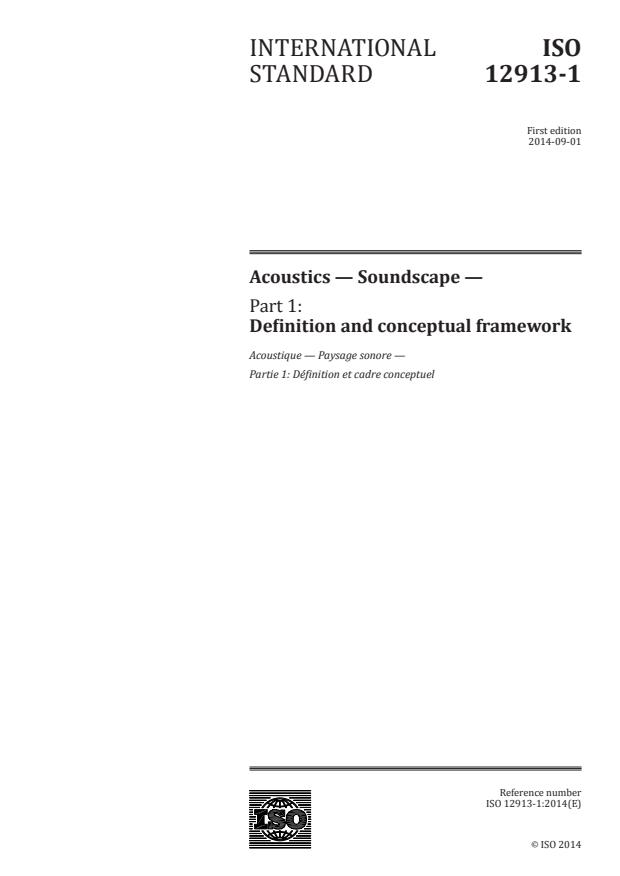
INTERNATIONAL ISO
STANDARD 12913-1
First edition
2014-09-01
Acoustics — Soundscape —
Part 1:
Definition and conceptual framework
Acoustique — Paysage sonore —
Partie 1: Définition et cadre conceptuel
Reference number
©
ISO 2014
© ISO 2014
All rights reserved. Unless otherwise specified, no part of this publication may be reproduced or utilized otherwise in any form
or by any means, electronic or mechanical, including photocopying, or posting on the internet or an intranet, without prior
written permission. Permission can be requested from either ISO at the address below or ISO’s member body in the country of
the requester.
ISO copyright office
Case postale 56 • CH-1211 Geneva 20
Tel. + 41 22 749 01 11
Fax + 41 22 749 09 47
E-mail copyright@iso.org
Web www.iso.org
Published in Switzerland
ii © ISO 2014 – All rights reserved
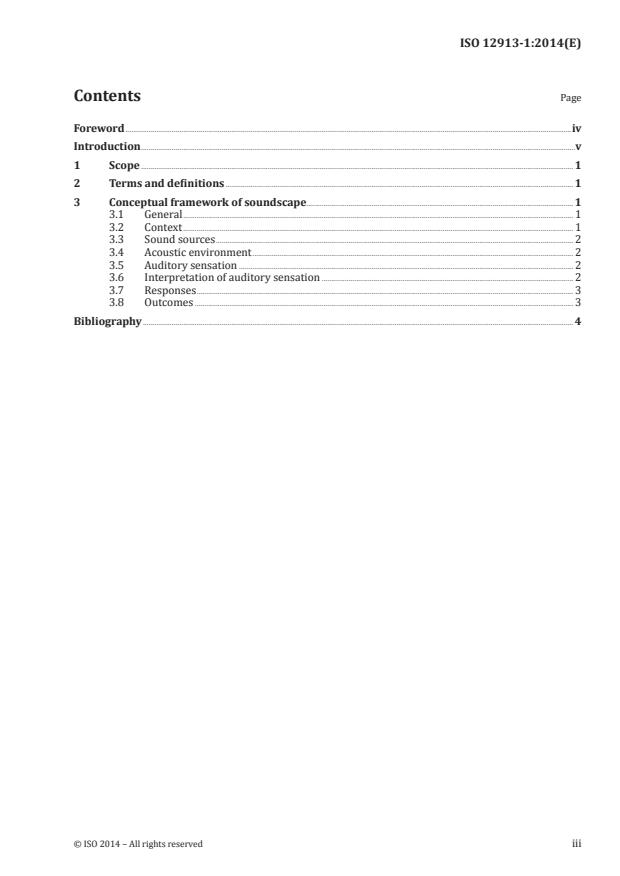
Contents Page
Foreword .iv
Introduction .v
1 Scope . 1
2 Terms and definitions . 1
3 Conceptual framework of soundscape. 1
3.1 General . 1
3.2 Context . 1
3.3 Sound sources . 2
3.4 Acoustic environment . 2
3.5 Auditory sensation . 2
3.6 Interpretation of auditory sensation . 2
3.7 Responses . 3
3.8 Outcomes . 3
Bibliography . 4
Foreword
ISO (the International Organization for Standardization) is a worldwide federation of national standards
bodies (ISO member bodies). The work of preparing International Standards is normally carried out
through ISO technical committees. Each member body interested in a subject for which a technical
committee has been established has the right to be represented on that committee. International
organizations, governmental and non-governmental, in liaison with ISO, also take part in the work.
ISO collaborates closely with the International Electrotechnical Commission (IEC) on all matters of
electrotechnical standardization.
The procedures used to develop this document and those intended for its further maintenance are
described in the ISO/IEC Directives, Part 1. In particular the different approval criteria needed for the
different types of ISO documents should be noted. This document was drafted in accordance with the
editorial rules of the ISO/IEC Directives, Part 2. www.iso.org/directives
Attention is drawn to the possibility that some of the elements of this document may be the subject of
patent rights. ISO shall not be held responsible for identifying any or all such patent rights. Details of any
patent rights identified during the development of the document will be in the Introduction and/or on
the ISO list of patent declarations received. www.iso.org/patents
Any trade name used in this document is information given for the convenience of users and does not
constitute an endorsement.
For an explanation on the meaning of ISO specific terms and expressions related to conformity
assessment, as well as information about ISO’s adherence to the WTO principles in the Technical Barriers
to Trade (TBT), see the following URL: Foreword - Supplementary information
The committee responsible for this document is ISO/TC 43, Acoustics, Subcommittee SC 1, Noise.
ISO 12913 consists of the following parts, under the general title Acoustics — Soundscape:
— Part 1: Definition and conceptual framework
The following part is under preparation:
— Part 2: Methods and measurements
iv © ISO 2014 – All rights reserved
Introduction
[1],[2],[3],[4],[5]
Soundscape studies have a rich tradition . Because the field has evolved differently around
the world, as well as across disciplines, there is a diversity of opinions about its definition and aims.
[6]
Consequently, the use of the term ‘soundscape’ has become idiosyncratic and ambiguous .
This International Standard aims to enable a broad international consensus on the definition of
‘soundscape’, to provide a foundation for communication across disciplines and professions with an
interest in soundscape.
[7]
There are similarities between the concepts of ‘landscape’ and ‘soundscape’; both are based on
perception by people. For the purpose of this International Standard, soundscape will be understood as
a perceptual construct, related to a physical phenomenon. The standard distinguishes the perceptual
construct (soundscape) from the physical phenomenon (acoustic environment), and clarifies that
soundscape exists through human perception of the acoustic environment.
INTERNATIONAL STANDARD ISO 12913-1:2014(E)
Acoustics — Soundscape —
Part 1:
Definition and conceptual framework
1 Scope
This International Standard provides a definition and a conceptual framework of soundscape. It explains
factors relevant for measurement and reporting in soundscape studies, as well as for planning, design
and management of soundscape.
2 Terms and definitions
For the purposes of this document, the following terms and definitions
...
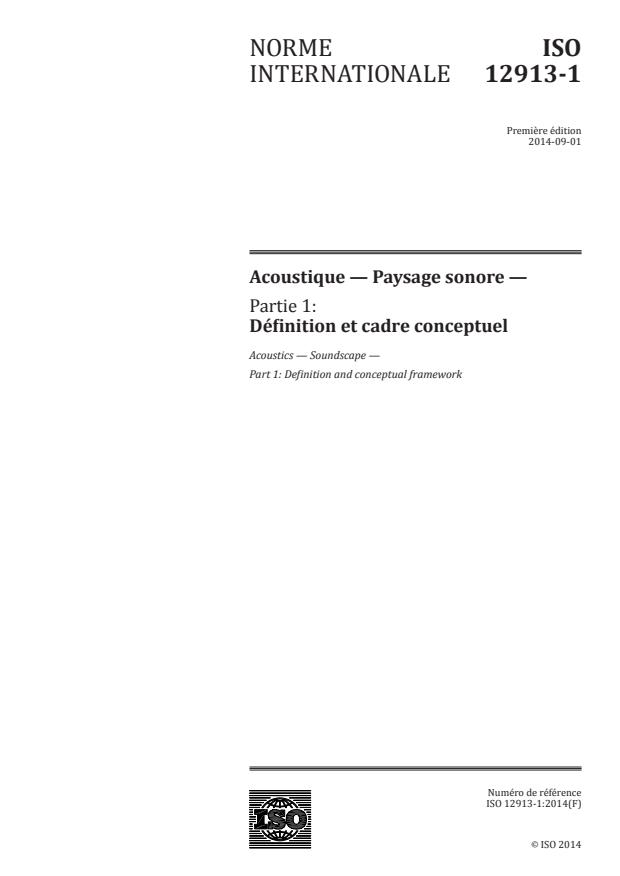
NORME ISO
INTERNATIONALE 12913-1
Première édition
2014-09-01
Acoustique — Paysage sonore —
Partie 1:
Définition et cadre conceptuel
Acoustics — Soundscape —
Part 1: Definition and conceptual framework
Numéro de référence
©
ISO 2014
DOCUMENT PROTÉGÉ PAR COPYRIGHT
© ISO 2014
Droits de reproduction réservés. Sauf indication contraire, aucune partie de cette publication ne peut être reproduite ni utilisée
sous quelque forme que ce soit et par aucun procédé, électronique ou mécanique, y compris la photocopie, l’affichage sur
l’internet ou sur un Intranet, sans autorisation écrite préalable. Les demandes d’autorisation peuvent être adressées à l’ISO à
l’adresse ci-après ou au comité membre de l’ISO dans le pays du demandeur.
ISO copyright office
Case postale 56 • CH-1211 Geneva 20
Tel. + 41 22 749 01 11
Fax + 41 22 749 09 47
E-mail copyright@iso.org
Web www.iso.org
Publié en Suisse
ii © ISO 2014 – Tous droits réservés
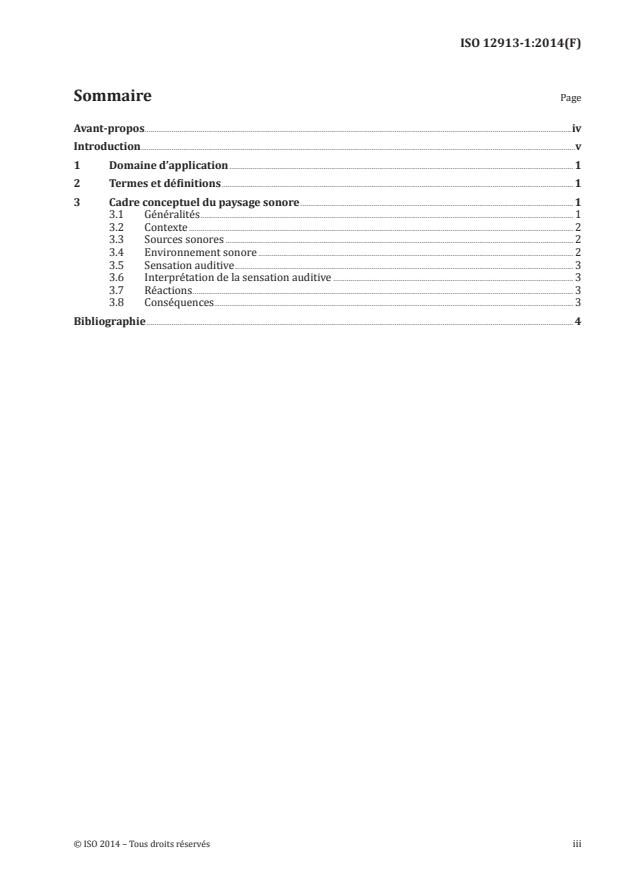
Sommaire Page
Avant-propos .iv
Introduction .v
1 Domaine d’application . 1
2 Termes et définitions . 1
3 Cadre conceptuel du paysage sonore . 1
3.1 Généralités . 1
3.2 Contexte . 2
3.3 Sources sonores . 2
3.4 Environnement sonore . 2
3.5 Sensation auditive . 3
3.6 Interprétation de la sensation auditive . 3
3.7 Réactions . 3
3.8 Conséquences. 3
Bibliographie . 4
Avant-propos
L’ISO (Organisation internationale de normalisation) est une fédération mondiale d’organismes
nationaux de normalisation (comités membres de l’ISO). L’élaboration des Normes internationales est
en général confiée aux comités techniques de l’ISO. Chaque comité membre intéressé par une étude
a le droit de faire partie du comité technique créé à cet effet. Les organisations internationales,
gouvernementales et non gouvernementales, en liaison avec l’ISO participent également aux travaux.
L’ISO collabore étroitement avec la Commission électrotechnique internationale (IEC) en ce qui concerne
la normalisation électrotechnique.
Les procédures utilisées pour élaborer le présent document et celles destinées à sa mise à jour sont
décrites dans les Directives ISO/IEC, Partie 1. Il convient, en particulier de prendre note des différents
critères d’approbation requis pour les différents types de documents ISO. Le présent document a été
rédigé conformément aux règles de rédaction données dans les Directives ISO/IEC, Partie 2 (voir www.
iso.org/directives).
L’attention est appelée sur le fait que certains des éléments du présent document peuvent faire l’objet de
droits de propriété intellectuelle ou de droits analogues. L’ISO ne saurait être tenue pour responsable
de ne pas avoir identifié de tels droits de propriété et averti de leur existence. Les détails concernant les
références aux droits de propriété intellectuelle ou autres droits analogues identifiés lors de l’élaboration
du document sont indiqués dans l’Introduction et/ou dans la liste des déclarations de brevets reçues par
l’ISO (voir www.iso.org/brevets).
Les appellations commerciales éventuellement mentionnées dans le présent document sont données
pour information, par souci de commodité, à l’intention des utilisateurs et ne sauraient constituer un
engagement.
Pour une explication de la signification des termes et expressions spécifiques de l’ISO liés à l’évaluation de
la conformité, ou pour toute information au sujet de l’adhésion de l’ISO aux principes de l’OMC concernant
les obstacles techniques au commerce (OTC), voir le lien suivant: Avant-propos — Informations
supplémentaires.
Le comité chargé de l’élaboration du présent document est l’ISO/TC 43, Acoustique, Sous-comité 1, Bruit.
L’ISO 12913 comprend les parties suivantes, présentées sous le titre général, Acoustique — Paysage
sonore:
— Partie 1: Définition et cadre conceptuel
La partie suivante est en cours d’élaboration:
— Partie 2: Méthodes et mesurages
iv © ISO 2014 – Tous droits réservés
Introduction
[1][2][3][4][5]
Les études portant sur le paysage sonore sont nombreuses . Le champ d’application de ce
concept ayant évolué différemment de par le monde, ainsi que selon les disciplines concernées, les
opinions divergent quant à sa définition et à son objet. Ainsi, l’usage du terme «paysage sonore» est
[6]
propre à chacun et sa signification est devenue ambigüe .
La présente Norme internationale vise à obtenir un large consensus à l’échelle internationale sur la
définition de l’expression «paysage sonore», en vue de fournir une base commune utilisable dans le
cadre des communications entre disciplines et professions en rapport avec le paysage sonore.
[7]
Il y a des similitudes entre les concepts de «paysage» et «paysage sonore»; les deux sont basés sur la
perception par les personnes. Pour les besoins de la présente Norme internationale, le paysage sonore
peut être entendu comme étant le produit de la perception d’un phénomène physique. La présente norme
fait ainsi la distinction entre la construction perceptive (le paysage sonore) et le phénomène physique
(l’environnement sonore), et met en évidence que le paysage sonore n’existe qu’à travers la perception
humaine de cet environnement sonore.
NORME INTERNATIONALE ISO 12913-1:2014(F)
Acoustique — Paysage sonore —
Partie 1:
Définition et cadre conceptuel
1 Domaine d’application
La présente Norme internationale donne une définition et élabore un cadre conceptuel du paysage
sonore. Elle expose les facteurs pertinents à mesurer et dont il faut rendre compte dans le cadre des
études relatives au paysage sonore. Elle explicite également les éléments nécessaires pour prévoir,
concevoir et gérer des paysages sonores.
2 Termes et définitions
Pour les besoins du présent document, les termes et définitions suivants s’appliquent.
2.1
sources sonores
bruit provenant de la nature ou d’une activité humaine
Note 1 à l’article: V
...