

ISO 3946:1982
(Main)Starches and derived products — Determination of total phosphorus content — Spectrophotometric method
General Information
- Abstract
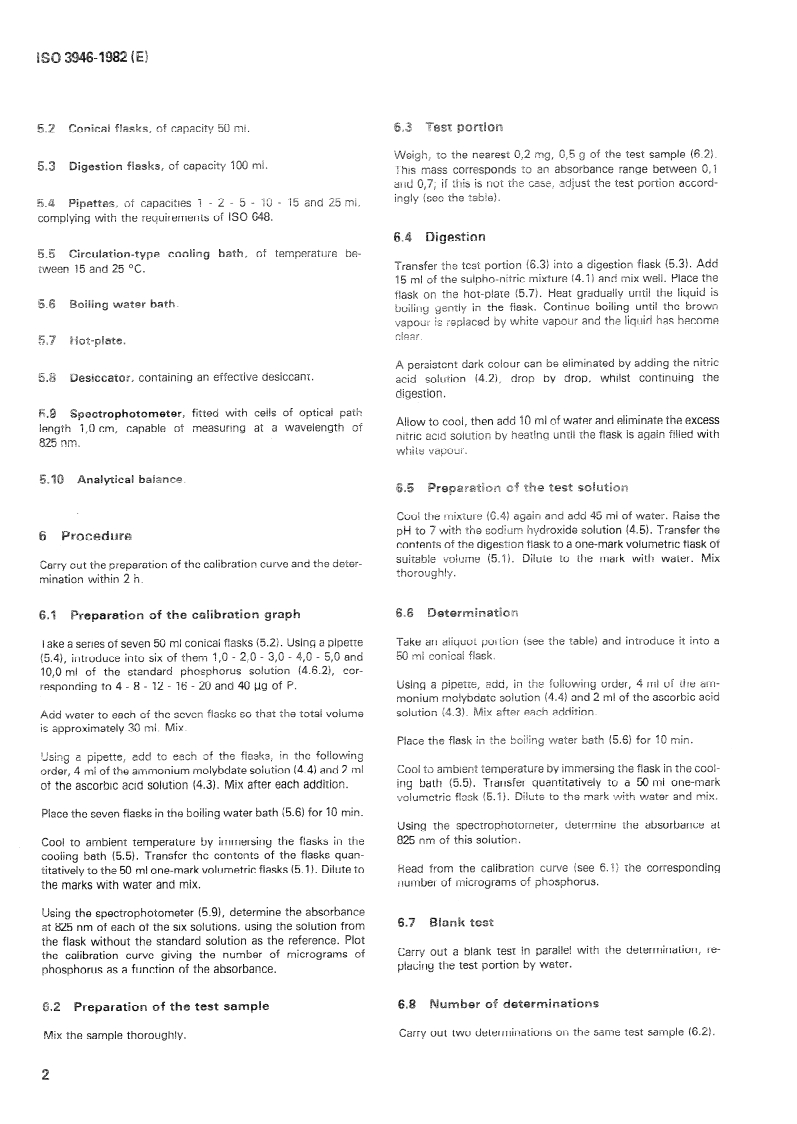
Destruction of the organic substances by digestion with a sulpho-nitric mixture and conversion of phosphates to orthophosphates. Formation of a phosphomolybdate. Measurement of the intensity of the blue colour at a wavelength of 825 nm. The method applies to contents up to 5 % (m/m).
- Status
- Published
- Publication Date
- 30-Nov-1982
- Technical Committee
- ISO/TC 93 - Starch (including derivatives and by-products)
- Drafting Committee
- ISO/TC 93 - Starch (including derivatives and by-products)
- Current Stage
- 9093 - International Standard confirmed
- Start Date
- 25-Mar-2025
- Completion Date
- 29-Aug-2026
Buy Documents
ISO 3946:1982 - Starches and derived products -- Determination of total phosphorus content -- Spectrophotometric method
ISO 3946:1982 - Starches and derived products — Determination of total phosphorus content — Spectrophotometric method/1/1982
ISO 3946:1982 - Amidons, fécules et produits dérivés -- Détermination de la teneur en phosphore total -- Méthode spectrophotométrique
ISO 3946:1982 - Amidons, fécules et produits dérivés -- Détermination de la teneur en phosphore total -- Méthode spectrophotométrique
ISO 3946:1982 - Amidons, fécules et produits dérivés — Détermination de la teneur en phosphore total — Méthode spectrophotométrique/1/1982
ISO 3946:1982 - Amidons, fécules et produits dérivés — Détermination de la teneur en phosphore total — Méthode spectrophotométrique/1/1982
Overview
ISO 3946:1982 is an international standard established by the International Organization for Standardization (ISO) for the determination of total phosphorus content in starches and derived products. This standard specifies a reliable spectrophotometric method designed to measure phosphorus content up to 5% by mass. The method involves digesting organic substances with a sulpho-nitric acid mixture, converting phosphates to orthophosphates, and then forming a colored phosphomolybdate complex measured at a wavelength of 825 nm.
This standard is essential for accurate chemical analysis, ensuring quality and compliance in industries utilizing starch and its derivatives.
Key Topics
Scope and Application
ISO 3946 applies to starch, including derivatives and related by-products, providing a method for determining total phosphorus content when expected values do not exceed 5% (m/m).Analytical Principle
The organic material is destroyed by digestion with sulpho-nitric acid, converting all phosphate forms to orthophosphates. A reducing agent then transforms the orthophosphate into a phosphomolybdate complex (molybdenum blue), whose blue color intensity correlates with phosphorus concentration.Reagents and Solutions
Including sulpho-nitric reagent, nitric acid, ascorbic acid, ammonium molybdate solution, and carefully prepared standard phosphorus solutions for calibration.Spectrophotometric Measurement
The blue color formed is measured at 825 nm using a spectrophotometer to quantify phosphorus content based on absorbance.Calculation and Reporting
Results are expressed as a percentage mass of phosphorus in the test sample, with repeatability criteria ensuring result accuracy. The standard also outlines recommended test portion sizes and dilution volumes depending on expected phosphorus content.
Applications
Quality Control in Food and Starch Industries
Ensuring compliance with nutritional labeling and regulatory limits for phosphorus in starch-based products.Research and Development
Useful in product formulation and modification where phosphorus content affects functional properties.Agricultural and Environmental Analysis
Monitoring phosphorus in starch raw materials to support sustainable sourcing and processing controls.Industrial Processing
Deployment in manufacturing processes where phosphorus levels influence product characteristics or equipment maintenance.
Related Standards
- ISO 1042 - Laboratory glassware standards, relevant to volumetric flasks used in the method
- Other ISO standards on starch analysis that cover moisture content, protein, and fat determination ensuring comprehensive quality assessment
- National and international standards for chemical analysis of food and agricultural products that may complement phosphorus testing
Keywords: ISO 3946, total phosphorus determination, starch analysis, spectrophotometric method, molybdenum blue, phosphorus content, sulpho-nitric digestion, starch derivatives, chemical analysis, quality control, industrial standards.
Buy Documents
ISO 3946:1982 - Starches and derived products -- Determination of total phosphorus content -- Spectrophotometric method
ISO 3946:1982 - Starches and derived products — Determination of total phosphorus content — Spectrophotometric method/1/1982
ISO 3946:1982 - Amidons, fécules et produits dérivés -- Détermination de la teneur en phosphore total -- Méthode spectrophotométrique
ISO 3946:1982 - Amidons, fécules et produits dérivés -- Détermination de la teneur en phosphore total -- Méthode spectrophotométrique
ISO 3946:1982 - Amidons, fécules et produits dérivés — Détermination de la teneur en phosphore total — Méthode spectrophotométrique/1/1982
ISO 3946:1982 - Amidons, fécules et produits dérivés — Détermination de la teneur en phosphore total — Méthode spectrophotométrique/1/1982
Get Certified
Connect with accredited certification bodies for this standard

BSI Group
BSI (British Standards Institution) is the business standards company that helps organizations make excellence a habit.

Bureau Veritas
Bureau Veritas is a world leader in laboratory testing, inspection and certification services.

DNV
DNV is an independent assurance and risk management provider.
Sponsored listings
Frequently Asked Questions
ISO 3946:1982 is a standard published by the International Organization for Standardization (ISO). Its full title is "Starches and derived products — Determination of total phosphorus content — Spectrophotometric method". This standard covers: Destruction of the organic substances by digestion with a sulpho-nitric mixture and conversion of phosphates to orthophosphates. Formation of a phosphomolybdate. Measurement of the intensity of the blue colour at a wavelength of 825 nm. The method applies to contents up to 5 % (m/m).
Destruction of the organic substances by digestion with a sulpho-nitric mixture and conversion of phosphates to orthophosphates. Formation of a phosphomolybdate. Measurement of the intensity of the blue colour at a wavelength of 825 nm. The method applies to contents up to 5 % (m/m).
ISO 3946:1982 is classified under the following ICS (International Classification for Standards) categories: 67.180.20 - Starch and derived products. The ICS classification helps identify the subject area and facilitates finding related standards.
ISO 3946:1982 is available in PDF format for immediate download after purchase. The document can be added to your cart and obtained through the secure checkout process. Digital delivery ensures instant access to the complete standard document.
Standards Content (Sample)
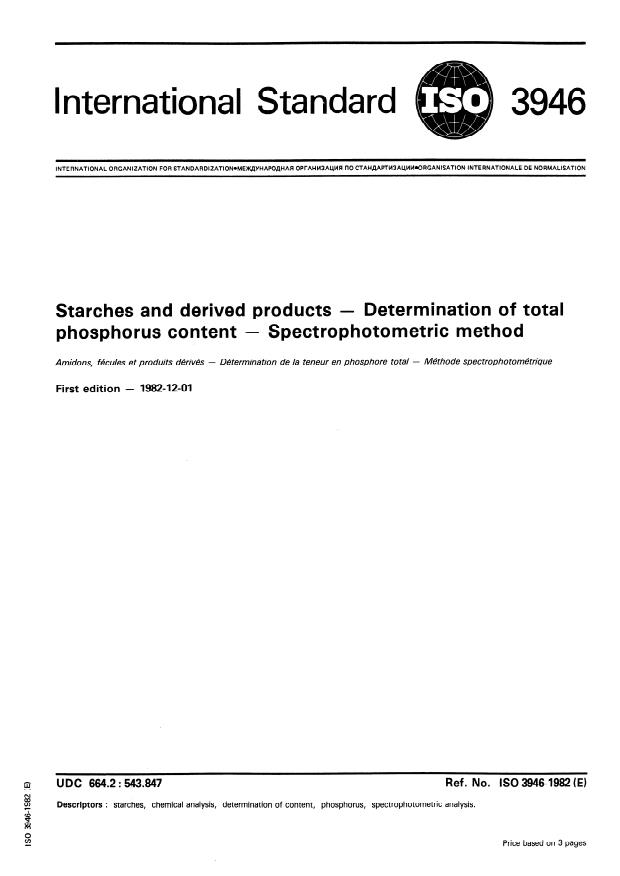
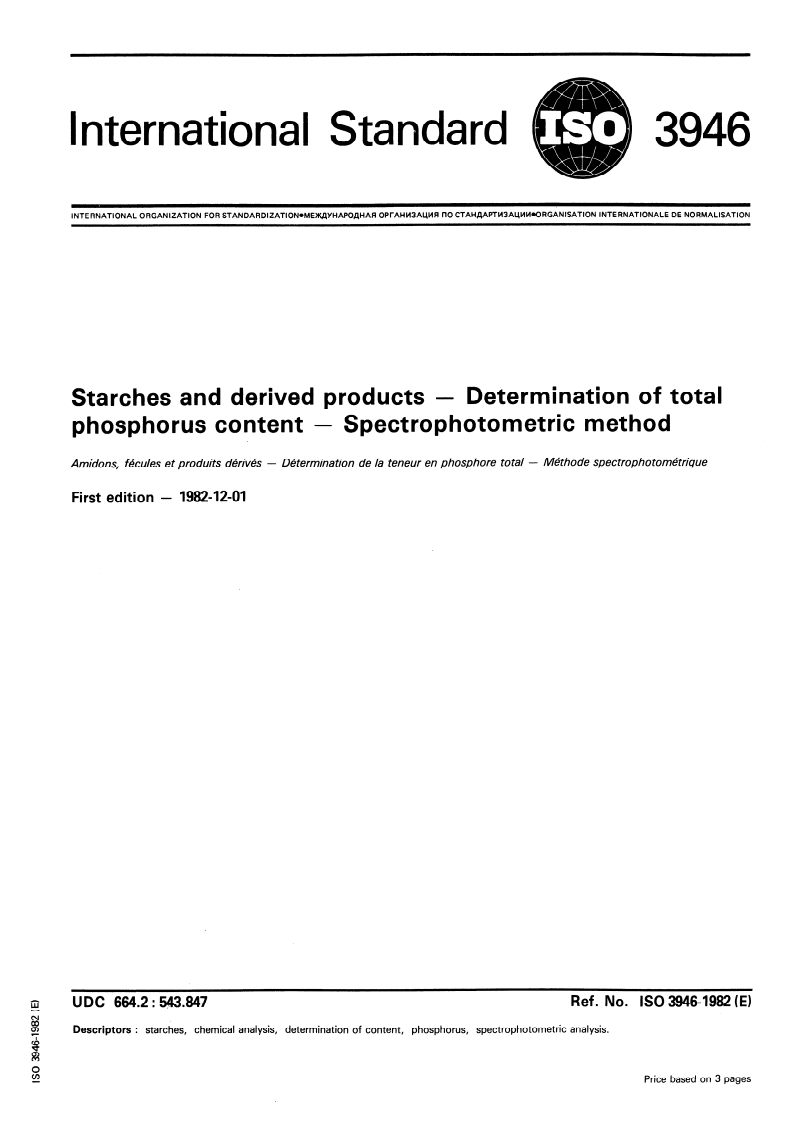
International Standard
INTERNATIONAL ORGANIZATION FOR STANDARDIZATIONWEIKJJYHAPOAHAR OPTAHM3AWlR fl0 CTAH~APTM3AWlM~RGANISATION INTERNATIONALE DE NORMALISATION
Starches and derived products - Determination of total
Spectrophotometric method
phosphorus content -
Amidons, fkcules et produirs d&iv& - Determination de Ia teneur en Phosphore total - Mkthode spectrophotometrique
First edition - 1982-12-01
UDC 664.2 : 543.847 Ref. No. ISO 3946-1982 (EI
Descriptors : starches, Chemical analysis, determination of content, phosphorus, spectrophotometric analysis.
Price based on 3 pages
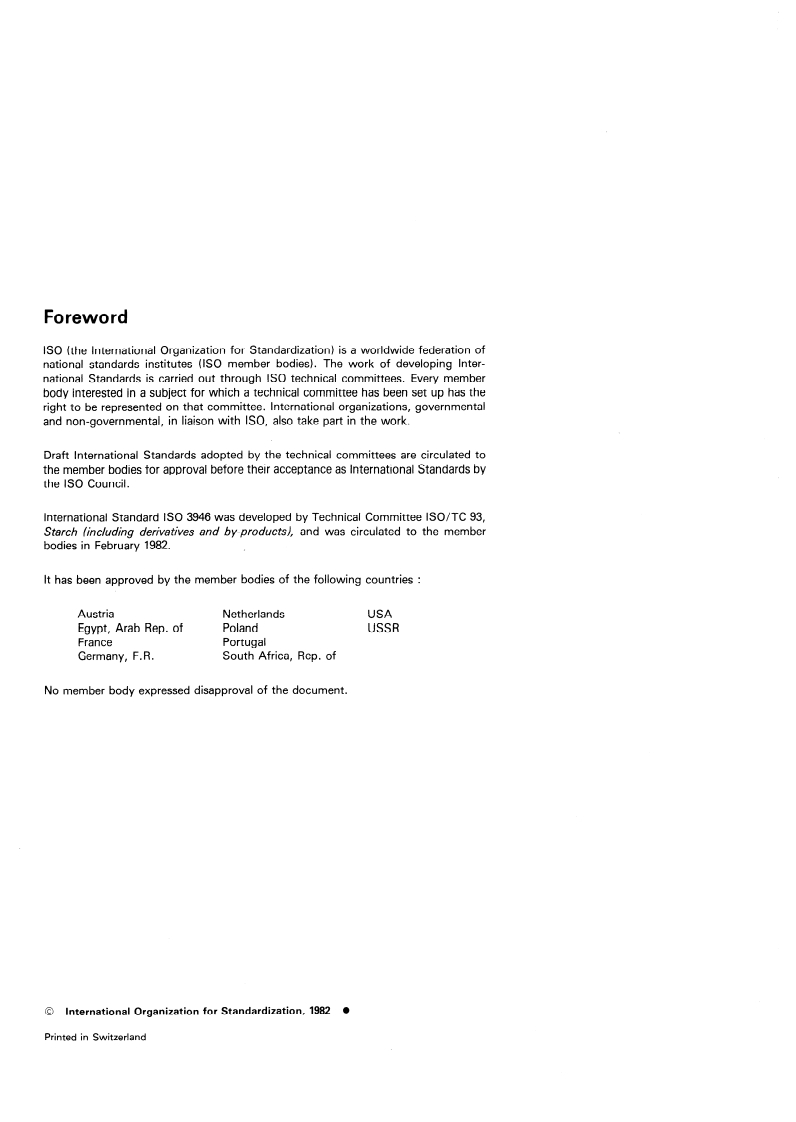
Foreword
BS0 (the international Organization for Standardization) is a wsrldwide federation of
national Standards institutes (60 member bedies). The werk of developing Inter-
national Standards is carried out through ISO technical committees. Every member
body interested in a subject for which a technical committee has been set up has the
right ts be represented on that csmmittee. International organizations, governmental
and non-governmental, in liaison with ISO, also take part in the work.
Draft International Standards adopted by the technical committees are circulated to
the member bodies for apprsval before their acceptance as International Standards by
the ISO Council.
International Standard ISO 3946 was developed by Technical Committee ISO/TC 93,
Starch fincluding derivatives and Qy-productsl, and was circulated to the member
bodies in February 1982.
lt has been approved by the member bodies of the following countries :
Austria
Netherlands USA
Egypt, Arab Rep. of Roland
USSR
France
Portugal
Germany, F. R. South Africa, Rep. sf
No member body expressed disapproval of the document.
@ International Organization for Standardization, 1982 0
Printed in Switzerland
INTERNATIONAL STANDARD
ISO 3946-1982 (E)
Starches and derived products - Determination of total
phosphorus content - Spectrophotometric method
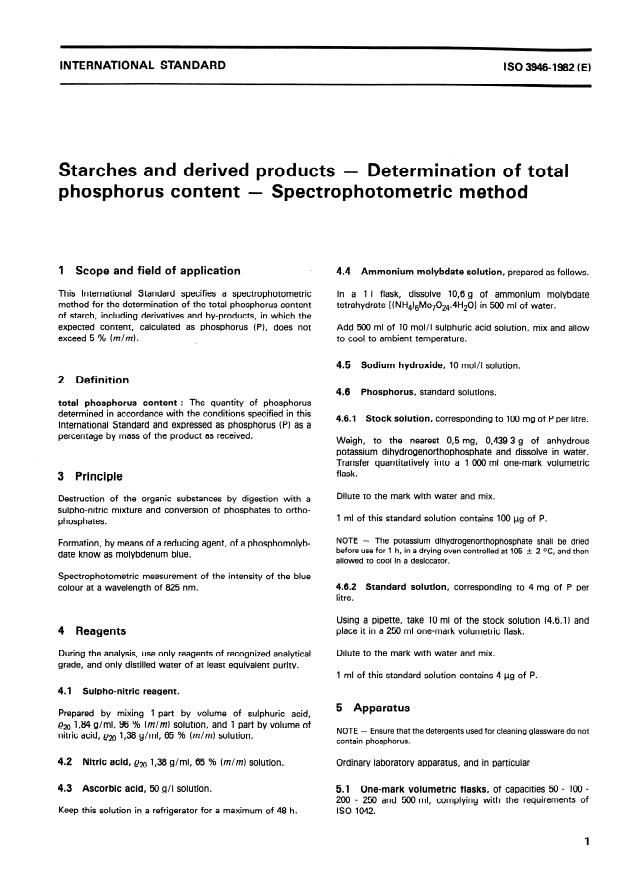
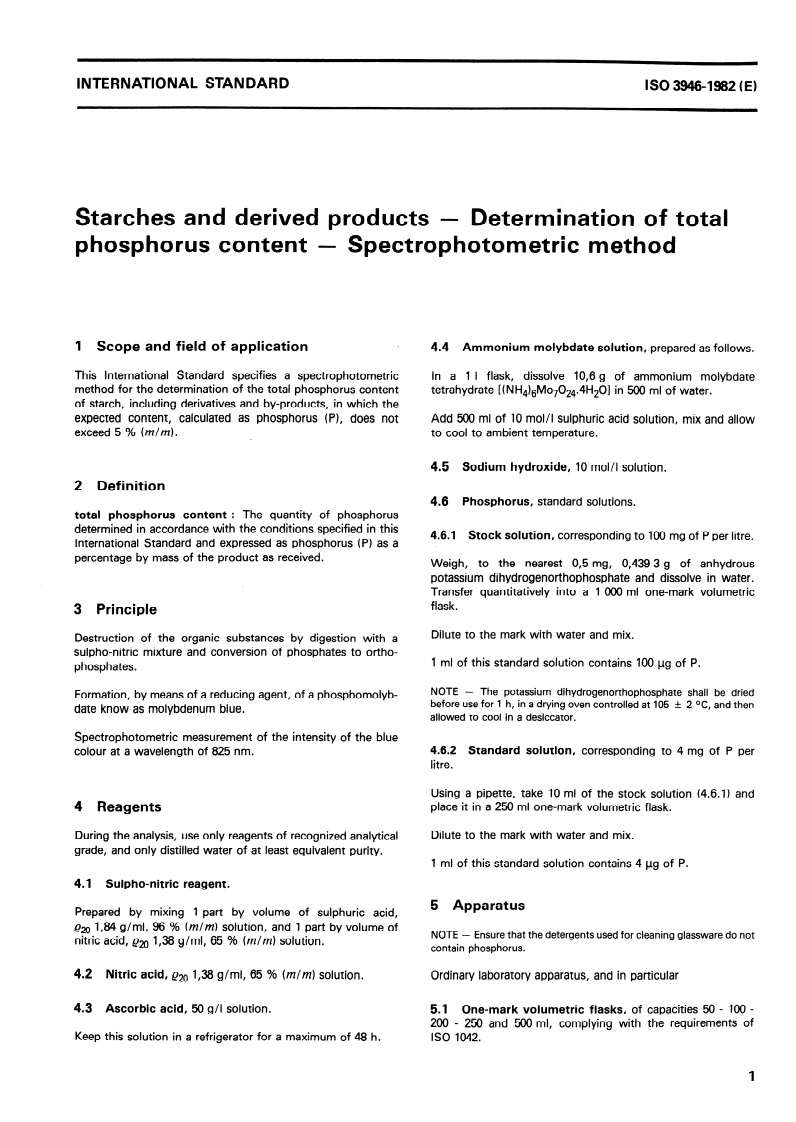
4.4 Ammonium molybdate Solution, prepared as follows.
1 Scope and field of application
This International Standard specifies a spectrophotometric In a 1 I flask, dissolve 10,6 g of ammonium molybdate
tetrahydrate [(NH&Mo70~+4H201 in 500 ml of water.
method for the determination of the total phosphorus content
of starch, including derivatives and by-products, in which the
expected content, calculated as phosphorus (P), does not Add 500 ml of 10 mol/1 sulphuric acid Solution, mix and allow
to cool to ambient temperature.
exceed 5 % (mlm).
Sodium hydroxide, 10 mol/1 Solution.
4.5
2 Definition
46 . Phosphorus, Standard solutions.
total phosphorus content : The quantity of phosphorus
determined in accordance with the conditions specified in this
4.6.1 Stock Solution, corresponding to 100 mg of P per litre.
International Standard and expressed as phosphorus (P) as a
percentage by mass of the product as received.
Weigh, to the nearest 0,5 mg, 0,439 3 g of anhydrous
potassium dihydrogenorthophosphate and dissolve in water.
Transfer quantitatively into a 1 000 ml one-mark volumetric
flask.
3 Principle
Dilute to the mark with water and mix.
Destruction of the organic substances by digestion with a
sulpho-nitric mixture and conversion of Phosphates to ortho-
1 ml of this Standard Solution contains 100 pg of P.
Phosphates.
NOTE - The potassium dihydrogenorthophosphate shall be dried
Formation, by means of a reducing agent, of a phosphomolyb-
before use for 1 h, in a drying oven controlled at 105 + 2 OC, and then
date know as molybdenum blue.
allowed to cool in a desiccator.
Spectrophotometric measurement of the intensity of the blue
4.6.2 Standard Solution, corresponding to 4 mg of P per
colour at a wavelength of 825 nm.
litre.
Using a pipette, take 10 ml of the stock Solution (4.6.1) and
place it in a 250 ml one-mark volumetric flask.
4 Reagents
Dilute to the mark with water and mix.
During the analysis, use only reagents of recognized analytical
grade, and only distilled water of at least equivalent purity.
1 ml of this Standard Solution contains 4 Mg of P.
4.1
...
International Standard
INTERNATIONAL ORGANIZATION FOR STANDARDIZATIONWEIKJJYHAPOAHAR OPTAHM3AWlR fl0 CTAH~APTM3AWlM~RGANISATION INTERNATIONALE DE NORMALISATION
Starches and derived products - Determination of total
Spectrophotometric method
phosphorus content -
Amidons, fkcules et produirs d&iv& - Determination de Ia teneur en Phosphore total - Mkthode spectrophotometrique
First edition - 1982-12-01
UDC 664.2 : 543.847 Ref. No. ISO 3946-1982 (EI
Descriptors : starches, Chemical analysis, determination of content, phosphorus, spectrophotometric analysis.
Price based on 3 pages
Foreword
BS0 (the international Organization for Standardization) is a wsrldwide federation of
national Standards institutes (60 member bedies). The werk of developing Inter-
national Standards is carried out through ISO technical committees. Every member
body interested in a subject for which a technical committee has been set up has the
right ts be represented on that csmmittee. International organizations, governmental
and non-governmental, in liaison with ISO, also take part in the work.
Draft International Standards adopted by the technical committees are circulated to
the member bodies for apprsval before their acceptance as International Standards by
the ISO Council.
International Standard ISO 3946 was developed by Technical Committee ISO/TC 93,
Starch fincluding derivatives and Qy-productsl, and was circulated to the member
bodies in February 1982.
lt has been approved by the member bodies of the following countries :
Austria
Netherlands USA
Egypt, Arab Rep. of Roland
USSR
France
Portugal
Germany, F. R. South Africa, Rep. sf
No member body expressed disapproval of the document.
@ International Organization for Standardization, 1982 0
Printed in Switzerland
INTERNATIONAL STANDARD
ISO 3946-1982 (E)
Starches and derived products - Determination of total
phosphorus content - Spectrophotometric method
4.4 Ammonium molybdate Solution, prepared as follows.
1 Scope and field of application
This International Standard specifies a spectrophotometric In a 1 I flask, dissolve 10,6 g of ammonium molybdate
tetrahydrate [(NH&Mo70~+4H201 in 500 ml of water.
method for the determination of the total phosphorus content
of starch, including derivatives and by-products, in which the
expected content, calculated as phosphorus (P), does not Add 500 ml of 10 mol/1 sulphuric acid Solution, mix and allow
to cool to ambient temperature.
exceed 5 % (mlm).
Sodium hydroxide, 10 mol/1 Solution.
4.5
2 Definition
46 . Phosphorus, Standard solutions.
total phosphorus content : The quantity of phosphorus
determined in accordance with the conditions specified in this
4.6.1 Stock Solution, corresponding to 100 mg of P per litre.
International Standard and expressed as phosphorus (P) as a
percentage by mass of the product as received.
Weigh, to the nearest 0,5 mg, 0,439 3 g of anhydrous
potassium dihydrogenorthophosphate and dissolve in water.
Transfer quantitatively into a 1 000 ml one-mark volumetric
flask.
3 Principle
Dilute to the mark with water and mix.
Destruction of the organic substances by digestion with a
sulpho-nitric mixture and conversion of Phosphates to ortho-
1 ml of this Standard Solution contains 100 pg of P.
Phosphates.
NOTE - The potassium dihydrogenorthophosphate shall be dried
Formation, by means of a reducing agent, of a phosphomolyb-
before use for 1 h, in a drying oven controlled at 105 + 2 OC, and then
date know as molybdenum blue.
allowed to cool in a desiccator.
Spectrophotometric measurement of the intensity of the blue
4.6.2 Standard Solution, corresponding to 4 mg of P per
colour at a wavelength of 825 nm.
litre.
Using a pipette, take 10 ml of the stock Solution (4.6.1) and
place it in a 250 ml one-mark volumetric flask.
4 Reagents
Dilute to the mark with water and mix.
During the analysis, use only reagents of recognized analytical
grade, and only distilled water of at least equivalent purity.
1 ml of this Standard Solution contains 4 Mg of P.
4.1
...
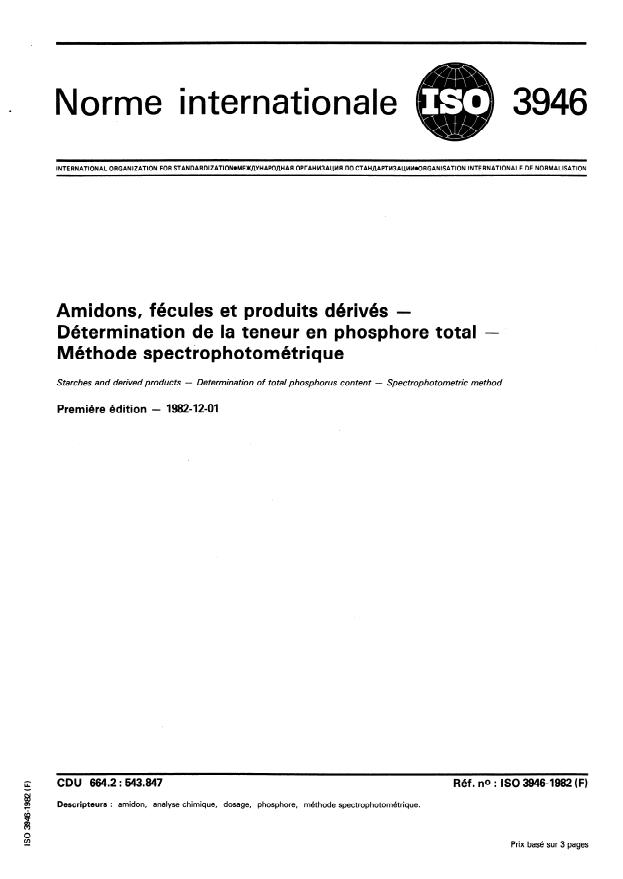
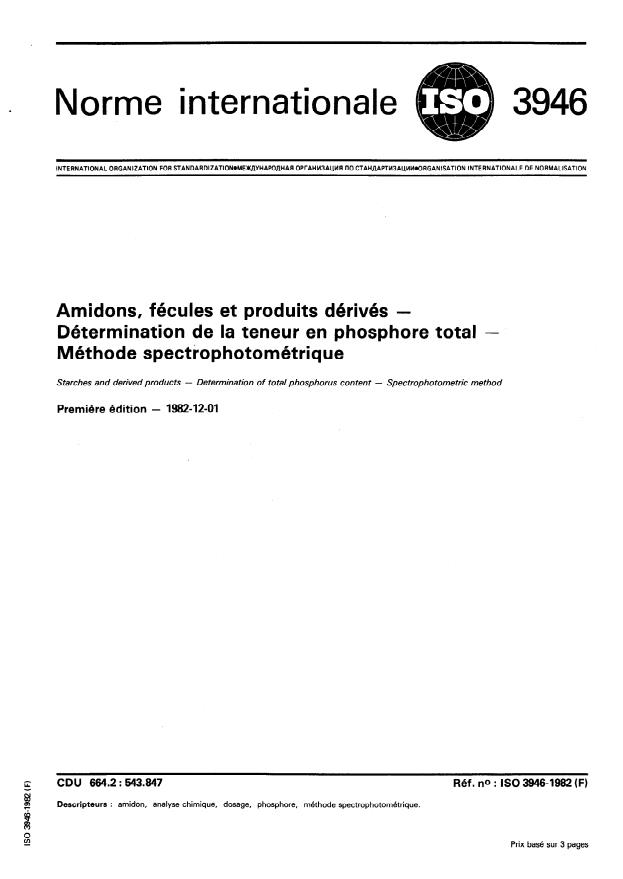
Norme internationale
INTERNATIONAL ORGANIZATION FOR STANDARDIZATIONWlE~YHAPOiqHAR OPrAHM3ALWlR Il0 CTAH~PTM3AL(WM.ORGANISATION INTERNATIONALE DE NORMALISATION
Amidons, fécules et produits dérivés -
Détermination de la teneur en phosphore total -
Méthode spectrophotométrique
Determination of total phosphorus content - Spectrophotometric method
Starches and derived products -
Première édition - 1982-12-01
Réf. no : ISO 39464982 (F)
CDU 664.2: 543.847
CL
amidon, analyse chimique, dosage, phosphore, méthode spectrophotométrique.
Descripteurs :
Prix basé sur 3 pages
Avant-propos
L’ISO (Organisation internationale de normalisation) est une fédération mondiale
d’organismes nationaux de normalisation (comités membres de I’ISO). L’élaboration
des Normes internationales est confiée aux comités techniques de I’ISO. Chaque
comité membre intéressé par une étude a le droit de faire partie du comité technique
correspondant. Les organisations internationales, gouvernementales et non gouverne-
mentales, en liaison avec I’ISO, participent également aux travaux.
Les projets de Normes internationales adoptés par les comités techniques sont soumis
aux comités membres pour approbation, avant leur acceptation comme Normes inter-
nationales par le Conseil de I’ISO.
La Norme internationale ISO 3946 a été élaborée par le comité technique ISO/TC 93,
Amidon (amidons, fkules), dérivés et sous-produits, et a été soumise aux comités
membres en février 1982.
Les comités membres des pays suivants l’ont approuvée :
Afrique du Sud, Rép. d’ France
URSS
Allemagne, R. F. Pays-Bas USA
Autriche Pologne
Égypte, Rép. arabe d’ Portugal
Aucun comité membre ne l’a désapprouvée.
@ Organisation internationale de normalisation, 1982 0
Imprimé en Suisse
ISO 3946-1982 (F)
NORME INTERNATIONALE
Amidons, fécules et produits dérivés -
Détermination de la teneur en phosphore total -
Méthode spectrophotométrique
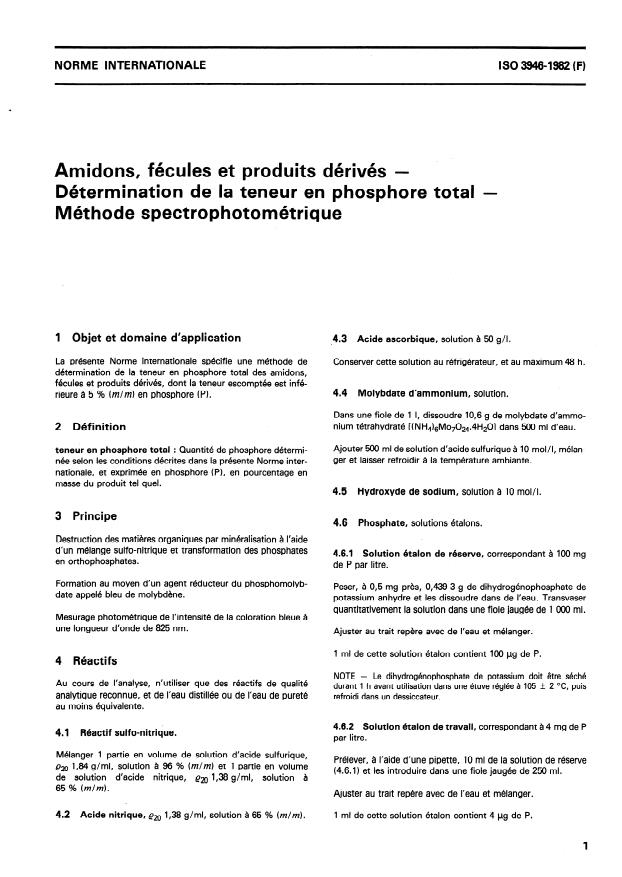
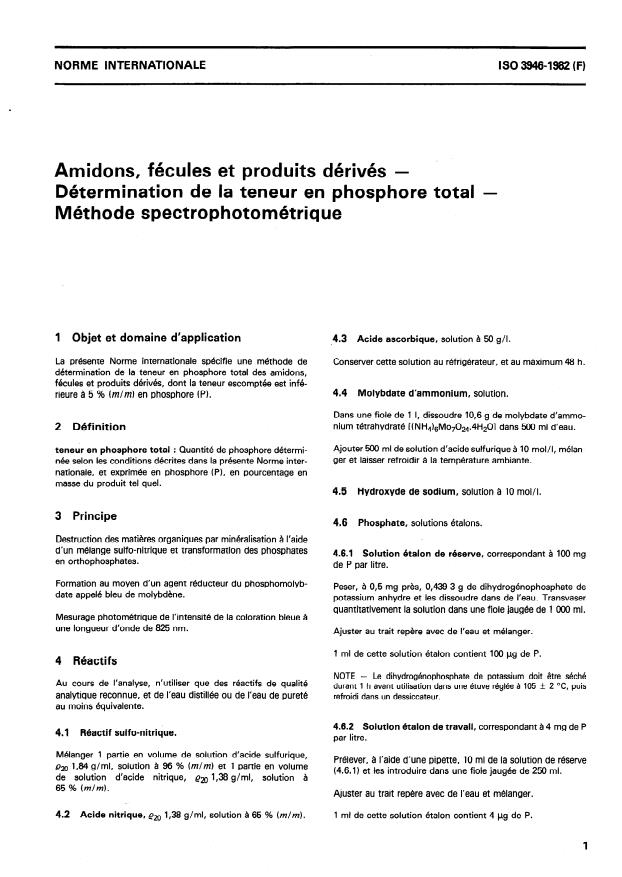
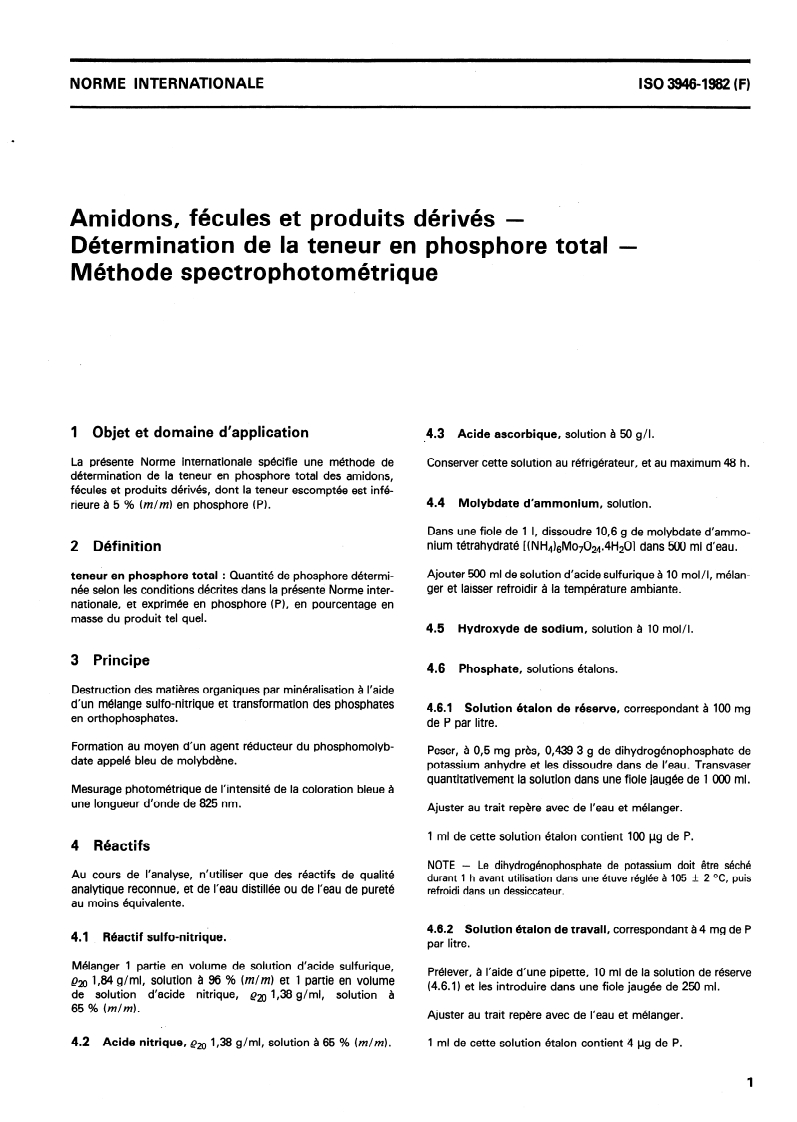
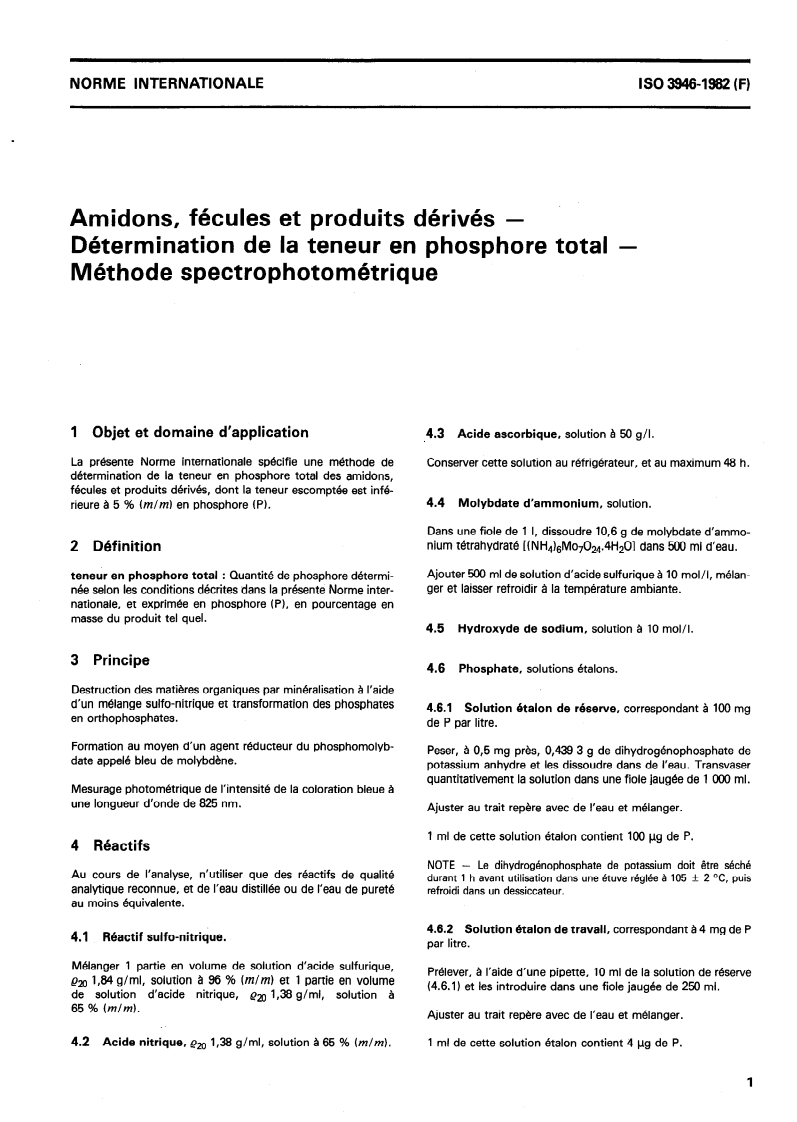
1 Objet et domaine d’application 4.3 Acide ascorbique, solution à 50 g/l.
.
La présente Norme internationale spécifie une méthode de Conserver cette solution au réfrigérateur, et au maximum 48 h.
détermination de la teneur en phosphore total des amidons,
fécules et produits dérivés, dont la teneur escomptée est infé-
4.4 Molybdate d’ammonium, solution.
rieure à 5 % (mlm) en phosphore (PI.
Dans une fiole de 1 1, dissoudre 10,6 g de molybdate d’ammo-
nium tétrahydraté [(NH&Mo70~~.4H~01 dans 500 ml d’eau.
2 Définition
Ajouter 500 ml de solution d’acide sulfurique à 10 mol/l, mélan-
teneur en phosphore total : Quantité de phosphore détermi-
ger et laisser refroidir à la température ambiante.
née selon les conditions décrites dans la présente Norme inter-
nationale, et exprimée en phosphore (PI, en pourcentage en
masse du produit tel quel.
4.5 Hydroxyde de sodium, solution à 10 molk
3 Principe
4.6 Phosphate, solutions étalons.
Destruction des matiéres organiques par minéralisation à l’aide
d’un mélange sulfo-nitrique et transformation des phosphates
4.6.1 Solution étalon de réserve, correspondant à 100 mg
en orthophosphates.
de P par litre.
Formation au moyen d’un agent réducteur du phosphomolyb-
Peser, à 0,5 mg près, 0,439 3 g de dihydrogénophosphate de
date appelé bleu de molybdène.
potassium anhydre et les dissoudre dans de l’eau. Transvaser
quantitativement la solution dans une fiole jaugée de 1 000 ml.
Mesurage photométrique de l’intensité de la coloration bleue a
une longueur d’onde de 825 nm.
Ajuster au trait repére avec de l’eau et mélanger.
1 ml de cette solution étalon contient 100 Fg de P.
4 Réactifs
NOTE - Le dihydrogénophosphate de potassium doit être séché
Au cours de l’analyse, n’utiliser que des réactifs de qualité
durant 1 h avant utilisation dans une étuve réglée à 105 31 2 OC, puis
analytique reconnue, et de l’eau distillée ou de l’eau de pureté refroidi dans un dessiccateur.
au moins équivalente.
4.6.2 Solution etalon de travail, correspondant à 4 mg de P
4.1 Réactif sulfo-nitrique.
par litre.
Mélanger 1 partie en volume de solution d’acide sulfurique,
Prélever, à l’aide d’une pipette, 10 ml de la solution de réserve
QA, 1,84 g/ml, solution à 96 % (mlm) et 1 partie en volume
(4.6.1) et les introduire dans une fiole jaugée de 250 ml.
de solution d’acide nitrique, ~20 138 g/ml, solution à
65% (mlm).
Ajuster au trait repére avec de l’eau et mélanger.
1 ml de cette solution étalon contient 4 pg de P.
4.2 Acide nitrique, ~20 138 g/ml, solution à 65 % (mlm).
ISO 39464982 (FI
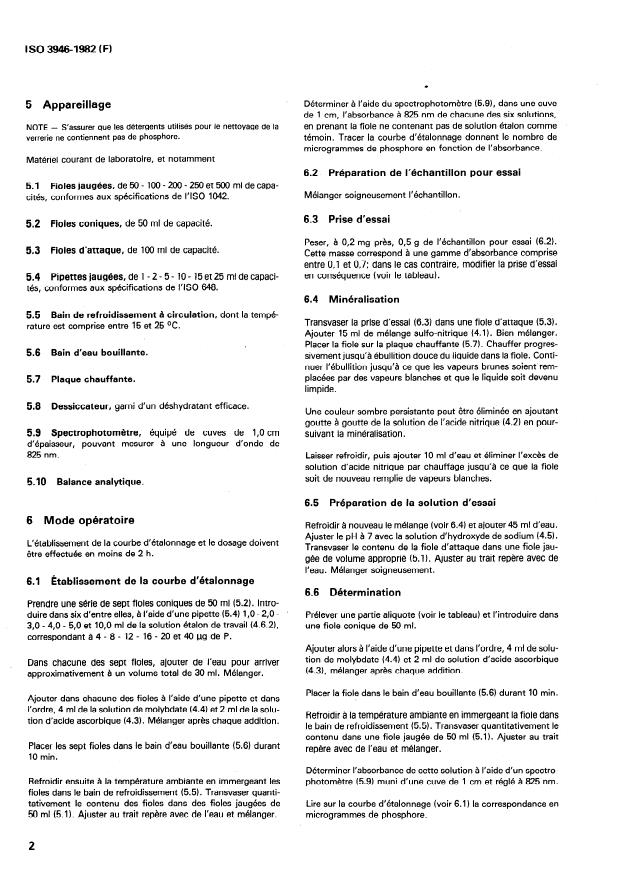
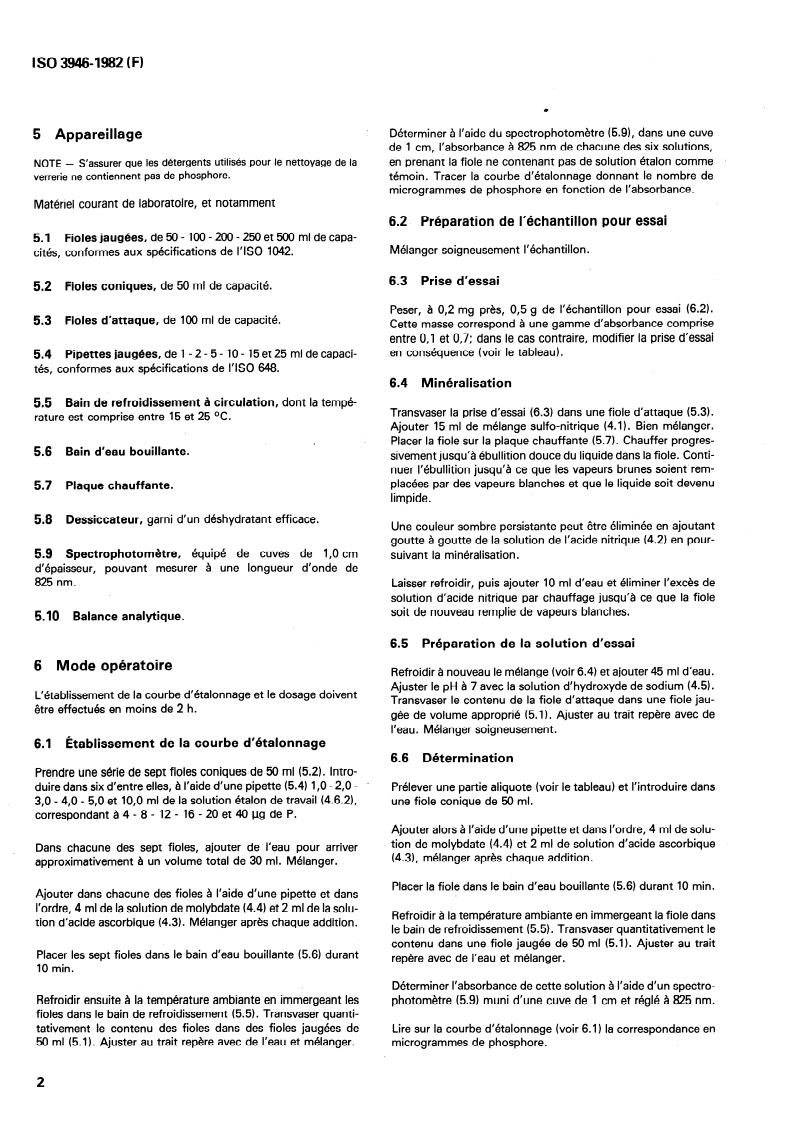
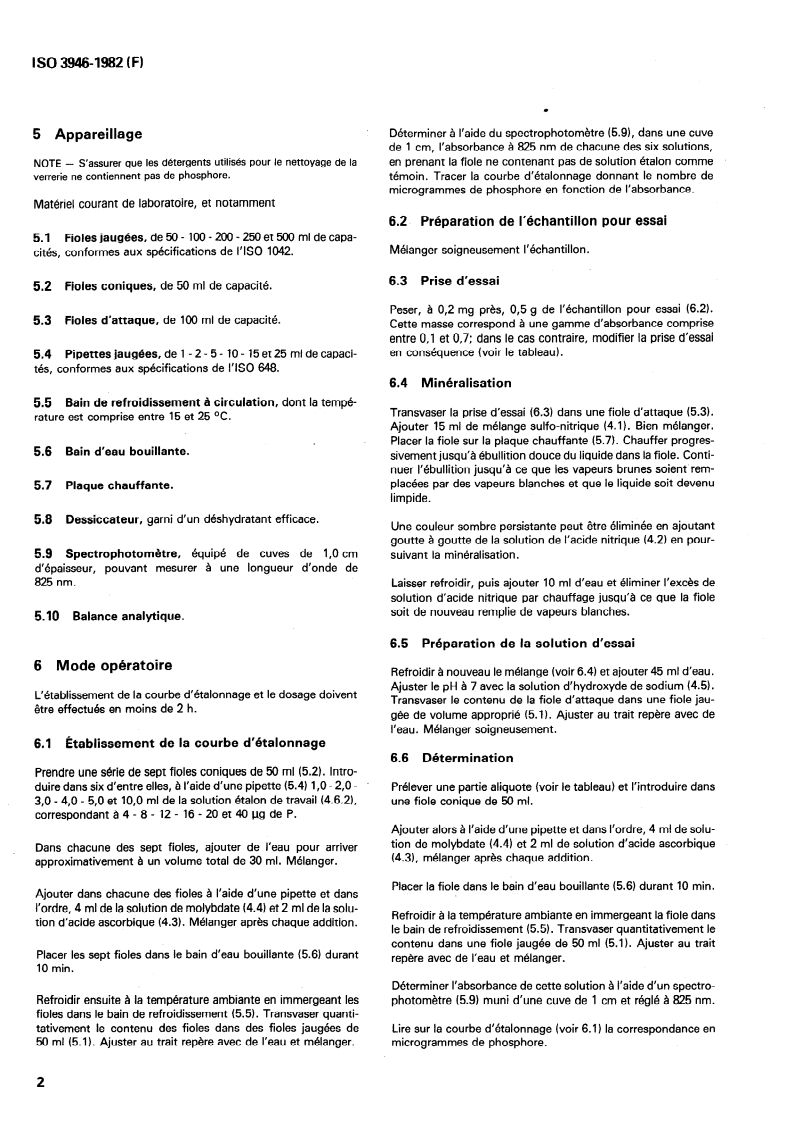
Déterminer à l’aide du spectrophotomètre (5.91, dans une cuve
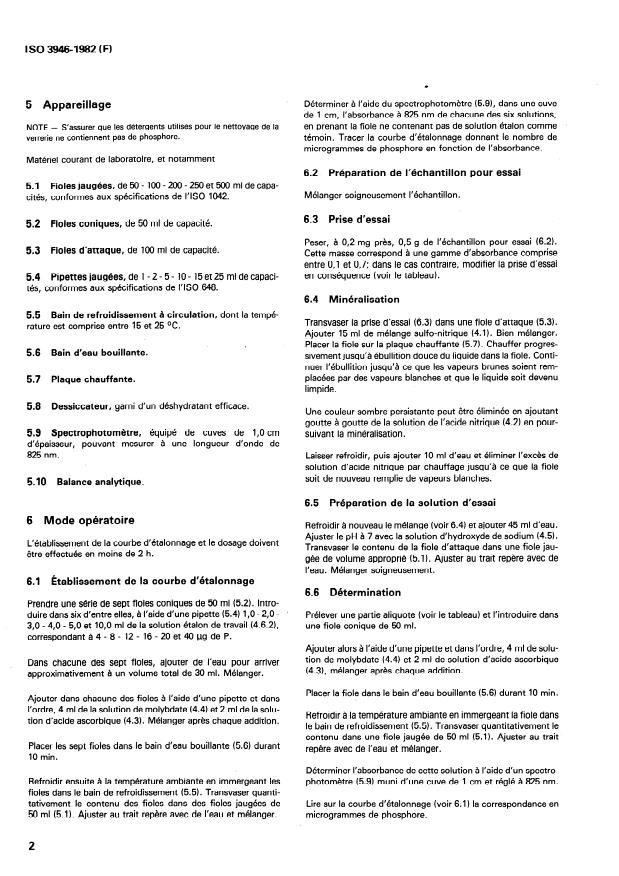
5 Appareillage
de 1 cm, I’absorbance à 825 nm de chacune des six solutions,
en prenant la fiole ne contenant pas de solution étalon comme G
NOTE - S’assurer que les détergents utilisés pour le nettoyage de la
verrerie ne contiennent pas de phosphore. témoin. Tracer la courbe d’étalonnage donnant le nombre de
microgrammes de phosphore en fonction de I’absorbance.
Matériel courant de laboratoire, et notamment
6.2 Préparation de l’échantillon pour essai
5.1 Fioles jaugées, de 50 - 100 - 200 - 250 et 500 ml de capa-
Mélanger soigneusement l’échantillon.
cités, conformes aux spécifications de I’ISO 1042.
6.3 Prise d’essai
5.2 Fioles coniques, de 50 ml de capacité.
Peser, à 0,2 mg prés, 0,5 g de l’échantillon pour essai (6.2).
5.3 Fioles d’attaque, de 100 ml de capacité.
Cette masse correspond à une gamme d’absorbance comprise
entre 0,l et 0,7; dans le cas contraire, modifier la prise d’essai
en conséquence (voir le tableau).
ml de capaci-
5.4 Pipettes jaugées, de 1 - 2 - 5 - 10 - 15 et 25
tés, conformes aux spécification
...
Norme internationale
INTERNATIONAL ORGANIZATION FOR STANDARDIZATIONWlE~YHAPOiqHAR OPrAHM3ALWlR Il0 CTAH~PTM3AL(WM.ORGANISATION INTERNATIONALE DE NORMALISATION
Amidons, fécules et produits dérivés -
Détermination de la teneur en phosphore total -
Méthode spectrophotométrique
Determination of total phosphorus content - Spectrophotometric method
Starches and derived products -
Première édition - 1982-12-01
Réf. no : ISO 39464982 (F)
CDU 664.2: 543.847
amidon, analyse chimique, dosage, phosphore, méthode spectrophotométrique.
Descripteurs :
Prix basé sur 3 pages
Avant-propos
L’ISO (Organisation internationale de normalisation) est une fédération mondiale
d’organismes nationaux de normalisation (comités membres de I’ISO). L’élaboration
des Normes internationales est confiée aux comités techniques de I’ISO. Chaque
comité membre intéressé par une étude a le droit de faire partie du comité technique
correspondant. Les organisations internationales, gouvernementales et non gouverne-
mentales, en liaison avec I’ISO, participent également aux travaux.
Les projets de Normes internationales adoptés par les comités techniques sont soumis
aux comités membres pour approbation, avant leur acceptation comme Normes inter-
nationales par le Conseil de I’ISO.
La Norme internationale ISO 3946 a été élaborée par le comité technique ISO/TC 93,
Amidon (amidons, fkules), dérivés et sous-produits, et a été soumise aux comités
membres en février 1982.
Les comités membres des pays suivants l’ont approuvée :
Afrique du Sud, Rép. d’ France
URSS
Allemagne, R. F. Pays-Bas USA
Autriche Pologne
Égypte, Rép. arabe d’ Portugal
Aucun comité membre ne l’a désapprouvée.
0 Organisation internationale de normalisation, 1982
Imprimé en Suisse
ISO 3946-1982 (F)
NORME INTERNATIONALE
Amidons, fécules et produits dérivés -
Détermination de la teneur en phosphore total -
Méthode spectrophotométrique
1 Objet et domaine d’application 4.3 Acide ascorbique, solution à 50 g/l.
.
La présente Norme internationale spécifie une méthode de Conserver cette solution au réfrigérateur, et au maximum 48 h.
détermination de la teneur en phosphore total des amidons,
fécules et produits dérivés, dont la teneur escomptée est infé-
4.4 Molybdate d’ammonium, solution.
rieure à 5 % (mlm) en phosphore (PI.
Dans une fiole de 1 1, dissoudre 10’6 g de molybdate d’ammo-
nium tétrahydraté [(NH&Mo~O~~.~H~OI dans 500 ml d’eau.
2 Définition
Ajouter 500 ml de solution d’acide sulfurique à 10 mol/l, mélan-
teneur en phosphore total : Quantité de phosphore détermi-
ger et laisser refroidir à la température ambiante.
née selon les conditions décrites dans la présente Norme inter-
nationale, et exprimée en phosphore (PI, en pourcentage en
masse du produit tel quel.
4.5 Hydroxyde de sodium, solution à 10 molk
3 Principe
4.6 Phosphate, solutions étalons.
Destruction des matiéres organiques par minéralisation à l’aide
d’un mélange sulfo-nitrique et transformation des phosphates
4.6.1 Solution étalon de réserve, correspondant à 100 mg
en orthophosphates.
de P par litre.
Formation au moyen d’un agent réducteur du phosphomolyb-
Peser, à 0’5 mg près, 0,439 3 g de dihydrogénophosphate de
date appelé bleu de molybdène.
potassium anhydre et les dissoudre dans de l’eau. Transvaser
quantitativement la solution dans une fiole jaugée de 1 000 ml.
Mesurage photométrique de l’intensité de la coloration bleue a
une longueur d’onde de 825 nm.
Ajuster au trait repére avec de l’eau et mélanger.
1 ml de cette solution étalon contient 100 Fg de P.
4 Réactifs
NOTE - Le dihydrogénophosphate de potassium doit être séché
Au cours de l’analyse, n’utiliser que des réactifs de qualité
durant 1 h avant utilisation dans une étuve réglée à 105 31 2 OC, puis
analytique reconnue, et de l’eau distillée ou de l’eau de pureté refroidi dans un dessiccateur.
au moins équivalente.
4.6.2 Solution etalon de travail, correspondant à 4 mg de P
4.1 Réactif sulfo-nitrique.
par litre.
Mélanger 1 partie en volume de solution d’acide sulfurique,
Prélever, à l’aide d’une pipette, 10 ml de la solution de réserve
QA, 1’84 g/ml, solution à 96 % (mlm) et 1 partie en volume
(4.6.1) et les introduire dans une fiole jaugée de 250 ml.
de solution d’acide nitrique, ~20 1’38 g/ml, solution à
65% (mlm).
Ajuster au trait repére avec de l’eau et mélanger.
1 ml de cette solution étalon contient 4 pg de P.
4.2 Acide nitrique, ~20 1’38 g/ml, solution à 65 % (mlm).
ISO 39464982 (FI
’ Déterminer à l’aide du spectrophotomètre (5.91, dans une cuve
5 Appareillage
de 1 cm, I’absorbance à 825 nm de chacune des six solutions,
S’assurer que les détergents utilisés pour le nettoyage de la en prenant la fiole ne contenant pas de solution étalon comme G
NOTE -
verrerie ne contiennent pas de phosphore.
témoin. Tracer la courbe d’étalonnage donnant le nombre de
microgrammes de phosphore en fonction de I’absorbance.
Matériel courant de laboratoire, et notamment
6.2 Préparation de l’échantillon pour essai
5.1 Fioles jaugées, de 50 - 100 - 200 - 250 et 500 ml de capa-
Mélanger soigneusement l’échantillon.
cités, conformes aux spécifications de I’ISO 1042.
6.3 Prise d’essai
5.2 Fioles coniques, de 50 ml de capacité.
Peser, à OI2 mg prés, OI5 g de l’échantillon pour essai (6.2).
5.3 Fioles d’attaque, de 100 ml de capacité.
Cette masse correspond à une gamme d’absorbance comprise
entre OI1 et 0’7; dans le cas contraire, modifier la prise d’essai
en conséquence (voir le tableau).
ml de capaci-
5.4 Pipettes jaugées, de 1 - 2 - 5 - 10 - 15 et 25
tés, conformes aux spécifications de
...
Norme internationale
INTERNATIONAL ORGANIZATION FOR STANDARDIZATIONWlE~YHAPOiqHAR OPrAHM3ALWlR Il0 CTAH~PTM3AL(WM.ORGANISATION INTERNATIONALE DE NORMALISATION
Amidons, fécules et produits dérivés -
Détermination de la teneur en phosphore total -
Méthode spectrophotométrique
Determination of total phosphorus content - Spectrophotometric method
Starches and derived products -
Première édition - 1982-12-01
Réf. no : ISO 39464982 (F)
CDU 664.2: 543.847
CL
amidon, analyse chimique, dosage, phosphore, méthode spectrophotométrique.
Descripteurs :
Prix basé sur 3 pages
Avant-propos
L’ISO (Organisation internationale de normalisation) est une fédération mondiale
d’organismes nationaux de normalisation (comités membres de I’ISO). L’élaboration
des Normes internationales est confiée aux comités techniques de I’ISO. Chaque
comité membre intéressé par une étude a le droit de faire partie du comité technique
correspondant. Les organisations internationales, gouvernementales et non gouverne-
mentales, en liaison avec I’ISO, participent également aux travaux.
Les projets de Normes internationales adoptés par les comités techniques sont soumis
aux comités membres pour approbation, avant leur acceptation comme Normes inter-
nationales par le Conseil de I’ISO.
La Norme internationale ISO 3946 a été élaborée par le comité technique ISO/TC 93,
Amidon (amidons, fkules), dérivés et sous-produits, et a été soumise aux comités
membres en février 1982.
Les comités membres des pays suivants l’ont approuvée :
Afrique du Sud, Rép. d’ France
URSS
Allemagne, R. F. Pays-Bas USA
Autriche Pologne
Égypte, Rép. arabe d’ Portugal
Aucun comité membre ne l’a désapprouvée.
@ Organisation internationale de normalisation, 1982 0
Imprimé en Suisse
ISO 3946-1982 (F)
NORME INTERNATIONALE
Amidons, fécules et produits dérivés -
Détermination de la teneur en phosphore total -
Méthode spectrophotométrique
1 Objet et domaine d’application 4.3 Acide ascorbique, solution à 50 g/l.
.
La présente Norme internationale spécifie une méthode de Conserver cette solution au réfrigérateur, et au maximum 48 h.
détermination de la teneur en phosphore total des amidons,
fécules et produits dérivés, dont la teneur escomptée est infé-
4.4 Molybdate d’ammonium, solution.
rieure à 5 % (mlm) en phosphore (PI.
Dans une fiole de 1 1, dissoudre 10,6 g de molybdate d’ammo-
nium tétrahydraté [(NH&Mo70~~.4H~01 dans 500 ml d’eau.
2 Définition
Ajouter 500 ml de solution d’acide sulfurique à 10 mol/l, mélan-
teneur en phosphore total : Quantité de phosphore détermi-
ger et laisser refroidir à la température ambiante.
née selon les conditions décrites dans la présente Norme inter-
nationale, et exprimée en phosphore (PI, en pourcentage en
masse du produit tel quel.
4.5 Hydroxyde de sodium, solution à 10 molk
3 Principe
4.6 Phosphate, solutions étalons.
Destruction des matiéres organiques par minéralisation à l’aide
d’un mélange sulfo-nitrique et transformation des phosphates
4.6.1 Solution étalon de réserve, correspondant à 100 mg
en orthophosphates.
de P par litre.
Formation au moyen d’un agent réducteur du phosphomolyb-
Peser, à 0,5 mg près, 0,439 3 g de dihydrogénophosphate de
date appelé bleu de molybdène.
potassium anhydre et les dissoudre dans de l’eau. Transvaser
quantitativement la solution dans une fiole jaugée de 1 000 ml.
Mesurage photométrique de l’intensité de la coloration bleue a
une longueur d’onde de 825 nm.
Ajuster au trait repére avec de l’eau et mélanger.
1 ml de cette solution étalon contient 100 Fg de P.
4 Réactifs
NOTE - Le dihydrogénophosphate de potassium doit être séché
Au cours de l’analyse, n’utiliser que des réactifs de qualité
durant 1 h avant utilisation dans une étuve réglée à 105 31 2 OC, puis
analytique reconnue, et de l’eau distillée ou de l’eau de pureté refroidi dans un dessiccateur.
au moins équivalente.
4.6.2 Solution etalon de travail, correspondant à 4 mg de P
4.1 Réactif sulfo-nitrique.
par litre.
Mélanger 1 partie en volume de solution d’acide sulfurique,
Prélever, à l’aide d’une pipette, 10 ml de la solution de réserve
QA, 1,84 g/ml, solution à 96 % (mlm) et 1 partie en volume
(4.6.1) et les introduire dans une fiole jaugée de 250 ml.
de solution d’acide nitrique, ~20 138 g/ml, solution à
65% (mlm).
Ajuster au trait repére avec de l’eau et mélanger.
1 ml de cette solution étalon contient 4 pg de P.
4.2 Acide nitrique, ~20 138 g/ml, solution à 65 % (mlm).
ISO 39464982 (FI
Déterminer à l’aide du spectrophotomètre (5.91, dans une cuve
5 Appareillage
de 1 cm, I’absorbance à 825 nm de chacune des six solutions,
en prenant la fiole ne contenant pas de solution étalon comme G
NOTE - S’assurer que les détergents utilisés pour le nettoyage de la
verrerie ne contiennent pas de phosphore. témoin. Tracer la courbe d’étalonnage donnant le nombre de
microgrammes de phosphore en fonction de I’absorbance.
Matériel courant de laboratoire, et notamment
6.2 Préparation de l’échantillon pour essai
5.1 Fioles jaugées, de 50 - 100 - 200 - 250 et 500 ml de capa-
Mélanger soigneusement l’échantillon.
cités, conformes aux spécifications de I’ISO 1042.
6.3 Prise d’essai
5.2 Fioles coniques, de 50 ml de capacité.
Peser, à 0,2 mg prés, 0,5 g de l’échantillon pour essai (6.2).
5.3 Fioles d’attaque, de 100 ml de capacité.
Cette masse correspond à une gamme d’absorbance comprise
entre 0,l et 0,7; dans le cas contraire, modifier la prise d’essai
en conséquence (voir le tableau).
ml de capaci-
5.4 Pipettes jaugées, de 1 - 2 - 5 - 10 - 15 et 25
tés, conformes aux spécification
...
Norme internationale
INTERNATIONAL ORGANIZATION FOR STANDARDIZATIONWlE~YHAPOiqHAR OPrAHM3ALWlR Il0 CTAH~PTM3AL(WM.ORGANISATION INTERNATIONALE DE NORMALISATION
Amidons, fécules et produits dérivés -
Détermination de la teneur en phosphore total -
Méthode spectrophotométrique
Determination of total phosphorus content - Spectrophotometric method
Starches and derived products -
Première édition - 1982-12-01
Réf. no : ISO 39464982 (F)
CDU 664.2: 543.847
amidon, analyse chimique, dosage, phosphore, méthode spectrophotométrique.
Descripteurs :
Prix basé sur 3 pages
Avant-propos
L’ISO (Organisation internationale de normalisation) est une fédération mondiale
d’organismes nationaux de normalisation (comités membres de I’ISO). L’élaboration
des Normes internationales est confiée aux comités techniques de I’ISO. Chaque
comité membre intéressé par une étude a le droit de faire partie du comité technique
correspondant. Les organisations internationales, gouvernementales et non gouverne-
mentales, en liaison avec I’ISO, participent également aux travaux.
Les projets de Normes internationales adoptés par les comités techniques sont soumis
aux comités membres pour approbation, avant leur acceptation comme Normes inter-
nationales par le Conseil de I’ISO.
La Norme internationale ISO 3946 a été élaborée par le comité technique ISO/TC 93,
Amidon (amidons, fkules), dérivés et sous-produits, et a été soumise aux comités
membres en février 1982.
Les comités membres des pays suivants l’ont approuvée :
Afrique du Sud, Rép. d’ France
URSS
Allemagne, R. F. Pays-Bas USA
Autriche Pologne
Égypte, Rép. arabe d’ Portugal
Aucun comité membre ne l’a désapprouvée.
0 Organisation internationale de normalisation, 1982
Imprimé en Suisse
ISO 3946-1982 (F)
NORME INTERNATIONALE
Amidons, fécules et produits dérivés -
Détermination de la teneur en phosphore total -
Méthode spectrophotométrique
1 Objet et domaine d’application 4.3 Acide ascorbique, solution à 50 g/l.
.
La présente Norme internationale spécifie une méthode de Conserver cette solution au réfrigérateur, et au maximum 48 h.
détermination de la teneur en phosphore total des amidons,
fécules et produits dérivés, dont la teneur escomptée est infé-
4.4 Molybdate d’ammonium, solution.
rieure à 5 % (mlm) en phosphore (PI.
Dans une fiole de 1 1, dissoudre 10’6 g de molybdate d’ammo-
nium tétrahydraté [(NH&Mo~O~~.~H~OI dans 500 ml d’eau.
2 Définition
Ajouter 500 ml de solution d’acide sulfurique à 10 mol/l, mélan-
teneur en phosphore total : Quantité de phosphore détermi-
ger et laisser refroidir à la température ambiante.
née selon les conditions décrites dans la présente Norme inter-
nationale, et exprimée en phosphore (PI, en pourcentage en
masse du produit tel quel.
4.5 Hydroxyde de sodium, solution à 10 molk
3 Principe
4.6 Phosphate, solutions étalons.
Destruction des matiéres organiques par minéralisation à l’aide
d’un mélange sulfo-nitrique et transformation des phosphates
4.6.1 Solution étalon de réserve, correspondant à 100 mg
en orthophosphates.
de P par litre.
Formation au moyen d’un agent réducteur du phosphomolyb-
Peser, à 0’5 mg près, 0,439 3 g de dihydrogénophosphate de
date appelé bleu de molybdène.
potassium anhydre et les dissoudre dans de l’eau. Transvaser
quantitativement la solution dans une fiole jaugée de 1 000 ml.
Mesurage photométrique de l’intensité de la coloration bleue a
une longueur d’onde de 825 nm.
Ajuster au trait repére avec de l’eau et mélanger.
1 ml de cette solution étalon contient 100 Fg de P.
4 Réactifs
NOTE - Le dihydrogénophosphate de potassium doit être séché
Au cours de l’analyse, n’utiliser que des réactifs de qualité
durant 1 h avant utilisation dans une étuve réglée à 105 31 2 OC, puis
analytique reconnue, et de l’eau distillée ou de l’eau de pureté refroidi dans un dessiccateur.
au moins équivalente.
4.6.2 Solution etalon de travail, correspondant à 4 mg de P
4.1 Réactif sulfo-nitrique.
par litre.
Mélanger 1 partie en volume de solution d’acide sulfurique,
Prélever, à l’aide d’une pipette, 10 ml de la solution de réserve
QA, 1’84 g/ml, solution à 96 % (mlm) et 1 partie en volume
(4.6.1) et les introduire dans une fiole jaugée de 250 ml.
de solution d’acide nitrique, ~20 1’38 g/ml, solution à
65% (mlm).
Ajuster au trait repére avec de l’eau et mélanger.
1 ml de cette solution étalon contient 4 pg de P.
4.2 Acide nitrique, ~20 1’38 g/ml, solution à 65 % (mlm).
ISO 39464982 (FI
’ Déterminer à l’aide du spectrophotomètre (5.91, dans une cuve
5 Appareillage
de 1 cm, I’absorbance à 825 nm de chacune des six solutions,
S’assurer que les détergents utilisés pour le nettoyage de la en prenant la fiole ne contenant pas de solution étalon comme G
NOTE -
verrerie ne contiennent pas de phosphore.
témoin. Tracer la courbe d’étalonnage donnant le nombre de
microgrammes de phosphore en fonction de I’absorbance.
Matériel courant de laboratoire, et notamment
6.2 Préparation de l’échantillon pour essai
5.1 Fioles jaugées, de 50 - 100 - 200 - 250 et 500 ml de capa-
Mélanger soigneusement l’échantillon.
cités, conformes aux spécifications de I’ISO 1042.
6.3 Prise d’essai
5.2 Fioles coniques, de 50 ml de capacité.
Peser, à OI2 mg prés, OI5 g de l’échantillon pour essai (6.2).
5.3 Fioles d’attaque, de 100 ml de capacité.
Cette masse correspond à une gamme d’absorbance comprise
entre OI1 et 0’7; dans le cas contraire, modifier la prise d’essai
en conséquence (voir le tableau).
ml de capaci-
5.4 Pipettes jaugées, de 1 - 2 - 5 - 10 - 15 et 25
tés, conformes aux spécifications de
...