

ISO 13061-3:2014/Amd 1:2017
(Amendment)Physical and mechanical properties of wood — Test methods for small clear wood specimens — Part 3: Determination of ultimate strength in static bending — Amendment 1
General Information
- Abstract
- Status
- Published
- Publication Date
- 11-Jul-2017
- Technical Committee
- ISO/TC 218 - Timber
- Drafting Committee
- ISO/TC 218/WG 4 - Test methods
- Current Stage
- 6060 - International Standard published
- Start Date
- 12-Jul-2017
- Due Date
- 10-Jan-2020
- Completion Date
- 10-Jan-2020

Overview
ISO 13061-3:2014/Amd 1:2017 is an important amendment to the international standard specifying test methods for determining the ultimate strength in static bending of small clear wood specimens. Managed by the International Organization for Standardization (ISO) under Technical Committee ISO/TC 218 (Timber), this standard focuses on physical and mechanical properties of wood. It provides precise guidelines for evaluating wood’s bending strength, critical for both research and industry applications.
This amendment updates the original 2014 edition by revising test method references to ensure greater accuracy and consistency in strength assessment procedures. It is fundamental for professionals involved in wood materials testing, quality control, forestry research, and structural engineering.
Key Topics
Scope and Purpose
Defines procedures for testing the ultimate strength of small, defect-free wood samples under static bending load conditions. This test determines the maximum load the specimen can sustain before failure.Test Specimen Requirements
Specifies characteristics and preparation of small clear wood specimens to ensure uniformity and reliability of results.Measurement Accuracy
Introduces an updated requirement for linear deflection measurement accuracy of at least 0.02 mm as per ISO 13061-4. This is essential for combined tests involving both ultimate strength and modulus of elasticity in static bending.Test Setup and Procedures
Details the mechanical setup, loading methods, and calculation techniques to obtain consistent and reproducible bending strength data.Harmonization with Related Standards
Updates references to related parts of the ISO 13061 series, ensuring standardization across multiple wood testing methods.
Applications
ISO 13061-3:2014/Amd 1:2017 is widely applied in:
Wood Quality Assessment
Enabling producers and researchers to quantify the mechanical strength properties of timber samples, supporting grading and classification.Structural Engineering & Design
Providing essential data for the safe design of wooden structures by understanding bending strength limits.Material Research and Development
Guiding development of engineered wood products by assessing performance under bending stresses.Certification & Compliance Testing
Assisting manufacturers and testing laboratories in meeting international quality and safety standards.Forestry and Wood Science
Supporting studies on wood variability, species comparisons, and effects of treatments on mechanical properties.
Related Standards
ISO 13061-3:2014/Amd 1:2017 aligns with other standards in the ISO 13061 series, which collectively address various mechanical and physical testing methods for wood, including:
ISO 13061-4: Test methods for the determination of the modulus of elasticity in static bending, referenced for deflection measurement accuracy.
ISO 13061-1: General requirements and test conditions for small clear wood specimens (superseded in this amendment for certain references).
Additional parts of the ISO 13061 series covering density, moisture content, compression strength, and hardness tests.
These interconnected standards facilitate comprehensive evaluation of wood properties, encouraging harmonization and consistency in international wood testing practices.
Keywords: ISO 13061-3:2014, wood testing standard, static bending test, ultimate strength of wood, mechanical properties of timber, small clear wood specimens, wood material testing, modulus of elasticity, deflection measurement, structural wood testing, ISO wood standards.
Relations
- Effective Date
- 06-Jun-2022
- Effective Date
- 09-May-2020
Get Certified
Connect with accredited certification bodies for this standard

Gozdarski inštitut Slovenije
Slovenian Forestry Institute. Forest management certification support, timber testing.
Sponsored listings
Frequently Asked Questions
ISO 13061-3:2014/Amd 1:2017 is a standard published by the International Organization for Standardization (ISO). Its full title is "Physical and mechanical properties of wood — Test methods for small clear wood specimens — Part 3: Determination of ultimate strength in static bending — Amendment 1". This standard covers: Physical and mechanical properties of wood — Test methods for small clear wood specimens — Part 3: Determination of ultimate strength in static bending — Amendment 1
Physical and mechanical properties of wood — Test methods for small clear wood specimens — Part 3: Determination of ultimate strength in static bending — Amendment 1
ISO 13061-3:2014/Amd 1:2017 is classified under the following ICS (International Classification for Standards) categories: 79.040 - Wood, sawlogs and sawn timber. The ICS classification helps identify the subject area and facilitates finding related standards.
ISO 13061-3:2014/Amd 1:2017 has the following relationships with other standards: It is inter standard links to ISO 15876-5:2017/Amd 1:2020, ISO 13061-3:2014. Understanding these relationships helps ensure you are using the most current and applicable version of the standard.
ISO 13061-3:2014/Amd 1:2017 is available in PDF format for immediate download after purchase. The document can be added to your cart and obtained through the secure checkout process. Digital delivery ensures instant access to the complete standard document.
Standards Content (Sample)
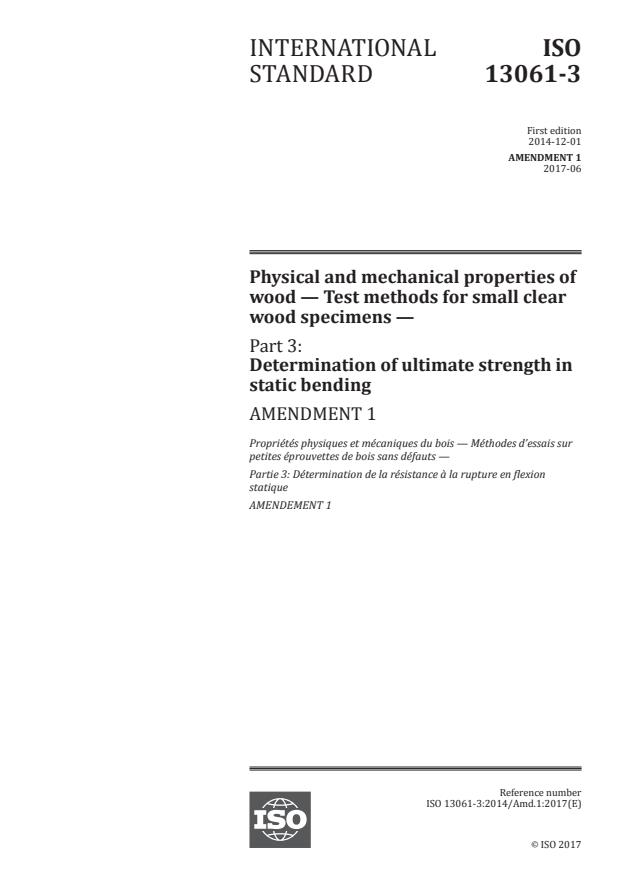
INTERNATIONAL ISO
STANDARD 13061-3
First edition
2014-12-01
AMENDMENT 1
2017-06
Physical and mechanical properties of
wood — Test methods for small clear
wood specimens —
Part 3:
Determination of ultimate strength in
static bending
AMENDMENT 1
Propriétés physiques et mécaniques du bois — Méthodes d’essais sur
petites éprouvettes de bois sans défauts —
Partie 3: Détermination de la résistance à la rupture en flexion
statique
AMENDEMENT 1
Reference number
ISO 13061-3:2014/Amd.1:2017(E)
©
ISO 2017
ISO 13061-3:2014/Amd.1:2017(E)
© ISO 2017, Published in Switzerland
All rights reserved. Unless otherwise specified, no part of this publication may be reproduced or utilized otherwise in any form
or by any means, electronic or mechanical, including photocopying, or posting on the internet or an intranet, without prior
written permission. Permission can be requested from either ISO at the address below or ISO’s member body in the country of
the requester.
ISO copyright office
Ch. de Blandonnet 8 • CP 401
CH-1214 Vernier, Geneva, Switzerland
Tel. +41 22 749 01 11
Fax +41 22 749 09 47
copyright@iso.org
www.iso.org
ii © ISO 2017 – All rights reserved
ISO 13061-3:2014/Amd.1:2017(E)
Foreword
ISO (the International Organization for Standardization) is a worldwide federation of national standards
bodies (ISO member bodies). The work of preparing International Standards is normally carried out
through ISO technical committees. Each member body interested in a subject for which a technical
committee has been established has the right to be represented on that committee. International
organizations, governmental and non-governmental, in liaison with ISO, also take part in the work.
ISO collaborates closely with the International Electrotechnical Commission (IEC) on all matters of
electrotechnical standardization.
The procedures used to develop this document and those intended for its further maintenance are
described in the I
...