

ISO/IEC 24760-2:2025
(Main)Information security, cybersecurity and privacy protection — A framework for identity management — Part 2: Reference architecture and requirements
General Information
- Abstract
This document: provides guidelines for the implementation of systems for the management of identity information; specifies requirements for the implementation and operation of a framework for identity management; is applicable to any information system where information relating to identity is processed or stored; is considered to be a horizontal document for the following reasons: it applies concepts such as distinguishing the term “identity” from the term “identifier” on the implementation of systems for the management of identity information and on the requirements for the implementation and operation of a framework for identity management, it provides an important contribution to assess identity management systems with regard to their privacy-friendliness and their ability to assure the relevant attributes of an identity, and consequently it provides a foundation and a common understanding for any other standard addressing identity, identity information, and identity management.
- Status
- Published
- Publication Date
- 15-Sep-2025
- Current Stage
- 6060 - International Standard published
- Start Date
- 16-Sep-2025
- Due Date
- 19-Jul-2024
- Completion Date
- 16-Sep-2025
Buy Documents

ISO/IEC 24760-2:2025 - Information security, cybersecurity and privacy protection — A framework for identity management — Part 2: Reference architecture and requirements Released:16. 09. 2025

ISO/IEC 24760-2:2025 - Sécurité de l'information, cybersécurité et protection de la vie privée — Cadre pour la gestion de l'identité — Partie 2: Architecture de référence et exigences
Overview
ISO/IEC 24760-2:2025 - "Information security, cybersecurity and privacy protection - A framework for identity management - Part 2: Reference architecture and requirements" defines a reference architecture and implementation requirements for identity management. As a horizontal standard it applies to any information system that processes or stores identity information and provides a common foundation for other identity, privacy and security standards. The 2025 second edition updates the 2015 version and adds coverage of emerging concepts such as mobile identity and the principal’s private IMS (PPI).
Key topics and technical requirements
This standard describes architecture, stakeholders, actors, processes and technical requirements for managing identity information:
- Reference architecture and deployment scenarios
- Enterprise/internal identity models and architectures for external identities (including federated and service deployment scenarios).
- Stakeholders and actors
- Principals, identity management authority, identity information authority, relying parties, verifiers, auditors, regulators and consumer/citizen advocates.
- Processes, services and use cases
- Identity registration, lifecycle management, verification, provisioning, auditing and additional identity functions.
- Components and physical model
- Identity registers, identity information providers, interfaces and component models to support interoperable implementations.
- Functional requirements
- Policy for identity information lifecycle, conditions and procedures to maintain identity information, identity information interfaces, reference identifiers, and identity information quality and compliance.
- Non-functional requirements
- Availability, confidentiality, integrity, privacy-friendliness, archiving, termination and secure deletion of identity information.
- Governance and compliance
- Guidance to assess privacy-friendliness and assurance of identity attributes across implementations.
Practical applications and who benefits
ISO/IEC 24760-2:2025 is intended for organizations and professionals implementing or assessing identity management systems:
- IAM architects and engineers designing identity stores, identity providers, federated authentication and SSO.
- Security and cybersecurity teams enforcing identity-related controls and non-functional security requirements.
- Privacy officers and data protection teams evaluating privacy-friendliness and lifecycle controls for identity data.
- Auditors and regulators assessing compliance, governance and assurance of identity attributes.
- Software vendors and cloud service providers building identity management solutions, mobile identity services (PPI), or identity-as-a-service offerings.
- Enterprises and government agencies that manage employee, citizen or customer identities.
Related standards
- ISO/IEC 24760 series (see Part 1 for concepts and terminology)
- ISO/IEC SC 27 work on information security, cybersecurity and privacy protection
ISO/IEC 24760-2:2025 is a practical, standards-based blueprint for designing privacy-aware, interoperable and secure identity management frameworks usable across sectors and deployment scenarios.
Relations
- Effective Date
- 06-Jun-2022
Buy Documents
ISO/IEC 24760-2:2025 - Information security, cybersecurity and privacy protection — A framework for identity management — Part 2: Reference architecture and requirements Released:16. 09. 2025
ISO/IEC 24760-2:2025 - Sécurité de l'information, cybersécurité et protection de la vie privée — Cadre pour la gestion de l'identité — Partie 2: Architecture de référence et exigences
Get Certified
Connect with accredited certification bodies for this standard

BSI Group
BSI (British Standards Institution) is the business standards company that helps organizations make excellence a habit.

Bureau Veritas
Bureau Veritas is a world leader in laboratory testing, inspection and certification services.

DNV
DNV is an independent assurance and risk management provider.
Sponsored listings
Frequently Asked Questions
ISO/IEC 24760-2:2025 is a standard published by the International Organization for Standardization (ISO). Its full title is "Information security, cybersecurity and privacy protection — A framework for identity management — Part 2: Reference architecture and requirements". This standard covers: This document: provides guidelines for the implementation of systems for the management of identity information; specifies requirements for the implementation and operation of a framework for identity management; is applicable to any information system where information relating to identity is processed or stored; is considered to be a horizontal document for the following reasons: it applies concepts such as distinguishing the term “identity” from the term “identifier” on the implementation of systems for the management of identity information and on the requirements for the implementation and operation of a framework for identity management, it provides an important contribution to assess identity management systems with regard to their privacy-friendliness and their ability to assure the relevant attributes of an identity, and consequently it provides a foundation and a common understanding for any other standard addressing identity, identity information, and identity management.
This document: provides guidelines for the implementation of systems for the management of identity information; specifies requirements for the implementation and operation of a framework for identity management; is applicable to any information system where information relating to identity is processed or stored; is considered to be a horizontal document for the following reasons: it applies concepts such as distinguishing the term “identity” from the term “identifier” on the implementation of systems for the management of identity information and on the requirements for the implementation and operation of a framework for identity management, it provides an important contribution to assess identity management systems with regard to their privacy-friendliness and their ability to assure the relevant attributes of an identity, and consequently it provides a foundation and a common understanding for any other standard addressing identity, identity information, and identity management.
ISO/IEC 24760-2:2025 is classified under the following ICS (International Classification for Standards) categories: 35.030 - IT Security. The ICS classification helps identify the subject area and facilitates finding related standards.
ISO/IEC 24760-2:2025 has the following relationships with other standards: It is inter standard links to ISO/IEC 24760-2:2015. Understanding these relationships helps ensure you are using the most current and applicable version of the standard.
ISO/IEC 24760-2:2025 is available in PDF format for immediate download after purchase. The document can be added to your cart and obtained through the secure checkout process. Digital delivery ensures instant access to the complete standard document.
Standards Content (Sample)
International
Standard
ISO/IEC 24760-2
Second edition
Information security, cybersecurity
2025-09
and privacy protection —
A framework for identity
management —
Part 2:
Reference architecture and
requirements
Sécurité de l'information, cybersécurité et protection de la vie
privée — Cadre pour la gestion de l'identité —
Partie 2: Architecture de référence et exigences
Horizontal document
Reference number
© ISO/IEC 2025
All rights reserved. Unless otherwise specified, or required in the context of its implementation, no part of this publication may
be reproduced or utilized otherwise in any form or by any means, electronic or mechanical, including photocopying, or posting on
the internet or an intranet, without prior written permission. Permission can be requested from either ISO at the address below
or ISO’s member body in the country of the requester.
ISO copyright office
CP 401 • Ch. de Blandonnet 8
CH-1214 Vernier, Geneva
Phone: +41 22 749 01 11
Email: copyright@iso.org
Website: www.iso.org
Published in Switzerland
© ISO/IEC 2025 – All rights reserved
ii
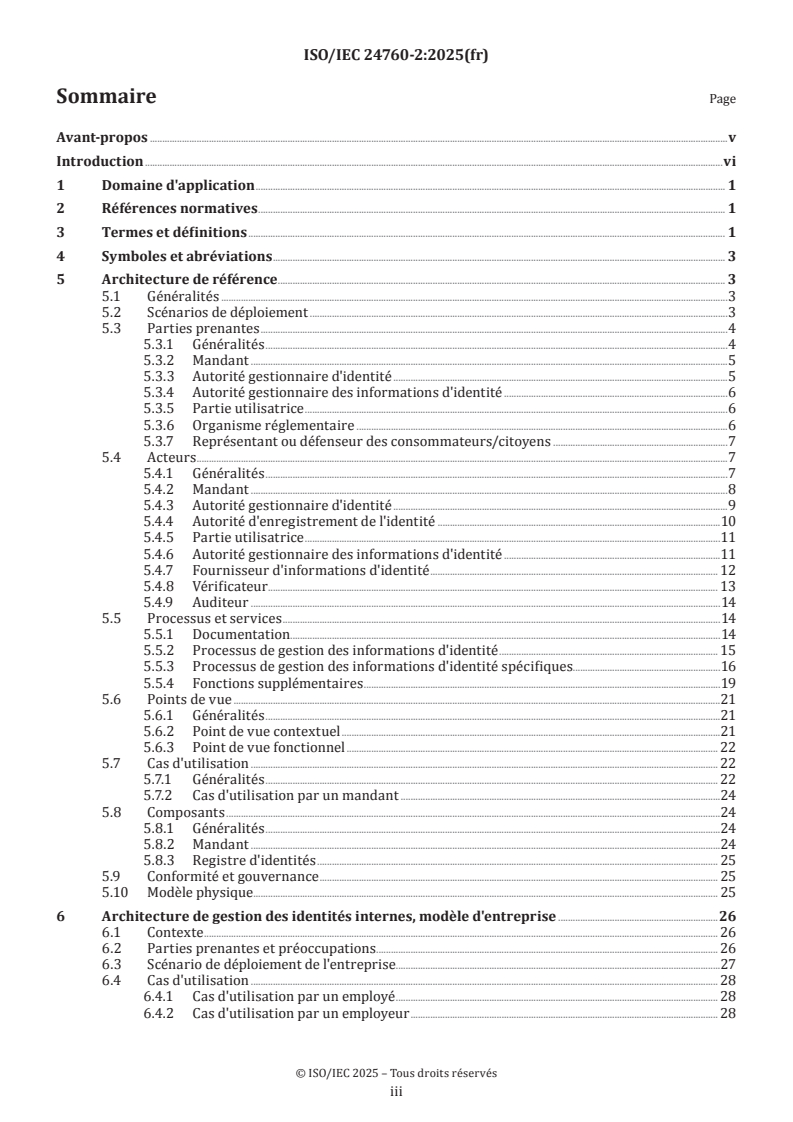
Contents Page
Foreword .v
Introduction .vi
1 Scope . 1
2 Normative references . 1
3 Terms and definitions . 1
4 Symbols and abbreviated terms. 3
5 Reference architecture . 3
5.1 General .3
5.2 Deployment scenarios .3
5.3 Stakeholders .4
5.3.1 General .4
5.3.2 Principal .5
5.3.3 Identity management authority .5
5.3.4 Identity information authority .6
5.3.5 Relying party .6
5.3.6 Regulatory body .6
5.3.7 Consumer/citizen representative or advocate .6
5.4 Actors .7
5.4.1 General .7
5.4.2 Principal .8
5.4.3 Identity management authority .8
5.4.4 Identity registration authority .9
5.4.5 Relying party .10
5.4.6 Identity information authority .10
5.4.7 Identity information provider .11
5.4.8 Verifier . 12
5.4.9 Auditor . 13
5.5 Processes and services . 13
5.5.1 Documentation. 13
5.5.2 Identity information management processes .14
5.5.3 Specific identity information management processes . 15
5.5.4 Additional functions . .17
5.6 Viewpoints . 20
5.6.1 General . 20
5.6.2 Context viewpoint . 20
5.6.3 Functional viewpoint . 20
5.7 Use cases .21
5.7.1 General .21
5.7.2 Principal use cases . 22
5.8 Components . 23
5.8.1 General . 23
5.8.2 Principal . 23
5.8.3 Identity register . 23
5.9 Compliance and governance .24
5.10 Physical model .24
6 Architecture for managing internal identities, the enterprise model .24
6.1 Context .24
6.2 Stakeholders and concerns . 25
6.3 The enterprise deployment scenario . 26
6.4 Use cases . 26
6.4.1 Employee use cases . 26
6.4.2 Employer use cases .27
© ISO/IEC 2025 – All rights reserved
iii
7 Architecture for managing external identities .27
7.1 Context .27
7.2 Stakeholders and concerns .27
7.3 Deployment scenarios with external identities . 29
7.3.1 The federated deployment scenario . 29
7.3.2 The service deployment scenario . 29
7.3.3 The federated deployment scenario as applied as a service . 29
7.4 Use cases . 29
7.4.1 Device use cases . 29
7.4.2 Sharing use cases . 29
8 Requirements for the management of identity information .30
8.1 General . 30
8.2 Access policy for identity information . 30
8.3 Functional requirements for management of identity information . 30
8.3.1 Policy for identity information lifecycle . 30
8.3.2 Conditions and procedure to maintain identity information .31
8.3.3 Identity information interface .31
8.3.4 Reference identifier .31
8.3.5 Identity information quality and compliance . . 33
8.3.6 Archiving information . 33
8.3.7 Terminating and deleting identity information. 33
8.4 Non-functional requirements. 34
Annex A (informative) Use case .35
Annex B (informative) Component model .38
Annex C (informative) Business process model . 41
Bibliography .46
© ISO/IEC 2025 – All rights reserved
iv
Foreword
ISO (the International Organization for Standardization) and IEC (the International Electrotechnical
Commission) form the specialized system for worldwide standardization. National bodies that are
members of ISO or IEC participate in the development of International Standards through technical
committees established by the respective organization to deal with particular fields of technical activity.
ISO and IEC technical committees collaborate in fields of mutual interest. Other international organizations,
governmental and non-governmental, in liaison with ISO and IEC, also take part in the work.
The procedures used to develop this document and those intended for its further maintenance are described
in the ISO/IEC Directives, Part 1. In particular, the different approval criteria needed for the different types
of document should be noted. This document was drafted in accordance with the editorial rules of the ISO/
IEC Directives, Part 2 (see www.iso.org/directives or www.iec.ch/members_experts/refdocs).
ISO and IEC draw attention to the possibility that the implementation of this document may involve the
use of (a) patent(s). ISO and IEC take no position concerning the evidence, validity or applicability of any
claimed patent rights in respect thereof. As of the date of publication of this document, ISO and IEC had not
received notice of (a) patent(s) which may be required to implement this document. However, implementers
are cautioned that this may not represent the latest information, which may be obtained from the patent
database available at www.iso.org/patents and https://patents.iec.ch. ISO and IEC shall not be held
responsible for identifying any or all such patent rights.
Any trade name used in this document is information given for the convenience of users and does not
constitute an endorsement.
For an explanation of the voluntary nature of standards, the meaning of ISO specific terms and expressions
related to conformity assessment, as well as information about ISO's adherence to the World Trade
Organization (WTO) principles in the Technical Barriers to Trade (TBT) see www.iso.org/iso/foreword.html.
In the IEC, see www.iec.ch/understanding-standards.
This document was prepared by Joint Technical Committee ISO/IEC JTC 1, Information technology,
Subcommittee SC 27, Information security, cybersecurity and privacy protection.
This second edition cancels and replaces the first edition (ISO/IEC 24760-2:2015), which has been technically
revised.
The main changes are as follows:
— in Clause 3, the definitions of terms from ISO/IEC 24760-1 were removed;
— to address the emerging concept of mobile identity, the term “principal’s private IMS” (PPI) was added in
Clauses 3, 4, and described in 5.4.2, 5.4.3 and 5.4.6;
— some of the content of Clause 5 was moved to Clauses 6 and 7;
— former Annex A has been deleted and the existing annexes have been relabelled.
A list of all parts in the ISO/IEC 24760 series can be found on the ISO and IEC websites.
This document has been given the status of a horizontal document in accordance with the ISO/IEC
Directives, Part 1.
Any feedback or questions on this document should be directed to the user’s national standards
body. A complete listing of these bodies can be found at www.iso.org/members.html and
www.iec.ch/national-committees.
© ISO/IEC 2025 – All rights reserved
v
Introduction
Data processing systems commonly gather a range of information on its users, which can include people,
pieces of equipment, or pieces of software connected to the equipment. Based on the information gathered
on user identity, these data processing systems make decisions that can impact how users access to IT
resources.
To address the need to efficiently and effectively implement systems that make identity-based decisions, this
document specifies a framework for the issuance, administration and use of data. This framework serves to
characterize individuals, organizations, or information technology components, which operate on behalf of
individuals or organizations.
For many organizations, the proper management of identity information is crucial for maintaining the
security of the organizational processes. For individuals, correct identity management is important for
protecting privacy.
The ISO/IEC 24760 series specifies fundamental concepts and operational structures for identity
management and provides a framework on which information systems can meet business, contractual,
regulatory, and legal obligations.
This document defines a reference architecture for identity management including interrelationships.
These architectural elements are described in respect to identity management deployments scenarios and
their models. This document also specifies requirements for the design and implementation of an identity
management system so that it can meet the objectives of stakeholders involved in the deployment and
operation of identity management.
This document is intended to provide a foundation for the implementation of other international standards
related to identity information processing such as ISO/IEC 29100, ISO/IEC 29101, ISO/IEC 29115, and
ISO/IEC 29146.
This document is not a management system standard (MSS).
© ISO/IEC 2025 – All rights reserved
vi
International Standard ISO/IEC 24760-2:2025(en)
Information security, cybersecurity and privacy protection —
A framework for identity management —
Part 2:
Reference architecture and requirements
1 Scope
This document:
— provides guidelines for the implementation of systems for the management of identity information;
— specifies requirements for the implementation and operation of a framework for identity management;
— is applicable to any information system where information relating to identity is processed or stored;
— is considered to be a horizontal document for the following reasons:
— it applies concepts such as distinguishing the term “identity” from the term “identifier” on the
implementation of systems for the management of identity information and on the requirements for
the implementation and operation of a framework for identity management,
— it provides an important contribution to assess identity management systems with regard to their
privacy-friendliness and their ability to assure the relevant attributes of an identity, and consequently
it provides a foundation and a common understanding for any other standard addressing identity,
identity information, and identity management.
2 Normative references
The following documents are referred to in the text in such a way that some or all of their content constitutes
requirements of this document. For dated references, only the edition cited applies. For undated references,
the latest edition of the referenced document (including any amendments) applies.
ISO/IEC 24760-1, Information security, cybersecurity and privacy protection — A framework for identity
management — Part 1: Core concepts and terminology
ISO/IEC 29115, Information technology — Security techniques — Entity authentication assurance framework
3 Terms and definitions
For the purposes of this document, the terms and definitions given in ISO/IEC 24760-1 and the following apply.
ISO and IEC maintain terminology databases for use in standardization at the following addresses:
— ISO Online browsing platform: available at https:// www .iso .org/ obp
— IEC Electropedia: available at https:// www .electropedia .org/
© ISO/IEC 2025 – All rights reserved
3.1
documented design
authoritative description of structural, functional, and operational system aspects
Note 1 to entry: A documented design is the documentation created to serve as guidance for the implementation of an
Information and Communication Technology (ICT) system.
Note 2 to entry: A documented design typically includes the description of a concrete architecture of the ICT system.
3.2
identity management authority
entity responsible for setting and enforcing operational policies for an identity management system
Note 1 to entry: An identity management authority typically commissions the design, implementation, and deployment
of an identity management system.
EXAMPLE The executive management of a company deploying an identity management system in support of its
services.
3.3
invalidation
process performed in an identity management system when a particular attribute is no longer valid for a
particular entity to mark the attribute invalid for future use
Note 1 to entry: Invalidation of attributes can be part of updating the attribute value, for instance, with a change of
address.
Note 2 to entry: Invalidation typically takes place for an attribute that is determined as no longer valid before the end
of a validity period that had previously been associated with it.
Note 3 to entry: The term “revocation” is commonly used for invalidation of attributes that are credentials.
Note 4 to entry: Invalidation typically happens immediately after the determination that an attribute is no longer
valid for a particular entity.
3.4
regulatory body
formally recognized organization tasked and empowered by law, regulation, or agreement to supervise the
operation of identity management systems
3.5
stakeholder
role, position, individual, organization, or classes thereof, having an interest, right, share, or claim, in an
entity of interest
[SOURCE: ISO/IEC/IEEE 42010:2022, 3.17, modified — the Example has been removed.]
3.6
principal’s private identity management system
PPI
identity management system holding identity information for a single principal, operated by, or under
exclusive control of, this principal
Note 1 to entry: The wording “mobile identity” has been used to, among other concepts, refer to a principal’s private
identity management system, e.g. as implemented on a mobile phone or as a dedicated processing token.
© ISO/IEC 2025 – All rights reserved
4 Symbols and abbreviated terms
ICT information and communication technology
IMS identity management system
PII personally identifiable information
PPI principal’s private identity management system
UML unified modeling language
5 Reference architecture
5.1 General
This clause describes the architectural elements for identity management and the relationships between
these elements.
The documented design for the architecture of identity management should be based on ISO/IEC/IEEE 42010
and address the primary concerns of this system, which can be either one or both of the following:
a) managing identity information for the members of an organization (Clause 6);
b) managing identity information for entities outside an organization (Clause 7).
NOTE The reference architecture and architecture description specified in this document are based on
ISO/IEC/IEEE 42010.
The documented design for the architecture of an identity management system should specify the system
in its deployed context based on stakeholders and actors defined in this document. Business-level actors
are stakeholders. Some stakeholders do not interact with the system. The documented design shall address
requirements for both actor and non-actor stakeholders. The documented design shall exhaustively describe
the actors.
A documented design for identity management should use applicable language to describe the reference
architecture; components and functions of this architecture should be labelled according to the terms
defined in the ISO/IEC 24760 series.
This clause provides an overview of the components that can be present in one or more of the architectural
views that can be specified in a documented design including:
— stakeholders (5.3),
— actors (5.4), and
— processes and services (5.5).
Two common viewpoints for identity management are presented in 5.6.
5.2 Deployment scenarios
An identity management system can be deployed according to various scenarios. A deployment scenario
impacts governance of the identity management system. The deployment scenario determines the trust
relationships that exist between parties involved in operating and governing the identity management system.
A deployment scenario can be chosen when extending an existing identity management system. An extension
deployment model can be different from the original or enterprise deployment model.
© ISO/IEC 2025 – All rights reserved
The different deployment scenarios that can be used to implement an identity management system include:
— the enterprise scenario (6.3);
— the federated scenario (7.3.1);
— the service scenario (7.3.2);
— the federated scenario as applied as a service (7.3.3).
5.3 Stakeholders
5.3.1 General
The documented design can recognize the following direct and indirect stakeholders:
— principal,
— identity management authority,
— identity information authority,
— relying party,
— regulatory body,
— auditor,
— assessor,
— cloud service provider, and
— consumer/citizen representative or advocate.
Each stakeholder performs a separate function in the identity management system. These functions imply
specific responsibilities and liabilities.
NOTE 1 The purpose of the deployment of an identity management system, and the regulatory environment of that
deployment, indicates the involvement of stakeholders.
Stakeholders in a particular identity management system can be affiliated with different commercial or
public organizations with their interests in the system shaped by this affiliation. As the information about
the system available to different stakeholders can be different, interactions between stakeholders should be
based on explicitly established trust relations.
The documented design shall specify concrete representations of its stakeholders and actors as defined
in 5.3 and 5.4, respectively. The documented design can add additional stakeholders or actors. It may also
specify the stakeholders and actors identified in 5.3 and 5.4 with multiple distinct representations.
Stakeholders as specified in this document can also be actors. Non-actor stakeholders are a regulatory body
and a consumer/citizen representative or advocate.
Concerns of stakeholders in an identity management system are described in 5.3.2 and 5.3.7 and should be
addressed in the documented design, implementation and operation of the system.
NOTE 2 Concerns expressed for each type of stakeholder are taken into consideration with references when
developing Clauses 6 and 7. The same references can also be used when documenting a reference architecture.
© ISO/IEC 2025 – All rights reserved
5.3.2 Principal
Concerns of a principal in an identity management system include:
— correctness of the identity information collected, processed and stored (can be referenced as “data
correctness”);
— minimization of the identity information collected, processed and stored by the identity management
system (can be referenced as “data minimization”);
— minimization of the identity information usage by the identity management system in its domain of
applicability (can be referenced as “information sharing minimization”);
— ability of different relying parties to correlate identity information for a single principal (can be
referenced as “principal correlation”);
— ability of a relying party to positively link the principal with their recorded identity information received
to identity information that it has already stored, e.g. a user account (can be referenced as “correct
authentication”);
— errors in identification including false negative and false positive identification, and the detection and
handling of errors (can be referenced as “correct identification”);
— knowledge of and consent to, identity information sharing with third parties (can be referenced as
"information and consent”);
— being correctly represented by identity information which is captured, processed or stored (can be
referenced as “representative information”);
— correctness of operations in the delivery of services and the access to resources made available based on
the attributes presented in a specific situation (can be referenced as “correct operation”);
— collecting, processing and storage of identity information only occurs with its informed consent (can be
referenced as “processing consent”),
— equitable treatment in its interactions with the system (can be referenced as “equitable”);
— an easily understandable, effective, appropriate user interface (can be referenced as “understandable”).
NOTE A concern of a principal about how a third-party service uses identity information obtained from the
identity management system is not a concern about the identity management system itself. Therefore, such a concern
is not addressed explicitly in the documented design.
5.3.3 Identity management authority
Concerns of the identity management authority in an identity management system include:
— the definition of identity management objectives for the domain(s) served by the identity management
system (can be referenced as “defined objectives”);
— specification of policies to maintain identity management objectives for the domain(s) served by the
identity management system (can be referenced as “policies specified”);
— fulfilment of the business objectives of the identity management system with respect to principals and
users of identity information (can be referenced as “meeting user objectives”);
— fulfilment of the business objectives of relationships with other identity management (can be referenced
as “meeting third party objectives”);
— accuracy of the identity information provided by each principal as pertaining to that principal and to a
specific level of assurance (can be referenced as “correct information”);
— compliance with regulation (can be referenced as “compliance”).
© ISO/IEC 2025 – All rights reserved
5.3.4 Identity information authority
Concerns of an identity information authority in an identity management system include:
— completeness, correctness and freshness of the identity information (can be referenced as “data quality”);
— meeting requirements from relying parties (can be referenced as “meeting needs of relying parties”);
— effectiveness of the cryptographic methods to assert the identity information (can be referenced as
“appropriate assertion”);
— effectiveness of the cryptographic methods to de-identify the identity information (can be referenced as
“effective de-identification”);
— compliance with regulation (can be referenced as “compliance”); and
— meeting business obligations with principals (can be referenced as “meeting principal objectives”).
5.3.5 Relying party
Concerns of a relying party in an identity management system include:
— confidentiality, availability and integrity, and applicability to a principal of identity information (can be
referenced as “required identity information”);
— provisioning of accurate identity information pertaining to relevant principals at the required level of
assurance (can be referenced as “quality of information”);
— effective, documented and secure interfaces (can be referenced as “usable interfaces”);
— conformance to regulation applicable to its operations (can be referenced as “compliance”);
— effective mechanism and procedures for auditing (can be referenced as “auditing”).
5.3.6 Regulatory body
As an external independent organization, concerns of a regulatory body in an identity management system
include:
— the proper documentation of operating policies (can be referenced as “documented policies”);
— correctness of operation, in particular, in applying operational polices (can be referenced as “correct
operation”);
— proper accountability and audit of system operations (can be referenced as “accountability”);
— compliance of operational policy and operational practice with legal and regulatory requirements (can
be referenced as “compliance”);
— effective reporting on system operations, including control effectiveness, incidents, and actions taken in
overcoming incidents (can be referenced as “effective reporting”);
— effective response to incidents that violate, or have a potential to violate privacy protection (can be
referenced as “incident responsiveness”).
NOTE Effectively, auditors, as actors in an identity management system (see 5.4.9), in inspecting the operations of
an identity management system (see 5.5) can represent the interests of regulatory bodies.
5.3.7 Consumer/citizen representative or advocate
Consumer/citizen advocates are individuals or groups that emerge from civil society and try to protect
consumers and citizens from surveillance, and lobby for improved privacy regulations.
© ISO/IEC 2025 – All rights reserved
Consumer/citizen representatives are individuals appointed by a principal or selected by consumer
organizations to represent a consumer or citizen in its rights with respect to privacy.
The main concerns of consumer/citizen representative and advocates are:
— transparency, notification, compliance and protection against complex legal language (can be referenced
as “clear language”);
— availability of procedures to exercise the rights of consumer/citizen (can be referenced as “accessible
procedures”);
— access of services to disadvantaged populations (can be referenced as “accessible services”).
NOTE 1 Consumer and citizen representatives participate in recognized multi-stakeholder societal processes such
as governance and establish good practices and requirements to be met by those providing goods and services to
consumers and citizens.
NOTE 2 Consumer and citizen representatives are selected, briefed and, where necessary, trained to ensure that
they participate through reasonable and reasoned discussion, based wherever possible on good quality evidence.
5.4 Actors
5.4.1 General
An actor interacts with an identity management system to participate in identity management operations.
An entity may interact with the same identity management system as multiple, different actors. The
document design shall define all interactions by any actor supported by the system.
NOTE 1 Actors can be directly related to the domain that uses an IMS or they can be third parties, which can be
another IMS.
The documented design should describe actor interactions in terms of the functions that the interactions
relate to. Where an actor that interacts with the identity management system requires authentication before
interactions are allowed to proceed, the documented design shall specify the basis for authentication (e.g.
entity-based and role-based authentication), the authentication method and the assurance level required for
each interaction, as defined in ISO/IEC 29115.
NOTE 2 One purpose of specifying actors in the design of an identity management system is to be able to describe
all intended interactions with the system.
A documented design can recognize the following actors:
— principal;
— identity management authority;
— identity registration authority
— relying party;
— identity information provider;
— identity information authority;
— verifier;
— auditor.
The documented design shall specify the level of assurance required to identify and authenticate entities
requesting access to identity information contained in its identity management system, in accordance with
ISO/IEC 29115. The level of assurance can be different for different types of information and the type of
access granted i.e. read, write etc. Authorization can be implemented as specified in ISO/IEC 29146.
© ISO/IEC 2025 – All rights reserved
5.4.2 Principal
A principal is an actor who provides identification information to establish and validate its identity
information within identification management processes. The principal has the following responsibilities:
— to provide accurate identity information for enrolment as a new principal, when applying as an entity to
become registered in a domain of applicability;
— once enrolled as a system user, to request to be recognized by the identity management system and to
be permitted to access services or use resources available in the domain of applicability associated with
the identity management system;
— to facilitate the observation, as the subject of observation to obtain identity information.
NOTE 1 As a subject of observation, the identity information obtained is anonymous until its relation to the
principal has been established.
For a PPI, the principal makes available a suitable hardware platform for the identity register and the
execution environment for implementing IMS functions. A PPI hardware platform can be provided by a
domain where the principal is known, or by a third party. Requirement for this hardware platform and its
operations including issuance and data provisioning are beyond the scope of this document.
NOTE 2 The hardware platform can be a mobile phone in which case the IMS can be an implementation installed on
the phone.
A principal can use an identity management system to:
— request to be recognized by information in the identity management system and to be permitted for
access to services or use of resources available in the domain of applicability associated with the identity
management system, and
— be informed, as a human, of the identity information pertaining to the principle that is held in the identity
management system and to request any errors in the identity information to be corrected.
NOTE 3 In appropriately defined circumstances, a legally authorized representative can act on behalf of a principal.
5.4.3 Identity management authority
An identity management authority is associated with a domain of applicability with the duty and capabilities
to define and adjust business objectives for identity management in that domain and set management
policies to meet these objectives.
NOTE 1 A Chief Information Officer (CIO) in an organization that uses an IMS typically acts as an identity
registration authority. In practice, this can also be realized by a compliance team.
An identity management authority uses policies to regulate the use of registered identity information.
Policies may specify levels of service provided, including the level of assurance on identity information that
can be provided by the identity management system. Policies can also specify how to obtain authorization
for access and modification of identity information in unforeseen circumstances.
The identity management authority shall define identity management objectives for a domain of applicability
served by the identity management system operating under its authority. The identity management authority
shall specify policies to meet identity management objectives for an associated domain.
Responsibilities of an identity management authority include:
— to create, modify or revoke operational policies;
— to ensure legal and regulatory compliance of the policies and operation of the identity management system;
— to require and approve modification of mechanisms to establish a required level of assurance in entity
authentication for access to identity information and system control functions;
© ISO/IEC 2025 – All rights reserved
— to respond to incidents;
— to approve changes in the type of information recorded in the identity register;
— to initiate regular
...
Norme
internationale
ISO/IEC 24760-2
Deuxième édition
Sécurité de l'information,
2025-09
cybersécurité et protection de la vie
privée — Cadre pour la gestion de
l'identité —
Partie 2:
Architecture de référence et
exigences
Information security, cybersecurity and privacy protection — A
framework for identity management —
Part 2: Reference architecture and requirements
Document horizontal
Numéro de référence
DOCUMENT PROTÉGÉ PAR COPYRIGHT
© ISO/IEC 2025
Tous droits réservés. Sauf prescription différente ou nécessité dans le contexte de sa mise en œuvre, aucune partie de cette
publication ne peut être reproduite ni utilisée sous quelque forme que ce soit et par aucun procédé, électronique ou mécanique,
y compris la photocopie, ou la diffusion sur l’internet ou sur un intranet, sans autorisation écrite préalable. Une autorisation peut
être demandée à l’ISO à l’adresse ci-après ou au comité membre de l’ISO dans le pays du demandeur.
ISO copyright office
Case postale 401 • Ch. de Blandonnet 8
CH-1214 Vernier, Genève
Tél.: +41 22 749 01 11
E-mail: copyright@iso.org
Web: www.iso.org
Publié en Suisse
© ISO/IEC 2025 – Tous droits réservés
ii
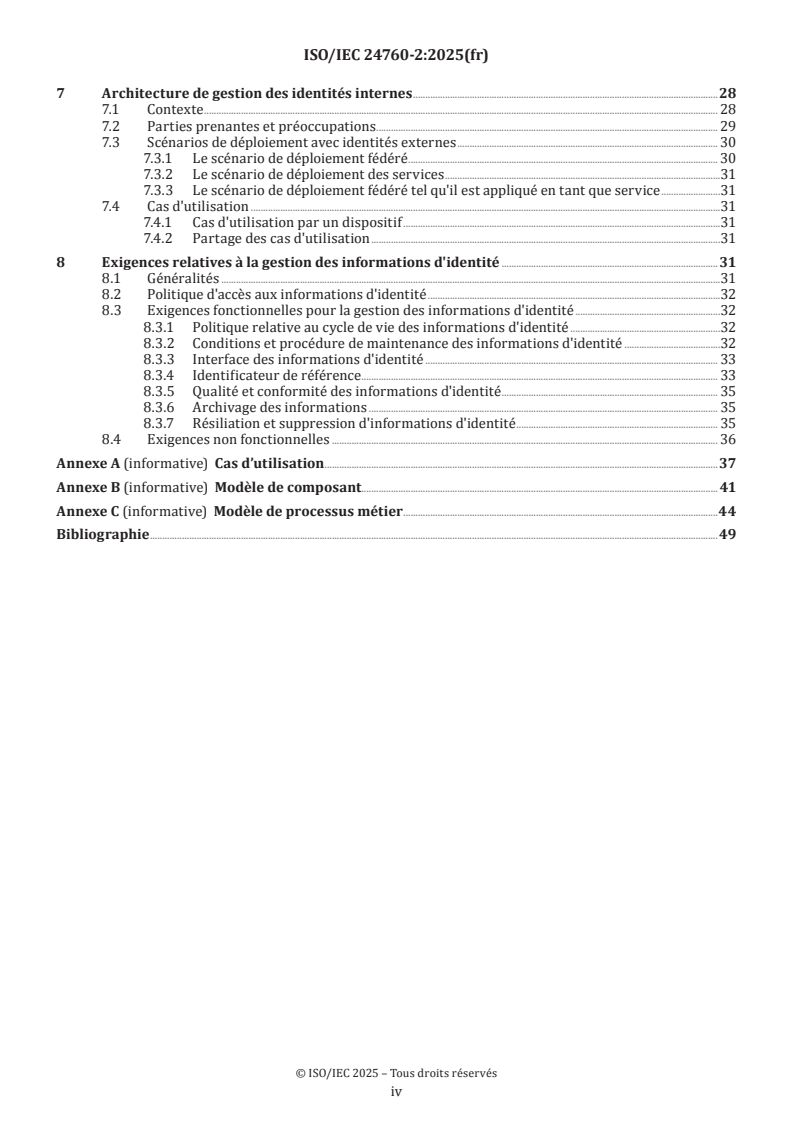
Sommaire Page
Avant-propos .v
Introduction .vi
1 Domaine d'application . 1
2 Références normatives . 1
3 Termes et définitions . 1
4 Symboles et abréviations . 3
5 Architecture de référence . 3
5.1 Généralités .3
5.2 Scénarios de déploiement .3
5.3 Parties prenantes .4
5.3.1 Généralités .4
5.3.2 Mandant .5
5.3.3 Autorité gestionnaire d'identité .5
5.3.4 Autorité gestionnaire des informations d'identité .6
5.3.5 Partie utilisatrice .6
5.3.6 Organisme réglementaire .6
5.3.7 Représentant ou défenseur des consommateurs/citoyens .7
5.4 Acteurs .7
5.4.1 Généralités .7
5.4.2 Mandant .8
5.4.3 Autorité gestionnaire d'identité .9
5.4.4 Autorité d'enregistrement de l'identité .10
5.4.5 Partie utilisatrice .11
5.4.6 Autorité gestionnaire des informations d'identité .11
5.4.7 Fournisseur d'informations d'identité . 12
5.4.8 Vérificateur . 13
5.4.9 Auditeur .14
5.5 Processus et services .14
5.5.1 Documentation.14
5.5.2 Processus de gestion des informations d'identité . 15
5.5.3 Processus de gestion des informations d'identité spécifiques.16
5.5.4 Fonctions supplémentaires .19
5.6 Points de vue .21
5.6.1 Généralités .21
5.6.2 Point de vue contextuel .21
5.6.3 Point de vue fonctionnel . 22
5.7 Cas d'utilisation . 22
5.7.1 Généralités . 22
5.7.2 Cas d'utilisation par un mandant .24
5.8 Composants .24
5.8.1 Généralités .24
5.8.2 Mandant .24
5.8.3 Registre d'identités . 25
5.9 Conformité et gouvernance . 25
5.10 Modèle physique . . 25
6 Architecture de gestion des identités internes, modèle d'entreprise .26
6.1 Contexte . 26
6.2 Parties prenantes et préoccupations . . 26
6.3 Scénario de déploiement de l'entreprise.27
6.4 Cas d'utilisation . 28
6.4.1 Cas d'utilisation par un employé . 28
6.4.2 Cas d'utilisation par un employeur . 28
© ISO/IEC 2025 – Tous droits réservés
iii
7 Architecture de gestion des identités internes .28
7.1 Contexte . 28
7.2 Parties prenantes et préoccupations . . 29
7.3 Scénarios de déploiement avec identités externes . 30
7.3.1 Le scénario de déploiement fédéré . 30
7.3.2 Le scénario de déploiement des services .31
7.3.3 Le scénario de déploiement fédéré tel qu'il est appliqué en tant que service .31
7.4 Cas d'utilisation .31
7.4.1 Cas d'utilisation par un dispositif .31
7.4.2 Partage des cas d'utilisation .31
8 Exigences relatives à la gestion des informations d'identité .31
8.1 Généralités .31
8.2 Politique d'accès aux informations d'identité .32
8.3 Exigences fonctionnelles pour la gestion des informations d'identité .32
8.3.1 Politique relative au cycle de vie des informations d'identité .32
8.3.2 Conditions et procédure de maintenance des informations d'identité .32
8.3.3 Interface des informations d'identité . 33
8.3.4 Identificateur de référence . 33
8.3.5 Qualité et conformité des informations d'identité . 35
8.3.6 Archivage des informations . 35
8.3.7 Résiliation et suppression d'informations d'identité . 35
8.4 Exigences non fonctionnelles . 36
Annexe A (informative) Cas d’utilisation .37
Annexe B (informative) Modèle de composant. 41
Annexe C (informative) Modèle de processus métier .44
Bibliographie .49
© ISO/IEC 2025 – Tous droits réservés
iv
Avant-propos
L'ISO (Organisation internationale de normalisation) et l’IEC (Commission électrotechnique internationale)
forment le système spécialisé de la normalisation mondiale. Les organismes nationaux membres de l'ISO ou
de l’IEC participent au développement de Normes internationales par l'intermédiaire des comités techniques
créés par l'organisation concernée afin de s'occuper des domaines particuliers de l'activité technique.
Les comités techniques de l'ISO et de l’IEC collaborent dans des domaines d'intérêt commun. D'autres
organisations internationales, gouvernementales et non gouvernementales, en liaison avec l'ISO et l’IEC,
participent également aux travaux.
Les procédures utilisées pour élaborer le présent document et celles destinées à sa mise à jour sont décrites
dans les Directives ISO/IEC, Partie 1. Il convient, en particulier de prendre note des différents critères
d'approbation requis pour les différents types de documents. Le présent document a été rédigé conformément
aux règles de rédaction données dans les Directives ISO/IEC, Partie 2 (voir www.iso.org/directives ou
www.iec.ch/members_experts/refdocs).
L’ISO et l’IEC attirent l’attention sur le fait que la mise en application du présent document peut entraîner
l’utilisation d’un ou de plusieurs brevets. L’ISO et l’IEC ne prennent pas position quant à la preuve, à la
validité et à l’applicabilité de tout droit de brevet revendiqué à cet égard. À la date de publication du présent
document, L’ISO et l’IEC n'avaient pas reçu notification qu’un ou plusieurs brevets pouvaient être nécessaires
à sa mise en application. Toutefois, il y a lieu d’avertir les responsables de la mise en application du présent
document que des informations plus récentes sont susceptibles de figurer dans la base de données de
brevets, disponible à l'adresse www.iso.org/brevets et https://patents.iec.ch. L’ISO et l’IEC ne sauraient être
tenues pour responsables de ne pas avoir identifié tout ou partie de tels droits de propriété.
Les appellations commerciales éventuellement mentionnées dans le présent document sont données pour
information, par souci de commodité, à l’intention des utilisateurs et ne sauraient constituer un engagement.
Pour une explication de la nature volontaire des normes, la signification des termes et expressions spécifiques
de l'ISO liés à l'évaluation de la conformité, ou pour toute information au sujet de l'adhésion de l'ISO aux
principes de l’Organisation mondiale du commerce (OMC) concernant les obstacles techniques au commerce
(OTC), voir www.iso.org/iso/avant-propos. Pour l'IEC, voir www.iec.ch/understanding-standards.
Le présent document a été élaboré par le comité technique mixte ISO/IEC JTC 1, Technologies de l'information,
sous-comité SC 27, Sécurité de l'information, cybersécurité et protection de la vie privée.
Cette deuxième édition annule et remplace la première édition (ISO/IEC 24760-2:2015), qui fait l'objet d'une
révision technique.
Les principales modifications sont les suivantes:
— à l'Article 3, les définitions des termes de l'ISO/IEC 24760-1 ont été supprimées;
— pour traiter le concept émergent de l'identité mobile, le terme “IMS privé du mandant” (PPI) a été ajouté
aux Articles 3, 4 et décrit en 5.4.2, 5.4.3 et 5.4.6;
— une partie du contenu de l'Article 5 a été déplacée vers les Articles 6 et 7;
— l'ancienne Annexe A a été supprimée et les annexes existantes ont été réétiquetées.
Une liste de toutes les parties de la série ISO/IEC 24760 se trouve sur les sites Web de l'ISO et de l'IEC.
Le présent document a obtenu le statut de document horizontal conformément aux Directives ISO/IEC,
Partie 1.
Il convient que l'utilisateur adresse tout retour d'information ou toute question concernant le présent
document à l'organisme national de normalisation de son pays. Une liste exhaustive desdits organismes se
trouve aux adresses www.iso.org/fr/members.html et www.iec.ch/national-committees.
© ISO/IEC 2025 – Tous droits réservés
v
Introduction
Les systèmes de traitement des données collectent généralement un éventail d'informations relatives
à leurs utilisateurs, ce qui peut inclure des personnes physiques, des matériels ou des logiciels qui sont
connectés à l'équipement. Sur la base des informations recueillies sur l'identité de l'utilisateur, ces systèmes
de traitement des données prennent des décisions qui peuvent influer sur la manière dont les utilisateurs
accèdent aux ressources informatiques.
Pour répondre à la nécessité de mettre en œuvre de manière efficace et efficiente des systèmes qui prennent
des décisions basées sur l'identité, le présent document spécifie un cadre pour l'émission, l'administration
et l'utilisation des données. Ce cadre sert à caractériser les individus, les organismes ou les composants de
technologie de l'information qui agissent pour le compte d'individus ou d'organismes.
Pour de nombreuses organisations, la gestion adéquate des informations d'identité est essentielle pour le
maintien de la sécurité des processus organisationnels. Pour les individus, une gestion correcte de l'identité
est importante pour la protection de la vie privée.
La série ISO/IEC 24760 spécifie les concepts fondamentaux et les structures opérationnelles pour la gestion
de l'identité et fournit un cadre sur lequel les systèmes d'information peuvent satisfaire aux obligations
métier, contractuelles, réglementaires et légales.
Le présent document définit une architecture de référence pour la gestion de l'identité, y compris les
relations. Ces éléments architecturaux sont décrits par rapport aux scénarios de déploiement de la gestion
de l'identité ou leurs modèles. Le présent document spécifie les exigences relatives à la conception et à la
mise en œuvre d'un système de gestion de l'identité afin qu'il puisse répondre aux objectifs des parties
prenantes impliquées dans le déploiement et l'exploitation de la gestion de l'identité.
Le présent document vise à fournir une base pour la mise en œuvre d'autres normes internationales relatives
au traitement de l'information d'identité, telles que l'ISO/IEC 29100, l'ISO/IEC 29101, l'ISO/IEC 29115 et
l'ISO/IEC 29146.
Le présent document n'est pas une norme de système de management (MSS).
© ISO/IEC 2025 – Tous droits réservés
vi
Norme internationale ISO/IEC 24760-2:2025(fr)
Sécurité de l'information, cybersécurité et protection de la vie
privée — Cadre pour la gestion de l'identité —
Partie 2:
Architecture de référence et exigences
1 Domaine d'application
Le présent document:
— fournit des lignes directrices pour la mise en œuvre de systèmes pour la gestion des informations
d'identité;
— spécifie les exigences relatives à la mise en œuvre et à l'exploitation d'un cadre pour la gestion de
l'identité;
— est applicable à tout système d'information dans lequel les informations relatives à l'identité sont traitées
ou stockées;
— est considéré comme un document horizontal pour les raisons suivantes:
— il applique des concepts tels que la distinction entre le terme “identité” et le terme “identificateur”
concernant la mise en œuvre de systèmes de gestion des informations d'identité et les exigences
relatives à la mise en œuvre et au fonctionnement d'un cadre de gestion de l'identité;
— il apporte une contribution importante à l'évaluation des systèmes de gestion de l'identité en ce qui
concerne leur protection de la vie privée et leur capacité à assurer les attributs pertinents d'une
identité, et par conséquent il fournit une base et une compréhension commune pour toute autre
norme traitant de l'identité, des informations d'identité et de la gestion de l'identité.
2 Références normatives
Les documents suivants sont cités dans le texte de sorte qu’ils constituent, pour tout ou partie de leur
contenu, des exigences du présent document. Pour les références datées, seule l’édition citée s’applique. Pour
les références non datées, la dernière édition du document de référence s'applique (y compris les éventuels
amendements).
ISO/IEC 24760-1, Sécurité de l'information, cybersécurité et protection de la vie privée — Cadre pour la gestion
de l'identité — Partie 1: Concepts fondamentaux et terminologie
ISO/IEC 29115, Technologies de l'information — Techniques de sécurité — Cadre d'assurance de l'authentification
d'entité
3 Termes et définitions
Pour les besoins du présent document, les termes et les définitions de l'ISO IEC 24760-1 ainsi que les suivants
s'appliquent.
L’ISO et l’IEC tiennent à jour des bases de données terminologiques destinées à être utilisées en normalisation,
consultables aux adresses suivantes:
— ISO Online browsing platform: disponible à l’adresse https:// www .iso .org/ obp
© ISO/IEC 2025 – Tous droits réservés
— IEC Electropedia: disponible à l’adresse https:// www .electropedia .org/
3.1
conception documentée
description faisant autorité des aspects structurels, fonctionnels et opérationnels du système
Note 1 à l'article: Une conception documentée est la documentation créée afin de servir de document d'orientation
pour la mise en œuvre d'un système de technologies de l'information et de la communication (ICT).
Note 2 à l'article: Une conception documentée inclut généralement la description d'une architecture concrète du
système ICT.
3.2
autorité gestionnaire d'identité
entité responsable de la définition et de l'application des politiques opérationnelles pour un système de
gestion de l'identité
Note 1 à l'article: Une autorité gestionnaire d'identité commande généralement la conception, la mise en œuvre et le
déploiement d'un système de gestion de l'identité.
EXEMPLE La direction générale d'une entreprise qui déploie un système de gestion de l'identité afin de soutenir
ses services.
3.3
invalidation
processus exécuté dans un système de gestion de l'identité lorsqu'un attribut donné n'est plus valide pour
une entité donnée afin de marquer l'attribut comme étant invalide pour une utilisation future
Note 1 à l'article: L'invalidation des attributs peut faire partie de la mise à jour de la valeur de l'attribut, par exemple,
avec un changement d'adresse.
Note 2 à l'article: L'invalidation se produit généralement pour un attribut qui est identifié comme n'étant plus valide
avant la fin de la période de validité qui lui avait été précédemment associée.
Note 3 à l'article: Le terme de “révocation” est couramment utilisé pour l'invalidation d'attributs qui sont des
justificatifs d'identité.
Note 4 à l'article: L'invalidation se produit généralement immédiatement après avoir déterminé qu'un attribut n'est
plus valable pour une entité donnée.
3.4
organisme réglementaire
organisme reconnu formellement, chargé et habilité par la loi, la réglementation ou un accord à superviser
l'exploitation de systèmes de gestion de l'identité
3.5
partie prenante
rôle, position, personne, organisme ou catégories de rôle, de position, de personne ou d'organisme, ayant un
intérêt, un droit, une part ou une revendication dans une entité d'intérêt
[SOURCE: ISO/IEC IEEE 42010:2022, 3.17, modifié – l'exemple a été supprimé.]
3.6
système de gestion de l'identité privée du mandant
PPI
système de gestion de l'identité contenant des informations d'identité pour un seul mandant, exploité par ce
mandant ou sous son contrôle exclusif
Note 1 à l'article: La formulation “identité mobile” a été utilisée pour, entre autres concepts, faire référence à un
système de gestion de l'identité privée du mandant, par exemple tel qu'il est mis en œuvre sur un téléphone mobile ou
sous la forme d'un jeton de traitement dédié.
© ISO/IEC 2025 – Tous droits réservés
4 Symboles et abréviations
TIC technologie de l'information et de la communication
IMS système de gestion de l'identité
DCP données à caractère personnel
PPI système de gestion de l'identité privée du mandant
UML unified modeling language (langage de modélisation unifié)
5 Architecture de référence
5.1 Généralités
Le présent article décrit les éléments architecturaux pour la gestion de l'identité et les relations entre ces
éléments.
Il convient que la conception documentée de l'architecture de gestion de l'identité soit basée sur
l'ISO/IEC/IEEE 42010 et réponde aux principales préoccupations de ce système, qui peut être l'un ou les
deux des éléments suivants:
a) la gestion des informations d'identité pour les membres d'un organisme (Article 6);
b) la gestion des informations d'identité pour les entités en dehors d'un organisme (Article 7).
NOTE L'architecture de référence et la description de l'architecture spécifiées dans le présent document sont
basées sur l'ISO/IEC/IEEE 42010.
Il convient que la conception documentée pour l'architecture d'un système de gestion de l'identité spécifie
le système dans son contexte de déploiement sur la base des parties prenantes et des acteurs définis dans le
présent document. Les acteurs issus de l'entreprise sont des parties prenantes. Certaines parties prenantes
n'interagissent pas avec le système. La conception documentée doit couvrir les exigences des parties
prenantes, qu'elles soient des acteurs ou non. La conception documentée doit décrire les acteurs de façon
exhaustive.
Il convient qu'une conception documentée pour la gestion de l'identité utilise un langage applicable pour
décrire l'architecture de référence; il convient que les composants et les fonctions de cette architecture
soient étiquetés selon les termes définis dans la série de normes ISO/IEC 24760.
Le présent article donne une vue d'ensemble des composants qui peuvent être présents dans une ou plusieurs
vues architecturales qui peuvent être spécifiées dans une conception documentée, y compris:
— parties prenantes (5.3),
— acteurs (5.4), et
— processus et services (5.5).
Deux points de vue communs pour la gestion de l'identité sont présentés en 5.6.
5.2 Scénarios de déploiement
Un système de gestion de l'identité peut être déployé selon différents scénarios. Un scénario de déploiement
a une incidence sur la gouvernance du système de gestion de l'identité. Le scénario de déploiement détermine
les relations de confiance qui existent entre les parties impliquées dans l'exploitation et la gouvernance du
système de gestion de l'identité.
© ISO/IEC 2025 – Tous droits réservés
Un scénario de déploiement peut être choisi lors de l'extension d'un système de gestion de l'identité
existant. Un modèle de déploiement d'extension peut être différent du modèle de déploiement d'origine ou
d'entreprise.
Les différents scénarios de déploiement qui peuvent être utilisés pour mettre en œuvre un système de
gestion de l'identité sont les suivants:
— le scénario d'entreprise (6.3);
— le scénario fédéré (7.3.1);
— le scénario de service (7.3.2);
— le scénario fédéré tel qu'il est appliqué en tant que service (7.3.3).
5.3 Parties prenantes
5.3.1 Généralités
La conception documentée peut reconnaître les parties prenantes directes et indirectes suivantes:
— mandant;
— autorité gestionnaire d'identité;
— autorité gestionnaire des informations d'identité;
— partie utilisatrice;
— organisme réglementaire;
— auditeur;
— évaluateur;
— fournisseur de services en nuage; et
— représentant ou défenseur des consommateurs/citoyens.
Chaque partie prenante assume une fonction différente dans le système de gestion de l'identité. Ces fonctions
impliquent des responsabilités et obligations spécifiques.
NOTE 1 L'objectif du déploiement d'un système de gestion de l'identité et l'environnement réglementaire de ce
déploiement indiquent l'implication des parties prenantes.
Les parties prenantes d'un système particulier de gestion de l'identité peuvent être associées à différents
organismes commerciaux ou publics avec leurs intérêts dans le système façonné par cette affiliation.
Comme les informations relatives au système disponibles pour différentes parties prenantes peuvent être
différentes, il convient que les interactions entre les parties prenantes soient basées sur des relations de
confiance explicitement établies.
La conception documentée doit spécifier les représentations concrètes de ses parties prenantes et acteurs,
tels que définis en 5.3 et 5.4, respectivement. La conception documentée peut ajouter des parties prenantes
ou des acteurs supplémentaires. Elle peut spécifier les parties prenantes et acteurs identifiés en 5.3 et 5.4
avec de multiples représentations distinctes.
Les parties prenantes spécifiées dans le présent document peuvent également être des acteurs. Les parties
prenantes autres que les acteurs sont un organisme de réglementation et un représentant ou un défenseur
des consommateurs/citoyens.
© ISO/IEC 2025 – Tous droits réservés
Les préoccupations des parties prenantes d'un système de gestion de l'identité sont décrites en 5.3.2 et
5.3.7 et il convient qu'elles soient prises en compte dans la conception documentée, la mise en œuvre et
l'exploitation du système.
NOTE 2 Les préoccupations exprimées pour chaque type de partie prenante sont prises en compte avec des
références lors de l'élaboration des Articles 6 et 7. Les mêmes références peuvent également être utilisées pour
documenter une architecture de référence.
5.3.2 Mandant
Les préoccupations d'un mandant d'un système de gestion de l'identité incluent:
— l'exactitude des informations d'identité collectées, traitées et stockées (peut être citée comme “exactitude
des données”);
— la minimisation des informations d'identité collectées, traitées et stockées par le système de gestion de
l'identité (peut être citée comme “minimisation des données”);
— la minimisation de l'utilisation des informations d'identité par le système de gestion de l'identité dans
son domaine d'applicabilité (peut être citée comme “minimisation du partage d'information”);
— la capacité des différentes parties utilisatrices à corréler les informations d'identité pour un seul mandant
(peut être citée comme “corrélation du mandant”);
— la capacité d'une partie utilisatrice à établir un lien positif entre le mandant et les informations d'identité
enregistrées reçues et les informations d'identité qu'elle a déjà stockées, par exemple un compte
utilisateur (peut être citée comme “authentification correcte”);
— les erreurs d'identification, y compris l'identification de faux négatifs et de faux positifs, ainsi que la
détection et le traitement des erreurs (peut être citée comme “identification correcte”);
— la connaissance et le consentement au partage des informations d'identité avec des tiers (peut être citée
“informations et consentement”);
— être correctement représenté par des informations d'identité qui sont capturées, traitées ou stockées
(peut être citée comme “informations représentatives”);
— l'exactitude des opérations dans la fourniture des services et l'accès aux ressources mises à disposition
sur la base des attributs présentés dans une situation spécifique (peut être citée comme “bon
fonctionnement”);
— la collecte, le traitement et le stockage des informations d'identité n'ont lieu qu'avec son consentement
éclairé (peut être cité comme “consentement au traitement”);
— le traitement équitable dans ses interactions avec le système (peut être cité comme “équitable”); et
— une interface utilisateur compréhensible, efficace et appropriée (peut être citée comme “compréhensible”).
NOTE Une préoccupation d'un mandant concernant la manière dont un service tiers utilise des informations
d'identité obtenues à partir du système de gestion de l'identité n'est pas une préoccupation relative au système
de gestion de l'identité lui-même. Par conséquent, une telle préoccupation n'est pas traitée explicitement dans la
conception documentée.
5.3.3 Autorité gestionnaire d'identité
Les préoccupations de l'autorité gestionnaire d'identité d'un système de gestion de l'identité incluent:
— définition des objectifs de gestion de l'identité pour le(s) domaine(s) couvert(s) par le système de gestion
de l'identité (peuvent être cités comme “objectifs définis”);
— spécification des politiques destinées à maintenir à jour les objectifs de gestion de l'identité pour le(s)
domaine(s) couvert(s) par le système de gestion de l'identité (peuvent être citées comme “politiques
spécifiées”);
© ISO/IEC 2025 – Tous droits réservés
— réalisation des objectifs métier du système de gestion de l'identité en ce qui concerne les mandants
et les utilisateurs des informations d'identité (peuvent être cités comme “répondre aux objectifs de
l'utilisateur”);
— réalisation des objectifs opérationnels des relations avec d'autres services de gestion de l'identité
(peuvent être citées comme “objectifs de rencontre avec des tiers”);
— exactitude des informations d'identité fournies par chaque mandant en ce qui concerne ce mandant et un
niveau de garantie spécifique (peuvent être citées comme “informations correctes”);
— conformité à la réglementation (peut être citée comme “conformité”).
5.3.4 Autorité gestionnaire des informations d'identité
Les préoccupations d'une autorité gestionnaire des informations d'identité d'un système de gestion de
l'identité incluent:
— l'exhaustivité, l'exactitude et la fraîcheur des informations d'identité (peut être citée comme “qualité des
données”);
— la satisfaction des exigences des parties utilisatrices (peut être citée comme “répondre aux besoins des
parties utilisatrices”);
— l'efficacité des méthodes cryptographiques pour faire valoir les informations d'identité (peut être citée
comme “affirmation appropriée”);
— l'efficacité des méthodes cryptographiques permettant de dé-identifier les informations d'identité (peut
être citée comme “dé-identification effective”);
— conformité à la réglementation (peut être citée comme “conformité”) et;
— le respect des obligations métier vis-à-vis des mandants (peut être cités comme “atteindre les objectifs
des mandants”).
5.3.5 Partie utilisatrice
Les préoccupations d'une partie utilisatrice d'un système de gestion de l'identité incluent:
— confidentialité, disponibilité et intégrité et applicabilité à un mandant des informations d'identité
(peuvent être citées comme “informations d'identité requises”);
— fourniture d'informations d'identité exactes concernant les mandants pertinents au niveau d'assurance
requis (peut être citée comme “qualité des informations”);
— interfaces efficaces, documentées et sécurisées (peut être citées comme “interfaces utilisables”);
— conformité à la réglementation applicable à ses opérations (peut être citée comme “conformité”);
— mécanisme et des procédures d'audit efficaces (peut être cité comme “audit”).
5.3.6 Organisme réglementaire
En tant qu'organisation externe indépendante, les préoccupations d'un organisme réglementaire d'un
système de gestion de l'identité incluent:
— la documentation adéquate des politiques d'exploitation (peuvent être citées comme “politiques
documentées”);
— l'exactitude du fonctionnement, particulièrement dans l'application des politiques opérationnelles (peut
être citée comme “bon fonctionnement”);
— la responsabilité et l'audit adéquats des opérations du système (peut être citée “responsabilité”);
© ISO/IEC 2025 – Tous droits réservés
— la conformité de la politique et des pratiques opérationnelles aux exigences légales et réglementaires
(peut être citée comme “conformité”);
— un rapport efficace sur les opérations du système, y compris l'efficacité des mesures de sécurité, les
incidents et les mesures prises pour surmonter les incidents (peut être cité comme “rapport efficace”); et
— une réponse efficace aux incidents qui violent, ou sont susceptibles de violer la protection de la vie privée
(peut être citée comme “réactivité aux incidents”).
NOTE En effet, les auditeurs, en tant qu'acteurs d'un système de gestion de l'identité (voir 5.4.9), en inspectant
les opérations d'un système de gestion de l'identité (voir 5.5), peuvent représenter les intérêts des organismes
réglementaires.
5.3.7 Représentant ou défenseur des consommateurs/citoyens
Les défenseurs des consommateurs/citoyens sont des personnes ou des groupes issus de la société civile
qui tentent de protéger les consommateurs et les citoyens contre la surveillance et qui militent pour
l'amélioration des réglementations relatives à la vie privée.
Les représentants des consommateurs/citoyens sont des personnes nommées par un mandant ou
sélectionnées par des organisations de consommateurs pour représenter un consommateur ou un citoyen
dans ses droits en matière de vie privée.
Les principales préoccupations des représentants et des défenseurs des consommateurs/citoyens sont les
suivantes:
— transparence, notification, conformité et protection contre le langage juridique complexe (peut être cité
comme “langage clair”);
— disponibilité des procédures permettant d'exercer les droits du consommateur/citoyen (peuvent être
citées comme “procédures accessibles”);
— accès des populations défavorisées aux services (peuvent être cités comme “services accessibles”).
NOTE 1 Les représentants des consommateurs et des citoyens participent à des processus sociétaux reconnus
impliquant de multiples parties prenantes, tels que la gouvernance, et établissent les bonnes pratiques et les exigences
à respecter par ceux qui fournissent des biens et des services aux consommateurs et aux citoyens.
NOTE 2 Les représentants des consommateurs et des citoyens sont sélectionnés, informés et, si nécessaire, formés
afin de garantir qu'ils participent à des discussions raisonnables et raisonnées, basées dans la mesure du possible sur
des preuves de bonne qualité.
5.4 Acteurs
5.4.1 Généralités
Un acteur interagit avec un système de gestion de l'identité afin de participer à des opérations de gestion de
l'identité. Une entité peut interagir avec le même système de gestion de l'identité sous la forme de multiples
acteurs différents. La conception documentée doit définir toutes les interactions de tout acteur pris en
charge par le système.
NOTE 1 Les acteurs peuvent être directement liés au domaine qui utilise un IMS ou ils peuvent être des tiers, ce qui
peut être un autre IMS.
Il convient que la conception documentée décrive les interactions des acteurs en termes de fonctions
auxquelles les interactions se rapportent. Lorsque l'authentification préalable d'un acteur qui interagit
avec le système de gestion de l'identité est requise pour que les interactions soient autorisées, la conception
documentée doit spécifier la base de l'authentification (par exemple: authentification basée sur l'entité,
© ISO/IEC 2025 – Tous droits réservés
basée sur le rôle), la méthode d'authentification et le niveau d'assurance requis pour chaque interaction, tel
que défini dans l'ISO/IEC 29115.
NOTE 2 L'une des finalités de la spécification des acteurs dans la conception d'un système de gestion de l'identité
est d'être en mesure de décrire toutes les interactions prévues avec le système.
Une conception documentée peut reconnaître les acteurs suivants:
— mandant;
— autorité gestionnaire d'identité;
— autorité d'enregistrement de l'identité;
— partie utilisatrice;
— fournisseur d'informations d'identité;
— autorité gestionnaire des informations d'identité;
— vérificateur;
— auditeur.
La conception documentée doit spécifier le niveau d'assurance requise pour l'identification et
l'authentification des entités qui demandent l'accès aux informations d'identité contenues dans son
système de gestion de l'identité, conformément à l'ISO/IEC 29115. Le niveau d'assurance peut être différent
pour différents types d'informations et selon le type d'accès accordé, c'est-à-dire lecture, écriture, etc.
L'autorisation peut être mise en œuvre tel que spécifié dans l'ISO/IEC 29146.
5.4.2 Mandant
Un mandant est un acteur qui fournit des informations d'identification pour établir et valider ses
informations d'identité au sein des processus de gestion de l'identification. Le mandant a les
...