


ISO/IEC 8473-1:1994
(Main)Information technology — Protocol for providing the connectionless-mode network service: Protocol specification
Information technology — Protocol for providing the connectionless-mode network service: Protocol specification
Technologies de l'information — Protocole assurant le service réseau en mode sans connexion: Spécification du protocole
General Information
- Status
- Withdrawn
- Publication Date
- 13-Jul-1994
- Withdrawal Date
- 13-Jul-1994
- Current Stage
- 9599 - Withdrawal of International Standard
- Start Date
- 22-Oct-1998
- Completion Date
- 14-Feb-2026
Relations
- Effective Date
- 06-Jun-2022
- Effective Date
- 06-Jun-2022
- Effective Date
- 06-Jun-2022
- Effective Date
- 16-Oct-2025
- Effective Date
- 15-Apr-2008
- Effective Date
- 15-Apr-2008
- Effective Date
- 15-Apr-2008
- Effective Date
- 15-Apr-2008
- Effective Date
- 15-Apr-2008
Buy Documents

ISO/IEC 8473-1:1994 - Information technology -- Protocol for providing the connectionless-mode network service: Protocol specification
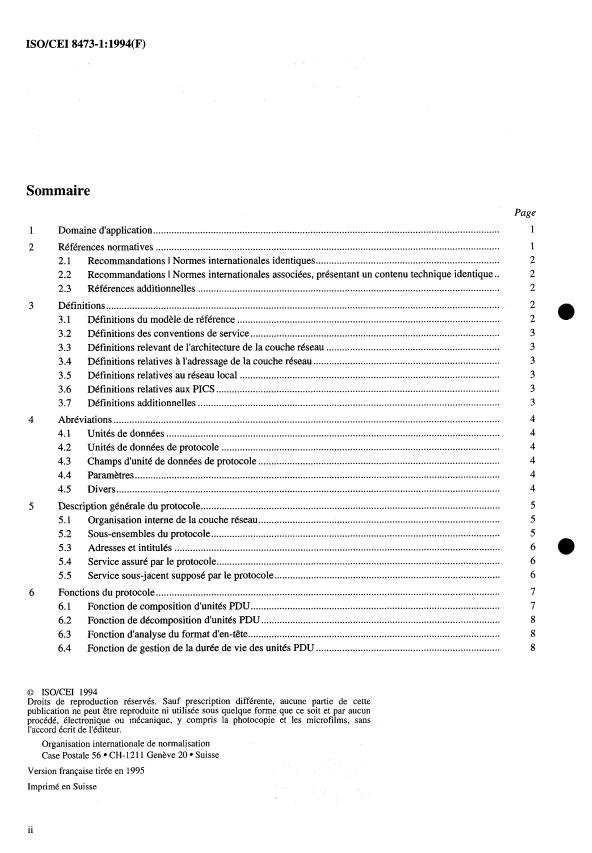


ISO/IEC 8473-1:1994 - Technologies de l'information -- Protocole assurant le service réseau en mode sans connexion: Spécification du protocole
Get Certified
Connect with accredited certification bodies for this standard

BSI Group
BSI (British Standards Institution) is the business standards company that helps organizations make excellence a habit.

NYCE
Mexican standards and certification body.
Sponsored listings
Frequently Asked Questions
ISO/IEC 8473-1:1994 is a standard published by the International Organization for Standardization (ISO). Its full title is "Information technology — Protocol for providing the connectionless-mode network service: Protocol specification". This standard covers: Information technology — Protocol for providing the connectionless-mode network service: Protocol specification
Information technology — Protocol for providing the connectionless-mode network service: Protocol specification
ISO/IEC 8473-1:1994 is classified under the following ICS (International Classification for Standards) categories: 35.100.30 - Network layer. The ICS classification helps identify the subject area and facilitates finding related standards.
ISO/IEC 8473-1:1994 has the following relationships with other standards: It is inter standard links to ISO/IEC 8473-1:1994/Amd 3:1996, ISO/IEC 8473-1:1994/Amd 1:1995, ISO/IEC 8473-1:1994/Amd 2:1996, ISO 8473:1988/Cor 1:1992, ISO 8473:1988, ISO/IEC 8473-1:1998; is excused to ISO/IEC 8473-1:1994/Amd 3:1996, ISO/IEC 8473-1:1994/Amd 2:1996, ISO/IEC 8473-1:1994/Amd 1:1995. Understanding these relationships helps ensure you are using the most current and applicable version of the standard.
ISO/IEC 8473-1:1994 is available in PDF format for immediate download after purchase. The document can be added to your cart and obtained through the secure checkout process. Digital delivery ensures instant access to the complete standard document.
Standards Content (Sample)
I NTERNAT I ON AL ISO/IEC
STANDARD
First edition
1994-07-1 5
Information technology - Protocol for
providing the connectionless-mode
network service: Protocol specification
Technologies de i'information - Protocole de fourniture de service de
réseau en mode sans connexion: Spécification du protocole
Reference number
ISO/IEC 8473-1 :I 994(E)
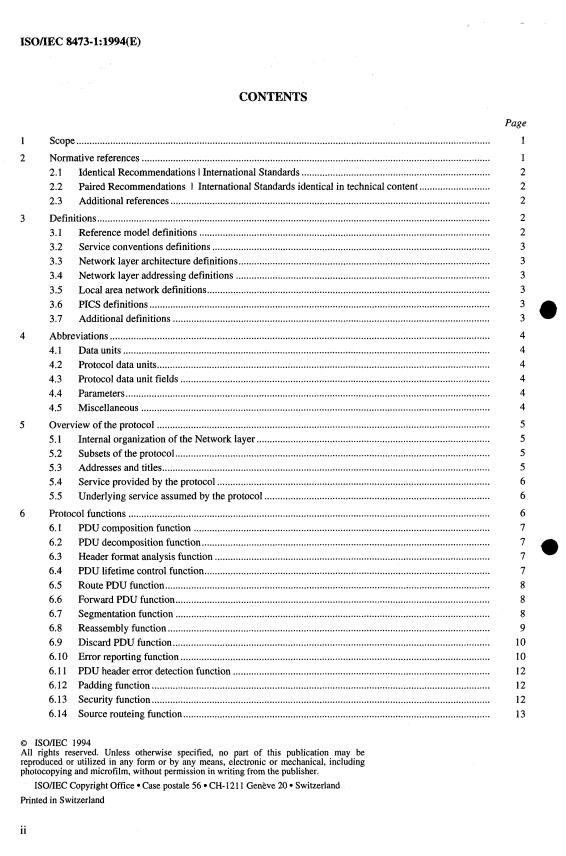
ISOAEC 8473-1: 1994(E)
CONTENTS
Page
Scope .
Normative references . 1
2.1 Identical Recommendations I International Standards . 2
2.2 Paired Recommendations I International Standards identical in technical content .
2.3 Additional references . 2
Definitions .
3.1 Reference model definitions . 2
3.2 Service conventions definitions . 3
3.3 Network layer architecture definitions . 3
3.4 Network layer addressing definitions .
3.5 Local area network definitions .
3.6 PICS definitions . 3
3.7 Additional definitions . 3
Abbreviations . 4
4.1 Data units .
4.2 Protocol data units . 4
4.3 Protocol data unit fields . 4
4.4 Parameters .
4.5 Miscellaneous . 4
Overview of the protocol .
Internal organization of the Network layer . 5
5.1
Subsets of the protocol . 5
5.2
5.3 Addresses and titles .
Service provided by the protocol . 6
5.4
Underlying service assumed by the protocol . 6
5.5
Protocol functions . 6
6.1 PDU composition function .
6.2 PDU decomposition function .
6.3 Header format analysis function . 7
6.4 PDU lifetime control function . 7
6.5 Route PDU function . 8
6.6 Forward PDU function . 8
6.7 Segmentation function . 8
6.8 Reassembly function . 9
6.9 Discard PDU function . 10
6.1 O Error reporting function .
6.1 1 PDU header error detection function . 12
6.12 Padding function . 12
6.13 Security function .
6.14 Source routeing function .
0 ISO/IEC 1994
All rights reserved . Unless otherwise specified. no part of this publication may be
reproduced or utilized in any form or by any means. electronic or mechanical. including
photocopying and microfilm. without permission in writing from the publisher .
ISO/IEC Copyright Office Case postale 56 CH-1211 Genkve 20 Switzerland
Printed in Switzerland
ii
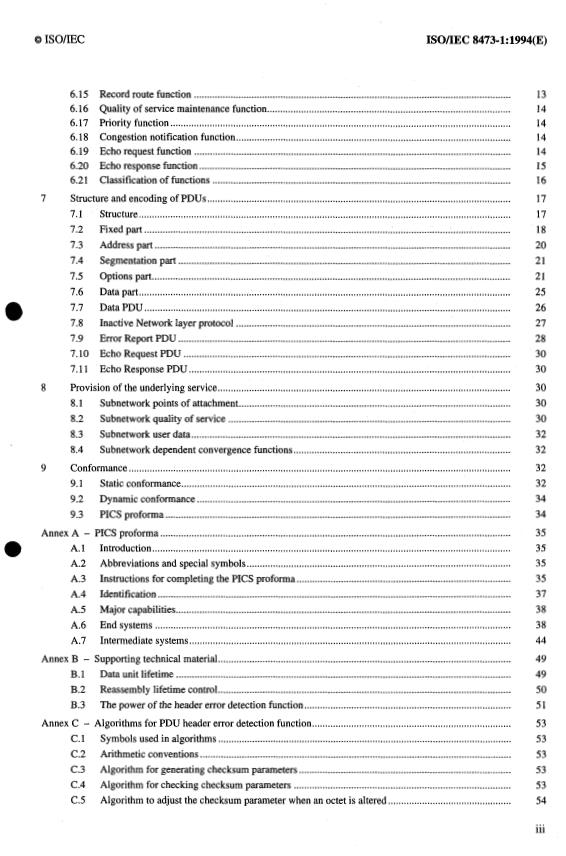
0 ISO/IEC ISOAEC 8473-1:1994(E)
6.15 Record route function . 13
6.16 Quality of service maintenance function . 14
6.17 Priority function . . . . . . . . . . . . . . . . . . . .
6.18 Congestion notification function . . . 14
6.19 Echo request function . . . 14
6.20 Echo response function .
6.21 Classification of functions . . .
Structure and encoding of PDUs . . . . . . . . . . . . . . . .
7 17
7.1 Structure . 17
7.2 Fixed part . . . 18
7.3 Address part . . . . . . . . . . . . . . . . . . . . . . . 20
7.4 Segmentation part .
7.5 Options part. . . . . . . . . . . . ,. . . . . . . . . . . . . . . . 21
7.6 Datapart . . . . . . 25
7.7 DataPDU . . . . 26
7.8 Inactive Network layer protocol .
7.9 Error Report PDU . . , . . . . . . . . . . . . . . . . . . . . . . . . . . . . . . . . . . . . . . . . . . . . . . . . . . . . . . . . . . . . . . . . . . . . . . . . . . . . . . . . . . . . . . . . . . . . . . . . . . . . . . . . . . .
7.1 O Echo Request PDU . . . . . . . . . . . . . . . . . . . . . . . . . . . . . . . . . . . . . . . . . . . . . . . . . . . . . . . . . . . ,. . . . . . . . . . . . . . . . . . . . . . . . . . . . . . . . . . . . . . . . . . 30
7.1 1 Echo Response PDU . . . ,. . . . . . . . . . . . . . . . . . . . . . . . . . . . . . . 30
Provision of the underlying service . . . . . . . . ,. . . . . . . . . . . . . . . . . 30
8.1 Subnetwork points of attachment .
8.2 Subnetwork quality of service .
8.3 Subnetwork user data . 32
8.4 Subnetwork dependent convergence functions . . . . . . . . . . . . . . 32
Conformance. . . . . . . . . . . . . . . . . . . . . . . . . . . . . .
9 32
9.1 Static conformance . 32
9.2 Dynamic conformance . . . . . .
9.3 PICS proforma . 34
Annex A - PICS proforma . 35
A. 1 Introduction . 35
A.2 Abbreviations and special symbols . . . . . . ,. . . . . . . . . . . 35
A.3 Instructions for completing the PICS proforma . . . 35
A.4 Identification . . . 37
A.5 Major capabilities. . . . . . . . . . . . . . . . . . . . . . . . . . . . . . . . . . . . . . . . , . . . . . . , . . . . , . . . . . . . . . . . . . . . . . . . . . . . . . . . . . . . . . . . . . . . . . . . . . . . . . .
A.6 End systems . . . . . . . . . . . . . . . . . . . . . . . . . . . . . . . . . . . . . . .
A.7 Intermediate systems . . . . . . . . . . . . . . . . . ,. . . . . . . . . . . . . . . . .
Annex €3 - Supporting technical material . . . 49
Data unit lifetime . . . . . . . . . . . . . . . . . . . . . 49
B. 1
Reassembly lifetime control . . . . . . . . . . . . . . . . . . . . . . . . . . . . 50
B.2
The power of the header error detection function . 51
B.3
Annex C - Algorithms for PDU header error detection function .
Symbols used in algorithms . . . . . . . . . . , . . . . . . . . . . . . . .
C. 1 53
Arithmetic conventions . . . . . . . . . . . . , . . . . . . . . . . . . .
C.2 53
Algorithm for generating checksum parameters . . . . . . . . . . . . . . . . . . . . . . . . . 53
C.3
C.4 Algorithm for checking checksum parameters . . 53
Algorithm to adjust the checksum parameter when an octet is altered . . . I
C.5 54
...
0 ISO/IEC
IS0 (the International Organization for Standardization) and IEC (the Inter-
national Electrotechnical Commission) form the specialized system for worldwide
standardization. National bodies that are members of IS0 or IEC participate in the
development of International Standards through technical committees established
by the respective organization to deal with particular fields of technical activity.
IS0 and IEC technical committees collaborate in fields of mutual interest. Other
international organizations, governmental and non-governmental, in liaison with
IS0 and IEC, also take part in the work.
In the field of information technology, IS0 and IEC have established a joint
technical committee, ISO/IEC JTC 1. Draft International Standards adopted by the
joint technical committee are circulated to national bodies for voting. Publication
as an International Standard requires approval by at least 75 % of the national
bodies casting a vote.
International Standard ISOAEC 8473-1 was prepared by Joint Technical
Committee ISOAEC JTC 1, Information technology, Subcommittee SC 6,
Telecommunications and information exchange between systems, in collaboration
with ITU-T. The identical text is published as CCITT Recommendation X.233.
ISOLEC 8473 consists of the following parts, under the general title Information
technology - Protocol for providing the connectionless-mode network service:
- Part 1: Protocol specijkation
Annex A forms an integral part of this part of ISOAEC 8473. Annexes B and C
are for information only.
ISOBEC 8473-1:1994(E)
0 ISO/IEC
Introduction
This is one of a set of Recommendations and International Standards produced to facilitate the interconnection of open
systems. The set covers the services and protocols required to achieve such interconnection.
This Recommendation I International Standard is positioned with respect to other related Recommendations and
International Standards by the layers defined in ITU-T Rec. X.200 I ISOREC 7498-1. In particular, it is a protocol of the
Network layer. The protocol specified by this Recommendation I International Standard may be used between Network
entities in end systems, between Network entities in intermediate systems, or between a Network entity in an end system
and a Network entity in an intermediate system. In an end system, it provides the connectionless-mode Network service
defined in CCITT Rec. X.213 I ISO/IEC 8348.
The interrelationship of the protocol specification and the related service definitions is illustrated in Figure Intro. 1.
OS1 Network seMce
Reference to aims
specificaîion
Reference to assumptions
Underlying service
II T0718880-93/do1
Figure htro. - Interrelationship of protocol and services
In order to evaluate the conformance of a particular implementation of this protocol, it is necessary to have a statement
of which of the protocol’s capabilities and options have been implemented. Such a statement is called a Protocol
Implementation Conformance Statement (PICS), as defined in CCITT Rec. X.290 I ISOREC 9646-1. A PICS proforma,
from which a PICS may be prepared for a specific implementation, is included in this Recommendation I International
Standard as normative Annex A.
V
ISO/IEC 8473-1 : 1994 (E)
INTERNATIONAL STANDARD
CCITT RECOMMENDATION
INFORMATION TECHNOLOGY - PROTOCOL FOR PROVIDING
THE CONNECTIONLESS-MODE NETWORK SERVICE:
PROTOCOL SPECIFICATION
1 Scope
This Recommendation I International Standard specifies a protocol that is used to provide the connectionless-mode
Network service described in CCITT Rec. X.213 I ISODEC 8348 and to perform certain Network layer management
functions. The protocol relies upon the provision of an underlying connectionless-mode service by real subnetworks
nd/or data links. The underlying connectionless-mode service assumed by the protocol may be obtained either directly,
@r om a connectionless-mode real subnetwork, or indirectly, through the operation of an appropriate Subnetwork
Dependent Convergence Function (SNDCF) or Protocol (SNDCP) over a connection-mode real subnetwork, as
described in ISODEC 8648. This Recommendation I International Standard specifies the operation of the protocol with
respect to a uniform, abstract “underlying subnetwork service”. Other Recommendations I International Standards
specify the way in which this “underlying subnetwork service” is obtained from real subnetworks, such as those which
conform to ISODEC 8802 or ISOAEC 8208. The “underlying subnetwork service” may be obtained from real
subnetworks other than those that are specifically covered by the other Recommendations I International Standards.
This Recommendation I International Standard specifies
procedures for the connectionless transmission of data and control information from one Network entity
a)
to a peer Network entity;
the encoding of the protocol data units (PDUs) used for the transmission of data and control information,
b)
comprising a variable-length protocol header format;
procedures for the correct interpretation of protocol control information; and
c)
the functional requirements for implementations claiming conformance to this Recommendation I
d)
International Standard.
whe procedures are defined in terms of
the interactions among peer Network entities through the exchange of protocol data units;
a)
the interactions between a Network entity and a Network service user through the exchange of Network
b)
service primitives; and
the interactions between a Network entity and an abstract underlying service provider through the
c)
exchange of service primitives.
This Recommendation I International Standard also provides the PICS proforma for this protocol, in compliance with the
relevant requirements, and in accordance with the relevant guidance, given in CCITT Rec. X.290 I ISODEC 9646-1.
2 Normative references
The following Recommendations and International Standards contain provisions which, through reference in this text,
constitute provisions of this Recommendation I International Standard. At the time of publication, the editions indicated
were valid. All Recommendations and Standards are subject to revision, and parties to agreements based on this
Recommendation I International Standard are encouraged to investigate the possibility of applying the most recent
editions of the Recommendations and Standards listed below. Members of IEC and IS0 maintain registers of currently
valid International Standards. The Telecommunication Standardization Bureau of the ITU maintains a list of the
currently valid ITU-T Recommendations.
ITU-T Rec. X.233 (1993 E) 1
ISO/IEC 8473-1 : 1994 (E)
2.1 Identical Recommendations I International Standards
-
ITU-T Recommendation X.200 (1994) I ISOAEC 7498-1: 1994, Information technology - Open Systems
Interconnection - Reference Model: Basic Reference Model.
-
ITU-T Recommendation X.210 (1993) I ISOAEC 1073 1 : 1993, Information technology - Open Systems
Interconnection - Conventions for the definition of OS1 services.
-
CCITT Recommendation X.213 (1992) I ISOAEC 8348: 1992, Information technology -Network service
definition for Open Systems Interconnection.
2.2
Paired Recommendations I International Standards identical in technical content
-
ITU-T Recommendation X.224 (1 993), Protocol for providing the OSI connection-mode Transport
service.
ISOAEC 8073: 1992, Information technology - Telecommunications and information exchange between
systems - Open Systems Interconnection - Protocol for providing the connection-mode transport service.
-
CCITT Recommendation X.290 (1992), OS1 conformance testing methodology and framework for
protocol Recommendations for CCITir applications - General concepts.
ISOAEC 9646-1 : 199 1, Information technology - Open Systems Interconnection - Conformance testin@
methodology and framework: General concepts.
2.3 Additional references
-
ITU-T Recommendation X.25 (1993), Inter$ace between data terminal equipment (DTE) and data
circuit-termirtating equipment (DCE) for terminals operating in the packet mode and connected to public
data networks by dedicated circuit.
-
ISOAEC 8208: 1990, Information technology - Data communications - X.25 Packet byer Protocol for
Data Terminai Equipment.
- ISOAEC 8648: 1988, Information processing systems - Open Systems Interconnection - Internal
organization of the network layer.
-
ISOiiEC 8802: 1990, Information processing systems - Data communications - Local area networks.
3 Definitions
For the purposes of this Recommendation I International Standard, the following definitions apply.
3.1 Reference model definitions
This Recommendation I International Standard makes use of the following terms defined in ITU-T Rec. X.200 I
ISOAEC 7498-1 :
end system;
Network entity;
Network layer;
Network protocol;
Network protocol data unit;
Network relay;
Network service;
Network service access point;
Network service access point address;
routeing ;
service;
service data unit;
service primitive.
ITU-T Rec. X.233 (1993 E)
ISOBEC 8473-1 : 1994 (E)
3.2 Service conventions definitions
This Recommendation I International Standard makes use of the following terms defined in ITU-T Rec. X.210 I
ISOAEC 10731:
a) service provider;
b) service user.
3.3 Network layer architecture definitions
This Recommendation I International Standard makes use of the following terms defined in ISOhEC 8648:
intermediate system;
relay system;
subnetwork;
subnetwork dependent convergence protocol;
subnetwork dependent convergence function;
subnetwork independent convergence protocol;
subnetwork independent convergence function;
subnetwork access protocol.
Network layer addressing definitions
Y4
This Recommendation I International Standard makes use of the following terms defined in CCITT Rec. X.213 I
ISOAEC 8348:
a) Network addressing domain;
b) Network protocol address information;
c) subnetwork point of attachment.
3.5 Local area network definitions
This Recommendation I Internationai Standard makes use of the following term defined in ISOAEC 8802:
local area network
3.6 PICS definitions
This Recommendation I International Standard makes use of the following terms defined in CCITT Rec. X.290 I
ISODEC 9646- 1 :
a) PICS proforma;
a
b) protocol implementation conformance statement.
3.7 Additional definitions
3.7.1 derived PDU: A protocol data unit the fields of which are identical to those of an initial PDU, except that it
carries only a segment of the user data from an N-UNITDATA request.
initial PDU: A protocol data unit carrying the whole of the user data from an N-UNITDATA request.
3.7.2
3.7.3 local matter: A decision made by a system concerning its behaviour in the Network layer that is not
prescribed or constrained by this Recommendation I International Standard.
3.7,4 Network entity title: An identifier for a Network entity which has the same abstract syntax as an NSAP
address, and which can be used to unambiguously identify a Network entity in an end or intermediate system.
3.7.5 reassembly: The act of regenerating an initial PDU from two or more derived PDUs.
3.7.6 segment: A distinct unit of data consisting of part of the user data provided in the N-UNITDATA request and
delivered in the N-UNITDATA indication.
3.7.7 segmentation: The act of generating two or more derived PDUs from an initial or derived PDU. The derived
PDUs together carry the entire user data of the initial or derived PDU from which they were generated.
ITU-T Rec. X.233 (1993 E)
ISO/IEC 8473-1 : 1994 (E)
4 Abbreviations
For the purposes of this Recommendation I International Standard, the following abbreviations apply:
4.1 Dataunits
NSDU Network service data unit
PDU protocol data unit
SDU service data unit
SNSDU subnetwork service data unit
4.2 Protocol data units
DT PDU
data protocol data unit
ER PDU error report protocol data unit
ERP PDU
echo reply protocol data unit
ERQ PDU echo request protocol data unit
4.3 Protocol data unit fields
DA destination address
DAL destination address length
DUID
data unit identifier
ER error report flag
LI
length indicator
LT lifetime
MS
more segments flag
NLPID Network layer protocol identifier
SA
source address
SAL source address length
SL segment length
so
segment offset
SP segmentation permitted flag
4.4 Parameters
a
DA destination address
QOS quality of service
SA source address
I
4.5 Miscellaneous
CLNP
connectionless-mode network protocol (i.e. the protocol defined in this Recommendation I
International Standard)
NPAI Network protocol address information
NS Network service
NSAP Network service access point
PICS protocol implementation conformance statement
SN subnetwork
SNAcP subnetwork access protocol
SNDCF subnetwork dependent convergence function
subnetwork dependent convergence protocol
SNDCP
SNICP subnetwork independent convergence protocol
SNPA subnetwork point of attachment
4 ITU-T Rec. X.233 (1993 E)
ISODEC 8473-1 : 1994 (E)
5 Overview of the protocol
5.1 Internal organization of the Network layer
The architectural organization of the Network layer is described in ISOAEC 8648. ISOAEC 8648 identifies and
categorizes the way in which functions can be performed within the Network layer by Network layer protocols,
thus providing a uniform framework for describing how protocols operating either individually or cooperatively in
OS1 Network service. This protocol is designed to be used in the context of
the Network layer can be used to provide the
the internetworking protocol approach to the provision of the connectionless-mode Network service defined in
ISO/IEC 8648.
This protocol is intended for use in the Subnetwork Independent Convergence Protocol (SNICP) role. A protocol which
fulfills the SNICP role operates to construct the OS1 Network service over a defined set of underlying services,
performing functions which are necessary to support the uniform appearance of the OS1 connectionless-mode Network
service over a homogeneous or heterogeneous set of interconnected subnetworks. This protocol is defined to
accommodate variability where subnetwork dependent convergence protocols and/or subnetwork access protocols do not
provide all of the functions necessary to support the connectionless-mode Network service over all or part of the path
from one Network Service Access Point (NSAP) to another.
As described in ISOAEC 8648, a protocol at the Network layer may fulfill different roles in different configurations.
Although this protocol is designed particularly to be suitable for a SNICP role in the context of the internetworking
protocol approach to the provision of the connectionless-mode Network service, it may also be used to fulfill other roles,
.and may therefore be used in the context of other approaches to subnetwork interconnection.
The operation of this protocol is specified with respect to an “underlying subnetwork service” which is made available
through the operation of other Network layer protocols or through provision of the Data Link service. The “underlying
subnetwork service” assumed by this protocol is described in 5.5.
5.2 Subsets of the protocol
Two subsets of the full protocol are defined, which exploit the known subnetwork characteristics of particular
configurations and are therefore not subnetwork independent.
The Inactive Network Layer Protocol Subset is a null-function subset which can be used when it is known that the
source and destination end systems are connected by a single subnetwork, and when none of the functions performed by
the full protocol is required to provide the connectionless-mode Network service between any pair of end systems.
The Non-segmenting Protocol Subset permits simplification of the header when it is known that the source and
destination end systems are connected by subnetworks whose individual service data unit sizes are greater than or equal
to a known bound which is large enough so that segmentation is not required. This subset is selected by setting the
segmentation permitted flag to zero (see 6.7).
5.3 Addresses and titles
The following clauses describe the addresses and titles used by this protocol.
5.3.1 Addresses
The source address and destination address parameters referred to in 7.3 are NSAP addresses. The syntax and semantics
of an NSAP address are described in CCITT Rec. X.213 I ISOAEC 8348.
The encoding used by this protocol to convey NSAP addresses is the “preferred encoding” specified in CCITT
Rec. X.213 I ISOAEC 8348. The NSAP address, encoded as a string of binary octets according to CCITT Rec. X.213 I
ISODEC 8348, is conveyed in its entirety in the address fields described in 7.3.
5.3.2 Network entity titles
A Network Entity Title (NET) is an identifier for a Network entity in an end system or intermediate system. Network
entity titles are allocated from the same name space as NSAP addresses, and the determination of whether a name is an
NSAP address or a Network entity title depends on the context in which the name is interpreted. The values of the source
route and record route parameters defined in 7.5.4 and 7.5.5 respectively are Network entity titles. The values of the
source address and destination address parameters in the Error Report PDU defined in 7.9, in the Echo Request PDU
defined in 7.10, and in the Echo Response PDU defined in 7.11 1 are also Network entity titles.
ITU-T Rec. X.233 (1993 E)
ISODEC 8473-1 : 1994 (E)
The encoding used by this protocol to convey Network entity titles is the “preferred encoding” specified in CCITT
Rec. X.213 I ISOAEC 8348. The Network entity title, encoded as a string of binary octets according to CCITT
Rec. X.213 I ISOAEC 8348, is conveyed in its entirety in the appropriate fields.
5.4 Service provided by the protocol
This protocol provides the connectionless-mode Network service described in CCITT Rec. X.213 I ISOAEC 8348. The
relevant Network service primitive and its parameters are shown in Table 1.
NOTE - CCITT Rec. X.213 I ISO/IEC 8348 states that the maximum size of a connectionless-mode Network service data
unit (NSDU) is 64 512 octets.
Table 1 - Connectionless-mode Network service primitive
Primitive I Parameters
N-UNITDATA Request NS-Source- Address,
Indication NS-Destination- Address,
NS-Quali ty-of-Service,
NS-Userdata
Underlying service assumed by the protocol
5.5
It is intended that this protocol be capable of operating over connectionless-mode services derived from a wide variety of
real subnetworks and data links. Therefore, in order to simplify the specification of the protocol, its operation is defined
(in clause 6) with respect to an abstract “underlying subnetwork service” rather than any particular real subnetwork
service. This underlying service consists of a single SN-UNITDATA primitive which conveys the source and destination
subnetwork point of attachment addresses, a subnetwork quality of service parameter, and a certain number of octets of
user data.
The SN-UNITDATA primitive is used to describe the abstract interface that exists between the CLNP protocol machine
and an underlying real subnetwork or a subnetwork dependent convergence function that operates over a real
or real data link to provide the required underlying service.
subnetwork
The primitive provided and its parameters are shown in Table 2.
Provision of the “underlying subnetwork service” by real subnetworks and data links is described in clause 8 and in
other Recommendations I International Standards.
Table 2 - Underlying service primitive
Primitive Parameters
SN-UNITDATA Request SN-Source- Address,
Indication SN-Destination- Address,
SN-Quali ty-of-Service,
SN-Userdata
6 Protocol functions
This clause describes the functions performed as part of the protocol.
I
Not all of the functions must be performed by every implementation. Subclause 6.21 specifies which functions may be
omitted, and the correct behavior when requested functions are not implemented.
ITU-T Rec. X.233 (1993 E)
I
ISOAEC 8473-1 : 1994 (E)
6.1 PDU composition function
This function is responsible for the construction of a protocol data unit according to the rules governing the encoding of
PDUs given in clause 7. The Protocol Control Information (PCI) required is determined from current state and local
information and from the parameters associated with the N-UNITDATA request.
Network Protocol Address Information (NPAI) for the source address and destination address fields of the PDU header
is derived from the NS-Source-Address and NS-Destination-Address parameters. The NS-Destination-Address and NS-
Quality-of-Service parameters, together with current state and local information, are used to determine which optional
functions are to be selected. User data passed from the Network service user (NS-Userdata) form the data part of the
protocol data unit.
During the composition of the protocol data unit, a Data Unit Identifier (DUID) is assigned to distinguish this request to
transmit NS-Userdata to a particular destination Network service user from other such requests. The originator of the
PDU shall choose the DUID so that it remains unique (for this source and destination address pair) for the maximum
lifetime of the Initial PDU in the network; this rule applies for any PDUs derived from the Initial PDU as a result of the
application of the segmentation function (see 6.7). Derived PDUs are considered to correspond to the same Initial PDU,
and hence to the same N-UNITDATA request, if they have the same source address, destination address, and data unit
identifier.
The DUID is also available for ancillary functions such as error reporting (see 6.10).
(()The total length of the PDU in octets is determined by the originator and placed in the total length field of the PDU
header. This field is not changed for the lifetime of the protocol data unit, and has the same value in the Initial PDU and
in each of any Derived PDUs that may be created from the Initial PDU.
When the non-segmenting protocol subset is employed, neither the total length field nor the data unit identifier field is
present. The rules governing the PDU composition function are modified in this case as follows. During the composition
of the protocol data unit, the total length of the PDU in octets is determined by the originator and placed in the segment
length field of the PDU header. This field is not changed for the lifetime of the PDU. No data unit identification is
provided.
6.2 PDU decomposition function
This function is responsible for removing the protocol control information from the protocol data unit. During this
process, information pertinent to the generation of the N-UNITDATA indication is determined as follows. The NS-
Source-Address and NS-Destination-Address parameters of the N-UNITDATA indication are recovered from the NPAI
in the source address and destination address fields of the PDU header. The data part of the received PDU is retained
until all segments of the original service data unit have been received; collectively, these form the NS-Userdata
parameter of the N-UNITDATA indication. Information relating to the Quality of Service (QOS) provided during the
transmission of the PDU is determined from the quality of service and other information contained in the options part of
Othe PDU header. This information constitutes the NS-Quality-of-Service parameter of the N-UNITDATA indication.
6.3 Header format analysis function
This function determines whether the full protocol or the inactive Network layer protocol is in use, and whether or not a
received PDU has reached its final destination. If the Network layer protocol identifier (NLPID) field in a received PDU
contains a value that identifies the protocol defined by this Recommendation I International Standard, then either the full
protocol or the non-segmenting subset is in use; the header format analysis function determines whether or not the
received PDU has reached its destination, using the destination address in the PDU header. If the destination address
provided in the PDU identifies either a Network entity title of this Network entity or an NSAP served by this Network
entity, then the PDU has reached its destination; if not, it shall be forwarded.
If the NLPID field contains a value that identifies the inactive Network layer protocol, then no further analysis of the
PDU header is required. The Network entity in this case determines that either the Subnetwork Point of Attachment
(SNPA) address encoded as NPAI in the supporting subnetwork protocol (see 8.1) corresponds directly to an NSAP
address serviced by this Network entity, or that an error has occurred.
6.4 PDU lifetime control function
This function is used to enforce the maximum PDU lifetime. It determines whether a received PDU may be forwarded or
whether its assigned lifetime has expired, in which case it shall be discarded.
ITU-T Rec. X.233 (1993 E) 7
ISO/IEC 8473-1 : 1994 (E)
The operation of the PDU lifetime control function depends upon the lifetime field in the PDU header. This field
contains, at any time, the remaining lifetime of the PDU (represented in units of 500 ms). The lifetime of the Initial PDU
is determined by the originating Network entity and placed in the lifetime field of the PDU. If and when the
segmentation function is applied to a PDU, the value of the lifetime field of the Initial PDU is copied into all of the
corresponding Derived PDUs.
The value of the lifetime field of a PDU is decremented by every Network entity that processes the PDU. When a
Network entity processes a PDU, it decrements the PDU lifetime by at least one. The value of the PDU lifetime field
shall be decremented by more than one if the sum of
the transit delay in the underlying service from which the PDU was received, and
a)
the delay within the system processing the PDU
b)
exceeds or is estimated to exceed 500 ms. In this case, the lifetime field shall be decremented by one for each additional
500 ms of actual or estimated delay. The determination of delay need not be precise, but where a precise value cannot be
ascertained, the value used shall be an overestimate, not an underestimate.
If the lifetime field reaches a value of zero before the PDU is delivered to its destination, the PDU shall be discarded.
The error reporting function shall be invoked as described in 6.10. This may result in the generation of an Error
Report PDU.
It is a local matter whether or not the destination Network entity perfo the lifetime control function.
6.5 Route PDU function
This function determines the Network entity to which a PDU should be forwarded and the underlying service that must
be used to reach that Network entity, using the destination address field and either the segment length field (if present) or
the total length field (if the segment length field is not present). Where segmentation is required, the route PDU function
further determines over which underlying service Derived PDUs shall be sent in order to reach that Network entity. The
results of the route PDU function are passed to the forward PDU function (along with the PDU itself) for further
processing.
Selection of the underlying service that shall be used to reach the “next” system in the route to the destination is initially
QOS requested by
influenced by the NS-Quality-of-Service parameter of the N-UNITDATA request, which specifies the
the sending NS user. Whether this QOS is to be provided directly by the protocol, through the selection of the quality of
service maintenance parameter and other optional parameters, or through the QOS facilities offered by each of the
underlying services, or both, is determined prior to invocation of the forward PDU function. Route selection by
intermediate systems may subsequently be influenced by the values of the quality of service maintenance parameter (if
present), and other optional parameters (if present).
6.6 Forward PDU function
This function issues an SN-UNITDATA request primitive (see 5.54, supplying the subnetwork or SNDCF identified by.
the route PDU function with the protocol data unit as user data to be transmitted, the address information required by
that subnetwork or SNDCF to identify the “next” system within the subnetwork-specific addressing domain (this may be
an intermediate system or the destination end system), and quality of service constraints (if any) to be considered in the
processing of the user data.
When the PDU to be forwarded is longer than the maximum service data unit size provided by the underlying service,
the segmentation function is applied (see 6.7).
6.7 Segmentation function
Segmentation is performed when the length of a protocol data unit is greater than the maximum service data unit size
supported by the underlying service to be used to transmit the PDU.
Segmentation consists of composing two or more new PDUs (Derived PDUs) from the too-long Initial or Derived PDU
that is to be segmented. All of the header information from the PDU to be segmented, with the exception of the segment
in each
length and checksum fields of the fixed part, and the segment offset field of the segmentation part, is duplicated
Derived PDU, including all of the address part, the data unit identifier and total length of the segmentation part, and the
options part (if present).
NOTE -The rules for forwarding and segmentation guarantee that the header length is the same for all segment
PDUs) of an Initial
...
NORME
ISO/CEI
I N TE R NAT I O NA LE
8473-1
Première édition
1 994-07-1 5
Technologies de l'information - Protocole
assurant le service réseau en mode sans
connexion: Spécification du protocole
Information technology - Protocol for providing the connectionless-mode
network service: Protocol specification
Numéro de référence
ISO/CEI 8473-1 11 994(F)
ISOKEI 8473-1: 1994(F)
Sommaire
Page
Domaine d'application . 1
Références normatives . 1
2.1 Recommandations I Normes internationales identiques .
2.2 Recommandations I Normes internationales associées, présentant un contenu technique identique . 2
2.3 Références additionnelles . 2
Définitions .
e
3.1 Définitions du modèle de référence . 2
3.2 Définitions des conventions de service .
3.3 Définitions relevant de l'architecture de la couche réseau . 3
3.4 Définitions relatives à l'adressage de la couche réseau . 3
3.5 Définitions relatives au réseau local . 3
3.6 Définitions relatives aux PICS . 3
3.7 Définitions additionnelles . 3
Abréviations . 4
4.1 Unités de données . 4
4.2 Unités de données de protocole .
4.3 Champs d'unité de données de protocole . 4
4.4 Paramètres . 4
4.5 Divers . 4
Description générale du protocole . 5
5.1 Organisation interne de la couche réseau .
5.2 Sous-ensembles du protocole . 5
5.3 Adresses et intitulés . 6
e
5.4 Service assuré par le protocole . 6
5.5 Service sous-jacent supposé par le protocole . 6
Fonctions du protocole . 7
6.1 Fonction de composition d'unités PDU . 7
Fonction de décomposition d'unités PDU .
6.2 8
6.3 Fonction d'analyse du format d'en-tête . 8
Fonction de gestion de la durée de vie des unités PDU .
6.4 8
O ISOKEI 1994
Droits de reproduction réservés . Sauf prescription différente. aucune partie de cette
publication ne peut être reproduite ni utilisée sous quelque forme que ce soit et par aucun
ou mécanique. y compris la photocopie et les microfilms. sans
procédé. électronique
l'accord écrit de l'éditeur .
Organisation internationale de normalisation
Case Postale 56 CH- 121 1 Genève 20 Suisse
Version française tirée en 1995
Imprimé en Suisse
0 ISOKEI ISO/CEI 8473-1:1994(F)
Fonction de routage des unités PDU .
6.5 8
Fonction de retransmission d'unités PDU .
6.6 9
Fonction de segmentation .
6.7
Fonction de réassemblage .
6.8
Fonction de mise au rebut d'unités PDU .
6.9 10
6.10 Fonction de rapport d'erreur . 11
1 Fonction de détection d'erreur den-tête PDU . 12
6.1
Fonction de bourrage .
6.12 13
Fonction de sécurité .
6.13 13
Fonction de routage à partir de la source .
6.14 13
6.15 Fonction d'enregistrement de routage . 14
6.16 Fonction de maintien de la qualité de service .
6.17 Fonction de priorité .
6.18 Fonction de notification d'encombrement . 15
6.19 Fonction de demande de réponse en écho .
Fonction de réponse en écho .
Classification des fonctions .
Structure et codage des unités PDU . 18
7.1 Structure . 18
7.2 Partie fixe .
7.3 Partie «adresses» . 21
7.4 Partie «segmentation» .
7.5 Partie «options» . 22
7.6 Partie «données» . 27
7.7 Unité PDU de données . 27
7.8 Protocole de couche de réseau inactif . 29
7.9 Unité PDU de rapport d'erreur . 29
7.1 O Unité PDU de demande de réponse en écho . 31
7.1 1 Unité PDU de réponse en écho . 31
8 Fourniture du service sous-jacent . 31
8.1 Points de rattachement au sous-réseau . 32
a
8.2 Qualité de service dans le sous-réseau . 32
8.3 Données d'utilisateur de sous-réseau . 33
Fonctions de convergence dépendantes du sous-réseau . 34
8.4
9 Conformité . 34
9.1 Conformité statique . 34
9.2 Conformité dynamique . 36
9.3 Formulaire PICS . 36
Annexe A - Formulaire PICS proforma . 37
A.l Introduction . 37
A.2 Abbreviations and special symbols . 37
A.3 Instructions for completing the PICS proforma . 37
A.4 Identification . 39
AS Major capabilities .
A.6 End systems . 40
A.7 Intermediate systems . 46
...
ISOKEI 8473-1:1994(F)
0 ISOKEI
Annexe B . Informations techniques complémentaires .
B.l Durée de vie des unités de données . 51
B.2 Gestion de la durée de réassemblage . 52
miissance de la fonction de détection d'erreurs d'en-tête .
B.3 53
Annexe C - Algorithmes de la fonction de détection d'erreurs d'en-tête PDU . 55
C.l Symboles utilisés dans les algorithmes . 55
C.2 Conventions arithmétiques .
Algorithme de génération des paramètres de somme de vérification .
C.3 55
Algorithme de vérification des paramètres de somme de vérification .
C.4 55
Algorithme d'ajustement du paramètre de somme de vérification en cas d'altération d'un octet .
C.5 56
a
a
iv
0 ISOKEI ISOKEI 8473-1: 1994(F)
Avant-propos
L'ISO (Organisation internationale de normalisation) et la CE1 (Commission
électrotechnique internationale) forment ensemble un système consacré à la
normalisation internationale considérée comme un tout. Les organismes nationaux
membres de I'ISO ou de la CE1 participent au développement de Normes
internationales par l'intermédiaire des comités techniques créés par l'organisation
concernée afin de s'occuper des différents domaines particuliers de l'activité technique.
Les comités techniques de l'IS0 et de la CE1 collaborent dans des domaines d'intérêt
commun. D'autres organisations internationales, gouvernementales ou non gouverne-
mentales, en liaison avec I'ISO et la CE1 participent égaiement aux travaux.
Dans le domaine des technologies de l'information, l'IS0 et la CE1 ont créé un comité
technique mixte, l'ISO/CEI JTC 1. Les projets de Normes internationales adoptés par le
comité technique mixte sont soumis aux organismes nationaux pour approbation, avant
leur acceptation comme Normes internationales. Les Normes internationales sont
approuvées conformément aux procédures qui requièrent l'approbation de 75 % au
moins des organismes nationaux votants.
La Norme internationale ISO/CEI 8473-1 a été élaborée par le comité technique mixte
ISO/CEI JTC 1, Technologies de l'information, sous-comité SC 6, Téléinformatique, en
collaboration avec l'IUT-T. Le texte identique est publié en tant que Recommandation
UIT-T X.233.
L'ISO/CEI 8473 comprend les parties suivantes, présentées sous le titre général
Technologies de l'information - Protocole assurant le service réseau en mode sans
connexion:
- Partie 1: Spécification du protocole
L'annexe A fait partie intégrante de la présente partie de l'ISO/CEI 8473. Les annexes
B et C sont données uniquement à titre d'information.
V
ISOKEI 8473-1: 1994(F)
0 ISO/CEI
Introduction
La présente Recommandation fait partie dun ensemble de Recommandations et Normes internationales établies dans le
souci de faciliter l'interconnexion des systèmes ouverts, ensemble qui couvre les services et protocoles requis pour cette
interconnexion.
La «position» de la présente Recommandation I Norme internationale, par rapport aux autres Recommandations et
Normes internationales connexes, est définie par les couches spécifiées dans la Rec. X.200 de WIT-T I ISO/CEI 7498-1.
Le protocole relève notamment de la couche réseau. Le protocole spécifié par la présente Recommandation I Norme
internationale peut être utilisé entre entités de réseau de systèmes d'extrémité, entre entités de réseau de systèmes
intermédiaires ou entre une entité de réseau de système d'extrémité et une entité de réseau de système intermédiaire.
Dans un système d'extrémité, il assure le service réseau en mode sans connexion défini dans la Rec. X.213 du CCITT I
ISOKEI 8348.
La relation entre la spécification du protocole et les définitions de service correspondantes est illustrée à la
Figure Intro. 1.
Service de réseau
os I
t
Spécification Référence aux objectifs I
du protocole
Référence aux hypothèses
Service de base 1
TO71 8880-93/d01
Figure Intro. 1 - Relation entre le protocole et les services
Pour évaluer la conformité d'une application particulière du protocole, il faut connaître les capacités et options utilisées
Les capacités et options sélectionnées doivent faire l'objet dune déclaration de conformité de mise
dans cette application.
en œuvre de protocole (Protocol Implementation Conformance Statement - PICS) (se reporter à la Rec. X.290 du
CCITT I ISO/CEI 9646-1). Un formulaire PICS type, pouvant être utilisé pour toute application spécifique, est reproduit
dans la présente Recommandation I Norme internationale (Annexe normative A).
vi
ISO/CEI 8473-1 : 1994 (F)
NORME INTERNATIONALE
RECOMMANDATION UIT-T
TECHNOLOGIES DE L'INFORMATION - PROTOCOLE ASSURANT LE SERVICE
EN MODE SANS CONNEXION: SPÉCIFICATION DU PROTOCOLE
RÉSEAU
1 Domaine d'application
La présente Recommandation I Norme internationale spécifie un protocole servant à assurer le service de réseau en mode
sans connexion décrit dans la Rec. X.213 du CCITT I ISO/CEI 8348 et à exécuter certaines fonctions de gestion dans la
couche réseau. Dans l'application de ce protocole, on suppose que des sous-réseaux réels et/ou des liaisons de données
assurent un service de base en mode sans connexion. Ce service de base en mode sans connexion, assuré par hypothèse,
peut être obtenu soit directement à partir dun sous-réseau réel en mode sans connexion, soit indirectement par
l'intermédiaire d'une fonction ou dun protocole de convergence approprié dépendant du sous-réseau (respectivement
SNDCF et SNDCP) selon la description donnée dans l'ISO/CEI 8648. La présente Recommandation I Norme
internationale spécifie le déroulement du protocole par référence à un «service de sous-réseau de base» abstrait et
uniforme. D'autres Recommandations I Norme internationale spécifient les modalités d'obtention de ce «service de
sous-réseau de base» à partir de sous-réseaux réels, par exemple à partir de sous-réseaux conformes à I'ISO/CEI 8802 ou
à l'ISO/CEI 8208. Le «service de sous-réseau de base» peut être obtenu à partir de sous-réseaux réels autres que les
I Norme internationale.
sous-réseaux spécifiquement couverts par les autres Recommandations
La présente Recommandation I Norme internationale spécifie:
les procédures de transmission sans connexion de données et d'informations de commande entre entités de
a)
réseau homologues;
le codage des unités de données de protocole (PDU) utilisé pour la transmission des données et des
b)
informations de commande, notamment un format d'en-tête de protocole de longueur variable;
les procédures d'interprétation correcte des informations de commande du protocole;
c)
les caractéristiques fonctionnelles des applications déclarées conformes à la présente Recommandation I
d)
I
Norme internationale.
Les procédures sont définies par référence:
'0
aux interactions entre entités de réseau homologues résultant de l'échange d'unités de données de
a)
protocole;
aux interactions entre une entité de réseau et un utilisateur de service de réseau, résultant de l'échange des
b)
primitives de service de réseau; et
aux interactions entre une entité de réseau et un fournisseur de service de base abstrait, résultant de
c)
l'échange de primitives de service.
La présente Recommandation I Norme internationale comprend également un formulaire PICS conforme aux conditions
pertinentes et aux directives applicables, exposées dans la Rec. X.290 du CCITT I ISO/CEI 9646- 1.
2 Références normatives
Les Recommandations et les Normes internationales suivantes contiennent des dispositions qui, par suite de la référence
qui y est faite, constituent des dispositions valables pour la présente Recommandation I Norme internationale. Au
moment de la publication, les éditions indiquées étaient en vigueur. Toute Recommandation ou Norme est sujette à
révision et les parties prenantes aux accords fondés sur la présente Recommandation I Norme internationale sont invitées
à rechercher la possibilité d'appliquer les éditions les plus récentes des Recommandations et Normes indiquées ci-après.
Les membres de la CE1 et de I'ISO possèdent le registre des Normes internationales en vigueur. Le Bureau de la
normalisation des télécommunications tient à jour une liste des Recommandations du UIT-T en vigueur.
Rec. X.233 de WIT-T (1993 F) 1
ISOKEI 8473-1 : 1994 (F)
Recommandations I Normes internationales identiques
2.1
-
Recommandation X.200 de I'UIT-T (1994) I ISO/CEI 7498- 1 : 1994, Modèle de référence pour 1 'inter-
connexion des systèmes ouverts pour les applications du CCIïT - Modèle de référence de base.
-
Recommandation X.210 de I'UIT-T (1993) I ISO/CEI 10731: 1993, Technologie de l'information -
Interconnexion de systèmes ouverts - Conventions relatives à la définition des services OSI.
-
Recommandation X.213 du CCITT (1992) I ISO/CEI 8348:1992, Technologie de l'information -
Définition du service de réseau pour l'interconnexion de systèmes ouverts.
2.2 Recommandations I Normes internationales associées, présentant un contenu technique
identique
-
Recommandation X.224 de I'UIT-T (1993), Protocole du service transport en mode connexion de 1'OSZ.
ISOKEI 8073: 1992, Technologies de l'information - Echange de télécommunications et d'information
entre systèmes - Interconnexion de systèmes ouverts - Protocole du service transport en mode connexion.
-
Recommandation X.290 du CCITT (1992), Cadre général et méthodologie des tests de conformité OSZ
pour les Recommandations sur les protocoles pour les applications du CCITT - Concepts généraux.
ISOKEI 9646-1: 1991, Technologies de l'information - Interconnexion de systèmes ouverts - Cadre
général et méthodologie des tests de conformité - Concepts généraux.
2.3 Références additionnelles e
-
Recommandation X.25 de I'UIT-T (1993), Integace entre équipement terminal de traitement de données
et équipement de terminaison du circuit de données pour terminaux fonctionnant en mode paquet et
raccordés par circuits spécialisés à des réseaux publics pour données.
- ISO/CEI 8208:1990, Systèmes de traitement de l'information - Cornmunications de données -
Protocole X.25 couche paquet pour les équipements terminaux de transmission de données.
-
ISOKEI 8648: 1988, Systèmes de traitement de l'information - Interconrtexion de systèmes ouverts -
Organisation interne de la couche réseau.
-
ISO/CEI 8802: 1990, Systèmes de traitement de l'information - Communications de données - Réseaux
locaux.
3 Définitions
Pour les besoins de la présente Recommandation I Norme internationale, les définitions suivantes s'appliquent.
3.1 Définitions du modèle de référence
e
Les termes suivants, définis dans la Rec. X.200 de 1'UIT-T I ISO/CEI 7498-1, sont utilisés dans la présente
Recommandation I Norme internationale:
système d'extrémité;
entité de réseau;
couche réseau;
protocole de réseau;
unité de données de protocole de réseau;
relais de réseau;
service de réseau;
point d'accès au service de réseau;
adresse de point d'accès au service de réseau;
routage;
service;
unité de données de service;
primitive de service.
2 Rec. X.233 de WIT-T (1993 F)
ISO/CEI 8473-1 : 1994 (F)
3.2 Définitions des conventions de service
Les termes suivants, définis dans la Rec. X.210 de WIT-T I ISO/CEI 10731, sont utilisés dans la présente
Recommandation I Norme internationale:
a) fournisseur de service;
b) utilisateur de service.
3.3 Définitions relevant de l'architecture de la couche réseau
Les termes suivants, définis dans la Norme ISO/CEI 8648, sont utilisés dans la présente Recommandation I Norme
in ternationale:
a) système intermédiaire;
b) système relais;
c) sous-réseau;
protocole de convergence dépendant du sous-réseau;
d)
fonction de convergence dépendante du sous-réseau;
e)
protocole de convergence indépendant du sous-réseau;
f)
fonction de convergence indépendante du sous-réseau;
g)
h) protocole d'accès au sous-réseau.
3.4 Définitions relatives à l'adressage de la couche réseau
Les termes suivants, définis dans la Rec. X.213 du CCITT I ISOKEI 8348, sont utilisés dans la présente
Recommandation I Norme internationale:
a) domaine d'adressage du réseau;
information d'adresse de protocole de réseau;
b)
c) point d'attache de sous-réseau.
Définitions relatives au réseau local
3.5
L'expression suivante, définie dans la Norme ISO/CEI 8802, est utilisée dans la présente Recommandation I Norme
internationale:
réseau local
3.6 Définitions relatives aux PICS
Les termes suivants, définis dans la Rec. X.290 du CCITT I ISOKEI 9646-1, sont utilisés dans la présente
Recommandation I Norme internationale:
a) formulaire PICS;
déclaration de conformité de mise en œuvre de protocole.
b)
3.7 Définitions additionnelles
3.7.1 PDU dérivée: unité de données de protocole dont les champs sont identiques à ceux d'une unité PDU initiale à
ceci près qu'elle n'achemine qu'un segment des données d'utilisateur associées à une demande N-UNITDATA.
3.7.2 PDU initiale: unité de données de protocole acheminant l'ensemble des données d'utilisateur associées à une
demande N-UNITDATA.
3.7.3 décision locale: décision prise par un système concernant son comportement dans la couche réseau en
l'absence de prescription ou de limitation découlant de la présente Recommandation I Norme internationale.
3.7.4 intitulé d'entité de réseau: identificateur d'entité de réseau présentant la même syntaxe abstraite qu'une
adresse NSAP et pouvant être utilisé pour identifier sans ambiguïté une entité de réseau dans un système d'extrémité ou
un système intermédiaire.
Rec. X.233 de I'UIT-T (1993 F) 3
ISO/CEI 8473-1 : 1994 (F)
3.7.5 réassemblage: régénération dune PDU initiale à partir d'au moins deux PDU dérivées.
3.7.6 segment: unité de données distincte composée d'une partie des données d'utilisateur fournies dans la demande
N-UNITDATA et remises dans l'indication N-UNITDATA.
3.7.7 segmentation: génération d'au moins deux PDU dérivées à partir dune PDU initiale ou dune PDU dérivée.
Ensemble, ces PDU dérivées acheminent la totalité des données d'utilisateur de la PDU initiale ou dérivée à partir de
laquelle elles ont été produites.
4 Abréviations
Pour les besoins de la présente Recommandation I Norme internationale, les abréviations suivantes sont utilisées:
4.1 Unités de données
NSDU unité de données de service de réseau (network service data unit)
unité de données de protocole (protocol data unit)
PDU
SDU unité de données de service (sewice data unit)
SNSDU unité de données de service de sous-réseau (subnetwork service data unit)
4.2 Unités de données de protocole
unité de données de protocole de données (data protocol data unit)
DT PDU
unité de données de protocole de rapport d'erreur (error report protocol data unit)
ER PDU
ERP PDU unité de données de protocole de réponse en écho (echo reply protocol data unit)
ERQ PDU unité de données de protocole de demande de réponse en écho (echo request protocol data unit)
4.3 Champs d'unité de données de protocole
DA adresse de destination (destination address)
longueur d'adresse de destination (destination address length)
DAL
identificateur d'unité de données (data unit identifier)
DUID
marqueur de rapport d'erreur (error reportflag)
E/R
LI indicateur de longueur (length indicator)
LT vie utile (lifetime)
MS marqueur d'annonce de segments (more segmentsflag)
NLPID identificateur de protocole de couche réseau (network layer protocol identifier)
SA adresse de source (source address)
SAL longueur d'adresse de source (source address length)
SL longueur de segment (segment length)
so décalage de segment (segment oflset)
SP marqueur d'autorisation de segmentation (segmentation permittedflag)
Paramètres
4.4
DA adresse de destination (destination address)
qualité de service (quality of service)
QOS
SA adresse de source (source address)
4.5 Divers
CLNP protocole de réseau en mode sans connexion - il s'agit du protocole défini dans la présente
Recommandation I Norme internationale) (connectionless-mode network protocol)
NPAI information d'adresse de protocole de réseau (network protocol address information)
NS service de réseau (network sewice)
4 Rec. X.233 de WIT-T (1993 F)
ISO/CEI 8473-1 : 1994 (F)
NSAP point d'accès au service de réseau (network service access point)
PICS déclaration de conformité de mise en œuvre de protocole (protocol implementation
conformance statement)
SN sous-réseau (subnetwork)
NSAcP protocole d'accès au sous-réseau (subnetwork access protocol)
SNDCF fonction de convergence dépendante du sous-réseau (subnetwok dependent convergence
protocol)
SNDCP protocole de convergence dépendant du sous-réseau (subnetwok dependent convergence
protocol)
SNICP protocole de convergence indépendant du sous-réseau (subnetwork independent convergence
protocol)
SNPA point de rattachement au sous-réseau (subnetwork point of attachment)
5 Description générale du protocole
5.1 Organisation interne de la couche réseau
L'architecture de la couche réseau est décrite dans la norme ISO/CEI 8648, qui identifie et classe en catégories les
modalités selon lesquelles les fonctions peuvent être assurées dans cette couche par les protocoIes correspondants et
fournit ainsi un cadre uniforme de description des modalités selon lesquelles les protocoles, appliqués individuellement
ou en association dans la couche réseau, permettent de fournir le service de réseau OSI. Le présent protocole, utilisé à
titre de protocole dinterfonctionnement, permet d'assurer le service de réseau en mode sans connexion défini dans la
norme ISOKEI 8648.
Le présent protocole doit être utilisé à titre de protocole de convergence indépendant du sous-réseau (SNICP). Ainsi
exploité, il permet de structurer le service de réseau OS1 sur un ensemble défini de services de base et d'assurer les
fonctions nécessaires à la présence uniforme du service de réseau OS1 en mode sans connexion dans un ensemble
homogène ou hétérogène de sous-réseaux interconnectés. I1 présente par conception une caractéristique de variabilité
utile lorsque les protocoles de convergence dépendants du sous-réseau ou les protocoles d'accès au sous-réseau
n'assurent pas toutes les fonctions nécessaires à la fourniture du service de réseau en mode sans connexion dans
l'ensemble ou sur une partie du trajet entre deux points d'accès au service de réseau (NSAP).
Comme cela est exposé dans la norme ISOKEI 8648, le «rôle» d'un protocole de la couche réseau peut varier d'une
configuration à l'autre. Le présent protocole est avant tout adapté à un rôle de SNICP dans le contexte dun service réseau
en mode sans connexion assuré par l'intermédiaire d'un protocole d'interfonctionnement, mais il peut assumer d'autres
fonctions et, par voie de conséquence, être utilisé dans le contexte d'autres approches de I'interconnexion au sous-réseau.
L'application du présent protocole est spécifiée par référence à un «service de sous-réseau de base» assuré par
l'application d'autres protocoles de couche réseau ou la disponibilité dun service de liaison de données. Le «service de
sous-réseau de basen en question est décrit en 5.5.
5.2 Sous-ensembles du protocole
Le protocole complet est subdivisé en deux sous-ensembles, structurés selon les caractéristiques de sous-réseau connues
des configurations considérées, et qui ne sont donc pas indépendants du sous-réseau.
Le sous-ensemble de protocole de couche réseau inactif est un sous-ensemble de fonctions nulles qui peut être utilisé
lorsque l'on sait que les deux systèmes d'extrémité - source et destination - sont connectés par un seul sous-réseau et
lorsqu'aucune des fonctions assurées par le protocole complet n'est nécessaire au service réseau en mode sans connexion
entre une paire de systèmes d'extrémité quelconque.
Le sous-ensemble de protocole de non-segmentation permet de simplifier l'en-tête lorsque l'on sait que les deux systèmes
d'extrémité - source et destination - sont connectés par des sous-réseaux dans lesquels la longueur des unités de données
de service considérées individuellement est égale ou supérieure à une limite connue, suffisamment élevée pour
qu'aucune segmentation ne soit requise. Ce sous-ensemble est sélectionné par mise à zéro du marqueur d'autorisation de
segmentation (voir 6.7).
Rec. X.233 de I'UIT-T (1993 F) 5
ISOICEI 8473-1 : 1994 (F)
5.3 Adresses et intitulés
Les articles suivants décrivent les adresses et les intitulés utilisés dans le présent protocole.
5.3.1 Adresses
Les paramètres d'adresse de source et d'adresse de destination dont il est question en 7.3 correspondent à des adresses
NSAP, dont la syntaxe et la sémantique sont décrites dans la Rec. X.213 du CCITT I ISOKEI 8348.
Le codage d'acheminement des adresses NSAP utilisé dans le présent protocole est le (codage préféré» spécifié dans
laRec. X.213 du CCITT I ISO/CEI 8348. L'adresse NSAP, codée sous forme de chaîne d'octets binaires selon la
Rec. X.213 du CCITT I ISOKEI 8348, est acheminée dans son intégralité dans les champs d'adresse décrits en 7.3.
5.3.2 Intitulés d'entité de réseau
Un intitulé d'entité de réseau (NET) (network entity title) identifie une entité de réseau relevant d'un système d'extrémité
ou dun système intermédiaire. Les intitulés sont pris sur l'espace de dénomination utilisé pour les adresses NSAP, et
l'interprétation dune dénomination - s'agit-il dune adresse NSAP ou d'un intitulé d'entité de réseau? - dépend donc du
contexte. Les valeurs des paramètres de routage à partir de la source et d'enregistrement de routage définis
respectivement en 7.5.4 et 7.5.5 sont des intitulés d'entité de réseau. Les valeurs des paramètres d'adresse de source et
d'adresse de destination de l'unité PDU de rapport d'erreur définis au 7.9, de l'unité PDU de demande de réponse en écho
définie en 7.10 et de l'unité PDU de réponse en écho définie au 7.1 1 sont également des intitulés d'entité de réseau.
Le codage utilisé dans le présent protocole pour acheminer les intitulés d'entité de réseau est le «codage préféré» spécifié
dans la Rec. X.213 du CCITT I ISO/CEI 8348. L'intitulé d'entité de réseau, codé sous forme de chaîne d'octets binaires
selon la Rec. X.213 du CCITT I ISOKEI 8348, est acheminé dans son intégralité dans les champs appropriés.
5.4 Service assuré par le protocole
Le présent protocole assure le service de réseau en mode sans connexion décrit dans la Rec. X.213 du CCITT I
ISO/CEI 8348. La primitive de service de réseau correspondante et ses paramètres sont indiqués au Tableau 1.
NOTE - La Rec. X.213 du CCIïT I ISOlCEI 8348 précise que la longueur maximale dune unité de données du service en
mode sans connexion (NSDU) est de 64 512 octets.
Tableau 1 - Primitive du service de réseau en mode sans connexion
Primitive Paramètres
I I
N-UNITDATA Demande Adresse de source NS
Indication Adresse de destination NS
Qualité de service NS
Données d'utilisateur NS
Service sous-jacent supposé par le protocole
5.5
Par conception, le présent protocole doit pouvoir être appliqué à des services en mode sans connexion dérivés dune
grande diversité de sous-réseaux et de liaisons de données réels. En conséquence, pour en simplifier la spécification, il a
été décidé de définir son application (voir l'article 6) par référence à un aservice de sous-réseau sous-jacent» abstrait
plutôt que par référence à tel ou tel service de sous-réseau réel. Ce service sous-jacent consiste en une primitive SN-
UNITDATA unique qui achemine les adresses de point de rattachement au sous-réseau source et au sous-réseau de
destination, un paramètre de qualité de service de sous-réseau et un certain nombre d'octets de données d'utilisateur.
La primitive SN-UNITDATA sert à décrire l'interface abstraite qui existe entre la machine de protocole CLNP et un
sous-réseau réel de base où une fonction de convergente dépendante du sous-réseau assurant, par l'intermédiaire dun
sous-réseau réel ou dune liaison de données réelle, le service sous-jacent requis.
6 Rec. X.233 de WIT-T (1993 F)
ISO/CEI 8473-1 : 1994 (F)
La primitive et ses paramètres sont indiqués au Tableau 2.
La fourniture du «service du sous-réseau sous-jacent» par les sous-réseaux et les liaisons de données réelles fait l'objet
de l'article 8 et d'autres Recommandations I Norme internationale.
Tableau 2 - Primitive du service sous-jacent
Primitive Paramètres
~~ ~~ ~
SN-UNITDATA Demande Adresse de source SN
Indication Adresse de destination SN
Qualité de service SN
Données d'utilisateur SN
Fonctions du protocole
a6
Le présent article décrit les fonctions assurées dans le cadre du protocole.
II n'est pas nécessaire que la totalité de ces fonctions soit assurée dans chaque application. Le paragraphe 6.21 précise les
fonctions qui peuvent être omises et le comportement attendu lorsque des fonctions requises ne sont pas mises en œuvre.
6.1 Fonction de composition d'unités PDU
Cette fonction assure la structuration des unités de données de protocole selon les règles qui régissent le codage des
unités PDU, spécifiées dans l'article 7. Les informations de commande de protocole (PCI) (protocol control information)
requises sont déterminées à partir de l'état actuel et des informations locales ainsi que des paramètres associés à la
demande N-UNITDATA.
Les informations d'adresse de protocole de réseau (NPAI) nécessaires pour les champs d'adresse de source et d'adresse
de destination de l'en-tête de l'unité PDU sont obtenues à partir des paramètres dadresse de source NS et d'adresse de
destination NS. Les paramètres d'adresse de destination NS et de qualité de service NS combinés aux informations d'état
actuel et aux informations locales, servent à déterminer, parmi les fonctions optionnelles, celles qui seront sélectionnées.
Les données d'utilisateur reçues de l'utilisateur de service de réseau (données d'utilisateur NS) constituent la partie
«données» de l'unité de données de protocole.
Pendant la structuration de l'unité de données de protocole, un identificateur d'unité de données (DUID) (data unit
identifier) permet de distinguer des autres demandes analogues la demande de transmission de données d'utilisateur NS à
un utilisateur de service de réseau de destination particulier. L'entité d'origine de l'unité PDU choisit un DUID demeurant
unique (pour la paire adresse de source - adresse de destination considérée) pendant toute la vie de l'unité PDU initiale
dans le réseau; cette règle s'applique à toutes les unités PDU dérivées de l'unité PDU initiale par application de la
fonction de segmentation (voir 6.7). Les unités PDU dérivées sont considérées comme correspondant à la même unité
PDU initiale, et donc à la même demande N-UNITDATA lorsqu'elles ont la même adresse de source, la même adresse
de destination et le même identificateur d'unité de données.
Le DUID est également utilisé pour des fonctions auxiliaires telles que l'envoi de rapports d'erreur (6.10).
La longueur totale de l'unité PDU en octets, déterminée par l'entité d'origine, est placée dans le champ de longueur totale
de l'en-tête PDU. Ce champ n'est pas modifié pendant la vie de l'unité de données de protocole et présente donc la même
valeur dans l'unité PDU initiale et chacune des unités PDU dérivées qui peuvent être créées à partir de cette unité initiale.
Lorsque l'on utilise le sous-ensemble de protocole de non-segmentation, ni le champ de longueur totale ni le champ
d'identificateur d'unité de données ne sont présents. Les règles régissant la fonction de composition de l'unité PDU sont
alors modifiées comme suit. Pendant la structuration de l'unité de données de protocole, la longueur totale de l'unité PDU
en octets, déterminée par l'entité d'origine, est placée dans le champ de longueur de segment de l'en-tête PDU. Ce champ
n'est pas modifié pendant la vie de l'unité PDU. Aucune identification d'unité de données n'est fournie.
Rec. X.233 de I'UIT-T (1993 F) 7
ISO/CEI 8473-1 : 1994 (F)
6.2 Fonction de décomposition d'unités PDU
Cette fonction assure la suppression des informations de commande de protocole présentes dans l'unité de données de
protocole. Pendant le déroulement du processus, les informations concernant la génération de l'indication
N-UNITDATA sont déterminées comme suit. Les paramètres d'adresse de source NS et d'adresse de destination NS de
l'indication N-UNITDATA sont extraites des informations NPAI présentes dans les champs d'adresse de source et
d'adresse de destination de l'en-tête PDU. La partie «données» de l'unité PDU reçue est conservée jusqu'à réception de la
totalité des segments de l'unité de données de service d'origine; ensemble, ces données forment le paramètre de données
d'utilisateur NS de l'indication N-UNITDATA. Les informations concernant la qualité de service (QoS) fournies pendant
la transmission de l'unité PDU sont déterminées à partir des informations de qualité de service et des autres informations
contenues dans la partie «options» de l'en-tête PDU. Ces informations constituent le paramètre de qualité de service NS
de l'indication N-UNIDATA.
6.3 Fonction d'analyse du format d'en-tête
Cette fonction détermine le protocole en service - protocole complet ou protocole de couche réseau inactif - et permet
de savoir si l'unité PDU reçue est parvenue à sa destination finale. Lorsque le champ d'identificateur de protocole de
couche réseau (NLPID) d'une unité PDU reçue contient une valeur qui identifie le protocole défini par la présente
Recommandation I Norme internationale, c'est le protocole complet ou le sous-ensemble de non-segmentation qui est en
service; la fonction d'analyse de format d'en-tête permet de savoir si l'unité PDU reçue est parvenue à sa destination, à
partir de l'adresse de destination présente dans l'en-tête PDU. Lorsque l'adresse de destination présente dans l'unité PDU
identifie un intitulé d'entité de réseau correspondant à l'entité de réseau active ou à un NSAP desservi par cette entité,
l'unité PDU est parvenue à sa destination; dans le cas contraire, elle est retransmise.
Lorsque le champ NLPID contient une valeur qui identifie le protocole de couche réseau inactif, il n'est pas nécessaire de
poursuivre l'analyse de l'en-tête PDU. Dans ce cas, l'entité de réseau détermine soit que l'adresse de point de
rattachement au sous-réseau (SNPA) codée dans l'information NPAI du protocole de sous-réseau actif (voir 8.1)
correspond directement à une adresse NSAP desservie par l'entité de réseau considérée, soit qu'une erreur s'est produite.
6.4 Fonction de gestion de la durée de vie des unités PDU
Cette fonction donne effet à la limite de vie utile des unités PDU, déterminant si une PDU reçue peut être retransmise ou
si sa vie utile est terminée, auquel cas elle est mise au rebut.
à tout moment, le
La mise en œuvre de cette fonction dépend du champ de vie utile de l'en-tête PDU. Ce champ contient,
reste de vie utile de l'unité (exprimé en unités de 500 ms). La durée de vie de l'unité PDU initiale est déterminée par
l'entité de réseau d'origine et consignée dans le champ de vie utile de l'unité. Lorsque la fonction de segmentation est
à une unité PDU, la valeur du champ de vie utile de l'unité PDU initiale est copiée dans toutes les unités PDU
appliquée
dérivées correspondantes.
La valeur du champ de vie utile dune unité PDU est décrémentée par toutes les entités de r
...
Questions, Comments and Discussion
Ask us and Technical Secretary will try to provide an answer. You can facilitate discussion about the standard in here.
Loading comments...