

ISO/IEC 8473-1:1998
(Main)Information technology — Protocol for providing the connectionless-mode network service: Protocol specification — Part 1:
General Information
- Abstract
This Recommendation | International Standard specifies a protocol that is used to provide the connectionless-mode Network service described in ITU-T Rec. X.213 | ISO/IEC 8348 and to perform certain Network layer management functions. The protocol relies upon the provision of an underlying connectionless-mode service by real subnetworks and/or data links. The underlying connectionless-mode service assumed by the protocol may be obtained either directly, from a connectionless-mode real subnetwork, or indirectly, through the operation of an appropriate Subnetwork Dependent Convergence Function (SNDCF) or Protocol (SNDCP) over a connection-mode real subnetwork, as described in ISO/IEC 8648. This Recommendation | International Standard specifies the operation of the protocol with respect to a uniform, abstract "underlying subnetwork service". Other Recommendations | International Standards specify the way in which this "underlying subnetwork service" is obtained from real subnetworks, such as those which conform to ISO/IEC 8802 or ISO/IEC 8208. The "underlying subnetwork service" may be obtained from real subnetworks other than those that are specifically covered by the other Recommendations | International Standards. This Recommendation | International Standard specifies: a) procedures for the connectionless transmission of data and control information from one Network entity to one or more peer Network entities; b) the encoding of the Protocol Data Units (PDUs) used for the transmission of data and control information, comprising a variable-length protocol header format; c) procedures for the correct interpretation of protocol control information; and d) the functional requirements for implementations claiming conformance to this Recommendation | International Standard. The procedures are defined in terms of: a) the interactions among peer Network entities through the exchange of protocol data units; b) the interactions between a Network entity and a Network service user through the exchange of Network service primitives; and c) the interactions between a Network entity and an abstract underlying service provider through the exchange of service primitives. This Recommendation | International Standard also provides the PICS proforma for this protocol, in compliance with the relevant requirements, and in accordance with the relevant guidance, given in ITU-T Rec. X.290 | ISO/IEC 9646-1
- Status
- Published
- Publication Date
- 21-Oct-1998
- Drafting Committee
- ISO/IEC JTC 1/SC 6/WG 7 - Network, transport and future network
- Current Stage
- 9093 - International Standard confirmed
- Start Date
- 23-Oct-2003
- Completion Date
- 29-Aug-2026
Buy Documents


ISO/IEC 8473-1:1998 - Information technology — Protocol for providing the connectionless-mode network service: Protocol specification — Part 1: Released:10/22/1998


ISO/IEC 8473-1:1998 - Technologies de l'information — Protocole assurant le service réseau en mode sans connexion: Spécification du protocole — Partie 1: Released:12/20/1998
Overview
ISO/IEC 8473-1:1998 specifies the Protocol for providing the connectionless-mode network service (Protocol specification - Part 1). Positioned at the OSI Network layer, it describes a uniform, abstract underlying subnetwork service and defines a connectionless protocol for exchanging data and control information between network entities. The text is identical to ITU‑T Recommendation X.233 and includes normative material for conformance (PICS proforma).
Key topics and requirements
- Connectionless transmission: Procedures for sending PDUs (Protocol Data Units) from one Network entity to one or more peers without establishing a connection.
- PDU structure and encoding: Variable-length protocol header format, address part, segmentation/reassembly parts, options, and data fields.
- Protocol functions: Definitions and requirements for PDU composition/decomposition, routing, forwarding, segmentation, reassembly, lifetime control, discard, error reporting, header error detection, padding, security, source routing, record routing, multicast, echo request/response, priority, QoS maintenance and congestion notification.
- Service interactions:
- Between peer Network entities via PDUs;
- Between Network entity and Network service user via Network service primitives;
- Between Network entity and abstract underlying service provider via service primitives.
- Underlying service assumptions: The protocol assumes a connectionless underlying service which may be provided directly by real subnetworks or via Subnetwork Dependent Convergence Functions (SNDCFs/SNDCP) over connection-mode subnetworks (see ISO/IEC 8648).
- Conformance and testing: Includes a PICS proforma (Protocol Implementation Conformance Statement) and static/dynamic conformance requirements in line with ITU‑T X.290 / ISO/IEC 9646‑1.
Applications and who uses it
- Network architects and protocol implementers designing connectionless OSI Network layer implementations.
- Developers mapping OSI Network functions over diverse real subnetworks (Ethernet, X.25, frame relay, ISDN B-channels) using the appropriate Part 2–7 mappings.
- Vendors producing network equipment (end systems, intermediate systems) that must interoperate in mixed subnetwork environments.
- Test laboratories and conformance assessors using the PICS proforma to evaluate implementations.
Related standards
- ITU‑T Rec. X.213 / ISO/IEC 8348 (OSI Network service definitions)
- ITU‑T Rec. X.233 (identical text)
- ISO/IEC 8473 Parts 2–7 (provision of the underlying service for specific subnetworks)
- ISO/IEC 8648 (SNDCF / SNDCP guidance)
- ISO/IEC 7498-1 (OSI reference model)
Keywords: ISO/IEC 8473-1, connectionless-mode network service, Network layer protocol, PDU, SNDCF, SNDCP, PICS proforma, OSI, ITU‑T X.233.
Relations
- Effective Date
- 15-Apr-2008
- Effective Date
- 15-Apr-2008
- Effective Date
- 15-Apr-2008
- Effective Date
- 15-Apr-2008
Buy Documents
ISO/IEC 8473-1:1998 - Information technology — Protocol for providing the connectionless-mode network service: Protocol specification — Part 1: Released:10/22/1998
ISO/IEC 8473-1:1998 - Technologies de l'information — Protocole assurant le service réseau en mode sans connexion: Spécification du protocole — Partie 1: Released:12/20/1998
Get Certified
Connect with accredited certification bodies for this standard

BSI Group
BSI (British Standards Institution) is the business standards company that helps organizations make excellence a habit.

NYCE
Mexican standards and certification body.
Sponsored listings
Frequently Asked Questions
ISO/IEC 8473-1:1998 is a standard published by the International Organization for Standardization (ISO). Its full title is "Information technology — Protocol for providing the connectionless-mode network service: Protocol specification — Part 1:". This standard covers: This Recommendation | International Standard specifies a protocol that is used to provide the connectionless-mode Network service described in ITU-T Rec. X.213 | ISO/IEC 8348 and to perform certain Network layer management functions. The protocol relies upon the provision of an underlying connectionless-mode service by real subnetworks and/or data links. The underlying connectionless-mode service assumed by the protocol may be obtained either directly, from a connectionless-mode real subnetwork, or indirectly, through the operation of an appropriate Subnetwork Dependent Convergence Function (SNDCF) or Protocol (SNDCP) over a connection-mode real subnetwork, as described in ISO/IEC 8648. This Recommendation | International Standard specifies the operation of the protocol with respect to a uniform, abstract "underlying subnetwork service". Other Recommendations | International Standards specify the way in which this "underlying subnetwork service" is obtained from real subnetworks, such as those which conform to ISO/IEC 8802 or ISO/IEC 8208. The "underlying subnetwork service" may be obtained from real subnetworks other than those that are specifically covered by the other Recommendations | International Standards. This Recommendation | International Standard specifies: a) procedures for the connectionless transmission of data and control information from one Network entity to one or more peer Network entities; b) the encoding of the Protocol Data Units (PDUs) used for the transmission of data and control information, comprising a variable-length protocol header format; c) procedures for the correct interpretation of protocol control information; and d) the functional requirements for implementations claiming conformance to this Recommendation | International Standard. The procedures are defined in terms of: a) the interactions among peer Network entities through the exchange of protocol data units; b) the interactions between a Network entity and a Network service user through the exchange of Network service primitives; and c) the interactions between a Network entity and an abstract underlying service provider through the exchange of service primitives. This Recommendation | International Standard also provides the PICS proforma for this protocol, in compliance with the relevant requirements, and in accordance with the relevant guidance, given in ITU-T Rec. X.290 | ISO/IEC 9646-1
This Recommendation | International Standard specifies a protocol that is used to provide the connectionless-mode Network service described in ITU-T Rec. X.213 | ISO/IEC 8348 and to perform certain Network layer management functions. The protocol relies upon the provision of an underlying connectionless-mode service by real subnetworks and/or data links. The underlying connectionless-mode service assumed by the protocol may be obtained either directly, from a connectionless-mode real subnetwork, or indirectly, through the operation of an appropriate Subnetwork Dependent Convergence Function (SNDCF) or Protocol (SNDCP) over a connection-mode real subnetwork, as described in ISO/IEC 8648. This Recommendation | International Standard specifies the operation of the protocol with respect to a uniform, abstract "underlying subnetwork service". Other Recommendations | International Standards specify the way in which this "underlying subnetwork service" is obtained from real subnetworks, such as those which conform to ISO/IEC 8802 or ISO/IEC 8208. The "underlying subnetwork service" may be obtained from real subnetworks other than those that are specifically covered by the other Recommendations | International Standards. This Recommendation | International Standard specifies: a) procedures for the connectionless transmission of data and control information from one Network entity to one or more peer Network entities; b) the encoding of the Protocol Data Units (PDUs) used for the transmission of data and control information, comprising a variable-length protocol header format; c) procedures for the correct interpretation of protocol control information; and d) the functional requirements for implementations claiming conformance to this Recommendation | International Standard. The procedures are defined in terms of: a) the interactions among peer Network entities through the exchange of protocol data units; b) the interactions between a Network entity and a Network service user through the exchange of Network service primitives; and c) the interactions between a Network entity and an abstract underlying service provider through the exchange of service primitives. This Recommendation | International Standard also provides the PICS proforma for this protocol, in compliance with the relevant requirements, and in accordance with the relevant guidance, given in ITU-T Rec. X.290 | ISO/IEC 9646-1
ISO/IEC 8473-1:1998 is classified under the following ICS (International Classification for Standards) categories: 35.100.30 - Network layer. The ICS classification helps identify the subject area and facilitates finding related standards.
ISO/IEC 8473-1:1998 has the following relationships with other standards: It is inter standard links to ISO/IEC 8473-1:1994/Amd 3:1996, ISO/IEC 8473-1:1994/Amd 1:1995, ISO/IEC 8473-1:1994/Amd 2:1996, ISO/IEC 8473-1:1994. Understanding these relationships helps ensure you are using the most current and applicable version of the standard.
ISO/IEC 8473-1:1998 is available in PDF format for immediate download after purchase. The document can be added to your cart and obtained through the secure checkout process. Digital delivery ensures instant access to the complete standard document.
Standards Content (Sample)
INTERNATIONAL ISO/IEC
STANDARD 8473-1
Second edition
1998-11-01
Information technology — Protocol for
providing the connectionless-mode
network service: Protocol specification
Technologies de l'information — Protocole assurant le service réseau en
mode sans connexion: Spécification du protocole
Reference number
B C
ISO/IEC 8473-1 : 1998 (E)
Contents
Page
1 Scope . 1
2 Normative references. 1
2.1 Identical Recommendations | International Standards . 1
2.2 Paired Recommendations | International Standards equivalent in technical content . 2
2.3 Additional references. 2
3 Definitions . 2
3.1 Reference model definitions. 2
3.2 Service conventions definitions. 3
3.3 Network layer architecture definitions. 3
3.4 Network layer addressing definitions . 3
3.5 Local area network definitions . 3
3.6 PICS definitions . 3
3.7 Additional definitions. 3
4 Abbreviations. 4
4.1 Data units. 4
4.2 Protocol data units. 4
4.3 Protocol data unit fields. 4
4.4 Parameters . 4
4.5 Miscellaneous. 4
5 Overview of the protocol . 5
5.1 Internal organization of the Network layer. 5
5.2 Subsets of the protocol . 5
5.3 Addresses and titles . 5
5.4 Service provided by the protocol. 6
5.5 Underlying service assumed by the protocol . 6
6 Protocol functions. 7
6.1 PDU composition function . 7
6.2 PDU decomposition function . 7
6.3 Header format analysis function . 8
6.4 PDU lifetime control function . 8
6.5 Route PDU function . 8
6.6 Forward PDU function . 9
6.7 Segmentation function. 9
6.8 Reassembly function. 10
6.9 Discard PDU function . 10
6.10 Error reporting function. 11
6.11 PDU header error detection function. 12
6.12 Padding function. 13
6.13 Security function. 13
6.14 Source routeing function . 13
6.15 Record route function. 14
© ISO/IEC 1998
All rights reserved. Unless otherwise specified, no part of this publication may be reproduced or
utilized in any form or by any means, electronic or mechanical, including photocopying and micro-
film, without permission in writing from the publisher.
ISO/IEC Copyright Office • Case postale 56 • CH-1211 Genève 20 • Switzerland
Printed in Switzerland
ii
©
ISO/IEC ISO/IEC 8473-1 : 1998 (E)
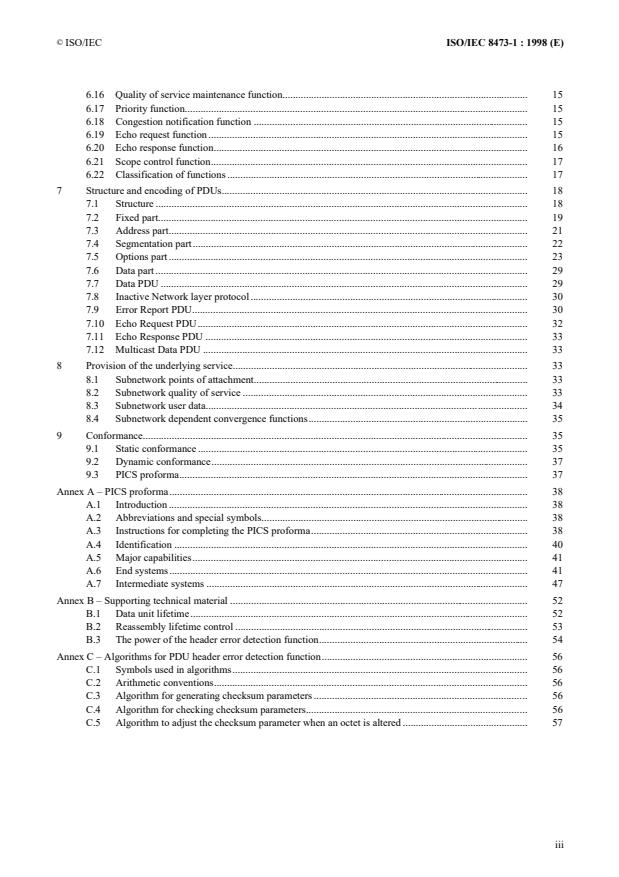
6.16 Quality of service maintenance function. 15
6.17 Priority function. 15
6.18 Congestion notification function . 15
6.19 Echo request function . 15
6.20 Echo response function. 16
6.21 Scope control function. 17
6.22 Classification of functions . 17
7 Structure and encoding of PDUs. 18
7.1 Structure . 18
7.2 Fixed part. 19
7.3 Address part. 21
7.4 Segmentation part. 22
7.5 Options part. 23
7.6 Data part . 29
7.7 Data PDU . 29
7.8 Inactive Network layer protocol . 30
7.9 Error Report PDU. 30
7.10 Echo Request PDU. 32
7.11 Echo Response PDU . 33
7.12 Multicast Data PDU . 33
8 Provision of the underlying service. 33
8.1 Subnetwork points of attachment. 33
8.2 Subnetwork quality of service . 33
8.3 Subnetwork user data. 34
8.4 Subnetwork dependent convergence functions. 35
9 Conformance. 35
9.1 Static conformance . 35
9.2 Dynamic conformance. 37
9.3 PICS proforma. 37
Annex A – PICS proforma. 38
A.1 Introduction . 38
A.2 Abbreviations and special symbols. 38
A.3 Instructions for completing the PICS proforma. 38
A.4 Identification . 40
A.5 Major capabilities. 41
A.6 End systems. 41
A.7 Intermediate systems . 47
Annex B – Supporting technical material . 52
B.1 Data unit lifetime. 52
B.2 Reassembly lifetime control . 53
B.3 The power of the header error detection function. 54
Annex C – Algorithms for PDU header error detection function. 56
C.1 Symbols used in algorithms. 56
C.2 Arithmetic conventions. 56
C.3 Algorithm for generating checksum parameters . 56
C.4 Algorithm for checking checksum parameters. 56
C.5 Algorithm to adjust the checksum parameter when an octet is altered . 57
iii
©
ISO/IEC 8473-1 : 1998 (E) ISO/IEC
Foreword
ISO (the International Organization for Standardization) and IEC (the International Electrotechnical Commission) form
the specialized system for worldwide standardization. National bodies that are members of ISO or IEC participate in the
development of International Standards through technical committees established by the respective organization to deal
with particular fields of technical activity. ISO and IEC technical committees collaborate in fields of mutual interest.
Other international organizations, governmental and non-governmental, in liaison with ISO and IEC, also take part in the
work.
In the field of information technology, ISO and IEC have established a joint technical committee, ISO/IEC JTC 1. Draft
International Standards adopted by the joint technical committee are circulated to national bodies for voting. Publication
as an International Standard requires approval by at least 75 % of the national bodies casting a vote.
International Standard ISO/IEC 8473-1 was prepared by Joint Technical Committee ISO/IEC JTC 1, Information
technology, Subcommittee SC 6, Telecommunications and information exchange between systems, in collaboration with
ITU-T. The identical text is published as ITU-T Recommendation X.233.
This second edition cancels and replaces the first edition (ISO/IEC 8473-1:1994), which has been technically revised. It
also incorporates Amendment 1:1995, Amendment 2:1996 and Amendment 3:1996.
ISO/IEC 8473 consists of the following parts, under the general title Information technology — Protocol for providing
the connectionless-mode network service:
— Part 1: Protocol specification
— Part 2: Provision of the underlying service by an ISO/IEC 8802 subnetwork
— Part 3: Provision of the underlying service by an X.25 subnetwork
— Part 4: Provision of the underlying service by a subnetwork that provides the OSI data link service
— Part 5: Provision of the underlying service by ISDN circuit-switched B-channels
— Part 6: Provision of the underlying service assumed by ISO/IEC 8473 by subnetworks employing ISO/IEC 10028
CONS relay
— Part 7: Provision of the underlying service assumed by ISO/IEC 8473 by frame relay subnetworks
Annex A forms an integral part of this part of ISO/IEC 8473. Annexes B and C are for information only.
iv
©
ISO/IEC ISO/IEC 8473-1 : 1998 (E)
Introduction
This is one of a set of Recommendations and International Standards produced to facilitate the interconnection of open
systems. The set covers the services and protocols required to achieve such interconnection.
This Recommendation | International Standard is positioned with respect to other related Recommendations and
International Standards by the layers defined in ITU-T Rec. X.200 | ISO/IEC 7498-1. In particular, it is a protocol of the
Network layer. The protocol specified by this Recommendation | International Standard may be used between Network
entities in end systems, between Network entities in intermediate systems, or between a Network entity in an end system
and a Network entity in an intermediate system. In an end system, it provides the connectionless-mode Network service
defined in ITU-T Rec. X.213 | ISO/IEC 8348.
The interrelationship of the protocol specification and the related service definitions is illustrated in Figure Intro.1.
OSI Network service
Reference to aims
Protocol
specification
Reference to assumptions
Underlying service
T0718880-93/d01
Figure Intro. 1 – Interrelationship of protocol and services
FIGURE 1/X.233.[D01] = 4 CM
In order to evaluate the conformance of a particular implementation of this protocol, it is necessary to have a statement of
which of the protocol’s capabilities and options have been implemented. Such a statement is called a Protocol
Implementation Conformance Statement (PICS), as defined in ITU-T Rec. X.296 | ISO/IEC 9646-7. A PICS proforma,
from which a PICS may be prepared for a specific implementation, is included in this Recommendation | International
Standard as normative Annex A.
v
ISO/IEC 8473-1 : 1998 (E)
INTERNATIONAL STANDARD
ISO/IEC 8473-1 : 1998 (E)
ITU-T Rec. X.233 (1997 E)
ITU-T RECOMMENDATION
INFORMATION TECHNOLOGY – PROTOCOL FOR PROVIDING
THE CONNECTIONLESS-MODE NETWORK SERVICE:
PROTOCOL SPECIFICATION
1 Scope
This Recommendation | International Standard specifies a protocol that is used to provide the connectionless-mode
Network service described in ITU-T Rec. X.213 | ISO/IEC 8348 and to perform certain Network layer management
functions. The protocol relies upon the provision of an underlying connectionless-mode service by real subnetworks
and/or data links. The underlying connectionless-mode service assumed by the protocol may be obtained either directly,
from a connectionless-mode real subnetwork, or indirectly, through the operation of an appropriate Subnetwork
Dependent Convergence Function (SNDCF) or Protocol (SNDCP) over a connection-mode real subnetwork, as described
in ISO/IEC 8648. This Recommendation | International Standard specifies the operation of the protocol with respect to a
uniform, abstract “underlying subnetwork service”. Other Recommendations | International Standards specify the way in
which this “underlying subnetwork service” is obtained from real subnetworks, such as those which conform to ISO/IEC
8802 or ISO/IEC 8208. The “underlying subnetwork service” may be obtained from real subnetworks other than those
that are specifically covered by the other Recommendations | International Standards.
This Recommendation | International Standard specifies:
a) procedures for the connectionless transmission of data and control information from one Network entity to
one or more peer Network entities;
b) the encoding of the Protocol Data Units (PDUs) used for the transmission of data and control information,
comprising a variable-length protocol header format;
c) procedures for the correct interpretation of protocol control information; and
d) the functional requirements for implementations claiming conformance to this Recommendation |
International Standard.
The procedures are defined in terms of:
a) the interactions among peer Network entities through the exchange of protocol data units;
b) the interactions between a Network entity and a Network service user through the exchange of Network
service primitives; and
c) the interactions between a Network entity and an abstract underlying service provider through the
exchange of service primitives.
This Recommendation | International Standard also provides the PICS proforma for this protocol, in compliance with the
relevant requirements, and in accordance with the relevant guidance, given in ITU-T Rec. X.290 | ISO/IEC 9646-1.
2 Normative references
The following Recommendations and International Standards contain provisions which, through reference in this text,
constitute provisions of this Recommendation | International Standard. At the time of publication, the editions indicated
were valid. All Recommendations and Standards are subject to revision, and parties to agreements based on this
Recommendation | International Standard are encouraged to investigate the possibility of applying the most recent edition
of the Recommendations and Standards listed below. Members of IEC and ISO maintain registers of currently valid
International Standards. The Telecommunication Standardization Bureau of the ITU maintains a list of the currently valid
ITU-T Recommendations.
2.1 Identical Recommendations | International Standards
– ITU-T Recommendation X.200 (1994) | ISO/IEC 7498-1:1994, Information technology – Open Systems
Interconnection – Reference Model: The Basic Model.
ITU-T Rec. X.233 (1997 E) 1
ISO/IEC 8473-1 : 1998 (E)
– ITU-T Recommendation X.210 (1993) | ISO/IEC 10731:1994, Information technology – Open Systems
Interconnection – Basic Reference Model: Conventions for the definition of OSI services.
– ITU-T Recommendation X.213 (1995) | ISO/IEC 8348:1996, Information technology – Open Systems
Interconnection – Network service definition.
– ITU-T Recommendation X.224 (1995) | ISO/IEC 8073:1997, Information technology – Open Systems
Interconnection – Protocol for providing the connection-mode transport service.
2.2 Paired Recommendations | International Standards equivalent in technical content
– ITU-T Recommendation X.290 (1995), OSI conformance testing methodology and framework for
protocol Recommendations for ITU-T applications – General concepts.
ISO/IEC 9646-1:1994, Information technology – Open Systems Interconnection – Conformance testing
methodology and framework – Part 1: General concepts.
– ITU-T Recommendation X.296 (1995), OSI conformance testing methodology and framework for
protocol Recommendations for ITU-T applications – Implementation conformance statements.
ISO/IEC 9646-7:1995, Information technology – Open Systems Interconnection – Conformance testing
methodology and framework – Part 7: Implementation Conformance Statements.
2.3 Additional references
–ITU-T Recommendation X.25 (1996), Interface between Data Terminal Equipment (DTE) and Data
Circuit-terminating Equipment (DCE) for terminals operating in the packet mode and connected to public
data networks by dedicated circuit.
– ISO/IEC 8208:1995, Information technology – Data communications – X.25 Packet Layer Protocol for
Data Terminal Equipment.
– ISO 8648:1988, Information processing systems – Open Systems Interconnection – Internal organization
of the Network Layer.
– ISO/IEC TR 8802-1:1997, Information technology – Telecommunications and information exchange
between systems – Local and metropolitan area networks – Specific requirements – Part 1: Overview of
Local Area Network Standards.
3 Definitions
For the purposes of this Recommendation | International Standard, the following definitions apply.
3.1 Reference model definitions
This Recommendation | International Standard makes use of the following terms defined in ITU-T Rec. X.200 | ISO/IEC
7498-1:
a) end system;
b) Network entity;
c) Network layer;
d) Network protocol;
e) Network protocol data unit;
f) Network relay;
g) Network service;
h) Network service access point;
i) Network service access point address;
j) routeing;
k) service;
l) service data unit;
m) service primitive.
2 ITU-T Rec. X.233 (1997 E)
ISO/IEC 8473-1 : 1998 (E)
3.2 Service conventions definitions
This Recommendation | International Standard makes use of the following terms defined in ITU-T Rec. X.210 |
ISO/IEC 10731:
a) service provider;
b) service user.
3.3 Network layer architecture definitions
This Recommendation | International Standard makes use of the following terms defined in ISO 8648:
a) intermediate system;
b) relay system;
c) subnetwork;
d) subnetwork dependent convergence protocol;
e) subnetwork dependent convergence function;
f) subnetwork independent convergence protocol;
g) subnetwork independent convergence function;
h) subnetwork access protocol.
3.4 Network layer addressing definitions
This Recommendation | International Standard makes use of the following terms defined in ITU-T Rec. X.213 |
ISO/IEC 8348:
a) Network addressing domain;
b) Network protocol address information;
c) subnetwork point of attachment;
d) individual Network address.
3.5 Local area network definitions
This Recommendation | International Standard makes use of the following term defined in ISO/IEC TR 8802-1:
– local area network.
3.6 PICS definitions
This Recommendation | International Standard makes use of the following terms defined in ITU-T Rec. X.296 |
ISO/IEC 9646-7:
a) PICS proforma;
b) protocol implementation conformance statement.
3.7 Additional definitions
3.7.1 derived PDU: A protocol data unit the fields of which are identical to those of an initial PDU, except that it
carries only a segment of the user data from an N-UNITDATA request.
3.7.2 initial PDU: A protocol data unit carrying the whole of the user data from an N-UNITDATA request.
3.7.3 local matter: A decision made by a system concerning its behaviour in the Network layer that is not prescribed
or constrained by this Recommendation | International Standard.
3.7.4 Network entity title: An identifier for a Network entity which has the same abstract syntax as an NSAP
address, and which can be used to unambiguously identify a Network entity in an end or intermediate system.
3.7.5 reassembly: The act of regenerating an initial PDU from two or more derived PDUs.
3.7.6 segment: A distinct unit of data consisting of part of the user data provided in the N-UNITDATA request and
delivered in the N-UNITDATA indication.
ITU-T Rec. X.233 (1997 E) 3
ISO/IEC 8473-1 : 1998 (E)
3.7.7 segmentation: The act of generating two or more derived PDUs from an initial or derived PDU. The derived
PDUs together carry the entire user data of the initial or derived PDU from which they were generated.
3.7.8 multicast: Data transmission to one or more destinations in a selected group in a single service invocation.
3.7.9 multicast capable intermediate system: An Intermediate System which incorporates the multicast features of
the Network layer.
3.7.10 “strong” forwarding: Forwarding only PDUs for which the QOS criteria can be satisfied.
3.7.11 “weak” forwarding: Forwarding PDUs even if the QOS criteria cannot be satisfied.
4 Abbreviations
For the purposes of this Recommendation | International Standard, the following abbreviations apply:
4.1 Data units
NSDU Network Service Data Unit
PDU Protocol Data Unit
SDU Service Data Unit
SNSDU Subnetwork Service Data Unit
4.2 Protocol data units
DT PDU Data Protocol Data Unit
ER PDU Error Report Protocol Data Unit
ERP PDU Echo Reply Protocol Data Unit
ERQ PDU Echo Request Protocol Data Unit
MD PDU Multicast Data Protocol Data Unit
4.3 Protocol data unit fields
DA Destination Address
DAL Destination Address Length
DUID Data Unit Identifier
E/R Error Report flag
LI Length Indicator
LT Lifetime
MS More Segments flag
NLPID Network Layer Protocol Identifier
SA Source Address
SAL Source Address Length
SL Segment Length
SO Segment Offset
SP Segmentation Permitted flag
4.4 Parameters
DA Destination Address
QOS Quality of Service
SA Source Address
4.5 Miscellaneous
CLNP Connectionless-mode Network Protocol (i.e. the protocol defined in this Recommendation |
International Standard)
NPAI Network Protocol Address Information
4 ITU-T Rec. X.233 (1997 E)
ISO/IEC 8473-1 : 1998 (E)
NS Network Service
NSAP Network Service Access Point
PICS Protocol Implementation Conformance Statement
SN Subnetwork
SNAcP Subnetwork Access Protocol
SNDCF Subnetwork Dependent Convergence Function
SNDCP Subnetwork Dependent Convergence Protocol
SNICP Subnetwork Independent Convergence Protocol
SNPA Subnetwork Point of Attachment
5 Overview of the protocol
5.1 Internal organization of the Network layer
The architectural organization of the Network layer is described in ISO 8648. ISO 8648 identifies and categorizes the
way in which functions can be performed within the Network layer by Network layer protocols, thus providing a uniform
framework for describing how protocols operating either individually or cooperatively in the Network layer can be used
to provide the OSI Network service. This protocol is designed to be used in the context of the internetworking protocol
approach to the provision of the connectionless-mode Network service defined in ISO 8648.
This protocol is intended for use in the Subnetwork Independent Convergence Protocol (SNICP) role. A protocol which
fulfills the SNICP role operates to construct the OSI Network service over a defined set of underlying services,
performing functions which are necessary to support the uniform appearance of the OSI connectionless-mode Network
service over a homogeneous or heterogeneous set of interconnected subnetworks. This protocol is defined to
accommodate variability where subnetwork dependent convergence protocols and/or subnetwork access protocols do not
provide all of the functions necessary to support the connectionless-mode Network service over all or part of the path
from one Network Service Access Point (NSAP) to another.
As described in ISO 8648, a protocol at the Network layer may fulfill different roles in different configurations. Although
this protocol is designed particularly to be suitable for a SNICP role in the context of the internetworking protocol
approach to the provision of the connectionless-mode Network service, it may also be used to fulfill other roles, and may
therefore be used in the context of other approaches to subnetwork interconnection.
The operation of this protocol is specified with respect to an “underlying subnetwork service” which is made available
through the operation of other Network layer protocols or through provision of the Data Link service. The “underlying
subnetwork service” assumed by this protocol is described in 5.5.
5.2 Subsets of the protocol
Two subsets of the full protocol are defined, which exploit the known subnetwork characteristics of particular
configurations and are therefore not subnetwork independent.
The Inactive Network Layer Protocol Subset is a null-function subset which can be used when it is known that the source
and destination end systems are connected by a single subnetwork, and when none of the functions performed by the full
protocol is required to provide the connectionless-mode Network service between any pair of end systems.
The Non-segmenting Protocol Subset permits simplification of the header when it is known that the source and
destination end systems are connected by subnetworks whose individual service data unit sizes are greater than or equal
to a known bound which is large enough so that segmentation is not required. This subset is selected by setting the
segmentation permitted flag to zero (see 6.7).
5.3 Addresses and titles
The following subclauses describe the addresses and titles used by this protocol.
5.3.1 Addresses
The source address and destination address parameters referred to in 7.3 are NSAP addresses. The syntax and semantics
of an NSAP address are described in ITU-T Rec. X.213 | ISO/IEC 8348.
ITU-T Rec. X.233 (1997 E) 5
ISO/IEC 8473-1 : 1998 (E)
The encoding used by this protocol to convey NSAP addresses is the “preferred encoding” specified in ITU-T
Rec. X.213 | ISO/IEC 8348. The NSAP address, encoded as a string of binary octets according to ITU-T Rec. X.213 |
ISO/IEC 8348, is conveyed in its entirety in the address fields described in 7.3.
A Network entity may send Multicast PDUs using the optional multicast capabilities incorporated into this
Recommendation | International Standard. The destination address parameter of a multicast PDU shall contain a group
Network address as described in ITU-T Rec. X.213 | ISO/IEC 8348. The source address parameter shall not be a group
Network address.
5.3.2 Network entity titles
A Network Entity Title (NET) is an identifier for a Network entity in an end system or intermediate system. Network
entity titles are allocated from the same name space as NSAP addresses, and the determination of whether a name is an
NSAP address or a Network entity title depends on the context in which the name is interpreted. The values of the source
route and record route parameters defined in 7.5.4 and 7.5.5 respectively are Network entity titles. The values of the
source address and destination address parameters in the Error Report PDU defined in 7.9, in the Echo Request PDU
defined in 7.10, and in the Echo Response PDU defined in 7.11 are also Network entity titles.
The encoding used by this protocol to convey Network entity titles is the “preferred encoding” specified in ITU-T
Rec. X.213 | ISO/IEC 8348. The Network entity title, encoded as a string of binary octets according to ITU-T Rec. X.213
| ISO/IEC 8348, is conveyed in its entirety in the appropriate fields.
5.4 Service provided by the protocol
This protocol provides the connectionless-mode Network service described in ITU-T Rec. X.213 | ISO/IEC 8348. The
relevant Network service primitive and its parameters are shown in Table 1.
NOTE – ITU-T Rec. X.213 | ISO/IEC 8348 states that the maximum size of a connectionless-mode Network Service Data
Unit (NSDU) is 64 512 octets.
Table 1 – Connectionless-mode Network service primitive
Primitive Parameters
N-UNITDATA Request NS-Source-Address,
Indication NS-Destination-Address,
NS-Quality-of-Service,
NS-Userdata
5.5 Underlying service assumed by the protocol
It is intended that this protocol be capable of operating over connectionless-mode services derived from a wide variety of
real subnetworks and data links. Therefore, in order to simplify the specification of the protocol, its operation is defined
(in clause 6) with respect to an abstract “underlying subnetwork service” rather than any particular real subnetwork
service. This underlying service consists of a single SN-UNITDATA primitive which conveys the source and destination
subnetwork point of attachment addresses, a subnetwork quality of service parameter, and a certain number of octets of
user data.
The SN-UNITDATA primitive is used to describe the abstract interface that exists between the CLNP protocol machine
and an underlying real subnetwork or a subnetwork dependent convergence function that operates over a real subnetwork
or real data link to provide the required underlying service.
The primitive provided and its parameters are shown in Table 2.
Provision of the “underlying subnetwork service” by real subnetworks and data links is described in clause 8 and in other
Recommendations | International Standards.
6 ITU-T Rec. X.233 (1997 E)
ISO/IEC 8473-1 : 1998 (E)
Table 2 – Underlying service primitive
Primitive Parameters
SN-UNITDATA Request SN-Source-Address,
Indication SN-Destination-Address,
SN-Quality-of-Service,
SN-Userdata
6 Protocol functions
This clause describes the functions performed as part of the protocol.
Not all of the functions must be performed by every implementation. Subclause 6.21 specifies which functions may be
omitted, and the correct behavior when requested functions are not implemented.
6.1 PDU composition function
This function is responsible for the construction of a protocol data unit according to the rules governing the encoding of
PDUs given in clause 7. The Protocol Control Information (PCI) required is determined from current state and local
information and from the parameters associated with the N-UNITDATA request.
Network Protocol Address Information (NPAI) for the source address and destination address fields of the PDU header is
derived from the NS-Source-Address and NS-Destination-Address parameters. The NS-Destination-Address, NS-Quality-
of-Service and (for multicast transmission) Scope Control parameters, together with current state and local information,
are used to determine which optional functions are to be selected. User data passed from the Network service user (NS-
Userdata) form the data part of the protocol data unit.
During the composition of the protocol data unit, a Data Unit Identifier (DUID) is assigned to distinguish this request to
transmit NS-Userdata to a particular destination Network service user or users from other such requests. The originator of
the PDU shall choose the DUID so that it remains unique (for this source and destination address pair) for the maximum
lifetime of the Initial PDU in the network; this rule applies for any PDUs derived from the Initial PDU as a result of the
application of the segmentation function (see 6.7). Derived PDUs are considered to correspond to the same Initial PDU,
and hence to the same N-UNITDATA request, if they have the same source address, destination address, and data unit
identifier.
The DUID is also available for ancillary functions such as error reporting (see 6.10).
The total length of the PDU in octets is determined by the originator and placed in the total length field of the PDU
header. This field is not changed for the lifetime of the protocol data unit, and has the same value in the Initial PDU and
in each of any Derived PDUs that may be created from the Initial PDU.
When the non-segmenting protocol subset is employed, neither the total length field nor the data unit identifier field is
present. The rules governing the PDU composition function are modified in this case as follows. During the composition
of the protocol data unit, the total length of the PDU in octets is determined by the originator and placed in the segment
length field of the PDU header. This field is not changed for the lifetime of the PDU. No data unit identification is
provided.
6.2 PDU decomposition function
This function is responsible for removing the protocol control information from the protocol data unit. During this
process, information pertinent to the generation of the N-UNITDATA indication is determined as follows. The NS-
Source-Address and NS-Destination-Address parameters of the N-UNITDATA indication are recovered from the NPAI
in the source address and destination address fields of the PDU header. The data part of the received PDU is retained
until all segments of the original service data unit have been received; collectively, these form the NS-Userdata parameter
of the N-UNITDATA indication. Information relating to the Quality of Service (QOS) provided during the transmission
of the PDU is determined from the quality of service and other information contained in the options part of the PDU
header. This information constitutes the NS-Quality-of-Service parameter of the N-UNITDATA indication.
ITU-T Rec. X.233 (1997 E) 7
ISO/IEC 8473-1 : 1998 (E)
6.3 Header format analysis function
This function determines whether the full protocol or the inactive Network layer protocol is in use, and whether or not a
received PDU has reached its final destination. If the Network Layer Protocol Identifier (NLPID) field in a received PDU
contains a value that identifies the protocol defined by this Recommendation | International Standard, then either the full
protocol or the non-segmenting subset is in use; the header format analysis function determines whether or not the
received PDU has reached its destination, using the destination address in the PDU header. If multicast transfer is not
supported and if the destination address provided in the PDU identifies either a Network entity title of this Network entity
or an NSAP served by this Network entity, then the PDU has reached its destination; if not, it shall be forwarded.
If the NLPID field contains a value that identifies the inactive Network layer protocol, then no further analysis of the
PDU header is required. The Network entity in this case determines that either the Subnetwork Point of Attachment
(SNPA) address encoded as NPAI in the supporting subnetwork protocol (see 8.1) corresponds directly to an NSAP
address serviced by this Network entity, or that an error has occurred.
If a Network entity supports multicast transmission, then the header format analysis function shall provide checking to
ensure that a PDU does not contain a group Network address in the source address field. Any PDU header analysed to
have a group address in the source address field shall be discarded.
6.3.1 Multicast transfer
The header format analysis function optionally provides capabilities to Network entities which support multicast transfer
to supply applicable PDUs directly to end systems served by such a Network entity as well as to forward such PDUs to
other Network entities. This optional functionality is realized through a Network entity with multicast capability
identifying a PDU as using multicast transfer via the PDU type and the PDU’s destination address field.
6.4 PDU lifetime control function
This function is used to enforce the maximum PDU lifetime. It determines whether a received PDU may be forwarded or
whether its assigned lifetime has expired, in which case it shall be discarded.
The operation of the PDU lifetime control function depends upon the lifetime field in the PDU header. This field
contains, at any time, the remaining lifetime of the PDU (represented in units of 500 ms). The lifetime of the Initial PDU
is determined by the originating Network entity and placed in the lifetime field of the PDU. If the segmentation function
is applied to a PDU, the value of the lifetime field of the Initial PDU is copied into all of the corresponding Derived
PDUs.
The value of the lifetime field of a PDU is decremented by every Network entity that processes the PDU. When a
Network entity processes a PDU, it decrements the PDU lifetime by at least one. The value of the PDU lifetime field shall
be decremented by more than one if the sum of:
a) the transit delay in the underlying service from which the PDU was received; and
b) the delay within the system processing the PDU
exceeds or is estimated to exceed 500 ms. In this case, the lifetime field shall be decremented by one for each additional
500 ms of actual or estimated delay. The determination of delay need not be precise, but where a precise value cannot be
ascertained, the value used shall be an overestimate, not an underestimate.
When a Network entity decrements the value of the lifetime field, it shall place a value of 0 into this field if the current
value is less than the amount it is to decrement by. If the lifetime field reaches a value of zero before the PDU is delivered
to its destination, the PDU shall be discarded. The error reporting function shall be invoked as described in 6.10. This
may result in the generation of an Error Report PDU.
It is a local matter whether or not the destination Network entity performs the lifetime control function.
6.5 Route PDU function
This function determines the Network entity or Network entities to which a PDU should be forwarded and the underlying
service that must be used to reach that Network entity or Network entities, using the destination address field and either
the segment length field (if present) or the total length field (if the segment length field is not present). Where
segmentation is required, the route PDU function further determines over which underlying service Derived PDUs shall
be sent in order to reach that Network entity or Network entities. The results of the route PDU function are passed to the
forward PDU function (along with the PDU itself) for further processing.
...
NORME ISO/CEl
INTERNATIONALE 84734
Deuxikme Edition
1998-11-01
Technologies de I ’information - Protocole
assurant Ie Service reseau en mode sans
connexion: Specification du protocole
Information technology - Protocol for pro lviding the connectionless-mode
network Service: Protocol specifica tion
Numero de rkfkrence
ISO/CEI 8473-1: 1998(F)
ISOKEI 8473-1 : 1998 (F)
Sommaire
Page
Domaine d ’application . 1
References normatives .
2.1 Recommandations 1 Normes internationales identiques . 2
2.2 Recommandations 1 Normes internationales associees, presentant un contenu technique identique . .
References additionnelles . 2
2.3
Definitions .
Definitions du modele de reference . 2
3.1
3.2 Definitions des conventions de Service .
Defnitions relevant de l ’architecture de la couche Reseau . 3
3.3
...................................................................... 3
3.4 Definitions relatives a l ’adressage de la couche Reseau
3.5 Definitions relatives au reseau local . 3
............................................................................................................ 3
3.6 Definitions relatives aux PICS
3.7 Definitions additionnelles . 3
Abreviations . 4
4.1 Unites de donnees .
4.2 Unites de donnees protocolaires .
4.3 Champs d ’unite de donnees protocolaire .
........................................................................................................................................... 5
4.4 Parameeres
4.5 Divers .
Description generale du protocole .
5.1 Organisation interne de la couche Reseau . 5
5.2 Sous-ensembles du protocole .
5.3 Adresses et intitules .
5.4 Service assure par le protocole . 6
...................................................................................... 7
5.5 Service sous-jacent suppose par le protocole
................................................................................................................................... 7
Fonctions du protocole
6.1 Fonction de composition d ’unites PDU .
6.2 Fonction de decomposition d ’unites PDU . 8
................................................................................................ 8
6.3 Fonction d ’analyse du forrnat d ’en-tete
6.4 Fonction de gestion de la duree de vie des unites PDU .
6.5 Fonction de routage des unites PDU .
............................................................................................ 9
6.6 Fonction de retransmission d ’unites PDU
6.7 Fonction de Segmentation .
................................................................................................................... 10
6.8 Fonction de reassemblage
6.9 Fonction de mise au rebut d ’unites PDU .
ISOKEI 1998
Droits de reproduction reserves. Sauf prescription differente, aucune Partie de cette publication ne
peut etre reproduite ni utilisee sous quelque forme que ce soit et par aucun procede, electronique ou
mecanique, y compris la photocopie et les microfilms, sans l ’accord ecrit de l ’editeur.
ISOKEI Copyright Office l Case postale 56 l CH- 1211 Geneve 20 l Suisse
Imprime en Suisse
0 ISO/CEI
KOKE1 8473-1 : 1998 (F)
................................................................................................................
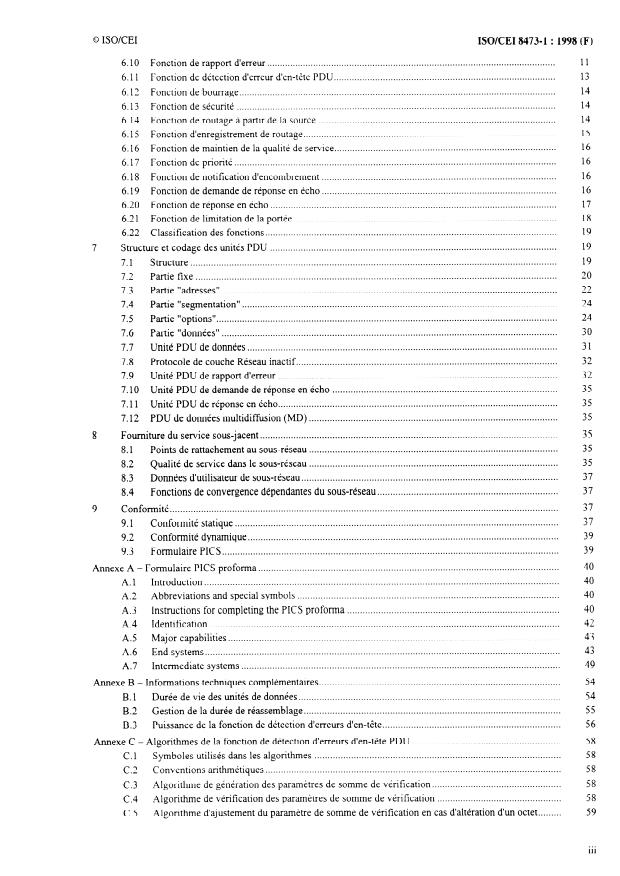
6.10 Fonction de rapport d ’erreur
6.1 1 Fonction de detection d ’erreur d ’en-tete PDU .
6 . 1 3 - Fonction de bourrage .
...................................................................................................... 14
6.13 Fonction de securite .
................................. ................................ ...........................
6.14 Fonction de routage a partir de la Source
..................................................................................................
6.15 Fonction d ’enregistrement de routage
...................................................................................... 16
6.16 Fonction de maintien de la quake de Service
6.17 Fonction de priorite .
...........................................................................................
6.18 Fonction de notification d ’encombrement
6.19 Fonction de demande de reponse en echo .
....................................................................... ........................................
6.20 Fonction de reponse en kho
6.21 Fonction de limitation de la portee .
.................................................................................................................
6.22 Classification des fonctions
...............................................................................................................
7 Structure et codage des unites PDU
7.1 Structure .
7.2 Partie fixe .
Partie “adresses” .
7.3
7.4 Partie “segmentation” .
....................................................................................................................................
7.5 Partie “Options”
7.6 Partie “donnees” .
........................................................................................................................
7.7 Unite PDU de donnees
Protocole de couche Reseau inactif .
7.8
............................................................................................................ 32
7.9 Unite PDU de rapport d ’erreur
.......................................................................................
7.10 Unite PDU de demande de reponse en echo
............................................................................................................ 35
7.11 Unite PDU de reponse en echo
................................................................................................
7.12 PDU de donnees multidiffusion (MD)
...................................................................................................................
8 Fourniture du Service sous-jacent
Points de rattachement au sous-reseau .
8.1
................................................................................................
8.2 Qualite de Service dans le sous-reseau
................................................................................................... 37
8.3 Donnees d ’utilisateur de sous-reseau
......................................................................
8.4 Fonctions de convergence dependantes du sous-reseau
9 Conformite .
Conformite statique .
9.1
........................................................................................................................
9.2 Conformite dynamique
9.3 Formulaire PICS .
....................................................................................................................
Annexe A - Formulaire PICS proforma
.........................................................................................................................................
A.l Introduction
..................................................................................................... 40
A.2 Abbreviations and special Symbols
.................................................................................. 40
Instructions for completing the PICS proforma
A.3
.......................................................................................................................................
A.4 Identification
A.5 Major capabilities .
A.6 End Systems .
...........................................................................................................................
A.7 Intermediate Systems
............................................................................................. 54
Annexe B - Informations techniques complementaires
B.l Duree de vie des unites de donnees .
...................................................................................................
B.2 Gestion de la duree de reassemblage
..................................................................... 56
B.3 Puissance de la fonction de detection d ’erreurs d ’en-tete
.......................................................... 58
Annexe C - Algorithmes de la fonction de detection d ’erreurs d ’en-tete PDU
............................................................................................... 58
c.1 Symboles utilises dans les algorithmes
Conventions arithmetiques .
C.2
.................................................. 58
c.3 Algorithme de generation des parametres de sornme de verification
................................................ 58
C.4 Algorithme de verifkation des parametres de somme de verifkation
......... 59
CT.5 Algorithme d ’ajustement du parametre de somrne de verification en cas d ’alteration d ’un octet
. . .
ISOKEI 8473-1 : 1998 (F)
Q ISOKEI
Avant-propos
L ’ISO (Organisation internationale de normalisation) et la CE1 (Commission
electrotechnique internationale) forment ensemble un systeme consacre a la
normalisation internationale considkee comme un tout. Les organismes nationaux
membres de I ’ISO ou de la CE1 participent au developpement de Normes inter-
nationales par l ’intermediaire des comites techniques cr& par l ’organisation
concernee afin de s ’occuper des differents domaines particuliers de l ’activite
technique. Les comites techniques de I ’ISO et de la CE1 collaborent dans des
domaines d ’interet commun. D ’autres organisations internationales, gouverne-
mentales et non gouvernementales, en liaison avec I ’ISO et Ia CE1 participent
egalement aux travaux.
Dans le domaine des technologies de l ’information, I ’ISO et Ia CE1 ont cree un
comite technique mixte, l ’ISO/CEI JTC 1. Les projets de Normes internationales
adoptes par le comite technique mixte sont soumis aux organismes nationaux pour
approbation, avant leur acceptation comme Normes internationales. Les Normes
internationales sont approuvees conformement aux procedures qui requierent
l ’approbation de 75 % au moins des organismes nationaux votants.
La Norme internationale ISO/CEI 8473-1 a etc elaboree par le comite technique
mixte ISOKEI JTC 1, Technologies de l ’information, sous-comite SC 6,
Teleinformatique, en collaboration avec I ’UIT-T. Le texte identique est public en
tant que Recommandation UIT-T X.233.
Cette deuxieme Edition annule et remplace la premike Edition
(ISOKEI 8473- 1: 1994), qui a fait l ’objet d ’une rkvision technique. Elle incorpore
aussi 1 ’Amendement 1: 1995, 1 ’Amendement 2: 1996 et 1 ’Amendement 3: 1996.
L ’ISOKEI 8473 comprend les Parties suivantes, prksentees sous le titre gkneral
Technologies de 1 ‘informa tion - Protocole assurant le Service rheau en mode
sans connexion:
- Partie 1: Specification du protocole
- Partie 2: Fourniture du Service sous-jacent par ren saus-reseau ISOKEI 8802
- Partie 3: Fourniture du senke sous-jacent pur un saus-reseau X.25
- Partie 4: Fourniture du Service sous-jacent par un sous-reseau fournissant le
Service de liaison de donnees OSI
- Partie 5: Fourniture du Service sous-jacent sur des canaux B a commutation
de circuits du RNIS
- Partie 6: Fourniture du Service sous-jacent lit! a I ’ISO KEI 8473 pur des
sous-reseaux emplovant le relais CONS de I ’LSOKEI 10028
.
- Partie 7: Fourniture du Service sous-jacent lie ci l ’lSO/CEI 8473 par des
sous-rheaux de relais de trame
L ’annexe A fait Partie intkgrante de Ia prkente Partie de l ’ISO/CEI 8473. Les
annexes B et C sont donnkes uniquement a titre d ’information.
iv
0 ISO/CEI
ISO/CEI 8473-1 : 1998 (F)
Introduction
La presente Recommandation fait Partie d ’un ensemble de Recommandations et Normes internationales etablies dans le
souci de faciliter l ’interconnexion des systemes ouverts, ensemble qui couvre les Services et protocoles requis pour cette
interconnexion.
La “position” de la presente Recommandation / Norme internationale, par rapport aux autres Recommandations et
Normes internationales connexes, est definie par les couches specifiees dans la Rec. UIT-T X.200 1 ISOKEI 7498-1. Le
protocole releve notamment de la couche Reseau. Le protocole specifie par la presente Recommandation 1 Norme
internationale peut etre utilise entre entites de reseau de systemes d ’extremite, entre entites de reseau de systemes
intermediaires ou entre une entite de reseau de Systeme d ’extremite et une entite de reseau de Systeme intermediaire.
Dans un Systeme d ’extremite, il assure le Service reseau en mode sans connexion defini dans la Rec. UIT-T X.213 1
ISOKEI 8348.
La relation entre la specification du protocole et les definitions de Service correspondantes est illustree a la
Figure Intro. 1.
Senke de rheau
I Os’
Rbfbrence aux objectifs -
Spkcification
du protocole
Rbfkrence aux hypothkses
I
Sewice de base
T071888O-93JdOl
Figure Intro. 1 - Relation entre le protocole et les Services
Pour evaluer la conformite d ’une application particuliere du protocole, il faut connaitre les capacites et Options utilisees
dans cette application. Les capacites et Options selectionnees doivent faire l ’objet d ’une declaration de conformite de mise
en cEuvre de protocole (PICS, pro~ocol implementation conformance slatement (se reporter a la Rec. UIT-T X.296 j
ISO/CEI 9646-7). Un formulaire PICS type, pouvant etre utilise pour toute application specifique, est reproduit dans la
presente Recommandation 1 Norme internationale (Annexe normative A).
ISOKEI 8473-1 : 1998 (F)
NORME INTERNATIONALE
RECOMMANDATION UIT-T
TECHNOLOGIES DE L ’INFORMATION - PROTOCOLE ASSURANT
LE SERVICE RkSEAU EN MODE SANS CONNEXION:
SPECIFICATION DU PROTOCOLE
1 Domaine d ’application
La presente Recommandation 1 Norme internationale specifie un protocole servant a assurer le Service de reseau en mode
sans connexion dkr-it dans la Rec. UIT-T X.213 1 ISOKEI 8348 et a executer certaines fonctions de gestion dans la
couche Reseau. Dans l ’application de ce protocole, on suppose que des sous-reseaux reels ou des liaisons de donnees
assurent un Service de base en mode sans connexion. Ce Service de base en mode sans connexion, assure par hypothese,
peut etre obtenu soit directement a partir d ’un sous-reseau reel en mode sans connexion, soit indirectement par
l ’intermediaire d ’une fonction ou d ’un protocole de convergence approprie dependant du sous-reseau (respectivement
SNDCF et SNDCP) selon la description donnee dans l ’ISO/CEI 8648. La presente Recommandation 1 Norme
internationale specifie le deroulement du protocole par reference a un “Service de sous-reseau de base” abstrait et
uniforme. D ’autres Recommandations 1 Norme internationale specifient les modalites d ’obtention de ce “Service de
sous-reseau de base” a partir de sous-reseaux reels, par exemple a partir de sous-reseaux conformes a I ’ISOKEI 8802 ou
a l ’ISO/CEI 8208. Le “Service de sous-reseau de base” peut etre obtenu a partir de sous-reseaux reels autres que les
sous-reseaux specifiquement couverts par les autres Recommandations ( Normes internationales.
La presente Recommandation 1 Norme internationale specifie:
les procedures de transmission en mode sans connexion de donnees et d ’in formations de commande entre
a)
une entite de reseau et une ou plusieurs entites de reseau homologues;
le codage des unites de donnees de protocole (PDU, protocol data mit) utilise pour Ia transmission des
b)
donnees et des informations de commande, notamment un format d ’en-tete de protocole de longueur
variable;
les procedures d ’interpretation torrecte des informations de commande du protocole;
C)
les caracteristiques fonctionnelles des applications declarees con formes i la presente Recommandation 1
Norme internationale.
Les procedures sont definies par reference:
tions entre entites de reseau homo logues resultant de l ’echange d ’unites de donnees de
aux interac
protocole;
aux interactions entre une entite de reseau et un utilisateur de Service de reseau, resultant de l ’echange des
b)
primitives de Service de reseau;
aux interactions entre une entite de reseau et un foumisseur de Service de base abstrait, resultant de
C)
l ’echange de primitives de Service.
La presente Recommandation ( Norme internationale comprend egalement un formulaire PICS tonforme aux conditions
pertinentes et aux directives applicables, exposees dans la UIT-T Rec. X.290 1 ISO/CEI 9646-1.
2 Rhfkrences normatives
Les Recommandations et les Normes internationales suivantes contiennent des dispositions qui, par Suite de la reference
qui y est faite, constituent des dispositions valables pour la presente Recommandation ] Norme internationale. Au
moment de la publication, les editions indiquees etaient en vigueur. Toutes Recommandations ou Normes sont sujettes a
revision et les Parties prenantes aus accords fondes sur la presente Recommandation i Norme internationale sont invitees
a rechercher la possibilite d ’appliquer l ’edition la plus recente des Recommandations et Normes indiquees ci-apres. Les
membres de la CE1 et de l ’IS0 possedent ie registre des Normes internationales en vigueur. Le Bureau de la
normalisation des telecommunications tient a jour une liste des Recommandations du UIT-T en vigueur.
Rec. UIT-T X.233 (1997 F) 1
ISOKEI 8473-1 : 1998 (F)
21 . Recommandations 1 Normes internationales identiques
-
Recommandation UIT-T X.200 (1994) 1 KOKE1 7498-1: 1994, Technologies de l ’information -
Interconnexion des systtimes ouverts - Modele de rkfirence de base.
-
-
Recommandation UIT-T X.2 10 (1993) / ISOKEI 1073 1: 1994, Technologies de Z ’information -
Interconnexion des s@mes ouverts - Modele de reference de base: conventions pour la d$nition des
M
Services de I ’interconnexion de systemes ouverts.
-
Recommandation UIT-T X.213 (1995) ( ISO/CEI 8348: 1996, Technologies de l ’information -
Interconnexion des systemes ouverts - Definition du Service de reseau.
-
Recommandation UIT-T X.224 (1995) 1 KOKE1 8073: 1997, Technologies de l ’information -
Protocolepour assurer le Service de transport en mode connexion.
Interconnexion des systemes ouverts -
22 .
Paires de Recommandations 1 Normes internationales Äquivalentes par leur contenu technique
-
Recommandation UIT-T X.290 (1995), Cadre general et methodologie des tests de conformite
d ’interconnexion des systemes ouverts pour les Recommandations sur les protocoles pour les applications
de I ’UIT-T - Concepts generaux.
Interconnexion de systemes ouverts (OSI) - Cadre
ISOKEI 9646- 1: 1994, Technologies de l ’information -
general et methodologie des tests de conformite - Partie I: Concepts generaux.
-
Recommandation UIT-T X.296 (1995), Cadre general et methodologie des tests de conformite OSI pour
les Recommandations sur les protocoles pour les applications de I ’UIT-T - Declarations de conformite
d ’instance.
ISO/CEI 9646-7: 1995, Technologies de I ’information - Interconnexion de systemes ouverts (OSI) -
Essais de conformite - Methodologie gknkrale et procedures - Partie 7: Declarations de cor; ‘ormite des
mises en awvre.
23 . Refkences additionnelles
-
Recommandation UIT-T X.25 (1996), Interface entre equipement terminal de traitement de donnees et
equipement de terminaison du circuit de donnees pour terminaux fonctionnant en mode paquet et
raccordes par circuit specialise a des reseaux publics pour donnees.
-
ISOCEI 8208: 1995, Technologies de l ’information - Communications de donnees - Protocole X.25 de
couche paquet pour terminal de donnees.
-
ISO 8648:1988, Systemes de traitement de l ’information - Interconnexion de systemes ouverts -
Organisation interne de la Couche Reseau.
-
ISO/CEI TR 8802- 1: 1997, Technologies de l ’information - Telecommunications et echange d ’information
entre systemes - Reseaux locaux et metropolitains - Exigences specifiques - Partie 1: Vue d ’ensemble des
normes de rkseaux Zocaux.
Dkfinitions
Pour les besoins de la presente Recommandation 1 Norme internationale, les definitions suivantes s ’appliquent.
31 . Dkfinitions du modele de rkfkrence
Pour les besoins de la presente, Recommandation 1 Norme internationale, les termes suivants, definis dans la Rec. UIT-T
X.200 1 ISOKEI 7498-1, sont utilises.
Systeme d ’extremite;
a)
entite de reseau;
b)
couche Reseau;
C)
protocole de rkseau;
unite de donnees protocolaire de reseau;
e)
relais de rkeau;
f)
Service de reseau;
Point d ’acces au Service de reseau;
adresse de Point d ’acces au Service de reseau;
Rec. UIT-T X.233 (1997 F)
ISOKEI 8473-1 : 1998 (F)
routage;
j>
k) Service;
unite de donnees de Service;
1)
m) primitive de Service.
32 .
Dbfinitions des conventions de Service
Pour les besoins de la presente Recommandation 1 Norme internationale, les termes suivants, definis dans la Rec. UIT-T
X.210 1 ISOKEI 1073 1, sont utilises.
a) foumisseur de Service;
utilisateur de Service.
W
33 . Dbfinitions relevant de l ’architecture de Ia couche Rkseau
Pour les besoins de la presente Recommandation / Norme internationale, les termes suivants, def-inis dans 1 ’ISO 8648,
sont utilises.
Systeme intermediaire;
a)
b) Systeme relais;
sous-reseau;
C)
protocole de convergence dependant du sous-reseau;
d)
e) fonction de convergence dependante du sous-reseau;
protocole de convergence independant du sous-reseau;
f)
g) fonction de convergence independante du sous-reseau;
h) protocole d ’acces au sous-reseau.
Dbfinitions relatives A I ’adressage de Ia couche Rkeau
34 .
Pour les besoins de la presente Recommandation ) Norme internationale, les termes suivants, dkfinis dans la Rec. UIT-T
X.213 1 ISOKEI 8348, sont utilises.
a) domaine d ’adressage du reseau;
information d ’adresse de protocole de reseau;
W
c) Point d ’attache de sous-reseau.
adresse de reseau individuelle;
d)
35 . Dkfinitions relatives au rbseau local
Pour les besoins de la presente Recommandation 1 Norme internationale, le terme suivant, defini dans 1 ’ISOKEI TR
8802- 1, est utilise.
-
reseau local
36 . DMnitions relatives au formulaire PICS
Pour les besoins de la presente Recommandation 1 Norme internationale, les termes suivants, definis dans la Rec. UIT-T
X.296 1 ISOKEI 9646-7, sont utilises.
a) formulaire PICS;
b) declaration de conformite d ’instance de protocole.
Dkfinitions additionnelles
37 .
3.7.1 PDU derivee: unite de donnees protocolaire dont les champs sont identiques a ceux d ’une unite PDU initiale a
ceci pres quelle n ’achemine qu ’un Segment des donnees d ’utilisateur associees a une demande N-UNITDATA.
3.7.2 PDU initiale: unite de donnees de protocole acheminant l ’ensemble des donnees d ’utilisateur associees a une
demande N-UNITDATA.
Rec. UIT-T X.233 (1997 F)
ISOKEI 8473-1 : 1998 (F)
3.7.3 dkision locale: decision Prise par un Systeme concemant son comportement dans la couche reseau en
l ’absence de prescription ou de contrainte decoulant de la presente Recommandation 1 Norme internationale.
3.7.4 intitulk d ’entitk de rkseau: identificateur d ’entite de reseau presentant la meme syntaxe abstraite qu ’une
adresse NSAP et powant etre utilise pour identifier sans ambiguite une entite de reseau dans un Systeme d ’extremite ou
un Systeme intermediaire.
3.7.5 rkassemblage: regeneration d ’une PDU initiale a partir d ’au moins deux PDU derivees.
3.7.6 Segment: unite de donnees distincte composee d ’une Partie des donnees d ’utilisateur foumies dans la demande
N-UNITDATA et remises dans l ’indication N-UNITDATA.
3.7.7 Segmentation: generation d ’au moins deux PDU derivees a partir d ’une PDU initiale ou d ’une PDU derivee.
Ensemble, ces PDU derivees acheminent la totalite des donnees d ’utilisateur de la PDU initiale ou derivee a partir de
laquelle elles ont etc produites.
3.7.8 multidiffusion: transmission de donnees vers une ou plusieurs destinations dans un groupe determine, au
cours d ’un appel de Service simple.
3.7.9 Systeme intermediaire A capacitk de multidiffusion: Systeme intermediaire incorporant les caracteristiques
de multidiffusion de la couche Reseau.
3.7.10 retransmission “robuste ”: retransmission des seuies unites de donnees protocolaires pour lesquelles le critere
de qualite de Service peut etre respecte.
3.7.11 retransmission “fragile ”: retransmission de toutes les unites de donnees protocolaires meme pour lesquelles
Ie critere de qualite de Service ne peut pas etre respecte.
4 Abrkviations
Pour les besoins de la presente Recommandation 1 Norme internationale, les abreviations suivantes sont utilisees:
41 . Unites de donnees
NSDU Unite de donnees de Service de reseau (network Service data mit)
Unite de donnees protocolaire (protocol data unit)
PDU
SDU Unite de donnees de Service (Service data mit)
SNSDU Unite de donnees de Service de sous-reseau (subnetwork Service data unit)
42 . Uni& de donnkes protocolaires
PDU DT Unite de donnees protocolaire de donnees (data protocol data unit)
PDU ER Unite de donnees protocolaire de rapport d ’erreur (error report protocol data unit)
PDU ERP Unite de donnees protocolaire de reponse en echo (echo replvprotocol data unit)
d
PDU ERQ Unite de donnees protocolaire de demande de reponse en echo (echo request protocol data unit)
PDU MD Unite de donnees protocolaire de donnees multidiffusion (multicast data protocol data unit)
43 . Champs d ’unit6 de donnees protocolaire
DA Adresse de destination (destination address)
DAL Longueur d ’adresse de destination (destination address Zength)
Identificateur d ’unite de donnees (data unit identzjier)
DUID
Marqueur de rapport d ’erreur (error reportjlag)
E/R
LI Indicateur de longueur (length indicator)
LT Duree de vie (/#2time)
Marqueur d ’annonce de Segments (more segmentsflag)
MS
Identificateur de protocole de couche Reseau (network layer protocol identvier)
NLPID
Adresse de Source (Source address)
SA
4 Rec. UIT-T X.233 (1997 F)
ISOKEI 8473-1 : 1998 (F)
SAL Longueur d ’adresse de Source (Source address length)
SL Longueur de Segment (Segment Iength)
so Decalage de Segment (Segment offset)
SP Marqueur d ’autorisation de Segmentation (Segmentation permittedflag)
44 . Parametres
DA Adresse de destination (destination address)
Qualite de Service
QS
SA Adresse de Source (Source address)
45 . Divers
CLNP Protocole de reseau en mode sans connexion - il s ’agit du protocole defini dans la presente
Recommandation ( Norme internationale) (connectionless-mode networkprotocol)
NPAI Information d ’adresse de protocole de reseau (network protocol address information)
Service de reseau (network Service)
NS
NSAP Point d ’acces aux Services de la couche Reseau (network Service access Point)
PICS Declaration de conformite d ’implementation de protocole (protocol implementation
conformance Statement)
Sous-reseau (subnetwork)
SN
Protocole d ’acces au sous-reseau (subnetwork access protocol)
NSAcP
SNDCF Fonction de convergence dependante du sous-reseau (subnetwork dependent convergence
fünction)
Protocole de convergence dependant du sous-reseau (subnetwork dependent convergence
SNDCP
protocol)
SNICP Protocole de convergence independant du sous-reseau (subnetwork independent convergence
protocol)
SNPA Point de rattachement de sous-reseau (subnetworkpoint of attachment)
Description ghkale du protocole
51 . Organisation interne de Ia couche Rkseau
L ’architecture de la couche Reseau est decrite dans 1 ’ISO 8648, qui identifie et classe en categories les modalites selon
lesquelles les fonctions peuvent etre assurees dans cette couche par les protocoles correspondants et foumit ainsi un
cadre uniforme de description des modalites selon lesquelles les protocoles, appliques individuellement ou en association
dans la couche Reseau, permettent de foumir le Service de reseau OSI. Le present protocole, utilise a titre de protocole
d ’interfonctionnement, per-met d ’assurer le Service de reseau en mode sans connexion defini dans 1 ’ISO 8648.
Le present protocole doit etre utilise a titre de protocole de convergence independant du sous-reseau (SNICP). Ainsi
exploite, il permet de structurer le Service de reseau OS1 sur un ensemble defini de Services de base et d ’assurer les
fonctions necessaires a la presence uniforme du Service de reseau OS1 en mode sans connexion dans un ensemble
homogene ou heterogene de sous-reseaux interconnectes. 11 presente par conception une caracteristique de variabilite
utile lorsque les protocoles de convergence dependants du sous-reseau ou les protocoles d ’acces au sous-reseau
n ’assurent pas toutes les fonctions necessaires a la foumiture du Service de reseau en mode sans connexion dans
l ’ensemble ou sur une Partie du trajet entre deux Points d ’acces au Service de reseau (NSAP).
Comme cela est expose dans 1 ’ISO 8648, Ie “role” d ’un protocole de la couche Reseau peut varier d ’une configuration a
l ’autre. Le present protocole est avant tout adapte a un role de SNICP dans le tontexte d ’un Service reseau en mode sans
connexion assure par l ’intermediaire d ’un protocole d ’interfonctionnement, mais il peut assumer d ’autres fonctions et, par
voie de consequence, etre utilise dans le tontexte d ’autres approches de l ’interconnexion au sous-reseau.
L ’application du present protocole est specifiee par reference a un “Service de sous-reseau de base” assure par
l ’application d ’autres protocoles de couche Reseau ou la disponibilite d ’un Service de liaison de donnees. Le “Service de
sous-reseau de base” en question est decrit en 5.5.
Rec. UIT-T X.233 (1997 F) 5
ISO/CEI 8473-1 : 1998 (F)
52 . Sous-ensembles du protocole
Le protocole complet est subdivisk en deux sous-ensembles, structures selon les caractkistiques de sous-rkseau connues
des configurations consid erees, et q ui ne sont donc pas i ndkpendants du sous- reseau.
Le sous-ensemble de protocole de couche Reseau inactif est un sous-ensemble de fonctions nulles qui peut etre utilise
lorsque l ’on sait que les deux systemes d ’extremitk - Source et destination - sont connectks par un seul sous-rkseau et
lorsqu ’aucune des fonctions assurees par Ie protocole complet n ’est nkessaire au Service reseau en mode sans connexion
entre une paire de systemes d ’extremitk quelconque.
Le sous-ensemble de protocole de non-Segmentation permet de simplifier l ’en-tete lorsque l ’on sait que les deux systkmes
d ’extremitk - Source et destination - sont connectks par des sous-rkseaux dans lesquels la longueur des uni& de donnees
de Service considerkes individuellement est egale ou supkieure ti une limite connue, suffisarnment elevke pour
qu ’aucune Segmentation ne soit requise. Ce sous-ensemble est selectionne par mise a z&o du marqueur d ’autorisation de
Segmentation (voir 6.7).
53 . Adresses et intitules
Les paragraphes suivants dkrivent les adresses et les intitulks utilises dans le prksent protocole.
53.1 Adresses
Les param&res d ’adresse de Source et d ’adresse de destination dont il est question en 7.3 correspondent a des adresses
NSAP, dont la syntaxe et la semantique sont dkites dans la Rec. UIT-T X.213 1 ISO/CEI 8348.
Le codage d ’acheminement des adresses NSAP utilisk dans le present protocole est le “codage prefkre” specifie dans
la Rec. UIT-T X.213 1 ISOKEI 8348. L ’adresse NSAP, codee sous forme de Chaine d ’octets binaires selon la Rec. UIT-T
X.2 13 ( ISOKEI 8348, est acheminee dans son integralitk dans les champs d ’adresse dkrits en 7.3.
Une entitk de reseau peut envoyer des PDU multidiffusion ti l ’aide des fonctions multidiffusion optionnelles incorporkes
dans la presente Recommandation ( Norme internationale. Le param&re d ’adresse de destination d ’une PDU
multidifksion doit contenir une adresse de reseau de groupe telle que dkrite dans la Rec. UIT-T X.213 1 ISOKEI 8348.
Le paramktre d ’adresse de Source ne doit pas etre une adresse de reseau de groupe.
5.3.2 Mitulks d ’entitk de rkseau
Un intitulk d ’entite de reseau (NET, network entity title) identifie une entite de reseau relevant d ’un systltme d ’extrkmitk
ou d ’un Systeme intermkdiaire. Les intituk sont pris sur l ’espace de denomination utilise pour les adresses NSAP, et
l ’interpr&ation d ’une denomination - s ’agit-il d ’une adresse NSAP ou d ’un intituli d ’entite de rkseau? - dkpend donc du
tontexte. Les valeurs des paramktres de routage ti partir de la Source et d ’enregistrement de routage dkfinis
respectivement en 7.5.4 et 7.5.5 sont des intituk d ’entite de rkseau. Les valeurs des parametres d ’adresse de Source et
d ’adresse de destination de l ’unitk PDU de rapport d ’erreur definis au 7.9, de l ’unite PDU de demande de reponse en kho
dkfinie en 7.10 et de l ’unite PDU de rkponse en Echo definie au 7.11 sont egalement des intituk d ’entitk de rkseau.
Le codage utilise dans le present protocole pour acheminer les intituk d ’entitk de rkseau est le “codage prefkre” spkifie
dans la Rec. UIT-T X.2 13 j ISO/CEI 8348. L ’intituk d ’entite de reseau, code sous forme de Chaine d ’octets binaires selon
* la Rec. UIT-T X.2 13 1 ISO/CEI 8348, est achemine dans son intkgralite dans les champs appropries.
. Service assurh par Ie protocole
Le prksent protocole assure le Service de rkseau en mode sans connexion dkrit dans la Rec. UIT-T X.213 )
ISO/CEI 8348. La primitive de Service de reseau correspondante et ses paramktres sont indiques au Tableau 1.
NOTE - La Rec. UIT-T X.2 13 1 ISOKEI 8348 prkise que la longueur maximale d ’une unitk de donnees du Service en mode sans
connexion (NSDU) est de 64 5 12 octets.
Tableau 1 - Primitive du Service de rkseau en mode sans connexion
Primitive Paramitres
Adresse de Source NS
N-U-NITDATA Demande
Indication Adresse de destination NS
Qualite de Service NS
Donnees d ’utilisateur NS
6 Rec. UIT-T X.233 (1997 F)
ISO/CEI 8473-1 : 1998 (F)
55 . Service sous-jacent supposb par Ie protocole
Par conception, le present protocole doit pouvoir etre applique a des Services en mode sans connexion derives d ’une
grande diversite de sous-reseaux et de liaisons de donnees reels. En consequence, pour en simplifier la specifkation, il a
etc decide de definir son application (voir l ’article 6) par reference a un “Service de sous-reseau sous-jacent” abstrait
pht6t que par reference a tel ou tel Service de sous-reseau reel. Ce Service sous-jacent consiste en une primitive
SN-UNITDATA unique qui achemine les adresses de Point de rattachement au sous-reseau Source et au sous-reseau de
destination, un parametre de qualite de Service de sous-reseau et un certain nombre d ’octets de donnees d ’utilisateur.
La primitive SN-UNITDATA sert a decke l ’interface abstraite qui existe entre la machine de protocole CLNP et un
sous-reseau reel de base ou une fonction de convergente dependante du sous-reseau assurant, par l ’intermediaire d ’un
sous-reseau reel ou d ’une liaison de donnees reelle, le Service sous-jacent requis.
La primitive et ses parametres sont indiques au Tableau 2.
La fourniture du “Service du sous-reseau sous-jacent” par les sous-reseaux et les liaisons de donnees reelles fait l ’obiet de
l ’article 8 et d ’autres Recommandations 1 Normes internationales.
Tableau 2 - Primitive du Service saus-jacent
Primitive Parametres
SN-UNITDATA Demande Adresse de Source SN
Indication Adresse de destination SN
Qualite de Service SN
Donnkes d ’utilisateur SN
6 Fonctions du protocole
Le present article decrit les fonctions assurees dans le cadre du protocole.
11 n ’est pas necessaire la totalite de ces fonctions soit assuree dans chaque application. Le Paragraphe 6.2 1 precise les
we
fonctions qui peuvent h-e omises et le comportement attendu lorsque des fonctions requises ne sont pas mises en oeuvre.
61 . Fonction de composition d ’unitks PDU
Cette fonction assure la structuration des unites de donnees de protocole selon les regles qui regissent le codage des
unites PDU, specifiees dans l ’article 7. Les informations de commande de protocole (PCI, pr~rocol control information)
requises sont determinees a partir de l ’etat actuel et des informations locales ainsi que des parametres associes a la
demande N-UNITDATA.
Les informations d ’adresse de protocole de reseau (NPAI, network protocol address information) necessaires pour les
champs d ’adresse de Source et d ’adresse de destination de l ’en-tete de l ’unite PDU sont obtenues a partir des parametres
d ’adresse de Source NS et d ’adresse de destination NS. Les pararnetres d ’adresse de destination NS, de qualite de Service
NS et (pour la transmission multidiffusion) de limitation de la portee combines aux informations d ’etat actuel et aux
informations locales, servent A determiner, parmi les fonctions optionnelles, celles qui seront selectionnees. Les donnees
d ’utilisateur recues de l ’utilisateur de Service de reseau (donnees d ’utilisateur NS, network Service) constituent la Partie
“donnees” de l ’unite de donnees de protocole.
Pendant la structuration de l ’unite de donnees de protocole, un identificateur d ’unite de donnees (DUID, data mit
identzjier) permet de distinguer des autres demandes analogues la demande de transmission de donnees d ’utilisateur NS a
a un ou plusieurs utilisateurs de Service de reseau de destination particuliers. L ’entite d ’origine de l ’unite PDU choisit un
DUID demeurant unique (pour la paire aciresse de Source - adresse de destination consideree) Pendant toute la vie de
l ’unite PDU initiale dans le reseau; cette regle s ’applique a toutes les unites PDU derivees de l ’unite PDU initiale par
application de la fonction de Segmentation (voir 6.7). Les unites PDU dkivees sont considerees comme correspondant a
la mime unite PDU initiale, et donc a la meme demande N-UNITDATA lorsqu ’elles ont la meme adresse de Source, la
meme adresse de destination et le meme identificateur d ’unite de donnees.
Le DUID est egalement utilise pour des fonctions auxiliaires telles que I ’envoi de rapports d ’erreur (6.10).
La longueur totale de I ’unite PDU en octets, determinee par l ’entite d ’origine, est placee dans le champ de longueur totale
de l ’en-tete PDU. Ce champ n ’est pas modifie Pendant la vie de l ’unite de donnees de protocole et presente donc la meme
Valeur dans l ’unite PDU initiale et chacune des unites PDU derivees qui peuvent etre creees a partir de cette unite
initiale.
Rec. UIT-T X.233 (1997 F) 7
ISOKEI 8473-1 : 1998 (F)
Lorsque l ’on utilise le sous-ensemble de protocole de non-Segmentation, ni le champ de longueur totale ni le champ
d ’identificateur d ’unite de donnees ne sont presents. Les regles regissant la fonction de composition de l ’unite PDU sont
alors modifiees comme suit. Pendant la structuration de l ’unite de donnees de protocole, Ia longueur totale de l ’unite PDU
en octets, determinee par l ’entite d ’origine, est placee dans le champ de longueur de Segment de l ’en-tete PDU. Ce champ
n ’est pas modifie Pendant la vie de l ’unite PDU. Aucune identification d ’unite de donnees n ’est foumie.
62 . Fonction de dkomposition d ’unitks PDU
Cette fonction assure la suppression des informations de commande de protocole presentes dans l ’unite de donnees de
protocole. Pendant le deroulement du processus, les informations concema
...