


ISO 13491-2:2017
(Main)Financial services — Secure cryptographic devices (retail) — Part 2: Security compliance checklists for devices used in financial transactions
Financial services — Secure cryptographic devices (retail) — Part 2: Security compliance checklists for devices used in financial transactions
ISO 13491-2:2017 specifies checklists to be used to evaluate secure cryptographic devices (SCDs) incorporating cryptographic processes as specified in ISO 9564‑1, ISO 9564‑2, ISO 16609, ISO 11568‑1, ISO 11568‑2, and ISO 11568‑4 in the financial services environment. Integrated circuit (IC) payment cards are subject to the requirements identified in this document up until the time of issue after which they are to be regarded as a "personal" device and outside of the scope of this document. ISO 13491-2:2017 does not address issues arising from the denial of service of an SCD. In the checklists given in Annex A to Annex H, the term "not feasible" is intended to convey the notion that although a particular attack might be technically possible, it would not be economically viable since carrying out the attack would cost more than any benefits obtained from a successful attack. In addition to attacks for purely economic gain, malicious attacks directed toward loss of reputation need to be considered.
Services financiers — Dispositifs cryptographiques de sécurité (services aux particuliers) — Partie 2: Listes de contrôle de conformité de sécurité pour les dispositifs utilisés dans les transactions financières
General Information
- Status
- Withdrawn
- Publication Date
- 22-Mar-2017
- Technical Committee
- ISO/TC 68/SC 2 - Financial Services, security
- Drafting Committee
- ISO/TC 68/SC 2/WG 13 - Security in retail banking
- Current Stage
- 9599 - Withdrawal of International Standard
- Start Date
- 11-Jan-2023
- Completion Date
- 14-Feb-2026
Relations
- Effective Date
- 06-Jun-2022
- Effective Date
- 20-Aug-2016

Get Certified
Connect with accredited certification bodies for this standard

BSI Group
BSI (British Standards Institution) is the business standards company that helps organizations make excellence a habit.

NYCE
Mexican standards and certification body.
Sponsored listings
Frequently Asked Questions
ISO 13491-2:2017 is a standard published by the International Organization for Standardization (ISO). Its full title is "Financial services — Secure cryptographic devices (retail) — Part 2: Security compliance checklists for devices used in financial transactions". This standard covers: ISO 13491-2:2017 specifies checklists to be used to evaluate secure cryptographic devices (SCDs) incorporating cryptographic processes as specified in ISO 9564‑1, ISO 9564‑2, ISO 16609, ISO 11568‑1, ISO 11568‑2, and ISO 11568‑4 in the financial services environment. Integrated circuit (IC) payment cards are subject to the requirements identified in this document up until the time of issue after which they are to be regarded as a "personal" device and outside of the scope of this document. ISO 13491-2:2017 does not address issues arising from the denial of service of an SCD. In the checklists given in Annex A to Annex H, the term "not feasible" is intended to convey the notion that although a particular attack might be technically possible, it would not be economically viable since carrying out the attack would cost more than any benefits obtained from a successful attack. In addition to attacks for purely economic gain, malicious attacks directed toward loss of reputation need to be considered.
ISO 13491-2:2017 specifies checklists to be used to evaluate secure cryptographic devices (SCDs) incorporating cryptographic processes as specified in ISO 9564‑1, ISO 9564‑2, ISO 16609, ISO 11568‑1, ISO 11568‑2, and ISO 11568‑4 in the financial services environment. Integrated circuit (IC) payment cards are subject to the requirements identified in this document up until the time of issue after which they are to be regarded as a "personal" device and outside of the scope of this document. ISO 13491-2:2017 does not address issues arising from the denial of service of an SCD. In the checklists given in Annex A to Annex H, the term "not feasible" is intended to convey the notion that although a particular attack might be technically possible, it would not be economically viable since carrying out the attack would cost more than any benefits obtained from a successful attack. In addition to attacks for purely economic gain, malicious attacks directed toward loss of reputation need to be considered.
ISO 13491-2:2017 is classified under the following ICS (International Classification for Standards) categories: 35.240.40 - IT applications in banking. The ICS classification helps identify the subject area and facilitates finding related standards.
ISO 13491-2:2017 has the following relationships with other standards: It is inter standard links to ISO 13491-2:2023, ISO 13491-2:2016. Understanding these relationships helps ensure you are using the most current and applicable version of the standard.
ISO 13491-2:2017 is available in PDF format for immediate download after purchase. The document can be added to your cart and obtained through the secure checkout process. Digital delivery ensures instant access to the complete standard document.
Standards Content (Sample)
INTERNATIONAL ISO
STANDARD 13491-2
Fourth edition
2017-03
Financial services — Secure
cryptographic devices (retail) —
Part 2:
Security compliance checklists for
devices used in financial transactions
Services financiers — Dispositifs cryptographiques de sécurité
(services aux particuliers) —
Partie 2: Listes de contrôle de conformité de sécurité pour les
dispositifs utilisés dans les transactions financières
Reference number
©
ISO 2017
© ISO 2017, Published in Switzerland
All rights reserved. Unless otherwise specified, no part of this publication may be reproduced or utilized otherwise in any form
or by any means, electronic or mechanical, including photocopying, or posting on the internet or an intranet, without prior
written permission. Permission can be requested from either ISO at the address below or ISO’s member body in the country of
the requester.
ISO copyright office
Ch. de Blandonnet 8 • CP 401
CH-1214 Vernier, Geneva, Switzerland
Tel. +41 22 749 01 11
Fax +41 22 749 09 47
copyright@iso.org
www.iso.org
ii © ISO 2017 – All rights reserved
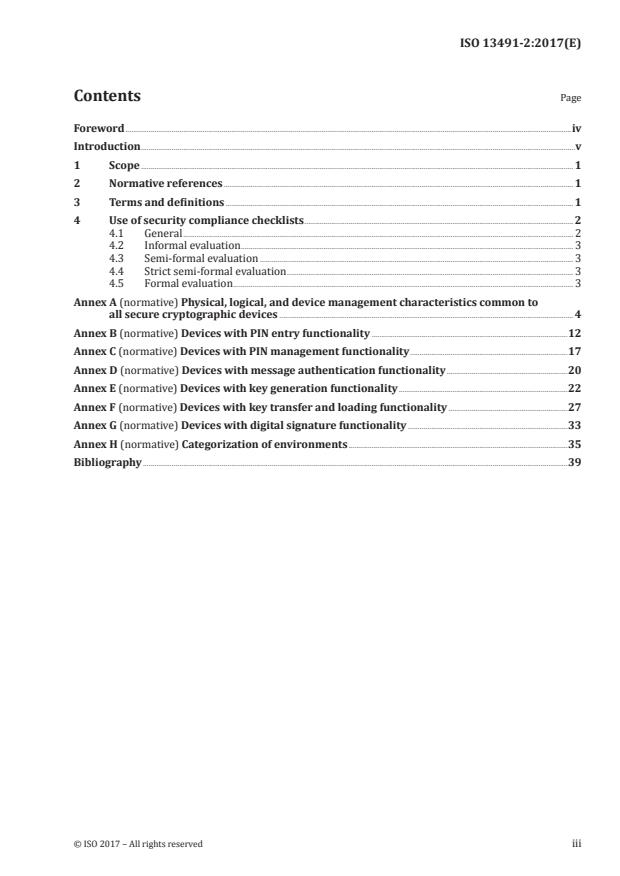
Contents Page
Foreword .iv
Introduction .v
1 Scope . 1
2 Normative references . 1
3 Terms and definitions . 1
4 Use of security compliance checklists . 2
4.1 General . 2
4.2 Informal evaluation . 3
4.3 Semi-formal evaluation . 3
4.4 Strict semi-formal evaluation . 3
4.5 Formal evaluation . 3
Annex A (normative) Physical, logical, and device management characteristics common to
all secure cryptographic devices . 4
Annex B (normative) Devices with PIN entry functionality .12
Annex C (normative) Devices with PIN management functionality .17
Annex D (normative) Devices with message authentication functionality .20
Annex E (normative) Devices with key generation functionality .22
Annex F (normative) Devices with key transfer and loading functionality .27
Annex G (normative) Devices with digital signature functionality .33
Annex H (normative) Categorization of environments .35
Bibliography .39
Foreword
ISO (the International Organization for Standardization) is a worldwide federation of national standards
bodies (ISO member bodies). The work of preparing International Standards is normally carried out
through ISO technical committees. Each member body interested in a subject for which a technical
committee has been established has the right to be represented on that committee. International
organizations, governmental and non-governmental, in liaison with ISO, also take part in the work.
ISO collaborates closely with the International Electrotechnical Commission (IEC) on all matters of
electrotechnical standardization.
The procedures used to develop this document and those intended for its further maintenance are
described in the ISO/IEC Directives, Part 1. In particular the different approval criteria needed for the
different types of ISO documents should be noted. This document was drafted in accordance with the
editorial rules of the ISO/IEC Directives, Part 2 (see www .iso .org/ directives).
Attention is drawn to the possibility that some of the elements of this document may be the subject of
patent rights. ISO shall not be held responsible for identifying any or all such patent rights. Details of
any patent rights identified during the development of the document will be in the Introduction and/or
on the ISO list of patent declarations received (see www .iso .org/ patents).
Any trade name used in this document is information given for the convenience of users and does not
constitute an endorsement.
For an explanation on the voluntary nature of standards, the meaning of ISO specific terms and
expressions related to conformity assessment, as well as information about ISO’s adherence to the
World Trade Organization (WTO) principles in the Technical Barriers to Trade (TBT) see the following
URL: w w w . i s o .org/ iso/ foreword .html.
This document was prepared by ISO/TC 68, Financial services, Subcommittee SC 2, Security.
This fourth edition cancels and replaces the third edition (ISO 13491-2:2016), of which it constitutes a
minor revision with the following changes:
— references made to H.5 have been replaced with ISO 9564-1;
— editorially revised.
A list of all the parts in the ISO 13491 series can be found on the ISO website.
iv © ISO 2017 – All rights reserved
Introduction
This document specifies both the physical and logical characteristics and the management of the
secure cryptographic devices (SCDs) used to protect messages, cryptographic keys, and other sensitive
information used in a retail financial services environment.
The security of retail financial services is largely dependent upon the security of these cryptographic
devices.
Security requirements are based upon the premise that computer files can be accessed and manipulated,
communication lines can be “tapped”, and authorized data or control inputs in a system device can be
replaced with unauthorized inputs. While certain cryptographic devices (e.g. host security modules)
reside in relatively high-security processing centres, a large proportion of cryptographic devices used in
retail financial services (e.g. PIN entry devices, etc.) now reside in non-secure environments. Therefore,
when PINs, MACs, cryptographic keys, and other sensitive data are processed in these devices, there is a
risk that the devices can be tampered with, or otherwise, compromised to disclose or modify such data.
It is to be ensured that the risk of financial loss is reduced through the appropriate use of cryptographic
devices that have proper physical and logical security characteristics and are properly managed. To
ensure that SCDs have the proper physical and logical security, they require evaluation.
This document provides the security compliance checklists for evaluating SCDs used in financial
services systems in accordance with ISO 13491-1. Other evaluation frameworks exist and may be
appropriate for formal security evaluations (e.g. ISO/IEC 15408-1, ISO/IEC 15408-2, ISO/IEC 15408-3,
and ISO/IEC 19790) and are outside the scope of this document.
Appropriate device characteristics are necessary to ensure that the device has the proper operational
capabilities and provides adequate protection for the data it contains. Appropriate device management
is necessary to ensure that the device is legitimate, that it has not been modified in an unauthorized
manner (e.g. by “bugging”) and that any sensitive data placed within the device (e.g. cryptographic
keys) have not been subject to disclosure or change.
Absolute security is not practically achievable. Cryptographic security depends upon each life cycle
phase of the SCD and the complementary combination of appropriate device management procedures
and secure cryptographic characteristics. These management procedures implement preventive
measures to reduce the opportunity for a breach of cryptographic device security. These measures aim
for a high probability of detection of any illicit access to sensitive or confidential data in the event that
device characteristics fail to prevent or detect the security compromise.
INTERNATIONAL STANDARD ISO 13491-2:2017(E)
Financial services — Secure cryptographic devices
(retail) —
Part 2:
Security compliance checklists for devices used in financial
transactions
1 Scope
This document specifies checklists to be used to evaluate secure cryptographic devices (SCDs)
incorporating cryptographic processes as specified in ISO 9564-1, ISO 9564-2, ISO 16609, ISO 11568-1,
ISO 11568-2, and ISO 11568-4 in the financial services environment. Integrated circuit (IC) payment
cards are subject to the requirements identified in this document up until the time of issue after which
they are to be regarded as a “personal” device and outside of the scope of this document.
This document does not address issues arising from the denial of service of an SCD.
In the checklists given in Annex A to Annex H, the term “not feasible” is intended to convey the notion
that although a particular attack might be technically possible, it would not be economically viable
since carrying out the attack would cost more than any benefits obtained from a successful attack. In
addition to attacks for purely economic gain, malicious attacks directed toward loss of reputation need
to be considered.
2 Normative references
The following documents are referred to in the text in such a way that some or all of their content
constitutes requirements of this document. For dated references, only the edition cited applies. For
undated references, the latest edition of the referenced document (including any amendments) applies.
ISO 9564-1, Financial services — Personal Identification Number (PIN) management and security —
Part 1: Basic principles and requirements for PINs in card-based systems
ISO 11568-1, Banking — Key management (retail) — Part 1: Principles
ISO 11568-2, Financial services — Key management (retail) — Part 2: Symmetric ciphers, their key
management and life cycle
ISO 11568-4, Banking — Key management (retail) — Part 4: Asymmetric cryptosystems — Key
management and life cycle
ISO 13491-1, Financial services — Secure cryptographic devices (retail) — Part 1: Concepts, requirements
and evaluation methods
ISO 16609, Financial services — Requirements for message authentication using symmetric techniques
ISO/IEC 18031, Information technology — Security techniques — Random bit generation
3 Terms and definitions
For the purposes of this document, the terms and definitions given in ISO 13491-1 and the following apply.
ISO and IEC maintain terminological databases for use in standardization at the following addresses:
— IEC Electropedia: available at http:// www .electropedia .org/
— ISO Online browsing platform: available at http:// www .iso .org/ obp
3.1
auditor
person who has the appropriate skills to check, assess, review, and evaluate compliance with an
informal evaluation on behalf of the sponsor or audit review body
3.2
data integrity
property that data has not been altered or destroyed in an unauthorized manner
3.3
dual control
process of utilizing two or more entities (usually persons) operating in concert to protect sensitive
functions or information whereby no single entity is able to access or use the materials
Note 1 to entry: A cryptographic key is an example of the type of material to be accessed or utilized.
3.4
evaluation agency
organization trusted by the design, manufacturing, and sponsoring entities which evaluates the SCD
(using specialist skills and tools)
Note 1 to entry: Evaluation is in accordance with ISO 13491-1.
3.5
exclusive or
bit-by-bit modulo two addition of binary vectors of equal length
3.6
security compliance checklist
list of auditable claims, organized by device type
Note 1 to entry: Checklist is as specified in this document.
3.7
sensitive state
device condition that provides access to the secure operator interface such that it can only be entered
when the device is under dual or multiple control
4 Use of security compliance checklists
4.1 General
These checklists shall be used to assess the acceptability of cryptographic equipment upon which
the security of the system depends. It is the responsibility of any sponsor, approval authority, or
accreditation authority, depending on the evaluation method chosen, that adopts some or all of these
checklists to
— approve evaluating agencies for use by suppliers to or participants in the system, and
— set up an audit review body to review the completed audit checklists.
Annex A to Annex H, which provide checklists defining the minimum evaluation to be performed
to assess the acceptability of cryptographic equipment, shall be applied. Additional tests may be
performed to reflect the state-of-the-art at the time of the evaluation.
2 © ISO 2017 – All rights reserved
The evaluation may be either “informal”, “semi-formal”, or “strict semi-formal” as specified in
ISO 13491-1. Should a “formal” evaluation be chosen, these audit checklists shall not be used as
presented here, but shall rather be used as input to assist in the preparation of the “formal claims” that
such an evaluation requires.
NOTE These formal claims, as they inherently include other criteria, are themselves outside of the scope of
this document.
A cryptographic device achieves security both through its inherent characteristics and the
characteristics of the environment in which the device is located. When completing these audit
checklists, the environment in which the device is located shall be considered, e.g. a device intended
for use in a public location might require greater inherent security than the equivalent device
operating in a controlled environment. So that an evaluating agency need not investigate the specific
environment where an evaluated device may reside, this document provides a suggested categorization
of environments in Annex H. Thus, an evaluating agency may be asked to evaluate a given device for
operation in a specific environment. Such a device can be deployed in a given facility, only if this facility
itself has been audited to ensure that it provides the ensured environment. However, these audit
checklists may be used with categorizations of the environment other than those suggested in Annex H.
The four evaluation methods specified in ISO 13491-1 are described in 4.2, 4.3, 4.4, and 4.5.
4.2 Informal evaluation
As part of an informal evaluation, an independent auditor shall complete the appropriate checklist(s)
for the device being evaluated.
4.3 Semi-formal evaluation
In the semi-formal method, the sponsor, who may be the manufacturer, shall submit a device to an
evaluation agency for testing against the appropriate checklist(s).
4.4 Strict semi-formal evaluation
In the strict semi-formal method, the sponsor, who may be the manufacturer, shall submit a device to an
evaluation agency for testing against the appropriate checklist(s) determined by an approval authority.
4.5 Formal evaluation
In the formal method, the manufacturer or sponsor shall submit a device to an accredited evaluation
agency for testing against the formal claims where the appropriate checklist(s) were used as input.
Annex A
(normative)
Physical, logical, and device management characteristics common
to all secure cryptographic devices
A.1 General
This annex is intended for use with all evaluations and shall be completed prior to any device-specific
security compliance checklists.
The following statements in this security compliance checklist are required to be specified by the
auditor as “true (T)”, “false (F)”, or “not applicable (N/A)”. A “false” indication does not necessarily
indicate unacceptable practice, but shall be explained in writing. Those statements that are indicated as
“N/A” shall also be explained in writing.
A.2 Device characteristics
A.2.1 Physical security characteristics
A.2.1.1 General
All devices shall meet the criteria given in A.2.1.2 for general security characteristics and the criteria
given in A.2.1.5 for tamper responsive characteristics and in A.2.1.3 for tamper-evident characteristics.
Other devices shall additionally meet the criteria given in A.2.1.4 for tamper-resistant characteristics.
A.2.1.2 General security characteristics
An evaluation agency has evaluated the device bearing in mind susceptibility to physical and logical
attack techniques known at the time of the evaluation such as (but not limited to) the following:
— chemical attacks (solvents);
— scanning attacks (scanning electron microscope);
— mechanical attacks (drilling, cutting, probing, etc.);
— thermal attacks (high and low temperature extremes);
— radiation attacks (X-rays);
— information leakage through covert (side) channels (power supply, timing, etc.);
— failure attacks;
and has concluded the following as in Table A.1.
4 © ISO 2017 – All rights reserved
Table A.1 — General security characteristics
No. Security compliance statement True False N/A
It is not feasible to determine a PIN, a key, or other secret
information by monitoring (e.g. the electro-magnetic
A1
emissions from the device with or without the cooperation
of the device operator).
Any ventilation and other openings in the module are
positioned and protected so that it is not feasible to use
such an opening to probe any component of the module
A2
such that plaintext PINs, access codes, or cryptographic
keys might be disclosed or to disable any of the protection
mechanisms of the device.
All sensitive data and cryptographic keys, including
A3
residues, are stored in the security module.
All transfer mechanisms within the device are implemented
A4 in such a way that it is not feasible to monitor the device to
obtain unauthorized disclosure of any such information.
Any access entry point into the device’s internal circuitry is
locked in the closed position when the device is operative,
A5
by means of one or more pick-resistant locks or similar
security mechanisms.
The design of the device is such that a duplicate device
A6 cannot be constructed from components which are available
through retail commercial channels.
If the device generates random numbers or pseudo random
A7 numbers, then the generation of those numbers conforms to
ISO/IEC 18031.
If the device generates random numbers or pseudo random
numbers, it is not feasible to influence the output of those
A8 numbers, e.g. by varying environmental conditions of the
device such as resetting or reinitializing the device, or
manipulating the power supply/electro-magnetic injection.
A.2.1.3 Tamper-evident characteristics
The evaluating agency has concluded the following as in Table A.2.
Table A.2 — Tamper-evident characteristics
No. Security compliance statement True False N/A
The device is designed and constructed so that it is not
feasible to penetrate the device in order to:
— make any additions, substitutions, or modifications
(e.g. the installation of a bug) to the hardware or software
of the device; or
— determine or modify any sensitive information
(e.g. PINs, access codes, and cryptographic keys)
A9
and then subsequently, return the device without requiring
specialized skills and equipment not generally available and:
a) without damaging the device so severely that the
damage would have a high probability of detection; or
b) requiring that the device be absent from its intended
location for a sufficiently long time that its absence or reap-
pearance would have a high probability of being detected.
A.2.1.4 Tamper-resistant characteristics
The evaluating agency has concluded the following as in Table A.3.
Table A.3 — Tamper-resistant characteristics
No. Security compliance statement True False N/A
The device is protected against penetration by employing
A10 physical protection to such a degree that penetration is not
feasible.
Even after having gained unlimited, undisturbed access to
A11 the device, discovery of secret information in the target
device is not feasible.
A.2.1.5 Tamper-responsive characteristics
The evaluating agency has concluded the following as in Table A.4.
Table A.4 — Tamper-responsive characteristics
No. Security compliance statement True False N/A
The device is protected against penetration by including
features that detect any feasible attempts to tamper with
A12
the device and cause immediate erasure of all cryptographic
keys and sensitive data when such an attempt is detected.
Removal of the case or the opening, whether authorized or
unauthorized of any access entry to the device’s internal
A13
components, causes the automatic and immediate erasure
of the cryptographic keys stored within the device.
There is a defined method for ensuring that secret data or
any cryptographic key that has been used to encrypt secret
data is erased from the unit when permanently removing the
unit from service (decommissioning). There is also a defined
A14 method for ensuring, when permanently decommissioned,
that any cryptographic key contained in the unit that might be
usable in the future is either erased from the unit or is
invalidated at all facilities with which the unit is capable of
performing cryptographically protected communications.
6 © ISO 2017 – All rights reserved
Table A.4 (continued)
No. Security compliance statement True False N/A
Any tamper detection/key erasure mechanisms function
A15
even in the absence of applied power.
If the device has no mechanism for detection of removal from
its operational environment, then defeating the tamper
detection mechanisms or discovery of secret information
in the target device is not feasible, even when removed from
its operational environment. Compromise of the device
requires equipment and skill sets that are not readily available.
A16
As a possible example, discovery of such information
requires a significant time, such as one month of preparation,
including analysis of other devices and at least one week of
effort to compromise the device after having gained unlimited,
undisturbed access to the target device.
If the device has a mechanism for detection of removal from
its operational environment, then defeating the tamper-
detection mechanisms or discovery of secret information in
the target device is not feasible. Compromise of the device
shall require skill sets that are not readily available and
equipment that is not readily available at the device site nor
A17
can be feasibly transported to the device site.
As a possible example, discovery of such information
requires a significant time, such as one month of preparation,
including analysis of other devices and at least 12 h of
unlimited, undisturbed access to the target device.
A.2.2 Logical security characteristics
The evaluating agency has concluded the following as in Table A.5.
Table A.5 — Logical security characteristics
No. Security compliance statement True False N/A
The device includes self-test capabilities capable of manual
A18 or automatic initiation to ensure that its basic functions are
operating properly.
A19 The device only performs its designed functions.
It is not feasible to determine a key or other secret
A20
information by the use of diagnostic or special test modes.
The cryptographic algorithms, modes of operation, and
A21 lengths of cryptographic keys used by the device conform
to ISO 11568-1, ISO 11568-2, and ISO 11568-4.
The device key management conforms to ISO 11568-1,
ISO 11568-2, and ISO 11568-4 using each key for only one
A22
cryptographic purpose (although a variant of a key may
be used for a different purpose).
The functionality implemented within the device is such that
there is no feasible way in which plaintext secret information,
(e.g. PINs or cryptographic keys) or secret information
A23
enciphered under other than the legitimate key, can be
obtained from the device, except in an authorized manner
(e.g. PIN mailers).
If the device is composed of several components, it is not
possible to move a secret cryptographic key within the
A24
device from a component of higher security to a component
providing lower security.
Table A.5 (continued)
No. Security compliance statement True False N/A
The loading of keys is performed when:
— the device is in a sensitive state; or
A25
— the action of loading a key puts the device into a mode
that activates all the tamper protection mechanisms within
the device.
The following operator functions that may influence the
security of a device are only permitted when the device is
in a sensitive state, i.e. under dual or multiple control:
A26
— disabling or enabling of device functions; or
— change of passwords or data that enable the device to
enter the sensitive state.
The secure operator interface is so designed that entry of
more than one password (or some equivalent mechanism for
A27
dual or multiple control) is required in order to enter this
sensitive state.
The secure operator interface is so designed that it is highly
A28 unlikely that the device can inadvertently be left in the
sensitive state.
If sensitive state is established with multiple limits (e.g. on the
A29 number of function calls and a time limit), the device returns
to normal state when the first of these limits is reached.
Where passwords or other plaintext data are used to control
A30 transition to a sensitive state, then these are protected in the
same manner as other secret or sensitive information.
If cryptographic keys are lost for any reason (e.g. long-term
A31 absence of applied power), the device will enter a non-
operational state.
The only function calls and sensitive operator functions that
A32 exist in the device are functions approved by the sponsor or
the system in which the device is to operate.
Keys are never translated from encipherment under one
A33
variant to encipherment under another variant of the same key.
A.3 Device management
A.3.1 General consideration
For each life cycle stage, the entity responsible for completing the audit checklist for that stage has
provided assurance for the following as in Table A.6.
8 © ISO 2017 – All rights reserved
Table A.6 — General consideration
No. Security compliance statement True False N/A
For audit and control purposes, the identity of the device
(e.g. its serial number) can be determined, either by external
A34 tamper-evident marking or labelling, or by a command that
causes the device to return its identity via the interface or via
the display.
When the device is in a life cycle stage such that it contains
cryptographic keys, the identity of these keys can be easily
A35
determined from the identity of the device [so that the key(s)
can be invalidated if the device is reported lost or stolen].
Any physical keys used to unlock or operate the device are
A36
carefully controlled and available only to authorized persons.
If a device contains a secret cryptographic key and there is an
attack on a device, or a device is stolen, then procedures are
A37
in place to notify the party responsible for the security of the
device immediately after detection.
If a device does not yet contain a secret cryptographic key
and there is an attack on a device, or a device is stolen, then
A38 procedures are in place to prevent the substitution of the
attacked or stolen device for a legitimate device that does not
yet contain a secret cryptographic key.
If no sensitive state exists in the device, the loading of
A39
plaintext keys is performed under dual control.
A.3.2 Device protection by manufacturer
The device manufacturer or an independent auditor has provided assurance, acceptable to the audit
review body, for the following as in Table A.7
Table A.7 — Device protection by manufacturer
No. Security compliance statement True False N/A
The hardware and software design of the device has been
evaluated to ensure that the functional capabilities provided
A40 with the device are all legitimate, documented functions, and
that no unauthorized function (e.g. a “Trojan Horse”) resides
in the device.
The device, including software, is produced and stored in a
controlled environment under the control of qualified
A41
personnel to prevent unauthorized modifications to the
physical or functional characteristics of the device.
A.3.3 Device protection between manufacturer and post-manufacturing phases
The device manufacturer and those responsible for the transport and storage of the device prior to
initial financial key loading, or else an independent auditor, have provided assurance for the following
as in Table A.8.
Table A.8 — Device protection between manufacturer and post-manufacturing phases
No. Security compliance statement True False N/A
Subsequent to manufacturing and prior to shipment, the
A42 device is stored in a protected area or sealed within tamper-
evident packaging to detect unauthorized access to it.
The device is shipped in tamper-evident packaging, and
inspected to detect unauthorized access to it or
— before a device is loaded with cryptographic keys, it is
closely inspected by qualified staff to ensure that it has not
been subject to any physical or functional modification, or
A43
— the device is delivered with secret information that is
erased if tampering is detected to enable the user to
ascertain that the device is genuine and not compromised.
NOTE One example of such information is the private key
of an asymmetric key pair with the public key of the device
signed by a private key known only to the manufacturer.
A.3.4 Device protection during initial financial key loading and prior to pre use
Those responsible for device storage and transport during initial key loading, or else an independent
auditor, have provided assurance, acceptable to the audit review body, for the following as in Table A.9.
Table A.9 — Device protection during initial financial key loading and prior to pre use
No. Security compliance statement True False N/A
The transfer mechanisms by which plaintext keys, key
components, or passwords are entered into the device are
A44 protected and/or inspected so as to prevent any type of
monitoring that could result in the unauthorized disclosure
of any key, component, or password.
The device is loaded with initial key(s) in a controlled manner
only when there is reasonable assurance that the device has
A45
not been subject to unauthorized physical or functional
modification.
A.3.5 Device protection during pre-use and prior to installation
Those responsible for device storage and transport subsequent to initial key loading, or else an
independent auditor, have provided assurance, acceptable to the audit-review body, for the following as
in Table A.10.
Table A.10 — Device protection during pre-use and prior to installation
No. Security compliance statement True False N/A
Any uninstalled device is controlled so as to prevent or detect
A46 unauthorized access to it and records are kept and audited
so as to detect and report theft or loss.
A.3.6 Device protection subsequent to installation
The acquirer or an independent auditor has provided assurance, acceptable to the audit review body,
which controls and procedures are in place to ensure the following as in Table A.11.
10 © ISO 2017 – All rights reserved
Table A.11 — Device protection subsequent to installation
No. Security compliance statement True False N/A
If, for any reason, a device ceases to hold valid keys,
— the device is removed from service as soon as possible,
— transactions from the device are rejected, and
A47
— the device is not loaded with new keys until it has been
carefully inspected and tested by at least two knowledgeable
and qualified individuals who have determined that the device
has not been subject to any physical or functional modification.
If a device is lost or stolen and then recovered, or if
unauthorized modification of the device is suspected for any
A48 reason, all cryptographic keys contained in the unit are
erased, and new keys are not loaded until the unit has been
inspected and tested as indicated in A.3.3.
Manual and/or automated auditing and control procedures
have been implemented to detect the unauthorized
reinstallation of a previously used device or of a device
containing the key(s) of a previously used device. Such
instances are investigated, and if potentially fraudulent
activity is suspected, the device is removed from service as
A49 soon as possible. When each transaction identifies the key(s)
used in the transaction, host software can be used to
automatically detect
a) the removal of a device from service, and
b) the subsequent installation of a device containing the
key(s) of a device previously removed from service.
When the device is being serviced or installed, procedures
A50 are in place to ensure that the device cannot be compromised
by the staff performing these functions.
When the secure operator interface is to be used, the data
entry device and cables connected to the device are carefully
A51
inspected to ensure that no unauthorized hardware has been
inserted.
If the device relies on tamper evidence, procedures are in
A52
place to ensure regular inspection for such evidence.
A.3.7 Device protection after removal from service
Those responsible for device removal, or else an independent auditor, have provided assurance,
acceptable to the audit review body, for the following as in Table A.12.
Table A.12 — Device protection after removal from service
No. Security compliance statement True False N/A
If the device is to be reinstalled, then it is controlled so as to
A53 prevent unauthorized access to it and is audited so as to
detect and report its theft or loss.
If the device is being permanently removed from service, then
A54 any key contained within the device which has been used for
any cryptographic purpose is erased from the device.
If the device case is intended to provide tamper-evident
characteristics and the device is being permanently removed
A55
from service, then the case is destroyed. The storage of the
case is controlled and audited until its destruction.
Annex B
(normative)
Devices with PIN entry functionality
B.1 General
The procedure for evaluating PIN entry devices is as follows:
— complete the checklists given in Annex A; and
— complete the checklists given in this annex.
The following statements in this security compliance checklist are required to be specified by the
auditor as “true (T)”, “false (F)”, or “not applicable (N/A)”. A “false” indication does not necessarily
indicate unacceptable practice, but shall be explained in writing. Those statements that are indicated as
“N/A” shall also be explained in writing.
B.2 Device characteristics
B.2.1 Physical security characteristics
B.2.1.1 General physical security characteristics
The evaluating agency has concluded the following as in Table B.1.
Table B.1 — General physical security characteristics
No. Security compliance statement True False N/A
The path from the keypad to the cryptographic processing
unit is physically protected such that there is no feasible
method of ascertaining the data passed between the two
without:
— triggering the erasure of the device’s cryptographic keys
B1
(reference A.2.1.5); or
— causing sufficient damage to preclude its continued use
(reference A.2.1.3);
or meeting the requirements of B27.
If the PIN entry device can be used to enter data that will not
B2 be enciphered, then the path to the display is physically
protected or the requirements of B22 are met.
The path from the magnetic stripe card reader to the
cryptographic processing unit is physically protected such
that there is no feasible method of accessing and/or altering
B3
the data passed between the two without triggering the
erasure of the secret or private cryptographic keys or the
requirements of B28 are met.
If PIN entry is accompanied by an audible tone, the tone for
B4 each entered PIN digit is indistinguishable from the tone for
any other entered PIN digit.
12 © ISO 2017 – All rights reserved
Table B.1 (continued)
No. Security compliance statement True False N/A
If the PIN entry device has a display, this display does not
disclose any entered PIN digit, but may display a string of
B5
non-significant symbols, such as asterisks, to denote the
number of PIN digits entered.
The PIN entry device is equipped with a privacy shield or is
B6 designed so that the cardholder can shield it with his/her body
to protect against observation of the PIN during PIN entry.
Any residues of PINs or cryptographic keys used during a
transaction are either stored in a tamper-resistant or tamper-
responsive module or are overwritten immediately after the
B7
completion of the transaction.
NOTE Plaintext PINs are always overwritten immediately
after being enciphered.
The slot of the IC reader into which the IC card is inserted does
not have sufficient space to hold a PIN-disclosing “bug” when a
card is inserted, nor can it feasibly be enlarged to provide
space for a PIN-disclosing “bug”. It is not possible for both an
IC card and any other foreign object to reside within the card
insertion slot. The opening for the insertion of the IC card is in
B8
full view of the cardholder so that any untoward obstructions
or suspicious objects at the opening are detectable.
NOTE A PIN entry device need not comply with this
requirement if the PINs are only transferred to the IC card
with logical (cryptographic) protection.
The IC reader is constructed so that wires running out of the
slot of the IC reader to a recorder or a transmitter (an external
bug) can be observed by the cardholder.
B9
NOTE A PIN entry device need not comply with this
requirement if the PINs are only transferred to the IC card
with logical (cryptographic) protection.
The PIN pad and the IC reader are either integrated in a single
tamper-evident (as defined in ISO 13491-1) device or exist as
two separate tamper-evident devices.
B10
NOTE A non-integrated IC reader need not comply with this
requirement if the PINs are only transferred to the IC card
with logical (cryptographic) protection.
B.2.1.2 Tamper-responsive characteristics
The evaluating agency has concluded the following as in Table B.2.
Table B.2 — Tamper-responsive characteristics
No. Security compliance statement True False N/A
The device is protected against penetration by including
features that detect any feasible attempts to tamper with the
B11
device and cause immediate erasure of all cryptographic keys
and sensitive data when such an attempt is detected.
Removal of the case or the opening, whether authorized or
unauthorized of any access entry to the device’s internal
B12
components, causes the automatic and immediate erasure of
the cryptographic keys stored within the device.
There is a defined method for ensuring that secret data, or
any cryptographic key that has been used to encrypt secret
data, is erased from the unit when permanently removing the
unit from service (decommissioning). There is also a defined
B13 method for ensuring, when permanently decommissioned,
that any cryptographic key contained in the unit that might be
usable in the future is either erased from the unit or is
invalidated at all facilities with which the unit is capable of
performing cryptographically protected communications.
Any tamper detection/key erasure mechanisms function even
B14
in the absence of applied power.
If the device has no mechanism for detection of removal from
its operational environment, then defeating the tamper
detection mechanisms or discovery of secret information in
the target device is not feasible even when removed from its
operational environment. Compromise of the device requires
equipment and skill sets that are not readily available.
B15
NOTE As a possible example, discovery of such information
requires a significant time, such as one month of preparation,
including analysis of other devices and at least one week of
effort to compromise the device after having gained unlimited,
undisturbed access to the target device.
If the device has a mechanism for detection of removal from
its operational environment, then defeating the tamper-de-
tection mechanisms or discovery of secret information in the
target device is not feasible. Compromise of the device shall
require skill sets that are not readily available and equipment
that is not readily available at the device site nor can be feasi-
B16
bly transported to the device site.
NOTE As a possible example, discovery of such information
requires a significant time, such as one month of preparation,
including analysis of other devices and at least 12 h of unlimit-
ed, undisturbed access to the target device.
If the device has a mechanism fo
...
Questions, Comments and Discussion
Ask us and Technical Secretary will try to provide an answer. You can facilitate discussion about the standard in here.
Loading comments...