

ISO 10993-23:2021
(Main)Biological evaluation of medical devices — Part 23: Tests for irritation
General Information
- Abstract
This document specifies the procedure for the assessment of medical devices and their constituent materials with regard to their potential to produce irritation. The tests are designed to predict and classify the irritation potential of medical devices, materials or their extracts according to ISO 10993‑1 and ISO 10993‑2. This document includes: — pre-test considerations for irritation, including in silico and in vitro methods for dermal exposure; — details of in vitro and in vivo irritation test procedures; — key factors for the interpretation of the results.
- Status
- Published
- Publication Date
- 19-Jan-2021
- Technical Committee
- ISO/TC 194 - Biological and clinical evaluation of medical devices
- Drafting Committee
- ISO/TC 194/WG 8 - Irritation, sensitization
- Current Stage
- 9093 - International Standard confirmed
- Start Date
- 08-Jun-2026
- Completion Date
- 29-Aug-2026
Buy Documents
ISO 10993-23:2021 - Biological evaluation of medical devices
ISO 10993-23:2021 - Biological evaluation of medical devices — Part 23: Tests for irritation/20/2021

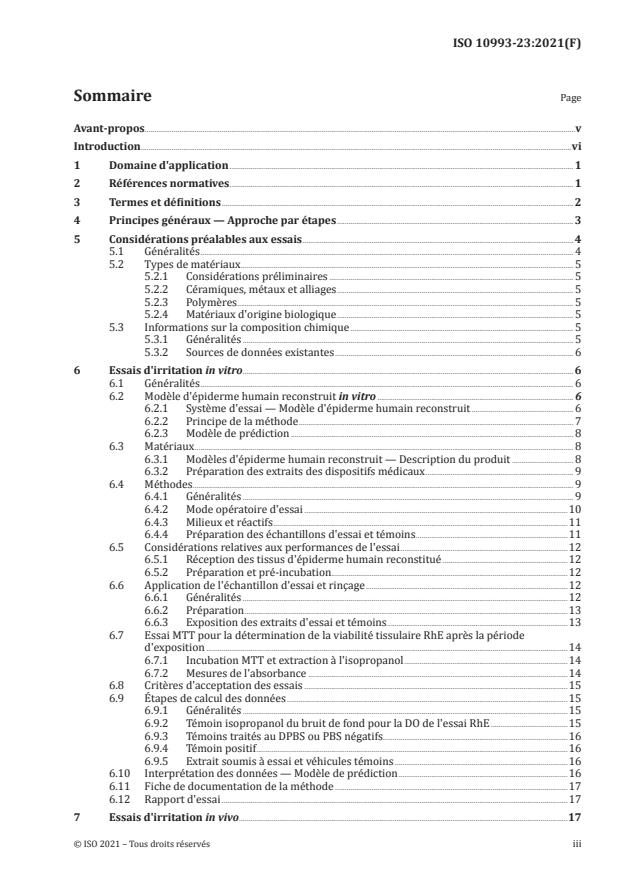
ISO 10993-23:2021 - Évaluation biologique des dispositifs médicaux
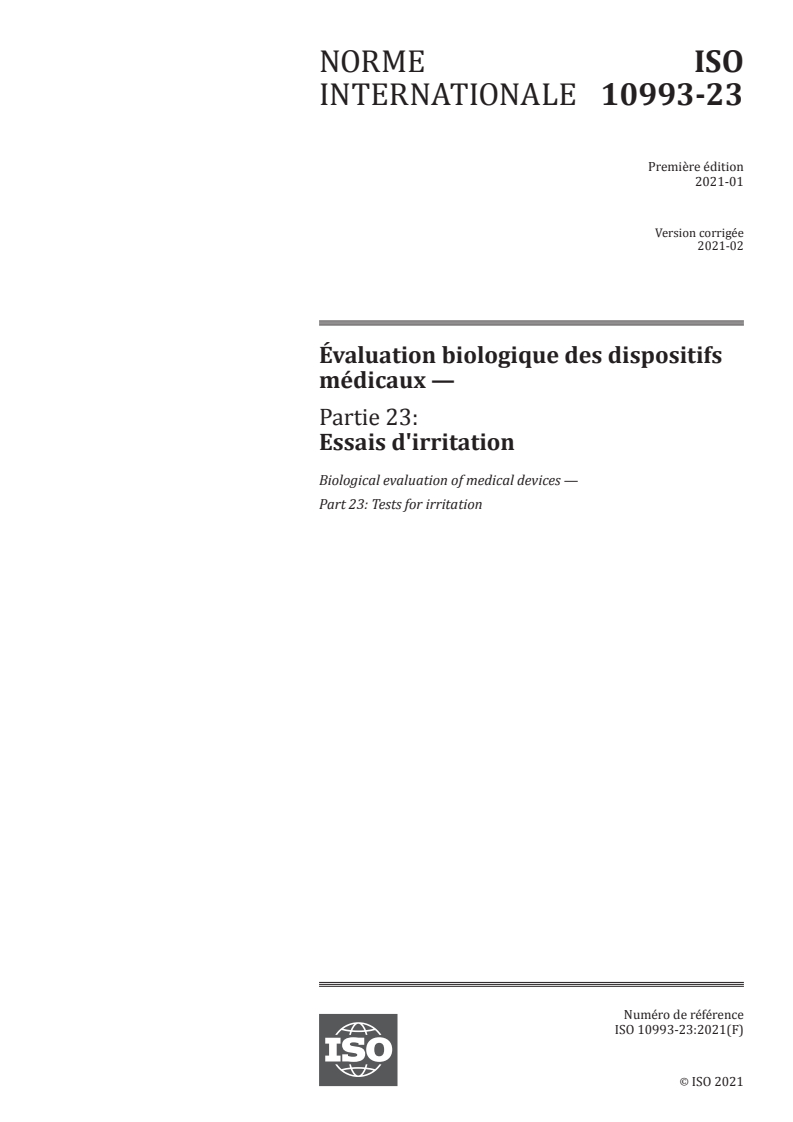
ISO 10993-23:2021 - Évaluation biologique des dispositifs médicaux — Partie 23: Essais d'irritation/16/2021
Overview - ISO 10993-23:2021 (Tests for irritation)
ISO 10993-23:2021 is part of the ISO 10993 series on the biological evaluation of medical devices. It specifies procedures to assess the potential of medical devices, constituent materials or extracts to cause irritation of skin or mucosal tissues. The standard defines a step-wise evaluation framework that includes pre-test considerations, validated in vitro methods (including reconstructed human epidermis models) and, when necessary, in vivo animal tests and human skin tests. It also covers result interpretation, test acceptance criteria and reporting requirements.
Key topics and technical requirements
- Step-wise approach: Guidance to select appropriate testing (in silico → in vitro → in vivo → human), consistent with ISO 10993‑1 risk-based evaluation.
- Pre-test considerations: Material type, chemical composition, existing data sources, and decision criteria for testing route (dermal, mucosal).
- In vitro irritation tests: Use of reconstructed human epidermis (RhE) models, test system description, sample preparation, exposure procedures, and viability assessment (e.g., MTT assay) for prediction of irritation potential.
- In vivo irritation tests: Protocols for skin exposure and intracutaneous (intradermal) administration in animals, observation schedules, evaluation and reporting.
- Human skin irritation test: When appropriate, controlled human patch testing and associated ethical/consent considerations are described (see Annex E).
- Data interpretation and documentation: Prediction models, acceptance criteria, method documentation sheets and required test report elements.
- Supporting material: Annexes covering preparation of materials, checklists, special irritation test methods and background information.
Practical applications - who uses ISO 10993-23
- Medical device manufacturers: To evaluate irritation risk during product development, material selection and design validation.
- Regulatory and compliance teams: To assemble biocompatibility data for regulatory submissions and to meet regional requirements.
- Biocompatibility and safety engineers: To plan testing strategies that minimize animal use while ensuring human safety.
- Contract testing laboratories and CROs: To implement standardized in vitro and in vivo irritation assays and produce compliant reports.
- Notified bodies and auditors: To assess conformity of biocompatibility evidence with international expectations.
Related standards and context
- ISO 10993‑1 (biological evaluation framework and risk management) - defines the overall process and how irritation testing fits into device evaluation.
- ISO 10993‑2 (animal welfare and ethical considerations) - provides guidance on animal testing and the 3Rs (replacement, reduction, refinement).
- ISO 10993 series and relevant test method guidance used together to support regulatory submissions and risk assessments.
ISO 10993-23 helps organizations implement robust, reproducible irritation testing strategies-prioritizing validated in vitro alternatives where possible-to demonstrate the safety of medical device materials and products.
Relations
- Effective Date
- 25-Aug-2026
- Effective Date
- 25-Aug-2026
- Effective Date
- 25-Aug-2026
- Effective Date
- 25-Aug-2026
- Effective Date
- 01-Jul-2026
- Effective Date
- 04-Mar-2026
- Effective Date
- 10-Feb-2026
- Effective Date
- 12-Feb-2026
- Effective Date
- 06-Jun-2022
- Effective Date
- 04-Nov-2023
Buy Documents
ISO 10993-23:2021 - Biological evaluation of medical devices
ISO 10993-23:2021 - Biological evaluation of medical devices — Part 23: Tests for irritation/20/2021
ISO 10993-23:2021 - Évaluation biologique des dispositifs médicaux
ISO 10993-23:2021 - Évaluation biologique des dispositifs médicaux — Partie 23: Essais d'irritation/16/2021
Get Certified
Connect with accredited certification bodies for this standard

BSI Group
BSI (British Standards Institution) is the business standards company that helps organizations make excellence a habit.

TÜV Rheinland
TÜV Rheinland is a leading international provider of technical services.

TÜV SÜD
TÜV SÜD is a trusted partner of choice for safety, security and sustainability solutions.
Sponsored listings
Frequently Asked Questions
ISO 10993-23:2021 is a standard published by the International Organization for Standardization (ISO). Its full title is "Biological evaluation of medical devices — Part 23: Tests for irritation". This standard covers: This document specifies the procedure for the assessment of medical devices and their constituent materials with regard to their potential to produce irritation. The tests are designed to predict and classify the irritation potential of medical devices, materials or their extracts according to ISO 10993‑1 and ISO 10993‑2. This document includes: — pre-test considerations for irritation, including in silico and in vitro methods for dermal exposure; — details of in vitro and in vivo irritation test procedures; — key factors for the interpretation of the results.
This document specifies the procedure for the assessment of medical devices and their constituent materials with regard to their potential to produce irritation. The tests are designed to predict and classify the irritation potential of medical devices, materials or their extracts according to ISO 10993‑1 and ISO 10993‑2. This document includes: — pre-test considerations for irritation, including in silico and in vitro methods for dermal exposure; — details of in vitro and in vivo irritation test procedures; — key factors for the interpretation of the results.
ISO 10993-23:2021 is classified under the following ICS (International Classification for Standards) categories: 11.100.20 - Biological evaluation of medical devices. The ICS classification helps identify the subject area and facilitates finding related standards.
ISO 10993-23:2021 has the following relationships with other standards: It is inter standard links to EN ISO 21649:2023, EN ISO 7405:2025, EN ISO 18562-4:2024, EN ISO 25539-3:2024, EN ISO 10993-7:2026, EN ISO 10993-1:2025, EN 60601-1:2006/A1:2013, EN ISO 10993-23:2021, ISO 21873-2:2019, ISO 10993-23:2021/Amd 1:2025. Understanding these relationships helps ensure you are using the most current and applicable version of the standard.
ISO 10993-23:2021 is available in PDF format for immediate download after purchase. The document can be added to your cart and obtained through the secure checkout process. Digital delivery ensures instant access to the complete standard document.
Standards Content (Sample)
INTERNATIONAL ISO
STANDARD 10993-23
First edition
2021-01
Biological evaluation of medical
devices —
Part 23:
Tests for irritation
Évaluation biologique des dispositifs médicaux —
Partie 23: Essais d'irritation
Reference number
©
ISO 2021
© ISO 2021
All rights reserved. Unless otherwise specified, or required in the context of its implementation, no part of this publication may
be reproduced or utilized otherwise in any form or by any means, electronic or mechanical, including photocopying, or posting
on the internet or an intranet, without prior written permission. Permission can be requested from either ISO at the address
below or ISO’s member body in the country of the requester.
ISO copyright office
CP 401 • Ch. de Blandonnet 8
CH-1214 Vernier, Geneva
Phone: +41 22 749 01 11
Email: copyright@iso.org
Website: www.iso.org
Published in Switzerland
ii © ISO 2021 – All rights reserved
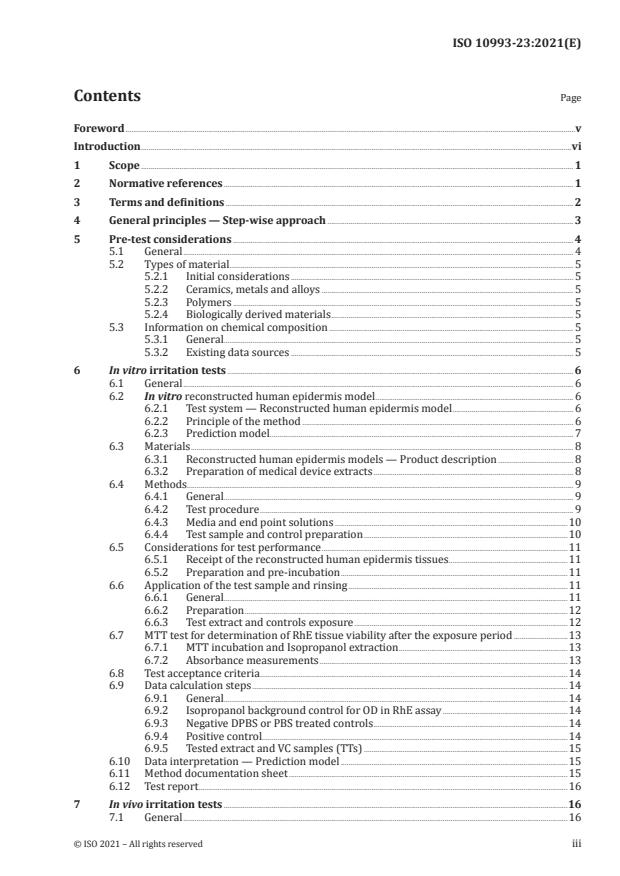
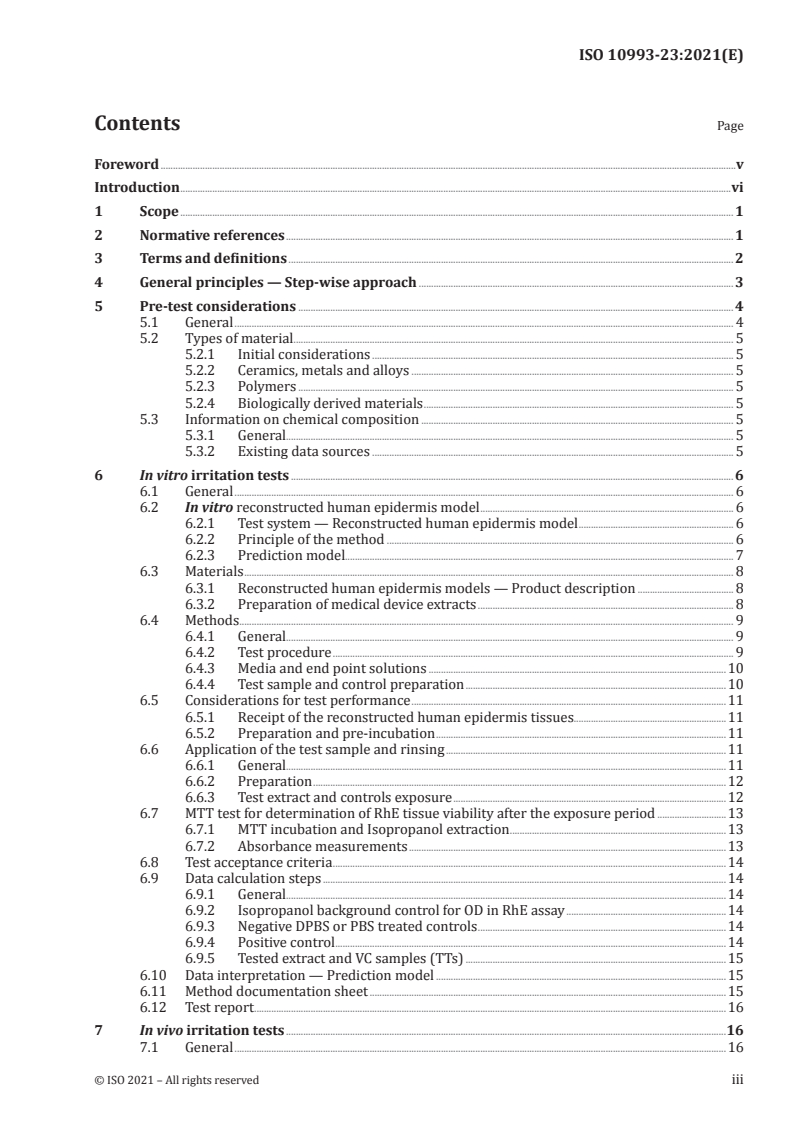
Contents Page
Foreword .v
Introduction .vi
1 Scope . 1
2 Normative references . 1
3 Terms and definitions . 2
4 General principles — Step-wise approach . 3
5 Pre-test considerations . 4
5.1 General . 4
5.2 Types of material. 5
5.2.1 Initial considerations . 5
5.2.2 Ceramics, metals and alloys . 5
5.2.3 Polymers . 5
5.2.4 Biologically derived materials . 5
5.3 Information on chemical composition . 5
5.3.1 General. 5
5.3.2 Existing data sources . 5
6 In vitro irritation tests . 6
6.1 General . 6
6.2 In vitro reconstructed human epidermis model . 6
6.2.1 Test system — Reconstructed human epidermis model . 6
6.2.2 Principle of the method . 6
6.2.3 Prediction model. 7
6.3 Materials . 8
6.3.1 Reconstructed human epidermis models — Product description . 8
6.3.2 Preparation of medical device extracts . 8
6.4 Methods . 9
6.4.1 General. 9
6.4.2 Test procedure . 9
6.4.3 Media and end point solutions .10
6.4.4 Test sample and control preparation .10
6.5 Considerations for test performance .11
6.5.1 Receipt of the reconstructed human epidermis tissues.11
6.5.2 Preparation and pre-incubation .11
6.6 Application of the test sample and rinsing .11
6.6.1 General.11
6.6.2 Preparation .12
6.6.3 Test extract and controls exposure .12
6.7 MTT test for determination of RhE tissue viability after the exposure period .13
6.7.1 MTT incubation and Isopropanol extraction .13
6.7.2 Absorbance measurements .13
6.8 Test acceptance criteria .14
6.9 Data calculation steps .14
6.9.1 General.14
6.9.2 Isopropanol background control for OD in RhE assay .14
6.9.3 Negative DPBS or PBS treated controls .14
6.9.4 Positive control . .14
6.9.5 Tested extract and VC samples (TTs) .15
6.10 Data interpretation — Prediction model .15
6.11 Method documentation sheet .15
6.12 Test report .16
7 In vivo irritation tests .16
7.1 General .16
7.2 Animal irritation test by skin exposure .17
7.2.1 Principle .17
7.2.2 Test materials .17
7.2.3 Animals and husbandry .17
7.2.4 Test procedure .17
7.2.5 Observation of animals . .19
7.2.6 Evaluation of results .19
7.2.7 Test report .21
7.3 Animal irritation test by intracutaneous (intradermal) administration.21
7.3.1 Introduction .21
7.3.2 Exclusion from test .21
7.3.3 Test sample .21
7.3.4 Animals and husbandry .22
7.3.5 Test procedure .22
7.3.6 Observation of animals . .23
7.3.7 Evaluation of results .23
7.3.8 Test report .23
8 Human skin irritation test .24
8.1 Introduction .24
8.2 Initial considerations .24
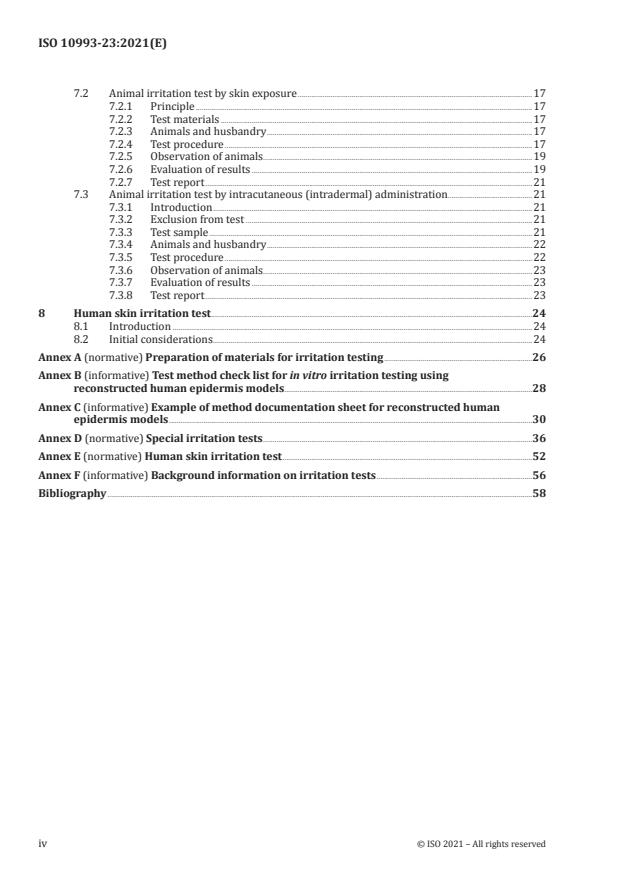
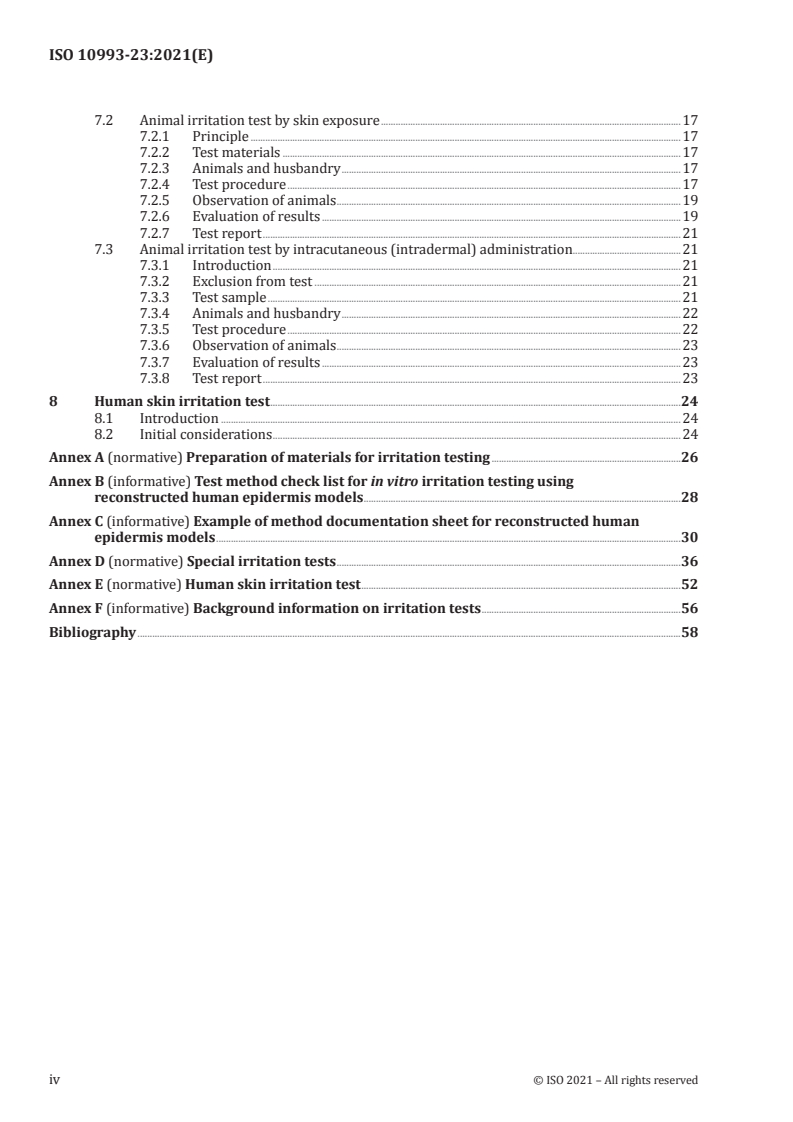
Annex A (normative) Preparation of materials for irritation testing .26
Annex B (informative) Test method check list for in vitro irritation testing using
reconstructed human epidermis models .28
Annex C (informative) Example of method documentation sheet for reconstructed human
epidermis models .30
Annex D (normative) Special irritation tests .36
Annex E (normative) Human skin irritation test .52
Annex F (informative) Background information on irritation tests .56
Bibliography .58
iv © ISO 2021 – All rights reserved
Foreword
ISO (the International Organization for Standardization) is a worldwide federation of national standards
bodies (ISO member bodies). The work of preparing International Standards is normally carried out
through ISO technical committees. Each member body interested in a subject for which a technical
committee has been established has the right to be represented on that committee. International
organizations, governmental and non-governmental, in liaison with ISO, also take part in the work.
ISO collaborates closely with the International Electrotechnical Commission (IEC) on all matters of
electrotechnical standardization.
The procedures used to develop this document and those intended for its further maintenance are
described in the ISO/IEC Directives, Part 1. In particular, the different approval criteria needed for the
different types of ISO documents should be noted. This document was drafted in accordance with the
editorial rules of the ISO/IEC Directives, Part 2 (see www .iso .org/ directives).
Attention is drawn to the possibility that some of the elements of this document may be the subject of
patent rights. ISO shall not be held responsible for identifying any or all such patent rights. Details of
any patent rights identified during the development of the document will be in the Introduction and/or
on the ISO list of patent declarations received (see www .iso .org/ patents).
Any trade name used in this document is information given for the convenience of users and does not
constitute an endorsement.
For an explanation of the voluntary nature of standards, the meaning of ISO specific terms and
expressions related to conformity assessment, as well as information about ISO's adherence to the
World Trade Organization (WTO) principles in the Technical Barriers to Trade (TBT), see www .iso .org/
iso/ foreword .html.
This document was prepared by Technical Committee ISO/TC 194, Biological and clinical evaluation of
medical devices, in collaboration with the European Committee for Standardization (CEN) Technical
Committee CEN/TC 206, Biological and clinical evaluation of medical devices, in accordance with the
Agreement on technical cooperation between ISO and CEN (Vienna Agreement).
A list of all parts in the ISO 10993 series can be found on the ISO website.
Any feedback or questions on this document should be directed to the user’s national standards body. A
complete listing of these bodies can be found at www .iso .org/ members .html.
Introduction
This document assesses possible contact hazards from medical devices, which can produce irritation.
Some materials that are included in medical devices have been tested, and their skin or mucosal
irritation potential has been demonstrated. Other materials and their chemical components have not
been tested and can induce adverse effects when in contact with human tissue. The manufacturer is
thus obliged to evaluate each device for potential adverse effects prior to marketing.
The irritation potential of a medical device or its components can be predicted either by an in vivo
animal irritation test or by an in vitro irritation test if qualified for use with medical devices.
ISO 10993-2 describes animal welfare aspects for performing animal studies for the biological evaluation
of medical devices thereby also emphasizing the 3R’s for replacement, reduction, and refinement of
animal studies. This document describes tests to determine the irritancy of medical devices, materials
or their extracts either by in vitro tests or in vivo tests. In vitro tests have preference over in vivo tests
when appropriately validated and providing equally relevant information to that obtained from in vivo
tests (see ISO 10993-1 and ISO 10993-2).
Traditionally, tests in small animals have been performed prior to testing on humans to help predict
human responses. More recently, in vitro tests as well as human tests have been added as adjuncts
or alternatives. For skin irritation testing of neat chemicals in vitro tests were developed using
[31]
reconstructed human epidermis (RhE) models . The method was adapted for detection of irritant
chemicals in medical device extracts. The results of a large round robin study that tested two types
of RhE models showed that these models can also be used to detect the presence of irritant chemicals
extracted from polymeric materials [polyvinylchloride (PVC) and silicone] commonly used in the
[6]
manufacture of medical devices . This method was found to be equally sensitive in the detection of
low concentrations of some strong irritant compounds when compared to the human patch testing and
[14]
intracutaneous rabbit test . Therefore, a stepwise approach for irritant testing can start with the in
vitro RhE model.
The developed and validated RhE models are appropriate to predict skin tissue irritation response. It
is recommended to explore the use of other alternative in vitro models to assess the irritation potential
for mucosal or eye epithelial applications.
It is intended that, for regulatory submission, these studies be conducted using GLP or ISO/IEC 17025 as
applicable to the respective country and comply with regulations related to animal welfare. Statistical
analysis of data is recommended and can be used whenever appropriate.
This document is intended for use by professionals, appropriately qualified by training and experience,
who are able to interpret its requirements and judge the outcomes of the evaluation for each medical
device, taking into consideration all the factors relevant to the device, its intended use and the current
knowledge of the medical device provided by review of the scientific literature and previous clinical
experience.
The tests included in this document are important tools for the development of safe products, provided
that they are executed and interpreted by trained personnel.
This document is based on numerous standards and guidelines, including OECD Test Guidelines (TG),
[40] [39]
U.S. Pharmacopoeia and the European Pharmacopoeia . It is intended to be the basic document for
the selection and conduct of tests enabling evaluation of irritation responses relevant to the safety of
medical materials and devices.
Instructions are given in normative Annex A for the preparation of materials specifically in relation to
the above tests. In normative Annex D several special in vivo irritation tests are described for application
of medical devices in areas other than skin. In addition, normative Annex E provides information for
conducting human skin irritation testing.
vi © ISO 2021 – All rights reserved
INTERNATIONAL STANDARD ISO 10993-23:2021(E)
Biological evaluation of medical devices —
Part 23:
Tests for irritation
1 Scope
This document specifies the procedure for the assessment of medical devices and their constituent
materials with regard to their potential to produce irritation. The tests are designed to predict and
classify the irritation potential of medical devices, materials or their extracts according to ISO 10993-1
and ISO 10993-2.
This document includes:
— pre-test considerations for irritation, including in silico and in vitro methods for dermal exposure;
— details of in vitro and in vivo irritation test procedures;
— key factors for the interpretation of the results.
2 Normative references
The following documents are referred to in the text in such a way that some or all of their content
constitutes requirements of this document. For dated references, only the edition cited applies. For
undated references, the latest edition of the referenced document (including any amendments) applies
ISO 10993-1, Biological evaluation of medical devices — Part 1: Evaluation and testing within a risk
management process
ISO 10993-2, Biological evaluation of medical devices — Part 2: Animal welfare requirements
ISO 10993-9, Biological evaluation of medical devices — Part 9: Framework for identification and
quantification of potential degradation products
ISO 10993-12, Biological evaluation of medical devices — Part 12: Sample preparation and reference
materials
ISO 10993-13, Biological evaluation of medical devices — Part 13: Identification and quantification of
degradation products from polymeric medical devices
ISO 10993-14, Biological evaluation of medical devices — Part 14: Identification and quantification of
degradation products from ceramics
ISO 10993-15, Biological evaluation of medical devices — Part 15: Identification and quantification of
degradation products from metals and alloys
ISO 10993-18, Biological evaluation of medical devices — Part 18: Chemical characterization of medical
device materials within a risk management process
ISO 14155, Clinical investigation of medical devices for human subjects — Good clinical practice
OECD 404, Acute Dermal Irritation/Corrosion
OECD 439, In Vitro Skin Irritation: Reconstructed Human Epidermis Test Method
3 Terms and definitions
For the purposes of this document, the following terms and definitions apply.
ISO and IEC maintain terminological databases for use in standardization at the following addresses:
— ISO Online browsing platform: available at https:// www .iso .org/ obp
— IEC Electropedia: available at http:// www .electropedia .org/
3.1
blank
solution prepared in the same way as the sample measuring solution but so that it does not contain the
analyte to be determined
[SOURCE: ISO 10136-1:1993, 3.8, modified — the term has been changed from "blank test solution" to
"blank".]
3.2
dose
dosage
amount of test sample (3.14) administered (e.g. mass, volume) expressed per unit of body weight or
surface area
Note 1 to entry: The terms are often used interchangeably (more commonly dosage).
3.3
erythema
reddening of the skin or mucous membrane
3.4
eschar
scab or discoloured slough of skin
3.5
extract
liquid or suspension that results from exposing a test or control material to an extraction vehicle (3.16)
under controlled conditions
3.6
irritant
agent that produces irritation (3.7)
3.7
irritation
localized non-specific inflammatory response to single, repeated or continuous application of a
substance/material
Note 1 to entry: Skin irritation is a reversible reaction and is mainly characterized by local erythema (3.3)
(redness) and swelling [oedema (3.9)] of the skin.
3.8
necrosis
cell death as a direct result of irreversible changes caused by injury or disease
Note 1 to entry: Tissue repair will occur either resulting in complete functional restoration or resulting in scar
formation.
2 © ISO 2021 – All rights reserved
3.9
negative control
well-characterized material or substance that, when evaluated by a specific test method, demonstrates
the suitability of the procedure to yield a reproducible, appropriately negative, non-reactive or minimal
response in the test system
Note 1 to entry: In practice, negative controls (NC) include blanks (3.1), vehicles (3.16)/solvents and reference
materials.
3.10
oedema
swelling due to abnormal infiltration of fluid into the tissue
3.11
positive control
well-characterized material or substance that, when evaluated by a specific test method, demonstrates
the suitability of the test system to yield a reproducible, appropriately positive or reactive response in
the test system
3.12
skin corrosion
production of irreversible damage to the skin, manifested as visible necrosis (3.8) through the epidermis
and into the dermis, following application of a test sample (3.14)
EXAMPLE The action of a compound, chemical or a test sample resulting in ulceration of skin (see 3.15).
3.13
test material
material, device, device portion or component thereof that is sampled for biological or chemical testing
3.14
test sample
material, device, device portion, component, extract (3.5) or portion thereof that is subjected to
biological or chemical testing or evaluation
3.15
ulceration
open sore representing loss of superficial tissue
3.16
vehicle
liquid used to moisten, dilute, suspend, extract (3.5) or dissolve the test substance/material
3.17
vehicle control
extraction vehicle (3.16) not containing the test material (3.13), retained in a vessel identical to that
which holds the test material and subjected to identical conditions to which the test material is
subjected during its extraction
Note 1 to entry: The purpose of the vehicle control (VC) is to evaluate possible confounding effects due to the
extraction vessel, the vehicle and the extraction process.
4 General principles — Step-wise approach
The available methods for testing irritation were developed specifically to detect skin and mucous
membrane irritation potential. Other types of adverse effects, such as sensitization, are generally
not predicted by these tests. Historically irritation testing was done on rabbits. For medical devices
that are used as implants or external communicating devices, intradermal testing is more relevant
in approaching the application and so for detection of irritation activity, intracutaneous testing is
indicated as described in 7.2.
Preference for in vitro tests instead of in vivo tests in accordance with ISO 10993-2, shall be considered,
with replacement of the latter as new in vitro tests are scientifically validated and qualified for use
with medical devices and become reasonably and practicably available. The results of a large round
robin study that tested two types of RhE models showed that these models can also be used to detect
the presence of irritant chemicals extracted from polymeric materials [polyvinylchloride (PVC) and
[6]
silicone] commonly used in the manufacture of medical devices . This method was found equally
sensitive to detect low concentrations of some strong irritant compounds when compared to the human
[14]
patch testing and intracutaneous rabbit test . Therefore, the in vitro irritation test shall be performed
before animal testing or human patch test is considered.
NOTE It can be relevant to provide detailed information of the applicability of the RhE model for the specific
medical device being tested.
This document describes a stepwise approach, which shall include one or more of the following:
a) chemical characterization, supplemented where needed with chemical testing of samples in
accordance with the general principles specified in ISO 10993-9, ISO 10993-13, ISO 10993-14,
ISO 10993-15 and ISO 10993-18;
b) literature review, as indicated in ISO 10993-1, including an evaluation of chemical and physical
properties, and information on the irritation potential of any product constituent as well as
structurally-related chemicals and materials;
NOTE In silico methods (structure activity relationship, QSAR, read across) can indicate potential
irritant activity.
c) in vitro alternative test using validated RhE per the methods in 6.2 to 6.12;
NOTE For special irritation tests relevant for medical devices intended to be applied to a specific area
(Annex D), i.e. mucosal or eye epithelia, the RhE models are not adapted and it is recommended to explore
the use of other in vitro models with relevant cells or tissues if qualified for use with medical devices.
d) in vivo animal tests;
NOTE In vivo animal tests are appropriate when test materials cannot be characterized and risk
assessments cannot be undertaken using information obtained by the means set out in a), b) and c).
e) clinical studies according to ISO 14155 and ethics principles governing human clinical research,
shall not be performed before the irritancy potential of a device has been established through one
or more of the evaluations described in a) to d).
5 Pre-test considerations
5.1 General
It is important to emphasize that pre-test considerations can result in the conclusion that testing for
irritation is not necessary. For example, if the pH of the test sample is ≤2,0 or ≥11,5 the material shall be
considered an irritant and no further irritant testing is required according to OECD 404.
The requirements specified in ISO 10993-1:2018, Clause 5 on the categorization of medical devices and
the following apply.
Non-sterile samples shall be investigated in vivo by topical investigation only, as the possibility of
microbial contamination of the test sample could confound the final assay interpretation. In cases
where the sterility of a test sample cannot be guaranteed, but the sample is still considered to be non-
contaminated, intradermal administration should be justified.
4 © ISO 2021 – All rights reserved
5.2 Types of material
5.2.1 Initial considerations
It shall be taken into consideration that during manufacture and assembly of medical devices, additional
chemical components can be used as processing aids, for example, lubricants or mould-release agents.
In addition to the chemical components of the starting material and manufacturing process aids,
adhesive/solvent residues from assembly, sterilant residues or reaction products resulting from the
sterilization process can be present in a finished product. Whether these components pose a health
hazard/risk depends on the leaching or degradation characteristics of the finished products. These
components shall be taken into account for their potential irritation activity. The following types of
materials are often used in medical devices and could introduce risks for irritation.
5.2.2 Ceramics, metals and alloys
These materials are normally less complex than polymers and biologically derived materials in terms of
the number of chemical constituents.
5.2.3 Polymers
These materials are normally chemically more complex than ceramics, metals and alloys in terms
of composition. A number of reaction products, impurities, and additives can be present and the
completeness of polymerization can vary.
5.2.4 Biologically derived materials
These materials are inherently complex in their composition. They often also contain process residues,
for example, cross-linkers and anti-microbial agents. Biological materials can be inconsistent from
sample to sample.
5.3 Information on chemical composition
5.3.1 General
A description of the medical device chemical constituents shall be established according to ISO 10993-18.
As described in ISO 10993-1, the extent of physical and/or chemical characterization required depends
on what is known about the material formulation and on the nature and duration of body contact with
the medical device. At a minimum, the characterization shall address the constituent chemicals of the
medical device and possible residual process aids or additives used in its manufacture. The rigour
necessary in the characterization of the chemical constituents is principally determined by the nature,
degree, frequency and duration of the exposure and the hazards identified for the medical device or
material. Where relevant to biological safety, quantitative data shall also be obtained. If quantitative
data are not obtained, the rationale shall be documented and justified.
5.3.2 Existing data sources
Qualitative and quantitative information on the composition shall be obtained where possible from the
supplier of the starting material. For polymers, this often requires access to proprietary information;
provision should be made for the transfer and use of such confidential information.
Qualitative information about any additional processing additives (e.g. mould-release agents) shall
also be obtained from appropriate members of the manufacturing chain, including converters and
component manufacturers.
In the absence of any data on composition, a literature search is recommended to establish the
likely nature of the starting material(s) and any additives, so as to assist in the selection of the most
appropriate methods of analysis for the material concerned.
The chemical characterization of a medical device shall be conducted in accordance with ISO 10993-18.
NOTE The composition of ceramics, metals and alloys can be specified in accordance with ISO or American
Society of Testing Materials (ASTM) standards or it can be specified by the user, or both. However, in order to
obtain full qualitative and quantitative details on composition, it can be necessary to request these from the
supplier or manufacturer of the starting material and also from component manufacturers to ensure that
processing aids are also identified. Material master files held by regulatory authorities are another source of
data, where they are accessible.
6 In vitro irritation tests
6.1 General
The in vitro method with RhE models for testing irritation was developed specifically to detect skin
[3][12]
irritation potential for neat chemicals (see OECD 439). The method was adapted and validated with
[5][6][12][13][17][18][19]
two RhE models for detection of irritant chemicals in medical device extracts . This
method was found equally sensitive to detect low concentrations of some strong irritants in extracts
from polymeric medical materials (PVC and silicone) when compared to the human patch testing and
[20]
intracutaneous rabbit test . Hence, the RhE test as described in this document can replace the in vivo
rabbit test for irritation by skin exposure and by intracutaneous (intradermal) administration.
NOTE It can be relevant to provide detailed information of the applicability of the RhE model for the specific
medical device being tested.
6.2 In vitro reconstructed human epidermis model
6.2.1 Test system — Reconstructed human epidermis model
The RhE model shall consist of normal human-derived epidermal keratinocytes, which have been
cultured to form a multi-layered highly differentiated model of the human epidermis. It shall consist
of organized basal, spinous and granular layers, and a multi-layered stratum corneum containing
intercellular lamellar lipid layers arranged in patterns analogous to those found in vivo. Normal human
keratinocytes obtained from healthy volunteer donors shall be cultured for a number of days on a
membrane or filter at an air-liquid interface to form the three-dimensional epidermal model comprising
the main basal, supra basal, spinous and granular layers and a functional stratum corneum. The model
system shall allow for both polar (e.g. saline) and non-polar (e.g. sesame oil) extracts to be directly
added to the apical surface of RhE constructs.
Materials not suitable for extraction (e.g. liquids, gels, pastes, and particulates) might be suitable for the
test system. If used, validation data should be provided to demonstrate the ability of the assay to detect
irritant activity of these forms of materials prior to testing.
6.2.2 Principle of the method
Endpoints: cell viability determination is based on cellular reduction of MTT (3-(4,
5-dimethylthiazolyl-2)-2, 5-diphenyltetrazolium bromide) and subsequent conversion to a purple
[9][16]
formazan salt that is quantitatively measured after extraction from the tissues . The cell viability
in treated tissues is expressed as a percentage of the negative control. The percent reduction in viability
is used to predict the irritation potential.
[13][17][19]
NOTE 1 Reduced tissue survival can be accompanied by IL-1α release . Tissue culture media from the
exposure can be collected and kept frozen at ≤−20 °C for possible analysis of cytokines.
Brief procedure: studies performed with polymeric biomaterials specifically manufactured to contain
irritant chemicals at low concentrations indicated that a prolonged exposure is needed compared to the
OECD 439 protocol for neat chemicals. An incubation period of no less than 18 h up to 24 h exposure
at 37 °C for exposure to potentially low concentrations of irritants in extracts from biomaterials is
[4][6][13][17][19]
sufficient for predicting irritation in vitro by reduction of tissue viability below 50 % . Both
6 © ISO 2021 – All rights reserved
18 h and 24 h exposure showed similar results in both RhE models evaluated in the round robin study
[13][17][19]
using medical device extracts .
Tissues are incubated at 37 °C, 5 % CO in a humidified incubator following the addition of the test and
control extracts.
Exposure to the test sample extract is terminated by rinsing with Dulbecco’s phosphate buffered saline
2+ 2+
(DPBS), or PBS without Ca and Mg . After washing, the tissues are manually dried. The viability is
assessed by incubating the tissues for 3 h with MTT solution in a 24-well plate (1 mg/ml; 300 µl per
well). The formazan crystals are extracted using an appropriate amount (depending on the RhE model
used) of isopropanol for at least 2 h at room temperature. Two or three aliquots (depending on the
instructions of the supplier) per tissue of extracted formazan is then added to 96-well plates (200 µl/
well) and quantified spectrophotometrically at 570 nm.
For direct inoculation assays, a solution with a 1 % volume fraction of sodium dodecyl sulfate (SDS,
see 6.4.4) in saline solution of NaCl 0,9 % can be used as positive controls (PCs) and DPBS or PBS without
2+ 2+
Ca and Mg treated epidermis are used as the negative control, respectively. For extracted assays, a
verified irritant infused control extracted in sesame oil and in saline solutions of NaCl 0,9 % can be
used as positive controls.
NOTE 2 Aliquots of culture media collected after 18 h or 24 h exposure can be stored frozen (at a minimum
of −20 °C) for potential cytokine (IL-1α) measurements as a complementary endpoint to cell viability. IL-1α
measurement determines the inflammation component to the assessment of skin irritation in addition to the cell
damage component determined indirectly by the MTT test for cell viability.
Vehicle controls shall include saline (NaCl 0,9 %) solution and sesame oil that have undergone the
ISO 10993-12 medical device extraction procedure. For each treated tissue the viability is expressed as
a percent relative to negative DPBS or PBS treated control tissues (mean).
Known limitations of the method: The method is not applicable to gases and aerosols. It is also not
considered applicable to evaluate irritation by direct contact of solid materials as close contact over the
whole test surface cannot be guaranteed.
Known cases of test-compounds requiring specific controls: some chemicals can directly reduce
the MTT reagent (e.g. electrophiles, test articles with high pH), while other chemicals can directly
colour the tissue or the cells. Such test sample properties can only interfere if sufficient amounts of
the chemical are still present on the tissue at the end of the exposure period. In these cases, a special
procedure allowing the quantification of the “true” MTT reduction should be applied. A protocol for
the determination of possible interactions with MTT is provided in References [20] and [21]. The use
of specific and adapted controls enables the calculation of true tissue viability after subtracting the
unspecific optical densities (OD) due to direct chemical MTT reduction or chemical residual colour
extracted from the tissues, or both.
6.2.3 Prediction model
This prediction model is based on the prediction model of the OECD 439 and data further generated
[4][6][14][17][19]
during the optimization of the medical device protocol .
If cell viability after the exposure is ≤50 %: the test sample is classified as an irritant (I).
If cell viability after the exposure is >50 %: the test sample is classified as a non-irritant (NI).
The cell viability test shall be conducted with both polar (e.g. saline) and non-polar (e.g. sesame oil) test
extracts. If at least one of the extracts shows a positive effect (viability ≤50 %) the test sample of the
medical device is considered to have irritant potential. The device or the device component tested shall
then be considered to induce irritant activity. In vivo testing might be considered to further evaluate
the categorization of the irritant activity when necessary. If the result is non-irritant (viability >50 %)
with the two solvents, the device or the device component shall be considered as non-irritant.
6.3 Materials
6.3.1 Reconstructed human epidermis models — Product description
The epidermal cells are taken from healthy volunteer donors negative to anti-HIV 1 and 2
...
INTERNATIONAL ISO
STANDARD 10993-23
First edition
2021-01
Biological evaluation of medical
devices —
Part 23:
Tests for irritation
Évaluation biologique des dispositifs médicaux —
Partie 23: Essais d'irritation
Reference number
©
ISO 2021
© ISO 2021
All rights reserved. Unless otherwise specified, or required in the context of its implementation, no part of this publication may
be reproduced or utilized otherwise in any form or by any means, electronic or mechanical, including photocopying, or posting
on the internet or an intranet, without prior written permission. Permission can be requested from either ISO at the address
below or ISO’s member body in the country of the requester.
ISO copyright office
CP 401 • Ch. de Blandonnet 8
CH-1214 Vernier, Geneva
Phone: +41 22 749 01 11
Email: copyright@iso.org
Website: www.iso.org
Published in Switzerland
ii © ISO 2021 – All rights reserved
Contents Page
Foreword .v
Introduction .vi
1 Scope . 1
2 Normative references . 1
3 Terms and definitions . 2
4 General principles — Step-wise approach . 3
5 Pre-test considerations . 4
5.1 General . 4
5.2 Types of material. 5
5.2.1 Initial considerations . 5
5.2.2 Ceramics, metals and alloys . 5
5.2.3 Polymers . 5
5.2.4 Biologically derived materials . 5
5.3 Information on chemical composition . 5
5.3.1 General. 5
5.3.2 Existing data sources . 5
6 In vitro irritation tests . 6
6.1 General . 6
6.2 In vitro reconstructed human epidermis model . 6
6.2.1 Test system — Reconstructed human epidermis model . 6
6.2.2 Principle of the method . 6
6.2.3 Prediction model. 7
6.3 Materials . 8
6.3.1 Reconstructed human epidermis models — Product description . 8
6.3.2 Preparation of medical device extracts . 8
6.4 Methods . 9
6.4.1 General. 9
6.4.2 Test procedure . 9
6.4.3 Media and end point solutions .10
6.4.4 Test sample and control preparation .10
6.5 Considerations for test performance .11
6.5.1 Receipt of the reconstructed human epidermis tissues.11
6.5.2 Preparation and pre-incubation .11
6.6 Application of the test sample and rinsing .11
6.6.1 General.11
6.6.2 Preparation .12
6.6.3 Test extract and controls exposure .12
6.7 MTT test for determination of RhE tissue viability after the exposure period .13
6.7.1 MTT incubation and Isopropanol extraction .13
6.7.2 Absorbance measurements .13
6.8 Test acceptance criteria .14
6.9 Data calculation steps .14
6.9.1 General.14
6.9.2 Isopropanol background control for OD in RhE assay .14
6.9.3 Negative DPBS or PBS treated controls .14
6.9.4 Positive control . .14
6.9.5 Tested extract and VC samples (TTs) .15
6.10 Data interpretation — Prediction model .15
6.11 Method documentation sheet .15
6.12 Test report .16
7 In vivo irritation tests .16
7.1 General .16
7.2 Animal irritation test by skin exposure .17
7.2.1 Principle .17
7.2.2 Test materials .17
7.2.3 Animals and husbandry .17
7.2.4 Test procedure .17
7.2.5 Observation of animals . .19
7.2.6 Evaluation of results .19
7.2.7 Test report .21
7.3 Animal irritation test by intracutaneous (intradermal) administration.21
7.3.1 Introduction .21
7.3.2 Exclusion from test .21
7.3.3 Test sample .21
7.3.4 Animals and husbandry .22
7.3.5 Test procedure .22
7.3.6 Observation of animals . .23
7.3.7 Evaluation of results .23
7.3.8 Test report .23
8 Human skin irritation test .24
8.1 Introduction .24
8.2 Initial considerations .24
Annex A (normative) Preparation of materials for irritation testing .26
Annex B (informative) Test method check list for in vitro irritation testing using
reconstructed human epidermis models .28
Annex C (informative) Example of method documentation sheet for reconstructed human
epidermis models .30
Annex D (normative) Special irritation tests .36
Annex E (normative) Human skin irritation test .52
Annex F (informative) Background information on irritation tests .56
Bibliography .58
iv © ISO 2021 – All rights reserved
Foreword
ISO (the International Organization for Standardization) is a worldwide federation of national standards
bodies (ISO member bodies). The work of preparing International Standards is normally carried out
through ISO technical committees. Each member body interested in a subject for which a technical
committee has been established has the right to be represented on that committee. International
organizations, governmental and non-governmental, in liaison with ISO, also take part in the work.
ISO collaborates closely with the International Electrotechnical Commission (IEC) on all matters of
electrotechnical standardization.
The procedures used to develop this document and those intended for its further maintenance are
described in the ISO/IEC Directives, Part 1. In particular, the different approval criteria needed for the
different types of ISO documents should be noted. This document was drafted in accordance with the
editorial rules of the ISO/IEC Directives, Part 2 (see www .iso .org/ directives).
Attention is drawn to the possibility that some of the elements of this document may be the subject of
patent rights. ISO shall not be held responsible for identifying any or all such patent rights. Details of
any patent rights identified during the development of the document will be in the Introduction and/or
on the ISO list of patent declarations received (see www .iso .org/ patents).
Any trade name used in this document is information given for the convenience of users and does not
constitute an endorsement.
For an explanation of the voluntary nature of standards, the meaning of ISO specific terms and
expressions related to conformity assessment, as well as information about ISO's adherence to the
World Trade Organization (WTO) principles in the Technical Barriers to Trade (TBT), see www .iso .org/
iso/ foreword .html.
This document was prepared by Technical Committee ISO/TC 194, Biological and clinical evaluation of
medical devices, in collaboration with the European Committee for Standardization (CEN) Technical
Committee CEN/TC 206, Biological and clinical evaluation of medical devices, in accordance with the
Agreement on technical cooperation between ISO and CEN (Vienna Agreement).
A list of all parts in the ISO 10993 series can be found on the ISO website.
Any feedback or questions on this document should be directed to the user’s national standards body. A
complete listing of these bodies can be found at www .iso .org/ members .html.
Introduction
This document assesses possible contact hazards from medical devices, which can produce irritation.
Some materials that are included in medical devices have been tested, and their skin or mucosal
irritation potential has been demonstrated. Other materials and their chemical components have not
been tested and can induce adverse effects when in contact with human tissue. The manufacturer is
thus obliged to evaluate each device for potential adverse effects prior to marketing.
The irritation potential of a medical device or its components can be predicted either by an in vivo
animal irritation test or by an in vitro irritation test if qualified for use with medical devices.
ISO 10993-2 describes animal welfare aspects for performing animal studies for the biological evaluation
of medical devices thereby also emphasizing the 3R’s for replacement, reduction, and refinement of
animal studies. This document describes tests to determine the irritancy of medical devices, materials
or their extracts either by in vitro tests or in vivo tests. In vitro tests have preference over in vivo tests
when appropriately validated and providing equally relevant information to that obtained from in vivo
tests (see ISO 10993-1 and ISO 10993-2).
Traditionally, tests in small animals have been performed prior to testing on humans to help predict
human responses. More recently, in vitro tests as well as human tests have been added as adjuncts
or alternatives. For skin irritation testing of neat chemicals in vitro tests were developed using
[31]
reconstructed human epidermis (RhE) models . The method was adapted for detection of irritant
chemicals in medical device extracts. The results of a large round robin study that tested two types
of RhE models showed that these models can also be used to detect the presence of irritant chemicals
extracted from polymeric materials [polyvinylchloride (PVC) and silicone] commonly used in the
[6]
manufacture of medical devices . This method was found to be equally sensitive in the detection of
low concentrations of some strong irritant compounds when compared to the human patch testing and
[14]
intracutaneous rabbit test . Therefore, a stepwise approach for irritant testing can start with the in
vitro RhE model.
The developed and validated RhE models are appropriate to predict skin tissue irritation response. It
is recommended to explore the use of other alternative in vitro models to assess the irritation potential
for mucosal or eye epithelial applications.
It is intended that, for regulatory submission, these studies be conducted using GLP or ISO/IEC 17025 as
applicable to the respective country and comply with regulations related to animal welfare. Statistical
analysis of data is recommended and can be used whenever appropriate.
This document is intended for use by professionals, appropriately qualified by training and experience,
who are able to interpret its requirements and judge the outcomes of the evaluation for each medical
device, taking into consideration all the factors relevant to the device, its intended use and the current
knowledge of the medical device provided by review of the scientific literature and previous clinical
experience.
The tests included in this document are important tools for the development of safe products, provided
that they are executed and interpreted by trained personnel.
This document is based on numerous standards and guidelines, including OECD Test Guidelines (TG),
[40] [39]
U.S. Pharmacopoeia and the European Pharmacopoeia . It is intended to be the basic document for
the selection and conduct of tests enabling evaluation of irritation responses relevant to the safety of
medical materials and devices.
Instructions are given in normative Annex A for the preparation of materials specifically in relation to
the above tests. In normative Annex D several special in vivo irritation tests are described for application
of medical devices in areas other than skin. In addition, normative Annex E provides information for
conducting human skin irritation testing.
vi © ISO 2021 – All rights reserved
INTERNATIONAL STANDARD ISO 10993-23:2021(E)
Biological evaluation of medical devices —
Part 23:
Tests for irritation
1 Scope
This document specifies the procedure for the assessment of medical devices and their constituent
materials with regard to their potential to produce irritation. The tests are designed to predict and
classify the irritation potential of medical devices, materials or their extracts according to ISO 10993-1
and ISO 10993-2.
This document includes:
— pre-test considerations for irritation, including in silico and in vitro methods for dermal exposure;
— details of in vitro and in vivo irritation test procedures;
— key factors for the interpretation of the results.
2 Normative references
The following documents are referred to in the text in such a way that some or all of their content
constitutes requirements of this document. For dated references, only the edition cited applies. For
undated references, the latest edition of the referenced document (including any amendments) applies
ISO 10993-1, Biological evaluation of medical devices — Part 1: Evaluation and testing within a risk
management process
ISO 10993-2, Biological evaluation of medical devices — Part 2: Animal welfare requirements
ISO 10993-9, Biological evaluation of medical devices — Part 9: Framework for identification and
quantification of potential degradation products
ISO 10993-12, Biological evaluation of medical devices — Part 12: Sample preparation and reference
materials
ISO 10993-13, Biological evaluation of medical devices — Part 13: Identification and quantification of
degradation products from polymeric medical devices
ISO 10993-14, Biological evaluation of medical devices — Part 14: Identification and quantification of
degradation products from ceramics
ISO 10993-15, Biological evaluation of medical devices — Part 15: Identification and quantification of
degradation products from metals and alloys
ISO 10993-18, Biological evaluation of medical devices — Part 18: Chemical characterization of medical
device materials within a risk management process
ISO 14155, Clinical investigation of medical devices for human subjects — Good clinical practice
OECD 404, Acute Dermal Irritation/Corrosion
OECD 439, In Vitro Skin Irritation: Reconstructed Human Epidermis Test Method
3 Terms and definitions
For the purposes of this document, the following terms and definitions apply.
ISO and IEC maintain terminological databases for use in standardization at the following addresses:
— ISO Online browsing platform: available at https:// www .iso .org/ obp
— IEC Electropedia: available at http:// www .electropedia .org/
3.1
blank
solution prepared in the same way as the sample measuring solution but so that it does not contain the
analyte to be determined
[SOURCE: ISO 10136-1:1993, 3.8, modified — the term has been changed from "blank test solution" to
"blank".]
3.2
dose
dosage
amount of test sample (3.14) administered (e.g. mass, volume) expressed per unit of body weight or
surface area
Note 1 to entry: The terms are often used interchangeably (more commonly dosage).
3.3
erythema
reddening of the skin or mucous membrane
3.4
eschar
scab or discoloured slough of skin
3.5
extract
liquid or suspension that results from exposing a test or control material to an extraction vehicle (3.16)
under controlled conditions
3.6
irritant
agent that produces irritation (3.7)
3.7
irritation
localized non-specific inflammatory response to single, repeated or continuous application of a
substance/material
Note 1 to entry: Skin irritation is a reversible reaction and is mainly characterized by local erythema (3.3)
(redness) and swelling [oedema (3.9)] of the skin.
3.8
necrosis
cell death as a direct result of irreversible changes caused by injury or disease
Note 1 to entry: Tissue repair will occur either resulting in complete functional restoration or resulting in scar
formation.
2 © ISO 2021 – All rights reserved
3.9
negative control
well-characterized material or substance that, when evaluated by a specific test method, demonstrates
the suitability of the procedure to yield a reproducible, appropriately negative, non-reactive or minimal
response in the test system
Note 1 to entry: In practice, negative controls (NC) include blanks (3.1), vehicles (3.16)/solvents and reference
materials.
3.10
oedema
swelling due to abnormal infiltration of fluid into the tissue
3.11
positive control
well-characterized material or substance that, when evaluated by a specific test method, demonstrates
the suitability of the test system to yield a reproducible, appropriately positive or reactive response in
the test system
3.12
skin corrosion
production of irreversible damage to the skin, manifested as visible necrosis (3.8) through the epidermis
and into the dermis, following application of a test sample (3.14)
EXAMPLE The action of a compound, chemical or a test sample resulting in ulceration of skin (see 3.15).
3.13
test material
material, device, device portion or component thereof that is sampled for biological or chemical testing
3.14
test sample
material, device, device portion, component, extract (3.5) or portion thereof that is subjected to
biological or chemical testing or evaluation
3.15
ulceration
open sore representing loss of superficial tissue
3.16
vehicle
liquid used to moisten, dilute, suspend, extract (3.5) or dissolve the test substance/material
3.17
vehicle control
extraction vehicle (3.16) not containing the test material (3.13), retained in a vessel identical to that
which holds the test material and subjected to identical conditions to which the test material is
subjected during its extraction
Note 1 to entry: The purpose of the vehicle control (VC) is to evaluate possible confounding effects due to the
extraction vessel, the vehicle and the extraction process.
4 General principles — Step-wise approach
The available methods for testing irritation were developed specifically to detect skin and mucous
membrane irritation potential. Other types of adverse effects, such as sensitization, are generally
not predicted by these tests. Historically irritation testing was done on rabbits. For medical devices
that are used as implants or external communicating devices, intradermal testing is more relevant
in approaching the application and so for detection of irritation activity, intracutaneous testing is
indicated as described in 7.2.
Preference for in vitro tests instead of in vivo tests in accordance with ISO 10993-2, shall be considered,
with replacement of the latter as new in vitro tests are scientifically validated and qualified for use
with medical devices and become reasonably and practicably available. The results of a large round
robin study that tested two types of RhE models showed that these models can also be used to detect
the presence of irritant chemicals extracted from polymeric materials [polyvinylchloride (PVC) and
[6]
silicone] commonly used in the manufacture of medical devices . This method was found equally
sensitive to detect low concentrations of some strong irritant compounds when compared to the human
[14]
patch testing and intracutaneous rabbit test . Therefore, the in vitro irritation test shall be performed
before animal testing or human patch test is considered.
NOTE It can be relevant to provide detailed information of the applicability of the RhE model for the specific
medical device being tested.
This document describes a stepwise approach, which shall include one or more of the following:
a) chemical characterization, supplemented where needed with chemical testing of samples in
accordance with the general principles specified in ISO 10993-9, ISO 10993-13, ISO 10993-14,
ISO 10993-15 and ISO 10993-18;
b) literature review, as indicated in ISO 10993-1, including an evaluation of chemical and physical
properties, and information on the irritation potential of any product constituent as well as
structurally-related chemicals and materials;
NOTE In silico methods (structure activity relationship, QSAR, read across) can indicate potential
irritant activity.
c) in vitro alternative test using validated RhE per the methods in 6.2 to 6.12;
NOTE For special irritation tests relevant for medical devices intended to be applied to a specific area
(Annex D), i.e. mucosal or eye epithelia, the RhE models are not adapted and it is recommended to explore
the use of other in vitro models with relevant cells or tissues if qualified for use with medical devices.
d) in vivo animal tests;
NOTE In vivo animal tests are appropriate when test materials cannot be characterized and risk
assessments cannot be undertaken using information obtained by the means set out in a), b) and c).
e) clinical studies according to ISO 14155 and ethics principles governing human clinical research,
shall not be performed before the irritancy potential of a device has been established through one
or more of the evaluations described in a) to d).
5 Pre-test considerations
5.1 General
It is important to emphasize that pre-test considerations can result in the conclusion that testing for
irritation is not necessary. For example, if the pH of the test sample is ≤2,0 or ≥11,5 the material shall be
considered an irritant and no further irritant testing is required according to OECD 404.
The requirements specified in ISO 10993-1:2018, Clause 5 on the categorization of medical devices and
the following apply.
Non-sterile samples shall be investigated in vivo by topical investigation only, as the possibility of
microbial contamination of the test sample could confound the final assay interpretation. In cases
where the sterility of a test sample cannot be guaranteed, but the sample is still considered to be non-
contaminated, intradermal administration should be justified.
4 © ISO 2021 – All rights reserved
5.2 Types of material
5.2.1 Initial considerations
It shall be taken into consideration that during manufacture and assembly of medical devices, additional
chemical components can be used as processing aids, for example, lubricants or mould-release agents.
In addition to the chemical components of the starting material and manufacturing process aids,
adhesive/solvent residues from assembly, sterilant residues or reaction products resulting from the
sterilization process can be present in a finished product. Whether these components pose a health
hazard/risk depends on the leaching or degradation characteristics of the finished products. These
components shall be taken into account for their potential irritation activity. The following types of
materials are often used in medical devices and could introduce risks for irritation.
5.2.2 Ceramics, metals and alloys
These materials are normally less complex than polymers and biologically derived materials in terms of
the number of chemical constituents.
5.2.3 Polymers
These materials are normally chemically more complex than ceramics, metals and alloys in terms
of composition. A number of reaction products, impurities, and additives can be present and the
completeness of polymerization can vary.
5.2.4 Biologically derived materials
These materials are inherently complex in their composition. They often also contain process residues,
for example, cross-linkers and anti-microbial agents. Biological materials can be inconsistent from
sample to sample.
5.3 Information on chemical composition
5.3.1 General
A description of the medical device chemical constituents shall be established according to ISO 10993-18.
As described in ISO 10993-1, the extent of physical and/or chemical characterization required depends
on what is known about the material formulation and on the nature and duration of body contact with
the medical device. At a minimum, the characterization shall address the constituent chemicals of the
medical device and possible residual process aids or additives used in its manufacture. The rigour
necessary in the characterization of the chemical constituents is principally determined by the nature,
degree, frequency and duration of the exposure and the hazards identified for the medical device or
material. Where relevant to biological safety, quantitative data shall also be obtained. If quantitative
data are not obtained, the rationale shall be documented and justified.
5.3.2 Existing data sources
Qualitative and quantitative information on the composition shall be obtained where possible from the
supplier of the starting material. For polymers, this often requires access to proprietary information;
provision should be made for the transfer and use of such confidential information.
Qualitative information about any additional processing additives (e.g. mould-release agents) shall
also be obtained from appropriate members of the manufacturing chain, including converters and
component manufacturers.
In the absence of any data on composition, a literature search is recommended to establish the
likely nature of the starting material(s) and any additives, so as to assist in the selection of the most
appropriate methods of analysis for the material concerned.
The chemical characterization of a medical device shall be conducted in accordance with ISO 10993-18.
NOTE The composition of ceramics, metals and alloys can be specified in accordance with ISO or American
Society of Testing Materials (ASTM) standards or it can be specified by the user, or both. However, in order to
obtain full qualitative and quantitative details on composition, it can be necessary to request these from the
supplier or manufacturer of the starting material and also from component manufacturers to ensure that
processing aids are also identified. Material master files held by regulatory authorities are another source of
data, where they are accessible.
6 In vitro irritation tests
6.1 General
The in vitro method with RhE models for testing irritation was developed specifically to detect skin
[3][12]
irritation potential for neat chemicals (see OECD 439). The method was adapted and validated with
[5][6][12][13][17][18][19]
two RhE models for detection of irritant chemicals in medical device extracts . This
method was found equally sensitive to detect low concentrations of some strong irritants in extracts
from polymeric medical materials (PVC and silicone) when compared to the human patch testing and
[20]
intracutaneous rabbit test . Hence, the RhE test as described in this document can replace the in vivo
rabbit test for irritation by skin exposure and by intracutaneous (intradermal) administration.
NOTE It can be relevant to provide detailed information of the applicability of the RhE model for the specific
medical device being tested.
6.2 In vitro reconstructed human epidermis model
6.2.1 Test system — Reconstructed human epidermis model
The RhE model shall consist of normal human-derived epidermal keratinocytes, which have been
cultured to form a multi-layered highly differentiated model of the human epidermis. It shall consist
of organized basal, spinous and granular layers, and a multi-layered stratum corneum containing
intercellular lamellar lipid layers arranged in patterns analogous to those found in vivo. Normal human
keratinocytes obtained from healthy volunteer donors shall be cultured for a number of days on a
membrane or filter at an air-liquid interface to form the three-dimensional epidermal model comprising
the main basal, supra basal, spinous and granular layers and a functional stratum corneum. The model
system shall allow for both polar (e.g. saline) and non-polar (e.g. sesame oil) extracts to be directly
added to the apical surface of RhE constructs.
Materials not suitable for extraction (e.g. liquids, gels, pastes, and particulates) might be suitable for the
test system. If used, validation data should be provided to demonstrate the ability of the assay to detect
irritant activity of these forms of materials prior to testing.
6.2.2 Principle of the method
Endpoints: cell viability determination is based on cellular reduction of MTT (3-(4,
5-dimethylthiazolyl-2)-2, 5-diphenyltetrazolium bromide) and subsequent conversion to a purple
[9][16]
formazan salt that is quantitatively measured after extraction from the tissues . The cell viability
in treated tissues is expressed as a percentage of the negative control. The percent reduction in viability
is used to predict the irritation potential.
[13][17][19]
NOTE 1 Reduced tissue survival can be accompanied by IL-1α release . Tissue culture media from the
exposure can be collected and kept frozen at ≤−20 °C for possible analysis of cytokines.
Brief procedure: studies performed with polymeric biomaterials specifically manufactured to contain
irritant chemicals at low concentrations indicated that a prolonged exposure is needed compared to the
OECD 439 protocol for neat chemicals. An incubation period of no less than 18 h up to 24 h exposure
at 37 °C for exposure to potentially low concentrations of irritants in extracts from biomaterials is
[4][6][13][17][19]
sufficient for predicting irritation in vitro by reduction of tissue viability below 50 % . Both
6 © ISO 2021 – All rights reserved
18 h and 24 h exposure showed similar results in both RhE models evaluated in the round robin study
[13][17][19]
using medical device extracts .
Tissues are incubated at 37 °C, 5 % CO in a humidified incubator following the addition of the test and
control extracts.
Exposure to the test sample extract is terminated by rinsing with Dulbecco’s phosphate buffered saline
2+ 2+
(DPBS), or PBS without Ca and Mg . After washing, the tissues are manually dried. The viability is
assessed by incubating the tissues for 3 h with MTT solution in a 24-well plate (1 mg/ml; 300 µl per
well). The formazan crystals are extracted using an appropriate amount (depending on the RhE model
used) of isopropanol for at least 2 h at room temperature. Two or three aliquots (depending on the
instructions of the supplier) per tissue of extracted formazan is then added to 96-well plates (200 µl/
well) and quantified spectrophotometrically at 570 nm.
For direct inoculation assays, a solution with a 1 % volume fraction of sodium dodecyl sulfate (SDS,
see 6.4.4) in saline solution of NaCl 0,9 % can be used as positive controls (PCs) and DPBS or PBS without
2+ 2+
Ca and Mg treated epidermis are used as the negative control, respectively. For extracted assays, a
verified irritant infused control extracted in sesame oil and in saline solutions of NaCl 0,9 % can be
used as positive controls.
NOTE 2 Aliquots of culture media collected after 18 h or 24 h exposure can be stored frozen (at a minimum
of −20 °C) for potential cytokine (IL-1α) measurements as a complementary endpoint to cell viability. IL-1α
measurement determines the inflammation component to the assessment of skin irritation in addition to the cell
damage component determined indirectly by the MTT test for cell viability.
Vehicle controls shall include saline (NaCl 0,9 %) solution and sesame oil that have undergone the
ISO 10993-12 medical device extraction procedure. For each treated tissue the viability is expressed as
a percent relative to negative DPBS or PBS treated control tissues (mean).
Known limitations of the method: The method is not applicable to gases and aerosols. It is also not
considered applicable to evaluate irritation by direct contact of solid materials as close contact over the
whole test surface cannot be guaranteed.
Known cases of test-compounds requiring specific controls: some chemicals can directly reduce
the MTT reagent (e.g. electrophiles, test articles with high pH), while other chemicals can directly
colour the tissue or the cells. Such test sample properties can only interfere if sufficient amounts of
the chemical are still present on the tissue at the end of the exposure period. In these cases, a special
procedure allowing the quantification of the “true” MTT reduction should be applied. A protocol for
the determination of possible interactions with MTT is provided in References [20] and [21]. The use
of specific and adapted controls enables the calculation of true tissue viability after subtracting the
unspecific optical densities (OD) due to direct chemical MTT reduction or chemical residual colour
extracted from the tissues, or both.
6.2.3 Prediction model
This prediction model is based on the prediction model of the OECD 439 and data further generated
[4][6][14][17][19]
during the optimization of the medical device protocol .
If cell viability after the exposure is ≤50 %: the test sample is classified as an irritant (I).
If cell viability after the exposure is >50 %: the test sample is classified as a non-irritant (NI).
The cell viability test shall be conducted with both polar (e.g. saline) and non-polar (e.g. sesame oil) test
extracts. If at least one of the extracts shows a positive effect (viability ≤50 %) the test sample of the
medical device is considered to have irritant potential. The device or the device component tested shall
then be considered to induce irritant activity. In vivo testing might be considered to further evaluate
the categorization of the irritant activity when necessary. If the result is non-irritant (viability >50 %)
with the two solvents, the device or the device component shall be considered as non-irritant.
6.3 Materials
6.3.1 Reconstructed human epidermis models — Product description
The epidermal cells are taken from healthy volunteer donors negative to anti-HIV 1 and 2
...
NORME ISO
INTERNATIONALE 10993-23
Première édition
2021-01
Version corrigée
2021-02
Évaluation biologique des dispositifs
médicaux —
Partie 23:
Essais d'irritation
Biological evaluation of medical devices —
Part 23: Tests for irritation
Numéro de référence
©
ISO 2021
DOCUMENT PROTÉGÉ PAR COPYRIGHT
© ISO 2021
Tous droits réservés. Sauf prescription différente ou nécessité dans le contexte de sa mise en œuvre, aucune partie de cette
publication ne peut être reproduite ni utilisée sous quelque forme que ce soit et par aucun procédé, électronique ou mécanique,
y compris la photocopie, ou la diffusion sur l’internet ou sur un intranet, sans autorisation écrite préalable. Une autorisation peut
être demandée à l’ISO à l’adresse ci-après ou au comité membre de l’ISO dans le pays du demandeur.
ISO copyright office
Case postale 401 • Ch. de Blandonnet 8
CH-1214 Vernier, Genève
Tél.: +41 22 749 01 11
E-mail: copyright@iso.org
Web: www.iso.org
Publié en Suisse
ii © ISO 2021 – Tous droits réservés
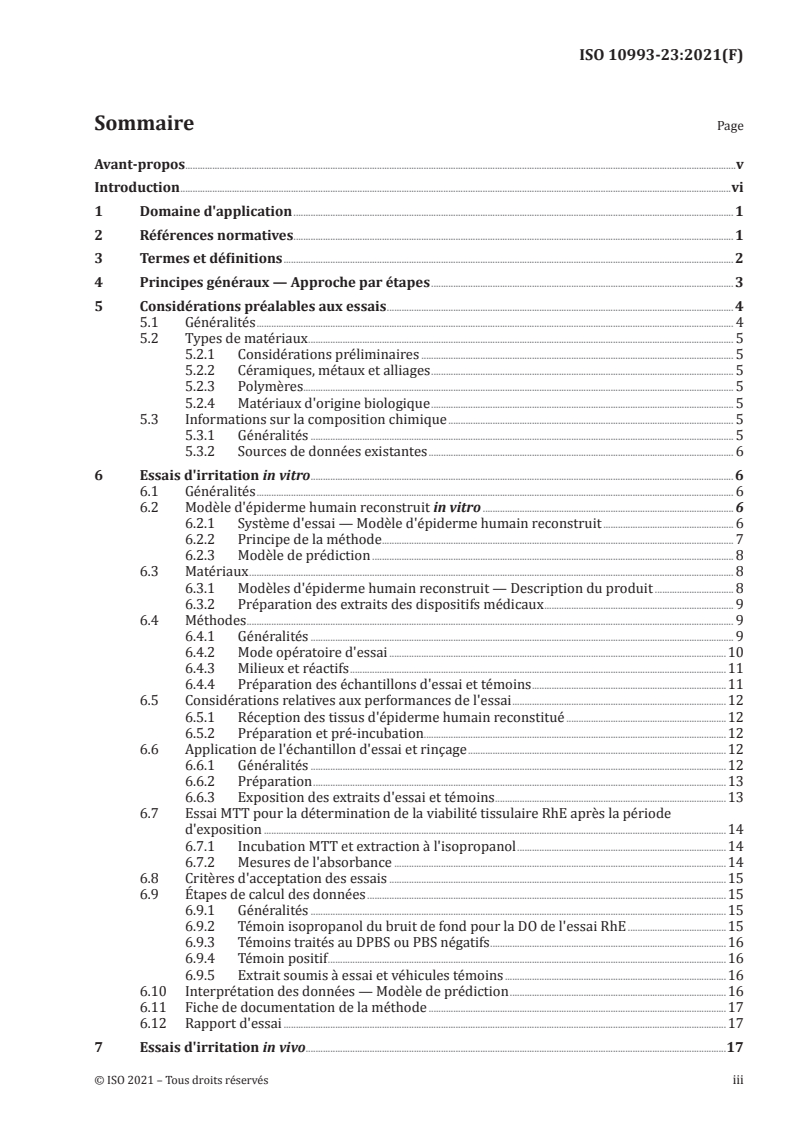
Sommaire Page
Avant-propos .v
Introduction .vi
1 Domaine d'application . 1
2 Références normatives . 1
3 Termes et définitions . 2
4 Principes généraux — Approche par étapes . 3
5 Considérations préalables aux essais . 4
5.1 Généralités . 4
5.2 Types de matériaux . 5
5.2.1 Considérations préliminaires . 5
5.2.2 Céramiques, métaux et alliages . 5
5.2.3 Polymères. 5
5.2.4 Matériaux d'origine biologique . 5
5.3 Informations sur la composition chimique . 5
5.3.1 Généralités . 5
5.3.2 Sources de données existantes . 6
6 Essais d'irritation in vitro . 6
6.1 Généralités . 6
6.2 Modèle d'épiderme humain reconstruit in vitro . 6
6.2.1 Système d'essai — Modèle d'épiderme humain reconstruit . 6
6.2.2 Principe de la méthode . . 7
6.2.3 Modèle de prédiction . 8
6.3 Matériaux . 8
6.3.1 Modèles d'épiderme humain reconstruit — Description du produit . 8
6.3.2 Préparation des extraits des dispositifs médicaux . 9
6.4 Méthodes . 9
6.4.1 Généralités . 9
6.4.2 Mode opératoire d'essai .10
6.4.3 Milieux et réactifs .11
6.4.4 Préparation des échantillons d'essai et témoins .11
6.5 Considérations relatives aux performances de l'essai .12
6.5.1 Réception des tissus d'épiderme humain reconstitué .12
6.5.2 Préparation et pré-incubation.12
6.6 Application de l'échantillon d'essai et rinçage .12
6.6.1 Généralités .12
6.6.2 Préparation .13
6.6.3 Exposition des extraits d'essai et témoins .13
6.7 Essai MTT pour la détermination de la viabilité tissulaire RhE après la période
d'exposition .14
6.7.1 Incubation MTT et extraction à l'isopropanol .14
6.7.2 Mesures de l'absorbance .14
6.8 Critères d'acceptation des essais .15
6.9 Étapes de calcul des données .15
6.9.1 Généralités .15
6.9.2 Témoin isopropanol du bruit de fond pour la DO de l'essai RhE .15
6.9.3 Témoins traités au DPBS ou PBS négatifs .16
6.9.4 Témoin positif .16
6.9.5 Extrait soumis à essai et véhicules témoins .16
6.10 Interprétation des données — Modèle de prédiction .16
6.11 Fiche de documentation de la méthode .17
6.12 Rapport d'essai .17
7 Essais d'irritation in vivo.17
7.1 Généralités .17
7.2 Essai d'irritation chez l'animal par exposition cutanée .18
7.2.1 Principe .18
7.2.2 Matériaux d'essai .18
7.2.3 Animaux et leur hébergement .19
7.2.4 Mode opératoire d'essai .19
7.2.5 Observation des animaux .21
7.2.6 Évaluation des résultats .21
7.2.7 Rapport d'essai .23
7.3 Essai d'irritation chez l'animal par administration intracutanée (intradermique) .23
7.3.1 Introduction .23
7.3.2 Matériaux exclus de l'essai .23
7.3.3 Échantillon d'essai .23
7.3.4 Animaux et leur hébergement .24
7.3.5 Mode opératoire d'essai .24
7.3.6 Observation des animaux .25
7.3.7 Évaluation des résultats .26
7.3.8 Rapport d'essai .26
8 Essai d'irritation de la peau sur l'homme .27
8.1 Introduction .27
8.2 Considérations préliminaires .27
Annexe A (normative) Préparation des matériaux pour les essais d'irritation .28
Annexe B (informative) Liste de contrôle de la méthode d'essai pour les essais d'irritation
in vitro utilisant des modèles d'épiderme humain reconstruit .30
Annexe C (informative) Exemple de Fiche de documentation de la méthode pour les
modèles d'épiderme humain reconstruit.32
Annexe D (normative) Essais d'irritation particuliers .37
Annexe E (normative) Essai d'irritation de la peau humaine .54
Annexe F (informative) Informations générales sur les essais d'irritation .58
Bibliographie .60
iv © ISO 2021 – Tous droits réservés
Avant-propos
L'ISO (Organisation internationale de normalisation) est une fédération mondiale d'organismes
nationaux de normalisation (comités membres de l'ISO). L'élaboration des Normes internationales est
en général confiée aux comités techniques de l'ISO. Chaque comité membre intéressé par une étude
a le droit de faire partie du comité technique créé à cet effet. Les organisations internationales,
gouvernementales et non gouvernementales, en liaison avec l'ISO participent également aux travaux.
L'ISO collabore étroitement avec la Commission électrotechnique internationale (IEC) en ce qui
concerne la normalisation électrotechnique.
Les procédures utilisées pour élaborer le présent document et celles destinées à sa mise à jour sont
décrites dans les Directives ISO/IEC, Partie 1. Il convient, en particulier de prendre note des différents
critères d'approbation requis pour les différents types de documents ISO. Le présent document a été
rédigé conformément aux règles de rédaction données dans les Directives ISO/IEC, Partie 2 (voir www
.iso .org/ directives).
L'attention est attirée sur le fait que certains des éléments du présent document peuvent faire l'objet de
droits de propriété intellectuelle ou de droits analogues. L'ISO ne saurait être tenue pour responsable
de ne pas avoir identifié de tels droits de propriété et averti de leur existence. Les détails concernant
les références aux droits de propriété intellectuelle ou autres droits analogues identifiés lors de
l'élaboration du document sont indiqués dans l'Introduction et/ou dans la liste des déclarations de
brevets reçues par l'ISO (voir www .iso .org/ brevets).
Les appellations commerciales éventuellement mentionnées dans le présent document sont données
pour information, par souci de commodité, à l'intention des utilisateurs et ne sauraient constituer un
engagement.
Pour une explication de la nature volontaire des normes, la signification des termes et expressions
spécifiques de l'ISO liés à l'évaluation de la conformité, ou pour toute information au sujet de l'adhésion
de l'ISO aux principes de l'Organisation mondiale du commerce (OMC) concernant les obstacles
techniques au commerce (OTC), voir le lien suivant : www .iso .org/ iso/ fr/ avant -propos.
Le présent document a été élaboré par le comité technique ISO/TC 194, Évaluation biologique et clinique
des dispositifs médicaux, en collaboration avec le comité technique CEN/TC 206 du Comité européen de
normalisation (CEN), Évaluation biologique et clinique des dispositifs médicaux, conformément à l'Accord
de coopération technique entre l'ISO et le CEN (Accord de Vienne).
Une liste de toutes les parties de la série ISO 10993 se trouve sur le site web de l'ISO.
Il convient que l'utilisateur adresse tout retour d'information ou toute question concernant le présent
document à l'organisme national de normalisation de son pays. Une liste exhaustive desdits organismes
se trouve à l'adresse www .iso .org/ fr/ members .html.
La présente version corrigée de l'ISO 10993-23:2021 inclut la correction suivante : la date de l'édition du
présent document a été corrigée sur la page de couverture pour indiquer "2021-01".
Introduction
Le présent document évalue les dangers éventuels dus au contact des dispositifs médicaux pouvant
provoquer une irritation.
Certains matériaux contenus dans ces dispositifs médicaux ont fait l'objet d'essais, et le risque
d'irritation de la peau ou des muqueuses qu'ils présentent a été démontré. D'autres matériaux et leurs
constituants chimiques n'ont pas fait l'objet d'essais et peuvent induire des effets indésirables lorsqu'ils
sont en contact avec des tissus humains. Le fabricant est donc tenu d'évaluer les effets indésirables
potentiels de chaque dispositif avant de le commercialiser.
Le potentiel d'irritation d'un dispositif médical ou de ses composants peut être prédit soit par un essai
d'irritation in vivo chez l'animal, soit par un essai d'irritation in vitro s'il est qualifié pour une utilisation
avec des dispositifs médicaux.
L'ISO 10993-2 traite de la protection des animaux dans le cadre de l'expérimentation animale pour
l'évaluation biologique des dispositifs médicaux ; elle met ainsi l'accent sur les « 3 R » que sont le
remplacement, la réduction et le raffinement des études sur l'animal. Le présent document décrit les
essais in vitro ou in vivo permettant de déterminer la propriété irritante des dispositifs médicaux, des
matériaux ou de leurs extraits. Les essais in vitro sont à préférer aux essais in vivo lorsqu'ils ont été
dûment validés et qu'ils fournissent des informations aussi pertinentes que celles des essais in vivo
(ISO 10993-1 et ISO 10993-2).
Traditionnellement, des essais sur les petits animaux sont effectués avant les essais sur l'être humain
afin d'aider à prévoir la réaction chez l'homme. Plus récemment, des essais in vitro ainsi que des essais
sur l'être humain ont été introduits comme compléments ou alternatives. Pour les essais d'irritation
de la peau concernant des produits chimiques purs, des essais in vitro ont été élaborés à l'aide de
[31]
modèles d'épiderme humain reconstruit (RhE) . La méthode a été adaptée pour détecter les produits
chimiques irritants présents dans les extraits des dispositifs médicaux. Les résultats d'une grande étude
interlaboratoires portant sur deux types de modèles RhE peuvent également être utilisés pour déceler
la présence de produits chimiques irritants dans les matériaux polymériques [polychlorure de vinyle
[6]
(PVC) et silicone] communément utilisés dans la fabrication de dispositifs médicaux . Il a été démontré
que cette méthode présente une sensibilité équivalente pour détecter de faibles concentrations de
certains composés fortement irritants comparée aux essais épicutanés sur l'être humain et aux essais
[14]
intradermiques sur le lapin . Une approche par étapes pour les essais d'irritation peut donc démarrer
avec le modèle RhE in vitro.
Les modèles RhE développés et validés sont appropriés pour prédire la réaction d'irritation du tissu
cutané. Il est recommandé d'explorer l'utilisation d'autres modèles in vitro alternatifs pour évaluer le
potentiel d'irritation pour les applications épithéliales des muqueuses ou des yeux.
Il est prévu que, pour les soumissions aux autorités réglementaires, ces études soient menées
conformément aux principes des BPL ou de l'ISO/IEC 17025 selon les règles applicables au pays concerné,
et qu'elles soient conformes aux réglementations relatives à la protection des animaux. L'analyse
statistique de données est recommandée et peut être utilisée chaque fois que cela s'avère nécessaire.
Le présent document est destiné à être utilisé par les professionnels, qualifiés par une formation et une
expérience appropriées, capables d'interpréter ses exigences et de juger des conclusions de l'évaluation
pour chaque dispositif médical, en tenant compte de tous les facteurs concernant le dispositif, son
emploi prévu et les connaissances en cours sur le dispositif médical apportées par la consultation de la
littérature scientifique et des expériences cliniques antérieures.
Les essais inclus dans le présent document constituent des outils importants pour la mise au point de
produits sûrs, à condition qu'ils soient réalisés et interprétés par un personnel qualifié.
Le présent document est fondé sur de nombreuses normes et directives, y compris les lignes
[40]
directrices (LD) relatives aux essais de l'OCDE, la pharmacopée des États-Unis et la pharmacopée
[39]
européenne . Il vise à constituer le document de référence de base pour la sélection et la conduite des
vi © ISO 2021 – Tous droits réservés
essais permettant d'évaluer les réactions d'irritation se rapportant à la sécurité des matériaux et des
dispositifs médicaux.
Des instructions sont fournies dans l'Annexe A (normative) en vue de la préparation des matériaux,
notamment pour les essais précités. L'Annexe D (normative) décrit plusieurs essais d'irritation in
vivo spécifiques pour l'application de dispositifs médicaux dans des zones autres que la peau. En
complément, l'Annexe E (normative) fournit des informations pour la conduite des essais d'irritation
cutanée sur l'être humain.
NORME INTERNATIONALE ISO 10993-23:2021(F)
Évaluation biologique des dispositifs médicaux —
Partie 23:
Essais d'irritation
1 Domaine d'application
Le présent document spécifie le mode opératoire pour l'évaluation du potentiel des dispositifs
médicaux et de leurs matériaux constitutifs à provoquer une irritation. Les essais sont conçus pour
prédire et classer le potentiel d'irritation des dispositifs médicaux, des matériaux ou de leurs extraits
conformément à l'ISO 10993-1 et à l'ISO 10993-2.
Le présent document comprend :
— les considérations préalables à la réalisation des essais d'irritation, y compris des méthodes in silico
et in vitro d'exposition cutanée ;
— les informations détaillées relatives aux modes opératoires d'essai d'irritation in vitro et in vivo ;
— les facteurs clés pour l'interprétation des résultats.
2 Références normatives
Les documents suivants sont cités dans le texte de sorte qu'ils constituent, pour tout ou partie de leur
contenu, des exigences du présent document. Pour les références datées, seule l'édition citée s'applique.
Pour les références non datées, la dernière édition du document de référence s'applique (y compris les
éventuels amendements).
ISO 10993-1, Évaluation biologique des dispositifs médicaux — Partie 1: Évaluation et essais au sein d'un
processus de gestion du risque
ISO 10993-2, Évaluation biologique des dispositifs médicaux — Partie 2 : Exigences relatives à la protection
des animaux
ISO 10993-9, Évaluation biologique des dispositifs médicaux — Partie 9: Cadre pour l'identification et la
quantification des produits potentiels de dégradation
ISO 10993-12, Évaluation biologique des dispositifs médicaux — Partie 12 : Préparation des échantillons et
matériaux de référence
ISO 10993-13, Évaluation biologique des dispositifs médicaux — Partie 13: Identification et quantification
de produits de dégradation de dispositifs médicaux à base de polymères
ISO 10993-14, Évaluation biologique des dispositifs médicaux — Partie 14: Identification et quantification
des produits de dégradation des céramiques
ISO 10993-15, Évaluation biologique des dispositifs médicaux — Partie 15: Identification et quantification
des produits de dégradation issus des métaux et alliages
ISO 10993-18, Évaluation biologique des dispositifs médicaux — Partie 18: Caractérisation chimique des
matériaux des dispositifs médicaux au sein d'un processus de gestion du risque
ISO 14155, Investigation clinique des dispositifs médicaux pour sujets humains — Bonne pratique clinique
OCDE 404, Effet irritant/corrosif aigu sur la peau
OCDE 439, Irritation cutanée in vitro : Essai sur épiderme humain reconstitué
3 Termes et définitions
Pour les besoins du présent document, les termes et définitions suivants s'appliquent.
L'ISO et l'IEC tiennent à jour des bases de données terminologiques destinées à être utilisées en
normalisation, consultables aux adresses suivantes :
— IEC Electropedia : disponible à l'adresse http:// www .electropedia .org/
— ISO Online browsing platform : disponible à l'adresse https:// www .iso .org/ obp
3.1
blanc
solution préparée de la même manière que la solution de dosage mais ne contenant pas l'analyte
[SOURCE: : ISO 10136‑1:1993, 3.8, modifiée — le terme « solution d'essai à blanc » a été remplacé par
« blanc ».]
3.2
dose
dosage
quantité d'échantillon d'essai (3.14) administrée (par exemple masse, volume) exprimée par unité de
poids ou de surface du corps
Note 1 à l'article: à l'article : Les termes sont souvent utilisés de manière interchangeable (plus communément
dosage).
3.3
érythème
rougissement de la peau ou d'une muqueuse
3.4
escarre
croûte ou lividité de la peau
3.5
extrait
liquide ou suspension résultant de l'exposition d'un matériau d'essai ou d'un matériau témoin à un
véhicule (3.16) d'extraction dans des conditions contrôlées
3.6
irritant
agent provoquant une irritation (3.7)
3.7
irritation
réaction inflammatoire non spécifique localisée à une application unique, répétée ou continue d'une
substance/d'un matériau
Note 1 à l'article: L'irritation de la peau est une réaction réversible et se caractérise principalement par un
érythème (3.3) (rougeur) et un gonflement de la peau [œdème (3.9)].
3.8
nécrose
mort de cellules en raison directe de modifications irréversibles provoquées par une blessure ou
une maladie
Note 1 à l'article: Il y aura une régénération des tissus aboutissant soit à une restauration fonctionnelle totale,
soit à la formation d'une cicatrice.
2 © ISO 2021 – Tous droits réservés
3.9
témoin négatif
matériau et/ou substance bien caractérisés qui, lors d'essais réalisés selon un mode opératoire
spécifique, démontrent l'aptitude du mode opératoire à fournir une réponse négative reproductible,
non réactive ou minimale lors de l'expérimentation
Note 1 à l'article: Dans la pratique, les témoins négatifs comprennent les blancs (3.1), les véhicules (3.16)/solvants
et les produits de référence.
3.10
œdème
gonflement dû à l'infiltration anormale de fluide dans le tissu
3.11
témoin positif
matériau ou substance bien caractérisé(e), qui, soumis(e) à essai conformément à une méthode
d'essai spécifique, démontre l'aptitude du système d'essai à conduire à une réponse reproductible,
judicieusement positive ou réactive vis-à-vis du système d'essai particulier
3.12
corrosion de la peau
production de lésions irréversibles de la peau, sous forme de nécrose (3.8) visible sur l'épiderme et dans
le derme, en réaction à l'application d'un échantillon d'essai (3.14)
EXEMPLE L'action d'un composant, d'un produit chimique ou d'un échantillon d'essai provoquant une
ulcération (voir 3.15) de la peau.
3.13
matériau d'essai
matériau, dispositif, partie ou composant de dispositif qui est échantillonné pour la conduite d'essais
biologiques ou chimiques
3.14
échantillon d'essai
matériau, dispositif, partie de dispositif, composant, extrait (3.5) ou partie de celui-ci qui est soumis à
des essais biologiques ou chimiques ou à une évaluation
3.15
ulcération
plaie ouverte correspondant à une perte de tissus superficiels
3.16
véhicule
liquide utilisé pour humidifier, diluer, mettre en suspension, extraire ou dissoudre le matériau/la
substance d'essai
3.17
véhicule témoin
véhicule (3.16) d'extraction ne contenant pas le matériau d'essai (3.13), contenu dans un récipient
identique à celui contenant le matériau d'essai et soumis à des conditions identiques à celles auxquelles
est soumis le matériau d'essai au cours de son extraction
Note 1 à l'article: Le but du véhicule témoin est d'évaluer les interférences possibles liées au récipient d'extraction,
au véhicule et au processus d'extraction.
4 Principes généraux — Approche par étapes
Les méthodes disponibles pour les essais d'irritation ont été mises au point spécifiquement afin de déceler
un risque potentiel d'irritation de la peau et d'une muqueuse. Ces essais ne permettent généralement
pas de prédire les autres types d'effets indésirables, tels que la sensibilisation. Historiquement, les
essais d'irritation sont réalisés sur le lapin. Pour les dispositifs médicaux utilisés comme implants ou
dispositifs de communication externes, les essais intradermiques sont plus pertinents pour s'approcher
de l'application et, de fait, les essais intracutanés tels que décrits en 7.2 sont indiqués pour la détection
des irritations.
Les essais in vitro doivent être préférés aux essais in vivo conformément à l'ISO 10993-2, avec
remplacement de ces derniers à mesure que de nouveaux essais in vitro sont validés scientifiquement
et deviennent raisonnablement et pratiquement disponibles. Les résultats d'une grande étude
interlaboratoires portant sur deux types de modèles RhE peuvent également être utilisés pour déceler
la présence de produits chimiques irritants dans les matériaux polymériques [polychlorure de vinyle
[6]
(PVC) et silicone] communément utilisés dans la fabrication de dispositifs médicaux . Il a été démontré
que cette méthode présente une sensibilité équivalente pour détecter de faibles concentrations de
certains composés fortement irritants comparée aux essais épicutanés sur l'être humain et aux essais
[14]
intradermiques sur le lapin . Par conséquent, l'essai d'irritation in vitro doit être réalisé avant
d'envisager des essais épicutanés sur l'être humain ou des essais sur les animaux.
NOTE Il peut être pertinent de fournir des informations détaillées concernant l'applicabilité du modèle RhE
pour le dispositif médical spécifique soumis à essai.
Le présent document décrit une approche par étapes, qui doit comprendre un ou plusieurs des éléments
suivants :
a) la caractérisation du chimique, complétée le cas échéant par des essais chimiques des échantillons
conformément aux principes généraux spécifiés dans l'ISO 10993‑9, l'ISO 10993‑13, l'ISO 10993‑14,
l'ISO 10993-15 et l'ISO 10993-18 ;
b) la revue de la littérature, comme indiqué dans l'ISO 10993-1, incluant l'évaluation des
caractéristiques chimiques et physiques, ainsi que des informations sur les risques d'irritation
de chaque composant du matériau d'essai, ainsi que des produits chimiques et des matériaux de
structure apparentée ;
NOTE Les méthodes in silico (relation structure-activité, QSAR, références croisées) peuvent indiquer
une potentielle activité irritante.
c) un essai in vitro alternatif utilisant un épiderme humain reconstitué (RhE) validé selon les
méthodes décrites en 6.2 à 6.12 ;
NOTE Pour les essais d'irritation particuliers pertinents pour les dispositifs médicaux destinés à
des zones spécifiques (Annexe D), c'est-à-dire pour les zones épithéliales des muqueuses ou des yeux, les
modèles RhE ne sont pas adaptés et il est recommandé d'explorer l'utilisation d'autres modèles in vitro avec
les cellules ou tissus appropriés s'ils sont qualifiés pour une utilisation avec des dispositifs médicaux.
d) des essais in vivo sur les animaux ;
NOTE Les essais in vivo sur l'animal sont appropriés lorsque les matériaux d'essai ne peuvent pas
être caractérisés et les évaluations du risque ne peuvent pas être entreprises en utilisant les informations
obtenues par les moyens indiqués en a), b) et c).
e) les études cliniques conformes à l'ISO 14155 et aux principes éthiques régissant la recherche
clinique chez l'être humain ne doivent pas être réalisées avant que le potentiel d'irritation d'un
dispositif n'a été établi par au moins l'une des évaluations décrites de a) à d).
5 Considérations préalables aux essais
5.1 Généralités
Il est important de souligner que les considérations préalables aux essais peuvent amener à conclure
que les essais d'irritation ne sont pas nécessaires. Par exemple, si le pH de l'échantillon d'essai est ≤ 2,0
ou ≥ 11,5, le matériau doit être considéré comme irritant et aucun essai d'irritation supplémentaire
n'est requis selon l'OCDE 404.
4 © ISO 2021 – Tous droits réservés
Les exigences spécifiées dans l'ISO 10993‑1:2018, Article 5, relatives à la catégorisation des dispositifs
médicaux et les exigences suivantes s'appliquent.
Les échantillons non stériles doivent être examinés in vivo par une investigation topique uniquement,
car la possibilité d'une contamination microbienne de l'échantillon d'essai est susceptible de nuire
à l'interprétation finale des essais. Lorsque la stérilité d'un échantillon d'essai ne peut être garantie
mais que l'échantillon est quand même considéré comme non contaminé, il convient de justifier
l'administration intradermique.
5.2 Types de matériaux
5.2.1 Considérations préliminaires
Il doit être pris en considération que, pendant la fabrication et l'assemblage des dispositifs médicaux,
des composants chimiques supplémentaires peuvent être utilisés comme intermédiaires de fabrication,
par exemple des lubrifiants ou des agents de démoulage. En plus des composants chimiques du matériau
initial et des intermédiaires de fabrication, des résidus d'adhésif/de solvant provenant de l'assemblage,
des résidus de stérilisation ou des produits de réaction résultant du procédé de stérilisation peuvent
être présents dans un produit fini. Le danger/le risque que constituent ces composants pour la santé
dépend des caractéristiques de relargage ou de dégradation des produits finis. Ces composants doivent
être pris en compte pour leur activité potentielle d'irritation. Les types de matériaux suivants sont
souvent utilisés dans les dispositifs médicaux et sont susceptibles d'introduire des risques d'irritation.
5.2.2 Céramiques, métaux et alliages
En matière de nombre de composants chimiques, ces matériaux sont normalement moins complexes
que les polymères et les matériaux d'origine biologique.
5.2.3 Polymères
Ces matériaux ont normalement une composition chimique plus complexe que celle des céramiques,
métaux et alliages. Un certain nombre de produits réactionnels, d'impuretés et d'additifs peut être
présent et la complétude de la polymérisation peut varier.
5.2.4 Matériaux d'origine biologique
Ces matériaux ont par essence une composition complexe. Ils contiennent souvent des résidus de
procédé, par exemple des agents de réticulation et des agents antimicrobiens. Les matériaux d'origine
biologique peuvent varier d'un échantillon à l'autre.
5.3 Informations sur la composition chimique
5.3.1 Généralités
Une description des composants chimiques du dispositif médical doit être établie conformément à
l'ISO 10993-18. Comme précisé dans l'ISO 10993-1, l'étendue de la caractérisation physique et/ou
chimique exigée dépend des informations connues sur la formule du matériau, ainsi que de la nature
et de la durée du contact du dispositif médical avec le corps. La caractérisation doit déterminer au
minimum les composants chimiques du dispositif et les éventuels additifs et auxiliaires résiduels de
fabrication. La rigueur nécessaire dans la caractérisation des composants chimiques est principalement
déterminée par la nature, le degré, la durée et la fréquence de l'exposition et des dangers identifiés
pour le dispositif médical ou le matériau. Lorsque cela s'avère pertinent pour la connaissance du risque
biologique, les données quantitatives doivent également être obtenues. Si des données quantitatives ne
sont pas obtenues, la justification doit être documentée et établie.
5.3.2 Sources de données existantes
Lorsque cela est possible, les informations relatives à la composition qualitative et quantitative doivent
être obtenues auprès du fournisseur du matériau d'origine.
Pour les polymères, cette étape requiert souvent l'accès à des informations confidentielles et il convient
de prendre des mesures appropriées pour le transfert et l'utilisation de telles informations.
Les informations qualitatives sur les additifs de fabrication supplémentaires (par exemple les produits
de démoulage) doivent également être obtenues auprès des acteurs appropriés de la chaîne de
fabrication, incluant les transformateurs et les fabricants de composants.
En l'absence de toute donnée sur la composition, une recherche documentaire est recommandée pour
établir la nature probable du matériau de départ et de tout additif, afin d'aider au choix des méthodes
d'analyse les plus appropriées pour le matériau concerné.
La caractérisation chimique d'un dispositif médical doit être menée conformément à l'ISO 10993-18.
NOTE La composition des céramiques, des métaux et des alliages peut être spécifiée conformément à
des normes ISO ou à des normes ASTM (American Society for Testing Materials) et/ou peut être spécifiée par
l'utilisateur. Toutefois, afin d'obtenir des détails complets sur la composition qualitative et quantitative, il peut
être nécessaire de les demander au fournisseur ou au fabricant du matériau de départ ainsi qu'aux fabricants
de composants afin de s'assurer que les intermédiaires de fabrication sont également identifiés. S'ils sont
accessibles, les dossiers techniques sur le matériau détenus par les autorités réglementaires représentent une
autre source de données.
6 Essais d'irritation in vitro
6.1 Généralités
La méthode in vitro avec modèles RhE pour les essais d'irritation a été élaborée spécialement pour
[3][12]
détecter l'irritation cutanée potentielle pour les produits chimiques purs (voir OCDE 439). La
méthode a été adaptée et validée avec deux modèles RhE pour détecter les produits chimiques irritants
[5][6][12][13][17][18][19]
dans les extraits des dispositifs médicaux . Il a été démontré que cette méthode
présente une sensibilité équivalente pour détecter de faibles concentrations de certains composés
fortement irritants dans les extraits issus de matériaux médicaux à base de polymères (PVC et silicone)
[20]
comparée aux essais épicutanés sur l'être humain et aux essais intradermiques sur le lapin . Par
conséquent, l'essai RhE tel que décrit dans le présent document peut remplacer l'essai d'irritation par
exposition cutanée et par administration intradermique (intracutanée) in vivo sur le lapin.
NOTE Il peut être pertinent de fournir des informations détaillées concernant l'applicabilité du modèle RhE
pour le dispositif médical spécifique soumis à essai.
6.2 Modèle d'épiderme humain reconstruit in vitro
6.2.1 Système d'essai — Modèle d'épiderme humain reconstruit
Le modèle RhE doit être obtenu à partir de kératinocytes d'épiderme humain normaux, mis en culture
pour former un modèle multicouche hautement différencié d'épiderme humain. Il doit se composer de
couches organisées basales, épineuses et granuleuses, ainsi que d'un stratum corneum (couche cornée)
multicouche contenant des couches lipidiques lamellaires intercellulaires disposées de façon similaire
à celles trouvées in vivo. Les kératinocytes humains normaux obtenus auprès de donneurs volontaires
sains doivent être mis en culture pendant plusieurs jours sur une membrane ou un filtre, avec une
interface air/liquide, afin de former un modèle tridimensionnel d'épiderme contenant les principales
couches basales, supra-basales, épineuses et granuleuses, ainsi qu'un stratum corneum fonctionnel. Le
système du modèle doit permettre d'appliquer les extraits polaires (par exemple, solution saline) et non
polaires (par exemple, huile de sésame) directement sur la surface apicale des modèles RhE.
6 © ISO 2021 – Tous droits réservés
Les matériaux non adaptés à l'extraction (par exemple : liquides, gels, pâtes et particules) pourraient
convenir pour le système d'essai. Le cas échéant, il convient de fournir des données de validation pour
démontrer la capacité de l'essai à détecter l'activité irritante de ces formes de matériaux avant les essais.
6.2.2 Principe de la méthode
Critères d'évaluation : la détermination de la viabilité cellulaire est fondée sur la réduction cellulaire
du MTT [bromure de (3-(4, 5-diméthylthiazol-2-yl)-2,5-diphényltétrazolium] et sa conversion en sel de
[9][16]
formazan violet, mesuré quantitativement après son extraction des tissus. . La viabilité cellulaire
dans les tissus traités est exprimée en pourcentage du véhicule témoin négatif. Le pourcentage de
réduction de viabilité est utilisé pour prédire le potentiel d'irritation.
[13][17][19]
NOTE 1 La réduction de la survie tissulaire peut s'accompagner d'une libération d'IL‑1α . Le milieu
de culture tissulaire utilisé pour l'exposition peut être collecté et conservé à l'état congelé, à ≤−20 °C, pour une
analyse éventuelle des cytokines.
Mode opératoire succinct : les études réalisées avec des biomatériaux à base de polymères, fabriqués
spécialement pour contenir de faibles concentrations de produits chimiques irritants, ont montré qu'il
est nécessaire d'utiliser une exposition prolongée par rapport au protocole spécifié dans l'OCDE 439
pour les produits chimiques purs. Une période d'incubation comprise entre 18 h et 24 h à 37 °C, pour une
exposition à des concentrations potentiellement faibles d'irritants dans les extraits de biomatériaux,
est suffisante pour prédire l'irritation in vitro avec une réduction de la viabilité tissulaire au‑dessous
[4][6][13][17][19]
de 50 % . Les expositions de 18 h et 24 h ont donné des résultats similaires pour les deux
[13]
modèles RhE évalués par l'étude interlaboratoires portant sur les extraits de dispositifs médicaux
[17][19]
.
Les tissus sont incubés à 37 °C, 5 % de CO et dans un incubateur à atmosphère humide après l'ajout des
extraits d'essai et extraits témoins.
L'exposition à l'échantillon d'
...
NORME ISO
INTERNATIONALE 10993-23
Première édition
2021-01
Version corrigée
2021-02
Évaluation biologique des dispositifs
médicaux —
Partie 23:
Essais d'irritation
Biological evaluation of medical devices —
Part 23: Tests for irritation
Numéro de référence
©
ISO 2021
DOCUMENT PROTÉGÉ PAR COPYRIGHT
© ISO 2021
Tous droits réservés. Sauf prescription différente ou nécessité dans le contexte de sa mise en œuvre, aucune partie de cette
publication ne peut être reproduite ni utilisée sous quelque forme que ce soit et par aucun procédé, électronique ou mécanique,
y compris la photocopie, ou la diffusion sur l’internet ou sur un intranet, sans autorisation écrite préalable. Une autorisation peut
être demandée à l’ISO à l’adresse ci-après ou au comité membre de l’ISO dans le pays du demandeur.
ISO copyright office
Case postale 401 • Ch. de Blandonnet 8
CH-1214 Vernier, Genève
Tél.: +41 22 749 01 11
E-mail: copyright@iso.org
Web: www.iso.org
Publié en Suisse
ii © ISO 2021 – Tous droits réservés
Sommaire Page
Avant-propos .v
Introduction .vi
1 Domaine d'application . 1
2 Références normatives . 1
3 Termes et définitions . 2
4 Principes généraux — Approche par étapes . 3
5 Considérations préalables aux essais . 4
5.1 Généralités . 4
5.2 Types de matériaux . 5
5.2.1 Considérations préliminaires . 5
5.2.2 Céramiques, métaux et alliages . 5
5.2.3 Polymères. 5
5.2.4 Matériaux d'origine biologique . 5
5.3 Informations sur la composition chimique . 5
5.3.1 Généralités . 5
5.3.2 Sources de données existantes . 6
6 Essais d'irritation in vitro . 6
6.1 Généralités . 6
6.2 Modèle d'épiderme humain reconstruit in vitro . 6
6.2.1 Système d'essai — Modèle d'épiderme humain reconstruit . 6
6.2.2 Principe de la méthode . . 7
6.2.3 Modèle de prédiction . 8
6.3 Matériaux . 8
6.3.1 Modèles d'épiderme humain reconstruit — Description du produit . 8
6.3.2 Préparation des extraits des dispositifs médicaux . 9
6.4 Méthodes . 9
6.4.1 Généralités . 9
6.4.2 Mode opératoire d'essai .10
6.4.3 Milieux et réactifs .11
6.4.4 Préparation des échantillons d'essai et témoins .11
6.5 Considérations relatives aux performances de l'essai .12
6.5.1 Réception des tissus d'épiderme humain reconstitué .12
6.5.2 Préparation et pré-incubation.12
6.6 Application de l'échantillon d'essai et rinçage .12
6.6.1 Généralités .12
6.6.2 Préparation .13
6.6.3 Exposition des extraits d'essai et témoins .13
6.7 Essai MTT pour la détermination de la viabilité tissulaire RhE après la période
d'exposition .14
6.7.1 Incubation MTT et extraction à l'isopropanol .14
6.7.2 Mesures de l'absorbance .14
6.8 Critères d'acceptation des essais .15
6.9 Étapes de calcul des données .15
6.9.1 Généralités .15
6.9.2 Témoin isopropanol du bruit de fond pour la DO de l'essai RhE .15
6.9.3 Témoins traités au DPBS ou PBS négatifs .16
6.9.4 Témoin positif .16
6.9.5 Extrait soumis à essai et véhicules témoins .16
6.10 Interprétation des données — Modèle de prédiction .16
6.11 Fiche de documentation de la méthode .17
6.12 Rapport d'essai .17
7 Essais d'irritation in vivo.17
7.1 Généralités .17
7.2 Essai d'irritation chez l'animal par exposition cutanée .18
7.2.1 Principe .18
7.2.2 Matériaux d'essai .18
7.2.3 Animaux et leur hébergement .19
7.2.4 Mode opératoire d'essai .19
7.2.5 Observation des animaux .21
7.2.6 Évaluation des résultats .21
7.2.7 Rapport d'essai .23
7.3 Essai d'irritation chez l'animal par administration intracutanée (intradermique) .23
7.3.1 Introduction .23
7.3.2 Matériaux exclus de l'essai .23
7.3.3 Échantillon d'essai .23
7.3.4 Animaux et leur hébergement .24
7.3.5 Mode opératoire d'essai .24
7.3.6 Observation des animaux .25
7.3.7 Évaluation des résultats .26
7.3.8 Rapport d'essai .26
8 Essai d'irritation de la peau sur l'homme .27
8.1 Introduction .27
8.2 Considérations préliminaires .27
Annexe A (normative) Préparation des matériaux pour les essais d'irritation .28
Annexe B (informative) Liste de contrôle de la méthode d'essai pour les essais d'irritation
in vitro utilisant des modèles d'épiderme humain reconstruit .30
Annexe C (informative) Exemple de Fiche de documentation de la méthode pour les
modèles d'épiderme humain reconstruit.32
Annexe D (normative) Essais d'irritation particuliers .37
Annexe E (normative) Essai d'irritation de la peau humaine .54
Annexe F (informative) Informations générales sur les essais d'irritation .58
Bibliographie .60
iv © ISO 2021 – Tous droits réservés
Avant-propos
L'ISO (Organisation internationale de normalisation) est une fédération mondiale d'organismes
nationaux de normalisation (comités membres de l'ISO). L'élaboration des Normes internationales est
en général confiée aux comités techniques de l'ISO. Chaque comité membre intéressé par une étude
a le droit de faire partie du comité technique créé à cet effet. Les organisations internationales,
gouvernementales et non gouvernementales, en liaison avec l'ISO participent également aux travaux.
L'ISO collabore étroitement avec la Commission électrotechnique internationale (IEC) en ce qui
concerne la normalisation électrotechnique.
Les procédures utilisées pour élaborer le présent document et celles destinées à sa mise à jour sont
décrites dans les Directives ISO/IEC, Partie 1. Il convient, en particulier de prendre note des différents
critères d'approbation requis pour les différents types de documents ISO. Le présent document a été
rédigé conformément aux règles de rédaction données dans les Directives ISO/IEC, Partie 2 (voir www
.iso .org/ directives).
L'attention est attirée sur le fait que certains des éléments du présent document peuvent faire l'objet de
droits de propriété intellectuelle ou de droits analogues. L'ISO ne saurait être tenue pour responsable
de ne pas avoir identifié de tels droits de propriété et averti de leur existence. Les détails concernant
les références aux droits de propriété intellectuelle ou autres droits analogues identifiés lors de
l'élaboration du document sont indiqués dans l'Introduction et/ou dans la liste des déclarations de
brevets reçues par l'ISO (voir www .iso .org/ brevets).
Les appellations commerciales éventuellement mentionnées dans le présent document sont données
pour information, par souci de commodité, à l'intention des utilisateurs et ne sauraient constituer un
engagement.
Pour une explication de la nature volontaire des normes, la signification des termes et expressions
spécifiques de l'ISO liés à l'évaluation de la conformité, ou pour toute information au sujet de l'adhésion
de l'ISO aux principes de l'Organisation mondiale du commerce (OMC) concernant les obstacles
techniques au commerce (OTC), voir le lien suivant : www .iso .org/ iso/ fr/ avant -propos.
Le présent document a été élaboré par le comité technique ISO/TC 194, Évaluation biologique et clinique
des dispositifs médicaux, en collaboration avec le comité technique CEN/TC 206 du Comité européen de
normalisation (CEN), Évaluation biologique et clinique des dispositifs médicaux, conformément à l'Accord
de coopération technique entre l'ISO et le CEN (Accord de Vienne).
Une liste de toutes les parties de la série ISO 10993 se trouve sur le site web de l'ISO.
Il convient que l'utilisateur adresse tout retour d'information ou toute question concernant le présent
document à l'organisme national de normalisation de son pays. Une liste exhaustive desdits organismes
se trouve à l'adresse www .iso .org/ fr/ members .html.
La présente version corrigée de l'ISO 10993-23:2021 inclut la correction suivante : la date de l'édition du
présent document a été corrigée sur la page de couverture pour indiquer "2021-01".
Introduction
Le présent document évalue les dangers éventuels dus au contact des dispositifs médicaux pouvant
provoquer une irritation.
Certains matériaux contenus dans ces dispositifs médicaux ont fait l'objet d'essais, et le risque
d'irritation de la peau ou des muqueuses qu'ils présentent a été démontré. D'autres matériaux et leurs
constituants chimiques n'ont pas fait l'objet d'essais et peuvent induire des effets indésirables lorsqu'ils
sont en contact avec des tissus humains. Le fabricant est donc tenu d'évaluer les effets indésirables
potentiels de chaque dispositif avant de le commercialiser.
Le potentiel d'irritation d'un dispositif médical ou de ses composants peut être prédit soit par un essai
d'irritation in vivo chez l'animal, soit par un essai d'irritation in vitro s'il est qualifié pour une utilisation
avec des dispositifs médicaux.
L'ISO 10993-2 traite de la protection des animaux dans le cadre de l'expérimentation animale pour
l'évaluation biologique des dispositifs médicaux ; elle met ainsi l'accent sur les « 3 R » que sont le
remplacement, la réduction et le raffinement des études sur l'animal. Le présent document décrit les
essais in vitro ou in vivo permettant de déterminer la propriété irritante des dispositifs médicaux, des
matériaux ou de leurs extraits. Les essais in vitro sont à préférer aux essais in vivo lorsqu'ils ont été
dûment validés et qu'ils fournissent des informations aussi pertinentes que celles des essais in vivo
(ISO 10993-1 et ISO 10993-2).
Traditionnellement, des essais sur les petits animaux sont effectués avant les essais sur l'être humain
afin d'aider à prévoir la réaction chez l'homme. Plus récemment, des essais in vitro ainsi que des essais
sur l'être humain ont été introduits comme compléments ou alternatives. Pour les essais d'irritation
de la peau concernant des produits chimiques purs, des essais in vitro ont été élaborés à l'aide de
[31]
modèles d'épiderme humain reconstruit (RhE) . La méthode a été adaptée pour détecter les produits
chimiques irritants présents dans les extraits des dispositifs médicaux. Les résultats d'une grande étude
interlaboratoires portant sur deux types de modèles RhE peuvent également être utilisés pour déceler
la présence de produits chimiques irritants dans les matériaux polymériques [polychlorure de vinyle
[6]
(PVC) et silicone] communément utilisés dans la fabrication de dispositifs médicaux . Il a été démontré
que cette méthode présente une sensibilité équivalente pour détecter de faibles concentrations de
certains composés fortement irritants comparée aux essais épicutanés sur l'être humain et aux essais
[14]
intradermiques sur le lapin . Une approche par étapes pour les essais d'irritation peut donc démarrer
avec le modèle RhE in vitro.
Les modèles RhE développés et validés sont appropriés pour prédire la réaction d'irritation du tissu
cutané. Il est recommandé d'explorer l'utilisation d'autres modèles in vitro alternatifs pour évaluer le
potentiel d'irritation pour les applications épithéliales des muqueuses ou des yeux.
Il est prévu que, pour les soumissions aux autorités réglementaires, ces études soient menées
conformément aux principes des BPL ou de l'ISO/IEC 17025 selon les règles applicables au pays concerné,
et qu'elles soient conformes aux réglementations relatives à la protection des animaux. L'analyse
statistique de données est recommandée et peut être utilisée chaque fois que cela s'avère nécessaire.
Le présent document est destiné à être utilisé par les professionnels, qualifiés par une formation et une
expérience appropriées, capables d'interpréter ses exigences et de juger des conclusions de l'évaluation
pour chaque dispositif médical, en tenant compte de tous les facteurs concernant le dispositif, son
emploi prévu et les connaissances en cours sur le dispositif médical apportées par la consultation de la
littérature scientifique et des expériences cliniques antérieures.
Les essais inclus dans le présent document constituent des outils importants pour la mise au point de
produits sûrs, à condition qu'ils soient réalisés et interprétés par un personnel qualifié.
Le présent document est fondé sur de nombreuses normes et directives, y compris les lignes
[40]
directrices (LD) relatives aux essais de l'OCDE, la pharmacopée des États-Unis et la pharmacopée
[39]
européenne . Il vise à constituer le document de référence de base pour la sélection et la conduite des
vi © ISO 2021 – Tous droits réservés
essais permettant d'évaluer les réactions d'irritation se rapportant à la sécurité des matériaux et des
dispositifs médicaux.
Des instructions sont fournies dans l'Annexe A (normative) en vue de la préparation des matériaux,
notamment pour les essais précités. L'Annexe D (normative) décrit plusieurs essais d'irritation in
vivo spécifiques pour l'application de dispositifs médicaux dans des zones autres que la peau. En
complément, l'Annexe E (normative) fournit des informations pour la conduite des essais d'irritation
cutanée sur l'être humain.
NORME INTERNATIONALE ISO 10993-23:2021(F)
Évaluation biologique des dispositifs médicaux —
Partie 23:
Essais d'irritation
1 Domaine d'application
Le présent document spécifie le mode opératoire pour l'évaluation du potentiel des dispositifs
médicaux et de leurs matériaux constitutifs à provoquer une irritation. Les essais sont conçus pour
prédire et classer le potentiel d'irritation des dispositifs médicaux, des matériaux ou de leurs extraits
conformément à l'ISO 10993-1 et à l'ISO 10993-2.
Le présent document comprend :
— les considérations préalables à la réalisation des essais d'irritation, y compris des méthodes in silico
et in vitro d'exposition cutanée ;
— les informations détaillées relatives aux modes opératoires d'essai d'irritation in vitro et in vivo ;
— les facteurs clés pour l'interprétation des résultats.
2 Références normatives
Les documents suivants sont cités dans le texte de sorte qu'ils constituent, pour tout ou partie de leur
contenu, des exigences du présent document. Pour les références datées, seule l'édition citée s'applique.
Pour les références non datées, la dernière édition du document de référence s'applique (y compris les
éventuels amendements).
ISO 10993-1, Évaluation biologique des dispositifs médicaux — Partie 1: Évaluation et essais au sein d'un
processus de gestion du risque
ISO 10993-2, Évaluation biologique des dispositifs médicaux — Partie 2 : Exigences relatives à la protection
des animaux
ISO 10993-9, Évaluation biologique des dispositifs médicaux — Partie 9: Cadre pour l'identification et la
quantification des produits potentiels de dégradation
ISO 10993-12, Évaluation biologique des dispositifs médicaux — Partie 12 : Préparation des échantillons et
matériaux de référence
ISO 10993-13, Évaluation biologique des dispositifs médicaux — Partie 13: Identification et quantification
de produits de dégradation de dispositifs médicaux à base de polymères
ISO 10993-14, Évaluation biologique des dispositifs médicaux — Partie 14: Identification et quantification
des produits de dégradation des céramiques
ISO 10993-15, Évaluation biologique des dispositifs médicaux — Partie 15: Identification et quantification
des produits de dégradation issus des métaux et alliages
ISO 10993-18, Évaluation biologique des dispositifs médicaux — Partie 18: Caractérisation chimique des
matériaux des dispositifs médicaux au sein d'un processus de gestion du risque
ISO 14155, Investigation clinique des dispositifs médicaux pour sujets humains — Bonne pratique clinique
OCDE 404, Effet irritant/corrosif aigu sur la peau
OCDE 439, Irritation cutanée in vitro : Essai sur épiderme humain reconstitué
3 Termes et définitions
Pour les besoins du présent document, les termes et définitions suivants s'appliquent.
L'ISO et l'IEC tiennent à jour des bases de données terminologiques destinées à être utilisées en
normalisation, consultables aux adresses suivantes :
— IEC Electropedia : disponible à l'adresse http:// www .electropedia .org/
— ISO Online browsing platform : disponible à l'adresse https:// www .iso .org/ obp
3.1
blanc
solution préparée de la même manière que la solution de dosage mais ne contenant pas l'analyte
[SOURCE: : ISO 10136‑1:1993, 3.8, modifiée — le terme « solution d'essai à blanc » a été remplacé par
« blanc ».]
3.2
dose
dosage
quantité d'échantillon d'essai (3.14) administrée (par exemple masse, volume) exprimée par unité de
poids ou de surface du corps
Note 1 à l'article: à l'article : Les termes sont souvent utilisés de manière interchangeable (plus communément
dosage).
3.3
érythème
rougissement de la peau ou d'une muqueuse
3.4
escarre
croûte ou lividité de la peau
3.5
extrait
liquide ou suspension résultant de l'exposition d'un matériau d'essai ou d'un matériau témoin à un
véhicule (3.16) d'extraction dans des conditions contrôlées
3.6
irritant
agent provoquant une irritation (3.7)
3.7
irritation
réaction inflammatoire non spécifique localisée à une application unique, répétée ou continue d'une
substance/d'un matériau
Note 1 à l'article: L'irritation de la peau est une réaction réversible et se caractérise principalement par un
érythème (3.3) (rougeur) et un gonflement de la peau [œdème (3.9)].
3.8
nécrose
mort de cellules en raison directe de modifications irréversibles provoquées par une blessure ou
une maladie
Note 1 à l'article: Il y aura une régénération des tissus aboutissant soit à une restauration fonctionnelle totale,
soit à la formation d'une cicatrice.
2 © ISO 2021 – Tous droits réservés
3.9
témoin négatif
matériau et/ou substance bien caractérisés qui, lors d'essais réalisés selon un mode opératoire
spécifique, démontrent l'aptitude du mode opératoire à fournir une réponse négative reproductible,
non réactive ou minimale lors de l'expérimentation
Note 1 à l'article: Dans la pratique, les témoins négatifs comprennent les blancs (3.1), les véhicules (3.16)/solvants
et les produits de référence.
3.10
œdème
gonflement dû à l'infiltration anormale de fluide dans le tissu
3.11
témoin positif
matériau ou substance bien caractérisé(e), qui, soumis(e) à essai conformément à une méthode
d'essai spécifique, démontre l'aptitude du système d'essai à conduire à une réponse reproductible,
judicieusement positive ou réactive vis-à-vis du système d'essai particulier
3.12
corrosion de la peau
production de lésions irréversibles de la peau, sous forme de nécrose (3.8) visible sur l'épiderme et dans
le derme, en réaction à l'application d'un échantillon d'essai (3.14)
EXEMPLE L'action d'un composant, d'un produit chimique ou d'un échantillon d'essai provoquant une
ulcération (voir 3.15) de la peau.
3.13
matériau d'essai
matériau, dispositif, partie ou composant de dispositif qui est échantillonné pour la conduite d'essais
biologiques ou chimiques
3.14
échantillon d'essai
matériau, dispositif, partie de dispositif, composant, extrait (3.5) ou partie de celui-ci qui est soumis à
des essais biologiques ou chimiques ou à une évaluation
3.15
ulcération
plaie ouverte correspondant à une perte de tissus superficiels
3.16
véhicule
liquide utilisé pour humidifier, diluer, mettre en suspension, extraire ou dissoudre le matériau/la
substance d'essai
3.17
véhicule témoin
véhicule (3.16) d'extraction ne contenant pas le matériau d'essai (3.13), contenu dans un récipient
identique à celui contenant le matériau d'essai et soumis à des conditions identiques à celles auxquelles
est soumis le matériau d'essai au cours de son extraction
Note 1 à l'article: Le but du véhicule témoin est d'évaluer les interférences possibles liées au récipient d'extraction,
au véhicule et au processus d'extraction.
4 Principes généraux — Approche par étapes
Les méthodes disponibles pour les essais d'irritation ont été mises au point spécifiquement afin de déceler
un risque potentiel d'irritation de la peau et d'une muqueuse. Ces essais ne permettent généralement
pas de prédire les autres types d'effets indésirables, tels que la sensibilisation. Historiquement, les
essais d'irritation sont réalisés sur le lapin. Pour les dispositifs médicaux utilisés comme implants ou
dispositifs de communication externes, les essais intradermiques sont plus pertinents pour s'approcher
de l'application et, de fait, les essais intracutanés tels que décrits en 7.2 sont indiqués pour la détection
des irritations.
Les essais in vitro doivent être préférés aux essais in vivo conformément à l'ISO 10993-2, avec
remplacement de ces derniers à mesure que de nouveaux essais in vitro sont validés scientifiquement
et deviennent raisonnablement et pratiquement disponibles. Les résultats d'une grande étude
interlaboratoires portant sur deux types de modèles RhE peuvent également être utilisés pour déceler
la présence de produits chimiques irritants dans les matériaux polymériques [polychlorure de vinyle
[6]
(PVC) et silicone] communément utilisés dans la fabrication de dispositifs médicaux . Il a été démontré
que cette méthode présente une sensibilité équivalente pour détecter de faibles concentrations de
certains composés fortement irritants comparée aux essais épicutanés sur l'être humain et aux essais
[14]
intradermiques sur le lapin . Par conséquent, l'essai d'irritation in vitro doit être réalisé avant
d'envisager des essais épicutanés sur l'être humain ou des essais sur les animaux.
NOTE Il peut être pertinent de fournir des informations détaillées concernant l'applicabilité du modèle RhE
pour le dispositif médical spécifique soumis à essai.
Le présent document décrit une approche par étapes, qui doit comprendre un ou plusieurs des éléments
suivants :
a) la caractérisation du chimique, complétée le cas échéant par des essais chimiques des échantillons
conformément aux principes généraux spécifiés dans l'ISO 10993‑9, l'ISO 10993‑13, l'ISO 10993‑14,
l'ISO 10993-15 et l'ISO 10993-18 ;
b) la revue de la littérature, comme indiqué dans l'ISO 10993-1, incluant l'évaluation des
caractéristiques chimiques et physiques, ainsi que des informations sur les risques d'irritation
de chaque composant du matériau d'essai, ainsi que des produits chimiques et des matériaux de
structure apparentée ;
NOTE Les méthodes in silico (relation structure-activité, QSAR, références croisées) peuvent indiquer
une potentielle activité irritante.
c) un essai in vitro alternatif utilisant un épiderme humain reconstitué (RhE) validé selon les
méthodes décrites en 6.2 à 6.12 ;
NOTE Pour les essais d'irritation particuliers pertinents pour les dispositifs médicaux destinés à
des zones spécifiques (Annexe D), c'est-à-dire pour les zones épithéliales des muqueuses ou des yeux, les
modèles RhE ne sont pas adaptés et il est recommandé d'explorer l'utilisation d'autres modèles in vitro avec
les cellules ou tissus appropriés s'ils sont qualifiés pour une utilisation avec des dispositifs médicaux.
d) des essais in vivo sur les animaux ;
NOTE Les essais in vivo sur l'animal sont appropriés lorsque les matériaux d'essai ne peuvent pas
être caractérisés et les évaluations du risque ne peuvent pas être entreprises en utilisant les informations
obtenues par les moyens indiqués en a), b) et c).
e) les études cliniques conformes à l'ISO 14155 et aux principes éthiques régissant la recherche
clinique chez l'être humain ne doivent pas être réalisées avant que le potentiel d'irritation d'un
dispositif n'a été établi par au moins l'une des évaluations décrites de a) à d).
5 Considérations préalables aux essais
5.1 Généralités
Il est important de souligner que les considérations préalables aux essais peuvent amener à conclure
que les essais d'irritation ne sont pas nécessaires. Par exemple, si le pH de l'échantillon d'essai est ≤ 2,0
ou ≥ 11,5, le matériau doit être considéré comme irritant et aucun essai d'irritation supplémentaire
n'est requis selon l'OCDE 404.
4 © ISO 2021 – Tous droits réservés
Les exigences spécifiées dans l'ISO 10993‑1:2018, Article 5, relatives à la catégorisation des dispositifs
médicaux et les exigences suivantes s'appliquent.
Les échantillons non stériles doivent être examinés in vivo par une investigation topique uniquement,
car la possibilité d'une contamination microbienne de l'échantillon d'essai est susceptible de nuire
à l'interprétation finale des essais. Lorsque la stérilité d'un échantillon d'essai ne peut être garantie
mais que l'échantillon est quand même considéré comme non contaminé, il convient de justifier
l'administration intradermique.
5.2 Types de matériaux
5.2.1 Considérations préliminaires
Il doit être pris en considération que, pendant la fabrication et l'assemblage des dispositifs médicaux,
des composants chimiques supplémentaires peuvent être utilisés comme intermédiaires de fabrication,
par exemple des lubrifiants ou des agents de démoulage. En plus des composants chimiques du matériau
initial et des intermédiaires de fabrication, des résidus d'adhésif/de solvant provenant de l'assemblage,
des résidus de stérilisation ou des produits de réaction résultant du procédé de stérilisation peuvent
être présents dans un produit fini. Le danger/le risque que constituent ces composants pour la santé
dépend des caractéristiques de relargage ou de dégradation des produits finis. Ces composants doivent
être pris en compte pour leur activité potentielle d'irritation. Les types de matériaux suivants sont
souvent utilisés dans les dispositifs médicaux et sont susceptibles d'introduire des risques d'irritation.
5.2.2 Céramiques, métaux et alliages
En matière de nombre de composants chimiques, ces matériaux sont normalement moins complexes
que les polymères et les matériaux d'origine biologique.
5.2.3 Polymères
Ces matériaux ont normalement une composition chimique plus complexe que celle des céramiques,
métaux et alliages. Un certain nombre de produits réactionnels, d'impuretés et d'additifs peut être
présent et la complétude de la polymérisation peut varier.
5.2.4 Matériaux d'origine biologique
Ces matériaux ont par essence une composition complexe. Ils contiennent souvent des résidus de
procédé, par exemple des agents de réticulation et des agents antimicrobiens. Les matériaux d'origine
biologique peuvent varier d'un échantillon à l'autre.
5.3 Informations sur la composition chimique
5.3.1 Généralités
Une description des composants chimiques du dispositif médical doit être établie conformément à
l'ISO 10993-18. Comme précisé dans l'ISO 10993-1, l'étendue de la caractérisation physique et/ou
chimique exigée dépend des informations connues sur la formule du matériau, ainsi que de la nature
et de la durée du contact du dispositif médical avec le corps. La caractérisation doit déterminer au
minimum les composants chimiques du dispositif et les éventuels additifs et auxiliaires résiduels de
fabrication. La rigueur nécessaire dans la caractérisation des composants chimiques est principalement
déterminée par la nature, le degré, la durée et la fréquence de l'exposition et des dangers identifiés
pour le dispositif médical ou le matériau. Lorsque cela s'avère pertinent pour la connaissance du risque
biologique, les données quantitatives doivent également être obtenues. Si des données quantitatives ne
sont pas obtenues, la justification doit être documentée et établie.
5.3.2 Sources de données existantes
Lorsque cela est possible, les informations relatives à la composition qualitative et quantitative doivent
être obtenues auprès du fournisseur du matériau d'origine.
Pour les polymères, cette étape requiert souvent l'accès à des informations confidentielles et il convient
de prendre des mesures appropriées pour le transfert et l'utilisation de telles informations.
Les informations qualitatives sur les additifs de fabrication supplémentaires (par exemple les produits
de démoulage) doivent également être obtenues auprès des acteurs appropriés de la chaîne de
fabrication, incluant les transformateurs et les fabricants de composants.
En l'absence de toute donnée sur la composition, une recherche documentaire est recommandée pour
établir la nature probable du matériau de départ et de tout additif, afin d'aider au choix des méthodes
d'analyse les plus appropriées pour le matériau concerné.
La caractérisation chimique d'un dispositif médical doit être menée conformément à l'ISO 10993-18.
NOTE La composition des céramiques, des métaux et des alliages peut être spécifiée conformément à
des normes ISO ou à des normes ASTM (American Society for Testing Materials) et/ou peut être spécifiée par
l'utilisateur. Toutefois, afin d'obtenir des détails complets sur la composition qualitative et quantitative, il peut
être nécessaire de les demander au fournisseur ou au fabricant du matériau de départ ainsi qu'aux fabricants
de composants afin de s'assurer que les intermédiaires de fabrication sont également identifiés. S'ils sont
accessibles, les dossiers techniques sur le matériau détenus par les autorités réglementaires représentent une
autre source de données.
6 Essais d'irritation in vitro
6.1 Généralités
La méthode in vitro avec modèles RhE pour les essais d'irritation a été élaborée spécialement pour
[3][12]
détecter l'irritation cutanée potentielle pour les produits chimiques purs (voir OCDE 439). La
méthode a été adaptée et validée avec deux modèles RhE pour détecter les produits chimiques irritants
[5][6][12][13][17][18][19]
dans les extraits des dispositifs médicaux . Il a été démontré que cette méthode
présente une sensibilité équivalente pour détecter de faibles concentrations de certains composés
fortement irritants dans les extraits issus de matériaux médicaux à base de polymères (PVC et silicone)
[20]
comparée aux essais épicutanés sur l'être humain et aux essais intradermiques sur le lapin . Par
conséquent, l'essai RhE tel que décrit dans le présent document peut remplacer l'essai d'irritation par
exposition cutanée et par administration intradermique (intracutanée) in vivo sur le lapin.
NOTE Il peut être pertinent de fournir des informations détaillées concernant l'applicabilité du modèle RhE
pour le dispositif médical spécifique soumis à essai.
6.2 Modèle d'épiderme humain reconstruit in vitro
6.2.1 Système d'essai — Modèle d'épiderme humain reconstruit
Le modèle RhE doit être obtenu à partir de kératinocytes d'épiderme humain normaux, mis en culture
pour former un modèle multicouche hautement différencié d'épiderme humain. Il doit se composer de
couches organisées basales, épineuses et granuleuses, ainsi que d'un stratum corneum (couche cornée)
multicouche contenant des couches lipidiques lamellaires intercellulaires disposées de façon similaire
à celles trouvées in vivo. Les kératinocytes humains normaux obtenus auprès de donneurs volontaires
sains doivent être mis en culture pendant plusieurs jours sur une membrane ou un filtre, avec une
interface air/liquide, afin de former un modèle tridimensionnel d'épiderme contenant les principales
couches basales, supra-basales, épineuses et granuleuses, ainsi qu'un stratum corneum fonctionnel. Le
système du modèle doit permettre d'appliquer les extraits polaires (par exemple, solution saline) et non
polaires (par exemple, huile de sésame) directement sur la surface apicale des modèles RhE.
6 © ISO 2021 – Tous droits réservés
Les matériaux non adaptés à l'extraction (par exemple : liquides, gels, pâtes et particules) pourraient
convenir pour le système d'essai. Le cas échéant, il convient de fournir des données de validation pour
démontrer la capacité de l'essai à détecter l'activité irritante de ces formes de matériaux avant les essais.
6.2.2 Principe de la méthode
Critères d'évaluation : la détermination de la viabilité cellulaire est fondée sur la réduction cellulaire
du MTT [bromure de (3-(4, 5-diméthylthiazol-2-yl)-2,5-diphényltétrazolium] et sa conversion en sel de
[9][16]
formazan violet, mesuré quantitativement après son extraction des tissus. . La viabilité cellulaire
dans les tissus traités est exprimée en pourcentage du véhicule témoin négatif. Le pourcentage de
réduction de viabilité est utilisé pour prédire le potentiel d'irritation.
[13][17][19]
NOTE 1 La réduction de la survie tissulaire peut s'accompagner d'une libération d'IL‑1α . Le milieu
de culture tissulaire utilisé pour l'exposition peut être collecté et conservé à l'état congelé, à ≤−20 °C, pour une
analyse éventuelle des cytokines.
Mode opératoire succinct : les études réalisées avec des biomatériaux à base de polymères, fabriqués
spécialement pour contenir de faibles concentrations de produits chimiques irritants, ont montré qu'il
est nécessaire d'utiliser une exposition prolongée par rapport au protocole spécifié dans l'OCDE 439
pour les produits chimiques purs. Une période d'incubation comprise entre 18 h et 24 h à 37 °C, pour une
exposition à des concentrations potentiellement faibles d'irritants dans les extraits de biomatériaux,
est suffisante pour prédire l'irritation in vitro avec une réduction de la viabilité tissulaire au‑dessous
[4][6][13][17][19]
de 50 % . Les expositions de 18 h et 24 h ont donné des résultats similaires pour les deux
[13]
modèles RhE évalués par l'étude interlaboratoires portant sur les extraits de dispositifs médicaux
[17][19]
.
Les tissus sont incubés à 37 °C, 5 % de CO et dans un incubateur à atmosphère humide après l'ajout des
extraits d'essai et extraits témoins.
L'exposition à l'échantillon d'
...