


ISO/IEC 23000-19:2024/Amd 1:2024
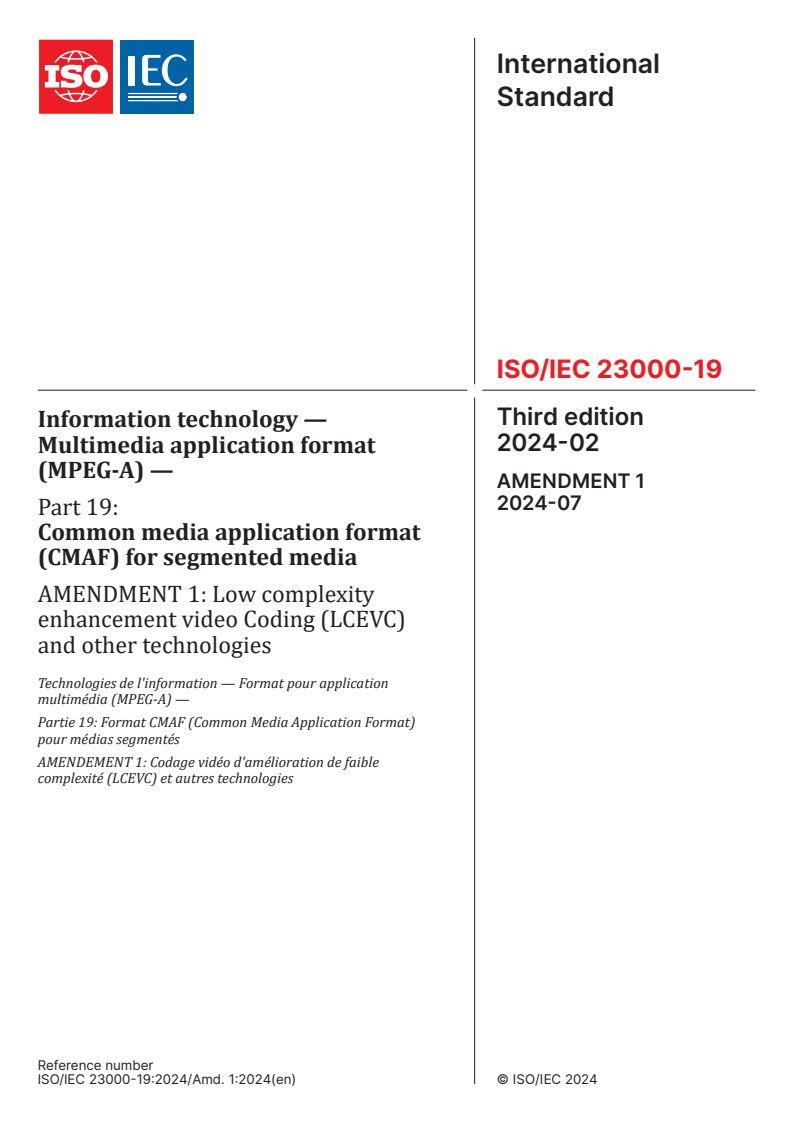
(Amendment)Information technology — Multimedia application format (MPEG-A) — Part 19: Common media application format (CMAF) for segmented media — Amendment 1: Low complexity enhancement video Coding (LCEVC) and other technologies
Information technology — Multimedia application format (MPEG-A) — Part 19: Common media application format (CMAF) for segmented media — Amendment 1: Low complexity enhancement video Coding (LCEVC) and other technologies
Technologies de l'information — Format pour application multimédia (MPEG-A) — Partie 19: Format CMAF (Common Media Application Format) pour médias segmentés — Amendement 1: Codage vidéo d'amélioration de faible complexité (LCEVC) et autres technologies
General Information
- Status
- Published
- Publication Date
- 21-Jul-2024
- Current Stage
- 6060 - International Standard published
- Start Date
- 22-Jul-2024
- Due Date
- 02-Sep-2024
- Completion Date
- 22-Jul-2024
Relations
- Effective Date
- 24-Sep-2022
Overview
ISO/IEC 23000-19:2024/Amd 1:2024 is an amendment to the international MPEG-A standard, specifically Part 19: Common Media Application Format (CMAF) for segmented media. Published by ISO and IEC, this amendment introduces support for Low Complexity Enhancement Video Coding (LCEVC) and related video codec technologies. The update ensures enhanced compatibility and performance in segment-based media streaming, supporting advanced coding techniques while maintaining interoperability with established media workflows.
Key Topics
- LCEVC Integration: Defines packaging and codec constraints for using LCEVC within CMAF media profiles, including dependent and enhancement track structures.
- CMAF Track Dependencies: Details how LCEVC tracks can depend on base CMAF tracks (e.g., AVC, HEVC, EVC, or VVC), requiring proper signaling and manifest structure for efficient adaptive streaming.
- Media Profile and Track Format: Introduces requirements for LCEVC media profiles, track formats, and the associated file brands, ensuring standardized implementation across platforms.
- Bitrate, Layer, and Parameter Controls: Sets out frame rate, bitrate, and layer constraints, along with parameter set referencing, to optimize video playback and compatibility.
- Codec Signaling and Metadata: Specifies usage of RFC 6381-compatible codecs parameters and extended metadata for correct codec identification and display rendering.
Applications
ISO/IEC 23000-19:2024/Amd 1:2024 is critical for industries and organizations involved in streaming media, online video delivery, and multimedia packaging. Key areas of application include:
- OTT and Video-on-Demand Platforms: Supports efficient streaming by enabling adaptive broadcasts using base and enhancement layers, improving end-user video experiences even on devices with limited decoding capabilities.
- Content Production and Post-Processing: Streamlines workflows where multiple codecs and container formats are present by ensuring that enhancements like LCEVC can be cleanly packaged within standard CMAF files.
- Broadcasting and Live Streaming: Facilitates low-latency and high-efficiency delivery, crucial in live sporting events, news, and large-scale broadcasts where segmentation and quick adaptation to network conditions are necessary.
- Device Interoperability: Enhances compatibility across smart TVs, set-top boxes, mobile devices, and web players by conforming to standardized media profiles and signaling methods.
- Scalable Video Coding: Provides a way to deliver both base (lower quality) and enhancement (higher quality) streams, optimizing bandwidth use and playback quality depending on user device and network conditions.
Related Standards
Adoption of ISO/IEC 23000-19:2024/Amd 1:2024 benefits from understanding its relationship with other widely used international standards:
- ISO/IEC 23094-2:2021 - General video coding: Specifies LCEVC technology and profiles.
- ISO/IEC 14496-15 - MP4 File Format: Outlines the storage of video in the ISO Base Media File Format, which is referenced for implementing CMAF and LCEVC.
- RFC 6381 - Codec Parameters: Used for identifying codecs in media streams and signaling proper profile and level information.
- MPEG-A Standards Series (ISO/IEC 23000-x) - Framework for the MPEG application formats, including the packaging and interoperability of audio, video, and multimedia content.
- CMAF (ISO/IEC 23000-19) - Standardizes segmented media delivery, foundational for adaptive streaming solutions.
Practical Value
By integrating LCEVC and other advanced video coding technologies into the CMAF standard, this amendment:
- Optimizes streaming workflows by adding support for layered video delivery (base and enhancement).
- Improves network and decoder efficiency, making high-quality video accessible even in constrained environments.
- Supports long-term interoperability and scalability in the media ecosystem.
- Facilitates innovation in both content delivery and playback device design, accommodating current and emerging video codec needs.
Implementing this amendment helps organizations stay current with technological advancements in video streaming, ensuring their platforms deliver high-quality, standards-based multimedia experiences to users worldwide.
Buy Documents



ISO/IEC 23000-19:2024/Amd 1:2024 - Information technology — Multimedia application format (MPEG-A) — Part 19: Common media application format (CMAF) for segmented media — Amendment 1: Low complexity enhancement video Coding (LCEVC) and other technologies Released:7/22/2024
Get Certified
Connect with accredited certification bodies for this standard

BSI Group
BSI (British Standards Institution) is the business standards company that helps organizations make excellence a habit.

NYCE
Mexican standards and certification body.
Sponsored listings
Frequently Asked Questions
ISO/IEC 23000-19:2024/Amd 1:2024 is a standard published by the International Organization for Standardization (ISO). Its full title is "Information technology — Multimedia application format (MPEG-A) — Part 19: Common media application format (CMAF) for segmented media — Amendment 1: Low complexity enhancement video Coding (LCEVC) and other technologies". This standard covers: Information technology — Multimedia application format (MPEG-A) — Part 19: Common media application format (CMAF) for segmented media — Amendment 1: Low complexity enhancement video Coding (LCEVC) and other technologies
Information technology — Multimedia application format (MPEG-A) — Part 19: Common media application format (CMAF) for segmented media — Amendment 1: Low complexity enhancement video Coding (LCEVC) and other technologies
ISO/IEC 23000-19:2024/Amd 1:2024 is classified under the following ICS (International Classification for Standards) categories: 35.040.40 - Coding of audio, video, multimedia and hypermedia information. The ICS classification helps identify the subject area and facilitates finding related standards.
ISO/IEC 23000-19:2024/Amd 1:2024 has the following relationships with other standards: It is inter standard links to ISO/IEC 23000-19:2024. Understanding these relationships helps ensure you are using the most current and applicable version of the standard.
ISO/IEC 23000-19:2024/Amd 1:2024 is available in PDF format for immediate download after purchase. The document can be added to your cart and obtained through the secure checkout process. Digital delivery ensures instant access to the complete standard document.
Standards Content (Sample)
International
Standard
ISO/IEC 23000-19
Third edition
Information technology —
2024-02
Multimedia application format
(MPEG-A) —
AMENDMENT 1
2024-07
Part 19:
Common media application format
(CMAF) for segmented media
AMENDMENT 1: Low complexity
enhancement video Coding (LCEVC)
and other technologies
Technologies de l'information — Format pour application
multimédia (MPEG-A) —
Partie 19: Format CMAF (Common Media Application Format)
pour médias segmentés
AMENDEMENT 1: Codage vidéo d'amélioration de faible
complexité (LCEVC) et autres technologies
Reference number
ISO/IEC 23000-19:2024/Amd. 1:2024(en) © ISO/IEC 2024
ISO/IEC 23000-19:2024/Amd. 1:2024(en)
© ISO/IEC 2024
All rights reserved. Unless otherwise specified, or required in the context of its implementation, no part of this publication may
be reproduced or utilized otherwise in any form or by any means, electronic or mechanical, including photocopying, or posting on
the internet or an intranet, without prior written permission. Permission can be requested from either ISO at the address below
or ISO’s member body in the country of the requester.
ISO copyright office
CP 401 • Ch. de Blandonnet 8
CH-1214 Vernier, Geneva
Phone: +41 22 749 01 11
Email: copyright@iso.org
Website: www.iso.org
Published in Switzerland
© ISO/IEC 2024 – All rights reserved
ii
ISO/IEC 23000-19:2024/Amd. 1:2024(en)
Foreword
ISO (the International Organization for Standardization) and IEC (the International Electrotechnical
Commission) form the specialized system for worldwide standardization. National bodies that are
members of ISO or IEC participate in the development of International Standards through technical
committees established by the respective organization to deal with particular fields of technical activity.
ISO and IEC technical committees collaborate in fields of mutual interest. Other international organizations,
governmental and non-governmental, in liaison with ISO and IEC, also take part in the work.
The procedures used to develop this document and those intended for its further maintenance are described
in the ISO/IEC Directives, Part 1. In particular, the different approval criteria needed for the different types
of document should be noted. This document was drafted in accordance with the editorial rules of the ISO/
IEC Directives, Part 2 (see www.iso.org/directives or www.iec.ch/members_experts/refdocs).
ISO and IEC draw attention to the possibility that the implementation of this document may involve the
use of (a) patent(s). ISO and IEC take no position concerning the evidence, validity or applicability of any
claimed patent rights in respect thereof. As of the date of publication of this document, ISO and IEC had not
received notice of (a) patent(s) which may be required to implement this document. However, implementers
are cautioned that this may not represent the latest information, which may be obtained from the patent
database available at www.iso.org/patents and https://patents.iec.ch. ISO and IEC shall not be held
responsible for identifying any or all such patent rights.
Any trade name used in this document is information given for the convenience of users and does not
constitute an endorsement.
For an explanation of the voluntary nature of standards, the meaning of ISO specific terms and expressions
related to conformity assessment, as well as information about ISO's adherence to the World Trade
Organization (WTO) principles in the Technical Barriers to Trade (TBT) see www.iso.org/iso/foreword.html.
In the IEC, see www.iec.ch/understanding-standards.
This document was prepared by Joint Technical Committee ISO/IEC JTC 1, Information technology,
Subcommittee SC 29, Coding of audio, picture, multimedia and hypermedia information.
A list of all parts in the ISO/IEC 23000 series can be found on the ISO and IEC websites.
Any feedback or questions on this document should be directed to the user’s national standards
body. A complete listing of these bodies can be found at www.iso.org/members.html and
www.iec.ch/national-committees.
© ISO/IEC 2024 – All rights reserved
iii
ISO/IEC 23000-19:2024/Amd. 1:2024(en)
Information technology — Multimedia application format
(MPEG-A) —
Part 19:
Common media application format (CMAF) for segmented media
AMENDMENT 1: Low complexity enhancement video Coding
(LCEVC) and other technologies
Clause 2, Normative references
Add the following document:
ISO/IEC 23094-2:2021, Information technology — General video coding — Part 2: Low complexity enhancement
video coding
Clause 4
Add the following abbreviated terms:
EVC essential video coding
LCEVC low complexcity enhancement video coding
VVC verstaile video coding
Clause 5
Add the following text:
Annex O describes packaging and codec constraints for some CMAF media profiles using the LCEVC video
codec. Systems claiming conformance to CMAF using LCEVC shall conform to the provisions of Annex O.
Annex O
Add the following new annex after Annex N, before the Bibliography:
© ISO/IEC 2024 – All rights reserved
ISO/IEC 23000-19:2024/Amd. 1:2024(en)
Annex O
(normative)
LCEVC media profile and track format
O.1 Dependent CMAF tracks
The LCEVC media profile makes use of Dependent CMAF Tracks, as defined in Clause H.1.
O.2 LCEVC CMAF tracks
LCEVC CMAF tracks shall conform to Clauses 7, 8, 9, and 12 and shall additionally conform to the constraints
specified in this annex.
Each LCEVC CMAF track that does not contain the Base Codec VCL NAL units is a dependent CMAF track,
and the constraints specified for dependent CMAF tracks in Clause H.1 shall apply. It is expected that the
manifest provides signalling to express the dependency of a dependent LCEVC CMAF track on a Base CMAF
track, for example, using the @dependencyID in a DASH MPD.
O.3 CMAF switching set constraints for LCEVC CMAF tracks and media profiles
O.3.1 General
Subclause 9.2.3 shall apply with the following additional constraints.
— Each CMAF track with sample entry 'lvc1' shall conform to the LCEVC media profile and track format as
specified in this annex.
— Each CMAF track containing a Base bitstream or an LCEVC bitstream or part thereof shall contain exactly
one ISO BMFF track with a Base bitstream or an LCEVC bitstream, respectively.
— When two CMAF tracks are present for carrying Base and LCEVC bitstreams, the corresponding ISO
BMFF tracks shall use distinct track IDs.
— CMAF switching sets containing a media profile listed in clause O.6 with sample entry 'lvc1' shall conform
to single initialization CMAF switching set constraints.
Each coded video sequence in an LCEVC bitstream shall contain the necessary parameter sets (Sequence
Configuration, Global Configuration) to signal decoding parameters changes allowed between CMAF tracks
in the same switching set.
O.3.2 Sample Description Box ('stsd')
Subclauses 9.2.4 and 9.3.2.2 shall apply with the following additional restrictions.
A decoder configuration re
...
Questions, Comments and Discussion
Ask us and Technical Secretary will try to provide an answer. You can facilitate discussion about the standard in here.
Loading comments...