


ISO/IEC 9075:1992/Cor 1:1996
(Corrigendum)Information technology — Database languages — SQL — Technical Corrigendum 1
Information technology — Database languages — SQL — Technical Corrigendum 1
Technologies de l'information — Langages de base de données — SQL — Rectificatif technique 1
General Information
- Status
- Withdrawn
- Publication Date
- 14-Aug-1996
- Withdrawal Date
- 14-Aug-1996
- Technical Committee
- ISO/IEC JTC 1/SC 32 - Data management and interchange
- Drafting Committee
- ISO/IEC JTC 1/SC 32 - Data management and interchange
- Current Stage
- 9599 - Withdrawal of International Standard
- Start Date
- 16-Dec-1999
- Completion Date
- 14-Feb-2026
Relations
- Effective Date
- 06-Jun-2022
- Effective Date
- 16-Oct-2025
- Effective Date
- 16-Oct-2025
- Effective Date
- 16-Oct-2025
- Effective Date
- 16-Oct-2025
- Effective Date
- 16-Oct-2025
- Effective Date
- 15-Apr-2008
Get Certified
Connect with accredited certification bodies for this standard

BSI Group
BSI (British Standards Institution) is the business standards company that helps organizations make excellence a habit.

NYCE
Mexican standards and certification body.
Sponsored listings
Frequently Asked Questions
ISO/IEC 9075:1992/Cor 1:1996 is a standard published by the International Organization for Standardization (ISO). Its full title is "Information technology — Database languages — SQL — Technical Corrigendum 1". This standard covers: Information technology — Database languages — SQL — Technical Corrigendum 1
Information technology — Database languages — SQL — Technical Corrigendum 1
ISO/IEC 9075:1992/Cor 1:1996 is classified under the following ICS (International Classification for Standards) categories: 35.060 - Languages used in information technology. The ICS classification helps identify the subject area and facilitates finding related standards.
ISO/IEC 9075:1992/Cor 1:1996 has the following relationships with other standards: It is inter standard links to ISO/IEC 9075:1992, ISO/IEC 9075-1:1999, ISO/IEC 9075-4:1999, ISO/IEC 9075-5:1999, ISO/IEC 9075-2:1999, ISO/IEC 9075-3:1999; is excused to ISO/IEC 9075:1992. Understanding these relationships helps ensure you are using the most current and applicable version of the standard.
ISO/IEC 9075:1992/Cor 1:1996 is available in PDF format for immediate download after purchase. The document can be added to your cart and obtained through the secure checkout process. Digital delivery ensures instant access to the complete standard document.
Standards Content (Sample)
INTERNATIONAL STANDARD ISOJIEC 9075:1992
TECHNICAL CORRIGENDUM 1
Published 1996-08-l 5
INTERNATIONAL ORGANIZATION FOR STANDARDlZATlON*ME~~YHAPO,flHAFI OPTAHM3AUMFl l-l0 CTAHflAPTM3AlJWl* ORGANISATION INTERNATIONALE DE NORMALISATION
INTERNATIONAL ELECTROTECHNICAL COMMISSION*ME))
Information technology - Database languages - SQL
TECHNICAL CORRIGENDUM 1
Technologies de I ’informa tion - Langages de bases de don&es - SQL
RECTIFICATIF TECHNIQUE I
Technical Corrigendum 1 to International Standard lSO/IEC 9075:1992 was prepared by Joint Technical Committee
lSO/IEC JTC 1, Information technology, Subcommittee SC 21, Open systems interconnection, data management
and open distributed processing.
Relation to previous technical corrigenda:
This Corrigendum contains the cumulative set of corrections to ISO/IEC 9075: 1992.
It cancels and replaces Technical Corrigendum 1: 1994.
Statement of purpose for rationale:
A statement indicating the rationale for each change to ISO/IEC 9075: 1992 is included. This is to inform the users
of that standard as to the reason why it was judged necessary to change the original wording. In many cases the
reason is editorial or to clarify the wording; in some cases it is to correct an error or an omission in the original
wording.
Notes on rule numbering:
This Corrigendum introduces some new Syntax, Access, General and Leveling Rules. The new Rules in this
Corrigendum have been numbered as follows:
Rules inserted between, for example, Rules 7) and 8) (in ISO/IEC 9075:1992) are numbered 7.1), 7.2), etc. [or
7) a. l), 7) a.2), etc.]. Those inserted before Rule 1) are numbered O.l), 0.2). etc.
Ref. No. ISO/IEC 9075:1992/Cor.l:1996(E)
KS 35.060
information interchange, documentation, documents,
Descriptors: data processing, text processing, factual data bases,
logical structk-e, artificial languages, database languages, SQL.
0 ISO/IEC 1996
Printed in Switzerland
OISO/IEC
ISO/IEC 9075:1992/Cor.l:1996(E)
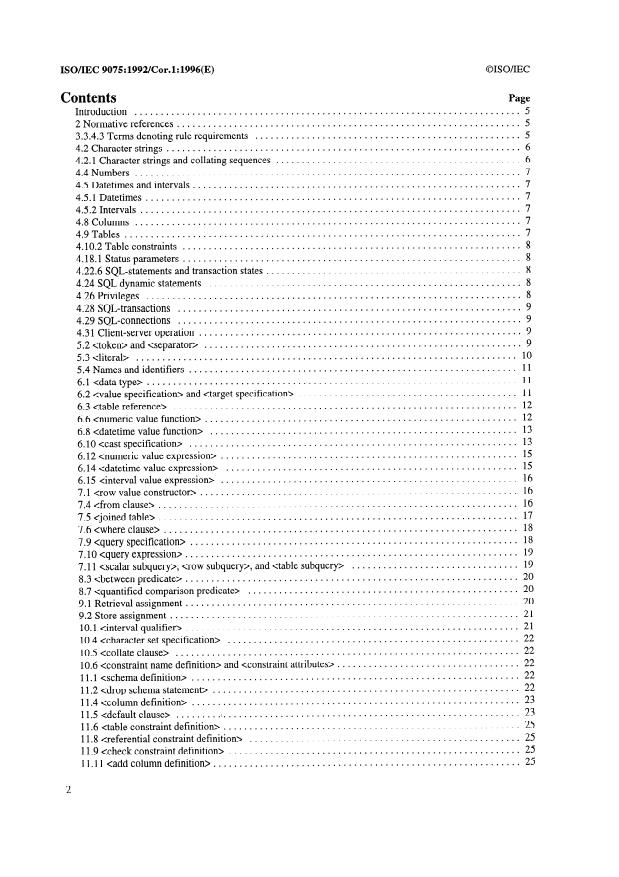
Contents Page
Introduction .
..................................................................
2 Normative references
................................................... 5
3.3.4.3 Terms denoting rule requirements
....................................................................
4.2 Character strings
............................................... 6
4.2.1 Character strings and collating sequences
4.4Numbers .
............................................................... 7
4.5 Datetimes and intervals
4.5.1Datetimes .
4.5.2Intervals .
4.8Columns .
..........................................................................
4.9Tables.
.................................................................
4.10.2 Table constraints
................................................................. 8
4.18.1 Status parameters
................................................. 8
4.22.6 SQL-statements and transaction states
............................................................ 8
4.24 SQL dynamic statements
........................................................................
4.26Privileges
.................................................................. 9
4.28 SQL-transactions
4.29 SQL-connections .
.............................................................. 9
4.3 1 Client-server operation
............................................................. 9
5.2 and
5.3 .
............................................................... 11
5.4 Names and identifiers
6.1 .
..........................................
6.2 and
..................................................................
6.3
............................................................
6.6
........................................................... 13
6.8
6.10 .
.........................................................
6.12
........................................................
6.14 cdatetime value expression>
......................................................... 16
6.15
............................................................. 16
7.1
7.4 .
7,5 .
7,6 .
............................................................... 18
7.9
7.10.~ .
................................ 19
7.11 , , and
................................................................
8.3
....................................................
8.7
................................................................ 20
9.1 Retrieval assignment
9.2Storeassignment .
................................................................ 21
10.1
........................................................
10.4
.................................................................. 22
10.5
................................... 22
10.6 and
...............................................................
ll.l
........................................................... 22
11.2
11.4. .
.................................................................... 23
11.5
......................................................... 25
11.6
....................................................
11.8
........................................................
11.9
ll.ll .
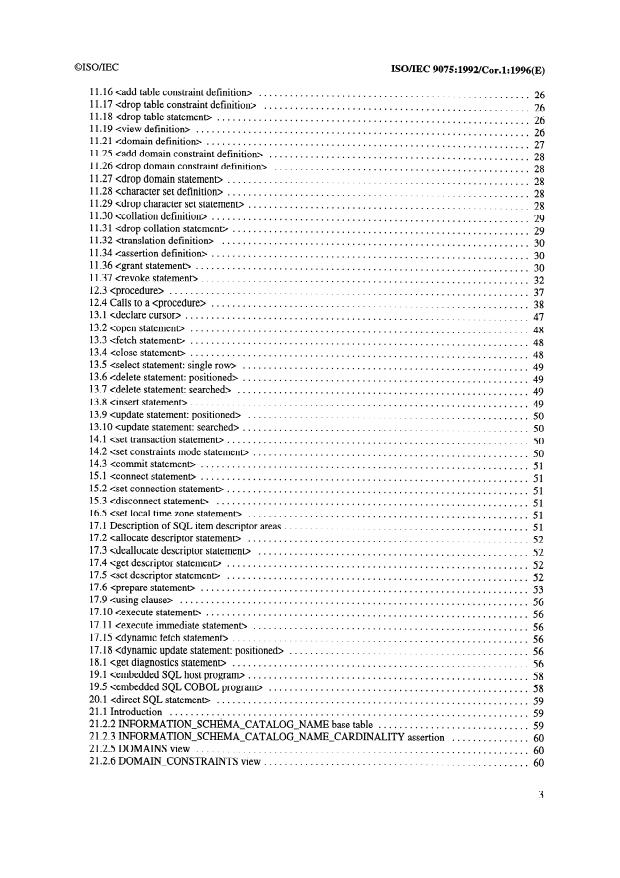
OISOIIEC
ISO/IEC 9075:1992/Cor.l:1996(E)
11.16
....................................................
11.17
...................................................
11.18
............................................................
ll.l9
................................................................
11.21
..............................................................
11.25
..................................................
11.26
................................................. 28
11.27
.......................................................... 28
11.28
.......................................................... 28
11.29
......................................................
ccollationdefinition>
11.30 .
11.31
.........................................................
11.32
........................................................... 30
11.34 cassertiondefinition> .
11.36 .
11.37 crevokestatement> .
12.3cprocedure>
.....................................................................
12.4 Calls to a
......................................................... ....
13.1cdeclarecursor> .
13.2copenstatement> .
13.3 48
.................................................................
13.4
.................................................................
13.5
.......................................................
13.6
....................................................... 49
13.7
........................................................ 49
13.8
................................................................. 49
13.9 cupdate statement: positioned>
...................................................... 50
13.10 cupdate statement: searched>
....................................................... 50
14.1
..........................................................
14.2
.....................................................
14.3ccommitstatement> .
15.1cconnectstatement>. .
15.2
.......................................................... 5 1
15.3
............................................................ 5 1
16.5
......................................................
17.1 Description of SQL item descriptor areas
...............................................
17.2 callocate descriptor statement>
...................................................... 52
17.3
.................................................... 52
17.4
..........................................................
17.5
..........................................................
17.6
...............................................................
17.9cusingclause> .
17.10cexecutestatement>. .
17.11
..................................................... 56
17.15
......................................................... 56
17.18
.............................................. 56
18.1
.........................................................
19.1
...................................................... 58
19.5
..................................................
20.1
............................................................
21.1Introduction .
21.2.2 INFORMATION SCHI?MA CATALOG NAME base table
- . 59
- -
21.2.3 INFORMATION SCHEMA CATALOG NAME CARDINALITY assertion
- - .
21.2.5DOMAINSview -. .
........ .
21.2.6DOMAIN CONSTRAINTSview .
- 60
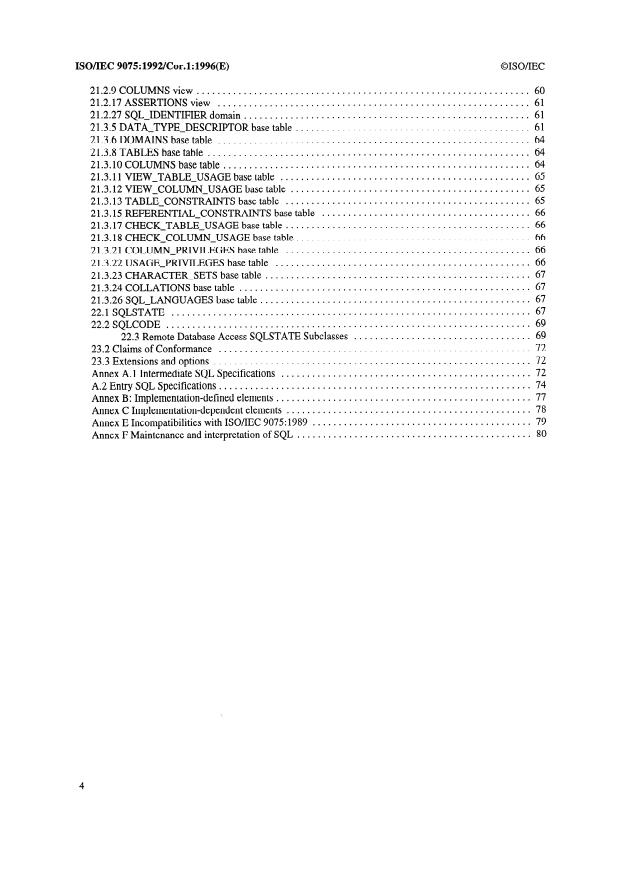
ISO/IEC 9075:1992/Cor.l:1996(E) OISOIIEC
................................................................
21.2.9 COLUMNS view
21.2.17 ASSERTIONS view .
....................................................... 61
21.2.27 SQL IDENTIFIER domain
21.3.5 DATA TYPE DESCRIPTOR base table . . . 61
21.3.6DOMkNSbaietable . ::::. . ::::. . ::::::::. .
.............................................................. 64
21.3.8 TABLES base table
...........................................................
21.3.10 COLUMNS base table
21.3.11 VIEW TABLE USAGE base table . 65
.............................................. 65
21.3.12 VIEW-COLUMN USAGE base table
....................................... 65
21.3.13 TABLE CONSTRAINTS base table
. : : . . . 66
21.3.15 REFERENTIAL CONSTRAINTS base’ table
... 66
21.3.17 CHECK TABLE USAGE base table . : : . : 1. : : : : : : : : : : : : : : : : : : : : : : : 1.
.............................................
21.3.18 CHECK-COLUMN USAGE base table 66
...............................................
21.3.21 COLUMk PRIVILEGES base table 66
................................................. 66
21.3.22 USAGE PRIVILEGES base table
................................................... 67
21.3.23 CHARACTER SETS base table
........................................................ 67
2 1.3.24 COLLATIONSbase table
21.3.26 SQL LANGUAGES base table . 67
22.1SQLSTATE . 67
22.2SQLCODE .
.................................. 69
22.3 Remote Database Access SQLSTATE Subclasses
............................................................ 72
23.2 Claims of Conformance
23.3 Extensions and options . 72
................................................ 72
Annex A.1 Intermediate SQL Specifications
............................................................ 74
A.2 Entry SQL Specifications
................................................. 77
Annex B: Implementation-defined elements
...............................................
Annex C Implementation-dependent elements 78
..........................................
Annex E Incompatibilities with ISO/IEC 9075: 1989 79
............................................. 80
Annex F Maintenance and interpretation of SQL
OISO/IEC ISO/IEC 9075:1992/Cor.l:1996(E)
Introduction
Rationale: In the list of significant new features, the wording incorrectly implies
1. that all the listed
examples
in item 10) are referential integrity facilities.
On page xiv, in Significant new feature lo), replace “referential integrity” with “integrity ”.
2 Normative references
I. Rationale: Editorial.
Add the following reference after the reference to “IS0 8601: 1988 ”:
IS0 8649: 1988, Information processing systems -Open Systems Interconnection-Service definition
for the Association Control Service Element.
language standard (ISO/IEC 8652: 1995, Information
2. Rationale: The newly revised Ada
technology-Programming languages-Ada) contains support for decimal-encoded numeric data and variable
length character strings. The revised inter$ace allows newly written applications in the revised Ada language
access to these features of SQL; previously written Ada applications, conformant with the earlier Ada
inter$ace, are conformant with the revised inter$ace.
Replace the reference to ISOIIEC 8652: 1987) with the following:
ISO/IEC 8652: 1995, Information technology-Programming languages-Ada.
3. Rationale: Editorial.
Add the following reference after the reference to ISO/IEC 8824: 1990:
ISOIIEC 9579- 1: 1993, Information technology-Open Systems Interconnection-Remote Database
Access-Part I: Generic Model, Service and Protocol.
Add the following reference after the reference to ISO/IEC 9899:
Interconnection-Distributed
ISO/IEC 10026-2: 1996, Information technology-Open Systems
Transaction Processing-Part 2: OSI TP Service.
3.3.4.3 Terms denoting rule requirements
Rationale: The following unifies the SQLSTATE returnedfor the different ways of invoking an SQL statement.
1.
In the first and second paragraphs, replace “syntax error or access rule violation (if this situation occurs during
dynamic execution of an SQL-statement, then the exception that is raised is syntax error or access rule violation in
dynamic SQL statement; if the situation occurs during direct invocation of an SQL-statement, then the exception that
is raised is syntax or access rule violation in direct SQL statement)” with “syntax error or access rule violation ”.
ISO/IEC 9075:1992/Cor.l: 1996(E)
OISOPIEC
4.2 Character strings
1. Rationale: Editorial.
In the second paragraph, replace the last sentence with the following:
Character sets defined by standards or by implementations reside in the Information Schema (named
INFORMATION SCHEMA) in each catalog, as do collations and translations defined by standards and
-
collations, translations, and form-of-use conversions defined by implementations.
4.2.1 Character strings and collating sequences
Rationale: The following changes make the de@nitions of character set and collation descriptors more precise.
1.
Replace the text on page 17 that occurs after the first paragraph with the following:
A character set is described by a character set descriptor. A character set descriptor includes:
the name of the character set or character repertoire,
if the character set is a character repertoire, then the name of the form-of-use,
an indication of what characters are in the character set, and
whether or not the character set uses the DEFAULT collation for its character repertoire, and,
if the character set does not utilize the DEFAULT collation for its character repertoire, then the
contained in the character set ’s , if any, the
contained in the character set ’s or , if any, and, whether or
not DESC was specified in the reference to the collation
For every character set, there is at least one collation. A collation is described by a collation descriptor . A
collation descriptor includes:
the name of the collation,
the name of the character repertoire on which the collation operates,
whether the collation has the NO PAD or the PAD SPACE attribute, and
whether or not this collation utilizes the DEFAULT collation for its character repertoire,
if the collation does not utilize the DEFAULT collation for its character repertoire, then the name> contained in the collation ’s , if any, the contained in the
collation ’s , if any, and whether or not DESC was specified in the definition of the
collation.
OISOIIEC
ISO/IEC 9075:1992/Cor.l:1996(E)
4.4 Numbers
1. Rationale: Clarification.
Add the following sentence immediately before the heading of Subclause 4.4.1 Characteristics of Numbers:
A value described by a numeric data type descriptor is always signed.
4.5 Datetimes and intervals
1. Rationale: Clarification.
Add the following sentence before the paragraph starting “Every datetime . . ‘I.
A value described by an interval data type descriptor is always signed.
4.51 Datetimes
1. Rationale: Editorial.
In the penultimate paragraph on page 24, replace “Universal Coordinated Time” with “Coordinated Universal Time ”.
4.5.2 Intervals
1. Rationale: Editorial.
In Table 7, replace “” (two occurrences).
4.8 Columns
1. Rationale: Editorial.
In the penultimate paragraph on page 28, replace “crow value constructor expression>” with “vow value constructor
element> “.
4.9 Tables
1. Rationale: There is no named derived table other than a viewed table.
After the paragraph that begins with “A derived table descriptor describes a derived table. “, delete the first item ( ‘I-
if the table is named, then the name of the table; “).
2. Rationale: There is no named derived table other than a viewed table.
After the paragraph that begins with “A view descriptor describes a view. “, insert “- the name of the view, and”
before the existing item.
ISO/IEC 9075:1992/Cor.l:1996(E) OISOIIEC
4.10.2 Table constraints
1. Rationale: Editorial.
In the Note, replace “” with “ “.
2. Rationale: Editorial.
In the paragraph that begins with “A referential constraint is satisfied ”, replace “” with “ type> “.
4.18.1 Status parameters
1. Rationale: To insure that the value returned to the user in SQLSTATE is representative of the actual state of
the transaction or SQL-statement.
Add the following as the last paragraph:
For the purpose of choosing status parameter values to be returned, exceptions for transaction rollback have
precedence over exceptions for statement failure. Similarly, completion condition no data has precedence over
warning, which has precedence over successful completion. All exceptions have precedence over all completion
conditions. The values assigned to SQLSTATE shall obey these precedence rules.
4.22.6 SQL-statements and transaction states
1. Rationale: No statement can be both transaction-initiating and not transaction-initiating.
In the first dashed list (of transaction-initiating SQL-statements), in the bulleted sublist of SQL-data statements,
delete the entry for .
4.24 SQL dynamic statements
1. Rationale: Editorial.
In the fourth paragraph, replace “s” with “s” .
2. Rationale: Editorial.
In the eighth paragraph, replace the first occurrence of “ and replace the second occurrence of “ 4.26 Privileges
Rationale: Editorial.
1.
In the fourth paragraph on page 52, replace “ is” with “ identifier> is ”.
OISO/IEC
ISO/IEC 9075: 1992Kor.l: 1996(E)
2. Rationale: Provide missing rules that cover the acquisition of the necessary privileges to acquire the WITH
GRANT OPTION on views through a grant to PUBLIC.
Add the following before the antepenultimate paragraph of this Subclause:
The phrase user privileges refers to the set of privileges defined by the privilege descriptors whose grantee is
either the identified or PUBLIC.
4.28 SQL-transactions
1. Rationale: Clarification.
In the paragraph that begins “In some environments (e.g., remote database access) “, replace all occurrences of
“SQL-environment” with “SQL-implementation ”.
4.29 SQL-connections
1. Rationale: Editorial.
Replace the second paragraph with the following:
An SQL-connection is an active SQL-connection if any SQL-statement that initiates or requires an
SQL-transaction has been executed at its SQL-server via that SQL-connection during the current
SQL-transaction.
2. Rationale: Clarification.
In the last sentence of the penultimate paragraph, replace “SQL-environment” with “SQL-implementation ”.
4.31 Client-server operation
1. Rationale: Clarifzcation.
Replace the first sentence with the following:
As perceived by an SQL-agent, an SQL-implementation consists of one or more SQL-servers and one SQL-client
through which SQL-connections can be made to them.
5.2 and
1. Rationale: The maximum length of an is intended to be 128 characters.
Replace Syntax Rule 8) with the following:
In a , the number of s shall be less
f-9
than 128.
2. Rationale: A shall not contain any or . Thus, a identijier> with a containing a or is not equivalent to
any .
In Syntax Rule 13), delete the expression “(with all occurrences of replaced by and all
occurrences of replaced by ) “.
ISO/IEC 9075: 1992Kor.l: 1996(E) OISO/IEC
” and
3. Rationale: Correct the incorrect references to I’ ‘2 quote symbol> ” and delete the redundant
to “ “s and “ "S in Syntax Rule
references 14.
In Syntax Rule 14), delete “( with all occurrences of replaced and all of
occurrences
bY
replaced by ) “.
4. Rationale: A does not appear in a or in a identifier body>.
Replace Leveling Rule 2) a) with the following:
The number of s plus the number of s contained in a
a>
shall be less than 18.
Insert the following Leveling Rule 2) a. 1):
a.1) The of a shall not comprise more than 18 identifier part>s.
5.3
1. Rationale: Support changes to Subclause 6.10.
In Format, replace the BNF for ,
1. Rationale: Editorial.
In Syntax Rule 2) a), replace “with no intervening” with “without an intervening ”.
2. Rationale: Editorial.
In Syntax Rule 2) a), replace “The scope clause of the exposed” with “The scope of the exposed ”.
3. Rationale: Editorial.
In Syntax Rule 2) b), replace “with no intervening” with “without an intervening ”.
4. Rationale: Clarify that references to non-existing objects is only allowed within the same .
Add the following Syntax Rule:
8.1) Let T be the table identified by the
qualifier of the
S, then the schema identified by the explicit or implicit qualifier of the
shall include the descriptor of T, or S shall include a that creates the descriptor of T.
5. Rationale: Editorial.
Delete the first sentence of Access Rule 1).
6.6
1. Rationale: Correct Format for to support s in addition to
s.
In the Format replace the production for with the following:
::=
POSITION
IN
Replace Syntax Rule 1) with the following:
If is specified, then both s shall be 1)
expression>s or both shall be s having the same character repertoire.
OISOIIEC ISO/IEC 9075:1992/Cor.l:1996(E)
Replace General Rules 1) and 2) with the following:
If is specified and neither is the null value, then
Case:
If the first has a length 0, then the result is 1.
a>
b) If the value of the first is equal to an identical-length substring of
contiguous characters or bits from the value of the second , then the result
is 1 greater than the number of characters or bits within the value of the second expression> preceding the start of the first such substring.
Otherwise, the result is 0.
C>
is specified and either is the null value, then the result
2)
the null value.
6.8 cdatetime value function>
value function> is effectively
1. Rationale: The following change clarifies that per SQL statement.
Replace General Rule 3) with the following:
If an SQL-statement causes the evaluation of one or more cdatetime value function>s, then all such
3)
evaluations are effectively performed simultaneously. The time of evaluation of the function> during the execution of the SQL-statement is implementation-dependent.
6.10
1. Rationale: Clarify that references to non-existing objects is only allowed within the same .
Add the following Syntax Rule:
8.1) If is specified, then let D be the domain identified by the . If the specification> is not contained in a , then the schema identified by the explicit or
implicit qualifier of the shall include the descriptor of D. If the is
contained in a S, then the schema identified by the explicit or implicit qualifier of
the shall include the descriptor of D, or S shall include a that creates
the descriptor of D.
2. Rationale: Legalize a simpler format for character strings being cast to temporal data types.
In General Rule 9) a) i), replace “rules for ” with “rules for or for “.
ISO/IEC 9075:1992/Cor.l:1996(E) OISO/IEC
3. Rationale: Clarify the error condition that should be returned if a datetime overflow occurs.
Replace General Rule 9) a) ii) with the following:
ii) Otherwise,
If a does not conform to the natural rules for dates or times according to the
Gregorian calendar, an exception condition is raised: data exception-invalid datetime format.
Otherwise, an exception condition is raised: data exception- invalid character value for cast.
2)
4. Rationale: Legalize a simpler format for character strings being cast to temporal data types.
In General Rule 10) a) i), replace “rules for ” with “rules for or for “.
5. Rationale: Clari’ the error condition that should be returned if a datetime overflow occurs.
Replace General Rule 10) a) ii) with the following:
ii) Otherwise,
If a does not conform to the natural rules for dates or times according to
1)
.sed: data exception-
Gregorian calendar, an exception condition is rai invalid datetime format.
exception- invalid character value for cast.
Otherwise, an exception condition is raised: data
2)
Rationale: Legalize a simpler format for character strings being cast to temporal data types.
6.
In General Rule 11) a) i), replace “rules for ” with “rules for or for “.
7. Rationale: Clarify the error condition that should be returned if a datetime overjlow occurs.
Replace General Rule 11) a) ii) with the following:
ii) Otherwise,
If a cdatetime value> does not conform to the natural rules for dates or times according to the
1)
Gregorian calendar, an exception condition is raised: data exception-invalid datetime format.
2) Otherwise, an exception condition is raised: data exception- invalid character value for cast.
8. Rationale: Legalize a simpler format for character strings being cast to temporal data types.
In General Rule 12) b) i), replace “rules for ” with “rules for or for “.
OISOIIEC ISO/IEC 9075:1992/Cor.l:1996(E)
9. Rationale: Clarify the error condition that should be returned if a datetime overflow occurs.
Replace General Rule 12) b) ii) with the following:
ii)
Otherwise,
If a does not conform to the natural rules for intervals according to the Gregorian
calendar, an exception condition is raised: data exception-invalid interval format.
Otherwise, an exception condition is raised: data exception -invalid character value for cast.
2)
6.12
1. Rationale: Editorial.
In General Rule 2), replace “then the value of’ with “then the result of ’.
6.14
1. Rationale: The expression “X AT TIME ZONE Y - Z” may be parsed as either “(X AT TIME ZONE Y) - Z” or
“XAT TIME ZONE (Y - Z) “. Th e f o II owing clarifies that it should be the former.
Replace the Format for
3. Rationale: The 1989 standard prohibited the use of a in a predicate. A leveling rule was
omitted that would only allow this use of crow subquery> in Full level.
Add the following to Leveling Rule 1):
a.1) A shall not be a .
OISO/IEC ISO/IEC 9075:1992/Cor.l:1996(E)
7.4
1. Rationale: Editorial.
In Syntax Rule l)a), replace “with no intervening” with “without an intervening ”.
In Syntax Rule l)b), replace “with no intervening” with “without an intervening ”.
In General Rule l)a), replace “with no intervening” with “without an intervening ”.
In General Rule l)b), replace “with no intervening” with “without an intervening ”.
2. Rationale: Editorial.
In Leveling Rule 2) a), replace “
7.5
1. Rationale: Syntax Rule 6) [If NATURAL . .] does not adequately address the following:
the case when the set of corresponding columns is empty,
i)
ii) the cases when either set of non-corresponding columns is empty,
iii) the case when a set of non-corresponding join columns contains columns with the same name>.
Syntax Rule 6) also confzicts with Syntax Rules 7), 8) and 9) with respect to the definition of the nullability
characteristics of a column.
In Syntax Rule 6) d), replace “Let” by “If there is at least one corresponding join column, then let”
Replace Syntax Rule 6) e) with the following:
1) If TI contains at least one column that is not a corresponding join column, then let SLT, be a e)
list> of s of the form:
TA.C
for every column C of TI that is not a corresponding join column, taken in order of their ordinal
position in TI.
2) If T2 contains at least one column that is not a corresponding join column, then let SLT, be a list> of s of the form:
TB. C
for every column C of T2 that is not a corresponding join column, taken in order of their ordinal
position in T2.
Replace Syntax Rule 6) f) with the following:
Let the SL be defined as:
f)
Case:
i) If all the columns of TI and T2 are corresponding join columns, then let SL be SLCC.
ii) If T, contains no corresponding join columns and T2 contains no corresponding join columns, then
let SL be SLT,, SLT,.
iii) If TI contains no columns other than corresponding join columns, then let SL be SLCC, SLT,.
ISO/IEC 9075: 1992/Cor.l:1996(E) OISOIIEC
iv) If T2 contains no columns other than corresponding join columns, then let SL be SLCC, SLT,
v) Otherwise, let SL be SLCC, SLT,, SLT,
The descriptors of the columns of the result of the , with the possible exception of the
nullability characteristics of the column, are the same as the descriptors of the columns of the result of
SELECT SL FROM TR,, TR,
2. Rationale: General Rule 6) a) [IfNATURAL is . ./ uses the definitions SLCC, SLT, and SLT,
which are not applicable to the table SN.
Replace General Rule 6) a) with the following:
If NATURAL is specified or a is specified, then:
a>
i) Let CS, be a name for the i-th column of S. Column CSi of S corresponds to the i-th column of Tl if
i is less than or equal to D,. Column CSj of S corresponds to the o-D,)-th column of T2 for j greater
than D,.
ii) Let SLN be the derived from SL by replacing each of the form
TA.C or TB.C
in SL by the name CS, of the column of S that corresponds to the column C of T, or T2, respectively.
iii) The result of the is the multiset of rows resulting from
SELECT SLN FROM SN
7.6
Rationale: Remove the ambiguity in Leveling Rule 2).
1.
Replace Leveling Rule 2) with:
The following restrictions apply for Entry SQL in addition to any Intermediate SQL restriction:
2)
A directly contained in the shall not contain a a)
reference> that references a that generally contains a .
7.9
need to limit the expansion to the table identified by the
1. Rationale: The rules for expansion of “. *”
, rather than including the entire
Replace Syntax Rule 4) with the following:
If the “.*” is specified, then let Q be the of that .
4)
Q shall be a
in the of T. Let TQ be the table associated with Q. That is equivalent to
a sequence in which each is a CR that
references a column of 7Q that is not a common column of a . Each column of TQ that is
not a common column of a shall be referenced exactly once. The columns shall be
referenced in the ascending order of their ordinal positions with TQ.
Note: common column of a is defined in Subclause 7.5, “ “.
OISOIIEC
ISO/IEC 9075:1992/Cor.l:1996(E)
2. Rationale: Clarification of the definition of outer reference.
Replace Syntax Rule 7) with the following:
If T is a grouped table, then in each , each that references a
7)
column of T shall reference a grouping column or be specified
...
Questions, Comments and Discussion
Ask us and Technical Secretary will try to provide an answer. You can facilitate discussion about the standard in here.
Loading comments...