

ISO/IEC 9075-9:2023
(Main)Information technology — Database languages SQL — Part 9: Management of External Data (SQL/MED)
General Information
- Abstract
ISO/IEC 9075-9:2016 defines extensions to Database Language SQL to support management of external data through the use of foreign-data wrappers and datalink types.
- Status
- Published
- Publication Date
- 31-May-2023
- Technical Committee
- ISO/IEC JTC 1/SC 32 - Data management and interchange
- Drafting Committee
- ISO/IEC JTC 1/SC 32 - Data management and interchange
- Current Stage
- 9092 - International Standard to be revised
- Start Date
- 22-Jun-2025
- Completion Date
- 29-Aug-2026
Overview
ISO/IEC 9075-9:2023 - commonly called SQL/MED (Management of External Data) - is the international standard that extends SQL to support access to and management of external data sources. The standard defines language constructs, catalog objects, and interfaces needed to integrate foreign servers, foreign-data wrappers, user mappings, and datalink types into SQL-based systems. It standardizes how external data is discovered, referenced, described and manipulated from within SQL environments to improve interoperability and portability across database systems.
Key topics and technical requirements
The standard covers a broad set of functional areas; notable topics include:
- Foreign tables and foreign servers: definitions and catalog operations for registering and managing remote or external tables.
- Foreign-data wrappers (FDWs): the model and foreign-datawrapper interface including initialization, access, termination, error handling and diagnostics.
- User mappings and routinemappings: how credentials and routine behavior map between local SQL sessions and external data sources.
- Datalinks: types and operations for referencing large objects or external resources (URLs, file handles) from SQL.
- SQL language extensions: syntax additions for schema definition, table definition, ALTER/DROP for foreign objects, and session statements (e.g., passthrough).
- Dynamic SQL, embedded SQL and Call-Level Interface (SQL/CLI): rules for descriptors, prepare/execute, and CLI routines that interact with external data.
- Catalog manipulation and import/export: statements for creating, altering and importing foreign schemas and drivers.
- Diagnostics, security and transactions: privileges, basic security model, and transaction properties when external data is involved.
- Detailed interface routines: a comprehensive list of FDW and wrapper routines and their invocation behaviors (connect, fetch, free, diagnostics, etc.).
(These topics are drawn from the standard’s content structure and identify the key technical areas addressed.)
Practical applications
SQL/MED is focused on enabling and standardizing practical use cases such as:
- Federated queries and data virtualization across heterogeneous systems (RDBMS, NoSQL, cloud stores, files, web APIs).
- Integrating remote datasets without ETL by exposing them as foreign tables.
- Linking to large external resources (multimedia, documents) using datalinks.
- Building portable FDW implementations that work across compliant DBMSs.
- Implementing secure credential mappings and controlled passthrough execution to external services.
Who should use this standard
- Database engine developers and vendors implementing SQL/MED support (FDWs, catalogs, CLI).
- Data architects and system integrators designing federated or virtualized data platforms.
- Application developers building SQL-access layers to external sources.
- Standards and compliance teams evaluating interoperability and portability of SQL solutions.
Related standards
ISO/IEC 9075-9:2023 is part of the broader ISO/IEC 9075 (SQL) family and interoperates with SQL/Foundation and SQL/CLI specifications to provide complete external-data management support.
Keywords: ISO/IEC 9075-9:2023, SQL/MED, foreign-data wrapper, datalink types, management of external data, federated queries, database interoperability.
Relations
- Effective Date
- 07-Jan-2026
- Effective Date
- 06-Jun-2022
- Effective Date
- 06-Jun-2022
Get Certified
Connect with accredited certification bodies for this standard

BSI Group
BSI (British Standards Institution) is the business standards company that helps organizations make excellence a habit.

NYCE
Mexican standards and certification body.
Sponsored listings
Frequently Asked Questions
ISO/IEC 9075-9:2023 is a standard published by the International Organization for Standardization (ISO). Its full title is "Information technology — Database languages SQL — Part 9: Management of External Data (SQL/MED)". This standard covers: ISO/IEC 9075-9:2016 defines extensions to Database Language SQL to support management of external data through the use of foreign-data wrappers and datalink types.
ISO/IEC 9075-9:2016 defines extensions to Database Language SQL to support management of external data through the use of foreign-data wrappers and datalink types.
ISO/IEC 9075-9:2023 is classified under the following ICS (International Classification for Standards) categories: 35.060 - Languages used in information technology. The ICS classification helps identify the subject area and facilitates finding related standards.
ISO/IEC 9075-9:2023 has the following relationships with other standards: It is inter standard links to ISO/IEC 9075-9:2023/Cor 1:2026, ISO/IEC 9075-9:2016, ISO/IEC 9075-9:2016/Cor 2:2022. Understanding these relationships helps ensure you are using the most current and applicable version of the standard.
ISO/IEC 9075-9:2023 is available in PDF format for immediate download after purchase. The document can be added to your cart and obtained through the secure checkout process. Digital delivery ensures instant access to the complete standard document.
Standards Content (Sample)
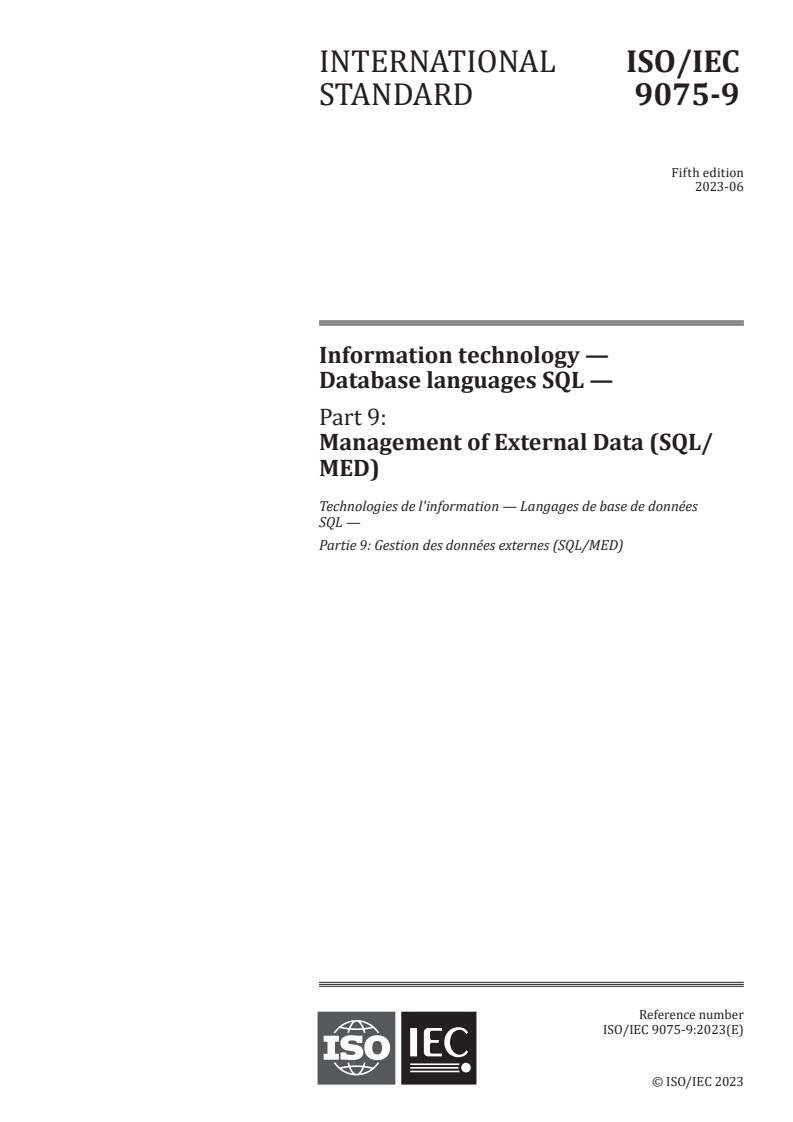
INTERNATIONAL ISO/IEC
STANDARD 9075-9
Fifth edition
2023-06
Information technology —
Database languages SQL —
Part 9:
Management of External Data (SQL/
MED)
Technologies de l'information — Langages de base de données
SQL —
Partie 9: Gestion des données externes (SQL/MED)
Reference number
© ISO/IEC 2023
© ISO/IEC 2023
All rights reserved. Unless otherwise specified, or required in the context of its implementation, no part of this publication may
be reproduced or utilized otherwise in any form or by any means, electronic or mechanical, including photocopying, or posting on
the internet or an intranet, without prior written permission. Permission can be requested from either ISO at the address below
or ISO’s member body in the country of the requester.
ISO copyright office
CP 401 • Ch. de Blandonnet 8
CH-1214 Vernier, Geneva
Phone: +41 22 749 01 11
Email: copyright@iso.org
Website: www.iso.org
Published in Switzerland
ii
© ISO/IEC 2023 – All rights reserved
ISO/IEC9075-9:2023(E)
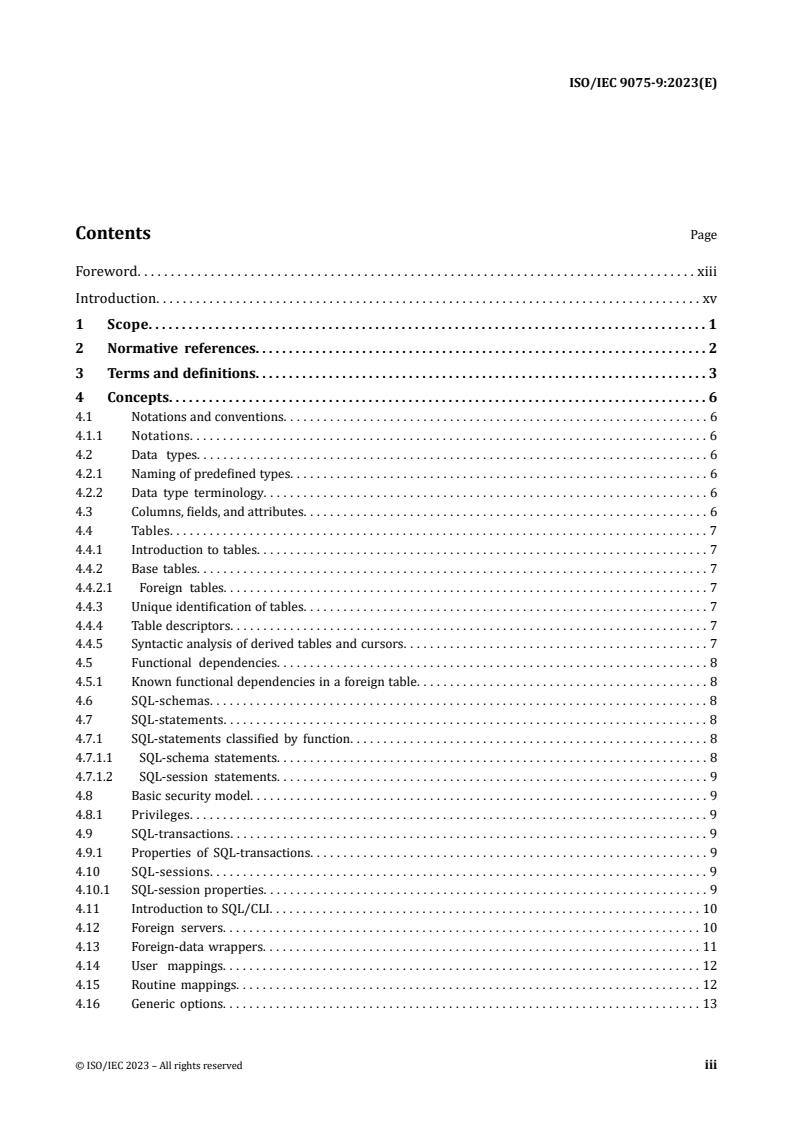
Contents Page
Foreword.xiii
Introduction.xv
1 Scope.1
2 Normativereferences.2
3 Termsanddefinitions.3
4 Concepts.6
4.1 Notationsandconventions.6
4.1.1 Notations.6
4.2 Data types.6
4.2.1 Namingofpredefinedtypes.6
4.2.2 Datatypeterminology.6
4.3 Columns,fields,andattributes.6
4.4 Tables.7
4.4.1 Introductiontotables.7
4.4.2 Basetables.7
4.4.2.1 Foreign tables.7
4.4.3 Uniqueidentificationoftables.7
4.4.4 Tabledescriptors.7
4.4.5 Syntacticanalysisofderivedtablesandcursors.7
4.5 Functional dependencies.8
4.5.1 Knownfunctionaldependenciesinaforeigntable.8
4.6 SQL-schemas.8
4.7 SQL-statements.8
4.7.1 SQL-statementsclassifiedbyfunction.8
4.7.1.1 SQL-schemastatements.8
4.7.1.2 SQL-sessionstatements.9
4.8 Basicsecuritymodel.9
4.8.1 Privileges.9
4.9 SQL-transactions.9
4.9.1 PropertiesofSQL-transactions.9
4.10 SQL-sessions.9
4.10.1 SQL-sessionproperties.9
4.11 IntroductiontoSQL/CLI.10
4.12 Foreign servers.10
4.13 Foreign-datawrappers.11
4.14 User mappings.12
4.15 Routinemappings.12
4.16 Genericoptions.13
©ISO/IEC2023–Allrightsreserved iii
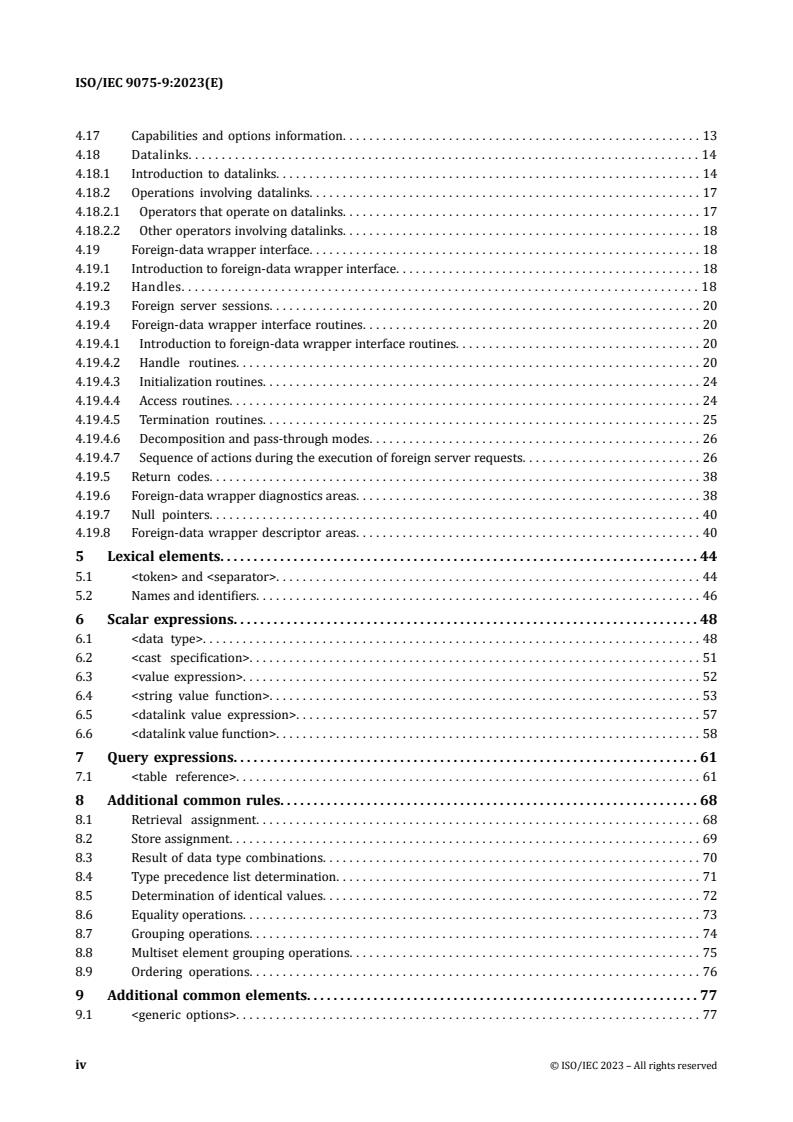
ISO/IEC9075-9:2023(E)
4.17 Capabilitiesandoptionsinformation.13
4.18 Datalinks.14
4.18.1 Introductiontodatalinks.14
4.18.2 Operationsinvolvingdatalinks.17
4.18.2.1 Operatorsthatoperateondatalinks.17
4.18.2.2 Otheroperatorsinvolvingdatalinks.18
4.19 Foreign-datawrapperinterface.18
4.19.1 Introductiontoforeign-datawrapperinterface.18
4.19.2 Handles.18
4.19.3 Foreignserversessions.20
4.19.4 Foreign-datawrapperinterfaceroutines.20
4.19.4.1 Introductiontoforeign-datawrapperinterfaceroutines.20
4.19.4.2 Handle routines.20
4.19.4.3 Initializationroutines.24
4.19.4.4 Accessroutines.24
4.19.4.5 Terminationroutines.25
4.19.4.6 Decompositionandpass-throughmodes.26
4.19.4.7 Sequenceofactionsduringtheexecutionofforeignserverrequests.26
4.19.5 Returncodes.38
4.19.6 Foreign-datawrapperdiagnosticsareas.38
4.19.7 Null pointers.40
4.19.8 Foreign-datawrapperdescriptorareas.40
5 Lexicalelements.44
5.1 and.44
5.2 Namesandidentifiers.46
6 Scalarexpressions.48
6.1 .48
6.2 .51
6.3 .52
6.4 .53
6.5 .57
6.6 .58
7 Queryexpressions.61
7.1 .61
8 Additionalcommonrules.68
8.1 Retrieval assignment.68
8.2 Storeassignment.69
8.3 Resultofdatatypecombinations.70
8.4 Typeprecedencelistdetermination.71
8.5 Determinationofidenticalvalues.72
8.6 Equalityoperations.73
8.7 Groupingoperations.74
8.8 Multisetelementgroupingoperations.75
8.9 Orderingoperations.76
9 Additionalcommonelements.77
9.1 .77
iv ©ISO/IEC2023–Allrightsreserved
ISO/IEC9075-9:2023(E)
9.2 .78
10 Schemadefinitionandmanipulation.80
10.1 .80
10.2 .81
10.3 .82
10.4 .83
10.5 .84
10.6 .85
10.7 .86
10.8 .87
10.9 .88
10.10 .89
10.11 .90
10.12 .91
10.13 .92
10.14 .93
10.15 .94
10.16 .97
10.17 .98
10.18 .99
10.19 .100
10.20 .102
11 Accesscontrol.104
11.1 .104
11.2 .105
11.3 .106
11.4 .108
11.5 .109
12 SQL-clientmodules.110
12.1 .110
12.2 .111
12.3 .114
12.4 Datatypecorrespondences.115
13 Additionaldatamanipulationrules.118
13.1 Effectofdeletingrowsfrombasetables.118
13.2 Effectofinsertingtablesintobasetables.119
13.3 Effectofreplacingrowsinbasetables.121
14 Sessionmanagement.123
14.1 .123
15 DynamicSQL.125
15.1 DescriptionofSQLdescriptorareas.125
15.2 .126
15.3 .128
15.4 .129
15.5 .131
©ISO/IEC2023–Allrightsreserved v
ISO/IEC9075-9:2023(E)
15.6 .135
15.7 .138
15.8 .139
15.9 .140
15.10 .141
15.11 .142
15.12 .143
15.13 .144
16 EmbeddedSQL.145
16.1 .145
16.2 .147
16.3 .148
16.4 .149
16.5 .150
16.6 .151
16.7 .152
17 Diagnosticsmanagement.153
17.1 .153
18 Call-LevelInterfacespecifications.155
18.1 .155
18.2 ImplicitDESCRIBEUSINGclause.156
18.3 DescriptionofCLIitemdescriptorareas.157
18.4 OthertablesassociatedwithCLI.158
18.5 SQL/CLIdatatypecorrespondences.160
19 SQL/CLIroutines.162
19.1 BuildDataLink().162
19.2 GetDataLinkAttr().163
19.3 GetInfo().165
20 URLs.166
20.1 URL format.166
21 Catalog manipulation.169
21.1 .169
21.2 .171
21.3 .172
21.4 .174
21.5 .176
21.6 .177
21.7 .178
21.8 .180
21.9 .181
21.10 .182
22 SQL/MEDcommonspecifications.183
22.1 Descriptionofforeign-datawrapperitemdescriptorareas.183
22.2 Implicitforeign-datawrappercursor.187
22.3 ImplicitDESCRIBEINPUTUSINGclauseforexternaldata.189
vi ©ISO/IEC2023–Allrightsreserved
ISO/IEC9075-9:2023(E)
22.4 ImplicitDESCRIBEOUTPUTUSINGclauseforexternaldata.192
22.5 ImplicitEXECUTEUSINGandOPENUSINGclausesforexternaldata.196
22.6 ImplicitFETCHUSINGclauseforexternaldata.199
22.7 Characterstringretrievalforexternaldata.203
22.8 Binarystringretrievalforexternaldata.204
22.9 TablesusedwithSQL/MED.205
23 Foreign-datawrapperinterfaceroutines.216
23.1 .216
23.2 invocation.221
23.3 AdvanceInitRequest().223
23.4 AllocQueryContext().224
23.5 AllocWrapperEnv().225
23.6 Close().227
23.7 ConnectServer().228
23.8 FreeExecutionHandle().230
23.9 FreeFSConnection().232
23.10 FreeQueryContext().233
23.11 FreeReplyHandle().234
23.12 FreeWrapperEnv().235
23.13 GetNextReply().236
23.14 GetNumReplyBoolVE().237
23.15 GetNumReplyOrderBy().238
23.16 GetNumReplySelectElems().239
23.17 GetNumReplyTableRefs().240
23.18 GetOpts().241
23.19 GetReplyBoolVE().243
23.20 GetReplyCardinality().244
23.21 GetReplyDistinct().245
23.22 GetReplyExecCost().246
23.23 GetReplyFirstCost().247
23.24 GetReplyOrderElem().248
23.25 GetReplyReExecCost)(.249
23.26 GetReplySelectElem().250
23.27 GetReplyTableRef().251
23.28 GetSPDHandle().252
23.29 GetSRDHandle().253
23.30 GetStatistics().254
23.31 GetWPDHandle().256
23.32 GetWRDHandle().257
23.33 InitRequest().258
23.34 Iterate().262
23.35 Open().264
23.36 ReOpen().265
23.37 ExecutionofOpen().266
23.38 TransmitRequest().270
23.39 AllocDescriptor().273
23.40 FreeDescriptor().274
©ISO/IEC2023–Allrightsreserved vii
ISO/IEC9075-9:2023(E)
23.41 GetAuthorizationId().275
23.42 GetBoolVE().276
23.43 GetDescriptor().277
23.44 GetDistinct().279
23.45 GetNumBoolVE().280
23.46 GetNumChildren().281
23.47 GetNumOrderByElems().282
23.48 GetNumRoutMapOpts().283
23.49 GetNumSelectElems().284
23.50 GetNumServerOpts().285
23.51 GetNumTableColOpts().286
23.52 GetNumTableOpts().288
23.53 GetNumTableRefElems().289
23.54 GetNumUserOpts().290
23.55 GetNumWrapperOpts().291
23.56 GetOrderByElem().292
23.57 GetRoutMapOpt().293
23.58 GetRoutMapOptName().295
23.59 GetRoutineMapping().297
23.60 GetSelectElem().298
23.61 GetSelectElemType().299
23.62 GetServerName().300
23.63 GetServerOpt().301
23.64 GetServerOptByName().303
23.65 GetServerType().305
23.66 GetServerVersion().306
23.67 GetSQLString().307
23.68 GetTableColOpt().308
23.69 GetTableColOptByName().310
23.70 GetTableOpt().312
23.71 GetTableOptByName().313
23.72 GetTableRefElem().315
23.73 GetTableRefElemType().316
23.74 GetTableRefTableName().317
23.75 GetTableServerName().318
23.76 GetTRDHandle().319
23.77 GetUserOpt().320
23.78 GetUserOptByName().322
23.79 GetValExprColName().324
23.80 GetValueExpDesc().325
23.81 GetValueExpKind().326
23.82 GetValueExpName().327
23.83 GetValueExpTable().328
23.84 GetVEChild().329
23.85 GetWrapperLibraryName().330
23.86 GetWrapperName().331
23.87 GetWrapperOpt().332
viii ©ISO/IEC2023–Allrightsreserved
ISO/IEC9075-9:2023(E)
23.88 GetWrapperOptByName().334
23.89 SetDescriptor().336
23.90 GetDiagnostics().341
24 InformationSchema.345
24.1 InformationSchemadigitalartifact.345
24.2 ATTRIBUTES view.345
24.3 COLUMN_OPTIONS view.346
24.4 COLUMNSview.347
24.5 FOREIGN_DATA_WRAPPER_OPTIONSview.348
24.6 FOREIGN_DATA_WRAPPERSview.349
24.7 FOREIGN_SERVER_OPTIONS view.350
24.8 FOREIGN_SERVERSview.351
24.9 FOREIGN_TABLE_OPTIONSview.352
24.10 FOREIGN_TABLES view.353
24.11 ROUTINE_MAPPING_OPTIONSview.354
24.12 ROUTINE_MAPPINGS view.355
24.13 USER_MAPPING_OPTIONS view.356
24.14 USER_MAPPINGSview.357
24.15 Shortnameviews.358
25 DefinitionSchema.362
25.1 DefinitionSchemadigitalartifact.362
25.2 COLUMN_OPTIONSbasetable.362
25.3 DATA_TYPE_DESCRIPTORbasetable.364
25.4 FOREIGN_DATA_WRAPPER_OPTIONSbasetable.371
25.5 FOREIGN_DATA_WRAPPERSbasetable.372
25.6 FOREIGN_SERVER_OPTIONSbasetable.373
25.7 FOREIGN_SERVERSbasetable.374
25.8 FOREIGN_TABLE_OPTIONSbasetable.375
25.9 FOREIGN_TABLESbasetable.376
25.10 ROUTINE_MAPPING_OPTIONSbasetable.377
25.11 ROUTINE_MAPPINGSbasetable.378
25.12 SQL_SIZINGbasetable.379
25.13 TABLESbasetable.380
25.14 USAGE_PRIVILEGESbasetable.381
25.15 USER_MAPPING_OPTIONSbasetable.382
25.16 USER_MAPPINGSbasetable.383
26 Statuscodes.384
26.1 SQLSTATE.384
27 Conformance.387
27.1 ClaimsofconformancetoSQL/MED.387
27.2 AdditionalconformancerequirementsforSQL/MED.387
AnnexA(informative) SQLconformancesummary.390
AnnexB(informative) Implementation-defined elements.408
AnnexC(informative) Implementation-dependent elements.422
AnnexD(informative) SQLoptionalfeaturetaxonomy.427
©ISO/IEC2023–Allrightsreserved ix
ISO/IEC9075-9:2023(E)
AnnexE(informative) Deprecatedfeatures.429
AnnexF(informative) IncompatibilitieswithISO/IEC9075:2016.430
AnnexG(informative) DefectReportsnotaddressedinthiseditionofthisdocument.431
AnnexH(informative) Exampleheaderfiles.432
H.1 Cheaderfilesqlcli.h.432
H.2 COBOLlibraryitemSQLCLI.433
AnnexI(informative) SQL/MED model.435
Bibliography.439
Index.440
x ©ISO/IEC2023–Allrightsreserved
ISO/IEC9075-9:2023(E)
Tables
Table Page
1 Validdatalinkfilecontroloptions.16
2 Sequenceofactionsduringtheexecutionofforeignserverrequests.26
3 Fieldsusedinforeign-datawrapperdiagnosticsareas.39
4 Fieldsinforeign-datawrapperdescriptorareas.41
5 DatatypecorrespondencesforAda.115
6 DatatypecorrespondencesforC.115
7 DatatypecorrespondencesforCOBOL.116
8 DatatypecorrespondencesforFortran.116
9 DatatypecorrespondencesforM.116
10 DatatypecorrespondencesforPascal.116
11 DatatypecorrespondencesforPL/I.117
12 CodesusedforSQLdatatypesinDynamicSQL.125
13 SQL-statementcodes.153
14 AbbreviatedSQL/CLIgenericnames.155
15 CodesusedforimplementationdatatypesinSQL/CLI.157
16 CodesusedforapplicationdatatypesinSQL/CLI.157
17 CodesusedtoidentifySQL/CLIroutines.158
18 Codesanddatatypesforimplementationinformation.158
19 Codesusedfordatalinkattributes.158
20 Datatypesofattributes.158
21 SQL/CLIdatatypecorrespondencesforAda.160
22 SQL/CLIdatatypecorrespondencesforC.160
23 SQL/CLIdatatypecorrespondencesforCOBOL.160
24 SQL/CLIdatatypecorrespondencesforFortran.161
25 SQL/CLIdatatypecorrespondencesforM.161
26 SQL/CLIdatatypecorrespondencesforPascal.161
27 SQL/CLIdatatypecorrespondencesforPL/I.161
28 Codesusedfortypes.205
29 Codesusedforkinds.205
30 Codesusedforforeign-datawrapperdiagnosticfields.205
31 Codesusedforforeign-datawrapperdescriptorfields.206
32 Codesusedforforeign-datawrapperhandletypes.208
33 Abilitytoretrieveforeign-datawrapperdescriptorfields.208
34 Abilitytosetforeign-datawrapperdescriptorfields.210
35 Foreign-datawrapperdescriptorfielddefaultvalues.213
36 CodesusedfortheformatofthecharacterstringtransmittedbyGetSQLString().215
37 SQLSTATEclassandsubclasscodes.384
38 ImpliedfeaturerelationshipsofSQL/MED.389
D.1 Featuretaxonomyforoptionalfeatures.427
I.1 LegendforSQL/MEDinterfaces.436
I.2 LegendforSQL/MEDinformationflow.437
©ISO/IEC2023–Allrightsreserved xi
ISO/IEC9075-9:2023(E)
Figures
Figure Page
1 SQL/MED interfaces.435
2 SQL/MEDinformationflow.437
xii ©ISO/IEC2023–Allrightsreserved
Foreword
ISO (the International Organization for Standardization) and IEC (the International Electrotechnical Com-
mission) form the specialized system for worldwide standardization. National bodies that are members
of ISO or IEC participate in the development of International Standards through technical committees
established by the respective organization to deal with particular fields of technical activity. ISO and IEC
technical committees collaborate in fields of mutual interest. Other international organizations, govern-
mental and non-governmental, in liaison with ISO and IEC, also take part in the work.
The procedures used to develop this document and those intended for its further maintenance are de-
scribed in the ISO/IEC Directives, Part 1. In particular, the different approval criteria needed for the dif-
ferent types of document should be noted. This document was drafted in accordance with the editorial
rules of the ISO/IEC Directives, Part 2 (see www.iso.org/directives or www.iec.ch/members_experts/ref-
docs).
ISO and IEC draw attention to the possibility that the implementation of this document may involve the
use of (a) patent(s). ISO and IEC take no position concerning the evidence, validity or applicability of any
claimed patent rights in respect thereof. As of the date of publication of this document, ISO and IEC have
not received notice of (a) patent(s) which may be required to implement this document. However, imple-
menters are cautioned that this may not represent the latest information, which may be obtained from
the patent database available at www.iso.org/patents and https://patents.iec.ch. ISO and IEC shall not be
held responsible for identifying any or all such patent rights.
Any trade name used in this document is information given for the convenience of users and does not
constitute an endorsement.
For an explanation of the voluntary nature of standards, the meaning of ISO specific terms and expres-
sions related to conformity assessment, as well as information about ISO's adherence to the World Trade
Organization (WTO) principles in the Technical Barriers to Trade (TBT) see www.iso.org/iso/fore-
word.html. In the IEC, see www.iec.ch/understanding-standards.
This document was prepared by Joint Technical Committee ISO/IEC JTC 1, Information technology, Sub-
committee SC 32, Data management and interchange.
This fifth edition cancels and replaces the fourth edition (ISO/IEC 9075-9:2016), which has been techni-
cally revised. It also incorporates the Technical Corrigenda ISO/IEC 9075-9:2016/Cor.1:2019 and
ISO/IEC 9075-9:2016/Cor.2:2022.
The main changes are as follows:
— improve the presentation and accuracy of the summaries of implementation-defined and implemen-
tation-dependent aspects of this document;
— introduction of several digital artifacts;
— alignment with updated ISO house style and other guidelines for creating standards.
This fifth edition of ISO/IEC 9075-9 is designed to be used in conjunction with the following editions of
other parts of the ISO/IEC 9075 series, all published in 2023:
— ISO/IEC 9075-1, sixth edition;
— ISO/IEC 9075-2, sixth edition;
© ISO/IEC 2023 – All rights reserved xiii
— ISO/IEC 9075-3, sixth edition;
— ISO/IEC 9075-4, seventh edition;
— ISO/IEC 9075-10, fifth edition;
— ISO/IEC 9075-11, fifth edition;
— ISO/IEC 9075-13, fifth edition;
— ISO/IEC 9075-14, sixth edition;
— ISO/IEC 9075-15, second edition;
— ISO/IEC 9075-16, first edition.
A list of all parts in the ISO/IEC 9075 series can be found on the ISO and IEC websites.
Any feedback or questions on this document should be directed to the user’s national standards body. A
complete listing of these bodies can be found at www.iso.org/members.html and www.iec.ch/national-
committees.
xiv © ISO/IEC 2023 – All rights reserved
ISO/IEC9075-9:2023(E)
Introduction
Theorganizationofthisdocumentisasfollows:
1) Clause1,“Scope”,specifiesthescopeofthisdocument.
2) Clause2,“Normativereferences”,identifiesadditionalstandardsthat,throughreferenceinthis
document,constituteprovisionsofthisdocument.
3) Clause3,“Termsanddefinitions”,definesthetermsanddefinitionsusedinthisdocument.
4) Clause4,“Concepts”,presentsconceptsrelatedtothisdocument.
5) Clause5,“Lexicalelements”,definesthelexicalelementsofthelanguagespecifiedinthisdocument.
6) Clause6,“Scalarexpressions”,definestheelementsofthelanguagethatproducescalarvalues.
7) Clause7,“Queryexpressions”,definestheelementsofthelanguagethatproducerowsandtables
ofdata.
8) Clause8,“Additionalcommonrules”,specifiestherulesforassignmentsthatretrievedatafromor
storedataintoSQL-data,andformationrulesforsetoperations.
9) Clause9,“Additionalcommonelements”,definesadditionalcommonelementsusedinthedefinition
offoreigntables,foreignservers,andforeign-datawrappers.
10) Clause10,“Schemadefinitionandmanipulation”,definesfacilitiesrelatedtoforeigntablesand
datalinktypesupportforcreatingandmanagingaschema.
11) Clause11,“Accesscontrol”,definesfacilitiesforcontrollingaccesstoSQL-data.
12) Clause12,“SQL-clientmodules”,definesSQL-clientmodulesandexternally-invokedprocedures.
13) Clause13,“Additionaldatamanipulationrules”,definesadditionalrulesfordatamanipulation.
14) Clause14,“Sessionmanagement”,definestheSQL-sessionmanagementstatements.
15) Clause15,“DynamicSQL”,definesthedynamicSQLstatements.
16) Clause16,“EmbeddedSQL”,definestheembeddedSQLstatements.
17) Clause17,“Diagnosticsmanagement”,definesthediagnosticsmanagementfacilities.
18) Clause18,“Call-LevelInterfacespecifications”,definesfacilitiesforusingSQLthroughaCall-Level
Interface.
19) Clause19,“SQL/CLIroutines”,defineseachoftheroutinesthatcomprisetheCall-LevelInterface.
20) Clause20,“URLs”,specifiestheformatofURLsusedinthisdocument.
21) Clause21,“Catalogmanipulation”,definesfacilitiesforcreating,altering,anddroppingforeign
serversandforeign-datawrappers.
22) Clause22,“SQL/MEDcommonspecifications”,specifiescommonfacilitiesusedbySQL/MED.
23) Clause23,“Foreign-datawrapperinterfaceroutines”,specifiestheinteractionbetweenanSQL-
serverandaforeign-datawrapper.
24) Clause24,“InformationSchema”,definesviewedtablesthatcontainschemainformation.
25) Clause25,“DefinitionSchema”,definesbasetablesonwhichtheviewedtablescontainingschema
informationdepend.
©ISO/IEC2023–Allrightsreserved xv
ISO/IEC9075-9:2023(E)
26) Clause26,“Statuscodes”,definesvaluesthatidentifythestatusoftheexecutionofSQL-statements
andthemechanismsbywhichthosevaluesarereturned.
27) Clause27,“Conformance”,specifiesthewayinwhichconformancetothisdocumentmaybeclaimed.
28) AnnexA,“SQLconformancesummary”,isaninformativeAnnex.Itsummarizestheconformance
requirementsoftheSQLlanguage.
29) AnnexB,“Implementation-definedelements”,isaninformativeAnnex.Itliststhosefeaturesfor
whichthebodyofdocumentstatesthatthesyntax,themeaning,thereturnedresults,theeffecton
SQL-dataand/orschemas,orotheraspectispartlyorwhollyimplementation-defined.
30) AnnexC,“Implementation-dependentelements”,isaninformativeAnnex.Itliststhosefeaturesfor
whichthebodyofthisdocumentstatesthatthesyntax,themeaning,thereturnedresults,theeffect
onSQL-dataand/orschemas,orotheraspectispartlyorwhollyimplementation-dependent.
31) AnnexD,“SQLoptionalfeaturetaxonomy”,isaninformativeAnnex.Itidentifiestheoptionalfeatures
oftheSQLlanguagespecifiedinthisdocumentbyanidentifierandashortdescriptivename.This
taxonomyisusedtospecifyconformance.
32) AnnexE,“Deprecatedfeatures”,isaninformativeAnnex.Itlistsfeaturesthattheresponsible
TechnicalCommitteeintendsnottoincludeinafutureeditionofthisdocument.
33) AnnexF,“IncompatibilitieswithISO/IEC9075:2016”,isaninformativeAnnex.Itlistsincompatib-
ilitieswiththepreviouseditionofthisdocument.
34) AnnexG,“DefectReportsnotaddressedinthiseditionofthisdocument”,isaninformativeAnnex.
ItdescribestheDefectReportsthatwereknownatthetimeofpublicationofthisdocument.Each
oftheseproblemsisaproblemcarriedforwardfromthepreviouseditionofthisdocument.Nonew
problemshavebeencreatedinthedraftingofthiseditionofthisdocument.
35) AnnexH,“Exampleheaderfiles”,isaninformativeAnnex.Itprovidesexamplesoftypicaldefinition
filesforapplicationprogramsusingtheSQLCall-LevelInterface.
36) AnnexI,“SQL/MEDmodel”,isani
...