


ISO 15009:2012
(Main)Soil quality — Gas chromatographic determination of the content of volatile aromatic hydrocarbons, naphthalene and volatile halogenated hydrocarbons — Purge-and-trap method with thermal desorption
Soil quality — Gas chromatographic determination of the content of volatile aromatic hydrocarbons, naphthalene and volatile halogenated hydrocarbons — Purge-and-trap method with thermal desorption
Qualité du sol — Détermination par chromatographie en phase gazeuse des teneurs en hydrocarbures aromatiques volatils, en naphtalène et en hydrocarbures halogénés volatils — Méthode par purge et piégeage avec désorption thermique
General Information
- Status
- Withdrawn
- Publication Date
- 28-Jun-2012
- Withdrawal Date
- 28-Jun-2012
- Technical Committee
- ISO/TC 190/SC 3 - Chemical and physical characterization
- Drafting Committee
- ISO/TC 190/SC 3/WG 6 - Organic analysis
- Current Stage
- 9599 - Withdrawal of International Standard
- Start Date
- 12-Feb-2016
- Completion Date
- 14-Feb-2026
Relations
- Effective Date
- 02-Nov-2013
- Effective Date
- 28-Feb-2009
Buy Documents

ISO 15009:2012 - Soil quality -- Gas chromatographic determination of the content of volatile aromatic hydrocarbons, naphthalene and volatile halogenated hydrocarbons -- Purge-and-trap method with thermal desorption
ISO 15009:2012 - Qualité du sol -- Détermination par chromatographie en phase gazeuse des teneurs en hydrocarbures aromatiques volatils, en naphtalene et en hydrocarbures halogénés volatils -- Méthode par purge et piégeage avec désorption thermique
Get Certified
Connect with accredited certification bodies for this standard

NSF International
Global independent organization facilitating standards development and certification.

CIS Institut d.o.o.
Personal Protective Equipment (PPE) certification body. Notified Body NB-2890 for EU Regulation 2016/425 PPE.

Kiwa BDA Testing
Building and construction product certification.
Sponsored listings
Frequently Asked Questions
ISO 15009:2012 is a standard published by the International Organization for Standardization (ISO). Its full title is "Soil quality — Gas chromatographic determination of the content of volatile aromatic hydrocarbons, naphthalene and volatile halogenated hydrocarbons — Purge-and-trap method with thermal desorption". This standard covers: Soil quality — Gas chromatographic determination of the content of volatile aromatic hydrocarbons, naphthalene and volatile halogenated hydrocarbons — Purge-and-trap method with thermal desorption
Soil quality — Gas chromatographic determination of the content of volatile aromatic hydrocarbons, naphthalene and volatile halogenated hydrocarbons — Purge-and-trap method with thermal desorption
ISO 15009:2012 is classified under the following ICS (International Classification for Standards) categories: 13.080.10 - Chemical characteristics of soils. The ICS classification helps identify the subject area and facilitates finding related standards.
ISO 15009:2012 has the following relationships with other standards: It is inter standard links to ISO 15009:2016, ISO 15009:2002. Understanding these relationships helps ensure you are using the most current and applicable version of the standard.
ISO 15009:2012 is available in PDF format for immediate download after purchase. The document can be added to your cart and obtained through the secure checkout process. Digital delivery ensures instant access to the complete standard document.
Standards Content (Sample)
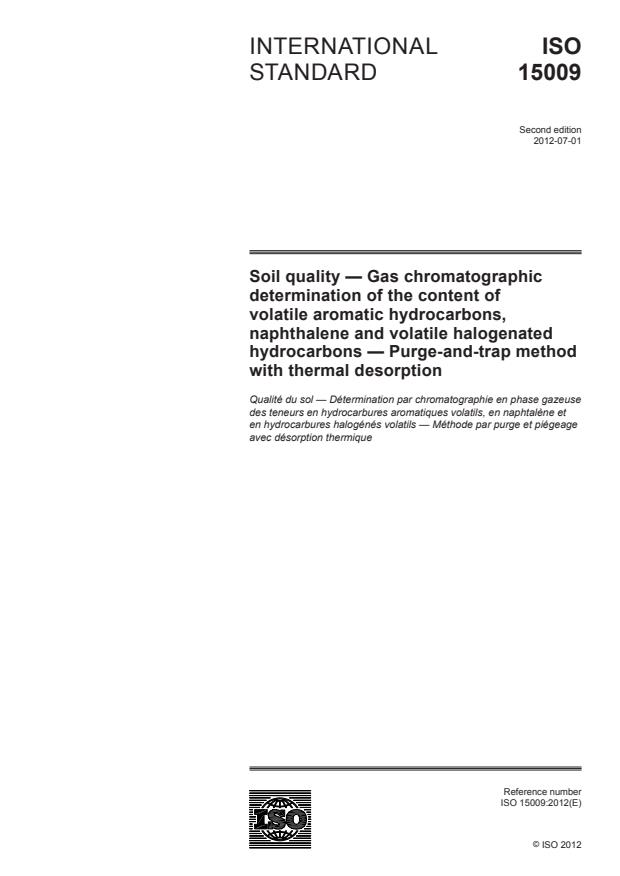
INTERNATIONAL ISO
STANDARD 15009
Second edition
2012-07-01
Soil quality — Gas chromatographic
determination of the content of
volatile aromatic hydrocarbons,
naphthalene and volatile halogenated
hydrocarbons — Purge-and-trap method
with thermal desorption
Qualité du sol — Détermination par chromatographie en phase gazeuse
des teneurs en hydrocarbures aromatiques volatils, en naphtalène et
en hydrocarbures halogénés volatils — Méthode par purge et piégeage
avec désorption thermique
Reference number
©
ISO 2012
All rights reserved. Unless otherwise specified, no part of this publication may be reproduced or utilized in any form or by any means,
electronic or mechanical, including photocopying and microfilm, without permission in writing from either ISO at the address below or ISO’s
member body in the country of the requester.
ISO copyright office
Case postale 56 • CH-1211 Geneva 20
Tel. + 41 22 749 01 11
Fax + 41 22 749 09 47
E-mail copyright@iso.org
Web www.iso.org
Published in Switzerland
ii © ISO 2012 – All rights reserved
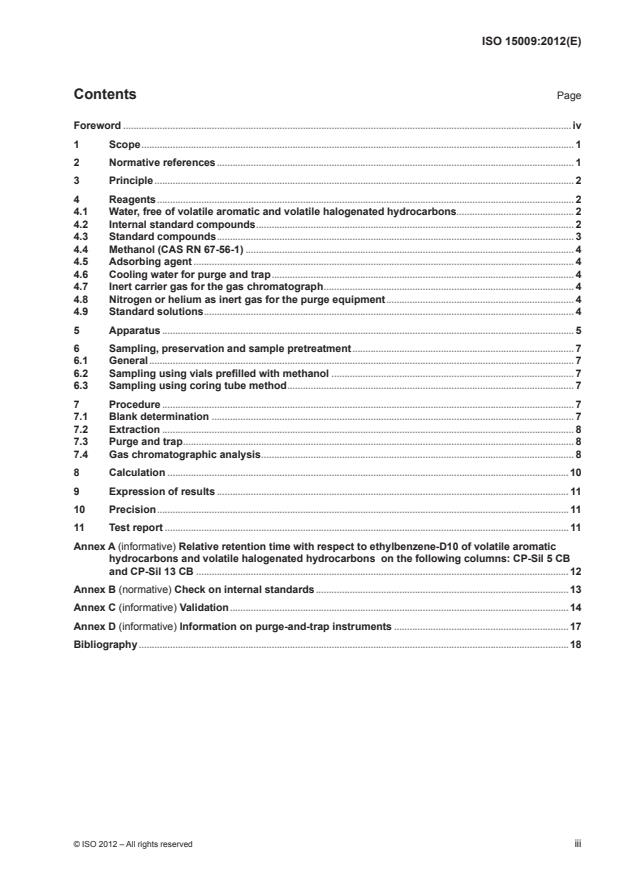
Contents Page
Foreword .iv
1 Scope . 1
2 Normative references . 1
3 Principle . 2
4 Reagents . 2
4.1 Water, free of volatile aromatic and volatile halogenated hydrocarbons. 2
4.2 Internal standard compounds . 2
4.3 Standard compounds . 3
4.4 Methanol (CAS RN 67-56-1) . 4
4.5 Adsorbing agent . 4
4.6 Cooling water for purge and trap . 4
4.7 Inert carrier gas for the gas chromatograph . 4
4.8 Nitrogen or helium as inert gas for the purge equipment . 4
4.9 Standard solutions . 4
5 Apparatus . 5
6 Sampling, preservation and sample pretreatment . 7
6.1 General . 7
6.2 Sampling using vials prefilled with methanol . 7
6.3 Sampling using coring tube method . 7
7 Procedure . 7
7.1 Blank determination . 7
7.2 Extraction . 8
7.3 Purge and trap . 8
7.4 Gas chromatographic analysis . 8
8 Calculation .10
9 Expression of results . 11
10 Precision . 11
11 Test report . 11
Annex A (informative) Relative retention time with respect to ethylbenzene-D10 of volatile aromatic
hydrocarbons and volatile halogenated hydrocarbons on the following columns: CP-Sil 5 CB
and CP-Sil 13 CB .12
Annex B (normative) Check on internal standards .13
Annex C (informative) Validation .14
Annex D (informative) Information on purge-and-trap instruments .17
Bibliography .18
Foreword
ISO (the International Organization for Standardization) is a worldwide federation of national standards bodies
(ISO member bodies). The work of preparing International Standards is normally carried out through ISO
technical committees. Each member body interested in a subject for which a technical committee has been
established has the right to be represented on that committee. International organizations, governmental and
non-governmental, in liaison with ISO, also take part in the work. ISO collaborates closely with the International
Electrotechnical Commission (IEC) on all matters of electrotechnical standardization.
International Standards are drafted in accordance with the rules given in the ISO/IEC Directives, Part 2.
The main task of technical committees is to prepare International Standards. Draft International Standards
adopted by the technical committees are circulated to the member bodies for voting. Publication as an
International Standard requires approval by at least 75 % of the member bodies casting a vote.
Attention is drawn to the possibility that some of the elements of this document may be the subject of patent
rights. ISO shall not be held responsible for identifying any or all such patent rights.
ISO 15009 was prepared by Technical Committee ISO/TC 190, Soil quality, Subcommittee SC 3, Chemical
methods and soil characteristics.
This second edition cancels and replaces the first edition (ISO 15009:2002), which has been technically revised.
iv © ISO 2012 – All rights reserved
INTERNATIONAL STANDARD ISO 15009:2012(E)
Soil quality — Gas chromatographic determination of the
content of volatile aromatic hydrocarbons, naphthalene and
volatile halogenated hydrocarbons — Purge-and-trap method
with thermal desorption
1 Scope
This International Standard specifies a method for quantitative gas chromatographic determination of volatile
hydrocarbons, naphthalene and volatile halogenated hydrocarbons in soil.
This International Standard is applicable to all types of soil.
NOTE In the case of unsaturated peaty soils, absorption of the extraction solution may occur.
The lower limit of determination is dependent on the equipment used and the quality of the methanol grade
used for the extraction of the soil sample.
Under the conditions specified in this International Standard, the following limits of determinations apply
(expressed on a basis of dry matter):
a) Typical limit of determination when using gas chromatography/flame ionization detection (GC/FID):
— volatile aromatic hydrocarbons: 0,1 mg/kg.
b) Typical limit of determination when using gas chromatography/electron capture detector (GC/ECD):
— volatile halogenated hydrocarbons: 0,01 mg/kg
Lower limits of determination for some compounds can be achieved by using mass spectrometry (MS) with
selected ion detection.
2 Normative references
The following referenced documents are indispensable for the application of this document. For dated
references, only the edition cited applies. For undated references, the latest edition of the referenced document
(including any amendments) applies.
ISO 4799, Laboratory glassware — Condensers
ISO 10381-1, Soil quality — Sampling — Part 1: Guidance on the design of sampling programmes
ISO 10381-2, Soil quality — Sampling — Part 2: Guidance on sampling techniques
ISO 10381-5, Soil quality — Sampling — Part 5: Guidance on the procedure for the investigation of urban and
industrial sites with regard to soil contamination
ISO 11465, Soil quality — Determination of dry matter and water content on a mass basis — Gravimetric method
ISO 11465:1993/Cor 1:1994, Soil quality — Determination of dry matter and water content on a mass basis —
Gravimetric method — Technical Corrigendum 1
ISO 15680, Water quality — Gas-chromatographic determination of a number of monocyclic aromatic
hydrocarbons, naphthalene and several chlorinated compounds using purge-and-trap and thermal desorption
ISO 18512, Soil quality — Guidance on long and short term storage of soil samples
ISO 22892, Soil quality — Guidelines for the identification of target compounds by gas chromatography and
mass spectrometry
3 Principle
Test samples are taken from an untreated field-moist soil sample. To prevent losses of the volatiles, samples
are taken as undisturbed as possible in the field with a tube corer or by adding methanol immediately in the field.
The test sample is extracted with methanol. After centrifugation, part of the methanol extract is brought into
a purge vessel filled with water. The volatile compounds are purged with nitrogen or helium and adsorbed on
a suitable adsorbing agent. The adsorbed compounds are desorbed thermally and by means of a carrier gas
flow, whether or not via a cold trap, brought into a gas chromatograph. The various compounds are separated
by using a capillary column with an immobile phase of low polarity. Volatile organic compounds are detected
with appropriate detectors such as: mass spectrometric detector (MS), flame ionization detector (FID), electron
capture detector (ECD), photo ionization detector (PID) or electrolytic conductivity detector (ELCD). Identification
and quantification takes place by comparison of retention times and peak heights (or peak areas) towards an
internal standard added with the corresponding variables of an external standard solution. The efficiency of the
procedure depends on the composition of the soil that is investigated. The described procedure does not take
into account incomplete extraction caused by structure and composition of the soil sample.
When using non-specific detectors such as FIDs and ECDs, the confirmation of the identity of the detected
compounds and their concentrations should be done by repeating the gas chromatographic analysis using
a column of different polarity. When using gas chromatography/mass spectrometry (GC/MS), the identity
confirmation and the quantification can be done in a single run.
NOTE 1 This International Standard follows the description of an off-line purge-and-trap method. The use of commercial
available online instruments is allowed, provided that equivalent results are obtained during validation of this equipment.
With such an instrument, purge and trap occurs on line with gas chromatography and detection. Follow the manufacturer’s
manual, especially regarding the items composing the apparatus which are listed in 5.1.1 to 5.1.9.
NOTE 2 Other injection techniques, such as static headspace followed by thermal desorption (ISO 22155) or solid-
phase micro-extraction (SPME), can be used, provided that their applicability is proven.
4 Reagents
All reagents shall be of recognized analytical grade. Verify whether the reagents are applicable for this specific
purpose and free of interfering compounds.
4.1 Water, free of volatile aromatic and volatile halogenated hydrocarbons
Usually boiler water with a temperature of at least 80 °C and 1 day old can be applied. Purging with an inert gas,
e.g. a flow of 10 ml/min of nitrogen for 30 min, is another means of removing interfering compounds from water.
A sufficient amount of water from the same batch should be available to complete each batch of analyses,
including all preparations.
4.2 Internal standard compounds
4.2.1 For the determination of volatile aromatic hydrocarbons, preferably two internal standard compounds
shall be selected that do not interfere with compounds present in the sample extract.
Examples of suitable internal standards are
— toluene-D8 (CAS RN 2037-26-5),
— ethylbenzene-D10 (CAS RN 25837-05-2), and
— 2-bromofluorobenzene (CAS RN 1072-85-1).
2 © ISO 2012 – All rights reserved
4.2.2 For the determination of volatile halogenated hydrocarbons, preferably two internal standard compounds
shall be selected that do not interfere with compounds present in the sample extract.
Examples of suitable internal standards are:
— 1,4-dichlorobutane (CAS RN 110-56-5);
— α,α,α-trifluorotoluene (CAS RN 98-08-8);
— 2-bromofluorobenzene (CAS RN 1072-85-1).
4.3 Standard compounds
4.3.1 Volatile aromatic hydrocarbons
— benzene (CAS RN 71-43-2);
— toluene (CAS RN 108-88-3);
— ethylbenzene (CAS RN 100-41-4);
— o-xylene (CAS RN 95-47-6);
— m-xylene (CAS RN 108-38-3);
— p-xylene (CAS RN 106-42-3);
— styrene (CAS RN 100-42-5);
— naphthalene (CAS RN 91-20-3).
4.3.2 Volatile halogenated hydrocarbons
— dichloromethane (CAS RN 75-09-2);
— trichloromethane (CAS RN 67-66-3);
— tetrachloromethane (CAS RN 56-23-5);
— 1,1-dichloroethane (CAS RN 75-34-3);
— 1,2-dichloroethane (CAS RN 107-06-2);
— 1,1,1-trichloroethane (CAS RN 79-01-6);
— 1,1,2-trichloroethane (CAS RN 79-00-5);
— 1,2-dichloropropane (CAS RN 78-87-5);
— 1,2,3-trichloropropane (CAS RN 98-18-4);
— cis-1,3-dichloropropene (CAS RN 10061-01-5);
— trans-1,3-dichloropropene (CAS RN 10061-02-6);
— cis-1,2-dichloroethene (CAS RN 156-59-2);
— trans-1,2-dichloroethene (CAS RN 156-60-5);
— 3-chloropropene (CAS RN 107-05-1);
— trichloroethene (CAS RN 79-01-6);
— tetrachloroethene (CAS RN 127-18-4);
— monochlorobenzene (CAS RN 108-90-7);
— 1,2-dichlorobenzene (CAS RN 95-50-1).
4.4 Methanol (CAS RN 67-56-1)
The methanol used shall not contain more than 100 µg/l of the individual volatile aromatic compounds and not
more than 10 µg/l of the volatile halogenated hydrocarbons that are to be analysed.
4.5 Adsorbing agent
Polymer of 2,6-diphenyl-p-phenoxide (40 mesh to 60 mesh) of a grade suitable for thermal desorption.
1)
NOTE 1 2,6-diphenyl-p-phenoxide is commercially available as Tenax TA .
NOTE 2 Other adsorbing agents may be used provided that their suitability has been tested.
4.6 Cooling water for purge and trap
The temperature of the cooling water depends on the dimensions of the purge-and-trap equipment (5.1). A temperature
of about 10 °C is recommended. A cryostat shall be used if the temperature of the cooling water is too high.
4.7 Inert carrier gas for the gas chromatograph
Helium, nitrogen or argon-methane mixture ultra-pure. Other gases for gas chromatography shall be used in
accordance with the instrument manufacturer’s instructions.
4.8 Nitrogen or helium as inert gas for the purge equipment
4.9 Standard solutions
4.9.1 Standard stock solutions for volatile aromatic and halogenated compounds in methanol, 4 g/l.
Weigh about 100 mg of the individual standard compounds (4.3) with an accuracy of 0,1 mg into a closed
septum flask containing 25 ml of methanol. Transfer the standard compounds into the flask by using a syringe.
NOTE The stock solution is stable for about 6 months when stored at −18 °C.
4.9.2 Internal standard solutions in methanol, 4 g/l.
Weigh about 100 mg of the individual internal standard compounds (4.2.1 and 4.2.2), accurate to 0,1 mg, into a
closed septum flask containing 25 ml of methanol. Using a syringe, transfer the standard compounds into the flask.
The containers containing the solutions shall be marked or weighed so that any evaporation losses of the
solvent may be recognized. The solutions shall be stored in the dark at a temperature of 4 °C ± 2 °C. Prior to
use, they shall be brought to ambient temperature.
4.9.3 Calibration solutions
Calibration solutions containing 0 mg/l to 200 mg/l of each standard (4.3) and the selected internal standard
compounds (4.2), 200 mg/l. The calibration solutions are prepared in methanol.
Dilute the amounts indicated in Table 1 of the solutions obtained according to 6.2 and 6.3 with methanol
(4.4) to 100 ml.
Other volumes of methanol may be used as long as suitability is proven.
1) Tenax TA is an example of a suitable product available commercially. This information is given for the convenience
of users of this International Standard and does not constitute an endorsement by ISO of this product.
4 © ISO 2012 – All rights reserved
Table 1 — Example for preparation of calibration solutions
Calibration solution Internal standard Standard stock Concentration in Quantity in µg/5 µl
solution (4.9.2) solution (4.9.1) the calibration calibration solution
ml ml solution in 100 ml (sample)
mg/l water
1 5 0 0 0
2 5 1 40 0,2
3 5 2 80 0,4
4 5 3 120 0,6
5 5 4 160 0,8
6 5 5 200 1,0
The total volume of the methanol used for calibration shall be the same as that which will be taken for the
methanol extract of the soil sample (see 7.2).
5 Apparatus
Usual laboratory glassware, free of interfering compounds.
All glassware shall be cleaned according to the usual procedures for this type of analysis.
5.1 Purge-and-trap apparatus
The instrument described here is for an off-line purge-and-trap method. As mentioned in Note 1 to Clause 3,
commercially available automated systems are allowed provided the requirements of this International Standard
are met. Annex D gives some considerations for the use of such systems.
5.1.1 Round-bottom flask with three angled side necks; volume 100 ml.
5.1.2 Gas inlet tube with a tip of sintered glass.
5.1.3 Ball-and-cup stopcock with a polytetrafluoroethylene (PTFE) ring.
5.1.4 Flow adjustment; the nitrogen flow shall be 40 ml/min ± 2 ml/min.
5.1.5 Inlet tube for the thermocouple.
5.1.6 Allin- or Graham-type condenser (see ISO 4799).
5.1.7 Screw cap with cut-off ring made of silicone rubber with PTFE inlay.
5.1.8 Adsorption tubes
Tubes made of glass or stainless steel, filled with at least 240 mg of adsorbing agent (4.5).
The adsorbent is kept in place by using inert material, e.g. silanized glass fibre. The tubes shall be suitable for
direct use in connection with the apparatus for thermal desorption. The tubes shall be marked on one side. The
tubes shall be provided with caps of inert material, e.g. polyethylene or metal, with screw caps and a PTFE ring,
that allow tight closing after purging.
Before use, the adsorbent shall be activated and purified by slowly heating the tubes to 250 °C and keeping them
at that temperature for 3 h while a nitrogen flow of 10 ml/min is maintained. The adsorbent shall be cooled under
nitrogen and the tubes analysed. The result of a blank determination shall not exceed the equivalent of 1 ng of
a compound to be analysed. When the result is higher than this, the adsorbent shall be desorbed once more.
NOTE The use of commercially available tubes is recommended.
Tubes that are used should not be used again, unless the blank determination meets the above-mentioned
requirements.
Care should be taken to avoid cross-contamination. A heavily loaded tube can contaminate a lightly loaded
tube in the sample change platform.
5.1.9 Heating block with thermocouple, suitable for heating 100 ml flasks
5.2 Centrifuge, suitable for centrifuging tubes of 200 ml with such a rotation frequency that the radial
acceleration is 2 000g to 3 000g.
5.3 Centrifuge tubes, with a volume of 200 ml.
5.4 Capillary columns
Fused silica capillary columns with a non-polar or semipolar stationary phase allowing sufficient separation of the
compounds of interest. A thick film of stationary phase increases the efficiency of the more volatile compounds.
Examples are given in 7.4 and Annex A.
5.5 Gas chromatograph, equipped with one or two appropriate detectors. Detectors, such as flame
ionization detectors (FIDs), electron capture detectors (ECDs), photo-ionization detectors (PIDs) or electrolytic
conductivity detectors (ELCDs), and a mass spectrometer (MS) can be used, depending on the substances to
be analysed and their target level of contamination. The mass spectrometer should be capable of operating
over the total mass range of interest and being equipped with a data system capable of quantifying ions using
selected m/z values.
5.6 Apparatus for thermal desorption
The apparatus used shall meet the following requirements:
— a primary desorption oven with adjustable desorption temperature up to 250 °C and adjustable desorption time;
— a cold trap/secondary desorption oven;
— a connecting tube to the gas chromatograph, with adjustable heating up to 150 °C;
— adjustable carrier-gas flow rate up to 40 ml/min.
NOTE Instruments for thermal desorption are commercially available.
5.7 Electronic integrator or automatic recorder
5.8 Syringe, of volume 5 µl, readable to 0,1 µl, and of volume 50 µl, readable to 1 µl.
5.9 Horizontal shaking machine
A shaking machine with horizontal movement (200 to 300 movements per minute).
6 © ISO 2012 – All rights reserved
6 Sampling, preservation and sample pretreatment
6.1 General
Sampling shall be carried out in accordance with ISO 10381-1 and ISO 10381-5, as appropriate, using
equipment according to ISO 10381-2, after coordination with the analytical laboratory.
Samples shall be analysed as soon as possible upon t
...
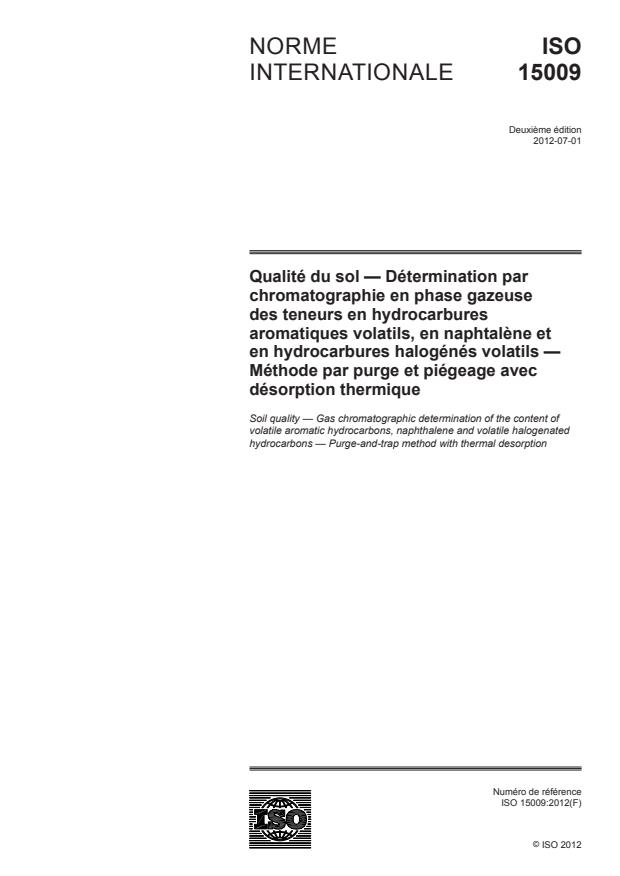
NORME ISO
INTERNATIONALE 15009
Deuxième édition
2012-07-01
Qualité du sol — Détermination par
chromatographie en phase gazeuse
des teneurs en hydrocarbures
aromatiques volatils, en naphtalène et
en hydrocarbures halogénés volatils —
Méthode par purge et piégeage avec
désorption thermique
Soil quality — Gas chromatographic determination of the content of
volatile aromatic hydrocarbons, naphthalene and volatile halogenated
hydrocarbons — Purge-and-trap method with thermal desorption
Numéro de référence
©
ISO 2012
DOCUMENT PROTÉGÉ PAR COPYRIGHT
Droits de reproduction réservés. Sauf prescription différente, aucune partie de cette publication ne peut être reproduite ni utilisée sous
quelque forme que ce soit et par aucun procédé, électronique ou mécanique, y compris la photocopie et les microfilms, sans l’accord écrit
de l’ISO à l’adresse ci-après ou du comité membre de l’ISO dans le pays du demandeur.
ISO copyright office
Case postale 56 • CH-1211 Geneva 20
Tel. + 41 22 749 01 11
Fax + 41 22 749 09 47
E-mail copyright@iso.org
Web www.iso.org
Publié en Suisse
ii © ISO 2012 – Tous droits réservés
Sommaire Page
Avant-propos .iv
1 Domaine d’application . 1
2 Références normatives . 1
3 Principe . 2
4 Réactifs . 2
4.1 Eau, exempte d’hydrocarbures aromatiques volatils et d’hydrocarbures halogénés volatils . 2
4.2 Composés étalons internes . 3
4.3 Composés étalons . 3
4.4 Méthanol (numéro CAS 67-56-1) . 4
4.5 Agent d’adsorption . 4
4.6 Eau de refroidissement, pour la purge et le piégeage . 4
4.7 Gaz vecteur inerte, pour le chromatographe en phase gazeuse . 4
4.8 Azote ou hélium, utilisé comme gaz inerte pour le dispositif de purge . 4
4.9 Solutions étalons . 4
5 Appareillage . 5
6 Échantillonnage, conservation et traitement préliminaire des échantillons . 7
6.1 Généralités . 7
6.2 Échantillonnage à l’aide de flacons préalablement remplis de méthanol . 7
6.3 Échantillonnage par la méthode du tube de carottage . 8
7 Mode opératoire . 8
7.1 Détermination à blanc . 8
7.2 Extraction . 8
7.3 Purge et piégeage . 8
7.4 Analyse par chromatographie en phase gazeuse . 9
8 Calcul . 11
9 Expression des résultats . 11
10 Fidélité . 11
11 Rapport d’essai .12
Annexe A (informative) Temps de rétention relatifs par rapport à l’éthylbenzène-D10 des hydrocarbures
aromatiques volatils et des hydrocarbures halogénés volatils sur les colonnes suivantes: CP-
Sil 5 CB et CP-Sil 13 CB .13
Annexe B (normative) Vérification des étalons internes .14
Annexe C (informative) Validation .15
Annexe D (informative) Informations sur les instruments de purge et de piégeage.18
Bibliographie .20
Avant-propos
L’ISO (Organisation internationale de normalisation) est une fédération mondiale d’organismes nationaux de
normalisation (comités membres de l’ISO). L’élaboration des Normes internationales est en général confiée aux
comités techniques de l’ISO. Chaque comité membre intéressé par une étude a le droit de faire partie du comité
technique créé à cet effet. Les organisations internationales, gouvernementales et non gouvernementales,
en liaison avec l’ISO participent également aux travaux. L’ISO collabore étroitement avec la Commission
électrotechnique internationale (CEI) en ce qui concerne la normalisation électrotechnique.
Les Normes internationales sont rédigées conformément aux règles données dans les Directives ISO/CEI, Partie 2.
La tâche principale des comités techniques est d’élaborer les Normes internationales. Les projets de Normes
internationales adoptés par les comités techniques sont soumis aux comités membres pour vote. Leur publication
comme Normes internationales requiert l’approbation de 75 % au moins des comités membres votants.
L’attention est appelée sur le fait que certains des éléments du présent document peuvent faire l’objet de droits
de propriété intellectuelle ou de droits analogues. L’ISO ne saurait être tenue pour responsable de ne pas avoir
identifié de tels droits de propriété et averti de leur existence.
L’ISO 15009 a été élaborée par le comité technique ISO/TC 190, Qualité du sol, sous-comité SC 3, Méthodes
chimiques et caractéristiques du sol.
Cette deuxième édition annule et remplace la première édition (ISO 15009:2002), qui a fait l’objet d’une
révision technique.
iv © ISO 2012 – Tous droits réservés
NORME INTERNATIONALE ISO 15009:2012(F)
Qualité du sol — Détermination par chromatographie en phase
gazeuse des teneurs en hydrocarbures aromatiques volatils, en
naphtalène et en hydrocarbures halogénés volatils — Méthode
par purge et piégeage avec désorption thermique
1 Domaine d’application
La présente Norme internationale spécifie une méthode pour la détermination quantitative par chromatographie
en phase gazeuse des hydrocarbures volatils, du naphtalène et des hydrocarbures halogénés volatils contenus
dans les sols.
La présente Norme internationale est applicable à tous les types de sols.
NOTE En cas de sols tourbeux insaturés, une absorption de la solution d’extraction peut avoir lieu.
La limite inférieure de détermination dépend du matériel utilisé et de la qualité du méthanol utilisé pour
l’extraction de l’échantillon de sol.
Dans les conditions spécifiées dans la présente Norme internationale, les limites de dosage suivantes
(exprimées par rapport à la matière sèche) s’appliquent:
a) Limite de dosage type lorsque le couplage chromatographie en phase gazeuse/détection par ionisation de
flamme (CG/FID) est utilisé:
— hydrocarbures aromatiques volatils: 0,1 mg/kg.
b) Limite de dosage type lorsque le couplage chromatographie en phase gazeuse/détecteur à capture
d’électrons (CG/ECD) est utilisé:
— hydrocarbures halogénés volatils: 0,01 mg/kg.
Des limites de dosage plus faibles peuvent être atteintes pour certains composés si l’on utilise la spectrométrie
de masse (SM) avec détection sélective des ions.
2 Références normatives
Les documents de référence suivants sont indispensables pour l’application du présent document. Pour les
références datées, seule l’édition citée s’applique. Pour les références non datées, la dernière édition du
document de référence s’applique (y compris les éventuels amendements).
ISO 4799, Verrerie de laboratoire — Réfrigérants
ISO 10381-1, Qualité du sol — Échantillonnage — Partie 1: Lignes directrices pour l’établissement des
programmes d’échantillonnage
ISO 10381-2, Qualité du sol — Échantillonnage — Partie 2: Lignes directrices pour les techniques
d’échantillonnage
ISO 10381-5, Qualité du sol — Échantillonnage — Partie 5: Lignes directrices pour la procédure d’investigation
des sols pollués en sites urbains et industriels
ISO 11465:1993/Cor. 1:1994, Qualité du sol — Détermination de la teneur pondérale en matière sèche et en
eau — Méthode gravimétrique — Rectificatif technique 1
ISO 15680, Qualité de l’eau — Dosage par chromatographie en phase gazeuse d’un certain nombre
d’hydrocarbures aromatiques monocycliques, du naphtalène et de divers composés chlorés par dégazage,
piégeage et désorption thermique
ISO 18512, Qualité du sol — Lignes directrices relatives au stockage des échantillons de sol à long et à court termes
ISO 22892, Qualité du sol — Lignes directrices pour l’identification de composés cibles par chromatographie
en phase gazeuse et spectrométrie de masse
3 Principe
Les échantillons pour essai sont prélevés dans un échantillon de sol brut non traité. Pour éviter les pertes de
matières volatiles, les échantillons sont prélevés à l’aide d’un tube de carottage en perturbant le moins possible
les conditions du sol ou en ajoutant immédiatement le méthanol sur le terrain.
L’échantillon pour essai est extrait à l’aide de méthanol. Après centrifugation, une partie de l’extrait de méthanol
est placée dans un récipient de purge rempli d’eau. Les composés volatils sont entraînés avec de l’azote ou de
l’hélium et adsorbés par un agent d’adsorption approprié. Une désorption thermique des composés adsorbés
est effectuée, puis ils sont dirigés vers un chromatographe en phase gazeuse au moyen d’un courant de
gaz vecteur, directement ou par l’intermédiaire d’un piège de refroidissement. Les différents composés sont
ensuite séparés à l’aide d’une colonne capillaire avec une phase stationnaire de faible polarité. Les composés
organiques volatils sont détectés avec des détecteurs appropriés, comme le spectromètre de masse (SM),
le détecteur à ionisation de flamme (FID), le détecteur à capture d’électrons (ECD), le détecteur à photo-
ionisation (PID) ou le détecteur à conductivité électrolytique (ELCD). L’identification et la quantification des
composés sont réalisées par comparaison des temps de rétention et des hauteurs de pics (ou aires de pics)
avec ceux d’un étalon interne et ceux d’une solution étalon externe. L’efficacité du mode opératoire dépend de
la composition du sol examiné. Le mode opératoire décrit ne prend pas en considération l’extraction incomplète
causée par la structure et la composition de l’échantillon de sol.
Si l’on utilise des détecteurs non spécifiques, tels que FID et ECD, il convient de confirmer l’identité des
composés détectés et leur concentration en répétant l’analyse chromatographique en phase gazeuse sur une
colonne de polarité différente. Si l’on utilise le couplage chromatographie en phase gazeuse/spectrométrie de
masse (CG/SM), la confirmation d’identité et la quantification peuvent se faire en une seule opération.
NOTE 1 La présente Norme internationale suit la description d’une «méthode de purge et de piégeage hors ligne». Les
instruments en ligne vendus dans le commerce peuvent être utilisés si des résultats équivalents sont obtenus au cours
de leur validation. Avec un tel instrument, la purge et le piégeage s’effectuent en ligne avec la chromatographie en phase
gazeuse et la détection. Suivre le manuel du fabricant particulièrement en ce qui concerne les éléments listés en 5.1.1 à
5.1.9, composant l’appareillage.
NOTE 2 D’autres techniques d’injection, telles que la méthode par espace de tête statique suivie d’une désorption
thermique (voir l’ISO 22155) ou d’une micro-extraction en phase solide (SPME), peuvent être utilisées si leur aptitude à
l’emploi est prouvée.
4 Réactifs
Tous les réactifs doivent être de qualité analytique reconnue. Vérifier que les réactifs sont applicables pour ce
besoin spécifique et exempts de composés interférents.
4.1 Eau, exempte d’hydrocarbures aromatiques volatils et d’hydrocarbures halogénés volatils
On utilise généralement de l’eau chauffée à au moins 80 °C et préparée la veille. Pour éliminer les composés
interférents de l’eau, il est également possible de purger à l’aide d’un gaz inerte, par exemple à un débit
d’azote de 10 ml/min pendant 30 min. Il convient de disposer d’une quantité d’eau suffisante du même lot pour
compléter chaque lot d’analyses, y compris toutes les préparations.
2 © ISO 2012 – Tous droits réservés
4.2 Composés étalons internes
4.2.1 Pour la détermination des hydrocarbures aromatiques volatils, sélectionner de préférence deux
composés étalons internes qui n’interfèrent pas avec les composés présents dans l’extrait d’échantillon.
Exemples d’étalons internes appropriés:
— toluène-D8 (numéro CAS 2037-26-5);
— éthylbenzène-D10 (numéro CAS 25837-05-2);
— 2-bromofluorobenzène (numéro CAS 1072-85-1).
4.2.2 Pour la détermination des hydrocarbures halogénés volatils, sélectionner de préférence deux composés
étalons internes qui n’interfèrent pas avec les composés présents dans l’extrait d’échantillon.
Exemples d’étalons internes appropriés:
— 1,4-dichlorobutane (numéro CAS 110-56-5);
— α,α,α-trifluorotoluène (numéro CAS 98-08-8);
— 2-bromofluorobenzène (numéro CAS 1072-85-1).
4.3 Composés étalons
4.3.1 Hydrocarbures aromatiques volatils
— Benzène (numéro CAS 71-43-2);
— toluène (numéro CAS 108-88-3);
— éthylbenzène (numéro CAS 100-41-4);
— o-xylène (numéro CAS 95-47-6);
— m-xylène (numéro CAS 108-38-3);
— p-xylène (numéro CAS 106-42-3);
— styrène (numéro CAS 100-42-5);
— naphtalène (numéro CAS 91-20-3).
4.3.2 Hydrocarbures halogénés volatils
— Dichlorométhane (numéro CAS 75-09-2);
— trichlorométhane (numéro CAS 67-66-3);
— tétrachlorométhane (numéro CAS 56-23-5);
— 1,1-dichloroéthane (numéro CAS 75-34-3);
— 1,2-dichloroéthane (numéro CAS 107-06-2);
— 1,1,1-trichloroéthane (numéro CAS 79-01-6);
— 1,1,2-trichloroéthane (numéro CAS 79-00-5);
— 1,2-dichloropropane (numéro CAS 78-87-5);
— 1,2,3-trichloropropane (numéro CAS 98-18-4);
— cis-1,3-dichloropropène (numéro CAS 10061-01-5);
— trans-1,3-dichloropropène (numéro CAS 10061-02-6);
— cis-1,2-dichloroéthène (numéro CAS 156-59-2);
— trans-1,2-dichloroéthène (numéro CAS 156-60-5);
— 3-chloropropène (numéro CAS 107-05-1);
— trichloroéthène (numéro CAS 79-01-6);
— tétrachloroéthène (numéro CAS 127-18-4);
— monochlorobenzène (numéro CAS 108-90-7);
— 1,2-dichlorobenzène (numéro CAS 95-50-1).
4.4 Méthanol (numéro CAS 67-56-1)
Le méthanol utilisé doit contenir au maximum 100 µg/l de chacun des composés aromatiques volatils et au
maximum 10 µg/l des hydrocarbures halogénés volatils à analyser.
4.5 Agent d’adsorption
Polymère de 2,6-diphényl-p-phénate (40 mesh à 60 mesh) d’une qualité appropriée pour la désorption thermique.
1)
NOTE 1 Le 2,6-diphényl-p-phénate est disponible sur le marché sous le nom de Tenax TA .
NOTE 2 D’autres agents d’adsorption peuvent être utilisés, à condition que des essais aient permis de vérifier leur
aptitude à l’emploi.
4.6 Eau de refroidissement, pour la purge et le piégeage
La température de l’eau de refroidissement dépend des dimensions de l’équipement de purge et de
piégeage (5.1). Il est recommandé d’utiliser une température de 10 °C environ. Un cryostat doit être utilisé si la
température de l’eau utilisée pour le refroidissement est trop élevée.
4.7 Gaz vecteur inerte, pour le chromatographe en phase gazeuse
Hélium, azote ou mélange d’argon et de méthane ultra-pur. Les autres gaz pour chromatographie en phase
gazeuse doivent être utilisés conformément aux instructions du fabricant des instruments.
4.8 Azote ou hélium, utilisé comme gaz inerte pour le dispositif de purge
4.9 Solutions étalons
4.9.1 Solutions étalons mères, pour composés aromatiques et halogénés volatils dans du méthanol, 4 g/l.
Peser environ 100 mg de composés étalons individuels (4.3) avec une précision de 0,1 mg dans un flacon à septum
fermé contenant 25 ml de méthanol. Transférer les composés étalons dans le flacon à l’aide d’une seringue.
NOTE La solution mère est stable pendant environ 6 mois si elle est conservée à -18 °C.
1) Tenax TA est un exemple de produit approprié disponible sur le marché. Cette information est donnée à l’intention
des utilisateurs de la présente Norme internationale et ne signifie nullement que l’ISO approuve ou recommande l’emploi
exclusif du produit ainsi désigné.
4 © ISO 2012 – Tous droits réservés
4.9.2 Solutions étalons internes dans du méthanol, 4 g/l.
Peser environ 100 mg de composés étalons internes individuels (4.2.1 et 4.2.2) avec une précision de 0,1 mg
dans un flacon à septum fermé contenant 25 ml de méthanol. Transférer les composés étalons dans le flacon
à l’aide d’une seringue.
Les récipients contenant les solutions doivent être marqués ou pesés de façon à permettre de détecter toute
perte du solvant par évaporation. Les solutions doivent être conservées à l’abri de la lumière, à une température
de 4 °C ± 2 °C. Elles doivent être ramenées à température ambiante avant utilisation.
4.9.3 Solutions d’étalonnage
Solutions d’étalonnage, contenant de 0 mg/l à 200 mg/l de chaque étalon (4.3) et les composés étalons internes
choisis (4.2), 200 mg/l. Les solutions d’étalonnage sont préparées dans du méthanol.
Diluer les quantités indiquées dans le Tableau 1 des solutions obtenues conformément à 6.2 et 6.3 avec du
méthanol (4.4) jusqu’à 100 ml.
On peut utiliser d’autres volumes de méthanol, à condition d’avoir démontré leur pertinence.
Tableau 1 — Exemple pour la préparation des solutions d’étalonnage
Solution Solution étalon interne Solution étalon mère Concentration Quantité, en
d’étalonnage (4.9.2) (4.9.1) de la solution µg/5 µl, de solution
ml ml d’étalonnage d’étalonnage
mg/l dans 100 ml d’eau
(échantillon)
1 5 0 0 0
2 5 1 40 0,2
3 5 2 80 0,4
4 5 3 120 0,6
5 5 4 160 0,8
6 5 5 200 1,0
Le volume total de méthanol utilisé pour l’étalonnage doit être le même que celui qui sera utilisé pour l’extraction
au méthanol de l’échantillon de sol (voir 7.2).
5 Appareillage
Verrerie courante de laboratoire, exempte de composés interférents.
La verrerie doit être nettoyée conformément aux méthodes habituelles pour ce type d’analyse.
5.1 Dispositif de purge et de piégeage
L’instrument décrit ici convient pour une méthode de purge et de piégeage hors ligne. Comme mentionné
dans la Note 1 de l’Article 3, il est permis d’utiliser des systèmes automatiques disponibles sur le marché, à
condition que les exigences de la présente Norme internationale soient satisfaites. L’Annexe D donne quelques
recommandations pour l’utilisation de tels systèmes.
5.1.1 Flacon à base arrondie, avec trois cols latéraux inclinés, d’une capacité de 100 ml.
5.1.2 Tube d’alimentation en gaz, avec embout en verre fritté.
5.1.3 Robinet d’arrêt à bille et coupelle, muni d’un joint en polytétrafluoréthylène (PTFE).
5.1.4 Réglage du débit. Le débit de l’azote doit être de 40 ml/min ± 2 ml/min.
5.1.5 Tube d’alimentation pour le thermocouple.
5.1.6 Réfrigérant de type Allin ou Graham (voir l’ISO 4799).
5.1.7 Bouchon, avec bague d’étanchéité, en caoutchouc de silicone avec garniture en PTFE.
5.1.8 Tubes d’adsorption, en verre ou en acier inoxydable, remplis avec au moins 240 mg d’agent
d’adsorption (4.5).
L’adsorbant est maintenu en place à l’aide d’un matériau inerte, par exemple de la fibre de verre silanisée. Les tubes
doivent être adaptés à une utilisation directe avec l’appareillage de désorption thermique. Les tubes doivent être
marqués sur un côté. Les tubes doivent être munis de bouchons en matériau inerte, par exemple du polyéthylène
ou du métal, avec filetages et anneaux en PTFE pour assurer la fermeture hermétique après la purge.
Avant utilisation, activer et purifier l’adsorbant en chauffant doucement les tubes à 250 °C et en les maintenant
à cette température pendant 3 h, avec un débit d’azote de 10 ml/min. Refroidir l’adsorbant dans l’azote et
procéder à l’analyse des tubes. Le résultat d’une détermination à blanc ne doit pas dépasser l’équivalent
de 1 ng d’un composé à analyser. Lorsque le résultat est supérieur à cette valeur, l’adsorbant doit subir une
nouvelle désorption.
NOTE Il est recommandé d’utiliser des tubes vendus dans le commerce.
Il convient de ne pas réutiliser les tubes, sauf si la détermination à blanc satisfait aux exigences
mentionnées ci-dessus.
Il convient de prendre des précautions afin d’éviter une contamination croisée entre échantillons. Un tube très
chargé en composés peut contaminer un autre tube peu chargé sur le passeur d’échantillons.
5.1.9 Bloc de chauffage, avec thermocouple, permettant de chauffer des flacons de 100 ml.
5.2 Centrifugeuse, permettant de centrifuger des tubes de 200 ml à une fréquence de rotation telle que
l’accélération radiale soit comprise entre 2 000g et 3 000g.
5.3 Tubes de centrifugation, d’une capacité de 200 ml.
5.4 Colonnes capillaires, en silice fondue avec phase stationnaire non polaire ou semi-polaire permettant
une séparation suffisante des composés d’intérêt. Un film épais de la phase stationnaire augmente l’efficacité
de séparation des composés les plus volatils.
Des exemples sont donnés en 7.4 et dans l’Annexe A.
5.5 Chromatographe en phase gazeuse, équipé d’un ou de deux détecteurs appropriés. Des détecteurs à
ionisation de flamme (FID), à capture d’électrons (ECD), à photo-ionisation (PID) ou à conductivité électrolytique
(ELCD) et un spectromètre de masse (SM) peuvent être utilisés en fonction des substances à analyser et de
leur niveau cible de contamination. Il convient que le spectromètre de masse puisse fonctionner sur toute la
plage des masses intéressantes et qu’il comporte un système de traitement des données capable de quantifier
les ions à partir des valeurs m/z sélectionnées.
6 © ISO 2012 – Tous droits réservés
5.6 Appareil de désorption thermique.
L’appareil utilisé doit répondre aux exigences suivantes:
— enceinte de désorption primaire avec température de désorption réglable jusqu’à 250 °C et durée de
désorption réglable;
— piège de refroidissement/enceinte de désorption secondaire;
— tube de connexion au chromatographe en phase gazeuse, avec chauffage réglable jusqu’à 150 °C;
— débit de gaz vecteur réglable jusqu’à 40 ml/min.
NOTE Les instruments de désorption thermique sont vendus dans le commerce.
5.7 Intégrateur électronique ou enregistreur automatique.
5.8 Seringues, d’un volume de 5 µl, d’une précision de lecture de 0,1 µl, d’un volume de 50 µl et d’une
précision de lecture de 1 µl.
5.9 Agitateur à mouvement horizontal, animé d’un mouvement horizontal (200 à 300 mouvements par minute).
6 Échantillonnage, conservation et traitement préliminaire des échantillons
6.1 Généralités
L’échantillonnage doit être effectué conformément à l’ISO 10381-1 et à l’ISO 10381-5 selon le cas approprié,
avec un équipement conforme à l’ISO 10381-2 après coordination avec le laboratoire d’analyse.
Les échantillons doivent être analysés dès que possible après leur réception au laboratoire. Si nécessaire, les
échantillons doivent être conservés au froid conformément à l’ISO 18512. Les échantillons ne subissent pas
de traitement préalable. L’exposition des échantillons à l’air doit être évitée, même durant l’échantillonnage.
Les échantillons utilisés pour le dosage des composés volatils peuvent être obtenus selon plusieurs techniques.
Les méthodes décrites en 6.
...
Questions, Comments and Discussion
Ask us and Technical Secretary will try to provide an answer. You can facilitate discussion about the standard in here.
Loading comments...