

ISO/IEC 20008-3:2024
(Main)Information security — Anonymous digital signatures — Part 3: Mechanisms using multiple public keys
General Information
- Abstract
This document specifies anonymous digital signature mechanisms in which a verifier uses multiple public keys to verify a digital signature. This document provides: — a general description of an anonymous digital signature mechanism using multiple public keys; — a variety of mechanisms that provide such anonymous digital signatures. For each mechanism, this document specifies the process for: — generating the private key and public key of each user; — producing signatures; — verifying signatures; — linking signatures (if the mechanism supports linking); — tracing signatures (if the mechanism supports tracing); — producing signatures with threshold capability (if the mechanism supports a threshold capability); — verifying signatures with threshold capability (if the mechanism supports a threshold capability). This document does not define the implementation of a public key infrastructure (PKI) and the means for distinct entities to exchange, extract and verify their respective public key certificates.
- Status
- Published
- Publication Date
- 02-Dec-2024
- Drafting Committee
- ISO/IEC JTC 1/SC 27/WG 2 - Cryptography and security mechanisms
- Current Stage
- 6060 - International Standard published
- Start Date
- 03-Dec-2024
- Due Date
- 16-Sep-2024
- Completion Date
- 03-Dec-2024


Overview
ISO/IEC 20008-3:2024 - "Information security - Anonymous digital signatures - Part 3: Mechanisms using multiple public keys" specifies anonymous digital signature mechanisms where a verifier uses multiple public keys to validate a signature. Part 3 of the ISO/IEC 20008 series describes a general model and a set of concrete mechanisms (including several ring-signature–style constructions) that let a signer form a spontaneous group by combining public keys. The standard defines processes for key generation, signature production and verification, and optional capabilities such as linking, tracing, and threshold signatures. It does not define PKI implementations or certificate exchange procedures.
Key topics and requirements
- General model and requirements: formal model, symbols, and functional/security requirements for multiple-public-key anonymous signatures.
- Key generation: procedures for creating each user’s private and public keys.
- Signature production and verification: step-by-step processes for creating and verifying anonymous (ring-style) signatures using multiple public keys.
- Linking capability: mechanisms that allow detection of whether two signatures were generated by the same signer under specified conditions.
- Tracing capability: mechanisms that permit identification of the true signer given certain inputs (as specified by the mechanism).
- Threshold capability: options where signatures can be produced/verified by subsets of users of a specified size (threshold settings).
- Mechanism variants: multiple mechanisms are specified - some unlinkable, some linkable, some traceable, and some supporting threshold operation.
- Annexes: normative object identifiers and conversion functions; informative numerical examples to aid implementation and testing.
- Scope limitation: the standard explicitly does not define PKI implementations, certificate exchange, or certificate verification protocols.
Applications and who should use it
ISO/IEC 20008-3:2024 is relevant to:
- Cryptographers and security researchers designing anonymous signature schemes and ring-signature-based protocols.
- Security architects and software engineers building privacy-preserving authentication, anonymous voting, whistleblowing platforms, or confidentiality-preserving logging.
- System integrators implementing signature schemes with linking, tracing, or threshold semantics in distributed systems.
- Standards bodies and compliance teams assessing anonymous signature methods and interoperability.
The standard provides formalized, interoperable mechanisms and examples that help implementers choose and adopt anonymous signature solutions while understanding their privacy and accountability trade-offs.
Related standards
- ISO/IEC 20008-1 (principles and requirements for anonymous digital signatures) - defines the two categories referenced.
- Other referenced documents (normative): e.g., ISO/IEC 10116 for block cipher modes where relevant.
Keywords: ISO/IEC 20008-3:2024, anonymous digital signatures, multiple public keys, ring signatures, linking capability, tracing capability, threshold signatures, information security, cryptography.
Get Certified
Connect with accredited certification bodies for this standard

BSI Group
BSI (British Standards Institution) is the business standards company that helps organizations make excellence a habit.

Bureau Veritas
Bureau Veritas is a world leader in laboratory testing, inspection and certification services.

DNV
DNV is an independent assurance and risk management provider.
Sponsored listings
Frequently Asked Questions
ISO/IEC 20008-3:2024 is a standard published by the International Organization for Standardization (ISO). Its full title is "Information security — Anonymous digital signatures — Part 3: Mechanisms using multiple public keys". This standard covers: This document specifies anonymous digital signature mechanisms in which a verifier uses multiple public keys to verify a digital signature. This document provides: — a general description of an anonymous digital signature mechanism using multiple public keys; — a variety of mechanisms that provide such anonymous digital signatures. For each mechanism, this document specifies the process for: — generating the private key and public key of each user; — producing signatures; — verifying signatures; — linking signatures (if the mechanism supports linking); — tracing signatures (if the mechanism supports tracing); — producing signatures with threshold capability (if the mechanism supports a threshold capability); — verifying signatures with threshold capability (if the mechanism supports a threshold capability). This document does not define the implementation of a public key infrastructure (PKI) and the means for distinct entities to exchange, extract and verify their respective public key certificates.
This document specifies anonymous digital signature mechanisms in which a verifier uses multiple public keys to verify a digital signature. This document provides: — a general description of an anonymous digital signature mechanism using multiple public keys; — a variety of mechanisms that provide such anonymous digital signatures. For each mechanism, this document specifies the process for: — generating the private key and public key of each user; — producing signatures; — verifying signatures; — linking signatures (if the mechanism supports linking); — tracing signatures (if the mechanism supports tracing); — producing signatures with threshold capability (if the mechanism supports a threshold capability); — verifying signatures with threshold capability (if the mechanism supports a threshold capability). This document does not define the implementation of a public key infrastructure (PKI) and the means for distinct entities to exchange, extract and verify their respective public key certificates.
ISO/IEC 20008-3:2024 is classified under the following ICS (International Classification for Standards) categories: 35.030 - IT Security. The ICS classification helps identify the subject area and facilitates finding related standards.
ISO/IEC 20008-3:2024 is available in PDF format for immediate download after purchase. The document can be added to your cart and obtained through the secure checkout process. Digital delivery ensures instant access to the complete standard document.
Standards Content (Sample)
International
Standard
ISO/IEC 20008-3
First edition
Information security — Anonymous
2024-12
digital signatures —
Part 3:
Mechanisms using multiple
public keys
Sécurité de l’information — Signatures numériques anonymes —
Partie 3: Mécanismes utilisant plusieurs clés publiques
Reference number
© ISO/IEC 2024
All rights reserved. Unless otherwise specified, or required in the context of its implementation, no part of this publication may
be reproduced or utilized otherwise in any form or by any means, electronic or mechanical, including photocopying, or posting on
the internet or an intranet, without prior written permission. Permission can be requested from either ISO at the address below
or ISO’s member body in the country of the requester.
ISO copyright office
CP 401 • Ch. de Blandonnet 8
CH-1214 Vernier, Geneva
Phone: +41 22 749 01 11
Email: copyright@iso.org
Website: www.iso.org
Published in Switzerland
© ISO/IEC 2024 – All rights reserved
ii
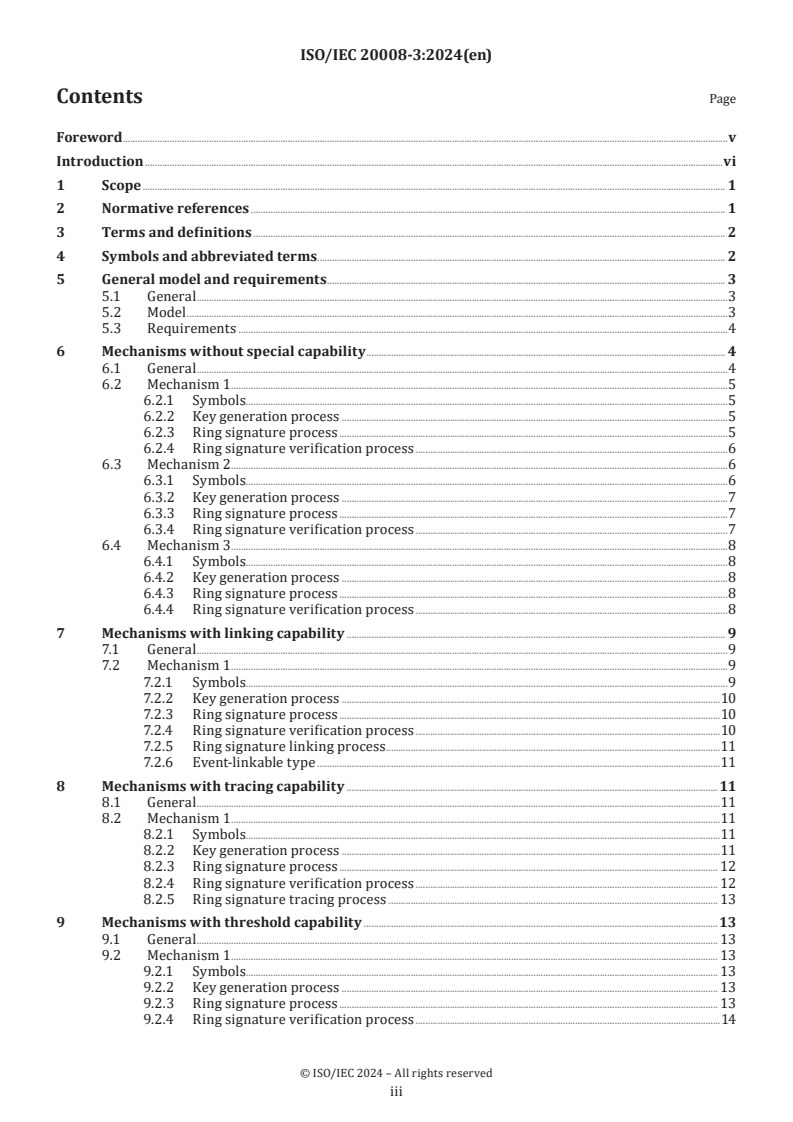
Contents Page
Foreword .v
Introduction .vi
1 Scope . 1
2 Normative references . 1
3 Terms and definitions . 2
4 Symbols and abbreviated terms. 2
5 General model and requirements . . 3
5.1 General .3
5.2 Model .3
5.3 Requirements .4
6 Mechanisms without special capability . 4
6.1 General .4
6.2 Mechanism 1 .5
6.2.1 Symbols.5
6.2.2 Key generation process .5
6.2.3 Ring signature process .5
6.2.4 Ring signature verification process .6
6.3 Mechanism 2 .6
6.3.1 Symbols.6
6.3.2 Key generation process .7
6.3.3 Ring signature process .7
6.3.4 Ring signature verification process .7
6.4 Mechanism 3 .8
6.4.1 Symbols.8
6.4.2 Key generation process .8
6.4.3 Ring signature process .8
6.4.4 Ring signature verification process .8
7 Mechanisms with linking capability . 9
7.1 General .9
7.2 Mechanism 1 .9
7.2.1 Symbols.9
7.2.2 Key generation process .10
7.2.3 Ring signature process .10
7.2.4 Ring signature verification process .10
7.2.5 Ring signature linking process .11
7.2.6 Event-linkable type .11
8 Mechanisms with tracing capability .11
8.1 General .11
8.2 Mechanism 1 .11
8.2.1 Symbols.11
8.2.2 Key generation process .11
8.2.3 Ring signature process . 12
8.2.4 Ring signature verification process . 12
8.2.5 Ring signature tracing process . 13
9 Mechanisms with threshold capability .13
9.1 General . 13
9.2 Mechanism 1 . 13
9.2.1 Symbols. 13
9.2.2 Key generation process . 13
9.2.3 Ring signature process . 13
9.2.4 Ring signature verification process .14
© ISO/IEC 2024 – All rights reserved
iii
9.3 Mechanism 2 .14
9.3.1 Symbols.14
9.3.2 Key generation process .14
9.3.3 Ring signature process . 15
9.3.4 Ring signature verification process . 15
Annex A (normative) Object identifiers .16
Annex B (normative) Conversion functions . 17
Annex C (informative) Numerical examples of mechanisms in this document .18
Bibliography .23
© ISO/IEC 2024 – All rights reserved
iv
Foreword
ISO (the International Organization for Standardization) and IEC (the International Electrotechnical
Commission) form the specialized system for worldwide standardization. National bodies that are
members of ISO or IEC participate in the development of International Standards through technical
committees established by the respective organization to deal with particular fields of technical activity.
ISO and IEC technical committees collaborate in fields of mutual interest. Other international organizations,
governmental and non-governmental, in liaison with ISO and IEC, also take part in the work.
The procedures used to develop this document and those intended for its further maintenance are described
in the ISO/IEC Directives, Part 1. In particular the different approval criteria needed for the different types
of document should be noted. This document was drafted in accordance with the editorial rules of the ISO/
IEC Directives, Part 2 (see www.iso.org/directives or www.iec.ch/members_experts/refdocs).
ISO and IEC draw attention to the possibility that the implementation of this document may involve the
use of (a) patent(s). ISO and IEC take no position concerning the evidence, validity or applicability of any
claimed patent rights in respect thereof. As of the date of publication of this document, ISO and IEC had not
received notice of (a) patent(s) which may be required to implement this document. However, implementers
are cautioned that this may not represent the latest information, which may be obtained from the patent
database available at www.iso.org/patents and https://patents.iec.ch. ISO and IEC shall not be held
responsible for identifying any or all such patent rights.
Any trade name used in this document is information given for the convenience of users and does not
constitute an endorsement.
For an explanation on the voluntary nature of standards, the meaning of ISO specific terms and expressions
related to conformity assessment, as well as information about ISO's adherence to the World Trade
Organization (WTO) principles in the Technical Barriers to Trade (TBT) see www.iso.org/iso/foreword.html.
In the IEC, see www.iec.ch/understanding-standards.
This document was prepared by Joint Technical Committee ISO/IEC JTC 1, Information technology,
Subcommittee SC 27, Information security, cybersecurity and privacy protection.
A list of all parts in the ISO/IEC 20008 series can be found on the ISO website.
Any feedback or questions on this document should be directed to the user’s national standards
body. A complete listing of these bodies can be found at www.iso.org/members.html and
www.iec.ch/national-committees.
© ISO/IEC 2024 – All rights reserved
v
Introduction
Anonymous digital signature mechanisms are a special type of digital signature mechanism in which, where
a digital signature is present, an unauthorized entity cannot discover the signer's identifier yet can verify
that a legitimate signer has generated a valid signature.
The ISO/IEC 20008 series specifies anonymous digital signature mechanisms. ISO/IEC 20008-1 specifies
principles and requirements for two categories of anonymous digital signatures mechanisms:
1) signature mechanisms using a group public key;
2) signature mechanisms using multiple public keys.
This document specifies a number of anonymous signature mechanisms in the second category.
Anonymous signature mechanisms in the second category allow a signer to form a group spontaneously by
combining the public keys of the relevant users with the signer’s own public key. The verifier can confirm
that a signature is generated by one of the users within this group but cannot find out who the actual signer
is. Unlike the first category described in ISO/IEC 20008 series, mechanisms in the second category do not
require a group manager, and the private key and public key are generated individually by each user.
Some mechanisms described in this document are unlinkable, where no one can determine whether
two signatures are generated by the same signer or not. Some mechanisms have a linking capability,
making it possible to be determined whether two signatures were generated by the same signer under
certain conditions. Some mechanisms have a tracing capability, where, given two (message, signature)
pairs generated by the same signer within the same ring setting, the true signer can be identified. Some
mechanisms have a threshold setting, where the verifier can confirm a signature is generated by subsets (of
specified size) of group users, but cannot determine which users were involved.
© ISO/IEC 2024 – All rights reserved
vi
International Standard ISO/IEC 20008-3:2024(en)
Information security — Anonymous digital signatures —
Part 3:
Mechanisms using multiple public keys
1 Scope
This document specifies anonymous digital signature mechanisms in which a verifier uses multiple public
keys to verify a digital signature.
This document provides:
— a general description of an anonymous digital signature mechanism using multiple public keys;
— a variety of mechanisms that provide such anonymous digital signatures.
For each mechanism, this document specifies the process for:
— generating the private key and public key of each user;
— producing signatures;
— verifying signatures;
— linking signatures (if the mechanism supports linking);
— tracing signatures (if the mechanism supports tracing);
— producing signatures with threshold capability (if the mechanism supports a threshold capability);
— verifying signatures with threshold capability (if the mechanism supports a threshold capability).
This document does not define the implementation of a public key infrastructure (PKI) and the means for
distinct entities to exchange, extract and verify their respective public key certificates.
2 Normative references
The following documents are referred to in the text in such a way that some or all of their content constitutes
requirements of this document. For dated references, only the edition cited applies. For undated references,
the latest edition of the referenced document (including any amendments) applies.
ISO/IEC 10116, Information technology — Security techniques — Modes of operation for an n-bit block cipher
ISO/IEC 10118-1, Information technology — Security techniques — Hash-functions — Part 1: General
ISO/IEC 10118-2, Information technology — Security techniques — Hash-functions — Part 2: Hash-functions
using an n-bit block cipher
ISO/IEC 10118-3, IT Security techniques — Hash-functions — Part 3: Dedicated hash-functions
ISO/IEC 10118-4, Information technology — Security techniques — Hash-functions — Part 4: Hash-functions
using modular arithmetic
ISO/IEC 18033-2:2006, Information technology — Security techniques — Encryption algorithms — Part 2:
Asymmetric ciphers
© ISO/IEC 2024 – All rights reserved
ISO/IEC 18033-3, Information technology — Security techniques — Encryption algorithms — Part 3: Block ciphers
ISO/IEC 18033-4, Information technology — Security techniques — Encryption algorithms — Part 4: Stream ciphers
ISO/IEC 18033-5:2015, Information technology — Security techniques — Encryption algorithms — Part 5:
Identity-based ciphers
ISO/IEC 29192-2, Information security — Lightweight cryptography — Part 2: Block ciphers
ISO/IEC 29192-3, Information technology — Security techniques — Lightweight cryptography — Part 3:
Stream ciphers
ISO/IEC 18031, Information technology — Security techniques — Random bit generation
ISO/IEC 18032, Information security — Prime number generation
ISO/IEC 20008-1, Information technology — Security techniques — Anonymous digital signatures — Part 1: General
ISO/IEC 20008-2:2013, Information technology — Security techniques — Anonymous digital signatures —
Part 2: Mechanisms using a group public key
RFC 9380, Hashing to Elliptic Curves, Internet Research Task Force (IRTF)
3 Terms and definitions
For the purposes of this document, the terms and definitions given in ISO/IEC 20008-1, ISO/IEC 18033-4 and
the following apply.
ISO and IEC maintain terminology databases for use in standardization at the following addresses:
— ISO Online browsing platform: available at https:// www .iso .org/ obp
— IEC Electropedia: available at https:// www .electropedia .org/
3.1
symmetric encryption system
encryption system based on symmetric cryptographic techniques
[SOURCE: ISO/IEC 18033-1:2021, 3.29, modified — the admitted terms “symmetric encipherment system”
and “symmetric cipher” were removed.]
4 Symbols and abbreviated terms
For the purposes of this document, the following symbols and abbreviated terms apply.
Bsn Linking base, either a special symbol ⊥ or an arbitrary string.
⨁ Bitwise exclusive OR (XOR) operation.
\ Set subtraction operation.
Enc ()m A symmetric-key encryption function taking a secret key k and a variable-length message m
k
as input and giving a ciphertext c as output, e.g. the encryption function for one of the sym-
metric encryption systems specified in ISO/IEC 18033-3, ISO/IEC 18033-4, ISO/IEC 10116,
ISO/IEC 29192-2 or ISO/IEC 29192-3.
Dec ()C A symmetric-key decryption function taking a secret key k and a ciphertext C as input and
k
giving a message m or a decryption failure symbol ⊥ as output.
C A ciphertext generated from a symmetric-key encryption function.
© ISO/IEC 2024 – All rights reserved
N
The size of the ring, i.e. the number of entities in the set consisting of the true signer and the
potential signer (or signers).
π
Index of the true signer, where 1≤≤π N . If π = N , π +1 is set to 1. Similarly, if π = 1 , π −1 is
set to N .
The base 2 logarithm of x .
lb()x
The largest integer within the integer set X .
max X
()
gcd(a,b) The greatest common divisor of the integers a and b.
H A hash-function taking an arbitrary string as input and giving a fixed-length bit string as
output, e.g. one of the dedicated hash-functions specified in ISO/IEC 10118-3.
|| X || Y denotes the result of the concatenation of octet strings X and Y in the order specified. In
cases where the result of concatenating two or more octet strings is input to a cryptographic
function as part of one of the mechanisms specified in this document, this result shall be com-
posed so that it can be uniquely resolved into its constituent octet strings, i.e. so that there is
no possibility of ambiguity in interpretation. This latter property can be achieved in a variety
of different ways, depending on the application. For example, it can be guaranteed by fixing
the length of each of the octet strings throughout the domain of use of the mechanism, or by
encoding the sequence of concatenated octet strings using a method that guarantees unique
[9]
decoding, e.g. using the distinguished encoding rules defined in ISO/IEC 8825-1 .
5 General model and requirements
5.1 General
This clause specifies the general model and requirements for the anonymous digital signature mechanisms
specified in this document. Some of the contents of this clause are taken from ISO/IEC 20008-1. In addition,
specific requirements applying to mechanisms using multiple public keys are addressed.
5.2 Model
An anonymous digital signature mechanism using multiple public keys is also known as a ring signature
mechanism. A ring signature mechanism involves a set of possible signers. Each possible signer has a
signature key pair in the same form as in a conventional signature mechanism. These possible signers are
independent of each other in the sense that it is not necessary for them to agree on being involved in the
same signature process. To create a ring signature, one of them is the true signer and the others are the
potential signers. The true signer chooses one or more potential signers and forms a ring of N possible
signers. The true signer may select only one potential signer and, in this case, N= 2 .
Some ring signature mechanisms have special capabilities. These mechanisms make it possible to link two
signatures, trace a signature back to its true signer or apply thresholds to the signing process.
A ring signature mechanism is defined by the specification of the following processes:
— key generation process;
— signature process;
— verification process;
— linking process (if supported);
— tracing process (if supported);
— threshold signature process (if supported);
© ISO/IEC 2024 – All rights reserved
— threshold verification process (if supported).
The security properties of a general ring signature include unforgeability and anonymity. Other specific
properties such as linkability, traceability and threshold are associated with ring signatures with special
capabilities.
The anonymous digital signature mechanisms using multiple public keys specified in this document involve
a range of types of entity. Some of these entities exist in every mechanism whereas others exist only in some
mechanisms. The following list defines the role of each entity:
— True signer: an entity generating a digital signature.
— Potential signer: an entity whose public key is used in creating a digital signature, which means the
public key is used in both the signature process and signature verification process, although the potential
signer is not involved in these two processes.
— Verifier: an entity verifying a digital signature.
— Linker: an entity that checks whether two signatures have been generated by the same signer with a
linking base. This entity exists in some of the mechanisms.
— Tracer: an entity that identifies the true signer when given as input two (message, signature) pairs which
are both generated by the same signer within the same ring setting. This entity exists in some of the
mechanisms.
5.3 Requirements
In order to use any of the mechanisms specified in this document, the following requirements shall be met.
— Each verifier shall have access to an authentic copy of the public key of each entity in the ring.
— A collision-resistant hash function shall be as specified in accordance with the ISO/IEC 10118 series.
— A robust random bit generator shall be as specified in accordance with ISO/IEC 18031.
— A robust prime number generator shall be as specified in accordance with ISO/IEC 18032.
— Symmetric-key encryption and decryption functions shall be as specified in accordance with
ISO/IEC 18033-3, ISO/IEC 18033-4, ISO/IEC 10116, ISO/IEC 29192-2 or ISO/IEC 29192-3.
— Object identifiers described in Annex A shall be used.
— Conversion functions described in Annex B shall be used.
Numerical examples of mechanisms in this document are provide in Annex C.
6 Mechanisms without special capability
6.1 General
This clause specifies three digital signature mechanisms without any special capabilities such as linking,
tracing or threshold.
NOTE 1 The mechanism given in 6.2 is based on the scheme originally specified in Reference [7].
NOTE 2 The mechanism given in 6.3 is based on the scheme originally specified in Reference [1].
NOTE 3 The mechanism given in 6.4 is based on the scheme originally specified in Reference [1].
© ISO/IEC 2024 – All rights reserved
6.2 Mechanism 1
6.2.1 Symbols
The following symbols apply in the specification of this mechanism.
— b : integer
— d : integer in the range 01, pq− −11−
[]()()
i ii
— k : l -bit string
k
— l : integer equal to or greater than 160
b
— l : integer equal to or greater than 256
k
— l : integer equal to or greater than 2048
n
— n : l -bit string
n
′′
— pq,,pq,,e : prime numbers
ii ii i
— vx,, y : b -bit integers
ii
— H: a hash function that outputs an l -bit hash-code as defined in Annex B
k
— Enc : symmetric-key encryption function that takes a secret key k and a variable-length message as
k
b
input and outputs an integer in the range 02, −1
— Dec : symmetric-key decryption function taking a secret key k and a ciphertext as input and outputs an
k
b
integer in the range 02, −1
6.2.2 Key generation process
The key generation process involves each user ii()1≤≤N independently performing the following steps.
a) Choose prime numbers pq′′, with l /2 bits such that pp=+21′′,qq=+21 are prime numbers.
ii n ii ii
Compute modulus nq= p .
ii i
b) Choose a number ep∈−[]01,()()q −11− such that gcd,()ep()−11()q − =1 .
ii i ii i
−1
c) Compute de=−mod()pq11()− .
ii ii
d) Output the following:
— Public key = vk = ne, ;
()
ii i
— Private key = sk =d .
ii
6.2.3 Ring signature process
In the ring signature process, a true signer first chooses a set of N−1 potential signers. The true signer also
chooses a random integer π satisfying 1≤≤π N , which denotes the index of the true signer. The true signer
then signs a message using its private key and the public keys of the potential signers, without requiring
their approval or assistance. In this process the potential signers are arranged in random order.
© ISO/IEC 2024 – All rights reserved
When inputting a private key ()nd, , a randomly ordered set of public keys Ln={}(),,en…,,()e
ππ 11 NN
*
[including ()ne, ], and a message m∈{,01} to be signed, the ring signature process involves the
ππ
following steps.
a) Compute bn=…lb max, ,nl+1 + .
()(){}
1 Nb
b) Compute kH=…()mn,,en,, ,e .
11 NN
b
c) Choose a random integer v∈−02, 1 .
b
d) Choose random integers x ∈−02, 1 for all iN∈ 1, \π .
[]
i
e
i
e) Compute yg= ()x for all iN∈[]1, \π , where gx() is defined as gx()= xn/mnx+ odn if
()
ii i i ii i i
b
()xn/ +12n ≤ , and gx()= x otherwise.
ii i
f) Compute
yy=⊕DecDec ……⊕⊕DecDyvec … ⊕⊕EncEy nc ……⊕⊕⊕Enc yv …
()()()()() ()()()()
ππkk+−11kN kk π k k 1
when π∈−21,N , or
[]
yv=DecE()⊕⊕nc ()yyEncE()……()⊕⊕nc ()v … when π = N , or
ππkk −11kk
yy=⊕DecD()ec ()……()⊕⊕DecD()yvec () … ⊕v when π = 1 .
ππkk+1 kN k
−1 −1 −1 d
π
i) Compute xg= y , where gy is defined as gy = yn/ ny+ modn if
() () ()
ππ π π ππ ππ()
b −1
yn/ +12n ≤ , and gy = y otherwise.
() ()
ππ π
j) Output the signature σ =…()vx,, ,x with the ordered set of public keys L.
1 N
6.2.4 Ring signature verification process
In the verification process, a verifier uses the public keys of the true signer and potential signers involved in
the signature process to verify the signature. The verifier checks whethe
...