


ISO 6292:2020
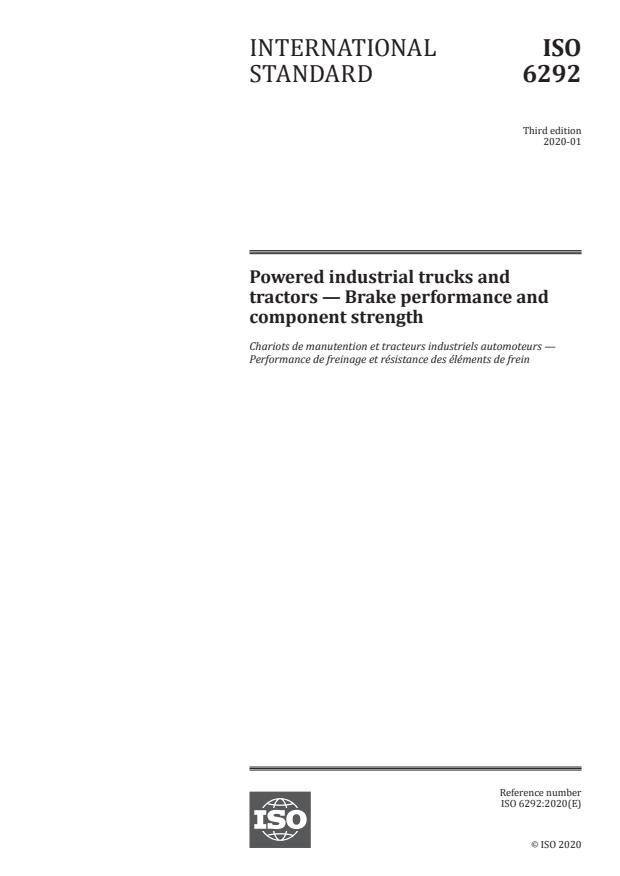
(Main)Powered industrial trucks and tractors — Brake performance and component strength
Powered industrial trucks and tractors — Brake performance and component strength
This document specifies performance, test methods, controls, control forces and component strength for brake systems fitted to the following, as defined in ISO 5053-1: powered industrial trucks of all capacities; towing and pushing tractors up to and including 66 750 N drawbar pull (hereafter referred to as industrial tractors); burden carriers; and industrial trucks handling freight containers. Loss of electrical power and loss of any other form of power assistance is not covered by this document. Braking systems used in emergency situations (e.g. activating the emergency switch or control system shut down) are not covered in this document. This document only includes requirements for newly manufactured trucks.
Chariots de manutention et tracteurs industriels automoteurs — Performance de freinage et résistance des éléments de frein
Le présent document spécifie la performance, les méthodes d'essai, les commandes, les forces de commande et la résistance de l'élément pour les systèmes de frein montés sur ce qui suit, tel que défini dans l'ISO 5053-1: les chariots de manutention automoteurs de toutes capacités; les tracteurs et pousseurs jusqu'à et y compris 66 750 N au crochet d'attelage (ci-après désignés tracteurs industriels); les transporteurs de charge; et les chariots de manutention manipulant des conteneurs de fret. La perte d'énergie électrique et la perte de toute autre forme d'assistance en énergie ne sont pas couvertes par le présent document. Les systèmes de freinage utilisés dans des situations d'urgence (par exemple, actionnement de l'interrupteur d'urgence ou arrêt du système de commande) ne sont pas couverts par le présent document. Le présent document comprend uniquement les exigences pour les chariots nouvellement fabriqués.
General Information
- Status
- Published
- Publication Date
- 28-Jan-2020
- Technical Committee
- ISO/TC 110/SC 2 - Safety of powered industrial trucks
- Drafting Committee
- ISO/TC 110/SC 2/WG 13 - Supporting standards
- Current Stage
- 9093 - International Standard confirmed
- Start Date
- 28-Oct-2025
- Completion Date
- 14-Feb-2026
Relations
- Revises
ISO 6292:2008 - Powered industrial trucks and tractors — Brake performance and component strength - Effective Date
- 20-Jan-2018
Overview - ISO 6292:2020 in brief
ISO 6292:2020 specifies brake performance, test methods and component strength for brake systems fitted to powered industrial trucks, industrial tractors (up to 66 750 N drawbar pull), burden carriers and container-handling trucks. The standard covers requirements for newly manufactured trucks and defines performance verification using stopping distance or drawbar-drag methods and mandatory heat‑fade evaluation. It does not cover loss of electrical power or other forms of power assistance, nor braking systems used only in emergency shutdown situations.
Key topics and technical requirements
- Scope and definitions: Applies to powered industrial trucks of all capacities and industrial tractors as defined in ISO 5053-1. Important terms include stopping distance, drawbar drag, service brake, parking brake and fade test.
- Required brake systems: Trucks must have a service braking system and a parking braking system (independent operating means unless exempted for stand-on/pedestrian-controlled trucks).
- Performance tests:
- Stopping distance test (s0) - measures distance from driver actuation to complete stop.
- Drawbar drag test - assesses steady-state braking force applied to ground at speed.
- Heat fade test - now compulsory for service brakes across test methods to assess performance loss with temperature.
- Alternative methods (e.g., calculation or simulation) are allowed with heat‑fade simulation.
- Brake control forces (maximums):
- Pedal actuation: service/parking performance must be achieved with ≤ 450 N pedal force.
- Hand lever (parking): ≤ 300 N at gripping point.
- Handgrip squeeze (service): ≤ 150 N.
- Tiller (biased type): ≤ 150 N at mid‑point of grip.
- Component strength requirements:
- Pedal systems must withstand 1 200 N (depressing) and 1 800 N applied at the pedal actuating surface for stop strength.
- Hand lever structures: withstand 600 N at grip.
- Handgrip: withstand 300 N.
- Upward‑applied pedal systems: withstand 200 % of max spring setting.
- Stored energy systems: Requirements for service‑brake recovery capacity and warnings for loss of stored energy.
Applications - who uses ISO 6292:2020
- Manufacturers of forklifts, industrial tractors, burden carriers and container-handling trucks for design validation and type approval.
- Test laboratories and certification bodies conducting brake performance and component strength tests.
- Safety and compliance engineers specifying braking requirements for new truck fleets.
- OEMs and suppliers of brakes, actuators and control systems to ensure ergonomic control forces and structural robustness.
Related standards
- ISO 5053-1 (definitions for industrial tractors)
- ISO 3691-1 (controls on industrial trucks)
- ISO 3450 and ISO/TR 29944 (background on stopping‑distance and brake measurements)
Keywords: ISO 6292:2020, powered industrial trucks, brake performance, brake component strength, stopping distance, drawbar drag, heat fade test, service brake, parking brake.
Buy Documents
ISO 6292:2020 - Powered industrial trucks and tractors -- Brake performance and component strength
ISO 6292:2020 - Powered industrial trucks and tractors — Brake performance and component strength Released:1/29/2020



ISO 6292:2020 - Chariots de manutention et tracteurs industriels automoteurs -- Performance de freinage et résistance des éléments de frein

ISO 6292:2020 - Chariots de manutention et tracteurs industriels automoteurs — Performance de freinage et résistance des éléments de frein Released:1/29/2020
Frequently Asked Questions
ISO 6292:2020 is a standard published by the International Organization for Standardization (ISO). Its full title is "Powered industrial trucks and tractors — Brake performance and component strength". This standard covers: This document specifies performance, test methods, controls, control forces and component strength for brake systems fitted to the following, as defined in ISO 5053-1: powered industrial trucks of all capacities; towing and pushing tractors up to and including 66 750 N drawbar pull (hereafter referred to as industrial tractors); burden carriers; and industrial trucks handling freight containers. Loss of electrical power and loss of any other form of power assistance is not covered by this document. Braking systems used in emergency situations (e.g. activating the emergency switch or control system shut down) are not covered in this document. This document only includes requirements for newly manufactured trucks.
This document specifies performance, test methods, controls, control forces and component strength for brake systems fitted to the following, as defined in ISO 5053-1: powered industrial trucks of all capacities; towing and pushing tractors up to and including 66 750 N drawbar pull (hereafter referred to as industrial tractors); burden carriers; and industrial trucks handling freight containers. Loss of electrical power and loss of any other form of power assistance is not covered by this document. Braking systems used in emergency situations (e.g. activating the emergency switch or control system shut down) are not covered in this document. This document only includes requirements for newly manufactured trucks.
ISO 6292:2020 is classified under the following ICS (International Classification for Standards) categories: 53.060 - Industrial trucks. The ICS classification helps identify the subject area and facilitates finding related standards.
ISO 6292:2020 has the following relationships with other standards: It is inter standard links to ISO 6292:2008. Understanding these relationships helps ensure you are using the most current and applicable version of the standard.
ISO 6292:2020 is available in PDF format for immediate download after purchase. The document can be added to your cart and obtained through the secure checkout process. Digital delivery ensures instant access to the complete standard document.
Standards Content (Sample)
INTERNATIONAL ISO
STANDARD 6292
Third edition
2020-01
Powered industrial trucks and
tractors — Brake performance and
component strength
Chariots de manutention et tracteurs industriels automoteurs —
Performance de freinage et résistance des éléments de frein
Reference number
©
ISO 2020
© ISO 2020
All rights reserved. Unless otherwise specified, or required in the context of its implementation, no part of this publication may
be reproduced or utilized otherwise in any form or by any means, electronic or mechanical, including photocopying, or posting
on the internet or an intranet, without prior written permission. Permission can be requested from either ISO at the address
below or ISO’s member body in the country of the requester.
ISO copyright office
CP 401 • Ch. de Blandonnet 8
CH-1214 Vernier, Geneva
Phone: +41 22 749 01 11
Fax: +41 22 749 09 47
Email: copyright@iso.org
Website: www.iso.org
Published in Switzerland
ii © ISO 2020 – All rights reserved
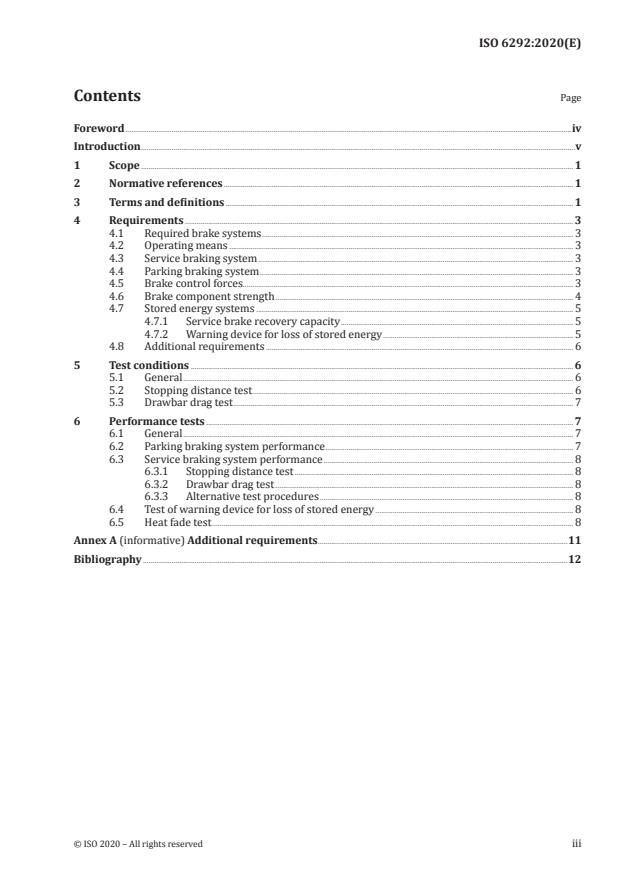
Contents Page
Foreword .iv
Introduction .v
1 Scope . 1
2 Normative references . 1
3 Terms and definitions . 1
4 Requirements . 3
4.1 Required brake systems . 3
4.2 Operating means . 3
4.3 Service braking system . 3
4.4 Parking braking system . 3
4.5 Brake control forces . . 3
4.6 Brake component strength . 4
4.7 Stored energy systems . 5
4.7.1 Service brake recovery capacity . 5
4.7.2 Warning device for loss of stored energy . 5
4.8 Additional requirements . 6
5 Test conditions . 6
5.1 General . 6
5.2 Stopping distance test . 6
5.3 Drawbar drag test . 7
6 Performance tests . 7
6.1 General . 7
6.2 Parking braking system performance . 7
6.3 Service braking system performance . 8
6.3.1 Stopping distance test . 8
6.3.2 Drawbar drag test . 8
6.3.3 Alternative test procedures . 8
6.4 Test of warning device for loss of stored energy . 8
6.5 Heat fade test . 8
Annex A (informative) Additional requirements .11
Bibliography .12
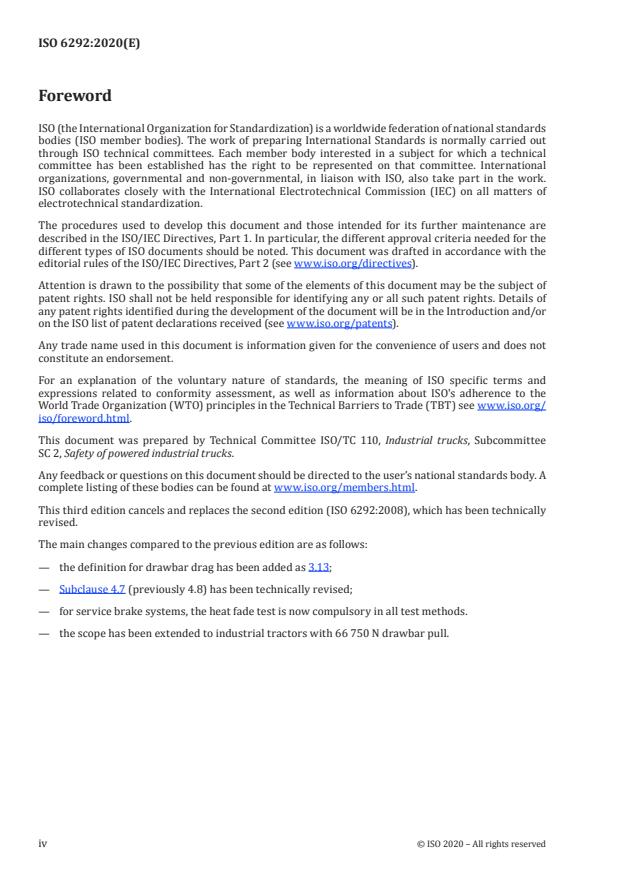
Foreword
ISO (the International Organization for Standardization) is a worldwide federation of national standards
bodies (ISO member bodies). The work of preparing International Standards is normally carried out
through ISO technical committees. Each member body interested in a subject for which a technical
committee has been established has the right to be represented on that committee. International
organizations, governmental and non-governmental, in liaison with ISO, also take part in the work.
ISO collaborates closely with the International Electrotechnical Commission (IEC) on all matters of
electrotechnical standardization.
The procedures used to develop this document and those intended for its further maintenance are
described in the ISO/IEC Directives, Part 1. In particular, the different approval criteria needed for the
different types of ISO documents should be noted. This document was drafted in accordance with the
editorial rules of the ISO/IEC Directives, Part 2 (see www .iso .org/ directives).
Attention is drawn to the possibility that some of the elements of this document may be the subject of
patent rights. ISO shall not be held responsible for identifying any or all such patent rights. Details of
any patent rights identified during the development of the document will be in the Introduction and/or
on the ISO list of patent declarations received (see www .iso .org/ patents).
Any trade name used in this document is information given for the convenience of users and does not
constitute an endorsement.
For an explanation of the voluntary nature of standards, the meaning of ISO specific terms and
expressions related to conformity assessment, as well as information about ISO's adherence to the
World Trade Organization (WTO) principles in the Technical Barriers to Trade (TBT) see www .iso .org/
iso/ foreword .html.
This document was prepared by Technical Committee ISO/TC 110, Industrial trucks, Subcommittee
SC 2, Safety of powered industrial trucks.
Any feedback or questions on this document should be directed to the user’s national standards body. A
complete listing of these bodies can be found at www .iso .org/ members .html.
This third edition cancels and replaces the second edition (ISO 6292:2008), which has been technically
revised.
The main changes compared to the previous edition are as follows:
— the definition for drawbar drag has been added as 3.13;
— Subclause 4.7 (previously 4.8) has been technically revised;
— for service brake systems, the heat fade test is now compulsory in all test methods.
— the scope has been extended to industrial tractors with 66 750 N drawbar pull.
iv © ISO 2020 – All rights reserved
Introduction
Industrial trucks, generally referred to as trucks, can satisfy the braking system requirements of
this document by complying with either the stopping distance requirements or the drawbar drag
requirements. Based on the requirements for brakes of rubber-tyred earthmoving machinery
(ISO 3450), the stopping distance as a measurement value has been established. The brake performance
is limited by consideration of the load. For further reference as to how the measurement of stopping
distance and measurement of brake reaction time were derived, see ISO/TR 29944.
INTERNATIONAL STANDARD ISO 6292:2020(E)
Powered industrial trucks and tractors — Brake
performance and component strength
1 Scope
This document specifies performance, test methods, controls, control forces and component strength
for brake systems fitted to the following, as defined in ISO 5053-1:
— powered industrial trucks of all capacities;
— towing and pushing tractors up to and including 66 750 N drawbar pull (hereafter referred to as
industrial tractors);
— burden carriers; and
— industrial trucks handling freight containers.
Loss of electrical power and loss of any other form of power assistance is not covered by this document.
Braking systems used in emergency situations (e.g. activating the emergency switch or control system
shut down) are not covered in this document.
This document only includes requirements for newly manufactured trucks.
2 Normative references
There are no normative references in this document.
3 Terms and definitions
For the purposes of this document, the following terms and definitions apply.
ISO and IEC maintain terminological databases for use in standardization at the following addresses:
— ISO Online browsing platform: available at https:// www .iso .org/ obp
— IEC Electropedia: available at http:// www .electropedia .org/
3.1
braking force
force at the contact surface between a wheel and the ground, produced by the effect of a braking system
(3.3), which opposes the speed or the tendency to movement of the truck
[SOURCE: ISO 611:2003, 9.11.3]
3.2
braking performance
performance of a braking system (3.3) as measured by the braking distance in relation to the initial
speed of the truck and/or by braking force (3.1) and the capability to hold the truck at a standstill on a
gradient
3.3
braking system
combination of parts which fulfil one or more of the following functions:
— control (usually to reduce) a truck’s speed;
— bring the truck to a halt or hold it stationary
[SOURCE: ISO 611:2003, 3.2, modified — In the definition, the word "vehicle" has been changed to
"truck".]
3.4
cold brake
brake that meets one of the following conditions:
a) the temperature measured at the periphery of the disc or on the outside of the drum is below 100 °C;
b) in the case of totally enclosed brakes including oil-immersed brakes, the temperature on the outside
of the housing is below 50 °C or within the manufacturer's specification;
c) the brake has not been operated in the previous 1 h
3.5
fade test
test procedure consisting of one or more brake applications or the continuous
dragging of the brake to generate heat with the effect that differences in braking performance (3.2), if
any, can be observed
[SOURCE: ISO 611:2003, 8.4]
3.6
lining burnishing
pre-test conditioning procedure for obtaining a specified degree of geometric, physical and chemical
adaptation between the brake lining surface and the drum or disc
3.7
laden mass
foreseen maximum laden truck mass likely to occur in the intended use of the truck, taking into
account various combinations of optional equipment and the actual capacity applicable at the lift height
specified for the tests (where relevant)
3.8
parking braking system
braking system (3.3) allowing a truck to be held stationary mechanically, even on an inclined surface,
particularly in the absence of the operator
3.9
service braking system
braking system (3.3) allowing the operator to control, directly or indirectly, the speed of the truck or to
bring the truck to a halt
3.10
stopping distance
s
distance travelled by the truck during the total braking time, i.e. distance travelled by the truck from
the instant when the driver begins to actuate the control device until the instant when the truck stops
Note 1 to entry: Control device is part of the braking system (3.3) which initiates its operation. Control devices of
industrial trucks are defined in ISO 3691-1:2011, 4.4.2.2, 4.4.2.3 and 4.4.2.4.
3.11
test speed
speed greater than 90 % of the maximum designed truck speed
Note 1 to entry: If the truck speed is automatically reduced in certain load conditions or load positions (i.e. lift
height dependent), this reduced speed is the maximum travel speed for that load condition/position.
2 © ISO 2020 – All rights reserved
3.12
unladen mass
foreseen minimum unladen truck mass likely to occur in the intended use of the truck, taking into
account various combinations of optional equipment
3.13
drawbar drag
steady state braking force (3.1) that can be applied to the ground by a mechanical braking system (3.3)
at a given speed
4 Requirements
4.1 Required brake systems
The truck shall have the following brake systems:
— a service brake system;
— a parking brake system.
4.2 Operating means
The service and parking brakes shall be operated by means of independent systems. Both braking
systems may utilize the same brakes; i.e. brake shoes, brake drums and related actuating items.
Independent brake systems are not required to be fitted to stand-on and pedestrian controlled trucks
as defined in ISO 3691-1.
4.3 Service braking system
All trucks shall meet the service brake requirements for:
— stopping distance (6.3.1) and heat fade test (6.5.2);
— drawbar drag test (6.3.2) and heat fade test (6.5.3); or
— alternative test procedure (6.3.3), e.g. calculation, and heat fade test simulation (6.5).
4.4 Parking braking system
The parking braking system shall meet the requirements of 6.2.
4.5 Brake control forces
4.5.1 The control forces to meet the required brake performances for the systems, as specified in 6.2
and either 6.3.1 or 6.3.2, shall not exceed the values given in 4.5.2 to 4.5.6 and summarized in Table 1.
NOTE Other types of brake actuations are possible.
4.5.2 For brakes applied by depressing a pedal, the required service brake performance and parking
brake performance shall be attained with a pedal force not greater than 450 N.
4.5.3 For brakes applied by an upward movement of a brake pedal (releasing the brake pedal), the
required service brake performance and parking brake performance specified shall be attained with the
pedal fully released. The force required to release the brakes and to hold the pedal
...
INTERNATIONAL ISO
STANDARD 6292
Third edition
2020-01
Powered industrial trucks and
tractors — Brake performance and
component strength
Chariots de manutention et tracteurs industriels automoteurs —
Performance de freinage et résistance des éléments de frein
Reference number
©
ISO 2020
© ISO 2020
All rights reserved. Unless otherwise specified, or required in the context of its implementation, no part of this publication may
be reproduced or utilized otherwise in any form or by any means, electronic or mechanical, including photocopying, or posting
on the internet or an intranet, without prior written permission. Permission can be requested from either ISO at the address
below or ISO’s member body in the country of the requester.
ISO copyright office
CP 401 • Ch. de Blandonnet 8
CH-1214 Vernier, Geneva
Phone: +41 22 749 01 11
Fax: +41 22 749 09 47
Email: copyright@iso.org
Website: www.iso.org
Published in Switzerland
ii © ISO 2020 – All rights reserved
Contents Page
Foreword .iv
Introduction .v
1 Scope . 1
2 Normative references . 1
3 Terms and definitions . 1
4 Requirements . 3
4.1 Required brake systems . 3
4.2 Operating means . 3
4.3 Service braking system . 3
4.4 Parking braking system . 3
4.5 Brake control forces . . 3
4.6 Brake component strength . 4
4.7 Stored energy systems . 5
4.7.1 Service brake recovery capacity . 5
4.7.2 Warning device for loss of stored energy . 5
4.8 Additional requirements . 6
5 Test conditions . 6
5.1 General . 6
5.2 Stopping distance test . 6
5.3 Drawbar drag test . 7
6 Performance tests . 7
6.1 General . 7
6.2 Parking braking system performance . 7
6.3 Service braking system performance . 8
6.3.1 Stopping distance test . 8
6.3.2 Drawbar drag test . 8
6.3.3 Alternative test procedures . 8
6.4 Test of warning device for loss of stored energy . 8
6.5 Heat fade test . 8
Annex A (informative) Additional requirements .11
Bibliography .12
Foreword
ISO (the International Organization for Standardization) is a worldwide federation of national standards
bodies (ISO member bodies). The work of preparing International Standards is normally carried out
through ISO technical committees. Each member body interested in a subject for which a technical
committee has been established has the right to be represented on that committee. International
organizations, governmental and non-governmental, in liaison with ISO, also take part in the work.
ISO collaborates closely with the International Electrotechnical Commission (IEC) on all matters of
electrotechnical standardization.
The procedures used to develop this document and those intended for its further maintenance are
described in the ISO/IEC Directives, Part 1. In particular, the different approval criteria needed for the
different types of ISO documents should be noted. This document was drafted in accordance with the
editorial rules of the ISO/IEC Directives, Part 2 (see www .iso .org/ directives).
Attention is drawn to the possibility that some of the elements of this document may be the subject of
patent rights. ISO shall not be held responsible for identifying any or all such patent rights. Details of
any patent rights identified during the development of the document will be in the Introduction and/or
on the ISO list of patent declarations received (see www .iso .org/ patents).
Any trade name used in this document is information given for the convenience of users and does not
constitute an endorsement.
For an explanation of the voluntary nature of standards, the meaning of ISO specific terms and
expressions related to conformity assessment, as well as information about ISO's adherence to the
World Trade Organization (WTO) principles in the Technical Barriers to Trade (TBT) see www .iso .org/
iso/ foreword .html.
This document was prepared by Technical Committee ISO/TC 110, Industrial trucks, Subcommittee
SC 2, Safety of powered industrial trucks.
Any feedback or questions on this document should be directed to the user’s national standards body. A
complete listing of these bodies can be found at www .iso .org/ members .html.
This third edition cancels and replaces the second edition (ISO 6292:2008), which has been technically
revised.
The main changes compared to the previous edition are as follows:
— the definition for drawbar drag has been added as 3.13;
— Subclause 4.7 (previously 4.8) has been technically revised;
— for service brake systems, the heat fade test is now compulsory in all test methods.
— the scope has been extended to industrial tractors with 66 750 N drawbar pull.
iv © ISO 2020 – All rights reserved
Introduction
Industrial trucks, generally referred to as trucks, can satisfy the braking system requirements of
this document by complying with either the stopping distance requirements or the drawbar drag
requirements. Based on the requirements for brakes of rubber-tyred earthmoving machinery
(ISO 3450), the stopping distance as a measurement value has been established. The brake performance
is limited by consideration of the load. For further reference as to how the measurement of stopping
distance and measurement of brake reaction time were derived, see ISO/TR 29944.
INTERNATIONAL STANDARD ISO 6292:2020(E)
Powered industrial trucks and tractors — Brake
performance and component strength
1 Scope
This document specifies performance, test methods, controls, control forces and component strength
for brake systems fitted to the following, as defined in ISO 5053-1:
— powered industrial trucks of all capacities;
— towing and pushing tractors up to and including 66 750 N drawbar pull (hereafter referred to as
industrial tractors);
— burden carriers; and
— industrial trucks handling freight containers.
Loss of electrical power and loss of any other form of power assistance is not covered by this document.
Braking systems used in emergency situations (e.g. activating the emergency switch or control system
shut down) are not covered in this document.
This document only includes requirements for newly manufactured trucks.
2 Normative references
There are no normative references in this document.
3 Terms and definitions
For the purposes of this document, the following terms and definitions apply.
ISO and IEC maintain terminological databases for use in standardization at the following addresses:
— ISO Online browsing platform: available at https:// www .iso .org/ obp
— IEC Electropedia: available at http:// www .electropedia .org/
3.1
braking force
force at the contact surface between a wheel and the ground, produced by the effect of a braking system
(3.3), which opposes the speed or the tendency to movement of the truck
[SOURCE: ISO 611:2003, 9.11.3]
3.2
braking performance
performance of a braking system (3.3) as measured by the braking distance in relation to the initial
speed of the truck and/or by braking force (3.1) and the capability to hold the truck at a standstill on a
gradient
3.3
braking system
combination of parts which fulfil one or more of the following functions:
— control (usually to reduce) a truck’s speed;
— bring the truck to a halt or hold it stationary
[SOURCE: ISO 611:2003, 3.2, modified — In the definition, the word "vehicle" has been changed to
"truck".]
3.4
cold brake
brake that meets one of the following conditions:
a) the temperature measured at the periphery of the disc or on the outside of the drum is below 100 °C;
b) in the case of totally enclosed brakes including oil-immersed brakes, the temperature on the outside
of the housing is below 50 °C or within the manufacturer's specification;
c) the brake has not been operated in the previous 1 h
3.5
fade test
test procedure consisting of one or more brake applications or the continuous
dragging of the brake to generate heat with the effect that differences in braking performance (3.2), if
any, can be observed
[SOURCE: ISO 611:2003, 8.4]
3.6
lining burnishing
pre-test conditioning procedure for obtaining a specified degree of geometric, physical and chemical
adaptation between the brake lining surface and the drum or disc
3.7
laden mass
foreseen maximum laden truck mass likely to occur in the intended use of the truck, taking into
account various combinations of optional equipment and the actual capacity applicable at the lift height
specified for the tests (where relevant)
3.8
parking braking system
braking system (3.3) allowing a truck to be held stationary mechanically, even on an inclined surface,
particularly in the absence of the operator
3.9
service braking system
braking system (3.3) allowing the operator to control, directly or indirectly, the speed of the truck or to
bring the truck to a halt
3.10
stopping distance
s
distance travelled by the truck during the total braking time, i.e. distance travelled by the truck from
the instant when the driver begins to actuate the control device until the instant when the truck stops
Note 1 to entry: Control device is part of the braking system (3.3) which initiates its operation. Control devices of
industrial trucks are defined in ISO 3691-1:2011, 4.4.2.2, 4.4.2.3 and 4.4.2.4.
3.11
test speed
speed greater than 90 % of the maximum designed truck speed
Note 1 to entry: If the truck speed is automatically reduced in certain load conditions or load positions (i.e. lift
height dependent), this reduced speed is the maximum travel speed for that load condition/position.
2 © ISO 2020 – All rights reserved
3.12
unladen mass
foreseen minimum unladen truck mass likely to occur in the intended use of the truck, taking into
account various combinations of optional equipment
3.13
drawbar drag
steady state braking force (3.1) that can be applied to the ground by a mechanical braking system (3.3)
at a given speed
4 Requirements
4.1 Required brake systems
The truck shall have the following brake systems:
— a service brake system;
— a parking brake system.
4.2 Operating means
The service and parking brakes shall be operated by means of independent systems. Both braking
systems may utilize the same brakes; i.e. brake shoes, brake drums and related actuating items.
Independent brake systems are not required to be fitted to stand-on and pedestrian controlled trucks
as defined in ISO 3691-1.
4.3 Service braking system
All trucks shall meet the service brake requirements for:
— stopping distance (6.3.1) and heat fade test (6.5.2);
— drawbar drag test (6.3.2) and heat fade test (6.5.3); or
— alternative test procedure (6.3.3), e.g. calculation, and heat fade test simulation (6.5).
4.4 Parking braking system
The parking braking system shall meet the requirements of 6.2.
4.5 Brake control forces
4.5.1 The control forces to meet the required brake performances for the systems, as specified in 6.2
and either 6.3.1 or 6.3.2, shall not exceed the values given in 4.5.2 to 4.5.6 and summarized in Table 1.
NOTE Other types of brake actuations are possible.
4.5.2 For brakes applied by depressing a pedal, the required service brake performance and parking
brake performance shall be attained with a pedal force not greater than 450 N.
4.5.3 For brakes applied by an upward movement of a brake pedal (releasing the brake pedal), the
required service brake performance and parking brake performance specified shall be attained with the
pedal fully released. The force required to release the brakes and to hold the pedal
...
NORME ISO
INTERNATIONALE 6292
Troisième édition
2020-01
Chariots de manutention et
tracteurs industriels automoteurs —
Performance de freinage et résistance
des éléments de frein
Powered industrial trucks and tractors — Brake performance and
component strength
Numéro de référence
©
ISO 2020
DOCUMENT PROTÉGÉ PAR COPYRIGHT
© ISO 2020
Tous droits réservés. Sauf prescription différente ou nécessité dans le contexte de sa mise en œuvre, aucune partie de cette
publication ne peut être reproduite ni utilisée sous quelque forme que ce soit et par aucun procédé, électronique ou mécanique,
y compris la photocopie, ou la diffusion sur l’internet ou sur un intranet, sans autorisation écrite préalable. Une autorisation peut
être demandée à l’ISO à l’adresse ci-après ou au comité membre de l’ISO dans le pays du demandeur.
ISO copyright office
Case postale 401 • Ch. de Blandonnet 8
CH-1214 Vernier, Genève
Tél.: +41 22 749 01 11
Fax: +41 22 749 09 47
E-mail: copyright@iso.org
Web: www.iso.org
Publié en Suisse
ii © ISO 2020 – Tous droits réservés
Sommaire Page
Avant-propos .iv
Introduction .v
1 Domaine d'application . 1
2 Références normatives . 1
3 Termes et définitions . 1
4 Exigences . 3
4.1 Systèmes de freinage exigés . 3
4.2 Moyens de commande . 3
4.3 Système de freinage de service . 3
4.4 Système de freinage de stationnement . 3
4.5 Forces de commande de frein . 3
4.6 Résistance de l’élément de frein . 4
4.7 Systèmes à accumulation d'énergie . 5
4.7.1 Capacité de récupération du frein de service . 5
4.7.2 Dispositif d'alarme pour la perte d'énergie accumulée . 5
4.8 Exigences supplémentaires. 6
5 Conditions d'essai . 6
5.1 Généralités . 6
5.2 Essai de la distance d'arrêt . 6
5.3 Essai de l'effort retardateur au crochet . 7
6 Essais de performance . 7
6.1 Généralités . 7
6.2 Performance du système de frein de stationnement . 7
6.3 Performance du système de frein de service . 8
6.3.1 Essai de la distance d'arrêt . 8
6.3.2 Essai de l'effort retardateur au crochet. 8
6.3.3 Modes opératoires d’essai alternatifs . 8
6.4 Essai du dispositif d'alarme pour la perte d'énergie accumulée . 8
6.5 Essai d'évanouissement par échauffement . 8
Annexe A (informative) Exigences supplémentaires .12
Bibliographie .13
Avant-propos
L'ISO (Organisation internationale de normalisation) est une fédération mondiale d'organismes
nationaux de normalisation (comités membres de l'ISO). L'élaboration des Normes internationales est
en général confiée aux comités techniques de l'ISO. Chaque comité membre intéressé par une étude
a le droit de faire partie du comité technique créé à cet effet. Les organisations internationales,
gouvernementales et non gouvernementales, en liaison avec l'ISO participent également aux travaux.
L'ISO collabore étroitement avec la Commission électrotechnique internationale (IEC) en ce qui
concerne la normalisation électrotechnique.
Les procédures utilisées pour élaborer le présent document et celles destinées à sa mise à jour sont
décrites dans les Directives ISO/IEC, Partie 1. Il convient, en particulier, de prendre note des différents
critères d'approbation requis pour les différents types de documents ISO. Le présent document a été
rédigé conformément aux règles de rédaction données dans les Directives ISO/IEC, Partie 2 (voir www
.iso .org/ directives).
L'attention est attirée sur le fait que certains des éléments du présent document peuvent faire l'objet de
droits de propriété intellectuelle ou de droits analogues. L'ISO ne saurait être tenue pour responsable
de ne pas avoir identifié de tels droits de propriété et averti de leur existence. Les détails concernant
les références aux droits de propriété intellectuelle ou autres droits analogues identifiés lors de
l'élaboration du document sont indiqués dans l'Introduction et/ou dans la liste des déclarations de
brevets reçues par l'ISO (voir www .iso .org/ brevets).
Les appellations commerciales éventuellement mentionnées dans le présent document sont données
pour information, par souci de commodité, à l’intention des utilisateurs et ne sauraient constituer un
engagement.
Pour une explication de la nature volontaire des normes, la signification des termes et expressions
spécifiques de l'ISO liés à l'évaluation de la conformité, ou pour toute information au sujet de l'adhésion
de l'ISO aux principes de l’Organisation mondiale du commerce (OMC) concernant les obstacles
techniques au commerce (OTC), voir www .iso .org/ avant -propos.
Le présent document a été élaboré par le comité technique ISO/TC 110, Chariots de manutention, sous-
comité SC 2, Sécurité des chariots de manutention automoteurs.
Il convient que l’utilisateur adresse tout retour d’information ou toute question concernant le présent
document à l’organisme national de normalisation de son pays. Une liste exhaustive desdits organismes
se trouve à l’adresse www .iso .org/ fr/ members .html.
Cette troisième édition annule et remplace la deuxième édition (ISO 6292:2008), qui a fait l’objet d’une
révision technique.
Les principales modifications par rapport à l’édition précédente sont les suivantes:
— la définition pour l’effort retardateur au crochet a été ajoutée en tant que 3.13;
— le paragraphe 4.7 (précédemment 4.8) a été révisé techniquement;
— pour les systèmes de frein de service, l’essai d'évanouissement par échauffement est maintenant
obligatoire dans toutes les méthodes d’essai;
— le domaine d'application a été étendu aux tracteurs industriels ayant 66 750 N au crochet d'attelage.
iv © ISO 2020 – Tous droits réservés
Introduction
Les chariots de manutention, généralement désignés chariots, peuvent satisfaire aux exigences du
système de freinage du présent document par conformité soit avec les exigences de la distance d'arrêt,
soit avec les exigences de l'effort retardateur au crochet. Sur la base des exigences pour les freins des
engins de terrassement sur roues équipées de pneumatiques (ISO 3450), la distance d'arrêt comme
valeur de mesure a été établie. La performance de freinage est limitée en fonction de la charge. Pour
toute référence complémentaire sur la manière dont les mesures de la distance d'arrêt et la mesure du
temps de réaction du freinage ont été dérivés, voir l'ISO/TR 29944.
NORME INTERNATIONALE ISO 6292:2020(F)
Chariots de manutention et tracteurs industriels
automoteurs — Performance de freinage et résistance des
éléments de frein
1 Domaine d'application
Le présent document spécifie la performance, les méthodes d'essai, les commandes, les forces de
commande et la résistance de l’élément pour les systèmes de frein montés sur ce qui suit, tel que défini
dans l’ISO 5053-1:
— les chariots de manutention automoteurs de toutes capacités;
— les tracteurs et pousseurs jusqu’à et y compris 66 750 N au crochet d'attelage (ci-après désignés
tracteurs industriels);
— les transporteurs de charge; et
— les chariots de manutention manipulant des conteneurs de fret.
La perte d'énergie électrique et la perte de toute autre forme d'assistance en énergie ne sont pas
couvertes par le présent document. Les systèmes de freinage utilisés dans des situations d'urgence
(par exemple, actionnement de l'interrupteur d'urgence ou arrêt du système de commande) ne sont pas
couverts par le présent document.
Le présent document comprend uniquement les exigences pour les chariots nouvellement fabriqués.
2 Références normatives
Le présent document ne contient aucune référence normative.
3 Termes et définitions
Pour les besoins du présent document, les termes et définitions suivants s'appliquent.
L’ISO et l’IEC tiennent à jour des bases de données terminologiques destinées à être utilisées en
normalisation, consultables aux adresses suivantes:
— ISO Online browsing platform: disponible à l’adresse https:// www .iso .org/ obp
— IEC Electropedia: disponible à l’adresse http:// www .electropedia .org/
3.1
force de freinage
force produite, par l'effet d'un système de freinage (3.3), à la surface de contact entre une roue et le sol,
qui s'oppose à la vitesse ou à la tendance au mouvement du véhicule
[SOURCE: ISO 611:2003, 9.11.3]
3.2
performance de freinage
performance d'un système de freinage (3.3) mesurée par la distance de freinage en fonction de la vitesse
initiale du chariot et/ou par la force de freinage (3.1) et la capacité à maintenir le chariot à l'arrêt sur
une pente
3.3
système de freinage
combinaison d'équipements qui remplissent une ou plusieurs des fonctions suivantes:
— maîtriser la vitesse d'un chariot (en général la réduire);
— arrêter le chariot ou le maintenir à l'arrêt
[SOURCE: ISO 611:2003, 3.2, modifié — Dans la définition, le mot "véhicule" a été remplacé par "chariot".]
3.4
frein froid
frein qui remplit l'une des conditions suivantes:
a) la température mesurée à la périphérie du disque ou à l’extérieur du tambour est inférieure à 100 °C;
b) dans le cas de freins entièrement sous carter, y compris les freins immergés dans de l'huile, la
température à l’extérieur du carter est inférieure à 50 °C ou dans les spécifications du fabricant;
c) le frein n'a pas été actionné pendant l'heure qui précède
3.5
essai d'évanouissement
procédure d'essai qui consiste en une ou plusieurs applications du frein
ou en une application continue pour produire de la chaleur afin de mettre en évidence d'éventuelles
différences dans les performances de freinage (3.2)
[SOURCE: ISO 611:2003, 8.4]
3.6
rodage des garnitures
mode opératoire de conditionnement avant essai pour obtenir un degré spécifié d'adaptation
géométrique, physique et chimique entre la surface de la garniture du frein et le tambour ou le disque
3.7
masse en charge
masse maximale prévisible du chariot en charge, susceptible de se produire pendant l'utilisation prévue
du chariot, prenant en compte les combinaisons variées de l'équipement optionnel et la capacité réelle
applicable à la hauteur de levée spécifiée pour les essais (lorsque cela est applicable)
3.8
système de freinage de stationnement
système de freinage (3.3) permettant de maintenir mécaniquement un chariot à l'arrêt, même sur une
surface inclinée, et particulièrement en l'absence du conducteur
3.9
système de freinage de service
système de freinage (3.3) permettant au conducteur de commander, directement ou indirectement, la
vitesse du chariot ou d’amener le chariot à un arrêt
3.10
distance d'arrêt
s
distance parcourue par le chariot pendant le temps total de freinage, c'est-à-dire, la distance parcourue
par le chariot depuis l'instant où le conducteur commence à actionner le dispositif de commande jusqu'à
l'instant où le chariot s'arrête
Note 1 à l'article: Le dispositif de commande fait partie du système de freinage (3.3) qui déclenche son
fonctionnement. Les dispositifs de commande des chariots de manutention sont définis dans l'ISO 3691-1:2011,
4.4.2.2, 4.4.2.3 et 4.4.2.4.
2 © ISO 2020 – Tous droits réservés
3.11
vitesse d'essai
vitesse supérieure à 90 % de la vitesse maximale de conception du chariot
Note 1 à l'article: Si la vitesse du chariot est automatiquement réduite dans certaines conditions de charge ou
positions de charge (c'est-à-dire dépendant de la hauteur de levée), cette vitesse réduite est la vitesse maximale
de roulage pour cette condition/position de charge.
3.12
masse à vide
masse minimale prévue du chariot à vide, susceptible de se produire pendant l'utilisation prévue du
chariot, prenant en compte les combinaisons variées de l'équipement optionnel
3.13
effort retardateur au crochet
force de freinage (3.1) à l'équilibre qui peut être appliquée au sol par un système de freinage (3.3)
mécanique à une vitesse donnée
4 Exigences
4.1 Systèmes de freinage exigés
Le chariot doit être équipé des systèmes de freinage suivants:
— un système de frein de service;
— un système de frein de stationnement.
4.2 Moyens de commande
Les freins de service et de stationnement doivent être actionnés à l'aide de systèmes indépendants. Les
deux systèmes de freinage peuvent utiliser les mêmes freins; c'est-à-dire, garnitures de frein, tambours
de frein et éléments d'actionnement associés. Des systèmes de frein indépendants ne sont pas exigés
pour équiper les chariots à conducteur debout et à conducteur accompagnant tels que définis dans
l'ISO 3691-1.
4.3 Système de freinage de service
Tous les chariots doivent satisfaire aux exigences de frein de service pour:
— la distance d’arrêt (6.3.1) et l’essai d'évanouissement par échauffement (6.5.2);
— l’essai de l'effort retardateur au crochet (6.3.2) et l’essai d'évanouissement par échauffement
(6.5.3); ou
— le mode opératoire d’essai alternatif (6.3.3), par exemple, calcul et simulation de l’essai
d'évanouissement par échauffement (6.5).
4.4 Système de freinage de stationnement
Le système de freinage de stationnement doit satisfaire aux exigences de 6.2.
4.5 Forces de commande de frein
4.5.1 Les forces de commande pour satisfaire aux performances de freinage requises pour les systèmes,
telles que spécifiées en 6.2 et soit en 6.3.1, soit en 6.3.2, ne doivent pas dépasser les valeurs données de
4.5.2 à 4.5.6 et résumées dans le Tableau 1.
NOTE D'autres types d'actionnements de frein sont possibles.
4.5.2 Pour les freins appliqués en appuyant sur une pédale, la performance du frein de service et la
performance du frein de stationnement requises doivent être atteintes avec une force sur la pédale ne
dépassant pas 450 N.
4.5.3 Pour les freins appliqués par un mouvement ascendant de la pédale de frein (en relâchant la
pédale de frein), la performance de freinage de service et la performance de freinage de stationnement
requises spécifiées doivent être atteintes avec la pédale complètement relâchée. La force requise pour
relâcher les freins et maintenir la pédale complètement appuyée pendant le roulage ne doit pas être
supérieure à 200 N.
4.5.4 Pour les freins de stationnement appliqués au moyen d'un levier à main, la performance de
freinage requise doit être atteinte lorsqu’une force ne dépassant pas 300 N est appliquée au levier à main
au point de préhension.
4.5.5 Pour les freins de service appliqués par serrage d'une poignée, la performance de freinage
requise doit être atteinte lorsqu’une force ne dépassant pas 150 N est appliquée à la poignée au point de
préhension.
4.5.6 Pour les freins appliqués par un timon qui est inclin
...
NORME ISO
INTERNATIONALE 6292
Troisième édition
2020-01
Chariots de manutention et
tracteurs industriels automoteurs —
Performance de freinage et résistance
des éléments de frein
Powered industrial trucks and tractors — Brake performance and
component strength
Numéro de référence
©
ISO 2020
DOCUMENT PROTÉGÉ PAR COPYRIGHT
© ISO 2020
Tous droits réservés. Sauf prescription différente ou nécessité dans le contexte de sa mise en œuvre, aucune partie de cette
publication ne peut être reproduite ni utilisée sous quelque forme que ce soit et par aucun procédé, électronique ou mécanique,
y compris la photocopie, ou la diffusion sur l’internet ou sur un intranet, sans autorisation écrite préalable. Une autorisation peut
être demandée à l’ISO à l’adresse ci-après ou au comité membre de l’ISO dans le pays du demandeur.
ISO copyright office
Case postale 401 • Ch. de Blandonnet 8
CH-1214 Vernier, Genève
Tél.: +41 22 749 01 11
Fax: +41 22 749 09 47
E-mail: copyright@iso.org
Web: www.iso.org
Publié en Suisse
ii © ISO 2020 – Tous droits réservés
Sommaire Page
Avant-propos .iv
Introduction .v
1 Domaine d'application . 1
2 Références normatives . 1
3 Termes et définitions . 1
4 Exigences . 3
4.1 Systèmes de freinage exigés . 3
4.2 Moyens de commande . 3
4.3 Système de freinage de service . 3
4.4 Système de freinage de stationnement . 3
4.5 Forces de commande de frein . 3
4.6 Résistance de l’élément de frein . 4
4.7 Systèmes à accumulation d'énergie . 5
4.7.1 Capacité de récupération du frein de service . 5
4.7.2 Dispositif d'alarme pour la perte d'énergie accumulée . 5
4.8 Exigences supplémentaires. 6
5 Conditions d'essai . 6
5.1 Généralités . 6
5.2 Essai de la distance d'arrêt . 6
5.3 Essai de l'effort retardateur au crochet . 7
6 Essais de performance . 7
6.1 Généralités . 7
6.2 Performance du système de frein de stationnement . 7
6.3 Performance du système de frein de service . 8
6.3.1 Essai de la distance d'arrêt . 8
6.3.2 Essai de l'effort retardateur au crochet. 8
6.3.3 Modes opératoires d’essai alternatifs . 8
6.4 Essai du dispositif d'alarme pour la perte d'énergie accumulée . 8
6.5 Essai d'évanouissement par échauffement . 8
Annexe A (informative) Exigences supplémentaires .12
Bibliographie .13
Avant-propos
L'ISO (Organisation internationale de normalisation) est une fédération mondiale d'organismes
nationaux de normalisation (comités membres de l'ISO). L'élaboration des Normes internationales est
en général confiée aux comités techniques de l'ISO. Chaque comité membre intéressé par une étude
a le droit de faire partie du comité technique créé à cet effet. Les organisations internationales,
gouvernementales et non gouvernementales, en liaison avec l'ISO participent également aux travaux.
L'ISO collabore étroitement avec la Commission électrotechnique internationale (IEC) en ce qui
concerne la normalisation électrotechnique.
Les procédures utilisées pour élaborer le présent document et celles destinées à sa mise à jour sont
décrites dans les Directives ISO/IEC, Partie 1. Il convient, en particulier, de prendre note des différents
critères d'approbation requis pour les différents types de documents ISO. Le présent document a été
rédigé conformément aux règles de rédaction données dans les Directives ISO/IEC, Partie 2 (voir www
.iso .org/ directives).
L'attention est attirée sur le fait que certains des éléments du présent document peuvent faire l'objet de
droits de propriété intellectuelle ou de droits analogues. L'ISO ne saurait être tenue pour responsable
de ne pas avoir identifié de tels droits de propriété et averti de leur existence. Les détails concernant
les références aux droits de propriété intellectuelle ou autres droits analogues identifiés lors de
l'élaboration du document sont indiqués dans l'Introduction et/ou dans la liste des déclarations de
brevets reçues par l'ISO (voir www .iso .org/ brevets).
Les appellations commerciales éventuellement mentionnées dans le présent document sont données
pour information, par souci de commodité, à l’intention des utilisateurs et ne sauraient constituer un
engagement.
Pour une explication de la nature volontaire des normes, la signification des termes et expressions
spécifiques de l'ISO liés à l'évaluation de la conformité, ou pour toute information au sujet de l'adhésion
de l'ISO aux principes de l’Organisation mondiale du commerce (OMC) concernant les obstacles
techniques au commerce (OTC), voir www .iso .org/ avant -propos.
Le présent document a été élaboré par le comité technique ISO/TC 110, Chariots de manutention, sous-
comité SC 2, Sécurité des chariots de manutention automoteurs.
Il convient que l’utilisateur adresse tout retour d’information ou toute question concernant le présent
document à l’organisme national de normalisation de son pays. Une liste exhaustive desdits organismes
se trouve à l’adresse www .iso .org/ fr/ members .html.
Cette troisième édition annule et remplace la deuxième édition (ISO 6292:2008), qui a fait l’objet d’une
révision technique.
Les principales modifications par rapport à l’édition précédente sont les suivantes:
— la définition pour l’effort retardateur au crochet a été ajoutée en tant que 3.13;
— le paragraphe 4.7 (précédemment 4.8) a été révisé techniquement;
— pour les systèmes de frein de service, l’essai d'évanouissement par échauffement est maintenant
obligatoire dans toutes les méthodes d’essai;
— le domaine d'application a été étendu aux tracteurs industriels ayant 66 750 N au crochet d'attelage.
iv © ISO 2020 – Tous droits réservés
Introduction
Les chariots de manutention, généralement désignés chariots, peuvent satisfaire aux exigences du
système de freinage du présent document par conformité soit avec les exigences de la distance d'arrêt,
soit avec les exigences de l'effort retardateur au crochet. Sur la base des exigences pour les freins des
engins de terrassement sur roues équipées de pneumatiques (ISO 3450), la distance d'arrêt comme
valeur de mesure a été établie. La performance de freinage est limitée en fonction de la charge. Pour
toute référence complémentaire sur la manière dont les mesures de la distance d'arrêt et la mesure du
temps de réaction du freinage ont été dérivés, voir l'ISO/TR 29944.
NORME INTERNATIONALE ISO 6292:2020(F)
Chariots de manutention et tracteurs industriels
automoteurs — Performance de freinage et résistance des
éléments de frein
1 Domaine d'application
Le présent document spécifie la performance, les méthodes d'essai, les commandes, les forces de
commande et la résistance de l’élément pour les systèmes de frein montés sur ce qui suit, tel que défini
dans l’ISO 5053-1:
— les chariots de manutention automoteurs de toutes capacités;
— les tracteurs et pousseurs jusqu’à et y compris 66 750 N au crochet d'attelage (ci-après désignés
tracteurs industriels);
— les transporteurs de charge; et
— les chariots de manutention manipulant des conteneurs de fret.
La perte d'énergie électrique et la perte de toute autre forme d'assistance en énergie ne sont pas
couvertes par le présent document. Les systèmes de freinage utilisés dans des situations d'urgence
(par exemple, actionnement de l'interrupteur d'urgence ou arrêt du système de commande) ne sont pas
couverts par le présent document.
Le présent document comprend uniquement les exigences pour les chariots nouvellement fabriqués.
2 Références normatives
Le présent document ne contient aucune référence normative.
3 Termes et définitions
Pour les besoins du présent document, les termes et définitions suivants s'appliquent.
L’ISO et l’IEC tiennent à jour des bases de données terminologiques destinées à être utilisées en
normalisation, consultables aux adresses suivantes:
— ISO Online browsing platform: disponible à l’adresse https:// www .iso .org/ obp
— IEC Electropedia: disponible à l’adresse http:// www .electropedia .org/
3.1
force de freinage
force produite, par l'effet d'un système de freinage (3.3), à la surface de contact entre une roue et le sol,
qui s'oppose à la vitesse ou à la tendance au mouvement du véhicule
[SOURCE: ISO 611:2003, 9.11.3]
3.2
performance de freinage
performance d'un système de freinage (3.3) mesurée par la distance de freinage en fonction de la vitesse
initiale du chariot et/ou par la force de freinage (3.1) et la capacité à maintenir le chariot à l'arrêt sur
une pente
3.3
système de freinage
combinaison d'équipements qui remplissent une ou plusieurs des fonctions suivantes:
— maîtriser la vitesse d'un chariot (en général la réduire);
— arrêter le chariot ou le maintenir à l'arrêt
[SOURCE: ISO 611:2003, 3.2, modifié — Dans la définition, le mot "véhicule" a été remplacé par "chariot".]
3.4
frein froid
frein qui remplit l'une des conditions suivantes:
a) la température mesurée à la périphérie du disque ou à l’extérieur du tambour est inférieure à 100 °C;
b) dans le cas de freins entièrement sous carter, y compris les freins immergés dans de l'huile, la
température à l’extérieur du carter est inférieure à 50 °C ou dans les spécifications du fabricant;
c) le frein n'a pas été actionné pendant l'heure qui précède
3.5
essai d'évanouissement
procédure d'essai qui consiste en une ou plusieurs applications du frein
ou en une application continue pour produire de la chaleur afin de mettre en évidence d'éventuelles
différences dans les performances de freinage (3.2)
[SOURCE: ISO 611:2003, 8.4]
3.6
rodage des garnitures
mode opératoire de conditionnement avant essai pour obtenir un degré spécifié d'adaptation
géométrique, physique et chimique entre la surface de la garniture du frein et le tambour ou le disque
3.7
masse en charge
masse maximale prévisible du chariot en charge, susceptible de se produire pendant l'utilisation prévue
du chariot, prenant en compte les combinaisons variées de l'équipement optionnel et la capacité réelle
applicable à la hauteur de levée spécifiée pour les essais (lorsque cela est applicable)
3.8
système de freinage de stationnement
système de freinage (3.3) permettant de maintenir mécaniquement un chariot à l'arrêt, même sur une
surface inclinée, et particulièrement en l'absence du conducteur
3.9
système de freinage de service
système de freinage (3.3) permettant au conducteur de commander, directement ou indirectement, la
vitesse du chariot ou d’amener le chariot à un arrêt
3.10
distance d'arrêt
s
distance parcourue par le chariot pendant le temps total de freinage, c'est-à-dire, la distance parcourue
par le chariot depuis l'instant où le conducteur commence à actionner le dispositif de commande jusqu'à
l'instant où le chariot s'arrête
Note 1 à l'article: Le dispositif de commande fait partie du système de freinage (3.3) qui déclenche son
fonctionnement. Les dispositifs de commande des chariots de manutention sont définis dans l'ISO 3691-1:2011,
4.4.2.2, 4.4.2.3 et 4.4.2.4.
2 © ISO 2020 – Tous droits réservés
3.11
vitesse d'essai
vitesse supérieure à 90 % de la vitesse maximale de conception du chariot
Note 1 à l'article: Si la vitesse du chariot est automatiquement réduite dans certaines conditions de charge ou
positions de charge (c'est-à-dire dépendant de la hauteur de levée), cette vitesse réduite est la vitesse maximale
de roulage pour cette condition/position de charge.
3.12
masse à vide
masse minimale prévue du chariot à vide, susceptible de se produire pendant l'utilisation prévue du
chariot, prenant en compte les combinaisons variées de l'équipement optionnel
3.13
effort retardateur au crochet
force de freinage (3.1) à l'équilibre qui peut être appliquée au sol par un système de freinage (3.3)
mécanique à une vitesse donnée
4 Exigences
4.1 Systèmes de freinage exigés
Le chariot doit être équipé des systèmes de freinage suivants:
— un système de frein de service;
— un système de frein de stationnement.
4.2 Moyens de commande
Les freins de service et de stationnement doivent être actionnés à l'aide de systèmes indépendants. Les
deux systèmes de freinage peuvent utiliser les mêmes freins; c'est-à-dire, garnitures de frein, tambours
de frein et éléments d'actionnement associés. Des systèmes de frein indépendants ne sont pas exigés
pour équiper les chariots à conducteur debout et à conducteur accompagnant tels que définis dans
l'ISO 3691-1.
4.3 Système de freinage de service
Tous les chariots doivent satisfaire aux exigences de frein de service pour:
— la distance d’arrêt (6.3.1) et l’essai d'évanouissement par échauffement (6.5.2);
— l’essai de l'effort retardateur au crochet (6.3.2) et l’essai d'évanouissement par échauffement
(6.5.3); ou
— le mode opératoire d’essai alternatif (6.3.3), par exemple, calcul et simulation de l’essai
d'évanouissement par échauffement (6.5).
4.4 Système de freinage de stationnement
Le système de freinage de stationnement doit satisfaire aux exigences de 6.2.
4.5 Forces de commande de frein
4.5.1 Les forces de commande pour satisfaire aux performances de freinage requises pour les systèmes,
telles que spécifiées en 6.2 et soit en 6.3.1, soit en 6.3.2, ne doivent pas dépasser les valeurs données de
4.5.2 à 4.5.6 et résumées dans le Tableau 1.
NOTE D'autres types d'actionnements de frein sont possibles.
4.5.2 Pour les freins appliqués en appuyant sur une pédale, la performance du frein de service et la
performance du frein de stationnement requises doivent être atteintes avec une force sur la pédale ne
dépassant pas 450 N.
4.5.3 Pour les freins appliqués par un mouvement ascendant de la pédale de frein (en relâchant la
pédale de frein), la performance de freinage de service et la performance de freinage de stationnement
requises spécifiées doivent être atteintes avec la pédale complètement relâchée. La force requise pour
relâcher les freins et maintenir la pédale complètement appuyée pendant le roulage ne doit pas être
supérieure à 200 N.
4.5.4 Pour les freins de stationnement appliqués au moyen d'un levier à main, la performance de
freinage requise doit être atteinte lorsqu’une force ne dépassant pas 300 N est appliquée au levier à main
au point de préhension.
4.5.5 Pour les freins de service appliqués par serrage d'une poignée, la performance de freinage
requise doit être atteinte lorsqu’une force ne dépassant pas 150 N est appliquée à la poignée au point de
préhension.
4.5.6 Pour les freins appliqués par un timon qui est inclin
...
Questions, Comments and Discussion
Ask us and Technical Secretary will try to provide an answer. You can facilitate discussion about the standard in here.
Loading comments...