


ISO/IEC 15018:2004
(Main)Information technology — Generic cabling for homes
Information technology — Generic cabling for homes
ISO/IEC 15018:2004 specifies a generic cabling for three groups of applications in homes: Information and Communications Technologies (ICT), Broadcast and Communications Technologies (BCT), and Commands, Controls and Communications in Buildings (CCCB). It is intended to guide installations in new buildings or refurbishments, and also applies where cabling is installed to support only one or two of the three application groups listed above. A generic cabling infrastructure is specified based upon balanced cabling and / or coaxial cabling. ICT channels specified in this standard include optical fibre, but the wider use of fibre optical cabling in a home is for further study. The three groups of applications may also be supported by different types of cabling, which may be subject to other International Standards. For example, ISO/IE cabling for ICT applications in general for the office environment. While the cabling structure and reference implementations are matched to the home environment in ISO/IEC 15018:2004, the channel performances specified for ICT are identical to those specified in ISO/IEC 11801.
Technologies de l'information — Câblage générique pour habitations
General Information
- Status
- Withdrawn
- Publication Date
- 15-Jul-2004
- Withdrawal Date
- 15-Jul-2004
- Technical Committee
- ISO/IEC JTC 1/SC 25 - Interconnection of information technology equipment
- Current Stage
- 9599 - Withdrawal of International Standard
- Start Date
- 21-Nov-2017
- Completion Date
- 14-Feb-2026
Relations
- Amended By
ISO/IEC 15018:2004/Amd 1:2009 - Information technology — Generic cabling for homes — Amendment 1: . - Effective Date
- 06-Jun-2022
- Effective Date
- 04-Nov-2015
- Parent
ISO/IEC 15018:2004/Amd 1:2009 - Information technology — Generic cabling for homes — Amendment 1: . - Effective Date
- 15-Apr-2008

Get Certified
Connect with accredited certification bodies for this standard

BSI Group
BSI (British Standards Institution) is the business standards company that helps organizations make excellence a habit.

NYCE
Mexican standards and certification body.
Sponsored listings
Frequently Asked Questions
ISO/IEC 15018:2004 is a standard published by the International Organization for Standardization (ISO). Its full title is "Information technology — Generic cabling for homes". This standard covers: ISO/IEC 15018:2004 specifies a generic cabling for three groups of applications in homes: Information and Communications Technologies (ICT), Broadcast and Communications Technologies (BCT), and Commands, Controls and Communications in Buildings (CCCB). It is intended to guide installations in new buildings or refurbishments, and also applies where cabling is installed to support only one or two of the three application groups listed above. A generic cabling infrastructure is specified based upon balanced cabling and / or coaxial cabling. ICT channels specified in this standard include optical fibre, but the wider use of fibre optical cabling in a home is for further study. The three groups of applications may also be supported by different types of cabling, which may be subject to other International Standards. For example, ISO/IE cabling for ICT applications in general for the office environment. While the cabling structure and reference implementations are matched to the home environment in ISO/IEC 15018:2004, the channel performances specified for ICT are identical to those specified in ISO/IEC 11801.
ISO/IEC 15018:2004 specifies a generic cabling for three groups of applications in homes: Information and Communications Technologies (ICT), Broadcast and Communications Technologies (BCT), and Commands, Controls and Communications in Buildings (CCCB). It is intended to guide installations in new buildings or refurbishments, and also applies where cabling is installed to support only one or two of the three application groups listed above. A generic cabling infrastructure is specified based upon balanced cabling and / or coaxial cabling. ICT channels specified in this standard include optical fibre, but the wider use of fibre optical cabling in a home is for further study. The three groups of applications may also be supported by different types of cabling, which may be subject to other International Standards. For example, ISO/IE cabling for ICT applications in general for the office environment. While the cabling structure and reference implementations are matched to the home environment in ISO/IEC 15018:2004, the channel performances specified for ICT are identical to those specified in ISO/IEC 11801.
ISO/IEC 15018:2004 is classified under the following ICS (International Classification for Standards) categories: 35.200 - Interface and interconnection equipment. The ICS classification helps identify the subject area and facilitates finding related standards.
ISO/IEC 15018:2004 has the following relationships with other standards: It is inter standard links to ISO/IEC 15018:2004/Amd 1:2009, ISO/IEC 11801-4:2017; is excused to ISO/IEC 15018:2004/Amd 1:2009. Understanding these relationships helps ensure you are using the most current and applicable version of the standard.
ISO/IEC 15018:2004 is available in PDF format for immediate download after purchase. The document can be added to your cart and obtained through the secure checkout process. Digital delivery ensures instant access to the complete standard document.
Standards Content (Sample)
INTERNATIONAL ISO/IEC
STANDARD 15018
First edition
2004-06
Information technology –
Generic cabling for homes
Reference number
INTERNATIONAL ISO/IEC
STANDARD 15018
First edition
2004-06
Information technology –
Generic cabling for homes
ISO/IEC 2004
All rights reserved. Unless otherwise specified, no part of this publication may be reproduced or utilized in any form or by any
means, electronic or mechanical, including photocopying and microfilm, without permission in writing from the publisher.
ISO/IEC Copyright Office Case postale 56 CH-1211 Genève 20 Switzerland
• • •
PRICE CODE
W
For price, see current catalogue
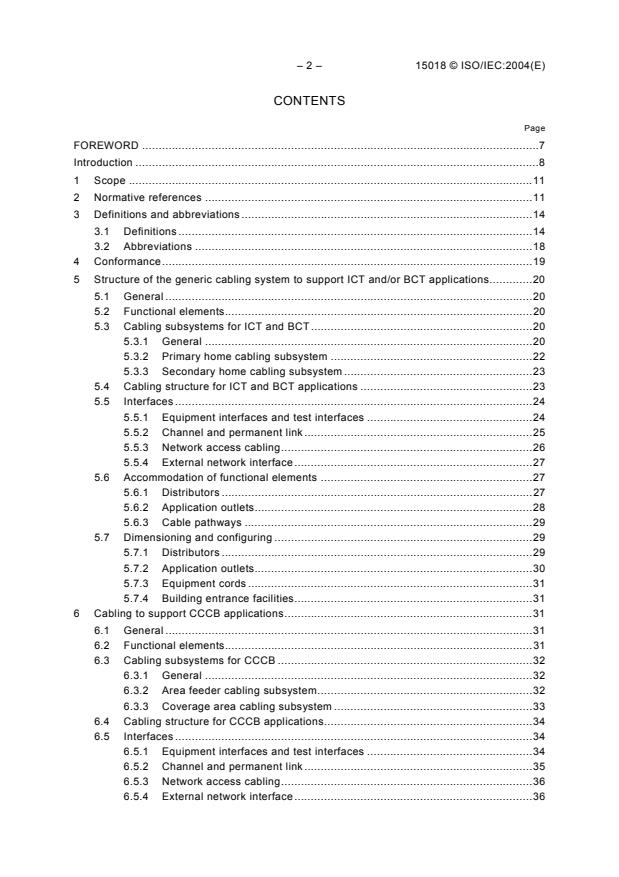
– 2 – 15018 © ISO/IEC:2004(E)
CONTENTS
Page
FOREWORD .7
Introduction .8
1 Scope .11
2 Normative references .11
3 Definitions and abbreviations .14
3.1 Definitions .14
3.2 Abbreviations .18
4 Conformance.19
5 Structure of the generic cabling system to support ICT and/or BCT applications.20
5.1 General .20
5.2 Functional elements.20
5.3 Cabling subsystems for ICT and BCT.20
5.3.1 General .20
5.3.2 Primary home cabling subsystem .22
5.3.3 Secondary home cabling subsystem .23
5.4 Cabling structure for ICT and BCT applications .23
5.5 Interfaces .24
5.5.1 Equipment interfaces and test interfaces .24
5.5.2 Channel and permanent link.25
5.5.3 Network access cabling.26
5.5.4 External network interface.27
5.6 Accommodation of functional elements .27
5.6.1 Distributors .27
5.6.2 Application outlets.28
5.6.3 Cable pathways .29
5.7 Dimensioning and configuring .29
5.7.1 Distributors .29
5.7.2 Application outlets.30
5.7.3 Equipment cords .31
5.7.4 Building entrance facilities.31
6 Cabling to support CCCB applications.31
6.1 General .31
6.2 Functional elements.31
6.3 Cabling subsystems for CCCB .32
6.3.1 General .32
6.3.2 Area feeder cabling subsystem.32
6.3.3 Coverage area cabling subsystem .33
6.4 Cabling structure for CCCB applications.34
6.5 Interfaces .34
6.5.1 Equipment interfaces and test interfaces .34
6.5.2 Channel and permanent link.35
6.5.3 Network access cabling.36
6.5.4 External network interface.36
15018 © ISO/IEC:2004(E) – 3 –
6.6 Accommodation of functional elements .37
6.6.1 Area connection points (ACPs).37
6.6.2 Control outlets (COs) .37
6.6.3 Cable pathways .37
6.7 Dimensioning and configuring .37
6.7.1 Distributors .37
6.7.2 Control outlet (CO).37
6.7.3 Cable sharing .38
6.7.4 Equipment cords .38
6.7.5 Building entrance facilities.38
7 Performance.38
7.1 General .38
7.2 ICT channel performance.40
7.3 BCT channel performance .40
7.4 CCCB channel performance.43
8 Reference implementation .45
8.1 General .45
8.2 Cabling assumptions .45
8.2.1 Introduction .45
8.2.2 General .45
8.2.3 Dimensions for ICT and BCT channels .47
8.2.4 Dimensions for CCCB channels.48
9 Cable requirements .49
9.1 General .49
9.2 Cable performance for ICT.49
9.3 Cable performance for BCT .51
9.3.1 Requirements for balanced pairs for BCT .51
9.3.2 Requirements for coaxial cables for BCT .52
9.4 Cable performance for CCCB coverage area .54
10 Connecting hardware.56
10.1 General requirements .56
10.1.1 Applicability .56
10.1.2 Location.56
10.1.3 Design .56
10.1.4 Operating environment.57
10.1.5 Mounting .57
10.1.6 Installation practices .57
10.1.7 Marking and colour coding .57
10.2 Mating interfaces at TO, BO and CO .58
10.2.1 General .58
10.2.2 Mating interface for TO .58
10.2.3 Mating interface for BO .58
10.2.4 Mating interface for CO .59
10.2.5 Minimum performance requirements .59
11 Safety requirements and screening practices .65
11.1 General .65
– 4 – 15018 © ISO/IEC:2004(E)
11.2 Coexistence with mains .65
11.3 Operational safety .65
11.4 Screening practices .66
11.4.1 General .66
11.4.2 Earthing.66
Annex A (normative) BCT channel levels.67
Annex B (normative) Link performance.68
B.1 General .68
B.2 Performance requirements for ICT permanent links .68
B.3 Performance requirements for BCT permanent links .69
B.4 Performance requirements for CCCB permanent links .71
Annex C (informative ) BCT levels: channel and link performance and implementation .72
C.1 General .72
C.2 BCT-H, BCT-M and BCT-L channels .72
C.3 BCT-H, BCT-M and BCT-L links .74
C.4 BCT levels' implementation.76
C.4.1 General .76
C.4.2 Cable specifications .76
C.4.3 Connecting hardware specifications.76
C.4.4 Maximum channel lengths for reference implementations.76
C.4.5 Channel lengths using other coaxial cable specifications .77
C.4.6 Channel lengths using other balanced cable specifications .77
Annex D (informative) Applications and associated cabling .78
Bibliography .81
Figure 1 – Overview of a generic cabling for home .9
Figure 2 – Structure of the generic cabling system.21
Figure 3 – Interconnect and cross-connect models .22
Figure 4 – Hierarchical structure of a generic cabling system in support of ICT and
BCT applications .23
Figure 5 – Equipment and test interfaces in support of ICT and BCT applications.24
Figure 6 – Channels and permanent links within the home.26
Figure 7 – Examples of interconnection of home and network access cabling.27
Figure 8 – Interconnection of home cabling subsystems .29
Figure 9 – Structure of the generic cabling system in support of CCCB applications .32
Figure 10 – Hierarchical structure of a generic cabling system in support of CCCB
applications .34
Figure 11 – Equipment and test interfaces in support of CCCB applications .35
Figure 12 – Channels and permanent links for CCCB cabling.36
Figure 13 – Reference implementations for ICT and BCT channels (PHD/SHD -
TO/BO).47
Figure 14 – Reference implementations for CCCB channels with PHD or SHD .48
Figure 15 – Reference implementations for CCCB channels with PHD and SHD.49
Figure 16 – Pin grouping assignments for IEC 60603-7 series outlet (front view) .58
15018 © ISO/IEC:2004(E) – 5 –
Figure 17 – Pin grouping assignments for 61076-3-104 outlet (front view) .59
Figure 18 – Pin grouping assignments for IEC 60603-7-7 outlet (front view) .59
Figure 19 – Conductor assignment of IEC 61169-2 and IEC 61169-24 (Type F)
connector .59
Table 1 – Maximum channel lengths for reference implementations of ICT/BCT
channels.30
Table 2 – Different channels and their potential use .39
Table 3 – Minimum performance of BCT-B channels.41
Table 4 – Minimum performance of BCT-C channels.42
Table 5 – Minimum performance of CCCB copper channels for information transfer .44
Table 6 – Minimum performance of CCCB channels for d.c. power feeding .44
Table 7 – Link length equations.46
Table 8 – Mechanical performance requirements for ICT and balanced BCT cables .50
Table 9 – Minimum transmission performance requirements BCT balanced pairs .51
Table 10 – Minimum electrical performance requirements for BCT coaxial cable .52
Table 11 – Mechanical performance requirements for coaxial BCT cables.53
Table 12 – Minimum transmission performance requirements for CCCB coverage area
cables .54
Table 13 – Mechanical performance requirements for balanced CCCB coverage area
cables .55
Table 14 – Mechanical characteristics of connecting hardware for use with balanced
cabling .61
Table 15 – Return loss (RL) .62
Table 16 – Insertion loss.63
Table 17 – Near end crosstalk (NEXT) .63
Table 18 – Far end crosstalk (FEXT) .63
Table 19 – Input to output resistance .64
Table 20 – Current carrying capacity .64
Table 21 – Propagation delay.64
Table 22 – Coupling and screening attenuation .64
Table 23 – Insulation resistance.65
Table 24 – Voltage proof.65
Table A.1 – BCT channels division .67
Table B.1 – Minimum performance of BCT-B permanent links .69
Table B.2 – Minimum performance of BCT-C permanent links.70
Table C.1 – Minimum insertion loss of BCT_B channels for BCT-H, BCT-M and BCT-L .73
Table C.2 – Minimum insertion loss of BCT-C channels for BCT-H, BCT-M and BCT-L .74
Table C.3 – Insertion loss for BCT-B permanent links .75
Table C.4 – Insertion loss for BCT-C permanent links .75
Table C.5 – BCT-L, BCT-M and BCT-H channel implementations.77
– 6 – 15018 © ISO/IEC:2004(E)
Table D.1 – Grouping of applications and cabling .78
Table D.2 – Characteristics of ICT, BCT & CCCB cabling .80
15018 © ISO/IEC:2004(E) – 7 –
INFORMATION TECHNOLOGY –
GENERIC CABLING FOR HOMES
FOREWORD
1) ISO (International Organization for Standardization) and IEC (International Electrotechnical Commission) form the
specialized system for worldwide standardization. National bodies that are members of ISO or IEC participate in
the development of International Standards through technical committees established by the respective
organization to deal with particular fields of technical activity. ISO and IEC technical committees collaborate in
fields of mutual interest. Other international organizations, governmental and non-governmental, in liaison with
ISO and IEC, also take part in the work.
2) In the field of information technology, ISO and IEC have established a joint technical committee, ISO/IEC JTC 1.
Draft International Standards adopted by the joint technical committee are circulated to national bodies for voting.
Publication as an International Standard requires approval by at least 75 % of the national bodies casting a vote.
3) All users should ensure that they have the latest edition of this publication.
4) No liability shall attach to IEC or ISO or its directors, employees, servants or agents including individual experts
and members of their technical committees and IEC or ISO member bodies for any personal injury, property
damage or other damage of any nature whatsoever, whether direct or indirect, or for costs (including legal fees)
and expenses arising out of the publication of, use of, or reliance upon, this ISO/IEC publication or any other IEC,
ISO or ISO/IEC publications.
5) Attention is drawn to the normative references cited in this publication. Use of the referenced publications is
indispensable for the correct application of this publication.
6) Attention is drawn to the possibility that some of the elements of this International Standard may be the subject of
patent rights. ISO and IEC shall not be held responsible for identifying any or all such patent rights.
International Standard ISO/IEC 15018 was prepared by subcommittee 25: Interconnection of
information technology equipment, of ISO/IEC joint technical committee 1: Information
technology.
This publication has been drafted in accordance with the ISO/IEC Directives, Part 2.
– 8 – 15018 © ISO/IEC:2004(E)
Introduction
This standard specifies a generic cabling for three groups of applications in homes:
• Information and Communications Technologies (ICT);
• Broadcast and Communications Technologies (BCT);
• Commands, Controls and Communications in Buildings (CCCB);
as shown in Figure 1, and it is intended to guide installations in new buildings or
refurbishments. (Cabling is a part of the infrastructure that supports home systems.)
This standard also applies where cabling is installed to support only one or two of the three
application groups listed above.
This standard specifies a generic cabling infrastructure based upon balanced cabling and/or
coaxial cabling. ICT channels specified in this standard include optical fibre. The wider use of
fibre optical cabling in a home is for further study.
These groups of applications may also be supported by different types of cabling, which may
be subject to other standards. For example, ISO/IEC 11801 specifies generic cabling for ICT
applications in general for the office environment. While the cabling structure and reference
implementations are matched to the home environment in this standard, the channel
performances specified for ICT are identical to those specified in ISO/IEC 11801.
This standard specifies a generic cabling for a home that may support ICT, BCT and CCCB
application groups. Because it is designed to cover the three major groups, the cabling
system may be installed prior to the selection of specific applications. The home may contain
one or more buildings (e.g. farm) or may be within a building which contains more than one
home (e.g. one home in a multi-dwelling building).
The campus or backbone cabling connecting individual homes is built according to the
relevant standard (for instance ISO/IEC 11801 or IEC 60728).
Generic cabling realised according to this standard:
a) allows deployment of a wide range of applications without changes to the fixed cabling
infrastructure;
b) provides a platform to support moves, adds and changes of connectivity.
This standard provides:
• users with an application-independent generic cabling for applications run in homes;
• users with a flexible cabling scheme such that changes are both easy and economical;
• building professionals (for example, architects) with guidance for accommodating cabling
before specific requirements are known, i.e. in the initial planning either for construction or
refurbishment;
• industry and applications standardisation bodies (e.g. ITU-T, ISO/IEC JTC 1/SC 6,
ISO/IEC JTC 1/SC 25/WG 1, IEC TC 100) with a cabling system that supports current
products and provides a basis for future product development in home electronic systems;
• users, designers and manufacturers of application-specific cabling systems with advice on
interfacing to this generic cabling;
• suppliers of cabling components and installers of cabling with relevant requirements;
• service providers with a distribution system for their services.
15018 © ISO/IEC:2004(E) – 9 –
Generic cabling for Generic cabling for
ICT and BCT CCCB
CO
CO
CO
CO ACP CO
CO CO
CO
BO
TO
CO CO ACP
BO
Transmission
CO
TO
CO
equipment
CO CO
CO
BO ACP
CO ACP
BO
TO
CO
TO
BEF
PHD PHD
CO
ENI
CO
CO
CO ACP CO
CO CO
BO
CO
TO
BO
CO CO ACP
TO
CO
CO
CO CO
BO CO
ACP
BO
TO
CO ACP
CO
TO
PHD
KEY: Items out of scope of this standard
Figure 1 – Overview of a generic cabling for home
– 10 – 15018 © ISO/IEC:2004(E)
A number of ICT, BCT and CCCB applications have been analysed to determine the
requirements for a generic cabling (see Table D.2) and to specify the minimum performance
of channels given in clause 7. These requirements, together with the logical and physical
models described in clauses 5 and 6, have been used to develop the requirements for cabling
components and to stipulate their arrangement into generic cabling systems.
Wireless and (unguided) infrared as well as Power Line Communication may also be used for
applications mentioned above. Media used for these technologies are not covered in this
standard.
15018 © ISO/IEC:2004(E) – 11 –
Information technology - Generic cabling for homes
1 Scope
This International Standard specifies generic cabling for homes. A home may contain one or
more buildings or may be within a building that contains more than one home.
This standard specifies a generic cabling for three groups of applications:
• Information and Communications Technologies (ICT);
• Broadcast and Communications Technologies (BCT);
• Commands, Controls and Communications in Buildings (CCCB).
It specifies cabling that comprises one or more of the following:
• balanced cabling;
• coaxial cabling;
• optical fibre cabling.
The standard specifies the requirements for the design and configuration of the generic
cabling with respect to:
a) structure and topology;
b) minimum configuration;
c) performance requirements for permanent links and channels;
d) density and location of connection points;
e) interfaces to application-specific equipment and external networks;
f) coexistence with other building services.
Although safety (electrical, fire, etc.) and electromagnetic compatibility (EMC) requirements
are outside the scope of this International Standard and are covered by other standards and
regulations, information given in this International Standard may be of assistance in meeting
these requirements.
NOTE 1 National regulations and local codes may preclude carrying certain services on the cabling specified in
this standard.
NOTE 2 • Test requirements in this standard are for system designers.
• The installation tests should be decided between supplier and customer or according to the relevant
installation guide.
2 Normative references
The following referenced documents are indispensable for the application of this document.
For dated references, only the edition cited applies. For undated references, the latest edition
of the referenced document (including any amendments) applies.
IEC 60189-1:1986, Low-frequency cables and wires with PVC insulation and PVC sheath –
Part 1: General test and measuring methods
Amendment 3 (1992)
IEC 60352-3, Solderless connections – Part 3: Solderless accessible insulation displacement
connections – General requirements, test methods and practical guidance
IEC 60352-4, Solderless connections – Part 4: Solderless non-accessible insulation
displacement connections – General requirements, test methods and practical guidance
– 12 – 15018 © ISO/IEC:2004(E)
IEC 60352-6, Solderless connections – Part 6: Insulation piercing connections – General
requirements, test methods and practical guidance
IEC 60364-4-41, Electrical installations of buildings – Part 4-41: Protection for safety –
Protection against electric shock
IEC 60512-2:1985, Electromechanical components for electronic equipment; basic testing
procedures and measuring methods – Part 2: General examination, electrical continuity and
contact resistance tests, insulation tests and voltage stress tests
IEC 60512-25-1, Connectors for electronic equipment – Tests and measurements - Part 25-1:
Test 25a – Crosstalk ratio
IEC 60512-25-2, Connectors for electronic equipment – Tests and measurements – Part 25-2:
Test 25b – Attenuation (insertion loss)
IEC 60512-25-4, Connectors for electronic equipment – Tests and measurements – Part 25-4:
Test 25d - Propagation delay
IEC 60512-25-5, Connectors for electronic equipment – Tests and measurements – Part 25-5:
Test 25e – Return loss
IEC 60512-3, Electromechanical components for electronic equipment; basic testing
procedures and measuring methods – Part 3: Current-carrying capacity tests
IEC 60603-7, Connectors for frequencies below 3 MHz for use with printed boards – Part 7:
Detail specification for connectors, 8-way, including fixed and free connectors with common
mating features, with assessed quality
IEC 60603-7-1:2002, Connectors for electronic equipment – Part 7-1: Detail specification for
8-way, shielded free and fixed connectors with common mating features, with assessed
quality
IEC 60603-7-2, Connectors for electronic equipment – Part 7-2: Detail specification for 8-way
unshielded free and fixed connectors, for data transmission with frequencies up to 100 MHz
IEC 60603-7-3, Connectors for electronic equipment – Part 7-3: Detail specification for 8-way
shielded connectors for frequencies up to 100 MHz
IEC 60603-7-4, Connectors for electronic equipment – Part 7-4: Detail specification for 8-way,
unshielded, free and fixed connectors, for data transmissions with frequencies up to 250 MHz
(CAT 6, unshielded)
IEC 60603-7-5, Connectors for electronic equipment – Part 7-5: Detail specification for 8-way,
shielded, free and fixed connectors, for data transmissions with frequencies up to 250 MHz
(CAT 6, shielded)
IEC 60603-7-7:2002, Connectors for electronic equipment – Part 7-7: Detail specification for
8-way, shielded, free and fixed connectors, for data transmission with frequencies up to
600 MHz (category 7, shielded)
IEC 60728 (all parts), Cabled distribution systems for television and sound signals
To be published.
15018 © ISO/IEC:2004(E) – 13 –
IEC 60966-1, Radio frequency and coaxial cable assemblies – Part 1: Generic specification – General
requirements and test methods
IEC 60966-2-4, Radio frequency and coaxial cable assemblies – Part 2-4: Detail specification
for cable assemblies for radio and TV receivers – Frequency range 0 to 3 000 MHz,
IEC 60169-2 connectors
IEC 60966-2-5, Radio frequency and coaxial cable assemblies – Part 2-5: Detail specification
for cable assemblies for radio and TV receivers – Frequency range 0 to 1 000 MHz,
IEC 61169-2 connectors
IEC 60966-2-6, Radio frequency and coaxial cable assemblies – Part 2-6: Detail specification
for cable assemblies for radio and TV receivers – Frequency range 0 to 3 000 MHz,
IEC 60169-24 connectors
IEC 61024 series, Protection of structures against lightning
IEC 61076-3-104, Connectors for electronic equipment – Part 3-104: Rectangular connectors
– Detail specification for 8 way, shielded free and fixed connectors for data transmissions with
frequencies up to 600 MHz minimum
IEC 61140, Protection against electric shock – Common aspects for installation and
equipment
IEC 61156 (all parts), Multicore and symmetrical pair/quad cables for digital communications
IEC 61156-1, Multicore and symmetrical pair/quad cables for digital communications – Part 1:
Generic specification
IEC 61156-5, Multicore and symmetrical pair/quad cables for digital communications – Part 5:
Symmetrical pair/quad cables with transmission characteristics up to 600 MHz – Horizontal
floor wiring - Sectional specification
IEC 61156-6, Multicore and symmetrical pair/quad cables for digital communications – Part 6:
Symmetrical pair/quad cables with transmission characteristics up to 600 MHz – Work area
wiring - Sectional specification
IEC 61156-7, Multicore and symmetrical pair/quad cables for digital communications – Part 7:
Symmetrical pair cables with transmission characteristics up to 1 200 MHz -Sectional
specification for digital and analog communication cables
IEC 61169-1, Radio-frequency connectors – Part 1: Generic specification – General
requirements and measuring methods
IEC 61169-2, Radio-frequency connectors – Part 2: Sectional specification - Radio frequency
coaxial connectors of type 9,52
IEC 61169-24, Radio-frequency connectors – Part 24: Sectional specification – Radio
frequency coaxial connectors with screw coupling, typically for use in 75 ohm cable
distribution systems (type F)
IEC 61196 (all parts), Radio-frequency cables
– 14 – 15018 © ISO/IEC:2004(E)
IEC 61935-1:2000, Generic cabling systems – Specification for the testing of balanced
communication cabling in accordance with ISO/IEC 11801 – Part 1: Installed cabling
Amendment (2002)
ISO/IEC 11801:2002, Information technology – Generic cabling for customer premises
ISO/IEC 14763-1, Information technology – Implementation and operation of customer
premises cabling – Part 1: Administration
ISO/IEC TR 14763-2, Information technology – Implementation and operation of customer
premises cabling – Part 2: Planning and installation
ITU-T K.31, Bonding configurations and earthing of telecommunication installations inside a
subscriber's building
EN 50289-1-14, Communication cables – Specifications for test methods – Part 1-14:
Electrical test methods – Coupling attenuation or screening attenuation of connecting
hardware
3 Definitions and abbreviations
3.1 Definitions
For the purposes of this International Standard, the following definitions apply.
3.1.1
application
system, with its associated transmission method, that is supported by cabling
3.1.2
application outlet
point at which equipment may be connected to the generic cabling in support of ICT and/or
BCT application
3.1.3
area connection point (ACP)
point at which coverage area cabling is connected to area feeder cabling
3.1.4
balanced cable
cable consisting of one or more metallic symmetrical cable elements (twisted pairs or quads)
[ISO/IEC 11801]
3.1.5
broadcast and communications technologies (BCT)
group of applications including sound radio and TV
NOTE These applications are also called HES class 3 in ISO/IEC TR 15044.
3.1.6
building entrance facility (BEF)
facility that provides all necessary mechanical and electrical services, that complies with all
relevant requirements, for the entry of telecommunications cables into a building
15018 © ISO/IEC:2004(E) – 15 –
3.1.7
cable element
the smallest construction unit (for example balanced pair, balanced quad, coaxial pair or
single optical fibre) in a cable; a cable element may have a screen
3.1.8
cable unit
single assembly of one or more cable elements of the same type or category; the cable unit
may have a screen
3.1.9
cabling
system of telecommunications cables, cords, and connecting hardware that can support the
connection of information technology and other equipment
3.1.10
channel
end-to-end transmission path connecting any two pieces of application-specific equipment
NOTE 1 Channels specified in this standard are within the boundaries of generic cabling and may only comprise
passive components.
NOTE 2 A channel may use one or more pairs, may share a pair with another channel, e.g. power feeding and
information may run over the same pair.
3.1.11
coaxial pair
a uniform transmission line consisting of two cylindrical conductors with the same axis
[see IEC 60050, term IEV 151-12-39]
3.1.12
commands, controls and communications in buildings (CCCB)
group of applications such as appliance control and building control
NOTE These applications are also called HES class 1 in ISO/IEC TR 15044.
3.1.13
connection
mated device or combination of devices including terminations connecting two cables or cable
elements in a not permanent way
3.1.14
connector sharing
ability of a connector to accept multiple plugs in one socket such as 4 one-pair plugs in one 4
pair socket while maintaining the required performance; this may also be achieved by means
of an external adapter
3.1.15
coverage area
area within a home covered by any application
3.1.16
cross-connect
apparatus enabling the termination of cable elements and their cross-connection, primarily by
means of patch cords or jumpers
[ISO/IEC 11801]
NOTE Incoming and outgoing cables are terminated at fixed points [ISO/IEC 11801]; they are connected with the
help of a third cable, a patch cord or a jumper cable.
– 16 – 15018 © ISO/IEC:2004(E)
3.1.17
distributor
term used for a collection of components (such as patch panels, patch cords) used to connect
cables
[ISO/IEC 11801]
3.1.18
equipment cord
cord connecting equipment to a distributor
[ISO/IEC 11801]
3.1.19
equipment interface (EI)
interface at which application specific equipment is connected to the cabling
NOTE An application outlet is an example of an EI.
3.1.20
home
physical structure used as a dwelling place, such as a house or an apartment
NOTE This may be an individual building, part of a larger building or more than one building.
3.1.21
home electronic system (HES)
electronic systems within homes that are interconnected in accordance with
ISO/IEC TR 14543
3.1.22
information and communications technologies (ICT)
group of applications using information and communications (telecommunications)
technologies
NOTE These applications are also called HES class 2 in ISO/IEC TR 15044.
3.1.23
intercom
communication system for voice and optionally video, internal to the premises often including
door opening functions
3.1.24
interconnect
technique enabling equipment cords (or cabling subsystems) to be terminated and connected
to the cabling subsystems without using a patch cord or jumper
[ISO/IEC 11801]
NOTE Incoming or outgoing cables are terminated at a fixed point.
[ISO/IEC 11801]
3.1.25
link
transmission path between an outlet or distributor to another outlet or distributor of a generic
cabling; it excludes equipment cords
3.1.26
network access cabling
cabling that brings services to the home from a source outside the home (see Figure 7)
15018 © ISO/IEC:2004(E) – 17 –
3.1.27
optical fibre cable (or optical cable)
cable comprising one or more optical fibre cable elements
[ISO/IEC 11801]
3.1.28
pathway
facility dedicated to the placement of cable or area reserved for the placement of cable
3.1.29
permanent link
transmission path between two mated interfaces of generic cabling, excluding equipment
cords, work area cords and cross-connections, but including the connecting hardware at each
end
3.1.30
primary home distributor (PHD)
the primary distributor within a home where cables terminate
3.1.31
remote power feeding
the supply of power different from mains power to application-specific equipment via cabling
specified in this standard
3.1.32
requirement to be met by design
requirement which may be met by calculation and selection of appropriate materials and
installation techniques, where either there is no test method specified that allows verification
or there is no requirement for verification by testing
3.1.33
screened balanced cable
balanced cable with an overall screen and/or screens for the individual elements
[ISO/IEC 11801]
3.1.34
secondary home distributor (SHD)
optional distributor used to provide additional infrastructure flexibility and/or allocate
transmission equipment between the primary home distributor and coverage areas (e.g. for
homes with multiple floors)
3.1.35
space
area or volume defined by markings or fittings intended for the containment of connecting
hardware
3.1.36
terminal equipment
equipment (e.g. telephone handset) that provides user access to an application / service at an
outlet
3.1.37
transmission equipment
active equipment used to distribute applications from distributors to other distributors and to
outlets
– 18 – 15018 © ISO/IEC:2004(E)
3.1.38
twisted pair
cable element consisting of two insulated conductors twisted together in a regular fashion to
form a balanced transmission line
[ISO/IEC 11801]
3.1.39
unscreened balanced cable
electrically conducting balanced cable without any screen
3.2 Abbreviations
a.c. alternating current
ACP Area Connection Point
ACR Attenuation to Cross-talk Ratio
BCT Broadcast and Communications Technologies
BCT B BCT supported by balanced cabling
BCT C BCT supported by coaxial cabling
BCT-H BCT high (signal level)
BCT-L BCT low (signal level)
BCT-M BCT medium (signal level)
BEF Building Entrance Facility
BO Broadcast Outlet
CATV Community Antenna TV
CC Cross-Connect
CCCB Commands, Controls and Communications in Buildings
CCTV Closed Circuit TV
CO Control Outlet
d.c. direct current
EI Equipment Interface
ELFEXT Equal Level Far End Cross-talk attenuation (loss)
EMC Electromagnetic Compatibility
ENI External Network Interface
EQP Transmission Equipment
FEXT Far End Cross-talk
ffs for further study
HES Home Electronic System
HVAC Heating, Ventilating, and Air-Conditioning
ICT Information and Communications Technology
IEV International Electrotechnical Vocabulary
ISDN Integrated Services Digital Network
IL Insertion Loss
lg Logarithm with the basis 10
N/A Not Applicable
NEXT Near-End cross-talk attenuation (loss)
15018 © ISO/IEC:2004(E) – 19 –
OF Optical Fibre
PELV Protective Extra Low Voltage
PHD Primary Home Distributor
PS Power Source
PS ACR Power Sum ACR
PS ELFEXT Power Sum ELFEXT
r.m.s. root mean square
SELV Safety Extra Low Voltage
SHD Secondary Home Distributor
TE Terminal Equipment
TI Test Interface
TO Telecommunications Outlet
TV Television
4 Conformance
For a cabling installation to conform to this International Standard the following shall apply.
a) The cabling shall support ICT applications.
b) The structure of cabling in support of ICT applications shall conform to the requirements in
clause 5.
c) The structure of cabling in support of BCT applications shall conform to the requirements
in clause 5.
d) The structure of cabling in support of CCCB applications shall conform to the requirements
in clause 6.
e) The interfaces to the cabling at the TO and the BO shall conform to the requirements of
clause 10 with respect to mating interfaces and performance.
f) Connecting hardware at other places in the cabling structure shall meet t
...
Questions, Comments and Discussion
Ask us and Technical Secretary will try to provide an answer. You can facilitate discussion about the standard in here.
Loading comments...