

ISO/IEC 29192-6:2019
(Main)Information technology — Lightweight cryptography — Part 6: Message authentication codes (MACs)
General Information
- Abstract
This document specifies MAC algorithms suitable for applications requiring lightweight cryptographic mechanisms. These mechanisms can be used as data integrity mechanisms to verify that data has not been altered in an unauthorized manner. They can also be used as message authentication mechanisms to provide assurance that a message has been originated by an entity in possession of the secret key. The following MAC algorithms are specified in this document: a) LightMAC; b) Tsudik's keymode; c) Chaskey-12.
- Status
- Published
- Publication Date
- 17-Sep-2019
- Drafting Committee
- ISO/IEC JTC 1/SC 27/WG 2 - Cryptography and security mechanisms
- Current Stage
- 9093 - International Standard confirmed
- Start Date
- 27-Mar-2025
- Completion Date
- 29-Aug-2026
Buy Documents

ISO/IEC 29192-6:2019 - Information technology -- Lightweight cryptography
ISO/IEC 29192-6:2019 - Information technology — Lightweight cryptography — Part 6: Message authentication codes (MACs)/18/2019
Overview
ISO/IEC 29192-6:2019 specifies lightweight Message Authentication Codes (MACs) for constrained environments. The standard defines three MAC algorithms - LightMAC, Tsudik’s keymode, and Chaskey-12 - intended for low-footprint applications that need data integrity and message authentication without the resource cost of full-scale cryptography. Typical use cases include IoT, embedded systems, smart sensors, and other devices with limited CPU, memory, or power.
Key topics and technical requirements
- Purpose: Provide MAC algorithms suitable for verifying that data has not been altered and for authenticating message origin via a shared secret key.
- Algorithms specified:
- LightMAC - a block-cipher–based MAC meant to be used with an n‑bit block cipher selected from ISO/IEC 29192-2 or ISO/IEC 18033-3. Key aspects:
- Uses two independently generated block-cipher keys.
- Parameters include block size n, MAC length t, and counter size s (0 ≤ s < n). Messages limited to length ≤ 2^(n−s) bits.
- Processing steps: padding (right-pad with a single ‘1’ then zeros), application of the block cipher with a counter (I2BS), and truncation to t bits.
- Tsudik’s keymode - a hash-function–based MAC that requires a lightweight hash chosen from ISO/IEC 29192-5. Implementers must supply a shared secret key and agreed hash function.
- Chaskey-12 - a dedicated lightweight MAC optimized for constrained platforms; defined using 32‑bit words, subkey derivation, padding, a permutation step, and truncation.
- LightMAC - a block-cipher–based MAC meant to be used with an n‑bit block cipher selected from ISO/IEC 29192-2 or ISO/IEC 18033-3. Key aspects:
- Implementation notes:
- Parameters (e.g., MAC length t, counter size s) must remain constant while using a given key; changing parameters under the same key invalidates security assumptions.
- Annexes provide object identifiers (Annex A), numerical examples (Annex B), and security/feature tables (Annex C), useful for conformance and testing.
Practical applications and who uses this standard
- Device manufacturers building low-power IoT devices, wearable tech, RFID, and industrial sensors where memory and CPU are constrained.
- Security architects and embedded software engineers choosing lightweight MACs for firmware updates, telemetry authentication, sensor message integrity, or secure boot sequences.
- Standards bodies and integrators implementing interoperable authentication mechanisms that align with the ISO/IEC 29192 lightweight cryptography series.
- Benefits: reduced code size, lower energy consumption, and suitability for hardware or software implementations in constrained environments while providing provable data integrity and authentication properties.
Related standards
- ISO/IEC 29192 series (lightweight cryptography)
- ISO/IEC 29192-2 - lightweight block ciphers (used with LightMAC)
- ISO/IEC 29192-5 - lightweight hash-functions (used with Tsudik’s keymode)
- ISO/IEC 18033-3 - block ciphers (alternative ciphers for LightMAC)
- Refer to the standard’s annexes for OIDs, examples, and security tables to aid implementation and interoperability.
Keywords: ISO/IEC 29192-6:2019, lightweight cryptography, MAC, LightMAC, Tsudik’s keymode, Chaskey-12, message authentication code, constrained devices, IoT security, data integrity.
Buy Documents
ISO/IEC 29192-6:2019 - Information technology -- Lightweight cryptography
ISO/IEC 29192-6:2019 - Information technology — Lightweight cryptography — Part 6: Message authentication codes (MACs)/18/2019
Get Certified
Connect with accredited certification bodies for this standard

BSI Group
BSI (British Standards Institution) is the business standards company that helps organizations make excellence a habit.

Bureau Veritas
Bureau Veritas is a world leader in laboratory testing, inspection and certification services.

DNV
DNV is an independent assurance and risk management provider.
Sponsored listings
Frequently Asked Questions
ISO/IEC 29192-6:2019 is a standard published by the International Organization for Standardization (ISO). Its full title is "Information technology — Lightweight cryptography — Part 6: Message authentication codes (MACs)". This standard covers: This document specifies MAC algorithms suitable for applications requiring lightweight cryptographic mechanisms. These mechanisms can be used as data integrity mechanisms to verify that data has not been altered in an unauthorized manner. They can also be used as message authentication mechanisms to provide assurance that a message has been originated by an entity in possession of the secret key. The following MAC algorithms are specified in this document: a) LightMAC; b) Tsudik's keymode; c) Chaskey-12.
This document specifies MAC algorithms suitable for applications requiring lightweight cryptographic mechanisms. These mechanisms can be used as data integrity mechanisms to verify that data has not been altered in an unauthorized manner. They can also be used as message authentication mechanisms to provide assurance that a message has been originated by an entity in possession of the secret key. The following MAC algorithms are specified in this document: a) LightMAC; b) Tsudik's keymode; c) Chaskey-12.
ISO/IEC 29192-6:2019 is classified under the following ICS (International Classification for Standards) categories: 35.030 - IT Security. The ICS classification helps identify the subject area and facilitates finding related standards.
ISO/IEC 29192-6:2019 is available in PDF format for immediate download after purchase. The document can be added to your cart and obtained through the secure checkout process. Digital delivery ensures instant access to the complete standard document.
Standards Content (Sample)
INTERNATIONAL ISO/IEC
STANDARD 29192-6
First edition
2019-09
Information technology — Lightweight
cryptography —
Part 6:
Message authentication codes (MACs)
Technologies de l'information — Cryptographie pour environnements
contraints —
Partie 6: Codes d'authentification de message (MACs)
Reference number
©
ISO/IEC 2019
© ISO/IEC 2019
All rights reserved. Unless otherwise specified, or required in the context of its implementation, no part of this publication may
be reproduced or utilized otherwise in any form or by any means, electronic or mechanical, including photocopying, or posting
on the internet or an intranet, without prior written permission. Permission can be requested from either ISO at the address
below or ISO’s member body in the country of the requester.
ISO copyright office
CP 401 • Ch. de Blandonnet 8
CH-1214 Vernier, Geneva
Phone: +41 22 749 01 11
Fax: +41 22 749 09 47
Email: copyright@iso.org
Website: www.iso.org
Published in Switzerland
ii © ISO/IEC 2019 – All rights reserved
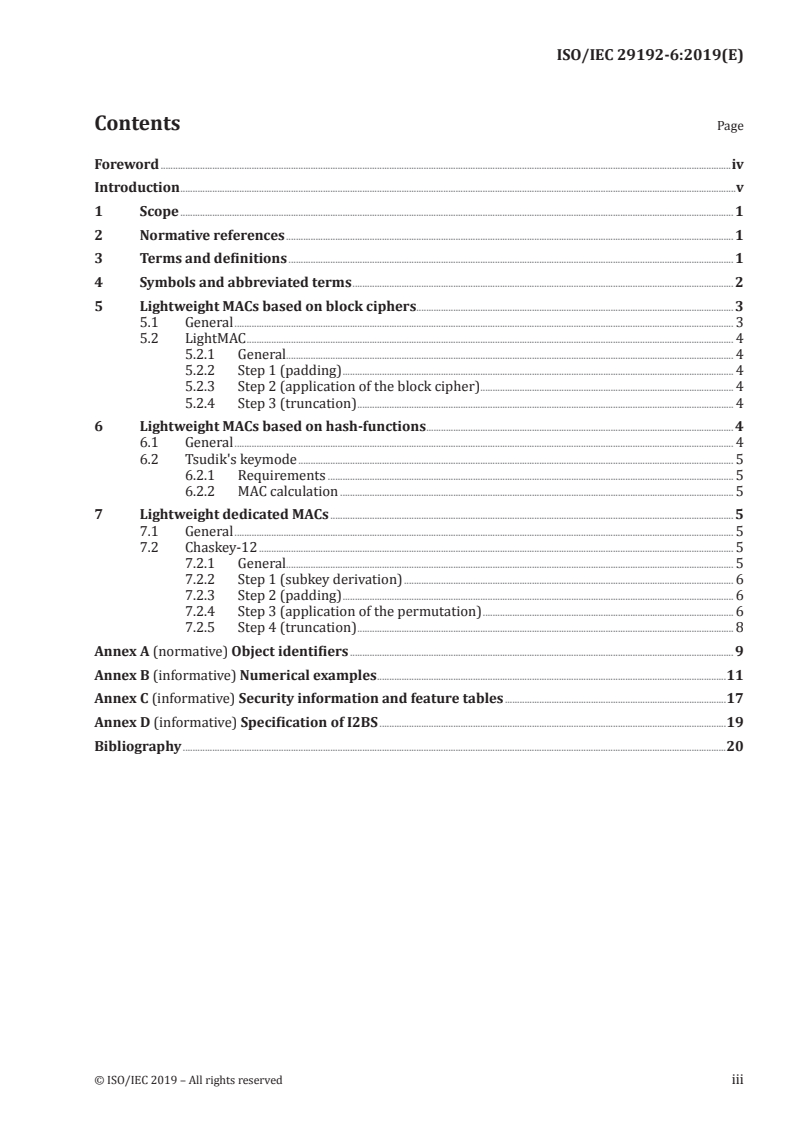
Contents Page
Foreword .iv
Introduction .v
1 Scope . 1
2 Normative references . 1
3 Terms and definitions . 1
4 Symbols and abbreviated terms . 2
5 Lightweight MACs based on block ciphers. 3
5.1 General . 3
5.2 LightMAC . 4
5.2.1 General. 4
5.2.2 Step 1 (padding) . 4
5.2.3 Step 2 (application of the block cipher) . 4
5.2.4 Step 3 (truncation) . 4
6 Lightweight MACs based on hash-functions . 4
6.1 General . 4
6.2 Tsudik's keymode . 5
6.2.1 Requirements . 5
6.2.2 MAC calculation . 5
7 Lightweight dedicated MACs . 5
7.1 General . 5
7.2 Chaskey-12 . 5
7.2.1 General. 5
7.2.2 Step 1 (subkey derivation) . 6
7.2.3 Step 2 (padding) . 6
7.2.4 Step 3 (application of the permutation) . 6
7.2.5 Step 4 (truncation) . 8
Annex A (normative) Object identifiers . 9
Annex B (informative) Numerical examples .11
Annex C (informative) Security information and feature tables .17
Annex D (informative) Specification of I2BS .19
Bibliography .20
© ISO/IEC 2019 – All rights reserved iii
Foreword
ISO (the International Organization for Standardization) and IEC (the International Electrotechnical
Commission) form the specialized system for worldwide standardization. National bodies that
are members of ISO or IEC participate in the development of International Standards through
technical committees established by the respective organization to deal with particular fields of
technical activity. ISO and IEC technical committees collaborate in fields of mutual interest. Other
international organizations, governmental and non-governmental, in liaison with ISO and IEC, also
take part in the work.
The procedures used to develop this document and those intended for its further maintenance are
described in the ISO/IEC Directives, Part 1. In particular, the different approval criteria needed for
the different types of document should be noted. This document was drafted in accordance with the
editorial rules of the ISO/IEC Directives, Part 2 (see www .iso .org/directives).
Attention is drawn to the possibility that some of the elements of this document may be the subject
of patent rights. ISO and IEC shall not be held responsible for identifying any or all such patent
rights. Details of any patent rights identified during the development of the document will be in the
Introduction and/or on the ISO list of patent declarations received (see www .iso .org/patents) or the IEC
list of patent declarations received (see http: //patents .iec .ch).
Any trade name used in this document is information given for the convenience of users and does not
constitute an endorsement.
For an explanation of the voluntary nature of standards, the meaning of ISO specific terms and
expressions related to conformity assessment, as well as information about ISO's adherence to the
World Trade Organization (WTO) principles in the Technical Barriers to Trade (TBT) see www .iso
.org/iso/foreword .html.
This document was prepared by Joint Technical Committee ISO/IEC JTC 1, Information technology,
Subcommittee SC 27, Information security, cybersecurity and privacy protection.
A list of all parts in the ISO/IEC 29192 series can be found on the ISO website.
Any feedback or questions on this document should be directed to the user’s national standards body. A
complete listing of these bodies can be found at www .iso .org/members .html.
iv © ISO/IEC 2019 – All rights reserved
Introduction
In an IT environment, it is often required that one can verify that electronic data has not been altered in
an unauthorized manner and that one can provide assurance that a message has been originated by an
entity in possession of the secret key. A MAC (Message Authentication Code) algorithm is a commonly
used data integrity mechanism that can satisfy these requirements.
It is possible to take the first approach to realize a lightweight MAC by using the specified MAC algorithm
in conjunction with a block cipher that can be chosen from ISO/IEC 29192-2 or ISO/IEC 18033-3, and in
conjunction with a hash-function that can be chosen from ISO/IEC 29192-5. It is also possible to take the
second approach to realize a lightweight MAC using a dedicated function. Examples of both approaches
are specified in this document.
© ISO/IEC 2019 – All rights reserved v
INTERNATIONAL STANDARD ISO/IEC 29192-6:2019(E)
Information technology — Lightweight cryptography —
Part 6:
Message authentication codes (MACs)
1 Scope
This document specifies MAC algorithms suitable for applications requiring lightweight cryptographic
mechanisms. These mechanisms can be used as data integrity mechanisms to verify that data has not
been altered in an unauthorized manner. They can also be used as message authentication mechanisms
to provide assurance that a message has been originated by an entity in possession of the secret key.
The following MAC algorithms are specified in this document:
a) LightMAC;
b) Tsudik's keymode;
c) Chaskey-12.
2 Normative references
The following documents are referred to in the text in such a way that some or all of their content
constitutes requirements of this document. For dated references, only the edition cited applies. For
undated references, the latest edition of the referenced document (including any amendments) applies.
ISO/IEC 18033-3, Information technology — Security techniques — Encryption algorithms — Part 3:
Block ciphers
ISO/IEC 29192-2, Information technology — Security techniques — Lightweight cryptography — Part 2:
Block ciphers
ISO/IEC 29192-5, Information technology — Security techniques — Lightweight cryptography — Part 5:
Hash-functions
3 Terms and definitions
For the purposes of this document, the terms and definitions given in ISO/IEC 18033-3 and the
following apply.
ISO and IEC maintain terminological databases for use in standardization at the following addresses:
— ISO Online browsing platform: available at https: //www .iso .org/obp
— IEC Electropedia: available at http: //www .electropedia .org/
3.1
block cipher key
key that controls the operation of a block cipher
[SOURCE: ISO/IEC 9797-1:2011, 3.2]
© ISO/IEC 2019 – All rights reserved 1
3.2
encryption
reversible operation by a cryptographic algorithm converting data into ciphertext so as to hide the
information content of the data
[SOURCE: ISO/IEC 9797-1:2011, 3.6]
3.3
hash-function
function which maps strings of bits of variable (but usually upper bounded) length to fixed-length
strings of bits, satisfying the following two properties:
— for a given output, it is computationally infeasible to find an input which maps to this output;
— for a given input, it is computationally infeasible to find a second input which maps to the same output
Note 1 to entry: Computational feasibility depends on the specific security requirements and environment.
[SOURCE: ISO/IEC 10118-1:2016, 3.4]
3.4
key
sequence of symbols that controls the operation of a cryptographic transformation
Note 1 to entry: Examples are encryption, decryption, cryptographic check function computation, signature,
generation, or signature verification.
[SOURCE: ISO/IEC 9797-1:2011, 3.7]
3.5
Message Authentication Code
MAC
string of bits which is the output of a MAC algorithm
[SOURCE: ISO/IEC 9797-1:2011, 3.9]
3.6
MAC algorithm
algorithm for computing a function which maps strings of bits and a secret key to fixed-length strings
of bits, satisfying the following two properties:
— for any key and any input string, the function can be computed efficiently;
— for any fixed key, and given no prior knowledge of the key, it is computationally infeasible to
compute the function value on any new input string, even given knowledge of a set of input strings
and corresponding function values, where the value of the ith input string might have been chosen
after observing the value of the first i - 1 function values (for integers i > 1)
[SOURCE: ISO/IEC 9797-1:2011, 3.10]
3.7
word
string of 32 bits used in Chaskey-12 MAC algorithm
4 Symbols and abbreviated terms
a ← b set variable a to the value of b
E(K, P) encryption of the plaintext P with the block cipher E using the key K
h hash-function
2 © ISO/IEC 2019 – All rights reserved
IV t-bit initializing value
I2BS(x, g) function that takes as input a non-negative integer x and outputs a bit string of length g
corresponding to its binary representation
K block cipher key taken by the underlying block cipher used in LightMAC (i = 1, 2)
i
m message string to be input to the MAC algorithm
m' message string after the padding has been applied
th
m ' i n-bit block of the padded-message string m’
i
(n−s) th
m' i (n−s)-bit block of the padded-message string m’ for i < l where
i
(n−s) (n−s)
m’ ||m’ ||.||m’ = m’
1 2 ℓ
s counter size
t length of the MAC in bits
v 32-bit words used to store the results of intermediate computations
i
X| j-bit unsigned integer obtained from the u-bit unsigned integer X by taking the j least
j
significant bits of X (1 ≤ j ≤ u)
X<<1 operation of left shift by one bit, i.e. if X is a word then X << 1 denotes the word obtained
by left-shifting the contents of X by one position
X <<< n operation of ‘circular left shift’ by n bit positions, i.e. if X is a word and n is a non-negative
integer then X<<
positions in a cyclic fashion
s
0 string consisting of s zero-bits
⊕ bitwise exclusive-OR operation
⊞ addition modulo 2
|X| the length of bit string X in bits
|| concatenation of bit strings
w
+ addition modulo 2 operation, where w is the number of bits in a word; i.e. if A and B
w
are w–bit words, then A + B is the word obtained by treating A and B as the binary
w
w
representations of integers and computing their sum modulo 2 , where the result is con-
w
strained to lie between 0 and 2 − 1 inclusive
5 Lightweight MACs based on block ciphers
5.1 General
This clause specifies a lightweight MAC algorithm that uses a secret key and an n-bit block cipher to
calculate a t-bit MAC.
Annex A defines the object identifier which shall be used to identify the algorithm specified in Clause 5.
Annex B provides numerical examples for the MAC algorithms in hexadecimal notation. Annex C gives
the lightweight properties of the MAC algorithms described in this document.
© ISO/IEC 2019 – All rights reserved 3
5.2 LightMAC
5.2.1 General
LightMAC is a MAC algorithm that shall be used with any block cipher from ISO/IEC 29192-2 or
[6]
ISO/IEC 18033-3. Users who wish to employ LightMAC shall select:
— an n-bit block cipher E from ISO/IEC 29192-2 or ISO/IEC 18033-3;
— a length t in bits of the MAC;
— a counter size s, i.e. the number of bits allocated to represent the counter value, where 0 ≤ s < n .
The above parameters shall remain constant while using LightMAC under a given key. Different
parameter sets should not be used under the same key.
NOTE 1 If any of the parameters above are modified while using a key, then no security can be guaranteed.
NOTE 2 Numerical examples, including for the cases s = 8 or 32 and t = 64, are listed in B.2.
LightMAC takes as input two independently generated block cipher keys K and K , and a message M
1 2
s
of length at most 2 (n−s) bits. LightMAC produces an output of length t bits. LightMAC requires the
following steps: padding, application of the block cipher, and truncation.
5.2.2 Step 1 (padding)
Let m be the message input to LightMAC, and d = |m| mod (n−s). Right-pad m with a single ‘1’ bit, followed
by n-d-1 ‘0’ bits. The result is denoted by m’.
5.2.3 Step 2 (application of the block cipher)
(n−s) (n−s) (n−s)
m’ shall be split into strings m’ , m’ , …, m’ , where m’ , m’ , …, m’ are n-s bit strings, m’ is
1 2 ℓ 1 2 ℓ−1 ℓ
(n−s) (n−s)
an n bit string, and m’ ||m’ ||.||m’ = m’. The string S is computed using the following procedure.
1 2 ℓ
n
V ← 0
For i = 1 to ℓ-1:
V ←E(K , I2BS(i, s)||m’ ) ⊕ V
1 i
V ← m ’ ⊕ V
ℓ
S ←E(K , V)
Refer to Annex D for the specification of I2BS.
5.2.4 Step 3 (truncation)
The MAC of t bits is derived by taking the least significant t bits of the string S, i.e.:
MAC ←S|
t
6 Lightweight MACs based on hash-functions
6.1 General
This clause specifies a lightweight MAC algorithm that uses a lightweight hash-function to compute a MAC.
4 © ISO/IEC 2019 – All rights reserved
Annex A defines the object identifier which shall be used to identify the algorithm specified in Clause 6.
Annex B provides numerical examples for the MAC algorithms in hexadecimal notation. Annex C gives
the lightweight properties of the MAC algorithms described in this document.
6.2 Tsudik's keymode
6.2.1 Requirements
[1]
Tsudik's keymode is a MAC algorithm that uses a hash-function. In order to use Tsudik's keymode ,
a lightweight hash-function h shall be selected and agreed. The hash-function shall be chosen from
amongst the lightweight hash-functions specified in ISO/IEC 29192-5:2016. An entity generating a MAC
shall be equipped with a secret key K, which shall also be made available to all parties needing to verify
the MAC.
NOTE 1 Tsudik's keymode is classified as lightweight because the number of calls to the underlying hash-
function is typically smaller than generic-purpose hash-function-based MACs such as HMAC, as specified in
ISO/IEC 9797-2.
NOTE 2 The reason why the underlying hash-function must be chosen from amongst those specified in
ISO/IEC 29192-5 is described in Annex C.
NOTE 3 In the selection of the underlying hash-function used in Tsudik’s keymode, it is up to the user to check
its security against length extension attacks.
6.2.2 MAC calculation
To compute a MAC over the message m using the Tsudik's keymode, the following operation is
performed:
S←h (K||m).
The MAC of t bits is derived by taking the least significant t bits of the string S, i.e.:
MAC ← S| .
t
7 Lightweight dedicated MACs
7.1 General
This clause specifies a lightweight dedicated MAC algorithm.
Annex A defines the object identifier which shall be used to identify the algorithm specified in Clause 7.
Annex B provides numerical examples for the MAC algorithms in hexadecimal notation. Annex C gives
the lightweight properties of the MAC algorithms described in this document.
7.2 Chaskey-12
7.2.1 General
[8]
Chaskey-12 is a lightweight MAC algorithm that processes an arbitrary-length message m using a key
K of length 128 bits. It outputs a MAC of 128 bits or less.
[7]
NOTE 1 In the original proposal for the Chaskey algorithm , the number of rounds was set to 8, and the
algorithm is referred to as Chaskey-8. Because of concerns that 8 rounds are insufficient to guarantee the
[8]
required level of security, the scheme specified here has 12 rounds, and is thus referred to as Chaskey-12 .
© ISO/IEC 2019 – All rights reserved 5
Chaskey-12 interchangeably considers an element a of GF (2 ) as a 128-bit string a[127]a[126].a[0]
127 126
and as the polynomial a(x) = a[127]x + a[126]x + . + a[0] with binary coefficients.
128 7 2
Let f(x) be the irreducible polynomial x +x +x +x+1. To multiply two elements a and b, they are
represented as two polynomials a(x) and b(x), and a(x)b(x) mod f
...
INTERNATIONAL ISO/IEC
STANDARD 29192-6
First edition
2019-09
Information technology — Lightweight
cryptography —
Part 6:
Message authentication codes (MACs)
Technologies de l'information — Cryptographie pour environnements
contraints —
Partie 6: Codes d'authentification de message (MACs)
Reference number
©
ISO/IEC 2019
© ISO/IEC 2019
All rights reserved. Unless otherwise specified, or required in the context of its implementation, no part of this publication may
be reproduced or utilized otherwise in any form or by any means, electronic or mechanical, including photocopying, or posting
on the internet or an intranet, without prior written permission. Permission can be requested from either ISO at the address
below or ISO’s member body in the country of the requester.
ISO copyright office
CP 401 • Ch. de Blandonnet 8
CH-1214 Vernier, Geneva
Phone: +41 22 749 01 11
Fax: +41 22 749 09 47
Email: copyright@iso.org
Website: www.iso.org
Published in Switzerland
ii © ISO/IEC 2019 – All rights reserved
Contents Page
Foreword .iv
Introduction .v
1 Scope . 1
2 Normative references . 1
3 Terms and definitions . 1
4 Symbols and abbreviated terms . 2
5 Lightweight MACs based on block ciphers. 3
5.1 General . 3
5.2 LightMAC . 4
5.2.1 General. 4
5.2.2 Step 1 (padding) . 4
5.2.3 Step 2 (application of the block cipher) . 4
5.2.4 Step 3 (truncation) . 4
6 Lightweight MACs based on hash-functions . 4
6.1 General . 4
6.2 Tsudik's keymode . 5
6.2.1 Requirements . 5
6.2.2 MAC calculation . 5
7 Lightweight dedicated MACs . 5
7.1 General . 5
7.2 Chaskey-12 . 5
7.2.1 General. 5
7.2.2 Step 1 (subkey derivation) . 6
7.2.3 Step 2 (padding) . 6
7.2.4 Step 3 (application of the permutation) . 6
7.2.5 Step 4 (truncation) . 8
Annex A (normative) Object identifiers . 9
Annex B (informative) Numerical examples .11
Annex C (informative) Security information and feature tables .17
Annex D (informative) Specification of I2BS .19
Bibliography .20
© ISO/IEC 2019 – All rights reserved iii
Foreword
ISO (the International Organization for Standardization) and IEC (the International Electrotechnical
Commission) form the specialized system for worldwide standardization. National bodies that
are members of ISO or IEC participate in the development of International Standards through
technical committees established by the respective organization to deal with particular fields of
technical activity. ISO and IEC technical committees collaborate in fields of mutual interest. Other
international organizations, governmental and non-governmental, in liaison with ISO and IEC, also
take part in the work.
The procedures used to develop this document and those intended for its further maintenance are
described in the ISO/IEC Directives, Part 1. In particular, the different approval criteria needed for
the different types of document should be noted. This document was drafted in accordance with the
editorial rules of the ISO/IEC Directives, Part 2 (see www .iso .org/directives).
Attention is drawn to the possibility that some of the elements of this document may be the subject
of patent rights. ISO and IEC shall not be held responsible for identifying any or all such patent
rights. Details of any patent rights identified during the development of the document will be in the
Introduction and/or on the ISO list of patent declarations received (see www .iso .org/patents) or the IEC
list of patent declarations received (see http: //patents .iec .ch).
Any trade name used in this document is information given for the convenience of users and does not
constitute an endorsement.
For an explanation of the voluntary nature of standards, the meaning of ISO specific terms and
expressions related to conformity assessment, as well as information about ISO's adherence to the
World Trade Organization (WTO) principles in the Technical Barriers to Trade (TBT) see www .iso
.org/iso/foreword .html.
This document was prepared by Joint Technical Committee ISO/IEC JTC 1, Information technology,
Subcommittee SC 27, Information security, cybersecurity and privacy protection.
A list of all parts in the ISO/IEC 29192 series can be found on the ISO website.
Any feedback or questions on this document should be directed to the user’s national standards body. A
complete listing of these bodies can be found at www .iso .org/members .html.
iv © ISO/IEC 2019 – All rights reserved
Introduction
In an IT environment, it is often required that one can verify that electronic data has not been altered in
an unauthorized manner and that one can provide assurance that a message has been originated by an
entity in possession of the secret key. A MAC (Message Authentication Code) algorithm is a commonly
used data integrity mechanism that can satisfy these requirements.
It is possible to take the first approach to realize a lightweight MAC by using the specified MAC algorithm
in conjunction with a block cipher that can be chosen from ISO/IEC 29192-2 or ISO/IEC 18033-3, and in
conjunction with a hash-function that can be chosen from ISO/IEC 29192-5. It is also possible to take the
second approach to realize a lightweight MAC using a dedicated function. Examples of both approaches
are specified in this document.
© ISO/IEC 2019 – All rights reserved v
INTERNATIONAL STANDARD ISO/IEC 29192-6:2019(E)
Information technology — Lightweight cryptography —
Part 6:
Message authentication codes (MACs)
1 Scope
This document specifies MAC algorithms suitable for applications requiring lightweight cryptographic
mechanisms. These mechanisms can be used as data integrity mechanisms to verify that data has not
been altered in an unauthorized manner. They can also be used as message authentication mechanisms
to provide assurance that a message has been originated by an entity in possession of the secret key.
The following MAC algorithms are specified in this document:
a) LightMAC;
b) Tsudik's keymode;
c) Chaskey-12.
2 Normative references
The following documents are referred to in the text in such a way that some or all of their content
constitutes requirements of this document. For dated references, only the edition cited applies. For
undated references, the latest edition of the referenced document (including any amendments) applies.
ISO/IEC 18033-3, Information technology — Security techniques — Encryption algorithms — Part 3:
Block ciphers
ISO/IEC 29192-2, Information technology — Security techniques — Lightweight cryptography — Part 2:
Block ciphers
ISO/IEC 29192-5, Information technology — Security techniques — Lightweight cryptography — Part 5:
Hash-functions
3 Terms and definitions
For the purposes of this document, the terms and definitions given in ISO/IEC 18033-3 and the
following apply.
ISO and IEC maintain terminological databases for use in standardization at the following addresses:
— ISO Online browsing platform: available at https: //www .iso .org/obp
— IEC Electropedia: available at http: //www .electropedia .org/
3.1
block cipher key
key that controls the operation of a block cipher
[SOURCE: ISO/IEC 9797-1:2011, 3.2]
© ISO/IEC 2019 – All rights reserved 1
3.2
encryption
reversible operation by a cryptographic algorithm converting data into ciphertext so as to hide the
information content of the data
[SOURCE: ISO/IEC 9797-1:2011, 3.6]
3.3
hash-function
function which maps strings of bits of variable (but usually upper bounded) length to fixed-length
strings of bits, satisfying the following two properties:
— for a given output, it is computationally infeasible to find an input which maps to this output;
— for a given input, it is computationally infeasible to find a second input which maps to the same output
Note 1 to entry: Computational feasibility depends on the specific security requirements and environment.
[SOURCE: ISO/IEC 10118-1:2016, 3.4]
3.4
key
sequence of symbols that controls the operation of a cryptographic transformation
Note 1 to entry: Examples are encryption, decryption, cryptographic check function computation, signature,
generation, or signature verification.
[SOURCE: ISO/IEC 9797-1:2011, 3.7]
3.5
Message Authentication Code
MAC
string of bits which is the output of a MAC algorithm
[SOURCE: ISO/IEC 9797-1:2011, 3.9]
3.6
MAC algorithm
algorithm for computing a function which maps strings of bits and a secret key to fixed-length strings
of bits, satisfying the following two properties:
— for any key and any input string, the function can be computed efficiently;
— for any fixed key, and given no prior knowledge of the key, it is computationally infeasible to
compute the function value on any new input string, even given knowledge of a set of input strings
and corresponding function values, where the value of the ith input string might have been chosen
after observing the value of the first i - 1 function values (for integers i > 1)
[SOURCE: ISO/IEC 9797-1:2011, 3.10]
3.7
word
string of 32 bits used in Chaskey-12 MAC algorithm
4 Symbols and abbreviated terms
a ← b set variable a to the value of b
E(K, P) encryption of the plaintext P with the block cipher E using the key K
h hash-function
2 © ISO/IEC 2019 – All rights reserved
IV t-bit initializing value
I2BS(x, g) function that takes as input a non-negative integer x and outputs a bit string of length g
corresponding to its binary representation
K block cipher key taken by the underlying block cipher used in LightMAC (i = 1, 2)
i
m message string to be input to the MAC algorithm
m' message string after the padding has been applied
th
m ' i n-bit block of the padded-message string m’
i
(n−s) th
m' i (n−s)-bit block of the padded-message string m’ for i < l where
i
(n−s) (n−s)
m’ ||m’ ||.||m’ = m’
1 2 ℓ
s counter size
t length of the MAC in bits
v 32-bit words used to store the results of intermediate computations
i
X| j-bit unsigned integer obtained from the u-bit unsigned integer X by taking the j least
j
significant bits of X (1 ≤ j ≤ u)
X<<1 operation of left shift by one bit, i.e. if X is a word then X << 1 denotes the word obtained
by left-shifting the contents of X by one position
X <<< n operation of ‘circular left shift’ by n bit positions, i.e. if X is a word and n is a non-negative
integer then X<<
positions in a cyclic fashion
s
0 string consisting of s zero-bits
⊕ bitwise exclusive-OR operation
⊞ addition modulo 2
|X| the length of bit string X in bits
|| concatenation of bit strings
w
+ addition modulo 2 operation, where w is the number of bits in a word; i.e. if A and B
w
are w–bit words, then A + B is the word obtained by treating A and B as the binary
w
w
representations of integers and computing their sum modulo 2 , where the result is con-
w
strained to lie between 0 and 2 − 1 inclusive
5 Lightweight MACs based on block ciphers
5.1 General
This clause specifies a lightweight MAC algorithm that uses a secret key and an n-bit block cipher to
calculate a t-bit MAC.
Annex A defines the object identifier which shall be used to identify the algorithm specified in Clause 5.
Annex B provides numerical examples for the MAC algorithms in hexadecimal notation. Annex C gives
the lightweight properties of the MAC algorithms described in this document.
© ISO/IEC 2019 – All rights reserved 3
5.2 LightMAC
5.2.1 General
LightMAC is a MAC algorithm that shall be used with any block cipher from ISO/IEC 29192-2 or
[6]
ISO/IEC 18033-3. Users who wish to employ LightMAC shall select:
— an n-bit block cipher E from ISO/IEC 29192-2 or ISO/IEC 18033-3;
— a length t in bits of the MAC;
— a counter size s, i.e. the number of bits allocated to represent the counter value, where 0 ≤ s < n .
The above parameters shall remain constant while using LightMAC under a given key. Different
parameter sets should not be used under the same key.
NOTE 1 If any of the parameters above are modified while using a key, then no security can be guaranteed.
NOTE 2 Numerical examples, including for the cases s = 8 or 32 and t = 64, are listed in B.2.
LightMAC takes as input two independently generated block cipher keys K and K , and a message M
1 2
s
of length at most 2 (n−s) bits. LightMAC produces an output of length t bits. LightMAC requires the
following steps: padding, application of the block cipher, and truncation.
5.2.2 Step 1 (padding)
Let m be the message input to LightMAC, and d = |m| mod (n−s). Right-pad m with a single ‘1’ bit, followed
by n-d-1 ‘0’ bits. The result is denoted by m’.
5.2.3 Step 2 (application of the block cipher)
(n−s) (n−s) (n−s)
m’ shall be split into strings m’ , m’ , …, m’ , where m’ , m’ , …, m’ are n-s bit strings, m’ is
1 2 ℓ 1 2 ℓ−1 ℓ
(n−s) (n−s)
an n bit string, and m’ ||m’ ||.||m’ = m’. The string S is computed using the following procedure.
1 2 ℓ
n
V ← 0
For i = 1 to ℓ-1:
V ←E(K , I2BS(i, s)||m’ ) ⊕ V
1 i
V ← m ’ ⊕ V
ℓ
S ←E(K , V)
Refer to Annex D for the specification of I2BS.
5.2.4 Step 3 (truncation)
The MAC of t bits is derived by taking the least significant t bits of the string S, i.e.:
MAC ←S|
t
6 Lightweight MACs based on hash-functions
6.1 General
This clause specifies a lightweight MAC algorithm that uses a lightweight hash-function to compute a MAC.
4 © ISO/IEC 2019 – All rights reserved
Annex A defines the object identifier which shall be used to identify the algorithm specified in Clause 6.
Annex B provides numerical examples for the MAC algorithms in hexadecimal notation. Annex C gives
the lightweight properties of the MAC algorithms described in this document.
6.2 Tsudik's keymode
6.2.1 Requirements
[1]
Tsudik's keymode is a MAC algorithm that uses a hash-function. In order to use Tsudik's keymode ,
a lightweight hash-function h shall be selected and agreed. The hash-function shall be chosen from
amongst the lightweight hash-functions specified in ISO/IEC 29192-5:2016. An entity generating a MAC
shall be equipped with a secret key K, which shall also be made available to all parties needing to verify
the MAC.
NOTE 1 Tsudik's keymode is classified as lightweight because the number of calls to the underlying hash-
function is typically smaller than generic-purpose hash-function-based MACs such as HMAC, as specified in
ISO/IEC 9797-2.
NOTE 2 The reason why the underlying hash-function must be chosen from amongst those specified in
ISO/IEC 29192-5 is described in Annex C.
NOTE 3 In the selection of the underlying hash-function used in Tsudik’s keymode, it is up to the user to check
its security against length extension attacks.
6.2.2 MAC calculation
To compute a MAC over the message m using the Tsudik's keymode, the following operation is
performed:
S←h (K||m).
The MAC of t bits is derived by taking the least significant t bits of the string S, i.e.:
MAC ← S| .
t
7 Lightweight dedicated MACs
7.1 General
This clause specifies a lightweight dedicated MAC algorithm.
Annex A defines the object identifier which shall be used to identify the algorithm specified in Clause 7.
Annex B provides numerical examples for the MAC algorithms in hexadecimal notation. Annex C gives
the lightweight properties of the MAC algorithms described in this document.
7.2 Chaskey-12
7.2.1 General
[8]
Chaskey-12 is a lightweight MAC algorithm that processes an arbitrary-length message m using a key
K of length 128 bits. It outputs a MAC of 128 bits or less.
[7]
NOTE 1 In the original proposal for the Chaskey algorithm , the number of rounds was set to 8, and the
algorithm is referred to as Chaskey-8. Because of concerns that 8 rounds are insufficient to guarantee the
[8]
required level of security, the scheme specified here has 12 rounds, and is thus referred to as Chaskey-12 .
© ISO/IEC 2019 – All rights reserved 5
Chaskey-12 interchangeably considers an element a of GF (2 ) as a 128-bit string a[127]a[126].a[0]
127 126
and as the polynomial a(x) = a[127]x + a[126]x + . + a[0] with binary coefficients.
128 7 2
Let f(x) be the irreducible polynomial x +x +x +x+1. To multiply two elements a and b, they are
represented as two polynomials a(x) and b(x), and a(x)b(x) mod f
...