

ISO 16635-1:2013
(Main)Dentistry — Dental rubber dam technique — Part 1: Hole punch
General Information
- Abstract
ISO 16635-1:2013 specifies requirements and test methods for hole punches for dental rubber dams.
- Status
- Published
- Publication Date
- 20-Mar-2013
- Technical Committee
- ISO/TC 106/SC 4 - Dental instruments
- Drafting Committee
- ISO/TC 106/SC 4/WG 8 - Dental hand instruments
- Current Stage
- 9093 - International Standard confirmed
- Start Date
- 06-Sep-2023
- Completion Date
- 29-Aug-2026
Buy Documents


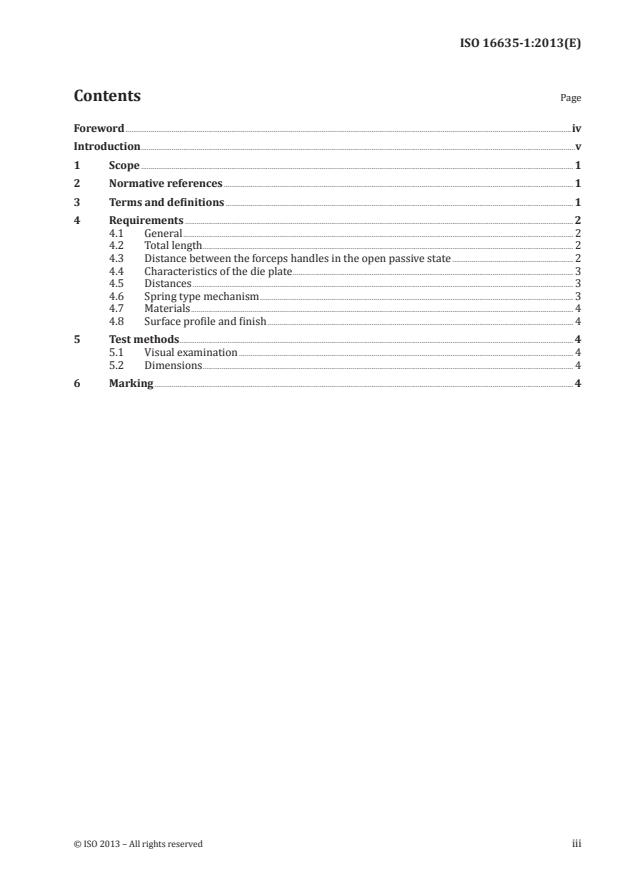

ISO 16635-1:2013 - Dentistry — Dental rubber dam technique — Part 1: Hole punch Released:3/21/2013

ISO 16635-1:2013 - Médecine bucco-dentaire — Technique de la digue dentaire en caoutchouc — Partie 1: Pinces a percer la digue Released:12/13/2013
Overview
ISO 16635-1:2013 sets forth international requirements and test methods for hole punches used in dental rubber dam techniques. This standard is part one of the ISO 16635 series dedicated to instruments for dental rubber dams, specifically focusing on the hole punch tool. Dental rubber dams are essential in isolating teeth during dental procedures, improving treatment efficacy and infection control. The hole punch enables precise perforation of the rubber dam material, facilitating proper placement around teeth. ISO 16635-1 ensures that these instruments meet strict safety, dimensional, material, and performance criteria for consistent clinical use.
Key Topics
Scope and Application
Defines the use of hole punches intended for dental rubber dams made from elastic rubber sheets. It includes specifications for dimensions, mechanical function, and materials.Terms and Definitions
Clarifies key concepts such as:- Dental rubber dam
- Hole punch (pince emporte-pièce)
- Punch matrix and punch pin
- Insertion depth and opening width
Dimensional Requirements
- Total length: 165 ± 5 mm
- Max handle opening: ≤ 95 mm (ensures ease of use for different hand sizes)
- Punch matrix holes: Options for 6 or 8 holes ranging from 0.5 mm to 2.6 mm in diameter with uniform spacing
- Insertion depth: between 20 mm and 70 mm to accommodate various rubber dam thicknesses
Mechanical Features
- Spring mechanism to keep punch open by default, with a gap of at least 2.5 mm between punch tip and matrix surface
- Adjustable punch matrix that locks precisely to enable accurate hole placement
Material and Surface Quality
- Hole punches must be crafted from corrosion-resistant martensitic stainless steel (per ISO 15510)
- Punch matrix hardness requirements: 48–55 HRC or 600–720 HV1 for durability and sharpness
- Smooth, polished surfaces free from defects such as pores, cracks, or residues for hygiene and function
Marking
Each instrument must be clearly marked with:- Manufacturer name or brand
- Model/reference number
- Batch or lot number
Test Methods
Standardized visual examinations and dimensional measurements ensure compliance with the specifications using calibrated tools like micrometers and calipers.
Applications
ISO 16635-1:2013 applies primarily in dental clinics and laboratories where rubber dam isolation is routine. The standardized hole punch:
- Enhances accuracy in perforating rubber dams for optimal fit around teeth
- Improves efficiency in preparation of rubber dams, saving clinical time
- Supports infection control by ensuring the integrity and cleanliness of instruments
- Enables compatibility across different manufacturers and types of rubber dam materials
- Facilitates safe handling with ergonomic size and spring mechanics accommodating various hand sizes
This standard benefits dental professionals including general dentists, endodontists, and dental assistants by providing reliable, high-quality tools for predictable treatment outcomes.
Related Standards
- ISO 16635-2 – Dentistry - Dental rubber dam technique - Part 2: Clamp holder (pince porte-crampon), complementary to Part 1 focusing on clamp placement instruments.
- ISO 1942 – Dentistry - Vocabulary, providing terminology definitions referenced in ISO 16635-1.
- ISO 15510 – Stainless steels - Chemical composition, specifying materials for dental instruments.
- ISO 6507-1 and ISO 6508-1 – Metal hardness testing methods (Vickers and Rockwell), used for testing dental punch materials.
By adhering to ISO 16635-1:2013, manufacturers and dental professionals ensure hole punch instruments meet global quality and safety standards, supporting optimal dental rubber dam application and patient care.
Relations
- Effective Date
- 09-Feb-2026
Buy Documents
ISO 16635-1:2013 - Dentistry — Dental rubber dam technique — Part 1: Hole punch Released:3/21/2013
ISO 16635-1:2013 - Médecine bucco-dentaire — Technique de la digue dentaire en caoutchouc — Partie 1: Pinces a percer la digue Released:12/13/2013
Get Certified
Connect with accredited certification bodies for this standard

BSI Group
BSI (British Standards Institution) is the business standards company that helps organizations make excellence a habit.

TÜV Rheinland
TÜV Rheinland is a leading international provider of technical services.

TÜV SÜD
TÜV SÜD is a trusted partner of choice for safety, security and sustainability solutions.
Sponsored listings
Frequently Asked Questions
ISO 16635-1:2013 is a standard published by the International Organization for Standardization (ISO). Its full title is "Dentistry — Dental rubber dam technique — Part 1: Hole punch". This standard covers: ISO 16635-1:2013 specifies requirements and test methods for hole punches for dental rubber dams.
ISO 16635-1:2013 specifies requirements and test methods for hole punches for dental rubber dams.
ISO 16635-1:2013 is classified under the following ICS (International Classification for Standards) categories: 11.060.20 - Dental equipment. The ICS classification helps identify the subject area and facilitates finding related standards.
ISO 16635-1:2013 has the following relationships with other standards: It is inter standard links to EN ISO 16635-2:2014. Understanding these relationships helps ensure you are using the most current and applicable version of the standard.
ISO 16635-1:2013 is available in PDF format for immediate download after purchase. The document can be added to your cart and obtained through the secure checkout process. Digital delivery ensures instant access to the complete standard document.
Standards Content (Sample)
INTERNATIONAL ISO
STANDARD 16635-1
First edition
2013-04-01
Dentistry — Dental rubber dam
technique —
Part 1:
Hole punch
Médecine bucco-dentaire — Technique de la digue dentaire en
caoutchouc —
Partie 1: Pinces à percer la digue
Reference number
©
ISO 2013
© ISO 2013
All rights reserved. Unless otherwise specified, no part of this publication may be reproduced or utilized otherwise in any form
or by any means, electronic or mechanical, including photocopying, or posting on the internet or an intranet, without prior
written permission. Permission can be requested from either ISO at the address below or ISO’s member body in the country of
the requester.
ISO copyright office
Case postale 56 • CH-1211 Geneva 20
Tel. + 41 22 749 01 11
Fax + 41 22 749 09 47
E-mail copyright@iso.org
Web www.iso.org
Published in Switzerland
ii © ISO 2013 – All rights reserved
Contents Page
Foreword .iv
Introduction .v
1 Scope . 1
2 Normative references . 1
3 Terms and definitions . 1
4 Requirements . 2
4.1 General . 2
4.2 Total length. 2
4.3 Distance between the forceps handles in the open passive state . 2
4.4 Characteristics of the die plate . 3
4.5 Distances . 3
4.6 Spring type mechanism . 3
4.7 Materials . 4
4.8 Surface profile and finish . 4
5 Test methods . 4
5.1 Visual examination . 4
5.2 Dimensions . 4
6 Marking . 4
Foreword
ISO (the International Organization for Standardization) is a worldwide federation of national standards
bodies (ISO member bodies). The work of preparing International Standards is normally carried out
through ISO technical committees. Each member body interested in a subject for which a technical
committee has been established has the right to be represented on that committee. International
organizations, governmental and non-governmental, in liaison with ISO, also take part in the work.
ISO collaborates closely with the International Electrotechnical Commission (IEC) on all matters of
electrotechnical standardization.
International Standards are drafted in accordance with the rules given in the ISO/IEC Directives, Part 2.
The main task of technical committees is to prepare International Standards. Draft International
Standards adopted by the technical committees are circulated to the member bodies for voting.
Publication as an International Standard requires approval by at least 75 % of the member bodies
casting a vote.
Attention is drawn to the possibility that some of the elements of this document may be the subject of
patent rights. ISO shall not be held responsible for identifying any or all such patent rights.
ISO 16635-1 was prepared by Technical Committee ISO/TC 106, Dentistry, Subcommittee SC 4,
Dental instruments.
ISO 16635 consists of the following parts, under the general title Dentistry — Dental rubber dam technique:
— Part 1: Hole punch
— Part 2: Clamp forceps
iv © ISO 2013 – All rights reserved
Introduction
In order to facilitate the use of dental rubber dam, standardization of the required instruments and
materials is necessary.
In dental practice hole punches do not come into direct contact with the patient, provided
...
NORME ISO
INTERNATIONALE 16635-1
Première édition
2013-04-01
Médecine bucco-dentaire — Technique
de la digue dentaire en caoutchouc —
Partie 1:
Pinces à percer la digue
Dentistry — Dental rubber dam technique —
Part 1: Hole punch
Numéro de référence
©
ISO 2013
DOCUMENT PROTÉGÉ PAR COPYRIGHT
© ISO 2013
Droits de reproduction réservés. Sauf indication contraire, aucune partie de cette publication ne peut être reproduite ni utilisée
sous quelque forme que ce soit et par aucun procédé, électronique ou mécanique, y compris la photocopie, l’affichage sur
l’internet ou sur un Intranet, sans autorisation écrite préalable. Les demandes d’autorisation peuvent être adressées à l’ISO à
l’adresse ci-après ou au comité membre de l’ISO dans le pays du demandeur.
ISO copyright office
Case postale 56 • CH-1211 Geneva 20
Tel. + 41 22 749 01 11
Fax + 41 22 749 09 47
E-mail copyright@iso.org
Web www.iso.org
Publié en Suisse
ii © ISO 2013 – Tous droits réservés
Sommaire Page
Avant-propos .iv
Introduction .v
1 Domaine d’application . 1
2 Références normatives . 1
3 Termes et définitions . 1
4 Exigences . 2
4.1 Généralités . 2
4.2 Longueur totale . 2
4.3 Écartement des poignées de la pince à l’état passif, ouvert . 3
4.4 Caractéristiques de la matrice de perforation . 3
4.5 Distances . 3
4.6 Mécanisme de type ressort. 4
4.7 Matériaux . 4
4.8 Profil de surface et état de surface . 4
5 Méthodes d’essai . 4
5.1 Examen visuel . 4
5.2 Dimensions . 4
6 Marquage . 5
Avant-propos
L’ISO (Organisation internationale de normalisation) est une fédération mondiale d’organismes
nationaux de normalisation (comités membres de l’ISO). L’élaboration des Normes internationales est
en général confiée aux comités techniques de l’ISO. Chaque comité membre intéressé par une étude
a le droit de faire partie du comité technique créé à cet effet. Les organisations internationales,
gouvernementales et non gouvernementales, en liaison avec l’ISO participent également aux travaux.
L’ISO collabore étroitement avec la Commission électrotechnique internationale (CEI) en ce qui concerne
la normalisation électrotechnique.
Les Normes internationales sont rédigées conformément aux règles données dans les Directives
ISO/CEI, Partie 2.
La tâche principale des comités techniques est d’élaborer les Normes internationales. Les projets de
Normes internationales adoptés par les comités techniques sont soumis aux comités membres pour vote.
Leur publication comme Normes internationales requiert l’approbation de 75 % au moins des comités
membres votants.
L’attention est appelée sur le fait que certains des éléments du présent document peuvent faire l’objet de
droits de propriété intellectuelle ou de droits analogues. L’ISO ne saurait être tenue pour responsable de
ne pas avoir identifié de tels droits de propriété et averti de leur existence.
L’ISO 16635-1 a été élaborée par le comité technique ISO/TC 106, Médecine bucco-dentaire, sous-comité
SC 4, Instruments dentaires.
L’ISO 16635 comprend les parties suivantes, présentées sous le titre général Médecine bucco-dentaire —
Technique de la digue dentaire en caoutchouc :
— Partie 1: Pince emporte-pièce
— Partie 2: Pince porte-crampon
iv © ISO 2013 – Tous droits réservés
Introduction
En vue de rendre plus aisée l’utilisation de digues dentaires en caoutchouc, il est nécessaire de normaliser
les instruments et matériaux requis.
En pratique bucco-dentaire, les pinces emporte-pièce n’entrent pas en contact direct avec le patient
lorsqu’elles sont utilisées suivant leur destination.
NORME INTERNATIONALE ISO 16635-1:2013(F)
Médecine bucco-dentaire — Technique de la digue
dentaire en caoutchouc —
Partie 1:
Pinces à percer la digue
1 Domaine d’application
La présente partie de l’ISO 16635 spécifie des exigences et des méthodes d’essai relatives aux pinces
emporte-pièce destinées à être utilisées pour des digues dentaires en caoutchouc.
2 Références normatives
Les documents suivants, en totalité ou en partie, sont référencés de manière normative dans le présent
document et sont indispensables pour son application. Pour les références datées, seule l’édition citée
s’applique. Pour les références non
...