

ISO/TR 23476:2021
(Main)Ergonomics — Application of ISO 11226, the ISO 11228 series and ISO/TR 12295 in the agricultural sector
General Information
- Abstract
This document is intended to be used alongside ISO/TR 12295, ISO 11226 and the ISO 11228 series in the agricultural sector. This document gives information on how existing standards can be used in a global sector such as agriculture where, albeit with different characteristics, biomechanical overload is a relevant aspect, WMSDs are common and specific preventive actions are needed. The proposed project aims to: 1) define the user(s) and fields for its application (including non-experts in ergonomics); 2) provide examples of procedures for hazard identification, risk estimation or evaluation and risk reduction in different agricultural settings, through: — more synthetic procedural schemes (main test); — more analytical explanations of the procedures, through mathematical models and application examples, also with the use of specific free simple tools, in: — Annex A (pre-mapping with ERGOCHECK); — Annex B (evaluation of Multitask risk of biomechanical overload on typical agricultural macro-cycles, considering upper limbs repetitive movements, manual lifting and carrying, pushing-pulling); — Annex C (study of awkward postures with criteria derived from the actual standards and scientific literature as TACOS method).
- Status
- Published
- Publication Date
- 15-Jun-2021
- Technical Committee
- ISO/TC 159/SC 3 - Anthropometry and biomechanics
- Current Stage
- 6060 - International Standard published
- Start Date
- 16-Jun-2021
- Due Date
- 10-Sep-2021
- Completion Date
- 16-Jun-2021
Buy Documents

ISO/TR 23476:2021 - Ergonomics — Application of ISO 11226, the ISO 11228 series and ISO/TR 12295 in the agricultural sector Released:6/16/2021

ISO/TR 23476:2021 - Ergonomics — Application of ISO 11226, the ISO 11228 series and ISO/TR 12295 in the agricultural sector/16/2021
Overview
ISO/TR 23476:2021 - Ergonomics - Application of ISO 11226, the ISO 11228 series and ISO/TR 12295 in the agricultural sector - is a technical report that explains how existing ergonomic standards can be applied in agricultural contexts. It focuses on preventing biomechanical overload and work‑related musculoskeletal disorders (WMSDs) in multi‑task, seasonal and year‑long farm work. The document is written to be usable by ergonomics experts and non‑experts (e.g., farm managers, SMEs, occupational health practitioners) and references simple, non‑commercial tools (spreadsheet tools, ERGOCHECK) to support risk estimation.
Key topics and technical requirements
- Scope and purpose: Guidance to apply ISO 11226, the ISO 11228 series (Parts 1–3) and ISO/TR 12295 specifically within agricultural settings where multi‑task macro‑cycles are common.
- Multi‑task / macro‑cycle analysis: Methods for mapping and analysing tasks distributed over weekly, monthly or annual cycles (macrocycles), including defining homogeneous worker groups and typical daily/monthly workloads.
- Hazard identification & pre‑mapping: Rapid screening using key questions and a pre‑mapping model (Annex A) supported by ERGOCHECK and simple spreadsheet tools.
- Analytical risk evaluation: Use of established observational and mathematical models to quantify exposure to: repetitive upper‑limb actions, manual material handling (lifting, carrying), pushing/pulling, and awkward/static postures (Annex B).
- Posture assessment: Criteria and timing‑based posture evaluation using standards‑derived approaches and the TACOS method for spine and lower limb postures (Annex C).
- Multi‑day/multi‑task tools: Application of the OCRA checklist for multitask repetitive exposure and construction of “artificial working days” to represent annual exposure.
- Practical risk reduction: Procedures and procedural schemes for identification, risk estimation and risk reduction adapted to agricultural realities (smallholdings to industrial farms).
Practical applications and users
- Who uses it: Ergonomists, occupational health and safety professionals, farm owners/managers, agricultural engineers, SMEs, and labour inspectors. The report is intentionally accessible to non‑experts.
- Where to apply: Crop production, seasonal harvesting, planting, greenhouse work, packing/processing lines, and other farm activities with repetitive tasks, manual handling, pushing/pulling or prolonged postures.
- Benefits: Enables systematic assessment of biomechanical overload across seasonal cycles, supports targeted preventive measures, and helps prioritize ergonomic interventions to reduce WMSDs among agricultural workers.
Related standards
- ISO 11226 - Static working postures
- ISO 11228 series - Manual handling (Part 1: lifting and carrying; Part 2: pushing and pulling; Part 3: low loads at high frequency)
- ISO/TR 12295 - Application guidance and simple risk assessment for small enterprises
Keywords: ISO/TR 23476:2021, ergonomics, agriculture, biomechanical overload, WMSDs, ISO 11226, ISO 11228, ISO/TR 12295, OCRA, TACOS, ERGOCHECK, manual handling, multi‑task analysis.
Buy Documents
ISO/TR 23476:2021 - Ergonomics — Application of ISO 11226, the ISO 11228 series and ISO/TR 12295 in the agricultural sector Released:6/16/2021
ISO/TR 23476:2021 - Ergonomics — Application of ISO 11226, the ISO 11228 series and ISO/TR 12295 in the agricultural sector/16/2021
Get Certified
Connect with accredited certification bodies for this standard

CIS Institut d.o.o.
Personal Protective Equipment (PPE) certification body. Notified Body NB-2890 for EU Regulation 2016/425 PPE.

Kiwa BDA Testing
Building and construction product certification.
Kmetijski inštitut Slovenije
Agricultural Institute of Slovenia. Soil testing, plant health, agricultural product analysis.
Sponsored listings
Frequently Asked Questions
ISO/TR 23476:2021 is a technical report published by the International Organization for Standardization (ISO). Its full title is "Ergonomics — Application of ISO 11226, the ISO 11228 series and ISO/TR 12295 in the agricultural sector". This standard covers: This document is intended to be used alongside ISO/TR 12295, ISO 11226 and the ISO 11228 series in the agricultural sector. This document gives information on how existing standards can be used in a global sector such as agriculture where, albeit with different characteristics, biomechanical overload is a relevant aspect, WMSDs are common and specific preventive actions are needed. The proposed project aims to: 1) define the user(s) and fields for its application (including non-experts in ergonomics); 2) provide examples of procedures for hazard identification, risk estimation or evaluation and risk reduction in different agricultural settings, through: — more synthetic procedural schemes (main test); — more analytical explanations of the procedures, through mathematical models and application examples, also with the use of specific free simple tools, in: — Annex A (pre-mapping with ERGOCHECK); — Annex B (evaluation of Multitask risk of biomechanical overload on typical agricultural macro-cycles, considering upper limbs repetitive movements, manual lifting and carrying, pushing-pulling); — Annex C (study of awkward postures with criteria derived from the actual standards and scientific literature as TACOS method).
This document is intended to be used alongside ISO/TR 12295, ISO 11226 and the ISO 11228 series in the agricultural sector. This document gives information on how existing standards can be used in a global sector such as agriculture where, albeit with different characteristics, biomechanical overload is a relevant aspect, WMSDs are common and specific preventive actions are needed. The proposed project aims to: 1) define the user(s) and fields for its application (including non-experts in ergonomics); 2) provide examples of procedures for hazard identification, risk estimation or evaluation and risk reduction in different agricultural settings, through: — more synthetic procedural schemes (main test); — more analytical explanations of the procedures, through mathematical models and application examples, also with the use of specific free simple tools, in: — Annex A (pre-mapping with ERGOCHECK); — Annex B (evaluation of Multitask risk of biomechanical overload on typical agricultural macro-cycles, considering upper limbs repetitive movements, manual lifting and carrying, pushing-pulling); — Annex C (study of awkward postures with criteria derived from the actual standards and scientific literature as TACOS method).
ISO/TR 23476:2021 is classified under the following ICS (International Classification for Standards) categories: 13.180 - Ergonomics. The ICS classification helps identify the subject area and facilitates finding related standards.
ISO/TR 23476:2021 is available in PDF format for immediate download after purchase. The document can be added to your cart and obtained through the secure checkout process. Digital delivery ensures instant access to the complete standard document.
Standards Content (Sample)
TECHNICAL ISO/TR
REPORT 23476
First edition
2021-06
Ergonomics — Application of ISO
11226, the ISO 11228 series and ISO/
TR 12295 in the agricultural sector
Reference number
©
ISO 2021
© ISO 2021
All rights reserved. Unless otherwise specified, or required in the context of its implementation, no part of this publication may
be reproduced or utilized otherwise in any form or by any means, electronic or mechanical, including photocopying, or posting
on the internet or an intranet, without prior written permission. Permission can be requested from either ISO at the address
below or ISO’s member body in the country of the requester.
ISO copyright office
CP 401 • Ch. de Blandonnet 8
CH-1214 Vernier, Geneva
Phone: +41 22 749 01 11
Email: copyright@iso.org
Website: www.iso.org
Published in Switzerland
ii © ISO 2021 – All rights reserved
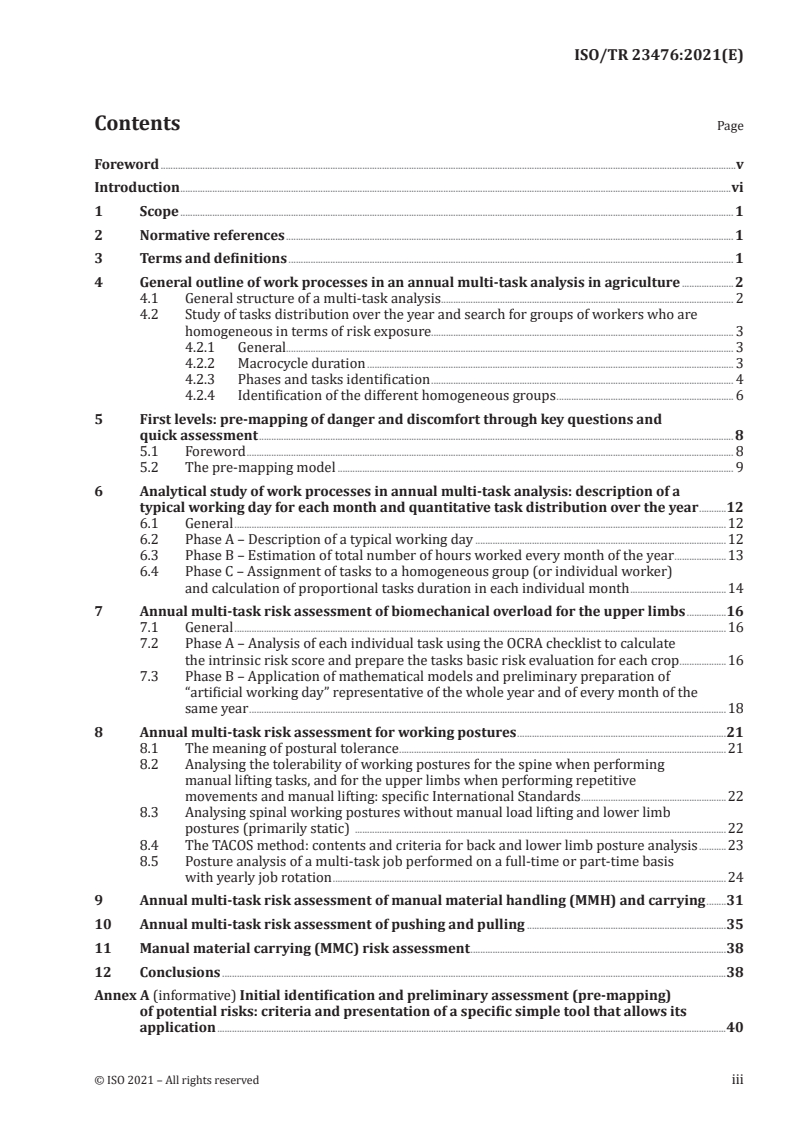
Contents Page
Foreword .v
Introduction .vi
1 Scope . 1
2 Normative references . 1
3 Terms and definitions . 1
4 General outline of work processes in an annual multi-task analysis in agriculture .2
4.1 General structure of a multi-task analysis. 2
4.2 Study of tasks distribution over the year and search for groups of workers who are
homogeneous in terms of risk exposure. 3
4.2.1 General. 3
4.2.2 Macrocycle duration . 3
4.2.3 Phases and tasks identification . 4
4.2.4 Identification of the different homogeneous groups . 6
5 First levels: pre-mapping of danger and discomfort through key questions and
quick assessment . 8
5.1 Foreword . 8
5.2 The pre-mapping model . 9
6 Analytical study of work processes in annual multi-task analysis: description of a
typical working day for each month and quantitative task distribution over the year .12
6.1 General .12
6.2 Phase A – Description of a typical working day .12
6.3 Phase B – Estimation of total number of hours worked every month of the year .13
6.4 Phase C – Assignment of tasks to a homogeneous group (or individual worker)
and calculation of proportional tasks duration in each individual month .14
7 Annual multi-task risk assessment of biomechanical overload for the upper limbs .16
7.1 General .16
7.2 Phase A – Analysis of each individual task using the OCRA checklist to calculate
the intrinsic risk score and prepare the tasks basic risk evaluation for each crop .16
7.3 Phase B – Application of mathematical models and preliminary preparation of
“artificial working day” representative of the whole year and of every month of the
same year .18
8 Annual multi-task risk assessment for working postures .21
8.1 The meaning of postural tolerance .21
8.2 Analysing the tolerability of working postures for the spine when performing
manual lifting tasks, and for the upper limbs when performing repetitive
movements and manual lifting: specific International Standards .22
8.3 Analysing spinal working postures without manual load lifting and lower limb
postures (primarily static) .22
8.4 The TACOS method: contents and criteria for back and lower limb posture analysis .23
8.5 Posture analysis of a multi-task job performed on a full-time or part-time basis
with yearly job rotation .24
9 Annual multi-task risk assessment of manual material handling (MMH) and carrying .31
10 Annual multi-task risk assessment of pushing and pulling .35
11 Manual material carrying (MMC) risk assessment .38
12 Conclusions .38
Annex A (informative) Initial identification and preliminary assessment (pre-mapping)
of potential risks: criteria and presentation of a specific simple tool that allows its
application .40
Annex B (informative) Criteria and mathematical models for analysing exposure to
biomechanical overload in multitask jobs featuring complex macro-cycles (e.g.
weekly, monthly, annual turnover) .69
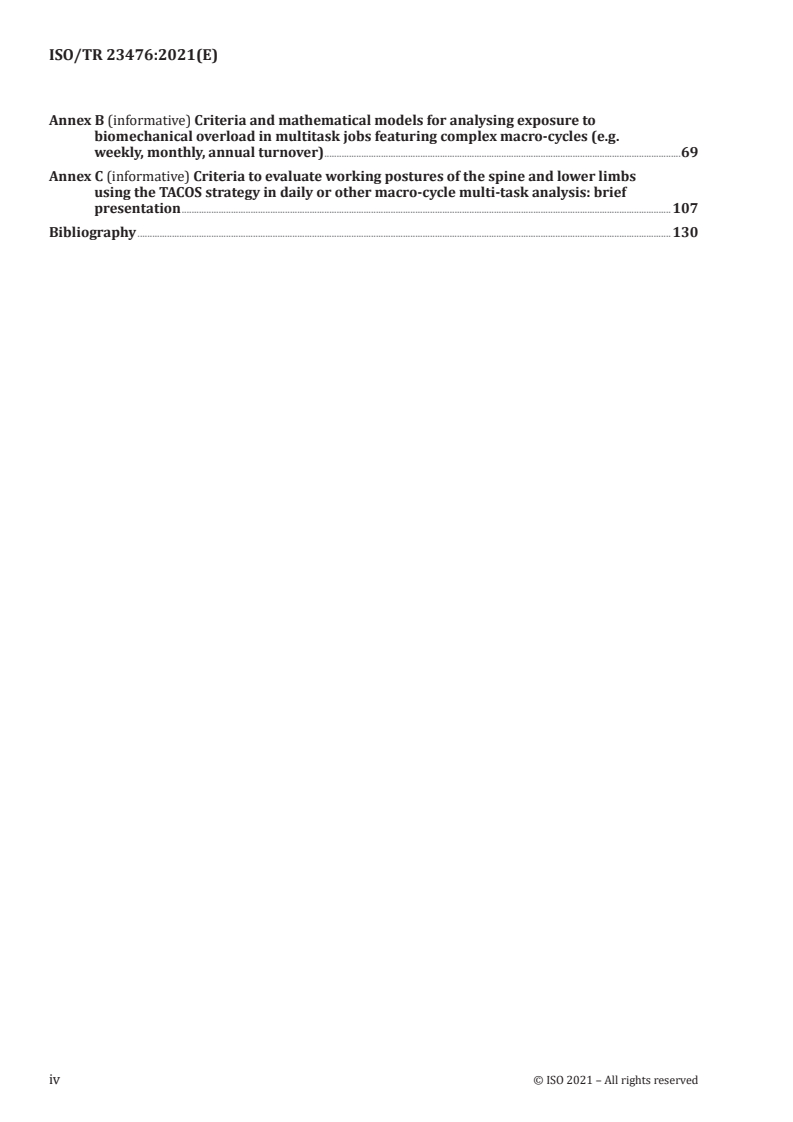
Annex C (informative) Criteria to evaluate working postures of the spine and lower limbs
using the TACOS strategy in daily or other macro-cycle multi-task analysis: brief
presentation .107
Bibliography .130
iv © ISO 2021 – All rights reserved
Foreword
ISO (the International Organization for Standardization) is a worldwide federation of national standards
bodies (ISO member bodies). The work of preparing International Standards is normally carried out
through ISO technical committees. Each member body interested in a subject for which a technical
committee has been established has the right to be represented on that committee. International
organizations, governmental and non-governmental, in liaison with ISO, also take part in the work.
ISO collaborates closely with the International Electrotechnical Commission (IEC) on all matters of
electrotechnical standardization.
The procedures used to develop this document and those intended for its further maintenance are
described in the ISO/IEC Directives, Part 1. In particular, the different approval criteria needed for the
different types of ISO documents should be noted. This document was drafted in accordance with the
editorial rules of the ISO/IEC Directives, Part 2 (see www .iso .org/ directives).
Attention is drawn to the possibility that some of the elements of this document may be the subject of
patent rights. ISO shall not be held responsible for identifying any or all such patent rights. Details of
any patent rights identified during the development of the document will be in the Introduction and/or
on the ISO list of patent declarations received (see www .iso .org/ patents).
Any trade name used in this document is information given for the convenience of users and does not
constitute an endorsement.
For an explanation of the voluntary nature of standards, the meaning of ISO specific terms and
expressions related to conformity assessment, as well as information about ISO's adherence to the
World Trade Organization (WTO) principles in the Technical Barriers to Trade (TBT), see www .iso .org/
iso/ foreword .html.
This document was prepared by Technical Committee ISO/TC 159, Ergonomics, Subcommittee SC 3,
Anthropometry and biomechanics.
Any feedback or questions on this document should be directed to the user’s national standards body. A
complete listing of these bodies can be found at www .iso .org/ members .html.
Introduction
Agriculture is by far the biggest working sector in the world. It is estimated that 2,6 billion people or
40 % of the world's population are farmers. Agriculture is one of the most hazardous sectors in both
the developing and the developed worlds. Work-related musculoskeletal disorders (WMSDs) are the
most common work-related diseases in farmers. In Europe more than 50 % of farmers report disorders
of their lower back or limbs related to their working conditions. WMSDs are caused mainly by manual
handling, heavy physical work, awkward postures and repetitive movements. Increasing attention is
being drawn to the application of practical actions in agricultural settings to help reduce work-related
accidents and illness and WMSDs in particular. ISO 11226, the ISO 11228 series and, more recently,
ISO/TR 12295 are useful for this specific scope.
Experiences in the application of these standards have been acquired in different parts of the world, but
rarely in agriculture. This document extends the scope and methods included in existing standards to
different agricultural contexts (e.g. smallholdings, industrialized farms) based on emerging application
experiences. Special attention is devoted to rendering this document accessible also to non-experts.
Reference is made to easily applicable, non-commercial online tools (simple tools in spreadsheets)
that may be useful for the purposes of this document, making possible the application of the criteria
provided here and therefore the real numerical estimate of the biomechanical overload risks.
The ISO 11228 series, ISO 11226 and ISO/TR 12295 establish ergonomic recommendations for
different manual handling tasks, repetitive movements and working postures. All their parts apply
to occupational and non-occupational activities. The standards provide information for designers,
employers, employees and others involved in work, job and product design, such as occupational health
and safety professionals.
ISO 11228 series consists of the following parts, under the general title Ergonomics — Manual handling:
— Part 1: Lifting and carrying;
— Part 2: Pushing and pulling;
— Part 3: Handling of low loads at high frequency.
ISO 11226 provides recommended limits for static working postures with no or minimal external force
exertion, while taking into account body angles and duration.
ISO/TR 12295 serves as an application guide of the ISO 11228 series and ISO 11226. It offers a simple
risk assessment methodology for small and medium enterprises and for non-professional active.
This document is intended to be used alongside ISO/TR 12295, ISO 11226 and the ISO 11228 series in
the agricultural sector, where the risk from biomechanical work overload from repetitive movements,
from manual handling of loads, from towing and pushing carts and awkward postures is universally
present.
In addition to having deeply used the standards previously mentioned, an extensive review of the
literature on methods for risk assessment of biomechanical overload applied in the agricultural setting
for the prevention of musculoskeletal disorders (MSDs) has been conducted, of which the most salient
data are reported.
Regarding crop production (not cattle), the assessment of biomechanical exposures at work results in
800 studies where 58 studies were selected on the basis of title and abstract. Only studies regarding
crop production and reporting on risk assessment of biomechanical exposures at work were included in
the analysis.
The design of the selected studies was mostly cross-sectional (70 %) and Asia was the world region
from where the majority of the studies came (41 %). In addition, 10 studies were carried out in South
America, 13 in North America (Canada and the USA), 10 in Europe and two in Africa. Most of the selected
studies were field studies (68 %); only 8 % were carried out in a laboratory and seven studies were
classified as surveys.
vi © ISO 2021 – All rights reserved
Regarding the applied methods, 14 studies used direct measurements (e.g. electromyography,
accelerometer) and 12 studies used different types of questionnaires (self-compiled or filled in by an
Ergonomist).
[45]
Six studies used the RULA (Rapid Upper Limb Assessment) method.
[42]
OWAS (Ovako Working Posture Analysing System) was used as a risk assessment method in five
studies.
[21],[22]
The OCRA (Occupational Repetitive Actions ) checklist, the REBA (Rapid Entire Body Assessment)
[39] [29]
method and the QEC (Quick Exposure Check) method were used in nine studies (three studies).
Most of the applied methods are observational and attention is drawn to the problems related to their
reliability, especially when the movements are fast.
These studies represent a summary of the papers published in the last decade in the agriculture sector.
The available research has shown a lack of high-quality studies (generally using statistical “prospective”
studies) to evaluate the dose-response relationship between the level of biomechanical exposure at
work and the outcome (MSDs). It is necessary to consider in fact that, given the lack of results of clinical
studies in agriculture (due to the widespread difficulty in subjecting workers to health surveillance),
occupational exposure limits connected with the probability of generating MSDs in the agricultural
setting are not available.
[22]
The OCRA checklist method, in its multi-day cycle risk assessment version, is currently the only
risk assessment method available in literature capable of offering criteria and application experiences
to address multitask analysis (supported by a specific simple tool in the form of free download
spreadsheets for final risk calculation).
ISO/TR 12295 had already adopted this multitask method of exposure analysis.
Clinical evaluation of exposed workers, conducted in multitask studies in agriculture with the OCRA
method and with other methods, are still limited to few longitudinal studies due to great difficulty in
having case studies subjected to health control, as there are rarely fixed-term workers, but more often
seasonal workers, with high turnover, without regular work contracts and underpaid. For this reason,
the prospective studies are difficult and very rarely can be concluded.
After all, the development of a method capable of predicting the appearance of pathologies (real risk
assessment method) can be conquered only after years of use and improvement. The development of
a new TR which, offering evaluation solutions for biomechanical overload study in agriculture, can
stimulate many more valid epidemiological studies in the future, is therefore desirable. The concept of
doing nothing, while waiting for sufficient and perfect published methods, means not doing prevention.
The NIOSH itself, due to the formula for calculating the lifting index (LI), changed the maximum limit
value of its first formula several times over the years, through years of application experience. Recently
the NIOSH added the formula for calculating the variable lifting index (VLI) for the evaluation of
[20],[63]
manual lifting tasks of complex loads, with many different weights and geometries . The gained
experience in this type of analysis was introduced in ISO/TR 12295 and ISO 11228-1.
For the study of working postures it is important to point out the new TACOS (Timing Assessment
[24]
Computerized Strategy for posture) strategy, which adds to all the experience gained from the
RULA and REBA methods and from ISO 11226, a more adequate timing assessment (therefore not only
qualitative studies of work postures, but also studies of their real duration).
The mathematical criterion for the extension of the calculation of any risk factors for the study of
biomechanical overload, not only for the working day cycle but also for cycles different in duration (e.g.
annual cultivation cycles) was also discussed within a specifically activated writing group of experts
for the preparation of this document. The transition is indispensable for the extension of the evaluation
models already present in the specific International Standards (all used in this document) to the risk
evaluation in multitask exposition with annual turnover needed for risk studies in agriculture (see
Annex B).
Any other risk assessment methods that include a multitask analysis procedure can adopt the criteria
here proposed, extending multitask annual exposure risk study, for instance to:
— repetitive movements (e.g. strain index, method present in ISO 11228-3);
— manual handling of loads (NIOSH formula in ISO 11228-1).
viii © ISO 2021 – All rights reserved
TECHNICAL REPORT ISO/TR 23476:2021(E)
Ergonomics — Application of ISO 11226, the ISO 11228
series and ISO/TR 12295 in the agricultural sector
1 Scope
This document is intended to be used alongside ISO/TR 12295, ISO 11226 and the ISO 11228 series in
the agricultural sector. This document gives information on how existing standards can be used in a
global sector such as agriculture where, albeit with different characteristics, biomechanical overload is
a relevant aspect, WMSDs are common and specific preventive actions are needed.
The proposed project aims to:
1) define the user(s) and fields for its application (including non-experts in ergonomics);
2) provide examples of procedures for hazard identification, risk estimation or evaluation and risk
reduction in different agricultural settings, through:
— more synthetic procedural schemes (main test);
— more analytical explanations of the procedures, through mathematical models and application
examples, also with the use of specific free simple tools, in:
— Annex A (pre-mapping with ERGOCHECK);
— Annex B (evaluation of Multitask risk of biomechanical overload on typical agricultural
macro-cycles, considering upper limbs repetitive movements, manual lifting and carrying,
pushing-pulling);
— Annex C (study of awkward postures with criteria derived from the actual standards and
scientific literature as TACOS method).
2 Normative references
There are no normative references in this document.
3 Terms and definitions
No terms and definitions are listed in this document.
ISO and IEC maintain terminological databases for use in standardization at the following addresses:
— ISO Online browsing platform: available at https:// www .iso .org/ obp
— IEC Electropedia: available at http:// www .electropedia .org/
4 General outline of work processes in an annual multi-task analysis in
agriculture
4.1 General structure of a multi-task analysis
Specifically, this document provides additional information to aid the user in the selection and use of
the appropriate standards. Depending upon whether specific risks are present, it is intended to help the
user to decide which standards to apply. It will include three levels of approach (Figure 1):
— First level: the “participatory approach” for pre-mapping of danger and discomfort provides all
users, particularly those who are not experts in ergonomics, with criteria and procedures to identify
situations in which they may apply the ISO 11228 series, ISO 11226 and ISO/TR 12295 in different
agricultural settings (key-enter and key-questions level). Only in the early analytical stage is the
opportunity offered to map, even if only using subjective data obtained by interviewing the workers
(through the identification of groups of workers, homogeneous for exposure to occupational risks),
all the occupational hazards and not just the risk of biomechanical overload.
— Second level: provides a “quick assessment method” (according to the criteria provided in
ISO/TR 12295) for easily recognizing activities that are “definitely acceptable or definitely critical”.
If an activity is “neither definitely acceptable nor definitely critical”, it is necessary to complete
a detailed risk-assessment as set out in the standards, continuing with the necessary subsequent
preventive actions.
— Third level: refer to detailed methods for risk assessment set out in the relevant standards when the
quick assessment method shows that the activity risk falls between the two exposure conditions
(definitely acceptable or definitely critical).
The above approaches and scopes are illustrated in the flowchart in Figure 1 and are described in the
main text of ISO/TR 12295.
At first the user is required to answer a short series of practical questions present in the first and second
level. It is emphasized that the quick-assessment method is best implemented using a participatory
approach involving workers in the enterprise (homogeneous groups of workers).
This involvement is deemed to be essential for effectively setting priorities for dealing with the different
hazard and risk conditions and, where necessary, identifying effective risk reduction measures.
In agriculture evaluation it can be possible to limit the study to the first and second levels, obtaining
sufficient data about occupational risk priorities.
The analytical risk assessment approach (third level) provides all users, especially those experienced
in ergonomics, or familiar with the ISO 11228 series, with details and criteria for applying the risk
assessment methods proposed in the original standards also to agriculture.
This analytical risk assessment approach is fully consistent with the methods proposed in the standards
and does not introduce any changes in the criteria (mathematical model) for risk calculations, defined in
the existing standards (as well expressed in ISO/TR 12295) but only adapts the proposed methodology
to the risk assessment in agriculture.
The proposed additional analyses aim to facilitate the use of the actual standards, making it possible to
extend them to risk assessment in agriculture (Annexes A, B and C).
2 © ISO 2021 – All rights reserved
Figure 1 — Different risk assessment levels according to ISO/TR 12295 for biomechanical
overload estimation
4.2 Study of tasks distribution over the year and search for groups of workers who are
homogeneous in terms of risk exposure
4.2.1 General
In a setting such as agriculture, before starting a risk analysis, it is necessary to define a set of
procedures and criteria for estimating risk in complex situations where workers perform multiple
tasks, variously distributed in qualitative and quantitative terms over the year (annual cycle).
The general risk evaluation process entails a certain number of steps, beginning with:
a) identification of the macrocycle of the many different tasks;
b) analysis of farming tasks to identify tasks performed within the period and obtain a qualitative
definition of the work during each month of the year;
c) identification of one or more homogeneous groups.
4.2.2 Macrocycle duration
Task rotation is when a worker alternates between two or more tasks during a certain period of time;
this situation occurs quite often in modern work organizations and, if properly designed, can represent
one of the most effective strategies for reducing the risk of biomechanical overload.
In special situations, such as in agriculture, where the worker has to perform a large number of tasks
and the tasks are distributed “asymmetrically” over the shift, risk assessments can become extremely
complex. This is why it is necessary to carry out a thorough preliminary study of how the work is
organized. At any rate, the risk analysis process involves different steps, listed further on.
The first step consists in defining the time required to complete the task rotation schedule; this is the
macro-cycle time, which may be daily, weekly, monthly or yearly.
The types of macrocycles durations are infinite, but if there are no simplification criteria that allow us
to estimate the risk, every risk assessment stops and nobody does anything (the excuse being that the
mission is impossible).
The modal macro-cycle periods appear to be, at least in the sectors of agriculture, building construction
and services, accurately representative of job cycles. In agriculture, task rotations are typically annual,
but one can use annual cycles even when multiple cycles of fewer months in each year are repeated
identically (e.g. multiple harvests per year of the same product). In the construction sector there
is generally a yearly cycle for large construction sites, but a monthly cycle (modal) is more frequent
in smaller-scale constructions and civil renovation projects. In other sectors (e.g. logistics for retail
chains, cleaning services, food preparation facilities), the most common rotation scenario is monthly,
while in yet other situations (e.g. supermarkets) tasks can be rotated on a weekly or, occasionally, a
monthly basis.
In summary, some practical suggestions are provided here for using the predefined macro-cycle
(weekly, monthly, yearly), thus certainly simplifying subsequent evaluations:
— If several identical sub-macro-cycles are repeated over the year, use the annual macro-cycle.
— If several identical sub-macro-cycles (e.g. week, fortnight) are repeated within the month and if the
following months are similarly repeated, use the monthly macro-cycle.
Whichever macro-cycle duration is chosen, the criteria and procedures for dealing with the
biomechanical overload risk analysis are the same. Given the extreme activity variability, the
recommendation is, however, to identify and evaluate representative modal scenarios.
4.2.3 Phases and tasks identification
It is not simple to identify farming tasks, which may be very numerous and performed by different
workers or groups of workers. At the outset, therefore, it is necessary to:
a) identify the specific cultivation or crop;
a) break down the crop-growing activities into phases; all relevant tasks must be identified inside
each phase.
The same activity can be carried out in several different ways; each operating method is intended to
be viewed as a separate task and listed accordingly (e.g. pruning with manual tool or pruning with
pneumatic tool).
It is important to note that all the tasks performed at the farm over the year have to be evidenced,
including preparing the soil, applying fertilizers and disinfectants and other seemingly ancillary
activities, regardless of who performs them.
As it is so inherently difficult to identify phases and tasks in the crop growing or cultivation
[21],[22],[25]
process, a kind of universal cultivation system has been developed that will enable even
beginners to conduct a preliminary organizational analysis in an agricultural setting.
It consists of phases (soil preparation, treatment, disinfection and fertilization, planting, intermediate
processes, harvesting) that include a certain number of typical tasks broken down by type, technique
and tools (Table 1).
4 © ISO 2021 – All rights reserved
Table 1 — Principal tasks characterizing a generic cultivation: the universal cultivation system
with tractor
with animals
with manual tools
manual carrying (weight up to max. 3 kg)
Preparation and
treatment of
manual carrying (weight 3 kg)
soil, mechanical
with manual tool and pulling or pushing
weeding
other activities, without tools, with repetitive movements of the upper limbs (without lifting
up to max. 3 kg)
other activities, without tools, with repetitive movements of the upper limbs (with lifting up
to max. 3 kg)
with tractor
manual with machinery
manual with tools
Disinfection,
disinfestation, fer-
with manual tools and pulling or pushing
tilizing, chemical
other activities, without tools, with repetitive movements of the upper limbs (without lifting
weeding
up to max. 3 kg)
other activities, without tools, with repetitive movements of the upper limbs (with lifting up
to max. 3 kg)
automatic with tractor
semi-automatic with tools or machinery
manual with manual tool (product weight up to max. 3 kg)
manual without tools (product weight up to max. 3 kg)
manual with manual tool (product weight over 3 kg)
Planting
manual without tools (product weight over 3 kg)
manual carrying (product weight up to max. 3 kg)
manual carrying (product weight over 3 kg)
with manual tool and pulling or pushing
other activities, without tools, with repetitive movements of the upper limbs (without lifting
up to max. 3 kg)
pruning with manual tools
pruning with pneumatic or electric tools
pruning with chainsaws
manual pruning without tools
Intermediate
manual carrying (weight up to max. 3 kg)
farm work (e.g.
manual carrying (weight 3 kg)
pruning, binding,
thinning)
with manual tool and pulling or pushing
other activities, without tools, with repetitive movements of the upper limbs (without lifting
up to max. 3 kg)
other activities, without tools, with repetitive movements of the upper limbs (with lifting up
to max. 3 kg)
Table 1 (continued)
automatic with tractor
semi-automatic with tools or machinery
manual with manual tool
manual with pneumatic or electric tools
manual without tools
Harvesting of
manual carrying (weight up to max. 3 kg)
crops
manual carrying (weight 3 kg)
with manual tool and pulling or pushing
other activities, without tools, with repetitive movements of the upper limbs (without lifting
up to max. 3 kg)
other activities, without tools, with repetitive movements of the upper limbs (with lifting up
to max. 3 kg)
4.2.4 Identification of the different homogeneous groups
The next step is to assign tasks to an individual worker or group of workers exposed to the same risk,
to identify homogeneous groups. Since the focus of the analysis is the exposure of workers to a set of
conditions determined by the tasks they are assigned to perform, it is first necessary to identify which
homogeneous group of workers are present that need to be examined.
The homogeneous group of workers for risk exposure (as groups of workers homogeneous for working
risks are being defined, not groups of people homogeneous for other factors, such as weight, age,
culture or gender) is the group of workers that performs the same tasks, in the same workplace and
with similar durations (or time patterns) during the selected period (macro-cycle).
Note that a homogeneous group may sometimes be made up of just one person, if no other workers
perform the same tasks qualitatively and quantitatively.
Moreover, if two groups of workers perform the same tasks in the same workplaces but with different
durations or time patterns (e.g. one group works full-time and the other works part-time) the two
groups must be analysed separately.
For instance, typically (as presented in Table 2), a single group of workers may be assigned the job
of actually growing a crop (tasks may include pruning and harvesting) (homogeneous group 1), while
other workers prepare and disinfect the soil, apply fertilizers and so on (homogeneous group 2), as
presented in Table 3.
Homogeneous groups of seasonal workers can also be present, who are called to work only in the
harvesting phase (Table 4).
The assignment of the tasks to a homogeneous group (or individual worker) even just from the
qualitative standpoint (or semiquantitative as here), is not difficult but it is absolutely essential before
conducting the first levels of risk evaluation (key questions and quick assessment level).
To determine the real risk exposure (risk assessment level) it is necessary to study a quantitative
description of all active tasks.
Only after this organizational analysis, can the different risk levels be assessed in terms of repetitive
movements, manual load handling, awkward postures and pushing-pulling.
Table 2 — Example of description of tasks (pruning and harvesting) performed monthly by
homogeneous group 1
Tasks Jan Feb Mar Apr May Jun Jul Aug Sep Oct Nov Dec
Plowing (tractor)
Installing irrigation system
6 © ISO 2021 – All rights reserved
Table 2 (continued)
Tasks Jan Feb Mar Apr May Jun Jul Aug Sep Oct Nov Dec
Planting (manual) 40 % 10 %
Planting (mechanical) 20 % 90 %
Pruning large branches with
chainsaws
Pruning with manual shears 50 % 5 %
MMH of large branches 40 % 30 %
Pruning with manual shears 70 % 70 % 60 % 60 % 60 %
MMH of small branches 20 % 20 % 30 % 30 % 30 %
Manual harvesting on ground 45 % 45 % 45 %
Manual harvesting on ladder 35 % 35 % 35 %
MMH of ladder 10 % 10 % 10 %
Preparing machine to apply ferti-
lizer
Driving tractor
Composting (manual)
Disinfection (manual)
Disinfection (tractor)
Push/pull trolley-large branches 5 % 5 % 5 % 5 % 5 % 5 % 5 %
Push/pull trolley-small branches 5 % 5 % 5 % 5 % 5 % 5 %
Push/pull trolley-fruit boxes 10 % 10 % 10 %
0 100 % 100 % 100 % 100 % 100 % 100 % 100 % 100 % 100 % 100 % 100 %
Table 3 — Example of description of tasks (workers prepare and disinfect the soil, apply
fertilizers) performed monthly by homogeneous group
Task Jan Feb Mar Apr May Jun Jul Aug Sep Oct Nov Dec
Plowing (tractor) 40 % 20 % 20 % 20 % 40 % 30 % 30 % 30 % 100 % 20 % 20 %
Installing irrigation system 20 %
Planting (manual)
Planting (mechanical) 20 % 20 %
Pruning large branches with chainsaws
Pruning with manual shears
MMH of large branches
Pruning with manual shears
MMH of small branches
Manual harvesting on ground
Manual harvesting on ladder
MMH of ladder 70 % 70 % 70 %
Preparing machine to apply fertilizer 10 % 10 % 10 % 20 % 20 %
Driving tractor 40 % 40 % 40 % 20 % 20 %
Composting (manual) 10 % 10 % 10 % 20 % 20 %
Disinfection (manual) 20 % 10 % 10 % 10 % 30 %
Disinfection (tractor) 20 % 10 % 10 % 10 % 30 %
100 % 100 % 100 % 100 % 100 % 100 % 100 % 100 % 0 100 % 100 % 100 %
Table 4 — Example of description of tasks (harvesting) performed by a seasonal homogeneous
group
Tasks Jan Feb Mar Apr May Jun Jul Aug Sep Oct Nov Dec
Plowing (tractor)
Table 4 (continued)
Tasks Jan Feb Mar Apr May Jun Jul Aug Sep Oct Nov Dec
Installing irrigation system
Planting (manual) 40 % 10 %
Planting (mechanical) 20 % 90 %
Pruning large branches with
chainsaws
Pruning with manual shears 50 % 5 %
MMH of large branches 40 % 30 %
Pruning with manual shears
MMH of small branches
Manual harvesting on ground 45 % 45 % 45 %
Manual harvesting on ladder 35 % 35 % 35 %
MMH of ladder 10 % 10 % 10 %
Preparing machine to apply ferti-
lizer
Driving tractor
Composting (manual)
Disinfection (manual)
Disinfection (tractor)
Push/pull trolley-large branches 5 % 5 %
Push/pull trolley-small branches 5 %
Push/pull trolley-fruit boxes 10 % 10 % 10 %
100 % 100 % 100 %
5 First levels: pre-mapping of danger and discomfort through key questions and
quick assessment
5.1 Foreword
One of the latest developments being pursued by the World Health Organization (WHO) and other
international organizations (ILO, ISO), in relation to preventing work-related diseases and disorders
[8] [9] [17] [19] [26] [27]
concerns the creation of toolkits , , , , , .
The main aim is to rapidly but accurately identify the presence of possible sources of risk, using
instruments that can easily be used by accident prevention officers, occupational physicians, business
owners, workers, trade union representatives and security services.
However, this objective also reflects the criteria set forth in ISO/TR 12295 with respect to the risk of
biomechanical overload, as mentioned in Annex A. In Annex A, all the criteria and methods used for
the pre-mapping are presented again but in greater detail and through real examples. The presented
results have been obtained with specifically prepared simple tools. Against this backdrop, the “problem
of WMSDs” can be considered together with “other occupational hazards” (e.g. physical, chemical), for
the more general purposes of prevention.
The aim here is to suggest a methodology and some simple tools (free downloadable calculation
[64]
) to undertake a preliminary mapping of discomfort or danger (i.e. to identify risk sources in
sheets
the work cycle), especially in small and very small businesses. The simple tool is not designed to replace
the standard risk evaluation process, but to support such a process in order to identify hazardous
situations in the workplace, to single out emerging problems that need to be submitted to a full risk
assessment, in the appropriate order of priority. The simple tool is primarily designed to be used by
employers and work safety officers, but it may also be useful for:
— medical staff conducting periodical inspections and drafting health surveillance protocols;
8 © ISO 2021 – All rights reserved
— work safety officers periodically monitoring hazardous situations in the workplace;
— supervisory bodies (labour inspectors) conducting inspections in the workplace, needing to rapidly
detect potentially dangerous situations requiring specific preventive interventions;
— trade union representatives.
The procedure presented here demands a cooperative approach towards assessing and managing risk,
as it also entails interviews with workers.
In accordance with the recommendations of the WHO, three main criteria underpin the methodology:
— globality: a global approach towards assessing the worker's discomfort, due to either the task or the
workplace;
— simplicity: the methodology consists in an easy-to-use model for collecting data;
— priority setting: the results obtained automatically via dedicated software and depicted clearly in
bar graphs will not only help to identify problems but also offer a scale of priorities for conducting
subsequent assessments and ergonomic redesign.
5.2 The pre-mapping model
Please note that the pre-mapping model (presented in greater detail in Annex A) has to be used through
the interview of workers of each homogeneous group (i.e. groups of workers exposed to the same
occupational hazards).
This step entails two levels of intervention (Figure 1):
— level one: a rapid and general identification of possible risk inducers via the use of specific “key-
enters and key questions”.
The first level is broken down into several “boxes” relating to the main types of risks, for example
handling loads, repetitive movements of the upper limbs, postures, noise, microclimate, chemicals,
organization of work and stress. This preliminary level ensures that anyone can simply and generally
observe the workplace and respond to the expected closed-ended questions by interviewing the
workers. The main highlights of the model are described in Annex A.
— level two: quick assessment (only for studying biomechanical overload).
Quick assessment consists in a rapid identification of acceptable risk (using the traffic light colours),
indicated as green when risk is absent, red when very high and purple when critical. Quick assessment
procedure produces the following information:
a) if the situation is code green (green light) the quick risk assessment process can stop here because
it means that there is no meaningful occupational risk;
b) if a critical code (purple light) is detected, then there is definitely a significant occupational risk
and immediate corrective action is required;
c) if the quick assessment finds that the risk level at the work station is neither acceptable (green
light) nor critical (purple light), and therefore the situation is intermediate (potentially code yellow
or red), then the risk assessment has to be carried out, using the analytical methods suggested by
International Standards or the accredited literature (third level).
To simplify as far as possible this kind of approach, the criteria and methodology were included in an
easy-to-use computer-based model (the first specific simple tool) for allowing users to collect data in
the correct way through close questions and to obtain an automatic evaluation of them.
The spreadsheet “EPMIES-agriERGOCHECKprecultivoENG ( )” can be downloaded free of charge from
[64]
http:// www .epmresearch .org/ a57 _free -software -in -english .html .
The compilation has to be done
...
TECHNICAL ISO/TR
REPORT 23476
First edition
2021-06
Ergonomics — Application of ISO
11226, the ISO 11228 series and ISO/
TR 12295 in the agricultural sector
Reference number
©
ISO 2021
© ISO 2021
All rights reserved. Unless otherwise specified, or required in the context of its implementation, no part of this publication may
be reproduced or utilized otherwise in any form or by any means, electronic or mechanical, including photocopying, or posting
on the internet or an intranet, without prior written permission. Permission can be requested from either ISO at the address
below or ISO’s member body in the country of the requester.
ISO copyright office
CP 401 • Ch. de Blandonnet 8
CH-1214 Vernier, Geneva
Phone: +41 22 749 01 11
Email: copyright@iso.org
Website: www.iso.org
Published in Switzerland
ii © ISO 2021 – All rights reserved
Contents Page
Foreword .v
Introduction .vi
1 Scope . 1
2 Normative references . 1
3 Terms and definitions . 1
4 General outline of work processes in an annual multi-task analysis in agriculture .2
4.1 General structure of a multi-task analysis. 2
4.2 Study of tasks distribution over the year and search for groups of workers who are
homogeneous in terms of risk exposure. 3
4.2.1 General. 3
4.2.2 Macrocycle duration . 3
4.2.3 Phases and tasks identification . 4
4.2.4 Identification of the different homogeneous groups . 6
5 First levels: pre-mapping of danger and discomfort through key questions and
quick assessment . 8
5.1 Foreword . 8
5.2 The pre-mapping model . 9
6 Analytical study of work processes in annual multi-task analysis: description of a
typical working day for each month and quantitative task distribution over the year .12
6.1 General .12
6.2 Phase A – Description of a typical working day .12
6.3 Phase B – Estimation of total number of hours worked every month of the year .13
6.4 Phase C – Assignment of tasks to a homogeneous group (or individual worker)
and calculation of proportional tasks duration in each individual month .14
7 Annual multi-task risk assessment of biomechanical overload for the upper limbs .16
7.1 General .16
7.2 Phase A – Analysis of each individual task using the OCRA checklist to calculate
the intrinsic risk score and prepare the tasks basic risk evaluation for each crop .16
7.3 Phase B – Application of mathematical models and preliminary preparation of
“artificial working day” representative of the whole year and of every month of the
same year .18
8 Annual multi-task risk assessment for working postures .21
8.1 The meaning of postural tolerance .21
8.2 Analysing the tolerability of working postures for the spine when performing
manual lifting tasks, and for the upper limbs when performing repetitive
movements and manual lifting: specific International Standards .22
8.3 Analysing spinal working postures without manual load lifting and lower limb
postures (primarily static) .22
8.4 The TACOS method: contents and criteria for back and lower limb posture analysis .23
8.5 Posture analysis of a multi-task job performed on a full-time or part-time basis
with yearly job rotation .24
9 Annual multi-task risk assessment of manual material handling (MMH) and carrying .31
10 Annual multi-task risk assessment of pushing and pulling .35
11 Manual material carrying (MMC) risk assessment .38
12 Conclusions .38
Annex A (informative) Initial identification and preliminary assessment (pre-mapping)
of potential risks: criteria and presentation of a specific simple tool that allows its
application .40
Annex B (informative) Criteria and mathematical models for analysing exposure to
biomechanical overload in multitask jobs featuring complex macro-cycles (e.g.
weekly, monthly, annual turnover) .69
Annex C (informative) Criteria to evaluate working postures of the spine and lower limbs
using the TACOS strategy in daily or other macro-cycle multi-task analysis: brief
presentation .107
Bibliography .130
iv © ISO 2021 – All rights reserved
Foreword
ISO (the International Organization for Standardization) is a worldwide federation of national standards
bodies (ISO member bodies). The work of preparing International Standards is normally carried out
through ISO technical committees. Each member body interested in a subject for which a technical
committee has been established has the right to be represented on that committee. International
organizations, governmental and non-governmental, in liaison with ISO, also take part in the work.
ISO collaborates closely with the International Electrotechnical Commission (IEC) on all matters of
electrotechnical standardization.
The procedures used to develop this document and those intended for its further maintenance are
described in the ISO/IEC Directives, Part 1. In particular, the different approval criteria needed for the
different types of ISO documents should be noted. This document was drafted in accordance with the
editorial rules of the ISO/IEC Directives, Part 2 (see www .iso .org/ directives).
Attention is drawn to the possibility that some of the elements of this document may be the subject of
patent rights. ISO shall not be held responsible for identifying any or all such patent rights. Details of
any patent rights identified during the development of the document will be in the Introduction and/or
on the ISO list of patent declarations received (see www .iso .org/ patents).
Any trade name used in this document is information given for the convenience of users and does not
constitute an endorsement.
For an explanation of the voluntary nature of standards, the meaning of ISO specific terms and
expressions related to conformity assessment, as well as information about ISO's adherence to the
World Trade Organization (WTO) principles in the Technical Barriers to Trade (TBT), see www .iso .org/
iso/ foreword .html.
This document was prepared by Technical Committee ISO/TC 159, Ergonomics, Subcommittee SC 3,
Anthropometry and biomechanics.
Any feedback or questions on this document should be directed to the user’s national standards body. A
complete listing of these bodies can be found at www .iso .org/ members .html.
Introduction
Agriculture is by far the biggest working sector in the world. It is estimated that 2,6 billion people or
40 % of the world's population are farmers. Agriculture is one of the most hazardous sectors in both
the developing and the developed worlds. Work-related musculoskeletal disorders (WMSDs) are the
most common work-related diseases in farmers. In Europe more than 50 % of farmers report disorders
of their lower back or limbs related to their working conditions. WMSDs are caused mainly by manual
handling, heavy physical work, awkward postures and repetitive movements. Increasing attention is
being drawn to the application of practical actions in agricultural settings to help reduce work-related
accidents and illness and WMSDs in particular. ISO 11226, the ISO 11228 series and, more recently,
ISO/TR 12295 are useful for this specific scope.
Experiences in the application of these standards have been acquired in different parts of the world, but
rarely in agriculture. This document extends the scope and methods included in existing standards to
different agricultural contexts (e.g. smallholdings, industrialized farms) based on emerging application
experiences. Special attention is devoted to rendering this document accessible also to non-experts.
Reference is made to easily applicable, non-commercial online tools (simple tools in spreadsheets)
that may be useful for the purposes of this document, making possible the application of the criteria
provided here and therefore the real numerical estimate of the biomechanical overload risks.
The ISO 11228 series, ISO 11226 and ISO/TR 12295 establish ergonomic recommendations for
different manual handling tasks, repetitive movements and working postures. All their parts apply
to occupational and non-occupational activities. The standards provide information for designers,
employers, employees and others involved in work, job and product design, such as occupational health
and safety professionals.
ISO 11228 series consists of the following parts, under the general title Ergonomics — Manual handling:
— Part 1: Lifting and carrying;
— Part 2: Pushing and pulling;
— Part 3: Handling of low loads at high frequency.
ISO 11226 provides recommended limits for static working postures with no or minimal external force
exertion, while taking into account body angles and duration.
ISO/TR 12295 serves as an application guide of the ISO 11228 series and ISO 11226. It offers a simple
risk assessment methodology for small and medium enterprises and for non-professional active.
This document is intended to be used alongside ISO/TR 12295, ISO 11226 and the ISO 11228 series in
the agricultural sector, where the risk from biomechanical work overload from repetitive movements,
from manual handling of loads, from towing and pushing carts and awkward postures is universally
present.
In addition to having deeply used the standards previously mentioned, an extensive review of the
literature on methods for risk assessment of biomechanical overload applied in the agricultural setting
for the prevention of musculoskeletal disorders (MSDs) has been conducted, of which the most salient
data are reported.
Regarding crop production (not cattle), the assessment of biomechanical exposures at work results in
800 studies where 58 studies were selected on the basis of title and abstract. Only studies regarding
crop production and reporting on risk assessment of biomechanical exposures at work were included in
the analysis.
The design of the selected studies was mostly cross-sectional (70 %) and Asia was the world region
from where the majority of the studies came (41 %). In addition, 10 studies were carried out in South
America, 13 in North America (Canada and the USA), 10 in Europe and two in Africa. Most of the selected
studies were field studies (68 %); only 8 % were carried out in a laboratory and seven studies were
classified as surveys.
vi © ISO 2021 – All rights reserved
Regarding the applied methods, 14 studies used direct measurements (e.g. electromyography,
accelerometer) and 12 studies used different types of questionnaires (self-compiled or filled in by an
Ergonomist).
[45]
Six studies used the RULA (Rapid Upper Limb Assessment) method.
[42]
OWAS (Ovako Working Posture Analysing System) was used as a risk assessment method in five
studies.
[21],[22]
The OCRA (Occupational Repetitive Actions ) checklist, the REBA (Rapid Entire Body Assessment)
[39] [29]
method and the QEC (Quick Exposure Check) method were used in nine studies (three studies).
Most of the applied methods are observational and attention is drawn to the problems related to their
reliability, especially when the movements are fast.
These studies represent a summary of the papers published in the last decade in the agriculture sector.
The available research has shown a lack of high-quality studies (generally using statistical “prospective”
studies) to evaluate the dose-response relationship between the level of biomechanical exposure at
work and the outcome (MSDs). It is necessary to consider in fact that, given the lack of results of clinical
studies in agriculture (due to the widespread difficulty in subjecting workers to health surveillance),
occupational exposure limits connected with the probability of generating MSDs in the agricultural
setting are not available.
[22]
The OCRA checklist method, in its multi-day cycle risk assessment version, is currently the only
risk assessment method available in literature capable of offering criteria and application experiences
to address multitask analysis (supported by a specific simple tool in the form of free download
spreadsheets for final risk calculation).
ISO/TR 12295 had already adopted this multitask method of exposure analysis.
Clinical evaluation of exposed workers, conducted in multitask studies in agriculture with the OCRA
method and with other methods, are still limited to few longitudinal studies due to great difficulty in
having case studies subjected to health control, as there are rarely fixed-term workers, but more often
seasonal workers, with high turnover, without regular work contracts and underpaid. For this reason,
the prospective studies are difficult and very rarely can be concluded.
After all, the development of a method capable of predicting the appearance of pathologies (real risk
assessment method) can be conquered only after years of use and improvement. The development of
a new TR which, offering evaluation solutions for biomechanical overload study in agriculture, can
stimulate many more valid epidemiological studies in the future, is therefore desirable. The concept of
doing nothing, while waiting for sufficient and perfect published methods, means not doing prevention.
The NIOSH itself, due to the formula for calculating the lifting index (LI), changed the maximum limit
value of its first formula several times over the years, through years of application experience. Recently
the NIOSH added the formula for calculating the variable lifting index (VLI) for the evaluation of
[20],[63]
manual lifting tasks of complex loads, with many different weights and geometries . The gained
experience in this type of analysis was introduced in ISO/TR 12295 and ISO 11228-1.
For the study of working postures it is important to point out the new TACOS (Timing Assessment
[24]
Computerized Strategy for posture) strategy, which adds to all the experience gained from the
RULA and REBA methods and from ISO 11226, a more adequate timing assessment (therefore not only
qualitative studies of work postures, but also studies of their real duration).
The mathematical criterion for the extension of the calculation of any risk factors for the study of
biomechanical overload, not only for the working day cycle but also for cycles different in duration (e.g.
annual cultivation cycles) was also discussed within a specifically activated writing group of experts
for the preparation of this document. The transition is indispensable for the extension of the evaluation
models already present in the specific International Standards (all used in this document) to the risk
evaluation in multitask exposition with annual turnover needed for risk studies in agriculture (see
Annex B).
Any other risk assessment methods that include a multitask analysis procedure can adopt the criteria
here proposed, extending multitask annual exposure risk study, for instance to:
— repetitive movements (e.g. strain index, method present in ISO 11228-3);
— manual handling of loads (NIOSH formula in ISO 11228-1).
viii © ISO 2021 – All rights reserved
TECHNICAL REPORT ISO/TR 23476:2021(E)
Ergonomics — Application of ISO 11226, the ISO 11228
series and ISO/TR 12295 in the agricultural sector
1 Scope
This document is intended to be used alongside ISO/TR 12295, ISO 11226 and the ISO 11228 series in
the agricultural sector. This document gives information on how existing standards can be used in a
global sector such as agriculture where, albeit with different characteristics, biomechanical overload is
a relevant aspect, WMSDs are common and specific preventive actions are needed.
The proposed project aims to:
1) define the user(s) and fields for its application (including non-experts in ergonomics);
2) provide examples of procedures for hazard identification, risk estimation or evaluation and risk
reduction in different agricultural settings, through:
— more synthetic procedural schemes (main test);
— more analytical explanations of the procedures, through mathematical models and application
examples, also with the use of specific free simple tools, in:
— Annex A (pre-mapping with ERGOCHECK);
— Annex B (evaluation of Multitask risk of biomechanical overload on typical agricultural
macro-cycles, considering upper limbs repetitive movements, manual lifting and carrying,
pushing-pulling);
— Annex C (study of awkward postures with criteria derived from the actual standards and
scientific literature as TACOS method).
2 Normative references
There are no normative references in this document.
3 Terms and definitions
No terms and definitions are listed in this document.
ISO and IEC maintain terminological databases for use in standardization at the following addresses:
— ISO Online browsing platform: available at https:// www .iso .org/ obp
— IEC Electropedia: available at http:// www .electropedia .org/
4 General outline of work processes in an annual multi-task analysis in
agriculture
4.1 General structure of a multi-task analysis
Specifically, this document provides additional information to aid the user in the selection and use of
the appropriate standards. Depending upon whether specific risks are present, it is intended to help the
user to decide which standards to apply. It will include three levels of approach (Figure 1):
— First level: the “participatory approach” for pre-mapping of danger and discomfort provides all
users, particularly those who are not experts in ergonomics, with criteria and procedures to identify
situations in which they may apply the ISO 11228 series, ISO 11226 and ISO/TR 12295 in different
agricultural settings (key-enter and key-questions level). Only in the early analytical stage is the
opportunity offered to map, even if only using subjective data obtained by interviewing the workers
(through the identification of groups of workers, homogeneous for exposure to occupational risks),
all the occupational hazards and not just the risk of biomechanical overload.
— Second level: provides a “quick assessment method” (according to the criteria provided in
ISO/TR 12295) for easily recognizing activities that are “definitely acceptable or definitely critical”.
If an activity is “neither definitely acceptable nor definitely critical”, it is necessary to complete
a detailed risk-assessment as set out in the standards, continuing with the necessary subsequent
preventive actions.
— Third level: refer to detailed methods for risk assessment set out in the relevant standards when the
quick assessment method shows that the activity risk falls between the two exposure conditions
(definitely acceptable or definitely critical).
The above approaches and scopes are illustrated in the flowchart in Figure 1 and are described in the
main text of ISO/TR 12295.
At first the user is required to answer a short series of practical questions present in the first and second
level. It is emphasized that the quick-assessment method is best implemented using a participatory
approach involving workers in the enterprise (homogeneous groups of workers).
This involvement is deemed to be essential for effectively setting priorities for dealing with the different
hazard and risk conditions and, where necessary, identifying effective risk reduction measures.
In agriculture evaluation it can be possible to limit the study to the first and second levels, obtaining
sufficient data about occupational risk priorities.
The analytical risk assessment approach (third level) provides all users, especially those experienced
in ergonomics, or familiar with the ISO 11228 series, with details and criteria for applying the risk
assessment methods proposed in the original standards also to agriculture.
This analytical risk assessment approach is fully consistent with the methods proposed in the standards
and does not introduce any changes in the criteria (mathematical model) for risk calculations, defined in
the existing standards (as well expressed in ISO/TR 12295) but only adapts the proposed methodology
to the risk assessment in agriculture.
The proposed additional analyses aim to facilitate the use of the actual standards, making it possible to
extend them to risk assessment in agriculture (Annexes A, B and C).
2 © ISO 2021 – All rights reserved
Figure 1 — Different risk assessment levels according to ISO/TR 12295 for biomechanical
overload estimation
4.2 Study of tasks distribution over the year and search for groups of workers who are
homogeneous in terms of risk exposure
4.2.1 General
In a setting such as agriculture, before starting a risk analysis, it is necessary to define a set of
procedures and criteria for estimating risk in complex situations where workers perform multiple
tasks, variously distributed in qualitative and quantitative terms over the year (annual cycle).
The general risk evaluation process entails a certain number of steps, beginning with:
a) identification of the macrocycle of the many different tasks;
b) analysis of farming tasks to identify tasks performed within the period and obtain a qualitative
definition of the work during each month of the year;
c) identification of one or more homogeneous groups.
4.2.2 Macrocycle duration
Task rotation is when a worker alternates between two or more tasks during a certain period of time;
this situation occurs quite often in modern work organizations and, if properly designed, can represent
one of the most effective strategies for reducing the risk of biomechanical overload.
In special situations, such as in agriculture, where the worker has to perform a large number of tasks
and the tasks are distributed “asymmetrically” over the shift, risk assessments can become extremely
complex. This is why it is necessary to carry out a thorough preliminary study of how the work is
organized. At any rate, the risk analysis process involves different steps, listed further on.
The first step consists in defining the time required to complete the task rotation schedule; this is the
macro-cycle time, which may be daily, weekly, monthly or yearly.
The types of macrocycles durations are infinite, but if there are no simplification criteria that allow us
to estimate the risk, every risk assessment stops and nobody does anything (the excuse being that the
mission is impossible).
The modal macro-cycle periods appear to be, at least in the sectors of agriculture, building construction
and services, accurately representative of job cycles. In agriculture, task rotations are typically annual,
but one can use annual cycles even when multiple cycles of fewer months in each year are repeated
identically (e.g. multiple harvests per year of the same product). In the construction sector there
is generally a yearly cycle for large construction sites, but a monthly cycle (modal) is more frequent
in smaller-scale constructions and civil renovation projects. In other sectors (e.g. logistics for retail
chains, cleaning services, food preparation facilities), the most common rotation scenario is monthly,
while in yet other situations (e.g. supermarkets) tasks can be rotated on a weekly or, occasionally, a
monthly basis.
In summary, some practical suggestions are provided here for using the predefined macro-cycle
(weekly, monthly, yearly), thus certainly simplifying subsequent evaluations:
— If several identical sub-macro-cycles are repeated over the year, use the annual macro-cycle.
— If several identical sub-macro-cycles (e.g. week, fortnight) are repeated within the month and if the
following months are similarly repeated, use the monthly macro-cycle.
Whichever macro-cycle duration is chosen, the criteria and procedures for dealing with the
biomechanical overload risk analysis are the same. Given the extreme activity variability, the
recommendation is, however, to identify and evaluate representative modal scenarios.
4.2.3 Phases and tasks identification
It is not simple to identify farming tasks, which may be very numerous and performed by different
workers or groups of workers. At the outset, therefore, it is necessary to:
a) identify the specific cultivation or crop;
a) break down the crop-growing activities into phases; all relevant tasks must be identified inside
each phase.
The same activity can be carried out in several different ways; each operating method is intended to
be viewed as a separate task and listed accordingly (e.g. pruning with manual tool or pruning with
pneumatic tool).
It is important to note that all the tasks performed at the farm over the year have to be evidenced,
including preparing the soil, applying fertilizers and disinfectants and other seemingly ancillary
activities, regardless of who performs them.
As it is so inherently difficult to identify phases and tasks in the crop growing or cultivation
[21],[22],[25]
process, a kind of universal cultivation system has been developed that will enable even
beginners to conduct a preliminary organizational analysis in an agricultural setting.
It consists of phases (soil preparation, treatment, disinfection and fertilization, planting, intermediate
processes, harvesting) that include a certain number of typical tasks broken down by type, technique
and tools (Table 1).
4 © ISO 2021 – All rights reserved
Table 1 — Principal tasks characterizing a generic cultivation: the universal cultivation system
with tractor
with animals
with manual tools
manual carrying (weight up to max. 3 kg)
Preparation and
treatment of
manual carrying (weight 3 kg)
soil, mechanical
with manual tool and pulling or pushing
weeding
other activities, without tools, with repetitive movements of the upper limbs (without lifting
up to max. 3 kg)
other activities, without tools, with repetitive movements of the upper limbs (with lifting up
to max. 3 kg)
with tractor
manual with machinery
manual with tools
Disinfection,
disinfestation, fer-
with manual tools and pulling or pushing
tilizing, chemical
other activities, without tools, with repetitive movements of the upper limbs (without lifting
weeding
up to max. 3 kg)
other activities, without tools, with repetitive movements of the upper limbs (with lifting up
to max. 3 kg)
automatic with tractor
semi-automatic with tools or machinery
manual with manual tool (product weight up to max. 3 kg)
manual without tools (product weight up to max. 3 kg)
manual with manual tool (product weight over 3 kg)
Planting
manual without tools (product weight over 3 kg)
manual carrying (product weight up to max. 3 kg)
manual carrying (product weight over 3 kg)
with manual tool and pulling or pushing
other activities, without tools, with repetitive movements of the upper limbs (without lifting
up to max. 3 kg)
pruning with manual tools
pruning with pneumatic or electric tools
pruning with chainsaws
manual pruning without tools
Intermediate
manual carrying (weight up to max. 3 kg)
farm work (e.g.
manual carrying (weight 3 kg)
pruning, binding,
thinning)
with manual tool and pulling or pushing
other activities, without tools, with repetitive movements of the upper limbs (without lifting
up to max. 3 kg)
other activities, without tools, with repetitive movements of the upper limbs (with lifting up
to max. 3 kg)
Table 1 (continued)
automatic with tractor
semi-automatic with tools or machinery
manual with manual tool
manual with pneumatic or electric tools
manual without tools
Harvesting of
manual carrying (weight up to max. 3 kg)
crops
manual carrying (weight 3 kg)
with manual tool and pulling or pushing
other activities, without tools, with repetitive movements of the upper limbs (without lifting
up to max. 3 kg)
other activities, without tools, with repetitive movements of the upper limbs (with lifting up
to max. 3 kg)
4.2.4 Identification of the different homogeneous groups
The next step is to assign tasks to an individual worker or group of workers exposed to the same risk,
to identify homogeneous groups. Since the focus of the analysis is the exposure of workers to a set of
conditions determined by the tasks they are assigned to perform, it is first necessary to identify which
homogeneous group of workers are present that need to be examined.
The homogeneous group of workers for risk exposure (as groups of workers homogeneous for working
risks are being defined, not groups of people homogeneous for other factors, such as weight, age,
culture or gender) is the group of workers that performs the same tasks, in the same workplace and
with similar durations (or time patterns) during the selected period (macro-cycle).
Note that a homogeneous group may sometimes be made up of just one person, if no other workers
perform the same tasks qualitatively and quantitatively.
Moreover, if two groups of workers perform the same tasks in the same workplaces but with different
durations or time patterns (e.g. one group works full-time and the other works part-time) the two
groups must be analysed separately.
For instance, typically (as presented in Table 2), a single group of workers may be assigned the job
of actually growing a crop (tasks may include pruning and harvesting) (homogeneous group 1), while
other workers prepare and disinfect the soil, apply fertilizers and so on (homogeneous group 2), as
presented in Table 3.
Homogeneous groups of seasonal workers can also be present, who are called to work only in the
harvesting phase (Table 4).
The assignment of the tasks to a homogeneous group (or individual worker) even just from the
qualitative standpoint (or semiquantitative as here), is not difficult but it is absolutely essential before
conducting the first levels of risk evaluation (key questions and quick assessment level).
To determine the real risk exposure (risk assessment level) it is necessary to study a quantitative
description of all active tasks.
Only after this organizational analysis, can the different risk levels be assessed in terms of repetitive
movements, manual load handling, awkward postures and pushing-pulling.
Table 2 — Example of description of tasks (pruning and harvesting) performed monthly by
homogeneous group 1
Tasks Jan Feb Mar Apr May Jun Jul Aug Sep Oct Nov Dec
Plowing (tractor)
Installing irrigation system
6 © ISO 2021 – All rights reserved
Table 2 (continued)
Tasks Jan Feb Mar Apr May Jun Jul Aug Sep Oct Nov Dec
Planting (manual) 40 % 10 %
Planting (mechanical) 20 % 90 %
Pruning large branches with
chainsaws
Pruning with manual shears 50 % 5 %
MMH of large branches 40 % 30 %
Pruning with manual shears 70 % 70 % 60 % 60 % 60 %
MMH of small branches 20 % 20 % 30 % 30 % 30 %
Manual harvesting on ground 45 % 45 % 45 %
Manual harvesting on ladder 35 % 35 % 35 %
MMH of ladder 10 % 10 % 10 %
Preparing machine to apply ferti-
lizer
Driving tractor
Composting (manual)
Disinfection (manual)
Disinfection (tractor)
Push/pull trolley-large branches 5 % 5 % 5 % 5 % 5 % 5 % 5 %
Push/pull trolley-small branches 5 % 5 % 5 % 5 % 5 % 5 %
Push/pull trolley-fruit boxes 10 % 10 % 10 %
0 100 % 100 % 100 % 100 % 100 % 100 % 100 % 100 % 100 % 100 % 100 %
Table 3 — Example of description of tasks (workers prepare and disinfect the soil, apply
fertilizers) performed monthly by homogeneous group
Task Jan Feb Mar Apr May Jun Jul Aug Sep Oct Nov Dec
Plowing (tractor) 40 % 20 % 20 % 20 % 40 % 30 % 30 % 30 % 100 % 20 % 20 %
Installing irrigation system 20 %
Planting (manual)
Planting (mechanical) 20 % 20 %
Pruning large branches with chainsaws
Pruning with manual shears
MMH of large branches
Pruning with manual shears
MMH of small branches
Manual harvesting on ground
Manual harvesting on ladder
MMH of ladder 70 % 70 % 70 %
Preparing machine to apply fertilizer 10 % 10 % 10 % 20 % 20 %
Driving tractor 40 % 40 % 40 % 20 % 20 %
Composting (manual) 10 % 10 % 10 % 20 % 20 %
Disinfection (manual) 20 % 10 % 10 % 10 % 30 %
Disinfection (tractor) 20 % 10 % 10 % 10 % 30 %
100 % 100 % 100 % 100 % 100 % 100 % 100 % 100 % 0 100 % 100 % 100 %
Table 4 — Example of description of tasks (harvesting) performed by a seasonal homogeneous
group
Tasks Jan Feb Mar Apr May Jun Jul Aug Sep Oct Nov Dec
Plowing (tractor)
Table 4 (continued)
Tasks Jan Feb Mar Apr May Jun Jul Aug Sep Oct Nov Dec
Installing irrigation system
Planting (manual) 40 % 10 %
Planting (mechanical) 20 % 90 %
Pruning large branches with
chainsaws
Pruning with manual shears 50 % 5 %
MMH of large branches 40 % 30 %
Pruning with manual shears
MMH of small branches
Manual harvesting on ground 45 % 45 % 45 %
Manual harvesting on ladder 35 % 35 % 35 %
MMH of ladder 10 % 10 % 10 %
Preparing machine to apply ferti-
lizer
Driving tractor
Composting (manual)
Disinfection (manual)
Disinfection (tractor)
Push/pull trolley-large branches 5 % 5 %
Push/pull trolley-small branches 5 %
Push/pull trolley-fruit boxes 10 % 10 % 10 %
100 % 100 % 100 %
5 First levels: pre-mapping of danger and discomfort through key questions and
quick assessment
5.1 Foreword
One of the latest developments being pursued by the World Health Organization (WHO) and other
international organizations (ILO, ISO), in relation to preventing work-related diseases and disorders
[8] [9] [17] [19] [26] [27]
concerns the creation of toolkits , , , , , .
The main aim is to rapidly but accurately identify the presence of possible sources of risk, using
instruments that can easily be used by accident prevention officers, occupational physicians, business
owners, workers, trade union representatives and security services.
However, this objective also reflects the criteria set forth in ISO/TR 12295 with respect to the risk of
biomechanical overload, as mentioned in Annex A. In Annex A, all the criteria and methods used for
the pre-mapping are presented again but in greater detail and through real examples. The presented
results have been obtained with specifically prepared simple tools. Against this backdrop, the “problem
of WMSDs” can be considered together with “other occupational hazards” (e.g. physical, chemical), for
the more general purposes of prevention.
The aim here is to suggest a methodology and some simple tools (free downloadable calculation
[64]
) to undertake a preliminary mapping of discomfort or danger (i.e. to identify risk sources in
sheets
the work cycle), especially in small and very small businesses. The simple tool is not designed to replace
the standard risk evaluation process, but to support such a process in order to identify hazardous
situations in the workplace, to single out emerging problems that need to be submitted to a full risk
assessment, in the appropriate order of priority. The simple tool is primarily designed to be used by
employers and work safety officers, but it may also be useful for:
— medical staff conducting periodical inspections and drafting health surveillance protocols;
8 © ISO 2021 – All rights reserved
— work safety officers periodically monitoring hazardous situations in the workplace;
— supervisory bodies (labour inspectors) conducting inspections in the workplace, needing to rapidly
detect potentially dangerous situations requiring specific preventive interventions;
— trade union representatives.
The procedure presented here demands a cooperative approach towards assessing and managing risk,
as it also entails interviews with workers.
In accordance with the recommendations of the WHO, three main criteria underpin the methodology:
— globality: a global approach towards assessing the worker's discomfort, due to either the task or the
workplace;
— simplicity: the methodology consists in an easy-to-use model for collecting data;
— priority setting: the results obtained automatically via dedicated software and depicted clearly in
bar graphs will not only help to identify problems but also offer a scale of priorities for conducting
subsequent assessments and ergonomic redesign.
5.2 The pre-mapping model
Please note that the pre-mapping model (presented in greater detail in Annex A) has to be used through
the interview of workers of each homogeneous group (i.e. groups of workers exposed to the same
occupational hazards).
This step entails two levels of intervention (Figure 1):
— level one: a rapid and general identification of possible risk inducers via the use of specific “key-
enters and key questions”.
The first level is broken down into several “boxes” relating to the main types of risks, for example
handling loads, repetitive movements of the upper limbs, postures, noise, microclimate, chemicals,
organization of work and stress. This preliminary level ensures that anyone can simply and generally
observe the workplace and respond to the expected closed-ended questions by interviewing the
workers. The main highlights of the model are described in Annex A.
— level two: quick assessment (only for studying biomechanical overload).
Quick assessment consists in a rapid identification of acceptable risk (using the traffic light colours),
indicated as green when risk is absent, red when very high and purple when critical. Quick assessment
procedure produces the following information:
a) if the situation is code green (green light) the quick risk assessment process can stop here because
it means that there is no meaningful occupational risk;
b) if a critical code (purple light) is detected, then there is definitely a significant occupational risk
and immediate corrective action is required;
c) if the quick assessment finds that the risk level at the work station is neither acceptable (green
light) nor critical (purple light), and therefore the situation is intermediate (potentially code yellow
or red), then the risk assessment has to be carried out, using the analytical methods suggested by
International Standards or the accredited literature (third level).
To simplify as far as possible this kind of approach, the criteria and methodology were included in an
easy-to-use computer-based model (the first specific simple tool) for allowing users to collect data in
the correct way through close questions and to obtain an automatic evaluation of them.
The spreadsheet “EPMIES-agriERGOCHECKprecultivoENG ( )” can be downloaded free of charge from
[64]
http:// www .epmresearch .org/ a57 _free -software -in -english .html .
The compilation has to be done
...