

ISO 11228-2:2007/Amd 1:2022
(Amendment)Ergonomics — Manual handling — Part 2: Pushing and pulling — Amendment 1
General Information
- Abstract
- Status
- Published
- Publication Date
- 06-Jul-2022
- Technical Committee
- ISO/TC 159/SC 3 - Anthropometry and biomechanics
- Current Stage
- 6060 - International Standard published
- Start Date
- 07-Jul-2022
- Due Date
- 06-Apr-2022
- Completion Date
- 07-Jul-2022
Buy Documents

ISO 11228-2:2007/Amd 1:2022 - Ergonomics — Manual handling — Part 2: Pushing and pulling — Amendment 1 Released:7/7/2022

ISO 11228-2:2007/Amd 1:2022 - Ergonomie — Manutention manuelle — Partie 2: Actions de pousser et de tirer — Amendement 1 Released:7/29/2022
Overview
ISO 11228-2:2007/Amd 1:2022 is an important amendment to the international standard focusing on ergonomics and manual handling, specifically addressing the tasks of pushing and pulling. Developed by the International Organization for Standardization (ISO), this document builds upon the original 2007 edition by updating guidelines and recommendations to enhance safety and reduce fatigue during manual pushing and pulling activities. This amendment reflects current ergonomic research and practical applications for workplace safety, emphasizing optimal force application and risk reduction.
Key Topics
Smooth Force Application
The amendment highlights the significance of applying smooth, continuous forces while pushing or pulling objects. Jerky movements and prolonged force exertion are discouraged due to their association with increased muscle and whole-body fatigue risks.Population-Specific Guidelines
Relevant ergonomic limits are clarified based on worker demographics. For example, male limits apply when all workers are male, whereas female or mixed groups should follow female limits to ensure safety and inclusivity.Measurement and Assessment Techniques
Practical procedures for measuring initial and sustained forces during cart movement are detailed. These include standardized methods to evaluate peak initial force and consistent sustained force over set distances and velocities, facilitating accurate ergonomic risk assessments.Risk Reduction Systems
The document renames and expands guidance on general risk reduction strategies, reinforcing ways to minimize physical strain during manual pushing and pulling tasks.Updated Biomechanical Data
Amendments include revised compressive force limits on the lumbar spine and adjustments to assessment tables and figures to reflect contemporary biometric understanding, enhancing the standard’s precision and relevance.
Applications
ISO 11228-2:2007/Amd 1:2022 serves as a critical resource across multiple sectors where manual handling operations are frequent:
Workplace Ergonomic Design
Employers and safety professionals use the standard to design manual handling tasks that minimize injury risk by specifying acceptable force thresholds and recommended worker postures.Occupational Health and Safety Programs
Integrating this standard supports compliance with workplace safety regulations and helps reduce musculoskeletal disorders (MSDs) related to pushing and pulling.Equipment and Tool Development
Manufacturers of carts, trolleys, and other mobile handling equipment can apply these guidelines to optimize design for ease of use, reduce required operational force, and enhance worker safety.Training and Risk Assessment
Occupational trainers and ergonomic assessors utilize the standard’s measurement techniques to evaluate pushing and pulling tasks, enabling data-driven interventions to prevent fatigue and injury.
Related Standards
ISO 11228-2:2007/Amd 1:2022 is part of the broader ISO 11228 series on manual handling, which includes:
- ISO 11228-1: Manual handling - Lifting and carrying
- ISO 11228-3: Manual handling - Handling of low loads at high frequency
Additionally, it aligns with ergonomics and biomechanical standards developed by ISO Technical Committee ISO/TC 159, collaborating closely with related occupational health and safety standards to provide comprehensive guidance on safe manual handling practices.
Keywords: ISO 11228-2, manual handling ergonomics, pushing and pulling standard, occupational safety, ergonomic risk reduction, biomechanical limits, workplace fatigue, cart handling force measurement, lumbar spine compressive force, ergonomic guidelines
Relations
- Effective Date
- 25-Apr-2020
Buy Documents
ISO 11228-2:2007/Amd 1:2022 - Ergonomics — Manual handling — Part 2: Pushing and pulling — Amendment 1 Released:7/7/2022
ISO 11228-2:2007/Amd 1:2022 - Ergonomie — Manutention manuelle — Partie 2: Actions de pousser et de tirer — Amendement 1 Released:7/29/2022
Get Certified
Connect with accredited certification bodies for this standard

CIS Institut d.o.o.
Personal Protective Equipment (PPE) certification body. Notified Body NB-2890 for EU Regulation 2016/425 PPE.

Kiwa BDA Testing
Building and construction product certification.
Kmetijski inštitut Slovenije
Agricultural Institute of Slovenia. Soil testing, plant health, agricultural product analysis.
Sponsored listings
Frequently Asked Questions
ISO 11228-2:2007/Amd 1:2022 is a standard published by the International Organization for Standardization (ISO). Its full title is "Ergonomics — Manual handling — Part 2: Pushing and pulling — Amendment 1". This standard covers: Ergonomics — Manual handling — Part 2: Pushing and pulling — Amendment 1
Ergonomics — Manual handling — Part 2: Pushing and pulling — Amendment 1
ISO 11228-2:2007/Amd 1:2022 is classified under the following ICS (International Classification for Standards) categories: 13.180 - Ergonomics. The ICS classification helps identify the subject area and facilitates finding related standards.
ISO 11228-2:2007/Amd 1:2022 has the following relationships with other standards: It is inter standard links to ISO 11228-2:2007. Understanding these relationships helps ensure you are using the most current and applicable version of the standard.
ISO 11228-2:2007/Amd 1:2022 is available in PDF format for immediate download after purchase. The document can be added to your cart and obtained through the secure checkout process. Digital delivery ensures instant access to the complete standard document.
Standards Content (Sample)
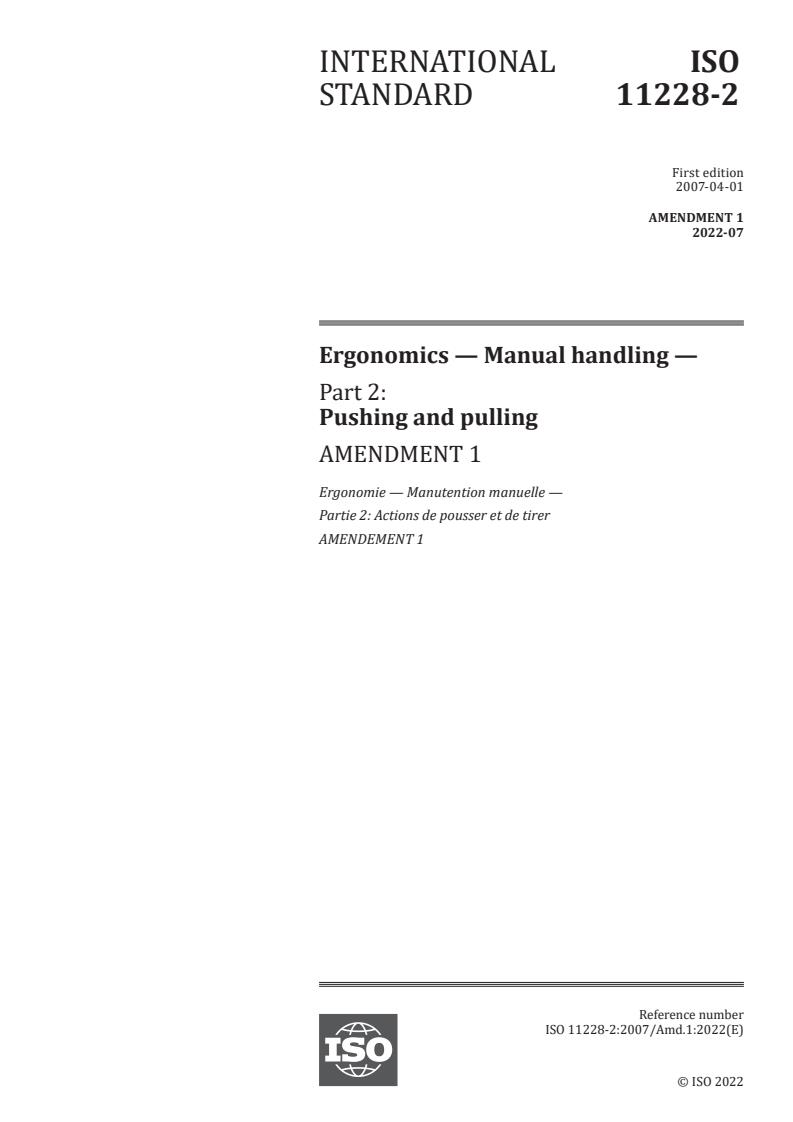
INTERNATIONAL ISO
STANDARD 11228-2
First edition
2007-04-01
AMENDMENT 1
2022-07
Ergonomics — Manual handling —
Part 2:
Pushing and pulling
AMENDMENT 1
Ergonomie — Manutention manuelle —
Partie 2: Actions de pousser et de tirer
AMENDEMENT 1
Reference number
ISO 11228-2:2007/Amd.1:2022(E)
ISO 11228-2:2007/Amd.1:2022(E)
© ISO 2022
All rights reserved. Unless otherwise specified, or required in the context of its implementation, no part of this publication may
be reproduced or utilized otherwise in any form or by any means, electronic or mechanical, including photocopying, or posting on
the internet or an intranet, without prior written permission. Permission can be requested from either ISO at the address below
or ISO’s member body in the country of the requester.
ISO copyright office
CP 401 • Ch. de Blandonnet 8
CH-1214 Vernier, Geneva
Phone: +41 22 749 01 11
Email: copyright@iso.org
Website: www.iso.org
Published in Switzerland
ii
ISO 11228-2:2007/Amd.1:2022(E)
Foreword
ISO (the International Organization for Standardization) is a worldwide federation of national standards
bodies (ISO member bodies). The work of preparing International Standards is normally carried out
through ISO technical committees. Each member body interested in a subject for which a technical
committee has been established has the right to be represented on that committee. International
organizations, governmental and non-governmental, in liaison with ISO, also take part in the work.
ISO collaborates closely with the International Electrotechnical Commission (IEC) on all matters of
electrotechnical standardization.
The procedures used to develop this document and those intended for its further maintenance are
described in the ISO/IEC Directives, Part 1. In particular, the different approval criteria needed for the
different types of ISO documents should be noted. This document was drafted in accordance with the
editorial rules of the ISO/IEC Directives, Part 2 (see www.iso.org/directives).
Attention is drawn to the possibility that some of the elements of this document may be the subject of
patent rights. ISO shall not be held responsible for identifying any or all such patent rights. Details of
any patent rights identified during the development of the document will be in the Introduction and/or
on the ISO list of patent declarations received (see www.iso.org/patents).
Any trade name used in this document is information given for the convenience of users and does not
constitute an endorsement.
For an explanation of the voluntary nature of standards, the meaning of ISO specific terms and
expressions related to conformity assessment, as well as information about ISO's adherence to
the World Trade Organization (WTO) principles in the Technical Barriers to Trade (TBT), see
www.iso.org/iso/foreword.html.
This document was prepared by Technical Committee ISO/TC 159, Ergonomics, Subcommittee SC 3,
Anthropometry and biomechanics.
A list of all parts in the ISO 11228 series can be found on the ISO website.
Any feedback or questions on this document should be directed to the user’s national standards body. A
complete listing of these bodies can be found at www.iso.org/members.html.
iii
ISO 11228-2:2007/Amd.1:2022(E)
Ergonomics — Manual handling —
Part 2:
Pushing and pulling
AMENDMENT 1
3.2.1.1
Replace the last sentence with the following:
Smooth continuous force exertions should be applied to the object, avoiding jerky movements and long
duration. Sustained forces should be avoided if possible, as they increase the risk of muscle or whole-
body fatigue.
A.2.2
Replace list item d) with the following:
d) worker population, i.e. if all male, use male limits; if all femal
...
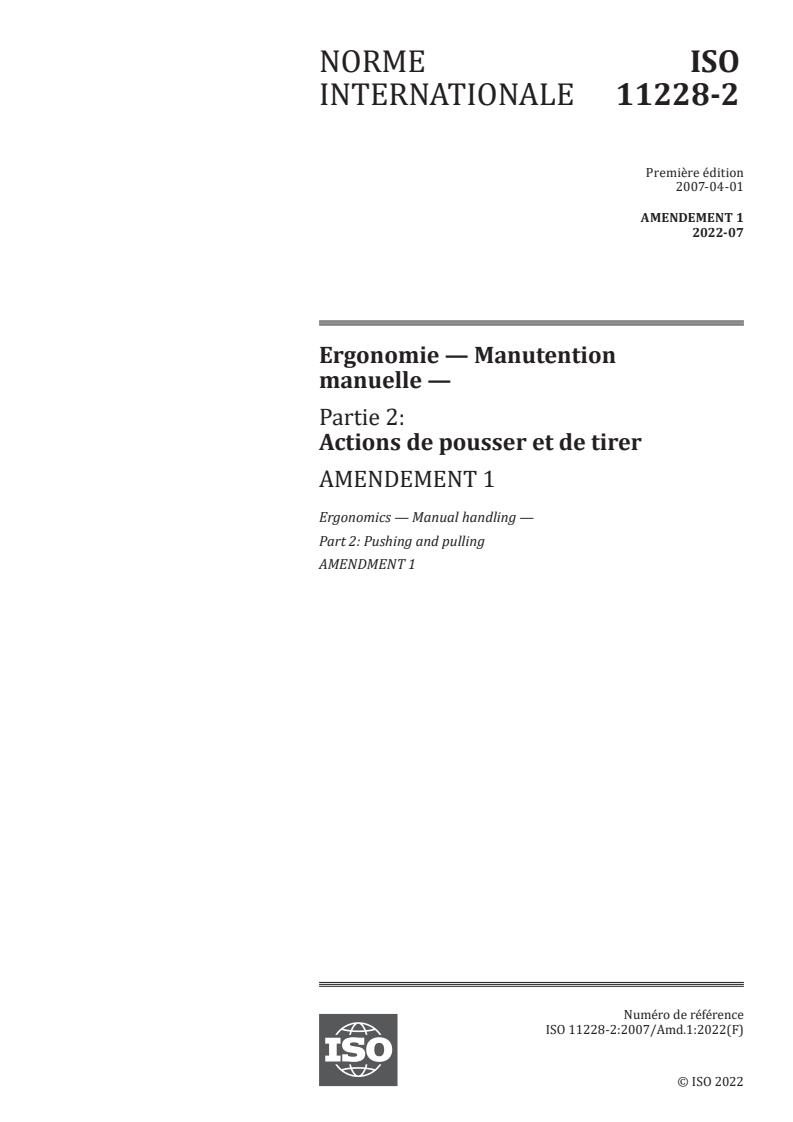
NORME ISO
INTERNATIONALE 11228-2
Première édition
2007-04-01
AMENDEMENT 1
2022-07
Ergonomie — Manutention
manuelle —
Partie 2:
Actions de pousser et de tirer
AMENDEMENT 1
Ergonomics — Manual handling —
Part 2: Pushing and pulling
AMENDMENT 1
Numéro de référence
ISO 11228-2:2007/Amd.1:2022(F)
ISO 11228-2:2007/Amd.1:2022(F)
DOCUMENT PROTÉGÉ PAR COPYRIGHT
© ISO 2022
Tous droits réservés. Sauf prescription différente ou nécessité dans le contexte de sa mise en œuvre, aucune partie de cette
publication ne peut être reproduite ni utilisée sous quelque forme que ce soit et par aucun procédé, électronique ou mécanique,
y compris la photocopie, ou la diffusion sur l’internet ou sur un intranet, sans autorisation écrite préalable. Une autorisation peut
être demandée à l’ISO à l’adresse ci-après ou au comité membre de l’ISO dans le pays du demandeur.
ISO copyright office
Case postale 401 • Ch. de Blandonnet 8
CH-1214 Vernier, Genève
Tél.: +41 22 749 01 11
E-mail: copyright@iso.org
Web: www.iso.org
Publié en Suisse
ii
ISO 11228-2:2007/Amd.1:2022(F)
Avant-propos
L'ISO (Organisation internationale de normalisation) est une fédération mondiale d'organismes
nationaux de normalisation (comités membres de l'ISO). L'élaboration des Normes internationales est
en général confiée aux comités techniques de l'ISO. Chaque comité membre intéressé par une étude
a le droit de faire partie du comité technique créé à cet effet. Les organisations internationales,
gouvernementales et non gouvernementales, en liaison avec l'ISO participent également aux travaux.
L'ISO collabore étroitement avec la Commission électrotechnique internationale (IEC) en ce qui
concerne la normalisation électrotechnique.
Les procédures utilisées pour élaborer le présent document et celles destinées à sa mise à jour sont
décrites dans les Directives ISO/IEC, Partie 1. Il convient, en particulier, de prendre note des différents
critères d'approbation requis pour les différents types de documents ISO. Le présent document a été
rédigé conformément aux règles de rédaction données dans les Directives ISO/IEC, Partie 2 (voir www.
iso.org/directives).
L'attention est attirée sur le fait que certains des éléments du présent document peuvent faire l'objet de
droits de propriété intellectuelle ou de droits analogues. L'ISO ne saurait être tenue pour responsable
de ne pas avoir identifié de tels droits de propriété et averti de leur existence. Les détails concernant
les références aux droits de propriété intellectuelle ou autres droits analogues identifiés lors de
l'élaboration du document sont indiqués dans l'Introduction et/ou dans la liste des déclarations de
brevets reçues par l'ISO (voir www.iso.org/brevets).
Les appellations commerciales éventuellement mentionnées dans le présent document sont données
pour information, par souci de commodité, à l’intention des utilisateurs et ne sauraient constituer un
engagement.
Pour une explication de la nature volontaire des normes, la signification des termes et expressions
spécifiques de l'ISO liés à l'évaluation de la conformité, ou pour toute information au sujet de l'adhésion
de l'ISO aux principes de l’Organisation mondiale du commerce (OMC) concernant les obstacles
techniques au commerce (OTC), voir www.iso.org/avant-propos.
Le présent document a été élaboré par le comité technique ISO/TC 159, Ergonomie, sous-comité SC 3,
Anthropométrie et biomécanique.
Une liste de toutes les parties de la série ISO 11228 se trouve sur le site web de l’ISO.
Il convient que l’utilisateur adresse tout retour d’information ou toute question concernant le présent
document à l’organisme national de normalisation de son pays. Une liste exhaustive desdits organismes
se trouve à l’adresse www.iso.org/fr/members.html.
iii
ISO 11228-2:2007/Amd.1:2022(F)
Ergonomie — Manutention manuelle —
Partie 2:
Actions de pousser et de tirer
AMENDEMENT 1
3.2.1.1
Remplacer la dernière phrase par la suivante:
Il convient d'appliquer des efforts continus et réguliers à l'objet, en évitant les mouvements saccadés et
une durée prolongée. Si possible, il convient d'éviter les forces soutenues car elles augmentent le risque
de fatigue musculaire ou corporelle.
A.2.2
Remplacer le point d) par le suivant:
d) la population de travailleurs: si elle est entièrement masculine, utiliser les limites app
...