

ISO/IEC 27040:2024
(Main)Information technology — Security techniques — Storage security
General Information
- Abstract
This document provides detailed technical requirements and guidance on how organizations can achieve an appropriate level of risk mitigation by employing a well-proven and consistent approach to the planning, design, documentation, and implementation of data storage security. Storage security applies to the protection of data both while stored in information and communications technology (ICT) systems and while in transit across the communication links associated with storage. Storage security includes the security of devices and media, management activities related to the devices and media, applications and services, and controlling or monitoring user activities during the lifetime of devices and media, and after end of use or end of life. Storage security is relevant to anyone involved in owning, operating, or using data storage devices, media, and networks. This includes senior managers, acquirers of storage products and services, and other non-technical managers or users, in addition to managers and administrators who have specific responsibilities for information or storage security, storage operation, or who are responsible for an organization’s overall security programme and security policy development. It is also relevant to anyone involved in the planning, design, and implementation of the architectural aspects of storage network security. This document provides an overview of storage security concepts and related definitions. It includes requirements and guidance on the threats, design, and control aspects associated with typical storage scenarios and storage technology areas. In addition, it provides references to other international standards and technical reports that address existing practices and techniques that can be applied to storage security.
- Status
- Published
- Publication Date
- 25-Jan-2024
- Drafting Committee
- ISO/IEC JTC 1/SC 27/WG 4 - Security controls and services
- Current Stage
- 6060 - International Standard published
- Start Date
- 26-Jan-2024
- Due Date
- 15-Jun-2023
- Completion Date
- 26-Jan-2024
Overview
ISO/IEC 27040:2024 - Information technology - Security techniques - Storage security - provides detailed technical requirements and guidance for planning, designing, documenting, and implementing storage security. The standard covers protection of data at rest and in transit, security of storage devices and media, management activities, user controls during device lifetime and after end-of-life, and architectural aspects of storage networks. It helps organizations achieve consistent risk mitigation for storage systems across on‑premises, virtualized, and cloud environments.
Key topics and requirements
ISO/IEC 27040:2024 addresses practical, technical controls and design principles, including:
- Storage security concepts and terminology to support consistent implementation and assessment.
- Design and implementation guidance for secure storage architectures, including quality attributes, retention, preservation, and disposal.
- Data confidentiality measures such as encryption, key management, encrypting data at rest and in transit, and cryptographic erase considerations.
- Storage sanitization: selection of sanitization methods, media-based and logical sanitization, verification and proof of sanitization.
- Storage networking: secure approaches for SAN, NAS, Fibre Channel, IP storage, block- and file-based protocols, and object storage security.
- Storage management controls: authentication and authorization, secure management interfaces, auditing, accounting, monitoring, and vulnerability management.
- Data protection and recovery: backups, replication, snapshots, archives, and repository security.
- Virtualization and multi-tenancy: securing storage in virtualized and cloud environments and protecting tenant separation.
- Physical and organizational controls: physical protection, isolation, compliance alignment, and business continuity considerations.
Practical applications and users
ISO/IEC 27040 is intended for anyone responsible for owning, operating, acquiring, or using data storage systems, including:
- Senior managers and non‑technical acquirers evaluating storage products and services.
- Storage architects and system designers developing secure storage architectures.
- Storage and security administrators implementing encryption, sanitization, backups, and monitoring.
- Procurement, compliance, and legal teams requiring evidence-based controls for audits and regulatory requirements.
- Cloud service evaluators assessing provider security controls for object, block, and file storage.
Common uses:
- Secure storage procurement and vendor assessment
- Designing secure backup and recovery strategies
- Implementing encryption and key management policies
- Demonstrating sanitization and disposal procedures for audits
- Hardening storage networks and management interfaces
Related standards
ISO/IEC 27040:2024 is typically used alongside other information security standards such as ISO/IEC 27001 (ISMS) and ISO/IEC 27002 (security controls), and with cloud‑specific guidance (e.g., ISO/IEC 27017/27018) and business continuity standards to provide a complete storage security program.
Keywords: ISO/IEC 27040:2024, storage security, data at rest, data in transit, storage encryption, sanitization, storage networks, backups, cloud storage, key management.
Relations
- Effective Date
- 23-Apr-2020
Get Certified
Connect with accredited certification bodies for this standard

BSI Group
BSI (British Standards Institution) is the business standards company that helps organizations make excellence a habit.

Bureau Veritas
Bureau Veritas is a world leader in laboratory testing, inspection and certification services.

DNV
DNV is an independent assurance and risk management provider.
Sponsored listings
Frequently Asked Questions
ISO/IEC 27040:2024 is a standard published by the International Organization for Standardization (ISO). Its full title is "Information technology — Security techniques — Storage security". This standard covers: This document provides detailed technical requirements and guidance on how organizations can achieve an appropriate level of risk mitigation by employing a well-proven and consistent approach to the planning, design, documentation, and implementation of data storage security. Storage security applies to the protection of data both while stored in information and communications technology (ICT) systems and while in transit across the communication links associated with storage. Storage security includes the security of devices and media, management activities related to the devices and media, applications and services, and controlling or monitoring user activities during the lifetime of devices and media, and after end of use or end of life. Storage security is relevant to anyone involved in owning, operating, or using data storage devices, media, and networks. This includes senior managers, acquirers of storage products and services, and other non-technical managers or users, in addition to managers and administrators who have specific responsibilities for information or storage security, storage operation, or who are responsible for an organization’s overall security programme and security policy development. It is also relevant to anyone involved in the planning, design, and implementation of the architectural aspects of storage network security. This document provides an overview of storage security concepts and related definitions. It includes requirements and guidance on the threats, design, and control aspects associated with typical storage scenarios and storage technology areas. In addition, it provides references to other international standards and technical reports that address existing practices and techniques that can be applied to storage security.
This document provides detailed technical requirements and guidance on how organizations can achieve an appropriate level of risk mitigation by employing a well-proven and consistent approach to the planning, design, documentation, and implementation of data storage security. Storage security applies to the protection of data both while stored in information and communications technology (ICT) systems and while in transit across the communication links associated with storage. Storage security includes the security of devices and media, management activities related to the devices and media, applications and services, and controlling or monitoring user activities during the lifetime of devices and media, and after end of use or end of life. Storage security is relevant to anyone involved in owning, operating, or using data storage devices, media, and networks. This includes senior managers, acquirers of storage products and services, and other non-technical managers or users, in addition to managers and administrators who have specific responsibilities for information or storage security, storage operation, or who are responsible for an organization’s overall security programme and security policy development. It is also relevant to anyone involved in the planning, design, and implementation of the architectural aspects of storage network security. This document provides an overview of storage security concepts and related definitions. It includes requirements and guidance on the threats, design, and control aspects associated with typical storage scenarios and storage technology areas. In addition, it provides references to other international standards and technical reports that address existing practices and techniques that can be applied to storage security.
ISO/IEC 27040:2024 is classified under the following ICS (International Classification for Standards) categories: 35.030 - IT Security. The ICS classification helps identify the subject area and facilitates finding related standards.
ISO/IEC 27040:2024 has the following relationships with other standards: It is inter standard links to ISO/IEC 27040:2015. Understanding these relationships helps ensure you are using the most current and applicable version of the standard.
ISO/IEC 27040:2024 is available in PDF format for immediate download after purchase. The document can be added to your cart and obtained through the secure checkout process. Digital delivery ensures instant access to the complete standard document.
Standards Content (Sample)
International
Standard
ISO/IEC 27040
Second edition
Information technology — Security
2024-01
techniques — Storage security
Technologie de l'information — Techniques de sécurité —
Sécurité de stockage
Reference number
© ISO/IEC 2024
All rights reserved. Unless otherwise specified, or required in the context of its implementation, no part of this publication may
be reproduced or utilized otherwise in any form or by any means, electronic or mechanical, including photocopying, or posting on
the internet or an intranet, without prior written permission. Permission can be requested from either ISO at the address below
or ISO’s member body in the country of the requester.
ISO copyright office
CP 401 • Ch. de Blandonnet 8
CH-1214 Vernier, Geneva
Phone: +41 22 749 01 11
Email: copyright@iso.org
Website: www.iso.org
Published in Switzerland
© ISO/IEC 2024 – All rights reserved
ii
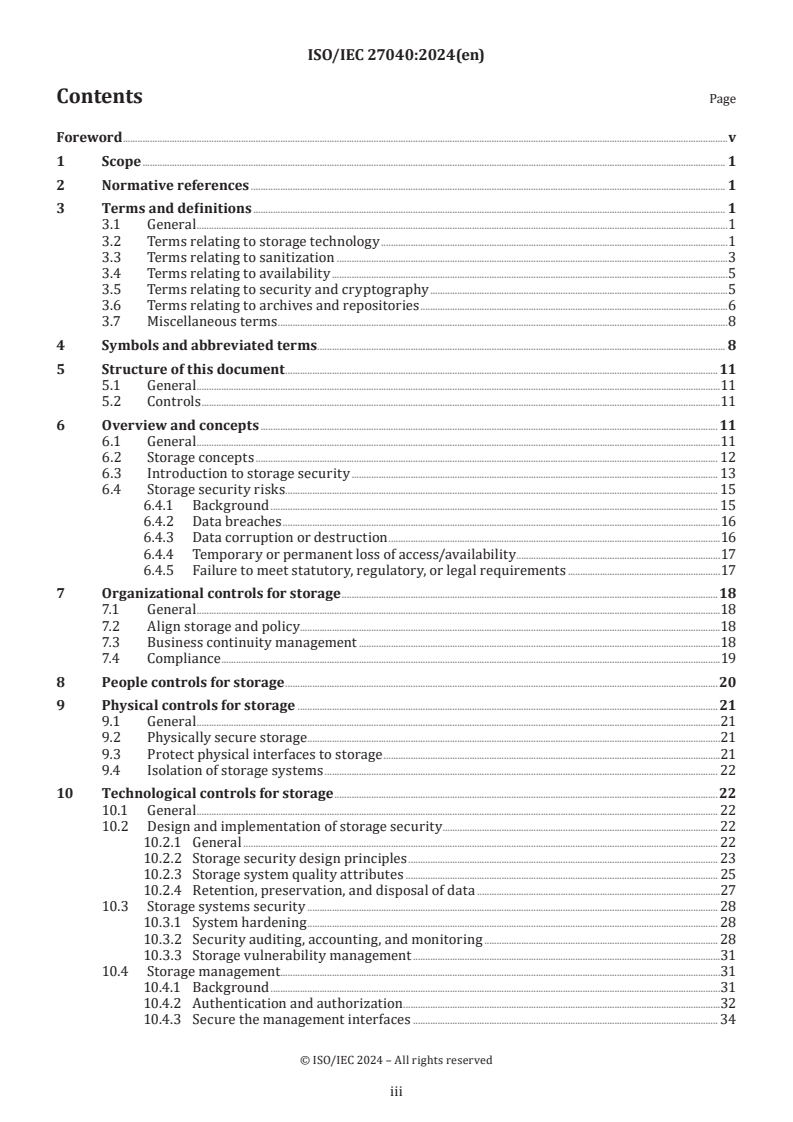
Contents Page
Foreword .v
1 Scope . 1
2 Normative references . 1
3 Terms and definitions . 1
3.1 General .1
3.2 Terms relating to storage technology .1
3.3 Terms relating to sanitization .3
3.4 Terms relating to availability .5
3.5 Terms relating to security and cryptography .5
3.6 Terms relating to archives and repositories .6
3.7 Miscellaneous terms .8
4 Symbols and abbreviated terms. 8
5 Structure of this document .11
5.1 General .11
5.2 Controls .11
6 Overview and concepts .11
6.1 General .11
6.2 Storage concepts . 12
6.3 Introduction to storage security . 13
6.4 Storage security risks. 15
6.4.1 Background . 15
6.4.2 Data breaches .16
6.4.3 Data corruption or destruction .16
6.4.4 Temporary or permanent loss of access/availability .17
6.4.5 Failure to meet statutory, regulatory, or legal requirements .17
7 Organizational controls for storage .18
7.1 General .18
7.2 Align storage and policy . .18
7.3 Business continuity management .18
7.4 Compliance .19
8 People controls for storage .20
9 Physical controls for storage .21
9.1 General .21
9.2 Physically secure storage .21
9.3 Protect physical interfaces to storage .21
9.4 Isolation of storage systems . 22
10 Technological controls for storage .22
10.1 General . 22
10.2 Design and implementation of storage security . 22
10.2.1 General . 22
10.2.2 Storage security design principles . 23
10.2.3 Storage system quality attributes . 25
10.2.4 Retention, preservation, and disposal of data .27
10.3 Storage systems security . 28
10.3.1 System hardening . 28
10.3.2 Security auditing, accounting, and monitoring . 28
10.3.3 Storage vulnerability management .31
10.4 Storage management . .31
10.4.1 Background .31
10.4.2 Authentication and authorization .32
10.4.3 Secure the management interfaces . 34
© ISO/IEC 2024 – All rights reserved
iii
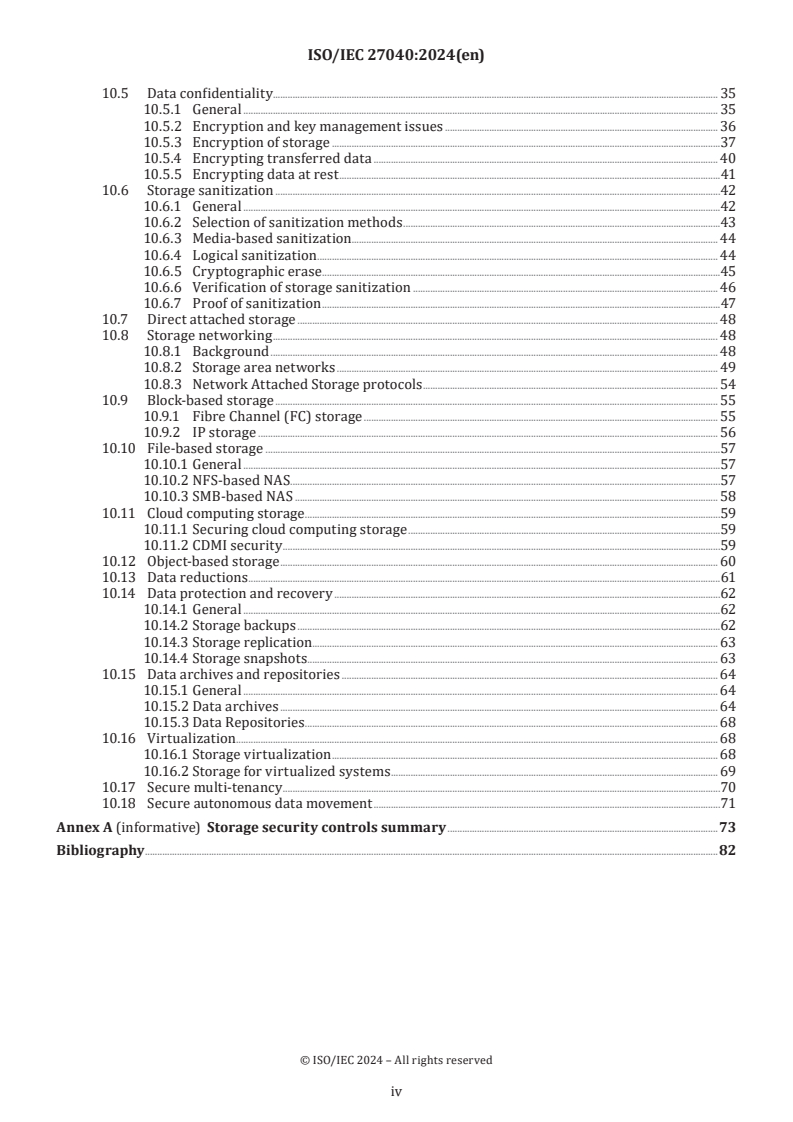
10.5 Data confidentiality. 35
10.5.1 General . 35
10.5.2 Encryption and key management issues . 36
10.5.3 Encryption of storage .37
10.5.4 Encrypting transferred data . 40
10.5.5 Encrypting data at rest .41
10.6 Storage sanitization .42
10.6.1 General .42
10.6.2 Selection of sanitization methods .43
10.6.3 Media-based sanitization. 44
10.6.4 Logical sanitization . 44
10.6.5 Cryptographic erase .45
10.6.6 Verification of storage sanitization . 46
10.6.7 Proof of sanitization .47
10.7 Direct attached storage . 48
10.8 Storage networking . 48
10.8.1 Background . 48
10.8.2 Storage area networks . 49
10.8.3 Network Attached Storage protocols . 54
10.9 Block-based storage . 55
10.9.1 Fibre Channel (FC) storage . 55
10.9.2 IP storage . 56
10.10 File-based storage .57
10.10.1 General .57
10.10.2 NFS-based NAS.57
10.10.3 SMB-based NAS . 58
10.11 Cloud computing storage .59
10.11.1 Securing cloud computing storage .59
10.11.2 CDMI security . .59
10.12 Object-based storage . 60
10.13 Data reductions .61
10.14 Data protection and recovery .62
10.14.1 General .62
10.14.2 Storage backups .62
10.14.3 Storage replication. 63
10.14.4 Storage snapshots. 63
10.15 Data archives and repositories . 64
10.15.1 General . 64
10.15.2 Data archives . 64
10.15.3 Data Repositories . 68
10.16 Virtualization . . 68
10.16.1 Storage virtualization . 68
10.16.2 Storage for virtualized systems . 69
10.17 Secure multi-tenancy .70
10.18 Secure autonomous data movement .71
Annex A (informative) Storage security controls summary .73
Bibliography .82
© ISO/IEC 2024 – All rights reserved
iv
Foreword
ISO (the International Organization for Standardization) and IEC (the International Electrotechnical
Commission) form the specialized system for worldwide standardization. National bodies that are
members of ISO or IEC participate in the development of International Standards through technical
committees established by the respective organization to deal with particular fields of technical activity.
ISO and IEC technical committees collaborate in fields of mutual interest. Other international organizations,
governmental and non-governmental, in liaison with ISO and IEC, also take part in the work.
The procedures used to develop this document and those intended for its further maintenance are described
in the ISO/IEC Directives, Part 1. In particular, the different approval criteria needed for the different types
of document should be noted. This document was drafted in accordance with the editorial rules of the ISO/
IEC Directives, Part 2 (see www.iso.org/directives or www.iec.ch/members_experts/refdocs).
ISO and IEC draw attention to the possibility that the implementation of this document may involve the
use of (a) patent(s). ISO and IEC take no position concerning the evidence, validity or applicability of any
claimed patent rights in respect thereof. As of the date of publication of this document, ISO and IEC had not
received notice of (a) patent(s) which may be required to implement this document. However, implementers
are cautioned that this may not represent the latest information, which may be obtained from the patent
database available at www.iso.org/patents and https://patents.iec.ch. ISO and IEC shall not be held
responsible for identifying any or all such patent rights.
Any trade name used in this document is information given for the convenience of users and does not
constitute an endorsement.
For an explanation of the voluntary nature of standards, the meaning of ISO specific terms and expressions
related to conformity assessment, as well as information about ISO's adherence to the World Trade
Organization (WTO) principles in the Technical Barriers to Trade (TBT) see www.iso.org/iso/foreword.html.
In the IEC, see www.iec.ch/understanding-standards.
This document was prepared by Joint Technical Committee ISO/IEC JTC 1, Information technology,
Subcommittee SC 27, Information security, cybersecurity and privacy protection.
This second edition cancels and replaces the first edition (ISO/IEC 27040:2015), which has been technically
revised.
The main changes are as follows:
— the scope has been expanded to cover requirements;
— the clause structure has been more closely aligned with ISO/IEC 27002:2022;
— requirements have been added in Clauses 7, 9, and 10;
— adjustments have been made regarding the storage technologies which are covered;
— a new controls labelling scheme has been added;
— former Annex A, which provided guidance on sanitizing specific types of media, has been removed and
text has been added in Clause 10, recommending IEEE 2883 for this purpose;
— former Annex B, which included table to help prioritize the adoption of recommendation, has been
replaced with Annex A that summarizes the requirements and guidance contained in this document;
— former Annex C, which provided tutorial oriented material, has been removed and references to
appropriate materials have been added in Clause 10.
Any feedback or questions on this document should be directed to the user’s national standards
body. A complete listing of these bodies can be found at www.iso.org/members.html and
www.iec.ch/national-committees.
© ISO/IEC 2024 – All rights reserved
v
© ISO/IEC 2024 – All rights reserved
vi
International Standard ISO/IEC 27040:2024(en)
Information technology — Security techniques — Storage
security
1 Scope
This document provides detailed technical requirements and guidance on how organizations can achieve
an appropriate level of risk mitigation by employing a well-proven and consistent approach to the planning,
design, documentation, and implementation of data storage security. Storage security applies to the
protection of data both while stored in information and communications technology (ICT) systems and
while in transit across the communication links associated with storage. Storage security includes the
security of devices and media, management activities related to the devices and media, applications and
services, and controlling or monitoring user activities during the lifetime of devices and media, and after
end of use or end of life.
Storage security is relevant to anyone involved in owning, operating, or using data storage devices, media,
and networks. This includes senior managers, acquirers of storage products and services, and other non-
technical managers or users, in addition to managers and administrators who have specific responsibilities
for information or storage security, storage operation, or who are responsible for an organization’s overall
security programme and security policy development. It is also relevant to anyone involved in the planning,
design, and implementation of the architectural aspects of storage network security.
This document provides an overview of storage security concepts and related definitions. It includes
requirements and guidance on the threats, design, and control aspects associated with typical storage
scenarios and storage technology areas. In addition, it provides references to other international standards
and technical reports that address existing practices and techniques that can be applied to storage security.
2 Normative references
The following documents are referred to in the text in such a way that some or all of their content constitutes
requirements of this document. For dated references, only the edition cited applies. For undated references,
the latest edition of the referenced document (including any amendments) applies.
ISO/IEC 27000, Information technology — Security techniques — Information security management systems —
Overview and vocabulary
3 Terms and definitions
3.1 General
For the purposes of this document, the terms and definitions given in ISO/IEC 27000 and the following apply.
ISO and IEC maintain terminology databases for use in standardization at the following addresses:
— ISO Online browsing platform: available at https:// www .iso .org/ obp
— IEC Electropedia: available at https:// www .electropedia .org/
3.2 Terms relating to storage technology
3.2.1
block
unit in which data is stored (3.2.17) and retrieved on storage devices (3.2.14) and storage media (3.2.16)
© ISO/IEC 2024 – All rights reserved
3.2.2
compression
reduction in the number of bits used to represent an item of data
Note 1 to entry: For storage (3.2.12), lossless compression (i.e. compression using a technique that preserves the entire
content of the original data, and from which the original data can be reconstructed exactly) is used.
3.2.3
data at rest
data recorded on stable, non-volatile storage (3.2.11)
3.2.4
data in motion
data being transferred from one location to another
Note 1 to entry: These transfers typically involve interfaces that are accessible and do not include internal transfers
(i.e. never exposed outside of an interface, chip, or device).
3.2.5
deduplication
method of reducing storage (3.2.12) needs by eliminating redundant data, which is replaced with a pointer
to the unique data copy
Note 1 to entry: Deduplication is sometimes considered a form of data reduction.
3.2.6
device
mechanical, electrical, or electronic contrivance with a specific purpose
[SOURCE: ISO/IEC 14776-372:2011, 3.1.10]
3.2.7
Fibre Channel
serial input/output interconnect capable of supporting multiple protocols, including access to open system
storage (3.2.12), access to mainframe storage, and networking
Note 1 to entry: Fibre Channel supports point to point, arbitrated loop, and switched topologies with a variety of
copper and optical links running at speeds from 1 gigabit per second to over 128 gigabits per second.
3.2.8
Fibre Channel Protocol
Serial Small Computer System Interface (SCSI) transport protocol used on Fibre Channel (3.2.7) interconnects
3.2.9
over provision
technique used by storage devices (3.2.14) in which a subset of the available storage medium (3.2.16) is
exposed through the interface
Note 1 to entry: The storage medium is used internally and independently by the storage device to improve
performance, endurance, or reliability.
3.2.10
network attached storage
storage device (3.2.14) or system that connects to a network and provides file access services to computer
systems
3.2.11
non-volatile storage
storage (3.2.12) that retains its contents after power is removed
3.2.12
storage
device (3.2.6), function, or service supporting data entry or retrieval
© ISO/IEC 2024 – All rights reserved
3.2.13
storage area network
network whose primary purpose is the transfer of data between computer systems and storage devices
(3.2.14) and among storage devices
Note 1 to entry: A storage area network consists of a communication infrastructure, which provides physical
connections, and a management layer, which organizes the connections, storage devices, and computer systems so
that data transfer is secure and robust.
3.2.14
storage device
component or aggregation of components made up of one or more devices (3.2.6) containing storage media
(3.2.16), designed and built primarily for the purpose for accessing non-volatile storage (3.2.11)
3.2.15
storage ecosystem
system of interdependent components that work together to enable storage (3.2.12) services and capabilities
Note 1 to entry: The components often include storage devices (3.2.14), storage networks, storage management, and
other information and communications technology (ICT) infrastructure.
3.2.16
storage medium
material on which digital data are, or can be, recorded or retrieved
3.2.17
store
record data on volatile storage (3.2.20) or non-volatile storage (3.2.11)
3.2.18
target data
information subject to a given process, typically including most or all information on storage (3.2.12)
3.2.19
virtualized storage
logical storage
abstraction of physical storage devices (3.2.14) or storage media (3.2.16) that masks the characteristics and
boundaries of the physical storage (3.2.12)
Note 1 to entry: Virtualized storage can employ multiple levels of virtualization prior to presenting the virtualized
storage to a system or an application.
3.2.20
volatile storage
storage (3.2.12) that fails to retain its contents after power is removed
3.3 Terms relating to sanitization
3.3.1
clear
sanitize (3.3.12) using logical techniques on user data on all addressable storage locations for protection
against simple non-invasive data recovery techniques using the same host interface available to the user
3.3.2
degauss
render magnetically stored data unreadable by applying a strong magnetic field to the storage medium
(3.2.16) with an organizationally approved field strength
© ISO/IEC 2024 – All rights reserved
3.3.3
destruct
sanitize (3.3.12) using physical techniques that make recovery of target data (3.2.18) infeasible using state
of the art laboratory techniques and results in the subsequent inability to use the storage medium (3.2.16)
for storage (3.2.12)
Note 1 to entry: Disintegrate (3.3.5), incinerate (3.3.6), melt (3.3.7), pulverize (3.3.9), and shred (3.3.13) are destruct
forms of media sanitization (3.3.16).
Note 2 to entry: If the storage medium cannot be removed, then the storage device (3.2.14) can be subjected to the
destruct technique; a storage device can contain multiple storage media.
3.3.4
destruction
result of destruct (3.3.3) actions taken to ensure that the storage medium (3.2.16) cannot be reused as
originally intended and that user data is virtually impossible or prohibitively expensive to recover
3.3.5
disintegrate
destruct (3.3.3) by separating storage medium (3.2.16) into its component parts
3.3.6
incinerate
destruct (3.3.3) by burning storage medium (3.2.16) completely
3.3.7
melt
destruct (3.3.3) by changing storage medium (3.2.16) from a solid to a liquid state generally by the application
of heat
3.3.8
cryptographic erase
method of sanitization in which the encryption key for the encrypted target data (3.2.18) is sanitized (3.3.12),
making recovery of the decrypted target data infeasible
3.3.9
pulverize
destruct (3.3.3) by grinding storage medium (3.2.16) to a powder or appropriately small particles
3.3.10
purge
sanitize (3.3.12) using physical or logical techniques that make recovery of target data (3.2.18) infeasible
using state of the art laboratory techniques, but which preserves the storage media (3.2.16) and storage
device (3.2.14) in a potentially reusable state
3.3.11
sanitization
process or method to sanitize (3.3.12)
3.3.12
sanitize
render access to target data (3.2.18) on storage (3.2.12) infeasible for a given level of effort
3.3.13
shred
destruct (3.3.3) by cutting or tearing storage medium (3.2.16) into small particles
3.3.14
storage sanitization
logical storage sanitization (3.3.15) or media sanitization (3.3.16)
© ISO/IEC 2024 – All rights reserved
3.3.15
logical storage sanitization
virtual storage sanitization
sanitization (3.3.11) of virtualized storage (3.2.19)
Note 1 to entry: Clear (3.3.1) and purge (3.3.10) are actions that can be taken to sanitize (3.3.12) virtualized storage.
Note 2 to entry: Logical storage sanitization is a subset of storage sanitization (3.3.14).
3.3.16
media sanitization
sanitization (3.3.11) of storage media (3.2.16)
Note 1 to entry: Clear (3.3.1), purge (3.3.10), and destruct (3.3.3) are actions that can be taken to sanitize (3.3.12)
storage media (3.2.16).
Note 2 to entry: Media sanitization is a subset of storage sanitization (3.3.14).
3.4 Terms relating to availability
3.4.1
resilience
ability to anticipate and adapt to, resist or quickly recover from a potentially disruptive event, whether
natural or man-made
[SOURCE: ISO 15392:2019, 3.21]
3.5 Terms relating to security and cryptography
3.5.1
cryptoperiod
defined period of time during which a specific cryptographic key is authorized for use or during which the
cryptographic keys in a given system may remain in effect
[SOURCE: ISO 16609:2022, 3.6]
3.5.2
data breach
compromise of security that leads to the accidental or unlawful destruction (3.3.4), loss, alteration,
unauthorized disclosure of, or access to protected data transmitted, stored (3.2.17), or otherwise processed
3.5.3
data integrity
property that data has not been altered or destroyed in an unauthorized manner
[SOURCE: ISO 7498-2:1989, 3.3.21]
3.5.4
multi-factor authentication
authentication using two or more of the following factors:
— knowledge factor, something an individual knows;
— possession factor, something an individual has;
— biometric factor, something an individual is or is able to do
[SOURCE: ISO 19092:2008, 4.42]
© ISO/IEC 2024 – All rights reserved
3.5.5
malware
malicious software designed specifically to damage or disrupt a system, attacking confidentiality, integrity,
and/or availability
Note 1 to entry: Viruses and Trojan horses are examples of malware.
[SOURCE: ISO/IEC 27033-1:2015, 3.22]
3.5.6
point of encryption
location within the information and communications technology infrastructure where data are encrypted
on its way to storage (3.2.12) and, conversely, where data are decrypted when accessed from storage
Note 1 to entry: The point of encryption is only applicable for data at rest (3.2.3).
3.5.7
security strength
number associated with the amount of work that is required to break a cryptographic algorithm or system
3.5.8
storage security
application of physical, technical, and administrative controls to protect storage systems and infrastructure
as well as the data stored (3.2.17) within them
Note 1 to entry: Storage security is focused on protecting data (and its storage infrastructure) against unauthorized
disclosure, modification, or destruction while assuring its availability to authorized users.
Note 2 to entry: These controls can be preventive, detective, corrective, deterrent, recovery, or compensatory in
nature.
3.5.9
strong authentication
authentication by means of cryptographically derived multi-factor credentials
[SOURCE: ISO 22600-1:2014, 3.23]
3.6 Terms relating to archives and repositories
3.6.1
archive
organization or part of an organization responsible for selection, acquisition, preservation
(3.6.5), and availability of one or more archives (3.6.2)
[SOURCE: ISO 5127:2017, 3.2.3.01, modified — Notes to entry 1 to 4 have been omitted; term changed to
singular from plural “archives”; domain has been added.]
3.6.2
archive
materials, items, records (3.6.6) or documents created or received by a person, family or
organization, public or private, in the conduct of their affairs and preserved because of the enduring value
contained in them or as evidence of the functions and responsibilities of their creator, especially those
materials maintained using the principles of provenance, original order and collective control
[SOURCE: ISO 5127:2017, 3.6.1.03, modified — "items, records or documents" have been included at the start
of the definition; Note 1 to entry has been omitted; term changed to singular from plural “archives”; domain
has been added.]
© ISO/IEC 2024 – All rights reserved
3.6.3
disposition
range of records processes associated with implementing records (3.6.6) retention (3.6.9), records destruction
(3.6.7) or transfer decisions which are documented in disposition authorities or other instruments
[SOURCE: ISO 30300:2020, 3.4.8, modified — “destruction” has been changed to “records destruction”.]
3.6.4
evidence
information that can be used either by itself or in conjunction with other information, to establish proof
about an event or action
[SOURCE: ISO 30300:2020, 3.2.6, modified — Note 1 to entry has been omitted; “could” has been changed to
“can”.]
3.6.5
preservation
measures taken to maintain the usability (3.6.10), authenticity, reliability and integrity of records (3.6.6)
over time
Note 1 to entry: Measures include principles, policies, rules, strategies, processes and operations.
[SOURCE: ISO 30300:2020, 3.4.11]
3.6.6
record
information created or received and maintained as evidence (3.6.4) and as an asset by an organization, in
pursuit of legal obligations or in the course of conducting business
Note 1 to entry: Records are normally used in plural.
Note 2 to entry: In a management system standard (MSS) implementation, the records created to conduct and direct
the management system and to document its implementation are called documented information.
[SOURCE: ISO 30300:2020, 3.2.10]
3.6.7
records destruction
eliminating or deleting a record (3.6.6), beyond any possible reconstruction
[SOURCE: ISO 30300:2020, 3.4.7, modified — changed the term “destruction” to “records destruction”.]
3.6.8
records requirement
requirement for evidence (3.6.4) of a business function, activity or transaction and for records processes
including how, and how long, records (3.6.6) need to be kept
[SOURCE: ISO 30300:2020, 3.3.2]
3.6.9
retention
keeping a record (3.6.6) according to records requirements (3.6.8)
[SOURCE: ISO 30300:2020, 3.4.14]
3.6.10
usability
property of being able to be located, retrieved, presented and understood
Note 1 to entry: Usability may also refer to the extent to which a system, product, or service can be used by specified
users to achieve specified goals with effectiveness, efficiency, and satisfaction in a specified context of use.
[SOURCE: ISO 30300:2020, 3.2.12]
© ISO/IEC 2024 – All rights reserved
3.7 Miscellaneous terms
3.7.1
in-band
communication or transmission that occurs within a previously established communication method or
channel
Note 1 to entry: The communications or transmissions often take the form of a separate protocol, such as a management
protocol over the same medium as the primary data protocol.
3.7.2
metadata
data that defines and describes other data
[SOURCE: ISO/IEC 11179-1:2023, 3.2.26]
3.7.3
multi-tenancy
allocation of physical or virtual resources such that multiple tenants and their computations and data are
isolated from and inaccessible to one another
[SOURCE: ISO/IEC 22123-1:2023, 3.4.3]
3.7.4
out-of-band
communication or transmission that occurs outside of a previously established communication method or
channel
3.7.5
secure multi-tenancy
type of multi-tenancy (3.7.3) that employs security controls to explicitly guard against data breaches (3.5.2)
and provides validation of these controls for proper governance
Note 1 to entry: Secure multi-tenancy exists when the risk profile of an individual tenant is no greater than in a
dedicated, single-tenant environment.
Note 2 to entry: In very secure environments even the identity of the tenants is kept secret.
4 Symbols and abbreviated terms
ACL access control list
AES Advanced Encryption Standard
API application programming interface
BCM business continuity management
BMC baseboard management controller
CCM counter with cipher block chaining message authentication code
CDMI Cloud Data Management Interface
CHAP Challenge Handshake Authentication Protocol
CLI command line interface
CNA converged network adaptor
DAS direct attached storage
© ISO/IEC 2024 – All rights reserved
DDoS distributed denial of service
DH-CHAP Diffie Hellman – Challenge Handshake Authentication Protocol
DNS domain name system
DoS denial of service
DRAM dynamic random access memory
ESP encapsulating security payload
FC fibre channel
FC-SP fibre channel – security protocol
FCIP fibre channel over TCP/IP
FCP fibre channel protocol
GCM Galois/Counter Mode
HBA host bus adapter
HDD hard disk drive
HMAC hash-based message authentication code
HTTPS hypertext transfer protocol secure
IB InfiniBand™
ICT information and communications technology
ID identifier
IEEE Institute of Electrical and Electronics Engineers
IETF Internet Engineering Task Force
IKE Internet Key Exchange
IP Internet Protocol
IPMI Intelligent Platform Management Interface
IPsec Internet Protocol Security
IRBC ICT readiness for business continuity
iSCSI Internet Small Computer Systems Interface
ISMS information security management system
iSNS Internet Storage Name Service
KMIP key management interoperability protocol
LAN local area network
LUN logical unit number
© ISO/IEC 2024 – All rights reserved
MTBF mean time between failure
MTTF mean time to failure
MTTR mean time to repair
NAS network attached storage
NFS network file system
NTP network time protocol
NVM non-volatile memory
® ®
NVMe NVM Express ®
NVMe-oF™ NVM Express over Fabric
® ®
NVMe /FC NVMe over Fibre Channel
® ®
NVMe /RDMA NVMe over RDMA
® ®
NVMe /TCP NVMe over TCP
OASIS Organization for the Advancement of Structured Information Standards
® ®
PCIe PCI Express
PII personally identifiable information
RADIUS remote authentication dial in user service
RAID redundant array of independent disks
RDMA remote direct memory access
REST representational state transfer
RMCP Remote Management Control Protocol
SAN storage area network
SCSI Small Computer System Interface
SHA Secure Hash Algorithm
SLP Service Locator Protocol
SMB Server
...