

ISO/IEC 39794-1:2019
(Main)Information technology — Extensible biometric data interchange formats — Part 1: Framework
General Information
- Abstract
This document specifies: — rules and guidelines for defining extensible biometric data interchange formats that are extensible without invalidating previous data structures; — the meaning of common data elements for use in extensible biometric data interchange formats; — common data structures for tagged binary data formats based on an extensible specification in ASN.1; — common data structures for textual data formats based on an XML schema definition; and — conformance testing concepts and methodologies for testing the syntactic conformance of biometric data blocks.
- Status
- Published
- Publication Date
- 19-Dec-2019
- Technical Committee
- ISO/IEC JTC 1/SC 37 - Biometrics
- Drafting Committee
- ISO/IEC JTC 1/SC 37/WG 3 - Biometric data interchange formats
- Current Stage
- 9060 - Close of review
- Completion Date
- 04-Jun-2030
Buy Documents


ISO/IEC 39794-1:2019 - Information technology -- Extensible biometric data interchange formats

ISO/IEC 39794-1:2019 - Information technology — Extensible biometric data interchange formats — Part 1: Framework/20/2019
Overview - ISO/IEC 39794-1:2019 (Extensible biometric data interchange formats - Framework)
ISO/IEC 39794-1:2019 defines a framework for extensible biometric data interchange formats designed so new data elements can be added without invalidating existing data structures. It specifies the meaning of common data elements, common data structures for both tagged binary (ASN.1) and textual (XML Schema) encodings, and introduces conformance testing concepts to verify syntactic correctness of biometric data blocks (BDBs). The standard was prepared by ISO/IEC JTC 1/SC 37 (Biometrics).
Key technical topics and requirements
- Extensibility rules and guidelines - how to design formats that can evolve while remaining backward compatible.
- Common data elements - standardized abstract elements such as version, representation, capture device, capture date/time, quality metrics and PAD (Presentation Attack Detection) data.
- Abstract data structures - definitions of version blocks, representation blocks, and extended data blocks to ensure consistent interpretation.
- Encoding schemes - support for two encodings:
- Tagged binary using ASN.1 for compact machine-readable BDBs.
- XML Schema definitions for textual interchange and human-readable representations.
- Naming and identification conventions - for ASN.1 modules, XML namespaces and resource identifiers used across the ISO/IEC 39794 series.
- Conformance testing methodology - concepts and procedures for syntactic conformance testing of biometric data blocks, enabling interoperable implementations.
- Guidance on capture and quality - rules for capture date/time, degree of processing (captured sample, intermediate sample, feature set), capture conditions, device requirements and quality requirements for biometric data.
Practical applications and who uses this standard
ISO/IEC 39794-1:2019 is intended for organizations and professionals who design, implement or evaluate biometric systems and data exchange flows, including:
- Biometric device and sensor manufacturers (capture devices)
- Biometric software developers and integrators (feature extraction, matching, storage)
- Identity management, border control and law-enforcement agencies deploying interoperable biometric exchange
- Test laboratories and certification bodies performing conformance testing
- Standards architects and implementers using ASN.1 and XML Schema to create interoperable biometric message formats
Using this framework helps ensure reliable data interchange, backward compatibility when formats evolve, and consistent handling of metadata such as quality and capture conditions - all critical for scalable, interoperable biometric ecosystems.
Related standards and references
- ISO/IEC 19794 series (historical biometric interchange formats)
- CBEFF (Common Biometric Exchange Formats Framework) - referenced for relationships and identifiers
- ASN.1 and XML Schema technologies for encoding and schema design
Keywords: ISO/IEC 39794-1:2019, biometric data interchange formats, extensible, ASN.1, XML Schema, tagged binary, conformance testing, biometric quality, capture device, BDB.
Relations
- Effective Date
- 09-Feb-2026
Buy Documents
ISO/IEC 39794-1:2019 - Information technology -- Extensible biometric data interchange formats
ISO/IEC 39794-1:2019 - Information technology — Extensible biometric data interchange formats — Part 1: Framework/20/2019
Get Certified
Connect with accredited certification bodies for this standard

BSI Group
BSI (British Standards Institution) is the business standards company that helps organizations make excellence a habit.

NYCE
Mexican standards and certification body.
Sponsored listings
Frequently Asked Questions
ISO/IEC 39794-1:2019 is a standard published by the International Organization for Standardization (ISO). Its full title is "Information technology — Extensible biometric data interchange formats — Part 1: Framework". This standard covers: This document specifies: — rules and guidelines for defining extensible biometric data interchange formats that are extensible without invalidating previous data structures; — the meaning of common data elements for use in extensible biometric data interchange formats; — common data structures for tagged binary data formats based on an extensible specification in ASN.1; — common data structures for textual data formats based on an XML schema definition; and — conformance testing concepts and methodologies for testing the syntactic conformance of biometric data blocks.
This document specifies: — rules and guidelines for defining extensible biometric data interchange formats that are extensible without invalidating previous data structures; — the meaning of common data elements for use in extensible biometric data interchange formats; — common data structures for tagged binary data formats based on an extensible specification in ASN.1; — common data structures for textual data formats based on an XML schema definition; and — conformance testing concepts and methodologies for testing the syntactic conformance of biometric data blocks.
ISO/IEC 39794-1:2019 is classified under the following ICS (International Classification for Standards) categories: 35.240.15 - Identification cards. Chip cards. Biometrics. The ICS classification helps identify the subject area and facilitates finding related standards.
ISO/IEC 39794-1:2019 has the following relationships with other standards: It is inter standard links to CEN/TS 18214:2025. Understanding these relationships helps ensure you are using the most current and applicable version of the standard.
ISO/IEC 39794-1:2019 is available in PDF format for immediate download after purchase. The document can be added to your cart and obtained through the secure checkout process. Digital delivery ensures instant access to the complete standard document.
Standards Content (Sample)
INTERNATIONAL ISO/IEC
STANDARD 39794-1
First edition
2019-12
Information technology — Extensible
biometric data interchange formats —
Part 1:
Framework
Reference number
©
ISO/IEC 2019
© ISO/IEC 2019
All rights reserved. Unless otherwise specified, or required in the context of its implementation, no part of this publication may
be reproduced or utilized otherwise in any form or by any means, electronic or mechanical, including photocopying, or posting
on the internet or an intranet, without prior written permission. Permission can be requested from either ISO at the address
below or ISO’s member body in the country of the requester.
ISO copyright office
CP 401 • Ch. de Blandonnet 8
CH-1214 Vernier, Geneva
Phone: +41 22 749 01 11
Fax: +41 22 749 09 47
Email: copyright@iso.org
Website: www.iso.org
Published in Switzerland
ii © ISO/IEC 2019 – All rights reserved
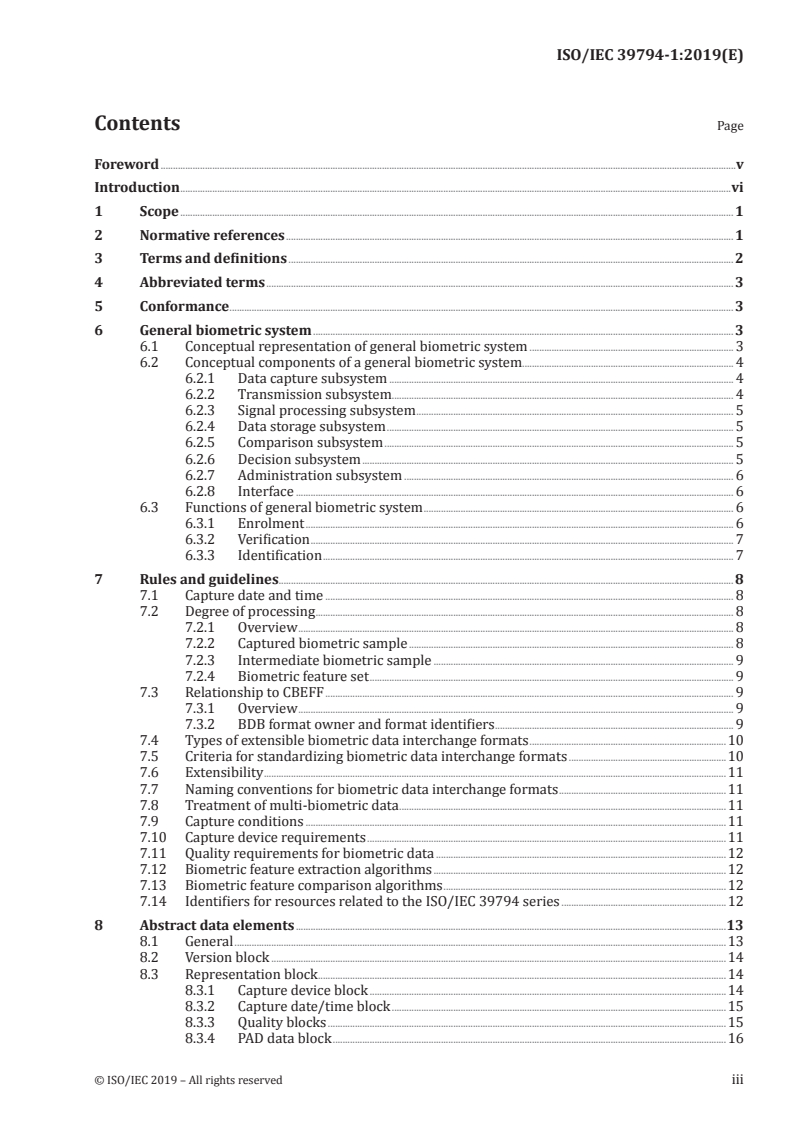
Contents Page
Foreword .v
Introduction .vi
1 Scope . 1
2 Normative references . 1
3 Terms and definitions . 2
4 Abbreviated terms . 3
5 Conformance . 3
6 General biometric system . 3
6.1 Conceptual representation of general biometric system . 3
6.2 Conceptual components of a general biometric system. 4
6.2.1 Data capture subsystem . 4
6.2.2 Transmission subsystem. 4
6.2.3 Signal processing subsystem . 5
6.2.4 Data storage subsystem . 5
6.2.5 Comparison subsystem . 5
6.2.6 Decision subsystem . 5
6.2.7 Administration subsystem . 6
6.2.8 Interface . 6
6.3 Functions of general biometric system . 6
6.3.1 Enrolment . 6
6.3.2 Verification . 7
6.3.3 Identification . 7
7 Rules and guidelines . 8
7.1 Capture date and time . 8
7.2 Degree of processing . 8
7.2.1 Overview . 8
7.2.2 Captured biometric sample . 8
7.2.3 Intermediate biometric sample . 9
7.2.4 Biometric feature set . 9
7.3 Relationship to CBEFF . 9
7.3.1 Overview . 9
7.3.2 BDB format owner and format identifiers . 9
7.4 Types of extensible biometric data interchange formats .10
7.5 Criteria for standardizing biometric data interchange formats .10
7.6 Extensibility .11
7.7 Naming conventions for biometric data interchange formats .11
7.8 Treatment of multi-biometric data .11
7.9 Capture conditions .11
7.10 Capture device requirements .11
7.11 Quality requirements for biometric data .12
7.12 Biometric feature extraction algorithms .12
7.13 Biometric feature comparison algorithms .12
7.14 Identifiers for resources related to the ISO/IEC 39794 series .12
8 Abstract data elements .13
8.1 General .13
8.2 Version block .14
8.3 Representation block .14
8.3.1 Capture device block .14
8.3.2 Capture date/time block .15
8.3.3 Quality blocks .15
8.3.4 PAD data block .16
© ISO/IEC 2019 – All rights reserved iii
8.3.5 Extended data blocks .22
9 Tagged binary encoding scheme .22
9.1 General .22
9.2 Naming conventions for ASN.1 modules in the ISO/IEC 39794 series .23
9.2.1 ASN.1 module names . .23
9.2.2 Object identifier for ASN.1 modules .23
9.2.3 Type and component names .23
9.3 Prototypes .24
9.4 Abstract syntax of common data types for the ISO/IEC 39794 series, in ASN.1 .24
9.5 Abstract syntax of general BDB, in ASN.1 .24
9.6 Definition extension in ASN.1 .25
9.6.1 General.25
9.6.2 Addition of components to sequence types .25
9.6.3 Addition of components to choice types .26
9.6.4 Extension of an enumerated type with a new value .26
10 XML encoding scheme .28
10.1 General .28
10.2 Structure of XML schema definitions .28
10.3 Naming conventions for XML schema definitions in the ISO/IEC 39794 series .28
10.3.1 XML namespace names .28
10.3.2 Type and element names .29
10.4 Prototypes .29
10.5 XML schema definition of common data types for the ISO/IEC 39794 series .30
10.6 Definition extension in XML .30
10.6.1 General.30
10.6.2 Extending XML simple types .30
10.6.3 Extending XML sequence types .30
10.6.4 Extending XML choice types .31
10.6.5 Extending XML enumerations .32
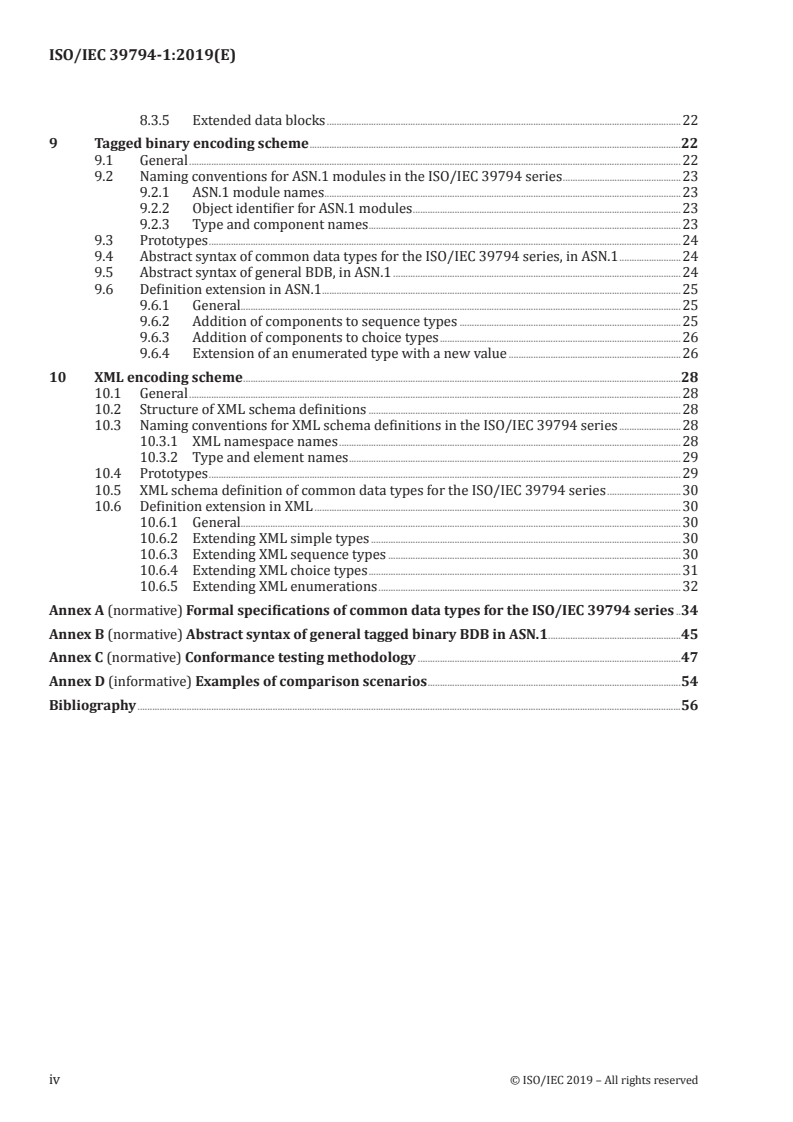
Annex A (normative) Formal specifications of common data types for the ISO/IEC 39794 series .34
Annex B (normative) Abstract syntax of general tagged binary BDB in ASN.1 .45
Annex C (normative) Conformance testing methodology .47
Annex D (informative) Examples of comparison scenarios .54
Bibliography .56
iv © ISO/IEC 2019 – All rights reserved
Foreword
ISO (the International Organization for Standardization) and IEC (the International Electrotechnical
Commission) form the specialized system for worldwide standardization. National bodies that
are members of ISO or IEC participate in the development of International Standards through
technical committees established by the respective organization to deal with particular fields of
technical activity. ISO and IEC technical committees collaborate in fields of mutual interest. Other
international organizations, governmental and non-governmental, in liaison with ISO and IEC, also
take part in the work.
The procedures used to develop this document and those intended for its further maintenance are
described in the ISO/IEC Directives, Part 1. In particular, the different approval criteria needed for
the different types of document should be noted. This document was drafted in accordance with the
editorial rules of the ISO/IEC Directives, Part 2 (see www .iso .org/ directives).
Attention is drawn to the possibility that some of the elements of this document may be the subject
of patent rights. ISO and IEC shall not be held responsible for identifying any or all such patent
rights. Details of any patent rights identified during the development of the document will be in the
Introduction and/or on the ISO list of patent declarations received (see www .iso .org/ patents) or the IEC
list of patent declarations received (see http:// patents .iec .ch).
Any trade name used in this document is information given for the convenience of users and does not
constitute an endorsement.
For an explanation of the voluntary nature of standards, the meaning of ISO specific terms and
expressions related to conformity assessment, as well as information about ISO's adherence to the
World Trade Organization (WTO) principles in the Technical Barriers to Trade (TBT) see www .iso .org/
iso/ foreword .html.
This document was prepared by Joint Technical Committee ISO/IEC JTC 1, Information technology,
Subcommittee SC 37, Biometrics.
A list of all parts in the ISO/IEC 39794 series can be found on the ISO website.
Any feedback or questions on this document should be directed to the user’s national standards body. A
complete listing of these bodies can be found at www .iso .org/ members .html.
The purchase of this ISO/IEC document carries a copyright licence for the purchaser to use ISO/IEC
copyright in the schemas in the annexes to this document for the purpose of developing, implementing,
installing and using software based on those schemas, subject to ISO/IEC licensing conditions set out in
the schemas.
© ISO/IEC 2019 – All rights reserved v
Introduction
Biometric data interchange formats enable the interoperability of different biometric systems. The
first generation of biometric data interchange formats was published between 2005 and 2007 in the
first edition of the ISO/IEC 19794 series. From 2011 onwards, the second generation of biometric data
interchange formats was published in the second edition of the established parts and the first edition
of some new parts of the ISO/IEC 19794 series. In the second generation of biometric data interchange
formats, new useful data elements such as those related to biometric sample quality were added, the
header data structures were harmonized across all parts of the ISO/IEC 19794 series, and XML encoding
was added in addition to the binary encoding.
The second generation of the biometric data interchange formats turned out to be syntactically
incompatible with their first generation. The second generation, however, did not cancel and replace
the first generation because the first generation has been adopted widely, e.g. for biometric data stored
in machine-readable travel documents, which will be in the field for a long time. Therefore, the first
editions of the ISO/IEC 19794 series are expected to be retained in the standards catalogue as long as
needed alongside their second editions.
In anticipation of the need for additional data elements, and in order to avoid future compatibility
issues, the ISO/IEC 39794 series provides standard biometric data interchange formats capable of
being extended in a defined way. Extensible specifications in ASN.1 (Abstract Syntax Notation One)
and the Distinguished Encoding Rules of ASN.1 form the basis for encoding biometric data in binary
tag-length-value formats. XSDs (XML schema definitions) form the basis for encoding biometric data in
XML (eXtensible Markup Language).
This document defines what is common for the extensible biometric data interchange formats
considered in the specific parts of the ISO/IEC 39794 series, i.e. the common content, meaning and
representation of biometric data interchange formats.
The ISO/IEC 39794 series is one of a family of international standards being developed by ISO/IEC JTC 1/
SC 37 that supports interoperability and data interchange among biometric applications and systems.
This family of standards specifies requirements on a wide variety of biometric recognition applications,
whether such applications operate in an open systems environment or consist of a single, closed system.
Open systems are built on standards-based, publicly defined data formats, interfaces and protocols to
facilitate data interchange and interoperability with other systems, which may include components of
different design or manufacture. A closed system can also be built on publicly defined standards, and
may include components of different design or manufacture, but inherently has no requirement for data
interchange and interoperability with any other system.
The ISO/IEC JTC 1/SC 37 biometric standards family includes a layered set of standards consisting
of biometric data interchange formats and biometric interfaces, as well as biometric profiles that
describe the use of these standards in specific application areas. Figure 1 shows the interrelation of
biometrics-related areas of standardization. Biometric data complying with one of the biometric data
[7]
interchange formats defined in the ISO/IEC 19794 series and the ISO/IEC 39794 series represent the
[4]
core component of biometric interoperability. The formats defined in the ISO/IEC 19785 series may
be used as a wrapper around biometric data. Since biometric data are sensitive data and subject to
attack, cryptographic protection is required in interchange environments. Biometrics-related profiles,
security evaluation and performance evaluation also play an important role. Biometric interfaces are
essential to facilitate easy integration and usage of biometric components. The harmonized biometric
vocabulary is recommended for use in describing biometric technology. The deployment of applications
using biometric verification or identification takes place within the context of societal and cross-
jurisdictional requirements.
The ISO/IEC 19794 series and the ISO/IEC 39794 series specify biometric data interchange formats for
different types of biometric characteristics. Parties that agree on a biometric data interchange format
specified in the ISO/IEC 19794 series or the ISO/IEC 39794 series should be able to decode each other’s
biometric data.
vi © ISO/IEC 2019 – All rights reserved
The biometric interface standards include the Common Biometric Exchange Formats Framework
[4]
(CBEFF) series (ISO/IEC 19785 ) and the Biometric Application Programming Interface (BioAPI) series
[3]
(ISO/IEC 19784 ). These standards support exchange of biometric data within a system or among
systems. The CBEFF series specifies the basic structure of a standardized biometric information record
(BIR) which includes one or more biometric data blocks (BDB) with added metadata, such as date and
time when it was captured, its expiry date, whether it is encrypted, etc. The BioAPI series specifies
an open system API that supports communications between software applications and underlying
biometric technology services.
[8]
The biometric profile series (ISO/IEC 24713 ) facilitates implementations of the base standards
(e.g. biometric data interchange format standards and biometric interface standards and possibly non-
biometric standards) for defined applications. These profiles define the functions of an application
(e.g. physical access control for employees at airports) and then specify use of options in the base
standards to ensure biometric interoperability.
[10]
The ISO/IEC 24779 series specifies a family of icons and symbols used in association with devices for
biometric enrolment, verification and/or identification. The symbols and icons are intended to show the
type of biometric characteristics and to advise on the appropriate preparation and behaviour required
when using a biometric system. They are also intended to assist capture subjects by guiding them as
they use the biometric system.
Figure 1 — General interrelation model of biometric issues
© ISO/IEC 2019 – All rights reserved vii
INTERNATIONAL STANDARD ISO/IEC 39794-1:2019(E)
Information technology — Extensible biometric data
interchange formats —
Part 1:
Framework
1 Scope
This document specifies:
— rules and guidelines for defining extensible biometric data interchange formats that are extensible
without invalidating previous data structures;
— the meaning of common data elements for use in extensible biometric data interchange formats;
— common data structures for tagged binary data formats based on an extensible specification in ASN.1;
— common data structures for textual data formats based on an XML schema definition; and
— conformance testing concepts and methodologies for testing the syntactic conformance of biometric
data blocks.
2 Normative references
The following documents are referred to in the text in such a way that some or all of their content
constitutes requirements of this document. For dated references, only the edition cited applies. For
undated references, the latest edition of the referenced document (including any amendments) applies.
ISO/IEC 2382-37, Information technology — Vocabulary — Part 37: Biometrics
ISO 8601 (all parts), Date and time — Representations for information interchange
ISO/IEC 8824-1, Information technology — Abstract Syntax Notation One (ASN.1): Specification of basic
notation — Part 1
ISO/IEC 8825-1, Information technology — ASN.1 encoding rules: Specification of Basic Encoding Rules
(BER), Canonical Encoding Rules (CER) and Distinguished Encoding Rules (DER) — Part 1
1)
ISO/IEC 19785-2, Information technology — Common Biometric Exchange Formats Framework — Part 2:
Procedures for the operation of the biometric registration authority
ISO/IEC 29794-1, Information technology — Biometric sample quality — Part 1: Framework
ISO/IEC 30107-2, Information technology — Biometric presentation attack detection — Part 2: Data formats
IETF RFC 5141, A Uniform Resource Name (URN) Namespace for the International Organization for
Standardization (ISO)
IETF RFC 5234, Augmented BNF for Syntax Specifications: ABNF
W3C Recommendation, XML Schema Part 1: Structures (Second Edition), 28 October 2004, http:// www
.w3 .org/ TR/ xmlschema -1/
1) Second edition under preparation. Stage at time of publication: ISO/IEC DIS 19785-2:2018.
© ISO/IEC 2019 – All rights reserved 1
W3C Recommendation, XML Schema Part 2: Datatypes (Second Edition), 28 October 2004, http:// www
.w3 .org/ TR/ xmlschema -2/
3 Terms and definitions
For the purposes of this document, the terms and definitions given in ISO/IEC 2382-37 and the
following apply.
ISO and IEC maintain terminological databases for use in standardization at the following addresses:
— IEC Electropedia available at http:// www .electropedia .org/ ;
— ISO Online Browsing Platform available at http:// www .iso .org/ obp.
3.1
biometric behavioural data
biometric data representing behavioural biometric characteristics of an individual
EXAMPLE Data resulting from writing, speaking or typing.
3.2
biometric data block
BDB
block of data conforming to a defined format
Note 1 to entry: The BDB is normally opaque to the processing of a standard biometric header (SBH) and is not
required to be self-delimiting.
Note 2 to entry: This definition is aligned with ISO/IEC 19875-1.
3.3
biometric feature data unit
smallest individual unit of extracted biometric feature data
EXAMPLE Minutiae of a fingerprint.
3.4
biometric image data
biometric data that results from the presentation of biological biometric characteristics of an individual
and is represented by pixels in a spatial coordinate system
EXAMPLE Fingerprint image data.
3.5
bit depth
number of bits used to represent a data element
3.6
octet
byte
contiguous sequence of 8 bits processed as a single unit of information
3.7
pixel
picture element
point in an image that is represented by an n-by-m matrix of points, where n is the number of horizontal
rows and m is the number of vertical columns
2 © ISO/IEC 2019 – All rights reserved
4 Abbreviated terms
ABNF Augmented Backus-Naur Form
API application programming interface
ASN.1 Abstract Syntax Notation One
BDB biometric data block
BIR biometric information record
CBEFF Common Biometric Exchange Formats Framework
DER Distinguished Encoding Rules
HTTP Hypertext Transfer Protocol
ICS implementation conformance statement
IUT implementation under test
NSS namespace-specific string
PAD presentation attack detection
SBH standard biometric header
TLV tag-length-value
URI uniform resource identifier
URN uniform resource name
UTC Coordinated Universal Time
XML eXtensible Markup Language
XSD XML schema definition
5 Conformance
A binary biometric data interchange format conforms to this document if it satisfies the requirements
specified within Clauses 7, 8, 9, and A.1.
A textual biometric data interchange format conforms to this document if it satisfies the requirements
specified within Clauses 7, 8, 10, and A.2.
A general BDB embedding BDBs in formats defined elsewhere conforms to this document if it satisfies
the requirements specified in Annex B.
A biometric data interchange format conformance test conforms to this document if it satisfies the
requirements specified in Annex C.
6 General biometric system
6.1 Conceptual representation of general biometric system
Given the variety of applications and technologies, it can seem difficult to draw any generalizations
about biometric systems. All such systems, however, have many elements in common. Captured
© ISO/IEC 2019 – All rights reserved 3
biometric samples are acquired from a subject by a biometric capture device. The biometric capture
device output is sent to a processor that extracts the distinctive but repeatable measures of the sample
(the biometric features), discarding all other components. The resulting features can be stored in
the biometric enrolment database as a biometric reference. In other cases, the sample itself (without
biometric feature extraction) may be stored as the reference. A subsequent query or probe biometric
sample can be compared to a specific reference, to many references, or all references already in the
database to determine if there is a match. A decision regarding the biometric claim is made based
upon the similarities or dissimilarities between the features of the probe and those of the reference or
references compared.
Figure 2 illustrates the information flow within a general biometric system, showing a general
biometric system consisting of data capture, signal processing, data storage, comparison and decision
subsystems. Figure 2 illustrates both enrolment and the operation of verification and identification
systems. The subclauses in Clause 6 describe each of these subsystems in more detail.
Figure 2 — Components of a general biometric system
NOTE In any implemented system, some of these conceptual components can be absent or could not have a
direct correspondence with a physical or software entity.
6.2 Conceptual components of a general biometric system
6.2.1 Data capture subsystem
The data capture subsystem collects an image or signal of a subject’s biometric characteristics presented
to the biometric capture device (sensor) and outputs this image/signal as a captured biometric sample.
6.2.2 Transmission subsystem
The transmission subsystem (not portrayed in Figure 2; not always present or visibly present in a
biometric system) will transmit samples, features, probes and references between different subsystems.
The captured biometric sample may be compressed and/or encrypted before transmission and
expanded and/or decrypted before use. A captured biometric sample may be altered in transmission
due to noise in the transmission channel as well as losses in the compression/expansion process.
Data may be transmitted using standardized biometric data interchange formats and cryptographic
4 © ISO/IEC 2019 – All rights reserved
techniques may be used to protect the authenticity, integrity and confidentiality of stored and
transmitted biometric data.
6.2.3 Signal processing subsystem
Signal processing may include processes such as:
— enhancement, i.e. improving the quality and clarity of the captured biometric sample;
— segmentation, i.e. locating the signal of the subject’s biometric characteristics within the captured
biometric sample;
— biometric feature extraction, i.e. deriving the subject’s repeatable and distinctive measures from
the captured biometric sample; and
— quality control, i.e. assessing the suitability of samples, features, references, etc., possibly affecting
other processes, such as:
— returning control to the data capture subsystem to collect further samples or
— modifying parameters for segmentation, biometric feature extraction, comparison.
In the case of enrolment, the signal processing subsystem creates a biometric reference. Sometimes
the enrolment process requires features from several presentations of the individual’s biometric
characteristics. Sometimes the reference comprises just the features, in which case the reference may
be called a biometric template. Sometimes the reference comprises just the sample, in which case
biometric feature extraction from the reference occurs immediately before comparison.
In the case of verification and identification, the signal processing subsystem creates a biometric
probe. Sequencing and iteration of the above-mentioned processes are determined by the specifics of
each system.
6.2.4 Data storage subsystem
References are stored within an enrolment database held in the data storage subsystem. Each reference
may be associated with some details of the enrolled subject or the enrolment process. Prior to being
stored in the enrolment database, references may be reformatted into a biometric data interchange
format. References may be stored within a biometric capture device, on a portable medium such as an
integrated-circuit card, on a personal computer or local server, or in a central database.
6.2.5 Comparison subsystem
In the comparison subsystem, the features extracted from probes are compared against one or more
references and comparison scores are passed to the decision subsystem. The comparison scores indicate
the similarities or dissimilarities between the probes and references compared. For verification, a
single specific claim of subject enrolment would lead to a single comparison score. For identification,
many or all references may be compared with the probe, and a comparison score may be produced for
each comparison.
6.2.6 Decision subsystem
The decision subsystem uses the comparison scores generated from one or more comparison attempts
to provide the decision outcome for a verification or identification transaction.
In the case of verification, the probe is considered to match a compared reference when (assuming that
higher scores correspond to greater similarity) the comparison score exceeds a specified threshold.
A biometric claim can then be verified on the basis of the decision policy, which may allow or require
multiple attempts.
© ISO/IEC 2019 – All rights reserved 5
In the case of identification, an enrolee is a potential candidate when (assuming that higher scores
correspond to greater similarity) the comparison score exceeds a specified threshold, and/or when the
comparison score is among the highest ranked values generated during comparisons across the entire
database. The decision policy may allow or require multiple attempts before making an identification
decision.
NOTE Conceptually, it is possible to treat multi-biometric systems in the same manner as unibiometric
systems, by treating the combined captured biometric samples/references/scores as if they were a single
sample/reference/score and allowing the decision subsystem to operate score fusion or decision fusion as and if
[9]
appropriate. See also ISO/IEC TR 24722 .
6.2.7 Administration subsystem
The administration subsystem (not shown in Figure 2) governs the overall policy, implementation,
configuration and usage of the biometric system, in accordance with the relevant legal, jurisdictional
and societal constraints and requirements. Illustrative examples include:
— interacting with the biometric capture subject including providing guidance feedback to the subject
during and/or after data capture and requesting additional information from the subject;
— storing and formatting of interchanged biometric data;
— providing final arbitration on output from decision and/or scores;
— setting threshold values for decision;
— setting biometric capture parameters;
— controlling the operational environment and non-biometric data storage;
— providing appropriate safeguards for subject privacy and data security; and
— interacting with the application that utilizes the biometric system.
6.2.8 Interface
The biometric system may or may not interface to an external application or system via a web services
interface, an application programming interface, a hardware interface or a protocol interface (not
shown in Figure 2).
6.3 Functions of general biometric system
6.3.1 Enrolment
In enrolment, a transaction by a biometric capture subject is processed by the system in order to
generate and store a biometric reference for that individual.
Enrolment typically involves:
— capturing one or more biometric samples;
— sample restoration or enhancement;
— segmentation;
— biometric feature extraction;
— quality checks (which may reject the sample/features as being unsuitable for creating a reference,
and require capture of further samples);
— (where system policy requires it) comparison against the stored biometric references to ensure that
the subject is not already enrolled;
6 © ISO/IEC 2019 – All rights reserved
— biometric reference creation (which may require features from multiple samples) and possibly
conversion into a biometric data interchange format;
— storage of the biometric reference;
— test verification or identification attempts to ensure that the resulting enrolment is usable; and
— allowing for repeat enrolment attempts, should the initial enrolment be deemed unsatisfactory
(dependent on the enrolment policy).
6.3.2 Verification
In access control applications, a transaction by a subject may be processed by the system in order to
verify a specific positive claim about the subject’s enrolment (e.g. “I am enrolled as subject X”).
NOTE Some biometric systems allow a single subject to enrol more than one instance of a biometric
characteristic (for example, an iris system can allow subjects to enrol both iris images, while a fingerprint system
can require enrolment of additional fingers for fall-back in case a primary finger is damaged).
Verification of a specific positive biometric claim typically involves:
— capturing one or more biometric samples;
— sample restoration or enhancement;
— segmentation;
— biometric feature extraction and possibly conversion into a standardized biometric data
interchange format;
— quality checks (which may reject the samples/features as being unsuitable for comparison and
require capture of further samples);
— comparison of the probe features against the reference for the claimed identity producing a
comparison score; and
— a verification decision based on whether the comparison score exceeds a threshold (assuming
that higher scores correspond to greater similarity) in one or more attempts as dictated by the
decision policy.
The decision subsystem will either accept or reject the specific positive claim. The verification decision
outcome is considered to be erroneous if either a false claim is accepted (false accept) or a true claim is
rejected (false reject).
EXAMPLE In a verification system allowing up to three attempts, a false reject occurs if the reference for the
biometric claim actually stems from the present biometric capture subject, but on all three attempts the probe
does not match this reference. A false accept occurs if the reference for the biometric claim does not stem from
the present biometric capture subject, but the probe falsely matches this reference on any of the three attempts.
6.3.3 Identification
In identification, a transaction by a subject is processed by the system and the enrolment database is
searched to return identifiers of similar references. Identification provides a candidate list of identifiers
that will contain zero, one, or more identifiers. Identification is considered correct when the subject is
enrolled, and an identifier for their enrolment is in the candidate list. The identification is considered to
be erroneous if either an enrolled subject’s identifier is not in the resulting candidate list (false-negative
identification error) or if a transaction by a non-enrolled subject produces a non-empty candidate list
(false-positive identification error).
Identification typically involves:
— capturing one or more biometric samples;
© ISO/IEC 2019 – All rights reserved 7
— sample restoration or enhancement;
— segmentation;
— biometric feature extraction and possibly conversion into a standardized biometric data
interchange format;
— quality checks (which may reject the sample/features as being unsuitable for comparison, and
require capture of further samples);
— comparison of the probe features against some or all references in the enrolment database, producing
a comparison score for each comparison; and
— determination of a candidate list based on whether the comparison score exceeds a threshold and/
or is among the highest ranked scores returned (assuming that higher scores correspond to greater
similarity) in one or more attempts, as dictated by the decision policy.
7 Rules and guidelines
7.1 Capture date and time
Some biometric characteristics (e.g. facial image or signature dynamics) may undergo changes as a
capture subject ages. Therefore, the capture date and time of biometric data should be recorded.
7.2 Degree of processing
7.2.1 Overview
The degree of processing of biometric data may be one of the following:
— captured biometric sample: the data are in raw form as delivered by the capture device;
— intermediate biometric sample: the data has been processed from the form delivered by the sensor,
but is not in a form usable for comparison – such data is referred to as biometric image data or
biometric behavioural data;
— processed data: the data is in a form that can be used for comparison – such data is referred to as
biometric feature set.
Figure 3 illustrates the degrees of processing of biometric data. For data interchange, intermediate
biometric samples (e.g. image data or behavioural data) and biometric feature sets are of special
relevance. Examples of scenarios using biometric data at d
...
INTERNATIONAL ISO/IEC
STANDARD 39794-1
First edition
2019-12
Information technology — Extensible
biometric data interchange formats —
Part 1:
Framework
Reference number
©
ISO/IEC 2019
© ISO/IEC 2019
All rights reserved. Unless otherwise specified, or required in the context of its implementation, no part of this publication may
be reproduced or utilized otherwise in any form or by any means, electronic or mechanical, including photocopying, or posting
on the internet or an intranet, without prior written permission. Permission can be requested from either ISO at the address
below or ISO’s member body in the country of the requester.
ISO copyright office
CP 401 • Ch. de Blandonnet 8
CH-1214 Vernier, Geneva
Phone: +41 22 749 01 11
Fax: +41 22 749 09 47
Email: copyright@iso.org
Website: www.iso.org
Published in Switzerland
ii © ISO/IEC 2019 – All rights reserved
Contents Page
Foreword .v
Introduction .vi
1 Scope . 1
2 Normative references . 1
3 Terms and definitions . 2
4 Abbreviated terms . 3
5 Conformance . 3
6 General biometric system . 3
6.1 Conceptual representation of general biometric system . 3
6.2 Conceptual components of a general biometric system. 4
6.2.1 Data capture subsystem . 4
6.2.2 Transmission subsystem. 4
6.2.3 Signal processing subsystem . 5
6.2.4 Data storage subsystem . 5
6.2.5 Comparison subsystem . 5
6.2.6 Decision subsystem . 5
6.2.7 Administration subsystem . 6
6.2.8 Interface . 6
6.3 Functions of general biometric system . 6
6.3.1 Enrolment . 6
6.3.2 Verification . 7
6.3.3 Identification . 7
7 Rules and guidelines . 8
7.1 Capture date and time . 8
7.2 Degree of processing . 8
7.2.1 Overview . 8
7.2.2 Captured biometric sample . 8
7.2.3 Intermediate biometric sample . 9
7.2.4 Biometric feature set . 9
7.3 Relationship to CBEFF . 9
7.3.1 Overview . 9
7.3.2 BDB format owner and format identifiers . 9
7.4 Types of extensible biometric data interchange formats .10
7.5 Criteria for standardizing biometric data interchange formats .10
7.6 Extensibility .11
7.7 Naming conventions for biometric data interchange formats .11
7.8 Treatment of multi-biometric data .11
7.9 Capture conditions .11
7.10 Capture device requirements .11
7.11 Quality requirements for biometric data .12
7.12 Biometric feature extraction algorithms .12
7.13 Biometric feature comparison algorithms .12
7.14 Identifiers for resources related to the ISO/IEC 39794 series .12
8 Abstract data elements .13
8.1 General .13
8.2 Version block .14
8.3 Representation block .14
8.3.1 Capture device block .14
8.3.2 Capture date/time block .15
8.3.3 Quality blocks .15
8.3.4 PAD data block .16
© ISO/IEC 2019 – All rights reserved iii
8.3.5 Extended data blocks .22
9 Tagged binary encoding scheme .22
9.1 General .22
9.2 Naming conventions for ASN.1 modules in the ISO/IEC 39794 series .23
9.2.1 ASN.1 module names . .23
9.2.2 Object identifier for ASN.1 modules .23
9.2.3 Type and component names .23
9.3 Prototypes .24
9.4 Abstract syntax of common data types for the ISO/IEC 39794 series, in ASN.1 .24
9.5 Abstract syntax of general BDB, in ASN.1 .24
9.6 Definition extension in ASN.1 .25
9.6.1 General.25
9.6.2 Addition of components to sequence types .25
9.6.3 Addition of components to choice types .26
9.6.4 Extension of an enumerated type with a new value .26
10 XML encoding scheme .28
10.1 General .28
10.2 Structure of XML schema definitions .28
10.3 Naming conventions for XML schema definitions in the ISO/IEC 39794 series .28
10.3.1 XML namespace names .28
10.3.2 Type and element names .29
10.4 Prototypes .29
10.5 XML schema definition of common data types for the ISO/IEC 39794 series .30
10.6 Definition extension in XML .30
10.6.1 General.30
10.6.2 Extending XML simple types .30
10.6.3 Extending XML sequence types .30
10.6.4 Extending XML choice types .31
10.6.5 Extending XML enumerations .32
Annex A (normative) Formal specifications of common data types for the ISO/IEC 39794 series .34
Annex B (normative) Abstract syntax of general tagged binary BDB in ASN.1 .45
Annex C (normative) Conformance testing methodology .47
Annex D (informative) Examples of comparison scenarios .54
Bibliography .56
iv © ISO/IEC 2019 – All rights reserved
Foreword
ISO (the International Organization for Standardization) and IEC (the International Electrotechnical
Commission) form the specialized system for worldwide standardization. National bodies that
are members of ISO or IEC participate in the development of International Standards through
technical committees established by the respective organization to deal with particular fields of
technical activity. ISO and IEC technical committees collaborate in fields of mutual interest. Other
international organizations, governmental and non-governmental, in liaison with ISO and IEC, also
take part in the work.
The procedures used to develop this document and those intended for its further maintenance are
described in the ISO/IEC Directives, Part 1. In particular, the different approval criteria needed for
the different types of document should be noted. This document was drafted in accordance with the
editorial rules of the ISO/IEC Directives, Part 2 (see www .iso .org/ directives).
Attention is drawn to the possibility that some of the elements of this document may be the subject
of patent rights. ISO and IEC shall not be held responsible for identifying any or all such patent
rights. Details of any patent rights identified during the development of the document will be in the
Introduction and/or on the ISO list of patent declarations received (see www .iso .org/ patents) or the IEC
list of patent declarations received (see http:// patents .iec .ch).
Any trade name used in this document is information given for the convenience of users and does not
constitute an endorsement.
For an explanation of the voluntary nature of standards, the meaning of ISO specific terms and
expressions related to conformity assessment, as well as information about ISO's adherence to the
World Trade Organization (WTO) principles in the Technical Barriers to Trade (TBT) see www .iso .org/
iso/ foreword .html.
This document was prepared by Joint Technical Committee ISO/IEC JTC 1, Information technology,
Subcommittee SC 37, Biometrics.
A list of all parts in the ISO/IEC 39794 series can be found on the ISO website.
Any feedback or questions on this document should be directed to the user’s national standards body. A
complete listing of these bodies can be found at www .iso .org/ members .html.
The purchase of this ISO/IEC document carries a copyright licence for the purchaser to use ISO/IEC
copyright in the schemas in the annexes to this document for the purpose of developing, implementing,
installing and using software based on those schemas, subject to ISO/IEC licensing conditions set out in
the schemas.
© ISO/IEC 2019 – All rights reserved v
Introduction
Biometric data interchange formats enable the interoperability of different biometric systems. The
first generation of biometric data interchange formats was published between 2005 and 2007 in the
first edition of the ISO/IEC 19794 series. From 2011 onwards, the second generation of biometric data
interchange formats was published in the second edition of the established parts and the first edition
of some new parts of the ISO/IEC 19794 series. In the second generation of biometric data interchange
formats, new useful data elements such as those related to biometric sample quality were added, the
header data structures were harmonized across all parts of the ISO/IEC 19794 series, and XML encoding
was added in addition to the binary encoding.
The second generation of the biometric data interchange formats turned out to be syntactically
incompatible with their first generation. The second generation, however, did not cancel and replace
the first generation because the first generation has been adopted widely, e.g. for biometric data stored
in machine-readable travel documents, which will be in the field for a long time. Therefore, the first
editions of the ISO/IEC 19794 series are expected to be retained in the standards catalogue as long as
needed alongside their second editions.
In anticipation of the need for additional data elements, and in order to avoid future compatibility
issues, the ISO/IEC 39794 series provides standard biometric data interchange formats capable of
being extended in a defined way. Extensible specifications in ASN.1 (Abstract Syntax Notation One)
and the Distinguished Encoding Rules of ASN.1 form the basis for encoding biometric data in binary
tag-length-value formats. XSDs (XML schema definitions) form the basis for encoding biometric data in
XML (eXtensible Markup Language).
This document defines what is common for the extensible biometric data interchange formats
considered in the specific parts of the ISO/IEC 39794 series, i.e. the common content, meaning and
representation of biometric data interchange formats.
The ISO/IEC 39794 series is one of a family of international standards being developed by ISO/IEC JTC 1/
SC 37 that supports interoperability and data interchange among biometric applications and systems.
This family of standards specifies requirements on a wide variety of biometric recognition applications,
whether such applications operate in an open systems environment or consist of a single, closed system.
Open systems are built on standards-based, publicly defined data formats, interfaces and protocols to
facilitate data interchange and interoperability with other systems, which may include components of
different design or manufacture. A closed system can also be built on publicly defined standards, and
may include components of different design or manufacture, but inherently has no requirement for data
interchange and interoperability with any other system.
The ISO/IEC JTC 1/SC 37 biometric standards family includes a layered set of standards consisting
of biometric data interchange formats and biometric interfaces, as well as biometric profiles that
describe the use of these standards in specific application areas. Figure 1 shows the interrelation of
biometrics-related areas of standardization. Biometric data complying with one of the biometric data
[7]
interchange formats defined in the ISO/IEC 19794 series and the ISO/IEC 39794 series represent the
[4]
core component of biometric interoperability. The formats defined in the ISO/IEC 19785 series may
be used as a wrapper around biometric data. Since biometric data are sensitive data and subject to
attack, cryptographic protection is required in interchange environments. Biometrics-related profiles,
security evaluation and performance evaluation also play an important role. Biometric interfaces are
essential to facilitate easy integration and usage of biometric components. The harmonized biometric
vocabulary is recommended for use in describing biometric technology. The deployment of applications
using biometric verification or identification takes place within the context of societal and cross-
jurisdictional requirements.
The ISO/IEC 19794 series and the ISO/IEC 39794 series specify biometric data interchange formats for
different types of biometric characteristics. Parties that agree on a biometric data interchange format
specified in the ISO/IEC 19794 series or the ISO/IEC 39794 series should be able to decode each other’s
biometric data.
vi © ISO/IEC 2019 – All rights reserved
The biometric interface standards include the Common Biometric Exchange Formats Framework
[4]
(CBEFF) series (ISO/IEC 19785 ) and the Biometric Application Programming Interface (BioAPI) series
[3]
(ISO/IEC 19784 ). These standards support exchange of biometric data within a system or among
systems. The CBEFF series specifies the basic structure of a standardized biometric information record
(BIR) which includes one or more biometric data blocks (BDB) with added metadata, such as date and
time when it was captured, its expiry date, whether it is encrypted, etc. The BioAPI series specifies
an open system API that supports communications between software applications and underlying
biometric technology services.
[8]
The biometric profile series (ISO/IEC 24713 ) facilitates implementations of the base standards
(e.g. biometric data interchange format standards and biometric interface standards and possibly non-
biometric standards) for defined applications. These profiles define the functions of an application
(e.g. physical access control for employees at airports) and then specify use of options in the base
standards to ensure biometric interoperability.
[10]
The ISO/IEC 24779 series specifies a family of icons and symbols used in association with devices for
biometric enrolment, verification and/or identification. The symbols and icons are intended to show the
type of biometric characteristics and to advise on the appropriate preparation and behaviour required
when using a biometric system. They are also intended to assist capture subjects by guiding them as
they use the biometric system.
Figure 1 — General interrelation model of biometric issues
© ISO/IEC 2019 – All rights reserved vii
INTERNATIONAL STANDARD ISO/IEC 39794-1:2019(E)
Information technology — Extensible biometric data
interchange formats —
Part 1:
Framework
1 Scope
This document specifies:
— rules and guidelines for defining extensible biometric data interchange formats that are extensible
without invalidating previous data structures;
— the meaning of common data elements for use in extensible biometric data interchange formats;
— common data structures for tagged binary data formats based on an extensible specification in ASN.1;
— common data structures for textual data formats based on an XML schema definition; and
— conformance testing concepts and methodologies for testing the syntactic conformance of biometric
data blocks.
2 Normative references
The following documents are referred to in the text in such a way that some or all of their content
constitutes requirements of this document. For dated references, only the edition cited applies. For
undated references, the latest edition of the referenced document (including any amendments) applies.
ISO/IEC 2382-37, Information technology — Vocabulary — Part 37: Biometrics
ISO 8601 (all parts), Date and time — Representations for information interchange
ISO/IEC 8824-1, Information technology — Abstract Syntax Notation One (ASN.1): Specification of basic
notation — Part 1
ISO/IEC 8825-1, Information technology — ASN.1 encoding rules: Specification of Basic Encoding Rules
(BER), Canonical Encoding Rules (CER) and Distinguished Encoding Rules (DER) — Part 1
1)
ISO/IEC 19785-2, Information technology — Common Biometric Exchange Formats Framework — Part 2:
Procedures for the operation of the biometric registration authority
ISO/IEC 29794-1, Information technology — Biometric sample quality — Part 1: Framework
ISO/IEC 30107-2, Information technology — Biometric presentation attack detection — Part 2: Data formats
IETF RFC 5141, A Uniform Resource Name (URN) Namespace for the International Organization for
Standardization (ISO)
IETF RFC 5234, Augmented BNF for Syntax Specifications: ABNF
W3C Recommendation, XML Schema Part 1: Structures (Second Edition), 28 October 2004, http:// www
.w3 .org/ TR/ xmlschema -1/
1) Second edition under preparation. Stage at time of publication: ISO/IEC DIS 19785-2:2018.
© ISO/IEC 2019 – All rights reserved 1
W3C Recommendation, XML Schema Part 2: Datatypes (Second Edition), 28 October 2004, http:// www
.w3 .org/ TR/ xmlschema -2/
3 Terms and definitions
For the purposes of this document, the terms and definitions given in ISO/IEC 2382-37 and the
following apply.
ISO and IEC maintain terminological databases for use in standardization at the following addresses:
— IEC Electropedia available at http:// www .electropedia .org/ ;
— ISO Online Browsing Platform available at http:// www .iso .org/ obp.
3.1
biometric behavioural data
biometric data representing behavioural biometric characteristics of an individual
EXAMPLE Data resulting from writing, speaking or typing.
3.2
biometric data block
BDB
block of data conforming to a defined format
Note 1 to entry: The BDB is normally opaque to the processing of a standard biometric header (SBH) and is not
required to be self-delimiting.
Note 2 to entry: This definition is aligned with ISO/IEC 19875-1.
3.3
biometric feature data unit
smallest individual unit of extracted biometric feature data
EXAMPLE Minutiae of a fingerprint.
3.4
biometric image data
biometric data that results from the presentation of biological biometric characteristics of an individual
and is represented by pixels in a spatial coordinate system
EXAMPLE Fingerprint image data.
3.5
bit depth
number of bits used to represent a data element
3.6
octet
byte
contiguous sequence of 8 bits processed as a single unit of information
3.7
pixel
picture element
point in an image that is represented by an n-by-m matrix of points, where n is the number of horizontal
rows and m is the number of vertical columns
2 © ISO/IEC 2019 – All rights reserved
4 Abbreviated terms
ABNF Augmented Backus-Naur Form
API application programming interface
ASN.1 Abstract Syntax Notation One
BDB biometric data block
BIR biometric information record
CBEFF Common Biometric Exchange Formats Framework
DER Distinguished Encoding Rules
HTTP Hypertext Transfer Protocol
ICS implementation conformance statement
IUT implementation under test
NSS namespace-specific string
PAD presentation attack detection
SBH standard biometric header
TLV tag-length-value
URI uniform resource identifier
URN uniform resource name
UTC Coordinated Universal Time
XML eXtensible Markup Language
XSD XML schema definition
5 Conformance
A binary biometric data interchange format conforms to this document if it satisfies the requirements
specified within Clauses 7, 8, 9, and A.1.
A textual biometric data interchange format conforms to this document if it satisfies the requirements
specified within Clauses 7, 8, 10, and A.2.
A general BDB embedding BDBs in formats defined elsewhere conforms to this document if it satisfies
the requirements specified in Annex B.
A biometric data interchange format conformance test conforms to this document if it satisfies the
requirements specified in Annex C.
6 General biometric system
6.1 Conceptual representation of general biometric system
Given the variety of applications and technologies, it can seem difficult to draw any generalizations
about biometric systems. All such systems, however, have many elements in common. Captured
© ISO/IEC 2019 – All rights reserved 3
biometric samples are acquired from a subject by a biometric capture device. The biometric capture
device output is sent to a processor that extracts the distinctive but repeatable measures of the sample
(the biometric features), discarding all other components. The resulting features can be stored in
the biometric enrolment database as a biometric reference. In other cases, the sample itself (without
biometric feature extraction) may be stored as the reference. A subsequent query or probe biometric
sample can be compared to a specific reference, to many references, or all references already in the
database to determine if there is a match. A decision regarding the biometric claim is made based
upon the similarities or dissimilarities between the features of the probe and those of the reference or
references compared.
Figure 2 illustrates the information flow within a general biometric system, showing a general
biometric system consisting of data capture, signal processing, data storage, comparison and decision
subsystems. Figure 2 illustrates both enrolment and the operation of verification and identification
systems. The subclauses in Clause 6 describe each of these subsystems in more detail.
Figure 2 — Components of a general biometric system
NOTE In any implemented system, some of these conceptual components can be absent or could not have a
direct correspondence with a physical or software entity.
6.2 Conceptual components of a general biometric system
6.2.1 Data capture subsystem
The data capture subsystem collects an image or signal of a subject’s biometric characteristics presented
to the biometric capture device (sensor) and outputs this image/signal as a captured biometric sample.
6.2.2 Transmission subsystem
The transmission subsystem (not portrayed in Figure 2; not always present or visibly present in a
biometric system) will transmit samples, features, probes and references between different subsystems.
The captured biometric sample may be compressed and/or encrypted before transmission and
expanded and/or decrypted before use. A captured biometric sample may be altered in transmission
due to noise in the transmission channel as well as losses in the compression/expansion process.
Data may be transmitted using standardized biometric data interchange formats and cryptographic
4 © ISO/IEC 2019 – All rights reserved
techniques may be used to protect the authenticity, integrity and confidentiality of stored and
transmitted biometric data.
6.2.3 Signal processing subsystem
Signal processing may include processes such as:
— enhancement, i.e. improving the quality and clarity of the captured biometric sample;
— segmentation, i.e. locating the signal of the subject’s biometric characteristics within the captured
biometric sample;
— biometric feature extraction, i.e. deriving the subject’s repeatable and distinctive measures from
the captured biometric sample; and
— quality control, i.e. assessing the suitability of samples, features, references, etc., possibly affecting
other processes, such as:
— returning control to the data capture subsystem to collect further samples or
— modifying parameters for segmentation, biometric feature extraction, comparison.
In the case of enrolment, the signal processing subsystem creates a biometric reference. Sometimes
the enrolment process requires features from several presentations of the individual’s biometric
characteristics. Sometimes the reference comprises just the features, in which case the reference may
be called a biometric template. Sometimes the reference comprises just the sample, in which case
biometric feature extraction from the reference occurs immediately before comparison.
In the case of verification and identification, the signal processing subsystem creates a biometric
probe. Sequencing and iteration of the above-mentioned processes are determined by the specifics of
each system.
6.2.4 Data storage subsystem
References are stored within an enrolment database held in the data storage subsystem. Each reference
may be associated with some details of the enrolled subject or the enrolment process. Prior to being
stored in the enrolment database, references may be reformatted into a biometric data interchange
format. References may be stored within a biometric capture device, on a portable medium such as an
integrated-circuit card, on a personal computer or local server, or in a central database.
6.2.5 Comparison subsystem
In the comparison subsystem, the features extracted from probes are compared against one or more
references and comparison scores are passed to the decision subsystem. The comparison scores indicate
the similarities or dissimilarities between the probes and references compared. For verification, a
single specific claim of subject enrolment would lead to a single comparison score. For identification,
many or all references may be compared with the probe, and a comparison score may be produced for
each comparison.
6.2.6 Decision subsystem
The decision subsystem uses the comparison scores generated from one or more comparison attempts
to provide the decision outcome for a verification or identification transaction.
In the case of verification, the probe is considered to match a compared reference when (assuming that
higher scores correspond to greater similarity) the comparison score exceeds a specified threshold.
A biometric claim can then be verified on the basis of the decision policy, which may allow or require
multiple attempts.
© ISO/IEC 2019 – All rights reserved 5
In the case of identification, an enrolee is a potential candidate when (assuming that higher scores
correspond to greater similarity) the comparison score exceeds a specified threshold, and/or when the
comparison score is among the highest ranked values generated during comparisons across the entire
database. The decision policy may allow or require multiple attempts before making an identification
decision.
NOTE Conceptually, it is possible to treat multi-biometric systems in the same manner as unibiometric
systems, by treating the combined captured biometric samples/references/scores as if they were a single
sample/reference/score and allowing the decision subsystem to operate score fusion or decision fusion as and if
[9]
appropriate. See also ISO/IEC TR 24722 .
6.2.7 Administration subsystem
The administration subsystem (not shown in Figure 2) governs the overall policy, implementation,
configuration and usage of the biometric system, in accordance with the relevant legal, jurisdictional
and societal constraints and requirements. Illustrative examples include:
— interacting with the biometric capture subject including providing guidance feedback to the subject
during and/or after data capture and requesting additional information from the subject;
— storing and formatting of interchanged biometric data;
— providing final arbitration on output from decision and/or scores;
— setting threshold values for decision;
— setting biometric capture parameters;
— controlling the operational environment and non-biometric data storage;
— providing appropriate safeguards for subject privacy and data security; and
— interacting with the application that utilizes the biometric system.
6.2.8 Interface
The biometric system may or may not interface to an external application or system via a web services
interface, an application programming interface, a hardware interface or a protocol interface (not
shown in Figure 2).
6.3 Functions of general biometric system
6.3.1 Enrolment
In enrolment, a transaction by a biometric capture subject is processed by the system in order to
generate and store a biometric reference for that individual.
Enrolment typically involves:
— capturing one or more biometric samples;
— sample restoration or enhancement;
— segmentation;
— biometric feature extraction;
— quality checks (which may reject the sample/features as being unsuitable for creating a reference,
and require capture of further samples);
— (where system policy requires it) comparison against the stored biometric references to ensure that
the subject is not already enrolled;
6 © ISO/IEC 2019 – All rights reserved
— biometric reference creation (which may require features from multiple samples) and possibly
conversion into a biometric data interchange format;
— storage of the biometric reference;
— test verification or identification attempts to ensure that the resulting enrolment is usable; and
— allowing for repeat enrolment attempts, should the initial enrolment be deemed unsatisfactory
(dependent on the enrolment policy).
6.3.2 Verification
In access control applications, a transaction by a subject may be processed by the system in order to
verify a specific positive claim about the subject’s enrolment (e.g. “I am enrolled as subject X”).
NOTE Some biometric systems allow a single subject to enrol more than one instance of a biometric
characteristic (for example, an iris system can allow subjects to enrol both iris images, while a fingerprint system
can require enrolment of additional fingers for fall-back in case a primary finger is damaged).
Verification of a specific positive biometric claim typically involves:
— capturing one or more biometric samples;
— sample restoration or enhancement;
— segmentation;
— biometric feature extraction and possibly conversion into a standardized biometric data
interchange format;
— quality checks (which may reject the samples/features as being unsuitable for comparison and
require capture of further samples);
— comparison of the probe features against the reference for the claimed identity producing a
comparison score; and
— a verification decision based on whether the comparison score exceeds a threshold (assuming
that higher scores correspond to greater similarity) in one or more attempts as dictated by the
decision policy.
The decision subsystem will either accept or reject the specific positive claim. The verification decision
outcome is considered to be erroneous if either a false claim is accepted (false accept) or a true claim is
rejected (false reject).
EXAMPLE In a verification system allowing up to three attempts, a false reject occurs if the reference for the
biometric claim actually stems from the present biometric capture subject, but on all three attempts the probe
does not match this reference. A false accept occurs if the reference for the biometric claim does not stem from
the present biometric capture subject, but the probe falsely matches this reference on any of the three attempts.
6.3.3 Identification
In identification, a transaction by a subject is processed by the system and the enrolment database is
searched to return identifiers of similar references. Identification provides a candidate list of identifiers
that will contain zero, one, or more identifiers. Identification is considered correct when the subject is
enrolled, and an identifier for their enrolment is in the candidate list. The identification is considered to
be erroneous if either an enrolled subject’s identifier is not in the resulting candidate list (false-negative
identification error) or if a transaction by a non-enrolled subject produces a non-empty candidate list
(false-positive identification error).
Identification typically involves:
— capturing one or more biometric samples;
© ISO/IEC 2019 – All rights reserved 7
— sample restoration or enhancement;
— segmentation;
— biometric feature extraction and possibly conversion into a standardized biometric data
interchange format;
— quality checks (which may reject the sample/features as being unsuitable for comparison, and
require capture of further samples);
— comparison of the probe features against some or all references in the enrolment database, producing
a comparison score for each comparison; and
— determination of a candidate list based on whether the comparison score exceeds a threshold and/
or is among the highest ranked scores returned (assuming that higher scores correspond to greater
similarity) in one or more attempts, as dictated by the decision policy.
7 Rules and guidelines
7.1 Capture date and time
Some biometric characteristics (e.g. facial image or signature dynamics) may undergo changes as a
capture subject ages. Therefore, the capture date and time of biometric data should be recorded.
7.2 Degree of processing
7.2.1 Overview
The degree of processing of biometric data may be one of the following:
— captured biometric sample: the data are in raw form as delivered by the capture device;
— intermediate biometric sample: the data has been processed from the form delivered by the sensor,
but is not in a form usable for comparison – such data is referred to as biometric image data or
biometric behavioural data;
— processed data: the data is in a form that can be used for comparison – such data is referred to as
biometric feature set.
Figure 3 illustrates the degrees of processing of biometric data. For data interchange, intermediate
biometric samples (e.g. image data or behavioural data) and biometric feature sets are of special
relevance. Examples of scenarios using biometric data at d
...