

ISO 5011:2025
(Main)Inlet air cleaning equipment for internal combustion engines and compressors — Performance testing
General Information
- Abstract
This document establishes and specifies uniform test procedures, conditions, equipment and a performance report to permit the direct laboratory performance comparison of air cleaners. The basic performance characteristics of greatest interest are airflow restriction or differential pressure, dust collection efficiency, dust capacity and oil carry-over on oil bath air cleaners. This test code therefore deals with the measurement of these parameters. This document is applicable to air cleaners used on internal combustion engines and compressors generally used in automotive and industrial applications.
- Status
- Published
- Publication Date
- 24-Sep-2025
- Technical Committee
- ISO/TC 22/SC 34 - Propulsion, powertrain and powertrain fluids
- Drafting Committee
- ISO/TC 22/SC 34 - Propulsion, powertrain and powertrain fluids
- Current Stage
- 6060 - International Standard published
- Start Date
- 25-Sep-2025
- Due Date
- 16-Feb-2026
- Completion Date
- 25-Sep-2025
Overview
ISO 5011:2025 - Inlet air cleaning equipment for internal combustion engines and compressors - Performance testing defines a uniform laboratory test code for comparing air cleaners. The standard specifies test procedures, conditions, required equipment and a standardized performance report to measure the principal performance attributes of inlet air cleaning equipment used in automotive and industrial internal combustion engines and compressors.
Key topics and technical requirements
- Scope and purpose: Enables direct laboratory performance comparison of air cleaners (dry-type, multistage, oil bath) used on engines and compressors.
- Primary performance parameters: airflow restriction / differential pressure, dust collection efficiency, dust capacity, and oil carry-over (for oil bath air cleaners).
- Test materials and conditions: Defines test dust, test oil, absolute filter media validation, temperature and humidity control, and measurement accuracy/precision.
- Test procedures by type:
- Dry-type single-stage: restriction tests, efficiency tests (absolute filter method and direct weighing method), capacity, pressure-collapse and variable airflow tests.
- Dry-type multistage: initial and full-life efficiency, capacity, scavenged airflow variations, precleaner and secondary element testing.
- Oil bath: restriction, oil carry-over, full-life efficiency/capacity and recovery tests.
- Measurement corrections and sensitivity: Includes airflow/resistance corrections to standard conditions and penetration sensitivity assessments.
- Reporting and annexes: Informative report sheets, data presentation formats (restriction vs flow, capacity), and normative annexes detailing equipment and test explanations.
Practical applications
- Product development and R&D: Compare filter media and air cleaner designs under controlled laboratory conditions.
- Quality control and production testing: Verify that manufacturing output meets performance expectations for restriction, efficiency and capacity.
- Supplier evaluation and procurement: Objectively compare candidate air cleaners for engines and compressors.
- Certification and regulatory support: Provide standardized test evidence for compliance and performance claims.
- Troubleshooting and field-lab correlation: Reproduce and analyze suspected performance issues under controlled conditions.
Who should use ISO 5011:2025
- Air cleaner and filter manufacturers
- Automotive and industrial OEM engineers and specifiers
- Independent testing laboratories and certification bodies
- Purchasing and quality assurance teams
- Research organizations studying particulate filtration for engines/compressors
Related notes
- This fifth edition replaces ISO 5011:2020 with technical revisions (e.g., capacity no longer depends on scavenge flow rate).
- Annexes provide templates and detailed equipment descriptions to support consistent, SEO-relevant searches for “ISO 5011:2025 test procedures,” “air cleaner efficiency testing,” and “inlet air cleaning equipment standards.”
Relations
- Effective Date
- 29-Oct-2022
Get Certified
Connect with accredited certification bodies for this standard

TÜV Rheinland
TÜV Rheinland is a leading international provider of technical services.

TÜV SÜD
TÜV SÜD is a trusted partner of choice for safety, security and sustainability solutions.

DEKRA Certification Inc.
DEKRA US certification services.
Sponsored listings
Frequently Asked Questions
ISO 5011:2025 is a standard published by the International Organization for Standardization (ISO). Its full title is "Inlet air cleaning equipment for internal combustion engines and compressors — Performance testing". This standard covers: This document establishes and specifies uniform test procedures, conditions, equipment and a performance report to permit the direct laboratory performance comparison of air cleaners. The basic performance characteristics of greatest interest are airflow restriction or differential pressure, dust collection efficiency, dust capacity and oil carry-over on oil bath air cleaners. This test code therefore deals with the measurement of these parameters. This document is applicable to air cleaners used on internal combustion engines and compressors generally used in automotive and industrial applications.
This document establishes and specifies uniform test procedures, conditions, equipment and a performance report to permit the direct laboratory performance comparison of air cleaners. The basic performance characteristics of greatest interest are airflow restriction or differential pressure, dust collection efficiency, dust capacity and oil carry-over on oil bath air cleaners. This test code therefore deals with the measurement of these parameters. This document is applicable to air cleaners used on internal combustion engines and compressors generally used in automotive and industrial applications.
ISO 5011:2025 is classified under the following ICS (International Classification for Standards) categories: 43.060.20 - Pressure charging and air/exhaust gas ducting systems. The ICS classification helps identify the subject area and facilitates finding related standards.
ISO 5011:2025 has the following relationships with other standards: It is inter standard links to ISO 5011:2020. Understanding these relationships helps ensure you are using the most current and applicable version of the standard.
ISO 5011:2025 is available in PDF format for immediate download after purchase. The document can be added to your cart and obtained through the secure checkout process. Digital delivery ensures instant access to the complete standard document.
Standards Content (Sample)
International
Standard
ISO 5011
Fifth edition
Inlet air cleaning equipment for
2025-09
internal combustion engines and
compressors — Performance testing
Séparateurs aérauliques placés à l'entrée des moteurs à
combustion interne et des compresseurs — Détermination des
performances
Reference number
© ISO 2025
All rights reserved. Unless otherwise specified, or required in the context of its implementation, no part of this publication may
be reproduced or utilized otherwise in any form or by any means, electronic or mechanical, including photocopying, or posting on
the internet or an intranet, without prior written permission. Permission can be requested from either ISO at the address below
or ISO’s member body in the country of the requester.
ISO copyright office
CP 401 • Ch. de Blandonnet 8
CH-1214 Vernier, Geneva
Phone: +41 22 749 01 11
Email: copyright@iso.org
Website: www.iso.org
Published in Switzerland
ii
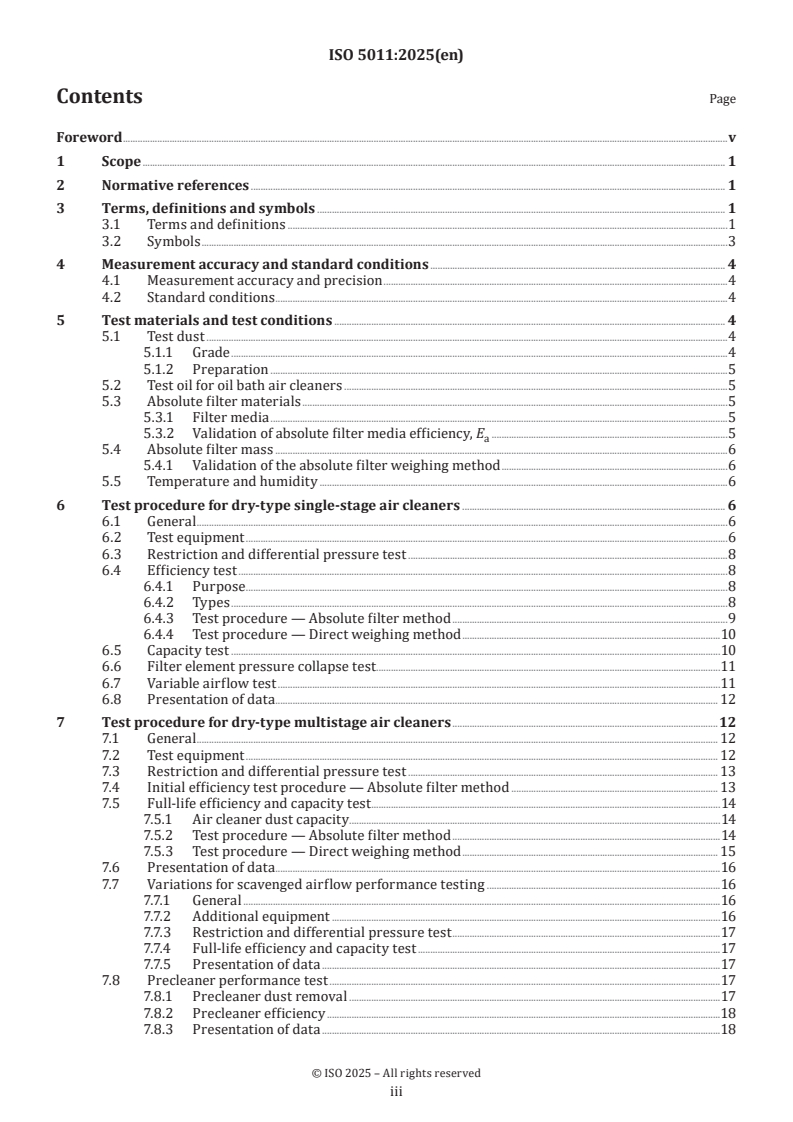
Contents Page
Foreword .v
1 Scope . 1
2 Normative references . 1
3 Terms, definitions and symbols . 1
3.1 Terms and definitions .1
3.2 Symbols .3
4 Measurement accuracy and standard conditions . 4
4.1 Measurement accuracy and precision .4
4.2 Standard conditions .4
5 Test materials and test conditions . 4
5.1 Test dust .4
5.1.1 Grade .4
5.1.2 Preparation .5
5.2 Test oil for oil bath air cleaners .5
5.3 Absolute filter materials .5
5.3.1 Filter media .5
5.3.2 Validation of absolute filter media efficiency, E .5
a
5.4 Absolute filter mass .6
5.4.1 Validation of the absolute filter weighing method .6
5.5 Temperature and humidity .6
6 Test procedure for dry-type single-stage air cleaners . 6
6.1 General .6
6.2 Test equipment .6
6.3 Restriction and differential pressure test .8
6.4 Efficiency test .8
6.4.1 Purpose .8
6.4.2 Types .8
6.4.3 Test procedure — Absolute filter method .9
6.4.4 Test procedure — Direct weighing method .10
6.5 Capacity test .10
6.6 Filter element pressure collapse test . . .11
6.7 Variable airflow test .11
6.8 Presentation of data . . 12
7 Test procedure for dry-type multistage air cleaners .12
7.1 General . 12
7.2 Test equipment . 12
7.3 Restriction and differential pressure test . 13
7.4 Initial efficiency test procedure — Absolute filter method . 13
7.5 Full-life efficiency and capacity test . .14
7.5.1 Air cleaner dust capacity.14
7.5.2 Test procedure — Absolute filter method .14
7.5.3 Test procedure — Direct weighing method . 15
7.6 Presentation of data .16
7.7 Variations for scavenged airflow performance testing .16
7.7.1 General .16
7.7.2 Additional equipment .16
7.7.3 Restriction and differential pressure test .17
7.7.4 Full-life efficiency and capacity test .17
7.7.5 Presentation of data .17
7.8 Precleaner performance test .17
7.8.1 Precleaner dust removal .17
7.8.2 Precleaner efficiency .18
7.8.3 Presentation of data .18
iii
7.9 Secondary element test procedure .18
7.9.1 General .18
7.9.2 Specific efficiency test .18
7.9.3 Expression of results .19
8 Test procedure for oil bath air cleaners . 19
8.1 General .19
8.2 Test equipment and conditions .19
8.3 Restriction and differential pressure test . 20
8.4 Oil carry-over test. 20
8.5 Full life efficiency and capacity test . 20
8.6 Recovery test .21
8.7 Presentation of data .21
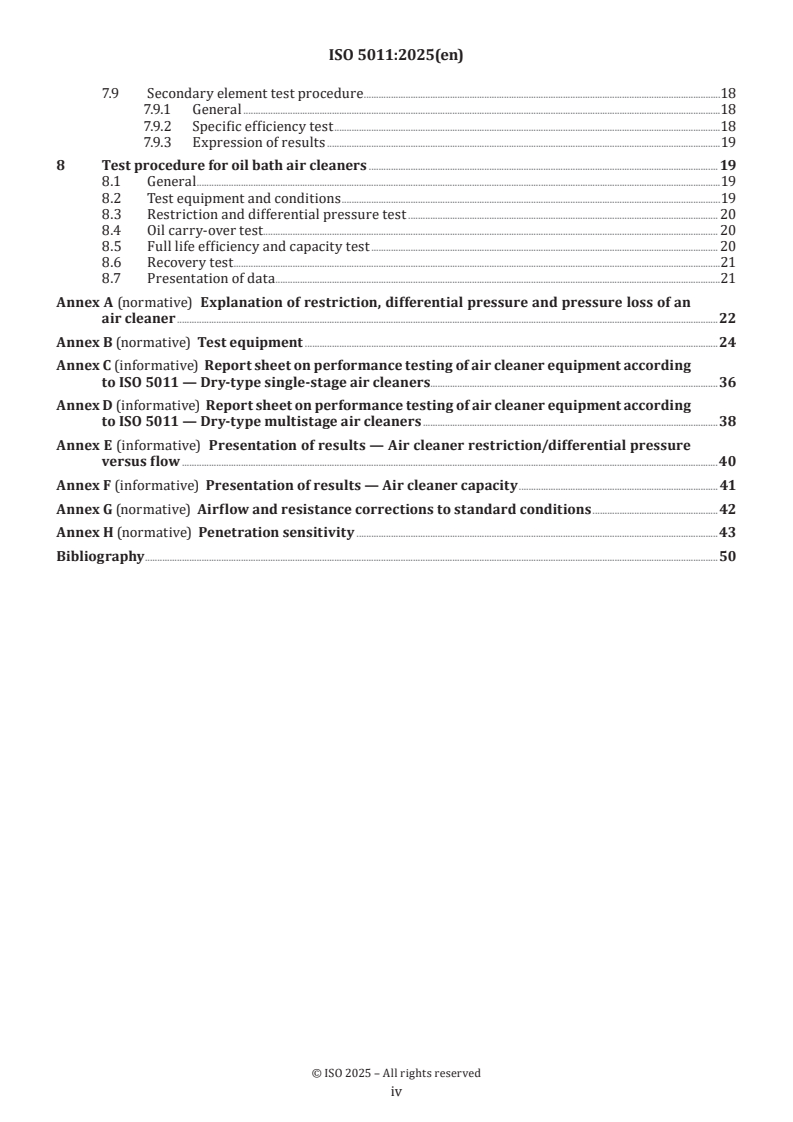
Annex A (normative) Explanation of restriction, differential pressure and pressure loss of an
air cleaner .22
Annex B (normative) Test equipment .24
Annex C (informative) Report sheet on performance testing of air cleaner equipment according
to ISO 5011 — Dry-type single-stage air cleaners.36
Annex D (informative) Report sheet on performance testing of air cleaner equipment according
to ISO 5011 — Dry-type multistage air cleaners .38
Annex E (informative) Presentation of results — Air cleaner restriction/differential pressure
versus flow .40
Annex F (informative) Presentation of results — Air cleaner capacity . 41
Annex G (normative) Airflow and resistance corrections to standard conditions .42
Annex H (normative) Penetration sensitivity .43
Bibliography .50
iv
Foreword
ISO (the International Organization for Standardization) is a worldwide federation of national standards
bodies (ISO member bodies). The work of preparing International Standards is normally carried out through
ISO technical committees. Each member body interested in a subject for which a technical committee
has been established has the right to be represented on that committee. International organizations,
governmental and non-governmental, in liaison with ISO, also take part in the work. ISO collaborates closely
with the International Electrotechnical Commission (IEC) on all matters of electrotechnical standardization.
The procedures used to develop this document and those intended for its further maintenance are described
in the ISO/IEC Directives, Part 1. In particular, the different approval criteria needed for the different types
of ISO document should be noted. This document was drafted in accordance with the editorial rules of the
ISO/IEC Directives, Part 2 (see www.iso.org/directives).
ISO draws attention to the possibility that the implementation of this document may involve the use of (a)
patent(s). ISO takes no position concerning the evidence, validity or applicability of any claimed patent
rights in respect thereof. As of the date of publication of this document, ISO had not received notice of (a)
patent(s) which may be required to implement this document. However, implementers are cautioned that
this may not represent the latest information, which may be obtained from the patent database available at
www.iso.org/patents. ISO shall not be held responsible for identifying any or all such patent rights.
Any trade name used in this document is information given for the convenience of users and does not
constitute an endorsement.
For an explanation of the voluntary nature of standards, the meaning of ISO specific terms and expressions
related to conformity assessment, as well as information about ISO's adherence to the World Trade
Organization (WTO) principles in the Technical Barriers to Trade (TBT), see www.iso.org/iso/foreword.html.
This document was prepared by Technical Committee ISO/TC 22, Road vehicles, Subcommittee SC 34,
Propulsion, powertrain and powertrain fluids.
This fifth edition cancels and replaces the fourth edition (ISO 5011:2020), which has been technically
revised.
The main changes are as follows:
— capacity of UUT is no longer dependent on scavenge flow rate;
— “air cleaner” used instead of “air filter” where warranted;
— edited list of symbols to meet ISO specifications;
— significant editorial modifications to Annex H .
Any feedback or questions on this document should be directed to the user’s national standards body. A
complete listing of these bodies can be found at www.iso.org/members.html.
v
International Standard ISO 5011:2025(en)
Inlet air cleaning equipment for internal combustion engines
and compressors — Performance testing
1 Scope
This document establishes and specifies uniform test procedures, conditions, equipment and a performance
report to permit the direct laboratory performance comparison of air cleaners.
The basic performance characteristics of greatest interest are airflow restriction or differential pressure,
dust collection efficiency, dust capacity and oil carry-over on oil bath air cleaners. This test code therefore
deals with the measurement of these parameters.
This document is applicable to air cleaners used on internal combustion engines and compressors generally
used in automotive and industrial applications.
2 Normative references
The following documents are referred to in the text in such a way that some or all of their content constitutes
requirements of this document. For dated references, only the edition cited applies. For undated references,
the latest edition of the referenced document (including any amendments) applies.
ISO 5167-1, Measurement of fluid flow by means of pressure differential devices inserted in circular cross-section
conduits running full — Part 1: General principles and requirements
ISO 12103-1, Road vehicles — Test contaminants for filter evaluation — Part 1: Arizona test dust
3 Terms, definitions and symbols
For the purposes of this document, the following terms and definitions apply.
ISO and IEC maintain terminology databases for use in standardization at the following addresses:
— ISO Online browsing platform: available at https:// www .iso .org/ obp
— IEC Electropedia: available at https:// www .electropedia .org/
3.1 Terms and definitions
3.1.1
air cleaner
device which removes particles suspended in the intake air as it is drawn into the engine
3.1.2
filter element
replaceable part of the air cleaner (3.1.1), consisting of the filter material and carrying frame
3.1.3
secondary element
air cleaner (3.1.1) element fitted downstream of the primary element for the purpose of providing the engine
with protection against dust in the event of
a) certain types of primary element failure, or
b) dust being present during the removal of the primary element for servicing
3.1.4
unit under test
either a single air filter element (3.1.2) or a complete air cleaner (3.1.1) assembly
3.1.5
single-stage air cleaner
air cleaner (3.1.1) which does not incorporate a separate precleaner (3.1.7)
3.1.6
multistage air cleaner
air cleaner (3.1.1) consisting of two or more stages, the first usually being a precleaner (3.1.7), followed by
one or more filter elements (3.1.2)
Note 1 to entry: If two elements are used, the first is called the primary element and the second one is called the
secondary element (3.1.3).
3.1.7
precleaner
device usually using inertial or centrifugal means to remove a portion of the test dust prior to reaching the
filter element (3.1.2)
3.1.8
test airflow
measure of the quantity of air drawn through the air cleaner (3.1.1) outlet per unit time
Note 1 to entry: The flow rate is expressed in cubic metres per minute corrected to standard conditions.
3.1.9
rated airflow
flow rate specified by the user or manufacturer
Note 1 to entry: It may be used as the test airflow (3.1.8).
3.1.10
scavenged airflow
measure of the quantity of air used to remove the collected dust from a precleaner (3.1.7)
Note 1 to entry: It is expressed as a percentage of the test airflow (3.1.8).
3.1.11
static pressure
pressure in a duct, at the observed airflow rate, measured by connecting a pressure gauge to a hole or holes
drilled in the wall of the duct
Note 1 to entry: In the tests specified in this document, a static pressure is measured by a manometer (usually a liquid
manometer) as a negative pressure difference against the atmospheric pressure and in the formula this is treated as a
positive value.
3.1.12
restriction
static pressure (3.1.11) measured immediately downstream of the unit under test (3.1.4)
3.1.13
differential pressure
difference in static pressure (3.1.11) measured immediately upstream and downstream of the unit under
test (3.1.4)
3.1.14
pressure loss
measure of the loss of energy caused by an air cleaner (3.1.1) at the observed airflow rate
Note 1 to entry: It is expressed as the differential pressure (3.1.13) corrected for any difference in the dynamic head at
the measuring points.
Note 2 to entry: For further information, see Annex A.
3.1.15
absolute filter
filter downstream of the unit under test (3.1.4) that retains the contaminant passed by the unit under test
3.1.16
efficiency
ability of the air cleaner (3.1.1) or the unit to remove contaminant mass under specified test conditions
3.1.17
capacity
quantity of contaminant removed by the unit under test (3.1.4) in producing specified terminal conditions
3.1.18
oil carry-over
appearance of oil at the cleaner outlet
3.1.19
test terminal condition
condition, relating to an air cleaner (3.1.1), the occurrence of which signifies the end of the test
Note 1 to entry: A test terminal condition may be, for example, any one of the following: the restriction (3.1.12) or
the differential pressure (3.1.13) reaches a specified or agreed terminal value; the dust-removing efficiency (3.1.16)
or some other performance parameter falls to a specified or agreed value; oil carry-over (3.1.18) occurs; a dust pot
becomes filled.
3.1.20
automotive application
air cleaner (3.1.1) used for internal combustion engines in passenger cars
Note 1 to entry: Automotive applications generally use single-stage air cleaners (3.1.5).
3.1.21
industrial application
air cleaner (3.1.1) used for internal combustion engines in heavy-duty trucks, construction equipment and
agricultural equipment
Note 1 to entry: Industrial applications generally use multistage air cleaners (3.1.6).
3.2 Symbols
The following applied units, according to ISO 80000-1, are used.
Name Symbol Unit
ρ
Density kg/m
Differential pressure Δp Pa
d
µ
Dynamic viscosity mPa·s
Mass m g
Mass flow rate q kg/min
m
Pressure p Pa
Pressure loss Δp Pa
l
Restriction Δp Pa
r
Temperature T °C
Time t s
Velocity v m/s
Volume flow rate q m /min
V
Name Symbol Unit
Efficiency E %
Penetration P %
Uncertainty U g
4 Measurement accuracy and standard conditions
4.1 Measurement accuracy and precision
Measure the airflow rate to within ±2 % of the actual value, except for the variable airflow test when
accuracy may be ±2 % of the maximum value of the cyclic flow rate through the cleaner.
Measure the differential pressure and restriction to within 25 Pa for pressure readings up to 10 kPa, within
1 % of reading for higher pressures.
Measure the temperature to within 0,5 °C of the actual value.
Measure the mass to within 0,1 g with the exception of absolute filter mass to be measured at 0,01 g and
with the exception of the feeder mass to be measured at 1 %.
Measure the relative humidity (RH) with an accuracy of ±2 % RH.
Measure the barometric pressure to within 0,3 kPa.
The measurement equipment shall be calibrated at regular intervals to ensure the required accuracy.
Follow Annex H to determine the reporting precision of your efficiency measurement.
4.2 Standard conditions
All airflow measurements shall be corrected to a standard condition of 20 °C at 101,3 kPa.
See Annex G.
5 Test materials and test conditions
5.1 Test dust
5.1.1 Grade
The test dust to be used shall be ISO 12103-1, A2 (ISO fine) or ISO 12103-1, A4 (ISO coarse), subject
to agreement between the filter manufacturer and client. The chemical analysis and the particle size
distribution shall conform to ISO 12103-1.
It is difficult, if not impossible, to select a test dust size distribution and concentration which will be
representative of all service conditions. Therefore, based on primarily practical considerations, the different
types of air cleaners have been classified as to their most probable service conditions, and the test dust
grade and concentration selected accordingly from Table 1.
Table 1 — Test dust and concentration
a
Air cleaner type Test dust Concentration
Single stage Coarse or fine 1 g/m
Multistage Coarse or fine 2 g/m
a
In accordance with ISO 12103-1.
In the absence of an agreement on the dust:
— for single-stage air cleaners, use ISO fine test dust, and
— for multistage air cleaners, use ISO coarse test dust.
5.1.2 Preparation
Before using the test dust, a quantity sufficient to cover the test requirements shall be mixed to ensure that
no stratification / clumping has occurred. The test dust shall then be allowed to become acclimatised to a
constant mass under the prevailing test conditions.
NOTE To ensure a constant rate of dust feed with some dust feeders, it can be necessary to heat the dust prior to
being acclimated to the environment.
5.2 Test oil for oil bath air cleaners
The oil used for testing oil bath air cleaners shall be that specified by the filter manufacturer and agreed
by the user for use at the appropriate ambient temperature. If an oil is not specified, the test oil shall be a
heavy-duty oil and the viscosity at the temperature of the test shall be adjusted as follows:
— 85 mm /s for oil carry-over and restriction/differential pressure tests;
— 330 mm /s for efficiency and capacity tests, including an oil carry-over test after the capacity test.
5.3 Absolute filter materials
5.3.1 Filter media
The absolute filter may consist of fibreglass media with a minimum thickness of 12,7 mm and a minimum
31)
density of 9,5 kg/m . The fibre diameter shall be 0,76 µm to 1,27 µm and the moisture absorption should
be less than 1 % by mass after exposure to 50 °C and 95 % relative humidity for 96 h. The absolute filter
media shall be installed with nap side facing upstream, in an airtight holder that adequately supports the
media. The face velocity shall not exceed approximately 0,8 m/s to maintain media integrity.
As an alternative, a non-woven filter media with the efficiency described in 5.3.2 may be used.
To reduce any subsequent errors in the measurements caused by losses of fibres or materials, the absolute
filter shall be subject to a flow of at least 110 % of the rated flow of ambient air for a minimum of 5 min
before the first (new) test weighing.
NOTE The use of an absolute filter with a backing will minimize fibre loss.
5.3.2 Validation of absolute filter media efficiency, E
a
Arrange two absolute filters in tandem. Perform a filter efficiency test and determine the mass increase of
each absolute filter according to the test procedure given in 6.4.3 or 7.5.2:
Δm
A
E = ×100 (1)
a
ΔΔmm+
AB
where
E is the absolute filter efficiency, expressed as a percentage;
a
Δm
is the mass increase of the upstream absolute filter;
A
Δm
is the mass increase of the downstream absolute filter.
B
1) A suitable material is commercially available. Details may be obtained from the secretariat of ISO/TC 22.
The absolute filter efficiency should be a minimum of 99 % for the contaminant presented to it.
5.4 Absolute filter mass
The absolute filter shall be weighed, to the nearest 0,01 g, after the mass has stabilized. Weight stabilization
may be achieved by storage in a ventilated oven at a constant temperature of 105 °C ± 5 °C. The absolute
filter shall be weighed inside the oven. Alternatively, air conditioned following 5.5 may be drawn through
the absolute filter for 15 min and then the filter is weighed. Evaluate conditioning method per 5.4.1.
5.4.1 Validation of the absolute filter weighing method
Using the method of choice, the absolute pad weight method shall be performed at least once each day for
three days and evaluate results per Annex H.
5.5 Temperature and humidity
All tests shall be conducted with air entering the air cleaner at a temperature of 23 °C ± 5 °C. Tests shall be
conducted at a relative humidity of (55 ± 15) %, the permissible variation at each weighing stage throughout
each single test being ±2 %.
The test results of an air cleaner will be affected by the relative humidity of the air passing through it and
the results of otherwise identical tests carried out near the two extremes of the permitted range of relative
humidity may not be directly comparable. The tests should be conducted within the narrowest range of
temperature and humidity possible.
6 Test procedure for dry-type single-stage air cleaners
6.1 General
Performance tests shall be performed on a complete air cleaner assembly or on a single air cleaner element;
tests on a complete air cleaner assembly are preferred. The tests shall consist of an airflow restriction/
differential pressure test, an efficiency test and a capacity test. In addition, a pressure collapse test shall be
performed on the air filter element.
6.2 Test equipment
6.2.1 Typical arrangements to determine resistance to airflow, dust capacity, dust removal characteristics
and rupture collapse characteristics are shown in Annex B, Figures B.1 and B.6 to B.11.
Use a dust feeder which when used with the dust injector in Figures B.2, B.3 and B.18 is capable of metering
dust over the range of delivery rates required. This dust feed system shall not change the primary particle
size distribution of the contaminant. The air feed pressure shall be 100 kPa minimum. The heavy-duty
injector pressure shall be a gauge pressure of 280 kPa minimum.
The dust feed system shall be validated as follows.
a) Charge the dust feeder with a pre-weighed amount of test dust.
b) Simultaneously start the dust feed system and timer.
c) At 5 min intervals, determine the mass of dust dispensed. Continue mass determinations of dust
increments for 30 min.
d) Adjust the dust feeder until the average delivery rate is within 5 % of the desired rate and the deviation
in delivery rate from the average is not more than 5 %.
6.2.2 Use a dust-transfer tube between the dust feeder and the injector of a size suitable to maintain dust
suspension. Sedimentation losses in the transfer tube should be avoided by having the tube as short as
possible and grounded.
6.2.3 Use the dust injector described in Table 2 and shown in Figures B.2, B.3 and B.18.
Table 2 — Recommended ISO dust injectors (see Figures B.2, B.3 and B.18)
Dust feed rate per injector
0 to 5 5 to 26 > 26
[g/min]
Light-duty injector or
Heavy-duty injectors
Injector type Light-duty injector heavy-duty injectors
(A or B)
(A or B)
If an array of injectors is used, special care shall be taken to make sure the dust fed is distributed evenly
between each injector for two reasons: First, to get homogeneous dust distribution in the airstream and
second, to make sure the maximum or minimum feed rate for the injectors being used is not exceeded.
Where dust feed rates greater than this are required, more than one injector will have to be used. It should
be noted that the design of the system feeding test dust to the injector may affect this maximum rate of dust
feed. The maximum attainable dust feed rate should therefore be determined prior to the dust feed/injector
system being used for tests.
Injector nozzles are subject to natural erosion. Erosion may affect the distribution and delivery of test
contaminant. Therefore, it is recommended to use a design with replaceable parts.
6.2.4 Use an inlet tube conforming to Figure B.4. The dust injector and inlet tube shall be positioned in
such a way that there is a uniform dust distribution and no loss of dust.
6.2.5 Use a manometer or other differential-pressure measuring device with the specified accuracy.
6.2.6 For air cleaner assembly testing, use a housing and set-up agreed upon by the manufacturer and
user conforming to Figure B.11. For air filter element testing, use a test set-up and shroud conforming to
Figures B.1 and B.5 or an arrangement as shown in Figures B.6 or B.7. Where the test equipment is as shown
in Figure B.6, the dust is fed into the chamber and, to ensure that it does not adhere to the walls and is evenly
distributed, dry compressed air jets on flexible tubing should be provided in the test chamber, arranged so
to agitate any dust that settles out.
When using compressed air for agitating dust, care shall be taken not to eject any dust out of the chamber.
To ensure that no dust is ejected from the chamber, a negative pressure should be maintained between the
chamber and the atmosphere.
6.2.7 Use an outlet tube conforming to Figure B.4. The cross-section shall be the same as the air cleaner
outlet. In the case of non-uniform flow conditions caused by special outlet tubes, special precautions may be
required.
6.2.8 Use an airflow rate measuring system having the accuracy described in 4.1.
Validate the airflow rate measuring system. The airflow meter shall be of an acceptable design, such as a
calibrated orifice and manometer conforming to ISO 5167-1. The orifice unit shall be permanently marked
such that it can be identified after calibration. Corrections shall be made for variations in absolute pressure
and temperature at the meter inlet and the airflow rate shall be expressed in cubic metres per minute
corrected to standard conditions (see 4.2).
6.2.9 Use an airflow rate control system capable of maintaining the indicated flow rate to within 2 % of
the selected value during steady-state and variable airflow operation.
6.2.10 Use a blower/exhauster for inducing airflow through the system, which has adequate flow rate
and pressure characteristics for the filters to be tested. Pulsation of flow rate shall be so low that it is not
measurable by the flow rate measuring system.
6.2.11 Grounding is required for all test apparatus to reduce the effects of static charges and to improve
the consistency of the test results. Grounding of metallic and non-metallic surfaces, housings, dust transport
tubes, injectors and associated hardware is recommended.
6.3 Restriction and differential pressure test
6.3.1 The purpose of this test is to determine the restriction/differential pressure/pressure loss across
the unit under test which will result when air is passed through under predetermined conditions. Airflow
restriction or differential pressure is measured with a clean filter element, or elements, at five equally
spaced airflows of between 50 % and 150 % of the rated airflow, or as agreed upon between the user and
manufacturer.
6.3.2 Condition the unit to the airflow at which the unit is tested for at least 15 min under the temperature
and humidity conditions specified in 5.5.
6.3.3 Set up the test stand as shown in Figures B.8 or B.9 and Figures B.14 or B.15. Seal all joints to prevent
air leaks. Connect pressure taps.
6.3.4 Measure and record the restriction and the differential pressure versus the flow rate at
approximately 50 %, 75 %, 100 %, 125 % and 150 % of the rated airflow, or as agreed upon between the
user and manufacturer.
6.3.5 Record the ambient temperature, barometric pressure and relative humidity.
6.3.6 Correct the recorded restriction and differential pressure to standard conditions in accordance with
Annex G, Formula (G.2).
6.3.7 For pressure loss determination, use the formula given in Annex A.
6.3.8 Plot the results, for example as shown in Annex E, Figure E.1 or equivalent.
6.4 Efficiency test
6.4.1 Purpose
The purpose of this test is to determine the retention capabilities of the unit under test. This test can be
conducted with either constant or variable airflow and with coarse dust or fine test dust. If desired,
efficiency tests can be performed concurrently with capacity tests (see 6.5). Determination of the efficiency
at constant test airflow can be performed at the rated airflow or any percentage thereof, as agreed upon by
the user and manufacturer. Determination of efficiency at variable airflow can be performed using variable
airflow cycle according to 6.7.
6.4.2 Types
Three types of efficiency tests can be performed, as follows:
a) full-life efficiency determined when the terminal condition, i.e. the terminating differential pressure is
reached;
b) incremental efficiency determined when, for example, 10 %, 25 % and 50 % of the terminating
differential pressure minus the initial differential pressure is reached;
c) initial efficiency determined after the addition of 20 g of contaminant or the number of grams
numerically equivalent to six times the airflow in cubic metres per minute, whichever is the greater.
6.4.3 Test procedure — Absolute filter method
6.4.3.1 Based on the test flow, calculate the test dust feed rate using a dust concentration of 1,0 g/m of
3 3
air; in special cases (e.g. small filters) 0,25 g/m or 0,5 g/m may be allowed.
6.4.3.2 Condition the unit under test according to 6.3.2, then measure and record the mass.
NOTE Conditioning of the absolute filter pad and air cleaner can be performed concurrently.
6.4.3.3 Weigh the absolute filter pad as specified in 5.4 and record mass before assembly within absolute
filter housing.
6.4.3.4 Set up test stand as shown in Figure B.11 for air cleaner assemblies, or as shown in Figure B.1, B.6
or B.7 for air filter elements. Seal all joints to prevent air leakage.
6.4.3.5 Record the temperature, barometric pressure and relative humidity.
6.4.3.6 Prepare the specified test dust according to 5.1 and weigh out the quantity required for test in
a suitable test container. For full-life efficiency tests, the quantity should be approximately 125 % of the
estimated capacity of the unit under test. Record the mass of the container and dust to the nearest 0,1 g.
Specified in 4.1.
6.4.3.7 Start the airflow through the test stand and stabilize at the test flow rate. Record the differential
pressure.
6.4.3.8 Load the dust feeder from the dust container and adjust the feed rate to inject dust at the
concentration calculated in 6.4.3.1. Reload the dust feeder from the dust container throughout the test as
necessary.
6.4.3.9 At specified time intervals (a minimum of five points is recommended), record the differential
pressure in accordance with Annex A at the test flow and the elapsed test time.
6.4.3.10 Continue the test until the specified terminal condition is reached.
6.4.3.11 Record the temperature, barometric pressure and relative humidity.
6.4.3.12 The dust on the exterior surfaces of a cleaner assembly or any which may have settled in the test
chamber/ducting on the inlet side of a test element shall be collected carefully and its weight recorded. This
dust shall then be discarded due to potential change in distribution.
6.4.3.13 Reweigh the dust container and add the result to the weight recorded in 6.4.3.12. Subtract this sum
from the mass recorded in 6.4.3.6. The difference is the mass of dust fed to the unit under test. The mass of
dust fed to the unit under test can be determined from weight loss of the dust feeder directly.
6.4.3.14 Carefully remove the unit under test without losing any dust. Note any evidence of seal leakage or
unusual conditions. Weigh the unit, per 4.1 in grams. The increase in mass of the unit under test is this mass
minus the mass determined in 6.4.3.2. In the full-life efficiency test [see 6.4.2 a)] this increase in mass is the
capacity of the unit under test.
6.4.3.15 Brush any observed dust on the downstream side of the test unit onto the absolute filter. Carefully
remove the absolute filter. Repeat step 6.4.3.3 per 4.1 and determine the difference in mass. This is the
increase in mass of the absolute filter.
6.4.3.16 Calculate the material balance, B, of the test dust. For the test to be valid, this value shall be within
the range 0,98 to 1,02:
ΔΔmm+
Fu
B= (2)
m
D
where
Δm is the increase in mass of the absolute filter;
F
Δm is the increase in mass of the unit under test;
u
m is the total mass of the dust fed.
D
6.4.3.17 Calculate the efficiency, E (expressed as a percentage), by the following method:
Δm
u
E= ×100 (3)
ΔΔmm+
uF
where the symbols are as in Formula (2).
6.4.4 Test procedure — Direct weighing method
NOTE This method is a less precise efficiency determination than the absolute filter method.
The direct weighing method may be used for cumulative efficiency determination where the humidity can be
controlled to within ± 1,0 % and the accuracy of the increase in mass of the filter determined to within 0,1 %.
Where a suitable large, accurate balance is available, it is permissible to use a direct weighing method of
assessing the performance of the unit under test. In such cases the air cleaner under test shall be tested
according to the procedure in 6.4.3 omitting the operations described in 6.4.3.3, 6.4.3.15, 6.4.3.16 and
6.4.3.17. Calculate the efficiency, E (expressed as a percentage), as follows:
Δm
u
E=×100 (4)
m
D
where the symbols
...