


ISO 6722:2006
(Main)Road vehicles — 60 V and 600 V single-core cables — Dimensions, test methods and requirements
Road vehicles — 60 V and 600 V single-core cables — Dimensions, test methods and requirements
ISO 6722:2006 specifies the dimensions, test methods, and requirements for single-core 60 V cables intended for use in road vehicle applications where the nominal system voltage is equal to or less than (60 V d.c. or 25 V a.c.). It also specifies additional test methods and/or requirements for 600 V cables intended for use in road vehicle applications where the nominal system voltage is greater than (60 V d.c. or 25 V a.c.) to equal to or less than (600 V d.c. or 600 V a.c.). It also applies to individual cores in multi-core cables.
Véhicules routiers — Câbles monoconducteurs de 60 V et 600 V — Dimensions, méthodes d'essai et exigences
General Information
- Status
- Withdrawn
- Publication Date
- 25-Jul-2006
- Withdrawal Date
- 25-Jul-2006
- Technical Committee
- ISO/TC 22 - Road vehicles
- Drafting Committee
- ISO/TC 22 - Road vehicles
- Current Stage
- 9599 - Withdrawal of International Standard
- Start Date
- 06-Oct-2011
- Completion Date
- 12-Feb-2026
Relations
- Effective Date
- 12-Dec-2009
- Effective Date
- 15-Apr-2008
- Effective Date
- 15-Apr-2008
Get Certified
Connect with accredited certification bodies for this standard

TÜV Rheinland
TÜV Rheinland is a leading international provider of technical services.

TÜV SÜD
TÜV SÜD is a trusted partner of choice for safety, security and sustainability solutions.

AIAG (Automotive Industry Action Group)
American automotive industry standards and training.
Sponsored listings
Frequently Asked Questions
ISO 6722:2006 is a standard published by the International Organization for Standardization (ISO). Its full title is "Road vehicles — 60 V and 600 V single-core cables — Dimensions, test methods and requirements". This standard covers: ISO 6722:2006 specifies the dimensions, test methods, and requirements for single-core 60 V cables intended for use in road vehicle applications where the nominal system voltage is equal to or less than (60 V d.c. or 25 V a.c.). It also specifies additional test methods and/or requirements for 600 V cables intended for use in road vehicle applications where the nominal system voltage is greater than (60 V d.c. or 25 V a.c.) to equal to or less than (600 V d.c. or 600 V a.c.). It also applies to individual cores in multi-core cables.
ISO 6722:2006 specifies the dimensions, test methods, and requirements for single-core 60 V cables intended for use in road vehicle applications where the nominal system voltage is equal to or less than (60 V d.c. or 25 V a.c.). It also specifies additional test methods and/or requirements for 600 V cables intended for use in road vehicle applications where the nominal system voltage is greater than (60 V d.c. or 25 V a.c.) to equal to or less than (600 V d.c. or 600 V a.c.). It also applies to individual cores in multi-core cables.
ISO 6722:2006 is classified under the following ICS (International Classification for Standards) categories: 43.040.10 - Electrical and electronic equipment. The ICS classification helps identify the subject area and facilitates finding related standards.
ISO 6722:2006 has the following relationships with other standards: It is inter standard links to ISO 6722-2:2013, ISO 6722:2002, ISO 6722-1:2011. Understanding these relationships helps ensure you are using the most current and applicable version of the standard.
ISO 6722:2006 is available in PDF format for immediate download after purchase. The document can be added to your cart and obtained through the secure checkout process. Digital delivery ensures instant access to the complete standard document.
Standards Content (Sample)
INTERNATIONAL ISO
STANDARD 6722
Second edition
2006-08-01
Road vehicles — 60 V and 600 V
single-core cables — Dimensions, test
methods and requirements
Véhicules routiers — Câbles monoconducteurs de 60 V et 600 V —
Dimensions, méthodes d'essai et exigences
Reference number
©
ISO 2006
PDF disclaimer
This PDF file may contain embedded typefaces. In accordance with Adobe's licensing policy, this file may be printed or viewed but
shall not be edited unless the typefaces which are embedded are licensed to and installed on the computer performing the editing. In
downloading this file, parties accept therein the responsibility of not infringing Adobe's licensing policy. The ISO Central Secretariat
accepts no liability in this area.
Adobe is a trademark of Adobe Systems Incorporated.
Details of the software products used to create this PDF file can be found in the General Info relative to the file; the PDF-creation
parameters were optimized for printing. Every care has been taken to ensure that the file is suitable for use by ISO member bodies. In
the unlikely event that a problem relating to it is found, please inform the Central Secretariat at the address given below.
© ISO 2006
All rights reserved. Unless otherwise specified, no part of this publication may be reproduced or utilized in any form or by any means,
electronic or mechanical, including photocopying and microfilm, without permission in writing from either ISO at the address below or
ISO's member body in the country of the requester.
ISO copyright office
Case postale 56 • CH-1211 Geneva 20
Tel. + 41 22 749 01 11
Fax + 41 22 749 09 47
E-mail copyright@iso.org
Web www.iso.org
Published in Switzerland
ii © ISO 2006 – All rights reserved
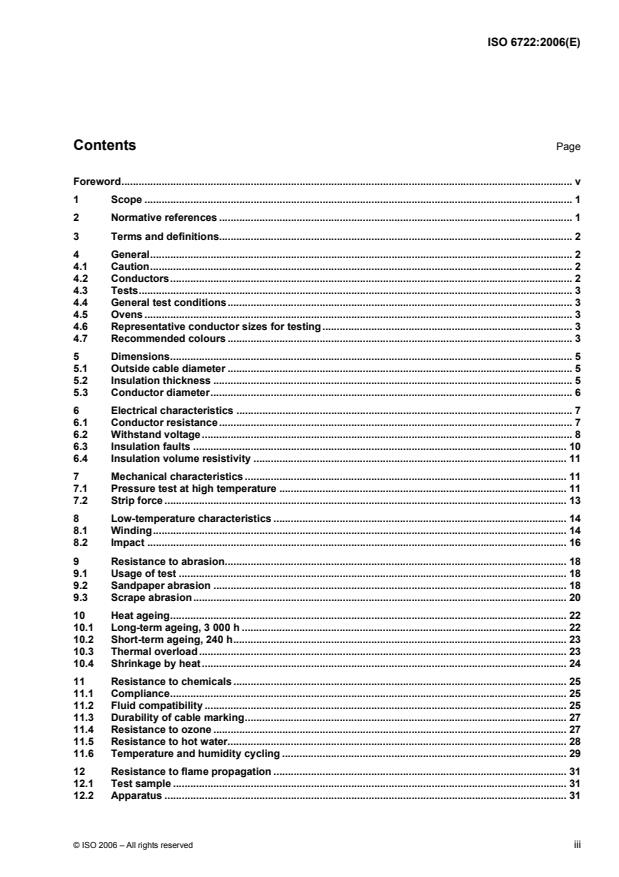
Contents Page
Foreword. v
1 Scope. 1
2 Normative references. 1
3 Terms and definitions. 2
4 General. 2
4.1 Caution. 2
4.2 Conductors. 2
4.3 Tests. 3
4.4 General test conditions. 3
4.5 Ovens. 3
4.6 Representative conductor sizes for testing. 3
4.7 Recommended colours . 3
5 Dimensions. 5
5.1 Outside cable diameter . 5
5.2 Insulation thickness . 5
5.3 Conductor diameter. 6
6 Electrical characteristics. 7
6.1 Conductor resistance. 7
6.2 Withstand voltage. 8
6.3 Insulation faults . 10
6.4 Insulation volume resistivity . 11
7 Mechanical characteristics. 11
7.1 Pressure test at high temperature . 11
7.2 Strip force. 13
8 Low-temperature characteristics. 14
8.1 Winding. 14
8.2 Impact. 16
9 Resistance to abrasion. 18
9.1 Usage of test . 18
9.2 Sandpaper abrasion . 18
9.3 Scrape abrasion. 20
10 Heat ageing. 22
10.1 Long-term ageing, 3 000 h . 22
10.2 Short-term ageing, 240 h. 23
10.3 Thermal overload. 23
10.4 Shrinkage by heat. 24
11 Resistance to chemicals . 25
11.1 Compliance. 25
11.2 Fluid compatibility . 25
11.3 Durability of cable marking. 27
11.4 Resistance to ozone . 27
11.5 Resistance to hot water. 28
11.6 Temperature and humidity cycling . 29
12 Resistance to flame propagation . 31
12.1 Test sample. 31
12.2 Apparatus. 31
12.3 Procedure. 31
12.4 Requirement. 31
Annex A (informative) Conductors . 32
Annex B (informative) Recommended colours. 33
Annex C (informative) High-volume cable constructions . 34
Annex D (informative) Sources for reference materials . 36
Bibliography . 37
iv © ISO 2006 – All rights reserved
Foreword
ISO (the International Organization for Standardization) is a worldwide federation of national standards bodies
(ISO member bodies). The work of preparing International Standards is normally carried out through ISO
technical committees. Each member body interested in a subject for which a technical committee has been
established has the right to be represented on that committee. International organizations, governmental and
non-governmental, in liaison with ISO, also take part in the work. ISO collaborates closely with the
International Electrotechnical Commission (IEC) on all matters of electrotechnical standardization.
International Standards are drafted in accordance with the rules given in the ISO/IEC Directives, Part 2.
The main task of technical committees is to prepare International Standards. Draft International Standards
adopted by the technical committees are circulated to the member bodies for voting. Publication as an
International Standard requires approval by at least 75 % of the member bodies casting a vote.
Attention is drawn to the possibility that some of the elements of this document may be the subject of patent
rights. ISO shall not be held responsible for identifying any or all such patent rights.
ISO 6722 was prepared by Technical Committee ISO/TC 22, Road vehicles, Subcommittee SC 3, Electrical
and electronic equipment.
This second edition cancels and replaces the first edition (ISO 6722:2002) which has been technically revised.
INTERNATIONAL STANDARD ISO 6722:2006(E)
Road vehicles — 60 V and 600 V single-core cables —
Dimensions, test methods and requirements
1 Scope
This International Standard specifies the dimensions, test methods, and requirements for single-core 60 V
cables intended for use in road vehicle applications where the nominal system voltage is u (60 V d.c. or
25 V a.c.). It also specifies additional test methods and/or requirements for 600 V cables intended for use in
road vehicle applications where the nominal system voltage is > (60 V d.c. or 25 V a.c.) to u (600 V d.c. or
600 V a.c.). It also applies to individual cores in multi-core cables.
Eight temperature classes are defined in Table 1.
Table 1 — Temperature class rating
Class Temperature
A − 40 °C to 85 °C
B – 40 °C to 100 °C
C − 40 °C to 125 °C
D − 40 °C to 150 °C
E − 40 °C to 175 °C
F − 40 °C to 200 °C
G − 40 °C to 225 °C
H − 40 °C to 250 °C
2 Normative references
The following referenced documents are indispensable for the application of this document. For dated
references, only the edition cited applies. For undated references, the latest edition of the referenced
document (including any amendments) applies.
ISO 1817, Rubber, vulcanized — Determination of the effect of liquids
ISO 6931-1, Stainless steels for springs — Part 1: Wire
IEC 60757, Code for designation of colours
IEC 60811-2-1, Common test methods for insulating and sheathing materials of electrical and optical
cables — Part 2-1: Methods specific to elastomeric compounds — Ozone resistance, hot set and mineral oil
immersion tests
ASTM B1, Standard Specification for Hard-Drawn Copper Wire
ASTM B3, Standard Specification for Soft or Annealed Copper Wire
ASTM B33, Standard Specification for Tinned Soft or Annealed Copper Wire for Electrical Purposes
ASTM B298, Standard Specification for Silver-Coated Soft or Annealed Copper Wire
ASTM B355, Standard Specification for Nickel-Coated Soft or Annealed Copper Wire
3 Terms and definitions
For the purposes of this document, the following terms and definitions apply.
3.1
60 Volt (V) cable
cable intended for use in road vehicle applications where the nominal system voltage is equal to or less than
60 V d.c. or 25 V a.c.
3.2
600 Volt (V) cable
cable intended for use in road vehicle applications where the nominal system voltage is greater than
(60 V d.c. or 25 V a.c.) and less than (600 V d.c. or 600 V a.c.)
NOTE a.c. tests are performed at 50 Hz or 60 Hz. Applications at higher frequencies may require additional testing.
3.3
cable family
group with multiple conductor sizes having the same conductor strand coating, insulation formulation and
wall-thickness type
3.4
nominal (value)
suitable approximate value used to designate or identify a component
4 General
4.1 Caution
Special care shall be taken with cables used with voltages above (60 V d.c. or 25 V a.c.) to protect them from
mechanical stress in order to avoid shock hazard. Regardless of wall thickness, 600 V cables shall meet the
“resistance to abrasion” requirements for thick wall cable.
4.2 Conductors
The conductors shall consist of plain or coated copper strands as shown in Table 2. Conductor sizes
W 0,5 mm shall consist of soft annealed copper or annealed compressed/compacted wires. Conductor sizes
< 0,5 mm shall consist of soft annealed copper, soft annealed compressed/compacted copper, hard
unannealed copper or a copper alloy. The specifications for the conductors shall be completed by material
specifications. Elongation requirements shall be established by agreement between customer and supplier.
The finished cable shall meet the resistance requirements of 6.1 for all conductors except alloys. When an
alloy is used, the resistance requirement shall be established by agreement between customer and supplier.
NOTE Examples of strandings are shown in Table A.1. These strandings highlight examples of conceptual
configurations and are not intended to reflect any preferred constructions. Other strandings' configurations may be used
provided they meet the requirements shown above and are agreed upon between customer and supplier.
2 © ISO 2006 – All rights reserved
Table 2 — Conductor specifications
ASTM B1 Hard-drawn copper wire
ASTM B3 Soft or annealed copper wire
ASTM B33 Tinned soft or annealed copper wire
ASTM B298 Silver-coated soft or annealed copper wire
ASTM B355 Nickel-coated soft or annealed copper wire
NOTE Silver- and nickel-coated conductors are intended for use
with high “temperature class ratings”.
4.3 Tests
The cables shall be submitted to the tests as specified in Table 3.
4.4 General test conditions
Test samples for all tests except those in Clause 5 and in 6.1 and 6.3 shall be preconditioned for at least 16 h
at a room temperature of (23 ± 5) °C. Unless otherwise specified, all tests other than “in-process” tests shall
be conducted at this same temperature. Where no tolerance is specified, all values shall be considered to be
approximate.
4.5 Ovens
Unless otherwise specified, when an oven is required, it shall be a hot air oven. The air contained in the oven
shall be completely changed at least eight (8) times but not more than twenty (20) times per hour at the
specified temperature.
4.6 Representative conductor sizes for testing
When a test is required, all combinations of conductor size, wall thickness and insulation formulation shall
meet the appropriate requirements. However, if representative conductor sizes for testing are permitted,
compliance for a cable family may be demonstrated by testing examples of large and small conductor sizes
only. Permission to show compliance for a cable family by testing “representative conductor sizes” shall be
established by agreement between customer and supplier.
4.7 Recommended colours
A list of recommended colours is shown in Table B.1
Table 3 — Tests
c
In-process Certification If required
Clause Test description
a b b
Initial Initial
tests Periodic Periodic
5 Dimensions
5.1 Outside cable diameter — × × — —
5.2 Insulation thickness — × × — —
5.3 Conductor diameter — — — × ×
6 Electrical characteristics
6.1 Conductor resistance — × × — —
d d
6.2 Withstand voltage — — —
d
6.3 Insulation faults — — — —
6.4 Insulation volume resistivity — — — × ×
7 Mechanical characteristics
7.1 Pressure test at high temperature — × × — —
7.2 Strip force — — — × ×
8 Low-temperature characteristics
8.1 Winding — × × — —
8.2 Impact — — — × ×
e e
9 Resistance to abrasion
— — —
9.2 Sandpaper abrasion — — — — —
9.3 Scrape abrasion — — — — —
10 Heat ageing
10.1 Long-term ageing, 3 000 h — × — — —
10.2 Short-term ageing, 240 h — × × — —
10.3 Thermal overload — — — × ×
10.4 Shrinkage by heat — — —
× ×
11 Resistance to chemicals
f, g f, g
11.2 Fluid compatibility — — —
g g
11.3 Durability of cable marking — — —
g
11.4 Resistance to ozone — — — —
g
11.5 Resistance to hot water — — — —
g
11.6 Temperature and humidity cycling — — — —
12 Resistance to flame propagation — × × — —
"X" To be applied.
"—" Not applicable.
a
A test made on all cables during or after manufacture.
b
The frequency of periodic testing shall be established by agreement between customer and supplier.
c
The usage of "if required” tests shall be established by agreement between customer and supplier.
d
Some cables are rated at 60 V and others at 600 V. See 6.2 and 6.3 for details.
e
See Clause 9.
f
Some fluids are for “certification” and others are “if required”. See 11.2 for details.
g
Compliance for a cable family may be demonstrated by testing examples of large and small conductor sizes only. See 4.6 for
details.
4 © ISO 2006 – All rights reserved
5 Dimensions
5.1 Outside cable diameter
5.1.1 Test Sample
Prepare a test sample 3 m in length.
5.1.2 Apparatus
Use a measuring device with an accuracy of ± 0,01 mm. The device shall not cause deformation.
5.1.3 Procedure
Take three sets of measurements at positions separated by 1 m and record the highest and lowest outside
cable diameter at each position.
5.1.4 Requirement
All measurements shall be within the limits of the appropriate maximum and minimum “outside cable
diameter” specified in Table 4 and Table C.1. The values in Table 4 are normative. Since the values in
Table C.1 are informative, they are not required; however, they may be applied by agreement between
customer and supplier.
5.2 Insulation thickness
5.2.1 Test samples
Prepare three test samples from a cable sample 3 m in length. Take the test samples at 1 m intervals. Strip
the insulation from the cable. A test sample consists of a thin cross section of insulation. Take care not to
deform the test sample during the preparation process. If cable marking causes indentation of the insulation,
take the first test sample through this indentation.
5.2.2 Apparatus
Use a measuring device with an accuracy of ± 0,01 mm. The device shall not cause deformation.
5.2.3 Procedure
Place the test sample under the measuring equipment with the plane of the cut perpendicular to the optical
axis. Determine the minimum “insulation thickness”.
5.2.4 Requirement
No single value shall be less than the appropriate minimum insulation thickness specified in Table 4.
Table 4 — Dimensions
ISO conductor Thick wall Thin wall Ultra-thin wall
Outside Outside Outside
Insulation Insulation Insulation
Size Diameter cable cable cable
thickness thickness thickness
diameter diameter diameter
mm mm mm mm mm mm mm mm
max. nominal min. max. nominal min. max. nominal min. max.
0,13 0,55 — — — 0,25 0,20 1,05 0,20 0,16 0,95
0,22 0,70 — — — 0,25 0,20 1,20 0,20 0,16 1,05
a
0,35 0,90 — — — 0,25 0,20 0,20 0,16 1,20
1,40
0,50 1,10 0,60 0,48 2,30 0,28 0,22 1,60 0,20 0,16 1,40
0,75 1,30 0,60 0,48 2,50 0,30 0,24 1,90 0,20 0,16 1,60
1 1,50 0,60 0,48 2,70 0,30 0,24 2,10 0,20 0,16 1,75
1,5 1,80 0,60 0,48 3,00 0,30 0,24 2,40 0,20 0,16 2,10
2 2,00 0,60 0,48 3,30 0,35 0,28 2,80 0,25 0,20 2,40
2,5 2,20 0,70 0,56 3,60 0,35 0,28 3,00 0,25 0,20 2,70
3 2,40 0,70 0,56 4,10 0,40 0,32 3,40 — — —
4 2,80 0,80 0,64 4,40 0,40 0,32 3,70 — — —
5 3,10 0,80 0,64 4,90 0,40 0,32 4,20 — — —
6 3,40 0,80 0,64 5,00 0,40 0,32 4,30 — — —
10 4,50 1,00 0,80 6,50 0,60 0,48 6,00 — — —
16 6,30 1,00 0,80 8,30 0,65 0,52 7,90 — — —
25 7,80 1,30 1,04 10,40 0,65 0,52 9,40 — — —
35 9,00 1,30 1,04 11,60 — — — — — —
50 10,50 1,50 1,20 13,50 — — — — — —
70 12,50 1,50 1,20 15,50 — — — — — —
95 14,80 1,60 1,28 18,00 — — — — — —
120 16,50 1,60 1,28 19,70 — — — — — —
NOTE Outside cable diameter minimum values for high-volume cable constructions are shown in Table C.1. Since the values in
Table C.1 are informative, they are not required; however, they may be applied by agreement between customer and supplier.
a 2
The outside cable diameter for conductor size 0,35 mm with 7 strands shall be a maximum of 1,30 mm.
5.3 Conductor diameter
5.3.1 Test samples
The usage of this test shall be established by agreement between customer and supplier. In case of disputed
results, a refereeing method is provided.
Referee test samples: in case of a dispute, prepare three test samples from a cable sample 3 m in length.
Take the test samples at 1 m intervals. A test sample consists of a 20 mm length of cable. Take care not to
deform the test sample. Immerse the test samples in a casting resin. After hardening, take a section
perpendicular to the axis of the test sample.
6 © ISO 2006 – All rights reserved
5.3.2 Apparatus
Carry out this test on the same apparatus used for the measurement of the insulation thickness (see 5.2).
Referee apparatus: in case of a dispute, the measuring device shall be capable of at least 10 × linear
magnification.
5.3.3 Procedure
Check the conductor diameter by measuring the inside diameter of the samples used in 5.2 and recording the
maximum inside diameter for each test sample.
Referee procedure: in case of a dispute, measure the conductor diameter using the “referee test samples”
and the “referee apparatus”. Record the maximum conductor diameter for each test sample.
5.3.4 Requirement
The measured value shall not exceed the maximum value, specified in Table 4. This measured value is also
required in 6.4.
6 Electrical characteristics
6.1 Conductor resistance
6.1.1 Test samples
Prepare a test sample 1 m in length plus the length necessary for connections. Other lengths may be used
providing that the resistance reading is adjusted using the method shown in 6.1.3. The ends of the test sample
may be soldered.
6.1.2 Apparatus
Use a resistance-measuring device with an accuracy of ± 0,5 % of the measured value and a thermometer
with an accuracy of ± 0,5 °C.
6.1.3 Procedure
Measure the temperature of the test sample and the unsoldered length. Take care to ensure that connections
are secure. Measure the resistance of the test sample. Correct the measured value using the following
equation:
R
t
R =
⎡⎤
Lt1+−0,003 93 20
()
⎣⎦
where
R is the corrected conductor resistance at the reference temperature of 20 °C, expressed in milliohms
per metre;
R is the conductor resistance measured at the conductor temperature, expressed in milliohms;
t
L is the unsoldered conductor length, expressed in metres;
t is the conductor temperature at the time of measuring, expressed in degrees centigrade.
NOTE The value of 0,003 93 is the temperature coefficient for copper with 100 % conductivity at a temperature of
20 °C. For coated wires or alloys, the correction factor shall be established by agreement between customer and supplier.
6.1.4 Requirement
The corrected value shall not exceed the appropriate maximum resistance specified in Table 5.
Conductors produced from silver-coated strands shall not exceed the maximum conductor resistance per
length for plain copper.
6.2 Withstand voltage
6.2.1 Test sample
Prepare a test sample of a minimum length of 350 mm, strip 25 mm of insulation from each end and twist the
ends together to form a loop.
6.2.2 Apparatus
Partially fill an electrically non-conductive vessel with salt water (aqueous solution of 3 % by mass of NaCl)
with the ends of the test sample emerging above the bath as shown in Figure 1. Use a 50 Hz or 60 Hz a.c.
voltage source.
6.2.3 Procedure
6.2.3.1 60 V cable
Immerse the test sample in the bath, as shown in Figure 1, for 4 h and then apply a test voltage of 1 kV
(r.m.s.) for 30 min between the conductor and the bath. Then increase the voltage at a rate of 500 V/s until the
following value is reached:
⎯ 3 kV (r.m.s.) for cables < 0,5 mm ;
⎯ 5 kV (r.m.s.) for cables W 0,5 mm .
6.2.3.2 600 V cable
After completing the procedure for a 60 V cable, hold the 3 kV or 5 kV for a further 5 min.
6.2.4 Requirement
Breakdown shall not occur.
8 © ISO 2006 – All rights reserved
Table 5 — Conductor resistance
Maximum conductor resistance per length
ISO conductor
mΩ/m at 20 °C
Size Plain copper Sn-plated copper Ni-plated copper
mm
0,13 136 140 142
0,22 84,8 86,5 87,9
0,35 54,4 55,5 56,8
0,50 37,1 38,2 38,6
0,75 24,7 25,4 25,7
1 18,5 19,1 19,3
1,5 12,7 13,0 13,2
2 9,42 9,69 9,82
2,5 7,60 7,82 7,92
3 6,15 6,36 6,41
4 4,71 4,85 4,91
5 3,94 4,02 4,11
6 3,14 3,23 3,27
10 1,82 1,85 1,90
16 1,16 1,18 1,21
25 0,743 0,757 0,774
35 0,527 0,538 0,549
50 0,368 0,375 0,383
70 0,259 0,264 0,270
95 0,196 0,200 0,204
120 0,153 0,156 0,159
NOTE Conductor resistance, minimum values for high-volume cable constructions are shown in Table C.2.
Since the values in Table C.2 are informative, they are not required; however, they may be applied by agreement
between customer and supplier.
Key
1 test voltage (terminals)
2 non-conductive vessel
3 electrode
4 test sample
5 salt-water bath
Figure 1 — Apparatus for withstand voltage test
6.3 Insulation faults
6.3.1 Test sample
All cable-produced.
6.3.2 Apparatus
Use a sinusoidal voltage source set at the value shown in Table 6. The test electrode may consist of metal
ball chains, metal brushes or any other type of suitable electrodes. Choose the electrode length and frequency
considering the speed of the cable running through the field of the electrode so that each point of the cable is
loaded by at least nine voltage cycles.
Table 6 — Insulation faults
Voltage rating
ISO
conductor size
kV (r.m.s.)
60 V cables 600 V cables
mm
3 6
< 0,5
W 0,5 5 8
6.3.3 Procedure
This test shall be carried out under production conditions. Subject all cables to this test. Other methods of test
may be used provided that insulation faults are detected with the same certainty.
10 © ISO 2006 – All rights reserved
6.3.4 Requirement
No breakdown shall occur when the earthed cable is drawn through the test electrode.
6.4 Insulation volume resistivity
6.4.1 Usage of test
The usage of this test shall be agreed between customer and supplier.
6.4.2 Test sample
Prepare a test sample of 5 m length and remove 25 mm of insulation from each end.
6.4.3 Apparatus
Partially fill an electrically non-conductive vessel with tap water at a temperature of (70 ± 2) °C. Use a
resistance-measuring device with a d.c. voltage of 500 V. Voltages between 100 V and 500 V are allowed;
however, if a dispute arises, the referee apparatus shall be a resistance-measuring device with a d.c. voltage
of 500 V.
6.4.4 Procedure
Immerse the test sample for 2 h with each end emerging from the bath by 250 mm. Apply the d.c. voltage
between the conductor and the bath. Measure the insulation resistance 1 min after application of the voltage.
Calculate the insulation volume resistivity using the following formula:
L× R
ρ=×2,725
D
lg
d
where
ρ is the insulation volume resistivity, expressed in ohm millimetres;
L is the immersed length of the test sample in millimetres;
R is the measured insulation resistance in ohms;
D is the outside cable diameter in millimetres according to 5.1;
d is the conductor diameter in millimetres according to 5.3;
lg is logarithm to the base 10.
6.4.5 Requirement
The insulation volume resistivity shall not be less than 10 Ω·mm.
7 Mechanical characteristics
7.1 Pressure test at high temperature
7.1.1 Test samples
Prepare three test samples, each of 600 mm length.
7.1.2 Apparatus
The test temperature for the oven is given in Table 7 and the apparatus is shown in Figure 2. Ensure that the
apparatus is free from vibrations. Apply the force, F, by the blade to the test sample as given by the formula:
F=−0,8iD2 i
()
where
F is the total vertical force exerted on the test sample in newtons;
0,8 is a coefficient which carries the dimension in newtons per millimetre;
D is the appropriate “outside cable diameter maximum” in millimetres according to Table 4;
i is the appropriate nominal value of the “insulation thickness” in millimetres according to Table 4.
The calculated force may be rounded off at the lower digit, but not beyond 3 %.
Table 7 — Pressure test at high temperature
a
Test temperature
Class
°C
A
85 ± 2
B 100 ± 2
C
125 ± 3
D 150 ± 3
E
175 ± 3
F 200 ± 3
G
225 ± 4
H 250 ± 4
a
Upper value of temperature class rating (see Table 1).
7.1.3 Procedure
Place a test sample as shown in Figure 2. Attach the test sample to the support so as not to bend it under the
pressure of the blade. The load and the blade of the apparatus shall be perpendicular to the test-sample axis
and applied in the middle of the test sample. Place the test sample under load, not preheated, for 4 h in the
oven. Then cool the test sample within 10 s by immersion in cold water. Repeat the procedure for the other
test samples. After immersion, subject the test samples to the withstand voltage test and make the following
changes to the procedure in 6.2.
⎯ Immerse the test samples in the salt-water bath for a minimum of 10 min prior to the application of the
voltage.
⎯ Apply the 1 kV (r.m.s.) voltage for 1 min.
⎯ Do not “ramp up” the voltage after the application of the 1 kV (r.m.s.) voltage.
12 © ISO 2006 – All rights reserved
Dimensions in millimetres
Key
1 test frame
2 test sample
3 support
F Applied force.
a
Sharp edge with a max. radius of 0,005 mm.
Figure 2 — Apparatus for pressure test at high temperature
7.1.4 Requirement
Breakdown shall not occur during the withstand voltage test.
7.2 Strip force
7.2.1 Usage of test
The usage of this test shall be agreed between customer and supplier. This test is applicable to cables with a
conductor size u 6 mm .
7.2.2 Test samples
Prepare three test samples of 100 mm from a cable sample 3 m in length. Take the test samples at 1 m
intervals. Cut at least 25 mm of insulation cleanly and strip it carefully from one end of the conductor (see
Figure 3, length AB). Then cut the test samples leaving a 50 mm section (B-C) undisturbed.
7.2.3 Apparatus
Use a test fixture similar to the one shown in Figure 3. A metal plate is provided with a round hole equal to the
appropriate conductor diameter. Use a tensile machine with a speed of 250 mm/min. Ensure that the
apparatus is capable of pulling the test samples without friction between the conductor and the apparatus.
Dimensions in millimetres
Figure 3 — Apparatus for strip force
7.2.4 Procedure
Place a test sample in the test fixture. Pull the test sample without friction between the conductor and the
apparatus at a speed of 250 mm/min and record the force, F. Repeat the procedure for the other test samples.
If the 50 mm section of insulation B-C buckles when sliding, prepare new test samples with the length B-C
equal to 25 mm and repeat this procedure.
7.2.5 Requirement
The measured force shall be within the values agreed between customer and supplier.
8 Low-temperature characteristics
8.1 Winding
8.1.1 Test samples
Prepare two test samples of 600 mm and remove 25 mm of insulation from each end.
8.1.2 Apparatus
Use a freezing chamber at (−40 ± 2) °C [(−25 ± 2) °C may be used for thick wall cables when agreed to
between customer and supplier]. Either a rotatable or a stationary mandrel may be used. See Table 8 for
mandrel diameter.
Rotatable mandrel: when a rotatable mandrel is used, it shall be in accordance with Figure 4. See Table 8 for
mass.
Stationary mandrel: when a stationary mandrel is used, no mass is used.
14 © ISO 2006 – All rights reserved
Table 8 — Winding
ISO conductor size Mandrel diameter
Number
Mass Winding speed
of turns
a
mm
Reference: Reference:
2 −1
kg min.
mm s
8.1, 10.2, 11.2, 11.4, 11.5 10.1, 10.3, 11.6
a u 0,75
0,5 1 3
0,75 < a u 1,5
2,5 1 3
1,5 < a u 6
5 1 2
u 1,5 × outside
u 5 × outside cable
6 < a u 10 cable diameter
8 0,5 0,5
diameter maximum
maximum
10 < a u 25
10 0,5 0,5
25 < a u 35
20 0,5 0,5
35 < a u 120
30 0,2 0,5
Key
1 mandrel
2 test sample(s)
3 mass(es)
Figure 4 — Apparatus for winding
8.1.3 Procedure
The test samples and mandrel shall be conditioned for a minimum of 4 h in the freezing chamber.
Rotatable mandrel: when a rotatable mandrel is used, the test samples shall be fixed on the mandrel as
shown in Figure 4. The free ends are loaded with the mass. Position the mandrel with the test samples
hanging vertically.
Stationary mandrel: when a stationary mandrel is used, a test sample shall be wrapped around the mandrel
by hand. Repeat the procedure for the other test sample.
Wind the test sample for at least the “minimum number of turns” around the mandrel within the freezing
chamber and at winding speed as specified in Table 8. Ensure that there is continuous contact between the
test samples and the mandrel.
After the cold winding, allow the test samples to return to room temperature, and make a visual examination of
the insulation. If no exposed conductor is visible, perform the withstand voltage test; however, make the
following changes to the procedure in 6.2:
⎯ immerse the test sample in the salt-water bath for a minimum of 10 min prior to the application of the
voltage;
⎯ apply the 1 kV (r.m.s.) voltage for 1 min;
⎯ do not “ramp up” the voltage after the application of the 1 kV (r.m.s.) voltage.
8.1.4 Requirement
After winding, no conductor shall be visible. During the withstand voltage test, breakdown shall not occur.
8.2 Impact
8.2.1 Usage of test
The usage of this test shall be agreed between customer and supplier.
8.2.2 Test samples
Prepare three test samples, each of 1,2 m length and remove 25 mm of insulation from each end.
8.2.3 Apparatus
The apparatus shown in Figure 5 is positioned on a foam rubber pad of 40 mm thickness. The mass of the
hammer is specified in Table 9. Set the freezing chamber temperature to (−15 ± 2) °C.
8.2.4 Procedure
Perform the “impact test” in the middle of the test sample. Place the apparatus, positioned on the foam rubber
pad, together with the test samples, in the freezing chamber for at least 16 h. If the apparatus is pre-cooled, a
freezing time of 4 h is sufficient, providing that the test samples have reached the specified temperature. At
the end of this period, place a test sample parallel to the steel base. The hammer is then allowed to fall from a
height of 100 mm. Repeat the procedure for the remaining test samples. After the impact, allow the test
samples to return to room temperature, and make a visual examination of the insulation. If no exposed
conductor is visible, perform the withstand voltage test; however, make the following changes to the
procedure in 6.2:
⎯ immerse the test samples in the salt-water bath for a minimum of 10 min prior to the application of the
voltage;
⎯ apply the 1 kV (r.m.s.) voltage for 1 min;
⎯ do not “ramp up” the voltage after the application of the 1 kV (r.m.s.) voltage.
16 © ISO 2006 – All rights reserved
8.2.5 Requirement
After impact, no conductor shall be visible. During the withstand voltage test according to 6.2, breakdown shall
not occur.
Dimensions in millimetres
Key
1 hammer
2 steel intermediate piece, 100 g
3 test sample
4 steel base, mass 10 kg
5 foam rubber pad
Figure 5 — Apparatus for impact test
Table 9 — Impact
ISO conductor size Mass of the hammer
a g
mm Thick wall cable Thin wall cable Ultra-thin wall cable
a u 0,5
— N/A
N/A
0,5 < a u 2,5
100 100
2,5 < a u 4
4 < a u 10
200 200
10 < a u 25 —
25 < a u 50
—
50 < a u 120
“N/A” Not applicable.
“—” Cable type does not exist.
9 Resistance to abrasion
9.1 Usage of test
This test is only applicable to cables with a conductor size u 6 mm , for which either 9.2 (sandpaper abrasion)
or 9.3 (scrape abrasion) shall be used. The customer and supplier shall define which test shall be used. No
abrasion test is required for conductor sizes > 6 mm .
9.2 Sandpaper abrasion
9.2.1 Test sample
Prepare a test sample of 1 m length and remove 25 mm of insulation from each end.
9.2.2 Apparatus
Measure the “resistance to sandpaper abrasion” using 150 J garnet sandpaper tape with 10 mm conductive
strips perpendicular to the edge of the sandpaper spaced a maximum of every 75 mm. Mount a suitable
bracket to the pivoting arm (see Figure 6) to maintain the test-sample position over an unused portion of the
sandpaper abrasion tape. Exert a force of (0,63 ± 0,05) N on the test sample by the combination of the
bracket, support rod and pivoting arm. The total vertical force exerted on the test sample shall be the
combination of the force exerted by the bracket, pivoting arm, support rod and additional mass. The additional
mass shall be according to Table 10.
9.2.3 Procedure
Mount the test sample taut, without stretching, in a horizontal position using an area of the sandpaper
abrasion tape not previously used. Place the additional mass and bracket on top of the test sample. Draw the
sandpaper abrasion tape under the test sample at a rate of (100 ± 75) mm/min and record the length of
sandpaper abrasion tape necessary to expose the conductor. Move the test sample 50 mm and rotate the test
sample clockwise 90°. Repeat the procedure for a total of four readings. The mean of the readings shall
determine the resistance to sandpaper abrasion.
18 © ISO 2006 – All rights reserved
Key
1 support rod 5 bracket
2 additional mass 6 tape supporting pin, diameter = 6,9 mm
3 pivoting arm 7 150 J, garnet sandpaper abrasion tape
4 test sample
Figure 6 — Apparatus for sandpaper abrasion test
9.2.4 Requirement
The resistance to sandpaper abrasion shall meet or exceed the minimum length of sandpaper requirements
according to Table 10.
Table 10 — Sandpaper abrasion
60 V thick wall 60 V thin wall 60 V ultra-thin wall 600 V
ISO
Minimum Minimum Minimum Minimum
conductor
Additional Additional Additional Additional
length of length of length of length of
size
mass mass mass mass
sandpaper sandpaper sandpaper sandpaper
mm kg mm kg mm kg mm kg mm
0,13 200 150
0,22 225 — — 0,1 0,05 175
0,35 250 200
0,5 400 300 175
0,5
0,75 410 350 200 410
1 420 0,5 0,2 400 0,1 225 420
1,5 430 450 250 430
2 450 500 275 450
2,5 280 250 0,2 125 280
3 330 300 330
4 400 1,5 0,5 350 1,5 400
— —
5 450 430 450
6 500 500 500
NOTE The total vertical force exerted on the test sample is the combination of the force exerted by the bracket, pivoting arm,
support rod and additional mass.
9.3 Scrape abrasion
9.3.1 Test sample
Prepare a test sample of 1 m length and remove 25 mm of insulation from one end.
9.3.2 Apparatus
Use a “resistance to scrape abrasion” apparatus according to Figure 7. It consists of a device designed to
abrade the surface of the insulation in both directions along the longitudinal axis of the test sample and a
counter for recording the numbers of cycles to failure. It shall be controlled in such a way that when the needle
abrades through the insulation and makes contact with the conductor, the machine shall stop operating. The
characteristics of a suitable apparatus shall be as follows:
⎯ diameter of needle: (0,25 ± 0,01) mm or (0,45 ± 0,01) mm as agreed between customer and supplier;
⎯ type of needle: spring wire (polished) material in accordance with ISO 6931-1;
⎯ frequency: (55 ± 5) cycles/min (one cycle consists of one reciprocating movement);
⎯ displacement of the needle: (20 ± 1) mm;
⎯ length of abrasion: (15,5 ± 1) mm;
⎯ type of movement: design details shall not influence the test result;
⎯ mass (position, value, design details): the vertical force on the test sample shall be constant under
dynamic conditions;
⎯ test sample mounting force: the test sample shall not move during the test; if fixing is necessary, the
tension applied on the conductor shall not exceed 100 MPa (N/mm );
⎯ stability of equipment: the apparatus shall be so stable that the results shall not be affected.
9.3.3 Procedure
Apply a total vertical force of (7 ± 0,05) N to the test sample. Determine the number of cycles by taking four
measurements at a temperature of (23 ± 1) °C. After each reading, move the test sample 100 mm and rotate it
clockwise 90°. Change the needle after each reading.
9.3.4 Requirement
The number of cycles shall be agreed between customer and supplier
...
Questions, Comments and Discussion
Ask us and Technical Secretary will try to provide an answer. You can facilitate discussion about the standard in here.
Loading comments...