

ISO 9173-2:2010
(Main)Dentistry — Extraction forceps — Part 2: Designation
General Information
- Abstract
ISO 9173‑2:2010 specifies the designation of dental extraction forceps.
- Status
- Published
- Publication Date
- 18-Apr-2010
- Technical Committee
- ISO/TC 106/SC 4 - Dental instruments
- Drafting Committee
- ISO/TC 106/SC 4/WG 8 - Dental hand instruments
- Current Stage
- 9093 - International Standard confirmed
- Start Date
- 22-Sep-2026
- Completion Date
- 26-Sep-2026
Buy Documents

ISO 9173-2:2010 - Dentistry -- Extraction forceps
ISO 9173-2:2010 - Dentistry — Extraction forceps — Part 2: Designation/19/2010


ISO 9173-2:2010 - Médecine bucco-dentaire -- Daviers
ISO 9173-2:2010 - Médecine bucco-dentaire — Daviers — Partie 2: Désignation/19/2010
Overview
ISO 9173-2:2010 - Dentistry - Extraction forceps - Part 2: Functional designation specifies a standardized system to designate dental extraction forceps so clinicians, manufacturers and suppliers can clearly identify the intended functional use of forceps. The standard defines how a traditional manufacturer pattern number is combined with a structured functional designator (based on ISO 3950 tooth/area codes) to produce a global, unambiguous designation for extraction forceps.
Key topics and technical requirements
Functional designation format
functional designation = pattern number [functional designator]
The functional designator is presented as: [First designator.Second designator.Third designator].Pattern number
The manufacturer’s traditional figure/pattern (e.g., 210H, examples in the draft such as #1, #67, #1S) is required and remains the primary instrument identifier.Functional designator components
- First designator - jaw scope: universal (00), maxillary (01), mandibular (02).
- Second designator - sextant or area codes (e.g., anterior, posterior sextants using ISO 3950 numerical codes such as 03–08, 04/07 for anterior).
- Third designator - special use: pediatric (1), root forceps (2), tooth-splitting forceps (3), premolar forceps (4).
Notation rules
- Multiple sextants are separated by a slash (e.g., [06/08]).
- Posterior universal forceps separate upper/lower sextants with a hyphen (e.g., [00.03/05-06/08]).
- Examples provided in the standard illustrate typical combinations (e.g., #1 [00.04/07] for universal anterior forceps).
Marking, labelling, and catalogue entries
- Forceps must be indelibly marked with the pattern number.
- Primary packaging must carry the pattern number and may include the functional designator.
- Catalogue entries shall include both pattern number and functional designator.
Practical applications and users
- Streamlines ordering and inventory management for dental clinics, hospitals and dental assistants by clarifying intended clinical use (upper/lower, sextant, pediatric/root/splitting).
- Enables consistent product listings for manufacturers, distributors, and catalogue managers.
- Supports regulatory and procurement processes where unambiguous instrument designation is required.
- Useful for standards committees, instrument designers, and dental equipment procurement teams integrating product data with ISO tooth/area codes.
Related standards
- ISO 9173-1 - General requirements and test methods (Part 1)
- ISO 9173-3 - Design and dimensions (Part 3)
- ISO 3950 - Designation system for teeth and areas of the oral cavity (used for functional designator mapping)
- ISO 1942, ISO 7153-1, ISO 13402, ISO 6508-1 - referenced normative documents for terminology, materials and testing
Keywords: ISO 9173-2, dental extraction forceps designation, functional designation, pattern number, dentistry standards, ISO 3950, instrument labelling.
Relations
- Effective Date
- 09-Feb-2026
- Consolidates
EN ISO 9173-2:2010 - Dentistry - Extraction forceps - Part 2: Designation (ISO 9173-2:2010) - Effective Date
- 12-Feb-2026
Buy Documents
ISO 9173-2:2010 - Dentistry -- Extraction forceps
ISO 9173-2:2010 - Dentistry — Extraction forceps — Part 2: Designation/19/2010
ISO 9173-2:2010 - Médecine bucco-dentaire -- Daviers
ISO 9173-2:2010 - Médecine bucco-dentaire — Daviers — Partie 2: Désignation/19/2010
Get Certified
Connect with accredited certification bodies for this standard

BSI Group
BSI (British Standards Institution) is the business standards company that helps organizations make excellence a habit.

TÜV Rheinland
TÜV Rheinland is a leading international provider of technical services.

TÜV SÜD
TÜV SÜD is a trusted partner of choice for safety, security and sustainability solutions.
Sponsored listings
Frequently Asked Questions
ISO 9173-2:2010 is a standard published by the International Organization for Standardization (ISO). Its full title is "Dentistry — Extraction forceps — Part 2: Designation". This standard covers: ISO 9173‑2:2010 specifies the designation of dental extraction forceps.
ISO 9173‑2:2010 specifies the designation of dental extraction forceps.
ISO 9173-2:2010 is classified under the following ICS (International Classification for Standards) categories: 11.060.20 - Dental equipment. The ICS classification helps identify the subject area and facilitates finding related standards.
ISO 9173-2:2010 has the following relationships with other standards: It is inter standard links to EN ISO 9173-3:2014, EN ISO 9173-2:2010. Understanding these relationships helps ensure you are using the most current and applicable version of the standard.
ISO 9173-2:2010 is available in PDF format for immediate download after purchase. The document can be added to your cart and obtained through the secure checkout process. Digital delivery ensures instant access to the complete standard document.
Standards Content (Sample)
INTERNATIONAL ISO
STANDARD 9173-2
First edition
2010-05-01
Dentistry — Extraction forceps —
Part 2:
Designation
Médecine bucco-dentaire — Daviers —
Partie 2: Désignation
Reference number
©
ISO 2010
PDF disclaimer
This PDF file may contain embedded typefaces. In accordance with Adobe's licensing policy, this file may be printed or viewed but
shall not be edited unless the typefaces which are embedded are licensed to and installed on the computer performing the editing. In
downloading this file, parties accept therein the responsibility of not infringing Adobe's licensing policy. The ISO Central Secretariat
accepts no liability in this area.
Adobe is a trademark of Adobe Systems Incorporated.
Details of the software products used to create this PDF file can be found in the General Info relative to the file; the PDF-creation
parameters were optimized for printing. Every care has been taken to ensure that the file is suitable for use by ISO member bodies. In
the unlikely event that a problem relating to it is found, please inform the Central Secretariat at the address given below.
© ISO 2010
All rights reserved. Unless otherwise specified, no part of this publication may be reproduced or utilized in any form or by any means,
electronic or mechanical, including photocopying and microfilm, without permission in writing from either ISO at the address below or
ISO's member body in the country of the requester.
ISO copyright office
Case postale 56 • CH-1211 Geneva 20
Tel. + 41 22 749 01 11
Fax + 41 22 749 09 47
E-mail copyright@iso.org
Web www.iso.org
Published in Switzerland
ii © ISO 2010 – All rights reserved
Foreword
ISO (the International Organization for Standardization) is a worldwide federation of national standards bodies
(ISO member bodies). The work of preparing International Standards is normally carried out through ISO
technical committees. Each member body interested in a subject for which a technical committee has been
established has the right to be represented on that committee. International organizations, governmental and
non-governmental, in liaison with ISO, also take part in the work. ISO collaborates closely with the
International Electrotechnical Commission (IEC) on all matters of electrotechnical standardization.
International Standards are drafted in accordance with the rules given in the ISO/IEC Directives, Part 2.
The main task of technical committees is to prepare International Standards. Draft International Standards
adopted by the technical committees are circulated to the member bodies for voting. Publication as an
International Standard requires approval by at least 75 % of the member bodies casting a vote.
Attention is drawn to the possibility that some of the elements of this document may be the subject of patent
rights. ISO shall not be held responsible for identifying any or all such patent rights.
ISO 9173-2 was prepared by Technical Committee ISO/TC 106, Dentistry, Subcommittee SC 4, Dental
instruments.
ISO 9173 consists of the following parts, under the general title Dentistry — Extraction forceps:
⎯ Part 1: General requirements and test methods
⎯ Part 2: Designation
Introduction
Dental extraction forceps are used for the extraction of teeth. The majority of extraction forceps are for use on
both sides and for more than one tooth, e.g. for all upper or lower premolars, for upper central incisors and
upper canines (and larger lateral incisors), for upper lateral incisors and for upper deciduous incisors and
canines. Some extraction forceps for upper molars and some extraction forceps for lower third molars are
specially designed for the type of tooth and the side concerned. Some extraction forceps are only for roots.
In order that the dentist and/or his assistant can order the correct extraction forceps for an intended clinical
purpose a global designation system is necessary.
General requirements and test methods for extraction forceps are specified in ISO 9173-1.
iv © ISO 2010 – All rights reserved
INTERNATIONAL STANDARD ISO 9173-2:2010(E)
Dentistry — Extraction forceps —
Part 2:
Designation
1 Scope
This part of ISO 9173 specifies the designation of dental extraction forceps.
2 Normative references
The following referenced documents are indispensable for the application of this document. For dated
references, only the edition cited applies. For undated references, the latest edition of the referenced
document (including any amendments) applies.
ISO 1942, Dentistry — Vocabulary
ISO 3166-1, Codes for the representation of names of countries and their subdivisions — Part 1: Country
codes
ISO 3950, Dentistry — Designation system for teeth and areas of the oral cavity
ISO 9173-1, Dentistry — Extraction forceps — Part 1: General
...
INTERNATIONAL ISO
STANDARD 9173-2
First edition
2010-05-01
Dentistry — Extraction forceps —
Part 2:
Designation
Médecine bucco-dentaire — Daviers —
Partie 2: Désignation
Reference number
©
ISO 2010
PDF disclaimer
This PDF file may contain embedded typefaces. In accordance with Adobe's licensing policy, this file may be printed or viewed but
shall not be edited unless the typefaces which are embedded are licensed to and installed on the computer performing the editing. In
downloading this file, parties accept therein the responsibility of not infringing Adobe's licensing policy. The ISO Central Secretariat
accepts no liability in this area.
Adobe is a trademark of Adobe Systems Incorporated.
Details of the software products used to create this PDF file can be found in the General Info relative to the file; the PDF-creation
parameters were optimized for printing. Every care has been taken to ensure that the file is suitable for use by ISO member bodies. In
the unlikely event that a problem relating to it is found, please inform the Central Secretariat at the address given below.
© ISO 2010
All rights reserved. Unless otherwise specified, no part of this publication may be reproduced or utilized in any form or by any means,
electronic or mechanical, including photocopying and microfilm, without permission in writing from either ISO at the address below or
ISO's member body in the country of the requester.
ISO copyright office
Case postale 56 • CH-1211 Geneva 20
Tel. + 41 22 749 01 11
Fax + 41 22 749 09 47
E-mail copyright@iso.org
Web www.iso.org
Published in Switzerland
ii © ISO 2010 – All rights reserved
Foreword
ISO (the International Organization for Standardization) is a worldwide federation of national standards bodies
(ISO member bodies). The work of preparing International Standards is normally carried out through ISO
technical committees. Each member body interested in a subject for which a technical committee has been
established has the right to be represented on that committee. International organizations, governmental and
non-governmental, in liaison with ISO, also take part in the work. ISO collaborates closely with the
International Electrotechnical Commission (IEC) on all matters of electrotechnical standardization.
International Standards are drafted in accordance with the rules given in the ISO/IEC Directives, Part 2.
The main task of technical committees is to prepare International Standards. Draft International Standards
adopted by the technical committees are circulated to the member bodies for voting. Publication as an
International Standard requires approval by at least 75 % of the member bodies casting a vote.
Attention is drawn to the possibility that some of the elements of this document may be the subject of patent
rights. ISO shall not be held responsible for identifying any or all such patent rights.
ISO 9173-2 was prepared by Technical Committee ISO/TC 106, Dentistry, Subcommittee SC 4, Dental
instruments.
ISO 9173 consists of the following parts, under the general title Dentistry — Extraction forceps:
⎯ Part 1: General requirements and test methods
⎯ Part 2: Designation
Introduction
Dental extraction forceps are used for the extraction of teeth. The majority of extraction forceps are for use on
both sides and for more than one tooth, e.g. for all upper or lower premolars, for upper central incisors and
upper canines (and larger lateral incisors), for upper lateral incisors and for upper deciduous incisors and
canines. Some extraction forceps for upper molars and some extraction forceps for lower third molars are
specially designed for the type of tooth and the side concerned. Some extraction forceps are only for roots.
In order that the dentist and/or his assistant can order the correct extraction forceps for an intended clinical
purpose a global designation system is necessary.
General requirements and test methods for extraction forceps are specified in ISO 9173-1.
iv © ISO 2010 – All rights reserved
INTERNATIONAL STANDARD ISO 9173-2:2010(E)
Dentistry — Extraction forceps —
Part 2:
Designation
1 Scope
This part of ISO 9173 specifies the designation of dental extraction forceps.
2 Normative references
The following referenced documents are indispensable for the application of this document. For dated
references, only the edition cited applies. For undated references, the latest edition of the referenced
document (including any amendments) applies.
ISO 1942, Dentistry — Vocabulary
ISO 3166-1, Codes for the representation of names of countries and their subdivisions — Part 1: Country
codes
ISO 3950, Dentistry — Designation system for teeth and areas of the oral cavity
ISO 9173-1, Dentistry — Extraction forceps — Part 1: General
...
NORME ISO
INTERNATIONALE 9173-2
Première édition
2010-05-01
Médecine bucco-dentaire — Daviers —
Partie 2:
Désignation
Dentistry — Extraction forceps —
Part 2: Designation
Numéro de référence
©
ISO 2010
PDF – Exonération de responsabilité
Le présent fichier PDF peut contenir des polices de caractères intégrées. Conformément aux conditions de licence d'Adobe, ce fichier
peut être imprimé ou visualisé, mais ne doit pas être modifié à moins que l'ordinateur employé à cet effet ne bénéficie d'une licence
autorisant l'utilisation de ces polices et que celles-ci y soient installées. Lors du téléchargement de ce fichier, les parties concernées
acceptent de fait la responsabilité de ne pas enfreindre les conditions de licence d'Adobe. Le Secrétariat central de l'ISO décline toute
responsabilité en la matière.
Adobe est une marque déposée d'Adobe Systems Incorporated.
Les détails relatifs aux produits logiciels utilisés pour la création du présent fichier PDF sont disponibles dans la rubrique General Info
du fichier; les paramètres de création PDF ont été optimisés pour l'impression. Toutes les mesures ont été prises pour garantir
l'exploitation de ce fichier par les comités membres de l'ISO. Dans le cas peu probable où surviendrait un problème d'utilisation,
veuillez en informer le Secrétariat central à l'adresse donnée ci-dessous.
DOCUMENT PROTÉGÉ PAR COPYRIGHT
© ISO 2010
Droits de reproduction réservés. Sauf prescription différente, aucune partie de cette publication ne peut être reproduite ni utilisée sous
quelque forme que ce soit et par aucun procédé, électronique ou mécanique, y compris la photocopie et les microfilms, sans l'accord écrit
de l'ISO à l'adresse ci-après ou du comité membre de l'ISO dans le pays du demandeur.
ISO copyright office
Case postale 56 • CH-1211 Geneva 20
Tel. + 41 22 749 01 11
Fax + 41 22 749 09 47
E-mail copyright@iso.org
Web www.iso.org
Publié en Suisse
ii © ISO 2010 – Tous droits réservés
Avant-propos
L'ISO (Organisation internationale de normalisation) est une fédération mondiale d'organismes nationaux de
normalisation (comités membres de l'ISO). L'élaboration des Normes internationales est en général confiée
aux comités techniques de l'ISO. Chaque comité membre intéressé par une étude a le droit de faire partie du
comité technique créé à cet effet. Les organisations internationales, gouvernementales et non
gouvernementales, en liaison avec l'ISO participent également aux travaux. L'ISO collabore étroitement avec
la Commission électrotechnique internationale (CEI) en ce qui concerne la normalisation électrotechnique.
Les Normes internationales sont rédigées conformément aux règles données dans les Directives ISO/CEI,
Partie 2.
La tâche principale des comités techniques est d'élaborer les Normes internationales. Les projets de Normes
internationales adoptés par les comités techniques sont soumis aux comités membres pour vote. Leur
publication comme Normes internationales requiert l'approbation de 75 % au moins des comités membres
votants.
L'attention est appelée sur le fait que certains des éléments du présent document peuvent faire l'objet de
droits de propriété intellectuelle ou de droits analogues. L'ISO ne saurait être tenue pour responsable de ne
pas avoir identifié de tels droits de propriété et averti de leur existence.
L'ISO 9173-2 a été élaborée par le comité technique ISO/TC 106, Médecine bucco-dentaire, sous-comité
SC 4, Instruments dentaires.
L'ISO 9173 comprend les parties suivantes, présentées sous le titre général Médecine bucco-dentaire —
Daviers:
⎯ Partie 1: Exigences générales et méthodes d'essai
⎯ Partie 2: Désignation
Introduction
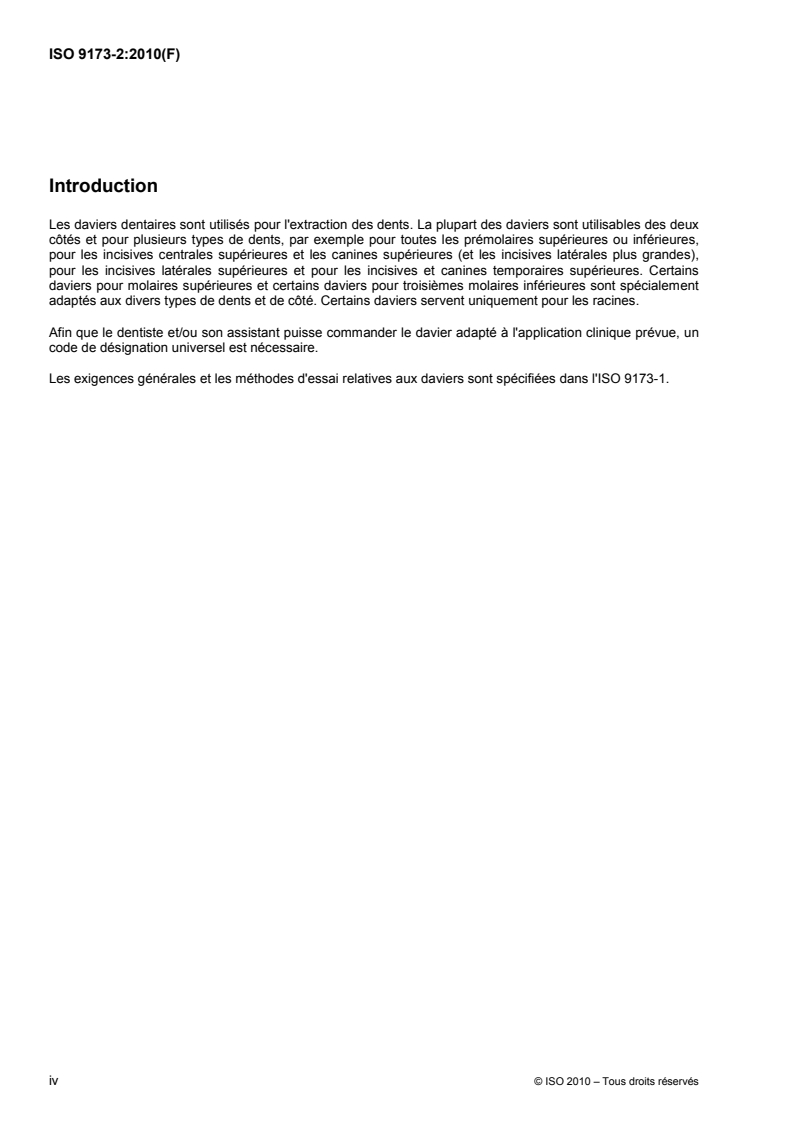
Les daviers dentaires sont utilisés pour l'extraction des dents. La plupart des daviers sont utilisables des deux
côtés et pour plusieurs types de dents, par exemple pour toutes les prémolaires supérieures ou inférieures,
pour les incisives centrales supérieures et les canines supérieures (et les incisives latérales plus grandes),
pour les incisives latérales supérieures et pour les incisives et canines temporaires supérieures. Certains
daviers pour molaires supérieures et certains daviers pour troisièmes molaires inférieures sont spécialement
adaptés aux divers types de dents et de côté. Certains daviers servent uniquement pour les racines.
Afin que le dentiste et/ou son assistant puisse commander le davier adapté à l'application clinique prévue, un
code de désignation universel est nécessaire.
Les exigences générales et les méthodes d'essai relatives aux daviers sont spécifiées dans l'ISO 9173-1.
iv © ISO 2010 – Tous droits réservés
NORME INTERNATIONALE ISO 9173-2:2010(F)
Médecine bucco-dentaire — Daviers —
Partie 2:
Désignation
1 Domaine d'application
La présente partie de l'ISO 9173 spécifie la désignation des daviers dentaires.
2 Références normatives
Les documents de référence suivants sont indispensables pour l'application du présent document. Pour les
références datées, seule l'édition citée s'applique. Pour les références non datées, la dernière édition du
document de référence s'applique (y compris les éventuels amendements).
ISO 1942, Médecine bucco-dentaire — Vocabulaire
ISO 3166-1, Codes pour la représentation des noms de pays et de leurs subdivisions — Partie 1: Codes de
pays
ISO 3950, Art dentaire — Code de désignation des dents et des régions de la cavité buccale
ISO 9173-1, Art dentaire
...
NORME ISO
INTERNATIONALE 9173-2
Première édition
2010-05-01
Médecine bucco-dentaire — Daviers —
Partie 2:
Désignation
Dentistry — Extraction forceps —
Part 2: Designation
Numéro de référence
©
ISO 2010
PDF – Exonération de responsabilité
Le présent fichier PDF peut contenir des polices de caractères intégrées. Conformément aux conditions de licence d'Adobe, ce fichier
peut être imprimé ou visualisé, mais ne doit pas être modifié à moins que l'ordinateur employé à cet effet ne bénéficie d'une licence
autorisant l'utilisation de ces polices et que celles-ci y soient installées. Lors du téléchargement de ce fichier, les parties concernées
acceptent de fait la responsabilité de ne pas enfreindre les conditions de licence d'Adobe. Le Secrétariat central de l'ISO décline toute
responsabilité en la matière.
Adobe est une marque déposée d'Adobe Systems Incorporated.
Les détails relatifs aux produits logiciels utilisés pour la création du présent fichier PDF sont disponibles dans la rubrique General Info
du fichier; les paramètres de création PDF ont été optimisés pour l'impression. Toutes les mesures ont été prises pour garantir
l'exploitation de ce fichier par les comités membres de l'ISO. Dans le cas peu probable où surviendrait un problème d'utilisation,
veuillez en informer le Secrétariat central à l'adresse donnée ci-dessous.
DOCUMENT PROTÉGÉ PAR COPYRIGHT
© ISO 2010
Droits de reproduction réservés. Sauf prescription différente, aucune partie de cette publication ne peut être reproduite ni utilisée sous
quelque forme que ce soit et par aucun procédé, électronique ou mécanique, y compris la photocopie et les microfilms, sans l'accord écrit
de l'ISO à l'adresse ci-après ou du comité membre de l'ISO dans le pays du demandeur.
ISO copyright office
Case postale 56 • CH-1211 Geneva 20
Tel. + 41 22 749 01 11
Fax + 41 22 749 09 47
E-mail copyright@iso.org
Web www.iso.org
Publié en Suisse
ii © ISO 2010 – Tous droits réservés
Avant-propos
L'ISO (Organisation internationale de normalisation) est une fédération mondiale d'organismes nationaux de
normalisation (comités membres de l'ISO). L'élaboration des Normes internationales est en général confiée
aux comités techniques de l'ISO. Chaque comité membre intéressé par une étude a le droit de faire partie du
comité technique créé à cet effet. Les organisations internationales, gouvernementales et non
gouvernementales, en liaison avec l'ISO participent également aux travaux. L'ISO collabore étroitement avec
la Commission électrotechnique internationale (CEI) en ce qui concerne la normalisation électrotechnique.
Les Normes internationales sont rédigées conformément aux règles données dans les Directives ISO/CEI,
Partie 2.
La tâche principale des comités techniques est d'élaborer les Normes internationales. Les projets de Normes
internationales adoptés par les comités techniques sont soumis aux comités membres pour vote. Leur
publication comme Normes internationales requiert l'approbation de 75 % au moins des comités membres
votants.
L'attention est appelée sur le fait que certains des éléments du présent document peuvent faire l'objet de
droits de propriété intellectuelle ou de droits analogues. L'ISO ne saurait être tenue pour responsable de ne
pas avoir identifié de tels droits de propriété et averti de leur existence.
L'ISO 9173-2 a été élaborée par le comité technique ISO/TC 106, Médecine bucco-dentaire, sous-comité
SC 4, Instruments dentaires.
L'ISO 9173 comprend les parties suivantes, présentées sous le titre général Médecine bucco-dentaire —
Daviers:
⎯ Partie 1: Exigences générales et méthodes d'essai
⎯ Partie 2: Désignation
Introduction
Les daviers dentaires sont utilisés pour l'extraction des dents. La plupart des daviers sont utilisables des deux
côtés et pour plusieurs types de dents, par exemple pour toutes les prémolaires supérieures ou inférieures,
pour les incisives centrales supérieures et les canines supérieures (et les incisives latérales plus grandes),
pour les incisives latérales supérieures et pour les incisives et canines temporaires supérieures. Certains
daviers pour molaires supérieures et certains daviers pour troisièmes molaires inférieures sont spécialement
adaptés aux divers types de dents et de côté. Certains daviers servent uniquement pour les racines.
Afin que le dentiste et/ou son assistant puisse commander le davier adapté à l'application clinique prévue, un
code de désignation universel est nécessaire.
Les exigences générales et les méthodes d'essai relatives aux daviers sont spécifiées dans l'ISO 9173-1.
iv © ISO 2010 – Tous droits réservés
NORME INTERNATIONALE ISO 9173-2:2010(F)
Médecine bucco-dentaire — Daviers —
Partie 2:
Désignation
1 Domaine d'application
La présente partie de l'ISO 9173 spécifie la désignation des daviers dentaires.
2 Références normatives
Les documents de référence suivants sont indispensables pour l'application du présent document. Pour les
références datées, seule l'édition citée s'applique. Pour les références non datées, la dernière édition du
document de référence s'applique (y compris les éventuels amendements).
ISO 1942, Médecine bucco-dentaire — Vocabulaire
ISO 3166-1, Codes pour la représentation des noms de pays et de leurs subdivisions — Partie 1: Codes de
pays
ISO 3950, Art dentaire — Code de désignation des dents et des régions de la cavité buccale
ISO 9173-1, Art dentaire
...