


ISO 1151-9:1993/Amd 1:1998
(Amendment)Flight dynamics — Concepts, quantities and symbols — Part 9: Models of atmospheric motions along the trajectory of the aircraft — Amendment 1: Turbulence
Flight dynamics — Concepts, quantities and symbols — Part 9: Models of atmospheric motions along the trajectory of the aircraft — Amendment 1: Turbulence
Mécanique du vol — Concepts, grandeurs et symboles — Partie 9: Modèles de mouvements atmosphériques le long de la trajectoire de l'avion — Amendement 1: Turbulence
General Information
- Status
- Published
- Publication Date
- 30-Sep-1998
- Technical Committee
- ISO/TC 20/SC 8 - Aerospace terminology
- Drafting Committee
- ISO/TC 20/SC 8 - Aerospace terminology
- Current Stage
- 9599 - Withdrawal of International Standard
- Start Date
- 16-Oct-2024
- Completion Date
- 12-Feb-2026
Relations
- Effective Date
- 06-Jun-2022
- Effective Date
- 15-Apr-2008
Overview
ISO 1151-9:1993/Amd 1:1998 is an important international standard published by the International Organization for Standardization (ISO) focusing on flight dynamics. It specifically addresses models of atmospheric motions-including turbulence-along the trajectory of an aircraft. This amendment enhances the original 1993 standard by introducing detailed turbulence models to better characterize the random and rapid variations in wind velocity that affect aircraft performance and behavior during flight.
The document provides a comprehensive framework for defining key concepts, quantities, and symbols associated with modeling turbulence and other atmospheric motions. It supports the development of mathematical representations for wind effects on aircraft, improving the accuracy of flight dynamics analysis and simulation.
Key Topics
Wind velocity models along the aircraft trajectory showcasing:
- Constant wind
- Wind gradients
- Discrete gusts
- Three-dimensional wind patterns
- Vortices
- Continuous turbulence
Turbulence characterization, including:
- Turbulence velocity components and speeds
- Spatial and temporal frequencies
- Turbulence wave-length and wave number
- Statistical properties such as stationarity, homogeneity, and isotropy
Gaussian turbulence models detailed with assumptions on:
- Zero mean Gaussian distribution of turbulence velocity
- Air path axis coordinate system for analysis
- Spatial spectral densities of turbulence velocities (longitudinal and normal components)
Mathematical and physical definitions useful for:
- Simulation of atmospheric disturbances on flight trajectories
- Quantitative analysis of aerodynamic effects from turbulent airflow
Applications
ISO 1151-9:1993/Amd 1:1998 plays a vital role in:
- Aerospace engineering: Assisting engineers in designing flight control systems and avionics that can compensate for turbulent conditions.
- Flight simulation and training: Enabling realistic flight simulators to incorporate atmospheric turbulence models that mirror actual flight conditions.
- Aircraft performance analysis: Providing a standard methodology to incorporate wind turbulence into stability, control, and structural load assessments.
- Atmospheric research: Offering a standardized vocabulary and framework for researchers studying the interaction between atmospheric motions and aircraft dynamics.
- Safety assessments: Supporting regulatory bodies and manufacturers in evaluating aircraft resilience and certification under turbulent conditions.
Related Standards
- ISO 1151 series: Other parts focus on additional flight dynamics concepts, quantities, and symbols relevant to aircraft and space vehicle behavior.
- ISO/TC 20: Technical committee responsible for standards related to aircraft and space vehicles, including flight mechanics and control systems.
- Aeronautical standards by ICAO and SAE: Complementary references for flight mechanics and turbulence modeling in aerospace applications.
Keywords
Aircraft, aerodynamics, flight dynamics, turbulence models, atmospheric disturbances, wind velocity, flight trajectory, Gaussian turbulence, spectral density, air path axis system, flight control, aerospace engineering, aviation safety.




Get Certified
Connect with accredited certification bodies for this standard

BSI Group
BSI (British Standards Institution) is the business standards company that helps organizations make excellence a habit.

Bureau Veritas
Bureau Veritas is a world leader in laboratory testing, inspection and certification services.

DNV
DNV is an independent assurance and risk management provider.
Sponsored listings
Frequently Asked Questions
ISO 1151-9:1993/Amd 1:1998 is a standard published by the International Organization for Standardization (ISO). Its full title is "Flight dynamics — Concepts, quantities and symbols — Part 9: Models of atmospheric motions along the trajectory of the aircraft — Amendment 1: Turbulence". This standard covers: Flight dynamics — Concepts, quantities and symbols — Part 9: Models of atmospheric motions along the trajectory of the aircraft — Amendment 1: Turbulence
Flight dynamics — Concepts, quantities and symbols — Part 9: Models of atmospheric motions along the trajectory of the aircraft — Amendment 1: Turbulence
ISO 1151-9:1993/Amd 1:1998 is classified under the following ICS (International Classification for Standards) categories: 01.060 - Quantities and units; 49.020 - Aircraft and space vehicles in general. The ICS classification helps identify the subject area and facilitates finding related standards.
ISO 1151-9:1993/Amd 1:1998 has the following relationships with other standards: It is inter standard links to ISO 1151-9:1993; is excused to ISO 1151-9:1993. Understanding these relationships helps ensure you are using the most current and applicable version of the standard.
ISO 1151-9:1993/Amd 1:1998 is available in PDF format for immediate download after purchase. The document can be added to your cart and obtained through the secure checkout process. Digital delivery ensures instant access to the complete standard document.
Standards Content (Sample)
INTERNATIONAL ISO
STANDARD 1151-9
First edition
1993-09-15
AMENDMENT 1
1998-10-01
Flight dynamics — Concepts, quantities
and symbols —
Part 9:
Models of atmospheric motions along the
trajectory of the aircraft
AMENDMENT 1: Turbulence
Mécanique du vol — Concepts, grandeurs et symboles —
Partie 9: Modèles de mouvements atmosphériques le long de la trajectoire
de l’avion
AMENDEMENT 1: Turbulence
A
Reference number
ISO 1151-9:1993/Amd.1:1998(E)
ISO 1151-9:1993/Amd.1:1998(E)
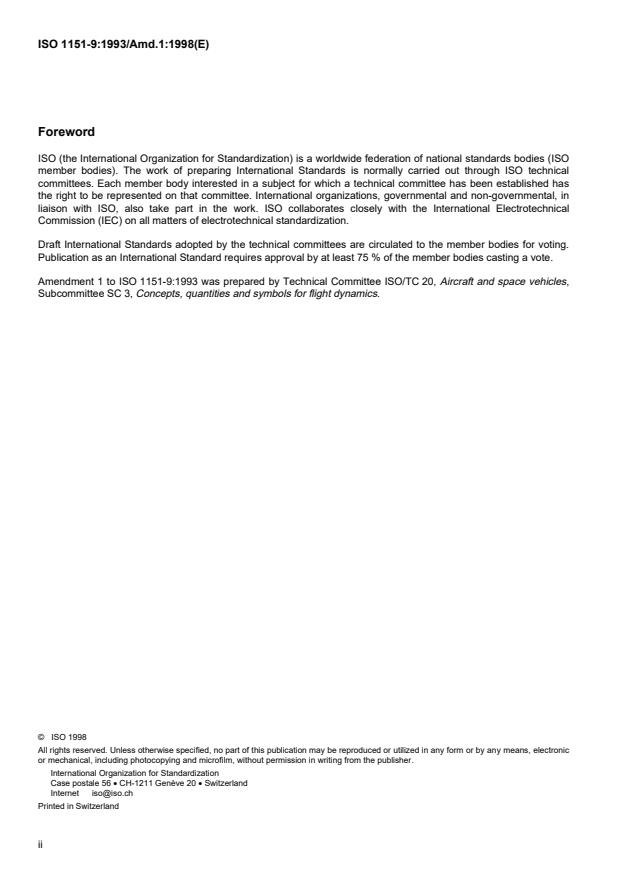
Foreword
ISO (the International Organization for Standardization) is a worldwide federation of national standards bodies (ISO
member bodies). The work of preparing International Standards is normally carried out through ISO technical
committees. Each member body interested in a subject for which a technical committee has been established has
the right to be represented on that committee. International organizations, governmental and non-governmental, in
liaison with ISO, also take part in the work. ISO collaborates closely with the International Electrotechnical
Commission (IEC) on all matters of electrotechnical standardization.
Draft International Standards adopted by the technical committees are circulated to the member bodies for voting.
Publication as an International Standard requires approval by at least 75 % of the member bodies casting a vote.
Amendment 1 to ISO 1151-9:1993 was prepared by Technical Committee ISO/TC 20, Aircraft and space vehicles,
Subcommittee SC 3, Concepts, quantities and symbols for flight dynamics.
© ISO 1998
All rights reserved. Unless otherwise specified, no part of this publication may be reproduced or utilized in any form or by any means, electronic
or mechanical, including photocopying and microfilm, without permission in writing from the publisher.
International Organization for Standardization
Case postale 56 • CH-1211 Genève 20 • Switzerland
Internet iso@iso.ch
Printed in Switzerland
ii
©
ISO ISO 1151-9:1993/Amd.1:1998(E)
Flight dynamics — Concepts, quantities and symbols —
Part 9:
Models of atmospheric motions along the trajectory of the aircraft
AMENDMENT 1: Turbulence
Page 1
Clause 9.0
Replace the existing clause 9.0 with the following:
"9.0 Introduction
This part of ISO 1151 deals with the concepts and quantities characterizing models of the air motions affecting the
dynamic behaviour of the aircraft.
The aircraft motion is only influenced by the wind velocity field in the space surrounding the aircraft trajectory (8.2.1)
and by its variations with time. In flight dynamic problems, it is usual to represent this field and its variations with
time by considering mathematic models, which are schematic representations of the real wind.
In this part of ISO 1151, the following models are defined:
constant wind (9.1);
wind gradients (9.2);
discrete gusts (9.3);
three-dimensional wind models (9.4);
vortices (9.5);
continuous turbulence (9.6).
In these models it is assumed that the air motions are not perturbed by the presence of the aircraft itself. Other
models can be defined by superposition of these models."
Page 6
Add the following new subclause:
©
ISO
ISO 1151-9:1993/Amd.1:1998(E)
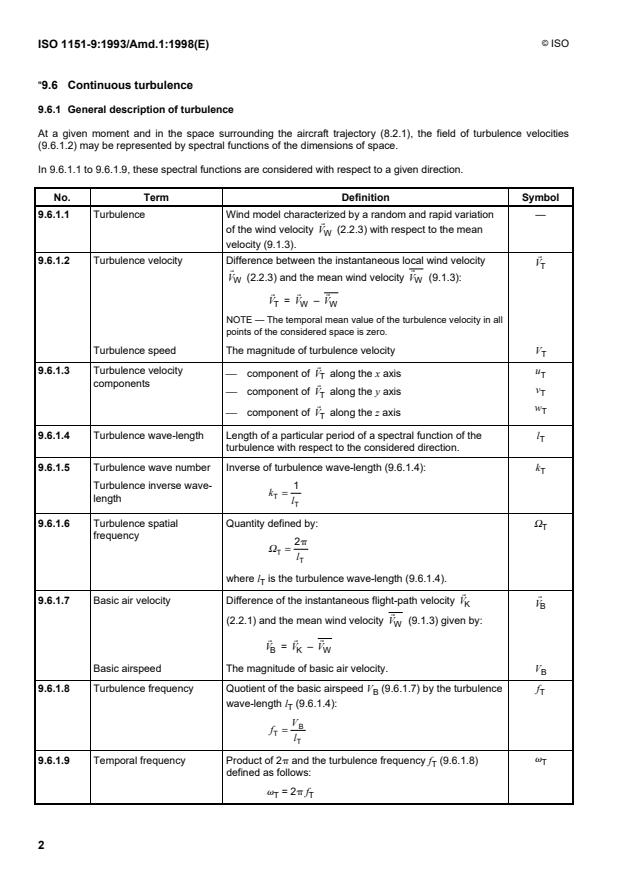
"9.6 Continuous turbulence
9.6.1 General description of turbulence
At a given moment and in the space surrounding the aircraft trajectory (8.2.1), the field of turbu
...
NORME ISO
INTERNATIONALE 1151-9
Première édition
1993-09-15
AMENDEMENT 1
1998-10-01
Mécanique du vol — Concepts, grandeurs
et symboles —
Partie 9:
Modèles de mouvements atmosphériques
le long de la trajectoire de l’avion
AMENDEMENT 1: Turbulence
Flight dynamics — Concepts, quantities and symbols —
Part 9: Models of the atmospheric motions along the trajectory of the aircraft
AMENDMENT 1: Turbulence
A
Numéro de référence
ISO 1151-9:1993/Amd.1:1998(F)
ISO 1151-9:1993/Amd.1:1998(F)
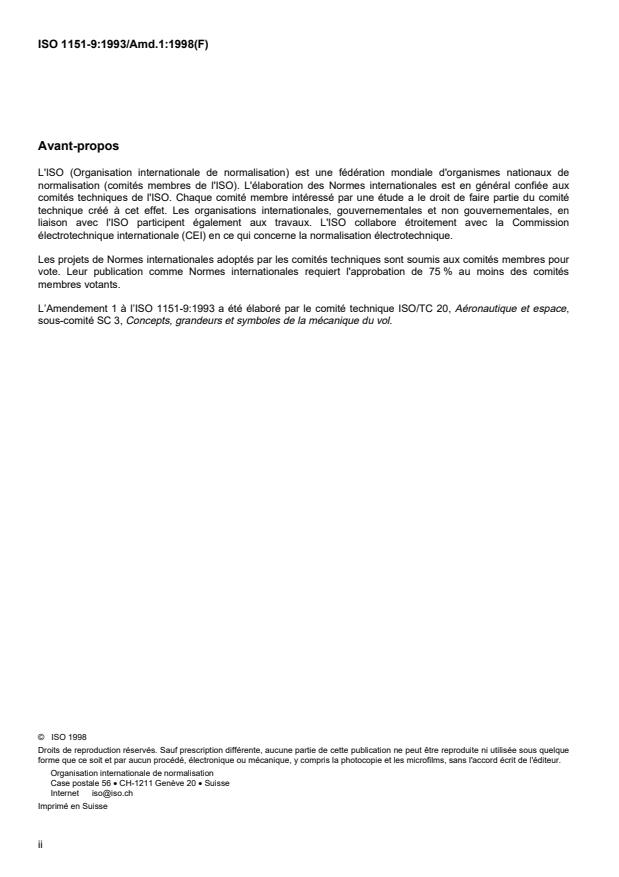
Avant-propos
L'ISO (Organisation internationale de normalisation) est une fédération mondiale d'organismes nationaux de
normalisation (comités membres de l'ISO). L'élaboration des Normes internationales est en général confiée aux
comités techniques de l'ISO. Chaque comité membre intéressé par une étude a le droit de faire partie du comité
technique créé à cet effet. Les organisations internationales, gouvernementales et non gouvernementales, en
liaison avec l'ISO participent également aux travaux. L'ISO collabore étroitement avec la Commission
électrotechnique internationale (CEI) en ce qui concerne la normalisation électrotechnique.
Les projets de Normes internationales adoptés par les comités techniques sont soumis aux comités membres pour
vote. Leur publication comme Normes internationales requiert l'approbation de 75 % au moins des comités
membres votants.
L’Amendement 1 à l’ISO 1151-9:1993 a été élaboré par le comité technique ISO/TC 20, Aéronautique et espace,
sous-comité SC 3, Concepts, grandeurs et symboles de la mécanique du vol.
© ISO 1998
Droits de reproduction réservés. Sauf prescription différente, aucune partie de cette publication ne peut être reproduite ni utilisée sous quelque
forme que ce soit et par aucun procédé, électronique ou mécanique, y compris la photocopie et les microfilms, sans l'accord écrit de l'éditeur.
Organisation internationale de normalisation
Case postale 56 • CH-1211 Genève 20 • Suisse
Internet iso@iso.ch
Imprimé en Suisse
ii
©
ISO ISO 1151-9:1993/Amd.1:1998(F)
Mécanique du vol — Concepts, grandeurs et symboles —
Partie 9:
Modèles de mouvements atmosphériques le long de la trajectoire
de l’avion
AMENDEMENT 1: Turbulence
Page 1
Article 9.0
Remplacer l’article 9.0 existant par le suivant:
« 9.0 Introduction
La présente partie de l’ISO 1151 traite des concepts et des grandeurs qui caractérisent les modèles des
mouvements atmosphériques d'air affectant le comportement dynamique de l’avion.
Le mouvement de l'avion n'est influencé que par le champ des vitesses du vent dans l'espace qui entoure la
trajectoire de l'avion (8.2.1) et par ses variations dans le temps. Normalement, en ce qui concerne les problèmes de
la mécanique du vol, ce champ de vitesses et ses variations dans le temps sont représentés en considérant des
modèles mathématiques qui sont des représentations schématiques du vent réel.
Dans la présente partie de l’ISO 1151, les modèles suivants sont définis:
vent constant (9.1);
gradients de vent (9.2);
rafales (9.3);
modèles tridimensionnels de vents (9.4);
tourbillons (9.5);
turbulences (9.6).
Dans les modèles indiqués, on fait l’hypothèse que les mouvements de l'air ne sont pas perturbés par la présence
de l'avion. D'autres modèles peuvent être définis par superposition de ces modèles. »
Page 6
Ajouter le paragraphe suivant:
©
ISO
ISO 1151-9:1993/Amd.1:1998(F)
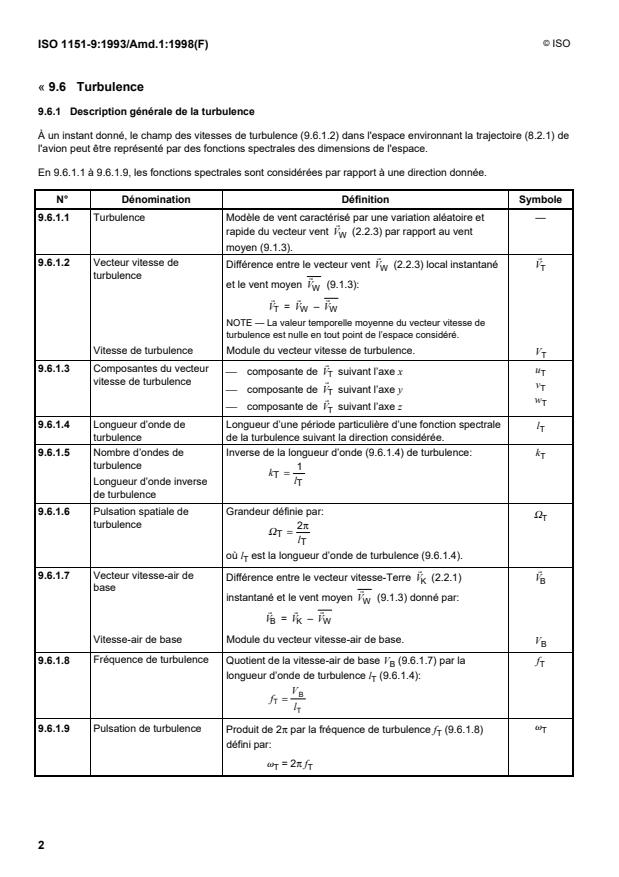
« 9.6 Turbulence
9.6.1 Description générale de la turbulence
À un instant donné, le champ des vitesses de turbulence (9.6.1.2)
...
Questions, Comments and Discussion
Ask us and Technical Secretary will try to provide an answer. You can facilitate discussion about the standard in here.
Loading comments...