


ISO 1151-2:1985
(Main)Flight dynamics — Concepts, quantities and symbols — Part 2: Motions of the aircraft and the atmosphere relative to the Earth
Flight dynamics — Concepts, quantities and symbols — Part 2: Motions of the aircraft and the atmosphere relative to the Earth
Gives basic definitions and deals with motion of the aircraft and the atmosphere relative to the earth. The atmosphere is assumed to be at rest or in translational motion at constant velocity relative to the Earth. The aircraft is assumed to be rigid. However, most of the definitions can be applied to the case of a flexible aircraft. Describes axis system, velocities flight path angles and wind direction angles.
Mécanique du vol — Concepts, grandeurs et symboles — Partie 2: Mouvements de l'avion et de l'atmosphère par rapport à la Terre
General Information
- Status
- Published
- Publication Date
- 04-Sep-1985
- Technical Committee
- ISO/TC 20/SC 8 - Aerospace terminology
- Drafting Committee
- ISO/TC 20/SC 8 - Aerospace terminology
- Current Stage
- 9599 - Withdrawal of International Standard
- Start Date
- 16-Oct-2024
- Completion Date
- 14-Feb-2026
Relations
- Effective Date
- 06-Jun-2022
- Effective Date
- 15-Apr-2008
- Effective Date
- 15-Apr-2008
Overview
ISO 1151-2:1985 is part of the ISO 1151 flight dynamics series and defines fundamental concepts, quantities and symbols for the motions of the aircraft and the atmosphere relative to the Earth. This second edition (1985) provides standardized terminology and coordinate conventions used to describe aircraft kinematics when the atmosphere is assumed either at rest or in uniform translational motion relative to the Earth. The standard assumes a rigid aircraft (though most definitions apply to flexible vehicles) and establishes consistent symbols, axis systems and sign conventions for flight dynamics work.
Key topics
- Coordinate and axis systems
- Definition of kinematic triads (aircraft, kinematic, and normal terrestrial triads) and guidance on selecting a reference plane.
- Right-handed, orthogonal triads and sign conventions for positive rotations.
- Velocity vectors and components
- Definition of the velocity-of-the-aircraft relative to the Earth (velocity-Terre / ground-velocity) and its components in different triads (e.g., u, v, w).
- Definition of the wind vector (air motion relative to Earth), its magnitude and components.
- Flight path and wind angles
- Azimuth (heading/route) and pente (flight path slope) of the velocity-Terre vector relative to the terrestrial triad.
- Azimuth and slope of the wind vector, including sign conventions (e.g., positive ascent for upward wind).
- Notation and conventions
- Standard symbols, naming rules and numerical indexing used throughout ISO 1151.
- Rules for local vertical variations and definition qualifiers when needed.
Applications
ISO 1151-2:1985 is used where unambiguous, standard definitions of motion and angles are required:
- Flight dynamics analysis and mathematical modelling
- Aircraft design (aerodynamics, stability and control)
- Flight simulation, avionics and navigation system development
- Flight test data reduction and instrumentation interpretation
- Interface between meteorology (wind modelling) and aircraft performance studies
- Regulatory and standards documentation where consistent symbols and sign conventions are required
Who uses this standard
- Aerospace engineers (flight dynamics, aerodynamics, controls)
- Flight test engineers and simulation developers
- Avionics and navigation system designers
- Researchers and educators in aerospace mechanics
- Standards bodies and certification authorities referencing consistent terminology
Related standards
- ISO 1151 series (Parts 1–7) - other parts cover aircraft motion relative to air, derivatives of forces/moments, stability parameters, measurement quantities, geometry and flight domains.
- Prepared by ISO/TC 20 (Aeronautics and Space)
Keywords: ISO 1151-2:1985, flight dynamics standard, motions of the aircraft, atmosphere relative to the Earth, axis system, velocities, flight path angles, wind direction angles.
Buy Documents


ISO 1151-2:1985 - Flight dynamics -- Concepts, quantities and symbols


ISO 1151-2:1985 - Mécanique du vol -- Concepts, grandeurs et symboles


ISO 1151-2:1985 - Mécanique du vol -- Concepts, grandeurs et symboles
Get Certified
Connect with accredited certification bodies for this standard

BSI Group
BSI (British Standards Institution) is the business standards company that helps organizations make excellence a habit.

Bureau Veritas
Bureau Veritas is a world leader in laboratory testing, inspection and certification services.

DNV
DNV is an independent assurance and risk management provider.
Sponsored listings
Frequently Asked Questions
ISO 1151-2:1985 is a standard published by the International Organization for Standardization (ISO). Its full title is "Flight dynamics — Concepts, quantities and symbols — Part 2: Motions of the aircraft and the atmosphere relative to the Earth". This standard covers: Gives basic definitions and deals with motion of the aircraft and the atmosphere relative to the earth. The atmosphere is assumed to be at rest or in translational motion at constant velocity relative to the Earth. The aircraft is assumed to be rigid. However, most of the definitions can be applied to the case of a flexible aircraft. Describes axis system, velocities flight path angles and wind direction angles.
Gives basic definitions and deals with motion of the aircraft and the atmosphere relative to the earth. The atmosphere is assumed to be at rest or in translational motion at constant velocity relative to the Earth. The aircraft is assumed to be rigid. However, most of the definitions can be applied to the case of a flexible aircraft. Describes axis system, velocities flight path angles and wind direction angles.
ISO 1151-2:1985 is classified under the following ICS (International Classification for Standards) categories: 01.060 - Quantities and units; 49.020 - Aircraft and space vehicles in general. The ICS classification helps identify the subject area and facilitates finding related standards.
ISO 1151-2:1985 has the following relationships with other standards: It is inter standard links to ISO 1151-2:1985/Add 1:1987, ISO 1151-2:1974; is excused to ISO 1151-2:1985/Add 1:1987. Understanding these relationships helps ensure you are using the most current and applicable version of the standard.
ISO 1151-2:1985 is available in PDF format for immediate download after purchase. The document can be added to your cart and obtained through the secure checkout process. Digital delivery ensures instant access to the complete standard document.
Standards Content (Sample)
International Standard
INTERNATIONAL DRGANIZATION FOR STANDARDIZATION.MEX~YHAPOfiHAR OPTAHbl3AlJklR fl0 CTAH~APTbl3ALlt ’lM.ORGANISATlON INTERNATIONALE DE NORMALISATIDN
Flight dynamics - Concepts, quantities and Symbols -
Part 2: Motions of the aircraft and the atmosphere
relative to the Earth
Mcanique du vol - Concepts, grandeurs et Symboles - Partie 2: Mouvements de l ’avion et de l ’atmosphere par rapport & Ia
Terre
Second edition - 1985-09-01
UDC 629.7.015 : 001.4 : 003.62 Ref. No. ISO 1151/2-1985 (E)
Descriptors : aircraft, dynamic propetties, flight dynamics, aerodynamics, quantities, Symbols, definitions.
Price based on 5 pages
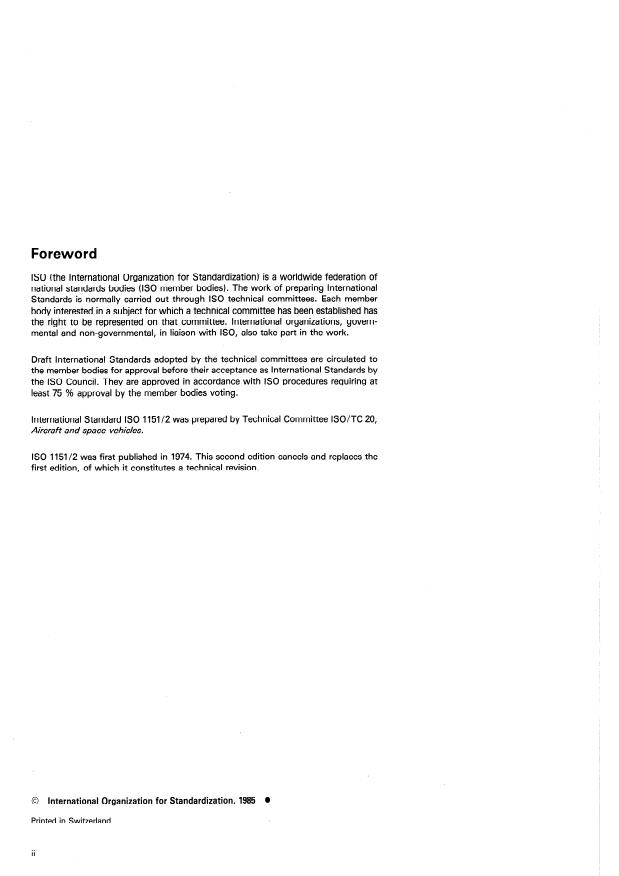
Foreword
ISO (the International Organization for Standardization) is a worldwide federation of
national Standards .bodies (ISO member bodies). The work of preparing International
Standards is normally carried out through ISO technical committees. EaCh member
body interested in a subject for which a technical committee has been established has
the right to be represented on that committee. International organizations, govern-
mental and non-governmental; in liaison with ISO, also take part in the work.
Draft International Standards adopted by the technical committees are circulated to
the member bodies for approval before their acceptance as International Standards by
the ISO Council. They are approved in accordance with ISO procedures requiring at
least 75 % approval by the member bodies voting.
International Standard ISO 1151/2 was prepared by Technical Committee ISO/TC 20,
Aircraft and space vehicles.
ISO 1151/2 was first published in 1974. This second edition cancels and replaces the
first edition, of which it constitutes a technical revision.
0 International Organkation for Standardization, 1985
Printed in Switzerland
ii
ISO 1151, Flight dynamics - Concepts, quantities and Symbols, comprises, at
present, seven Parts :
Part I : Aircraft motion relative to the air.
Part 2 : Motions of the aircraft and the atmosphere relative to the Earth.
Part 3 : Derivatives of forces, moments and their coefficients.
Part 4 : Parameters used in the study of aircraft stabil@ and control.
Part 5 : Quantities used in measurements.
Part 6 : Aircraft geometry.
Part 7 : Flight poin ts and fligh t envelopes.
ISO 1151 is intended to introduce the main concepts, to include the more important
terms used in theoretical and experimental studies and, as far as possible, to give cor-
responding Symbols.
In all the Parts comprising ISO 1151, the term “aircraft” denotes a vehicle intended for
atmosphere or space flight. Usually, it has an essentially port and starboard symmetry
with respect to a plane. That plane is determined by the geometric characteristics of
the aircraft. In that plane, two orthogonal directions are defined: fore-and-aft and
dorsal-ventral. The transverse direction, on the perpendicular to that plane, follows.
When there is more than one plane of symmetry, or when there is none, it is necessary
to introduce a reference plane. In the former case, the reference plane is one of the
planes of symmetry. In the latter case, the reference plane is arbitrary. In all cases, it is
necessary to specify the choice made.
positive
Angles of rotation, angular velocities and moments about any axis are
clockwise when viewed in the positive direction of that axis.
All the axis Systems used are three-dimensional, orthogonal and right-handed, which
implies that a positive rotation through 7c/2 around the x-axis brings the y-axis into the
Position previously occupied by the z-axis.
Numbering of sections and clauses
With the aim of easing the indication of references from a section or a clause, a decimal
numbering System has been adopted such that the first figure is the number of the part
of ISO 1151 considered.
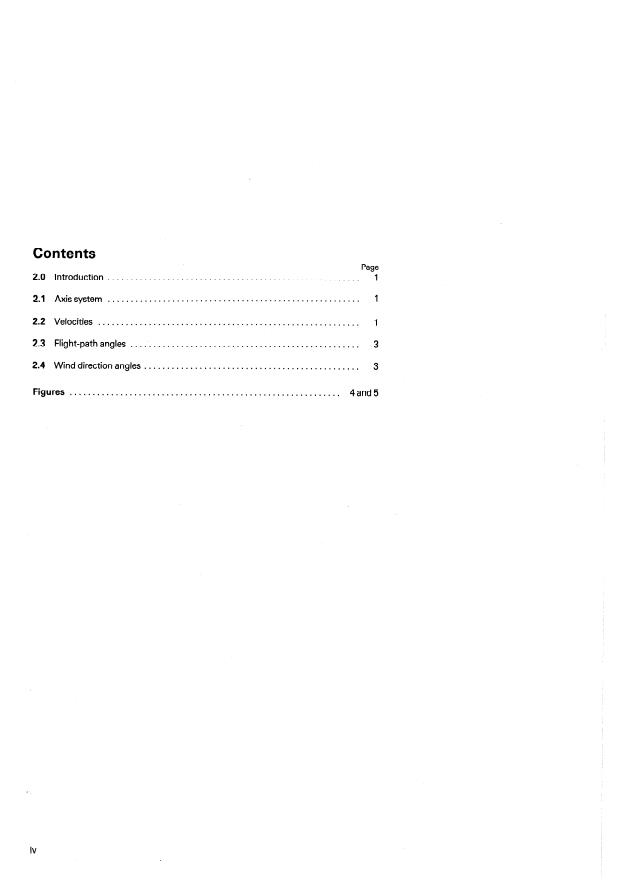
Contents
Page
2.0 Introduction . . . . . . . . . . . . . . . . . . . . . . . . . . . . . . . . . . . . . . . . . . . . . . . . . . . . . . . 1
2.1 Axis System . . . . . . . . . . . . . . . . . . . . . . . . . . . . . . . . . . . . . . . . . . . . . . . . . . . . . . . 1
2.2 Velocities . . . . . . . . . . . . . . . . . . . . . . . . . . . . . . . . . . . . . . . . . . . . . . . . . . . . . . . . . 1
2.3 Flight-path angles . . . . . . . . . . . . . . . . . . . . . . . . . . . . . . . . . . . . . . . . . . . . . . . . . . 3
2.4 Wind direction angles . . . . . . . . . . . . . . . . . . . . . . . . . . . . . . . . . . . . . . . . . . . . . . .
Figures . . . . . . . . . . . . . . . . . . . . . . . . . . . . . . . . . . . . . . . . . . . . . . . . . . . . . . . . . . .
4and5
iv
ISO 1151/2-1985 (E)
INTERNATIONAL STANDARD
Concepts, quantities and Symbols -
Flight dynamics -
Part 2: Motions of the aircraft and the atmosphere
relative to the Earth
2.0 ’ Introduction
This part of ISO 1151 gives basic definitions and deals with the motions of the aircraft and the atmosphere relative to the Earth.
The atmosphere is assumed to be at r&t or in translationaI’ motion at constant velocity relative to the Earth.1)
The aircraft is assumed to be rigid. However,
...
Norme internationale 1151/2
*
INTERNATIONAL ORGANIZATION FOR STANDARDIZATION~MEIK~YHAPO~HAR OPrAHM3AUblR ll0 CTAHAAPTbl3AUI4bl~ORGANISA?ION INTERNATIONALE DE NORMALISATION
Mécanique du vol - Concepts, grandeurs et symboles -
Partie 2: Mouvements de l’avion et de l’atmosphère par
rapport à la Terre
Concepts, guantities and symbols - Part 2: Motions of the aircraft and the atmosphere relative to the Earth
Flight dynamics -
Deuxième édition - 1985-09-01
z
CDU 629.7.015 : 001.4 : 003.62
Réf. no : ISO 1151/2-1985 (F)
Js
g
Descripteurs : aéronef, propriété dynamique, mécanique de vol, aérodynamique, grandeur, symbole, définition.
Prix basé sur 5 pages
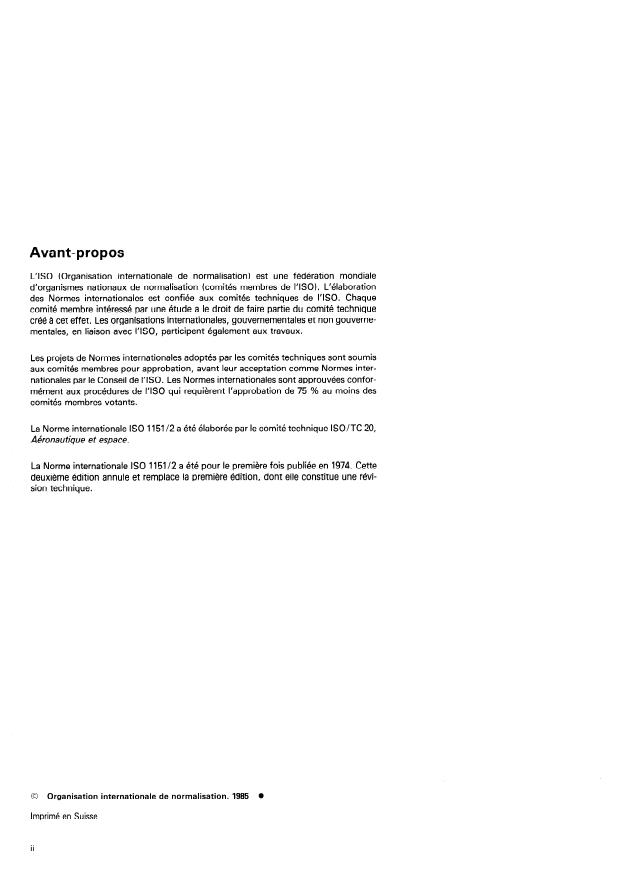
Avant-propos
L’ISO (Organisation internationale de normalisation) est une fédération mondiale
d’organismes nationaux de normalisation (comités membres de I’ISO). L’élaboration
des Normes internationales est confiée aux comités techniques de I’ISO. Chaque
comité membre intéressé par une étude a le droit de faire partie du comité technique
créé à cet effet. Les organisations internationales, gouvernementales et non gouverne-
mentales, en liaison avec I’ISO, participent également aux travaux.
Les projets de Normes internationales adoptés par les comités techniques sont soumis
aux comités membres pour approbation, avant leur acceptation comme Normes inter-
nationales par le Conseil de I’ISO. Les Normes internationales sont approuvées confor-
mément aux procédures de I’ISO qui requièrent l’approbation de 75 % au moins des
comités membres votants.
La Norme internationale ISO 1151/2 a été élaborée par le comité technique ISO/TC 20,
Aéronautique et espace.
La Norme internationale ISO 1151/2 a été pour le première fois publiée en 1974. Cette
deuxième édition annule et remplace la première édition, dont elle constitue une révi-
sion technique.
0 Organisation internationale de normalisation, 1985 l
imprimé en Suisse
ii
Concepts, grandeurs et symboles, comprend actuel-
L’ISO 1151, Mécanique du vol -
lement sept parties :
Partie I : Mouvement de l’avion par rapport à l’air.
Partie 2 : Mouvements de l’avion et de l’atmosphère par rapport à la Terre.
Partie 3 : Dérivées des forces, des moments et de leurs coefficients.
Partie 4 : Paramètres utilisés dans les études de la stabilité et du pio tage des avions.
Partie 5 : Grandeurs utilisées dans les mesures.
Partie 6 : Géométrie de l’avion.
Partie 7 : Points de vol et domaines de vol.
L’ISO 1151 est destinée à introduire les principaux concepts, à définir les termes les
plus importants utilisés dans les études théoriques et expérimentales et, dans la mesure
du possible, à donner les symboles correspondants.
Dans toutes les parties de I’ISO 1151, le terme «avion» désigne un véhicule destiné à
voler dans l’atmosphère ou dans l’espace. En général, il présente essentiellement une
symétrie gauche-droite par rapport à un plan. Ce plan est déterminé par les caractéristi-
ques géométriques de l’avion. Dans ce plan, on définit deux directions orthogonales:
arrière-avant et dessus-dessous. La direction transversale, sur la perpendiculaire à ce
plan, en résulte.
Lorsqu’il y a plus d’un plan de symétrie, ou lorsqu’il n’y en a aucun, il est nécessaire
d’introduire un plan de référence. Dans le premier cas, le plan de référence est l’un des
plans de symétrie. Dans le second cas, le plan de référence est arbitraire. Dans tous les
cas, il est nécessaire d’en préciser le choix.
Les angles de rotation, les vitesses angulaires et les moments autour d’un axe sont
positifs dans le sens d’horloge, pour un observateur regardant dans la direction posi-
tive de cet axe.
Tous les trièdres utilisés sont trirectangles et directs, c’est-à-dire qu’une rotation posi-
tive de z/2 autour de l’axe x amène l’axe y dans la position précédemment occupée par
l’axe 2.
Numérotation des chapitres et paragraphes
Dans le but de faciliter l’indication des références d’un chapitre ou d’un paragraphe,
une numérotation décimale a été adoptée telle que le premier chiffre soit le numéro de
la partie considérée de I’ISO 1151.
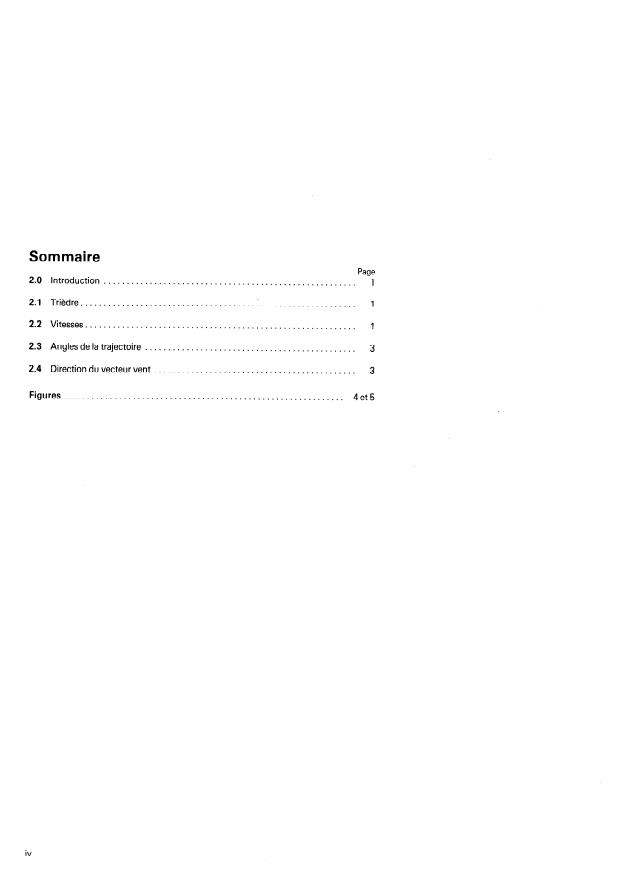
Sommaire
Page
2.0 Introduction . . . . . . . . . . . . . . . . . . . . . . . . . . . . . . . . . . . . . . . . . . . . . . . . . . . . . . .
2.1 Trièdre.;. 1
2.2 Vitesses. 1
2.3 Angles de la trajectoire 3
..............................................
Direction du vecteur vent 3
2.4 .
Figures. 4et5
iv
NORME INTERNATIONALE ISO 1151/2-1985 (F)
Mécanique du vol - Concepts, grandeurs et symboles -
Partie 2: Mouvements de l’avion et de l’atmosphère par
rapport à la Terre
2.0 Introduction
La présente partie de I’ISO 1151 donne les définitions de base et traite des mouvements de l’avion et de l’atmosphère par rapport à la
Terre.
L’atmosphère est supposée immobile ou animée d’un mouvement de translation à vitesse constante par rapport à la Terre. 1)
L’avion est supposé rigide. Toutefois, la plupart des définitions peuvent être appliquées au cas de l’avion déformable.
Dans le cas où l’on ve
...
Norme internationale 1151/2
*
INTERNATIONAL ORGANIZATION FOR STANDARDIZATION~MEIK~YHAPO~HAR OPrAHM3AUblR ll0 CTAHAAPTbl3AUI4bl~ORGANISA?ION INTERNATIONALE DE NORMALISATION
Mécanique du vol - Concepts, grandeurs et symboles -
Partie 2: Mouvements de l’avion et de l’atmosphère par
rapport à la Terre
Concepts, guantities and symbols - Part 2: Motions of the aircraft and the atmosphere relative to the Earth
Flight dynamics -
Deuxième édition - 1985-09-01
z
CDU 629.7.015 : 001.4 : 003.62
Réf. no : ISO 1151/2-1985 (F)
Js
g
Descripteurs : aéronef, propriété dynamique, mécanique de vol, aérodynamique, grandeur, symbole, définition.
Prix basé sur 5 pages
Avant-propos
L’ISO (Organisation internationale de normalisation) est une fédération mondiale
d’organismes nationaux de normalisation (comités membres de I’ISO). L’élaboration
des Normes internationales est confiée aux comités techniques de I’ISO. Chaque
comité membre intéressé par une étude a le droit de faire partie du comité technique
créé à cet effet. Les organisations internationales, gouvernementales et non gouverne-
mentales, en liaison avec I’ISO, participent également aux travaux.
Les projets de Normes internationales adoptés par les comités techniques sont soumis
aux comités membres pour approbation, avant leur acceptation comme Normes inter-
nationales par le Conseil de I’ISO. Les Normes internationales sont approuvées confor-
mément aux procédures de I’ISO qui requièrent l’approbation de 75 % au moins des
comités membres votants.
La Norme internationale ISO 1151/2 a été élaborée par le comité technique ISO/TC 20,
Aéronautique et espace.
La Norme internationale ISO 1151/2 a été pour le première fois publiée en 1974. Cette
deuxième édition annule et remplace la première édition, dont elle constitue une révi-
sion technique.
0 Organisation internationale de normalisation, 1985 l
imprimé en Suisse
ii
Concepts, grandeurs et symboles, comprend actuel-
L’ISO 1151, Mécanique du vol -
lement sept parties :
Partie I : Mouvement de l’avion par rapport à l’air.
Partie 2 : Mouvements de l’avion et de l’atmosphère par rapport à la Terre.
Partie 3 : Dérivées des forces, des moments et de leurs coefficients.
Partie 4 : Paramètres utilisés dans les études de la stabilité et du pio tage des avions.
Partie 5 : Grandeurs utilisées dans les mesures.
Partie 6 : Géométrie de l’avion.
Partie 7 : Points de vol et domaines de vol.
L’ISO 1151 est destinée à introduire les principaux concepts, à définir les termes les
plus importants utilisés dans les études théoriques et expérimentales et, dans la mesure
du possible, à donner les symboles correspondants.
Dans toutes les parties de I’ISO 1151, le terme «avion» désigne un véhicule destiné à
voler dans l’atmosphère ou dans l’espace. En général, il présente essentiellement une
symétrie gauche-droite par rapport à un plan. Ce plan est déterminé par les caractéristi-
ques géométriques de l’avion. Dans ce plan, on définit deux directions orthogonales:
arrière-avant et dessus-dessous. La direction transversale, sur la perpendiculaire à ce
plan, en résulte.
Lorsqu’il y a plus d’un plan de symétrie, ou lorsqu’il n’y en a aucun, il est nécessaire
d’introduire un plan de référence. Dans le premier cas, le plan de référence est l’un des
plans de symétrie. Dans le second cas, le plan de référence est arbitraire. Dans tous les
cas, il est nécessaire d’en préciser le choix.
Les angles de rotation, les vitesses angulaires et les moments autour d’un axe sont
positifs dans le sens d’horloge, pour un observateur regardant dans la direction posi-
tive de cet axe.
Tous les trièdres utilisés sont trirectangles et directs, c’est-à-dire qu’une rotation posi-
tive de z/2 autour de l’axe x amène l’axe y dans la position précédemment occupée par
l’axe 2.
Numérotation des chapitres et paragraphes
Dans le but de faciliter l’indication des références d’un chapitre ou d’un paragraphe,
une numérotation décimale a été adoptée telle que le premier chiffre soit le numéro de
la partie considérée de I’ISO 1151.
Sommaire
Page
2.0 Introduction . . . . . . . . . . . . . . . . . . . . . . . . . . . . . . . . . . . . . . . . . . . . . . . . . . . . . . .
2.1 Trièdre.;. 1
2.2 Vitesses. 1
2.3 Angles de la trajectoire 3
..............................................
Direction du vecteur vent 3
2.4 .
Figures. 4et5
iv
NORME INTERNATIONALE ISO 1151/2-1985 (F)
Mécanique du vol - Concepts, grandeurs et symboles -
Partie 2: Mouvements de l’avion et de l’atmosphère par
rapport à la Terre
2.0 Introduction
La présente partie de I’ISO 1151 donne les définitions de base et traite des mouvements de l’avion et de l’atmosphère par rapport à la
Terre.
L’atmosphère est supposée immobile ou animée d’un mouvement de translation à vitesse constante par rapport à la Terre. 1)
L’avion est supposé rigide. Toutefois, la plupart des définitions peuvent être appliquées au cas de l’avion déformable.
Dans le cas où l’on ve
...
Questions, Comments and Discussion
Ask us and Technical Secretary will try to provide an answer. You can facilitate discussion about the standard in here.
Loading comments...