


ISO/TS 16733-2
(Main)Fire safety engineering - Selection of design fire scenarios and design fires - Part 2: Design fires
Fire safety engineering - Selection of design fire scenarios and design fires - Part 2: Design fires
This document provides guidance for the specification of design fires for use in fire safety engineering analysis of building and structures in the built environment. The design fire is intended to be used in an engineering analysis to determine consequences in fire safety engineering (FSE) analyses.
Ingénierie de la sécurité incendie — Sélection de scénarios d’incendie et de feux de dimensionnement — Partie 2: Feux de dimensionnement
Le présent document fournit des recommandations pour la spécification des feux de dimensionnement utilisés en analyse d’ingénierie de la sécurité incendie des bâtiments et structures de l’ouvrage. Le feu de dimensionnement est destiné à être utilisé en analyse d’ingénierie afin de déterminer des conséquences dans les analyses d’ingénierie de la sécurité incendie (ISI).
General Information
- Status
- Not Published
- Technical Committee
- ISO/TC 92/SC 4 - Fire safety engineering
- Drafting Committee
- ISO/TC 92/SC 4/WG 6 - Design fire scenarios and design fires
- Current Stage
- 6000 - International Standard under publication
- Start Date
- 06-Dec-2025
- Completion Date
- 27-Dec-2025
Relations
- Effective Date
- 26-Apr-2025
Overview
ISO/TS 16733-2:2025 titled Fire safety engineering - Selection of design fire scenarios and design fires - Part 2: Design fires by ISO provides comprehensive guidance on specifying design fires for fire safety engineering analyses in buildings and structures. This standard supports professionals in developing engineering-based assessments that predict fire consequences based on quantitative design fires associated with particular fire scenarios. These design fires serve as critical inputs for performance-based fire safety design, ensuring that structures are evaluated against realistic and challenging fire conditions.
Covering aspects such as fire growth stages, heat release rates, and species production, ISO/TS 16733-2 facilitates a detailed and systematic approach to characterizing fires for engineering analysis. It is intended for qualified fire safety engineers familiar with fire behavior, combustion, and structural response, aiming to optimize safety for life, property, heritage, and the environment.
Key Topics
Design Fire Definition
A design fire is a quantitative, idealized description of fire characteristics (e.g., heat release rate, toxic species yields) within a specified fire scenario. It represents an engineering "load" to assess fire consequences.Fire Growth and Stages
The document details essential fire development phases: incipient, growth, flashover, fully developed, and decay stages. Proper understanding of these stages is fundamental to constructing design fire curves.Design Fire Curve Construction
Stepwise procedures guide engineers in developing design fire curves, incorporating parameters such as fire load, fuel types, heat release rates, flashover timing, fire duration, and decay characteristics.Fire Scenarios and Their Selection
The standard differentiates between a fire scenario (qualitative description) and a design fire scenario (selected for deterministic safety analysis). It emphasizes tailoring design fires to specific fire safety objectives, like occupant safety or property conservation.Probabilistic Fire Analysis
ISO/TS 16733-2 introduces probabilistic methods, covering statistical representativeness, stochastic modeling, and sampling techniques to improve the reliability and robustness of fire safety predictions.Special Fire Types
Guidance is included for localized fires, parametric fires, travelling (large compartment) fires, and external design fires, with updated provisions on travelling fires reflecting the latest research.Species Production and Combustion Efficiency
The document addresses toxic species yields and combustion efficiency calculations essential for fire hazard evaluations beyond temperature and heat.
Applications
Fire Safety Engineering Analysis
This standard is crucial for fire safety engineers conducting deterministic analyses to predict fire behavior, structural responses, and human safety outcomes within buildings.Performance-Based Fire Design
ISO/TS 16733-2 underpins performance-based design by quantifying realistic fire loads tailored to safety objectives, allowing for innovative fire protection strategies beyond prescriptive codes.Structural Fire Engineering
The guidance on design fires supports structural fire resistance design, including assessments of heat exposure during different fire stages for building materials and assemblies.Fire Risk Assessment and Scenario Selection
It aids in selecting representative fire scenarios for evaluating fire risk clusters, improving risk management and mitigation planning.Fire Testing and Standardization
Data and methods from this standard inform fire testing protocols and help ensure consistency across fire safety evaluations internationally.
Related Standards
ISO 16733-1
Selection of design fire scenarios and design fires - Part 1: Selection of design fire scenarios, which specifies how to choose relevant fire scenarios for engineering analysis.ISO 23932-1
Provides a performance-based methodology for fire safety engineering design, framing the context for using ISO/TS 16733-2 within a holistic fire safety program.ISO 13943
Fire safety vocabulary standard referenced for terminology used within ISO/TS 16733-2.Other ISO Fire Safety Engineering Standards
The ISO 16733 series and related documentation form an integrated system to support fire safety engineering practices globally.
By aligning design fire specifications with ISO/TS 16733-2, fire safety professionals can enhance the accuracy, consistency, and effectiveness of fire safety engineering solutions that protect lives, property, and valued resources.

ISO/DTS 16733-2 - Fire safety engineering — Selection of design fire scenarios and design fires — Part 2: Design fires Released:9/26/2025
REDLINE ISO/DTS 16733-2 - Fire safety engineering — Selection of design fire scenarios and design fires — Part 2: Design fires Released:9/26/2025

ISO/DTS 16733-2 - Ingénierie de la sécurité incendie — Sélection de scénarios d’incendie et de feux de dimensionnement — Partie 2: Feux de dimensionnement Released:17. 11. 2025
Frequently Asked Questions
ISO/TS 16733-2 is a draft published by the International Organization for Standardization (ISO). Its full title is "Fire safety engineering - Selection of design fire scenarios and design fires - Part 2: Design fires". This standard covers: This document provides guidance for the specification of design fires for use in fire safety engineering analysis of building and structures in the built environment. The design fire is intended to be used in an engineering analysis to determine consequences in fire safety engineering (FSE) analyses.
This document provides guidance for the specification of design fires for use in fire safety engineering analysis of building and structures in the built environment. The design fire is intended to be used in an engineering analysis to determine consequences in fire safety engineering (FSE) analyses.
ISO/TS 16733-2 is classified under the following ICS (International Classification for Standards) categories: 13.220.01 - Protection against fire in general. The ICS classification helps identify the subject area and facilitates finding related standards.
ISO/TS 16733-2 has the following relationships with other standards: It is inter standard links to ISO/TS 16733-2:2021. Understanding these relationships helps ensure you are using the most current and applicable version of the standard.
ISO/TS 16733-2 is available in PDF format for immediate download after purchase. The document can be added to your cart and obtained through the secure checkout process. Digital delivery ensures instant access to the complete standard document.
Standards Content (Sample)
FINAL DRAFT
Technical
Specification
ISO/DTS 16733-2
ISO/TC 92/SC 4
Fire safety engineering — Selection
Secretariat: AFNOR
of design fire scenarios and design
Voting begins on:
fires —
2025-10-10
Part 2:
Voting terminates on:
2025-12-05
Design fires
Ingénierie de la sécurité incendie — Sélection de scénarios
d'incendie et de feux de dimensionnement —
Partie 2: Feu de dimensionnement
RECIPIENTS OF THIS DRAFT ARE INVITED TO SUBMIT,
WITH THEIR COMMENTS, NOTIFICATION OF ANY
RELEVANT PATENT RIGHTS OF WHICH THEY ARE AWARE
AND TO PROVIDE SUPPOR TING DOCUMENTATION.
IN ADDITION TO THEIR EVALUATION AS
BEING ACCEPTABLE FOR INDUSTRIAL, TECHNO-
LOGICAL, COMMERCIAL AND USER PURPOSES, DRAFT
INTERNATIONAL STANDARDS MAY ON OCCASION HAVE
TO BE CONSIDERED IN THE LIGHT OF THEIR POTENTIAL
TO BECOME STAN DARDS TO WHICH REFERENCE MAY BE
MADE IN NATIONAL REGULATIONS.
Reference number
ISO/DTS 16733-2:2025(en) © ISO 2025
FINAL DRAFT
ISO/DTS 16733-2:2025(en)
Technical
Specification
ISO/DTS 16733-2
ISO/TC 92/SC 4
Fire safety engineering —
Secretariat: AFNOR
Selection of design fire scenarios
Voting begins on:
and design fires —
Part 2:
Voting terminates on:
Design fires
Ingénierie de la sécurité incendie — Sélection de scénarios
d'incendie et de feux de dimensionnement —
Partie 2: Feu de dimensionnement
RECIPIENTS OF THIS DRAFT ARE INVITED TO SUBMIT,
WITH THEIR COMMENTS, NOTIFICATION OF ANY
RELEVANT PATENT RIGHTS OF WHICH THEY ARE AWARE
AND TO PROVIDE SUPPOR TING DOCUMENTATION.
© ISO 2025
IN ADDITION TO THEIR EVALUATION AS
All rights reserved. Unless otherwise specified, or required in the context of its implementation, no part of this publication may
BEING ACCEPTABLE FOR INDUSTRIAL, TECHNO-
LOGICAL, COMMERCIAL AND USER PURPOSES, DRAFT
be reproduced or utilized otherwise in any form or by any means, electronic or mechanical, including photocopying, or posting on
INTERNATIONAL STANDARDS MAY ON OCCASION HAVE
the internet or an intranet, without prior written permission. Permission can be requested from either ISO at the address below
TO BE CONSIDERED IN THE LIGHT OF THEIR POTENTIAL
or ISO’s member body in the country of the requester.
TO BECOME STAN DARDS TO WHICH REFERENCE MAY BE
MADE IN NATIONAL REGULATIONS.
ISO copyright office
CP 401 • Ch. de Blandonnet 8
CH-1214 Vernier, Geneva
Phone: +41 22 749 01 11
Email: copyright@iso.org
Website: www.iso.org
Published in Switzerland Reference number
ISO/DTS 16733-2:2025(en) © ISO 2025
ii
ISO/DTS 16733-2:2025(en)
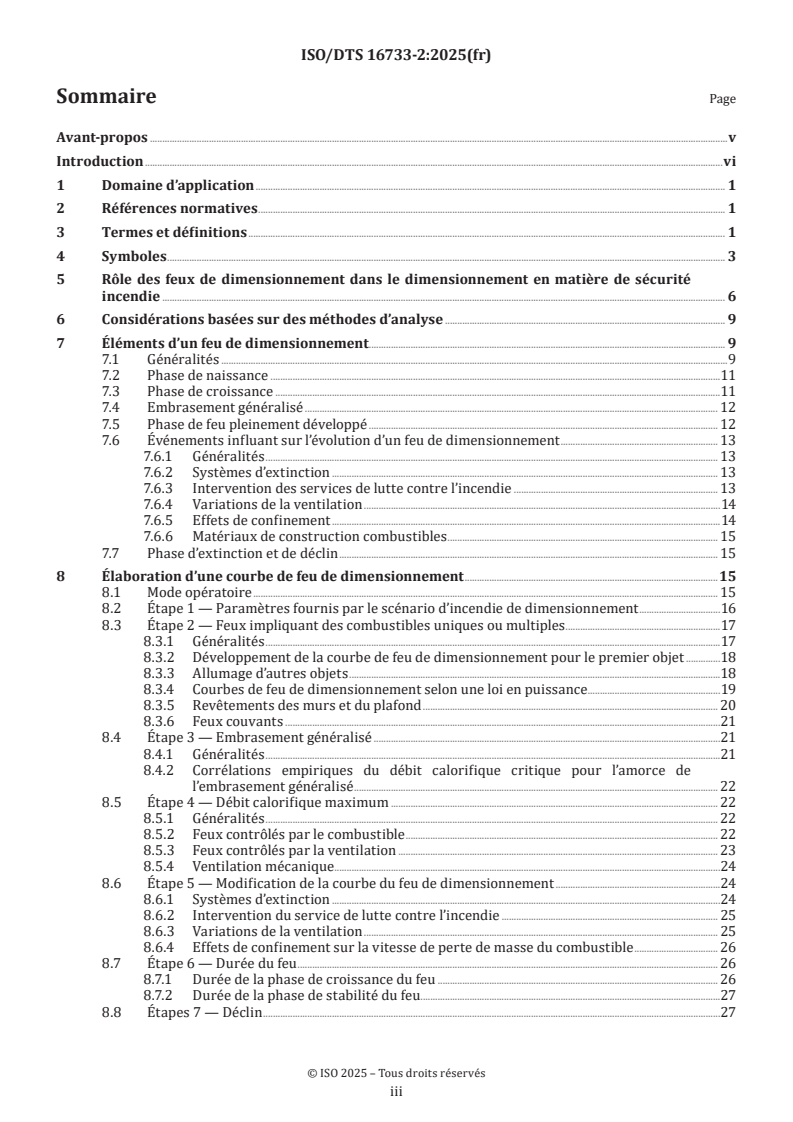
Contents Page
Foreword .v
Introduction .vi
1 Scope . 1
2 Normative references . 1
3 Terms and definitions . 1
4 Symbols . 3
5 Role of design fires in fire safety design. 6
6 Considerations based on methods of analysis . 9
7 Elements of a design fire . 9
7.1 General .9
7.2 Incipient stage .11
7.3 Growth stage .11
7.4 Flashover . 12
7.5 Fully developed stage . 12
7.6 Events that change a design fire . 13
7.6.1 General . 13
7.6.2 Suppression systems . 13
7.6.3 Intervention by fire services . 13
7.6.4 Changes in ventilation .14
7.6.5 Enclosure effects .14
7.6.6 Combustible construction materials .14
7.7 Extinction and decay stage .14
8 Constructing a design fire curve .15
8.1 Procedure . 15
8.2 Step 1 — Parameters provided by the design fire scenario.16
8.3 Step 2 — Fires involving single or multiple fuels .17
8.3.1 General .17
8.3.2 Develop the design fire curve for first item .18
8.3.3 Ignition of other items .18
8.3.4 Power law design fire curves .19
8.3.5 Wall and ceiling linings . 20
8.3.6 Smouldering fires . 20
8.4 Step 3 — Flashover . 20
8.4.1 General . 20
8.4.2 Empirical correlations for critical heat release rate for onset of flashover .21
8.5 Step 4 — Maximum heat release rate .21
8.5.1 General .21
8.5.2 Fuel-controlled fires .21
8.5.3 Ventilation-controlled fires . 22
8.5.4 Mechanical ventilation . 23
8.6 Step 5 — Modifying the design fire curve . 23
8.6.1 Suppression systems . 23
8.6.2 Fire service intervention . . .24
8.6.3 Changes in ventilation .24
8.6.4 Enclosure effects on mass loss rate of fuel .24
8.7 Step 6 — Fire duration . 25
8.7.1 Duration of the fire growth stage . 25
8.7.2 Duration of the steady burning stage . 25
8.8 Step 7 — Decay . 26
9 Species production .26
9.1 Species yields . 26
iii
ISO/DTS 16733-2:2025(en)
10 Design fires for structural fire engineering .26
10.1 General . 26
10.2 Localized fires .27
10.2.1 General .27
10.2.2 Flames not impinging the ceiling .27
10.2.3 Flames impinging the ceiling . 28
10.3 Parametric fires . 29
10.3.1 General . 29
10.3.2 Heating phase . 30
10.3.3 Heating duration and maximum temperature .31
10.3.4 Cooling phase .31
10.4 Fires in large compartments (travelling fires).32
11 External design fires .35
12 Fire tests .35
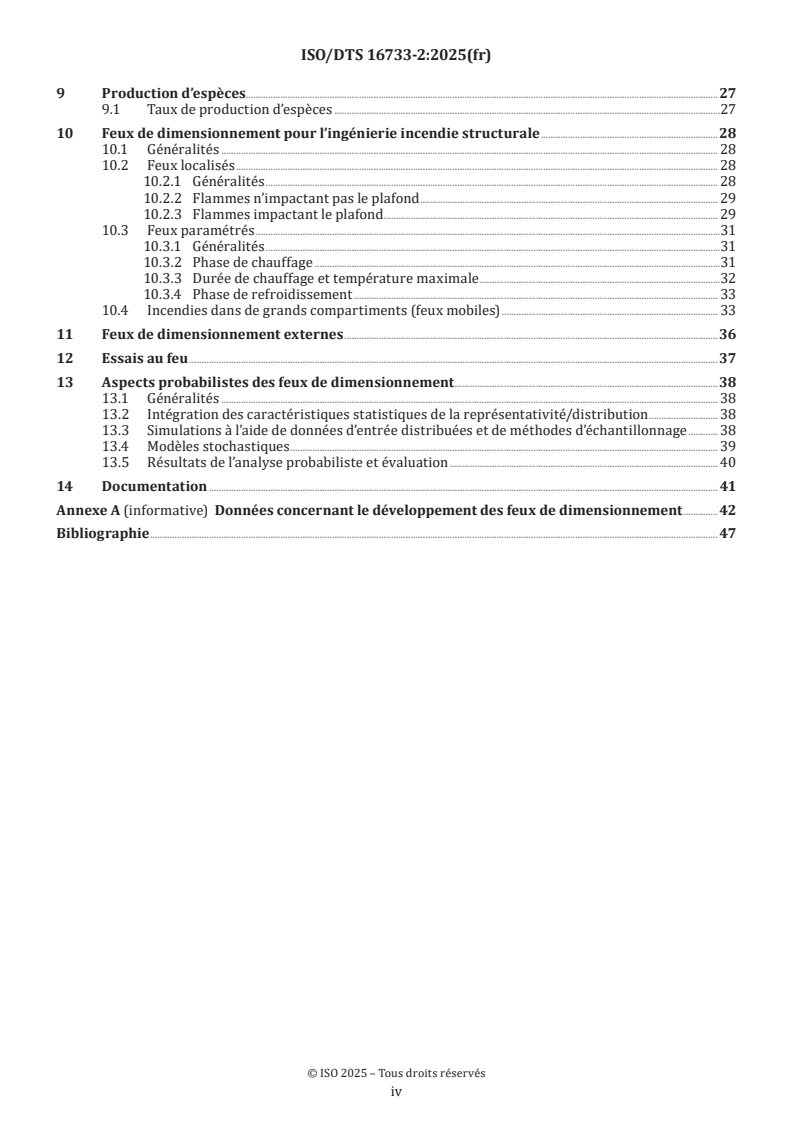
13 Probabilistic aspects of design fires .36
13.1 General . 36
13.2 Inclusion of statistical representativeness/distribution characteristics . 36
13.3 Simulations using distributed input and sampling techniques . 36
13.4 Stochastic models.37
13.5 Results of probabilistic analysis and their evaluation . 38
14 Documentation .39
Annex A (informative) Data for development of design fires.40
Bibliography .45
iv
ISO/DTS 16733-2:2025(en)
Foreword
ISO (the International Organization for Standardization) is a worldwide federation of national standards
bodies (ISO member bodies). The work of preparing International Standards is normally carried out through
ISO technical committees. Each member body interested in a subject for which a technical committee
has been established has the right to be represented on that committee. International organizations,
governmental and non-governmental, in liaison with ISO, also take part in the work. ISO collaborates closely
with the International Electrotechnical Commission (IEC) on all matters of electrotechnical standardization.
The procedures used to develop this document and those intended for its further maintenance are described
in the ISO/IEC Directives, Part 1. In particular, the different approval criteria needed for the different types
of ISO document should be noted. This document was drafted in accordance with the editorial rules of the
ISO/IEC Directives, Part 2 (see www.iso.org/directives).
ISO draws attention to the possibility that the implementation of this document may involve the use of (a)
patent(s). ISO takes no position concerning the evidence, validity or applicability of any claimed patent
rights in respect thereof. As of the date of publication of this document, ISO had not received notice of (a)
patent(s) which may be required to implement this document. However, implementers are cautioned that
this may not represent the latest information, which may be obtained from the patent database available at
www.iso.org/patents. ISO shall not be held responsible for identifying any or all such patent rights.
Any trade name used in this document is information given for the convenience of users and does not
constitute an endorsement.
For an explanation of the voluntary nature of standards, the meaning of ISO specific terms and expressions
related to conformity assessment, as well as information about ISO's adherence to the World Trade
Organization (WTO) principles in the Technical Barriers to Trade (TBT), see www.iso.org/iso/foreword.html.
This document was prepared by Technical Committee ISO/TC 92,Fire safety, Subcommittee SC 4, Fire safety
engineering.
This second edition cancels and replaces the first edition (ISO/TS 16733-2:2021), which has been technically
revised.
The main changes are as follows:
— revision of 10.4.
A list of all parts in the ISO 16733 series can be found on the ISO website.
Any feedback or questions on this document should be directed to the user’s national standards body. A
complete listing of these bodies can be found at www.iso.org/members.html.
v
ISO/DTS 16733-2:2025(en)
Introduction
This document provides guidance for the specification of design fires for use in fire safety engineering
analysis. A design fire is linked to a specific scenario that is tailored to the fire-safety design objective.
There can be several fire safety objectives being addressed, including safety of life (for occupants and rescue
personnel), conservation of property, protection of the environment and preservation of heritage. A different
set of design fire scenarios and design fires can be required to assess the adequacy of a proposed design for
each objective.
The procedure for the selection of the design fire scenarios is described in ISO 16733-1. The design fire can be
thought of as an engineering representation of a fire or a “load” that is used to determine the consequences
of a given fire scenario. The set of assumed fire characteristics are referred to as “the design fire”. In this
document, various formulae are presented to calculate different phenomena. Formulae other than those
presented here can also be applicable for a given application.
It is important that the design fire be appropriate to the objectives of the fire-safety engineering analysis. It
should challenge the fire safety systems in a specific built environment and result in a final design solution
that satisfies performance criteria associated with all the relevant design objectives.
Users of this document should be appropriately qualified and competent in the field of fire safety engineering.
It is important that users understand the parameters within which specific methodologies may be used.
ISO 23932-1 provides a performance-based methodology for engineers to assess the level of fire safety for
new or existing built environments. Fire safety is evaluated through an engineered approach based on the
quantification of the behaviour of fire and based on knowledge of the consequences of such behaviour on
life safety, property, heritage and the environment. ISO 23932-1 provides the process (necessary steps) and
essential elements for designing a robust, performance-based fire safety programme.
ISO 23932-1 is supported by a set of ISO fire safety engineering standards available on the methods and
data needed for the steps in a fire safety engineering design summarized in ISO 23932-1:2018, Clause 4 and
shown in Figure 1. This system of standards provides an awareness of the interrelationships between fire
evaluations when using the set of ISO fire safety engineering standards.
Each document includes language in the introductory material of the document to tie it to the steps in the
fire safety engineering design process outlined in ISO 23932-1. Selection of design fire scenarios and design
fires form part of conformance with ISO 23932-1, and all the requirements of ISO 23932-1 apply to any
application of this document.
vi
FINAL DRAFT Technical Specification ISO/DTS 16733-2:2025(en)
Fire safety engineering — Selection of design fire scenarios
and design fires —
Part 2:
Design fires
1 Scope
This document provides guidance for the specification of design fires for use in fire safety engineering
analysis of building and structures in the built environment. The design fire is intended to be used in an
engineering analysis to determine consequences in fire safety engineering (FSE) analyses.
2 Normative references
The following documents are referred to in the text in such a way that some or all of their content constitutes
requirements of this document. For dated references, only the edition cited applies. For undated references,
the latest edition of the referenced document (including any amendments) applies.
ISO 13943, Fire safety — Vocabulary
3 Terms and definitions
For the purposes of this document, the terms and definitions given in ISO 13943 and the following apply.
ISO and IEC maintain terminological databases for use in standardization at the following addresses:
— ISO Online browsing platform: available at https:// www .iso .org/ obp
— IEC Electropedia: available at https:// www .electropedia .org/
3.1
combustion efficiency
ratio of the amount of heat release in incomplete combustion to the theoretical heat of complete combustion
Note 1 to entry: Combustion efficiency can be calculated only for cases where complete combustion can be defined.
Note 2 to entry: Combustion efficiency is dimensionless and is usually expressed as a percentage.
3.2
design fire
quantitative description of assumed fire characteristics within a design fire scenario (3.3)
Note 1 to entry: Typically, an idealized description of the variation with time of important fire variables, such as heat
release rate and toxic species yields, along with other important input data for modelling such as the fire load density.
3.3
design fire scenario
specific fire scenario (3.9) on which a deterministic fire safety engineering analysis is conducted
Note 1 to entry: As the number of possible fire scenarios can be very large, it is necessary to select the most important
scenarios (the design fire scenarios) for analysis. The selection of design fire scenarios is tailored to the fire-safety
design objectives, and accounts for the likelihood and consequences of potential scenarios.
ISO/DTS 16733-2:2025(en)
3.4
effective heat of combustion
heat released from a burning test specimen in a given time interval divided by the mass lost from the test
specimen in the same time period
Note 1 to entry: This is the same as the net heat of combustion if all the test specimen is converted to volatile
combustion products and if all the combustion products are fully oxidized.
−1
Note 2 to entry: The typical units are kilojoules per gram (kJ⋅g ).
3.5
extinction coefficient
natural logarithm of the ratio of incident light intensity to transmitted light intensity, per unit light path length
−1
Note 1 to entry: Typical units are reciprocal metres (m ).
3.6
fire growth
stage of fire development during which the heat release rate (3.13) and the temperature of the fire are
increasing
3.7
fire load
quantity of heat which can be released by the complete combustion of all the combustible materials in a
volume, including the facings of all bounding surfaces
Note 1 to entry: Fire load may be based on effective heat of combustion (3.4), gross heat of combustion (3.12), or net heat
of combustion as required by the specifier.
Note 2 to entry: The word “load” can be used to denote force or power or energy. In this context, it is being used to
denote energy.
Note 3 to entry: The typical units are kilojoules (kJ) or megajoules (MJ).
3.8
fire load density
fire load (3.7) per unit area
−2
Note 1 to entry: The typical units are kilojoules per square metre (kJ⋅m ).
3.9
fire scenario
qualitative description of the course of a fire with time, identifying key events that characterize the fire and
differentiate it from other possible fires
Note 1 to entry: The fire scenario description typically includes the ignition and fire growth processes, the fully
developed fire (3.11) stage, the fire decay stage, and the environment and systems that will impact on the course of the
fire. Unlike deterministic fire analysis, where fire scenarios are individually selected and used as design fire scenarios
(3.3), in fire risk assessment, fire scenarios are used as representative fire scenarios within fire scenario clusters.
[SOURCE: ISO 13943:2008, 3.176, modified]
3.10
flashover
transition to a state of total surface involvement in a fire of combustible materials within an enclosure
3.11
fully developed fire
state of total involvement of combustible materials in a fire
ISO/DTS 16733-2:2025(en)
3.12
heat of combustion
thermal energy produced by combustion of unit mass of a given substance
−1
Note 1 to entry: The typical units are kilojoules per gram (kJ⋅g ).
3.13
heat release rate
rate of thermal energy production generated by combustion
Note 1 to entry: The typical units are watts (W).
3.14
target
a person, object or environment intended to be protected from the effects of fire and its effluents (smoke,
corrosive gas, etc.) and/or fire suppression effluents
4 Symbols
A total area of enclosure (walls, ceiling and floor, including openings), m
t
A total area of enclosure (walls, ceiling and floor, excluding openings), m
T
A
horizontal burning area of the fuel, m
f
A
floor area, m
fl
A
area of opening, m
o
2 1/2
b thermal inertia of linings, J/(m s K)
c distance of target from the centre of the flame, m
c specific heat, J/(kg K)
p
D fire diameter, m
e represents the mathematical constant - Euler's number
f flapping length
f flapping angle
a
fs()
probability distribution for RSET
s
fx()
probability distribution for ASET
s
q
fire load energy density, MJ/m
f,d
F non-dimensionless form of fire
s
h heat of gasification of the fuel, kJ/kg
g
h average effective heat transfer coefficient, kW/(m K)
T
h' heat flux, W/m
h′
net heat flux, W/m
net
H vertical distance between the fire source and the ceiling, m
ISO/DTS 16733-2:2025(en)
H height of an opening, m
o
L length of the compartment, m
L length of the design area involved in fire, m
d
L vertical flame height, m
f
L horizontal flame length, m
H
m
rate of mass loss of fuel, kg/s
f
m
mass loss rate of fuel under well ventilated free burn conditions, kg/s
F,u
m
mass of fuel burned during the growth phase, kg
g
m
rate of entry of air outflow from the enclosure, kg/s
out
m
mass flow of gases entrained into the fire plume, kg/s
p
m
mass loss rate for smouldering combustion, g/min
s
m
total mass of fuel burned, kg
tot
" 2
mass loss rate per unit area, kg/(s m )
m
1/2
O opening factor, m
q
total external heat flux from the smoke and heated enclosure boundary surfaces, kW
ext
q
fire load density per unit floor area, MJ/m
f,d
''
heat flux, kW/m
q
heat release rate, kW
Q
convective part of the heat release rate, W/m
Q
c
minimum heat release rate to cause flashover, kW
Q
fo
non-dimensional heat release rate
Q
H
maximum heat release rate, kW
Q
max
ventilation-controlled heat release rate, kW
Q
v
" 2
heat release rate per unit area, kW/m
Q
r stoichiometric air requirement for complete combustion of fuel, expressed as the mass ratio of
air to fuel
r horizontal distance between the vertical axis of the fire and the point along the ceiling where the
d
thermal flux is calculated, m
r radial distance away from the fire, m
x
s fire spread rate, m/s
t time, s
t burning time, s
b
ISO/DTS 16733-2:2025(en)
t
time required to reach the reference heat release rate Q , s
g
o
t
time at which the heat release rate reaches a maximum value, s
gw
t limiting time, h
lim
t total burning time, s
tot
T room temperature, °C
a
T reduced near-field temperature due to flapping, °C
f
T near-field temperature, °C
nf
W width of the compartment, m
X radiative fraction of the total energy
r
y dimensionless constant
Y
mass fraction of oxygen in the plume flow, kg/kg
O2
Y
mass fraction of oxygen in the gases feeding the flame, kg/kg
ol,
Y
mass fraction of oxygen under ambient free-burning conditions, kg/kg
o,∞
z height along the flame axis, m
z virtual origin of the axis, m
o
z' vertical position of the virtual heat source, m
α 2
fire growth coefficient, kW/s
α
convective heat transfer coefficient
c
Γ dimensionless ventilation parameter
ΔH
chemical heat of combustion, kJ/kg
c
ΔH
effective heat of combustion, kJ/kg
eff
ΔH
heat of combustion based on oxygen consumption, MJ/kg (~13,1 for hydrocarbons)
O2
ε
emissivity of the fire
f
ε
surface emissivity of the member
m
θ
surface temperature of the member, °C [see Formula (21)]
m
Θ parametric fire gas temperature, °C
g
ρ density of boundary, kg/m
b
σ
Stefan Boltzmann constant
λ thermal conductivity, W/(m K)
τ
duration of the decay burning stage, s
d
τ
duration of the growing fire stage, s
gw
ISO/DTS 16733-2:2025(en)
τ
duration of the steady burning stage, s
s
Φ configuration factor
χ
combustion efficiency
5 Role of design fires in fire safety design
Design fire specifications play a critical role in fire safety engineering. It is important that the procedures
described in ISO 23932-1 be followed. This means that the fire safety objectives and performance criteria are
stated and the relevant design scenarios are identified using ISO 16733-1 for fire scenarios and ISO/TS 29761
for behavioural scenarios.
Figure 1, taken from ISO 23932-1, illustrates the fire safety design process. The specification of design fires
follows the scenario selection step and provides input data for the selected engineering methods. Following
identification of the design fire scenarios in accordance with ISO 16733-1, the assumed characteristics of the
fire on which the scenario quantification will be based shall be described. The assumed fire characteristics
and the associated fire development over time are generally referred to as the “design fire”.
This document is applicable to design fires that are quantifiable in engineering terms and therefore intended
to form part of a deterministic or combined deterministic/probabilistic analysis. A deterministic approach
calculating the consequence of individual fire scenarios may also form part of an overriding probabilistic
analysis. For example, Monte Carlo simulation can be used to quantify uncertainty using statistical
techniques in both inputs and outputs.
This document is also intended to accommodate a range of different analysis methods, including use of
computational fluid dynamics models (CFD), zone models, or simple hand calculations. Each approach can
require the use of different parts of this document. Some calculations may be handled within the analysis
model, such as determining the ventilation limit or determining effect of suppression systems, while simpler
analysis methods can require these elements to be estimated separately. Where computer models are used
for the analysis, it is important for the engineer to understand the model limitations and which fire or other
phenomena are included and not included. The model or tool selected for use should be appropriate for the
overall analysis as described in ISO 23932-1:2018, Clause 11.
The nature of the fire scenario can require the application of selected clauses of this document rather than
all parts. For example, where the fire scenario predominantly concerns:
— a growing or developing fire, refer to Clause 8.
— a smouldering fire, refer to Clause 9.
— a fully developed fire affecting structure, refer to Clause 10.
ISO/DTS 16733-2:2025(en)
a
See also ISO/TR 16576 (Examples).
b
See also ISO 16732-1, ISO 16733-1, ISO/TS 29761.
c
See also ISO 16732-1, ISO 16733-1, ISO/TS 29761.
d
See also ISO/TS 13447, ISO 16730-1, ISO/TR 16730-2, ISO/TR 16730-3, ISO/TR 16730-4, ISO/TR 16730-5
(Examples), ISO 24678-2, ISO 24678-4, ISO 24678-3, ISO 24678-5, ISO/TR 16738, ISO 24678-6.
e
See also ISO/TR 16738, ISO 16733-1.
Figure 1 — Flowchart illustrating the fire safety design process
and selection of design fire scenarios (see ISO 23932-1)
Clause 11 covers several specific correlations for external fire exposures.
ISO/DTS 16733-2:2025(en)
Clause 12 discusses the use of fire tests for developing design fires when engineering calculation methods
are not available or not applicable.
Where analysis involving probabilistic aspects of design fires are envisaged, readers should also refer to
Clause 13 in addition to the relevant subclauses of Clauses 8 to 12.
The design fire can include descriptions of the heat release rate, gas temperature or heat fluxes as well as
the yields of smoke and other combustion products. The most important parameter of the design fire is the
heat release rate and different approaches are available to develop a design fire curve for the time-varying
heat release rate from a fire. In general, the main approaches are:
a) To calculate the fire growth and heat release from first principles based on an understanding of the
product materials and geometry, chemistry and underlying combustion processes.
This is generally difficult and can currently be considered insufficiently reliable for general use in fire
safety engineering. It is not discussed further in this document.
b) To construct composite heat release rate curves from the individual components.
This is more applicable when information is known regarding the specific contents and their
arrangement within the built environment. This requires consideration and estimation of fire spread
from the ignition source to other nearby items and the relevant timeline for this to occur.
c) To assume a generalized heat release rate curve (e.g. t fire).
This may include a representative fire growth rate for different well-defined occupancies. This could
be based on experimental data. It does not require fire spread from individual items to be assessed
and is therefore very simple to apply. This approach may be prescribed in some codes of practice (see
Annex A).
Initially, the engineer should determine the design heat release rate curve, without intervention, as would
apply if the fire were allowed to develop in well-ventilated, open-air conditions. Interventions result in a
potential change in the course of the fire. They could include:
— manual fire-fighting actions by occupants or by trained fire-fighters;
— automatic or manually operated fire suppression systems;
— restricted ventilation or changes in ventilation during the course of the fire (e.g. glass breaking);
— burning enhancement due to thermal feedback from the hot gases and enclosure surfaces to the fuel
surface.
The selected approach will depend on what is known about the fire scenario and the items involved. The
method of analysis may also determine the approach being dependent of what input information is available.
A complete description of the design fire from ignition to decay is estimated using the specified initial
conditions and a series of simple calculations to estimate parameters such as the sprinkler activation time,
transition to flashover and duration of any fully developed burning.
Alternatively, the design fire can be a combination of quantified initial conditions and subsequent fire
development determined iteratively or by calculation using more detailed models that account for
phenomena such as transient effects of changing ventilation on smoke production or thermal feedback
effects from a hot layer to the fuel surface.
As with the design fire scenario, it is important that the design fire be appropriate to the relevant fire-
safety objectives. For example, if safety of life is an objective, and the built environment includes a smoke
control system, a design fire should be selected that challenges the smoke control system. If the severity
of the design fire is underestimated, then the application of engineering methods to predict the effects of
the fire can produce results that do not accurately reflect the true impact of fires and can underestimate
the hazard. Conversely, if the severity is overestimated, unnecessary expense can result. It is important to
appreciate that in real life, due to uncertainties associated with the fuel, ventilation and other factors, the
actual severity of the fire varies according to statistical distribution.
ISO/DTS 16733-2:2025(en)
6 Considerations based on methods of analysis
It is common for fire models to include some of the dynamic changes and stage transitions expected over the
duration of the fire. For example, when a fire model constrains the heat release rate within a compartment to
match the available oxygen supply. Other dynamic effects may not be included such as fracture and fallout of
glazing within the compartment walls. The engineer is required to assess which elements of the design fire
are required for a specific analysis allowing for those predicted by the fire model as well as those required
as input to the model.
Whereas most advanced models require the heat release rate of the fire as input to a calculation of the
enclosure temperature or other fire properties, there is a class of models that is simpler in nature and
requires less sophisticated input data. For example, the parametric fire curves for post-flashover fires
discussed in 10.3 do not require estimates of the heat release rate of the fire as input. Instead, the gas
temperature is predicted directly, employing simpler information, such as the geometry of the enclosure
and its ventilation openings, the thermal properties of room lining materials and the fuel load.
For a given design fire scenario, the parameters determined in Clause 8 can be employed to predict the
temperature/heat flux evolution versus time and the associated effluents using various calculation methods
ranging in their complexity from simple to advanced.
7 Elements of a design fire
7.1 General
Fire can grow from ignition through to a fully developed stage and finally decay and eventual extinction.
The design fire is described by the values of variables, such as the heat release rate and yield of combustion
species, over the life of the fire.
A full specification of a design fire (see Figure 2) can include the following phases:
— incipient stage (A): characterized by a variety of sources, which can be smouldering, flaming or radiant.
— growth stage (B): covering the fire propagation period up to flashover or full fuel involvement.
— fully developed stage (C): characterized by a substantially steady burning rate determined from either
the ventilation supply or the fuel surface area. During this stage, the heat output within an enclosure is
generally the lesser of the ventilation-controlled heat output and the fuel-surface-area-controlled (under
free burn conditions) heat output. If the fuel bed-controlled rate exceeds the ventilation-controlled rate,
then the difference can potentially contribute to burning external to the enclosure.
— decay stage (D): covering the period of declining fire intensity until extinction.
ISO/DTS 16733-2:2025(en)
Key
X time
Y heat output
incipient - smouldering
sprinkler-controlled
ventilation-controlled
fuel-controlled
1 growth
2 sprinkler activation
3 flashover
4 ventilation limit
5 decay
6 extinction
Figure 2 — Example of design fire
Design fire characteristics can be subsequently modified based upon the stepwise results of the analysis.
For example, in case of a fire in a small/medium sized compartment, if the single-item fire grows sufficiently
intense that flashover in an enclosure is likely, it is necessary to modify the design fire to reflect the
characteristics of a ventilation-controlled or fuel-bed-controlled, fully-developed fire as well as involvement
of additional burning items, if present. Similarly, events such as sprinkler activation and window breakage
can influence the subsequent description of the design fire.
Consequently, a design fire can be a description of the fire over the full duration of the fire. This description
may include the following:
— parameters provided by the design-fire scenario (size of the room, location of the fire, combustible
material under consideration, etc.);
— parameters required to evaluate the fire development (heat release rate and other parameters, depending
on the assessment model to be used);
— events that result in a change in any of the above parameters.
ISO/DTS 16733-2:2025(en)
Design fires are usually characterized in terms of one or more of the following variables with respect to time
(as needed by the fire safety objective(s) and consequently by the analysis):
— heat release rate;
— combu
...
ISO/DTS 16733-2:2025(en)
Date: 2025-08-22
ISO /TC 92/SC 4
Secretariat: AFNOR
Date: 2025-xx
Fire safety engineering — Selection of design fire scenarios and
design fires —
Part 2:
Design fires
Ingénierie de la sécurité incendie – — Sélection de scénarios d'incendie et de feux de dimensionnement – —
Partie 2 : Feu de dimensionnement
ISO/DTS 16733-2:(en)
All rights reserved. Unless otherwise specified, or required in the context of its implementation, no part of this publication
may be reproduced or utilized otherwise in any form or by any means, electronic or mechanical, including photocopying,
or posting on the internet or an intranet, without prior written permission. Permission can be requested from either ISO
at the address below or ISO’s member body in the country of the requester.
ISO copyright office
CP 401 • Ch. de Blandonnet 8
CH-1214 Vernier, Geneva
Phone: + 41 22 749 01 11
EmailE-mail: copyright@iso.org
Website: www.iso.org
Published in Switzerland
ii
ISO/DTS 16733-2:(en)
Contents
Foreword . iv
Introduction . v
1 Scope . 1
2 Normative references . 1
3 Terms and definitions . 1
4 Symbols . 3
5 Role of design fires in fire safety design . 6
6 Considerations based on methods of analysis . 9
7 Elements of a design fire . 9
7.1 General. 9
7.2 Incipient stage . 11
7.3 Growth stage . 12
7.4 Flashover. 12
7.5 Fully developed stage . 13
7.6 Events that change a design fire . 13
7.7 Extinction and decay stage . 15
8 Constructing a design fire curve . 15
8.1 Procedure . 15
8.2 Step 1 — Parameters provided by the design fire scenario . 17
8.3 Step 2 — Fires involving single or multiple fuels . 17
8.4 Step 3 — Flashover . 21
8.5 Step 4 — Maximum heat release rate . 22
8.6 Step 5 — Modifying the design fire curve . 24
8.7 Step 6 — Fire duration . 26
8.8 Step 7 — Decay . 26
9 Species production . 27
9.1 Species yields. 27
10 Design fires for structural fire engineering . 27
10.1 General. 27
10.2 Localized fires . 28
10.3 Parametric fires . 30
10.4 Fires in large compartments (travelling fires) . 33
11 External design fires . 36
12 Fire tests . 37
13 Probabilistic aspects of design fires . 38
13.1 General. 38
13.2 Inclusion of statistical representativeness/distribution characteristics . 38
13.3 Simulations using distributed input and sampling techniques . 38
13.4 Stochastic models . 39
13.5 Results of probabilistic analysis and their evaluation . 40
14 Documentation . 41
Annex A (informative) Data for development of design fires . 42
Bibliography . 47
iii
ISO/DTS 16733-2:(en)
Foreword
ISO (the International Organization for Standardization) is a worldwide federation of national standards
bodies (ISO member bodies). The work of preparing International Standards is normally carried out through
ISO technical committees. Each member body interested in a subject for which a technical committee has been
established has the right to be represented on that committee. International organizations, governmental and
non-governmental, in liaison with ISO, also take part in the work. ISO collaborates closely with the
International Electrotechnical Commission (IEC) on all matters of electrotechnical standardization.
The procedures used to develop this document and those intended for its further maintenance are described
in the ISO/IEC Directives, Part 1. In particular, the different approval criteria needed for the different types of
ISO documentsdocument should be noted. This document was drafted in accordance with the editorial rules
of the ISO/IEC Directives, Part 2 (see www.iso.org/directives).
Attention is drawnISO draws attention to the possibility that some of the elementsimplementation of this
document may beinvolve the subjectuse of (a) patent(s). ISO takes no position concerning the evidence,
validity or applicability of any claimed patent rights in respect thereof. As of the date of publication of this
document, ISO had not received notice of (a) patent(s) which may be required to implement this document.
However, implementers are cautioned that this may not represent the latest information, which may be
obtained from the patent database available at www.iso.org/patents. ISO shall not be held responsible for
identifying any or all such patent rights. Details of any patent rights identified during the development of the
document will be in the Introduction and/or on the ISO list of patent declarations received (see ).
Any trade name used in this document is information given for the convenience of users and does not
constitute an endorsement.
For an explanation of the voluntary nature of standards, the meaning of ISO specific terms and expressions
related to conformity assessment, as well as information about ISO's adherence to the World Trade
Organization (WTO) principles in the Technical Barriers to Trade (TBT), see www.iso.org/iso/foreword.html.
This document was prepared by Technical Committee ISO/TC 92, Fire safety, Subcommittee SC 4, Fire safety
engineering.
This second edition cancels and replaces the first edition (ISO/TS 16733-2:2021), which has been technically
revised.
The main changes are as follows:
— revision of 10.4.
A list of all parts in the ISO 16733 series can be found on the ISO website.
Any feedback or questions on this document should be directed to the user’s national standards body. A
complete listing of these bodies can be found at www.iso.org/members.html.
iv
ISO/DTS 16733-2:(en)
Introduction
This document provides guidance for the specification of design fires for use in fire safety engineering analysis.
A design fire is linked to a specific scenario that is tailored to the fire-safety design objective. There can be
several fire safety objectives being addressed, including safety of life (for occupants and rescue personnel),
conservation of property, protection of the environment and preservation of heritage. A different set of design
fire scenarios and design fires can be required to assess the adequacy of a proposed design for each objective.
The procedure for the selection of the design fire scenarios is described in ISO 16733-1. The design fire can be
thought of as an engineering representation of a fire or a “load” that is used to determine the consequences of
a given fire scenario. The set of assumed fire characteristics are referred to as “the design fire”. In this
document, various formulae are presented to calculate different phenomena. Formulae other than those
presented here can also be applicable for a given application.
It is important that the design fire be appropriate to the objectives of the fire-safety engineering analysis. It
should challenge the fire safety systems in a specific built environment and result in a final design solution
that satisfies performance criteria associated with all the relevant design objectives.
Users of this document should be appropriately qualified and competent in the field of fire safety engineering.
It is important that users understand the parameters within which specific methodologies may be used.
ISO 23932-1 provides a performance-based methodology for engineers to assess the level of fire safety for
new or existing built environments. Fire safety is evaluated through an engineered approach based on the
quantification of the behaviour of fire and based on knowledge of the consequences of such behaviour on life
safety, property, heritage and the environment. ISO 23932-1 provides the process (necessary steps) and
essential elements for designing a robust, performance-based fire safety programme.
ISO 23932-1 is supported by a set of ISO fire safety engineering standards available on the methods and data
needed for the steps in a fire safety engineering design summarized in ISO 23932-1:2018, Clause 4 and shown
in Figure 1Figure 1. This system of standards provides an awareness of the interrelationships between fire
evaluations when using the set of ISO fire safety engineering standards.
Each document includes language in the introductory material of the document to tie it to the steps in the fire
safety engineering design process outlined in ISO 23932-1. Selection of design fire scenarios and design fires
form part of conformance with ISO 23932-1, and all the requirements of ISO 23932-1 apply to any application
of this document.
This document provides a revision of Section 10.4 “Traveling Fires”.
v
ISO/DTS 16733-2:(en)
Fire safety engineering — Selection of design fire scenarios and design
fires —
Part 2:
Design fires
1 Scope
This document provides guidance for the specification of design fires for use in fire safety engineering analysis
of building and structures in the built environment. The design fire is intended to be used in an engineering
analysis to determine consequences in fire safety engineering (FSE) analyses.
2 Normative references
The following documents, are referred to in wholethe text in such a way that some or in part, are normatively
referenced inall of their content constitutes requirements of this document. For dated references, only the
edition cited applies. For undated references, the latest edition of the referenced document (including any
amendments) applies.
ISO 13943, Fire safety — Vocabulary
3 Terms and definitions
For the purposes of this document, the terms and definitions given in ISO 13943 and the following apply.
ISO and IEC maintain terminological databases for use in standardization at the following addresses:
— — ISO Online browsing platform: available at https://www.iso.org/obp
— — IEC Electropedia: available at https://www.electropedia.org/
3.1 3.1
combustion efficiency
ratio of the amount of heat release in incomplete combustion to the theoretical heat of complete combustion
Note 1 to entry: Combustion efficiency can be calculated only for cases where complete combustion can be defined.
Note 2 to entry: Combustion efficiency is dimensionless and is usually expressed as a percentage.
3.2 3.2
design fire
quantitative description of assumed fire characteristics within a design fire scenario (3.3(3.3))
Note 1 to entry: Typically, an idealized description of the variation with time of important fire variables, such as heat
release rate and toxic species yields, along with other important input data for modelling such as the fire load density.
3.3 3.3
design fire scenario
specific fire scenario (3.9(3.9)) on which a deterministic fire safety engineering analysis is conducted
Note 1 to entry: As the number of possible fire scenarios can be very large, it is necessary to select the most important
scenarios (the design fire scenarios) for analysis. The selection of design fire scenarios is tailored to the fire-safety design
objectives, and accounts for the likelihood and consequences of potential scenarios.
ISO/DTS 16733-2:(en)
3.4 3.4
effective heat of combustion
heat released from a burning test specimen in a given time interval divided by the mass lost from the test
specimen in the same time period
Note 1 to entry: This is the same as the net heat of combustion if all the test specimen is converted to volatile combustion
products and if all the combustion products are fully oxidized.
−1
Note 2 to entry: The typical units are kilojoules per gram (kJ⋅g ).
3.5 3.5
extinction coefficient
natural logarithm of the ratio of incident light intensity to transmitted light intensity, per unit light path length
−1
Note 1 to entry: Typical units are reciprocal metres (m ).
3.6 3.6
fire growth
stage of fire development during which the heat release rate (3.13(3.15)) and the temperature of the fire are
increasing
3.7 3.7
fire load
quantity of heat which can be released by the complete combustion of all the combustible materials in a
volume, including the facings of all bounding surfaces
Note 1 to entry: Fire load may be based on effective heat of combustion (3.4(3.4),), gross heat of combustion (3.12(3.14),),
or net heat of combustion as required by the specifier.
Note 2 to entry: The word “load” can be used to denote force or power or energy. In this context, it is being used to
denote energy.
Note 3 to entry: The typical units are kilojoules (kJ) or megajoules (MJ).
3.8 3.8
fire load density
fire load (3.7(3.7)) per unit area
−2
Note 1 to entry: The typical units are kilojoules per square metre (kJ⋅m ).
3.9 3.9
fire scenario
qualitative description of the course of a fire with time, identifying key events that characterize the fire and
differentiate it from other possible fires
Note 1 to entry: The fire scenario description typically includes the ignition and fire growth processes, the fully
developed fire (3.11(3.13)) stage, the fire decay stage, and the environment and systems that will impact on the course of
the fire. Unlike deterministic fire analysis, where fire scenarios are individually selected and used as design fire scenarios
(3.3(3.3),), in fire risk assessment, fire scenarios are used as representative fire scenarios (3.10) within fire scenario
clusters.
[SOURCE: ISO 13943:2008, 4.1293.176, modified]
ISO/DTS 16733-2:(en)
3.10
representative fire scenario
Commented [eXtyles1]: The term "representative fire
scenario" is used only in terms and definitions section
specific fire scenario (3.9) selected from a fire scenario cluster (3.11) such that the consequence of the
representative fire scenario can be used as a reasonable estimate of the average consequence of scenarios in
the fire scenario cluster
3.11
fire scenario cluster
Commented [eXtyles2]: The term "fire scenario cluster" is
used only in terms and definitions section
subset of fire scenarios (3.9), usually defined as part of a complete partitioning of the universe of possible fire
scenarios
Note 1 to entry: The subset is usually defined so that the calculation of fire risk as the sum over all fire scenario clusters
of fire scenario cluster frequency multiplied by representative fire scenario (3.10) consequence does not impose an undue
calculation burden.
3.10 3.12
flashover
transition to a state of total surface involvement in a fire of combustible materials within an enclosure
3.11 3.13
fully developed fire
state of total involvement of combustible materials in a fire
3.12 3.14
heat of combustion
thermal energy produced by combustion of unit mass of a given substance
−1
Note 1 to entry: The typical units are kilojoules per gram (kJ⋅g ).
3.13 3.15
heat release rate
rate of thermal energy production generated by combustion
Note 1 to entry: The typical units are watts (W).
3.14 3.16
target
a person, object or environment intended to be protected from the effects of fire and its effluents (smoke,
corrosive gas, etc.) and/or fire suppression effluents
4 Symbols
A total area of enclosure (walls, ceiling and floor, including openings), m
t
AT total area of enclosure (walls, ceiling and floor, excluding openings), m
𝐴 horizontal burning area of the fuel, m
𝑓
𝐴 floor area, m
𝑓𝑙
𝐴 area of opening, m
𝑜
2 1/2
b thermal inertia of linings, J/(m s K)
c distance of target from the centre of the flame, m
c specific heat, J/(kg K)
p
D fire diameter, m
ISO/DTS 16733-2:(en)
e represents the mathematical constant - Euler's number
f flapping length
f flapping angle
a
𝑓 (𝑠) probability distribution for RSET
𝑠
𝑓 (𝑥) probability distribution for ASET
𝑠
𝑞 fire load energy density, MJ/m
𝑓,𝑑
F non-dimensionless form of fire
s
hg heat of gasification of the fuel, kJ/kg
h average effective heat transfer coefficient, kW/(m K)
T
h' heat flux, W/m
′
ℎ net heat flux, W/m
𝑛𝑒𝑡
H vertical distance between the fire source and the ceiling, m
H height of an opening, m
o
L length of the compartment, m
L length of the design area involved in fire, m
d
Lf vertical flame height, m
L horizontal flame length, m
H
𝑚˙ rate of mass loss of fuel, kg/s
𝑓
𝑚˙ mass loss rate of fuel under well ventilated free burn conditions, kg/s
𝐹,𝑢
𝑚 mass of fuel burned during the growth phase, kg
𝑔
𝑚˙ rate of entry of air outflow from the enclosure, kg/s
𝑜𝑢𝑡
𝑚˙ mass flow of gases entrained into the fire plume, kg/s
𝑝
𝑚˙ mass loss rate for smouldering combustion, g/min
𝑠
𝑚 total mass of fuel burned, kg
𝑡𝑜𝑡
"
𝑚˙ mass loss rate per unit area, kg/(s m )
1/2
O opening factor, m
𝑞˙ total external heat flux from the smoke and heated enclosure boundary surfaces, kW
𝑒𝑥𝑡
𝑞 fire load density per unit floor area, MJ/m
𝑓,𝑑
′′
𝑞˙ heat flux, kW/m
˙
𝑄 heat release rate, kW
˙
convective part of the heat release rate, W/m
𝑄
𝑐
˙
minimum heat release rate to cause flashover, kW
𝑄
𝑓𝑜
˙
non-dimensional heat release rate
𝑄
𝐻
˙
𝑄 maximum heat release rate, kW
𝑚𝑎𝑥
˙
𝑄 ventilation-controlled heat release rate, kW
𝑣
" 2
˙
heat release rate per unit area, kW/m
𝑄
ISO/DTS 16733-2:(en)
r stoichiometric air requirement for complete combustion of fuel, expressed as the mass ratio of
air to fuel
rd horizontal distance between the vertical axis of the fire and the point along the ceiling where the
thermal flux is calculated, m
r radial distance away from the fire, m
x
s fire spread rate, m/s
t time, s
t burning time, s
b
˙
tg time required to reach the reference heat release rate ,𝑄 , s
𝑜
𝑡 time at which the heat release rate reaches a maximum value, s
𝑔𝑤
tlim limiting time, h
t total burning time, s
tot
T room temperature, °C
a
T reduced near-field temperature due to flapping, °C
f
Tnf near-field temperature, °C
W width of the compartment, m
X radiative fraction of the total energy
r
y dimensionless constant
𝑌 mass fraction of oxygen in the plume flow, kg/kg
𝑂2
𝑌 mass fraction of oxygen in the gases feeding the flame, kg/kg
o,l
𝑌 mass fraction of oxygen under ambient free-burning conditions, kg/kg
o,∞
z height along the flame axis, m
zo virtual origin of the axis, m
z' vertical position of the virtual heat source, m
𝛼 fire growth coefficient, kW/s
𝛼 convective heat transfer coefficient
𝑐
Γ dimensionless ventilation parameter
𝛥𝐻 chemical heat of combustion, kJ/kg
𝑐
𝛥𝐻 effective heat of combustion, kJ/kg
eff
𝛥𝐻 heat of combustion based on oxygen consumption, MJ/kg (~13,1 for hydrocarbons)
𝑂2
𝜀 emissivity of the fire
𝑓
𝜀 surface emissivity of the member
𝑚
𝜃 surface temperature of the member, °C [see 0Formula (21)]]
𝑚
Θg parametric fire gas temperature, °C
ρb density of boundary, kg/m
𝜎 Stefan Boltzmann constant
λ thermal conductivity, W/(m K)
ISO/DTS 16733-2:(en)
𝜏 duration of the decay burning stage, s
𝑑
𝜏 duration of the growing fire stage, s
𝑔𝑤
𝜏 duration of the steady burning stage, s
𝑠
Φ configuration factor
𝜒 combustion efficiency
5 The Role of design fires in fire safety design
Design fire specifications play a critical role in fire safety engineering. It is important that the procedures
described in ISO 23932-1 be followed. This means that the fire safety objectives and performance criteria are
stated and the relevant design scenarios are identified using ISO 16733-1 for fire scenarios and ISO/TS 29761
for behavioural scenarios.
Figure 1Figure 1,, taken from ISO 23932-1, illustrates the fire safety design process. The specification of design
fires follows the scenario selection step and provides input data for the selected engineering methods.
Following identification of the design fire scenarios in accordance with ISO 16733-1, the assumed
characteristics of the fire on which the scenario quantification will be based shall be described. The assumed
fire characteristics and the associated fire development over time are generally referred to as the “design fire”.
This document is applicable to design fires that are quantifiable in engineering terms and therefore intended
to form part of a deterministic or combined deterministic/probabilistic analysis. A deterministic approach
calculating the consequence of individual fire scenarios may also form part of an overriding probabilistic
analysis. For example, Monte Carlo simulation can be used to quantify uncertainty using statistical techniques
in both inputs and outputs.
This document is also intended to accommodate a range of different analysis methods, including use of
computational fluid dynamics models (CFD), zone models, or simple hand calculations. Each approach can
require the use of different parts of this document. Some calculations may be handled within the analysis
model, such as determining the ventilation limit or determining effect of suppression systems, while simpler
analysis methods can require these elements to be estimated separately. Where computer models are used
for the analysis, it is important for the engineer to understand the model limitations and which fire or other
phenomena are included and not included. The model or tool selected for use should be appropriate for the
overall analysis as described in ISO 23932-1:2018, Clause 11.
The nature of the fire scenario can require the application of selected clauses of this document rather than all
parts. For example, where the fire scenario predominantly concerns:
— — a growing or developing fire, refer to 8Clause 8.
— — a smouldering fire, refer to 9Clause 9.
— — a fully developed fire affecting structure, refer to 10Clause 10.
ISO/DTS 16733-2:(en)
16733-2_ed2fig1.EPS
a
See also ISO/TR 16576 (Examples).
b
See also ISO 16732--1, ISO 16733--1, ISO/TS 29761.
c
See also ISO 16732--1, ISO 16733--1, ISO/TS 29761.
d
See also ISO/TS 13447, ISO 16730--1, ISO/TR 16730--2, ISO/TR 16730--3, ISO/TR 16730--4, ISO/TR 16730--5 (Examples),
ISO 1673424678-2, ISO 1673524678-4, ISO 1673624678-3, ISO 1673724678-5, ISO/TR 16738, ISO 24678--6.
e
See also ISO/TR 16738, ISO 16733--1.
Figure 1 — Flow chartFlowchart illustrating the fire safety design process
and selection of design fire scenarios (Source:see ISO 23932-1)
ISO/DTS 16733-2:(en)
11Clause 11 covers several specific correlations for external fire exposures.
12Clause 12 discusses the use of fire tests for developing design fires when engineering calculation methods
are not available or not applicable.
Where analysis involving probabilistic aspects of design fires are envisaged, readers should also refer to
13Clause 13 in addition to the relevant subclauses of 8 to 12Clauses 8-12.
The design fire can include descriptions of the heat release rate, gas temperature or heat fluxes as well as the
yields of smoke and other combustion products. The most important parameter of the design fire is the heat
release rate and different approaches are available to develop a design fire curve for the time-varying heat
release rate from a fire. In general, the main approaches are:
a) 1) To calculate the fire growth and heat release from first principles based on an understanding
of the product materials and geometry, chemistry and underlying combustion processes.
This is generally difficult and can currently be considered insufficiently reliable for general use in fire
safety engineering. It is not discussed further in this document.
b) 2) To construct composite heat release rate curves from the individual components.
This is more applicable when information is known regarding the specific contents and their arrangement
within the built environment. This requires consideration and estimation of fire spread from the ignition
source to other nearby items and the relevant timeline for this to occur.
c) 3) To assume a generalized heat release rate curve (e.g. t fire).
This may include a representative fire growth rate for different well-defined occupancies. This could be
based on experimental data. It does not require fire spread from individual items to be assessed and is
therefore very simple to apply. This approach may be prescribed in some codes of practice (see
Annex AAnnex A).).
Initially, the engineer should determine the design heat release rate curve, without intervention, as would
apply if the fire were allowed to develop in well-ventilated, open-air conditions. Interventions result in a
potential change in the course of the fire. They could include:
— — manual fire-fighting actions by occupants or by trained fire-fighters;
— — automatic or manually operated fire suppression systems;
— — restricted ventilation or changes in ventilation during the course of the fire (e.g. glass breaking);
— — burning enhancement due to thermal feedback from the hot gases and enclosure surfaces to the fuel
surface.
The selected approach will depend on what is known about the fire scenario and the items involved. The
method of analysis may also determine the approach being dependent of what input information is available.
A complete description of the design fire from ignition to decay is estimated using the specified initial
conditions and a series of simple calculations to estimate parameters such as the sprinkler activation time,
transition to flashover and duration of any fully developed burning.
Alternatively, the design fire can be a combination of quantified initial conditions and subsequent fire
development determined iteratively or by calculation using more detailed models that account for phenomena
ISO/DTS 16733-2:(en)
such as transient effects of changing ventilation on smoke production or thermal feedback effects from a hot
layer to the fuel surface.
As with the design fire scenario, it is important that the design fire be appropriate to the relevant fire-safety
objectives. For example, if safety of life is an objective, and the built environment includes a smoke control
system, a design fire should be selected that challenges the smoke control system. If the severity of the design
fire is underestimated, then the application of engineering methods to predict the effects of the fire can
produce results that do not accurately reflect the true impact of fires and can underestimate the hazard.
Conversely, if the severity is overestimated, unnecessary expense can result. It is important to appreciate that
in real life, due to uncertainties associated with the fuel, ventilation and other factors, the actual severity of
the fire varies according to statistical distribution.
6 Considerations based on methods of analysis
It is common for fire models to include some of the dynamic changes and stage transitions expected over the
duration of the fire. For example, when a fire model constrains the heat release rate within a compartment to
match the available oxygen supply. Other dynamic effects may not be included such as fracture and fallout of
glazing within the compartment walls. The engineer is required to assess which elements of the design fire
are required for a specific analysis allowing for those predicted by the fire model as well as those required as
input to the model.
Whereas most advanced models require the heat release rate of the fire as input to a calculation of the
enclosure temperature or other fire properties, there is a class of models that is simpler in nature and requires
less sophisticated input data. For example, the parametric fire curves for post-flashover fires discussed in
10.3subclause 10.3 do not require estimates of the heat release rate of the fire as input. Instead, the gas
temperature is predicted directly, employing simpler information, such as the geometry of the enclosure and
its ventilation openings, the thermal properties of room lining materials and the fuel load.
For a given design fire scenario, the parameters determined in 8Clause 8 can be employed to predict the
temperature/heat flux evolution versus time and the associated effluents using various calculation methods
ranging in their complexity from simple to advanced.
7 Elements of a design fire
7.1 General
Fire can grow from ignition through to a fully developed stage and finally decay and eventual extinction. The
design fire is described by the values of variables, such as the heat release rate and yield of combustion species,
over the life of the fire.
A full specification of a design fire (see Figure 2Figure 2)) can include the following phases:
— — incipient stage (A): characterized by a variety of sources, which can be smouldering, flaming or
radiant.
— — growth stage (B): covering the fire propagation period up to flashover or full fuel involvement.
— — fully developed stage (C): characterized by a substantially steady burning rate determined from either
the ventilation supply or the fuel surface area. During this stage, the heat output within an enclosure is
generally the lesser of the ventilation-controlled heat output and the fuel-surface-area-controlled (under
free burn conditions) heat output. If the fuel bed-controlled rate exceeds the ventilation-controlled rate,
then the difference can potentially contribute to burning external to the enclosure.
— — decay stage (D): covering the period of declining fire intensity until extinction.
ISO/DTS 16733-2:(en)
16733-2_ed2fig2.EPS
Key
X time
Y heat output
16733-
2_ed2fig2_
incipient - smouldering
key1.EPS
16733-
2_ed2fig2_
sprinkler-controlled
key2.EPS
16733-
2_ed2fig2_
ventilation-controlled
key3.EPS
16733-
2_ed2fig2_
fuel-controlled
key4.EPS
1 growth
2 sprinkler activation
3 flashover
4 ventilation limit
5 decay
6 extinction
Figure 2 — Example of design fire
ISO/DTS 16733-2:(en)
Design fire characteristics can be subsequently modified based upon the stepwise results of the analysis. For
example, in case of a fire in a small/medium sized compartment, if the single-item fire grows sufficiently
intense that flashover in an enclosure is likely, it is necessary to modify the design fire to reflect the
characteristics of a ventilation-controlled or fuel-bed-controlled, fully-developed fire as well as involvement
of additional burning items, if present. Similarly, events such as sprinkler activation and window breakage can
influence the subsequent description of the design fire.
Consequently, a design fire can be a description of the fire over the full duration of the fire. This description
may include the following:
— — parameters provided by the design-fire scenario (size of the room, location of the fire, combustible
material under consideration, etc.);
— — parameters required to evaluate the fire development (heat release rate and other parameters,
depending on the assessment model to be used);
— — events that result in a change in any of the above parameters.
Design fires are usually characterized in terms of one or more of the following variables with respect to time
(as needed by the fire safety objective(s) and consequently by the analysis):
— — heat release rate;
— — combustion product species generation rate;
— — smoke production rate;
— — flame height/volume;
— — burning area;
— — temperature/heat flux.
The appropriateness of the selection of the design fire depends on the objectives of the engineering
assessment. For example, a design fire for smoke control purposes can have different characteristics and
definition metrics compared to a design fire for assessing structural fire resistance.
7.2 Incipient stage
A smouldering fire typically produces very little heat but can, over a sufficiently long period, fill an enclosure
with unburned combustible gases, toxic products of combustion such as carbon monoxide and soot.
Entrainment into these smouldering fires is low, resulting in high rates of release of smoke and toxic species
[ [1] ]
per unit of mass burned 0 . .
The following factors affect the likelihood of onset of smouldering combustion:
— — nature of the fuel and the propensity to form char;
— — local air currents;
— — strength and characteristics of the ignition source.
Smouldering fires can readily transform into flaming fires, particularly when air flow across the surface is
increased. The principal hazard associated with smouldering fires is the production of carbon monoxide as a
result of incomplete combustion. The development of untenable conditions due to poor visibility is also a
significant hazard that it is important to consider in the analysis, particularly in residential occupancies.
ISO/DTS 16733-2:(en)
7.3 Growth stage
The factors determining the characteristic rate of fire growth for flaming fires include the following:
— — nature of combustibles and burning properties (e.g. heat of combustion, heat of gasification, etc.);
— — geometric arrangement of the fuel;
— — size and geometry of the enclosure (fire growth can vary for the same combustibles burning inside an
enclosure compared to burning in the open; see also 7.6.57.6.5););
— — strength and characteristics of the ignition source;
— — ignitability of the fuel;
— — ventilation;
— — external heat flux;
— — exposed surface area (and surface area to mass ratio).
The initial rate of fire growth is subsequently modified by events that occur during the design fire scenario.
These events can modify the heat release rate and smoke generation rate of the fire either positively or
negatively. Typical events and their effects on the fire are the following:
— flashover transition to a state of full involvement in the fire
compartment;
— low hot layer interface acceleration;
— sprinkler activation steady or declining;
— manual fire suppression steady or declining;
— fuel exhaustion decay;
— changes in ventilation transition between fuel control and ventilation control;
— flaming debris subsequent ignition(s) of other items.
It is important that a determination of the rate of initial fire growth includes these aspects. Fire models are
available that can predict rate of fire growth on simple fuel geometries under defined conditions. Experimental
[ ][ [2,3]]
data are also available 0 0 to assist in the determination of rate of fire growth on typical fuel packages.
Further guidance on determining the fire growth rate and heat release rate for single or multiple fuels is given
in 8.38.3,, and for power law design fire curves in 8.3.48.3.4.
7.4 Flashover
Flashover is the rapid transition from a localized fire to the involvement of all exposed surfaces of combustible
materials within an enclosure. It occurs somewhat commonly in small and medium size enclosures. In large
volume compartments flashover cannot occur. In these cases, the fire could either remain localized or
progressively spread to adjacent fuel (travelling fires). Depending on the purpose of the assessment, such non-
uniform fires can also need to be selected as a complementary design fire (for example see 10Clause 10 on
structural design fires, for example).
The effect of flashover on the design fire is to modify the heat release rate and other characteristics to those
appropriate to a fully developed fire. This can include changes in the yields of species generated by the fire.
ISO/DTS 16733-2:(en)
For example, the rate of generation of carbon monoxide and soot increases as the combustion environment
becomes ventilation limited.
Further guidance on determining the time for the occurrence of flashover is given in 8.48.4.
Species yields are discussed in 9.19.1.
7.5 Fully developed stage
Typically, following flashover, fires tend to rapidly reach a fully developed stage where the heat release rate
is a maximum and is limited either by the fuel area or the available ventilation. For some specific fuel
configurations (e.g. cribs) the burning can also be limited by porosity. The maximum heat release rate within
a compartment following flashover may be taken as the lesser of the ventilation-controlled, porosity-
controlled (if applicable) and fuel-surface-area-controlled heat release rates.
The ventilation-controlled rate of burning in a compartment can be determined from consideration of
air/oxygen flowing into the compartment, whereas the burning rate of fuel-bed-controlled fires is dependent
upon the nature and surface area of the fuel.
The duration of burning will be mainly dependent on the amount of fuel available and the rate at which it can
be pyrolyzed. When flashover does not occur within a compartment and travelling fire develops, the fire can
also reach a fully developed stage where the fire has reached its maximum intensity.
Further guidance on determining the maximum heat release rate and the duration of burning is given in 8.5
and 8.7 respectively in 8.5 and 8.7.
7.6 Events that change a design fire
7.6.1 General
During the period of fire development there are various events that can change the way in which the fire
develops in the future. Some of these are mentioned in this subclause. However, this list is not exhaustive.
7.6.2 Suppression systems
Suppression systems, if installed, could be either automatically or manually operated. Suppression systems
can operate at any time during the fire but are normally expected to operate during the pre-flashover stage.
Depending on the type of suppression system present and other circumstances, the fire can be affected in one
of the following ways:
a) a) fire continues to grow at a reduced rate;
b) b) fire growth stops and the heat release rate remains constant;
c) c) fire growth stops and the heat release rate decreases.
The performance of a suppression system can be affected by several factors, including the height of installation
relative to the fire source location, particularly for sprinkler systems. There can be shielding of the
combustibles from the suppression agent. The volume of the compartment and location and size of ventilation
openings including leakage paths can also be important, particularly for gaseous fire suppression systems.
Manual suppression by occupants can also occur and can affect the fire development depending on training,
agent availability and timeliness of application.
The heat-release rate following activation of a sprinkler system can be taken as remaining constant, unless it
can be demonstrated that the sprinkler system has been designed to suppress the fire within a specified
...
PROJET FINAL
Spécification
technique
ISO/DTS 16733-2
ISO/TC 92/SC 4
Ingénierie de la sécurité incendie —
Secrétariat: AFNOR
Sélection de scénarios d’incendie et
Début de vote:
de feux de dimensionnement —
2025-10-10
Partie 2:
Vote clos le:
2025-12-05
Feux de dimensionnement
Fire safety engineering — Selection of design fire scenarios and
design fires —
Part 2: Design fires
LES DESTINATAIRES DU PRÉSENT PROJET SONT
INVITÉS À PRÉSENTER, AVEC LEURS OBSERVATIONS,
NOTIFICATION DES DROITS DE PROPRIÉTÉ DONT ILS
AURAIENT ÉVENTUELLEMENT CONNAISSANCE ET À
FOURNIR UNE DOCUMENTATION EXPLICATIVE.
OUTRE LE FAIT D’ÊTRE EXAMINÉS POUR
ÉTABLIR S’ILS SONT ACCEPTABLES À DES FINS
INDUSTRIELLES, TECHNOLOGIQUES ET COM-MERCIALES,
AINSI QUE DU POINT DE VUE DES UTILISATEURS, LES
PROJETS DE NORMES
INTERNATIONALES DOIVENT PARFOIS ÊTRE CONSIDÉRÉS
DU POINT DE VUE DE LEUR POSSI BILITÉ DE DEVENIR DES
NORMES POUVANT
SERVIR DE RÉFÉRENCE DANS LA RÉGLEMENTATION
NATIONALE.
Numéro de référence
ISO/DTS 16733-2:2025(fr) © ISO 2025
PROJET FINAL
ISO/DTS 16733-2:2025(fr)
Spécification
technique
ISO/DTS 16733-2
ISO/TC 92/SC 4
Ingénierie de la sécurité incendie —
Secrétariat: AFNOR
Sélection de scénarios d’incendie et
Début de vote:
de feux de dimensionnement —
2025-10-10
Partie 2:
Vote clos le:
2025-12-05
Feux de dimensionnement
Fire safety engineering — Selection of design fire scenarios and
design fires —
Part 2: Design fires
LES DESTINATAIRES DU PRÉSENT PROJET SONT
INVITÉS À PRÉSENTER, AVEC LEURS OBSERVATIONS,
NOTIFICATION DES DROITS DE PROPRIÉTÉ DONT ILS
AURAIENT ÉVENTUELLEMENT CONNAISSANCE ET À
FOURNIR UNE DOCUMENTATION EXPLICATIVE.
DOCUMENT PROTÉGÉ PAR COPYRIGHT
OUTRE LE FAIT D’ÊTRE EXAMINÉS POUR
ÉTABLIR S’ILS SONT ACCEPTABLES À DES FINS
© ISO 2025 INDUSTRIELLES, TECHNOLOGIQUES ET COM-MERCIALES,
AINSI QUE DU POINT DE VUE DES UTILISATEURS, LES
Tous droits réservés. Sauf prescription différente ou nécessité dans le contexte de sa mise en œuvre, aucune partie de cette
PROJETS DE NORMES
INTERNATIONALES DOIVENT PARFOIS ÊTRE CONSIDÉRÉS
publication ne peut être reproduite ni utilisée sous quelque forme que ce soit et par aucun procédé, électronique ou mécanique,
DU POINT DE VUE DE LEUR POSSI BILITÉ DE DEVENIR DES
y compris la photocopie, ou la diffusion sur l’internet ou sur un intranet, sans autorisation écrite préalable. Une autorisation peut
NORMES POUVANT
être demandée à l’ISO à l’adresse ci-après ou au comité membre de l’ISO dans le pays du demandeur.
SERVIR DE RÉFÉRENCE DANS LA RÉGLEMENTATION
NATIONALE.
ISO copyright office
Case postale 401 • Ch. de Blandonnet 8
CH-1214 Vernier, Genève
Tél.: +41 22 749 01 11
E-mail: copyright@iso.org
Web: www.iso.org
Publié en Suisse Numéro de référence
ISO/DTS 16733-2:2025(fr) © ISO 2025
ii
ISO/DTS 16733-2:2025(fr)
Sommaire Page
Avant-propos .v
Introduction .vi
1 Domaine d’application . 1
2 Références normatives . 1
3 Termes et définitions . 1
4 Symboles . 3
5 Rôle des feux de dimensionnement dans le dimensionnement en matière de sécurité
incendie . 6
6 Considérations basées sur des méthodes d’analyse . 9
7 Éléments d’un feu de dimensionnement . . 9
7.1 Généralités .9
7.2 Phase de naissance .11
7.3 Phase de croissance .11
7.4 Embrasement généralisé . 12
7.5 Phase de feu pleinement développé . 12
7.6 Événements influant sur l’évolution d’un feu de dimensionnement . 13
7.6.1 Généralités . 13
7.6.2 Systèmes d’extinction . 13
7.6.3 Intervention des services de lutte contre l’incendie . 13
7.6.4 Variations de la ventilation .14
7.6.5 Effets de confinement .14
7.6.6 Matériaux de construction combustibles . 15
7.7 Phase d’extinction et de déclin . 15
8 Élaboration d’une courbe de feu de dimensionnement .15
8.1 Mode opératoire . 15
8.2 Étape 1 — Paramètres fournis par le scénario d’incendie de dimensionnement .16
8.3 Étape 2 — Feux impliquant des combustibles uniques ou multiples .17
8.3.1 Généralités .17
8.3.2 Développement de la courbe de feu de dimensionnement pour le premier objet .18
8.3.3 Allumage d’autres objets .18
8.3.4 Courbes de feu de dimensionnement selon une loi en puissance .19
8.3.5 Revêtements des murs et du plafond . 20
8.3.6 Feux couvants .21
8.4 Étape 3 — Embrasement généralisé .21
8.4.1 Généralités .21
8.4.2 Corrélations empiriques du débit calorifique critique pour l’amorce de
l’embrasement généralisé . 22
8.5 Étape 4 — Débit calorifique maximum . 22
8.5.1 Généralités . 22
8.5.2 Feux contrôlés par le combustible . 22
8.5.3 Feux contrôlés par la ventilation . 23
8.5.4 Ventilation mécanique .24
8.6 Étape 5 — Modification de la courbe du feu de dimensionnement .24
8.6.1 Systèmes d’extinction .24
8.6.2 Intervention du service de lutte contre l’incendie . 25
8.6.3 Variations de la ventilation . 25
8.6.4 Effets de confinement sur la vitesse de perte de masse du combustible . 26
8.7 Étape 6 — Durée du feu . 26
8.7.1 Durée de la phase de croissance du feu . 26
8.7.2 Durée de la phase de stabilité du feu .27
8.8 Étapes 7 — Déclin .27
iii
ISO/DTS 16733-2:2025(fr)
9 Production d’espèces.27
9.1 Taux de production d’espèces .27
10 Feux de dimensionnement pour l’ingénierie incendie structurale .28
10.1 Généralités . 28
10.2 Feux localisés . 28
10.2.1 Généralités . 28
10.2.2 Flammes n’impactant pas le plafond . 29
10.2.3 Flammes impactant le plafond . 29
10.3 Feux paramétrés .31
10.3.1 Généralités .31
10.3.2 Phase de chauffage .31
10.3.3 Durée de chauffage et température maximale .32
10.3.4 Phase de refroidissement . 33
10.4 Incendies dans de grands compartiments (feux mobiles) . 33
11 Feux de dimensionnement externes .36
12 Essais au feu .37
13 Aspects probabilistes des feux de dimensionnement .38
13.1 Généralités . 38
13.2 Intégration des caractéristiques statistiques de la représentativité/distribution . 38
13.3 Simulations à l’aide de données d’entrée distribuées et de méthodes d’échantillonnage . 38
13.4 Modèles stochastiques . 39
13.5 Résultats de l’analyse probabiliste et évaluation . 40
14 Documentation . 41
Annexe A (informative) Données concernant le développement des feux de dimensionnement .42
Bibliographie . 47
iv
ISO/DTS 16733-2:2025(fr)
Avant-propos
L’ISO (Organisation internationale de normalisation) est une fédération mondiale d’organismes nationaux
de normalisation (comités membres de l’ISO). L’élaboration des Normes internationales est en général
confiée aux comités techniques de l’ISO. Chaque comité membre intéressé par une étude a le droit de faire
partie du comité technique créé à cet effet. Les organisations internationales, gouvernementales et non
gouvernementales, en liaison avec l’ISO participent également aux travaux. L’ISO collabore étroitement avec
la Commission électrotechnique internationale (IEC) en ce qui concerne la normalisation électrotechnique.
Les procédures utilisées pour élaborer le présent document et celles destinées à sa mise à jour sont
décrites dans les Directives ISO/IEC, Partie 1. Il convient, en particulier, de prendre note des différents
critères d’approbation requis pour les différents types de documents ISO. Le présent document
a été rédigé conformément aux règles de rédaction données dans les Directives ISO/IEC, Partie 2
(voir www.iso.org/directives).
L’ISO attire l’attention sur le fait que la mise en application du présent document peut entraîner l’utilisation
d’un ou de plusieurs brevets. L’ISO ne prend pas position quant à la preuve, à la validité et à l’applicabilité de
tout droit de brevet revendiqué à cet égard. À la date de publication du présent document, l’ISO n’avait pas
reçu notification qu’un ou plusieurs brevets pouvaient être nécessaires à sa mise en application. Toutefois,
il y a lieu d’avertir les responsables de la mise en application du présent document que des informations
plus récentes sont susceptibles de figurer dans la base de données de brevets, disponible à l’adresse
www.iso.org/brevets. L’ISO ne saurait être tenue pour responsable de ne pas avoir identifié de tels droits de
brevet et averti de leur existence.
Les appellations commerciales éventuellement mentionnées dans le présent document sont données pour
information, par souci de commodité, à l’intention des utilisateurs et ne sauraient constituer un engagement.
Pour une explication de la nature volontaire des normes, la signification des termes et expressions
spécifiques de l’ISO liés à l’évaluation de la conformité, ou pour toute information au sujet de l’adhésion de
l’ISO aux principes de l’Organisation mondiale du commerce (OMC) concernant les obstacles techniques au
commerce (OTC), voir www.iso.org/avant-propos.
Le présent document a été élaboré par le comité technique ISO/TC 92, Sécurité au feu, sous-comité SC 4,
Ingénierie de la sécurité incendie.
Cette deuxième édition annule et remplace la première édition (ISO/TS 16733-2:2021), qui a fait l’objet d’une
révision technique.
Les principales modifications sont les suivantes:
— révision du 10.4.
Une liste de toutes les parties de la série ISO 16733 se trouve sur le site web de l’ISO.
Il convient que l’utilisateur adresse tout retour d’information ou toute question concernant le présent
document à l’organisme national de normalisation de son pays. Une liste exhaustive desdits organismes se
trouve à l’adresse www.iso.org/fr/members.html.
v
ISO/DTS 16733-2:2025(fr)
Introduction
Le présent document fournit des recommandations pour la spécification des feux de dimensionnement à
utiliser en analyse d’ingénierie de la sécurité incendie. Un feu de dimensionnement est associé à un scénario
spécifique adapté à l’objectif de dimensionnement en sécurité incendie. Il se peut que plusieurs objectifs de
sécurité incendie soient considérés, tels que la sécurité des personnes (pour les occupants et le personnel
de secours), la protection des biens, la protection de l’environnement et la préservation du patrimoine.
Un ensemble distinct de scénarios d’incendie de dimensionnement distincts peut être requis pour évaluer
l’adéquation d’un dimensionnement proposé par rapport à chaque objectif.
Le mode opératoire de la sélection des scénarios d’incendie de dimensionnement est décrit dans l’ISO 16733-1.
Le feu de dimensionnement peut être considéré comme une représentation d’ingénierie d’un incendie ou
d’une «action» utilisé(e) pour déterminer les conséquences d’un scénario d’incendie donné. L’ensemble des
caractéristiques présumées du feu est désigné par le terme «feu de dimensionnement». Dans le présent
document, plusieurs formules sont présentées pour calculer différents phénomènes. Des formules autres
que celles présentées ici peuvent également être applicables pour une application donnée.
Il est important que le feu de dimensionnement soit approprié aux objectifs de l’analyse en ingénierie de la
sécurité incendie. Il convient qu’il mette à l’épreuve les systèmes de sécurité incendie d’un ouvrage spécifique
et qu’il mène à une solution de dimensionnement finale satisfaisant aux critères de performance associés à
tous les objectifs de dimensionnement pertinents.
Il convient que les utilisateurs du présent document soient dûment qualifiés et compétents dans le domaine
de l’ingénierie de la sécurité incendie. Il est important que les utilisateurs comprennent les paramètres pris
en compte dans des méthodologies spécifiques qui peuvent être utilisées.
L’ISO 23932-1 fournit une méthodologie axée sur les performances permettant aux ingénieurs d’évaluer le
niveau de sécurité incendie des environnements bâtis neufs ou existants. La sécurité incendie est évaluée
par une méthode d’ingénierie fondée sur la quantification du comportement du feu et prenant en compte
la connaissance des conséquences d’un tel comportement sur les vies humaines, les biens, le patrimoine et
l’environnement. L’ISO 23932-1 fournit le processus (les étapes nécessaires) ainsi que les éléments essentiels
pour concevoir un programme robuste de sécurité incendie axé sur les performances.
L’ISO 23932-1 s’appuie sur un ensemble de normes ISO d’ingénierie de la sécurité incendie disponibles
relatives aux méthodes et données requises pour les étapes de dimensionnement en ingénierie de sécurité
incendie résumées dans l’Article 4 de l’ISO 23932-1:2018 et présentées à la Figure 1. Ce système de normes
permet de mieux comprendre les relations entre les évaluations en situation d’incendie lorsque l’ensemble
de normes ISO relatives à l’ingénierie de la sécurité incendie est utilisé.
Chaque document inclut, dans sa partie introductive, un langage permettant de rattacher la norme aux
étapes du processus de dimensionnement en ingénierie de la sécurité incendie présenté dans l’ISO 23932-1.
La sélection de scénarios d’incendie de dimensionnement et de feux de dimensionnement fait partie de la
conformité à l’ISO 23932-1, et toutes les exigences de l’ISO 23932-1 s’appliquent à toute utilisation du présent
document.
vi
PROJET FINAL Spécification technique ISO/DTS 16733-2:2025(fr)
Ingénierie de la sécurité incendie — Sélection de scénarios
d’incendie et de feux de dimensionnement —
Partie 2:
Feux de dimensionnement
1 Domaine d’application
Le présent document fournit des recommandations pour la spécification des feux de dimensionnement
utilisés en analyse d’ingénierie de la sécurité incendie des bâtiments et structures de l’ouvrage. Le feu de
dimensionnement est destiné à être utilisé en analyse d’ingénierie afin de déterminer des conséquences
dans les analyses d’ingénierie de la sécurité incendie (ISI).
2 Références normatives
Les documents suivants sont cités dans le texte de sorte qu’ils constituent, pour tout ou partie de leur
contenu, des exigences du présent document. Pour les références datées, seule l’édition citée s’applique. Pour
les références non datées, la dernière édition du document de référence s’applique (y compris les éventuels
amendements).
ISO 13943, Sécurité au feu — Vocabulaire
3 Termes et définitions
Pour les besoins du présent document, les termes et définitions de l’ISO 13943 ainsi que les suivants
s’appliquent.
L’ISO et l’IEC tiennent à jour des bases de données terminologiques destinées à être utilisées en normalisation,
consultables aux adresses suivantes:
— ISO Online browsing platform: disponible à l’adresse https:// www .iso .org/ obp
— IEC Electropedia: disponible à l’adresse https:// www .electropedia .org/
3.1
taux de combustion
rapport entre la quantité de dégagement de chaleur par une combustion incomplète et la chaleur théorique
dégagée par une combustion complète
Note 1 à l'article: Le taux de combustion ne peut être calculé que si la combustion complète peut être définie.
Note 2 à l'article: Le taux de combustion est une grandeur sans dimension, généralement exprimée en pourcentage.
3.2
feu de dimensionnement
description quantitative des caractéristiques théoriques d’un incendie dans le cadre d’un scénario d’incendie
de dimensionnement (3.3)
Note 1 à l'article: En général, c’est une description idéale de la variation en fonction du temps des variables importantes
de l’incendie, telles que le débit calorifique et le taux de production d’espèces toxiques, ainsi que d’autres données
d’entrée importantes pour la modélisation, comme la densité de charge calorifique.
ISO/DTS 16733-2:2025(fr)
3.3
scénario d’incendie de dimensionnement
scénario d’incendie spécifique (3.9) pour lequel sera réalisée une analyse déterministe d’ingénierie de la
sécurité incendie
Note 1 à l'article: Du fait que le nombre de scénarios d’incendie possibles peut être très grand, il est nécessaire de
sélectionner les scénarios les plus importants (les scénarios d’incendie de dimensionnement) pour l’analyse. La
sélection des scénarios d’incendie de dimensionnement est adaptée aux objectifs de dimensionnement en sécurité
incendie et tient compte de la probabilité et des effets des scénarios potentiels.
3.4
chaleur effective de combustion
chaleur dégagée par la combustion d’une éprouvette d’essai dans un intervalle de temps donné divisée par la
perte de masse de l’éprouvette dans la même période de temps
Note 1 à l'article: Elle est équivalente au pouvoir calorifique inférieur si la totalité de l’éprouvette est convertie en
produits de combustion volatils et si tous les produits de combustion sont complètement oxydés.
−1
Note 2 à l'article: Elle est exprimée en kilojoules par gramme (kJ⋅g ).
3.5
coefficient d’extinction
logarithme népérien du rapport de l’intensité lumineuse incidente à l’intensité lumineuse émise, par unité de
longueur de la trajectoire optique
−1
Note 1 à l'article: Il est exprimé en mètre inverse (m ).
3.6
croissance du feu
étape de développement du feu au cours de laquelle le débit calorifique (3.13) et la température du feu
augmentent
3.7
charge calorifique
quantité de chaleur qui peut être produite par la combustion complète de tous les matériaux combustibles
contenus dans un volume, y compris les revêtements de toutes les surfaces périphériques
Note 1 à l'article: La charge calorifique peut être établie à partir de la chaleur effective de combustion (3.4),
du pouvoir calorifique (3.12) supérieur, ou du pouvoir calorifique inférieur à la demande du prescripteur.
Note 2 à l'article: Le mot «charge» peut être utilisé pour désigner la force, la puissance ou l’énergie. Dans ce contexte,
il est utilisé pour désigner l’énergie.
Note 3 à l'article: Elle est exprimée en kilojoules (kJ) ou en mégajoules (MJ).
3.8
densité de charge calorifique
charge calorifique (3.7) par unité de surface
−2
Note 1 à l'article: Elle est exprimée en kilojoules par mètre carré (kJ⋅m ).
3.9
scénario d’incendie
description qualitative du déroulement d’un incendie dans le temps, identifiant les événements clés qui
caractérisent l’incendie et le différencient des autres incendies potentiels
Note 1 à l'article: Le scénario d’incendie définit typiquement les processus d’allumage et de croissance du feu, la phase
de feu pleinement développé (3.11), la phase de déclin du feu ainsi que l’environnement et les systèmes qui interviennent
dans le déroulement de l’incendie. Contrairement à une analyse d’incendie déterministe où les scénarios d’incendie
sont individuellement sélectionnés et utilisés en tant que scénarios d’incendie de dimensionnement (3.3), une évaluation
du risque d’incendie utilise les scénarios d’incendie en tant que scénarios représentatifs au sein de groupes de scénarios
d’incendie.
[SOURCE: ISO 13943:2008, 3.176, modifié]
ISO/DTS 16733-2:2025(fr)
3.10
embrasement généralisé - flashover
passage à l’état de combustion généralisée en surface des matériaux combustibles exposés à un feu dans une
enceinte
3.11
feu pleinement développé
état dans lequel l’ensemble des matériaux combustibles est impliqué dans un incendie
3.12
chaleur de combustion
pouvoir calorifique
énergie thermique dégagée par la combustion d’une unité de masse d’une substance donnée
−1
Note 1 à l'article: Elle est exprimée en kilojoules par gramme (kJ⋅g ).
3.13
débit calorifique
énergie calorifique produite par unité de temps par la combustion
Note 1 à l'article: Il est exprimé en watts (W).
3.14
cible
personne, objet ou environnement destiné(e) à être protégé(e) des effets du feu et de ses effluents
(fumée, gaz corrosif, etc.) et/ou des effluents d’extinction du feu
4 Symboles
A aire totale de l’enceinte (murs, plafond et plancher, incluant les ouvertures), m
t
A ’aire totale de l’enceinte (murs, plafond et plancher, à l’exclusion des ouvertures), m
T
A surface de combustion horizontale du combustible, m
f
A
surface du plancher, m
fl
A
aire de l’ouverture, m
o
2 1/2
b inertie thermique des revêtements, J/m s K
c distance d’une cible par rapport au centre de la flamme, m
c chaleur spécifique, J/(kg K)
p
D diamètre du feu, m
e représente la constante mathématique, le nombre d’Euler
f longueur d’oscillation
f angle d’oscillation
a
fs()
distribution de probabilité pour RSET
s
fx
() distribution de probabilité pour ASET
s
q
densité d’énergie de charge calorifique, MJ/m
fd,
F forme de feu qui n’est pas sans dimension
s
ISO/DTS 16733-2:2025(fr)
h chaleur de gazéification du combustible, kJ/kg
g
h coefficient de transfert thermique efficace moyen, kW/(m K)
T
h’ densité de flux thermique, W/m
h′
flux thermique net, W/m
net
H distance verticale entre la source d’incendie et le plafond, m
H hauteur d’une ouverture, m
o
L longueur du compartiment, m
L longueur de la surface de dimensionnement embrasée, m
d
L hauteur verticale de la flamme, m
f
L longueur de flamme horizontale, m
H
m
vitesse de perte de masse du combustible, kg/s
f
m
vitesse de perte de masse du combustible dans des conditions de combustion libre bien venti-
Fu,
lées, kg/s
m
masse du combustible brûlé pendant la phase de croissance, kg
g
m
débit d’apport d’air sortant de l’enceinte, kg/s
out
m
flux massique des gaz entraînés dans le panache de flamme, kg/s
p
m
vitesse de perte de masse d’une combustion couvante, g/min
s
m
masse totale du combustible brûlé, kg
tot
" 2
vitesse de perte de masse par unité de surface, kg/(s m )
m
1/2
O coefficient d’ouverture, m
q
flux thermique externe total dû à la fumée et aux surfaces de la paroi de l’enceinte embrasée, kW
ext
q
densité de charge calorifique par unité de surface de plancher, MJ/m
fd,
′′
q
densité de flux thermique, kW/m
débit calorifique, kW
Q
partie convective du débit calorifique, W/m
Q
c
débit calorifique minimal de déclenchement de l’embrasement généralisé, kW
Q
fo
débit calorifique non dimensionnel
Q
H
débit calorifique maximal, kW
Q
max
débit calorifique contrôlé par la ventilation, kW
Q
v
"
débit calorifique par unité de surface, kW/m
Q
r besoin d’air stœchiométrique pour une combustion complète du combustible, exprimé en tant
que rapport massique air/combustible
ISO/DTS 16733-2:2025(fr)
r distance horizontale entre l’axe vertical du feu et le point situé le long du plafond où le flux ther-
d
mique est calculé, m
r distance radiale par rapport au feu, m
x
s vitesse de propagation du feu, m/s
t temps, s
t temps de combustion, s
b
t
temps requis pour atteindre le débit calorifique de référence Q , s
g
o
t
temps après lequel le débit calorifique atteint une valeur maximale, s
gw
t temps d’atteinte, h
lim
t temps de combustion totale, s
tot
T température ambiante, °C
a
T température de la zone proche réduite en raison de l’oscillation de la flamme, °C
f
T température de la zone proche, °C
nf
W largeur du compartiment, m
X fraction radiative de l’énergie totale
r
y constante sans dimension
Y
fraction massique d’oxygène dans le panache, kg/kg
O2
Y
fraction massique d’oxygène dans les gaz alimentant la flamme, kg/kg
ol,
Y
fraction massique d’oxygène dans des conditions de combustion libre ambiantes, kg/kg
o,∞
z hauteur le long de l’axe de la flamme, m
z origine virtuelle de l’axe, m
o
z’ position verticale de la source de chaleur virtuelle, m
α
coefficient de croissance du feu, kW/s
α
coefficient de transfert thermique convectif
c
Γ paramètre de ventilation sans dimension
ΔH
chaleur chimique de combustion, kJ/kg
c
ΔH
chaleur effective de combustion, kJ/kg
eff
ΔH
chaleur de combustion à partir de la consommation d’oxygène, MJ/kg (~13,1 pour les hydrocar-
O2
bures)
ε
émissivité du feu
f
ε
émissivité de la surface de l’élément
m
θ
température de surface de l’élément (°C) [voir la Formule (21)]
m
ISO/DTS 16733-2:2025(fr)
Θ température du gaz du feu paramétré, °C
g
ρ densité de la paroi, kg/m
b
σ
constante de Stefan Boltzmann
λ conductivité thermique, W/(m K)
τ
durée de la phase de déclin de la combustion, s
d
τ
durée de la phase de croissance d’un feu, s
gw
τ
durée de la phase de combustion stable, s
s
Φ coefficient de configuration
χ
taux de combustion
5 Rôle des feux de dimensionnement dans le dimensionnement en matière de
sécurité incendie
Les spécifications des feux de dimensionnement jouent un rôle essentiel en matière d’ingénierie de la
sécurité incendie. Il est important que le mode opératoire décrit dans l’ISO 23932-1 soit suivi. Cela signifie
que les objectifs de sécurité incendie et les critères de performance soient exprimés et que les scénarios de
dimensionnement pertinents soient identifiés à l’aide de l’ISO 16733-1 pour les scénarios d’incendie et de
l’ISO/TS 29761 pour les scénarios de comportement.
La Figure 1, extraite de l’ISO 23932-1, illustre le processus de dimensionnement en matière de sécurité
incendie. La spécification des feux de dimensionnement suit l’étape de sélection de scénarios et fournit
des données d’entrée pour les méthodes d’ingénierie sélectionnées. Suite à l’identification des scénarios
d’incendie de dimensionnement conformément à l’ISO 16733-1, les caractéristiques présumées de l’incendie
sur lesquelles la quantification du scénario sera fondée doivent être décrites. Les caractéristiques présumées
de l’incendie et le développement associé du feu dans le temps sont généralement désignées par le terme
«feu de dimensionnement».
Le présent document s’applique aux feux de dimensionnement qui peuvent être quantifiés en termes
d’ingénierie et, par conséquent, destinés à faire partie d’une analyse déterministe ou d’une analyse combinée
déterministe/probabiliste. Une approche déterministe calculant la conséquence de scénarios d’incendie
individuels peut également faire partie d’une analyse probabiliste fondamentale. Par exemple, la méthode
de Monte-Carlo peut être utilisée pour quantifier l’incertitude à l’aide de techniques statistiques à la fois en
entrées et en sorties.
Le présent document est également destiné à accueillir une série de méthodes d’analyse différentes,
incluant l’utilisation de modèles de dynamique des fluides (mécanique des fluides), de modèles à zones
ou de calculs manuels simples. Chaque approche peut nécessiter l’utilisation de différentes parties du
présent document. Certains calculs peuvent être traités dans le modèle d’analyse comme la détermination
de la limite de ventilation ou la détermination de l’effet des systèmes d’extinction, alors que des méthodes
d’analyse plus simples peuvent nécessiter que ces éléments soient estimés séparément. Si des modèles
informatiques sont utilisés pour l’analyse, il est important pour l’ingénieur de comprendre les limites des
modèles et phénomènes d’incendie ou autres à inclure ou non. Il convient que le modèle ou l’outil sélectionné
pour l’utilisation soit approprié pour l’analyse globale telle que décrite dans l’ISO 23932-1:2018, Article 11.
La nature du scénario d’incendie peut nécessiter l’utilisation de certains articles du présent document plutôt
que de toutes les parties. Par exemple, si le scénario d’incendie concerne principalement:
— un feu croissant ou se développant, voir l’Article 8;
— un feu couvant, voir l’Article 9;
— un feu pleinement développé affectant l’ouvrage, voir l’Article 10.
ISO/DTS 16733-2:2025(fr)
a
Voir également l’ISO/TR 16576 (Exemples).
b
Voir également l’ISO 16732-1, l’ISO 16733-1 et l’ISO/TS 29761.
c
Voir également l’ISO 16732-1, l’ISO 16733-1 et l’ISO/TS 29761.
d
Voir également l’ISO/TS 13447, l’ISO 16730-1, l’ISO/TR 16730-2, l’ISO/TR 16730-3, l’ISO/TR 16730-4,
l’ISO/TR 16730-5 (Exemples), l’ISO 24678-2, l’ISO 24678-4, l’ISO 24678-3, l’ISO 24678-5, l’ISO/TR 16738 et
l’ISO 24678-6.
e
Voir également l’ISO/TR 16738 et l’ISO 16733-1.
Figure 1 — Organigramme illustrant le processus de dimensionnement de la sécurité incendie et la
sélection des scénarios d’incendie de dimensionnement (voir l’ISO 23932-1)
ISO/DTS 16733-2:2025(fr)
L’Article 11 couvre plusieurs corrélations spécifiques des expositions au feu externe.
L’Article 12 traite de l’utilisation d’essais au feu pour la conception de feux de dimensionnement lorsque des
méthodes de calcul d’ingénierie ne sont pas disponibles ou ne peuvent être appliquées.
Si des analyses incluant des aspects probabilistes de feux de dimensionnement sont envisagées, il convient
que les lecteurs se reportent également à l’Article 13, en plus des paragraphes pertinents des Articles 8 à 12.
Le feu de dimensionnement peut inclure des descriptions du débit calorifique, de la température des gaz
ou des flux thermiques ainsi que les taux de production de fumée et d’autres produits de combustion.
Le paramètre le plus important du feu de dimensionnement est le débit calorifique et différentes approches
sont disponibles pour concevoir une courbe de feu de dimensionnement pour le débit calorifique d’un feu en
fonction du temps. En général, les principales approches sont les suivantes:
a) calculer la croissance du feu et le dégagement de chaleur à partir des premiers principes fondés sur
la compréhension des matériaux et de la géométrie des produits, de la chimie et des processus de
combustion sous-jacents.
Ceci est généralement difficile et peut actuellement être considéré comme insuffisamment fiable
pour une utilisation générale en matière d’ingénierie de la sécurité incendie. Cette approche n’est pas
développée dans le présent document;
b) élaborer des courbes de débit calorifique composites à partir des composants individuels.
Ceci s’applique davantage si des informations concernant leur composition spécifique et leur disposition
dans l’ouvrage sont connues. Cela requiert de prendre en compte et d’estimer la propagation du feu de la
source d’allumage vers d’autres éléments situés à proximité et la chronologie pertinente pour que cela
se produise;
c) faire une hypothèse concernant une courbe de débit calorifique généralisée (par exemple feu en t ).
Ceci peut inclure un taux de croissance du feu représentatif pour différentes occupations bien définies.
Cela pourrait être fondé sur des données expérimentales. Cette approche ne nécessite pas d’évaluer
une propagation du feu à partir d’éléments individuels et est, par conséquent, très simple à appliquer.
Elle peut être prescrite dans certains codes de bonne pratique (voir l’Annexe A).
Initialement, il convient que l’ingénieur détermine la courbe du débit calorifique de dimensionnement,
sans intervention, telle qu’elle serait si le feu pouvait se développer dans des conditions bien ventilées à l’air
libre. Les interventions ont pour conséquence un changement éventuel pendant l’incendie. Elles pourraient
inclure:
— des actions de lutte manuelle contre l’incendie réalisées par des occupants ou par des services de secours
qualifiés;
— des systèmes d’extinction du feu automatiques ou manuels;
— une ventilation restreinte ou des variations de la ventilation pendant l’incendie (par exemple, bris de
vitrages);
— une augmentation de la combustion en raison du retour thermique des gaz chauds et des surfaces de
l’enceinte vers la surface du combustible.
L’approche sélectionnée dépendra des connaissances sur le scénario d’incendie et des objets impliqués.
La méthode d’analyse peut également déterminer l’approche en fonction des informations d’entrée
disponibles.
Une description complète du feu de dimensionnement de l’allumage à son déclin est estimée à l’aide des
conditions initiales spécifiées et d’une série de calculs simples pour évaluer des paramètres comme le temps
d’activation des sprinkleurs, le passage à la phase d’embrasement généralisé et la durée d’une combustion
pleinement développée.
Sinon, le feu de dimensionnement peut être une combinaison de conditions initiales quantifiées et du
développement subséquent du feu déterminé de façon itérative ou par calcul en utilisant des modèles plus
ISO/DTS 16733-2:2025(fr)
détaillés tenant compte des phénomènes tels que les effets transitoires des variations de ventilation sur le
dégagement de fumée ou les effets du retour thermique d’une couche chaude vers la surface du combustible.
Comme avec le scénario d’incendie de dimensionnement, il est important que le feu de dimensionnement
soit approprié aux objectifs de sécurité incendie pertinents. Par exemple, si la sécurité des personnes
est un objectif et si l’ouvrage inclut un système de désenfumage, il convient de sélectionner un feu de
dimensionnement qui mette ce système à l’épreuve. Si la gravité du feu de dimensionnement est sous-
estimée, alors l’application de méthodes d’ingénierie pour prévoir les effets de l’incendie peut produire
des résultats ne reflétant pas précisément le véritable impact des incendies et peut sous-estimer le danger.
Inversement, si la gravité est surestimée, il peut en résulter des dépenses inutiles. Il est important de
comprendre que, en situation réelle, en raison des incertitudes associées au combustible, à la ventilation et à
d’autres facteurs, la gravité réelle de l’incendie varie selon une distribution statistique.
6 Considérations basées sur des méthodes d’analyse
Il est courant que des modèles de feux incluent certaines variations dynamiques et transitions de phase
attendues pendant la durée de l’incendie. Par exemple, lorsqu’un modèle de feu limite le débit calorifique dans
un compartiment en fonction de la quantité d’oxygène disponible. D’autres effets dynamiques ne peuvent
pas être inclus comme le bris et la chute de vitrages situés dans les parois du compartiment. L’ingénieur doit
évaluer les éléments du fe
...
Questions, Comments and Discussion
Ask us and Technical Secretary will try to provide an answer. You can facilitate discussion about the standard in here.
Loading comments...