

ISO 4113:2010
(Main)Road vehicles — Calibration fluids for diesel injection equipment
General Information
- Abstract
ISO 4113:2010 specifies the requirements for calibration fluids, i.e. a basic fluid and a closer value (CV) fluid, intended for testing and calibrating diesel fuel injection equipment in production, in service and in laboratories. The CV calibration fluid requires a closer tolerance range for kinematic viscosity and density, and can be specified to enhance the accuracy of the calibration setting. ISO 4113:2010 also allows the specification of an anti-wear (AW) requirement in order to aid the running-in of diesel fuel injection equipment.
- Status
- Published
- Publication Date
- 20-May-2010
- Technical Committee
- ISO/TC 22/SC 34 - Propulsion, powertrain and powertrain fluids
- Drafting Committee
- ISO/TC 22/SC 34 - Propulsion, powertrain and powertrain fluids
- Current Stage
- 9060 - Close of review
- Completion Date
- 02-Sep-2031
Buy Documents

ISO 4113:2010 - Road vehicles -- Calibration fluids for diesel injection equipment

ISO 4113:2010 - Road vehicles — Calibration fluids for diesel injection equipment/21/2010
Overview
ISO 4113:2010 is an international standard that specifies stringent requirements for calibration fluids used in diesel injection equipment testing and calibration. Developed by ISO Technical Committee ISO/TC 22, this standard establishes criteria for two main types of calibration fluids: a basic fluid and a closer value (CV) fluid. These fluids are essential for ensuring accurate, reliable performance of diesel fuel injection systems across production environments, service maintenance, and laboratory testing.
Key attributes of these calibration fluids include controlled kinematic viscosity, density, and additional properties like anti-wear (AW) additives, which support the proper running-in of diesel injection components. ISO 4113:2010 modernizes and replaces the earlier 1988 edition, offering enhanced precision in calibration fluid specification to improve diesel engine efficiency and longevity.
Key Topics
Calibration Fluids Types
- Basic Fluid: Meets essential requirements for kinematic viscosity, density, and chemical stability.
- Closer Value (CV) Fluid: Defined by narrower tolerance for viscosity and density to improve calibration accuracy.
Physical and Chemical Properties
- Density at 15 °C ranging approximately from 0.820 to 0.830 g/ml.
- Kinematic viscosity at 40 °C between 2.45 and 2.75 mm²/s, depending on fluid type.
- Flash point exceeding +75 °C.
- Cloud point below −10 °C to ensure performance in low-temperature environments.
- Limits on water content, aromatic compounds, and total acidity to prevent corrosion and deposit formation.
Anti-Wear (AW) Specification
- A chemical additive that forms protective layers between moving parts during initial high-load conditions in diesel fuel injection systems.
- Performance verified using a modified ASTM D2783 four-ball wear test with strict control on wear scar diameter (max 0.8 mm).
- AW designation enhances running-in procedures and minimizes mechanical wear.
Additive Restrictions and Safety
- Fluids must be refined, deodorized mineral oils with additives that inhibit foaming, aging, corrosion, and wear without causing skin irritation or health hazards.
Testing Methods
- Conformance assured by referencing established ISO and ASTM test procedures such as ISO 3104 for viscosity, ISO 3675 for density, and ISO 2160 for corrosion resistance.
Applications
The ISO 4113:2010 calibration fluids are critical in multiple sectors involving diesel engine operation and maintenance:
Production Testing
Ensures diesel fuel injection equipment manufactured meets design specifications before delivery.In-Service Calibration and Maintenance
Supports periodic calibration to maintain fuel injection accuracy, thus optimizing engine efficiency and emissions control.Laboratory Research and Development
Provides standardized fluids for experimental setups, comparative studies, and calibration benchmarks.Running-In Procedures
The anti-wear calibration fluid option facilitates safer initial operation of new or repaired diesel injection equipment, preventing premature wear and mechanical failures.
Adoption of ISO 4113:2010 calibration fluids leads to improved diesel engine reliability, reduced maintenance costs, and compliance with emissions regulations.
Related Standards
- ISO 12156-1: Diesel fuel lubricity assessment by High-Frequency Reciprocating Rig (HFRR) test method.
- ISO 4008-3: Specifies fuel injection pump testing procedures related to calibration fluids.
- ISO 2049: Oil color determination, important for quality control of calibration fluids.
- ISO 3104: Kinematic viscosity measurement of petroleum products-a key property of calibration fluids.
- ASTM D2783: Extreme-pressure lubrication testing, modified in ISO 4113 for wear protection evaluation.
- ISO 2160: Copper strip corrosion test to assess fluid compatibility with metal components.
Using ISO 4113:2010 in conjunction with these standards helps create a comprehensive quality assurance framework for diesel injection system calibration and testing.
Keywords: ISO 4113, calibration fluids, diesel injection equipment, diesel fuel injection calibration, diesel engine testing, anti-wear calibration fluid, kinematic viscosity standard, diesel fuel system maintenance, ISO diesel standards, fuel injection calibration fluids
Relations
- Effective Date
- 11-Feb-2026
- Effective Date
- 15-Apr-2008
Buy Documents
ISO 4113:2010 - Road vehicles -- Calibration fluids for diesel injection equipment
ISO 4113:2010 - Road vehicles — Calibration fluids for diesel injection equipment/21/2010
Get Certified
Connect with accredited certification bodies for this standard

TÜV Rheinland
TÜV Rheinland is a leading international provider of technical services.

TÜV SÜD
TÜV SÜD is a trusted partner of choice for safety, security and sustainability solutions.

DEKRA Certification Inc.
DEKRA US certification services.
Sponsored listings
Frequently Asked Questions
ISO 4113:2010 is a standard published by the International Organization for Standardization (ISO). Its full title is "Road vehicles — Calibration fluids for diesel injection equipment". This standard covers: ISO 4113:2010 specifies the requirements for calibration fluids, i.e. a basic fluid and a closer value (CV) fluid, intended for testing and calibrating diesel fuel injection equipment in production, in service and in laboratories. The CV calibration fluid requires a closer tolerance range for kinematic viscosity and density, and can be specified to enhance the accuracy of the calibration setting. ISO 4113:2010 also allows the specification of an anti-wear (AW) requirement in order to aid the running-in of diesel fuel injection equipment.
ISO 4113:2010 specifies the requirements for calibration fluids, i.e. a basic fluid and a closer value (CV) fluid, intended for testing and calibrating diesel fuel injection equipment in production, in service and in laboratories. The CV calibration fluid requires a closer tolerance range for kinematic viscosity and density, and can be specified to enhance the accuracy of the calibration setting. ISO 4113:2010 also allows the specification of an anti-wear (AW) requirement in order to aid the running-in of diesel fuel injection equipment.
ISO 4113:2010 is classified under the following ICS (International Classification for Standards) categories: 43.180 - Diagnostic, maintenance and test equipment. The ICS classification helps identify the subject area and facilitates finding related standards.
ISO 4113:2010 has the following relationships with other standards: It is inter standard links to EN ISO 20844:2015, ISO 4113:1988. Understanding these relationships helps ensure you are using the most current and applicable version of the standard.
ISO 4113:2010 is available in PDF format for immediate download after purchase. The document can be added to your cart and obtained through the secure checkout process. Digital delivery ensures instant access to the complete standard document.
Standards Content (Sample)
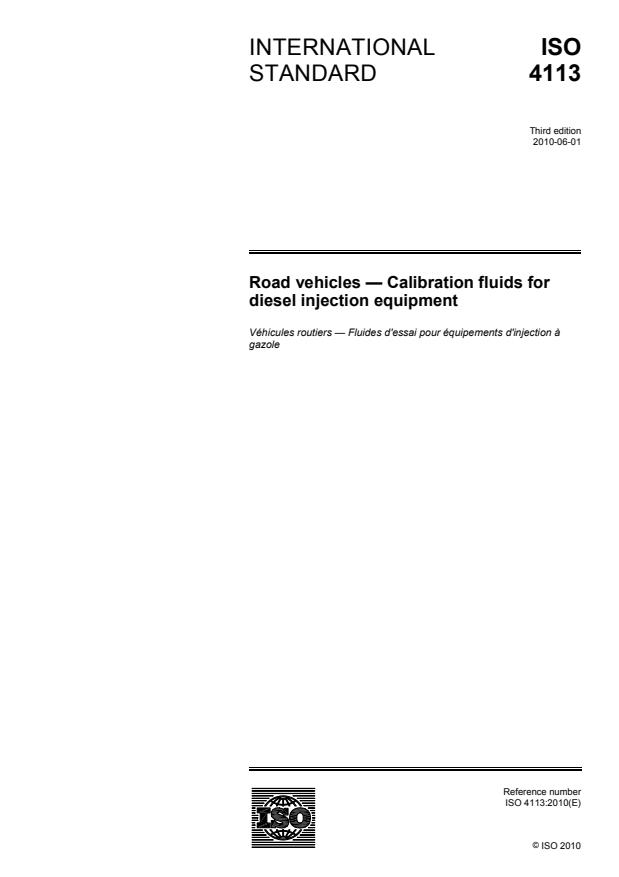
INTERNATIONAL ISO
STANDARD 4113
Third edition
2010-06-01
Road vehicles — Calibration fluids for
diesel injection equipment
Véhicules routiers — Fluides d'essai pour équipements d'injection à
gazole
Reference number
©
ISO 2010
PDF disclaimer
This PDF file may contain embedded typefaces. In accordance with Adobe's licensing policy, this file may be printed or viewed but
shall not be edited unless the typefaces which are embedded are licensed to and installed on the computer performing the editing. In
downloading this file, parties accept therein the responsibility of not infringing Adobe's licensing policy. The ISO Central Secretariat
accepts no liability in this area.
Adobe is a trademark of Adobe Systems Incorporated.
Details of the software products used to create this PDF file can be found in the General Info relative to the file; the PDF-creation
parameters were optimized for printing. Every care has been taken to ensure that the file is suitable for use by ISO member bodies. In
the unlikely event that a problem relating to it is found, please inform the Central Secretariat at the address given below.
© ISO 2010
All rights reserved. Unless otherwise specified, no part of this publication may be reproduced or utilized in any form or by any means,
electronic or mechanical, including photocopying and microfilm, without permission in writing from either ISO at the address below or
ISO's member body in the country of the requester.
ISO copyright office
Case postale 56 • CH-1211 Geneva 20
Tel. + 41 22 749 01 11
Fax + 41 22 749 09 47
E-mail copyright@iso.org
Web www.iso.org
Published in Switzerland
ii © ISO 2010 – All rights reserved
Foreword
ISO (the International Organization for Standardization) is a worldwide federation of national standards bodies
(ISO member bodies). The work of preparing International Standards is normally carried out through ISO
technical committees. Each member body interested in a subject for which a technical committee has been
established has the right to be represented on that committee. International organizations, governmental and
non-governmental, in liaison with ISO, also take part in the work. ISO collaborates closely with the
International Electrotechnical Commission (IEC) on all matters of electrotechnical standardization.
International Standards are drafted in accordance with the rules given in the ISO/IEC Directives, Part 2.
The main task of technical committees is to prepare International Standards. Draft International Standards
adopted by the technical committees are circulated to the member bodies for voting. Publication as an
International Standard requires approval by at least 75 % of the member bodies casting a vote.
Attention is drawn to the possibility that some of the elements of this document may be the subject of patent
rights. ISO shall not be held responsible for identifying any or all such patent rights.
ISO 4113 was prepared by Technical Committee ISO/TC 22, Road vehicles, Subcommittee SC 7, Injection
equipment and filters for use on road vehicles.
This third edition cancels and replaces the second edition (ISO 4113:1988), which has been technically
revised.
INTERNATIONAL STANDARD ISO 4113:2010(E)
Road vehicles — Calibration fluids for diesel injection
equipment
1 Scope
This International Standard specifies the requirements for calibration fluids, i.e. a basic fluid and a closer value
(CV) fluid, intended for testing and calibrating diesel fuel injection equipment in production, in service, and in
laboratories. The CV calibration fluid requires a closer tolerance range for kinematic viscosity and density, and
can be specified to enhance the accuracy of the calibration setting.
This International Standard also allows the specification of an anti-wear (AW) requirement in order to aid the
running-in of diesel fuel injection equipment.
2 Normative references
The following referenced documents are indispensable for the application of this document. For dated
references, only the edition cited applies. For undated references, the latest edition of the referenced
document (including any amendments) applies.
ISO 2049, Petroleum products — Determination of colour (ASTM scale)
ISO 2160, Petroleum products — Corrosiveness to copper — Copper strip test
ISO 2719, Determination of flash point — Pensky-Martens closed cup method
ISO 3015, Petroleum products — Determination of cloud point
ISO 3104, Petroleum products — Transparent and opaque liquids — Determination of kinematic viscosity and
calculation of dynamic viscosity
ISO 3405, Petroleum products — Determination of distillation characteristics at atmospheric pressure
ISO 3675, Crude petroleum and liquid petroleum products — Laboratory determination of density —
Hydrometer method
ISO 12937, Petroleum products — Determination of water — Coulometric Karl Fischer titration method
ASTM D665-06, Standard test method for rust-preventing characteristics of inhibited mineral oil in the
presence of water
ASTM D892-06, Standard test method for foaming characteristics of lubricating oils
ASTM D1748-02(2008), Standard test method for rust protection by metal preservatives in the humidity
cabinet
ASTM D2140-08, Standard practice for calculating carbon-type composition of insulating oils of petroleum
origin
...
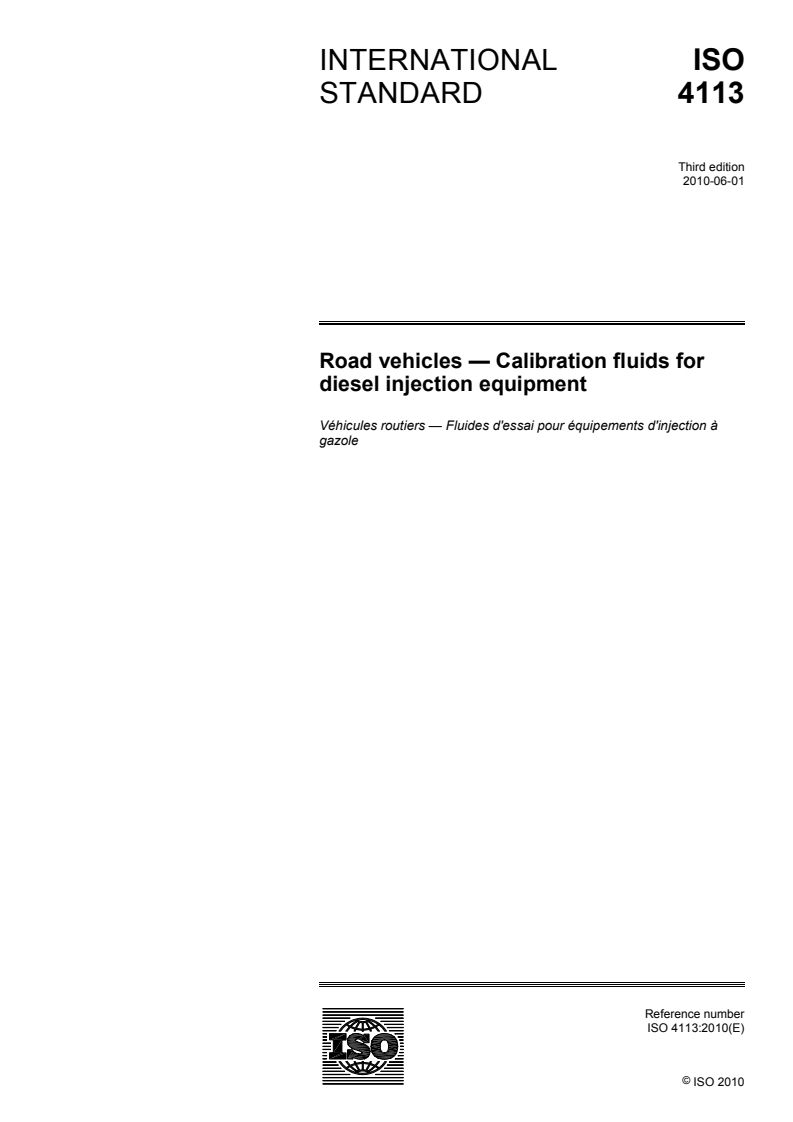
INTERNATIONAL ISO
STANDARD 4113
Third edition
2010-06-01
Road vehicles — Calibration fluids for
diesel injection equipment
Véhicules routiers — Fluides d'essai pour équipements d'injection à
gazole
Reference number
©
ISO 2010
PDF disclaimer
This PDF file may contain embedded typefaces. In accordance with Adobe's licensing policy, this file may be printed or viewed but
shall not be edited unless the typefaces which are embedded are licensed to and installed on the computer performing the editing. In
downloading this file, parties accept therein the responsibility of not infringing Adobe's licensing policy. The ISO Central Secretariat
accepts no liability in this area.
Adobe is a trademark of Adobe Systems Incorporated.
Details of the software products used to create this PDF file can be found in the General Info relative to the file; the PDF-creation
parameters were optimized for printing. Every care has been taken to ensure that the file is suitable for use by ISO member bodies. In
the unlikely event that a problem relating to it is found, please inform the Central Secretariat at the address given below.
© ISO 2010
All rights reserved. Unless otherwise specified, no part of this publication may be reproduced or utilized in any form or by any means,
electronic or mechanical, including photocopying and microfilm, without permission in writing from either ISO at the address below or
ISO's member body in the country of the requester.
ISO copyright office
Case postale 56 • CH-1211 Geneva 20
Tel. + 41 22 749 01 11
Fax + 41 22 749 09 47
E-mail copyright@iso.org
Web www.iso.org
Published in Switzerland
ii © ISO 2010 – All rights reserved
Foreword
ISO (the International Organization for Standardization) is a worldwide federation of national standards bodies
(ISO member bodies). The work of preparing International Standards is normally carried out through ISO
technical committees. Each member body interested in a subject for which a technical committee has been
established has the right to be represented on that committee. International organizations, governmental and
non-governmental, in liaison with ISO, also take part in the work. ISO collaborates closely with the
International Electrotechnical Commission (IEC) on all matters of electrotechnical standardization.
International Standards are drafted in accordance with the rules given in the ISO/IEC Directives, Part 2.
The main task of technical committees is to prepare International Standards. Draft International Standards
adopted by the technical committees are circulated to the member bodies for voting. Publication as an
International Standard requires approval by at least 75 % of the member bodies casting a vote.
Attention is drawn to the possibility that some of the elements of this document may be the subject of patent
rights. ISO shall not be held responsible for identifying any or all such patent rights.
ISO 4113 was prepared by Technical Committee ISO/TC 22, Road vehicles, Subcommittee SC 7, Injection
equipment and filters for use on road vehicles.
This third edition cancels and replaces the second edition (ISO 4113:1988), which has been technically
revised.
INTERNATIONAL STANDARD ISO 4113:2010(E)
Road vehicles — Calibration fluids for diesel injection
equipment
1 Scope
This International Standard specifies the requirements for calibration fluids, i.e. a basic fluid and a closer value
(CV) fluid, intended for testing and calibrating diesel fuel injection equipment in production, in service, and in
laboratories. The CV calibration fluid requires a closer tolerance range for kinematic viscosity and density, and
can be specified to enhance the accuracy of the calibration setting.
This International Standard also allows the specification of an anti-wear (AW) requirement in order to aid the
running-in of diesel fuel injection equipment.
2 Normative references
The following referenced documents are indispensable for the application of this document. For dated
references, only the edition cited applies. For undated references, the latest edition of the referenced
document (including any amendments) applies.
ISO 2049, Petroleum products — Determination of colour (ASTM scale)
ISO 2160, Petroleum products — Corrosiveness to copper — Copper strip test
ISO 2719, Determination of flash point — Pensky-Martens closed cup method
ISO 3015, Petroleum products — Determination of cloud point
ISO 3104, Petroleum products — Transparent and opaque liquids — Determination of kinematic viscosity and
calculation of dynamic viscosity
ISO 3405, Petroleum products — Determination of distillation characteristics at atmospheric pressure
ISO 3675, Crude petroleum and liquid petroleum products — Laboratory determination of density —
Hydrometer method
ISO 12937, Petroleum products — Determination of water — Coulometric Karl Fischer titration method
ASTM D665-06, Standard test method for rust-preventing characteristics of inhibited mineral oil in the
presence of water
ASTM D892-06, Standard test method for foaming characteristics of lubricating oils
ASTM D1748-02(2008), Standard test method for rust protection by metal preservatives in the humidity
cabinet
ASTM D2140-08, Standard practice for calculating carbon-type composition of insulating oils of petroleum
origin
...