

ISO/IEC 11581-1:2000
(Main)Information technology — User system interfaces and symbols — Icon symbols and functions — Part 1: Icons — General
General Information
- Abstract
ISO/IEC 11581 applies to software products providing office applications such as document production, desktop publishing, finance, and planning that present their functions via a graphical user interface. ISO/IEC 11581 applies to software products for people who are familiar with office work but who are at present not necessarily familiar with computer-based applications. ISO/IEC 11581 is meant to be used by persons involved in the design, implementation, and evaluation of icons for graphical user interfaces to computer-based office applications, and by procurers of systems that employ such interfaces. Other parts of ISO/IEC 11581 contain: _ graphics of commonly used icons, and _ descriptions of the functionality of the icons. This part of ISO/IEC 11581-1 provides a framework for the development and design of icons and their application on screens capable of displaying graphics as well as text. It contains: _ general requirements and recommendations for icons; _ global variations to the graphical representations of icons.
- Status
- Published
- Publication Date
- 22-Mar-2000
- Technical Committee
- ISO/IEC JTC 1/SC 35 - User interfaces
- Drafting Committee
- ISO/IEC JTC 1/SC 35/WG 2 - Graphical user interface and interaction
- Current Stage
- 9060 - Close of review
- Completion Date
- 04-Jun-2031
Overview
ISO/IEC 11581-1:2000 - "Information technology - User system interfaces and symbols - Icon symbols and functions - Part 1: Icons - General" defines a framework and guidance for designing icon graphics used in graphical user interfaces (GUIs) for office-oriented software. The standard targets software that presents functions via icons - for example, document production, desktop publishing, finance and planning tools - and supports users familiar with office work but not necessarily with computers. ISO/IEC 11581-1 focuses on icon design fundamentals, general requirements, recommendations and permissible global variations to keep icon sets consistent, comprehensible and usable across systems.
Key topics and requirements
- Conceptual framework: Describes how icons relate to function through metaphor, abstraction, generic objects and graphic components to support intended user interpretation.
- Core properties: Definitions and usability concepts such as recognisability, comprehensibility, discriminability, legibility and learnability.
- Functional types: Differentiates object icons, pointer icons, control icons, tool icons, action icons and status indicators (other parts of ISO/IEC 11581 cover specific icon graphics and functions).
- Mandatory requirements (high-level):
- Icons must be discriminable between different states or modes.
- Icons must remain comprehensible and discriminable through state changes and environment variations.
- Conformance requires compliance with visual display ergonomic rules (ISO 9241-3).
- Color must not be the sole informative element except when color itself is the function.
- Interacting with icons must not destroy user data without permission.
- When icons overlap, the moved icon’s sensitive region should appear on top.
- Recommendations:
- Maintain a consistent visual style across an icon set (realism, line width, corner treatment, level of detail).
- Design icons to scale and preserve aspect ratios for different displays.
- Animation should not reduce comprehensibility; blinking rates reference ISO 9241-3.
- Global variations: Allowed changes in line attributes, corner attributes, surface pattern/colour and detail level, provided recognisability is preserved.
Applications
- Designing and evaluating icon sets for office applications and desktop software.
- Creating internationalized, user-centered GUIs that reduce learning time and improve usability.
- Procuring software or setting UI guidelines in organizations to ensure consistent icon behavior and presentation across products and platforms.
- Establishing icon libraries for desktop publishing, document management systems, finance and planning applications.
Who should use this standard
- UI/UX designers and icon designers
- Software developers and GUI implementers
- Usability evaluators and human factors engineers
- IT procurers and product managers specifying UI requirements
Related standards
- ISO/IEC 11581 (other parts: Object icons, Pointer icons, Control icons, Tool icons, Action icons)
- ISO 9241-3 (visual display requirements)
- ISO 7000, ISO 7001, IEC 60417 (related graphical symbol standards)
Relations
- Effective Date
- 25-Aug-2026
- Effective Date
- 15-Apr-2008
Get Certified
Connect with accredited certification bodies for this standard

BSI Group
BSI (British Standards Institution) is the business standards company that helps organizations make excellence a habit.

NYCE
Mexican standards and certification body.
Sponsored listings
Frequently Asked Questions
ISO/IEC 11581-1:2000 is a standard published by the International Organization for Standardization (ISO). Its full title is "Information technology — User system interfaces and symbols — Icon symbols and functions — Part 1: Icons — General". This standard covers: ISO/IEC 11581 applies to software products providing office applications such as document production, desktop publishing, finance, and planning that present their functions via a graphical user interface. ISO/IEC 11581 applies to software products for people who are familiar with office work but who are at present not necessarily familiar with computer-based applications. ISO/IEC 11581 is meant to be used by persons involved in the design, implementation, and evaluation of icons for graphical user interfaces to computer-based office applications, and by procurers of systems that employ such interfaces. Other parts of ISO/IEC 11581 contain: _ graphics of commonly used icons, and _ descriptions of the functionality of the icons. This part of ISO/IEC 11581-1 provides a framework for the development and design of icons and their application on screens capable of displaying graphics as well as text. It contains: _ general requirements and recommendations for icons; _ global variations to the graphical representations of icons.
ISO/IEC 11581 applies to software products providing office applications such as document production, desktop publishing, finance, and planning that present their functions via a graphical user interface. ISO/IEC 11581 applies to software products for people who are familiar with office work but who are at present not necessarily familiar with computer-based applications. ISO/IEC 11581 is meant to be used by persons involved in the design, implementation, and evaluation of icons for graphical user interfaces to computer-based office applications, and by procurers of systems that employ such interfaces. Other parts of ISO/IEC 11581 contain: _ graphics of commonly used icons, and _ descriptions of the functionality of the icons. This part of ISO/IEC 11581-1 provides a framework for the development and design of icons and their application on screens capable of displaying graphics as well as text. It contains: _ general requirements and recommendations for icons; _ global variations to the graphical representations of icons.
ISO/IEC 11581-1:2000 is classified under the following ICS (International Classification for Standards) categories: 35.240.20 - IT applications in office work. The ICS classification helps identify the subject area and facilitates finding related standards.
ISO/IEC 11581-1:2000 has the following relationships with other standards: It is inter standard links to EN ISO 9241-16:1999, ISO/IEC TR 11581-1:2011. Understanding these relationships helps ensure you are using the most current and applicable version of the standard.
ISO/IEC 11581-1:2000 is available in PDF format for immediate download after purchase. The document can be added to your cart and obtained through the secure checkout process. Digital delivery ensures instant access to the complete standard document.
Standards Content (Sample)
INTERNATIONAL ISO/IEC
STANDARD 11581-1
First edition
2000-04-01
Information technology — User system
interfaces and symbols — Icon symbols
and functions —
Part 1:
Icons — General
Technologies de l'information — Interfaces pour système utilisateur et
symboles — Symboles et fonctions d'icônes —
Partie 1: Icônes — Généralités
Reference number
©
ISO/IEC 2000
PDF disclaimer
This PDF file may contain embedded typefaces. In accordance with Adobe's licensing policy, this file may be printed or viewed but shall not
be edited unless the typefaces which are embedded are licensed to and installed on the computer performing the editing. In downloading this
file, parties accept therein the responsibility of not infringing Adobe's licensing policy. The ISO Central Secretariat accepts no liability in this
area.
Adobe is a trademark of Adobe Systems Incorporated.
Details of the software products used to create this PDF file can be found in the General Info relative to the file; the PDF-creation parameters
were optimized for printing. Every care has been taken to ensure that the file is suitable for use by ISO member bodies. In the unlikely event
that a problem relating to it is found, please inform the Central Secretariat at the address given below.
© ISO/IEC 2000
All rights reserved. Unless otherwise specified, no part of this publication may be reproduced or utilized in any form or by any means, electronic
or mechanical, including photocopying and microfilm, without permission in writing from either ISO at the address below or ISO's member body
in the country of the requester.
ISO copyright office
Case postale 56 � CH-1211 Geneva 20
Tel. + 41 22 749 01 11
Fax + 41 22 734 10 79
E-mail copyright@iso.ch
Web www.iso.ch
Printed in Switzerland
ii © ISO/IEC 2000 – All rights reserved
Foreword
ISO (the International Organization for Standardization) and IEC (the International Electrotechnical Commission)
form the specialized system for worldwide standardization. National bodies that are members of ISO or IEC
participate in the development of International Standards through technical committees established by the
respective organization to deal with particular fields of technical activity. ISO and IEC technical committees
collaborate in fields of mutual interest. Other international organizations, governmental and non-governmental, in
liaison with ISO and IEC, also take part in the work.
International Standards are drafted in accordance with the rules given in the ISO/IEC Directives, Part 3.
In the field of information technology, ISO and IEC have established a joint technical committee, ISO/IEC JTC 1.
Draft International Standards adopted by the joint technical committee are circulated to national bodies for voting.
Publication as an International Standard requires approval by at least 75 % of the national bodies casting a vote.
Attention is drawn to the possibility that some of the elements of this part of ISO/IEC 11581 may be the subject of
patent rights. ISO and IEC shall not be held responsible for identifying any or all such patent rights.
International Standard ISO/IEC 11581-1 was prepared by Joint Technical Committee ISO/IEC JTC 1, Information
technology, Subcommittee SC 35, User interfaces.
ISO/IEC 11581 consists of the following parts, under the general title Information technology — User system
interfaces and symbols — Icon symbols and functions:
— Part 1: Icons — General
— Part 2: Object icons
— Part 3: Pointer icons
— Part 4: Control icons
— Part 5: Tool icons
— Part 6: Action icons
© ISO/IEC 2000 – All rights reserved iii
Introduction
Icons are used on visual display terminals (VDTs, or screens) to facilitate interaction between computer-based
applications (software products) and their users. Icon graphics can provide a language-independent means of
communicating information to the user. They are part of a graphical interface that can facilitate the user's ability to
learn, understand, and remember functional elements of the system, and aid in the manipulation of these elements.
Typically, a graphical user interface draws on a user’s environment to provide a metaphorical representation of the
user's tasks. A metaphor provides an analogy to concepts already familiar to the user, from which the user can
deduce the system's use and behaviour. Icons can express the metaphor directly, as graphical representations of
the metaphorical objects. They may also directly represent a physical object.
Icons are distinguished from other symbols on screens by the fact that they represent underlying system functions.
Icons represent the objects, pointers, controls and tools making up the domain of an application and that users
manipulate in doing their jobs. They can also represent status indicators used by the computer system to give
information to the user and to mediate user interactions with software applications.
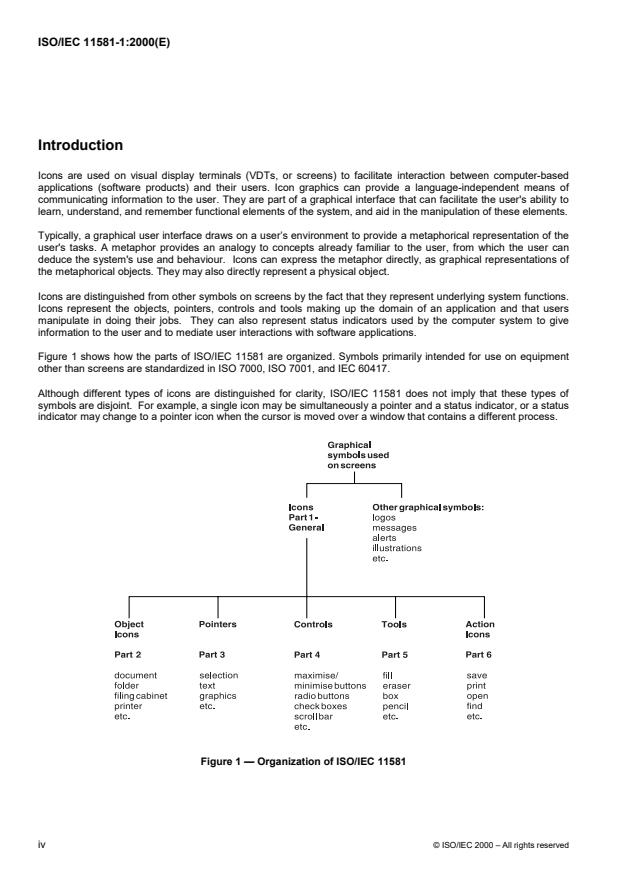
Figure 1 shows how the parts of ISO/IEC 11581 are organized. Symbols primarily intended for use on equipment
other than screens are standardized in ISO 7000, ISO 7001, and IEC 60417.
Although different types of icons are distinguished for clarity, ISO/IEC 11581 does not imply that these types of
symbols are disjoint. For example, a single icon may be simultaneously a pointer and a status indicator, or a status
indicator may change to a pointer icon when the cursor is moved over a window that contains a different process.
Figure 1 — Organization of ISO/IEC 11581
iv © ISO/IEC 2000 – All rights reserved
INTERNATIONAL STANDARD ISO/IEC 11581-1:2000(E)
Information technology — User system interfaces and symbols —
Icon symbols and functions —
Part 1:
Icons — General
1 Scope
ISO/IEC 11581 applies to software products providing office applications such as document production, desktop
publishing, finance, and planning that present their functions via a graphical user interface.
ISO/IEC 11581 applies to software products for people who are familiar with office work but who are at present not
necessarily familiar with computer-based applications.
ISO/IEC 11581 is meant to be used by persons involved in the design, implementation, and evaluation of icons for
graphical user interfaces to computer-based office applications, and by procurers of systems that employ such
interfaces.
Other parts of ISO/IEC 11581 contain:
� graphics of commonly used icons, and
� descriptions of the functionality of the icons.
This part of ISO/IEC 11581-1 provides a framework for the development and design of icons and their application
on screens capable of displaying graphics as well as text. It contains:
� general requirements and recommendations for icons;
� global variations to the graphical representations of icons.
2 Conformance
A system, application, or set of one or more icon(s) conforms to this part of ISO/IEC 11581 if all icons available to
the user in the computer system, application or set conform to clause 5 and subclause 6.1.
3 Normative reference
The following normative document contains provisions which, through reference in this text, constitute provisions of
this part of ISO/IEC 11581. For dated references, subsequent amendments to, or revisions of, any of these
publications do not apply. However, parties to agreements based on this part of ISO/IEC 11581 are encouraged to
investigate the possibility of applying the most recent edition of the normative document indicated below. For
undated references, the latest edition of the normative document referred to applies. Members of ISO and IEC
maintain registers of currently valid International Standards.
ISO 9241-3:1992, Ergonomic requirements for office work with visual display terminals (VDTs) — Part 3: Visual
display requirements.
© ISO/IEC 2000 – All rights reserved 1
4 Terms and definitions
For the purposes of this part of ISO/IEC 11581, the following terms and definitions apply.
4.1
action icon
icon, which acts upon a selected source and/or target, and provides a single step access to functions typically also
available via a menu
4.2
application
collection of functions with which a user can perform a task
4.3
comprehensibility
ease with which the meaning of an icon is understood
4.4
control icon
graphic, often analogous to physical controls such as dials, radio buttons, which allow a user to directly manipulate
data, other objects or their attributes
4.5
discriminability
ease with which a given icon can be distinguished from other icons that might occur in close spatial, temporal, or
contextual proximity
4.6
graphic
graphical representation of a specific instance of a generic object
SeeFigure2
4.7
icon
graphic displayed on the screen of a visual display that represents a function of the computer system
4.8
icon function
capability of the computer system represented by an icon
4.9
learnability
ease with which the system function represented by an icon can be recalled after it has been under
...