


ISO/IEC 9594-10:1998
(Main)Information technology — Open Systems Interconnection — The Directory: Use of systems management for administration of the Directory — Part 10:
Information technology — Open Systems Interconnection — The Directory: Use of systems management for administration of the Directory — Part 10:
Technologies de l'information — Interconnexion de systèmes ouverts (OSI) — L'annuaire: Utilisation de la gestion-systèmes pour l'administration de l'annuaire — Partie 10:
General Information
- Status
- Withdrawn
- Publication Date
- 14-Dec-1998
- Withdrawal Date
- 14-Dec-1998
- Drafting Committee
- ISO/IEC JTC 1/SC 6/WG 7 - Network, transport and future network
- Current Stage
- 9599 - Withdrawal of International Standard
- Start Date
- 21-May-2007
- Completion Date
- 12-Feb-2026
Relations
- Effective Date
- 06-Jun-2022
- Effective Date
- 15-Apr-2008
- Effective Date
- 15-Apr-2008
ISO/IEC 9594-10:1998 - Information technology -- Open Systems Interconnection -- The Directory: Use of systems management for administration of the Directory
ISO/IEC 9594-10:1998 - Technologies de l'information -- Interconnexion de systemes ouverts (OSI) -- L'annuaire: Utilisation de la gestion-systemes pour l'administration de l'annuaire
Get Certified
Connect with accredited certification bodies for this standard

BSI Group
BSI (British Standards Institution) is the business standards company that helps organizations make excellence a habit.

NYCE
Mexican standards and certification body.
Sponsored listings
Frequently Asked Questions
ISO/IEC 9594-10:1998 is a standard published by the International Organization for Standardization (ISO). Its full title is "Information technology — Open Systems Interconnection — The Directory: Use of systems management for administration of the Directory — Part 10:". This standard covers: Information technology — Open Systems Interconnection — The Directory: Use of systems management for administration of the Directory — Part 10:
Information technology — Open Systems Interconnection — The Directory: Use of systems management for administration of the Directory — Part 10:
ISO/IEC 9594-10:1998 is classified under the following ICS (International Classification for Standards) categories: 35.100.70 - Application layer. The ICS classification helps identify the subject area and facilitates finding related standards.
ISO/IEC 9594-10:1998 has the following relationships with other standards: It is inter standard links to ISO/IEC 9594-10:1998/Cor 1:2002, ISO/IEC 9594-10:2001; is excused to ISO/IEC 9594-10:1998/Cor 1:2002. Understanding these relationships helps ensure you are using the most current and applicable version of the standard.
ISO/IEC 9594-10:1998 is available in PDF format for immediate download after purchase. The document can be added to your cart and obtained through the secure checkout process. Digital delivery ensures instant access to the complete standard document.
Standards Content (Sample)
INTERNATIONAL ISO/IEC
STANDARD 9594-10
First edition
1998-12-15
Information technology — Open Systems
Interconnection — The Directory: Use of
systems management for administration
of the Directory
Technologies de l'information — Interconnexion de systèmes ouverts
(OSI) — L'Annuaire: Emploi de la gestion-systèmes pour
l'administration de l'Annuaire
Reference number
©
ISO/IEC 1998
PDF disclaimer
This PDF file may contain embedded typefaces. In accordance with Adobe's licensing policy, this file may be printed or viewed but shall not
be edited unless the typefaces which are embedded are licensed to and installed on the computer performing the editing. In downloading this
file, parties accept therein the responsibility of not infringing Adobe's licensing policy. The ISO Central Secretariat accepts no liability in this
area.
Adobe is a trademark of Adobe Systems Incorporated.
Details of the software products used to create this PDF file can be found in the General Info relative to the file; the PDF-creation parameters
were optimized for printing. Every care has been taken to ensure that the file is suitable for use by ISO member bodies. In the unlikely event
that a problem relating to it is found, please inform the Central Secretariat at the address given below.
© ISO/IEC 1998
All rights reserved. Unless otherwise specified, no part of this publication may be reproduced or utilized in any form or by any means, electronic
or mechanical, including photocopying and microfilm, without permission in writing from either ISO at the address below or ISO's member body
in the country of the requester.
ISO copyright office
Case postale 56 � CH-1211 Geneva 20
Tel. + 41 22 749 01 11
Fax + 41 22 749 09 47
E-mail copyright@iso.ch
Web www.iso.ch
Published by ISO in 2000
Printed in Switzerland
ii © ISO/IEC 1998 – All rights reserved
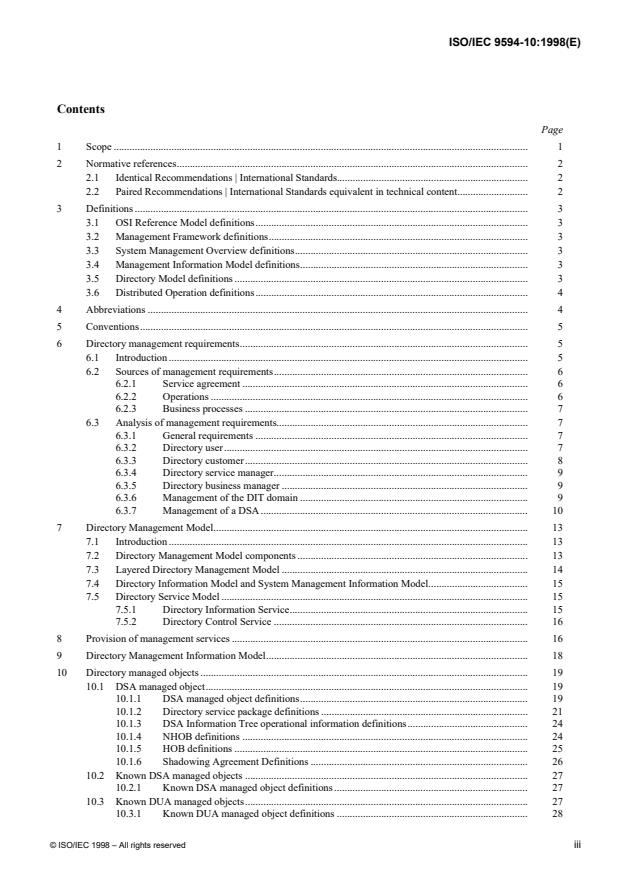
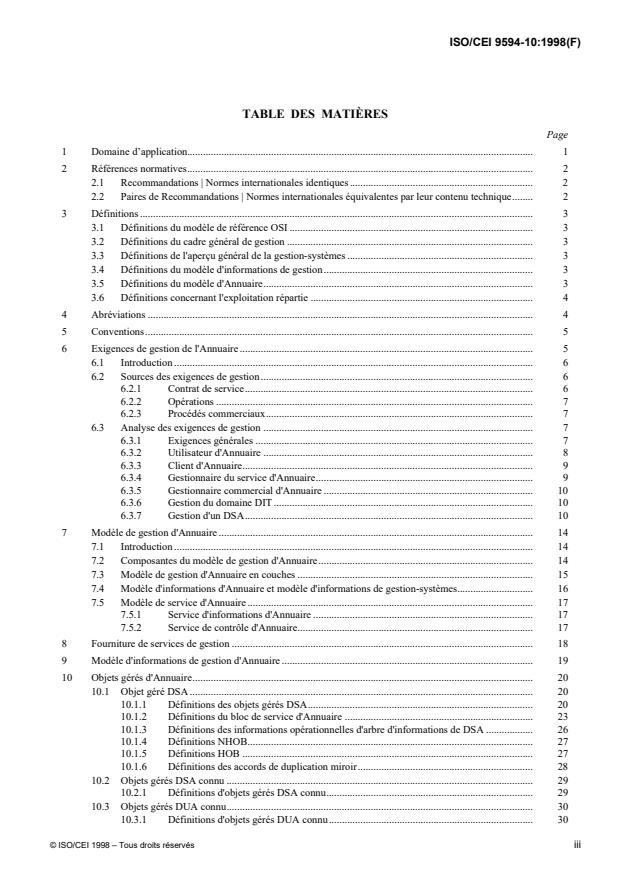
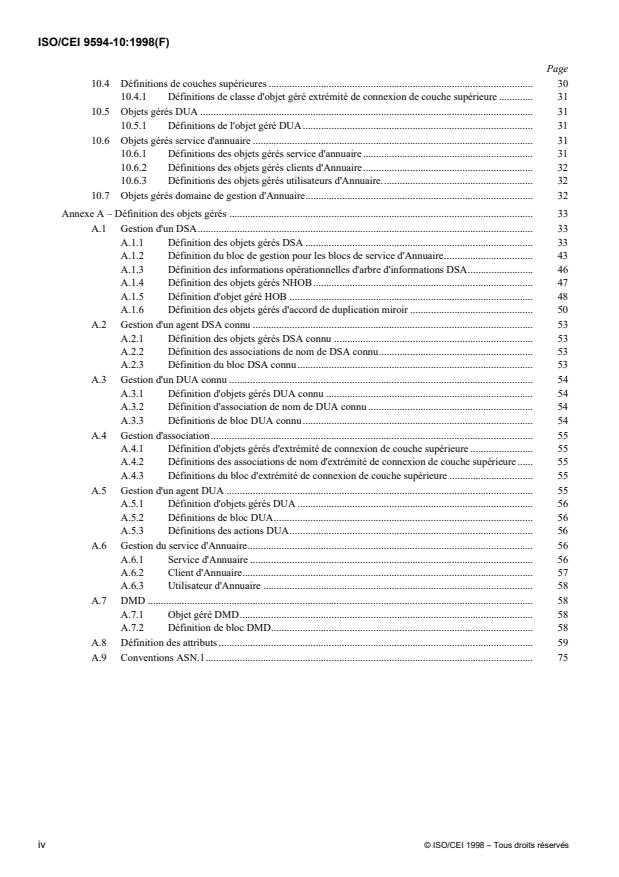
Contents
Page
1 Scope . 1
2 Normative references. 2
2.1 Identical Recommendations | International Standards. 2
2.2 Paired Recommendations | International Standards equivalent in technical content. 2
3 Definitions . 3
3.1 OSI Reference Model definitions. 3
3.2 Management Framework definitions. 3
3.3 System Management Overview definitions. 3
3.4 Management Information Model definitions. 3
3.5 Directory Model definitions . 3
3.6 Distributed Operation definitions. 4
4 Abbreviations . 4
5 Conventions. 5
6 Directory management requirements. 5
6.1 Introduction . 5
6.2 Sources of management requirements. 6
6.2.1 Service agreement . 6
6.2.2 Operations . 6
6.2.3 Business processes . 7
6.3 Analysis of management requirements. 7
6.3.1 General requirements . 7
6.3.2 Directory user. 7
6.3.3 Directory customer. 8
6.3.4 Directory service manager. 9
6.3.5 Directory business manager . 9
6.3.6 Management of the DIT domain . 9
6.3.7 Management of a DSA. 10
7 Directory Management Model. 13
7.1 Introduction . 13
7.2 Directory Management Model components .13
7.3 Layered Directory Management Model . 14
7.4 Directory Information Model and System Management Information Model. 15
7.5 Directory Service Model . 15
7.5.1 Directory Information Service. 15
7.5.2 Directory Control Service . 16
8 Provision of management services . 16
9 Directory Management Information Model. 18
10 Directory managed objects . 19
10.1 DSA managed object. 19
10.1.1 DSA managed object definitions. 19
10.1.2 Directory service package definitions . 21
10.1.3 DSA Information Tree operational information definitions. 24
10.1.4 NHOB definitions . 24
10.1.5 HOB definitions . 25
10.1.6 Shadowing Agreement Definitions . 26
10.2 Known DSA managed objects . 27
10.2.1 Known DSA managed object definitions . 27
10.3 Known DUA managed objects. 27
10.3.1 Known DUA managed object definitions . 28
© ISO/IEC 1998 – All rights reserved iii
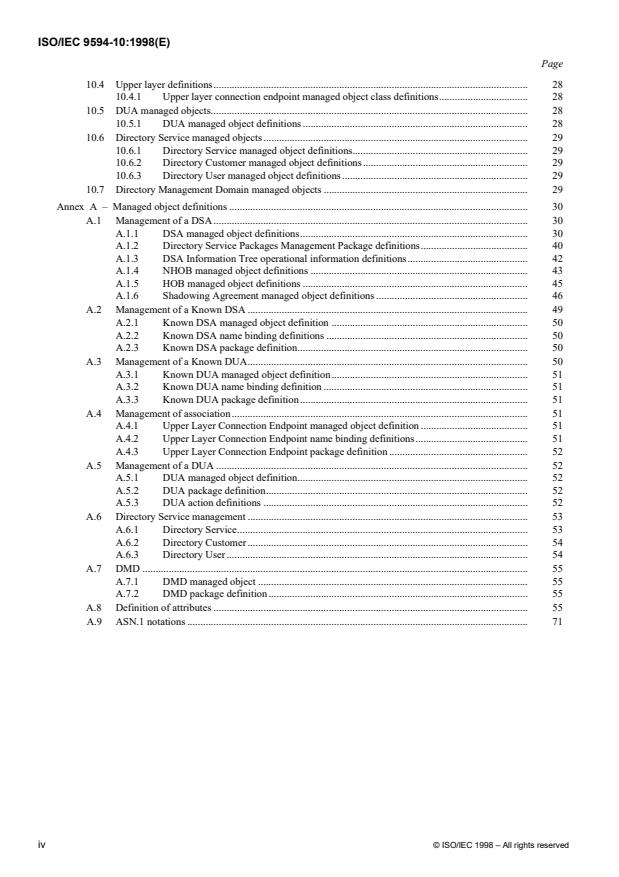
Page
10.4 Upper layer definitions. 28
10.4.1 Upper layer connection endpoint managed object class definitions. 28
10.5 DUA managed objects. 28
10.5.1 DUA managed object definitions . 28
10.6 Directory Service managed objects . 29
10.6.1 Directory Service managed object definitions. 29
10.6.2 Directory Customer managed object definitions . 29
10.6.3 Directory User managed object definitions. 29
10.7 Directory Management Domain managed objects . 29
Annex A – Managed object definitions . 30
A.1 Management of a DSA. 30
A.1.1 DSA managed object definitions. 30
A.1.2 Directory Service Packages Management Package definitions. 40
A.1.3 DSA Information Tree operational information definitions. 42
A.1.4 NHOB managed object definitions . 43
A.1.5 HOB managed object definitions . 45
A.1.6 Shadowing Agreement managed object definitions . 46
A.2 Management of a Known DSA . 49
A.2.1 Known DSA managed object definition . 50
A.2.2 Known DSA name binding definitions . 50
A.2.3 Known DSA package definition. 50
A.3 Management of a Known DUA. 50
A.3.1 Known DUA managed object definition. 51
A.3.2 Known DUA name binding definition . 51
A.3.3 Known DUA package definition. 51
A.4 Management of association . 51
A.4.1 Upper Layer Connection Endpoint managed object definition . 51
A.4.2 Upper Layer Connection Endpoint name binding definitions. 51
A.4.3 Upper Layer Connection Endpoint package definition . 52
A.5 Management of a DUA . 52
A.5.1 DUA managed object definition. 52
A.5.2 DUA package definition. 52
A.5.3 DUA action definitions .52
A.6 Directory Service management . 53
A.6.1 Directory Service. 53
A.6.2 Directory Customer . 54
A.6.3 Directory User . 54
A.7 DMD . 55
A.7.1 DMD managed object . 55
A.7.2 DMD package definition . 55
A.8 Definition of attributes . 55
A.9 ASN.1 notations . 71
iv © ISO/IEC 1998 – All rights reserved
Foreword
ISO (the International Organization for Standardization) and IEC (the International Electrotechnical Commission)
form the specialized system for worldwide standardization. National bodies that are members of ISO or IEC
participate in the development of International Standards through technical committees established by the
respective organization to deal with particular fields of technical activity. ISO and IEC technical committees
collaborate in fields of mutual interest. Other international organizations, governmental and non-governmental, in
liaison with ISO and IEC, also take part in the work.
International Standards are drafted in accordance with the rules given in the ISO/IEC Directives, Part 3.
In the field of information technology, ISO and IEC have established a joint technical committee, ISO/IEC JTC 1.
Draft International Standards adopted by the joint technical committee are circulated to national bodies for voting.
Publication as an International Standard requires approval by at least 75 % of the national bodies casting a vote.
Attention is drawn to the possibility that some of the elements of this part of ISO/IEC 9594 may be the subject of
patent rights. ISO and IEC shall not be held responsible for identifying any or all such patent rights.
International Standard ISO/IEC 9594-10 was prepared by Joint Technical Committee ISO/IEC JTC 1, Information
technology, Subcommittee SC 6, Telecommunications and information exchange between systems,in
collaboration with ITU-T. The identical text is published as ITU-T Recommendation X.530.
ISO/IEC 9594 consists of the following parts, under the general title Information technology — Open Systems
Interconnection — The Directory :
� Part 1: Overview of concepts, models and services
� Part 2: Models
� Part 3: Abstract service definition
� Part 4: Procedures for distributed operation
� Part 5: Protocol specifications
� Part 6: Selected attribute types
� Part 7: Selected object classes
� Part 8: Authentication framework
� Part 9: Replication
� Part 10: Use of systems management for administration of the Directory
Annex A forms a normative part of this part of ISO/IEC 9594.
© ISO/IEC 1998 – All rights reserved v
Introduction
This Recommendation | International Standard, together with other Recommendations | International Standards, has been
produced to facilitate the interconnection of information processing systems to provide Directory services. A set of such
systems, together with the Directory information which they hold, can be viewed as an integrated whole, called the
Directory. The information held by the Directory, collectively known as the Directory Information Base (DIB), is
typically used to facilitate communication between, with or about objects such as application entities, people, terminals
and distribution lists.
The Directory plays a significant role in Open Systems Interconnection, whose aim is to allow, with a minimum of
technical agreement outside of the interconnection standards themselves, the interconnection of information processing
systems:
– from different manufacturers;
– under different managements;
– of different levels of complexity; and
– of different ages.
The purpose of Directory management is to assure that needed, accurate Directory information is available to users as
scheduled with the expected response time, integrity, security and level of consistency. Furthermore, systems
management may be accomplished with the minimum burden on processing time and memory on platforms and the
communications system.
The Directory may support open systems applications such as message handling systems, File, Transfer, Access, and
Management (FTAM) systems, and transaction processing systems. Therefore, the Directory system may be manageable
from an integrated system management platform.
Implementors should note that a defect resolution process exists and that corrections may be applied to this
Recommendation | International Standard in the form of technical corrigenda. The identical corrections will be applied to
this Recommendation | International Standard in the form of an Implementor’s Guide. A list of approved technical
corrigenda for this Recommendation | International Standard can be obtained from the Subcommittee secretariat.
Published technical corrigenda are available from your national standards organization. The Implementor’s Guide may
be obtained from the ITU Web site.
Annex A, which is an integral part of this Recommendation | International Standard, defines the managed objects used
for Directory System Agent administration.
vi © ISO/IEC 1998 – All rights reserved
ISO/IEC 9594-10 : 1998 (E)
INTERNATIONAL STANDARD
ISO/IEC 9594-10 : 1998 (E)
ITU-T Rec. X.530 (1997 E)
ITU-T RECOMMENDATION
INFORMATION TECHNOLOGY – OPEN SYSTEMS INTERCONNECTION –
THE DIRECTORY: USE OF SYSTEMS MANAGEMENT FOR
ADMINISTRATION OF THE DIRECTORY
SECTION 1 – GENERAL
1 Scope
This specification describes the requirements for Directory management, and analyses these requirements to identify
those that may be realised by OSI Systems Management services (and protocols), those that are realised by Directory
services (and protocols), and those that are realised by local means.
Based on the requirements, this specification defines a model for Directory management that encompasses all of the
requirements.
Management of the Directory is divided into four major segments:
a) management of the DIT Domain: Management of Directory information;
b) management of the operation of a single DSA within a DMD;
c) management of the operation of a single DUA within a DMD; and
d) management of the Directory Management Domain (DMD): Integrated management of the functional
components of the Directory.
This Recommendation | International Standard covers items a), b) and c). Item d), Management of the Directory
Management Domain, is for further study.
Based on the model, this Specification describes the detailed OSI Systems Management Managed Objects used to
manage Directory System Agents (DSAs) and Directory User Agents (DUAs) within a Directory Domain, and describes
the detailed OSI Systems Management Managed Objects used to manage the interfaces to DUAs and DSAs in other
domains as shown in Figure 1.
Global X.500 Directory
DMD DMD
Management
DMD
responsiblility
T0727140-96/d01
Figure 1 – Scope of Directory management
FIGURE 1/X.530.[D01] = 3 CM
ITU-T Rec. X.530 (1997 E) 1
ISO/IEC 9594-10 : 1998 (E)
2 Normative references
The following Recommendations and International Standards contain provisions which, through reference in this text,
constitute provisions of this Recommendation | International Standard. At the time of publication, the editions indicated
were valid. All Recommendations and Standards are subject to revision, and parties to agreements based on this
Recommendation | International Standard are encouraged to investigate the possibility of applying the most recent
edition of the Recommendations and Standards listed below. Members of IEC and ISO maintain registers of currently
valid International Standards. The Telecommunication Standardisation Bureau of the ITU maintains a list of currently
valid ITU-T Recommendations.
2.1 Identical Recommendations | International Standards
– ITU-T Recommendation X.200 (1994) | ISO/IEC 7498-1:1994, Information technology – Open Systems
Interconnection – Basic Reference Model: The Basic Model.
– ITU-T Recommendation X.500 (1997) | ISO/IEC 9594-1:1997, Information technology – Open Systems
Interconnection – The Directory: Overview of concepts, models and services.
– ITU-T Recommendation X.501 (1997) | ISO/IEC 9594-2:1997, Information technology – Open Systems
Interconnection – The Directory: Models.
– ITU-T Recommendation X.509 (1997) | ISO/IEC 9594-8:1997, Information technology – Open Systems
Interconnection – The Directory: Authentication framework.
– ITU-T Recommendation X.511 (1997) | ISO/IEC 9594-3:1997, Information technology – Open Systems
Interconnection – The Directory: Abstract service definition.
– ITU-T Recommendation X.518 (1997) | ISO/IEC 9594-4:1997, Information technology – Open Systems
Interconnection – The Directory: Procedures for distributed operation.
– ITU-T Recommendation X.519 (1997) | ISO/IEC 9594-5:1997, Information technology – Open Systems
Interconnection – The Directory: Protocol specifications.
– ITU-T Recommendation X.520 (1997) | ISO/IEC 9594-6:1997, Information technology – Open Systems
Interconnection – The Directory: Selected attribute types.
– ITU-T Recommendation X.521 (1997) | ISO/IEC 9594-7:1997, Information technology – Open Systems
Interconnection – The Directory: Selected object classes.
– ITU-T Recommendation X.525 (1997) | ISO/IEC 9594-9:1997, Information technology – Open Systems
Interconnection – The Directory: Replication.
– ITU-T Recommendation X.701 (1997) | ISO/IEC 10040:1997, Information technology – Open Systems
Interconnection – Systems management overview.
– CCITT Recommendation X.720 (1992) | ISO/IEC 10165-1:1993, Information technology – Open Systems
Interconnection – Structure of management information: Management Information Model.
– CCITT Recommendation X.721 (1992) | ISO/IEC 10165-2:1992, Information technology – Open Systems
Interconnection – Structure of management information: Definition of management information.
– CCITT Recommendation X.722 (1992) | ISO/IEC 10165-4:1992, Information technology – Open Systems
Interconnection – Structure of management information: Guidelines for the definition of managed
objects.
– ITU-T Recommendation X.723 (1993) | ISO/IEC 10165-5:1994, Information technology – Open Systems
Interconnection – Structure of management information: Generic management information.
2.2 Paired Recommendations | International Standards equivalent in technical content
– CCITT Recommendation X.700 (1992), Management framework for Open Systems Interconnection (OSI)
for CCITT applications.
ISO/IEC 7498-4:1989, Information processing systems – Open Systems Interconnection – Basic
Reference Model – Part 4: Management framework.
– CCITT Recommendation X.710 (1991), Common management information service definition for CCITT
applications.
ISO/IEC 9595:1991, Information technology – Open Systems Interconnection – Common management
information service definition.
2 ITU-T Rec. X.530 (1997 E)
ISO/IEC 9594-10 : 1998 (E)
– CCITT Recommendation X.711 (1991), Common management information protocol specification for
CCITT applications.
ISO/IEC 9596-1:1991, Information technology – Open Systems Interconnection – Common management
information protocol – Part 1: Specification.
3 Definitions
For the purposes of this Recommendation | International Standard, the following definitions apply.
3.1 OSI Reference Model definitions
The following terms are defined in ITU-T Rec. X.200 | ISO/IEC 7498-1:
a) application-entity;
b) Application Layer;
c) application-process;
d) application protocol data unit.
3.2 Management Framework definitions
The following terms are defined in CCITT Rec. X.700 and ISO/IEC 7498-4:
a) management information base;
b) managed object.
3.3 System Management Overview definitions
The following terms are defined in ITU-T Rec. X.701 | ISO/IEC 10040:
a) agent;
b) manager;
c) notification;
d) managed object class.
3.4 Management Information Model definitions
The following terms are defined in CCITT Rec. X.720 | ISO/IEC 10165-1:
a) behaviour;
b) conditional package;
c) inheritance;
d) naming tree;
e) package;
f) subclass;
g) superclass.
3.5 Directory Model definitions
The following terms are defined in ITU-T Rec. X.501 | ISO/IEC 9594-2:
a) access control;
b) Administration Directory Management Domain;
c) alias;
d) attribute;
e) attribute type;
ITU-T Rec. X.530 (1997 E) 3
ISO/IEC 9594-10 : 1998 (E)
f) attribute value;
g) authentication;
h) Directory Information Tree ;
i) Directory Management Domain ;
j) Directory System Agent ;
k) DSA Specific Entry;
l) Directory User Agent (DUA);
m) distinguished name;
n) entry;
o) name;
p) object (of interest);
q) Private Directory Management Domain;
r) relative distinguished name;
s) root;
t) schema;
u) security policy;
v) subordinate object;
w) superior entry;
x) superior object;
y) tree;
z) (Directory) user.
3.6 Distributed Operation definitions
The following terms are defined in ITU-T Rec. X.518 | ISO/IEC 9594-4:
a) hierarchical operational binding;
b) non-specific hierarchical operational binding.
4 Abbreviations
For the purposes of this Recommendation | International Standard, the following abbreviations apply:
ADDMD Administration Directory Management Domain
CMIP Common Management Information Protocol
DAP Directory Access Protocol
DIB Directory Information Base
DISP Directory Information Shadowing Protocol
DIT Directory Information Tree
DMD Directory Management Domain
DOP Directory Operational Binding Management Protocol
DSA Directory System Agent
DSE DSA Specific Entry
DSP Directory System Protocol
DUA Directory User Agent
HOB Hierarchical Operational Binding
MIB Management Information Base
4 ITU-T Rec. X.530 (1997 E)
ISO/IEC 9594-10 : 1998 (E)
NHOB Non-specific Hierarchical Operational Binding
NSAP Network Service Access Point
NSSR Non-specific Subordinate Reference
OSI Open Systems Interconnection
PRDMD Private Directory Management Domain
RDN Relative Distinguished Name
TMN Telecommunications Management Network
5 Conventions
With minor exceptions, this Directory Specification has been prepared according to the "Presentation of ITU-T |
ISO/IEC common text" guidelines in the Guide for ITU-T and ISO/IEC JTC 1 Co-operation, March 1993.
The term "Directory Specification" (as in "this Directory Specification") shall be taken to mean this Recommendation |
International Standard. The term "Directory Specifications" shall be taken to mean all of the X.500-Series Recommen-
dations | ISO/IEC 9594.
This Directory Specification uses the term "1988 edition systems" to refer to systems conforming to the first (1988)
edition of the Directory Specifications, i.e. the 1988 edition of the series of CCITT X.500 Recommendations and the
ISO/IEC 9594:1990 edition. This Directory Specification uses the term "1993 edition systems" to refer to systems
conforming to the second (1993) edition of the Directory Specifications, i.e. the 1993 edition of the series of ITU-T
X.500 Recommendations and the ISO/IEC 9594:1995 edition. Systems conforming to this third edition of the Directory
Specifications are referred to as "1997 edition systems".
This Directory Specification presents ASN.1 notation and Managed Object Definitions in the bold Times Roman, 9 point
typeface. When ASN.1 types and values or Managed Object Definitions are referenced in normal text, they are
differentiated from normal text by presenting them in the bold Times Roman, 9 point typeface. Access control
permissions are presented in italicized Helvetica.
SECTION 2 – MANAGEMENT REQUIREMENTS
6 Directory management requirements
The collection and processing of management information is an overhead set against the primary objective of the
Directory. Consequently, it is essential to ensure that all activities involved in acquiring management information are
useful, valid and present the minimum overhead to the natural processes of Directory components.
In order to derive the required management information and associated actions, it is necessary to analyse the various
entities which both provide the Directory service and also interact with it so that the relevant management needs are
identified. Furthermore, the Directory will operate in conjunction with other networks and services. The Telecommuni-
1)
cations Management Network (TMN) is designed to provide a framework for management across differing networks
and services. Hence, the management features of Directory components are aligned with the expectations of TMN.
6.1 Introduction
This Section analyses the environment in which a Directory will operate and isolates the management requirements.
The management requirements are defined by analysis of the activities of roles concerned with using, operating and
owning a Directory service. The motivation for the selection of these roles has been influenced by the functional
hierarchy view of management, defined within the TMN. This takes a broad view of an organisation offering Directory
services and encompasses the need for low-level component management, the customer-oriented requirements of
offering services and the effects of the business objectives of the owners of Directory systems.
_______________
1)
ITU-T Rec. M.3010, Principles for a telecommunications management network.
ITU-T Rec. X.530 (1997 E) 5
ISO/IEC 9594-10 : 1998 (E)
6.2 Sources of management requirements
6.2.1 Service agreement
6.2.1.1 Directory customer service agreement
A Directory service agreement is a set of terms and conditions governing the provision of the Directory services and
establishing the contractual relationship between the Directory customer and a Directory service provider. A service
agreement may cover a number of items relating to the expected operation of the Directory, such as accessible Directory
information (including maintenance of indirect data links such as seeAlso attributes and groupOfName entries), allowed
operations on accessible Directory information, quality of service operation, conditions for settlement for usage of the
service, and availability of the service and access points.
Of these items, some are directly embodied by Directory components and management activities (for example, detecting
aliases that point to non-existent distinguished names). Conversely, some service agreement items (for example,
settlement) are indirectly embodied by Directory components in that a management process uses a record of Directory
component activity as a basis for fulfilling the service agreement.
Associated with a service agreement there are a number of roles such as:
– Directory user;
– Directory customer;
– Directory service manager;
– Directory system manager/administrator (see 6.2.2); and
– Directory business manager (see 6.2.3 and 6.3.5).
A Directory customer, acting on behalf of Directory users, enters into an agreement with the Directory management
organisation which determines an agreed service to be presented to users. The Directory customer may represent any
arbitrary group of users, the structure and content of which are not restricted by the Directory management organisation.
A Directory user is a consumer of Directory services. Actions of Directory users stimulate the Directory components to
produce management information in order that the Directory service manager may ascertain whether the Directory is
operating within the bounds of the Directory user’s service agreement.
A Directory service manager is responsible for ensuring that a service agreement is implemented and maintained. The
Directory service manager functions may encompass a number of areas such as:
– registration (e.g. of Directory users, Directory customers);
– configuration changes (e.g. enabling or disabling DSAs);
– assistance (e.g. help desk, technical support);
– service configuration changes (e.g. changes to service characteristics);
– quality of service monitoring and reporting; and
– accounting, billing and settlement.
6.2.1.2 Peer service provider service agreement
In order to fully satisfy a service offered to a Directory user, it may be necessary to make use of Directory services
provided by other Directory service providers. The essence of a peer service provider service agreement may be similar
to that constructed for the basis of interaction with Directory users. That is, available information, allowed operations,
access details, etc., will need to be agreed between two Directory service providers before interaction can occur.
6.2.2 Operations
An essential part of attaining an agreed service is the on-going monitoring and maintenance of the Directory components
which provide the service:
– Re-configuration of Directory components:
a) predictable downtime due to equipment maintenance;
b) unpredictable downtime due to equipment failure.
6 ITU-T Rec. X.530 (1997 E)
ISO/IEC 9594-10 : 1998 (E)
– Management re-configuration:
• for example, redirecting collected management information out of office hours.
– Management of product operating limitations:
a) observing product maximum operating parameters (e.g. maximum number of associations for
a DSA, maximum number of entries for a DSA);
b) observing inter-provider operating parameters.
– Troubleshooting:
• configuring components to act in a specific way for the purposes of problem solving.
The role associated with Operations is Directory system administrator.
6.2.3 Business processes
Business processes reflect the activities undertaken by business managers in the pursuit of business objectives through
the offering of Directory services. Objectives and motivations differ from one organisation to another, e.g. financial gain
is one motivation. Different objectives/motivations will result in different sets of management information being relevant
to different organisations. The Directory management facilities shall enable the construction of management policies by
organisations.
Information regarding the performance against those objectives is required. Activities which are undertaken will include
sell/(advertise) services, expand/contract system, procure equipment, and evolve services.
The role associated with business processes is the Directory business manager who will strive to meet business
objectives through the setting of service targets (for example, in terms of reducing operating costs), selling/advertising
services, expanding/contracting capacity, procuring capital equipment, instigating new service offerings, etc.
6.3 Analysis of management requirements
The identification of management requirements illustrates the roles and activities concerned with both using, providing
and owning a Directory service. A closer analysis of these roles and activities will identify a set of required management
information and management actions which serve to maintain a successful Directory service.
6.3.1 General requirements
There are a number of issues to consider:
– Management information can be expressed in a number of different forms such as maintaining logs and
counters, establishing gauges and thresholds, and generating events and alarms. It is expected that the
management system will supply standardised mechanisms for the expression of different management
information formats.
– Management activities, and thus the need for specific elements of management information, may vary
over time. There is a need for the dynamic configuration of the collection of management information.
– Implementation of management policies should not be hindered by Directory management specifications.
– Operational information produced by Directory systems may change status according to which type of
organisation is operating the service and which type of service agreement has been made.
6.3.2 Directory user
6.3.2.1 Allowed Directory user activity
6.3.2.1.1 Successful Directory user access
Record Directory DAP, DSP, DISP, DOP activity:
– Log operation counts.
– Log operation details.
– Log details against the data retrieved rather than the operation invoked.
– Log resource usage.
– Notifications of an exceptional valid operation that will take place may be required. This may be required
if, for example, the operation would cause a large amount of activity within the Directory system (e.g. a
subtree search at the country level, or a shadow update is occurring).
ITU-T Rec. X.530 (1997 E) 7
ISO/IEC 9594-10 : 1998 (E)
6.3.2.1.2 Unsuccessful Directory user access
Directory reports no errors, but service operation is not as expected. It will be necessary to report the details to service
management as a violation of the service agreement. The Directory components will only collect management
information as described in 6.3.2.1.1.
The unexpected event may be against any of the items of the service agreement that the user is aware of, for example:
– unable to invoke a specific Directory operation on the DIB;
– returned data is not of a quality agreed within the service agreement (e.g. the data is out of date or certain
agreed optional attributes are not included).
A condition caused by a valid operation which fails because of:
– direct information failure (e.g. alias dereference failure, knowledge problem);
– indirect information failure (e.g. an entry does not exist with the distinguished name found on a previous
read of a groupOfNames entry or seeAlso);
– equipment failure.
6.3.2.2 Disallowed Directory user activity
6.3.2.2.1 Disallowed unsuccessful Directory service access
The Directory detects and shall notify an attempt at illegal access to:
– the Directory service (i.e. the bind);
– specific information and (invocation of) operations (i.e. detection by access control procedures).
Logging of all unauthorised activity may also occur.
Additionally, resource usage incurred when making an unauthorised access can be. This information allows system and
service administrators to assess the cost of unauthorised access.
6.3.2.2.2 Disallowed successful Directory service access
This situation occurs when a Directory user has successfully accessed the Directory in a way which breaches the service
agreement but the Directory did not detect this as an error. This indicates an error in the system configuration against the
service agreement. Detection would only take place if sufficient log information was available and was analysed off-line.
6.3.3 Directory customer
– Establishment of service agreement:
• scope assigned to the user (i.e. anywhere, within the DMD, within the DSA).
– Represents users of service – The specific combination of users in terms of numbers, structure and service
agreement features is arbitrary and not inhibited by the Directory management capabilities.
– Query status of service against service agreement.
– Query capabilities of service with a view to extending/curtailing existing service agreement.
– Settle for usage of service. Settlement arrangement is based upon an internal calculation of service
management and can include:
a) query-oriented, based on resources used in querying;
b) data supplier oriented, based on resources used by information residing in DIT;
c) pre-defined absolute time limit usage of the Directory (as opposed to a specific association time);
d) a pre-settled resource usage of the Directory.
The customer may represent a number of users; the settlement process will need to be able to identify users with the
billable customer.
8 ITU-T Rec. X.530 (1997 E)
ISO/IEC 9594-10 : 1998 (E)
6.3.4 Directory service manager
The Directory service manager acts upon requests made by Directory customers and the need to monitor the operation of
the Directory service in order that service agreements are maintained:
– Create Directory configuration necessary for meeting a service agreement.
– Respond to requests for service information from customer:
a) Billing information – Based upon customer, rather than user.
b) Problem reports.
– Make decision as to exactly what management information is required to be collected and when, in order
that the service agreement is maintained.
– Inhibit binds (for example, due to user not registered for a service, service available during limited times,
service unavailable due to customer/service contravening service agreement).
– Validate operation requests against service agreements.
When considering the management of Directory information extraction, there are a number of issues:
– Control is needed over the amount of data that may be extracted, and the Directory currently addresses
this concern through the setting of size and time limits on requests. Additionally, control may be imposed
on users who would otherwise attempt to destroy the integrity of information within the Directory.
– Waste of resources through either retrieval of Directory information based upon an inappropriate choice
of filter, which results in a large number of entries being processed (e.g. search using a substring filter of
"Hotel" within a DIT subtree holding UK data).
– Waste of resources through specification of an operation that it is known will not succeed (e.g. searching
for an entry with a localityName filter which is non-existent).
– Attempting to retrieve directory information on an illegal basis. This may either be through the usage of a
particular attribute type within a filter (e.g. filtering entries against their telephone number is not allowed
within the UK) or through the use of a particular matching algorithm (e.g. it is not permitted within
France to use final substring filter match on surnames).
– A Directory service provider may not allow a user a wide-ranging browsing capability. This would result
in a designated set of DIT access locations (distinguished names).
6.3.5 Directory business manager
– Specify monitoring conditions concerned with detecting:
a) specific usage patterns (for example, from particular known groups or geographical areas);
b) candidates for the expansion/contraction of service resources (either through procurement or recon-
figuration) – due to demand;
c) candidates for identifying groups of users which do/don’t use particular service features (as basis of
marketing exercises);
d) configuration to cope with localised (temporally and/or geographically) demand (e.g. for special
events).
6.3.6 Management of the DIT domain
The schema, including DIT, object classes, attributes, attribute syntaxes, structure rules and matching rules shall be
implemented and maintained. The schema may be "
...
NORME ISO/CEI
INTERNATIONALE 9594-10
Première édition
1998-12-15
Technologies de l'information —
Interconnexion de systèmes ouverts
(OSI) — L'annuaire: Utilisation de la
gestion-systèmes pour l'administration
de l'annuaire
Information technology — Open Systems Interconnection —
The Directory: Use of systems management for administration of
the Directory
Numéro de référence
ISO/CEI 9594-10:1998(F)
©
ISO/CEI 1998
ISO/CEI 9594-10:1998(F)
PDF – Exonération de responsabilité
Le présent fichier PDF peut contenir des polices de caractères intégrées. Conformément aux conditions de licence d'Adobe, ce fichier peut
être imprimé ou visualisé, mais ne doit pas être modifiéà moins que l'ordinateur employéà cet effet ne bénéficie d'une licence autorisant
l'utilisation de ces polices et que celles-ci y soient installées. Lors du téléchargement de ce fichier, les parties concernées acceptent de fait la
responsabilité de ne pas enfreindre les conditions de licence d'Adobe. Le Secrétariat central de l'ISO décline toute responsabilité en la
matière.
Adobe est une marque déposée d'Adobe Systems Incorporated.
Les détails relatifs aux produits logiciels utilisés pour la créationduprésent fichier PDF sont disponibles dans la rubrique General Info du
fichier; les paramètres de création PDF ont été optimisés pour l'impression. Toutes les mesures ont été prises pour garantir l'exploitation de
ce fichier par les comités membres de l'ISO. Dans le cas peu probable où surviendrait un problème d'utilisation, veuillez en informer le
Secrétariat central à l'adresse donnée ci-dessous.
© ISO/CEI 1998
Droits de reproduction réservés. Sauf prescription différente, aucune partie de cette publication ne peut être reproduite ni utilisée sous quelque
forme que ce soit et par aucun procédé, électronique ou mécanique, y compris la photocopie et les microfilms, sans l'accord écrit de l’ISO à
l’adresse ci-aprèsouducomité membre de l’ISO dans le pays du demandeur.
ISO copyright office
Case postale 56 � CH-1211 Geneva 20
Tel. + 41 22 749 01 11
Fax. + 41 22 749 09 47
E-mail copyright@iso.ch
Web www.iso.ch
Publiée par l'ISO en 2000
Version française parue en 2001
Imprimé en Suisse
ii © ISO/CEI 1998 – Tous droits réservés
ISO/CEI 9594-10:1998(F)
TABLE DES MATIÈRES
Page
1 Domaine d’application. 1
2 Références normatives. 2
2.1 Recommandations | Normes internationales identiques . 2
2.2 Paires de Recommandations | Normes internationales équivalentes par leur contenu technique. 2
3 Définitions . 3
3.1 Définitions du modèle de référence OSI . 3
3.2 Définitions du cadre général de gestion . 3
3.3 Définitions de l'aperçu général de la gestion-systèmes .3
3.4 Définitions du modèle d'informations de gestion. 3
3.5 Définitions du modèle d'Annuaire. 3
3.6 Définitions concernant l'exploitation répartie . 4
4 Abréviations . 4
5 Conventions. 5
6 Exigences de gestion de l'Annuaire . 5
6.1 Introduction . 6
6.2 Sources des exigences de gestion. 6
6.2.1 Contrat de service. 6
6.2.2 Opérations . 7
6.2.3 Procédés commerciaux. 7
6.3 Analyse des exigences de gestion . 7
6.3.1 Exigences générales . 7
6.3.2 Utilisateur d'Annuaire . 8
6.3.3 Client d'Annuaire. 9
6.3.4 Gestionnaire du service d'Annuaire. 9
6.3.5 Gestionnaire commercial d'Annuaire . 10
6.3.6 Gestion du domaine DIT . 10
6.3.7 Gestion d'un DSA. 10
7 Modèle de gestion d'Annuaire . 14
7.1 Introduction . 14
7.2 Composantes du modèle de gestion d'Annuaire.14
7.3 Modèle de gestion d'Annuaire en couches . 15
7.4 Modèle d'informations d'Annuaire et modèle d'informations de gestion-systèmes. 16
7.5 Modèle de service d'Annuaire . 17
7.5.1 Service d'informations d'Annuaire . 17
7.5.2 Service de contrôle d'Annuaire. 17
8 Fourniture de services de gestion . 18
9 Modèle d'informations de gestion d'Annuaire . 19
10 Objets gérés d'Annuaire. 20
10.1 Objet géré DSA . 20
10.1.1 Définitions des objets gérés DSA. 20
10.1.2 Définitions du bloc de service d'Annuaire . 23
10.1.3 Définitions des informations opérationnelles d'arbre d'informations de DSA . 26
10.1.4 Définitions NHOB. 27
10.1.5 Définitions HOB . 27
10.1.6 Définitions des accords de duplication miroir. 28
10.2 Objets gérés DSA connu . 29
10.2.1 Définitions d'objets gérés DSA connu. 29
10.3 Objets gérés DUA connu. 30
10.3.1 Définitions d'objets gérés DUA connu. 30
© ISO/CEI 1998 – Tous droits réservés iii
ISO/CEI 9594-10:1998(F)
Page
10.4 Définitions de couches supérieures . 30
10.4.1 Définitions de classe d'objet géré extrémité de connexion de couche supérieure . 31
10.5 Objets gérés DUA . 31
10.5.1 Définitions de l'objet géré DUA. 31
10.6 Objets gérés service d'annuaire . 31
10.6.1 Définitions des objets gérés service d'annuaire . 31
10.6.2 Définitions des objets gérés clients d'Annuaire. 32
10.6.3 Définitions des objets gérés utilisateurs d'Annuaire. 32
10.7 Objets gérés domaine de gestion d'Annuaire. 32
Annexe A – Définition des objets gérés . 33
A.1 Gestion d'un DSA. 33
A.1.1 Définition des objets gérés DSA . 33
A.1.2 Définition du bloc de gestion pour les blocs de service d'Annuaire. 43
A.1.3 Définition des informations opérationnelles d'arbre d'informations DSA. 46
A.1.4 Définition des objets gérés NHOB. 47
A.1.5 Définition d'objet géré HOB . 48
A.1.6 Définition des objets gérés d'accord de duplication miroir . 50
A.2 Gestion d'un agent DSA connu . 53
A.2.1 Définition des objets gérés DSA connu . 53
A.2.2 Définition des associations de nom de DSA connu. 53
A.2.3 Définition du bloc DSA connu. 53
A.3 Gestion d'un DUA connu . 54
A.3.1 Définition d'objets gérés DUA connu . 54
A.3.2 Définition d'association de nom de DUA connu . 54
A.3.3 Définitions de bloc DUA connu. 54
A.4 Gestion d'association . 55
A.4.1 Définition d'objets gérés d'extrémité de connexion de couche supérieure . 55
A.4.2 Définitions des associations de nom d'extrémité de connexion de couche supérieure. 55
A.4.3 Définitions du bloc d'extrémité de connexion de couche supérieure . 55
A.5 Gestion d'un agent DUA . 55
A.5.1 Définition d'objets gérés DUA . 56
A.5.2 Définitions de bloc DUA. 56
A.5.3 Définitions des actions DUA. 56
A.6 Gestion du service d'Annuaire. 56
A.6.1 Service d'Annuaire . 56
A.6.2 Client d'Annuaire. 57
A.6.3 Utilisateur d'Annuaire . 58
A.7 DMD . 58
A.7.1 Objet géré DMD. 58
A.7.2 Définition de bloc DMD. 58
A.8 Définition des attributs . 59
A.9 Conventions ASN.1. 75
iv © ISO/CEI 1998 – Tous droits réservés
ISO/CEI 9594-10:1998(F)
Avant-propos
L'ISO (Organisation internationale de normalisation) et la CEI (Commission électrotechnique internationale)
forment le système spécialisé de la normalisation mondiale. Les organismes nationaux membres de l'ISO ou de la
CEI participent au développement de Normes internationales par l'intermédiaire des comités techniques créés par
l'organisation concernée afin de s'occuper des domaines particuliers de l'activité technique. Les comités
techniques de l'ISO et de la CEI collaborent dans des domaines d'intérêt commun. D'autres organisations
internationales, gouvernementales et non gouvernementales, en liaison avec l'ISO et la CEI participent également
aux travaux.
Les Normes internationales sont rédigées conformément aux règles données dans les Directives ISO/CEI, Partie 3.
Dans le domaine des technologies de l'information, l'ISO et la CEI ont créé un comité technique mixte,
l'ISO/CEI JTC 1. Les projets de Normes internationales adoptéspar le comité technique mixte sont soumis aux
organismes nationaux pour vote. Leur publication comme Normes internationales requiert l'approbation de 75 % au
moins des organismes nationaux votants.
L’attention est appelée sur le fait que certains des éléments delaprésente partie de l’ISO/CEI 9594 peuvent faire
l’objet de droits de propriété intellectuelle ou de droits analogues. L’ISO et la CEI ne sauraient être tenues pour
responsables de ne pas avoir identifié de tels droits de propriété et averti de leur existence.
La Norme internationale ISO/CEI 9594-10 a étéélaborée par le comité technique mixte ISO/CEI JTC 1,
Technologies de l'information, sous-comité SC 6, Téléinformatique, en collaboration avec l'UIT-T. Le texte
identique est publié en tant que Recommandation UIT-T X.530.
L'ISO/CEI 9594 comprend les parties suivantes, présentées sous le titre général Technologies de l'information —
Interconnexion de systèmes ouverts (OSI) — L'annuaire:
� Partie 1: Aperçugénéral des concepts, modèles et services
� Partie 2: Les modèles
� Partie 3: Définition du service abstrait
� Partie 4: Procédures pour le fonctionnement réparti
� Partie 5: Spécification du protocole
� Partie 6: Types d'attributs sélectionnés
� Partie 7: Classes d'objets sélectionnées
� Partie 8: Cadre d'authentification
� Partie 9: Duplication
� Partie 10: Utilisation de la gestion-systèmes pour l'administration de l'annuaire
L'annexe A constitue un élément normatif de la présente partie de l'ISO/CEI 9594.
© ISO/CEI 1998 – Tous droits réservés v
ISO/CEI 9594-10:1998(F)
Introduction
La présente Recommandation | Norme internationale a été élaborée, ainsi que d'autres Recommandations | Normes
internationales, pour faciliter l'interconnexion des systèmes de traitement de l'information et permettre ainsi d'assurer des
services d'annuaire. L'ensemble de tous ces systèmes, avec les informations d'annuaire qu'ils contiennent, peut être
considéré comme un tout intégré, appelé Annuaire. Les informations de l'Annuaire, appelées collectivement base
d'informations d'Annuaire (DIB), sont généralement utilisées pour faciliter la communication entre, avec ou à propos
d'objets tels que des entités d'application, des personnes, des terminaux et des listes de distribution.
L'Annuaire joue un rôle important dans l'interconnexion des systèmes ouverts, dont le but est de permettre, moyennant
un minimum d'accords techniques en dehors des normes d'interconnexion proprement dites, l'interconnexion des
systèmes de traitement de l'information:
– provenant de divers fabricants;
– gérés différemment;
– de niveaux de complexité différents;
– de générations différentes.
Le but de la gestion de l'Annuaire est d'assurer que les informations d'annuaire précises et nécessaires soient disponibles
aux utilisateurs comme prévu, avec les temps de réponse, l'intégrité, la sécurité et le niveau de cohérence attendus. En
outre, la gestion-systèmes peut être réalisée en surchargeant aussi peu que possible le temps de traitement et la mémoire
sur les plates-formes et le système de communication.
L'Annuaire peut prendre en charge des applications de systèmes ouverts tels que des systèmes de messagerie, des
systèmes de classement, de transfert, d'accès et de gestion (FTAM, file transfer, access and management) et des
systèmes de traitement des transactions. Par conséquent, le système d'Annuaire peut être gérable à partir d'une plate-
forme intégrée de gestion-systèmes.
Les développants noteront qu'il existe un processus de résolution de défauts, et que des corrections peuvent être
apportées à la présente Recommendation | Norme internationale sous forme de corrigenda techniques. Les corrections
seront appliquées à la présente Recommendation | Norme internationale par un guide de développement. La liste des
corrigenda techniques approuvés peut être obtenue auprès du secrétariat du TSB/secrétariat du sous-comité. Les
corrigenda techniques publiés sont disponibles auprès de votre organisme de normalisation nationale. Le guide de
développement peut être téléchargé à partir du site UIT sur la Toile.
L'Annexe A, qui fait partie intégrante de la présente Recommandation | Norme internationale, définit les objets gérés,
utilisés pour l'administration d'agent de système d'Annuaire.
vi © ISO/CEI 1998 – Tous droits réservés
ISO/CEI 9594-10 : 1998 (F)
NORME INTERNATIONALE
ISO/CEI 9594-10 : 1999 (F)
Rec. UIT-T X.530 (1997 F)
RECOMMANDATION UIT-T
TECHNOLOGIES DE L'INFORMATION – INTERCONNEXION DES
SYSTÈMES OUVERTS – L'ANNUAIRE: UTILISATION DE LA
GESTION-SYSTÈMES POUR L'ADMINISTRATION DE L'ANNUAIRE
SECTION 1 – GÉNÉRALITÉS
1 Domaine d’application
La présente spécification décrit et analyse les exigences de gestion de l'Annuaire afin d'identifier celles qui peuvent être
remplies par les services (et protocoles) de gestion-systèmes OSI, celles qui sont remplies par les services (et protocoles)
d'Annuaire, ainsi que celles qui sont remplies par des moyens locaux.
Fondée sur les exigences, cette spécification définit un modèle de gestion de l'Annuaire qui englobe toutes les exigences.
La gestion de l'Annuaire se répartit en quatre segments principaux:
a) gestion du domaine du DIT: gestion des informations d'Annuaire;
b) gestion de fonctionnement d'un seul DSA dans le DMD;
c) gestion de fonctionnement d'un seul DUA dans le DMD; et
d) gestion du domaine de gestion d'Annuaire (DMD, directory managenent domain): gestion intégrée des
composantes fonctionnelles de l'Annuaire.
La présente Recommandation | Norme internationale traite des points a), b) et c) ci-dessus. Le point d), gestion du
domaine de gestion d'Annuaire, fera l'objet d'une étude ultérieure.
Cette spécification, fondée sur le modèle, décrit en détail les objets gérés de la gestion-systèmes OSI utilisés pour gérer
les agents de système d'annuaire (DSA, directory system agent) et les agents utilisateurs d'annuaire (DUA, directory user
agent) dans un domaine d'Annuaire donné, et décrit en détail les objets gérés de la gestion-systèmes OSI utilisés pour
gérer les interfaces avec les DUA et les DSA dans d'autres domaines, comme illustré à la Figure 1.
annuaire global X.500
DMD DMD
responsabilité
DMD
de gestion
T0727140-96/d01
Figure 1 – Domaine d'application de la gestion d'Annuaire
FIGURE 1/X.530.[D01] = 3 CM
Rec. UIT-T X.530 (1997 F) 1
ISO/CEI 9594-10 : 1998 (F)
2Références normatives
Les Recommandations et Normes internationales suivantes contiennent des dispositions qui, par suite de la référence qui
y est faite, constituent des dispositions valables pour la présente Recommandation | Norme internationale. Au moment de
la publication, les éditions indiquées étaient en vigueur. Toutes Reocmmandations et Normes sont sujettes à révision et
les parties prenantes aux accords fondés sur la présente Recommandation | Norme internationale sont invitées à
rechercher la possibilité d'appliquer les éditions les plus récentes des Recommandations et Normes indiquées ci-après.
Les membres de la CEI et de l'ISO possèdent le registre des Normes internationales en vigueur. Le Bureau de la
normalisation des télécommunications de l'UIT tient à jour une liste des Recommandations de l'UIT-T en vigueur.
2.1 Recommandations | Normes internationales identiques
– Recommandation UIT-T X.200 (1994) | ISO/CEI 7498-1:1994, Technologies de l'information –
Interconnexion des systèmes ouverts – Modèle de référence de base: Le modèle de référence de base.
– Recommandation UIT-T X.500 (1997) | ISO/CEI 9594-1:1999, Technologies de l'information –
Interconnexion des systèmes ouverts – L'annuaire: vue d'ensemble des concepts, modèles et services.
– Recommandation UIT-T X.501 (1997) | ISO/CEI 9594-2:1997, Technologies de l'information –
Interconnexion des systèmes ouverts – L'annuaire: les modèles.
– Recommandation UIT-T X.509 (1997) | ISO/CEI 9594-8:1999, Technologies de l'information –
Interconnexion des systèmes ouverts – L'annuaire: cadre d'authentification.
– Recommandation UIT-T X.511 (1997) | ISO/CEI 9594-3:1997, Technologies de l'information –
Interconnexion des systèmes ouverts – L'annuaire: définition du service abstrait.
– Recommandation UIT-T X.518 (1997) | ISO/CEI 9594-4:1997, Technologies de l'information –
Interconnexion des systèmes ouverts – L'annuaire: procédure pour le fonctionnement réparti.
– Recommandation UIT-T X.519 (1997) | ISO/CEI 9594-5:1997, Technologies de l'information –
Interconnexion des systèmes ouverts – L'annuaire: spécification du protocole.
– Recommandation UIT-T X.520 (1997) | ISO/CEI 9594-6:1997, Technologies de l'information –
Interconnexion des systèmes ouverts – L'annuaire: types d'attributs sélectionnés.
– Recommandation UIT-T X.521 (1997) | ISO/CEI 9594-7:1997, Technologies de l'information –
Interconnexion des systèmes ouverts – L'annuaire: classes d'objets sélectionnées.
– Recommandation UIT-T X.525 (1997) | ISO/CEI 9594-9:1999, Technologies de l'information –
Interconnexion des systèmes ouverts – L'annuaire: duplication.
– Recommandation UIT-T X.701 (1997) | ISO/CEI 10040:1997, Technologies de l'information –
Interconnexion des systèmes ouverts – Aperçu général de la gestion-systèmes.
– Recommandation X.720 du CCITT (1992) | ISO/CEI 10165-1:1993, Technologies de l'information –
Interconnexion des systèmes ouverts – Structure des informations de gestion: modèle d'information de
gestion.
– Recommandation X.721 du CCITT (1992) | ISO/CEI 10165-2:1992, Technologies de l'information –
Interconnexion des systèmes ouverts – Structure des informations de gestion: définition des informations
de gestion.
– Recommandation X.722 du CCITT (1992) | ISO/CEI 10165-4:1992, Technologies de l'information –
Interconnexion des systèmes ouverts – Structure des informations de gestion: directives pour la définition
des objets gérés.
– Recommandation UIT-T X.723 (1993) | ISO/CEI 10165-5:1994, Technologies de l'information –
Interconnexion des systèmes ouverts – Structure des informations de gestion: informations génériques de
gestion.
2.2 Paires de Recommandations | Normes internationales équivalentes par leur contenu technique
– Recommandation X.700 du CCITT (1992), Cadre de gestion pour l'interconnexion de systèmes ouverts
pour les applications du CCITT.
ISO/CEI 7498-4:1989, Systèmes de traitement de l'information – Interconnexion de systèmes ouverts –
Modèle de référence de base – Partie 4: Cadre général de gestion.
2 Rec. UIT-T X.530 (1997 F)
ISO/CEI 9594-10 : 1998 (F)
– Recommandation X.710 du CCITT (1991), Définition du service commun de transfert d'informations de
gestion pour les applications du CCITT.
ISO/CEI 9595:1991, Technologies de l'information – Interconnexion de systèmes ouverts – Définition du
service commun d'informations de gestion.
– Recommandation X.711 du CCITT (1991), Spécification du protocole commun de transfert
d'informations de gestion pour les applications du CCITT.
ISO/CEI 9596-1:1991, Technologies de l'information – Interconnexion de systèmes ouverts – Protocole
commun d'information de gestion – Partie 1: Spécifications.
3 Définitions
Pour les besoins de la présente Recommandation | Norme Internationale, les définitions suivantes s'appliquent.
3.1 Définitions du modèle de référence OSI
Les termes suivants sont définis dans la Rec. UIT-T X.200 | ISO/CEI 7498-1:
a) entité d'application;
b) couche Application;
c) processus d'application;
d) unité de données du protocole d'application.
3.2 Définitions du cadre général de gestion
Les termes suivants sont définis dans la Rec. X.700 du CCITT et l'ISO/CEI 7498-4:
a) base d'informations de gestion;
b) objet géré.
3.3 Définitions de l'aperçu général de la gestion-systèmes
Les termes suivants sont définis dans la Rec. UIT-T X.701 | ISO/CEI 10040:
a) agent;
b) gestionnaire;
c) notification;
d) classe d'objets gérés.
3.4 Définitions du modèle d'informations de gestion
Les termes suivants sont définis dans la Rec. X.720 du CCITT | ISO/CEI 10165-1:
a) comportement;
b) bloc de propriétés conditionnel;
c) héritage;
d) arbre de dénomination;
e) bloc;
f) sous-classe;
g) super-classe.
3.5 Définitions du modèle d'Annuaire
Les termes suivants sont définis dans la Rec. UIT-T X.501 | ISO/CEI 9594-2:
a) contrôle d'accès;
b) domaine de gestion d'Annuaire d'administration;
Rec. UIT-T X.530 (1997 F) 3
ISO/CEI 9594-10 : 1998 (F)
c) alias;
d) attribut;
e) type d’attribut;
f) valeur d’attribut;
g) authentification;
h) arbre d’informations d’Annuaire;
i) domaine de gestion d’Annuaire;
j) agent de système d'Annuaire;
k) entrée spécifique de DSA;
l) agent utilisateur d'Annuaire (DUA);
m) nom distinctif;
n) entrée;
o) nom;
p) objet (d'intérêt);
q) domaine de gestion privé d'Annuaire;
r) nom distinctif relatif;
s) racine;
t) schéma;
u) politique de sécurité;
v) objet subordonné;
w) entrée supérieure;
x) objet supérieur;
y) arbre;
z) utilisateur (d'Annuaire).
3.6 Définitions concernant l'exploitation répartie
Les termes suivants sont définis dans la Rec. UIT-T X.518 | ISO/CEI 9594-4:
a) association opérationnelle hiérarchique;
b) association opérationnelle hiérarchique non spécifique.
4 Abréviations
Pour les besoins de la présente Recommandation | Norme internationale les abréviations suivantes sont utilisées.
ADDMD Domaine de gestion d'annuaire d'administration (administration directory management domain)
CMIP Protocole commun d'informations de gestion (common management information protocol)
DAP Protocole d'accès à l'annuaire (directory access protocol)
DIB Base d'informations d'Annuaire (directory information base)
DISP Protocole de duplication miroir des informations de l'Annuaire (directory information
shadowing protocol)
DIT Arbre d'informations d'annuaire (directory information tree)
DMD Domaine de gestion d'Annuaire (directory management domain)
DOP Protocole de gestion d'association opérationnelle de l'Annuaire (directory operational binding
management protocol)
4 Rec. UIT-T X.530 (1997 F)
ISO/CEI 9594-10 : 1998 (F)
DSA Agent de système d'annuaire (directory system agent)
DSE Entrée spécifique de DSA (DSA specific entry)
DSP Protocole du système d'annuaire (directory system protocol)
DUA Agent d'utilisateur d'annuaire (directory user agent)
HOB Association opérationnelle hiérarchique (hierarchical operational binding)
MIB Base d'informations de gestion (management information base)
NHOB Association opérationnelle hiérarchique non spécifique (non-specific hierarchical operational
binding)
NSAP Point d'accès aux services de la couche Réseau (network service access point)
NSSR Référence subordonnée non spécifique (non-specific subordinate référence)
OSI Interconnexion des systèmes ouverts (open systems interconnection)
PRDMD Domaine de gestion privé d'Annuaire (private directory management domain)
RDN Nom distinctif relatif (relative distinguished name)
RGT Réseau de gestion des télécommunications
5 Conventions
A quelques exceptions mineures près, la présente Spécification d'Annuaire a été élaborée conformément aux directives
concernant la "présentation des textes communs UIT-T | ISO/CEI", qui figurent dans le Guide relatif à la coopération
entre l'UIT-T et l'ISO/CEI JTC 1, mars 1993.
Le terme "Spécification d'Annuaire" (comme dans "la présente Spécification d'Annuaire") s'entend selon l'acception de
la présente Recommandation | Norme internationale. Le terme "Spécifications d'Annuaire" s'entend selon l'acception de
toutes les Recommandations de la série X.500 | ISO/CEI 9594.
La présente Spécification d'Annuaire utilise le terme "systèmes de l'édition 1988" pour désigner les systèmes conformes
à la première édition (1988) des Spécifications d'Annuaire, c'est-à-dire à l'édition 1988 des Recommandations de la série
X.500 du CCITT et de l'ISO/CEI 9594:1990. La présente Spécification d'Annuaire utilise le terme "systèmes de l'édition
1993" pour désigner les systèmes conformes à la deuxième édition (1993) des Spécifications d'Annuaire, c'est-à-dire
l'édition 1993 des Recommandations UIT-T de la série X.500 et de l'ISO/CEI 9594:1995. Les systèmes conformes à la
présente troisième édition des Spécifications d'Annuaire sont désignés par le terme "systèmes de l'édition 1997".
Cette Spécification d'Annuaire présente la notation ASN.1 et les définitions des objets gérés en caractères gras de la
police Times Roman, 9 points. Lorsque des types et des valeurs ASN.1 ou définitions d'objets gérés sont cités dans le
texte normal, ils en sont différenciés par leur présentation en caractères gras Times Roman, 9 points. Les autorisations de
contrôle d'accès sont présentées en caractères italiques de la police Helvetica.
SECTION 2 – EXIGENCES DE GESTION
6 Exigences de gestion de l’Annuaire
La collecte et le traitement d’informations de gestion constituent des fonctions auxiliaires par rapport à l'objectif primaire
de l'Annuaire. Par conséquent, il est essentiel de s'assurer que toutes les activités concernées par l'acquisition
d'informations de gestion soient utiles et valides et qu'elles constituent une surcharge minimale par rapport aux processus
naturels des composantes d'Annuaire.
Afin de déduire les informations de gestion et les actions associées requises, il est nécessaire d'analyser les différentes
entités qui fournissent le service d'Annuaire et interagissent également sur lui, de manière à identifier les besoins de
gestion correspondants. De plus, l'Annuaire fonctionne en association avec les autres réseaux et services. Le réseau de
1)
gestion des télécommunications (RGT) est conçu pour fournir un cadre de gestion de réseaux et de services différents.
Les caractéristiques de gestion des composantes d'Annuaire correspondent donc aux attentes du RGT.
_______________
1)
Rec. UIT-T M.3010, Principes pour un réseau de gestion des télécommunications.
Rec. UIT-T X.530 (1997 F) 5
ISO/CEI 9594-10 : 1998 (F)
6.1 Introduction
La présente section analyse l'environnement de fonctionnement de l'Annuaire et souligne les exigences de gestion.
Les exigences de gestion sont définies par l'analyse des activités des fonctions concernées par l'utilisation, l'exploitation
et la possession d'un service d'Annuaire. La motivation du choix de ces fonctions a été influencée par une perception de
la gestion en hiérarchie fonctionnelle, définie dans le cadre du RGT. Ceci donne une large vision d'un organisme
proposant des services d'Annuaire et englobe la nécessité d'une gestion des composantes de niveau inférieur, les
exigences d'offres de services orientés clientèle et les finalités commerciales des propriétaires de systèmes d'Annuaire.
6.2 Sources des exigences de gestion
6.2.1 Contrat de service
6.2.1.1 Contrat de service de client d’Annuaire
Un contrat de service d'Annuaire est un ensemble de termes et de conditions régissant la fourniture des services
d'Annuaire et établissant la relation contractuelle entre le client d'Annuaire et un prestataire de service d'Annuaire. Un
contrat de service peut couvrir un nombre important d'éléments relatifs à l'exploitation prévue de l'Annuaire, tels que les
informations d'Annuaire accessibles (y compris la maintenance des liaisons de donnés indirectes, telles que les attributs
seeAlso et les entrées groupOfName), les opérations autorisées sur les informations d'Annuaire accessibles, la qualité de
fonctionnement des services, les conditions de règlement de l'utilisation du service, ainsi que la disponibilité du service
et des points d'accès.
Parmi ces éléments, certains sont directement matérialisés par les composantes d'Annuaire et les activités de gestion (par
exemple déceler les pseudonymes désignant des noms distinctifs qui n'existent pas). A l'inverse, certains éléments du
contrat de service (par exemple le règlement) sont indirectement matérialisés par les composantes d'Annuaire, dans la
mesure où un processus de gestion utilise un enregistrement de l'activité des composantes d'Annuaire comme base de
conformité aux dispositions du contrat de service.
Bon nombre de fonctions sont associées à un contrat de service:
– utilisateur d'Annuaire;
– client d'Annuaire;
– gestionnaire de service d'Annuaire;
– gestionnaire/administrateur de système d'Annuaire (voir 6.2.2); et
– gestionnaire commercial d'Annuaire (voir 6.2.3 et 6.3.5).
Un client d'Annuaire agissant pour le compte d'utilisateurs d'Annuaire, passe un contrat avec l'organisation de gestion de
l'Annuaire qui détermine un service convenu par accord et à mettre à la disposition des utilisateurs. Le client d'Annuaire
peut représenter tout groupe arbitraire d'utilisateurs, dont la structure et le contenu ne sont pas limités par l'organisation
de gestion de l'Annuaire.
Un utilisateur d'Annuaire est un consommateur des services d'Annuaire. Les actions des utilisateurs d'Annuaire stimulent
les composantes d'Annuaire pour la production d'informations de gestion permettant au gestionnaire de service
d'Annuaire de s'assurer que l'Annuaire fonctionne dans les limites du contrat de service utilisateur d'Annuaire.
Le gestionnaire de service d'Annuaire est chargé de la mise en œuvre et du maintien du contrat de service. Les fonctions
du gestionnaire de service d'Annuaire peuvent englober un certain nombre de domaines, tels que:
– l'inscription (par exemple, des utilisateurs d'Annuaire, des clients d'Annuaire);
– les modifications de configuration (par exemple activation ou désactivation des agents DSA);
– l'assistance (par exemple, pupitre d'aide, support technique);
– les modifications de configuration du service (par exemple, modifications des caractéristiques du service);
– la qualité de contrôle de service et les comptes rendus correspondants;
– la comptabilité, la facturation et les règlements.
6 Rec. UIT-T X.530 (1997 F)
ISO/CEI 9594-10 : 1998 (F)
6.2.1.2 Contrat de service de prestataire homologue
Pour qu’un service offert à un utilisateur d'Annuaire soit pleinement satisfaisant, il peut être nécessaire d'utiliser les
services d'Annuaire proposés par d'autres prestataires de service d'Annuaire. L'essence d'un contrat de service avec un
prestataire de service homologue peut être similaire à celle établie comme la base d'interactions avec les utilisateurs
d'Annuaire. C'est-à-dire que les informations disponibles, les opérations autorisées les détails d'accès, etc., seront
convenus entre deux prestataires de service d'Annuaire avant que l'interaction puisse avoir lieu.
6.2.2 Opérations
Le contrôle permanent et la maintenance continue des composantes d'Annuaire qui fournissent le service constituent une
condition primordiale de réalisation du service convenu:
– Reconfiguration des composantes d'Annuaire:
a) temps d'arrêt prévisible pour maintenance du matériel;
b) temps d'arrêt imprévisible dû à une défaillance du matériel.
– Reconfiguration de la gestion:
• par exemple, rediriger les informations de gestion recueillies en dehors des heures de travail.
– Gestion des limites de fonctionnement du produit:
a) respect des paramètres de fonctionnement maximal des produits (par exemple nombre maximal
d'associations pour un DSA, nombre maximal d'entrées pour un DSA);
b) respect des paramètres de fonctionnement inter-prestataires.
– Recherche de pannes:
• configuration des composantes afin d'agir de manière à résoudre les problèmes.
La fonction associée aux opérations est l'administrateur du système d'Annuaire.
6.2.3 Procédés commerciaux
Les procédés commerciaux reflètent les activités entreprises par les responsables commerciaux pour réaliser des objectifs
commerciaux en offrant des services d'Annuaire. Les objectifs et les motivations diffèrent d'un organisme à l'autre; par
exemple le profit financier en est une. Des objectifs/motivations différents donnent lieu à des ensembles différents
d'informations de gestion, qui correspondent à des organismes différents. Les utilitaires de gestion d'Annuaire doivent
permettre aux organismes de construire leurs politiques de gestion.
Il est nécessaire de disposer d'informations permettant de comparer les performances à ces objectifs. Les activités
entreprises à cet égard comprendront la vente/(publicité) de services, l'extension/réduction du système, l'achat
d'équipements et le développement des services.
La fonction associée aux procédés commerciaux est le gestionnaire commercial d'Annuaire qui s'efforce de satisfaire aux
objectifs commerciaux en se fixant des buts pour la fourniture du service (par exemple, en termes de réduction des coûts
d'exploitation), et en assurant la vente/publicité des services, l'extension/la réduction de la capacité, l'achat de biens
d'équipements, la recherche de nouvelles offres de services, etc.
6.3 Analyse des exigences de gestion
L'identification des exigences de gestion illustre les fonctions et les activités concernées tant par l'utilisation que par la
fourniture et la possession d'un service d'Annuaire. Une analyse plus poussée de ces fonctions et de ces activités
permettra d'identifier un ensemble d'informations de gestion et d'actions de gestion nécessaires au maintien d'un service
d'Annuaire satisfaisant.
6.3.1 Exigences générales
Un grand nombre de questions doivent être prises en compte:
– les informations de gestion peuvent être exprimées sous des formes différentes telles que le maintien
d'archives, de compteurs, l'établissement d'étalons et de seuils, et la génération d'événements et d'alarmes.
Il est prévu que le système de gestion fournisse des mécanismes normalisés pour l'expression des
différents formats d'informations de gestion;
Rec. UIT-T X.530 (1997 F) 7
ISO/CEI 9594-10 : 1998 (F)
– les activités de gestion et donc la nécessité d'éléments spécifiques d'informations de gestion peuvent
varier avec le temps. Il est donc nécessaire d'avoir une configuration dynamique de la collecte des
informations de gestion;
– il convient que les spécifications de gestion d'Annuaire n'entravent pas la mise en œuvre de politiques de
gestion;
– les informations opérationnelles générées par les systèmes d'Annuaire peuvent changer d'état selon le type
d'un organisme qui utilise le service et le type de contrat de service conclu.
6.3.2 Utilisateur d’Annuaire
6.3.2.1 Activité d'utilisateur d'Annuaire autorisée
6.3.2.1.1 Réussite d'un accès d'utilisateur d'Annuaire
Enregistrer l’activité DAP, DSP, DISP ou DOP de l'Annuaire:
– consigner les comptes d'opération;
– consigner les détails des opérations;
– consigner les détails relatifs aux données récupérées plutôt qu'à l'opération invoquée;
– consigner l'utilisation des ressources;
– des notifications d'une opération valide exceptionnelle à venir peuvent être requises. Ceci peut être
nécessaire lorsque, par exemple l'opération pourrait donner lieu à une activité intense dans le système
d'Annuaire (si, par exemple, une recherche de sous-arbre au niveau national, ou une mise à jour miroir est
en cours).
6.3.2.1.2 Echec d'un accès d'utilisateur d'Annuaire
L’Annuaire ne mentionne aucune erreur, mais le service ne fonctionne pas comme prévu. Il sera nécessaire de rendre
compte des détails de l'incident à la gestion du service comme une violation du contrat de service. Les composantes de
l'Annuaire ne recueilleront que les informations de gestion comme décrit en 6.3.2.1.1.
L'événement imprévu peut concerner l'un des éléments du contrat de service dont l'utilisateur est conscient, comme par
exemple:
– incapacité d'invoquer une opération d'Annuaire spécifique sur la DIB;
– les données retournées n'ont pas la qualité convenue dans l'accord de service (par exemple, données
périmées ou certains attributs optionnels convenus non inclus).
Un état dû à l'échec d'une opération valide du fait:
– d'une défaillance des informations directes (par exemple défaillance de déréférencement du pseudonyme,
problème de connaissance);
– d'une défaillance des informations indirectes (par exemple une entrée ne doit pas exister avec le nom
distinctif figurant sur une précédente lecture d'une entrée de groupOfNames ou seeAlso);
– d'une défaillance du matériel.
6.3.2.2 Activité d'utilisateur d'Annuaire non autorisée
6.3.2.2.1 Echec d'un accès non autorisé au service d'Annuaire
L’Annuaire détecte et doit signaler toute tentative d'accès illégal:
– au service d'Annuaire (c'est-à-dire le lien);
– informations (invocation) d'opérations spécifiques (c'est-à-dire détection par des procédures de contrôle
d'accès).
Toutes les activités non autorisées peuvent également être consignées.
De plus, un accès non autorisé peut entraîner une évaluation des ressources ainsi utilisées. Ces informations permettent
aux administrateurs du système et du service d'évaluer le coût d'accès non autorisé.
8 Rec. UIT-T X.530 (1997 F)
...
Questions, Comments and Discussion
Ask us and Technical Secretary will try to provide an answer. You can facilitate discussion about the standard in here.
Loading comments...