


ISO 16817:2017
(Main)Building environment design — Indoor environment — Design process for the visual environment
Building environment design — Indoor environment — Design process for the visual environment
ISO 16817:2017 provides an integrated design process for high-quality indoor visual environment including architectural and engineering aspects of daylighting and lighting systems for user satisfaction, health, well-being and productivity as well as the energy performance and sustainability of buildings.
Conception de l'environnement des bâtiments — Environnement intérieur — Processus de conception de l'environnement visuel
Le présent document établit un processus de conception intégré pour un environnement visuel intérieur de haute qualité, intégrant aussi bien les aspects architecturaux et d'ingénierie de l'éclairage naturel et des systèmes d'éclairage pour la satisfaction, la santé, le bien-être et la productivité des utilisateurs, que les aspects de performance énergétique et de développement durable des bâtiments.
General Information
- Status
- Published
- Publication Date
- 11-May-2017
- Technical Committee
- ISO/TC 205 - Building environment design
- Drafting Committee
- ISO/TC 205/WG 7 - Indoor visual environment
- Current Stage
- 9093 - International Standard confirmed
- Start Date
- 06-Sep-2022
- Completion Date
- 12-Feb-2026
Relations
- Effective Date
- 26-Nov-2011
Overview
ISO 16817:2017 - "Building environment design - Indoor environment - Design process for the visual environment" describes an integrated, iterative design process to achieve a high‑quality indoor visual environment. The standard addresses architectural and engineering aspects of daylighting and artificial lighting systems with goals that include user satisfaction, visual comfort, health and well‑being, productivity, energy performance and building sustainability. It is a process‑oriented standard intended to guide decision making across project stages from concept through commissioning.
Key Topics
- Integrated design process: staged workflow (Project definition, Schematic design, Detail design, Final design) with defined inputs, outputs (Document I, II, IIIa/IIIb), evaluations and iterations.
- Daylighting and artificial lighting: harmonization of architectural form and lighting systems to provide visual comfort, view and reduced energy use.
- Human factors: consideration of visual comfort, circadian effects of light, colour rendering and task related requirements.
- Verification and documentation: frameworks for generation, verification and documentation at approval and handover, including commissioning documents and plans.
- Cost and lifecycle: estimation of primary costs and evaluation of design benefits versus costs (linked to life‑cycle costing principles).
- Sustainability integration: application of the nine general principles of sustainability (NGPS) as described in ISO 15392 and alignment with energy performance goals.
- Compliance and continuous improvement: review procedures and feedback loops to improve outcomes over time.
- Coordination with other bodies: references to CIE and CEN guidance for illuminating and lighting research and standards.
Applications and Who Uses It
ISO 16817 is practical for:
- Architects and lighting designers integrating daylight strategies and artificial lighting.
- Building services and electrical engineers specifying lighting systems and controls.
- Clients, project managers and contractors who need clear design deliverables, cost evaluation and commissioning plans.
- Authorities and consultants performing compliance reviews and sustainability assessments.
- Academic and research teams studying human responses to indoor lighting and design process methodologies.
Use cases include office buildings, schools, healthcare facilities and other indoor environments where occupant visual comfort, health and energy performance are priorities.
Related Standards
- ISO 16813 - General principles for indoor environment design
- ISO 15392 - Sustainability in building construction (NGPS)
- ISO 15686-5 - Life‑cycle costing (referenced for cost evaluation)
- ISO 26000 - Guidance on social responsibility
- CIE and CEN publications - technical guidance on lighting, colour rendering and circadian issues
Keywords: ISO 16817, indoor visual environment, daylighting, lighting design, visual comfort, sustainable lighting design, building environment design, lighting commissioning.

ISO 16817:2017 - Building environment design -- Indoor environment -- Design process for the visual environment

ISO 16817:2017 - Conception de l'environnement des bâtiments -- Environnement intérieur -- Processus de conception de l'environnement visuel
Get Certified
Connect with accredited certification bodies for this standard

ICC Evaluation Service
Building products evaluation and certification.

QAI Laboratories
Building and construction product testing and certification.

Aboma Certification B.V.
Specialized in construction, metal, and transport sectors.
Sponsored listings
Frequently Asked Questions
ISO 16817:2017 is a standard published by the International Organization for Standardization (ISO). Its full title is "Building environment design — Indoor environment — Design process for the visual environment". This standard covers: ISO 16817:2017 provides an integrated design process for high-quality indoor visual environment including architectural and engineering aspects of daylighting and lighting systems for user satisfaction, health, well-being and productivity as well as the energy performance and sustainability of buildings.
ISO 16817:2017 provides an integrated design process for high-quality indoor visual environment including architectural and engineering aspects of daylighting and lighting systems for user satisfaction, health, well-being and productivity as well as the energy performance and sustainability of buildings.
ISO 16817:2017 is classified under the following ICS (International Classification for Standards) categories: 91.040.01 - Buildings in general. The ICS classification helps identify the subject area and facilitates finding related standards.
ISO 16817:2017 has the following relationships with other standards: It is inter standard links to ISO 16817:2012. Understanding these relationships helps ensure you are using the most current and applicable version of the standard.
ISO 16817:2017 is available in PDF format for immediate download after purchase. The document can be added to your cart and obtained through the secure checkout process. Digital delivery ensures instant access to the complete standard document.
Standards Content (Sample)
INTERNATIONAL ISO
STANDARD 16817
Second edition
2017-05
Building environment design —
Indoor environment — Design process
for the visual environment
Conception de l’environnement des bâtiments — Environnement
intérieur — Processus de conception de l’environnement visuel
Reference number
©
ISO 2017
© ISO 2017, Published in Switzerland
All rights reserved. Unless otherwise specified, no part of this publication may be reproduced or utilized otherwise in any form
or by any means, electronic or mechanical, including photocopying, or posting on the internet or an intranet, without prior
written permission. Permission can be requested from either ISO at the address below or ISO’s member body in the country of
the requester.
ISO copyright office
Ch. de Blandonnet 8 • CP 401
CH-1214 Vernier, Geneva, Switzerland
Tel. +41 22 749 01 11
Fax +41 22 749 09 47
copyright@iso.org
www.iso.org
ii © ISO 2017 – All rights reserved
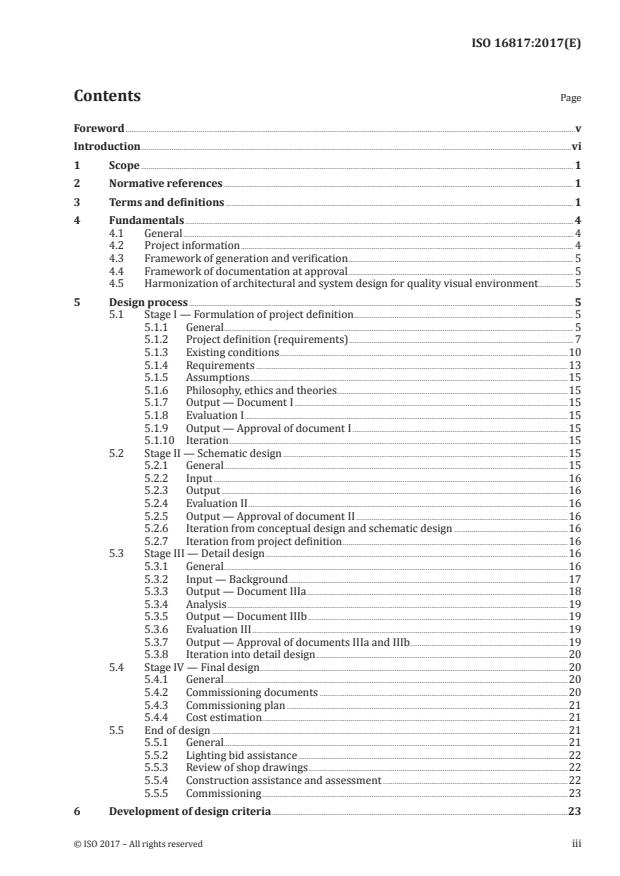
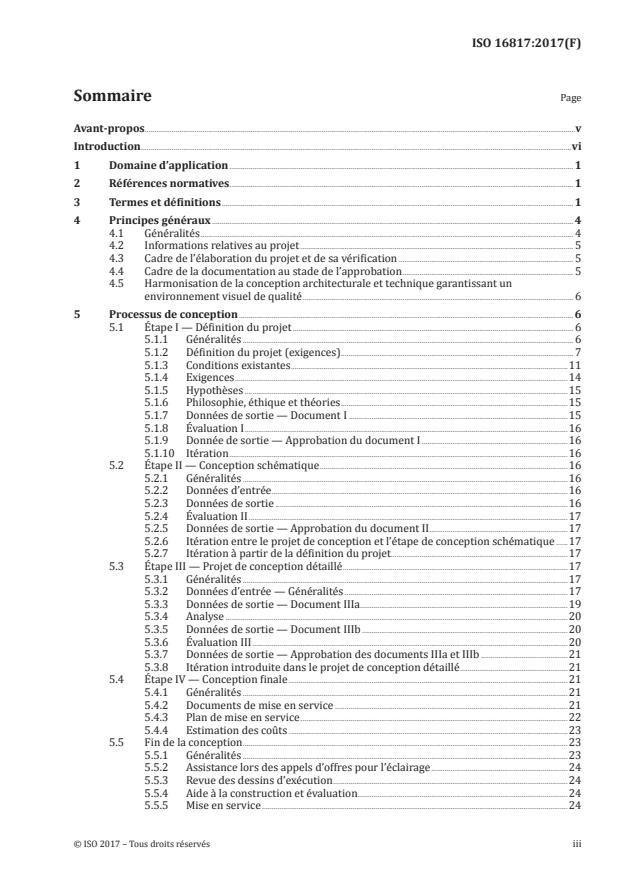
Contents Page
Foreword .v
Introduction .vi
1 Scope . 1
2 Normative references . 1
3 Terms and definitions . 1
4 Fundamentals . 4
4.1 General . 4
4.2 Project information . 4
4.3 Framework of generation and verification . 5
4.4 Framework of documentation at approval . 5
4.5 Harmonization of architectural and system design for quality visual environment . 5
5 Design process . 5
5.1 Stage I — Formulation of project definition . 5
5.1.1 General. 5
5.1.2 Project definition (requirements) . 7
5.1.3 Existing conditions . .10
5.1.4 Requirements .13
5.1.5 Assumptions .15
5.1.6 Philosophy, ethics and theories .15
5.1.7 Output — Document I .15
5.1.8 Evaluation I .15
5.1.9 Output — Approval of document I .15
5.1.10 Iteration .15
5.2 Stage II — Schematic design .15
5.2.1 General.15
5.2.2 Input .16
5.2.3 Output .16
5.2.4 Evaluation II .16
5.2.5 Output — Approval of document II .16
5.2.6 Iteration from conceptual design and schematic design .16
5.2.7 Iteration from project definition .16
5.3 Stage III — Detail design .16
5.3.1 General.16
5.3.2 Input — Background .17
5.3.3 Output — Document IIIa.18
5.3.4 Analysis .19
5.3.5 Output — Document IIIb .19
5.3.6 Evaluation III .19
5.3.7 Output — Approval of documents IIIa and IIIb .19
5.3.8 Iteration into detail design .20
5.4 Stage IV — Final design .20
5.4.1 General.20
5.4.2 Commissioning documents .20
5.4.3 Commissioning plan .21
5.4.4 Cost estimation .21
5.5 End of design .21
5.5.1 General.21
5.5.2 Lighting bid assistance .22
5.5.3 Review of shop drawings .22
5.5.4 Construction assistance and assessment .22
5.5.5 Commissioning .23
6 Development of design criteria .23
7 Development of design aids .23
8 Cost evaluation .23
8.1 Estimation of primary costs .23
8.2 Evaluation of the visual environment design benefits versus costs as required by
the client .23
9 Compliance review .24
10 Continuous improvement .24
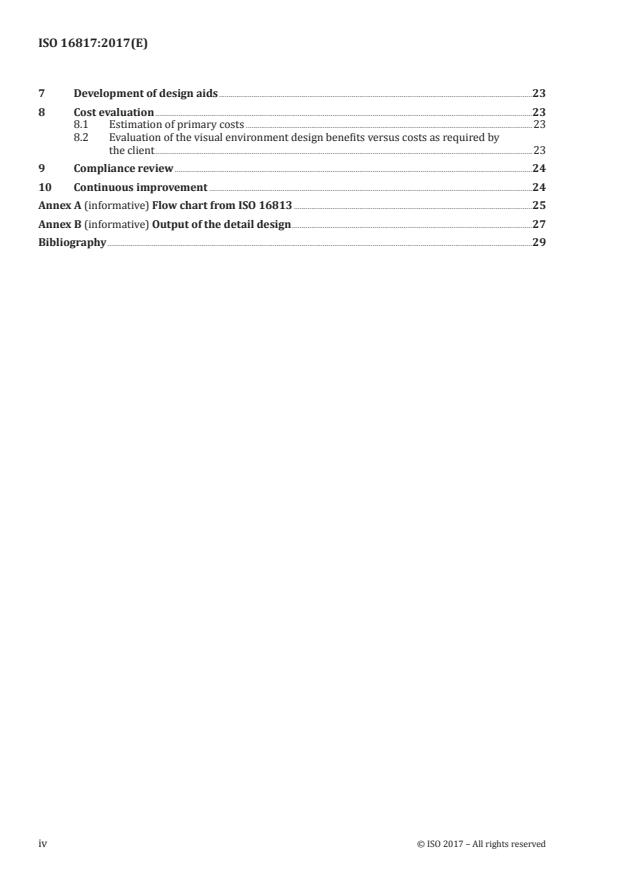
Annex A (informative) Flow chart from ISO 16813 .25
Annex B (informative) Output of the detail design .27
Bibliography .29
iv © ISO 2017 – All rights reserved
Foreword
ISO (the International Organization for Standardization) is a worldwide federation of national standards
bodies (ISO member bodies). The work of preparing International Standards is normally carried out
through ISO technical committees. Each member body interested in a subject for which a technical
committee has been established has the right to be represented on that committee. International
organizations, governmental and non-governmental, in liaison with ISO, also take part in the work.
ISO collaborates closely with the International Electrotechnical Commission (IEC) on all matters of
electrotechnical standardization.
The procedures used to develop this document and those intended for its further maintenance are
described in the ISO/IEC Directives, Part 1. In particular the different approval criteria needed for the
different types of ISO documents should be noted. This document was drafted in accordance with the
editorial rules of the ISO/IEC Directives, Part 2 (see www .iso .org/ directives).
Attention is drawn to the possibility that some of the elements of this document may be the subject of
patent rights. ISO shall not be held responsible for identifying any or all such patent rights. Details of
any patent rights identified during the development of the document will be in the Introduction and/or
on the ISO list of patent declarations received (see www .iso .org/ patents).
Any trade name used in this document is information given for the convenience of users and does not
constitute an endorsement.
For an explanation on the voluntary nature of standards, the meaning of ISO specific terms and
expressions related to conformity assessment, as well as information about ISO’s adherence to the
World Trade Organization (WTO) principles in the Technical Barriers to Trade (TBT) see the following
URL: w w w . i s o .org/ iso/ foreword .html.
This document was prepared by Technical Committee ISO/TC 205, Building environment design.
This second edition cancels and replaces the first edition (ISO 16817:2012), which has been technically
revised.
Introduction
ISO 16813 defines general principles for the design of building indoor environment and helps the main
participants in the design process to ensure an indoor environment of the quality required for users.
The purpose of this document is to provide design team members with a design process for the indoor
visual environment to aid provision of, in a sustainable approach, required visual comfort, physiological
effects of light and energy performance of buildings. Visual comfort does not necessarily only provide a
suitable lighting for executing a task. For example, a window has at least two functions: to facilitate the
entry of daylight and to provide a view.
The design of an indoor visual environment of the required quality for users takes into account human
needs that include elements linked to performance, visual comfort, health, safety and well-being.
The objective of this document is to provide the design team at each phase of the design process with
a way to implement the nine general principles of sustainability (NGPS) in buildings, as described in
ISO 15392 and how to integrate these principles in their decision-making processes, in order to be part
of a sustainable approach.
Concerning research in illuminating and lighting, work by the International Commission on Illumination
(CIE) should be consulted. The existing CIE and CEN standards are used and any new work is performed
in close coordination with CIE and CEN.
This document
— provides a framework for taking into consideration various parameters and criteria that influence
the quality of the indoor visual environment,
— is prepared for design teams (architects and engineers), as well as building clients, contractors,
government officials, and academic staff,
— is aimed at assisting these groups in applying an effective design process in the pursuit of an indoor
visual environment of the required quality for the users,
— incorporates sustainability considerations, and
— is prepared on the basis of the following fundamental ideas:
— it addresses the standardization of a design process elaborated through a systemic approach, a
system of tasks that are structured together;
— it is a guideline which invites designers to follow an iterative and progressive approach, to make
choices and take compromise solutions according to the goals of the client, to the constraints
and the opportunities linked to the building site, in relation to the main areas of work covered
by ISO/TC 205;
— it allows the performance level or values to be established by the programme and/or applicable
regulation.
vi © ISO 2017 – All rights reserved
INTERNATIONAL STANDARD ISO 16817:2017(E)
Building environment design — Indoor environment —
Design process for the visual environment
1 Scope
This document provides an integrated design process for high-quality indoor visual environment
including architectural and engineering aspects of daylighting and lighting systems for user satisfaction,
health, well-being and productivity as well as the energy performance and sustainability of buildings.
2 Normative references
The following documents are referred to in the text in such a way that some or all of their content
constitutes requirements of this document. For dated references, only the edition cited applies. For
undated references, the latest edition of the referenced document (including any amendments) applies.
ISO 15686-5, Buildings and constructed assets — Service-life planning — Part 5: Life-cycle costing
ISO 26000, Guidance on social responsibility
3 Terms and definitions
For the purposes of this document, the terms and definitions given in IEC 60050-845 and the
following apply.
ISO and IEC maintain terminological databases for use in standardization at the following addresses:
— IEC Electropedia: available at http:// www .electropedia .org/
— ISO Online browsing platform: available at http:// www .iso .org/ obp
3.1
artificial lighting
lighting that is provided by artificial light sources such as electric lights, candles, oil lamps and gas lights
3.2
circadian rhythm
biological rhythm with a period of approximately 24 h
[SOURCE: CIE S 017/E]
3.3
colour rendering index
measure of the degree to which the psychophysical colour of an object illuminated by the test illuminant
conforms to that of the same object illuminated by the reference illuminant, suitable allowance having
been made for the state of chromatic adaptation
[SOURCE: CIE S 017/E]
3.4
daylighting
practice of placing windows (3.25) and/or rooflights (3.19), or other openings, and reflective surfaces so
that, during the day, natural light provides internal illumination
Note 1 to entry: Particular attention is given to daylighting while designing a building when the aim is to maximize
visual comfort or to reduce energy use. Energy savings can be achieved from the reduced use of lighting systems.
3.5
daylight opening
area, glazed or unglazed, that is capable of admitting daylight to an interior
[SOURCE: CIE S 017/E]
3.6
design aids
set of guidelines used for conceptual details and final designs for the indoor environment, based on the
requirements whether or not expressed by the client and stakeholders
[SOURCE: ISO 16813]
3.7
directionality
the quality of being directional
3.8
electric lighting
lighting by electric light sources
[SOURCE: CIE S 017/E]
3.9
energy performance of a building
calculated or measured amount of weighted net delivered energy actually used or estimated to meet
different needs associated with a standardized use of a building
Note 1 to entry: This may include energy used for heating, cooling, ventilation, domestic hot water and lighting.
[SOURCE: ISO 16818]
3.10
obstruction
anything outside a building which prevents the direct view of part of the sky
[SOURCE: CIE S 017/E]
3.11
glare
condition of vision in which there is discomfort or a reduction in the ability to see details or objects,
caused by an unsuitable distribution or range of luminance (3.16), or by extreme contrasts
[SOURCE: CIE S 017/E]
3.12
illuminance
〈at a point of a surface〉 quotient of the luminous flux d Φ incident on an element of the surface
v
containing the point, divided by the area dA of that element
−2
Note 1 to entry: This is expressed in lux, 1 lx = 1 lm·m .
3.13
life cycle cost
cost of an asset or its parts throughout its life cycle, while fulfilling the performance requirements
3.14
light pollution
generic term indicating the sum total of all adverse effects of artificial light
[SOURCE: CIE S 017/E]
2 © ISO 2017 – All rights reserved
3.15
light trespass
unwanted impingement of light from external light sources such as nearby building and street lights
3.16
luminance
L
v
〈in a given direction, at a given point of a real or imaginary surface〉 quantity defined by the following
formula:
d Φ
v
L =
v
ddA⋅⋅cosθ Ω
where
d Φv is the luminous flux transmitted by an elementary beam passing through the given point and
propagating in the solid angle, dΩ, containing the given direction;
dA is the area of a section of that beam containing the given point;
θ is the angle between the normal to that section and the direction of the beam.
−2 −2 −1
Note 1 to entry: This is expressed in candela per square metre, 1 cd·m = 1 lm·m ·sr .
[SOURCE: CIE S 017/E]
3.17
luminous flux
quantity derived from the radiant flux by evaluating the radiation according to its action upon the CIE
standard photometric observer
Note 1 to entry: This is expressed in lumen lm.
[SOURCE: CIE S 017/E]
3.18
reflectance
ratio of the reflected radiant or luminous flux (3.17) to the incident flux in the given conditions
[SOURCE: CIE S 017/E]
3.19
rooflight
daylight opening (3.5) on the roof or on a horizontal surface of a building
[SOURCE: CIE S 017/E]
3.20
skylight
part of sky radiation capable of causing a visual sensation
[SOURCE: CIE S 017/E]
3.21
sunlight
part of direct solar radiation capable of causing a visual sensation
[SOURCE: CIE S 017/E]
3.22
transmittance
ratio of the transmitted luminous flux (3.17) to the incident flux in the given conditions
3.23
transparency
capacity to transmit radiative energy without altering its incoming direction
3.24
visual nuisances
subjective visual discomfort caused by unwanted views
3.25
window
daylight opening (3.5) on a vertical or nearly vertical area of a room envelope
[SOURCE: CIE S 017/E]
4 Fundamentals
4.1 General
General principles of indoor visual environment design allow the clients and design teams to provide the
desired quality of indoor visual environment in a sustainable building according to the fundamentals of
the design process.
The nine general principles of sustainability (NGPS) are defined in ISO 15392. The NGPS include
— continual improvement,
— equity,
— global thinking,
— holistic approach,
— involvement of interested parties,
— long-term consideration,
— precaution and risk,
— responsibility, and
— transparency.
Building designers should define the goals based on the requirements, constraints and actual conditions
to be achieved, integrating the owning and operating costs during the design stage.
4.2 Project information
The project information that influences the development of visual environment design concepts,
together with constraints and all requirements, shall be documented. A description of the intended use
(and related requirements) of the building and end-user needs shall be included. When assumptions
are made in lieu of necessary information related to the standards or regulations applicable to quality
visual environment design, these assumptions shall be documented. The project information provided
by the users of this document that influences the programming, development and/or the design of
building components and the building service systems shall also be documented. The expected service
life of the building and its components shall be specified.
4 © ISO 2017 – All rights reserved
4.3 Framework of generation and verification
Architectural design and building system design are goal-driven activities. The routes necessary to
achieve the end result are not straightforward, and should be flexible. In some instances, the assumptions
are made under uncertain conditions. The design choices shall be focused on the limitation of adverse
environmental impacts. Hence, an iterative generation process and verification and validation of the
design decisions shall be established at each stage of the design process. When a decision is to be made,
the design team shall make a systematic review of the potential effects of that decision during the life
cycle of the building. The generation process is a sub-process where a design solution is synthesized,
while the verification process is another sub-process in which the design solution depends on different
quality visual environment design criteria. The expected performance of the visual environment shall
be achieved during the above processes. When the targets are not met, the design team shall determine
acceptability and act accordingly. A periodic review of the management system shall be made in order
to check effectiveness of existing management system and consider improvement as necessary.
4.4 Framework of documentation at approval
The evaluation and approval processes shall be documented. The documentation process shall explicitly
state what is to be provided by the project. The evaluation and approval process shall demonstrate that
the stated goals can be achieved. Every document provided shall describe the characteristics planned
and verify whether they are actually achieved. Transparent decision-making and communication
processes shall be established. Essential maintenance and replacement plans of the building components
shall be documented according to the expected service life of the building. Approval should be obtained
at each design stage.
The documents issued during this design process shall cover the following questions:
— Is the stated definition adequate and feasible?
— Is the environmental design for quality visual environment feasible?
— Is the specified structure expected to satisfy the environmental, economic and social constraints
and requirements?
— Is the building capable of providing the quality visual environment and performance required?
4.5 Harmonization of architectural and system design for quality visual environment
Since quality indoor visual environment is the result of a harmonization between architectural design
and technical, it is appropriate to apply the general principles of the indoor building environment design.
The general principles of building environment for quality visual environment design should not restrict
creative architectural design. The principles do not predefine the order or precedence of individual
tasks in both the architectural and building system design for quality visual environment.
5 Design process
5.1 Stage I — Formulation of project definition
5.1.1 General
A high-performance and high-quality visual environment is one that
— meets the design objectives of the visual environment,
— maximizes users’ quality visual environment, well-being, health and productivity,
— minimizes users’ complaints,
— maximizes building values to the owner,
— yields a lifetime of energy performance of a building, and reduces operating and maintenance costs,
— respects the sustainability policy of the client or main decision-maker: defines the key elements of
the sustainability policy for the project, and
— ensures the safety of the users.
In order to design a high-performance and high-quality visual environment, an integrated architectural
approach is recommended. The integrated approach addresses the critical interactions between the
building façade (which admits heat and light), building interior and all light sources such as daylight
(skylight and/or sunlight) and other lighting systems. This approach also shares appropriate decisions
across the owner and the design team throughout the design process.
Efficient and responsible management throughout the process shall be implemented to establish early
identification of needs and roles of interested parties, clear project organisation and planning at each
phase, shared decision making, traceability, with good anticipation of risks, problems and conflicts.
Sustainability objectives should be taken into account accordingly with the project:
— availability of resources (e.g. financial, technical, human, etc.):
— ensure the resources available for the project correspond to the ambitions of the project;
— ensure the resources available for the operation and maintenance allow an optimal use of the
buildings;
— management of risks:
— anticipate the administrative, technical and human issues, through early planning in
sufficient detail;
— identify and assess the financial, social, environmental and technical risks, considering short-,
medium- and long-term issues;
— determine acceptability and act accordingly;
— undertake a regular review;
— formalization of contracts and responsibilities between parties:
— establish contracts suitable for the project and its specificities;
— ensure that interfaces between actors are well organized and formalized;
— achievement of the expected performance;
— learning from experience:
— benefit from past experiences or projects;
— capitalize on present experience for continuous improvement;
— consideration of a life cycle perspective: bring into practice the life cycle thinking approach in
the key stages of the project/process:
— provision of information to successive actors to ensure they are aware of the initial principles,
objectives, technical and architectural choices that are specific to the construction work, and
the implications of these for its operation and its disposal at the end of life;
— create record for the operating actors on critical features of the works that relate to
sustainability issues.
6 © ISO 2017 – All rights reserved
5.1.2 Project definition (requirements)
The phases of visual environment design typically comprise parallel architectural design work
and might include programming, schematic (or preliminary) design, design development, contract
documents and construction administration.
— description of the intended use (and related requirements) of the construction work and
end-users needs:
— describe the primary functions of the work (e.g. school, offices, retail, residential, etc.);
— define the functional performance required for each user group, space and task area;
— spatial arrangement, connectivity and geometry (area, access, etc.);
— operating conditions;
— maintainability;
— specific requirements;
— define the profiles of performance required to achieve the expected levels of functionality,
health, comfort, safety and accessibility;
— provision of a safe and resistant construction work during exceptional events:
— identify exceptional events that might occur;
— minimize the likelihood of unacceptable risks of injury or damage;
— consider importance of functional continuity of activities supported by the building, particularly
for welfare activities;
— establish a minimum level of functional performance, during and after the event, typically
based on national or local codes/regulations or required by the client’s brief (e.g. resilience and
resistance to flooding);
— provision of accessibility for all:
— provide spaces able to be entered and used with ease by all users (with different kinds of
physical or cognitive abilities);
— functional flexibility:
— ensure the building ability to adapt:
— individual user requirements;
— change of user requirements;
— technical changes;
— change of use of some areas;
— security:
— ensure by designing the buildings and equipment the safety of the persons and the materials;
— contribution to social equity and improvement in the social climate:
— minimize disturbances and nuisances on neighbours during construction and operation.
Before beginning programming, items 5.1.2.1 through 5.1.2.6 shall be well understood.
5.1.2.1 Area of the visual environment design project
The area of the visual environment design project is important. This will offer some sense of the likely
variety of spaces, task areas and clues to the depth of problem solving involved.
The sustainability objectives are expressed as a short list of statements, actions or recommendations.
These are intended to make the objectives more evident for the various stakeholders consideration:
— during brief and design phases, establishment of an expected service life of the building, including
maintenance, replacement and end-of-life plans;
— when making a decision, consideration of its implications for all subsequent stages of the life cycle;
— limitation of adverse environmental impacts;
— provision of economic value over time;
— adaptability and end-of-life strategy:
— adaptability for different uses:
— ease of disassembly;
— innovation: investigate whether innovative solutions/approaches have the potential to provide a
more sustainable solution (technical, organisational, financial, etc.).
Larger projects:
— tend to require larger design teams and require greater number of meetings to review design
options and integration issues;
— challenge the design team on minimizing the number and types of light sources, luminaires, ballasts
and lighting control devices;
— challenge the designer on preparing specification and maintenance standards.
5.1.2.2 Neighbouring outdoor environment
The neighbouring outdoor external environment shall be analysed in order to enhance the
characteristics of the site:
— limit the impacts on the local environment (e.g. light pollution, glare);
— contribute to local appeal and the quality of life:
— assess the project’s contribution to the improvement of the neighbourhood/district image, the
local economy and the quality of life;
— create synergies within the existing context.
— identify the factors (links, spaces, task areas, functions, continuity and contribution) that fit
within and enhance the local environment
— ensure coherence between the site development and the policy of the local community regarding
sustainable development planning, including environmental protection (energy, sewage, waste,
rainwater, water resource, services, transport, risks, etc.)
8 © ISO 2017 – All rights reserved
5.1.2.3 Number and types of spaces and task areas
The brief shall determine whether the level of serviceability is adequate to meet the profiles of
performance required, and act accordingly. The number and types of spaces and task areas will give the
designer an early sense of the diversity of the occupants and tasks that will need to be accommodated.
— Assess serviceability.
— Assess the levels of performance to be attained for each user group, space and task area.
— Determine whether the level of serviceability is adequate to meet the profiles of performance
required, and act accordingly.
5.1.2.4 Schedule for visual environment design
The schedule for the visual environment design will affect the timing and the degree of performance by
the designer for the various stages of the design effort.
5.1.2.5 Client or users
Understanding the client or users and having access to the client influences the success of designing
a high-quality visual environment. Asking more pointed questions of the client and more carefully
addressing programming are necessary to better understand and address user’s needs. It concerns
— respect of human values:
— identify the relevance and significance of issues related to human values and address them
appropriately (e.g. responsible behaviour, labour rights, consumer issues, equity, ethical
behaviour, according to the principles of ISO 26000);
— identification, characterisation and involvement of the future end-users and their needs:
— identify the demographic features and other characteristics of the end users;
— identify the end users’ needs, desires, values and requirements;
— decide when and how the end users should be involved;
— identification and involvement of other interested parties:
— identify other key interested parties [e.g. the neighbours, local authorities, local association
professionals (service providers and operators)];
— decide when and how the other interested parties should be involved;
— establish their level, importance, influence and their role;
— management and resolution of contradictions or conflicts among the opinions of the
interested parties:
— take measures to ensure early identification of contradictions or conflicts and their resolution;
— satisfaction of users and other affected parties:
— decide how and when the satisfaction of the users will be determined and assessed;
— decide how and when the satisfaction of the other interested parties will be determined and
assessed;
— take into account their concerns in order to improve satisfaction and draw lessons for future
projects.
5.1.2.6 Design team
The design team is responsible for addressing human and technical issues on the project. An integrated
multidisciplinary approach shall be adopted throughout the process by
— identifying the necessary professional skills needed, and
— facilitating integrated working.
A design team should typically consist of an architect surrounded by a team with abilities in electrical
engineering, in illuminating engineering, in HVAC systems, in landscape design, in structural
engineering and in construction management.
5.1.3 Existing conditions
Before proceeding to the schematic design phase, existing conditions shall be identified. Taking
inventory of the existing conditions of any project is critical in assessing vision, perception and
subsequently visual needs of users. A checklist shown in Table 1 can be used as a guide for taking
inventory of the existing conditions on a project. This can be gathered from a variety of sources. Some
of the information is a matter of observation and measurement taking. Some information, however,
requires interaction with users.
— Survey of the local environment:
— conduct a multi-criteria survey/analysis of the local environment prior to setting objectives for
the project;
— determine the needs, opportunities, constraints and limitations for the works in context (e.g.
national, regional and/or local policies and regulations, etc.);
— implement decisions or solutions based on the findings of the survey.
10 © ISO 2017 – All rights reserved
Table 1 — Taking inventory of existing conditions (Suggesting existing conditions)
Parameter Existing conditions
External conditions — Sky conditions
— Clear
— Overcast
— Partly cloudy
— Albedo
— Site altitude
— Site cardinal orientation
— External obstruction
— Natural conditions
— Direct sunlight
— Reflected light
— Continuous/occasional
— Artificial conditions
— Light pollution
— Light trespassing
Dimensions of each space and task — Length
area within it
— Width
— Height
Spatial form — Rectilinear
— Curvilinear
— Long/narrow and tall/short
— Short/wide and tall/short
Activities within each task area — Primary (may be several)
— Secondary (may be several)
Visual tasks — Prioritize by importance
— Prioritize by time spent on each
Occupants’ ages (by group) — 0 to 10 years old
— 10 years old to 20 years old
— 20 years old to 40 years old
— 40 years old to 60 years old
— 60 years or more
Furnishings — Low and open
— Low and closed
— High and open
— Solid and void
Table 1 (continued)
Parameter Existing conditions
User feedback — Prior complaints about environment or work
— On-site feedback
Owner feedback — Present image
— Perceived quality of existing environment
— Present operating costs
— Relationship between indoor and outdoor environment
Designers’ impressions — Monument to prior design team
— Monument to owner
— Improvement to human condition
Obtaining user feedback on existing conditions requires the design team to survey the users and/or to
review any file of previous complaints about the workplace. Table 2 suggests some user survey questions.
Table 2 — Sample survey questions for existing conditions
Parameter Questions
Space or task area activities Which activities take place in this space or task area?
How is this space or task area used?
What do you consider as primary tasks?
How long is this space or task area occupied?
How long is this space or task area used for given functions?
Visual tasks What is the most important task?
Are there any other tasks of similar importance?
What are the visual aspects of your work?
How much time do you spend in this room each day?
How much time do you spend on each task or activity?
…
User feedback The indoor visual environment is comfortable. [agree/
disagree]
The room is too bright. [agree/disagree]
The room is too dim. [agree/disagree]
The task area is too bright. [agree/disagree]
The task area is too dim. [agree/disagree]
The lighting causes distracting shadows. [agree/disagree]
The lighting is easy to control. [agree/disagree]
…
After identifying the existing conditions, constraints for the new project that may significantly influence
visual environment design, or alternatively that the designer should influence, should be listed and
identified. Table 3 summarizes the constraints that can arise regarding the planned spaces and task areas.
12 © ISO 2017 – All rights reserved
Table 3 — Constraints on planned project
Parameter Constraints on planned project
Space dimensions Length
Width
Height
Spatial form Rectilinear
Curvilinear
Long/narrow and tall/short
Short/wide and tall/short
Space and task area related activities Primary activities
Secondary activities
Visual tasks Prioritize by importance
Prioritize by time spent on each task
User age (by group) 0 to 10 years old
10 years old to 20 years old
20 years old to 40 years old
40 years old to 60 years old
60 years or more
Furnishing and interior partition walls Low and transparent
Low and opaque
High and transparent
High and opaque
Surface finishes Texture (glossy or matte)
Colours
Reflectance (percentage)
Daylighting Sunlight
Skylight
Reflected light
View or no view
Owner expectations Image
Perceived quality of planned visual environment
Initial costs and planned operating costs
The programming phase consists of taking inventory on conditions of existing spaces and task areas
taking inventory on givens for the planned spaces and task areas, establishing design goals, defining
and prioritizing design criteria, and preparing programming statement.
5.1.4 Requirements
With a clear understanding of the users’ existing and planned constraints, it is possible to develop
specific design requirements for the visual environment. Table 4 provides a com
...
NORME ISO
INTERNATIONALE 16817
Deuxième édition
2017-05
Conception de l'environnement des
bâtiments — Environnement intérieur
— Processus de conception de
l'environnement visuel
Building environment design — Indoor environment — Design
process for the visual environment
Numéro de référence
©
ISO 2017
DOCUMENT PROTÉGÉ PAR COPYRIGHT
© ISO 2017
Tous droits réservés. Sauf prescription différente ou nécessité dans le contexte de sa mise en œuvre, aucune partie de cette
publication ne peut être reproduite ni utilisée sous quelque forme que ce soit et par aucun procédé, électronique ou mécanique,
y compris la photocopie, ou la diffusion sur l’internet ou sur un intranet, sans autorisation écrite préalable. Une autorisation peut
être demandée à l’ISO à l’adresse ci-après ou au comité membre de l’ISO dans le pays du demandeur.
ISO copyright office
Case postale 401 • Ch. de Blandonnet 8
CH-1214 Vernier, Genève
Tél.: +41 22 749 01 11
Fax: +41 22 749 09 47
E-mail: copyright@iso.org
Web: www.iso.org
Publié en Suisse
ii © ISO 2017 – Tous droits réservés
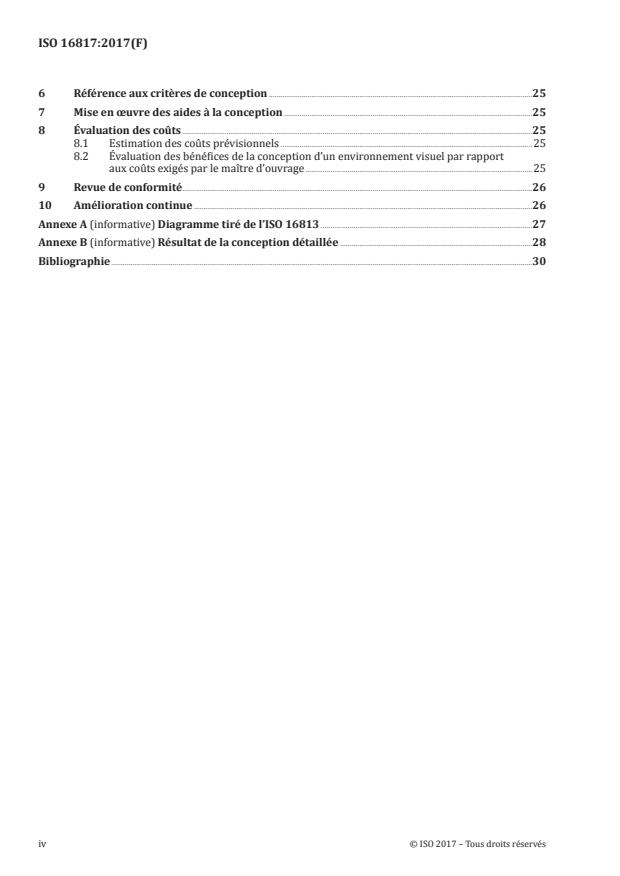
Sommaire Page
Avant-propos .v
Introduction .vi
1 Domaine d’application . 1
2 Références normatives . 1
3 Termes et définitions . 1
4 Principes généraux . 4
4.1 Généralités . 4
4.2 Informations relatives au projet . 5
4.3 Cadre de l’élaboration du projet et de sa vérification . 5
4.4 Cadre de la documentation au stade de l’approbation . 5
4.5 Harmonisation de la conception architecturale et technique garantissant un
environnement visuel de qualité . 6
5 Processus de conception . 6
5.1 Étape I — Définition du projet . 6
5.1.1 Généralités . 6
5.1.2 Définition du projet (exigences) . 7
5.1.3 Conditions existantes .11
5.1.4 Exigences .14
5.1.5 Hypothèses .15
5.1.6 Philosophie, éthique et théories .15
5.1.7 Données de sortie — Document I .15
5.1.8 Évaluation I .16
5.1.9 Donnée de sortie — Approbation du document I .16
5.1.10 Itération .16
5.2 Étape II — Conception schématique .16
5.2.1 Généralités .16
5.2.2 Données d’entrée .16
5.2.3 Données de sortie .16
5.2.4 Évaluation II .17
5.2.5 Données de sortie — Approbation du document II .17
5.2.6 Itération entre le projet de conception et l’étape de conception schématique .17
5.2.7 Itération à partir de la définition du projet.17
5.3 Étape III — Projet de conception détaillé .17
5.3.1 Généralités .17
5.3.2 Données d’entrée — Généralités .17
5.3.3 Données de sortie — Document IIIa .19
5.3.4 Analyse .20
5.3.5 Données de sortie — Document IIIb .20
5.3.6 Évaluation III .20
5.3.7 Données de sortie — Approbation des documents IIIa et IIIb .21
5.3.8 Itération introduite dans le projet de conception détaillé .21
5.4 Étape IV — Conception finale .21
5.4.1 Généralités .21
5.4.2 Documents de mise en service .21
5.4.3 Plan de mise en service .22
5.4.4 Estimation des coûts .23
5.5 Fin de la conception .23
5.5.1 Généralités .23
5.5.2 Assistance lors des appels d’offres pour l’éclairage .24
5.5.3 Revue des dessins d’exécution .24
5.5.4 Aide à la construction et évaluation .24
5.5.5 Mise en service .24
6 Référence aux critères de conception .25
7 Mise en œuvre des aides à la conception .25
8 Évaluation des coûts .25
8.1 Estimation des coûts prévisionnels .25
8.2 Évaluation des bénéfices de la conception d’un environnement visuel par rapport
aux coûts exigés par le maître d’ouvrage .25
9 Revue de conformité .26
10 Amélioration continue .26
Annexe A (informative) Diagramme tiré de l’ISO 16813 .27
Annexe B (informative) Résultat de la conception détaillée .28
Bibliographie .30
iv © ISO 2017 – Tous droits réservés
Avant-propos
L'ISO (Organisation internationale de normalisation) est une fédération mondiale d'organismes
nationaux de normalisation (comités membres de l'ISO). L'élaboration des Normes internationales est
en général confiée aux comités techniques de l'ISO. Chaque comité membre intéressé par une étude
a le droit de faire partie du comité technique créé à cet effet. Les organisations internationales,
gouvernementales et non gouvernementales, en liaison avec l'ISO participent également aux travaux.
L'ISO collabore étroitement avec la Commission électrotechnique internationale (IEC) en ce qui
concerne la normalisation électrotechnique.
Les procédures utilisées pour élaborer le présent document et celles destinées à sa mise à jour sont
décrites dans les Directives ISO/IEC, Partie 1. Il convient, en particulier, de prendre note des différents
critères d'approbation requis pour les différents types de documents ISO. Le présent document a été
rédigé conformément aux règles de rédaction données dans les Directives ISO/IEC, Partie 2 (voir www
.iso .org/ directives).
L'attention est attirée sur le fait que certains des éléments du présent document peuvent faire l'objet de
droits de propriété intellectuelle ou de droits analogues. L'ISO ne saurait être tenue pour responsable
de ne pas avoir identifié de tels droits de propriété et averti de leur existence. Les détails concernant
les références aux droits de propriété intellectuelle ou autres droits analogues identifiés lors de
l'élaboration du document sont indiqués dans l'Introduction et/ou dans la liste des déclarations de
brevets reçues par l'ISO (voir www .iso .org/ brevets).
Les appellations commerciales éventuellement mentionnées dans le présent document sont données
pour information, par souci de commodité, à l’intention des utilisateurs et ne sauraient constituer un
engagement.
Pour une explication de la nature volontaire des normes, la signification des termes et expressions
spécifiques de l'ISO liés à l'évaluation de la conformité, ou pour toute information au sujet de l'adhésion
de l'ISO aux principes de l’Organisation mondiale du commerce (OMC) concernant les obstacles
techniques au commerce (OTC), voir www .iso .org/ avant -propos.
Le présent document a été élaboré par le comité technique ISO/TC 205, Conception de l'environnement
intérieur des bâtiments.
Cette deuxième édition annule et remplace la première édition (ISO 16817:2012), qui a fait l’objet d’une
révision technique.
Il convient que l’utilisateur adresse tout retour d’information ou toute question concernant le présent
document à l’organisme national de normalisation de son pays. Une liste exhaustive desdits organismes
se trouve à l’adresse www .iso .org/ fr/ members .html.
Introduction
L’ISO 16813 définit les principes généraux de la conception de l’environnement intérieur des bâtiments
et aide les principaux acteurs du processus de conception à assurer un environnement intérieur de
qualité conforme aux exigences de l’utilisateur.
L’objectif du présent document est de fournir aux membres de l’équipe de conception un processus de
conception de l’environnement visuel intérieur qui contribue à assurer, selon une approche durable, le
confort visuel, les effets physiologiques de la lumière, ainsi que la performance énergétique requis pour
les bâtiments. Le confort visuel ne se limite pas nécessairement à la mise à disposition d’un éclairage
adapté à l’accomplissement d’une tâche. Par exemple, une fenêtre a au moins deux fonctions: laisser
entrer la lumière du jour et offrir une vue.
La conception d’un environnement visuel intérieur répondant aux exigences de qualité des utilisateurs
prend en compte les besoins humains liés à la performance, au confort visuel, à la santé, à la sécurité et
au bien-être.
L’objectif du présent document est de fournir à l’équipe de conception, à chaque phase du processus
de conception, une façon de mettre en œuvre les neuf principes généraux de développement durable
des bâtiments, conformément à l’ISO 15392, et d’intégrer ces principes dans son processus de prise de
décision, afin de s’inscrire dans une approche durable.
Il convient de consulter les travaux de la CIE (Commission internationale de l’éclairage) pour en savoir
plus sur la recherche sur l’éclairage et les sources de lumière. Les normes existantes de la CIE et du CEN
sont utilisées et aucun travail n’est réalisé sans une collaboration étroite avec la CIE et le CEN.
Le présent document:
— fournit un cadre de référence pour la prise en compte des différents paramètres et critères qui
influencent la qualité de l’environnement visuel intérieur;
— a été élaboré pour les équipes de conception (architectes et ingénieurs), ainsi que pour les maîtres
d’ouvrage, les entrepreneurs, les acteurs institutionnels et le personnel académique;
— est destiné à aider ces groupes de personnes à appliquer un processus de conception efficace
permettant d’assurer un environnement visuel intérieur de qualité conforme aux attentes des
utilisateurs;
— intègre des aspects liés au développement durable; et
— a été élaboré sur la base des principes généraux suivants:
— il traite de la normalisation d’un processus de conception par une approche systémique, c’est-à-
dire un système qui repose sur un ensemble de tâches structurées;
— il s’agit d’une recommandation qui invite les concepteurs à suivre une approche itérative et
progressive, à faire des choix et à adopter des solutions de compromis en fonction des objectifs
du client, des contraintes et des opportunités liées au site de construction, ce en relation avec
les principaux domaines de travail couverts par l’ISO/TC 205;
— il permet d’établir le niveau ou les valeurs de performance dans le cadre du programme et/ou
de la réglementation applicable.
vi © ISO 2017 – Tous droits réservés
NORME INTERNATIONALE ISO 16817:2017(F)
Conception de l'environnement des bâtiments —
Environnement intérieur — Processus de conception de
l'environnement visuel
1 Domaine d’application
Le présent document établit un processus de conception intégré pour un environnement visuel intérieur
de haute qualité, intégrant aussi bien les aspects architecturaux et d’ingénierie de l’éclairage naturel et
des systèmes d’éclairage pour la satisfaction, la santé, le bien-être et la productivité des utilisateurs,
que les aspects de performance énergétique et de développement durable des bâtiments.
2 Références normatives
Les documents suivants sont cités dans le texte de sorte qu’ils constituent, pour tout ou partie de leur
contenu, des exigences du présent document. Pour les références datées, seule l’édition citée s’applique.
Pour les références non datées, la dernière édition du document de référence s'applique (y compris les
éventuels amendements).
ISO 15686-5, Buildings and constructed assets — Service life planning — Part 5: Life-cycle costing
ISO 26000, Guidance on social responsibility
3 Termes et définitions
Pour les besoins du présent document, les termes et les définitions de l’IEC 60050-845 ainsi que les
suivants s’appliquent.
L’ISO et l’IEC tiennent à jour des bases de données terminologiques destinées à être utilisées en
normalisation, consultables aux adresses suivantes:
— ISO Online browsing platform: disponible à l’adresse https:// www .iso .org/ obp
— IEC Electropedia: disponible à l’adresse http:// www .electropedia .org/
3.1
éclairage artificiel
éclairage assuré par des sources de lumière artificielles telles que des systèmes d’éclairage électriques,
des bougies, des lampes à huile et des appareils d’éclairage au gaz
3.2
rythme circadien
rythme biologique d’une durée approximative de 24 h
[SOURCE: CIE S 017/E]
3.3
indice de rendu de couleur
évaluation quantitative du degré d’accord entre la couleur psychophysique d’un objet éclairé par
l’illuminant en essai et celle du même objet éclairé par l’illuminant de référence, l’état d’adaptation
chromatique ayant été correctement pris en compte
[SOURCE: CIE S 017/E]
3.4
éclairage naturel
opération consistant à placer les fenêtres (3.25) et/ou les lucarnes (3.19), ou autres prises de jour et
surfaces réfléchissantes de sorte que, pendant le jour, la lumière naturelle éclaire l’intérieur
Note 1 à l'article: Une attention particulière est apportée à l’éclairage naturel lors de la conception d’un bâtiment
lorsque l’objectif est de fournir un confort visuel maximal ou de réduire la consommation d’énergie. Des
économies d’énergie peuvent être réalisées en réduisant l’utilisation des systèmes d’éclairage.
3.5
prise de jour
surface, vitrée ou non, qui permet l’admission de lumière du jour à l’intérieur d’un local
[SOURCE: CIE S 017/E]
3.6
supports d’aide à la conception
ensemble de lignes directrices utilisées pour les détails conceptuels et les conceptions finales de
l’espace intérieur, reposant sur les exigences exprimées et/ou non exprimées par le maître d’ouvrage et
les parties prenantes
[SOURCE: ISO 16813]
3.7
directivité
qualité de ce qui est directionnel
3.8
éclairage électrique
éclairage provenant de sources de lumière électriques
[SOURCE: CIE S 017/E]
3.9
performance énergétique d’un bâtiment
quantité calculée ou mesurée d’énergie pondérée nette délivrée, réellement utilisée ou estimée, pour
répondre aux différents besoins associés à une utilisation normalisée du bâtiment
Note 1 à l'article: Cela peut comprendre l’énergie consommée pour le chauffage, le refroidissement, la ventilation,
l’eau chaude domestique et l’éclairage.
[SOURCE: ISO 16818]
3.10
obstruction
objet extérieur à un bâtiment, qui occulte la vue directe d’une partie du ciel
[SOURCE: CIE S 017/E]
3.11
éblouissement
conditions de vision dans lesquelles on éprouve une gêne ou une réduction de l’aptitude à distinguer des
détails ou des objets, par suite d’une répartition défavorable des luminances (3.16) ou d’un contraste
excessif
[SOURCE: CIE S 017/E]
2 © ISO 2017 – Tous droits réservés
3.12
éclairement
〈en un point d’une surface〉 quotient du flux lumineux, Φ , reçu par un élément de la surface contenant le
v
point, par l’aire dA de cet élément
−2
Note 1 à l'article: Il est exprimé en lux, 1 lx = 1 lm·m .
3.13
coût du cycle de vie
coût d’un bien immobilier ou de ses parties sur tout son cycle de vie, tant qu’il satisfait aux exigences de
performance
3.14
pollution lumineuse
terme générique indiquant la somme totale de tous les effets indésirables de l’éclairage artificiel
[SOURCE: CIE S 017/E]
3.15
éclairage extérieur entrant dans le bâtiment
incidence involontaire de la lumière provenant de sources extérieures telles que les bâtiments à
proximité et l’éclairage urbain
3.16
luminance
L
v
〈dans une direction donnée, en un point donné d’une surface réelle ou fictive〉 grandeur définie par la
formule suivante:
d Φ
v
L =
v
ddA⋅⋅cosθ Ω
où
d Φv est le flux lumineux transmis par un faisceau élémentaire passant par le point donné et se
propageant dans l’angle solide dΩ contenant la direction donnée;
dA est l’aire d’une section de ce faisceau au point donné;
θ est l’angle entre la normale à cette section et la direction du faisceau.
−2 −2 −1
Note 1 à l'article: Elle est exprimée en candelas par mètre carré, 1 cd·m = 1 lm·m ·sr .
[SOURCE: CIE S 017/E]
3.17
flux lumineux
grandeur dérivée du flux énergétique par l’évaluation du rayonnement d’après son action sur
l’observateur de référence photométrique CIE
Note 1 à l'article: Il est exprimé en lumens, lm.
[SOURCE: CIE S 017/E]
3.18
facteur de réflexion
rapport du flux énergétique ou du flux lumineux (3.17) réfléchi au flux incident dans les conditions données
[SOURCE: CIE S 017/E]
3.19
lucarne
prise de jour (3.5) dans une toiture ou une surface horizontale d’un bâtiment
[SOURCE: CIE S 017/E]
3.20
lumière du ciel
partie du rayonnement du ciel pouvant provoquer une sensation visuelle
[SOURCE: CIE S 017/E]
3.21
lumière solaire
partie du rayonnement solaire pouvant provoquer une sensation visuelle
[SOURCE: CIE S 017/E]
3.22
facteur de transmission
rapport du flux énergétique (3.17) au flux incident dans les conditions données
3.23
transparence
capacité de transmission de l’énergie radiative sans modification de la direction d’entrée
3.24
nuisances visuelles
inconfort visuel ressenti par un sujet dont la vision est gênée par des objets indésirables
3.25
fenêtre
prise de jour (3.5) dans une paroi verticale, ou presque verticale, de l’enveloppe d’un local
[SOURCE: CIE S 017/E]
4 Principes généraux
4.1 Généralités
Dans le cadre du développement durable, les principes généraux de la conception de l’environnement
visuel intérieur permettent aux maîtres d’ouvrage et aux concepteurs d’assurer la qualité désirée de
l’environnement visuel intérieur dans un bâtiment, durant le processus de conception.
Les neuf principes généraux de développement durable sont définis dans l’ISO 15392 et sont les suivants:
— amélioration continue;
— équité;
— penser global;
— approche holistique;
— implication des parties intéressées;
— vision à long terme;
— précaution et gestion du risque;
— responsabilité; et
4 © ISO 2017 – Tous droits réservés
— transparence.
Il convient que les concepteurs de bâtiments définissent des objectifs basés sur les exigences, les
contraintes et les conditions effectives à atteindre, en intégrant les coûts d’achat et d’utilisation au
cours de la phase de conception.
4.2 Informations relatives au projet
Les informations relatives au projet qui ont une incidence sur le développement des concepts de
conception de l’environnement visuel ainsi que les contraintes et toutes les exigences doivent être
documentées. Une description de l’usage prévu (et des exigences associées) du bâtiment et des besoins de
l’utilisateur final doit être incluse. Lorsque des hypothèses sont émises en lieu et place des informations
nécessaires contenues dans les normes ou dans les réglementations applicables à la conception d’un
environnement visuel de qualité, ces hypothèses doivent être documentées. Les informations relatives
au projet fournies par les utilisateurs du présent document et ayant une incidence sur la programmation,
la mise au point et/ou la conception des composants de bâtiments et de ses installations techniques
doivent également être documentées. La durée de vie prévue du bâtiment et de ses composants doit
être spécifiée.
4.3 Cadre de l’élaboration du projet et de sa vérification
La conception architecturale et la conception du système constructif des bâtiments sont des activités
qui concourent à un même but. Les voies à emprunter pour parvenir au résultat final ne sont pas toutes
tracées et il convient qu’elles soient modulables. Dans certains cas, les hypothèses sont incertaines.
Les choix de conception doivent viser à limiter l’impact néfaste sur l’environnement. Par conséquent,
un processus d’élaboration du projet, ainsi qu’une vérification et une validation des décisions de
conception itératives doivent être établis à chaque étape du processus de conception. En vue de
prendre une décision, l’équipe de conception doit examiner de façon systématique les effets potentiels
de cette décision durant le cycle de vie du bâtiment. L’élaboration du projet est un sous-processus
lors duquel la réponse apportée par le concepteur est le résultat d’une synthèse, tandis que, dans le
cadre du processus de vérification, qui est un autre sous-processus, la réponse apportée dépend des
différents critères de conception d’un environnement visuel de qualité. La performance attendue de
l’environnement visuel doit être obtenue au cours des processus ci-dessus. Si les objectifs ne sont pas
atteints, l’équipe de conception doit déterminer le niveau acceptable et agir en conséquence. Un examen
périodique du système de gestion doit être réalisé afin de vérifier l’efficacité du système de gestion
existant et d’établir les améliorations à apporter, le cas échéant.
4.4 Cadre de la documentation au stade de l’approbation
Les processus d’évaluation et d’approbation doivent être documentés. Le processus de documentation
doit détailler le contenu du projet. Les processus d’évaluation et d’approbation doivent démontrer
que les objectifs indiqués peuvent être atteints. Chaque document doit décrire les caractéristiques
planifiées et vérifier qu’elles ont bien été obtenues. Des processus transparents de prise de décision et
de communication doivent être mis en place. Les plans d’entretien et de remplacement essentiels des
composants du bâtiment doivent être documentés en fonction de la durée de vie prévue du bâtiment.
Il convient d’obtenir une approbation à chaque étape de la conception.
Les documents établis au cours du processus de conception doivent traiter des questions suivantes:
— La définition du projet est-elle pertinente et réalisable?
— La conception d’un environnement garantissant un environnement visuel de qualité est-elle
réalisable?
— La structure spécifiée peut-elle répondre aux contraintes et aux exigences environnementales,
économiques et sociétales?
— Le bâtiment répond-il aux exigences de performances et aux exigences liées à un environnement
visuel de qualité requises?
4.5 Harmonisation de la conception architecturale et technique garantissant un
environnement visuel de qualité
Un environnement visuel intérieur de qualité étant le fruit d’une harmonisation entre la conception
architecturale et la conception technique, il est approprié d’appliquer les principes généraux relatifs à la
conception de l’environnement intérieur des bâtiments.
Il convient que les principes généraux de la conception de l’environnement garantissant un
environnement visuel de qualité dans les bâtiments ne brident pas la créativité de la conception
architecturale. Ces principes ne prédéfinissent pas l’ordre ou la priorité des tâches de conception
architecturale et technique garantissant un environnement visuel de qualité.
5 Processus de conception
5.1 Étape I — Définition du projet
5.1.1 Généralités
Un environnement visuel de performances et de qualité élevées est celui qui:
— répond aux objectifs de conception de l’environnement visuel;
— maximise l’obtention d’un environnement visuel de qualité, le bien-être, la santé et la productivité
de l’utilisateur;
— réduit au minimum les réclamations des utilisateurs;
— maximise la valeur du bâtiment;
— offre une bonne performance énergétique tout au long de la vie du bâtiment et réduit les frais de
fonctionnement et d’entretien;
— respecte la politique de développement durable du maître d’ouvrage ou du décideur: définition des
éléments clés de cette politique pour le projet; et
— garantit la sécurité des utilisateurs.
Afin de concevoir un environnement visuel de performances et de qualité élevées, il est recommandé
d’adopter une approche intégrée de la conception architecturale. L’approche intégrée traite des
interactions critiques entre la façade principale du bâtiment (qui laisse entrer la chaleur et la lumière),
l’intérieur du bâtiment et toutes les sources d’éclairage telles que la lumière naturelle (lumière du ciel
et/ou lumière solaire) et les autres systèmes d’éclairage. Cette approche répartit aussi les décisions
appropriées entre le maître d’ouvrage et l’équipe de conception tout au long du processus de conception.
Tout au long du processus, une gestion efficace et responsable doit être appliquée afin d’établir
une identification rapide des besoins et des rôles des parties concernées, une organisation et une
planification claires du projet à chaque phase, une prise de décision partagée ainsi qu’une traçabilité,
avec une anticipation des risques, des problèmes et des conflits appropriée.
Il convient de prendre en compte les objectifs de développement durable en fonction du projet:
— disponibilité des ressources (financières, techniques, humaines, etc.):
— s’assurer que les ressources disponibles pour le projet correspondent aux ambitions du projet;
6 © ISO 2017 – Tous droits réservés
— s’assurer que les ressources disponibles pour le fonctionnement et l’entretien permettent une
utilisation optimale des bâtiments;
— gestion des risques:
— anticiper les problèmes administratifs, techniques et humains, au moyen d’une planification
suffisamment détaillée en amont;
— identifier et évaluer les risques financiers, sociétaux, environnementaux et techniques, en
tenant compte des problèmes à court, moyen et long termes;
— déterminer le niveau acceptable et agir en conséquence;
— procéder à un examen régulier;
— formalisation des contrats et des responsabilités entre les parties:
— établir des contrats adaptés au projet et à ses spécificités;
— s’assurer que l’organisation et la formalisation des interfaces entre les parties concernées sont
appropriées;
— réalisation de la performance attendue;
— le bénéfice de l’expérience:
— tirer parti des expériences ou des projets précédents;
— utiliser l’expérience présente pour une amélioration continue;
— prise en compte de la perspective du cycle de vie: mettre en pratique l’approche du cycle de vie
dans les étapes clés du projet/processus:
— fournir les informations aux différents intervenants afin de s’assurer qu’ils connaissent les
principes initiaux, les objectifs ainsi que les choix techniques et architecturaux spécifiques aux
ouvrages de construction, avec leurs implications pour le fonctionnement et l’élimination en
fin de vie;
— création d’une liste, pour les différents intervenants, des caractéristiques essentielles des
travaux concernant des aspects liés au développement durable.
5.1.2 Définition du projet (exigences)
Les phases de conception de l’environnement visuel comportent généralement les travaux parallèles de
conception architecturale et peuvent inclure la programmation, l’esquisse, l’avant-projet, les documents
de marché et les aspects administratifs de la construction.
— description de l’usage prévu (et des exigences associées) des ouvrages de construction et des
besoins des utilisateurs finaux:
— décrire les principales fonctions des ouvrages (écoles, bureaux, commerces, bâtiments
résidentiels, etc.);
— définir la performance de fonctionnement requise pour chaque groupe d’utilisateurs, chaque
espace et chaque zone d’activité;
— agencement, connectivité et géométrie (zone, accès, etc.);
— conditions d’exploitation;
— niveau d’entretien;
— exigences spécifiques;
— définir le profil de la performance requise pour atteindre les niveaux attendus de fonctionnalité,
de santé, de confort, de sécurité et d’accessibilité;
— mise en œuvre d’un ouvrage de construction sécurisé et résistant lors d’événements
exceptionnels:
— identifier des événements exceptionnels pouvant se produire;
— réduire la probabilité des risques de blessure ou de dommage inacceptables;
— prendre en compte l’importance de la continuité fonctionnelle des activités au sein du bâtiment,
en particulier pour les activités sociales;
— établir un niveau minimal de performance fonctionnelle, pendant et après l’événement,
généralement basé sur les codes/réglementations nationaux ou locaux, ou requis par le rapport
du maître d’ouvrage (par exemple, résilience et résistance aux inondations);
— mise en œuvre de l’accessibilité pour tous:
— fournir des espaces pouvant être aisément utilisés par tous les occupants et dans lesquels ces
derniers peuvent facilement entrer (avec différents types de capacités physiques ou cognitives);
— flexibilité fonctionnelle:
— s’assurer des capacités d’adaptation du bâtiment:
— exigences individuelles des utilisateurs;
— modification des exigences des utilisateurs;
— modifications techniques;
— modification de l’usage de certains espaces;
— sécurité:
— garantir, lors de la conception des bâtiments et des équipements, la sécurité des personnes et du
matériel;
— contribution à l’équité sociale et à l’amélioration du climat social:
— réduire les perturbations et les nuisances par rapport au voisinage durant la construction et
l’exploitation.
Avant de commencer la programmation, les paragraphes 5.1.2.1 à 5.1.2.6 doivent être bien compris.
5.1.2.1 Étendue du projet de conception de l’environnement visuel
L’étendue du projet de conception de l’environnement visuel est importante. Elle justifie en partie la
variété probable des espaces et des zones d’activité et apporte des éclaircissements sur la dimension
des problèmes à résoudre.
Les objectifs de développement durable sont exprimés dans une brève liste d’instructions, d’actions ou
de recommandations. Cela vise à rendre les objectifs plus évidents pour les différents intervenants:
— durant les phases de rapport et de conception, détermination de la durée de vie attendue du bâtiment,
incluant les plans d’entretien, de remplacement et de fin de vie;
— lors d’une prise de décision, prise en compte de ses implications pour toutes les étapes ultérieures
du cycle de vie;
— limitation des impacts néfastes sur l’environnement;
8 © ISO 2017 – Tous droits réservés
— indication de la valeur économique dans le temps;
— stratégie relative à l’évolution et à la fin de vie;
— évolution pour différents usages;
— facilité de démontage;
— innovation: déterminer si les solutions/approches innovantes sont en mesure de fournir une solution
(technique, organisationnelle, financière, etc.) davantage en adéquation avec un développement
durable.
Les projets plus importants:
— tendent à requérir des équipes plus importantes et un plus grand nombre de réunions pour étudier
les choix de conception et les problèmes d’intégration;
— représentent un défi pour l’équipe de conception concernant la réduction du nombre et des types de
sources de lumière, luminaires, ballasts et dispositifs de contrôle de l’éclairage;
— représentent un défi pour le concepteur concernant la préparation des spécifications et les normes
d’entretien.
5.1.2.2 Environnement extérieur alentour
L’environnement extérieur alentour doit être analysé pour exploiter les caractéristiques du site:
— limiter l’impact sur l’environnement alentour (par exemple, pollution lumineuse, éblouissement);
— contribuer à l’attrait et à la qualité de vie des alentours:
— évaluer la contribution du projet à l’amélioration de l’image des alentours/zones, de l’économie
locale et de la qualité de vie;
— créer des synergies au sein du contexte existant:
— identifier les facteurs (liaisons, espace, zones d’activité, fonctions, continuité, contribution) qui
entrent dans le cadre de l’environnement local;
— assurer la cohérence entre le développement du site et la politique de la communauté locale
concernant la planification du développement durable, y compris la protection de l’environnement
(énergie, eaux usées, gaspillage, eaux de pluie, ressources en eau, services, transport, risques, etc.).
5.1.2.3 Nombre et types d’espaces et de zones d’activité
Le rapport doit déterminer si le niveau de facilité d’entretien convient pour satisfaire aux profils de
performance requis et agir en conséquence. Le nombre et les types d’espaces et de zones d’activité
permettent au concepteur de se faire rapidement une idée de la diversité des occupants et des tâches à
prendre en compte.
— Évaluer la facilité d’entretien.
— Définir les niveaux de performance à atteindre pour chaque espace, zone d’activité et groupe
d’utilisateurs.
— Déterminer si le niveau de facilité d’entretien convient pour satisfaire aux profils de performance
requis et agir en conséquence.
5.1.2.4 Calendrier de conception de l’environnement visuel
Le calendrier de conception de l’environnement visuel influe sur la planification et le degré de
performance que le concepteur doit atteindre aux différentes étapes de la conception.
5.1.2.5 Maître d’ouvrage ou utilisateurs
La réussite d’un environnement visuel de haute qualité dépend de la compréhension des besoins du
maître d’ouvrage ou des utilisateurs et de la possibilité de communiquer avec le maître d’ouvrage.
Une formulation plus précise des questions au maître d’ouvrage et un examen plus attentif de la
programmation sont nécessaires à une meilleure compréhension et prise en compte des besoins de
l’utilisateur. Cela concerne les éléments suivants:
— respect des valeurs humaines:
— identifier la pertinence et l’importance des problèmes liés aux valeurs humaines et résoudre
ces problèmes de façon appropriée (par exemple, comportement responsable, droits de la main-
d’œuvre, problèmes liés aux consommateurs, équité, comportement éthique, conformément aux
principes de l’ISO 26000);
— identification, caractéristiques et implications des futurs utilisateurs finaux et de leurs
besoins:
— identifier les caractéristiques démographiques et d’autres caractéristiques des utilisateurs finaux;
— identifier les besoins, souhaits, valeurs et exigences des utilisateurs finaux;
— décider s’il convient que les utilisateurs finaux soient impliqués, et comment;
— identification et implication des autres parties concernées:
— identifier les autres parties concernées importantes [par exemple, les voisins, les autorités
locales, les associations ou les professionnels (prestataires et opérateurs de service)];
— décider s’il convient que les autres parties concernées soient impliquées, et comment;
— établir leur niveau, leur importance, leur influence et leur rôle;
— gestion et résolution des contradictions ou des conflits entre les opinions des parties
concernées:
— prendre des mesures pour assurer l’identification rapide des contradictions ou des conflits et
leur résolution;
— satisfaction des utilisateurs et des autres parties concernées:
— décider si la satisfaction des utilisateurs sera déterminée et évaluée, et comment;
— décider si la satisfaction des autres parties concernées sera déterminée et évaluée, et comment;
— prendre en compte leurs inquiétudes afin d’améliorer la satisfaction et d’en tirer des leçons
pour les projets ultérieurs.
5.1.2.6 Équipe de conception
L’équipe de conception traite tant des aspects humains que techniques du projet. Une approche
pluridisciplinaire intégrée doit être adoptée tout au long du processus:
— identifier les compétences professionnelles nécessaires; et
— permettre le travail intégré.
Il convient que l’équipe de conception soit généralement constituée d’un architecte entouré d’une équipe
compétente dans les domaines de l’ingénierie électrique, de l’ingénierie de l’éclairage, des systèmes
CVC, de la conception des paysages, du génie civil et de la direction des travaux.
10 © ISO 2017 – Tous droits réservés
5.1.3 Conditions existantes
Avant de procéder à la phase de conception schématique, les conditions existantes doivent être
identifiées. L’inventaire des conditions existantes du projet est indispensable dans l’évaluation des
vues, de la perception et, par là, des besoins visuels des utilisateurs. La liste de contrôle donnée dans
le Tableau 1 peut être utilisée comme guide de référence pour dresser l’inventaire des conditions
existantes d’un projet. Cette liste peut être obtenue de sources variées. Certaines des informations
concernent les observations et les mesures à prendre. Cependant, certaines informations requièrent
des échanges avec les utilisateurs.
— Enquête relative à l’environnement local:
— réaliser une enquête/analyse multi-critères relative à l’environnement local avant de déterminer
les objectifs du projet;
— déterminer les besoins, opportunités, contraintes et limites des travaux selon le contexte
(politiques et réglementations n
...
Questions, Comments and Discussion
Ask us and Technical Secretary will try to provide an answer. You can facilitate discussion about the standard in here.
Loading comments...