

ISO/TR 5914:2024
(Main)Railway applications — Rolling stock — Interior passive safety
General Information
- Abstract
This document reports worldwide best practice to minimize the risk of death and injury to occupants of rail vehicles in the event of a collision or derailment. This document investigates recent interior designs for passenger areas in heavy rail vehicles (e.g. coaches, fixed units, trainsets), including refurbished interiors.
- Status
- Published
- Publication Date
- 18-Dec-2024
- Technical Committee
- ISO/TC 269/SC 2 - Rolling stock
- Drafting Committee
- ISO/TC 269/SC 2 - Rolling stock
- Current Stage
- 9092 - International Standard to be revised
- Start Date
- 30-Jun-2026
- Completion Date
- 29-Aug-2026


Overview
ISO/TR 5914:2024 - Railway applications - Rolling stock - Interior passive safety is a Technical Report (first edition, 2024) that documents worldwide best practice for minimizing death and injury to occupants of heavy rail vehicles (coaches, fixed units, trainsets) during collisions, derailments and other dynamic events. The report focuses on interior design strategies and retrofit considerations for passenger areas, describing how interior measures complement structural crashworthiness to preserve survival space, contain occupants, and reduce secondary impacts.
Key Topics and Technical Focus
- Interior passive safety principles - containment, compartmentalization and energy-absorbing design to limit occupant travel and reduce injury severity.
- Strategic objectives - relationship between rail and road safety approaches, and integration with structural crash energy management (CEM).
- Component and material guidance - selection of non-aggressive shapes, energy-absorbing seats/tables, glazing and luggage fittings to reduce injury risk.
- Structural energy absorption and collapse - overview of approaches such as UK practice (GMRT2100) for controlled deformation and survival space preservation.
- Secondary impact assessment - methods to analyze and mitigate occupant impacts with interior fixtures; special considerations for persons with reduced mobility.
- Geometric criteria - design principles to limit trajectories and reduce hazardous contact points.
- Computer simulations, calculations and testing - guidance on modelling, test evidence and potential reuse of component test results for certification or refurbishment.
- Open bay seating and refurbishment - specific considerations for large open-plan interiors and reused components.
- Informative annexes on experience (UK/US), accident statistics, cost/benefit analysis, accessibility, and an example abbreviated injury scale.
Practical Applications
ISO/TR 5914:2024 is practical guidance for reducing occupant injury risk through interior design and retrofit. Typical applications include:
- Designing crash-mitigating passenger interiors (seats, tables, stanchions, luggage racks, glazing).
- Refurbishment programmes that improve interior passive safety without full structural rebuilds.
- Safety assessments, simulation studies and laboratory testing plans for interior components.
- Accessibility and human-factor design to protect vulnerable passengers during collisions, derailments or emergency braking.
Who should use this document
- Rolling stock designers and OEMs
- Train interior engineers and product designers
- Rail operators and fleet refurbishment teams
- Safety engineers, regulators and standards writers
- Accessibility and human factors specialists
Related standards and references
- The report references normative terminology from EN 17343:2023 and complements existing national and regional crashworthiness standards (Europe, North America). ISO/TR 5914:2024 is an informative Technical Report that consolidates global best practice rather than prescribing mandatory requirements.
Keywords: ISO/TR 5914:2024, interior passive safety, railway rolling stock, crashworthiness, survival space, secondary impact, containment, compartmentalization, train interior design.
Get Certified
Connect with accredited certification bodies for this standard

IRIS Certification (UNIFE)
International Railway Industry Standard certification.

TÜV SÜD Rail GmbH
TÜV SÜD railway certification services.

Bureau Veritas Railway Certification
Railway and transportation certification.
Sponsored listings
Frequently Asked Questions
ISO/TR 5914:2024 is a technical report published by the International Organization for Standardization (ISO). Its full title is "Railway applications — Rolling stock — Interior passive safety". This standard covers: This document reports worldwide best practice to minimize the risk of death and injury to occupants of rail vehicles in the event of a collision or derailment. This document investigates recent interior designs for passenger areas in heavy rail vehicles (e.g. coaches, fixed units, trainsets), including refurbished interiors.
This document reports worldwide best practice to minimize the risk of death and injury to occupants of rail vehicles in the event of a collision or derailment. This document investigates recent interior designs for passenger areas in heavy rail vehicles (e.g. coaches, fixed units, trainsets), including refurbished interiors.
ISO/TR 5914:2024 is classified under the following ICS (International Classification for Standards) categories: 45.060.01 - Railway rolling stock in general. The ICS classification helps identify the subject area and facilitates finding related standards.
ISO/TR 5914:2024 is available in PDF format for immediate download after purchase. The document can be added to your cart and obtained through the secure checkout process. Digital delivery ensures instant access to the complete standard document.
Standards Content (Sample)
Technical
Report
ISO/TR 5914
First edition
Railway applications — Rolling
2024-12
stock — Interior passive safety
Applications ferroviaires — Matériel roulant — Sécurité passive
des aménagements intérieurs
Reference number
© ISO 2024
All rights reserved. Unless otherwise specified, or required in the context of its implementation, no part of this publication may
be reproduced or utilized otherwise in any form or by any means, electronic or mechanical, including photocopying, or posting on
the internet or an intranet, without prior written permission. Permission can be requested from either ISO at the address below
or ISO’s member body in the country of the requester.
ISO copyright office
CP 401 • Ch. de Blandonnet 8
CH-1214 Vernier, Geneva
Phone: +41 22 749 01 11
Email: copyright@iso.org
Website: www.iso.org
Published in Switzerland
ii
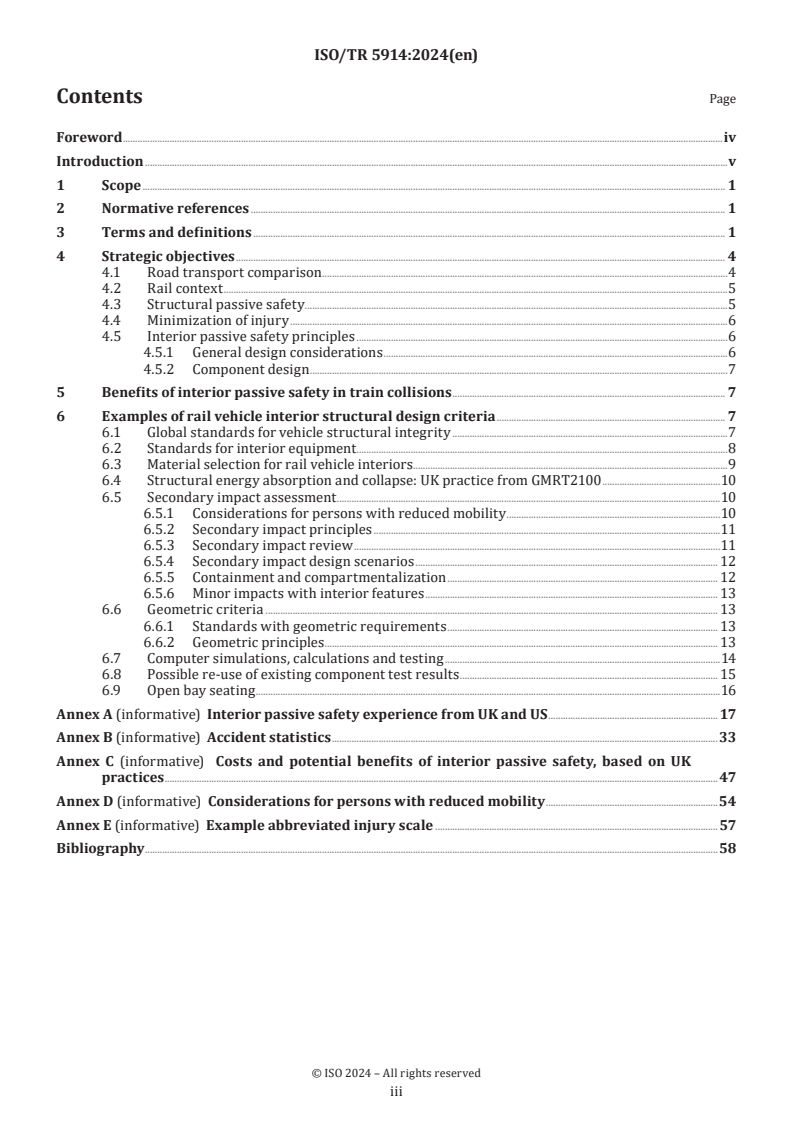
Contents Page
Foreword .iv
Introduction .v
1 Scope . 1
2 Normative references . 1
3 Terms and definitions . 1
4 Strategic objectives . 4
4.1 Road transport comparison . .4
4.2 Rail context .5
4.3 Structural passive safety .5
4.4 Minimization of injury .6
4.5 Interior passive safety principles .6
4.5.1 General design considerations .6
4.5.2 Component design .7
5 Benefits of interior passive safety in train collisions . 7
6 Examples of rail vehicle interior structural design criteria . 7
6.1 Global standards for vehicle structural integrity .7
6.2 Standards for interior equipment .8
6.3 Material selection for rail vehicle interiors.9
6.4 Structural energy absorption and collapse: UK practice from GMRT2100 .10
6.5 Secondary impact assessment .10
6.5.1 Considerations for persons with reduced mobility .10
6.5.2 Secondary impact principles .11
6.5.3 Secondary impact review .11
6.5.4 Secondary impact design scenarios . 12
6.5.5 Containment and compartmentalization . 12
6.5.6 Minor impacts with interior features . 13
6.6 Geometric criteria . 13
6.6.1 Standards with geometric requirements . 13
6.6.2 Geometric principles . 13
6.7 Computer simulations, calculations and testing .14
6.8 Possible re-use of existing component test results . 15
6.9 Open bay seating .16
Annex A (informative) Interior passive safety experience from UK and US . 17
Annex B (informative) Accident statistics .33
Annex C (informative) Costs and potential benefits of interior passive safety, based on UK
practices . 47
Annex D (informative) Considerations for persons with reduced mobility .54
Annex E (informative) Example abbreviated injury scale .57
Bibliography .58
iii
Foreword
ISO (the International Organization for Standardization) is a worldwide federation of national standards
bodies (ISO member bodies). The work of preparing International Standards is normally carried out through
ISO technical committees. Each member body interested in a subject for which a technical committee
has been established has the right to be represented on that committee. International organizations,
governmental and non-governmental, in liaison with ISO, also take part in the work. ISO collaborates closely
with the International Electrotechnical Commission (IEC) on all matters of electrotechnical standardization.
The procedures used to develop this document and those intended for its further maintenance are described
in the ISO/IEC Directives, Part 1. In particular, the different approval criteria needed for the different types
of ISO document should be noted. This document was drafted in accordance with the editorial rules of the
ISO/IEC Directives, Part 2 (see www.iso.org/directives).
ISO draws attention to the possibility that the implementation of this document may involve the use of (a)
patent(s). ISO takes no position concerning the evidence, validity or applicability of any claimed patent
rights in respect thereof. As of the date of publication of this document, ISO had not received notice of (a)
patent(s) which may be required to implement this document. However, implementers are cautioned that
this may not represent the latest information, which may be obtained from the patent database available at
www.iso.org/patents. ISO shall not be held responsible for identifying any or all such patent rights.
Any trade name used in this document is information given for the convenience of users and does not
constitute an endorsement.
For an explanation of the voluntary nature of standards, the meaning of ISO specific terms and expressions
related to conformity assessment, as well as information about ISO’s adherence to the World Trade
Organization (WTO) principles in the Technical Barriers to Trade (TBT), see www.iso.org/iso/foreword.html.
This document was prepared by Technical Committee ISO/TC 269, Railway applications, Subcommittee SC 2,
Rolling stock.
Any feedback or questions on this document should be directed to the user’s national standards body. A
complete listing of these bodies can be found at www.iso.org/members.html.
iv
Introduction
It is generally accepted that avoiding collisions is a key operating principle of railway systems. This can be
achieved, for example, by dedicated lines, eliminating level crossings and providing sophisticated control
(signalling) systems.
The safety performance of railways has improved significantly in recent years, to the extent that train
crashes, derailments and overturning are now very rare events. However, this document includes evidence
which suggests that, despite advancements in train control and other active safety measures, these incidents
will continue to occur, albeit at a much-reduced rate of incidence. Collisions and derailments can still occur
due to incidents such as infrastructure failures, landslides or incursions from road traffic.
Railway administrations in different countries have conducted extensive accident investigations and
research into collision events. These and other countries have reached consensus that there is benefit in
managing collision energy and vehicle dynamics in collision conditions. This is achieved by designing rail
vehicle structures to have better collision performance in certain prescribed conditions; such vehicles are
said to have a “crashworthy structural design”.
Many countries have static structural standards; these are complemented (e.g. in Europe and North America)
with structural crashworthiness standards. The aims of crashworthy structural designs are generally to:
— reduce the risk of vehicles overriding;
— absorb collision energy in a controlled manner;
— maintain survival space and structural integrity of the occupied areas;
— limit the car body deceleration;
— reduce the risk of derailment;
— limit the consequences of hitting an obstruction on the track.
Some countries have investigated the effect of train crashes on passengers in rail vehicles, aiming to establish
a causal link between occupant fatalities or injuries and the design and layout of train interior fixtures,
such as seats, tables, luggage racks, stanchions and interior glazing. These investigations culminated in the
modelling and testing of deceleration events, as prescribed for the crashworthy structural design, to apply
measures to the design of rail vehicle interiors which provide a favourable environment for passengers and
staff in these conditions. These measures are collectively considered as interior passive safety and will aid:
— containment;
— compartmentalization;
— reducing and controlling the risk of injuries in secondary impacts that occupants can experience in train
crashes and derailments, by incorporating energy absorption in seats and tables and non-aggressive
shapes for interior equipment (tables, grab poles, seats, luggage racks).
Specifically, the aim of interior passive safety is to reduce injuries and injury severity to limits which are
not life threatening, nor a threat to mobility or cognitive function. However, it is recognized that in the
catastrophic and chaotic events associated with vehicle collisions, derailments and overturning, passenger
injuries will still occur.
Interior passive safety principles are based on extensive research (e.g. the European Union (EU)-funded
SafeInteriors research project (2006–2010), and work conducted by the US Department of Transportation
(DoT) Federal Railroad Administration (FRA) and the Volpe National Transportation Systems Center).
This research has concluded that the aims of preventing occupant fatalities, and reducing the number and
severity of injuries, are best achieved through combining vehicle structural crashworthiness with interior
passive safety.
v
Application of the principles of interior passive safety can also be expected to reduce the consequences of
minor incidents, such as slips, trips and falls, that can result from unexpected vehicle movements caused by,
for example, emergency braking or track irregularities.
This document describes the worldwide state of the art regarding interior passive safety on passenger rail
vehicles.
vi
Technical Report ISO/TR 5914:2024(en)
Railway applications — Rolling stock — Interior passive safety
1 Scope
This document reports worldwide best practice to minimize the risk of death and injury to occupants of rail
vehicles in the event of a collision or derailment.
This document investigates recent interior designs for passenger areas in heavy rail vehicles (e.g. coaches,
fixed units, trainsets), including refurbished interiors.
2 Normative references
The following documents are referred to in the text in such a way that some or all of their content constitutes
requirements of this document. For dated references, only the edition cited applies. For undated references,
the latest edition of the referenced document (including any amendments) applies.
EN 17343:2023, Railway applications – General terms and definitions
3 Terms and definitions
For the purposes of this document, the terms and definitions given in EN 17343:2023 and the following apply.
ISO and IEC maintain terminology databases for use in standardization at the following addresses:
— ISO Online browsing platform: available at https:// www .iso .org/ obp
— IEC Electropedia: available at https:// www .electropedia .org/
3.1
structural passive safety
crash energy management
CEM
design to preserve the structural integrity of a rail vehicle during a collision or derailment
Note 1 to entry: It usually includes the objectives of reducing the risk (3.19) of derailment and overriding, providing
survival space (3.2) for occupants, and minimizing the risk of detached or loose objects or debris.
3.2
survival space
residual space
portion of the vehicle interior designed to have limited or no structural deformation
Note 1 to entry: This can apply both to the general vehicle structure and to smaller subdivisions such as the space
between seats or between a seat and a table.
Note 2 to entry: In terms of occupant interior passive safety, this is regarded as the space required for an occupant to
survive and to avoid crush-type injury and entrapment.
3.3
containment
keeping occupants within vehicles
Note 1 to entry: Containment predominantly prevents occupant excursion via windows and doors.
3.4
compartmentalization
control of occupant trajectory length within a vehicle
Note 1 to entry: This generally refers to an interior design strategy with the goal of limiting occupants’ travel within
a small, defined space during a collision, i.e. between rows of seats, or a seat and table, to prevent occupants from
travelling large distances and impacting other more hostile objects with larger velocities.
3.5
primary impact
collision of a rail vehicle with another rail vehicle or an obstacle on the track
3.6
secondary impact
contact of an occupant with a fixed interior feature, or another occupant or occupants, following a primary
impact (3.5) or other accident
3.7
proof load
load which represents, or is intended to be equivalent to, an exceptional maximum load that can be
encountered when in normal service and which, when applied and removed, results in no damage, loosening
of fixings or deformation that would require repair or replacement
Note 1 to entry: Normally, a proof load is a static or quasi-static load which has been derived from more complex
dynamic conditions.
[1]
[SOURCE: UNIFE REF 001 , 3.17]
3.8
ultimate load
load which represents, or is intended to be equivalent to, an exceptional load outside of normal service
conditions due to overloading or accident which can result in significant damage or permanent deformation
that will require repair or replacement
Note 1 to entry: An ultimate load may be a static, quasi-static or dynamic load.
3.9
slips, trips and falls
accidental or involuntary movement of a person arising from and/or resulting in contact with an object or surface
Note 1 to entry: A person can slip when they lose their footing, trip when they catch a foot on or in something, and fall
when they come down suddenly.
Note 2 to entry: Slipping is defined to be a fall because of sliding due to a sudden loss of all or part of the support base
(the area spread by the feet and any other support) in a way that the gravity line moves beyond the support area.
Tripping is most often caused by an obstruction, followed by uneven surfaces, preventing normal foot movements and
leading to a loss of balance. The size and location of any defects affects the severity of the trip. Finally, falling is usually
[2][3]
defined to be a fall from a height.
3.10
handhold
handrail
any device on board a transport vehicle that is designed to allow passengers to use their hand grip to
manoeuvre through the vehicle or provide passengers with a more stable ride while on board the vehicle
[4]
[SOURCE: ISO 10865-1:2012 , 3.4, modified — Admitted term “grab bar” deleted.]
3.11
grab rail
handhold (3.10) designed to support and to permit transfer of body weight, usually found in locations
adjacent to showers, bathtubs, WC suites, and wash basins in a bathroom or toilet
[5]
[SOURCE: ISO 6707-1:2020 , 3.3.2.76, modified — Admitted term “grab bar” deleted.]
3.12
light injury
moderate injury
person who is hospitalized for one day to three days or requires one day to three weeks off work
Note 1 to entry: See also minor injury (3.13), serious injury (3.14) and life threatening (3.15). These definitions vary
[6]
between countries. ISO/TS 17755-2 relates predominantly to fires in buildings.
Note 2 to entry: For the technical evaluation of occupant injury, the abbreviated injury scale (AIS, see Annex E) is used
by researchers and accident investigators to evaluate levels of attributed injury. The AIS system is an anatomically
based injury severity scoring system. It is linked to injury acceptance reference values (IARVs) or injury criteria used
by some countries to limit the injury potential of train furniture.
[6]
[SOURCE: ISO/TS 17755-2:2020 , 3.57, modified — Cross-reference to “fire injury” deleted and additional
sentences added in Note 1 to entry. Note 2 to entry added.]
3.13
minor injury
person who is hospitalized or off work for less than one day
Note 1 to entry: See also light injury (3.12), serious injury (3.14) and life threatening (3.15). These definitions vary
[6]
between countries. ISO/TS 17755-2 relates predominantly to fires in buildings.
Note 2 to entry: See also Note 2 to entry in 3.12.
[6]
[SOURCE: ISO/TS 17755-2:2020 , 3.61, modified — Cross-reference to “fire injury” deleted and additional
sentences added in Note 1 to entry. Note 2 to entry added.]
3.14
serious injury
person who is hospitalized for four days or more or has more than three weeks off work
Note 1 to entry: See also minor injury (3.13), light injury (3.12) and life threatening (3.15). These definitions vary
[6]
between countries. ISO/TS 17755-2 relates predominantly to fires in buildings.
Note 2 to entry: See also Note 2 to entry in 3.12.
[6]
[SOURCE: ISO/TS 17755-2:2020 , 3.73, modified — Cross-reference to “fire injury” deleted and additional
sentences added in Note 1 to entry. Note 2 to entry added.]
3.15
life threatening
injured person who must immediately receive emergency rescue and medical treatment to prevent a certain
and impending death
Note 1 to entry: See also minor injury (3.13), light injury (3.12) and serious injury (3.14). These definitions vary between
[6]
countries. ISO/TS 17755-2 relates predominantly to fires in buildings.
[6]
[SOURCE: ISO/TS 17755-2:2020 , 3.56, modified — Cross-reference to “fire injury” deleted and additional
sentences added in Note 1 to entry.]
3.16
fatality
death
person who has died as a result of injuries sustained during an accident
Note 1 to entry: In this context, there is no limitation of time after the accident. Fatalities also include death from
natural or accidental causes sustained while involved in the activities of attempting rescue or escaping from the
dangers of the accident.
Note 2 to entry: Fatalities are composed of all persons discovered or declared dead at the location of the accident,
during their transportation to the hospital or after their admission to the hospital.
[6]
Note 3 to entry: These definitions vary between countries; ISO/TS 17755-2 relates predominantly to fires in
buildings.
[6]
[SOURCE: ISO/TS 17755-2:2020 , 3.37, modified — Terms “fatal casualty” and “fatal injury” deleted.
References to fire either replaced by “accident” or deleted in the terms, definition and notes to entry. “including
blast and defenestration, except when a death occurred in sites with the right of extraterritoriality” deleted
from Note 1 to entry. Note 3 to entry added.]
3.17
value of preventing a fatality
VPF
sum of money used in cost benefit analysis (3.18) for the valuation of safety benefits and disbenefits in
decision-making processes
3.18
cost benefit analysis
CBA
means used to assess the relative cost and benefit of a number of risk reduction (3.20) alternatives
[7]
[SOURCE: ISO/TS 16901:2022 , 3.7, modified — Note 1 to entry deleted.]
3.19
risk
combination of the probability of occurrence of harm and the severity of that harm
[8]
[SOURCE: ISO/IEC Guide 51:2014 , 3.9, modified — Note 1 to entry deleted.]
3.20
risk reduction
actions or means to eliminate hazards or reduce risks (3.19)
[9]
[SOURCE: ISO 10377:2013 , 2.22]
3.21
fatalities and weighted injuries
FWI
composite measure of risk (3.19) or harm that combines fatalities (3.16) with physical injuries and cases of
shock/trauma, which are weighted according to their relative severity
Note 1 to entry: The measurement is the number of fatalities, serious injuries (3.14) and minor injuries (3.13) from
the consequences of accidents, where 1 serious injury is considered equivalent to 0,1 fatalities, and 1 minor injury is
considered equivalent to 0,01 fatalities.
[10]
[SOURCE: RSSB , modified — Note 1 to entry added.]
4 Strategic objectives
4.1 Road transport comparison
Although travel by rail is generally safer than by car or bus, many of the safety measures adopted in the
United Kingdom (UK) and the United States of America (US) are derived from the automotive industry, as
described in the following paragraphs.
[11]
European automotive regulations (UN/ECE 80 ) require impact testing using a sled to achieve a change of
velocity (Δv) of between 30 km/h and 32 km/h (8,3 m/s to 8,9 m/s); this gives acceleration levels between
8g and 12g.
It is worth noting that the reduced levels of acceleration (and the increased time period of the pulse) set
[14]
out in GMRT2100 are based on trains being significantly heavier than road vehicles, and that there
is potentially more space in the front of a rail vehicle to provide a “crumple zone” than in a road vehicle.
Clause A.2 describes the derivation of the pulse.
[15]
US automotive regulations 49 CFR 571_208 (FMVSS208) : The platform is decelerated from 48 km/h to
0 km/h (30 mph to 0 mph) in a distance of not more than 0,914 m (3 feet), without change of direction and
without transverse or rotational movement during the deceleration of the platform and the departure of
the vehicle. The deceleration rate is at least 20g for a minimum of 0,04 s. This therefore gives a change of
[11]
velocity (Δv) of at least 0,04 × 20 × 10 = 8 m/s; which is similar to UN/ECE 80 .
In 2023, the US DoT FRA developed an “Engineers’ Protection System” (comprising an airbag and knee
[16]
bolster fitted in the driver’s cab). The analysis and testing thereof used a test pulse derived from the
acceleration measured in the engineer’s cab during a single multilevel rail car impact with a rigid wall at
58,9 km/h (36,6 mph).
[17]
The APTA standard for seats (APTA PR-CS-S-016-99, Rev. 3.1, 2023 ) uses a scaled version of the aerospace
[18]
crash test pulse in SA AS8049 . This is a triangular pulse, maximum 8g over 250 ms, giving a minimum Δv
of 35,3 km/h (21,95 mph or 9,81 m/s).
Some recent work conducted by Transport Research Laboratory (TRL) for Transport for London in the
UK assessed the potential reduction in injuries on buses simply by implementing geometric criteria (e.g.
eliminating or relocating sharp edges).
4.2 Rail context
Rail systems aim to transport passengers and goods from place to place safely, comfortably and
economically. Active train control systems play a major part in this, notably in reducing the number of
train collisions; however, unforeseen circumstances still occur which can lead to collisions or derailments.
Such circumstances are often outside the immediate control of the railway system, such as weather-related
events or incursions of obstacles (such as debris, landslips and road vehicles) into the railway.
Further, operational events such as emergency braking, coupling trains in operation, and traversing switches
and crossings lead to accelerations affecting occupants.
Annex A gives further details of the application of interior passive safety on rail vehicles in the UK and the US.
4.3 Structural passive safety
There exist many examples worldwide of static structural standards, and these are complemented by rail
vehicle design standards for dynamic structural crashworthiness in North America and Europe. These aim
to preserve the structural integrity of the interior during a collision or derailment, with the objectives of
preserving occupant survival space and minimizing the risk from detached or loose objects or debris.
[19]
For example, EN 15227:2020 states:
“The objective of the passive safety requirements described in this European Standard is to reduce the
consequences of collision accidents. The measures considered in this European Standard provide the
means of protection when all possibilities of preventing an accident have failed. It provides a framework
for determining the crash conditions that rail vehicle bodies can be designed to withstand, based on the
most common collisions and associated risks.
[20]
This European Standard adds to the basic strength requirement defined in EN 12663-1:2010+A1:2014
by setting additional requirements for structural passive safety in order to increase occupant safety in
case of collisions.
In the event of a collision, application of this European standard provides protection for the occupants
of new designs of crashworthy vehicles through the preservation of structural integrity, reducing the
risk of overriding and limiting decelerations. This protection does not extend to interactions between
the occupants and the vehicle interior …” © CEN, reproduced with permission
Interior passive safety is therefore generally considered in the context of the first principle of vehicle
structural design and structural passive safety, i.e. the use of structural passive safety components to
preserve space and limit longitudinal decelerations up to specific collision speeds. Structural passive safety
also helps to prevent override and lateral buckling. Experience of crash tests varies between countries,
with some reporting reductions in fatalities and injuries from structural passive safety alone in relatively
high-speed collisions, while in other cases, the use of structural passive safety without considering interior
[21]
passive safety has led to increases in injuries from secondary impacts. Therefore, in general, it is
concluded that designing the interior to control secondary impacts is necessary to reduce the risk and/or
the severity of injuries.
4.4 Minimization of injury
The second principle of interior passive safety is to minimize the risk of injury to train occupants in the
event of a collision or derailment. Even if the possibility of injury cannot be eliminated, the seriousness of
potential injuries can at least be reduced; this improves the chances of injured persons being able to evacuate
themselves.
A further outcome is a likely reduction in the injuries to occupants arising from slips, trips and falls, by
minimizing or eliminating sharp contours and edges.
If there remains sufficient occupant survival space, and interior components such as seats, tables, fire
extinguishers, etc. have not detached from the structure, minimization of occupant injuries is achieved by
the following three main control measures:
a) Containment of occupants:
— to prevent occupants from being ejected from the vehicle by careful design of doorways (e.g.
[22] [23]
EN 14752 ) and glazing (e.g. ISO 22752 ).
b) Compartmentalization:
— in the event of a collision or derailment, occupants are contained within a small area of the vehicle
(e.g. between rows of seats, between a seat and table) and, equally, that heavy items such as luggage
or on-board equipment are contained in their respective areas.
c) Reduction of the consequences of secondary impacts:
— minimizing the trajectory length of an occupant before collision with interior fitments or another
occupant by careful design of seats, tables, partitions and luggage racks;
[24]
— careful design of interior components, including glazing (see EN 17530 ) to reduce point loads on
the human body, and avoiding trapping risks by good geometric design and selection of materials
[25] [26] [27]
(see JIS E 7103 , JIS E 7104 and JRIS R 1010 );
— consideration of the potential impact surface, e.g. impact surface mechanical performance and its
ability to absorb impact energy, and the shape of features and components.
Careful design of the interior of a rail vehicle can also reduce the risk of injuries from other mechanisms
such as:
— electric shocks from damaged electrical fittings or exposed wiring;
— injuries from broken glass in windows, partitions and draught screens.
4.5 Interior passive safety principles
4.5.1 General design considerations
[28]
Experience from research and accident investigations in the UK (see RSSB Report T910 ) and the US (see
Clause B.2) has shown that the vehicle layout, in particular the seating and the arrangement of screens,
partitions and grab rails or poles, plays a key role in determining potential trajectories for occupants in the
event of a collision.
NOTE Annex B contains examples of accident statistics from various countries.
Inside the vehicle, compartmentalization measures have the objective of managing the risk of uncontrolled
movement of occupants in the vehicle interior space. Vehicle interior layouts that offer good levels of
compartmentalization limit the length and number of potential trajectories from a given occupant location
(seated or standing) and therefore reduce the risk of injury.
Interior layouts are subject to a wider range of, sometimes contradictory, considerations, for example:
— operational needs and aspirations, including passenger density, boarding and alighting times;
— the type of service (distance, speed, duration);
— vehicle ambience and security.
4.5.2 Component design
It is intended that, once a component design is successfully validated (e.g. for a seat or table), it can be used
in another vehicle design without the need for further validation, when the vehicle category is similar, and
the installation is mechanically equivalent. Validation can consist of calculations, static or dynamic testing,
or a combination thereof.
When satisfactorily completed, the component can then be used in a wide range of vehicle layouts provided
that the limiting, worst case, conditions tested are not exceeded. It is therefore acceptable for a component,
having been successfully tested, to be used in a given vehicle interior without recourse to further testing,
provided that the effective design limits established are not exceeded.
5 Benefits of interior passive safety in train collisions
As indicated in the introduction of this document, train crashes, derailments and overturning are very rare
events. Because of this, there is very little data upon which to base a realistic analysis of the direct benefits
of interior passive safety measures.
However, it is considered that these measures are likely to lead to reductions in the number and severity of
injuries in collisions and derailments, which in turn lead to a better chance of escape. For example, a vehicle
interior designed with these principles can reduce the risk of an occupant sustaining a head injury or a
broken limb, which is likely to mean that the occupant is able to self-evacuate in the event that the train was
involved in an accident.
Other perceived benefits would include reduced injuries and their severities in “other incidents” (see
[29] [30]
LOC&PAS TSI clause 7.5.2 and Powell & Fletcher . There is also the potential for improvements to
reputation and the public perception of the safety of travelling by rail, even extending to reductions in
lawsuits.
The RSSB Business Case for GMRT2100 issue 4 (Annex F of Reference [31]) gave a benefit to cost ratio of
1,9 based on reductions in injuries from slips, trips and falls alone (thus ignoring the benefits of improved
signalling systems in preventing collisions).
Further details of potential benefits and costs are given in Annex C.
6 Examples of rail vehicle interior structural design criteria
6.1 Global standards for vehicle structural integrity
In Europe, high-level legislation for mainline passenger rail vehicle structural integrity is set out in the
[29] [32]
LOC&PAS TSI (the equivalent being the NTSN in the UK). The TSI requires compliance to parts of the
[20] [19]
European standards EN 12663-1 and EN 15227 , which would otherwise be voluntary standards.
[33]
In the US, Passenger Equipment Safety Standards 49 CFR 238 are federal regulations required by law.
These are supported by (voluntary) APTA standards shown in Table 1.
Table 1 — Selection of APTA standards for passenger rail vehicles
Reference Title
[34]
APTA PR-CS-RP-001-98 Passenger Equipment Roof Emergency Access
[35]
APTA PR-CS-RP-003-98 Developing a Clearance Diagram for Passenger Equipment
[36]
APTA PR-CS-RP-019-12 Pushback Coupler in Passenger Rail Equipment
[37]
APTA PR-CS-S-020-03 Passenger Rail Vehicle Structural Repair
[38]
APTA PR-CS-S-034-99 Design and Construction of Passenger Railroad Rolling Stock
Other rail vehicle structural standards and codes are listed in Table 2.
Table 2 — Other rail vehicle structural standards and codes
Reference Title
[39]
PRIIA 305 (US) Requirements Document For PRIIA Diesel-Electric Passenger Locomotives
[40]
UIC 566 (worldwide) Loadings of coach bodies and their components
[41]
TB/T 3548 (China) Strength design and test accreditation specification for rolling stock — General
[42]
TB/T 3500 (China) Crashworthiness requirements and verification specification for car body of EMU/DMU
[43]
TB/T 3501 (China) Test method for crash test of rolling stock
[25]
JIS E 7103 (Japan) Rolling Stock – General requirements of car body for passenger car
[44]
JIS E 7105 (Japan) Rolling stock – Test methods of static load for body structures
[45]
JIS E 7106 (Japan) Rolling Stock – Car body structure for passenger cars – General rules for design
6.2 Standards for interior equipment
[23]
ISO 22752 (bodyside windows) contains static loading requirements which are relevant to the safety of
rail vehicle occupants.
[22] [24]
The same can be said of the European Standards EN 14752 (doors) and EN 17530 (interior glazing).
[22] [29] [40]
EN 14752 is called up in the LOC&PAS TSI . UIC 566 includes proof loading requirements for interior
equipment such as luggage racks, coat hooks, seats, tables and doors.
[14]
GMRT2100 is the Railway Group Standard in the UK for rail vehicle structures. GMRT2100 issue
[13]
four and later issues include aspects of interior passive safety based on the outcomes of the European
SafeInteriors research programme and research required to satisfy various recommendations made by
various public inquiries into UK rail disasters.
It was originally intended that UIC and UNIFE would publish a joint Technical Recommendation document
[1]
(TecRec), but this never came to be. There exists a draft UNIFE Technical Report , and a UIC International
[46] [14]
Railway Solution (IRS 50564-3) , both of which have very similar content to GMRT2100 in respect
[14] [40] [46]
of interior passive safety. GMRT2100 is mandatory in the UK. UIC 566 and the IRS are voluntary
standards.
The US APTA standards for passenger vehicle interior equipment are listed in Table 3.
Table 3 — US APTA standards for passenger vehicle interior equipment
Reference Title
[47]
APTA PR-CS-S-006-98 Attachment Strength of Interior Fittings for Passenger Railroad Equipment
[48]
APTA PR-CS-S-011-99 Cab Crew Seating Design and Performance
[49]
APTA PR-CS-S-012-02 Door Systems for New and Rebuilt Passenger Cars
[17]
APTA PR-CS-S-016-99 Passenger Seats in Passenger Railcars
[50]
APTA PR-CS-S-018-13 Fixed Workstation Tables in Passenger Rail Cars
[27]
Japanese standards for passenger vehicle interior equipment include JRIS R 1010 (luggage racks) and
[26] [25]
JIS E 7104 (passenger seats). Further, Japanese standard JIS E 7103 requires that:
“the facility shall be designed to have sufficient strength taking such factors into consideration such
as the vibrations and impacts in running, the pushing force of hands or bodies of a passenger and
possibility that two or more passengers may use the same facility at the same time”.
[51] [52]
Chinese standards include TB/T 3263 (passenger seats) and TB/T 3286 (luggage racks and hat hooks).
[14] [53] [33]
Standards in the UK (GMRT2100 and RIS-2780-RST ) and the US (49 CFR 238 ) generally require
equipment fitted inside rail vehicles to be designed to meet the same load cases as set out for exterior-
[29]
mounted equipment. The European Technical Specification for Interoperability (TSI) also requires the
attachments of “fixed devices including those inside the passenger area” to be designed in accordance with
[20]
EN 12663-1 .
[47]
US Standard APTA PR-CS-S-006-98, Rev. 2, 2021 requires body mounted equipment generally to withstand
ultimate inertial accelerations of 8g longitudinal, 4g lateral and 4g vertical, applied separately. Given that in
[20]
EN 12663-1:2010+A1:2014 , there is a recommended ultimate factor of 1,5, the APTA accelerations are
slightly greater than the European requirements of 3g or 5g, 1g and (−1 ± 2)g, respectively.
Where there are specific static proof and ultimate loading requirements for interior mounted items (such
as seats, tables, grab handles, grab poles, grab rails and luggage stowage), and when the acceleration loads
[20]
set out in EN 12663-1:2010+A1:2014 applied on the corresponding mass are less severe than the specific
[20]
requirements, separate assessments against the acceleration loads set out in EN 12663-1:2010+A1:2014
are not always necessary because the specific requirements are derived from service and accident
[20]
conditions, are therefore more onerous and any requirements relating to EN 12663-1:2010+A1:2014 are
therefore satisfied.
To maintain a continuous load path for all load conditions and to absorb energy requires ductile behaviour.
Many interior elements will, however, use some non-ductile components (e.g. a table), where the tabletop is
often made from a non-ductile composite or wood-based material, but the legs and mountings are made from
ductile materials such as steel or aluminium. As a result, the overall assembly or sub-structure can exhibit
the desired behaviour when overloaded through plastic deformation of the ductile parts when subject to the
loadings set out in this document.
It is accepted practice for what can be considered minor items, where an installation has been used for an
extended period in service in a similar or more arduous environment and has performed satisfactorily with
no records of consistent unscheduled maintenance, this can be taken as evidence of acceptable performance.
Where adopted, this approach is generally documented.
In some cases, quasi-static inertia proof loads (mass × specified acceleration) have been applied dynamically
using a dynamic test pulse, scaled to the acceleration level required where necessary. The required
acceleration level is sustained for at least 80 ms for consistency with the dynamic test pulse.
6.3 Material selection for rail vehicle interiors
Materials can play a part in achieving the aim of reducing the number and severity of occupant injuries
(e.g. from abrasion, lacerations or stab wounds) in the event that parts of a vehicle interior are fractured,
[14]
deformed or dislodged under impact conditions. This fact is recognized in GMRT2100 .
Therefore, the suitability of materials used in vehicle interiors, in addition to fulfilling structural and impact
requirements, usually takes into account other foreseeable material requirements, for example:
— fire
...