

ISO/TS 21089:2018
(Main)Health informatics — Trusted end-to-end information flows
General Information
- Abstract
ISO/TS 21089:2018 describes trusted end-to-end flow for health information and health data/record management. Health data is originated and retained, typically as discrete record entries within a trusted electronic health record (EHR), personal health record (PHR) or other system/device. Health data can include clinical genomics information. Health record entries have a lifespan (period of time managed by one or more systems) and within that lifespan, various lifecycle events starting with "originate/retain". Subsequent record lifecycle events may include "update", "attest", "disclose", "transmit", "receive", "access/view" and more. A record entry instance is managed ? over its lifespan ? by the source system. If record entry content is exchanged, this instance may also be managed intact by one or more downstream systems. Consistent, trusted management of record entry instances is the objective of this document, continuously and consistently whether the instance is at rest or in motion, before/during/after each lifecycle event, across one or more systems.
- Status
- Published
- Publication Date
- 08-Apr-2018
- Technical Committee
- ISO/TC 215 - Health informatics
- Drafting Committee
- ISO/TC 215/WG 2 - Systems and Device Interoperability
- Current Stage
- 9092 - International Standard to be revised
- Start Date
- 18-Nov-2025
- Completion Date
- 29-Aug-2026
Buy Documents



ISO/TS 21089:2018 - Health informatics -- Trusted end-to-end information flows

ISO/TS 21089:2018 - Health informatics — Trusted end-to-end information flows/9/2018
Overview
ISO/TS 21089:2018 - Health informatics - Trusted end-to-end information flows - is a Technical Specification that defines how health data and health record entries are to be managed in a trusted, consistent manner across their full lifespan. It describes lifecycle events for discrete record entries originating in systems such as EHRs (electronic health records), PHRs (personal health records) or devices, and specifies requirements to maintain trust whether data is at rest or in motion across multiple systems.
This first edition (2018) replaces ISO/TR 21089:2004 and aligns closely with ISO/HL7 10781:2015 and HL7 FHIR resources, including Record Lifecycle Event guidance.
Key Topics
- Record lifecycle management - defined events such as originate/retain, update/amend, attest, disclose, transmit, receive, access/view, and many others (e.g., de-identify, pseudonymize, re-identify, archive, destroy).
- Trust characteristics - provenance, authenticity, integrity, confidentiality, permanence, indelibility and chain of trust.
- Accountability and identity - roles for human and software/device agents, stewardship responsibilities and scope of accountability for record entries.
- Auditability and metadata - requirements for capturing lifecycle metadata, provenance and audit events to support traceability.
- Interoperability foundations - principles to ensure consistent behavior across systems and reference mappings to HL7 FHIR resources (informative annexes provide FHIR examples).
- Contexts for records - identity, clinical, data-integrity, administrative/operational and accountability contexts that must be preserved over lifecycle events.
Practical Applications
Who uses ISO/TS 21089:2018 and why:
- EHR and PHR vendors - to design systems that preserve provenance, integrity and audit trails for record entries.
- Health IT architects and integrators - to implement trusted end-to-end information flows across interoperable systems.
- Clinical informaticians and CIOs - to define policies for stewardship, access control, and lifecycle event handling.
- Data governance, privacy and compliance teams - to ensure traceability and support regulatory obligations around data authenticity and retention.
- Health researchers and genomic data managers - to manage sensitive clinical genomics data with required provenance and lifecycle controls.
Practical benefits include stronger data trustworthiness, improved audit trails, consistent handling of record instances across systems, and clearer roles/responsibilities for data stewardship.
Related Standards
- ISO/HL7 10781:2015 (record lifecycle alignment)
- HL7 Fast Health Interoperable Resources (FHIR) - guidance and Annex mappings (AuditEvent, Provenance, RLE IG)
Keywords: ISO/TS 21089:2018, trusted end-to-end information flows, health informatics, EHR, PHR, record lifecycle, provenance, auditability, HL7 FHIR.
Relations
- Referred By
EN ISO 27789:2021 - Health informatics - Audit trails for electronic health records (ISO 27789:2021) - Effective Date
- 25-Aug-2026
- Effective Date
- 25-Aug-2026
- Effective Date
- 05-Jul-2014
Buy Documents
ISO/TS 21089:2018 - Health informatics -- Trusted end-to-end information flows
ISO/TS 21089:2018 - Health informatics — Trusted end-to-end information flows/9/2018
Get Certified
Connect with accredited certification bodies for this standard

BSI Group
BSI (British Standards Institution) is the business standards company that helps organizations make excellence a habit.

NYCE
Mexican standards and certification body.
Sponsored listings
Frequently Asked Questions
ISO/TS 21089:2018 is a technical specification published by the International Organization for Standardization (ISO). Its full title is "Health informatics — Trusted end-to-end information flows". This standard covers: ISO/TS 21089:2018 describes trusted end-to-end flow for health information and health data/record management. Health data is originated and retained, typically as discrete record entries within a trusted electronic health record (EHR), personal health record (PHR) or other system/device. Health data can include clinical genomics information. Health record entries have a lifespan (period of time managed by one or more systems) and within that lifespan, various lifecycle events starting with "originate/retain". Subsequent record lifecycle events may include "update", "attest", "disclose", "transmit", "receive", "access/view" and more. A record entry instance is managed ? over its lifespan ? by the source system. If record entry content is exchanged, this instance may also be managed intact by one or more downstream systems. Consistent, trusted management of record entry instances is the objective of this document, continuously and consistently whether the instance is at rest or in motion, before/during/after each lifecycle event, across one or more systems.
ISO/TS 21089:2018 describes trusted end-to-end flow for health information and health data/record management. Health data is originated and retained, typically as discrete record entries within a trusted electronic health record (EHR), personal health record (PHR) or other system/device. Health data can include clinical genomics information. Health record entries have a lifespan (period of time managed by one or more systems) and within that lifespan, various lifecycle events starting with "originate/retain". Subsequent record lifecycle events may include "update", "attest", "disclose", "transmit", "receive", "access/view" and more. A record entry instance is managed ? over its lifespan ? by the source system. If record entry content is exchanged, this instance may also be managed intact by one or more downstream systems. Consistent, trusted management of record entry instances is the objective of this document, continuously and consistently whether the instance is at rest or in motion, before/during/after each lifecycle event, across one or more systems.
ISO/TS 21089:2018 is classified under the following ICS (International Classification for Standards) categories: 35.240.80 - IT applications in health care technology. The ICS classification helps identify the subject area and facilitates finding related standards.
ISO/TS 21089:2018 has the following relationships with other standards: It is inter standard links to EN ISO 27789:2021, EN ISO 10781:2025, ISO/TR 21089:2004. Understanding these relationships helps ensure you are using the most current and applicable version of the standard.
ISO/TS 21089:2018 is available in PDF format for immediate download after purchase. The document can be added to your cart and obtained through the secure checkout process. Digital delivery ensures instant access to the complete standard document.
Standards Content (Sample)
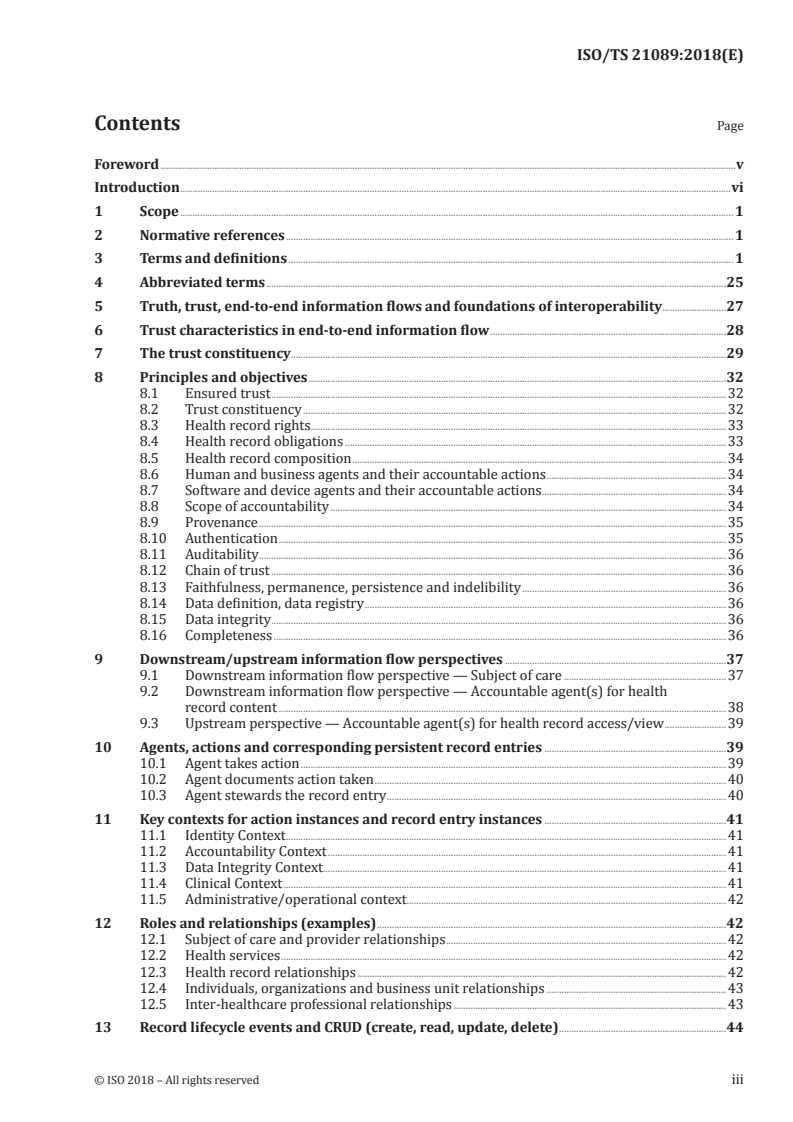
TECHNICAL ISO/TS
SPECIFICATION 21089
First edition
2018-04
Health informatics — Trusted end-to-
end information flows
Informatique de santé — Flux d'informations "trusted end-to-end"
Reference number
©
ISO 2018
© ISO 2018
All rights reserved. Unless otherwise specified, or required in the context of its implementation, no part of this publication may
be reproduced or utilized otherwise in any form or by any means, electronic or mechanical, including photocopying, or posting
on the internet or an intranet, without prior written permission. Permission can be requested from either ISO at the address
below or ISO’s member body in the country of the requester.
ISO copyright office
CP 401 • Ch. de Blandonnet 8
CH-1214 Vernier, Geneva
Phone: +41 22 749 01 11
Fax: +41 22 749 09 47
Email: copyright@iso.org
Website: www.iso.org
Published in Switzerland
ii © ISO 2018 – All rights reserved
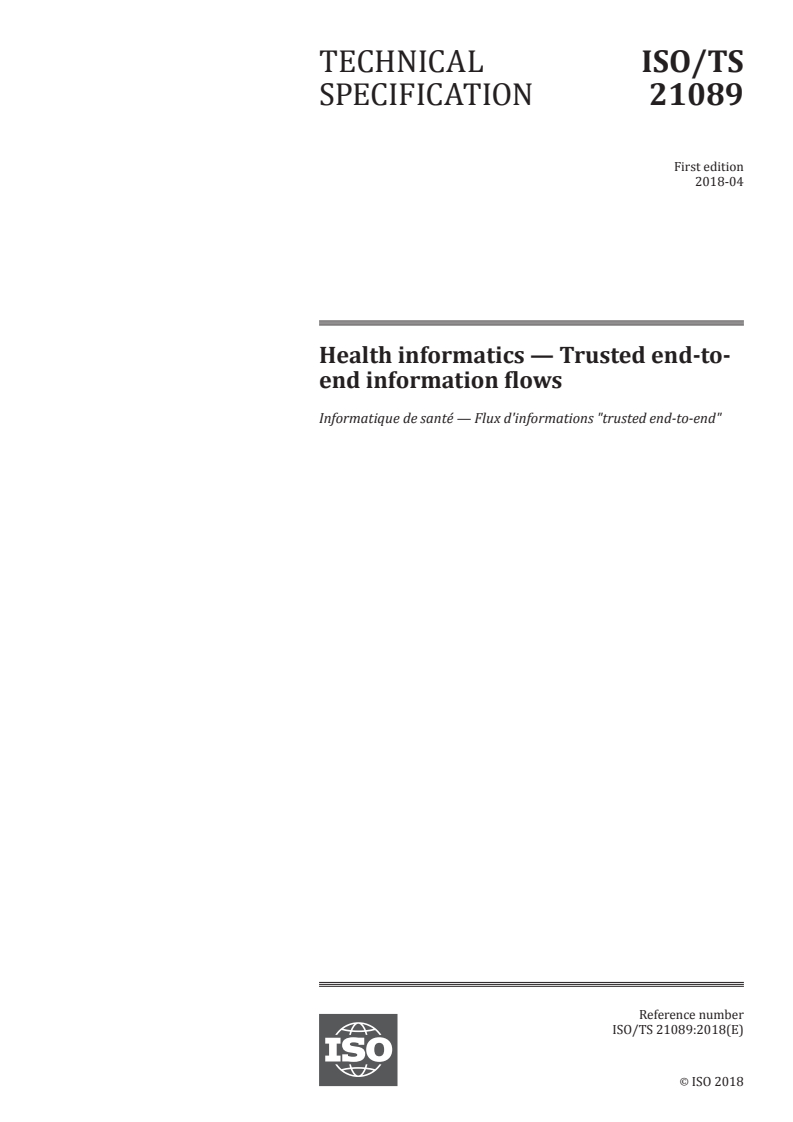
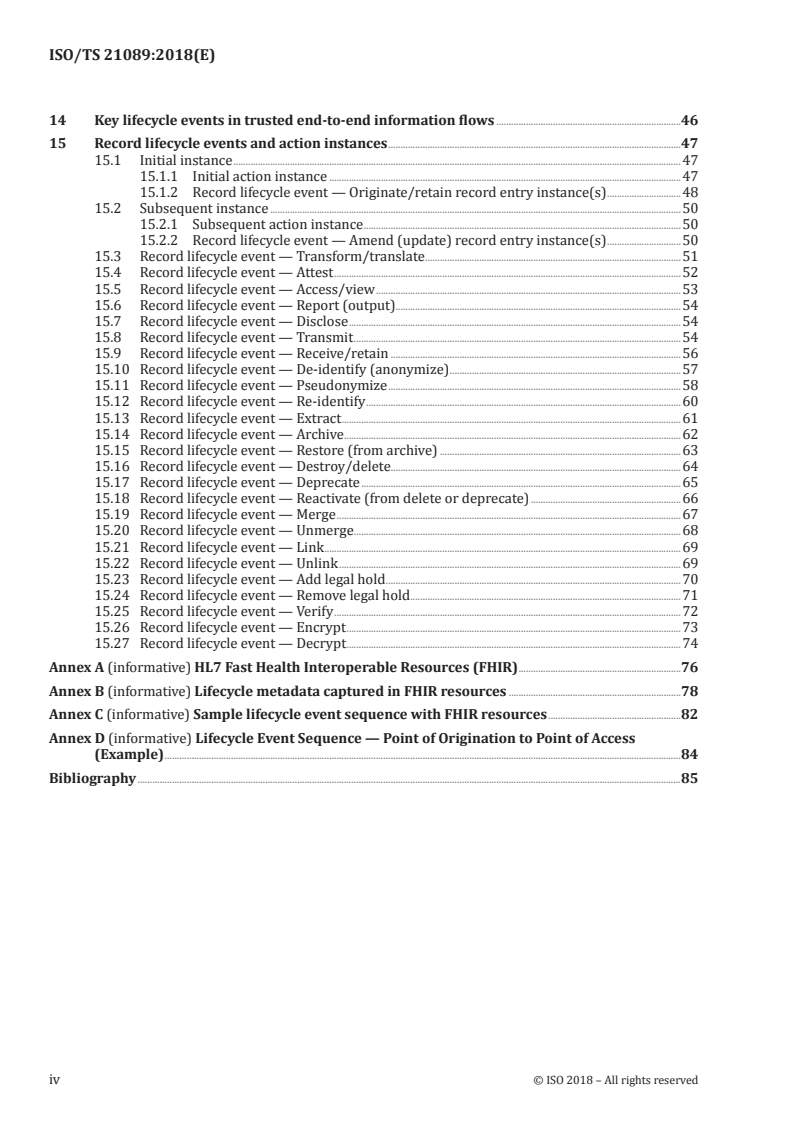
Contents Page
Foreword .v
Introduction .vi
1 Scope . 1
2 Normative references . 1
3 Terms and definitions . 1
4 Abbreviated terms .25
5 Truth, trust, end-to-end information flows and foundations of interoperability.27
6 Trust characteristics in end-to-end information flow .28
7 The trust constituency .29
8 Principles and objectives .32
8.1 Ensured trust .32
8.2 Trust constituency .32
8.3 Health record rights .33
8.4 Health record obligations .33
8.5 Health record composition .34
8.6 Human and business agents and their accountable actions .34
8.7 Software and device agents and their accountable actions.34
8.8 Scope of accountability .34
8.9 Provenance .35
8.10 Authentication .35
8.11 Auditability .36
8.12 Chain of trust .36
8.13 Faithfulness, permanence, persistence and indelibility .36
8.14 Data definition, data registry .36
8.15 Data integrity .36
8.16 Completeness .36
9 Downstream/upstream information flow perspectives .37
9.1 Downstream information flow perspective — Subject of care .37
9.2 Downstream information flow perspective — Accountable agent(s) for health
record content .38
9.3 Upstream perspective — Accountable agent(s) for health record access/view .39
10 Agents, actions and corresponding persistent record entries .39
10.1 Agent takes action .39
10.2 Agent documents action taken .40
10.3 Agent stewards the record entry .40
11 Key contexts for action instances and record entry instances .41
11.1 Identity Context .41
11.2 Accountability Context .41
11.3 Data Integrity Context.41
11.4 Clinical Context .41
11.5 Administrative/operational context.42
12 Roles and relationships (examples) .42
12.1 Subject of care and provider relationships .42
12.2 Health services .42
12.3 Health record relationships .42
12.4 Individuals, organizations and business unit relationships .43
12.5 Inter-healthcare professional relationships .43
13 Record lifecycle events and CRUD (create, read, update, delete) .44
14 Key lifecycle events in trusted end-to-end information flows .46
15 Record lifecycle events and action instances .47
15.1 Initial instance .47
15.1.1 Initial action instance .47
15.1.2 Record lifecycle event — Originate/retain record entry instance(s) .48
15.2 Subsequent instance .50
15.2.1 Subsequent action instance .50
15.2.2 Record lifecycle event — Amend (update) record entry instance(s) .50
15.3 Record lifecycle event — Transform/translate .51
15.4 Record lifecycle event — Attest .52
15.5 Record lifecycle event — Access/view .53
15.6 Record lifecycle event — Report (output).54
15.7 Record lifecycle event — Disclose .54
15.8 Record lifecycle event — Transmit .54
15.9 Record lifecycle event — Receive/retain .56
15.10 Record lifecycle event — De-identify (anonymize) .57
15.11 Record lifecycle event — Pseudonymize .58
15.12 Record lifecycle event — Re-identify .60
15.13 Record lifecycle event — Extract .61
15.14 Record lifecycle event — Archive .62
15.15 Record lifecycle event — Restore (from archive) .63
15.16 Record lifecycle event — Destroy/delete.64
15.17 Record lifecycle event — Deprecate .65
15.18 Record lifecycle event — Reactivate (from delete or deprecate) .66
15.19 Record lifecycle event — Merge .67
15.20 Record lifecycle event — Unmerge .68
15.21 Record lifecycle event — Link .69
15.22 Record lifecycle event — Unlink .69
15.23 Record lifecycle event — Add legal hold .70
15.24 Record lifecycle event — Remove legal hold .71
15.25 Record lifecycle event — Verify .72
15.26 Record lifecycle event — Encrypt .73
15.27 Record lifecycle event — Decrypt .74
Annex A (informative) HL7 Fast Health Interoperable Resources (FHIR) .76
Annex B (informative) Lifecycle metadata captured in FHIR resources .78
Annex C (informative) Sample lifecycle event sequence with FHIR resources .82
Annex D (informative) Lifecycle Event Sequence — Point of Origination to Point of Access
(Example) .84
Bibliography .85
iv © ISO 2018 – All rights reserved
Foreword
ISO (the International Organization for Standardization) is a worldwide federation of national standards
bodies (ISO member bodies). The work of preparing International Standards is normally carried out
through ISO technical committees. Each member body interested in a subject for which a technical
committee has been established has the right to be represented on that committee. International
organizations, governmental and non-governmental, in liaison with ISO, also take part in the work.
ISO collaborates closely with the International Electrotechnical Commission (IEC) on all matters of
electrotechnical standardization.
The procedures used to develop this document and those intended for its further maintenance are
described in the ISO/IEC Directives, Part 1. In particular the different approval criteria needed for the
different types of ISO documents should be noted. This document was drafted in accordance with the
editorial rules of the ISO/IEC Directives, Part 2 (see www .iso .org/directives).
Attention is drawn to the possibility that some of the elements of this document may be the subject of
patent rights. ISO shall not be held responsible for identifying any or all such patent rights. Details of
any patent rights identified during the development of the document will be in the Introduction and/or
on the ISO list of patent declarations received (see www .iso .org/patents).
Any trade name used in this document is information given for the convenience of users and does not
constitute an endorsement.
For an explanation on the voluntary nature of standards, the meaning of ISO specific terms and
expressions related to conformity assessment, as well as information about ISO's adherence to the
World Trade Organization (WTO) principles in the Technical Barriers to Trade (TBT) see the following
URL: www .iso .org/iso/foreword .html.
This document was prepared by Technical Committee ISO/TC 215, Health informatics.
This first edition of ISO/TS 21089 cancels and replaces ISO/TR 21089:2004, which has been technically
revised.
The main changes compared to ISO/TR 21089:2004 are as follows:
— transition from Technical Report (informative) to Technical Specification (normative);
— close alignment with ISO/HL7 10781:2015 and its specified record lifecycle events;
— close alignment with HL7 Fast Health Interoperable Resources (FHIR), Standard for Trial Use, 3rd
Edition (STU-3) (2017), including the FHIR Record Lifecycle Event Implementation Guide (RLE IG)
and two FHIR Resources AuditEvent and Provenance. See http: //www .hl7 .org/FHIR;
— incorporation of twenty-seven (27) record lifecycle events compared to fifteen (15) in the first
edition for more complete representation of end-to-end electronic health record management;
— comprehensive review and update of terms and definitions (Clause 3) to more completely specify
the range of health record lifespan and lifecycle events.
Introduction
This document describes requirements for health data/record management including identity,
accountability, provenance, authenticity, integrity, confidentiality, stewardship and interoperability
and addresses specific needs of health and healthcare stakeholders, in particular the individual subject
of care, the healthcare professional/caregiver, the healthcare provider organization, its business units
and the broader care community.
The trusted end-to-end information flows described herein offer necessary criteria for standards
developers and implementers of electronic health record and other record management systems,
including standards for data at rest (during retention) and data in motion (during exchange) within the
healthcare domain and provide guidance for software developers and vendors, healthcare providers
and end users.
vi © ISO 2018 – All rights reserved
TECHNICAL SPECIFICATION ISO/TS 21089:2018(E)
Health informatics — Trusted end-to-end information flows
1 Scope
This document describes trusted end-to-end flow for health information and health data/record
management. Health data is originated and retained, typically as discrete record entries within a
trusted electronic health record (EHR), personal health record (PHR) or other system/device. Health
data can include clinical genomics information.
Health record entries have a lifespan (period of time managed by one or more systems) and within that
lifespan, various lifecycle events starting with “originate/retain”. Subsequent record lifecycle events
may include “update”, “attest”, “disclose”, “transmit”, “receive”, “access/view” and more.
A record entry instance is managed – over its lifespan – by the source system. If record entry content is
exchanged, this instance may also be managed intact by one or more downstream systems. Consistent,
trusted management of record entry instances is the objective of this document, continuously and
consistently whether the instance is at rest or in motion, before/during/after each lifecycle event,
across one or more systems.
2 Normative references
There are no normative references in this document.
3 Terms and definitions
For the purposes of this document, the following terms and definitions apply.
ISO and IEC maintain terminological databases for use in standardization at the following addresses:
— ISO Online browsing platform: available at https: //www .iso .org/obp
— IEC Electropedia: available at https: //www .electropedia .org/
3.1
access, verb
obtain, open, inspect, review and/or make use of health data or information
Note 1 to entry: Access/View Record Lifecycle Event - occurs when an agent causes the system to obtain and
open a record entry for inspection or review.
Note 2 to entry: See view (3.156).
[SOURCE: CPRI, modified]
3.2
access control
means of ensuring that the resources of an electronic system can be accessed only by authorized
entities in authorized ways
Note 1 to entry: Alternatively, prevention of an unauthorized use of a resource, including the prevention of use of
a resource in an unauthorized manner.
[SOURCE: ISO/IEC 2382-8:1998, modified]
3.3.1
accountability
obligation of an individual or organization to account for its activities, for completion of a deliverable
or task, accept responsibility for those activities, deliverables or tasks, and to disclose the results in a
transparent manner
3.3.2
accountability
property that ensures that the actions of an entity can be traced uniquely to
the entity
[SOURCE: ISO 7498-2:1998, 3.3.3, modified]
3.4
accuracy
extent that recorded data reflect the actual underlying information
3.5
actor
with respect to an action, entity that participates in or observes that action
[SOURCE: ISO/IEC 15414:2015, modified]
3.6.1
agent
entity that takes conscious actions, such as an individual, organization, business unit
3.6.2
agent
entity that has been delegated (e.g. authority, a function) by and acts for another (in
exercising the authority, performing the function)
3.6.3
agent
individual, organization, business unit, medical device (e.g. instrument, monitor) and
software (e.g. application) which a) performs a role in the provision of healthcare services and/or b) is
accountable for actions related to, and/or c) ascribed in, the health record
[SOURCE: CEN 12265:2014, modified]
3.6.4
agent
entity that takes programmed actions, such as software or a device
3.6.5
agent
entity that bears some form of responsibility for an activity taking place, for the existence
of an entity, or for another agent's activity
3.7
aggregation
process to combine standardized data and information
[SOURCE: JCAHO, modified]
3.8.1
algorithm
process or set of rules to be followed in calculations or other problem-
solving operations, especially by a computer
2 © ISO 2018 – All rights reserved
3.8.2
algorithm
series of steps for addressing a specific issue
[SOURCE: JCAHO, modified]
3.9
amend
make changes in record content in order to make it fairer, more accurate, consistent, complete and/or
up-to-date
Note 1 to entry: Amend (Update) Record Lifecycle Event - occurs when an agent makes any change to record
entry content currently residing in storage considered permanent (persistent).
3.10
append
add information as an attachment or supplement to a previous record entry instance or object already
in existence
Note 1 to entry: It may be an attachment or supplement.
[SOURCE: HL7 RBAC, modified]
3.11
anonymize
remove personally identifying particulars or characteristics from record content so that the original
source or data subject cannot be known
Note 1 to entry: Anonymization is a sub-class of de-identification which is irreversible.
3.12
anonymous
anonymized
unnamed or unidentified
Note 1 to entry: It can include an unknown source or subject.
3.13
application
identifiable computer running a software process
Note 1 to entry: In this context, it may be any software process used in healthcare information systems including
those without any direct role in treatment or diagnosis.
Note 2 to entry: In some jurisdictions, software processes can be incorporated in regulated medical devices.
3.14
architecture
set of principles on which the logical structure and interrelationships to an organization and business
context are based
Note 1 to entry: Software architecture is the result of software design activity.
3.15
archive, verb
create, update or move an archive artifact with health record content for long-term, typically offline
storage, external to the source system
Note 1 to entry: Archive Record Lifecycle Event - occurs when an agent causes the system to create and move
archive artifacts containing record entry content, typically to long-term offline storage.
Note 2 to entry: Also, to store data by moving it to long-term storage media and deleting or purging that data
from the original online storage.
3.16
archival record
item of healthcare data saved for later reference or use, possibly off-line
[SOURCE: COACH, modified]
3.17.1
assurance
grounds for surety, certainty or confidence about something
[SOURCE: ISO/IEC 15408-1:2009, 3.1.4, modified]
3.17.2
assurance
grounds for confidence that an entity meets its claimed level of protection, including
security objectives
[SOURCE: OMG, modified]
3.17.3
assurance
development, documentation, testing, procedural and operational activities carried
out to ensure a system's services do in fact provide the claimed level of function, performance and
usability
[SOURCE: OMG, modified]
3.18.1
attest
declare that record entry content exists, is authentic, accurate and true and
therefore that it can be trusted
3.18.2
attest
declare that record entry content exists and is complete for the purpose intended
3.18.3
attest
provide or serve as clear evidence of and thus certify and record applicable administrative
(or “legal”) responsibility for a particular unit of information
Note 1 to entry: Attest Record Lifecycle Event - occurs when an agent causes the system to capture the agent’s
digital signature (or equivalent indication) during formal validation of record entry content.
3.19
audit, noun
audit control
mechanism employed to record and examine activities of an agent
3.20
audit, noun
independent review and examination of records and activities to assess the adequacy of
system controls, to ensure compliance with established policies and operational procedures, and to
recommend necessary changes in controls, policies or procedures
3.21.1
audit trail
audit log
record of the resources which were accessed and/or used by whom
[SOURCE: ISO 7498-2:1998, modified]
4 © ISO 2018 – All rights reserved
3.21.2
audit trail
documentary evidence of monitoring each operation (of
healthcare parties) on health information
[SOURCE: NRC, modified]
3.21.3
audit trail
chronological record of system activities that is sufficient to
enable the reconstruction, reviewing and examination of the sequence of environments and activities
surrounding or leading to an operation, a procedure, or an event in a transaction from its inception to
final results
[SOURCE: GCST]
3.22
authentic
what it purports to be
Note 1 to entry: Also, genuine and of undisputed origin; bona fide; based on facts, accurate and reliable.
3.23.1
authentication
process proving something is real, true, or genuine
3.23.2
authentication
process of verification of the integrity of data that have been captured, stored or transmitted
[SOURCE: GCST]
3.23.3
authentication
process of corroboration that the source of data received is as claimed
3.23.4
authentication
process to provide assurance regarding the claimed identity of an entity (e.g.
subject, user, author)
[SOURCE: ISO/IEC 10181-2:1996, 3.3, modified]
3.23.5
authentication
process to verify that an entry exists, is complete, accurate and final
[SOURCE: JCAHO, modified]
3.23.6
authentication
process to assure the identity of an object
[SOURCE: ASTM E1762: 2013, modified]
3.24
authorize
grant rights, which includes granting access based on access rights
[SOURCE: ISO 7498-2:1998, 3.3.10, modified]
3.25
authorization
prescription that a particular behaviour must not be prevented
[SOURCE: ISO/IEC 15414:2015]
3.26
authorized user
user who may, in accordance with a security policy, perform an operation
3.27.1
availability
property of being accessible and useable upon demand by an authorized entity
[SOURCE: ISO 7498 2:1998]
3.27.2
availability
prevention of the unauthorized withholding of information or resources
[SOURCE: ITSEC]
3.28
business unit
discrete and accountable function or sub-function within an organization
Note 1 to entry: A business unit can include a department, service or specialty within a healthcare provider
organization.
3.29
care
provision of accommodations, comfort and treatment to an individual subject of care (patient)
[SOURCE: JCAHO]
Note 1 to entry: Also, implying responsibility for safety.
3.30
caregiver
individual who is entrusted with the direct or indirect provision of defined healthcare services to an
individual subject of care or to populations
Note 1 to entry: cf. healthcare professional (3.71.1).
3.31
clinical information
information about a subject of care, relevant to the health or treatment of that subject of care, that is
recorded by or on behalf of a healthcare person
Note 1 to entry: Also, information related to the health and healthcare of an individual collected from or about an
individual receiving healthcare services: includes a caregiver's objective measurement or subjective evaluation
of a patient's physical or mental state of health, descriptions of an individual's health history and family health
history, diagnostic studies, decision rationale, descriptions of procedures performed, findings, therapeutic
interventions, medication prescribed; description of responses to treatment, prognostic statements, and
descriptions of socio-economic and environmental factors related to the patient's health.
[SOURCE: CEN 1613:1994]
3.32
code set
group of keys or indices used for encoding data elements, such as tables of terms, medical concepts (e.g.,
medical diagnostic codes or medical procedure codes)
6 © ISO 2018 – All rights reserved
3.33
coding scheme
collection of rules that maps the elements of one set on to the elements of a second set
3.34
complete health record
final, assembled and authenticated, health record for an individual
Note 1 to entry: A health record is complete when a) its contents reflect the diagnosis, results of diagnostic
tests, therapy rendered, condition and progress (of the subject of care), and condition (of the subject of care)
at discharge, and b) its contents, including any required clinical résumé or final progress notes, are assembled
and authenticated, and all final diagnoses and any complications are recorded without use of symbols or
abbreviations.
[SOURCE: JCAHO]
3.35
completeness
extent to which relevant records are present and the fields in each record are populated appropriately
3.36.1
confidentiality
condition in which information is shared or released in a controlled manner
[SOURCE: NRC]
3.36.2
confidentiality
status accorded to data or information indicating that it is sensitive for some reason, and
that therefore it needs to be protected against theft or improper use and must be disseminated only to
individuals or organizations authorized to have it
[SOURCE: OTA]
3.36.3
confidentiality
restriction of access to data and information to individuals who have a need, a reason
and permission for access
[SOURCE: JCAHO]
3.36.4
confidentiality
property that information is not made available or disclosed to unauthorized
individuals, entities or processes
[SOURCE: ISO 7498-2:1998, 3.3.16]
3.37.1
consent
voluntary agreement with what is being done or proposed (express or implied)
[SOURCE: CIHI]
3.37.2
consent
process of communication or correspondence between the caregiver and the subject of care
[SOURCE: CPRI, modified]
Note 1 to entry: May refer to consent for treatment, special procedures, release of information and/or advance
directives (which give instructions regarding the subject of care's wishes in special medical situations).
3.38
continuity of care
component of patient care quality consisting of the degree to which the care needed by a patient is
coordinated among practitioners and across organizations and time
3.39
constituency
class of persons served in common
Note 1 to entry: Typically a group of individuals and/or organizations with explicit common interests and who
can elect or otherwise designate agents or delegates to represent such interests.
3.40
correct, verb
identify and remedy an error or inaccuracy in record content
Note 1 to entry: cf. amend (3.9).
3.41.1
credentials
data that are transferred to establish the claimed identity of an entity
[SOURCE: ISO/IEC 2382:2015]
3.41.2
credentials
documented evidence of (a healthcare professional's) licensure, education,
training, experience, or other qualifications
[SOURCE: JCAHO]
3.42
criteria
expected level(s) of achievement, or specifications against which performance can be assessed
[SOURCE: JCAHO]
3.43
data
information elements which are input, stored, processed or output by the automated
information system which support the clinical and business functions of a healthcare organization
Note 1 to entry: These data may relate to person identifiable records or may be part of an administrative system
where persons are not identified.
[SOURCE: HL7, modified]
3.44
data attribute
data element
data item
single unit of data that in a certain context is considered indivisible
3.45
data consistency
for the uses intended, subject (data) elements that are clear and well defined enough to yield similar
results in similar analyses
8 © ISO 2018 – All rights reserved
3.46.1
data integrity
property that data has not been altered or destroyed in an unauthorized manner
[SOURCE: ISO 7498-2:1998]
3.46.2
data integrity
accuracy, consistency and completeness of data/record content
[SOURCE: JCAHO, modified]
3.47
data reliability
for the uses intended, subject (data) elements that demonstrate accuracy, completeness, integrity,
stability, repeatability and precision
[SOURCE: JCAHO, modified]
3.48
data transmission
sending of data or information from one location to another location; exchange of data between person
and program, or program and program, when the sender and receiver are remote from each other
[SOURCE: JCAHO; CPRI]
3.49
data validity
verification of correctness (reflecting the true situation)
Note 1 to entry: cf. validate (3.154).
[SOURCE: JCAHO]
3.50
decrypt
decode or render information readable by algorithmically transforming ciphertext into plaintext
Note 1 to entry: Decrypt Record Lifecycle Event - occurs when an agent causes the system to decode record entry
content from a cipher.
[SOURCE: HL7 ActCode code system, HL7 v3 ObligationPolicy value set, modified]
3.51
de-identify
reduce the association between a set of identifying data and the data subject in a way
that may or may not be reversible
Note 1 to entry: De-Identify (Anononymize) Record Lifecycle Event - occurs when an agent causes the system to
scrub record entry content to reduce the association between a set of identifying data and the data subject in a
way that may or may not be reversible.
Note 2 to entry: Also, remove all information which can be used to identify an individual where there is no
reasonable basis to believe that the information left can be used to identify the individual.
[SOURCE: US HIPAA, modified]
3.52
delegate
give authority, function, or responsibility to another
[SOURCE: ISO/IEC 15414:2015, modified]
3.53
deprecate
designate data/record content as obsolete, erroneous or untrustworthy, as indication against its
future use
Note 1 to entry: Deprecate Record Lifecycle Event - occurs when an agent causes the system to tag record
entry(ies) as obsolete, erroneous or untrustworthy, to warn against its future use.
3.54
destroy
purge or expunge data/record content stored in electronic or magnetic media, typically based on
explicit criteria, so that it is completely unreadable and cannot be accessed or used
Note 1 to entry: Destroy/Delete Record Lifecycle Event - occurs when an agent causes the system to permanently
erase record entry content from the system.
Note 2 to entry: It may otherwise make the data inaccessible to the application system by removing information
about the object from memory or storage.
3.55
device
identifiable computer or software controlled apparatus or instrument that can be the holder of a private
encipherment key
Note 1 to entry: Device in this context is any device used in healthcare information systems including those
without any direct role in treatment or diagnosis.
Note 2 to entry: Includes the class of regulated medical devices that meet the above definition.
3.56
digital signature
data appended to, or a cryptographic transformation (see cryptography) of a data unit that allows
a recipient of the data unit to prove the source, signer and integrity of the data unit and protect
against forgery
Note 1 to entry: This term is usually reserved for digital values or checksums calculated using asymmetric
techniques, where only the originator of the message can generate the digital signature but many people can
verify it.
[SOURCE: ISO 7498-2:1998, modified]
3.57
disclose
release, transfer, provide access to, or divulge in any other manner information outside the entity
holding the information
[SOURCE: US HIPAA]
Note 1 to entry: Disclose Record Lifecycle Event - occurs when an agent causes the system to release, transfer,
provision access to, or otherwise divulge record entry content.
3.58
disclosure
release of information to third parties within or outside the healthcare provider
organization from an individual's (health) record with or without the consent of the individual to whom
the record pertains
[SOURCE: CPRI]
10 © ISO 2018 – All rights reserved
3.59
documentation
process of recording information in the (health) record
[SOURCE: JCAHO]
3.60
effectiveness
degree to which the care is provided in the correct manner, given the current state of
knowledge, to achieve the desired or projected outcome for the (subject of care)
[SOURCE: JCAHO]
3.61
electronic health record
repository of (organized sets of) information regarding the health of a subject of care, in computer
processable form
[SOURCE: ISO 20514:2015, modified]
3.62
encrypt
encode or render information unreadable by algorithmically transforming plaintext into ciphertext
where data are temporarily re-arranged into an unreadable or unintelligible form for confidentiality,
transmission, or other security purposes
[SOURCE: HL7 Version 3 Standard: Security and Privacy Ontology, Release 1, modified]
Note 1 to entry: Encrypt Record Lifecycle Event - occurs when an agent causes the system to encode record entry
content in a cipher.
3.63
entity
physical, digital, conceptual, or other kind of thing with some fixed aspects, such as a person, body,
or object
[SOURCE: W3C, modified]
3.64.1
evidence
everything that is used to determine or demonstrate the truth of an assertion
3.64.2
evidence
currency by which one fulfills the burden of proof
3.65
extract, verb
select, copy out or cite a set of health data/record content, typically based on explicit criteria
Note 1 to entry: Extract Record Lifecycle Event - occurs when an agent causes the system to selectively pull out a
subset of record entry content, based on explicit criteria.
Note 2 to entry: Also, remove for separate consideration or publication.
3.66
health information
information, whether oral or recorded in any form or medium, that a) is created or received by a
healthcare provider, health plan, public health authority, employer, life insurer, school or university,
or healthcare clearing-house, and b) relates to the past, present, or future physical or mental health or
condition of an individual, the provision of healthcare to an individual, or the past, present, or future
payment for the provision of healthcare to an individual
[SOURCE: HIPAA, modified]
3.67
health record
account compiled [by healthcare parties (physicians and other healthcare professionals)] of a variety
of (subject of care) health information, such as (the subject of care's) assessment findings, treatment
details and progress notes
[SOURCE: JCAHO, modified]
3.68
health/care
health and/or healthcare (in context)
3.69
healthcare
care, services, or supplies related to the health of an individual
[SOURCE: HIPAA]
Note 1 to entry: Includes any: a) preventative, diagnostic, therapeutic, rehabilitative, maintenance, or palliative
care, counselling, service, or procedure with respect to the physical or mental condition, or functional status, of
a patient or affecting the structure or function of the body; b) sale or dispensing of a drug, device, equipment, or
other item pursuant to a prescription; or c) procurement or banking of blood, sperm, organs, or any other tissue
for administration to patients.
3.70
healthcare informatics
scientific discipline that is concerned with the cognitive, information processing and communication
tasks of healthcare practice, education and research, including the information science and technology
to support these tasks
[SOURCE: Directory of the European Standardization Requirements for Healthcare Informatics and
Telematics v2.1]
3.71.1
healthcare professional
individual
...
TECHNICAL ISO/TS
SPECIFICATION 21089
First edition
2018-04
Health informatics — Trusted end-to-
end information flows
Informatique de santé — Flux d'informations "trusted end-to-end"
Reference number
©
ISO 2018
© ISO 2018
All rights reserved. Unless otherwise specified, or required in the context of its implementation, no part of this publication may
be reproduced or utilized otherwise in any form or by any means, electronic or mechanical, including photocopying, or posting
on the internet or an intranet, without prior written permission. Permission can be requested from either ISO at the address
below or ISO’s member body in the country of the requester.
ISO copyright office
CP 401 • Ch. de Blandonnet 8
CH-1214 Vernier, Geneva
Phone: +41 22 749 01 11
Fax: +41 22 749 09 47
Email: copyright@iso.org
Website: www.iso.org
Published in Switzerland
ii © ISO 2018 – All rights reserved
Contents Page
Foreword .v
Introduction .vi
1 Scope . 1
2 Normative references . 1
3 Terms and definitions . 1
4 Abbreviated terms .25
5 Truth, trust, end-to-end information flows and foundations of interoperability.27
6 Trust characteristics in end-to-end information flow .28
7 The trust constituency .29
8 Principles and objectives .32
8.1 Ensured trust .32
8.2 Trust constituency .32
8.3 Health record rights .33
8.4 Health record obligations .33
8.5 Health record composition .34
8.6 Human and business agents and their accountable actions .34
8.7 Software and device agents and their accountable actions.34
8.8 Scope of accountability .34
8.9 Provenance .35
8.10 Authentication .35
8.11 Auditability .36
8.12 Chain of trust .36
8.13 Faithfulness, permanence, persistence and indelibility .36
8.14 Data definition, data registry .36
8.15 Data integrity .36
8.16 Completeness .36
9 Downstream/upstream information flow perspectives .37
9.1 Downstream information flow perspective — Subject of care .37
9.2 Downstream information flow perspective — Accountable agent(s) for health
record content .38
9.3 Upstream perspective — Accountable agent(s) for health record access/view .39
10 Agents, actions and corresponding persistent record entries .39
10.1 Agent takes action .39
10.2 Agent documents action taken .40
10.3 Agent stewards the record entry .40
11 Key contexts for action instances and record entry instances .41
11.1 Identity Context .41
11.2 Accountability Context .41
11.3 Data Integrity Context.41
11.4 Clinical Context .41
11.5 Administrative/operational context.42
12 Roles and relationships (examples) .42
12.1 Subject of care and provider relationships .42
12.2 Health services .42
12.3 Health record relationships .42
12.4 Individuals, organizations and business unit relationships .43
12.5 Inter-healthcare professional relationships .43
13 Record lifecycle events and CRUD (create, read, update, delete) .44
14 Key lifecycle events in trusted end-to-end information flows .46
15 Record lifecycle events and action instances .47
15.1 Initial instance .47
15.1.1 Initial action instance .47
15.1.2 Record lifecycle event — Originate/retain record entry instance(s) .48
15.2 Subsequent instance .50
15.2.1 Subsequent action instance .50
15.2.2 Record lifecycle event — Amend (update) record entry instance(s) .50
15.3 Record lifecycle event — Transform/translate .51
15.4 Record lifecycle event — Attest .52
15.5 Record lifecycle event — Access/view .53
15.6 Record lifecycle event — Report (output).54
15.7 Record lifecycle event — Disclose .54
15.8 Record lifecycle event — Transmit .54
15.9 Record lifecycle event — Receive/retain .56
15.10 Record lifecycle event — De-identify (anonymize) .57
15.11 Record lifecycle event — Pseudonymize .58
15.12 Record lifecycle event — Re-identify .60
15.13 Record lifecycle event — Extract .61
15.14 Record lifecycle event — Archive .62
15.15 Record lifecycle event — Restore (from archive) .63
15.16 Record lifecycle event — Destroy/delete.64
15.17 Record lifecycle event — Deprecate .65
15.18 Record lifecycle event — Reactivate (from delete or deprecate) .66
15.19 Record lifecycle event — Merge .67
15.20 Record lifecycle event — Unmerge .68
15.21 Record lifecycle event — Link .69
15.22 Record lifecycle event — Unlink .69
15.23 Record lifecycle event — Add legal hold .70
15.24 Record lifecycle event — Remove legal hold .71
15.25 Record lifecycle event — Verify .72
15.26 Record lifecycle event — Encrypt .73
15.27 Record lifecycle event — Decrypt .74
Annex A (informative) HL7 Fast Health Interoperable Resources (FHIR) .76
Annex B (informative) Lifecycle metadata captured in FHIR resources .78
Annex C (informative) Sample lifecycle event sequence with FHIR resources .82
Annex D (informative) Lifecycle Event Sequence — Point of Origination to Point of Access
(Example) .84
Bibliography .85
iv © ISO 2018 – All rights reserved
Foreword
ISO (the International Organization for Standardization) is a worldwide federation of national standards
bodies (ISO member bodies). The work of preparing International Standards is normally carried out
through ISO technical committees. Each member body interested in a subject for which a technical
committee has been established has the right to be represented on that committee. International
organizations, governmental and non-governmental, in liaison with ISO, also take part in the work.
ISO collaborates closely with the International Electrotechnical Commission (IEC) on all matters of
electrotechnical standardization.
The procedures used to develop this document and those intended for its further maintenance are
described in the ISO/IEC Directives, Part 1. In particular the different approval criteria needed for the
different types of ISO documents should be noted. This document was drafted in accordance with the
editorial rules of the ISO/IEC Directives, Part 2 (see www .iso .org/directives).
Attention is drawn to the possibility that some of the elements of this document may be the subject of
patent rights. ISO shall not be held responsible for identifying any or all such patent rights. Details of
any patent rights identified during the development of the document will be in the Introduction and/or
on the ISO list of patent declarations received (see www .iso .org/patents).
Any trade name used in this document is information given for the convenience of users and does not
constitute an endorsement.
For an explanation on the voluntary nature of standards, the meaning of ISO specific terms and
expressions related to conformity assessment, as well as information about ISO's adherence to the
World Trade Organization (WTO) principles in the Technical Barriers to Trade (TBT) see the following
URL: www .iso .org/iso/foreword .html.
This document was prepared by Technical Committee ISO/TC 215, Health informatics.
This first edition of ISO/TS 21089 cancels and replaces ISO/TR 21089:2004, which has been technically
revised.
The main changes compared to ISO/TR 21089:2004 are as follows:
— transition from Technical Report (informative) to Technical Specification (normative);
— close alignment with ISO/HL7 10781:2015 and its specified record lifecycle events;
— close alignment with HL7 Fast Health Interoperable Resources (FHIR), Standard for Trial Use, 3rd
Edition (STU-3) (2017), including the FHIR Record Lifecycle Event Implementation Guide (RLE IG)
and two FHIR Resources AuditEvent and Provenance. See http: //www .hl7 .org/FHIR;
— incorporation of twenty-seven (27) record lifecycle events compared to fifteen (15) in the first
edition for more complete representation of end-to-end electronic health record management;
— comprehensive review and update of terms and definitions (Clause 3) to more completely specify
the range of health record lifespan and lifecycle events.
Introduction
This document describes requirements for health data/record management including identity,
accountability, provenance, authenticity, integrity, confidentiality, stewardship and interoperability
and addresses specific needs of health and healthcare stakeholders, in particular the individual subject
of care, the healthcare professional/caregiver, the healthcare provider organization, its business units
and the broader care community.
The trusted end-to-end information flows described herein offer necessary criteria for standards
developers and implementers of electronic health record and other record management systems,
including standards for data at rest (during retention) and data in motion (during exchange) within the
healthcare domain and provide guidance for software developers and vendors, healthcare providers
and end users.
vi © ISO 2018 – All rights reserved
TECHNICAL SPECIFICATION ISO/TS 21089:2018(E)
Health informatics — Trusted end-to-end information flows
1 Scope
This document describes trusted end-to-end flow for health information and health data/record
management. Health data is originated and retained, typically as discrete record entries within a
trusted electronic health record (EHR), personal health record (PHR) or other system/device. Health
data can include clinical genomics information.
Health record entries have a lifespan (period of time managed by one or more systems) and within that
lifespan, various lifecycle events starting with “originate/retain”. Subsequent record lifecycle events
may include “update”, “attest”, “disclose”, “transmit”, “receive”, “access/view” and more.
A record entry instance is managed – over its lifespan – by the source system. If record entry content is
exchanged, this instance may also be managed intact by one or more downstream systems. Consistent,
trusted management of record entry instances is the objective of this document, continuously and
consistently whether the instance is at rest or in motion, before/during/after each lifecycle event,
across one or more systems.
2 Normative references
There are no normative references in this document.
3 Terms and definitions
For the purposes of this document, the following terms and definitions apply.
ISO and IEC maintain terminological databases for use in standardization at the following addresses:
— ISO Online browsing platform: available at https: //www .iso .org/obp
— IEC Electropedia: available at https: //www .electropedia .org/
3.1
access, verb
obtain, open, inspect, review and/or make use of health data or information
Note 1 to entry: Access/View Record Lifecycle Event - occurs when an agent causes the system to obtain and
open a record entry for inspection or review.
Note 2 to entry: See view (3.156).
[SOURCE: CPRI, modified]
3.2
access control
means of ensuring that the resources of an electronic system can be accessed only by authorized
entities in authorized ways
Note 1 to entry: Alternatively, prevention of an unauthorized use of a resource, including the prevention of use of
a resource in an unauthorized manner.
[SOURCE: ISO/IEC 2382-8:1998, modified]
3.3.1
accountability
obligation of an individual or organization to account for its activities, for completion of a deliverable
or task, accept responsibility for those activities, deliverables or tasks, and to disclose the results in a
transparent manner
3.3.2
accountability
property that ensures that the actions of an entity can be traced uniquely to
the entity
[SOURCE: ISO 7498-2:1998, 3.3.3, modified]
3.4
accuracy
extent that recorded data reflect the actual underlying information
3.5
actor
with respect to an action, entity that participates in or observes that action
[SOURCE: ISO/IEC 15414:2015, modified]
3.6.1
agent
entity that takes conscious actions, such as an individual, organization, business unit
3.6.2
agent
entity that has been delegated (e.g. authority, a function) by and acts for another (in
exercising the authority, performing the function)
3.6.3
agent
individual, organization, business unit, medical device (e.g. instrument, monitor) and
software (e.g. application) which a) performs a role in the provision of healthcare services and/or b) is
accountable for actions related to, and/or c) ascribed in, the health record
[SOURCE: CEN 12265:2014, modified]
3.6.4
agent
entity that takes programmed actions, such as software or a device
3.6.5
agent
entity that bears some form of responsibility for an activity taking place, for the existence
of an entity, or for another agent's activity
3.7
aggregation
process to combine standardized data and information
[SOURCE: JCAHO, modified]
3.8.1
algorithm
process or set of rules to be followed in calculations or other problem-
solving operations, especially by a computer
2 © ISO 2018 – All rights reserved
3.8.2
algorithm
series of steps for addressing a specific issue
[SOURCE: JCAHO, modified]
3.9
amend
make changes in record content in order to make it fairer, more accurate, consistent, complete and/or
up-to-date
Note 1 to entry: Amend (Update) Record Lifecycle Event - occurs when an agent makes any change to record
entry content currently residing in storage considered permanent (persistent).
3.10
append
add information as an attachment or supplement to a previous record entry instance or object already
in existence
Note 1 to entry: It may be an attachment or supplement.
[SOURCE: HL7 RBAC, modified]
3.11
anonymize
remove personally identifying particulars or characteristics from record content so that the original
source or data subject cannot be known
Note 1 to entry: Anonymization is a sub-class of de-identification which is irreversible.
3.12
anonymous
anonymized
unnamed or unidentified
Note 1 to entry: It can include an unknown source or subject.
3.13
application
identifiable computer running a software process
Note 1 to entry: In this context, it may be any software process used in healthcare information systems including
those without any direct role in treatment or diagnosis.
Note 2 to entry: In some jurisdictions, software processes can be incorporated in regulated medical devices.
3.14
architecture
set of principles on which the logical structure and interrelationships to an organization and business
context are based
Note 1 to entry: Software architecture is the result of software design activity.
3.15
archive, verb
create, update or move an archive artifact with health record content for long-term, typically offline
storage, external to the source system
Note 1 to entry: Archive Record Lifecycle Event - occurs when an agent causes the system to create and move
archive artifacts containing record entry content, typically to long-term offline storage.
Note 2 to entry: Also, to store data by moving it to long-term storage media and deleting or purging that data
from the original online storage.
3.16
archival record
item of healthcare data saved for later reference or use, possibly off-line
[SOURCE: COACH, modified]
3.17.1
assurance
grounds for surety, certainty or confidence about something
[SOURCE: ISO/IEC 15408-1:2009, 3.1.4, modified]
3.17.2
assurance
grounds for confidence that an entity meets its claimed level of protection, including
security objectives
[SOURCE: OMG, modified]
3.17.3
assurance
development, documentation, testing, procedural and operational activities carried
out to ensure a system's services do in fact provide the claimed level of function, performance and
usability
[SOURCE: OMG, modified]
3.18.1
attest
declare that record entry content exists, is authentic, accurate and true and
therefore that it can be trusted
3.18.2
attest
declare that record entry content exists and is complete for the purpose intended
3.18.3
attest
provide or serve as clear evidence of and thus certify and record applicable administrative
(or “legal”) responsibility for a particular unit of information
Note 1 to entry: Attest Record Lifecycle Event - occurs when an agent causes the system to capture the agent’s
digital signature (or equivalent indication) during formal validation of record entry content.
3.19
audit, noun
audit control
mechanism employed to record and examine activities of an agent
3.20
audit, noun
independent review and examination of records and activities to assess the adequacy of
system controls, to ensure compliance with established policies and operational procedures, and to
recommend necessary changes in controls, policies or procedures
3.21.1
audit trail
audit log
record of the resources which were accessed and/or used by whom
[SOURCE: ISO 7498-2:1998, modified]
4 © ISO 2018 – All rights reserved
3.21.2
audit trail
documentary evidence of monitoring each operation (of
healthcare parties) on health information
[SOURCE: NRC, modified]
3.21.3
audit trail
chronological record of system activities that is sufficient to
enable the reconstruction, reviewing and examination of the sequence of environments and activities
surrounding or leading to an operation, a procedure, or an event in a transaction from its inception to
final results
[SOURCE: GCST]
3.22
authentic
what it purports to be
Note 1 to entry: Also, genuine and of undisputed origin; bona fide; based on facts, accurate and reliable.
3.23.1
authentication
process proving something is real, true, or genuine
3.23.2
authentication
process of verification of the integrity of data that have been captured, stored or transmitted
[SOURCE: GCST]
3.23.3
authentication
process of corroboration that the source of data received is as claimed
3.23.4
authentication
process to provide assurance regarding the claimed identity of an entity (e.g.
subject, user, author)
[SOURCE: ISO/IEC 10181-2:1996, 3.3, modified]
3.23.5
authentication
process to verify that an entry exists, is complete, accurate and final
[SOURCE: JCAHO, modified]
3.23.6
authentication
process to assure the identity of an object
[SOURCE: ASTM E1762: 2013, modified]
3.24
authorize
grant rights, which includes granting access based on access rights
[SOURCE: ISO 7498-2:1998, 3.3.10, modified]
3.25
authorization
prescription that a particular behaviour must not be prevented
[SOURCE: ISO/IEC 15414:2015]
3.26
authorized user
user who may, in accordance with a security policy, perform an operation
3.27.1
availability
property of being accessible and useable upon demand by an authorized entity
[SOURCE: ISO 7498 2:1998]
3.27.2
availability
prevention of the unauthorized withholding of information or resources
[SOURCE: ITSEC]
3.28
business unit
discrete and accountable function or sub-function within an organization
Note 1 to entry: A business unit can include a department, service or specialty within a healthcare provider
organization.
3.29
care
provision of accommodations, comfort and treatment to an individual subject of care (patient)
[SOURCE: JCAHO]
Note 1 to entry: Also, implying responsibility for safety.
3.30
caregiver
individual who is entrusted with the direct or indirect provision of defined healthcare services to an
individual subject of care or to populations
Note 1 to entry: cf. healthcare professional (3.71.1).
3.31
clinical information
information about a subject of care, relevant to the health or treatment of that subject of care, that is
recorded by or on behalf of a healthcare person
Note 1 to entry: Also, information related to the health and healthcare of an individual collected from or about an
individual receiving healthcare services: includes a caregiver's objective measurement or subjective evaluation
of a patient's physical or mental state of health, descriptions of an individual's health history and family health
history, diagnostic studies, decision rationale, descriptions of procedures performed, findings, therapeutic
interventions, medication prescribed; description of responses to treatment, prognostic statements, and
descriptions of socio-economic and environmental factors related to the patient's health.
[SOURCE: CEN 1613:1994]
3.32
code set
group of keys or indices used for encoding data elements, such as tables of terms, medical concepts (e.g.,
medical diagnostic codes or medical procedure codes)
6 © ISO 2018 – All rights reserved
3.33
coding scheme
collection of rules that maps the elements of one set on to the elements of a second set
3.34
complete health record
final, assembled and authenticated, health record for an individual
Note 1 to entry: A health record is complete when a) its contents reflect the diagnosis, results of diagnostic
tests, therapy rendered, condition and progress (of the subject of care), and condition (of the subject of care)
at discharge, and b) its contents, including any required clinical résumé or final progress notes, are assembled
and authenticated, and all final diagnoses and any complications are recorded without use of symbols or
abbreviations.
[SOURCE: JCAHO]
3.35
completeness
extent to which relevant records are present and the fields in each record are populated appropriately
3.36.1
confidentiality
condition in which information is shared or released in a controlled manner
[SOURCE: NRC]
3.36.2
confidentiality
status accorded to data or information indicating that it is sensitive for some reason, and
that therefore it needs to be protected against theft or improper use and must be disseminated only to
individuals or organizations authorized to have it
[SOURCE: OTA]
3.36.3
confidentiality
restriction of access to data and information to individuals who have a need, a reason
and permission for access
[SOURCE: JCAHO]
3.36.4
confidentiality
property that information is not made available or disclosed to unauthorized
individuals, entities or processes
[SOURCE: ISO 7498-2:1998, 3.3.16]
3.37.1
consent
voluntary agreement with what is being done or proposed (express or implied)
[SOURCE: CIHI]
3.37.2
consent
process of communication or correspondence between the caregiver and the subject of care
[SOURCE: CPRI, modified]
Note 1 to entry: May refer to consent for treatment, special procedures, release of information and/or advance
directives (which give instructions regarding the subject of care's wishes in special medical situations).
3.38
continuity of care
component of patient care quality consisting of the degree to which the care needed by a patient is
coordinated among practitioners and across organizations and time
3.39
constituency
class of persons served in common
Note 1 to entry: Typically a group of individuals and/or organizations with explicit common interests and who
can elect or otherwise designate agents or delegates to represent such interests.
3.40
correct, verb
identify and remedy an error or inaccuracy in record content
Note 1 to entry: cf. amend (3.9).
3.41.1
credentials
data that are transferred to establish the claimed identity of an entity
[SOURCE: ISO/IEC 2382:2015]
3.41.2
credentials
documented evidence of (a healthcare professional's) licensure, education,
training, experience, or other qualifications
[SOURCE: JCAHO]
3.42
criteria
expected level(s) of achievement, or specifications against which performance can be assessed
[SOURCE: JCAHO]
3.43
data
information elements which are input, stored, processed or output by the automated
information system which support the clinical and business functions of a healthcare organization
Note 1 to entry: These data may relate to person identifiable records or may be part of an administrative system
where persons are not identified.
[SOURCE: HL7, modified]
3.44
data attribute
data element
data item
single unit of data that in a certain context is considered indivisible
3.45
data consistency
for the uses intended, subject (data) elements that are clear and well defined enough to yield similar
results in similar analyses
8 © ISO 2018 – All rights reserved
3.46.1
data integrity
property that data has not been altered or destroyed in an unauthorized manner
[SOURCE: ISO 7498-2:1998]
3.46.2
data integrity
accuracy, consistency and completeness of data/record content
[SOURCE: JCAHO, modified]
3.47
data reliability
for the uses intended, subject (data) elements that demonstrate accuracy, completeness, integrity,
stability, repeatability and precision
[SOURCE: JCAHO, modified]
3.48
data transmission
sending of data or information from one location to another location; exchange of data between person
and program, or program and program, when the sender and receiver are remote from each other
[SOURCE: JCAHO; CPRI]
3.49
data validity
verification of correctness (reflecting the true situation)
Note 1 to entry: cf. validate (3.154).
[SOURCE: JCAHO]
3.50
decrypt
decode or render information readable by algorithmically transforming ciphertext into plaintext
Note 1 to entry: Decrypt Record Lifecycle Event - occurs when an agent causes the system to decode record entry
content from a cipher.
[SOURCE: HL7 ActCode code system, HL7 v3 ObligationPolicy value set, modified]
3.51
de-identify
reduce the association between a set of identifying data and the data subject in a way
that may or may not be reversible
Note 1 to entry: De-Identify (Anononymize) Record Lifecycle Event - occurs when an agent causes the system to
scrub record entry content to reduce the association between a set of identifying data and the data subject in a
way that may or may not be reversible.
Note 2 to entry: Also, remove all information which can be used to identify an individual where there is no
reasonable basis to believe that the information left can be used to identify the individual.
[SOURCE: US HIPAA, modified]
3.52
delegate
give authority, function, or responsibility to another
[SOURCE: ISO/IEC 15414:2015, modified]
3.53
deprecate
designate data/record content as obsolete, erroneous or untrustworthy, as indication against its
future use
Note 1 to entry: Deprecate Record Lifecycle Event - occurs when an agent causes the system to tag record
entry(ies) as obsolete, erroneous or untrustworthy, to warn against its future use.
3.54
destroy
purge or expunge data/record content stored in electronic or magnetic media, typically based on
explicit criteria, so that it is completely unreadable and cannot be accessed or used
Note 1 to entry: Destroy/Delete Record Lifecycle Event - occurs when an agent causes the system to permanently
erase record entry content from the system.
Note 2 to entry: It may otherwise make the data inaccessible to the application system by removing information
about the object from memory or storage.
3.55
device
identifiable computer or software controlled apparatus or instrument that can be the holder of a private
encipherment key
Note 1 to entry: Device in this context is any device used in healthcare information systems including those
without any direct role in treatment or diagnosis.
Note 2 to entry: Includes the class of regulated medical devices that meet the above definition.
3.56
digital signature
data appended to, or a cryptographic transformation (see cryptography) of a data unit that allows
a recipient of the data unit to prove the source, signer and integrity of the data unit and protect
against forgery
Note 1 to entry: This term is usually reserved for digital values or checksums calculated using asymmetric
techniques, where only the originator of the message can generate the digital signature but many people can
verify it.
[SOURCE: ISO 7498-2:1998, modified]
3.57
disclose
release, transfer, provide access to, or divulge in any other manner information outside the entity
holding the information
[SOURCE: US HIPAA]
Note 1 to entry: Disclose Record Lifecycle Event - occurs when an agent causes the system to release, transfer,
provision access to, or otherwise divulge record entry content.
3.58
disclosure
release of information to third parties within or outside the healthcare provider
organization from an individual's (health) record with or without the consent of the individual to whom
the record pertains
[SOURCE: CPRI]
10 © ISO 2018 – All rights reserved
3.59
documentation
process of recording information in the (health) record
[SOURCE: JCAHO]
3.60
effectiveness
degree to which the care is provided in the correct manner, given the current state of
knowledge, to achieve the desired or projected outcome for the (subject of care)
[SOURCE: JCAHO]
3.61
electronic health record
repository of (organized sets of) information regarding the health of a subject of care, in computer
processable form
[SOURCE: ISO 20514:2015, modified]
3.62
encrypt
encode or render information unreadable by algorithmically transforming plaintext into ciphertext
where data are temporarily re-arranged into an unreadable or unintelligible form for confidentiality,
transmission, or other security purposes
[SOURCE: HL7 Version 3 Standard: Security and Privacy Ontology, Release 1, modified]
Note 1 to entry: Encrypt Record Lifecycle Event - occurs when an agent causes the system to encode record entry
content in a cipher.
3.63
entity
physical, digital, conceptual, or other kind of thing with some fixed aspects, such as a person, body,
or object
[SOURCE: W3C, modified]
3.64.1
evidence
everything that is used to determine or demonstrate the truth of an assertion
3.64.2
evidence
currency by which one fulfills the burden of proof
3.65
extract, verb
select, copy out or cite a set of health data/record content, typically based on explicit criteria
Note 1 to entry: Extract Record Lifecycle Event - occurs when an agent causes the system to selectively pull out a
subset of record entry content, based on explicit criteria.
Note 2 to entry: Also, remove for separate consideration or publication.
3.66
health information
information, whether oral or recorded in any form or medium, that a) is created or received by a
healthcare provider, health plan, public health authority, employer, life insurer, school or university,
or healthcare clearing-house, and b) relates to the past, present, or future physical or mental health or
condition of an individual, the provision of healthcare to an individual, or the past, present, or future
payment for the provision of healthcare to an individual
[SOURCE: HIPAA, modified]
3.67
health record
account compiled [by healthcare parties (physicians and other healthcare professionals)] of a variety
of (subject of care) health information, such as (the subject of care's) assessment findings, treatment
details and progress notes
[SOURCE: JCAHO, modified]
3.68
health/care
health and/or healthcare (in context)
3.69
healthcare
care, services, or supplies related to the health of an individual
[SOURCE: HIPAA]
Note 1 to entry: Includes any: a) preventative, diagnostic, therapeutic, rehabilitative, maintenance, or palliative
care, counselling, service, or procedure with respect to the physical or mental condition, or functional status, of
a patient or affecting the structure or function of the body; b) sale or dispensing of a drug, device, equipment, or
other item pursuant to a prescription; or c) procurement or banking of blood, sperm, organs, or any other tissue
for administration to patients.
3.70
healthcare informatics
scientific discipline that is concerned with the cognitive, information processing and communication
tasks of healthcare practice, education and research, including the information science and technology
to support these tasks
[SOURCE: Directory of the European Standardization Requirements for Healthcare Informatics and
Telematics v2.1]
3.71.1
healthcare professional
individual
...