


ISO/FDIS 20364
(Main)Healthcare organization management — Pandemic response — Requirements for surging diagnostic demand
Healthcare organization management — Pandemic response — Requirements for surging diagnostic demand
This document provides guidance and considerations for healthcare organizations to deliver diagnostic tests timely and accurately in a pandemic by leveraging innovative approaches to overcome the limitations of laboratory capacity as follows: – mitigating threats encountered in providing diagnostic services during a pandemic; – consideration for quality assurance of diagnostic service provision in a pandemic context; and – possible response measures to the surge in diagnostic demand. This document does not apply to the details for providing pandemic response medical tests such as the specimen collection protocols in the specimen collection units or screening stations (e.g., Walk-through or Drive-through), experiment procedures, and quality management systems of medical laboratories. Also, this document omits the pandemic responses related to the medical treatment of infected patients in the care units (e.g., emergency unit, in-patient unit) and transferring of confirmed patients in the healthcare organization during a pandemic.
Titre manque
General Information
- Status
- Not Published
- Technical Committee
- ISO/TC 304 - Healthcare organization management
- Drafting Committee
- ISO/TC 304 - Healthcare organization management
- Current Stage
- 5020 - FDIS ballot initiated: 2 months. Proof sent to secretariat
- Start Date
- 22-Dec-2025
- Completion Date
- 22-Dec-2025
Overview
ISO/FDIS 20364:2025 is an international standard developed by ISO Technical Committee ISO/TC 304, focusing on healthcare organization management during a pandemic, specifically addressing requirements for surging diagnostic demand. This standard provides critical guidance to healthcare organizations to deliver diagnostic services timely and accurately by leveraging innovative approaches to overcome laboratory capacity constraints during pandemic events.
The document highlights the challenges faced by healthcare organizations during pandemics-such as supply chain disruptions, shortage of skilled personnel, and increased workload-which can severely impact the turnaround time and quality of diagnostic testing. ISO/FDIS 20364 aims to strengthen healthcare organizations’ response capabilities by outlining mitigation strategies and quality assurance requirements suitable for managing surge demands.
Key Topics
- Mitigating Diagnostic Service Threats: The standard identifies threats including supply chain disruptions, workforce shortages, and ensuring the health and safety of healthcare workers involved in diagnostic testing during pandemics.
- Quality Assurance in a Pandemic Context: Emphasizes maintaining the accuracy and reliability of diagnostic tests despite increased demands and stressed resources, including management responsibilities and collaboration with stakeholders.
- Emergency-Use In Vitro Diagnostic (IVD) Devices: Discusses the use of emergency-approved IVD medical devices, ensuring their suitability and reliability under fast-track approval processes during crisis conditions.
- Surge Response Measures: Provides strategies to optimize workforce utilization and enhance laboratory testing capacity without compromising quality.
- Terminology and Definitions: Key terms are clearly defined to standardize communication and understanding across healthcare settings, such as accuracy, adverse events, false-negative results, and turnaround time (TAT).
Applications
ISO/FDIS 20364 is particularly valuable for:
- Healthcare Organizations: Hospitals, clinics, and diagnostic laboratories aiming to manage increased diagnostic demands effectively during pandemics.
- Pandemic Preparedness Planning: Enabling organizations to develop scalable frameworks and contingency plans for managing resource limitations in future health crises.
- Healthcare Management Teams: Improving coordination among laboratory staff, healthcare workers, and external stakeholders to maintain diagnostic service quality and timely delivery.
- Quality Assurance Programs: Guiding the integration of emergency-use diagnostics and the maintenance of analytical performance standards under pandemic conditions.
- Policy Makers and Regulators: Providing a reference for setting minimum requirements and recommendations for pandemic diagnostic testing capacity and quality control.
Related Standards
- ISO 15189:2022 – Medical laboratories - Requirements for quality and competence; offers complementary guidelines on laboratory quality management which ISO/FDIS 20364 references for ensuring diagnostic test accuracy during surges.
- ISO/TS 20914:2019 – Laboratory quality assurance activities including proficiency testing and external quality assessments (EQA), relevant for maintaining test reliability during pandemics.
- ISO 22367:2020 – Guidelines on risk management in healthcare labs, assisting in identifying and mitigating risks related to pandemic surge demands.
- ISO/IEC Guide 63:2019 – Guidance on risk management systems applicable in healthcare organizational settings.
By following ISO/FDIS 20364, healthcare organizations can better prepare for and respond to global health emergencies by ensuring that diagnostic testing services remain efficient, accurate, and scalable in times of unprecedented demand. This contributes to improved patient outcomes, reduced turnaround times, and enhanced public trust in healthcare systems during pandemics.

ISO/FDIS 20364 - Healthcare organization management — Pandemic response — Requirements for surging diagnostic demand Released:8. 12. 2025
REDLINE ISO/FDIS 20364 - Healthcare organization management — Pandemic response — Requirements for surging diagnostic demand Released:8. 12. 2025
Get Certified
Connect with accredited certification bodies for this standard

BSI Group
BSI (British Standards Institution) is the business standards company that helps organizations make excellence a habit.

TÜV Rheinland
TÜV Rheinland is a leading international provider of technical services.

TÜV SÜD
TÜV SÜD is a trusted partner of choice for safety, security and sustainability solutions.
Sponsored listings
Frequently Asked Questions
ISO/FDIS 20364 is a draft published by the International Organization for Standardization (ISO). Its full title is "Healthcare organization management — Pandemic response — Requirements for surging diagnostic demand". This standard covers: This document provides guidance and considerations for healthcare organizations to deliver diagnostic tests timely and accurately in a pandemic by leveraging innovative approaches to overcome the limitations of laboratory capacity as follows: – mitigating threats encountered in providing diagnostic services during a pandemic; – consideration for quality assurance of diagnostic service provision in a pandemic context; and – possible response measures to the surge in diagnostic demand. This document does not apply to the details for providing pandemic response medical tests such as the specimen collection protocols in the specimen collection units or screening stations (e.g., Walk-through or Drive-through), experiment procedures, and quality management systems of medical laboratories. Also, this document omits the pandemic responses related to the medical treatment of infected patients in the care units (e.g., emergency unit, in-patient unit) and transferring of confirmed patients in the healthcare organization during a pandemic.
This document provides guidance and considerations for healthcare organizations to deliver diagnostic tests timely and accurately in a pandemic by leveraging innovative approaches to overcome the limitations of laboratory capacity as follows: – mitigating threats encountered in providing diagnostic services during a pandemic; – consideration for quality assurance of diagnostic service provision in a pandemic context; and – possible response measures to the surge in diagnostic demand. This document does not apply to the details for providing pandemic response medical tests such as the specimen collection protocols in the specimen collection units or screening stations (e.g., Walk-through or Drive-through), experiment procedures, and quality management systems of medical laboratories. Also, this document omits the pandemic responses related to the medical treatment of infected patients in the care units (e.g., emergency unit, in-patient unit) and transferring of confirmed patients in the healthcare organization during a pandemic.
ISO/FDIS 20364 is classified under the following ICS (International Classification for Standards) categories: 11.020.01 - Quality and environmental management in health care. The ICS classification helps identify the subject area and facilitates finding related standards.
ISO/FDIS 20364 is available in PDF format for immediate download after purchase. The document can be added to your cart and obtained through the secure checkout process. Digital delivery ensures instant access to the complete standard document.
Standards Content (Sample)
FINAL DRAFT
International
Standard
ISO/TC 304
Healthcare organization
Secretariat: KATS
management — Pandemic response
Voting begins on:
— Requirements for surging
2025-12-22
diagnostic demand
Voting terminates on:
2026-02-16
RECIPIENTS OF THIS DRAFT ARE INVITED TO SUBMIT,
WITH THEIR COMMENTS, NOTIFICATION OF ANY
RELEVANT PATENT RIGHTS OF WHICH THEY ARE AWARE
AND TO PROVIDE SUPPOR TING DOCUMENTATION.
IN ADDITION TO THEIR EVALUATION AS
BEING ACCEPTABLE FOR INDUSTRIAL, TECHNO
LOGICAL, COMMERCIAL AND USER PURPOSES, DRAFT
INTERNATIONAL STANDARDS MAY ON OCCASION HAVE
TO BE CONSIDERED IN THE LIGHT OF THEIR POTENTIAL
TO BECOME STAN DARDS TO WHICH REFERENCE MAY BE
MADE IN NATIONAL REGULATIONS.
Reference number
FINAL DRAFT
International
Standard
ISO/TC 304
Healthcare organization
Secretariat: KATS
management — Pandemic response
Voting begins on:
— Requirements for surging
diagnostic demand
Voting terminates on:
RECIPIENTS OF THIS DRAFT ARE INVITED TO SUBMIT,
WITH THEIR COMMENTS, NOTIFICATION OF ANY
RELEVANT PATENT RIGHTS OF WHICH THEY ARE AWARE
AND TO PROVIDE SUPPOR TING DOCUMENTATION.
© ISO 2025
IN ADDITION TO THEIR EVALUATION AS
All rights reserved. Unless otherwise specified, or required in the context of its implementation, no part of this publication may
BEING ACCEPTABLE FOR INDUSTRIAL, TECHNO
LOGICAL, COMMERCIAL AND USER PURPOSES, DRAFT
be reproduced or utilized otherwise in any form or by any means, electronic or mechanical, including photocopying, or posting on
INTERNATIONAL STANDARDS MAY ON OCCASION HAVE
the internet or an intranet, without prior written permission. Permission can be requested from either ISO at the address below
TO BE CONSIDERED IN THE LIGHT OF THEIR POTENTIAL
or ISO’s member body in the country of the requester.
TO BECOME STAN DARDS TO WHICH REFERENCE MAY BE
MADE IN NATIONAL REGULATIONS.
ISO copyright office
CP 401 • Ch. de Blandonnet 8
CH-1214 Vernier, Geneva
Phone: +41 22 749 01 11
Email: copyright@iso.org
Website: www.iso.org
Published in Switzerland Reference number
ii
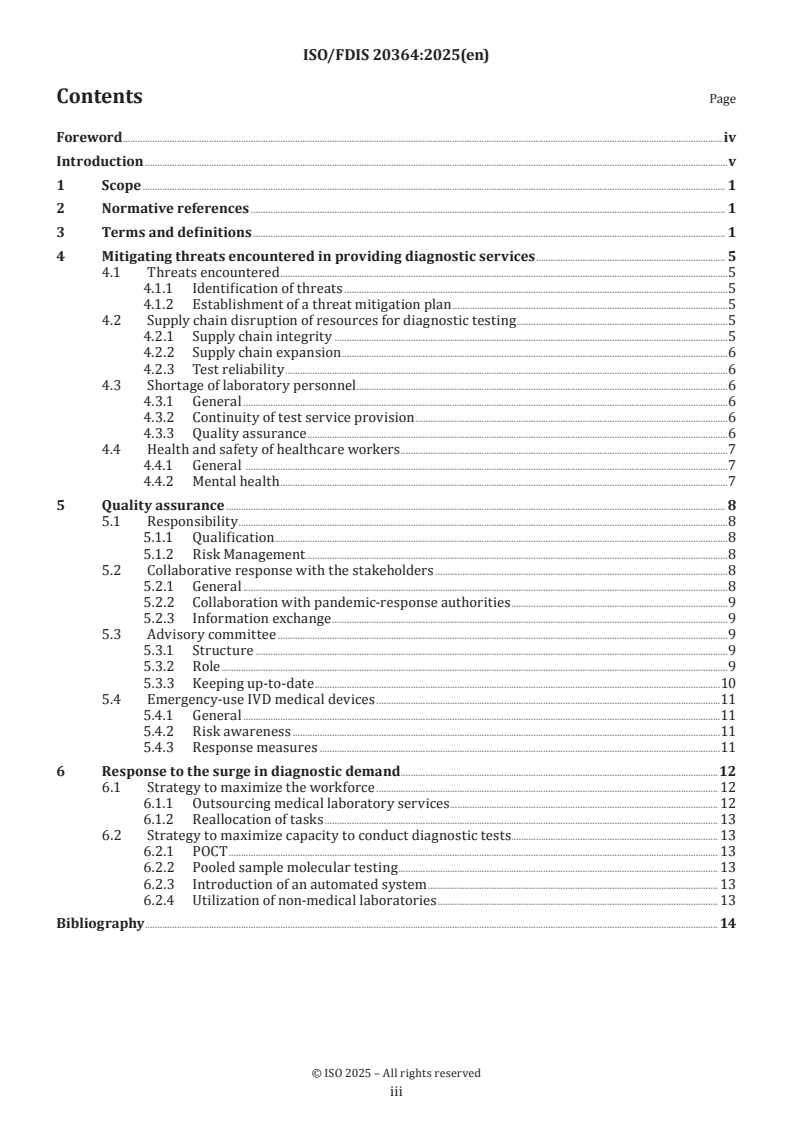
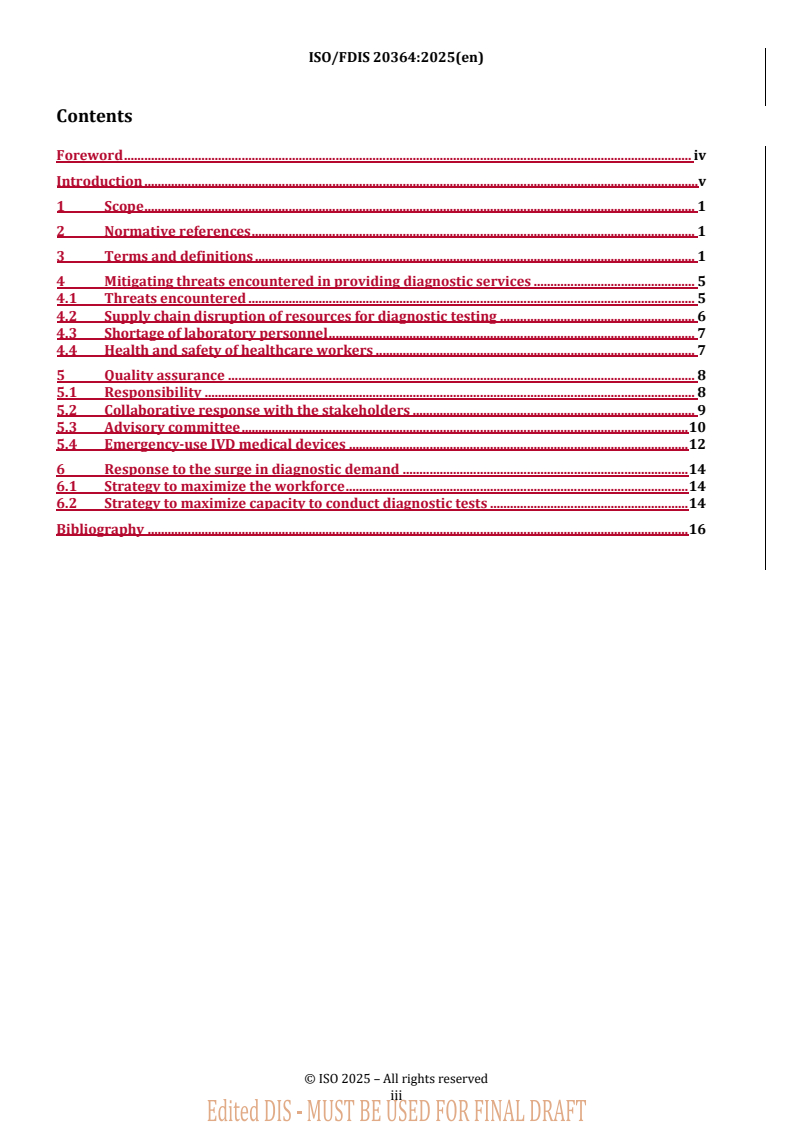
Contents Page
Foreword .iv
Introduction .v
1 Scope . 1
2 Normative references . 1
3 Terms and definitions . 1
4 Mitigating threats encountered in providing diagnostic services . 5
4.1 Threats encountered .5
4.1.1 Identification of threats .5
4.1.2 Establishment of a threat mitigation plan .5
4.2 Supply chain disruption of resources for diagnostic testing .5
4.2.1 Supply chain integrity .5
4.2.2 Supply chain expansion .6
4.2.3 Test reliability .6
4.3 Shortage of laboratory personnel .6
4.3.1 General .6
4.3.2 Continuity of test service provision .6
4.3.3 Quality assurance .6
4.4 Health and safety of healthcare workers .7
4.4.1 General .7
4.4.2 Mental health .7
5 Quality assurance . 8
5.1 Responsibility .8
5.1.1 Qualification .8
5.1.2 Risk Management.8
5.2 Collaborative response with the stakeholders .8
5.2.1 General .8
5.2.2 Collaboration with pandemic-response authorities .9
5.2.3 Information exchange .9
5.3 Advisory committee .9
5.3.1 Structure .9
5.3.2 Role .9
5.3.3 Keeping up-to-date .10
5.4 Emergency-use IVD medical devices .11
5.4.1 General .11
5.4.2 Risk awareness .11
5.4.3 Response measures .11
6 Response to the surge in diagnostic demand .12
6.1 Strategy to maximize the workforce . 12
6.1.1 Outsourcing medical laboratory services . 12
6.1.2 Reallocation of tasks . 13
6.2 Strategy to maximize capacity to conduct diagnostic tests. 13
6.2.1 POCT . 13
6.2.2 Pooled sample molecular testing . 13
6.2.3 Introduction of an automated system . 13
6.2.4 Utilization of non-medical laboratories . 13
Bibliography . 14
iii
Foreword
ISO (the International Organization for Standardization) is a worldwide federation of national standards
bodies (ISO member bodies). The work of preparing International Standards is normally carried out through
ISO technical committees. Each member body interested in a subject for which a technical committee
has been established has the right to be represented on that committee. International organizations,
governmental and non-governmental, in liaison with ISO, also take part in the work. ISO collaborates closely
with the International Electrotechnical Commission (IEC) on all matters of electrotechnical standardization.
The procedures used to develop this document and those intended for its further maintenance are described
in the ISO/IEC Directives, Part 1. In particular, the different approval criteria needed for the different types
of ISO document should be noted. This document was drafted in accordance with the editorial rules of the
ISO/IEC Directives, Part 2 (see www.iso.org/directives).
ISO draws attention to the possibility that the implementation of this document may involve the use of (a)
patent(s). ISO takes no position concerning the evidence, validity or applicability of any claimed patent
rights in respect thereof. As of the date of publication of this document, ISO had not received notice of (a)
patent(s) which may be required to implement this document. However, implementers are cautioned that
this may not represent the latest information, which may be obtained from the patent database available at
www.iso.org/patents. ISO shall not be held responsible for identifying any or all such patent rights.
Any trade name used in this document is information given for the convenience of users and does not
constitute an endorsement.
For an explanation of the voluntary nature of standards, the meaning of ISO specific terms and expressions
related to conformity assessment, as well as information about ISO's adherence to the World Trade
Organization (WTO) principles in the Technical Barriers to Trade (TBT), see www.iso.org/iso/foreword.html.
This document was prepared by Technical Committee ISO/TC 304, Healthcare organization management.
Any feedback or questions on this document should be directed to the user’s national standards body. A
complete listing of these bodies can be found at www.iso.org/members.html.
iv
Introduction
During the COVID-19 pandemic, the demand for diagnostic testing increased with the reopening of economies
[1]
and businesses when large-scale testing of the asymptomatic population was required .
The surging demand for diagnostic testing in a pandemic poses challenges in human resource capacity and
supply chain management, not only within diagnostic laboratories but also entire healthcare organizations.
The increased workload on existing limited numbers of laboratory personnel and skilled professionals to
perform diagnostic testing can lead to overworking and burn-out of staff, which can impact the accuracy of
testing and the turn-around time (TAT) of test results.
Lengthy TAT, in turn, leads to overcrowding in units for persons under evaluation for highly infectious
diseases. Similarly, this generates significant delays in emergency care for patients with infectious pandemic
symptoms and patients under investigation for non-pandemic-related symptoms (e.g. acute stroke care and
[2,3]
emergency operation) . Moreover, increased TAT for the pandemic infectious agent can also impact the
[4]
performance and TAT of other routine laboratory functions, including the testing of critically ill patients .
Accurate test results with rapid TAT are crucial for successful intervention and care within a pandemic
[5]
response . All of these factors can contribute to global disruption in the provision of healthcare services
and patient flow within a healthcare organization, leading to patient overload in the emergency department
[3]
and intensive care unit and prolonging the length of hospital stays .
The solution to the above challenges should be to increase laboratory capacity. However, increasing the
laboratory capacity abruptly is not feasible within a short time frame, which can lead to a more challenging
situation. Healthcare organizations need to find alternative solutions to address the surging diagnostic
demand by optimizing available resources and overcoming the limitations set by laboratory capacity.
This document aims to strengthen the capabilities for responding to surging diagnostic demand in upcoming
pandemics. This document is based on the experiences of different countries in previous pandemics,
particularly, COVID-19, including lessons learnt. It suggests innovative approaches to meet the surging
demand for medical testing services that can occur in any future pandemic. A standardized framework for
healthcare organizations to follow during a pandemic can facilitate a more effective pandemic response and
can enhance public trust in healthcare organizations’ response to the pandemic.
v
FINAL DRAFT International Standard ISO/FDIS 20364:2025(en)
Healthcare organization management — Pandemic response
— Requirements for surging diagnostic demand
1 Scope
This document outlines requirements for healthcare organizations to deliver diagnostic tests timely and
accurately in a pandemic by leveraging innovative approaches to overcome the limitations of laboratory
capacity as follows:
— mitigation of threats encountered in providing diagnostic services during a pandemic;
— consideration for quality assurance of diagnostic service provision in a pandemic context;
— possible response measures to the surge in diagnostic demand.
This document does not cover the specific procedures involved in providing pandemic-response medical
tests, such as the specimen collection protocols in the specimen collection units or screening stations (e.g.
walk-through or drive-through), experimental procedures and the quality management systems of medical
laboratories. Furthermore, this document does not address the pandemic responses related to the medical
treatment of infected patients in care units (e.g. emergency unit and in-patient unit) and the transferring of
confirmed patients within the healthcare organization during a pandemic.
2 Normative references
The following documents are referred to in the text in such a way that some or all of their content constitutes
requirements of this document. For dated references, only the edition cited applies. For undated references,
the latest edition of the referenced document (including any amendments) applies.
ISO 15189:2022, Medical laboratories — Requirements for quality and competence
3 Terms and definitions
For the purposes of this document, the following terms and definitions apply.
ISO and IEC maintain terminology databases for use in standardization at the following addresses:
— ISO Online browsing platform: available at https:// www .iso .org/ obp
— IEC Electropedia: available at https:// www .electropedia .org/
3.1
accuracy
closeness of agreement between a measured quantity value and a true quantity value of the measurand
Note 1 to entry: The concept “measurement accuracy” is not a quantity and is not given a numerical quantity value. A
measurement is said to be more accurate when it offers a smaller measurement error.
Note 2 to entry: The term “measurement accuracy” should not be used for measurement trueness and the term
“measurement precision” should not be used for measurement accuracy, which, however, is related to both these
concepts.
Note 3 to entry: Measurement accuracy is sometimes understood as closeness of agreement between measured
quantity values that are being attributed to a measurand.
[SOURCE: ISO 18113-1:2022, 3.2.27, modified — The preferred term “measurement accuracy” and Note 4 to
entry have been deleted.]
3.2
adverse event
any untoward medical occurrence, inappropriate patient management decision, unintended disease or
injury, or untoward clinical signs in subjects, users or other persons, with any connection to study related
activities, whether or not related to the in vitro diagnostic (IVD) medical device under investigation
Note 1 to entry: Adverse events can be caused by, for instance, insufficient or inadequate instructions for use,
deployment, installation, operation or any malfunction of the IVD medical device under investigation.
Note 2 to entry: This definition includes the malfunction or deterioration of a device which has not yet caused death or
serious injury, but which could lead to death or serious injury.
Note 3 to entry: This definition is not intended to be used in determining whether an event is reportable to a regulatory
authority.
Note 4 to entry: For users or other persons, this definition is restricted to events related to investigational (IVD)
medical devices.
Note 5 to entry: False negative or false-positive results are not considered an adverse event unless in an interventional
study, inappropriate patient management decisions are made based on those false results.
[SOURCE: ISO 20916:2019, 3.2, modified — The abbreviated term “AE” has been deleted as the preferred
term.]
3.3
emergency use in vitro diagnostic medical devices
emergency-use IVD medical device
in vitro diagnostic medical device(s) (3.6) which are urgently permitted to be introduced or used in the
market under minimum requirements or fast audit programs in disaster situations, such as pandemic (3.9)
infectious diseases
3.4
external quality assessment
EQA
proficiency testing
PT
international, national or local program designed to provide regular, external, independent quality
assessment of a medical laboratory’s analytical performance and assist in detecting bias of reported results
compared to other laboratories
[SOURCE: ISO/TS 20914:2019, 3.10, modified —The admitted terms "proficiency testing" and "PT" have been
added and notes to entry deleted.]
3.5
false-negative result
negative result by the tested method that is actually confirmed as a positive result
[SOURCE: ISO 16140-1:2016, 2.23]
3.6
in vitro diagnostic medical device
IVD medical device
medical device, whether used alone or in combination, intended by the manufacturer for the in vitro
examination of specimens derived from the human body solely or principally to provide information for
diagnostic, monitoring or compatibility purposes
Note 1 to entry: IVD medical devices include reagents, calibrators, control materials, specimen receptacles,
software and related instruments or apparatus, or other articles and are used, for example, for the following test
purposes: diagnosis, aid to diagnosis, screening, monitoring, predisposition, prognosis, prediction, determination of
physiological state.
Note 2 to entry: In some jurisdictions, certain IVD medical devices can be covered by other regulations.
[SOURCE: ISO 18113-1:2022,3.1.33]
3.7
internal quality control
IQC
set of procedures and specified materials used by laboratory staff for the repetitive monitoring of analytical
performance of measuring systems
[SOURCE: ISO/TS 20914:2019, 3.13]
3.8
medical laboratory
laboratory
entity for the examination of materials derived from the human body for the purpose of providing
information for the diagnosis, monitoring, management, prevention and treatment of disease, or assessment
of health
Note 1 to entry: The laboratory can also provide advice covering all aspects of examinations including appropriate
selection, the interpretation of results and advice on further examinations.
Note 2 to entry: Laboratory activities include pre-examination, examination and post-examination processes.
Note 3 to entry: Materials for examination include but are not limited to, microbiological, immunological, biochemical,
immunohaematological, haematological, biophysical, cytological, tissue and cells, and genetic material.
[SOURCE: ISO 15189:2022, 3.20]
3.9
pandemic
worldwide spread of a disease
[SOURCE: ISO/PAS 45005:2020, 3.5]
3.10
point-of-care testing
POCT
examination performed near or at the site of a patient
[SOURCE: ISO 15189:2022, 3.22]
3.11
referral laboratory
external laboratory to which a sample or data is submitted for examination
Note 1 to entry: A referral laboratory is one to which laboratory management chooses to submit a sample or sub-
sample for examination, data for analysis or interpretation, or when routine examinations cannot be carried out.
Note 2 to entry: This differs from a laboratory to which submission of samples is required by regulation, or a so-called
reference laboratory, e.g. public health, forensic, tumour registry, or a central (parent) facility to which submission of
samples is required by structure.
[SOURCE: ISO 15189:2022, 3.27]
3.12
risk management
systematic application of management policies, procedures and practices to the tasks of analysing,
evaluating, controlling and monitoring risk
[SOURCE: ISO/IEC Guide 63:2019, 3.15]
3.13
specimen
discrete portion of a body fluid or tissue or other sample associated with the human body taken for
examination, study or analysis of one or more quantities or characteristics to determine the character of the
whole
Note 1 to entry: The International medical device regulators forum (IMDRF) uses the term specimen in its harmonized
guidance documents to mean a sample of biological origin intended for examination by a medical laboratory.
[SOURCE: ISO 15189:2022, 3.25, modified — the preferred term "primary sample" has been deleted.]
3.14
stakeholder
person or organization that can affect, be affected by, or perceive themselves to be affected by a decision or
activity
Note 1 to entry: A decision maker can be a stakeholder.
[SOURCE: ISO 22367:2020, 3.39]
3.15
turn-around time
TAT
interval between specimen arrival in the laboratory and the reporting of the verified result
3.16
validation
verification (3.17) that the specified requirements are adequate for an intended use
EXAMPLE A measurement procedure for creatinine concentration in human serum can also be validated for the
measurement of creatinine concentration in human urine.
Note 1 to entry: ISO 9000:2015, definition 3.8.13, defines validation as confirmation, through the provision of objective
evidence that the requirements for a specific intended use or application have been fulfilled.
[SOURCE: ISO 18113-1:2022, 3.1.91]
3.17
verification
provision of objective evidence that a given item fulfils specified requirements
EXAMPLE 1 Confirmation that a given reference material, as claimed, is homogeneous for the quantity value and
measurement procedure concerned, down to a measurement portion having a mass of 10 mg.
EXAMPLE 2 Confirmation that performance properties or legal requirements of a measuring system are achieved.
EXAMPLE 3 Confirmation that a target measurement uncertainty can be met.
Note 1 to entry: The item can be, e.g. a process, measurement procedure, material, compound or measuring system.
Note 2 to entry: The specified requirements can be, e.g. that a manufacturer’s claims or specifications are met.
Note 3 to entry: In legal metrology, verification pertains to the examination and marking, and the issuing of a
verification certificate for a measuring instrument, or any combination thereof.
Note 4 to entry: Verification should not be confused with calibration or validation (3.16).
Note 5 to entry: In chemistry, the verification of the identity of the entity involved, or of the activity, requires a
description of the structure or properties of that entity or activity.
Note 6 to entry: ISO 9000:2015, 3.8.12, defines verification as confirmation, through the provision of objective
evidence that specified requirements have been fulfilled.
[SOURCE: ISO 18113-1:2022, 3.1.92 modified — “and/or” has been replaced with “or any combination
thereof” in Note 3 to entry, and the articles "the" have been added to Notes 3 and 5 to entry.]
4 Mitigating threats encountered in providing diagnostic services
4.1 Threats encountered
4.1.1 Identification of threats
The healthcare organization shall be aware of possible threats that can be encountered in the process of
providing diagnostic services during a pandemic.
The threats shall include at least the following:
— shortage of IVD medical devices including equipment, consumables and reagents;
— shortage of personal protective equipment (PPE);
— limited availability of skilled laboratory professionals;
— deteriorati
...
ISO/TC 304
Secretariat: KATS
Date: 2025-12-04
Healthcare organization management — Pandemic response —
Requirements for surging diagnostic demand
FDIS stage
All rights reserved. Unless otherwise specified, or required in the context of its implementation, no part of this publication
may be reproduced or utilized otherwise in any form or by any means, electronic or mechanical, including photocopying,
or posting on the internet or an intranet, without prior written permission. Permission can be requested from either ISO
at the address below or ISO’s member body in the country of the requester.
ISO copyright office
CP 401 • Ch. de Blandonnet 8
CH-1214 Vernier, Geneva
Phone: + 41 22 749 01 11
E-mail: copyright@iso.org
Website: www.iso.org
Published in Switzerland
ii © ISO #### 2025 – All rights reserved
ii
Contents
Foreword . iv
Introduction . v
1 Scope . 1
2 Normative references . 1
3 Terms and definitions . 1
4 Mitigating threats encountered in providing diagnostic services . 5
4.1 Threats encountered . 5
4.2 Supply chain disruption of resources for diagnostic testing . 6
4.3 Shortage of laboratory personnel . 7
4.4 Health and safety of healthcare workers . 7
5 Quality assurance . 8
5.1 Responsibility . 8
5.2 Collaborative response with the stakeholders . 9
5.3 Advisory committee . 10
5.4 Emergency-use IVD medical devices . 12
6 Response to the surge in diagnostic demand . 14
6.1 Strategy to maximize the workforce . 14
6.2 Strategy to maximize capacity to conduct diagnostic tests . 14
Bibliography . 16
iii
Foreword
ISO (the International Organization for Standardization) is a worldwide federation of national standards
bodies (ISO member bodies). The work of preparing International Standards is normally carried out through
ISO technical committees. Each member body interested in a subject for which a technical committee has been
established has the right to be represented on that committee. International organizations, governmental and
non-governmental, in liaison with ISO, also take part in the work. ISO collaborates closely with the
International Electrotechnical Commission (IEC) on all matters of electrotechnical standardization.
The procedures used to develop this document and those intended for its further maintenance are described
in the ISO/IEC Directives, Part 1. In particular, the different approval criteria needed for the different types of
ISO document should be noted. This document was drafted in accordance with the editorial rules of the
ISO/IEC Directives, Part 2 (see www.iso.org/directives).
ISO draws attention to the possibility that the implementation of this document may involve the use of (a)
patent(s). ISO takes no position concerning the evidence, validity or applicability of any claimed patent rights
in respect thereof. As of the date of publication of this document, ISO had not received notice of (a) patent(s)
which may be required to implement this document. However, implementers are cautioned that this may not
represent the latest information, which may be obtained from the patent database available at
www.iso.org/patents. ISO shall not be held responsible for identifying any or all such patent rights.
Any trade name used in this document is information given for the convenience of users and does not
constitute an endorsement.
For an explanation of the voluntary nature of standards, the meaning of ISO specific terms and expressions
related to conformity assessment, as well as information about ISO's adherence to the World Trade
Organization (WTO) principles in the Technical Barriers to Trade (TBT), see www.iso.org/iso/foreword.html.
This document was prepared by Technical Committee ISO/TC 304, Healthcare organization management.
Any feedback or questions on this document should be directed to the user’s national standards body. A
complete listing of these bodies can be found at www.iso.org/members.html.
iv © ISO #### 2025 – All rights reserved
iv
Introduction
Diagnostic testing plays a critical role in triaging patients, making informed treatment decisions, enabling
contact tracing, and carrying out epidemiological studies for policy making. During the mid to later phases
ofDuring the COVID-19 pandemic, the demand for diagnostic testing increased with the reopening of
[1][1]
economies and businesses when large-scale testing of the asymptomatic population was required. .
The surging demand for diagnostic testing in a pandemic poseposes challenges in human resourcesresource
capacity and supply chain management, not only within diagnostic laboratories but also within entire
healthcare organizations. Healthcare organizations haveThe increased workload on existing limited numbers
of laboratory personnel and skilled laboratory professionals for performingto perform diagnostic testing
which can lead to staff burn-out related to the delivery of diagnostic services (e.g., specimen collection,
examination, interpretation). The overworking and burn-out of staff, which can also impact the accuracy of
testing and the turn-around time (TAT) of test results.
Lengthy TAT, in turn, leads to overcrowding in units for persons under evaluation for highly infectious
diseases, as well as. Similarly, this generates significant delays in patient care for patients who need emergency
care for patients with infectious pandemic symptoms and patients under investigation for non-pandemic-
[2,3] [2,3]
related symptoms (e.g.,. acute stroke care, and emergency operation). ) . Moreover, increased TAT for the
pandemic infectious agent can also impact the performance and TAT of other routine laboratory functions,
[4][4]
including the testing of critically ill patients. . Accurate test results with rapid TAT are crucial for successful
[5][5]
intervention and care within a pandemic response. . All of these factors can contribute to global disruption
in the provision of healthcare services and patient flow within a healthcare organization, leading to patient
overload in the emergency department and intensive care unit and subsequently prolonging the length of
[3] [3]
hospital stay. stays .
The solution to the above challenges normally should be to increase laboratory capacity. However, increasing
the laboratory capacity abruptly is not feasible within a short timeframe, leadingtime frame, which can lead
to a more challenging situation. Healthcare organizations need to find alternative solutions to address the
surging diagnostic demand by optimizing available resources and overcoming the limitations set by
laboratory capacity.
This document aims to strengthen the capabilities for responding to surging diagnostic demand in upcoming
pandemics. The standardThis document is based on the experiences of different countries in previous
pandemics –, particularly, COVID-19 –, including lessons learnedlearnt. It suggests innovative approaches to
meet the surging demand for medical testing services that maycan occur in any future pandemic. A
standardized framework for healthcare organizations to follow during a pandemic can facilitate a more
effective pandemic response and may engendercan enhance public trust in healthcare organizations’ response
to the pandemic. In any future pandemic, healthcare organizations may need to modify the requirement
specified in this document based on policy and reporting directives of jurisdictional authorities responsible
for pandemic response management.
v
Final draft International Standard ISO/FDIS 20364:2025(en)
Healthcare organization management — Pandemic response —
Requirements for surging diagnostic demand
1 Scope
This document provides guidance and considerationsoutlines requirements for healthcare organizations to
deliver diagnostic tests timely and accurately in a pandemic by leveraging innovative approaches to overcome
the limitations of laboratory capacity as follows:
— — mitigation of threats encountered in providing diagnostic services during a pandemic;
— — consideration for quality assurance of diagnostic service provision in a pandemic context;
— — possible response measures to the surge in diagnostic demand.
This document does not cover the specific procedures involved in providing pandemic-response medical tests,
such as the specimen collection protocols in the specimen collection units or screening stations (e.g.,. walk-
through or drive-through), experimental procedures, and the quality management systems of medical
laboratories. Furthermore, this document omitsdoes not address the pandemic responses related to the
medical treatment of infected patients in care units (e.g.,. emergency unit, and in-patient unit) and the
transferring of confirmed patients within the healthcare organization during a pandemic.
2 Normative references
There are no normative references in this document.
The following documents are referred to in the text in such a way that some or all of their content constitutes
requirements of this document. For dated references, only the edition cited applies. For undated references,
the latest edition of the referenced document (including any amendments) applies.
ISO 15189:2022, Medical laboratories — Requirements for quality and competence
3 Terms and definitions
For the purposes of this document, the following terms and definitions apply.
ISO and IEC maintain terminology databases for use in standardization at the following addresses:
— ISO Online browsing platform: available at https://www.iso.org/obp
— IEC Electropedia: available at https://www.electropedia.org/
3.1
accuracy
closeness of agreement between a measured quantity value and a true quantity value of the measurand
Note 1 to entry: The concept “measurement accuracy” is not a quantity and is not given a numerical quantity value. A
measurement is said to be more accurate when it offers a smaller measurement error.
Note 2 to entry: The term “measurement accuracy” should not be used for measurement trueness and the term
“measurement precision” should not be used for measurement accuracy, which, however, is related to both these
concepts.
Note 3 to entry: Measurement accuracy is sometimes understood as closeness of agreement between measured quantity
values that are being attributed to a measurand.
[SOURCE: ISO 18113-1:2022, 3.2.27, modified — The preferred term "“measurement accuracy"” and Note 4
to entry have been deleted.]
3.2
adverse event
any untoward medical occurrence, inappropriate patient management decision, unintended disease or injury,
or untoward clinical signs in subjects, users, or other persons, with any connection to study related activities,
whether or not related to the in vitro diagnostic (IVD) medical device under investigation
Note 1 to entry: Adverse events can be caused by, for instance, insufficient or inadequate instructions for use,
deployment, installation, operation, or any malfunction of the IVD medical device under investigation.
Note 2 to entry: This definition includes the malfunction or deterioration of a device which has not yet caused death or
serious injury, but which could lead to death or serious injury.
Note 3 to entry: This definition is not intended to be used in determining whether an event is reportable to a regulatory
authority.
Note 4 to entry: For users or other persons, this definition is restricted to events related to investigational (IVD) medical
devices.
Note 5 to entry: False negative or false-positive results are not considered an adverse event unless in an interventional
study, inappropriate patient management decisions are made based on those false results.
[SOURCE: ISO 20916:2019, 3.2, modified — The abbreviation "abbreviated term “AE"” has been removed
fromdeleted as the preferred term.]
3.3
emergency-use in vitro diagnostic medical devices
emergency-use -IVD medical device
in vitro diagnostic medical device(s) (3.6)(3.6) which are urgently permitted to introducebe introduced or use
(used in) the market under minimum requirements or fast audit programprograms in disaster situations, such
as pandemic (3.9)(3.9) infectious diseases
3.4
external quality assessment
EQA
proficiency testing
PT
international, national or local program designed to provide regular, external, independent quality assessment
of a medical laboratory’s analytical performance, and assist in detecting bias of reported results compared to
other laboratories
Note 1 to entry: Also known as Proficiency Testing (PT).
Note 2 to entry: EQA is the term used in this document.
[SOURCE: ISO/TS 20914:2019, 3.10], modified —The admitted terms "proficiency testing" and "PT" have been
added and notes to entry deleted.]
3.5
false-negative result
negative result by the tested method that is actually confirmed as a positive result
[SOURCE: ISO 16140-1:2016, 2.23]
3.6
in vitro diagnostic medical device
IVD medical device
medical device, whether used alone or in combination, intended by the manufacturer for the in vitro
examination of specimens derived from the human body solely or principally to provide information for
diagnostic, monitoring or compatibility purposes
Note 1 to entry: IVD medical devices include reagents, calibrators, control materials, specimen receptacles, software, and
related instruments or apparatus, or other articles and are used, for example, for the following test purposes: diagnosis,
aid to diagnosis, screening, monitoring, predisposition, prognosis, prediction, determination of physiological state.
Note 2 to entry: In some jurisdictions, certain IVD medical devices can be covered by other regulations.
[SORUCESOURCE: ISO 18113-1:2022,3.1.33]
3.7
internal quality control
IQC
set of procedures and specified materials used by laboratory staff for the repetitive monitoring of analytical
performance of measuring systems
[SOURCE: ISO/TS 20914:2019, 3.13]
3.8
medical laboratory
laboratory
entity for the examination of materials derived from the human body for the purpose of providing information
for the diagnosis, monitoring, management, prevention and treatment of disease, or assessment of health
Note 1 to entry: The laboratory can also provide advice covering all aspects of examinations including appropriate
selection, the interpretation of results and advice on further examinations.
Note 2 to entry: Laboratory activities include pre-examination, examination and post-examination processes.
Note 3 to entry: Materials for examination include but are not limited to, microbiological, immunological, biochemical,
immunohaematological, haematological, biophysical, cytological, tissue and cells, and genetic material.
[SOURCE: ISO 15189:2022, 3.20]
3.9
pandemic
worldwide spread of a disease
[SOURCE: ISO/PAS 45005:2020, 3.5]
3.10
point-of-care testing
POCT
examination performed near or at the site of a patient
[SOURCE: ISO 15189:2022, 3.22]
3.11
referral laboratory
external laboratory to which a sample or data is submitted for examination
Note 1 to entry: A referral laboratory is one to which laboratory management chooses to submit a sample or sub-sample
for examination, data for analysis or interpretation, or when routine examinations cannot be carried out.
Note 2 to entry: This differs from a laboratory to which submission of samples is required by regulation, or a so-called
reference laboratory, e.g.,. public health, forensic, tumour registry, or a central (parent) facility to which submission of
samples is required by structure.
[SOURCE: ISO 15189:2022, 3.27]
3.12
risk management
systematic application of management policies, procedures and practices to the tasks of analysing, evaluating,
controlling and monitoring risk
[SOURCE: ISO/IEC Guide 63:2019, 3.15]
3.13
specimen
discrete portion of a body fluid or tissue or other sample associated with the human body taken for
examination, study or analysis of one or more quantities or characteristics to determine the character of the
whole
Note 1 to entry: The International Medical Device Regulators Forummedical device regulators forum (IMDRF) uses the
term specimen in its harmonized guidance documents to mean a sample of biological origin intended for examination by
a medical laboratory.
[SOURCE: ISO 15198 15189:2022, 3.25, modified — the preferred term 'primary sample'"primary sample"
has been deleted.]
3.14
stakeholder
person or organization that can affect, be affected by, or perceive themselves to be affected by a decision or
activity
Note 1 to entry: A decision maker can be a stakeholder.
[SOURCE: ISO 22367:2020, 3.39]
3.15
turn-around time
TAT
time interval between the specimens receivedspecimen arrival in the laboratory to and the reporting of the
time of reports dispatched with verificationverified result
3.16
validation
verification (3.17)(3.17) that the specified requirements are adequate for an intended use
EXAMPLE : A measurement procedure for creatinine concentration in human serum can also be validated for the
measurement of creatinine concentration in human urine.
Note 1 to entry: ISO 9000:2015, definition 3.8.13, defines validation as confirmation, through the provision of objective
evidence that the requirements for a specific intended use or application have been fulfilled.
[SOURCE: ISO 18113-1:2022, 3.1.91]
3.17
verification
provision of objective evidence that a given item fulfils specified requirements
EXAMPLE 1 : Confirmation that a given reference material, as claimed, is homogeneous for the quantity value and
measurement procedure concerned, down to a measurement portion having a mass of 10 mg.
EXAMPLE 2 : Confirmation that performance properties or legal requirements of a measuring system are achieved.
EXAMPLE 3 : Confirmation that a target measurement uncertainty can be met.
Note 1 to entry: The item can be, e.g.,. a process, measurement procedure, material, compound or measuring system.
Note 2 to entry: The specified requirements can be, e.g.,. that a manufacturer’s claims or specifications are met.
Note 3 to entry: In legal metrology, verification pertains to the examination and marking, and/or the issuing of a
verification certificate for a measuring instrument, or any combination thereof.
Note 4 to entry: Verification should not be confused with calibration or validation (3.16).(3.16).
Note 5 to entry: In chemistry, the verification of the identity of the entity involved, or of the activity, requires a description
of the structure or properties of that entity or activity.
Note 6 to entry: ISO 9000:2015, 3.8.12, defines verification as confirmation, through the provision of objective evidence
that specified requirements have been fulfilled.
[SOURCE: ISO 18113-1:2022, 3.1.92] modified — “and/or” has been replaced with “or any combination
thereof” in Note 3 to entry, and the articles "the" have been added to Notes 3 and 5 to entry.]
4 Mitigating threats encountered in providing diagnostic services
4.1 Threats encountered
4.1.1 Identification of threats
The healthcare organization shall be aware of possible threats that can be encountered in the process of
providing diagnostic services during a pandemic.
The threats shall include but are not limited toat least the following:
— — shortage of IVD medical devices including equipment, consumables and reagents;
— — shortage of personal protective equipment (PPE);
— — limited availability of skilled laboratory professionals;
— — deterioration of the accuracy and quality of test results due to overworking of healthcare workers;
— — prolonged turn-around time (TAT) of both pandemic and non-pandemic related medical tests;
— — infection of diagnostic service providers becoming infected bywith a pandemic disease leading to a
greater shortage of service providers.
4.1.2 Establishment of a threat mitigation plan
The healthcare organization shall develop a plan to mitigate possible threats.
The plan shall include but is not limited toat least the following:
— implementing measures to ensure the health and safety of workers and patients;
— providing training and education for workers to prepare and respond for a pandemic;
— developing strategies for stockpiling and emergency procurement of resources such as PPE and IVD
medical devices, including equipment, consumables and reagents;
— implementing quality assurance measures;
— maintaining the safety requirements of the medical laboratory and developing standard operating
procedures (SOPs) for managing the increased volume of hazardous and non-hazardous healthcare waste;
— developing effective communication strategies with external organizations.
NOTE 1 The healthcare organization can refer to ISO 15189 for information on continuity and emergency
[6]
preparedness planning in the medical laboratory. .
NOTE 2 The healthcare organization can refer to ISO 15190 for information on maintaining the safety requirements
[7][13]
of the medical laboratory. .
NOTE 3 The healthcare organization can refer to ISO 7101 for information on communication, risk management,
[8][14]
contingency planning and waste management processes. .
4.2 Supply chain disruption of resources for diagnostic testing
4.2.1 Supply chain integrity
The healthcare organization shall establish a plan to maintain the continuity of the diagnostic services.
The healthcare organization shall identify the stakeholders who need to cooperate outside the organization
(e.g.,. IVD manufacturers and suppliers) and review its supply chain's integrity to provide uninterrupted
pandemic-response medical tests.
NOTE 1 Surging diagnostic demands can exacerbate not only staffing shortages but also shortages of relevant medical
devices and PPE supplies.
NOTE 2 Strong, proactive collaboration between the healthcare organization and the manufacturers of various
products is needed proactivelycan help maintain supply chain integrity before the onset of a declared pandemic, as well
as during a pandemic crisis to maintain supply chain integrity.
4.2.2 Supply chain expansion
The healthcare organization shall identify additional relevant suppliers of IVD medical devices and PPE to
meet the surging demand of diagnostic testing.
NOTE During the diagnostic surge, usual suppliers of the healthcare organization cannot provide enough supply of
IVD medical devices and PPE. In this situation, the healthcare organization can purchase from additional relevant
suppliers.
4.2.3 Test reliability
The healthcare organization shall ensure that measures taken to maintain supply chain integrity do not harm
the reliability of diagnostic services.
4.3 Shortage of laboratory personnel
4.3.1 General
The healthcare organization shall address the possible shortage of laboratory personnel to provide diagnostic
tests for a pandemic in advance of pandemic onset.
NOTE The healthcare organization can consider cross-training staff to work in multiple departments to relieve the
shortage of laboratory personnel in a pandemic.
The healthcare organization shall ensure cross-trained staff are competent, qualified and have adequate
biosafety knowledge.
[6] [7][13]
NOTE The healthcare organization can refer to ISO 15189 and ISO 15190 for information on competence,
qualification and safety requirements in the medical laboratory.
4.3.2 Continuity of test service provision
The measures to maintain the continuity of diagnostic services for a pandemic disease shouldshall not hinder
the diagnostic services of other endemic diseases.
NOTE During surging diagnostic demand in a pandemic, allocating all laboratory personnel to performing pandemic-
response medical tests can cause a deterioration in diagnostic service delivery for other non-pandemic related tests.
4.3.3 Quality assurance
51 Quality assurance
The healthcare organization shall ensure that the increase in workload of laboratory personnel does not lead
to a decline in the quality of laboratory tests.
Contingency planning shall include but is not limited toat least the following:
— referring tests unrelated to the pandemic to referral laboratories (see 6.1.1); 6.1.1);
— reallocating tasks within the healthcare organization (see 6.1.2).6.1.2).
NOTE During a pandemic, healthcare organizations experience surging demand for pandemic-response medical
tests, which can lead to the burn-out of staff related todealing with diagnostic service delivery (e.g.,. specimen collection,
examination, and interpretation). The overworking of staff can affect not only the accuracy and TAT of test results but
also the mental and physical well-being of staff.
5.14.4 Health and safety of healthcare workers
...
Questions, Comments and Discussion
Ask us and Technical Secretary will try to provide an answer. You can facilitate discussion about the standard in here.
Loading comments...