

ISO/IEC 19795-2:2007/Amd 1:2015
(Amendment)Information technology — Biometric performance testing and reporting — Part 2: Testing methodologies for technology and scenario evaluation — Amendment 1: Testing of multimodal biometric implementations
General Information
- Abstract
- Status
- Published
- Publication Date
- 16-Jul-2015
- Technical Committee
- ISO/IEC JTC 1/SC 37 - Biometrics
- Drafting Committee
- ISO/IEC JTC 1/SC 37 - Biometrics
- Current Stage
- 6060 - International Standard published
- Start Date
- 17-Jul-2015
- Completion Date
- 22-Nov-2016
Buy Documents


ISO/IEC 19795-2:2007/Amd 1:2015 - Information technology — Biometric performance testing and reporting — Part 2: Testing methodologies for technology and scenario evaluation — Amendment 1: Testing of multimodal biometric implementations Released:7/17/2015
Overview
ISO/IEC 19795-2:2007/Amd 1:2015 is an international standard issued by ISO focusing on biometric performance testing and reporting, specifically addressing the methodologies for testing multimodal biometric implementations. This amendment to Part 2 of ISO/IEC 19795-2 expands the original framework, which primarily targeted single-modality biometric systems, to incorporate comprehensive guidelines for the evaluation of multimodal biometric technologies. Multimodal biometric systems, which combine multiple biometric modalities such as fingerprint, iris, and facial recognition, are increasingly critical in enhancing security applications and improving system robustness.
The amendment ensures standardized procedures for repeatable and reliable performance evaluation of these systems, which is essential for applications like border control, identity verification, and access systems.
Key Topics
Multimodal Biometric Specific Requirements: This document adds requirements tailored to multimodal biometric systems for both technology and scenario evaluation, addressing the complexities introduced when multiple modalities are combined.
Performance Measures and Enrolment Metrics: It introduces the metric of Multimodal Failure to Enrol (MFTE), which quantifies the proportion of users who cannot successfully enroll across all considered biometric modalities under specific enrolment policies.
Fusion Level Identification: The standard covers four fusion levels in multimodal biometrics that impact system evaluation:
- Decision-level fusion
- Score-level fusion
- Feature-level fusion
- Sample-level fusion
Each fusion level integrates biometric data differently, affecting testing methodologies and performance evaluation.
Technology and Scenario Evaluation Requirements: Clear criteria are established to maintain repeatability and consistency across tests, including:
- Identical function configurations for subsystems
- Consistent data sampling and template combination
- Detailed reporting of fusion functions and biometric subsystem characteristics
Sensor and Presentation Types: The standard emphasizes identifying sensor types (single integrated or multiple sensors) and presentation methods (simultaneous or sequential acquisition) as key factors influencing test repeatability.
Applications
ISO/IEC 19795-2:2007/Amd 1:2015 is vital for organizations developing, implementing, or evaluating multimodal biometric systems. Practical applications include:
- Border Security and Immigration: Enhancing the accuracy and robustness of identity verification in environments requiring high security.
- Access Control: Improving usability and reducing failure rates in secure facility entry systems by leveraging multiple biometric traits.
- Identity Management Systems: Providing reliable methods to test composite biometric solutions for government and commercial identity programs.
- Research and Development: Guiding developers and evaluators in producing reproducible test results that support technology improvements and compliance with international standards.
- Presentation Attack Resistance: Enabling better evaluation techniques to assess system resilience against spoofing or fraudulent biometric presentations.
Related Standards
- ISO/IEC 19795-1: Provides general performance testing and reporting principles for biometric systems, focusing primarily on single-modality scenarios.
- ISO/IEC TR 24722: Technical report detailing multimodal biometric system configurations and the classification of fusion techniques, foundational for understanding the fusion processes described in this amendment.
- ISO/IEC 30107 Series: Standards for biometric presentation attack detection, relevant to evaluating the robustness aspects of multimodal systems mentioned in this amendment.
- ISO/IEC 30137: Guides biometric data interchange formats that may be involved in multimodal biometric implementations.
Keywords: ISO/IEC 19795-2, biometric performance testing, multimodal biometrics, biometric fusion levels, failure to enrol rate, multimodal biometric evaluation, biometric technology testing, biometric scenario evaluation, biometric sensor types, biometric system robustness, biometric security standards.
Relations
- Effective Date
- 02-Sep-2026
- Effective Date
- 01-Jul-2026
- Effective Date
- 14-Oct-2020
Buy Documents
ISO/IEC 19795-2:2007/Amd 1:2015 - Information technology — Biometric performance testing and reporting — Part 2: Testing methodologies for technology and scenario evaluation — Amendment 1: Testing of multimodal biometric implementations Released:7/17/2015
Get Certified
Connect with accredited certification bodies for this standard

BSI Group
BSI (British Standards Institution) is the business standards company that helps organizations make excellence a habit.

NYCE
Mexican standards and certification body.
Sponsored listings
Frequently Asked Questions
ISO/IEC 19795-2:2007/Amd 1:2015 is a standard published by the International Organization for Standardization (ISO). Its full title is "Information technology — Biometric performance testing and reporting — Part 2: Testing methodologies for technology and scenario evaluation — Amendment 1: Testing of multimodal biometric implementations". This standard covers: Information technology — Biometric performance testing and reporting — Part 2: Testing methodologies for technology and scenario evaluation — Amendment 1: Testing of multimodal biometric implementations
Information technology — Biometric performance testing and reporting — Part 2: Testing methodologies for technology and scenario evaluation — Amendment 1: Testing of multimodal biometric implementations
ISO/IEC 19795-2:2007/Amd 1:2015 is classified under the following ICS (International Classification for Standards) categories: 35.040 - Information coding; 35.240.15 - Identification cards. Chip cards. Biometrics. The ICS classification helps identify the subject area and facilitates finding related standards.
ISO/IEC 19795-2:2007/Amd 1:2015 has the following relationships with other standards: It is inter standard links to CEN/TS 18212-3:2026, CEN/TS 18212-5:2026, ISO/IEC 19795-2:2007. Understanding these relationships helps ensure you are using the most current and applicable version of the standard.
ISO/IEC 19795-2:2007/Amd 1:2015 is available in PDF format for immediate download after purchase. The document can be added to your cart and obtained through the secure checkout process. Digital delivery ensures instant access to the complete standard document.
Standards Content (Sample)
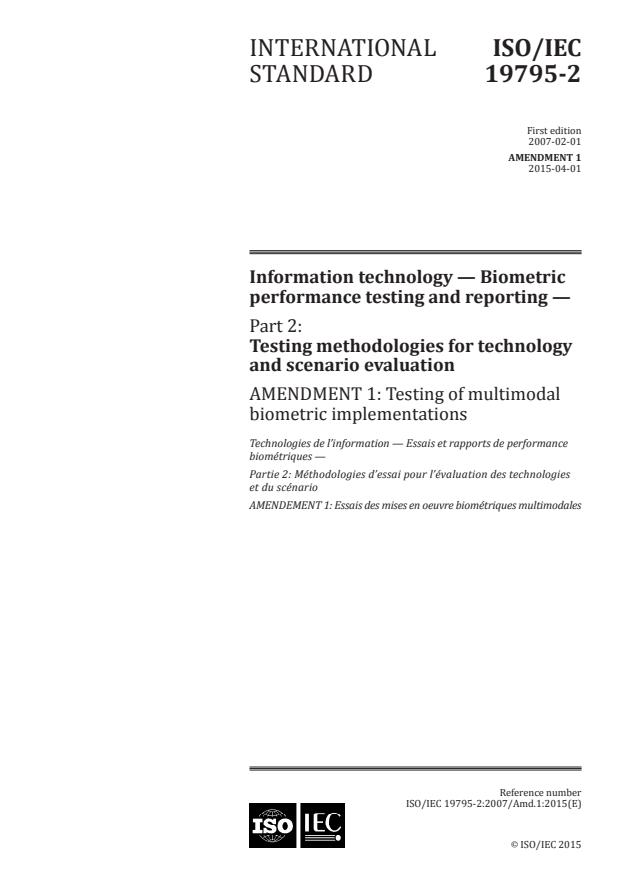
INTERNATIONAL ISO/IEC
STANDARD 19795-2
First edition
2007-02-01
AMENDMENT 1
2015-04-01
Information technology — Biometric
performance testing and reporting —
Part 2:
Testing methodologies for technology
and scenario evaluation
AMENDMENT 1: Testing of multimodal
biometric implementations
Technologies de l’information — Essais et rapports de performance
biométriques —
Partie 2: Méthodologies d’essai pour l’évaluation des technologies
et du scénario
AMENDEMENT 1: Essais des mises en oeuvre biométriques multimodales
Reference number
ISO/IEC 19795-2:2007/Amd.1:2015(E)
©
ISO/IEC 2015
ISO/IEC 19795-2:2007/Amd.1:2015(E)
© ISO/IEC 2015, Published in Switzerland
All rights reserved. Unless otherwise specified, no part of this publication may be reproduced or utilized otherwise in any form
or by any means, electronic or mechanical, including photocopying, or posting on the internet or an intranet, without prior
written permission. Permission can be requested from either ISO at the address below or ISO’s member body in the country of
the requester.
ISO copyright office
Ch. de Blandonnet 8 • CP 401
CH-1214 Vernier, Geneva, Switzerland
Tel. +41 22 749 01 11
Fax +41 22 749 09 47
copyright@iso.org
www.iso.org
ii © ISO/IEC 2015 – All rights reserved
ISO/IEC 19795-2:2007/Amd.1:2015(E)
Foreword
ISO (the International Organization for Standardization) is a worldwide federation of national standards
bodies (ISO member bodies). The work of preparing International Standards is normally carried out
through ISO technical committees. Each member body interested in a subject for which a technical
committee has been established has the right to be represented on that committee. International
organizations, governmental and non-governmental, in liaison with ISO, also take part in the work.
ISO collaborates closely with the International Electrotechnical Commission (IEC) on all matters of
electrotechnical standardization.
The procedures used to develop this document and those intended for its further maintenance are
described in the ISO/IEC Directives, Part 1. In particular the different approval criteria needed for the
different types of ISO documents should be noted. This document was drafted in accordance with the
editorial rules of the ISO/IEC Directives, Part 2 (see www.iso.org/directives).
Attention is drawn to the possibility that some of the elements of this document may be the subject of
patent rights. ISO shall not be held responsible for identifying any or all such patent rights. Details of any
patent rights identified during the development of the document will be in the Introduction and/or on
the ISO list of patent declarations received (see www.iso.org/patents).
Any trade name used in this document is information given for the convenience of users and does not
constitute an endorsement.
For an explanation on the meaning of ISO specific terms and expressions related to conformity
assessment, as well as information about ISO’s adherence to the WTO principles in the Technical Barriers
to Trade (TBT), see the following URL: Foreword — Supplementary information.
The committee responsible for this document is ISO/IEC JTC 1, Information technology, Subcommittee
SC 37, Biometrics.
© ISO/IEC 2015 – All rights reserved iii
ISO/IEC 19795-2:2007/Amd.1:2015(E)
Introduction
Testing and reporting methods in this part of ISO/IEC 19795 are primarily intended for single-modality
systems. These standards can be inadequate for executing reproducible performance evaluations of
multimodal biometric systems such as those used in border control applications. Various configurations
are proposed for multimodal biometric systems, as described in ISO/IEC TR 24722. It is necessary to
clearly identify methods and requirements for multimodal biometric systems evaluation such as
variation of parameters and environmental factors that are to be described when reporting.
iv © ISO/IEC 2015 – All rights reserved
ISO/IEC 19795-2:2007/Amd.1:2015(E)
Information technology — Biometric performance testing
and reporting —
Part 2:
Testing methodologies for technology and scenario
evaluation
AMENDMENT 1: Testing of multimodal biometric
implementations
Add the following items to the list in the scope clause of ISO/IEC 19795-2:
— multimodal biometric specific requirements for technology evaluation and scenario evaluation;
— description of the structure and performance measures of multimodal biometric devices and systems;
— specification of biometric data collection and performance calculation methods;
— specification of reporting requirements.
Add the following item to the definitions clause in this part of ISO/IEC 19795:
4.4.2
multimodal FTE
MFTE
proportion of the population for whom the multimodal biometric system with a stated enrolment policy
fails to complete the enrolment process
EXAMPLE 1 For a policy which allows one of a set of modalities to be enrolled, MFTE would be the
proportion of subjects that fail to enrol in all the modalities. This results in lower effective FTE.
EXAMPLE 2 For a policy which requires enrolment in all considered modalities, MFTE would be the
proportion of subjects that fail to enrol in one or more modalities. This results in an effective FTE greater
than or equal to the higher of the individual modality FTEs.
ISO/IEC 19795-2:2007/Amd.1:2015(E)
Insert the following normative Annex into this part of ISO/IEC 19795:
Annex F
(normative)
Testing of multimodal biometric implementations
F.1 General
This annex specifies methods for evaluating and reporting the performance of multimodal biometric
algorithms and systems.
Multimodal biometric implementations might be used to meet the following objectives:
— to support users who cannot present one or more requested modalities to the system, in other
words, to improve failure-to-enrol rate;
— to improve biometric system throughput;
— to improve recognition performance (e.g. through reduction of false negative identification rates);
— to improve usability; and
— to increase robustness against presentation attacks.
ISO/IEC TR 24722 defines the following multimodal fusion levels:
— decision-level;
— score-level;
— feature-level;
— sample-level.
Multimodal fusion implementations differ across each level. Even when multimodal data are gathered
with identical sensors, results might differ based the fusion level implemented.
For this reason, the experimenter shall determine the system or application to be evaluated. An evaluation
shall clearly identify the fusion level implemented, the components of the multimodal implementation,
and requirements applicable to evaluations for each fusion level.
Two types of multimodal evaluations can be considered:
— evaluations in which the experimenter does require insight into the multimodal system;
— evaluations in which the experimenter does not require insight into the integrated multimodal system.
This annex focuses on evaluations in which the experimenter requires insight into the multimodal
system. F.1 and F.6 are applicable to all multimodal implementations. If the experimenter does not
require insight into the integrated multimodal system component shown in Figure F.2 or Figure F.4,
then the multimodal implementation can be tested without using this annex.
2 © ISO 2015 – All rights reserved
ISO/IEC 19795-2:2007/Amd.1:2015(E)
F.2 Fusion scheme identification information for repeatable evaluation
F.2.1 Decision-level fusion
F.2.1.1 General
An example of decision-level fusion is shown in Figure F.1. Decision-level fusion systems combine
decision results from separate biometric sub systems.
Comparison 1
Comparison 2
Figure F.1 — Decision-level fusion
NOTE Decision-level fusion systems might be used to improve false match rate (FMR) or false non-match rate
(FNMR).
Figure F.2 is an example of an integrated multimodal system with a decision output in which insight is
not provided into the implementation. This type of system can be tested without methods described
in this annex.
ISO/IEC 19795-2:2007/Amd.1:2015(E)
Figure F.2 — Fusion in an integrated multimodal system with decision output
F.2.1.2 Technology evaluation
Requirements for repeatability of decision-level fusion technology evaluation results are as follows:
— the decision fusion logic shall be identical;
— the function configurations (i.e. feature extraction, comparison, and decision) of Sub System 1 and
Sub System 2, respectively, shall remain consistent across all tests;
NOTE 1 Sub System 1 and Sub System 2 can have different function configurations, and user-specific thresholds
can differ for different users.
— the combination of Sample 1 and Sample 2 fed into each feature extraction function shall be identical;
— the combination of Template 1 and Template 2 shall be identical.
Consistent data selection methods for samples and templates are also required for evaluation
repeatability.
If Sub System 1 and Sub System 2 are independent and separate, the evaluation report should include
the following:
— identifying information for Sub System 1 and Sub System 2;
— identifying information for decision fusion logic;
— fusion level.
NOTE 2 See 6.4.2.
F.2.1.3 Scenario evaluation
Requirements for repeatability of decision-level fusion evaluation results are as follows:
— the function configurations (i.e. capture, feature extraction, comparison, and decision) of Sub
System 1 and Sub System 2, respectively, shall remain consistent across all tests;
4 © ISO 2015 – All rights reserved
ISO/IEC 19795-2:2007/Amd.1:2015(E)
NOTE 1 Sub System 1 and Sub System 2 can have different function configurations, and user-specific thresholds
may differ for different users.
— the decision fusion logic shall be identical;
— the combination of Sample 1 and Sample 2 fed into each feature extraction function shall be based
on the same subject and position (e.g. right iris);
— the combination of Template 1 and Template 2 shall be based on the same subject and position.
Consistent data selection methods for samples and templates are also required for evaluation
repeatability.
If Sub System 1 and Sub System 2 are independent and separate, the evaluation report should include
the following:
— identifying information for Sub System 1 and Sub System 2;
— identifying information for decision fusion function;
— fusion level.
NOTE 2 See 7.4.2.
F.2.2 Score-level fusion
F.2.2.1 General
Fusion on the score level is illustrated in Figure F.3. Score-level fusion systems utilize score results from
separate biometric subsystems.
CComparison 11
CComparison 22
Figure F.3 — Score-level fusion
Score-level fusion may use sample quality in scenario or technology evaluations.
NOTE 1 Score-level fusion systems might be used to improve false match rate (FMR) and false non-match rate
(FNMR).
Figure F.4 is an example of an integrated multimodal system with a score output in which insight is
not provided into the implementation. This type of system can be tested without methods described
in this annex.
ISO/IEC 19795-2:2007/Amd.1:2015(E)
Figure F.4 — Fusion in an integrated multimodal system with score output
F.2.2.2 Technology evaluation
Requirements for repeatability of score-level fusion technology evaluation results are as follows:
— the score fusion function and decision function shall be identical;
— the function configurations (i.e. feature extraction and comparison) of Sub System 1 and Sub System
2, respectively, shall remain consistent across all tests;
NOTE 1 Sub System 1 and Sub System 2 can have different function configurations, and user-specific thresholds
might differ for different users.
— the combination of Template 1 and Template 2 shall be identical;
— the combination of Sample 1 and Sample 2 fed into each feature extraction function shall be identical.
Requirements will be necessary for the data selection method for samples and templates, in order to
keep repeatability.
If Sub System 1 and Sub System 2 are independent and separate, the evaluation report should include
the following:
— identifying information for Sub System 1 and Sub System 2;
— identifying information for score fusion function and decision function;
— fusion level.
NOTE 2 See 6.4.2.
F.2.2.3 Scenario evaluation
Requirements for repeatability of score-level fusion scenario evaluation results can be stated as follows:
— the function configurations (i.e. capture, feature extraction, and comparison) of Sub System 1 and
Sub System 2, respectively, shall remain consistent across all tests;
NOTE 1 Sub System 1 and Sub System 2 can have different function configurations, and user-specific thresholds
can differ for different users.
— the score fusion function and decision function shall be identical;
— the combination of Template 1 and Template 2 shall be based on the same subject and position;
— the combination of Sample 1 and Sample 2 fed into each feature extraction function shall be based
on the same subject and position.
6 © ISO 2015 – All rights reserved
ISO/IEC 19795-2:2007/Amd.1:2015(E)
Consistent data selection methods for samples and templates are also required for evaluation
repeatability.
If Sub System 1 and Sub System 2 are independent and separate, the evaluation report should include
the following:
— identifying information for Sub System 1 and Sub System 2;
— identifying information for score fusion function and decision function;
— fusion level.
NOTE 2 See 7.4.2.
F.2.3 Feature-level fusion
F.2.3.1 General
Fusion on the feature level is illustrated in Figure F.5. Feature-level fusion systems utilize results from
separate feature extraction components.
Figure F.5 — Fusion on the feature level
F.2.3.2 Technology evaluation
Requirements for repeatability of feature-level fusion technology evaluation results are as follows:
— feature fusion function, comparison function, and decision function shall be identical;
— the function configurations (i.e. feature extraction) of Feature extraction 1 and Feature extraction
2, respectively, shall remain consistent across all tests;
NOTE 1 Feature extraction 1 and Feature extraction 2 can have different function configurations, and user-
specific thresholds can differ for different users.
— the combination of Sample 1 and Sample 2 fed into each feature extraction function shall be identical;
— the combination of Sample 1 and Sample 2 at the time of template creation shall be identical.
Consistent data selection methods for samples and templates are also required for evaluation
repeatability.
If Feature extraction 1 and Feature extraction 2 are independent and separate, the evaluation report
should include the following:
— identifying information for Feature extraction 1 and Feature extraction 2;
— identifying information for feature fusion function, comparison function and decision function;
— fusion level.
...