


ISO 19233-1:2017
(Main)Implants for surgery — Orthopaedic joint prosthesis — Part 1: Procedure for producing parametric 3D bone models from CT data of the knee
Implants for surgery — Orthopaedic joint prosthesis — Part 1: Procedure for producing parametric 3D bone models from CT data of the knee
ISO 19233-1:2017 provides requirements for capturing necessary bone geometries, when using a medical X-ray computed tomography apparatus, to provide the information for applications such as preoperative planning, surgical navigation, robotic surgeries, patient matched instruments and personalized total knee joint prosthesis. The conditions to scan images of bones and the conditions to reconstruct three-dimensional bone models are provided. NOTE Requirements for the competence of testing laboratories appropriate to help to ensure the reliability and accuracy of the computational measurements can be found in ISO/IEC 17025.
Implants chirugicaux — Prothèses articulaires orthopédiques — Partie 1: Mode opératoire de production de modèles paramétriques d'os en 3D à partir de données de CT du genou
General Information
- Status
- Published
- Publication Date
- 09-May-2017
- Technical Committee
- ISO/TC 150/SC 4 - Bone and joint replacements
- Drafting Committee
- ISO/TC 150/SC 4/WG 4 - General requirements
- Current Stage
- 9093 - International Standard confirmed
- Start Date
- 21-Sep-2022
- Completion Date
- 12-Feb-2026
Overview
ISO 19233-1:2017 - "Implants for surgery - Orthopaedic joint prosthesis - Part 1: Procedure for producing parametric 3D bone models from CT data of the knee" specifies standardized procedures for generating accurate 3D bone models from CT data of the knee. The standard defines CT scanning conditions and reconstruction requirements to support applications such as preoperative planning, surgical navigation, robotic surgery, patient‑matched instruments and personalized total knee joint prostheses.
Key Topics
- Imaging conditions: Use a multi‑slice CT apparatus; scan in the supine position with the knee extended. Define a clear region of interest (full leg, femoral head–knee–ankle, or knee joint only).
- Field of view (FOV): Typically 200–250 mm; extend up to 320 mm for bilateral scans to maintain image resolution.
- Slice thickness & spacing: Minimize both values; if slice thickness > 2.0 mm or spacing > 1.5 mm, software validation is strongly recommended.
- Reconstruction kernel & CT settings: Select an appropriate reconstruction kernel. Set tube voltage within 80–140 kV and tube current to avoid noise; use Automatic Exposure Control (AEC) to reduce dose.
- Precautions: Mitigate metal artefacts (implants, external metals) and prevent patient movement during scanning. Use standing plain X‑rays to determine leg alignment and apply corrections to 3D models.
- Software & validation: Segmentation/generation software must meet Medical Device Software regulatory expectations, including design verification, documented risk analysis per ISO 14971, and validation of segmentation and 3D reconstruction algorithms.
- Segmentation methods: Supports pixel‑based and shape‑based techniques; operator involvement may be manual, semi‑automatic or automatic - automatic methods aim to reduce variability.
- Documentation & data formats: Requires traceable design history, functional verification, and validated data transfer from CT to output formats.
Applications
ISO 19233-1 is directly applicable to:
- Orthopaedic surgeons and radiologists preparing for complex knee procedures
- Medical device and implant manufacturers designing personalized knee prostheses and patient‑matched instruments
- Developers of surgical navigation, robotic surgery platforms and preoperative planning software
- Imaging departments and clinical engineers setting CT protocols for orthopaedic measurements
- Testing laboratories and regulatory teams validating segmentation and 3D reconstruction workflows
Related Standards
- ISO 14971 - Risk management for medical devices
- ISO/IEC 17025 - Competence of testing laboratories (informative note)
- ISO 7207-1, ISO 21536 - Knee implant dimensions and requirements
- IEC 61223-2-6, IEC/TR 60788 - CT imaging performance and terminology
ISO 19233-1:2017 provides practical, actionable guidance to ensure reproducible, high‑quality parametric 3D bone models from knee CT data, improving the reliability of surgical planning, device design and image‑guided orthopaedic workflows.

Get Certified
Connect with accredited certification bodies for this standard

BSI Group
BSI (British Standards Institution) is the business standards company that helps organizations make excellence a habit.

TÜV Rheinland
TÜV Rheinland is a leading international provider of technical services.

TÜV SÜD
TÜV SÜD is a trusted partner of choice for safety, security and sustainability solutions.
Sponsored listings
Frequently Asked Questions
ISO 19233-1:2017 is a standard published by the International Organization for Standardization (ISO). Its full title is "Implants for surgery — Orthopaedic joint prosthesis — Part 1: Procedure for producing parametric 3D bone models from CT data of the knee". This standard covers: ISO 19233-1:2017 provides requirements for capturing necessary bone geometries, when using a medical X-ray computed tomography apparatus, to provide the information for applications such as preoperative planning, surgical navigation, robotic surgeries, patient matched instruments and personalized total knee joint prosthesis. The conditions to scan images of bones and the conditions to reconstruct three-dimensional bone models are provided. NOTE Requirements for the competence of testing laboratories appropriate to help to ensure the reliability and accuracy of the computational measurements can be found in ISO/IEC 17025.
ISO 19233-1:2017 provides requirements for capturing necessary bone geometries, when using a medical X-ray computed tomography apparatus, to provide the information for applications such as preoperative planning, surgical navigation, robotic surgeries, patient matched instruments and personalized total knee joint prosthesis. The conditions to scan images of bones and the conditions to reconstruct three-dimensional bone models are provided. NOTE Requirements for the competence of testing laboratories appropriate to help to ensure the reliability and accuracy of the computational measurements can be found in ISO/IEC 17025.
ISO 19233-1:2017 is classified under the following ICS (International Classification for Standards) categories: 11.040.40 - Implants for surgery, prosthetics and orthotics. The ICS classification helps identify the subject area and facilitates finding related standards.
ISO 19233-1:2017 is available in PDF format for immediate download after purchase. The document can be added to your cart and obtained through the secure checkout process. Digital delivery ensures instant access to the complete standard document.
Standards Content (Sample)
INTERNATIONAL ISO
STANDARD 19233-1
First edition
2017-05
Implants for surgery — Orthopaedic
joint prosthesis —
Part 1:
Procedure for producing parametric
3D bone models from CT data of the
knee
Implants chirugicaux — Prothèses articulaires orthopédiques —
Partie 1: Mode opératoire de production de modèles paramétriques
d’os en 3D à partir de données de CT du genou
Reference number
©
ISO 2017
© ISO 2017, Published in Switzerland
All rights reserved. Unless otherwise specified, no part of this publication may be reproduced or utilized otherwise in any form
or by any means, electronic or mechanical, including photocopying, or posting on the internet or an intranet, without prior
written permission. Permission can be requested from either ISO at the address below or ISO’s member body in the country of
the requester.
ISO copyright office
Ch. de Blandonnet 8 • CP 401
CH-1214 Vernier, Geneva, Switzerland
Tel. +41 22 749 01 11
Fax +41 22 749 09 47
copyright@iso.org
www.iso.org
ii © ISO 2017 – All rights reserved
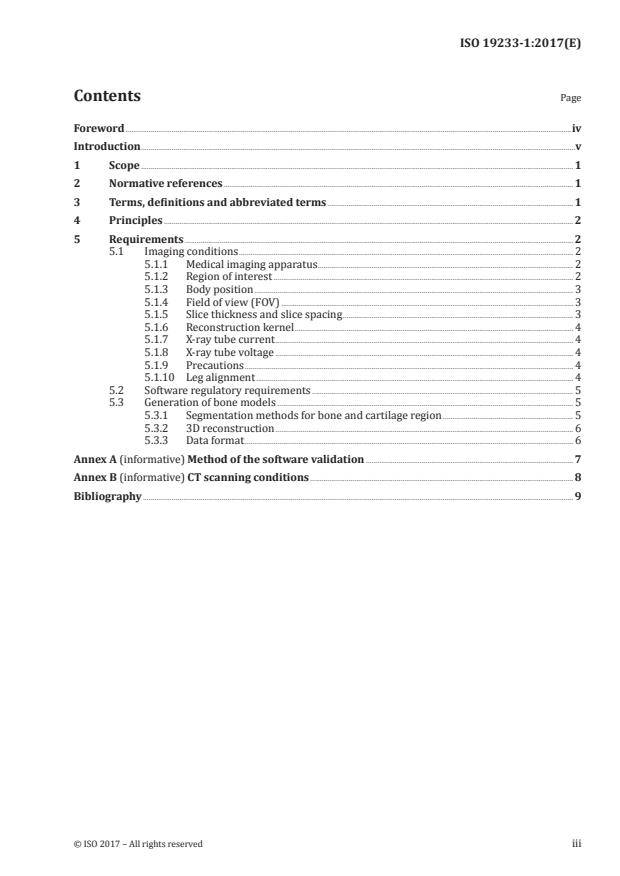
Contents Page
Foreword .iv
Introduction .v
1 Scope . 1
2 Normative references . 1
3 Terms, definitions and abbreviated terms . 1
4 Principles . 2
5 Requirements . 2
5.1 Imaging conditions . 2
5.1.1 Medical imaging apparatus . 2
5.1.2 Region of interest . 2
5.1.3 Body position . 3
5.1.4 Field of view (FOV) . 3
5.1.5 Slice thickness and slice spacing . 3
5.1.6 Reconstruction kernel . 4
5.1.7 X-ray tube current . 4
5.1.8 X-ray tube voltage . 4
5.1.9 Precautions . 4
5.1.10 Leg alignment . 4
5.2 Software regulatory requirements . 5
5.3 Generation of bone models . 5
5.3.1 Segmentation methods for bone and cartilage region . 5
5.3.2 3D reconstruction . 6
5.3.3 Data format . 6
Annex A (informative) Method of the software validation . 7
Annex B (informative) CT scanning conditions . 8
Bibliography . 9
Foreword
ISO (the International Organization for Standardization) is a worldwide federation of national standards
bodies (ISO member bodies). The work of preparing International Standards is normally carried out
through ISO technical committees. Each member body interested in a subject for which a technical
committee has been established has the right to be represented on that committee. International
organizations, governmental and non-governmental, in liaison with ISO, also take part in the work.
ISO collaborates closely with the International Electrotechnical Commission (IEC) on all matters of
electrotechnical standardization.
The procedures used to develop this document and those intended for its further maintenance are
described in the ISO/IEC Directives, Part 1. In particular the different approval criteria needed for the
different types of ISO documents should be noted. This document was drafted in accordance with the
editorial rules of the ISO/IEC Directives, Part 2 (see www .iso .org/ directives).
Attention is drawn to the possibility that some of the elements of this document may be the subject of
patent rights. ISO shall not be held responsible for identifying any or all such patent rights. Details of
any patent rights identified during the development of the document will be in the Introduction and/or
on the ISO list of patent declarations received (see www .iso .org/ patents).
Any trade name used in this document is information given for the convenience of users and does not
constitute an endorsement.
For an explanation on the voluntary nature of standards, the meaning of ISO specific terms and
expressions related to conformity assessment, as well as information about ISO’s adherence to the
World Trade Organization (WTO) principles in the Technical Barriers to Trade (TBT) see the following
URL: w w w . i s o .org/ iso/ foreword .html.
This document was prepared by Technical Committee ISO/TC 150, Implants for surgery, Subcommittee
SC 4, Bone and joint replacements.
A list of all parts in the ISO 19233 series can be found on the ISO website.
iv © ISO 2017 – All rights reserved
Introduction
In accordance with its widespread use of medical X-ray computed tomography apparatus, three-
dimensional (3D) bone models reconstructed from digital tomographic images have been widely used
for various applications such as preoperative planning, surgical navigation, robotic surgeries, patient
matched instruments and personalized total knee joint prosthesis. However, the conditions of taking
tomographic images are different among hospitals and not internationally unified. To measure bones
accurately, precise 3D bone models reconstructed from tomographic images should be used. On the
other hand, since conditions of this reconstruction process are left up to operators’ and/or medical
institutions’ discretion, this document provides a standard way of reconstructing 3D bone models.
INTERNATIONAL STANDARD ISO 19233-1:2017(E)
Implants for surgery — Orthopaedic joint prosthesis —
Part 1:
Procedure for producing parametric 3D bone models from
CT data of the knee
1 Scope
This document provides requirements for capturing necessary bone geometries, when using a medical
X-ray computed tomography apparatus, to provide the information for applications such as preoperative
planning, surgical navigation, robotic surgeries, patient matched instruments and personalized total
knee joint prosthesis. The conditions to scan images of bones and the conditions to reconstruct three-
dimensional bone models are provided.
NOTE Requirements for the competence of testing laboratories appropriate to help to ensure the reliability
and accuracy of the computational measurements can be found in ISO/IEC 17025.
2 Normative references
The following documents are referred to in the text in such a way that some or all of their content
constitutes requirements of this document. For dated references, only the edition cited applies. For
undated references, the latest edition of the referenced document (including any amendments) applies.
ISO 7207-1, Implants for surgery — Components for partial and total knee joint prostheses — Part 1:
Classification, definitions and designation of dimensions
ISO 14971, Medical devices — Application of risk management to medical devices
ISO 21536, Non-active surgical implants — Joint replacement implants — Specific requirements for knee-
joint replacement implants
IEC 61223-2-6, Evaluation and routine testing in medical imaging departments — Part 26: Constancy
tests — Imaging performance of computed tomography X-ray equipment
IEC/TR 60788, Medical electrical equipment — Glossary of defined terms
3 Terms, definitions and abbreviated terms
3.1 Terms and definitions
For the purposes of this document, the terms and definitions given in IEC/TR 60788, IEC 61223-2-6,
ISO 21536, ISO 7207-1 and the following apply.
ISO and IEC maintain terminological databases for use in standardization at the following addresses:
— IEC Electropedia: available at http:// www .electropedia .org/
— ISO Online browsing platform: available at http:// www .iso .org/ obp
3.1.1
3D bone model
bone model that is reconstructed based on CT images and made from 3D shape data in the computer
3.1.2
personalized artificial knee joint
knee joint prosthesis specifically designed for each patient
3.1.3
field of view
scanning field of view which includes the intended side of the lower limb
3.1.4
CT apparatus
X-ray computed tomography
technology that uses computer-processed x-rays to produce tomographic images (virtual “slices”) of
specific areas of the scanned object, allowing the user to see what is inside it without cutting it open
Note 1 to entry: Digital geometry processing is used to generate a three-dimensional (3D) image of an object
from two-dimensional (2D) radiographic images taken by the CT apparatus in a spiral path around a s
...
Questions, Comments and Discussion
Ask us and Technical Secretary will try to provide an answer. You can facilitate discussion about the standard in here.
Loading comments...