

ISO/IEC 29341-30-12:2017
(Main)Information technology — UPnP Device Architecture — Part 30-12: IoT management and control device control protocol — IoT management and control transport generic service
General Information
- Abstract
This part of Publicly Available Specification ISO/IEC 29341 specifies the characteristics of a networked service that offers sensor and/or actuator data transport capabilities to an independent networked entity known as a control point. ISO/IEC 29341-30-12:2017 defines the service SensorTransportGeneric:1 (in short TransportGeneric), which identifies Level 1 of the UPnP IoT Management and Control TransportGeneric:1 Service [10]. This Publicly Available Specification is applicable to Standardized DCPs of the UPnP Forum which include this service. This service enables UPnP clients to access sensors and/or actuators without needing a detailed knowledge of the target sensor or actuator or its connectivity to the UPnP network. Sensors and Actuators are instead treated a generic data sources or sinks. This service definition is compliant with the UPnP Device Architecture version 1.0 [1]. It defines a service type referred to herein as TransportGeneric service.
- Status
- Published
- Publication Date
- 01-Jun-2017
- Technical Committee
- ISO/IEC JTC 1 - Information technology
- Drafting Committee
- ISO/IEC JTC 1 - Information technology
- Current Stage
- 9093 - International Standard confirmed
- Start Date
- 10-May-2025
- Completion Date
- 29-Aug-2026
Buy Documents


ISO/IEC 29341-30-12:2017 - Information technology — UPnP Device Architecture — Part 30-12: IoT management and control device control protocol — IoT management and control transport generic service Released:6/2/2017
Overview
ISO/IEC 29341-30-12:2017 specifies the UPnP IoT Management and Control Transport Generic service (SensorTransportGeneric:1 / TransportGeneric). It defines a networked service that provides generic sensor and actuator data transport capabilities to an independent UPnP control point. The service abstracts sensors and actuators as generic data sources or sinks so UPnP clients can access them without detailed knowledge of device-specific interfaces or connectivity. The specification is compliant with the UPnP Device Architecture v1.0 and applies to Standardized DCPs of the UPnP Forum that include this service.
Key Topics and Technical Requirements
- Service type and architecture: Defines the SensorTransportGeneric service and its role at Level 1 of UPnP IoT management and control transport.
- Transport protocols: Describes sensor connectivity and the use of HTTP/HTTPS transport protocols for sensor/actuator data exchange.
- State variables and data types: Standardizes state variables and argument types such as A_ARG_TYPE_SensorID, A_ARG_TYPE_SensorURN, A_ARG_TYPE_TransportURL, A_ARG_TYPE_DataRecords, and A_ARG_TYPE_TransportConnectionID to enable consistent discovery and data transfer.
- Core actions: Specifies actions and their arguments/error codes for managing transport and data operations, including:
- ConnectSensor() and DisconnectSensor()
- ReadSensor() and WriteSensor()
- GetSensorTransportConnections()
- Error handling and extensions: Defines error code summaries and supports vendor-defined extensions while preserving interoperability.
- XML service description: Includes the XML schema for service description to enable UPnP device advertisement and control point integration.
Practical Applications
- Enables interoperable access to heterogeneous sensors and actuators, useful in:
- Smart home devices (temperature sensors, binary switches, smart locks)
- Building automation (environmental sensors, HVAC actuators)
- Industrial IoT gateways (aggregating sensor data from legacy devices)
- Remote monitoring and telemetry services
- Useful where a control point (controller software, gateway, cloud connector) must read/write sensor data without custom drivers for each device.
- Supports secure transport options (HTTP/HTTPS) for networked IoT deployments.
Who Should Use This Standard
- Device manufacturers implementing UPnP-compatible IoT sensors/actuators
- Gateway and middleware vendors building UPnP control points or IoT management platforms
- System integrators and solution architects designing interoperable IoT ecosystems
- Firmware and application developers aiming for UPnP-compliant sensor transport
Related Standards
- ISO/IEC 29341 series - UPnP Device Architecture (see ISO/IEC 29341‑1 for core architecture)
- UPnP Forum specifications for device control protocols and related service definitions
Keywords: UPnP, SensorTransportGeneric, TransportGeneric, IoT management, IoT transport, sensor data transport, actuator control, UPnP Device Architecture, ConnectSensor, ReadSensor, TransportURL.
Relations
- Effective Date
- 06-Jun-2022
Buy Documents
ISO/IEC 29341-30-12:2017 - Information technology — UPnP Device Architecture — Part 30-12: IoT management and control device control protocol — IoT management and control transport generic service Released:6/2/2017
Get Certified
Connect with accredited certification bodies for this standard

BSI Group
BSI (British Standards Institution) is the business standards company that helps organizations make excellence a habit.

NYCE
Mexican standards and certification body.
Sponsored listings
Frequently Asked Questions
ISO/IEC 29341-30-12:2017 is a standard published by the International Organization for Standardization (ISO). Its full title is "Information technology — UPnP Device Architecture — Part 30-12: IoT management and control device control protocol — IoT management and control transport generic service". This standard covers: This part of Publicly Available Specification ISO/IEC 29341 specifies the characteristics of a networked service that offers sensor and/or actuator data transport capabilities to an independent networked entity known as a control point. ISO/IEC 29341-30-12:2017 defines the service SensorTransportGeneric:1 (in short TransportGeneric), which identifies Level 1 of the UPnP IoT Management and Control TransportGeneric:1 Service [10]. This Publicly Available Specification is applicable to Standardized DCPs of the UPnP Forum which include this service. This service enables UPnP clients to access sensors and/or actuators without needing a detailed knowledge of the target sensor or actuator or its connectivity to the UPnP network. Sensors and Actuators are instead treated a generic data sources or sinks. This service definition is compliant with the UPnP Device Architecture version 1.0 [1]. It defines a service type referred to herein as TransportGeneric service.
This part of Publicly Available Specification ISO/IEC 29341 specifies the characteristics of a networked service that offers sensor and/or actuator data transport capabilities to an independent networked entity known as a control point. ISO/IEC 29341-30-12:2017 defines the service SensorTransportGeneric:1 (in short TransportGeneric), which identifies Level 1 of the UPnP IoT Management and Control TransportGeneric:1 Service [10]. This Publicly Available Specification is applicable to Standardized DCPs of the UPnP Forum which include this service. This service enables UPnP clients to access sensors and/or actuators without needing a detailed knowledge of the target sensor or actuator or its connectivity to the UPnP network. Sensors and Actuators are instead treated a generic data sources or sinks. This service definition is compliant with the UPnP Device Architecture version 1.0 [1]. It defines a service type referred to herein as TransportGeneric service.
ISO/IEC 29341-30-12:2017 is classified under the following ICS (International Classification for Standards) categories: 35.200 - Interface and interconnection equipment. The ICS classification helps identify the subject area and facilitates finding related standards.
ISO/IEC 29341-30-12:2017 has the following relationships with other standards: It is inter standard links to ISO/TR 23383:2020. Understanding these relationships helps ensure you are using the most current and applicable version of the standard.
ISO/IEC 29341-30-12:2017 is available in PDF format for immediate download after purchase. The document can be added to your cart and obtained through the secure checkout process. Digital delivery ensures instant access to the complete standard document.
Standards Content (Sample)
INTERNATIONAL ISO/IEC
STANDARD 29341-30-12
First edition
2017-06
Information technology — UPnP
Device Architecture —
Part 30-12:
IoT management and control device
control protocol — IoT management
and control transport generic service
Technologies de l’information — Architecture de dispositif UPnP —
Partie 30-12: Protocole de contrôle de dispositif de gestion et de
contrôle de l’Internet des objets — Service de transport générique de
gestion et de contrôle de l’Internet des objets
Reference number
©
ISO/IEC 2017
© ISO/IEC 2017, Published in Switzerland
All rights reserved. Unless otherwise specified, no part of this publication may be reproduced or utilized otherwise in any form
or by any means, electronic or mechanical, including photocopying, or posting on the internet or an intranet, without prior
written permission. Permission can be requested from either ISO at the address below or ISO’s member body in the country of
the requester.
ISO copyright office
Ch. de Blandonnet 8 • CP 401
CH-1214 Vernier, Geneva, Switzerland
Tel. +41 22 749 01 11
Fax +41 22 749 09 47
copyright@iso.org
www.iso.org
ii © ISO/IEC 2017 – All rights reserved
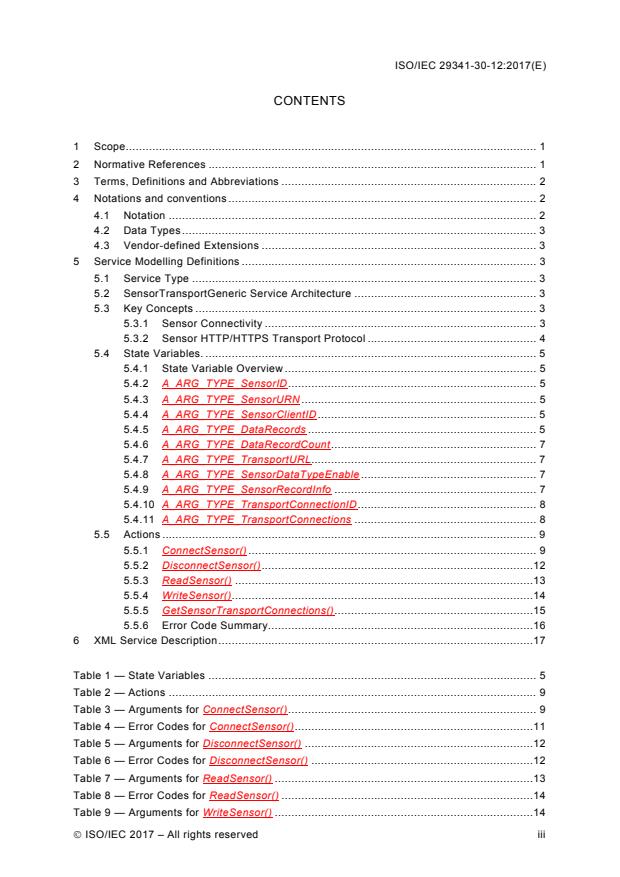
CONTENTS
1 Scope . 1
2 Normative References . 1
3 Terms, Definitions and Abbreviations . 2
4 Notations and conventions . 2
4.1 Notation . 2
4.2 Data Types . 3
4.3 Vendor-defined Extensions . 3
5 Service Modelling Definitions . 3
5.1 Service Type . 3
5.2 SensorTransportGeneric Service Architecture . 3
5.3 Key Concepts . 3
5.3.1 Sensor Connectivity . 3
5.3.2 Sensor HTTP/HTTPS Transport Protocol . 4
5.4 State Variables. . 5
5.4.1 State Variable Overview . 5
5.4.2 A_ARG_TYPE_SensorID . 5
5.4.3 A_ARG_TYPE_SensorURN . 5
5.4.4 A_ARG_TYPE_SensorClientID . 5
5.4.5 A_ARG_TYPE_DataRecords . 5
5.4.6 A_ARG_TYPE_DataRecordCount . 7
5.4.7 A_ARG_TYPE_TransportURL . 7
5.4.8 A_ARG_TYPE_SensorDataTypeEnable . 7
5.4.9 A_ARG_TYPE_SensorRecordInfo . 7
5.4.10 A_ARG_TYPE_TransportConnectionID . 8
5.4.11 A_ARG_TYPE_TransportConnections . 8
5.5 Actions . 9
5.5.1 ConnectSensor() . 9
5.5.2 DisconnectSensor() . 12
5.5.3 ReadSensor() . 13
5.5.4 WriteSensor() . 14
5.5.5 GetSensorTransportConnections() . 15
5.5.6 Error Code Summary . 16
6 XML Service Description . 17
Table 1 — State Variables . 5
Table 2 — Actions . 9
Table 3 — Arguments for ConnectSensor() . 9
Table 4 — Error Codes for ConnectSensor() . 11
Table 5 — Arguments for DisconnectSensor() . 12
Table 6 — Error Codes for DisconnectSensor() . 12
Table 7 — Arguments for ReadSensor() . 13
Table 8 — Error Codes for ReadSensor() . 14
Table 9 — Arguments for WriteSensor() . 14
ISO/IEC 2017 – All rights reserved iii
Table 10 — Error Codes for WriteSensor() . 15
Table 11 — Arguments for GetSensorTransportConnections() . 16
Table 12 — Error Codes for GetSensorTransportConnections() . 16
Table 13 — Error Code Summary . 16
iv ISO/IEC 2017 – All rights reserved
Foreword
ISO (the International Organization for Standardization) and IEC (the International Electrotechnical
Commission) form the specialized system for worldwide standardization. National bodies that are
members of ISO or IEC participate in the development of International Standards through technical
committees established by the respective organization to deal with particular fields of technical activity.
ISO and IEC technical committees collaborate in fields of mutual interest. Other international
organizations, governmental and non-governmental, in liaison with ISO and IEC, also take part in the
work. In the field of information technology, ISO and IEC have established a joint technical committee,
ISO/IEC JTC 1.
The procedures used to develop this document and those intended for its further maintenance are
described in the ISO/IEC Directives, Part 1. In particular the different approval criteria needed for the
different types of document should be noted. This document was drafted in accordance with the
editorial rules of the ISO/IEC Directives, Part 2 (see http://www.iso.org/directives).
Attention is drawn to the possibility that some of the elements of this document may be the subject of
patent rights. ISO and IEC shall not be held responsible for identifying any or all such patent rights.
Details of any patent rights identified during the development of the document will be in the
Introduction and/or on the ISO list of patent declarations received (see www.iso.org/patents).
Any trade name used in this document is information given for the convenience of users and does not
constitute an endorsement.
For an explanation on the voluntary nature of Standards, the meaning of the ISO specific terms and
expressions related to conformity assessment, as well as information about ISO’s adherence to the
WTO principles in the Technical Barriers to Trade (TBT) see the following URL: Foreword –
Supplementary information
ISO/IEC 29341-30-12 was prepared by UPnP Forum and adopted, under the PAS procedure, by joint
technical committee ISO/IEC JTC 1, Information technology, in parallel with its approval by national
bodies of ISO and IEC.
The list of all currently available parts of ISO/IEC 29341 series, under the general title
Information technology — UPnP Device Architecture, can be found on the ISO web site.
ISO/IEC 2017 – All rights reserved v
Introduction
ISO and IEC draw attention to the fact that it is claimed that compliance with this document may
involve the use of patents as indicated below.
ISO and IEC take no position concerning the evidence, validity and scope of these patent rights. The
holders of -these patent rights have assured ISO and IEC that they are willing to negotiate licenses
under reasonable and non-discriminatory terms and conditions with applicants throughout the world. In
this respect, the statements of the holders of these patent rights are registered with ISO and IEC.
Intel Corporation has informed IEC and ISO that it has patent applications or granted patents.
Information may be obtained from:
Intel Corporation
Standards Licensing Department
5200 NE Elam Young Parkway
MS: JFS-98
USA – Hillsboro, Oregon 97124
Microsoft Corporation has informed IEC and ISO that it has patent applications or granted
patents as listed below:
6101499 / US; 6687755 / US; 6910068 / US; 7130895 / US; 6725281 / US; 7089307 / US;
7069312 / US; 10/783 524 /US
Information may be obtained from:
Microsoft Corporation
One Microsoft Way
USA – Redmond WA 98052
Philips International B.V. has informed IEC and ISO that it has patent applications or granted
patents.
Information may be obtained from:
Philips International B.V. – IP&S
High Tech campus, building 44 3A21
NL – 5656 Eindhoven
NXP B.V. (NL) has informed IEC and ISO that it has patent applications or granted patents.
Information may be obtained from:
NXP B.V. (NL)
High Tech campus 60
NL – 5656 AG Eindhoven
Matsushita Electric Industrial Co. Ltd. has informed IEC and ISO that it has patent
applications or granted patents.
Information may be obtained from:
Matsushita Electric Industrial Co. Ltd.
1-3-7 Shiromi, Chuoh-ku
JP – Osaka 540-6139
Hewlett Packard Company has informed IEC and ISO that it has patent applications or
granted patents as listed below:
5 956 487 / US; 6 170 007 / US; 6 139 177 / US; 6 529 936 / US; 6 470 339 / US; 6 571 388 /
US; 6 205 466 / US
vi ISO/IEC 2017 – All rights reserved
Information may be obtained from:
Hewlett Packard Company
1501 Page Mill Road
USA – Palo Alto, CA 94304
Samsung Electronics Co. Ltd. has informed IEC and ISO that it has patent applications or
granted patents.
Information may be obtained from:
Digital Media Business, Samsung Electronics Co. Ltd.
416 Maetan-3 Dong, Yeongtang-Gu,
KR – Suwon City 443-742
Huawei Technologies Co., Ltd. has informed IEC and ISO that it has patent applications or
granted patents.
Information may be obtained from:
Huawei Technologies Co., Ltd.
Administration Building, Bantian Longgang District
Shenzhen – China 518129
Qualcomm Incorporated has informed IEC and ISO that it has patent applications or granted
patents.
Information may be obtained from:
Qualcomm Incorporated
5775 Morehouse Drive
San Diego, CA – USA 92121
Telecom Italia S.p.A.has informed IEC and ISO that it has patent applications or granted
patents.
Information may be obtained from:
Telecom Italia S.p.A.
Via Reiss Romoli, 274
Turin - Italy 10148
Cisco Systems informed IEC and ISO that it has patent applications or granted patents.
Information may be obtained from:
Cisco Systems, Inc.
170 West Tasman Drive
San Jose, CA – USA 95134
Attention is drawn to the possibility that some of the elements of this document may be the subject of
patent rights other than those identified above. ISO and IEC shall not be held responsible for
identifying any or all such patent rights.
ISO/IEC 2017 – All rights reserved vii
Original UPnP Document
Reference may be made in this document to original UPnP documents. These references are
retained in order to maintain consistency between the specifications as published by ISO/IEC
and by UPnP Implementers Corporation and later by UPnP Forum. The following table
indicates the original UPnP document titles and the corresponding part of ISO/IEC 29341:
UPnP Document Title ISO/IEC 29341 Part
UPnP Device Architecture 1.0 ISO/IEC 29341-1:2008
UPnP Device Architecture Version 1.0 ISO/IEC 29341-1:2011
UPnP Device Architecture 1.1 ISO/IEC 29341-1-1:2011
UPnP Device Architecture 2.0 ISO/IEC 29341-1-2
UPnP Basic:1 Device ISO/IEC 29341-2
UPnP AV Architecture:1 ISO/IEC 29341-3-1:2008
UPnP AV Architecture:1 ISO/IEC 29341-3-1:2011
UPnP AVTransport:1 Service ISO/IEC 29341-3-10
UPnP ConnectionManager:1 Service ISO/IEC 29341-3-11
UPnP ContentDirectory:1 Service ISO/IEC 29341-3-12
UPnP RenderingControl:1 Service ISO/IEC 29341-3-13
UPnP MediaRenderer:1 Device ISO/IEC 29341-3-2
UPnP MediaRenderer:2 Device ISO/IEC 29341-3-2:2011
UPnP MediaServer:1 Device ISO/IEC 29341-3-3
UPnP AVTransport:2 Service ISO/IEC 29341-4-10:2008
UPnP AVTransport:2 Service ISO/IEC 29341-4-10:2011
UPnP ConnectionManager:2 Service ISO/IEC 29341-4-11:2008
UPnP ConnectionManager:2 Service ISO/IEC 29341-4-11:2011
UPnP ContentDirectory:2 Service ISO/IEC 29341-4-12
UPnP RenderingControl:2 Service ISO/IEC 29341-4-13:2008
UPnP RenderingControl:2 Service ISO/IEC 29341-4-13:2011
UPnP ScheduledRecording:1 ISO/IEC 29341-4-14
UPnP ScheduledRecording:2 ISO/IEC 29341-4-14:2011
UPnP MediaRenderer:2 Device ISO/IEC 29341-4-2
UPnP MediaServer:2 Device ISO/IEC 29341-4-3
UPnP AV Datastructure Template:1 ISO/IEC 29341-4-4:2008
UPnP AV Datastructure Template:1 ISO/IEC 29341-4-4:2011
UPnP DigitalSecurityCamera:1 Device ISO/IEC 29341-5-1
UPnP DigitalSecurityCameraMotionImage:1 Service ISO/IEC 29341-5-10
UPnP DigitalSecurityCameraSettings:1 Service ISO/IEC 29341-5-11
UPnP DigitalSecurityCameraStillImage:1 Service ISO/IEC 29341-5-12
UPnP HVAC_System:1 Device ISO/IEC 29341-6-1
UPnP ControlValve:1 Service ISO/IEC 29341-6-10
UPnP HVAC_FanOperatingMode:1 Service ISO/IEC 29341-6-11
UPnP FanSpeed:1 Service ISO/IEC 29341-6-12
UPnP HouseStatus:1 Service ISO/IEC 29341-6-13
UPnP HVAC_SetpointSchedule:1 Service ISO/IEC 29341-6-14
UPnP TemperatureSensor:1 Service ISO/IEC 29341-6-15
UPnP TemperatureSetpoint:1 Service ISO/IEC 29341-6-16
UPnP HVAC_UserOperatingMode:1 Service ISO/IEC 29341-6-17
UPnP HVAC_ZoneThermostat:1 Device ISO/IEC 29341-6-2
viii ISO/IEC 2017 – All rights reserved
UPnP BinaryLight:1 Device ISO/IEC 29341-7-1
UPnP Dimming:1 Service ISO/IEC 29341-7-10
UPnP SwitchPower:1 Service ISO/IEC 29341-7-11
UPnP DimmableLight:1 Device ISO/IEC 29341-7-2
UPnP InternetGatewayDevice:1 Device ISO/IEC 29341-8-1
UPnP LANHostConfigManagement:1 Service ISO/IEC 29341-8-10
UPnP Layer3Forwarding:1 Service ISO/IEC 29341-8-11
UPnP LinkAuthentication:1 Service ISO/IEC 29341-8-12
UPnP RadiusClient:1 Service ISO/IEC 29341-8-13
UPnP WANCableLinkConfig:1 Service ISO/IEC 29341-8-14
UPnP WANCommonInterfaceConfig:1 Service ISO/IEC 29341-8-15
UPnP WANDSLLinkConfig:1 Service ISO/IEC 29341-8-16
UPnP WANEthernetLinkConfig:1 Service ISO/IEC 29341-8-17
UPnP WANIPConnection:1 Service ISO/IEC 29341-8-18
UPnP WANPOTSLinkConfig:1 Service ISO/IEC 29341-8-19
UPnP LANDevice:1 Device ISO/IEC 29341-8-2
UPnP WANPPPConnection:1 Service ISO/IEC 29341-8-20
UPnP WLANConfiguration:1 Service ISO/IEC 29341-8-21
UPnP WANDevice:1 Device ISO/IEC 29341-8-3
UPnP WANConnectionDevice:1 Device ISO/IEC 29341-8-4
UPnP WLANAccessPointDevice:1 Device ISO/IEC 29341-8-5
UPnP Printer:1 Device ISO/IEC 29341-9-1
UPnP ExternalActivity:1 Service ISO/IEC 29341-9-10
UPnP Feeder:1.0 Service ISO/IEC 29341-9-11
UPnP PrintBasic:1 Service ISO/IEC 29341-9-12
UPnP Scan:1 Service ISO/IEC 29341-9-13
UPnP Scanner:1.0 Device ISO/IEC 29341-9-2
UPnP QoS Architecture:1.0 ISO/IEC 29341-10-1
UPnP QosDevice:1 Service ISO/IEC 29341-10-10
UPnP QosManager:1 Service ISO/IEC 29341-10-11
UPnP QosPolicyHolder:1 Service ISO/IEC 29341-10-12
UPnP QoS Architecture:2 ISO/IEC 29341-11-1
UPnP QosDevice:2 Service ISO/IEC 29341-11-10
UPnP QosManager:2 Service ISO/IEC 29341-11-11
UPnP QosPolicyHolder:2 Service ISO/IEC 29341-11-12
UPnP QOS v2 Schema Files ISO/IEC 29341-11-2
UPnP RemoteUIClientDevice:1 Device ISO/IEC 29341-12-1
UPnP RemoteUIClient:1 Service ISO/IEC 29341-12-10
UPnP RemoteUIServer:1 Service ISO/IEC 29341-12-11
UPnP RemoteUIServerDevice:1 Device ISO/IEC 29341-12-2
UPnP DeviceSecurity:1 Service ISO/IEC 29341-13-10
UPnP SecurityConsole:1 Service ISO/IEC 29341-13-11
UPnP ContentDirectory:3 Service ISO/IEC 29341-14-12:2011
UPnP MediaServer:3 Device ISO/IEC 29341-14-3:2011
UPnP ContentSync:1 ISO/IEC 29341-15-10:2011
UPnP Low Power Architecture:1 ISO/IEC 29341-16-1:2011
UPnP LowPowerProxy:1 Service ISO/IEC 29341-16-10:2011
ISO/IEC 2017 – All rights reserved ix
UPnP LowPowerDevice:1 Service ISO/IEC 29341-16-11:2011
UPnP QoS Architecture:3 ISO/IEC 29341-17-1:2011
UPnP QosDevice:3 Service ISO/IEC 29341-17-10:2011
UPnP QosManager:3 Service ISO/IEC 29341-17-11:2011
UPnP QosPolicyHolder:3 Service ISO/IEC 29341-17-12:2011
UPnP QosDevice:3 Addendum ISO/IEC 29341-17-13:2011
UPnP RemoteAccessArchitecture:1 ISO/IEC 29341-18-1:2011
UPnP InboundConnectionConfig:1 Service ISO/IEC 29341-18-10:2011
UPnP RADAConfig:1 Service ISO/IEC 29341-18-11:2011
UPnP RADASync:1 Service ISO/IEC 29341-18-12:2011
UPnP RATAConfig:1 Service ISO/IEC 29341-18-13:2011
UPnP RAClient:1 Device ISO/IEC 29341-18-2:2011
UPnP RAServer:1 Device ISO/IEC 29341-18-3:2011
UPnP RADiscoveryAgent:1 Device ISO/IEC 29341-18-4:2011
UPnP SolarProtectionBlind:1 Device ISO/IEC 29341-19-1:2011
UPnP TwoWayMotionMotor:1 Service ISO/IEC 29341-19-10:2011
UPnP AV Architecture:2 ISO/IEC 29341-20-1
UPnP AVTransport:3 Service ISO/IEC 29341-20-10
UPnP ConnectionManager:3 Service ISO/IEC 29341-20-11
UPnP ContentDirectory:4 Device ISO/IEC 29341-20-12
UPnP RenderingControl:3 Service ISO/IEC 29341-20-13
UPnP ScheduledRecording:2 Service ISO/IEC 29341-20-14
UPnP MediaRenderer:3 Service ISO/IEC 29341-20-2
UPnP MediaServer:4 Device ISO/IEC 29341-20-3
UPnP AV Datastructure Template:1 ISO/IEC 29341-20-4
UPnP InternetGatewayDevice:2 Device ISO/IEC 29341-24-1
UPnP WANIPConnection:2 Service ISO/IEC 29341-24-10
UPnP WANIPv6FirewallControl:1 Service ISO/IEC 29341-24-11
UPnP WANConnectionDevice:2 Service ISO/IEC 29341-24-2
UPnP WANDevice:2 Device ISO/IEC 29341-24-3
UPnP Telephony Architecture:2 ISO/IEC 29341-26-1
UPnP CallManagement:2 Service ISO/IEC 29341-26-10
UPnP MediaManagement:2 Service ISO/IEC 29341-26-11
UPnP Messaging:2 Service ISO/IEC 29341-26-12
UPnP PhoneManagement:2 Service ISO/IEC 29341-26-13
UPnP AddressBook:1 Service ISO/IEC 29341-26-14
UPnP Calendar:1 Service ISO/IEC 29341-26-15
UPnP Presense:1 Service ISO/IEC 29341-26-16
UPnP TelephonyClient:2 Device ISO/IEC 29341-26-2
UPnP TelephonyServer:2 Device ISO/IEC 29341-26-3
UPnP Friendly Info Update:1 Service ISO/IEC 29341-27-1
UPnP MultiScreen MultiScreen Architecture:1
ISO/IEC 29341-28-1
UPnP MultiScreen Application Management:1 Service
ISO/IEC 29341-28-10
UPnP MultiScreen Screen:1 Device
ISO/IEC 29341-28-2
UPnP MultiScreen Application Management:2 Service
ISO/IEC 29341-29-10
UPnP MultiScreen Screen:2 Device
ISO/IEC 29341-29-2
UPnP IoT Management and Control Architecture Overview:1
ISO/IEC 29341-30-1
x ISO/IEC 2017 – All rights reserved
UPnP DataStore:1 Service
ISO/IEC 29341-30-10
UPnP IoT Management and Control Data Model:1 Service
ISO/IEC 29341-30-11
UPnP IoT Management and Control Transport Generic:1
Service ISO/IEC 29341-30-12
UPnP IoT Management and Control:1 Device
ISO/IEC 29341-30-2
UPnP Energy Management:1 Service ISO/IEC 29341-31-1
ISO/IEC 2017 – All rights reserved xi
1 Scope
This part of Publicly Available Specification ISO/IEC 29341 specifies the characteristics of a
networked service that offers sensor and/or actuator data transport capabilities to an
independent networked entity known as a control point.
This document defines the service SensorTransportGeneric:1 (in short TransportGeneric),
which identifies Level 1 of the UPnP IoT Management and Control TransportGeneric:1
Service [10]. This Publicly Available Specification is applicable to Standardized DCPs of the
UPnP Forum which include this service.
This service enables UPnP clients to access sensors and/or actuators without needing a
detailed knowledge of the target sensor or actuator or its connectivity to the UPnP network.
Sensors and Actuators are instead treated a generic data sources or sinks.
This service definition is compliant with the UPnP Device Architecture version 1.0 [1]. It
defines a service type referred to herein as TransportGeneric service.
2 Normative References
The following referenced documents are indispensable for the application of this document.
For dated references, only the edition cited applies. For undated references, the latest edition
of the referenced document (including any amendments) applies.
[1] UPnP Device Architecture, version 1.0, UPnP Forum, June 13, 2000. Available
at: http://upnp.org/specs/arch/UPnPDA10_20000613.pdf. Latest version available
at: http://upnp.org/specs/arch/UPnP-arch-DeviceArchitecture-v1.0.pdf.
[2] ISO 8601 Data elements and interchange formats – Information interchange --
Representation of dates and times, International Standards Organization, December 21, 2000.
Available at: ISO 8601:2000.
[3] IETF RFC 2119, Key words for use in RFCs to Indicate Requirement Levels, S. Bradner,
1997. Available at: http://www.faqs.org/rfcs/rfc2119.html.
[4] HyperText Transport Protocol – HTTP/1.1, R. Fielding, J. Gettys, J. Mogul, H. Frystyk, L.
Masinter, P. Leach, T. Berners-Lee, June 1999. Available at: http://www.ietf.org/rfc/rfc2616.txt.
[5] IETF RFC 3339, Date and Time on the Internet: Timestamps, G. Klyne, Clearswift
Corporation, C. Newman, Sun Microsystems, July 2002. Available
at: http://www.ietf.org/rfc/rfc3339.txt.
[6] Extensible Markup Language (XML) 1.0 (Third Edition), François Yergeau, Tim Bray, Jean
Paoli, C. M. Sperberg-McQueen, Eve Maler, eds., W3C Recommendation, February 4, 2004.
Available at: http://www.w3.org/TR/2004/REC-xml-20040204.
[7] XML Schema Part 2: Data Types, Second Edition, Paul V. Biron, Ashok Malhotra, W3C
Recommendation, 28 October 2004. Available at: http://www.w3.org/TR/2004/REC-
xmlschema-2-20041028.
[8] UPnP IoT Management and Control Architecture Overview, UPnP Forum, July 1, 2013.
Available at: http://www.upnp.org/specs/iotmc/UPnP-iotmc-IoTManagementAndControl-
Architecture-Overview-v1-20130701.pdf. Latest version available
at: http://www.upnp.org/specs/iotmc/UPnP-iotmc-IoTManagementAndControl-Architecture-
Overview-v1.pdf.
[9] UPnP IoT Management and Control Device, UPnP Forum July 1, 2013. Available
at: http://www.upnp.org/specs/iotm/UPnP-iotmc-IoTManagementAndControl-v1-Device-
20130701.pdf. Latest version available at: http://www.upnp.org/specs/iotmc/UPnP-iotmc-UPnP
IoT Management and Control Device-v1-Device.pdf.
[10] UPnP UPnP IoT Management and Control Device TransportGeneric:1 Service, UPnP
Forum July 1, 2013. Available at: http://www.upnp.org/specs/iotmc/UPnP-iotmc-UPnP
ISO/IEC 2017 – All rights reserved 1
IoTManagementandControl-TransportGeneric-v1-Service-20130701.pdf. Latest version
available at: http://www.upnp.org/specs/iotmc/UPnP-iotm-IoTManagementandControl-
TransportGeneric-v1-Service.pdf.
[11] UPnP DataStore:1 Service, UPnP Forum, July 1, 2013. Available
at: http://www.upnp.org/specs/smgt/UPnP-ds-DataStore-v1-Service-20130701.pdf. Latest
version available at: http://www.upnp.org/specs/smgt/UPnP-ds-DataStore-v1-Service.pdf.
[12] UPnP IoT Management And Control DataModel Service, UPnP Forum, July 1, 2013.
Available at: http://www.upnp.org/specs/smgt/UPnP-iotmc-IoTManagementAndControl-
DataModel-v1-Service-20130701.pdf. Latest version available
at: http://www.upnp.org/specs/smgt/UPnP-iotmc-IoTManagementAndControl-DataModel-v1-
Service.pdf.
[13] UPnP DeviceProtection:1 Service, UPnP Forum, February 24, 2011.
Available at: http://www.upnp.org/specs/gw/UPnP-gw-DeviceProtection-v1-Service-
20110224.pdf.
Latest version available at: http://www.upnp.org/specs/gw/UPnP-gw-DeviceProtection-v1-
Service.pdf.
[14] UPnP ConfigurationManagement:2 Service, UPnP Forum, February 16, 2012.
Available at: http://www.upnp.org/specs/dm/UPnP-dm-ConfigurationManagement-v2-Service-
20120216.pdf. Latest version available at: http://www.upnp.org/specs/dm/UPnP-dm-
ConfigurationManagement-v2-Service.pdf.
[15] XML Schema UPnP DataStore DataRecord Status, UPnP Forum, July 1, 2013.
Available at: http://www.upnp.org/schemas/ds/drecstatus-v1-20130701.xsd. Latest version
available at: http://www.upnp.org/schemas/ds/drecstatus.xsd.
[16] XML Schema UPnP DataStore DataRecord, UPnP Forum, July 1, 2013. Available
at: http://www.upnp.org/schemas/ds/drecs-v1-20130701.xsd. Latest version available
at: http://www.upnp.org/schemas/ds/drecs.xsd.
[17] XML Schema for Sensor DataRecord Information, UPnP Forum, July 1, 2013.
Available at: http://www.upnp.org/schemas/smgt/srecinfo-v1-20130701.xsd.
Latest version available at: http://www.upnp.org/schemas/smgt/srecinfo.xsd.
[18] XML Schema for Sensor TransportConnections Information, UPnP Forum, July 1, 2013.
Available at: http://www.upnp.org/schemas/smgt/tspc-v1-20130701.xsd.
Latest version available at: http://www.upnp.org/schemas/smgt/tspc.xsd.
3 Terms, Definitions and Abbreviations
For the purposes of this document, the terms and definitions given in [1] and [8] apply.
4 Notations and conventions
4.1 Notation
Strings that are to be taken literally are enclosed in “double quotes”.
Words that are emphasized are printed in italic.
Keywords that are defined by the UPnP Working Committee are printed using the forum
character style.
Keywords that are defined by the UPnP Device Architecture are printed using the arch
character style.
A double colon delimiter, “::”, signifies a hierarchical parent-child (parent::child)
relationship between the two objects separated by the double colon. This delimiter is used
in multiple contexts, for example: Service::Action(), Action()::Argument,
parentProperty::childProperty.
2 ISO/IEC 2017 – All rights reserved
4.2 Data Types
This specification uses data type definitions from two different sources. The UPnP Device
Architecture defined data types are used to define state variable and action argument data
types UPnP Device Architecture, version 1.0 [1]. The XML Schema namespace is used to
define property data types [7].
For UPnP Device Architecture defined Boolean data types, it is strongly RECOMMENDED to
use the value “0” for false, and the value “1” for true. The values “true”, “yes”, “false”, or “no”
MAY also be used but are NOT RECOMMENDED. The values “yes” and “no” are deprecated
and MUST NOT be sent out by devices but MUST be accepted on input.
For XML Schema defined Boolean data types, it is strongly RECOMMENDED to use the value
“0” for false, and the value “1” for true. The values “true”, “yes”, “false”, or “no” MAY also be
used but are NOT RECOMMENDED. The values “yes” and “no” are deprecated and MUST
NOT be sent out by devices but MUST be accepted on input.
4.3 Vendor-defined Extensions
Whenever vendors create additional vendor-defined state variables, actions or properties,
their assigned names and XML representation MUST follow the naming conventions and XML
rules as specified in UPnP Device Architecture, version 1.0 [1], Clause 2.5, “Description: Non-
standard vendor extensions”.
5 Service Modelling Definitions
5.1 Service Type
The following URN identifies a service that is compliant with this specification:
urn:schemas-upnp-org:service:SensorTransportGeneric:1
SensorTransportGeneric or TransportGeneric service is used herein to refer to this service
type.
5.2 SensorTransportGeneric Service Architecture
The TransportGeneric service enables UPnP clients to obtain sensor data without needing to
have detailed understanding the operation of a target sensor or the sensor’s access network
protocols. This service abstracts these notions treating the sensor as a generic data source
which defines output record formats. Both HTTP transport and a SOAP-based read action are
defined. In the case of actuators, this service treats the target as a generic data sink and
defines a SOAP-based write action. This service defines sections of the IoT Management And
Control DataModel related to the description of sensors supported by this service. See UPnP
IoT Management and Control DataModel service [12] and UPnP IoT Management and Control
Architecture Overview [8] for additional details.
5.3 Key Concepts
Note: See IoT Management and Control Architecture Overview [8] for an overall discussion of IoT Management and
Control and DataStore services.
5.3.1 Sensor Connectivity
The TransportGeneric service specification defines a set of SOAP actions which manage
connectivity to sensors as generic data sources and sinks. Sensors are advertised to UPnP
home-network clients via the IoTM anagement And Control DataModel service [12]. The
DataModel parameter SensorID is used to identify a sensor to SOAP actions defined by this
service.
Two models are supported for obtaining data from Sensors.
1) HTTP/HTTPS Transport Model
The TransportGeneric service acts as an HTTP/HTTPS client. The URL of a
HTTP/HTTPS transport sever is provided to this service using the ConnectSensor()
action. When the Sensor has data available the TransportGeneric service connects to
ISO/IEC 2017 – All rights reserved 3
the transport server endpoint provided and posts one or more DataRecords to that
endpoint.
2) SOAP Action Model
The TransportGeneric service provides a ReadSensor() action. A UPnP control point
can issue this action in response to a Sensor data event to read one or more pending
DataRecords from the target sensor.
The TransportGeneric service shall support both of these models enabling a single SOAP
client and one or more HTTP/HTTPS transport connections to exist concurrently. Each
connection maintains its state independently, so that read activity on a particular connection
has no effect on the data available to other connections.
For providing data to Sensors the WriteSensor() action is provided.
Note: Future versions of the UPnP IoT Management and Control device are anticipated to define additional
transport-specific (SensorTransport*) services to provide access to low-level control of bridged sensor transport
networks.
5.3.2 Sensor HTTP/HTTPS Transport Protocol
Sensor connections initialized by the ConnectSensor() action shall support the HTTP/HTTPS
Transport model as follows:
1) When the managed sensor has data available, the TransportGeneric service shall issue an
HTTP/HTTPS POST request to the transport endpoint provided by the TransportURL
argument of the ConnectSensor() action.
2) The request shall contain any HTTP entity-headers as required by RFC-2616.
3) The entity-body shall contain a DataRecords XML document as described for the
A_ARG_TYPE_DataRecords state variable.
4) If all elements contained within the POST request are acceptable, then
the transport endpoint shall generate a HTTP-response with HTTP status 200 and an
empty entity-body.
5) If transport endpoint does not accept all of the POST(ed) elements, the
transport endpoint shall return a HTTP-response with HTTP status 200 with an entity-body
containing an XML document conforming to the XML Schema UPnP DataStore
DataRecord Status [15].
Note: This schema is shared with the DataStore service [11].
xmlns="urn:schemas-upnp-org:ds:drecstatus"
xmlns:xsi="http://www.w3.org/2001/XMLSchema-instance"
xsi:schemaLocation="urn:schemas-upnp-org:ds:drecstatus
http://www.upnp.org/schemas/ds/drecstatus-v1.xsd">
element in the POST request -->
... Additional elements ...
Required. Case Sensitive.
Required. Shall include the namespace declaration for the XML Schema UPnP DataStore DataRecord Status
(urn:schema-upnp-org:ds:drecstatus). Shall include the following elements and attributes:
Required. XML. For each element in the original HTTP-POST request, a
corresponding element shall be included.
4 ISO/IEC 2017 – All rights reserved
accepted
Required. Boolean. This attribute shall be set to “1” if the corresponding
element was accepted by the transport server and to “0” if the corresponding
was rejected.
5.4 State Variables.
Note: For first-time reader, it may be more insightful to read the theory of operations first and then the action
definitions before reading the state variable definitions.
5.4.1 State Variable Overview
Table 1 — State Variables
a
Variable Name R/A Data Type Reference
A_ARG_TYPE_SensorID R string See 5.4.2
A_ARG_TYPE_SensorURN R string See 5.4.3
A_ARG_TYPE_SensorClientID R string See 5.4.4
A_ARG_TYPE_DataRecords b string(XML fragment) See 5.4.5
CR
A_ARG_TYPE_DataRecordCount R ui4 See 5.4.6
A_ARG_TYPE_TransportURL R string See 5.4.7
A_ARG_TYPE_SensorDataTypeEnable R boolean See 5.4.8
A_ARG_TYPE_SensorRecordInfo R string See 5.4.9
A_ARG_TYPE_TransportConnectionID R string See 5.4.10
A_ARG_TYPE_TransportConnections R string See 5.4.11
a
R = REQUIRED, A = ALLOWED, CR = CONDITIONALLY REQUIRED, CA = CONDITIONALLY
ALLOWED, X = Non-standard, add -D when deprecated (e.g., R-D, O-D).
b
This conditionally required state variable MUST be implemented if actions ReadSensor() or
WriteSensor() are implemented.
5.4.2 A_ARG_TYPE_SensorID
This state variable contains a string which shall indicate a sensor that is managed by this IoT
Management and Control device.
5.4.3 A_ARG_TYPE_SensorURN
This state variable contains a string which shall identify a URN value for a target sensor. The
URN value is used to match to a set of DataItems the target sensor can provide. See UPnP
IoT Management and Control DataModel service [12] SensorURN for further detail on sensor
URN values.
5.4.4 A_ARG_TYPE_SensorClientID
This state variable contains a string which the target sensor shall provide as the value of the
sensor's DataItem named "ClientID".
5.4.5 A_ARG_TYPE_DataRecords
This state variable contains an XML document which conforms to the XML Schema UPnP
DataStore DataRecord [16]. This document is used to retrieve or convey DataRecord(s) to or
from the TransportGeneric service.
Note: This schema is shared with the DataStore service [11].
ISO/IEC 2017 – All rights reserved 5
xmlns:xsi="http://www.w3.org/2001/XMLSchema-instance"
xsi:schemaLocation="urn:schemas-upnp-org:ds:drecs
http://www.upnp.org/schemas/ds/drecs-v1.xsd">
type="Type of DataItem"
encoding="Encoding of DataItem"
namespace="namespace(For XML-based DataItem)">
Value of DataItem
...Additional elements for DataItems in this record...
...Additional elements ...
Allowed. Case sensitive.
Required. The datarecords element shall contain one or more child elements; each
datarecord element providing the contents of an individual DataRecord. Shall include the following
elements. Shall include a namespace declaration for the XML Schema UPnP DataStore DataRecord
(“urn:schemas-upnp-org:ds:drecs”).
Required. xsd:string. Each element shall contain zero or more
elements.
Required. xsd:string. Each element shall contain zero or more
elements. The value of this element carries the value of the corresponding
named DataItem as indicated by the field element’s name attribute.
name
Required. xsd:string. Each element shall designate a
corresponding DataItem by specifying its name as the value this attribute. A
element is prohibited from containing multiple
elements with identical name attribute values.
type
Allowed. xsd:string. This attribute shall provide data type information for
each DataItem within a DataRecord. See IoTManagementAndControl
Architecture Overview [8] subclause 4.3, "DataItem Semantics" for encoding
of the type attribute.
Note: DataItem type information is conveyed when transport connections are
established rather than as part of each DataRecord. This information is
provided for testing and diagnostic purposes.
encoding
Required. xsd:string. . This attribute shall provide the encoding for this
DataItem. Allowable values for this attribute are either "ascii", "utf-8" or
"base64".
Note: DataItem encoding information is conveyed when transport
connections are established rather than as part of each DataRecord. This
information is provided for testing and diagnostic purposes.
namespace
Allowed. xsd:string. This attribute is permitted for DataItems consisting of
strings containing XML compliant documents. This attribute shall provide the
expected namespace for the encoded document. If this attribute is present,
implementations shall validate that the corresponding DataItem is a valid
6 ISO/IEC 2017 – All rights reserved
XML document encoded following XML escaping rules. Implementations are
permitted to perform further validate to insure consistency of the DataItem
with the XML namespace indicated by this attribute
Note: DataItem namespace information is conveyed when transport
connections are established rather than as part of each DataRecord. This
information is provided for testing and diagnostic purposes.
5.4.6 A_ARG_TYPE_DataRecordCount
This state variable contains an unsigned integer (ui4) which shall indicate a count of
DataRecord(s).
5.4.7 A_ARG_TYPE_TransportURL
This state variable shall define a string argument that conforms to Uniform Resource Locator
syntax [4]. The purpose of this URL is to enable IoT Management and Control device to
submit asynchronous updates to transport endpoint identified by this URL. This URL may be
allocated by DataStore service [11].
5.4.8 A_ARG_TYPE_SensorDataTypeEnable
This state variable shall provide a boolean value. If this argument is set to "1" (one) then
each DataRecord element provided by the subject action shall include type,
encoding and namespace (if applicable) attributes for the corresponding DataItem.
5.4.9 A_ARG_TYPE_SensorRecordInfo
This state variable contains an XML document which conforms to the Sensor DataRecord
Information schema [17]. This XML document which defines the contents of DataRecords to
be transmitted by the SensorTransportGeneric service either via a ReadSensor() /
WriteSensor() SOAP actions or via a sensor transport connection established via the
ConnectSensor() action.
xmlns="urn:schemas-upnp-org:smgt:srecinfo"
xmlns:xsi="http://www.w3.org/2001/XMLSchema-instance"
xsi:schemaLocation="urn:schemas-upnp-org:smgt:srecinfo
http://www.upnp.org/schemas/smgt/srecinfo-v1.xsd"
>
name="Name of DataItem"
prefix="Prefix to be applied to name of DataItem"
... Additional element(s) for DataItems to be included in this
... Sensor DataRecord ...
Allowed. Case sensitive.
Required. Shall include a namespace declaration for the XML Schema for Sensor DataRecord
Information (“urn:schemas-upnp-org:smgt:srecinfo”). Shall include the following elements and
attributes:
Allowed. Shall be specified one time. Shall include the following elements and attributes:
ISO/IEC 2017 – All rights reserved 7
Allowed. Shall be specified zero or more times. Each element shall specify
a DataItem name supported by the target sensor to be included in
element(s) generated by the sensor.
name
Required. Shall provide the name of the DataItem to be included in the
generated by the target sensor.
prefix
Allowed. The value provided shall be prefixed to the DataItem name in the
generated by the target sensor.
5.4.10 A_ARG_TYPE_TransportConnectionID
This state variable shall contain a unique identifier for a sensor transport connection. See
action(s) ConnectSensor() and DisconnectSensor() for usage of this argument type.
5.4.11 A_ARG_TYPE_TransportConnections
This state variable contains an XML document which conforms to the XML Schema UPnP
TransportConnections Information [18].
xmlns:xsi="http://www.w3.org/2001/XMLSchema-instance"
xsi:schemaLocation="urn:schemas-upnp-org:smgt:tspc
http://www.upnp.org/schemas/smgt/tspc-v1.xsd">
sensorID="SensorID value for the reported sensor"
transportConnectionID="identifier for the transport connection"
transportURL="transport endpoint URL for the transport connection"
sensorClientID="ClientID argument from the ConnectSensor() action" />
...Additional elements for each transport connections...
Allowed. Case sensitive.
Required. XML. Shall include a namespace declaration for the XML Schema UPnP
TransportConnections (“urn:schemas-upnp-org:smgt:tspc”). Shall include zero or more of the following
elements:
Required. xsd:string. Each element provides information for a
transport connection supported by the sensor indicated by the sensorID attribute. This
element shall contain the following attributes.
sensorID
Required. xsd:string. The value of this attribute shall identify the sensor supporting
the transport connection described by this element. This
value corresponds to the SensorID argument value supplied to the C
...