

ISO/IEC 24079:2024
(Main)Information technology — Network Controller Sideband Interface (NC-SI) specifications collection
General Information
- Abstract
This document defines the functionality and behavior of the Sideband Interface responsible for connecting the Network Controller to the Management Controller. It also outlines the behavioral model of the network traffic destined for the Management Controller from the Network Controller. This document defines the following two aspects of the Network Controller Sideband Interface (NC‑SI): behavior of the interface, which include its operational states as well as the states of the associated components, the payloads and commands of the communication protocol supported over the interface. The scope of this document is limited to addressing only a single Management Controller communicating with one or more Network Controllers. This document also defines the following aspects of a 3.3V RMII Based Transport (RBT) based physical medium: transport binding for NC-SI over RBT, electrical and timing requirements for the RBT, an optional hardware arbitration mechanism for RBT. Only the topics that may affect the behavior of the Network Controller or Management Controller, as it pertains to the Sideband Interface operations, are discussed in this document. NC-SI over MCTP Binding Specification (DSP0261) This document defines the bindings between NC-SI protocol elements and MCTP elements in order for NC-SI Control and Pass-Through traffic to be transported using MCTP. Portions of this document rely on information and definitions from other specifications, which clause REF _Ref99190650 \r \h 2 08D0C9EA79F9BACE118C8200AA004BA90B02000000080000000D0000005F00520065006600390039003100390030003600350030000000 identifies. Two of these references are particularly relevant: DMTF DSP0222, Network Controller Sideband Interface (NC-SI) Specification, provides the NC‑SI base control that is to be bound over MCTP by this specification. DMTF DSP0236, Management Component Transport Protocol (MCTP) Base Specification, defines the MCTP transport on which the NC-SI Control and Pass-through packets are to be conveyed.
- Status
- Published
- Publication Date
- 22-Jul-2024
- Technical Committee
- ISO/IEC JTC 1 - Information technology
- Drafting Committee
- ISO/IEC JTC 1 - Information technology
- Current Stage
- 6060 - International Standard published
- Start Date
- 23-Jul-2024
- Due Date
- 29-Aug-2026
- Completion Date
- 23-Jul-2024

Overview
ISO/IEC 24079:2024 - Information technology - Network Controller Sideband Interface (NC‑SI) specifications collection - standardizes the Sideband Interface connecting a Network Controller (NC) to a Management Controller (MC). The collection defines the NC‑SI behavioral model, operational states, protocol payloads and commands, and how NC‑SI traffic is presented to the MC. It also specifies a 3.3V RMII Based Transport (RBT) physical binding (transport binding, electrical and timing requirements, and optional hardware arbitration). The scope covers a single Management Controller communicating with one or more Network Controllers and includes bindings for NC‑SI over MCTP.
Key topics and technical requirements
- NC‑SI behavior and operational states: Defines state machines, component states, and how NC and MC transition during initialization, normal operation, and error conditions.
- Packet and command formats: Control, response and Asynchronous Event Notification (AEN) packet structures, op‑codes, reason codes, and timing constraints for command/response sequences.
- Transport bindings:
- NC‑SI over MCTP: Mapping of NC‑SI control and pass‑through traffic onto MCTP (Management Component Transport Protocol).
- RBT (3.3V RMII Based Transport): Electrical specifications, timing requirements, transport binding and an optional hardware arbitration mechanism for multi‑drop topologies.
- Arbitration and multi‑controller topologies: Support for hardware arbitration, multi‑drop rings, and packet filtering logic affecting NC/MC behavior.
- Timing and electrical conformance: DC/AC measurements, overshoot/undershoot criteria, and packet-based timing requirements that impact NIC and MC implementations.
- Scope limitations: Focuses only on topics that affect MC/NC behavior related to the sideband interface and assumes referenced DMTF documents for base NC‑SI and MCTP definitions.
Applications and who should use this standard
ISO/IEC 24079:2024 is essential for:
- BMC/Management Controller firmware developers implementing NC‑SI control and AEN handling.
- Network Interface Card (NIC) and Network Controller vendors designing sideband interfaces, RBT PHYs, and hardware arbitration logic.
- Server, appliance and OEM system architects integrating management channels for out‑of‑band management and telemetry.
- Test labs and compliance engineers validating electrical/timing conformance, packet formats, and NC‑MC interoperability. Practical uses include out‑of‑band management, remote monitoring, OEM system management integration, and secure transport of NC control and pass‑through traffic.
Related standards
- DMTF DSP0222 - Network Controller Sideband Interface (NC‑SI) Specification (base NC‑SI control).
- DMTF DSP0236 - MCTP Base Specification (transport layer).
- DMTF DSP0261 - NC‑SI over MCTP Binding Specification (bindings between NC‑SI and MCTP).
Keywords: ISO/IEC 24079:2024, NC‑SI, Network Controller Sideband Interface, MCTP, RBT, RMII, Management Controller, Network Controller, DMTF.
Get Certified
Connect with accredited certification bodies for this standard

BSI Group
BSI (British Standards Institution) is the business standards company that helps organizations make excellence a habit.

NYCE
Mexican standards and certification body.
Sponsored listings
Frequently Asked Questions
ISO/IEC 24079:2024 is a standard published by the International Organization for Standardization (ISO). Its full title is "Information technology — Network Controller Sideband Interface (NC-SI) specifications collection". This standard covers: This document defines the functionality and behavior of the Sideband Interface responsible for connecting the Network Controller to the Management Controller. It also outlines the behavioral model of the network traffic destined for the Management Controller from the Network Controller. This document defines the following two aspects of the Network Controller Sideband Interface (NC‑SI): behavior of the interface, which include its operational states as well as the states of the associated components, the payloads and commands of the communication protocol supported over the interface. The scope of this document is limited to addressing only a single Management Controller communicating with one or more Network Controllers. This document also defines the following aspects of a 3.3V RMII Based Transport (RBT) based physical medium: transport binding for NC-SI over RBT, electrical and timing requirements for the RBT, an optional hardware arbitration mechanism for RBT. Only the topics that may affect the behavior of the Network Controller or Management Controller, as it pertains to the Sideband Interface operations, are discussed in this document. NC-SI over MCTP Binding Specification (DSP0261) This document defines the bindings between NC-SI protocol elements and MCTP elements in order for NC-SI Control and Pass-Through traffic to be transported using MCTP. Portions of this document rely on information and definitions from other specifications, which clause REF _Ref99190650 \r \h 2 08D0C9EA79F9BACE118C8200AA004BA90B02000000080000000D0000005F00520065006600390039003100390030003600350030000000 identifies. Two of these references are particularly relevant: DMTF DSP0222, Network Controller Sideband Interface (NC-SI) Specification, provides the NC‑SI base control that is to be bound over MCTP by this specification. DMTF DSP0236, Management Component Transport Protocol (MCTP) Base Specification, defines the MCTP transport on which the NC-SI Control and Pass-through packets are to be conveyed.
This document defines the functionality and behavior of the Sideband Interface responsible for connecting the Network Controller to the Management Controller. It also outlines the behavioral model of the network traffic destined for the Management Controller from the Network Controller. This document defines the following two aspects of the Network Controller Sideband Interface (NC‑SI): behavior of the interface, which include its operational states as well as the states of the associated components, the payloads and commands of the communication protocol supported over the interface. The scope of this document is limited to addressing only a single Management Controller communicating with one or more Network Controllers. This document also defines the following aspects of a 3.3V RMII Based Transport (RBT) based physical medium: transport binding for NC-SI over RBT, electrical and timing requirements for the RBT, an optional hardware arbitration mechanism for RBT. Only the topics that may affect the behavior of the Network Controller or Management Controller, as it pertains to the Sideband Interface operations, are discussed in this document. NC-SI over MCTP Binding Specification (DSP0261) This document defines the bindings between NC-SI protocol elements and MCTP elements in order for NC-SI Control and Pass-Through traffic to be transported using MCTP. Portions of this document rely on information and definitions from other specifications, which clause REF _Ref99190650 \r \h 2 08D0C9EA79F9BACE118C8200AA004BA90B02000000080000000D0000005F00520065006600390039003100390030003600350030000000 identifies. Two of these references are particularly relevant: DMTF DSP0222, Network Controller Sideband Interface (NC-SI) Specification, provides the NC‑SI base control that is to be bound over MCTP by this specification. DMTF DSP0236, Management Component Transport Protocol (MCTP) Base Specification, defines the MCTP transport on which the NC-SI Control and Pass-through packets are to be conveyed.
ISO/IEC 24079:2024 is classified under the following ICS (International Classification for Standards) categories: 35.200 - Interface and interconnection equipment. The ICS classification helps identify the subject area and facilitates finding related standards.
ISO/IEC 24079:2024 is available in PDF format for immediate download after purchase. The document can be added to your cart and obtained through the secure checkout process. Digital delivery ensures instant access to the complete standard document.
Standards Content (Sample)
International
Standard
ISO/IEC 24079
First edition
Information technology — Network
2024-07
Controller Sideband Interface (NC-
SI) specifications collection
Technologies de l’information — Collection de spécifications
pour l’interface entre contrôleur réseau et contrôleur de gestion
système (NC-SI)
Reference number
© ISO/IEC 2024
All rights reserved. Unless otherwise specified, or required in the context of its implementation, no part of this publication may
be reproduced or utilized otherwise in any form or by any means, electronic or mechanical, including photocopying, or posting on
the internet or an intranet, without prior written permission. Permission can be requested from either ISO at the address below
or ISO’s member body in the country of the requester.
ISO copyright office
CP 401 • Ch. de Blandonnet 8
CH-1214 Vernier, Geneva
Phone: +41 22 749 01 11
Email: copyright@iso.org
Website: www.iso.org
Published in Switzerland
© ISO/IEC 2024 – All rights reserved
ii
Foreword
ISO (the International Organization for Standardization) and IEC (the International Electrotechnical
Commission) form the specialized system for worldwide standardization. National bodies that are members
of ISO or IEC participate in the development of International Standards through technical committees
established by the respective organization to deal with particular fields of technical activity. ISO and IEC
technical committees collaborate in fields of mutual interest. Other international organizations,
governmental and non-governmental, in liaison with ISO and IEC, also take part in the work.
The procedures used to develop this document and those intended for its further maintenance are described
in the ISO/IEC Directives, Part 1. In particular, the different approval criteria needed for the different types
of document should be noted (see www.iso.org/directives or www.iec.ch/members_experts/refdocs).
ISO and IEC draw attention to the possibility that the implementation of this document may involve the use
of (a) patent(s). ISO and IEC take no position concerning the evidence, validity or applicability of any claimed
patent rights in respect thereof. As of the date of publication of this document, ISO and IEC had not received
notice of (a) patent(s) which may be required to implement this document. However, implementers are
cautioned that this may not represent the latest information, which may be obtained from the patent
database available at www.iso.org/patents and https://patents.iec.ch. ISO and IEC shall not be held
responsible for identifying any or all such patent rights.
Any trade name used in this document is information given for the convenience of users and does not
constitute an endorsement.
For an explanation of the voluntary nature of standards, the meaning of ISO specific terms and expressions
related to conformity assessment, as well as information about ISO's adherence to the World Trade
Organization (WTO) principles in the Technical Barriers to Trade (TBT),
see www.iso.org/iso/foreword.html. In the IEC, see www.iec.ch/understanding-standards.
This document was prepared by DMTF [as DMFT Network Controller Sideband Interface (NC-SI)
Specifications Collection] and drafted in accordance with its editorial rules. It was adopted, under the JTC 1
PAS procedure, by Joint Technical Committee ISO/IEC JTC 1, Information technology.
Any feedback or questions on this document should be directed to the user’s national standards body. A
complete listing of these bodies can be found at www.iso.org/members.html and www.iec.ch/national-
committees.
© ISO/IEC 2024 – All rights reserved
iii
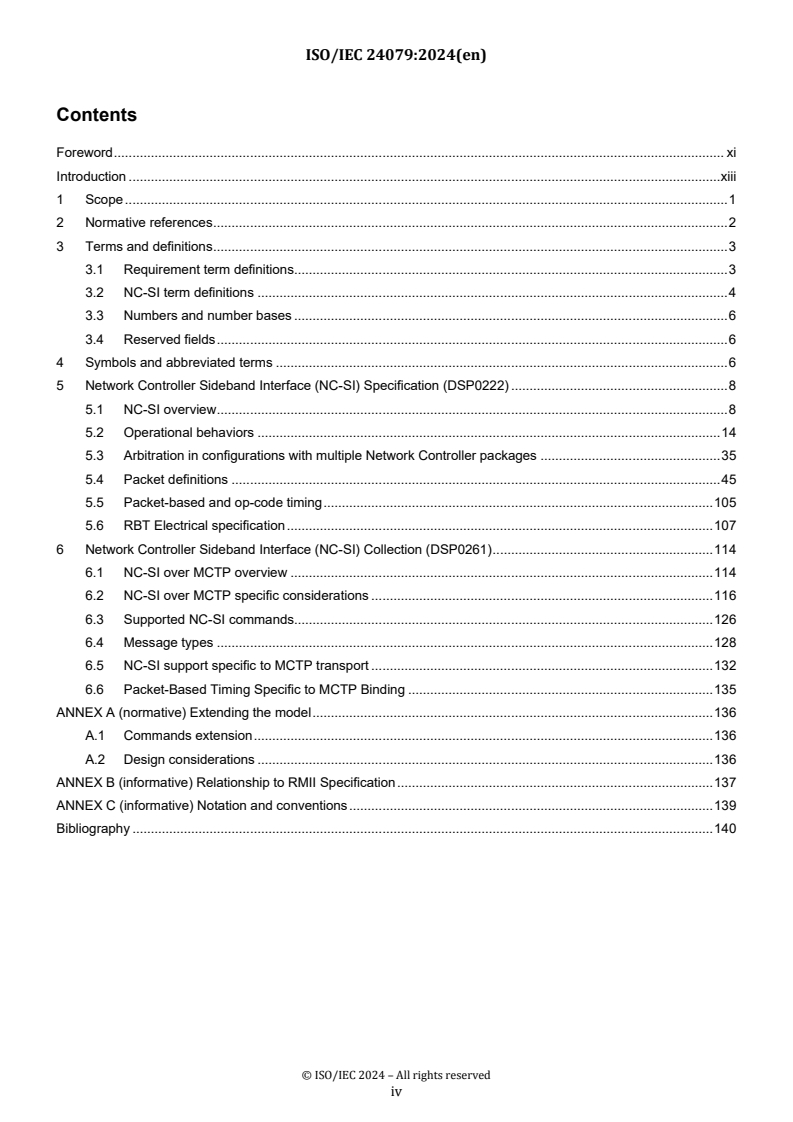
Contents
Foreword . xi
Introduction . xiii
1 Scope . 1
2 Normative references . 2
3 Terms and definitions . 3
3.1 Requirement term definitions . 3
3.2 NC-SI term definitions . 4
3.3 Numbers and number bases . 6
3.4 Reserved fields . 6
4 Symbols and abbreviated terms . 6
5 Network Controller Sideband Interface (NC-SI) Specification (DSP0222) . 8
5.1 NC-SI overview . 8
5.2 Operational behaviors . 14
5.3 Arbitration in configurations with multiple Network Controller packages . 35
5.4 Packet definitions . 45
5.5 Packet-based and op-code timing . 105
5.6 RBT Electrical specification . 107
6 Network Controller Sideband Interface (NC-SI) Collection (DSP0261) . 114
6.1 NC-SI over MCTP overview . 114
6.2 NC-SI over MCTP specific considerations . 116
6.3 Supported NC-SI commands. 126
6.4 Message types . 128
6.5 NC-SI support specific to MCTP transport . 132
6.6 Packet-Based Timing Specific to MCTP Binding . 135
ANNEX A (normative) Extending the model . 136
A.1 Commands extension . 136
A.2 Design considerations . 136
ANNEX B (informative) Relationship to RMII Specification . 137
ANNEX C (informative) Notation and conventions . 139
Bibliography . 140
© ISO/IEC 2024 – All rights reserved
iv
Figures
Figure 1 – NC-SI functional block diagram . 9
Figure 2 – NC-SI traffic flow diagram . 10
Figure 3 – Example topologies supported by the NC-SI . 11
Figure 4 – Network Controller integration options . 12
Figure 5 – NC-SI transport stack . 13
Figure 6 – NC-SI operational state diagram . 18
Figure 7 – NC-SI operational state diagram for hardware arbitration operation . 19
Figure 8 – MC steps when the MC does not have prior knowledge of hardware arbitration . 27
Figure 9 – NC-SI packet filtering flowchart . 32
Figure 10 – Basic multi-drop block diagram . 36
Figure 11 – Multiple Network Controllers in a ring format . 37
Figure 12 – Op-code to RXD relationship . 39
Figure 13 – Example TOKEN to transmit relationship . 42
Figure 14 – Hardware arbitration state machine . 43
Figure 15 – Ethernet frame encapsulation of NC-SI packet data without VLAN tag . 45
Figure 16 – Example NC-SI signal interconnect topology . 107
Figure 17 – DC measurements . 109
Figure 18 – AC measurements . 110
Figure 19 – Overshoot measurement . 112
Figure 20 – Undershoot measurement . 113
Figure 21 – NC-SI over RBT traffic flow diagram . 115
Figure 22 – NC-SI over MCTP traffic flow diagram . 116
Figure 23 – Single MCTP EID to multiple NC-SI channels mapping . 117
Figure 24 – Multiple MCTP EIDs to multiple NC-SI channels mapping . 118
Figure 25 – Multiple MCTP transport bindings example . 121
© ISO/IEC 2024 – All rights reserved
v
Tables
Table 1 – Component documents . xi
Table 2 – NC-SI operating state descriptions . 15
Table 3 – Channel ID format . 20
Table 4 – Channel Ready state configuration settings . 21
Table 5 – Hardware arbitration di-bit encoding . 38
Table 6 – Hardware arbitration op-code format . 38
Table 7 – Hardware arbitration states . 44
Table 8 – Hardware arbitration events . 44
Table 9 – Ethernet header format . 46
Table 10 – Control packet header format . 47
Table 11 – Generic example of control packet payload . 48
Table 12 – Generic example of response packet payload format . 50
Table 13 – Reason code ranges . 51
Table 14 – Standard response code values . 51
Table 15 – Standard reason code values . 52
Table 16 – AEN packet format . 52
Table 17 – AEN types . 53
Table 18 – Command and response types . 53
Table 19 – Example of complete minimum-sized NC-SI command packet . 55
Table 20 – Example of complete minimum-sized NC-SI response packet . 55
Table 21 – Clear Initial State command packet format . 56
Table 22 – Clear Initial State response packet format. 56
Table 23 – Select Package command packet format . 57
Table 24 – Hardware arbitration disable byte . 58
Table 25 – Select Package response packet format . 58
Table 26 – Deselect Package command packet format . 59
Table 27 – Deselect Package response packet format . 59
Table 28 – Enable Channel command packet format . 59
Table 29 – Enable Channel response packet format . 60
Table 30 – Disable Channel command packet format . 60
Table 31 – Disable Channel response packet format . 61
Table 32 – Reset Channel command packet format . 61
Table 33 – Reset Channel response packet format . 61
© ISO/IEC 2024 – All rights reserved
vi
Table 34 – Enable Channel Network TX command packet format . 62
Table 35 – Enable Channel Network TX response packet format . 62
Table 36 – Disable Channel Network TX command packet format . 62
Table 37 – Disable Channel Network TX response packet format . 63
Table 38 – AEN Enable command packet format . 63
Table 39 – Format of AEN control . 64
Table 40 – AEN Enable response packet format . 64
Table 41 – Set Link command packet format . 65
Table 42 – Set Link bit definitions . 65
Table 43 – OEM Set Link bit definitions . 66
Table 44 – Set Link response packet format . 66
Table 45 – Set Link command-specific reason codes . 66
Table 46 – Get Link Status command packet format . 67
Table 47 – Get Link Status response packet format . 67
Table 48 – Link Status field bit definitions . 67
Table 49 – Other Indications field bit definitions . 71
Table 50 – OEM Link Status field bit definitions (optional) . 71
Table 51 – Get Link Status command-specific reason code . 71
Table 52 – IEEE 802.1q VLAN fields . 72
Table 53 – Set VLAN Filter command packet format . 72
Table 54 – Possible settings for Filter Selector field (8-bit field) . 72
Table 55 – Possible settings for Enable (E) field (1-bit field) . 72
Table 56 – Set VLAN Filter response packet format . 73
Table 57 – Set VLAN Filter command-specific reason code . 73
Table 58 – Enable VLAN command packet format . 73
Table 59 – VLAN Enable modes . 73
Table 60 – Enable VLAN response packet format . 74
Table 61 – Disable VLAN command packet format . 74
Table 62 – Disable VLAN response packet format . 75
Table 63 – Set MAC Address command packet format . 76
Table 64 – Possible settings for MAC Address Number (8-bit field) . 76
Table 65 – Possible settings for Address Type (3-bit field) . 76
Table 66 – Possible settings for Enable Field (1-bit field) . 77
Table 67 – Set MAC Address response packet format . 77
© ISO/IEC 2024 – All rights reserved
vii
Table 68 – Set MAC Address command-specific reason code . 77
Table 69 – Enable Broadcast Filter command packet format . 77
Table 70 – Broadcast Packet Filter Settings field . 78
Table 71 – Enable Broadcast Filter response packet format . 79
Table 72 – Disable Broadcast Filter command packet format . 79
Table 73 – Disable Broadcast Filter response packet format . 79
Table 74 – Enable Global Multicast Filter command packet format . 80
Table 75 – Bit definitions for Multicast Packet Filter Settings field. 81
Table 76 – Enable Global Multicast Filter response packet format. 82
Table 77 – Disable Global Multicast Filter command packet format . 83
Table 78 – Disable Global Multicast Filter response packet format . 83
Table 79 – Set NC-SI Flow Control command packet format . 84
Table 80 – Values for the Flow Control Enable field (8-bit field) . 84
Table 81 – Set NC-SI Flow Control response packet format . 85
Table 82 – Set NC-SI Flow Control command-specific reason code . 85
Table 83 – Get Version ID command packet format . 85
Table 84 – Get Version ID response packet format . 85
Table 85 – Get Capabilities command packet format . 87
Table 86 – Get Capabilities response packet format . 88
Table 87 – Capabilities Flags bit definitions. 88
Table 88 – VLAN Mode Support bit definitions . 90
Table 89 – Get Parameters command packet format . 90
Table 90 – Get Parameters response packet format . 91
Table 91 – Get Parameters data definition . 92
Table 92 – MAC Address Flags bit definitions . 92
Table 93 – VLAN Tag Flags bit definitions . 92
Table 94 – Configuration Flags bit definitions . 93
Table 95 – Get Controller Packet Statistics command packet format . 93
Table 96 – Get Controller Packet Statistics response packet format . 94
Table 97 – Get Controller Packet Statistics counters . 95
Table 98 – Counters Cleared from Last Read Fields format . 96
Table 99 – Get NC-SI Statistics command packet format . 97
Table 100 – Get NC-SI Statistics response packet format . 97
Table 101 – Get NC-SI Statistics counters . 98
© ISO/IEC 2024 – All rights reserved
viii
Table 102 – Get NC-SI Pass-through Statistics command packet format . 98
Table 103 – Get NC-SI Pass-through Statistics response packet format . 99
Table 104 – Get NC-SI Pass-through Statistics counters . 99
Table 105 – Get Package Status packet format . 100
Table 106 – Get Package Status response packet format . 101
Table 107 – Package Status field bit definitions . 101
Table 108 – OEM command packet format . 101
Table 109 – OEM response packet format . 102
Table 110 – PLDM Request packet format . 102
Table 111 – PLDM Response packet format . 102
Table 112 – Get Package UUID command packet format . 103
Table 113 – Get Package UUID response packet format . 103
Table 114 – UUID format . 104
Table 115 – Link Status Change AEN packet format . 104
Table 116 – Configuration Required AEN packet format . 105
Table 117 – Host Network Controller Driver Status Change AEN packet format . 105
Table 118 – Host Network Controller Driver Status format . 105
Table 119 – NC-SI packet-based and op-code timing parameters . 106
Table 120 – Physical NC-SI signals . 108
Table 121 – DC specifications . 109
Table 122 – AC specifications . 111
Table 123 – MCTP Message types for NC-SI over MCTP . 116
Table 124 – Ordering rules . 120
Table 125 – Supported NC-SI commands . 126
Table 126 – NC-SI messages encapsulation . 129
Table 127 – MCTP Transport Header fields . 129
Table 128 – MCTP Specific Message Header field . 129
Table 129 – Ethernet messages encapsulation . 130
Table 130 – MCTP Transport Header fields . 131
Table 131 – MCTP Specific Message Header field . 131
Table 132 – Get Supported Media Command packet format . 132
Table 133 – Get Supported Media Response packet format . 132
Table 134 – Get Supported Media Response media descriptors format . 133
Table 135 – Transport Specific AENs Enable Command packet format . 133
© ISO/IEC 2024 – All rights reserved
ix
Table 136 – Transport Specific AENs Enable field format . 134
Table 137 – Transport-specific AENs Enable Response packet format . 134
Table 138 – Medium change AEN format . 134
Table 139 – NC-SI Timing Parameters Specific to MCTP Binding . 135
© ISO/IEC 2024 – All rights reserved
x
Foreword
The Network Controller Sideband Interface (NC-SI) Specification was prepared by the PMCI Working Group. DMTF
is a not-for-profit association of industry members dedicated to promoting enterprise and systems management
and interoperability.
Component documents
Table 1 lists the component documents for this specification:
Table 1 – Component documents
Document number Document title Version
DSP0222 Network Controller Sideband Interface (NC-SI) Specification (DSP0222) 1.1.1
DSP0261 Network Controller Sideband Interface (NC-SI) Collection (DSP0261) 1.2.3
Acknowledgments
The DMTF acknowledges the following individuals for their contributions to this document:
Editors:
• Eliel Louzoun – Intel Corporation
• Hemal Shah – Broadcom Corporation
• Bob Stevens – Dell
• Tom Slaight – Intel Corporation
Contributors:
• Alan Berenbaum – SMSC
• Patrick Caporale – Lenovo
• Philip Chidester – Dell Technologies
• Kelly Couch – Intel Corporation
• Benzi Friedman – Intel Corporation
• Yuval Itkin – Mellanox Technologies and NVIDIA Corporation
• Ira Kalman – Intel Corporation
• Ed Klodnicki – IBM
• Joe Kozlowski – Dell Technologies
• Patrick Kutch – Intel Corporation
• John Leung – Intel Corporation
• Eliel Louzoun – Intel Corporation
• Patrick Schoeller – Hewlett-Packard Company and Intel Corporation
© ISO/IEC 2024 – All rights reserved
xi
• Hemal Shah – Broadcom Inc.
• Tom Slaight – Intel Corporation
• Bob Stevens – Dell Technologies
© ISO/IEC 2024 – All rights reserved
xii
Introduction
Network Controller Sideband Interface (NC-SI) Specification (DSP0222)
In out-of-band management environments, the interface between the out-of-band Management Controller and
the Network Controller is critical. This interface is responsible for supporting communication between the
Management Controller and external management applications. Currently there are multiple such proprietary
interfaces in the industry, leading to inconsistencies in implementation of out-of-band management.
The goal of this specification is to define an interoperable sideband communication interface standard to enable
the exchange of management data between the Management Controller and Network Controller. The Sideband
Interface is intended to provide network access for the Management Controller, and the Management Controller
is expected to perform all the required network functions.
This specification defines the protocol and commands necessary for the operation of the sideband
communication interface. This specification also defines physical and electrical characteristics of a sideband
binding interface that is a variant of RMII targeted specifically for sideband communication traffic.
The specification is primarily intended for architects and engineers involved in the development of network
interface components and Management Controllers that will be used in providing out-of-band management.
NC-SI over MCTP Binding Specification (DSP0261)
The NC-SI over MCTP Binding Specification defines new MCTP messages used to convey NC-SI Control packets and
Ethernet traffic over MCTP to allow NC-SI Pass-through traffic over MCTP. This specification is based on the
DSP0222 1.1 specification and uses the same NC-SI Control packet definitions.
Document conventions
Typographical conventions
The following typographical conventions are used in this document:
• Document titles are marked in italics.
• Important terms that are used for the first time are marked in italics.
• Terms include a link to the term definition in Terms and definitions, enabling easy navigation to the term
definition.
• ABNF rules are in monospaced font.
ABNF usage conventions
Format definitions in this document are specified using ABNF (see RFC5234), with the following deviations:
• Literal strings are to be interpreted as case-sensitive Unicode characters, as opposed to the definition in
RFC5234 that interprets literal strings as case-insensitive US-ASCII characters.
© ISO/IEC 2024 – All rights reserved
xiii
Reserved and unassigned values
Unless otherwise specified, any reserved, unspecified, or unassigned values in enumerations or other numeric
ranges are reserved for future definition by the DMTF.
Unless otherwise specified, numeric or bit fields that are designated as reserved shall be written as 0 (zero) and
ignored when read.
Byte ordering
Unless otherwise specified, byte ordering of multibyte numeric fields or bit fields is "Big Endian" (that is, the lower
byte offset holds the most significant byte, and higher offsets hold lesser significant bytes).
Other conventions
See ANNEX C
(informative)
Notation and conventions for other conventions.
© ISO/IEC 2024 – All rights reserved
xiv
International Standard ISO/IEC 24079:2024(en)
Information technology — Network Controller Sideband
Interface (NC-SI) Specifications Collection
1 Scope
Network Controller Sideband Interface (NC-SI) Specification (DSP0222)
This specification defines the functionality and behavior of the Sideband Interface responsible for connecting the
Network Controller to the Management Controller. It also outlines the behavioral model of the network traffic
destined for the Management Controller from the Network Controller.
This specification defines the following two aspects of the Network Controller Sideband Interface (NC-SI):
• behavior of the interface, which include its operational states as well as the states of the associated
components
• the payloads and commands of the communication protocol supported over the interface
The scope of this specification is limited to addressing only a single Management Controller communicating with
one or more Network Controllers.
This specification also defines the following aspects of a 3.3V RMII Based Transport (RBT) based physical medium:
• transport binding for NC-SI over RBT
• electrical and timing requirements for the RBT
• an optional hardware arbitration mechanism for RBT
Only the topics that may affect the behavior of the Network Controller or Management Controller, as it pertains
to the Sideband Interface operations, are discussed in this specification.
NC-SI over MCTP Binding Specification (DSP0261)
This specification defines the bindings between NC-SI protocol elements and MCTP elements in order for NC-SI
Control and Pass-Through traffic to be transported using MCTP.
Portions of this specification rely on information and definitions from other specifications, which clause 2
identifies. Two of these references are particularly relevant:
• DMTF DSP0222, Network Controller Sideband Interface (NC-SI) Specification, provides the NC-SI base
control that is to be bound over MCTP by this specification.
• DMTF DSP0236, Management Component Transport Protocol (MCTP) Base Specification, defines the
MCTP transport on which the NC-SI Control and Pass-through packets are to be conveyed.
© ISO/IEC 2024 – All rights reserved
2 Normative references
The following referenced documents are indispensable for the application of this document. For dated or
versioned references, only the edition cited (including any corrigenda or DMTF update versions) applies. For
references without a date or version, the latest published edition of the referenced document (including any
corrigenda or DMTF update versions) applies.
ACPI, Advanced Configuration and Power Interface Specification Revision 4.0a, April 5, 2010,
http://www.acpi.info/DOWNLOADS/ACPIspec40a.pdf
DMTF DSP0004, CIM Infrastructure Specification 3.0,
http://www.dmtf.org/standards/published_documents/DSP0004_3.0.pdf
DMTF DSP0222, Network Controller Sideband Interface (NC-SI) Specification 1.1,
http://www.dmtf.org/sites/default/files/standards/documents/DSP0222_1.1.0.pdf
DMTF DSP0223, Generic Operations 1.0,
http://www.dmtf.org/standards/published_documents/DSP0223_1.0.pdf
DMTF DSP0236, Management Component Transport Protocol (MCTP) Base Specification 1.3,
http://www.dmtf.org/standards/published_documents/DSP0236_1.3.pdf
DMTF DSP0237, Management Component Transport Protocol (MCTP) SMBus/I2C Transport Binding Specification
1.1, http://www.dmtf.org/standards/published_documents/DSP0237_1.1.pdf
DMTF DSP0238, Management Component Transport Protocol (MCTP) PCIe VDM Transport Binding Specification
1.0, http://www.dmtf.org/standards/published_documents/DSP0238_1.0.pdf
DMTF DSP0239, Management Component Transport Protocol (MCTP) IDs and Codes 1.4,
http://www.dmtf.org/standards/published_documents/DSP0239_1.4.pdf
DMTF DSP0240, Platform Level Data Model (PLDM) Base 5 Specification 1.1.0,
https://www.dmtf.org/sites/default/files/standards/documents/DSP0240_1.1.0.pdf
DMTF DSP0261, NC-SI over MCTP Binding Specification 1.0,
http://www.dmtf.org/standards/published_documents/DSP0261_1.0.pdf
DMTF DSP1001, Management Profile Specification Usage Guide 1.2,
http://www.dmtf.org/standards/published_documents/DSP1001_1.2.pdf
IEEE 802.3, 802.3™ IEEE Standard for Information technology— Part 3: Carrier sense multiple access with collision
detection (CSMA/CD) access method and physical layer specifications, December 2005,
http://www.ieee.org/portal/site
IEEE 802.1Q, IEEE 802.1Q-2005 IEEE Standard for Local and Metropolitan Area Networks—Virtual Bridged Local
Area Networks, http://www.ieee.org/portal/site. This standard defines the operation of Virtual LAN (VLAN)
Bridges that permit the definition, operation and administration of Virtual LAN topologies within a Bridged LAN
infrastructure.
IETF RFC2131, Dynamic Host Configuration Protocol (DHCP), March 1997, http://www.ietf.org/rfc/rfc2131.txt
IETF RFC2373, IP Version 6 Addressing Architecture, July 1998, http://www.ietf.org/rfc/rfc2373.txt
IETF RFC2461, Neighbor Discovery for IP Version 6 (IPv6), December 1998, http://www.ietf.org/rfc/rfc2461.txt
© ISO/IEC 2024 – All rights reserved
IETF RFC2
...