

ISO/IEC 6429:1992
(Main)Information technology — Control functions for coded character sets
General Information
- Abstract
Includes control functions and their coded representations for a 7-bit code, an extended 7-bit code, an 8-bit code or an extended 8-bit code if these correspond to ISO 2022.
- Status
- Published
- Publication Date
- 29-Dec-1992
- Technical Committee
- ISO/IEC JTC 1/SC 2 - Coded character sets
- Drafting Committee
- ISO/IEC JTC 1/SC 2 - Coded character sets
- Current Stage
- 9093 - International Standard confirmed
- Start Date
- 27-Aug-2020
- Completion Date
- 29-Aug-2026




Overview
ISO/IEC 6429:1992 - "Information technology - Control functions for coded character sets" standardizes a comprehensive repertoire of control functions and their coded representations for use with 7‑bit, extended 7‑bit, 8‑bit and extended 8‑bit coded character sets when those codes are structured according to ISO 2022. The standard defines how control functions (for example escape sequences and control sequence introducers) behave when embedded in character streams and how character‑imaging devices should interpret them. The third edition adds facilities for handling bi‑directional text (left‑to‑right and right‑to‑left scripts).
Key topics and technical requirements
- Scope: Applies to control functions carried inside CC‑data‑elements and assumes device architecture described in clause 6 (presentation/data components, active positions, implicit/explicit movement).
- Control repertoire: A large set of standardized control functions (ESC, CSI, SGR, NEL, HT, LF, etc.) and control sequences with parameter formats and defaults.
- Coding models: Support for 7‑bit and 8‑bit encodings that follow ISO 2022 structure; definitions of independent control functions, control strings and device control strings.
- Modes and interaction: A mode model (e.g., Control Representation Mode, Bi‑Directional Support Mode, Format Effector modes) that governs interpretation and interactions among control functions.
- Conformance: Defines full and limited conformance, plus device conformance requirements - devices must document which control functions they originate, receive and present. Distinguishes originating vs receiving device responsibilities.
- Device concepts: Abstract device components (presentation, data, editor/formator functions), selected/qualified areas, tabulation/fields and auxiliary I/O.
- Annexes: Coding examples, formator/editor guidance, text composition considerations and implementation‑dependent features.
Applications and who uses it
ISO/IEC 6429 is practical for implementers and integrators working with text and terminal control:
- Terminal emulators, console and shell developers (escape/CSI handling)
- Printer and character‑imaging device manufacturers
- Firmware and embedded systems that process control sequences
- Text rendering and layout engines that must support bidirectional scripts
- Protocol designers and application developers exchanging CC‑data elements
- Internationalization (i18n) engineers ensuring correct directionality and control behavior
Implementing ISO/IEC 6429 helps ensure consistent behavior of escape sequences, control functions, and mode transitions across systems and devices, improving interoperability of text interchange and device control.
Related standards
- ISO 2022 - character code structure referenced by ISO/IEC 6429
- ECMA‑48 - ECMA equivalent (original development basis)
- ISO 2375 - registration of selected facility sets for interchange
Keywords: ISO/IEC 6429, control functions, escape sequences, control sequence introducer (CSI), ISO 2022, bi‑directional text, character‑imaging devices, terminal emulation, conformance.
Relations
- Effective Date
- 15-Apr-2008
- Revises
ISO 6429:1988 - Information processing — Control functions for 7-bit and 8-bit coded character sets - Effective Date
- 15-Apr-2008
Get Certified
Connect with accredited certification bodies for this standard

BSI Group
BSI (British Standards Institution) is the business standards company that helps organizations make excellence a habit.

NYCE
Mexican standards and certification body.
Sponsored listings
Frequently Asked Questions
ISO/IEC 6429:1992 is a standard published by the International Organization for Standardization (ISO). Its full title is "Information technology — Control functions for coded character sets". This standard covers: Includes control functions and their coded representations for a 7-bit code, an extended 7-bit code, an 8-bit code or an extended 8-bit code if these correspond to ISO 2022.
Includes control functions and their coded representations for a 7-bit code, an extended 7-bit code, an 8-bit code or an extended 8-bit code if these correspond to ISO 2022.
ISO/IEC 6429:1992 is classified under the following ICS (International Classification for Standards) categories: 35.040 - Information coding; 35.040.10 - Coding of character sets. The ICS classification helps identify the subject area and facilitates finding related standards.
ISO/IEC 6429:1992 has the following relationships with other standards: It is inter standard links to ISO 6429:1983, ISO 6429:1988. Understanding these relationships helps ensure you are using the most current and applicable version of the standard.
ISO/IEC 6429:1992 is available in PDF format for immediate download after purchase. The document can be added to your cart and obtained through the secure checkout process. Digital delivery ensures instant access to the complete standard document.
Standards Content (Sample)
SLOVENSKI STANDARD
01-junij-1995
Information technology - Control functions for coded character sets
Information technology -- Control functions for coded character sets
Technologies de l'information -- Fonctions de commande pour les jeux de caractères
codés
Ta slovenski standard je istoveten z: ISO/IEC 6429:1992
ICS:
35.040 Nabori znakov in kodiranje Character sets and
informacij information coding
2003-01.Slovenski inštitut za standardizacijo. Razmnoževanje celote ali delov tega standarda ni dovoljeno.
INTERNATIONAL
ISO/IEC
STANDARD 6429
Third edition
1992-I 2-l 5
Information technology - Control
functions for coded character sets
- Fonctions de commande pour /es jeux
Technologies de /‘information
de caracthres cod&
Reference number
ISO/l EC 6429: 1992(E)
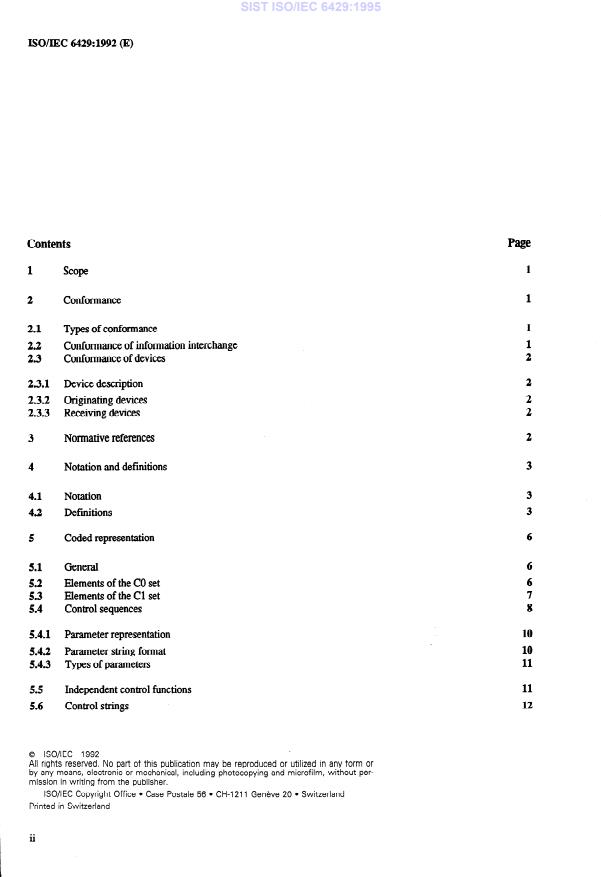
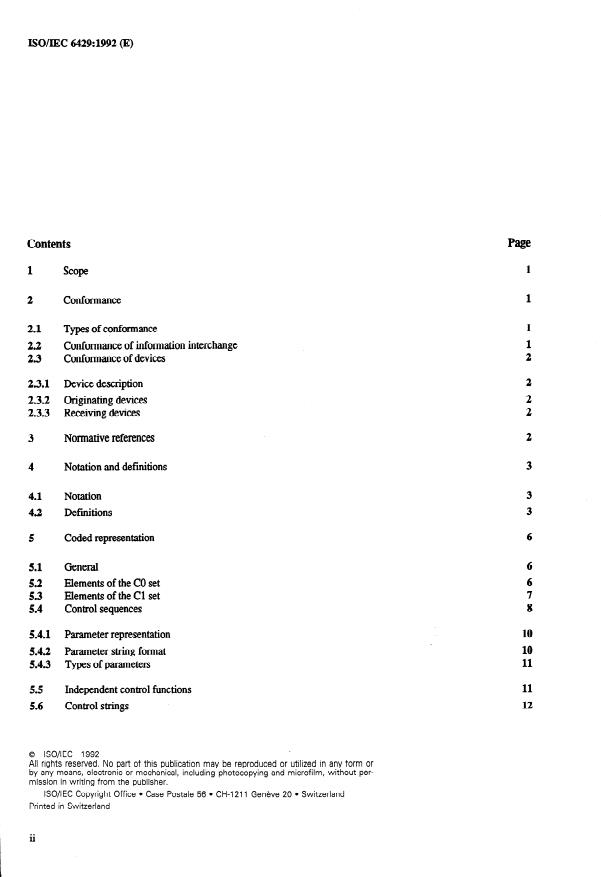
Contents
1 scope
2 Confamance
21 0 Types of confbrmance
22 l Confomance of information interchange
23 Conformance of devices
23.1 Device description
23.2 Originating devices
Receiving devices
2.3.3
Normative references
4 Notation and definitions
41 Notation
4e2 Definitions
Coded representation
51 . General
52 0 Elements of the CO set
Elements of the Cl set
53 .
54 0 Control sequences
5.4.1 Parameter representation
5.4.2 Parameter string format
5.4.3 Types of parameters
55 l Independent control functions
56 0 Control strings
0 lSO/IEC 1992
All rights reserved. No part of this publication may be reproduced or utilized in any form or
by any means, electronic or mechanical, including photocopying and microfilm, without per-
mission in writing from the publisher.
I SO/I EC Copyright Off ice l Case Postale 56 l CH-1211 Geneve 20 l Switzerland
Printed in Switzerland
ii
6 Device concepts
l Components
6.1.1 Presentation component
6.1.2 The active presentation position
Data component
6.13
6.1.4 The active data position
6.1.5 Relationship between active data position and active presentation position
6.1.6 Implicit movement
Explicit movement
6.1.7
6.1.8 Indirect movement
62 l The data stream
6.2.1 Data organization
6.3 The graphic image output
64 0 Formator functions and editor functions
6.4.1 Formator functions
6.4.2 Composite graphic characters
6.4.3 Editor functions
65 . Selected and qualified areas
B.S.1 Selected areas
Qualifiedareas
6.5.2
66 l Auxiliary input/output devices
67 l Tabulation and fields
7 Modes
71 l The concept of modes
Definition of modes
72 l
7.2.1 BDSM - BI-DIRECTIONAL SUPPORT MODE
7.2.2 CRM - CONTROL REPRESENTATION MODE
7.2.3 DCSM - DEVICE COMPONENT SELECT MODE
7.2.4 ERM - ERASURE MODE
FEAM - FORMAT EFFECTOR ACTION MODE
7.2.5
7.2.6 FETM - FORMAT EFFECTOR TRANSFER MODE
7.2.7 GATM - GUARDED AREA TRANSFER MODE
GRCM - GRAPHIC RENDITION COMBINATION MODE
7.2,s
HEM - CHARACTEREDITING MODE
7.2.9
7.2.10 IRM - INSERTION REPLACEMENT MODE
7.2.11 KAM - KEYBOARD ACTION MODE
7.2.12 MATM - MULTIPLE AREA TRANSFER MODE
7.2.13 PUM - POSITIONING UNIT MODE
7.2.14 SATM - SELECTED AREA TRANSFER MODE
7.2.15 SRM - SEND/RECEIVE MODE
. . .
ISOhEC 6429:1992 (E)
7.2,16 SRTM - STATUS REPORT TRANSFER MODE 23
72.17 TSM - TABULATION STOP MODE 24
7.2.18 TTM-TRANSFER TERMINATION MODE
702.19 VEM - LINE EDITING MODE 24
7.2.20 ZDM - ZERO DEFAULT MODE 24
73 l Interaction between modes 24
73.1 GUARDED AREA TRANSFER MODE (GA’I’M), IMULTIPLE AREA TRANSFER MODE (MATM),
SELECTEZD AREA TRANSFER MODE (SATM), and TRANSFER TERMIN ATION MODE (T-I’M) 25
25 -
7.3.2 CONTROL REPRESENTATION MODE (CRM) and FORMAT EFFECTOR ACTION MODE (FEAM)
7303 CH.AUCTER EDITING MODE (HEM) and INSERTION REPLACEMENT MODE (IRM) 25
26; t
7.3.4 BI-DIRECTIONAL SUPPORT MODE (BDSM) and DEVICE COMPONENT SELECI’ MODE (DCSM)
,
74 l Private modes
Control functions
8 26
.;
81 l Types of control functions
b
c
82 0 Categories of control functions
ii
27 h
8.2.1 Delimiters
27 ,
8.2.2 Introducers
b
I-
8.2.3 Shift functions
27 u’
8.2.4 Format effecters
I
k
8.2.5 Presentation control functions 28
i
8.2.6 Editor functions
29 t’
8.2.7 Cursor control functions 30
8.2.8 Display control functions
/*
8.2.9 Device control functions 30
8.2.10 Information separators 30
8.2.11 Area definition
8.2.12 Mode setting 31
8.2.13 Transmission control functions 31
8.2.14 Miscellaneous control functions
83 l Definition of control functions
8.3.1 ACK - ACKNOWLEDGE 32
8.3.2 APC - APPLICATION PROGRAMI COMMAND
8.3.3 BEL-BELL
8.3.4 BPH-BREAKP-HERE 33
8.3.5 BS - BACKSPACE
8.3.6 CAN - CANCEL
8.3.7 CBT - CURSOR BACKWARD TABULATION
8.3.8 cabCANCELCHARACTER
8.3.9 CHA - CURSOR CHARACIER ABSOLUTE
8.3.10 CHT - CURSORFORWARD TABULATION
8.3.11 CMD - CODING METHOD DELIMITER
8.3.12 CNL - CURSOR NEXT LINE
83.13 CPL - CURSOR PRECEDINGLINE
8.3.14 CPR - ACTIVE POSITION REPORT
83.15 CR - CARRIAGERETURN 35
8.3.16 CSI - CONTROL SEQUENCE INTRODUCER
8.3.17 CTC - CURSOR TABULATION CONTROL
iv
83.18 CUB - CURSORLEFT
8.3.19 CUD - CURSOR DQWN
83.20 CUF - CURSOR RIGHT 36
83.21 CUP - CURSOR POSITION 36
8.3.22 CULJ - CURSOR UP
8.3.23 CVT - CURSOR LINE TABULATION
8.3.24 DA - DEVICE A’ITRIBUTES
8.3.25 DAQ - DEFINE AREA QUALIFICATION 37
8.3.26 DCH - DELETE CHAluCTER
83e27 DCS - DEVICE CONTROL STRING
83.28 DC1 - DEVICE CONTROL ONE
8.3.29 DC2 - DEVICE CONTROL TWO 38
8.3.30 DC3 - DEVICE CONTROL THREE
8.3.31 DC4 - DEVICE CONTROL FOUR
8.3.32 DEL - DELETE 39
8.3.33 DL - DELETE LINE
8.3.34 DLE - DATA LINK ESCAPE
8.3.35 DMI - DISABLE MANUAL INPUT 39
8.3.36 DSR - DEVICE STATUS REPORT 40
8.3.37 DTA - DIMENSION TEXT AREA 40
8.3.38 EA - ERASE IN AREA 40
8.3.39 ECH - ERASE CHARACTER
83.40 ED - ERASE IN PAGE 41
83.41 EF - ERASE IN FIELD 42
8.3.42 EL - ERASE IN LINE 42
8.3.43 EM - END OF MEDIUM 43
8.3.44 EMI - ENABLE MANUAL INPUT
8.3.45 ENQ - ENQUIRY 43
8.3.46 EOT - END OF MSMISSION 43
8.3.47 EPA - END OF GUARDED AREA 43
8.3.48 ESA - END OF SELECTED AREA
8.3.49 ESC - ESCAPE 44
83.50 ETB - END OF TRANSMISSION BLOCK 44
8.3.51 E’IX - END OF TEXT 44
8.3.52 FF - FORM FEED 44
8.3.53 FNK - FUNCTION KEY 44
8.3.54 FNT - FONT SELECTION 44
8.3.55 GCC - GRAPHIC CHARACI’ER COMBINATION 45
8.3.56 GSM - GRAPHIC SIZE MODIFICATION 45
8.3.57 GSS - GRAPHIC SIZE SELECTtON 45
8.3.58 HPA - CHARACTER POSITION ABSOLUTE 45
8.3.59 HPB - CHARACTER POSITION BACKWARD 46
8.360 HPR - CHARACTER POSITION FORWARD 46
83.61 HT - CHARACTER TABULATION
8.3.62 HTJ - CHARACTER TABULATION WITH JUSTIFICATION 46
8.3.63 HTS - CHAIUKTER TABULATION SET 46
8.3.64 HVP - CHAMCTER AND LINEPOSITION
8.3.65 ICH - INSERT CHARACTER
8.3.66 IDCS - IDENTIFY DEVICE CONTROL SIRING
8.3.67 IGS - IDENTIFY GRAPHIC SUBREPERTOIRE 47
8.3.68 IL - INSERT LINE 48
8.3.69 INT - INTERRUPT
8.3.70 IS 1 - INFORMATION SEPARATOR ONE (US - UNIT SEPARATOR) 48
8.3.71 IS2 - INFORMATION SEPARATOR TWO (RS - RECORD SEPARATOR) 48
8.3.72 IS3 - INFORMATION SEPARATOR THREE (GS - GROUP SEPARATOR)
V
ISO/IEC6429:1992(E)
8.3.73 IS4 - INFORMATION SEPARATOR FOUR (FS - FILE SEPARATOR)
8.3.74 JFY-J'usm
8.3.75 LF-Lmm 49
8.3.76 LSO-LOCKRVG-SHIITZEiRO
8.3.77 LSl - LOCKING-SHIFT ONE
,
8.3.78 LSlR - LOCKING-SHIFT ONE RIGHT
8.3.79 LS2 - LOCKING-SHIFT TWO 50
83.80 LS2R - LOCKING-SHIFT TWO RIGHT 50
83.81 LS3 -LOCKING-SHIFT THREE
8.3.82 LS3R - LQCKING-SHIFT THREE RIGHT
83.83 MC - MEDIA COPY 51
8.3.84 MW - MESSAGE WAITING 51
8.3.85 NAK -NEGATIVE ACKNOWLEDGE
8.3.86 NBH - NO BREAK HERE
83.87 NEL-NEXTLINE
83.88 NP - NEXT PAGE 52
8.3.89 NUL-NULL
83.90 OSC - OP-TING SYSTEM COMMAND
83.91 PEC - PRESENTATION EXPAND OR CONTRACT
8.3.92 PFS - PAGE FORMAT SELECTION 53
8.3.93 PLD - PARTIAL LINE FORWARD 53
8.3.94 PLU - PARTIAL LINE BACKWARD
8.3.95 PM - PRIVACY MESSAGE
8.3.96 PP - PRECEDING PAGE
83.97 PPA - PAGE POSITION ABSOLUTE
83.98 PPB - PAGEPOSTI’ION BACKWARD
83.99 PPR - PAGE POSITION FORWARD
83.100 PTX - PARALLEL TEXTS
8.3.101 PUf - PRIVATE USE ONE
83.102 PU2 - PRIVATE USE TWO
8.3.103 QUAD - QUAD
8.3.104 REP - REPEAT
8.3.105 RI - REVERSE LINE FEED
8.3.106 RIS - RESET TO INITIAL STATE
83.107 RM - RESET MODE
83.108 SACS - SET ADDITIONAL CHARACTER SEPARATION
83.109 SAPV - SELECT ALTERNATIVEPRESENTATION VARIANTS
8.3.110 SC1 - SINGLE CHA&KTER INTRODUCER
83,11lSCO-SELECT(‘U~ ORIENTATION
8.3.i12SCP-SELECTCHARACTER PATH
8.3.113SCS-SETCHARACTER SPACING
83.114 SD - SCROLL DOWN
83.115 SDS - START DIRECTED STRING
83.116 SEE - SELECT EDTI’ING EXTENT
8.3.117 SEF - SHEET EJECT AND FEED
83.118 SGR - SELECT GRAPHIC RENDITION
83.119 SHS - SELECT CHARKTER SPACING
83.120 SI - SHIFT-IN
83.121 SIMD - SELECT IMPLICIT MOVEMENT
DIRECTION 63
83.122 SL - SCROLL LEFT
83.123 SLH - SET LINE HOME
.
83.124 SLL - SET LINE LIMIT
83.125 ST - SET LINE SPACING
a
83.126 SM - SET MODE
83.127 SO - SHIFI’-OUT
vi
ISWIEC 6429:1992 (E)
c
83.128 SOH - START OF HEADING
83.129 SOS - START OF STRING
83.130 SPA - START OF GUARDED AREA
83.131 SPD - SELECT PRESENTATION DIRECTIONS
83.132 SPH - SET PAGE HOME
83.133 SPI - SPACING INCREMEZNT
83.134 SPL - SET PAGE LIMIT
83.135 SPQR - SELECT PRINT QUALITY AND RAPnmy
83.136 SR - SCROLL RIGHT
83.137 SRCS - SET REDUCED CHARACTER SEPAIWIION
83.138 SRS - START REVERSED STRING
83.139 SSA - START OF SELECTED AREA
83.140 SSU - SELECT SrzF, UNI’I’
83.141 SSW - SFT SPACE WIDTH
83.142 SS2 - SINGLI%MI?T TWO
83.143 SS3 - SINGLE-SHIFT THREE
83.144 ST - STRING TERMINATOR
83.145 STAB - SELECTIVE TABULATION
83.146 STS - SET TEMNSMTI’ STATE 71
83.147 SIX - START OF TEXT
83.148 SU - SCROLL UP
83.149 SUB - SUBSTITUTE
83.150 SVS - SELECT LINE SPACING
83.151 SYN - SYNCHRONOUS IDLE 72
83.152 TAC - TABULATION ALIGNED CENTRED 72
83.153 TALE - TABULATION ALIGNED LEADING EDGE
83.154 TA’IE - TABULATION ALIGNED TRAILING EDGE
83.155 TBC - TABULATION CLEAR
83.156 TCC - TABULATION CENTRED
ONCHARACTER
83.157 TSR - TABULATION STOP REMOVE
83.158 TSS - THIN SPACE SPECIFICATION
83.159 VPA - LINE POSITION ABSOLUTE
83.160 VPB - LINEPOSITION BACKWARD
83.161 VPR - LINE POSITION FORWARD
83.162 VT. - LINE TABULATION
83.163 VTS - LINE TABULATION SET
Annexes
A - Formator functions and editor functions
B - Coding examples
C - Text composition considerations
D - Implementation-dependent features
E - Text area formats
F - Differences between the third and the second edition of ISO/IEC 6429
G - Bibliography
vii
lSO/IEC 6429:1992 (E)
Foreword
IS0 (the International Organization for Standardization) and IEC (the Inter-
national Electrotechnical Commission) form the specialized system for
worldwide standardization. National bodies that are members of IS0 or
IEC participate in the development of International Standards through
technical committees established by the respective organization to deal
with particular fields of technical activity. IS0 and IEC technical com-
mittees collaborate in fields of mutual interest. Other international organ-
izations, governmental and non-governmental, in liaison with IS0 and IEC,
also take part in the work.
In the field of information technology, IS0 and IEC have established a joint
technical committee, lSO/IEC JTC 1. Draft International Standards adopted
by the joint technical committee are circulated to national bodies for vot-
ing. Publication as an International Standard requires approval by at least
75 % of the national bodies casting a vote.
International Standard lSO/lEC 6429 was prepared by the European
Computer Manufacturers Association (as Standard ECMA-48) and was
adopted, under a special “fast-track procedure”, by Joint Technical Com-
mittee lSO/lEC JTCI, Information technology, in parallel with its approval
by national bodies of IS0 and IEC.
This third edition cancels and replaces the second edition
(IS0 6429:1988), which has been technically revised.
Annexes A, B, C, D, E, F and G of this International Standard are for in-
formation only.
. . .
VW
ISOiIEC 6429:1992 (E) ’
This International Standard constitutes a repertoire of a large number of control functions the definitions and coded
representations of which are thus standardized. For each application the required selection of control functions can be made
from this repertoire.
This third edition of ISO/lEC 6429 contains the control functions already standardized in the second edition and, in addition,
new control functions needed for handling bidirectional texts, i.e. texts comprising parts written with a left-to-right script
and parts written with a right-to-left script. ECMA Technical Report TR/53 gives further information and examples of
handling such texts. The inclusion of these specialized control functions has required a corresponding adjustment of the
definitions of some of the other control functions. Moreover, the concept of “device” had to be revised.
ix
This page intentionally left blank
INTERNATIONAL STANDARD
Information technology - Control functions for coded character sets
scope
This International Standard defines control functions’and their coded representations for use in a 7-bit code, an extended 7-
bit code, an &bit code or an extended 8-bit code, if such a code is structured in accordance with International Standard IS0
2022.
This International Standard specifies technical means to handle bi-directional texts in character-imaging devices in the case
of
- texts in a single script of which specific parts need to be presented in an opposite direction (for example, numbers in
Arabic or Hebrew text);
- texts in different scripts presented in opposite directions (like texts in Latin and Arabic or texts in Latin and H,ebrew;
I .
;
- texts like the above with a horizontal line orientation and a top-to-bottom line progression.
The control fimctions.defined in this International Standard are intended to be used embedded in character-coded data for
-
interchange, in part&lar with character-imaging devices.
In general, the control functions are defined by their effects on a character-imaging input/output device. It is, therefore,
necessary to make certain assumptions about the architecture of such a device. These assumptions are as unrestrictive as
possible; they are specified in clause 6.
In addition to being performed the control functions may need to be represented by a graphic symbol.
The structure of this International Standard is open-ended, so that more control functions can be included in future editions.
Other standards specifying control functions may define more restricted defmitions of them than those in this International
Standard.
The devices to which this International Standard applies can vary greatly from each other depending on the application for
which a device has been specifically designed. It is technically and economically impractical for one device to implement all
the facilities specified in this International Standard. The intention is that in any type of device only a limited selection of the.
facilities appropriate to the application will be implemented.
2 Conformance
21 0 Types of conformance
Full conformance to a standard means that all of its requirements are met. Conformance will only have a unique meaning if
the standard contains no options. If there are options within the standard they must be clearly identified, and any claim of
conformance must include a statement that identifies those options that have been adopted.
This International Standard is of a different nature since it specifies a large number of facilities Tom which different
selections may be made to suit individual applications. These selections are not identified in this International Standard, but
must be identified at the time that a claim of conformance is made. Conformance to such an identified selection is known as
limited conformance.
The facilities selected for a particular application may be registered according to IS0 2375 for ease of reference in
information interchange.
.
22 Conformance of information interchange
A CC-data-element within coded information far interchange is in conformance with this International Standard if the coded
representations of control functions within that CC-data-element satisfy the following conditions:
a) a coded representation of a control function that is specified in this International Standard shall always represent that
control function;
b) a control function that is specified in this International Standard shall always be represented by the coded representation
that is snecified in this International Standard for that control function;
c) any coded representation that is reserved for future standardization by this International Standard shall not appear.
any coded representation that is reserved for lkture standardization by this International Standard shall not appear.
C)
Coded representations of control functions and modes not specified in this International Standard may appear in interchanged
information subject to the above conditions (see 5.4,5.4.1 and 7.4).
23 Conformance of devices
A device is in conformance with this International Standard if it conforms to the requirements of 2.3.1, and either or both
2.3.2 and 2.3.3. Any claim of conformance shall identify the document which contains the description specified in 2.3.1.
2.3.1 Device description
A device that conforms to this International Standard shall be the subject of a description that:
identifies, by reference to the clauses of, or to the control functions specified in this International Standard, the
selection of control functions, the coded representations of which the device can originate or can receive and interpret
ii) identifies the means by which the user may supply the corresponding control functions, or may recognize them, as
specified respectively in 2.3.2 and 2.3.3 below.
2.3.2 Originating devices
An originating device shall be capable of transmitting within a CC-data-element the coded representations of an identified
selection of control functions, and of their parameter values (including mode selection parameters), conforming to this
International Standard.
Such a device shall allow the user to supply any control function that he chooses from among the identified selection for the
purpose of transmitting its coded representation over the coding interface.
2.3.3 Receiving devices
A receiving device shall be capable of receiving within a CC-data-element and interpreting the coded representations of an
identified selection of control functions, and of their parameter values (including mode selection parameters), conforming to
this International Standard.
If the identified selection contains a control sequence for which a default value far a parameter is specified in this
International Standard, the identified selection shall include the default value both in explicit and in implicit representations.
Such a device shall make available to the user any control function that is within the identified selection, and the coded
representation of which is received over the coding interface, in such a form that the user can recognize it from among the
control functions within the identified selection.
3 Normative references
The following standards contain provisions which, through reference in this text, constitute provisions of this International
Standard. At the time of publication, the edition indicated was valid. All standards are subject to revision, and parties to
agreements based on this International Standard are encouraged to investigate the possibility of applying the most recent
edition of the standards listed below. Members of IEC and IS0 maintain registers of currently valid International Standards.
IS0 1745:1975, Information processing - Basic mode control procedures for data communication systems.
IS0 7-bit crnd &bit coded churucter sets - Code extension techniques.
IS0 2022: 1986, Itformation processing -
IS0 23751985, Data processing - Procedure for registration of escape sequences.
IS0 8613-63989, Information processing - Text and ofice systems - Ofice Document Architecture (ODA) and interchange
format - Part 6: Character content architectures.
ISO/lEC6429:1992(E)
c
4 Notation and definitions
41 l Ndatim
In this International Standard a convention has been adopted to assist the reader. Capital letters are used to refer to a specific
control function, mode, mode setting, or graphic character in order to avoid confusion, for example, between the concept
“space” and the character SPACE.
It is intended that this convention and the acronyms of the modes and the control functions be retained in all translations of
the text.
This International Standard uses the notation of the form xx&y, where xx represents the column number 00 to 07 in a 7-bit
code table or 00 to 15 in an 8-bit code table, and yy represents the row number 00 to 15.
4e2 Deftitions
For the purpose of this International Standard, the following definitions apply.
4.2.1 Active area: The area in the data component which contains the active data position.
The area in the presentation component which contains the active presentation position.
4.2.2 Active field: The field in the data component which contains the active data position.
The field in the presentation component which contains the active presentation position.
4.2.3 Active line: The line in the data component which contains the active data position. The line in the presentation
component which contains the active presentation position.
Active page: The page in the data component which contains the active data position. The page in the presentation
4.2.4
component which contains the active presentation position.
representing the next graphic
4.2.5 Active position: The character position which is to image the graphic symbol
character or relative to which the next control function is to be executed.
NOTE - In general, the active position is indicated in a display by a cursor.
Active data position
In the data component the character position which is to receive the next graphic character or the next control function from
the data stream and relative to which certain control functions are to be executed.
Active presentation position
In the presentation component the character position which is to receive the next graphic character for graphic image output
and relative to which certain control functions are to be executed.
NOTE - In general, the active presentation position is indicated in a display by a cursor.
4.2.6 Area: A series of successive character positions that are not necessarily on the same line.
4.2.7 Auxiliary device: A device connected to a character-imaging device for the purpose of inputting, storing, retrieving,
or imaging data.
4.2.8 Bi-directional data: Data containing text strings which are to be presented in different writing directions, like left-
to-right and right-to-left.
Bit combination: An ordered set of bits used for the representation of characters.
4.2.9
4.2.10 Byte: A bit string that is operated upon as a unit.
4.2.11 To cancel: To mark data in such a way that it can be ignored in subsequent processing.
Character: A member of a set of elements used for the organization, control or reprexmt&on of data.
4.2.12
4.2.13 Character-imaging device: A device that gives a visual representation of data in the form of graphic symbols using
any technology, for example cathode ray tube or printer.
Isomc 6429:1992 (E)
component.
4.2.14 Character path: The sequential order of the character positions along a line of the presentation
‘. r
Symbol.
4.2.15 Character position: The portion of a display that is imaging or is capable of imaging a graphic
_
In the data component a position available for receiving a graphic character for further presentation processing.>
In the presentation component a position available for receiving a graphic character for the rendering of the graphic image
output.
4.2.16 Character progression: The sequential order of the character positions along a line of the data component.
To clear: To remove the display of &ta or the information used for thedisplay of data, for example tabulation stops
4.2.17
..’ .
marking the boundaries between fields.
4.2.18 Coded character set;’ code: A set of unambiguous rules that establishes a character set and the one-to-one
relationship between the characters of the set and their bit combinations.
4.2.19 Coded-character-data-element (CCdata-element): An element of interchanged information that is specified * to
consist of a sequence of coded representations of characters, in accordance with one or more identified standards far coded
character sets.
..
,
NOTE 1
In a communication environment according to tbe refekce model for Open Systems Interconnectio& of IS0 7498, a Cc-data-element will form all or part of the
information that corresponds to the Presentation-Protocol-Data-Units (PPDU) defined in that International Standard.
NOTE 2
When infomtion interchange is accomplished by means of interchangeable media, a CC-data-element will form all or part of the information that axresponds to
the user data, and not that xecorded during formatting and initialization.
Code extension: The techniques for the encoding of characters that are not included in the character set of a given
4.2.20
code.
Code table: A table showing the character allocated to each bit combination in a code.
4.2.21
4.2.22 Control character: A control function the coded representation of which consists of a single bit combination.
4.2.23 Control: function: An action that affects the recording, processing, transmission, or interpretatiori of data, and that
has a coded representation consisting of one or more bit combinations.
4.2.24 Control sequence: A string of bit combinations starting with the control function CONTROL %QUENCE
INTRODUCER (CSI), and used for the coded representation of control functions with or without parameters.
4.2.25 Control string: A string of bit combinations which may occur in the data stream as a logical entity fur control
plupo=*
4.2.26 Cursor: A special indicator used in a display to mark the active presentation position.
4.2.27 Data component: The device component which is used for storing the received’ data for further presentation
processing.
4.2.28 Decimal mark: A graphic symbol, usually a FULL STOP or a COMMA, used to separate the fractional part of a
decimal number from the integer part of that number.
Default: A value or a state that is to be assumed when no value or state is explicitly specified.
4.2.29
4.230 To delete: To remove the contents from character positions and closing the resulting gap by moving adjacent
graphic characters into the empty positions.
4.2.31 To designate: To identify a set of characters that are to be represented, in some cases immediately and in others on
the occurrence of a further control function, in a prescribed manner.
4.2.32 Device: A component of information processing equipment which can transmit, and/or receive, coded information
within CC-data-elements.
NOTE - It may be an input/output device in the conventional sense, or a process such as an application program or gateway function.
4.2.33 Display: The region for visual presentation of data on any type of character-imaging device, including printer,
cathode ray tube and similar devices.
4.2.34 Editor function: A control function used for editing, altering or transposing the visual arrangement of d&a.
Isomc 6429:1992 (E)
4.2.35 Eligible: The term used to denote an area considered for transmission or transfer.
4.2.36 Environment= The characteristic that identifies the number of bits used for representing a character in a data
processing or data communication system or in a part of such a system.
4.237 To erase: To remove the contents from character positions and leaving the re&ing gap open.
4.2.38 Escape sequence: A string of bit combinations that is used for control purposes in code extension procedures. The
first of these bit combinations represents the control function ESCAPE.
4.2.39 Field: An area consisting of the character position at a character tabulation stop (beginning of the field) and the
character positions up to, but not including, the character position at the following character tabulation stop (end of the field).
4.2.40 Final Byte: The bit combination that terminates an escape sequence or a control sequence.
4.2.41 Formator function: A control function (format effector or presentation control function) describing how the
originator of the data stream wishes the information to be formatted or presented.
4.2.42 Graphic character: A character, other than a control function, that has a visual representation normally hand-
written, printed or displayed, and that has a coded representation consisting of one or more bit combinations.
4.2.43 Graphic rendition: The visual style of displaying a set of graphic symbols.
4.2.44 Graphic symbol: A visual representation of a graphic character or of a control function.
4.2.45 Guarded area: A special case of a qualified area, the contents of which may be excluded from transmission as a
data stream and from transfer to an auxiliary input/output device.
4.2.46 Initial state: The state a device has after it is made operational. It is the recommended “reset” state of the modes.
4.2.47 Intermediate Byte: a) In an Escape Sequence, a bit combination that may occur between the control function
ESCAPE @SC) and the Final Byte.
In a Control Sequence, a bit combination that may occur between the control function CONTROL SEQUENCE
b)
INTRODU~ (CSI) and the Final Byte, or between a Parameter Byte and the Final Byte.
4.2.48 To invoke: To cause a designated set of characters to be represented by the prescribed bit combinations whenever
those bit combinations occur.
4.2.49 Line: A set of a consecutive character positions.
4.2.50 Line home position: A reference position on a line in the data component ahead of which the active data position
can normally not be moved.
A reference position on a line in the presentation component ahead of which the active presentation position can normally not
be moved
4.2.51 Line limit position: A reference position on a line in the data component beyond which the active data position can
normally not be moved.
A reference position on a line in the presentation component beyond which the active presentation position can normally not
be moved
4.2.52 Line orientation: The term used to describe the way in which a line will appear in the graphic image output. In this
International Standard, line orientation may only be vertical or horizontal.
4.2.53 Line progression: The direction of presentation of successive lines.
4.2.54 Operating system: The software that controls the execution of computer programs and that may provide scheduling,
debugging, input/output control, accounting, compilation, storage assignment, data management, and related services.
4.2.55 Page: A set of consecutive lines.
4.2.56 Page home position: A reference position on a page in the data component ahead of which the active line (the line
that contains the active data position) can normally not be moved.
A reference position on a page in the presentation component ahead of which the active line (the line that contains the active
presentation position) can normally not be moved.
ISODEC 6429:1992 (E)
4.2.57 Page limit position: A reference position on a page in the data component beyond which the active line (the line
that contains the active data position) can normally not be moved.
A reference position on a page in the presentation component beyond which the active line (the line that contains the active
presentation position) can normally not be moved.
4.2.58 Parameter Byte: In a control sequence, a bit combination that may occur between the control function CONTROL
SEQUENCE INTRODUCE!R (CSI) and the Final Byte, or between CSI and an Intermediate Byte.
4.2.59 Presentation component= The device component which is used for producing the graphic image output.
Private (or experimental) use: The means of representing a non-standardized control function or mode in a manner
4.260
compatible with this International Standard.
4.2.61 Protected area: A special case of a qualified area, the contents of which are protected against manual alteration and
may also be protected against erasure.
4.2.62 Qualified area: A string of character positions with which certain characteristics are associated.
4.2.63 Repertoire: A specified set of characters that are represented by one or more bit combinations of a coded character
set.
Scroll: The action whereby all, or part of, the graphic symbols of a display are moved in a specified direction.
4.2.64
4.2.65 Selected area: A string of character positions, the contents of which may be eligible to be transmitted in the form of
a data stream or to be transferred to an auxiliary input/output device.
4.2.66 Tabulation: The technique of identifying character positions or lines in a display for the purpose of arranging
information systematically.
4.2.67 Tabulation stop: The indication that a character position or a line is to be used for tabulation; a character tabulation
stop may also serve as a boundary between fields.
4.2.68 User: A person or other entity that invokes the sewices provided by a device.
NOTE 1
This entity may be a process such as an application program if the “device” is a code convertor or a gateway function, for example.
NOTE 2
“he characters, as supplied by the user or made available to the user, may be in the form of codes local to the device, or of non-conventional visuahep~sentations,
provided that clause 2.3 above is satisfied.
5 Coded representation
51 . General
Each control function in this International Standard belongs to one of the following types:
elements of the CO set;
a)
elements of the Cl set;
b)
control sequences;
c)
independent control functions;
d)
control strings.
e)
52 Elements of the CO set
These control functions are represented in 7-bit and 8-bit codes by bit combinations from OO/OO to 01/1X
The definitions and the coded representations of the control functions are specified in 8.3 (see also table 1).
The 3-byte escape sequence designating and invoking this CO set is ESC 02/0104/~.
NOTE 1
The use of this escape sequence implies that all conttrol functions of this CO set must be implemented.
NOTE 2
It is assumed that even with no invoked cy) SC% the control character ESCAPE is available and is represented by bit mmbiition ()1/l 1.
Isomc 6429:1992 (E)
Table 1 - Bit combinations representing the control functions of the CO set
Row number
DIE
SOH DC1
02 SIX
DC2
03 ETX
DC3
EOT DC4
NAK
ENQ
06 ACK SYN
07 BEL
08 BS CAN
09 HT
10 LF SUB
11 VT
ESC
12 FF IS4
13 CR IS3
14 SOorLSl IS2
15 SI or LSO IS1
53 Elements of the Cl set
These control functions are represented
in a 7-bit code by 2-byte escape sequences of the form ESC Fe, where ESC is represented by bit combination 01/l 1 and
a)
the Final Byte Fe is represented by a bit combination from 04/00 to 05/15;
in an 8-bit code by bit combinations from 08/00 to 09/15; however, when the announcer sequence ESC 02/00 CM/O6
b)
according to International Standard IS0 2022 is used, the control functions of the Cl set are represented by ESC Fe
sequences as in a 7-bit code.
The definitions and the coded representations of the control functions are specified in 8.3 (see also table 2a and table 2b).
The unallocated bit combinations are reserved for future standardization and shall not be used. For the bit combinations 04/04
(see table 2a) and 08/04 (see table 2b) see F.8.2 in annex F.
The 3-byte escape sequences designating and invoking this Cl set are ESC 02/06 04/00&d ESC 02/02 04/03.
NOTE - The use of these escape sequences implies that all control characters of this Cl set must be implemented.
Isomc 6429:1992 (E)
Table 2a - Bit combinations representing the Final Byte Fe for the control functions of the Cl set in the 79bit code
/ ~olumnymbe;5
Row number
00 DCS
01 PUl
02 BiH PU2
03 NBH
ST!3
CCH
05 NiL
06 SSA SPA
07 ESA EPA
08 HTS SOS
09 HTJ
10 VTS SC1
11 PLD CSI
12 PLU ST
13 RI osc
14 ss2 PM
15 ss3
Table 2b - Bit combinations representing the control functions of the Cl set in an &bit code
Column number
Row number
08 09
-
00 DCS
01 PUl
02 BiH
PU2
NBH
03 STS
04 CCH
05 NiL
06 SSA SPA
07 ESA EPA
08 SOS
w
09 HTJ
10 SC1
11 PLD CSI
12 PLU ST
13 RI osc
14 ss2 PM
15 ss3
54 l Control sequences
A control sequence is a string of bit combinations starting with the control function CONTROL SEQUENCE INTRODUCER
(CSI) followed by one or more bit combinations representing parameters, if any, and by one or more bit combinations
identifying the control function. The control function CSI itself is an element of the Cl set.
The format of a control sequence is
CSI P . . . P I . . . I F
where
CSI is represented by .bit combinations 01/l 1 (representing ESC) and 05/l 1 in a 7-bit code or by bit combination 09/l 1
a)
in an 8-bit code, see 5.3;
P . . . P are Parameter Bytes, which, if present; consist of bit combinations from 03/00 to 03/15;
b)
I . . . I are Intermediate Bytes, which, if present, consist of bit combinations from 02/00 to 02/15. Together with the
Cl
Final Byte F, they identify.the control function;
NOTE - The number of Intermediate Bytes is not limited by this International Standard; in practice, one Intermediate Byte will be sufkient since with sixteen
different bit combinations available for the Intemediate Byte over one thowand Control fhnctions my be i&ntifkd.
F is the Final Byte; it consists of a bit combination from 04/00 to 07/14; it terminates the control sequence and together
d>
with the Intermediate Bytes, if present, identifies the control function. Bit combinations 07/00 to 07/14 are available as
Final Bytes of control sequences for private (or experimental) use.
The definitions and the coded representations of the control functions are specified in 8.3 (see also tables 3 and 4). Coding
examples are shown in clause B.l in annex B.
Table 3 - Bit combinations representiug the Final Byte of control sequences without Intermediate Bytes
Cdumn number
Row number 1
04 05 06
00 ICH HPA
01 SEE HPR
’ 02 CPR
03 su DA
04 SD VPA
05 NP VPR Private
06 CPL PP Use
07 CTC TBC
08. SM
09 CVT MC
10 El, CRT HPB
11 EL VPB
SRS
12 IL
13 DL SDS SGR
EF SIMD DSR
II-
15 EA
DAQ
Table 4 - Bit combinations representing the Final Byte of control sequences with a single Intermediate Byte 02&O
Column number
Row number
04 05 06 07
00 SL PPA
TATE
I
01 SR PPR
TALE
02 GSM OOB
TAC
03 SPD
GSS TCC
04 DTA TSR
05 TSS SLH SC0 private
06 SLL SRCS Use
07 SPI scs
08 SLS
QUAD SPQR
09 ssu SEF SPH
PFS
10 PEC SPL
11 SHS ssw SCP
12 svs SACS -
13 IGS SAPV -
14 STAB -
ID& Gee -
The unallocated bit combinations are reserved far future standardization and shall not be used. Bit combination 06/13 is
reserved for use as the Final Byte with the control function IDENTIFY UNIVERSAL CHAFWCTER SuBSEr (WCS)
according to clause 17 of ISO/IEC 10646. See also F.8.3 in annex F.
5.4.1 Parameter representation
A control sequence may contain a string of Parameter Bytes P . . . P representing one or more parameters to complete the
specification of the control function.
The Parameter Bytes are bit combinations from 03/W to 03/1X The parameter string is interpreted as follows:
If the first bit combination of the parameter string is in the range 03/00 to 03/l 1, the parameter string is interpreted
a)
according to the format described in 5.4.2.
If the fmt bit combination of the parameter string is in the range 03/12 to 03/15, the parameter string is available for
b)
private (or experimental) use. Its format and meaning are not defined by this International Standard.
5.4.2 Parameter string format
A parameter string which does not start with a bit combination in the range 03/12 to 03/15 shall have the following format:
A parameter string consists of one or more parameter sub-strings, each of which represents a number in decimal
a)
notation.
Each parameter sub-string consists of one or more bit combinations from 03/00 to 03/10; the bit combinations fjrom
b)
03/00 to 03/09 represent the digits ZERO to NINE; bit combination 03/10 may be used as a separator in a parameter
sub-string, for example, to separate the fractional part of a decimal number from the integer part of that number.
Parameter sub-strings are separated by one bit combination 03/l 1.
C)
Bit combinations 03/12 to 03/15 are reserved for future standardization except when used as the first bit combination of
d)
the parameter string.
An empty parameter sub-string represents a default value which depends on the control function.
e)
In each parameter sub-string, leading bit combinations 03/W are not significant and may be omitted. If the parameter
sub-string consists of bit combinations 03/W only, at least one of them must be retained to indicate the zero value of the
sub-string.
If the parameter string starts with the bit combination 03/11, an empty parameter sub-string is assumed preceding the
9)
separator; if the parameter string terminates with the bit combination 03/l 1, an empty parameter sub-string is assumed
following the separator; if the parameter string contains successive bit combinations 03/l 1, empty parameter sub-
strings are assumed between the separators.
If the control function has more than one parameter, and some parameter sub-strings are empty, the separators (bit
h)
combination 03/11) must still be present. See F.10 in annex F.
Coding examples are shown in clause B.2 in annex B.
5.4.3 Types of parameters
In a contrbl sequence with parameters, each parameter sub-string corresponds to one parameter and represents the value of
that parameter. The number of parameters is either fixed or variable, depending on the control function. If the number of
parameters is variable, neither the maximum number of values nor the order in which the correspond
...
INTERNATIONAL
ISO/IEC
STANDARD 6429
Third edition
1992-I 2-l 5
Information technology - Control
functions for coded character sets
- Fonctions de commande pour /es jeux
Technologies de /‘information
de caracthres cod&
Reference number
ISO/l EC 6429: 1992(E)
Contents
1 scope
2 Confamance
21 0 Types of confbrmance
22 l Confomance of information interchange
23 Conformance of devices
23.1 Device description
23.2 Originating devices
Receiving devices
2.3.3
Normative references
4 Notation and definitions
41 Notation
4e2 Definitions
Coded representation
51 . General
52 0 Elements of the CO set
Elements of the Cl set
53 .
54 0 Control sequences
5.4.1 Parameter representation
5.4.2 Parameter string format
5.4.3 Types of parameters
55 l Independent control functions
56 0 Control strings
0 lSO/IEC 1992
All rights reserved. No part of this publication may be reproduced or utilized in any form or
by any means, electronic or mechanical, including photocopying and microfilm, without per-
mission in writing from the publisher.
I SO/I EC Copyright Off ice l Case Postale 56 l CH-1211 Geneve 20 l Switzerland
Printed in Switzerland
ii
6 Device concepts
l Components
6.1.1 Presentation component
6.1.2 The active presentation position
Data component
6.13
6.1.4 The active data position
6.1.5 Relationship between active data position and active presentation position
6.1.6 Implicit movement
Explicit movement
6.1.7
6.1.8 Indirect movement
62 l The data stream
6.2.1 Data organization
6.3 The graphic image output
64 0 Formator functions and editor functions
6.4.1 Formator functions
6.4.2 Composite graphic characters
6.4.3 Editor functions
65 . Selected and qualified areas
B.S.1 Selected areas
Qualifiedareas
6.5.2
66 l Auxiliary input/output devices
67 l Tabulation and fields
7 Modes
71 l The concept of modes
Definition of modes
72 l
7.2.1 BDSM - BI-DIRECTIONAL SUPPORT MODE
7.2.2 CRM - CONTROL REPRESENTATION MODE
7.2.3 DCSM - DEVICE COMPONENT SELECT MODE
7.2.4 ERM - ERASURE MODE
FEAM - FORMAT EFFECTOR ACTION MODE
7.2.5
7.2.6 FETM - FORMAT EFFECTOR TRANSFER MODE
7.2.7 GATM - GUARDED AREA TRANSFER MODE
GRCM - GRAPHIC RENDITION COMBINATION MODE
7.2,s
HEM - CHARACTEREDITING MODE
7.2.9
7.2.10 IRM - INSERTION REPLACEMENT MODE
7.2.11 KAM - KEYBOARD ACTION MODE
7.2.12 MATM - MULTIPLE AREA TRANSFER MODE
7.2.13 PUM - POSITIONING UNIT MODE
7.2.14 SATM - SELECTED AREA TRANSFER MODE
7.2.15 SRM - SEND/RECEIVE MODE
. . .
ISOhEC 6429:1992 (E)
7.2,16 SRTM - STATUS REPORT TRANSFER MODE 23
72.17 TSM - TABULATION STOP MODE 24
7.2.18 TTM-TRANSFER TERMINATION MODE
702.19 VEM - LINE EDITING MODE 24
7.2.20 ZDM - ZERO DEFAULT MODE 24
73 l Interaction between modes 24
73.1 GUARDED AREA TRANSFER MODE (GA’I’M), IMULTIPLE AREA TRANSFER MODE (MATM),
SELECTEZD AREA TRANSFER MODE (SATM), and TRANSFER TERMIN ATION MODE (T-I’M) 25
25 -
7.3.2 CONTROL REPRESENTATION MODE (CRM) and FORMAT EFFECTOR ACTION MODE (FEAM)
7303 CH.AUCTER EDITING MODE (HEM) and INSERTION REPLACEMENT MODE (IRM) 25
26; t
7.3.4 BI-DIRECTIONAL SUPPORT MODE (BDSM) and DEVICE COMPONENT SELECI’ MODE (DCSM)
,
74 l Private modes
Control functions
8 26
.;
81 l Types of control functions
b
c
82 0 Categories of control functions
ii
27 h
8.2.1 Delimiters
27 ,
8.2.2 Introducers
b
I-
8.2.3 Shift functions
27 u’
8.2.4 Format effecters
I
k
8.2.5 Presentation control functions 28
i
8.2.6 Editor functions
29 t’
8.2.7 Cursor control functions 30
8.2.8 Display control functions
/*
8.2.9 Device control functions 30
8.2.10 Information separators 30
8.2.11 Area definition
8.2.12 Mode setting 31
8.2.13 Transmission control functions 31
8.2.14 Miscellaneous control functions
83 l Definition of control functions
8.3.1 ACK - ACKNOWLEDGE 32
8.3.2 APC - APPLICATION PROGRAMI COMMAND
8.3.3 BEL-BELL
8.3.4 BPH-BREAKP-HERE 33
8.3.5 BS - BACKSPACE
8.3.6 CAN - CANCEL
8.3.7 CBT - CURSOR BACKWARD TABULATION
8.3.8 cabCANCELCHARACTER
8.3.9 CHA - CURSOR CHARACIER ABSOLUTE
8.3.10 CHT - CURSORFORWARD TABULATION
8.3.11 CMD - CODING METHOD DELIMITER
8.3.12 CNL - CURSOR NEXT LINE
83.13 CPL - CURSOR PRECEDINGLINE
8.3.14 CPR - ACTIVE POSITION REPORT
83.15 CR - CARRIAGERETURN 35
8.3.16 CSI - CONTROL SEQUENCE INTRODUCER
8.3.17 CTC - CURSOR TABULATION CONTROL
iv
83.18 CUB - CURSORLEFT
8.3.19 CUD - CURSOR DQWN
83.20 CUF - CURSOR RIGHT 36
83.21 CUP - CURSOR POSITION 36
8.3.22 CULJ - CURSOR UP
8.3.23 CVT - CURSOR LINE TABULATION
8.3.24 DA - DEVICE A’ITRIBUTES
8.3.25 DAQ - DEFINE AREA QUALIFICATION 37
8.3.26 DCH - DELETE CHAluCTER
83e27 DCS - DEVICE CONTROL STRING
83.28 DC1 - DEVICE CONTROL ONE
8.3.29 DC2 - DEVICE CONTROL TWO 38
8.3.30 DC3 - DEVICE CONTROL THREE
8.3.31 DC4 - DEVICE CONTROL FOUR
8.3.32 DEL - DELETE 39
8.3.33 DL - DELETE LINE
8.3.34 DLE - DATA LINK ESCAPE
8.3.35 DMI - DISABLE MANUAL INPUT 39
8.3.36 DSR - DEVICE STATUS REPORT 40
8.3.37 DTA - DIMENSION TEXT AREA 40
8.3.38 EA - ERASE IN AREA 40
8.3.39 ECH - ERASE CHARACTER
83.40 ED - ERASE IN PAGE 41
83.41 EF - ERASE IN FIELD 42
8.3.42 EL - ERASE IN LINE 42
8.3.43 EM - END OF MEDIUM 43
8.3.44 EMI - ENABLE MANUAL INPUT
8.3.45 ENQ - ENQUIRY 43
8.3.46 EOT - END OF MSMISSION 43
8.3.47 EPA - END OF GUARDED AREA 43
8.3.48 ESA - END OF SELECTED AREA
8.3.49 ESC - ESCAPE 44
83.50 ETB - END OF TRANSMISSION BLOCK 44
8.3.51 E’IX - END OF TEXT 44
8.3.52 FF - FORM FEED 44
8.3.53 FNK - FUNCTION KEY 44
8.3.54 FNT - FONT SELECTION 44
8.3.55 GCC - GRAPHIC CHARACI’ER COMBINATION 45
8.3.56 GSM - GRAPHIC SIZE MODIFICATION 45
8.3.57 GSS - GRAPHIC SIZE SELECTtON 45
8.3.58 HPA - CHARACTER POSITION ABSOLUTE 45
8.3.59 HPB - CHARACTER POSITION BACKWARD 46
8.360 HPR - CHARACTER POSITION FORWARD 46
83.61 HT - CHARACTER TABULATION
8.3.62 HTJ - CHARACTER TABULATION WITH JUSTIFICATION 46
8.3.63 HTS - CHAIUKTER TABULATION SET 46
8.3.64 HVP - CHAMCTER AND LINEPOSITION
8.3.65 ICH - INSERT CHARACTER
8.3.66 IDCS - IDENTIFY DEVICE CONTROL SIRING
8.3.67 IGS - IDENTIFY GRAPHIC SUBREPERTOIRE 47
8.3.68 IL - INSERT LINE 48
8.3.69 INT - INTERRUPT
8.3.70 IS 1 - INFORMATION SEPARATOR ONE (US - UNIT SEPARATOR) 48
8.3.71 IS2 - INFORMATION SEPARATOR TWO (RS - RECORD SEPARATOR) 48
8.3.72 IS3 - INFORMATION SEPARATOR THREE (GS - GROUP SEPARATOR)
V
ISO/IEC6429:1992(E)
8.3.73 IS4 - INFORMATION SEPARATOR FOUR (FS - FILE SEPARATOR)
8.3.74 JFY-J'usm
8.3.75 LF-Lmm 49
8.3.76 LSO-LOCKRVG-SHIITZEiRO
8.3.77 LSl - LOCKING-SHIFT ONE
,
8.3.78 LSlR - LOCKING-SHIFT ONE RIGHT
8.3.79 LS2 - LOCKING-SHIFT TWO 50
83.80 LS2R - LOCKING-SHIFT TWO RIGHT 50
83.81 LS3 -LOCKING-SHIFT THREE
8.3.82 LS3R - LQCKING-SHIFT THREE RIGHT
83.83 MC - MEDIA COPY 51
8.3.84 MW - MESSAGE WAITING 51
8.3.85 NAK -NEGATIVE ACKNOWLEDGE
8.3.86 NBH - NO BREAK HERE
83.87 NEL-NEXTLINE
83.88 NP - NEXT PAGE 52
8.3.89 NUL-NULL
83.90 OSC - OP-TING SYSTEM COMMAND
83.91 PEC - PRESENTATION EXPAND OR CONTRACT
8.3.92 PFS - PAGE FORMAT SELECTION 53
8.3.93 PLD - PARTIAL LINE FORWARD 53
8.3.94 PLU - PARTIAL LINE BACKWARD
8.3.95 PM - PRIVACY MESSAGE
8.3.96 PP - PRECEDING PAGE
83.97 PPA - PAGE POSITION ABSOLUTE
83.98 PPB - PAGEPOSTI’ION BACKWARD
83.99 PPR - PAGE POSITION FORWARD
83.100 PTX - PARALLEL TEXTS
8.3.101 PUf - PRIVATE USE ONE
83.102 PU2 - PRIVATE USE TWO
8.3.103 QUAD - QUAD
8.3.104 REP - REPEAT
8.3.105 RI - REVERSE LINE FEED
8.3.106 RIS - RESET TO INITIAL STATE
83.107 RM - RESET MODE
83.108 SACS - SET ADDITIONAL CHARACTER SEPARATION
83.109 SAPV - SELECT ALTERNATIVEPRESENTATION VARIANTS
8.3.110 SC1 - SINGLE CHA&KTER INTRODUCER
83,11lSCO-SELECT(‘U~ ORIENTATION
8.3.i12SCP-SELECTCHARACTER PATH
8.3.113SCS-SETCHARACTER SPACING
83.114 SD - SCROLL DOWN
83.115 SDS - START DIRECTED STRING
83.116 SEE - SELECT EDTI’ING EXTENT
8.3.117 SEF - SHEET EJECT AND FEED
83.118 SGR - SELECT GRAPHIC RENDITION
83.119 SHS - SELECT CHARKTER SPACING
83.120 SI - SHIFT-IN
83.121 SIMD - SELECT IMPLICIT MOVEMENT
DIRECTION 63
83.122 SL - SCROLL LEFT
83.123 SLH - SET LINE HOME
.
83.124 SLL - SET LINE LIMIT
83.125 ST - SET LINE SPACING
a
83.126 SM - SET MODE
83.127 SO - SHIFI’-OUT
vi
ISWIEC 6429:1992 (E)
c
83.128 SOH - START OF HEADING
83.129 SOS - START OF STRING
83.130 SPA - START OF GUARDED AREA
83.131 SPD - SELECT PRESENTATION DIRECTIONS
83.132 SPH - SET PAGE HOME
83.133 SPI - SPACING INCREMEZNT
83.134 SPL - SET PAGE LIMIT
83.135 SPQR - SELECT PRINT QUALITY AND RAPnmy
83.136 SR - SCROLL RIGHT
83.137 SRCS - SET REDUCED CHARACTER SEPAIWIION
83.138 SRS - START REVERSED STRING
83.139 SSA - START OF SELECTED AREA
83.140 SSU - SELECT SrzF, UNI’I’
83.141 SSW - SFT SPACE WIDTH
83.142 SS2 - SINGLI%MI?T TWO
83.143 SS3 - SINGLE-SHIFT THREE
83.144 ST - STRING TERMINATOR
83.145 STAB - SELECTIVE TABULATION
83.146 STS - SET TEMNSMTI’ STATE 71
83.147 SIX - START OF TEXT
83.148 SU - SCROLL UP
83.149 SUB - SUBSTITUTE
83.150 SVS - SELECT LINE SPACING
83.151 SYN - SYNCHRONOUS IDLE 72
83.152 TAC - TABULATION ALIGNED CENTRED 72
83.153 TALE - TABULATION ALIGNED LEADING EDGE
83.154 TA’IE - TABULATION ALIGNED TRAILING EDGE
83.155 TBC - TABULATION CLEAR
83.156 TCC - TABULATION CENTRED
ONCHARACTER
83.157 TSR - TABULATION STOP REMOVE
83.158 TSS - THIN SPACE SPECIFICATION
83.159 VPA - LINE POSITION ABSOLUTE
83.160 VPB - LINEPOSITION BACKWARD
83.161 VPR - LINE POSITION FORWARD
83.162 VT. - LINE TABULATION
83.163 VTS - LINE TABULATION SET
Annexes
A - Formator functions and editor functions
B - Coding examples
C - Text composition considerations
D - Implementation-dependent features
E - Text area formats
F - Differences between the third and the second edition of ISO/IEC 6429
G - Bibliography
vii
lSO/IEC 6429:1992 (E)
Foreword
IS0 (the International Organization for Standardization) and IEC (the Inter-
national Electrotechnical Commission) form the specialized system for
worldwide standardization. National bodies that are members of IS0 or
IEC participate in the development of International Standards through
technical committees established by the respective organization to deal
with particular fields of technical activity. IS0 and IEC technical com-
mittees collaborate in fields of mutual interest. Other international organ-
izations, governmental and non-governmental, in liaison with IS0 and IEC,
also take part in the work.
In the field of information technology, IS0 and IEC have established a joint
technical committee, lSO/IEC JTC 1. Draft International Standards adopted
by the joint technical committee are circulated to national bodies for vot-
ing. Publication as an International Standard requires approval by at least
75 % of the national bodies casting a vote.
International Standard lSO/lEC 6429 was prepared by the European
Computer Manufacturers Association (as Standard ECMA-48) and was
adopted, under a special “fast-track procedure”, by Joint Technical Com-
mittee lSO/lEC JTCI, Information technology, in parallel with its approval
by national bodies of IS0 and IEC.
This third edition cancels and replaces the second edition
(IS0 6429:1988), which has been technically revised.
Annexes A, B, C, D, E, F and G of this International Standard are for in-
formation only.
. . .
VW
ISOiIEC 6429:1992 (E) ’
This International Standard constitutes a repertoire of a large number of control functions the definitions and coded
representations of which are thus standardized. For each application the required selection of control functions can be made
from this repertoire.
This third edition of ISO/lEC 6429 contains the control functions already standardized in the second edition and, in addition,
new control functions needed for handling bidirectional texts, i.e. texts comprising parts written with a left-to-right script
and parts written with a right-to-left script. ECMA Technical Report TR/53 gives further information and examples of
handling such texts. The inclusion of these specialized control functions has required a corresponding adjustment of the
definitions of some of the other control functions. Moreover, the concept of “device” had to be revised.
ix
This page intentionally left blank
INTERNATIONAL STANDARD
Information technology - Control functions for coded character sets
scope
This International Standard defines control functions’and their coded representations for use in a 7-bit code, an extended 7-
bit code, an &bit code or an extended 8-bit code, if such a code is structured in accordance with International Standard IS0
2022.
This International Standard specifies technical means to handle bi-directional texts in character-imaging devices in the case
of
- texts in a single script of which specific parts need to be presented in an opposite direction (for example, numbers in
Arabic or Hebrew text);
- texts in different scripts presented in opposite directions (like texts in Latin and Arabic or texts in Latin and H,ebrew;
I .
;
- texts like the above with a horizontal line orientation and a top-to-bottom line progression.
The control fimctions.defined in this International Standard are intended to be used embedded in character-coded data for
-
interchange, in part&lar with character-imaging devices.
In general, the control functions are defined by their effects on a character-imaging input/output device. It is, therefore,
necessary to make certain assumptions about the architecture of such a device. These assumptions are as unrestrictive as
possible; they are specified in clause 6.
In addition to being performed the control functions may need to be represented by a graphic symbol.
The structure of this International Standard is open-ended, so that more control functions can be included in future editions.
Other standards specifying control functions may define more restricted defmitions of them than those in this International
Standard.
The devices to which this International Standard applies can vary greatly from each other depending on the application for
which a device has been specifically designed. It is technically and economically impractical for one device to implement all
the facilities specified in this International Standard. The intention is that in any type of device only a limited selection of the.
facilities appropriate to the application will be implemented.
2 Conformance
21 0 Types of conformance
Full conformance to a standard means that all of its requirements are met. Conformance will only have a unique meaning if
the standard contains no options. If there are options within the standard they must be clearly identified, and any claim of
conformance must include a statement that identifies those options that have been adopted.
This International Standard is of a different nature since it specifies a large number of facilities Tom which different
selections may be made to suit individual applications. These selections are not identified in this International Standard, but
must be identified at the time that a claim of conformance is made. Conformance to such an identified selection is known as
limited conformance.
The facilities selected for a particular application may be registered according to IS0 2375 for ease of reference in
information interchange.
.
22 Conformance of information interchange
A CC-data-element within coded information far interchange is in conformance with this International Standard if the coded
representations of control functions within that CC-data-element satisfy the following conditions:
a) a coded representation of a control function that is specified in this International Standard shall always represent that
control function;
b) a control function that is specified in this International Standard shall always be represented by the coded representation
that is snecified in this International Standard for that control function;
c) any coded representation that is reserved for future standardization by this International Standard shall not appear.
any coded representation that is reserved for lkture standardization by this International Standard shall not appear.
C)
Coded representations of control functions and modes not specified in this International Standard may appear in interchanged
information subject to the above conditions (see 5.4,5.4.1 and 7.4).
23 Conformance of devices
A device is in conformance with this International Standard if it conforms to the requirements of 2.3.1, and either or both
2.3.2 and 2.3.3. Any claim of conformance shall identify the document which contains the description specified in 2.3.1.
2.3.1 Device description
A device that conforms to this International Standard shall be the subject of a description that:
identifies, by reference to the clauses of, or to the control functions specified in this International Standard, the
selection of control functions, the coded representations of which the device can originate or can receive and interpret
ii) identifies the means by which the user may supply the corresponding control functions, or may recognize them, as
specified respectively in 2.3.2 and 2.3.3 below.
2.3.2 Originating devices
An originating device shall be capable of transmitting within a CC-data-element the coded representations of an identified
selection of control functions, and of their parameter values (including mode selection parameters), conforming to this
International Standard.
Such a device shall allow the user to supply any control function that he chooses from among the identified selection for the
purpose of transmitting its coded representation over the coding interface.
2.3.3 Receiving devices
A receiving device shall be capable of receiving within a CC-data-element and interpreting the coded representations of an
identified selection of control functions, and of their parameter values (including mode selection parameters), conforming to
this International Standard.
If the identified selection contains a control sequence for which a default value far a parameter is specified in this
International Standard, the identified selection shall include the default value both in explicit and in implicit representations.
Such a device shall make available to the user any control function that is within the identified selection, and the coded
representation of which is received over the coding interface, in such a form that the user can recognize it from among the
control functions within the identified selection.
3 Normative references
The following standards contain provisions which, through reference in this text, constitute provisions of this International
Standard. At the time of publication, the edition indicated was valid. All standards are subject to revision, and parties to
agreements based on this International Standard are encouraged to investigate the possibility of applying the most recent
edition of the standards listed below. Members of IEC and IS0 maintain registers of currently valid International Standards.
IS0 1745:1975, Information processing - Basic mode control procedures for data communication systems.
IS0 7-bit crnd &bit coded churucter sets - Code extension techniques.
IS0 2022: 1986, Itformation processing -
IS0 23751985, Data processing - Procedure for registration of escape sequences.
IS0 8613-63989, Information processing - Text and ofice systems - Ofice Document Architecture (ODA) and interchange
format - Part 6: Character content architectures.
ISO/lEC6429:1992(E)
c
4 Notation and definitions
41 l Ndatim
In this International Standard a convention has been adopted to assist the reader. Capital letters are used to refer to a specific
control function, mode, mode setting, or graphic character in order to avoid confusion, for example, between the concept
“space” and the character SPACE.
It is intended that this convention and the acronyms of the modes and the control functions be retained in all translations of
the text.
This International Standard uses the notation of the form xx&y, where xx represents the column number 00 to 07 in a 7-bit
code table or 00 to 15 in an 8-bit code table, and yy represents the row number 00 to 15.
4e2 Deftitions
For the purpose of this International Standard, the following definitions apply.
4.2.1 Active area: The area in the data component which contains the active data position.
The area in the presentation component which contains the active presentation position.
4.2.2 Active field: The field in the data component which contains the active data position.
The field in the presentation component which contains the active presentation position.
4.2.3 Active line: The line in the data component which contains the active data position. The line in the presentation
component which contains the active presentation position.
Active page: The page in the data component which contains the active data position. The page in the presentation
4.2.4
component which contains the active presentation position.
representing the next graphic
4.2.5 Active position: The character position which is to image the graphic symbol
character or relative to which the next control function is to be executed.
NOTE - In general, the active position is indicated in a display by a cursor.
Active data position
In the data component the character position which is to receive the next graphic character or the next control function from
the data stream and relative to which certain control functions are to be executed.
Active presentation position
In the presentation component the character position which is to receive the next graphic character for graphic image output
and relative to which certain control functions are to be executed.
NOTE - In general, the active presentation position is indicated in a display by a cursor.
4.2.6 Area: A series of successive character positions that are not necessarily on the same line.
4.2.7 Auxiliary device: A device connected to a character-imaging device for the purpose of inputting, storing, retrieving,
or imaging data.
4.2.8 Bi-directional data: Data containing text strings which are to be presented in different writing directions, like left-
to-right and right-to-left.
Bit combination: An ordered set of bits used for the representation of characters.
4.2.9
4.2.10 Byte: A bit string that is operated upon as a unit.
4.2.11 To cancel: To mark data in such a way that it can be ignored in subsequent processing.
Character: A member of a set of elements used for the organization, control or reprexmt&on of data.
4.2.12
4.2.13 Character-imaging device: A device that gives a visual representation of data in the form of graphic symbols using
any technology, for example cathode ray tube or printer.
Isomc 6429:1992 (E)
component.
4.2.14 Character path: The sequential order of the character positions along a line of the presentation
‘. r
Symbol.
4.2.15 Character position: The portion of a display that is imaging or is capable of imaging a graphic
_
In the data component a position available for receiving a graphic character for further presentation processing.>
In the presentation component a position available for receiving a graphic character for the rendering of the graphic image
output.
4.2.16 Character progression: The sequential order of the character positions along a line of the data component.
To clear: To remove the display of &ta or the information used for thedisplay of data, for example tabulation stops
4.2.17
..’ .
marking the boundaries between fields.
4.2.18 Coded character set;’ code: A set of unambiguous rules that establishes a character set and the one-to-one
relationship between the characters of the set and their bit combinations.
4.2.19 Coded-character-data-element (CCdata-element): An element of interchanged information that is specified * to
consist of a sequence of coded representations of characters, in accordance with one or more identified standards far coded
character sets.
..
,
NOTE 1
In a communication environment according to tbe refekce model for Open Systems Interconnectio& of IS0 7498, a Cc-data-element will form all or part of the
information that corresponds to the Presentation-Protocol-Data-Units (PPDU) defined in that International Standard.
NOTE 2
When infomtion interchange is accomplished by means of interchangeable media, a CC-data-element will form all or part of the information that axresponds to
the user data, and not that xecorded during formatting and initialization.
Code extension: The techniques for the encoding of characters that are not included in the character set of a given
4.2.20
code.
Code table: A table showing the character allocated to each bit combination in a code.
4.2.21
4.2.22 Control character: A control function the coded representation of which consists of a single bit combination.
4.2.23 Control: function: An action that affects the recording, processing, transmission, or interpretatiori of data, and that
has a coded representation consisting of one or more bit combinations.
4.2.24 Control sequence: A string of bit combinations starting with the control function CONTROL %QUENCE
INTRODUCER (CSI), and used for the coded representation of control functions with or without parameters.
4.2.25 Control string: A string of bit combinations which may occur in the data stream as a logical entity fur control
plupo=*
4.2.26 Cursor: A special indicator used in a display to mark the active presentation position.
4.2.27 Data component: The device component which is used for storing the received’ data for further presentation
processing.
4.2.28 Decimal mark: A graphic symbol, usually a FULL STOP or a COMMA, used to separate the fractional part of a
decimal number from the integer part of that number.
Default: A value or a state that is to be assumed when no value or state is explicitly specified.
4.2.29
4.230 To delete: To remove the contents from character positions and closing the resulting gap by moving adjacent
graphic characters into the empty positions.
4.2.31 To designate: To identify a set of characters that are to be represented, in some cases immediately and in others on
the occurrence of a further control function, in a prescribed manner.
4.2.32 Device: A component of information processing equipment which can transmit, and/or receive, coded information
within CC-data-elements.
NOTE - It may be an input/output device in the conventional sense, or a process such as an application program or gateway function.
4.2.33 Display: The region for visual presentation of data on any type of character-imaging device, including printer,
cathode ray tube and similar devices.
4.2.34 Editor function: A control function used for editing, altering or transposing the visual arrangement of d&a.
Isomc 6429:1992 (E)
4.2.35 Eligible: The term used to denote an area considered for transmission or transfer.
4.2.36 Environment= The characteristic that identifies the number of bits used for representing a character in a data
processing or data communication system or in a part of such a system.
4.237 To erase: To remove the contents from character positions and leaving the re&ing gap open.
4.2.38 Escape sequence: A string of bit combinations that is used for control purposes in code extension procedures. The
first of these bit combinations represents the control function ESCAPE.
4.2.39 Field: An area consisting of the character position at a character tabulation stop (beginning of the field) and the
character positions up to, but not including, the character position at the following character tabulation stop (end of the field).
4.2.40 Final Byte: The bit combination that terminates an escape sequence or a control sequence.
4.2.41 Formator function: A control function (format effector or presentation control function) describing how the
originator of the data stream wishes the information to be formatted or presented.
4.2.42 Graphic character: A character, other than a control function, that has a visual representation normally hand-
written, printed or displayed, and that has a coded representation consisting of one or more bit combinations.
4.2.43 Graphic rendition: The visual style of displaying a set of graphic symbols.
4.2.44 Graphic symbol: A visual representation of a graphic character or of a control function.
4.2.45 Guarded area: A special case of a qualified area, the contents of which may be excluded from transmission as a
data stream and from transfer to an auxiliary input/output device.
4.2.46 Initial state: The state a device has after it is made operational. It is the recommended “reset” state of the modes.
4.2.47 Intermediate Byte: a) In an Escape Sequence, a bit combination that may occur between the control function
ESCAPE @SC) and the Final Byte.
In a Control Sequence, a bit combination that may occur between the control function CONTROL SEQUENCE
b)
INTRODU~ (CSI) and the Final Byte, or between a Parameter Byte and the Final Byte.
4.2.48 To invoke: To cause a designated set of characters to be represented by the prescribed bit combinations whenever
those bit combinations occur.
4.2.49 Line: A set of a consecutive character positions.
4.2.50 Line home position: A reference position on a line in the data component ahead of which the active data position
can normally not be moved.
A reference position on a line in the presentation component ahead of which the active presentation position can normally not
be moved
4.2.51 Line limit position: A reference position on a line in the data component beyond which the active data position can
normally not be moved.
A reference position on a line in the presentation component beyond which the active presentation position can normally not
be moved
4.2.52 Line orientation: The term used to describe the way in which a line will appear in the graphic image output. In this
International Standard, line orientation may only be vertical or horizontal.
4.2.53 Line progression: The direction of presentation of successive lines.
4.2.54 Operating system: The software that controls the execution of computer programs and that may provide scheduling,
debugging, input/output control, accounting, compilation, storage assignment, data management, and related services.
4.2.55 Page: A set of consecutive lines.
4.2.56 Page home position: A reference position on a page in the data component ahead of which the active line (the line
that contains the active data position) can normally not be moved.
A reference position on a page in the presentation component ahead of which the active line (the line that contains the active
presentation position) can normally not be moved.
ISODEC 6429:1992 (E)
4.2.57 Page limit position: A reference position on a page in the data component beyond which the active line (the line
that contains the active data position) can normally not be moved.
A reference position on a page in the presentation component beyond which the active line (the line that contains the active
presentation position) can normally not be moved.
4.2.58 Parameter Byte: In a control sequence, a bit combination that may occur between the control function CONTROL
SEQUENCE INTRODUCE!R (CSI) and the Final Byte, or between CSI and an Intermediate Byte.
4.2.59 Presentation component= The device component which is used for producing the graphic image output.
Private (or experimental) use: The means of representing a non-standardized control function or mode in a manner
4.260
compatible with this International Standard.
4.2.61 Protected area: A special case of a qualified area, the contents of which are protected against manual alteration and
may also be protected against erasure.
4.2.62 Qualified area: A string of character positions with which certain characteristics are associated.
4.2.63 Repertoire: A specified set of characters that are represented by one or more bit combinations of a coded character
set.
Scroll: The action whereby all, or part of, the graphic symbols of a display are moved in a specified direction.
4.2.64
4.2.65 Selected area: A string of character positions, the contents of which may be eligible to be transmitted in the form of
a data stream or to be transferred to an auxiliary input/output device.
4.2.66 Tabulation: The technique of identifying character positions or lines in a display for the purpose of arranging
information systematically.
4.2.67 Tabulation stop: The indication that a character position or a line is to be used for tabulation; a character tabulation
stop may also serve as a boundary between fields.
4.2.68 User: A person or other entity that invokes the sewices provided by a device.
NOTE 1
This entity may be a process such as an application program if the “device” is a code convertor or a gateway function, for example.
NOTE 2
“he characters, as supplied by the user or made available to the user, may be in the form of codes local to the device, or of non-conventional visuahep~sentations,
provided that clause 2.3 above is satisfied.
5 Coded representation
51 . General
Each control function in this International Standard belongs to one of the following types:
elements of the CO set;
a)
elements of the Cl set;
b)
control sequences;
c)
independent control functions;
d)
control strings.
e)
52 Elements of the CO set
These control functions are represented in 7-bit and 8-bit codes by bit combinations from OO/OO to 01/1X
The definitions and the coded representations of the control functions are specified in 8.3 (see also table 1).
The 3-byte escape sequence designating and invoking this CO set is ESC 02/0104/~.
NOTE 1
The use of this escape sequence implies that all conttrol functions of this CO set must be implemented.
NOTE 2
It is assumed that even with no invoked cy) SC% the control character ESCAPE is available and is represented by bit mmbiition ()1/l 1.
Isomc 6429:1992 (E)
Table 1 - Bit combinations representing the control functions of the CO set
Row number
DIE
SOH DC1
02 SIX
DC2
03 ETX
DC3
EOT DC4
NAK
ENQ
06 ACK SYN
07 BEL
08 BS CAN
09 HT
10 LF SUB
11 VT
ESC
12 FF IS4
13 CR IS3
14 SOorLSl IS2
15 SI or LSO IS1
53 Elements of the Cl set
These control functions are represented
in a 7-bit code by 2-byte escape sequences of the form ESC Fe, where ESC is represented by bit combination 01/l 1 and
a)
the Final Byte Fe is represented by a bit combination from 04/00 to 05/15;
in an 8-bit code by bit combinations from 08/00 to 09/15; however, when the announcer sequence ESC 02/00 CM/O6
b)
according to International Standard IS0 2022 is used, the control functions of the Cl set are represented by ESC Fe
sequences as in a 7-bit code.
The definitions and the coded representations of the control functions are specified in 8.3 (see also table 2a and table 2b).
The unallocated bit combinations are reserved for future standardization and shall not be used. For the bit combinations 04/04
(see table 2a) and 08/04 (see table 2b) see F.8.2 in annex F.
The 3-byte escape sequences designating and invoking this Cl set are ESC 02/06 04/00&d ESC 02/02 04/03.
NOTE - The use of these escape sequences implies that all control characters of this Cl set must be implemented.
Isomc 6429:1992 (E)
Table 2a - Bit combinations representing the Final Byte Fe for the control functions of the Cl set in the 79bit code
/ ~olumnymbe;5
Row number
00 DCS
01 PUl
02 BiH PU2
03 NBH
ST!3
CCH
05 NiL
06 SSA SPA
07 ESA EPA
08 HTS SOS
09 HTJ
10 VTS SC1
11 PLD CSI
12 PLU ST
13 RI osc
14 ss2 PM
15 ss3
Table 2b - Bit combinations representing the control functions of the Cl set in an &bit code
Column number
Row number
08 09
-
00 DCS
01 PUl
02 BiH
PU2
NBH
03 STS
04 CCH
05 NiL
06 SSA SPA
07 ESA EPA
08 SOS
w
09 HTJ
10 SC1
11 PLD CSI
12 PLU ST
13 RI osc
14 ss2 PM
15 ss3
54 l Control sequences
A control sequence is a string of bit combinations starting with the control function CONTROL SEQUENCE INTRODUCER
(CSI) followed by one or more bit combinations representing parameters, if any, and by one or more bit combinations
identifying the control function. The control function CSI itself is an element of the Cl set.
The format of a control sequence is
CSI P . . . P I . . . I F
where
CSI is represented by .bit combinations 01/l 1 (representing ESC) and 05/l 1 in a 7-bit code or by bit combination 09/l 1
a)
in an 8-bit code, see 5.3;
P . . . P are Parameter Bytes, which, if present; consist of bit combinations from 03/00 to 03/15;
b)
I . . . I are Intermediate Bytes, which, if present, consist of bit combinations from 02/00 to 02/15. Together with the
Cl
Final Byte F, they identify.the control function;
NOTE - The number of Intermediate Bytes is not limited by this International Standard; in practice, one Intermediate Byte will be sufkient since with sixteen
different bit combinations available for the Intemediate Byte over one thowand Control fhnctions my be i&ntifkd.
F is the Final Byte; it consists of a bit combination from 04/00 to 07/14; it terminates the control sequence and together
d>
with the Intermediate Bytes, if present, identifies the control function. Bit combinations 07/00 to 07/14 are available as
Final Bytes of control sequences for private (or experimental) use.
The definitions and the coded representations of the control functions are specified in 8.3 (see also tables 3 and 4). Coding
examples are shown in clause B.l in annex B.
Table 3 - Bit combinations representiug the Final Byte of control sequences without Intermediate Bytes
Cdumn number
Row number 1
04 05 06
00 ICH HPA
01 SEE HPR
’ 02 CPR
03 su DA
04 SD VPA
05 NP VPR Private
06 CPL PP Use
07 CTC TBC
08. SM
09 CVT MC
10 El, CRT HPB
11 EL VPB
SRS
12 IL
13 DL SDS SGR
EF SIMD DSR
II-
15 EA
DAQ
Table 4 - Bit combinations representing the Final Byte of control sequences with a single Intermediate Byte 02&O
Column number
Row number
04 05 06 07
00 SL PPA
TATE
I
01 SR PPR
TALE
02 GSM OOB
TAC
03 SPD
GSS TCC
04 DTA TSR
05 TSS SLH SC0 private
06 SLL SRCS Use
07 SPI scs
08 SLS
QUAD SPQR
09 ssu SEF SPH
PFS
10 PEC SPL
11 SHS ssw SCP
12 svs SACS -
13 IGS SAPV -
14 STAB -
ID& Gee -
The unallocated bit combinations are reserved far future standardization and shall not be used. Bit combination 06/13 is
reserved for use as the Final Byte with the control function IDENTIFY UNIVERSAL CHAFWCTER SuBSEr (WCS)
according to clause 17 of ISO/IEC 10646. See also F.8.3 in annex F.
5.4.1 Parameter representation
A control sequence may contain a string of Parameter Bytes P . . . P representing one or more parameters to complete the
specification of the control function.
The Parameter Bytes are bit combinations from 03/W to 03/1X The parameter string is interpreted as follows:
If the first bit combination of the parameter string is in the range 03/00 to 03/l 1, the parameter string is interpreted
a)
according to the format described in 5.4.2.
If the fmt bit combination of the parameter string is in the range 03/12 to 03/15, the parameter string is available for
b)
private (or experimental) use. Its format and meaning are not defined by this International Standard.
5.4.2 Parameter string format
A parameter string which does not start with a bit combination in the range 03/12 to 03/15 shall have the following format:
A parameter string consists of one or more parameter sub-strings, each of which represents a number in decimal
a)
notation.
Each parameter sub-string consists of one or more bit combinations from 03/00 to 03/10; the bit combinations fjrom
b)
03/00 to 03/09 represent the digits ZERO to NINE; bit combination 03/10 may be used as a separator in a parameter
sub-string, for example, to separate the fractional part of a decimal number from the integer part of that number.
Parameter sub-strings are separated by one bit combination 03/l 1.
C)
Bit combinations 03/12 to 03/15 are reserved for future standardization except when used as the first bit combination of
d)
the parameter string.
An empty parameter sub-string represents a default value which depends on the control function.
e)
In each parameter sub-string, leading bit combinations 03/W are not significant and may be omitted. If the parameter
sub-string consists of bit combinations 03/W only, at least one of them must be retained to indicate the zero value of the
sub-string.
If the parameter string starts with the bit combination 03/11, an empty parameter sub-string is assumed preceding the
9)
separator; if the parameter string terminates with the bit combination 03/l 1, an empty parameter sub-string is assumed
following the separator; if the parameter string contains successive bit combinations 03/l 1, empty parameter sub-
strings are assumed between the separators.
If the control function has more than one parameter, and some parameter sub-strings are empty, the separators (bit
h)
combination 03/11) must still be present. See F.10 in annex F.
Coding examples are shown in clause B.2 in annex B.
5.4.3 Types of parameters
In a contrbl sequence with parameters, each parameter sub-string corresponds to one parameter and represents the value of
that parameter. The number of parameters is either fixed or variable, depending on the control function. If the number of
parameters is variable, neither the maximum number of values nor the order in which the corresponding actions are
performed are defined by this International Standard.
A parameter may be purely numeric or it may be selective, i.e. denoting one of a numbered list of actions the control function
can perform.
In the case of selected parameters a particular parameter may have the meaning asa combination of two or more
separate values.
Unassigned selective parameter values are reserved for future standardization.
55 Independent control functions
These control functions are represented in 7-bit and 8-bit codes by 2-byte escape sequences of the form ESC Fs, where ESC is
represented by bit combination 01/l 1 and the Final Byte Fs is represented by a bit combination from 06/00 to 07/14.
The deftitions and the coded representations of the control functions are specified in 8.3 (see also table 5).
Table 5 - Independent control functions
/ p”;““““,
Row number
-
12 L&R
LS2R
14 Ls2 I LSlR
/
15 Ls3 / -
The unallocated bit combinations are reserved for future standardization and shall not be used.
NOTE - ESC FS sequences a~ ~gisted in the IS0 Intemati~n
...