

ISO/TS 17519:2019
(Main)Gas cylinders — Refillable permanently mounted composite tubes for transportation
General Information
- Abstract
This document specifies the minimum requirements for the material, design construction and workmanship, manufacturing processes, examination and testing at time of manufacture of an assembly of permanently mounted composite tube(s) in a frame with associated components. Tubes covered by the requirements of this document are: a) of composite construction, permanently mounted in a transport frame and suitable for specified service conditions, designated as: Type 3 — a fully wrapped tube with a seamless metallic liner and composite reinforcement on both the cylindrical part and the dome ends; or Type 4 — a fully wrapped tube with a non-load sharing liner and composite reinforcement on both the cylindrical part and the dome ends. b) with water capacities from 450 l up to and including 10 000 l; c) containing compressed gases but excluding: liquefied gases, dissolved gases, and gases and gas mixtures which are classified for transport as toxic or oxidizing; d) with working pressure up to 1 000 bar. This document does not address tubes with working pressure times water capacity (p × V) more than 3 000 000 bar∙l.
- Status
- Published
- Publication Date
- 06-Jun-2019
- Technical Committee
- ISO/TC 58/SC 3 - Cylinder design
- Drafting Committee
- ISO/TC 58/SC 3/WG 35 - Permanently mounted composite tubes
- Current Stage
- 9092 - International Standard to be revised
- Start Date
- 21-Mar-2024
- Completion Date
- 29-Aug-2026
Buy Documents
ISO/TS 17519:2019 - Gas cylinders — Refillable permanently mounted composite tubes for transportation Released:6/7/2019
ISO/TS 17519:2019 - Gas cylinders — Refillable permanently mounted composite tubes for transportation/7/2019
Overview
ISO/TS 17519:2019 provides minimum requirements for the design, manufacture, inspection and testing of refillable permanently mounted composite tubes for transportation. It covers assemblies of composite tube(s) fixed in a transport frame intended for compressed gases (non‑liquefied, non‑dissolved and excluding gases classified as toxic or oxidizing). The specification applies to Type 3 (fully wrapped with a seamless metallic liner) and Type 4 (fully wrapped with a non‑load‑sharing liner) tubes with water capacities from 450 L to 10 000 L and working pressures up to 1 000 bar. The document excludes tubes where pressure × volume (p × V) exceeds 3 000 000 bar·L.
Key topics and requirements
- Scope and definitions - clear limits on gas types, tube types (Type 3, Type 4), volumes and pressures.
- Design basis - design life, filling cycles, temperature ranges, gas compatibility and prohibited gases.
- Materials and construction - requirements for liners, composite materials, metal end bosses, fibre winding and curing.
- Structural design - test pressure, burst pressure and fibre stress ratios, stress analysis, openings and neck threads.
- Manufacturing controls - workmanship, autofrettage (if applicable), exterior protection and fire protection measures.
- Testing and conformity
- Type approval and prototype testing procedures
- Batch tests, production tests and examinations at manufacture
- Documentation, statements of design intent and tube specification sheets
- Frames, mounting and fittings - frame materials, mounting methods for intermodal and non‑intermodal service, piping, valves and manifold components, and mounting frame testing.
- Marking and dispatch - mandatory marking, additional marking placement and preparation for transport.
- Normative and informative annexes - test methods (Annex A), report forms, handling instructions and safety background.
Applications and who uses it
ISO/TS 17519:2019 is intended for stakeholders involved in the design, manufacture and safe transport of large-volume high‑pressure composite gas tubes:
- Manufacturers of composite pressure tubes and transport frames
- Pressure vessel and gas system design engineers
- Transport operators and fleet safety managers for industrial gases
- Conformity assessment bodies, test labs and type‑approval authorities
- Regulators and compliance teams referencing UN Model Regulations
Practical applications include bulk transport and distribution of compressed gases where permanently mounted composite tube assemblies offer high specific strength, reduced weight and modular transport frame integration.
Related standards
- ISO 11119 and ISO 11515 - other composite cylinder standards (note: ISO/TS 17519 addresses tube/frame interaction not covered by those standards)
- UN Model Regulations - ISO/TS 17519 is written to be referenceable for transport regulations
Keywords: ISO/TS 17519:2019, gas cylinders, composite tubes, refillable, permanently mounted, transport frame, Type 3, Type 4, high‑pressure gas transport.
Relations
- Replaces
ISO/FDIS 17519.2 - Gas cylinders — Refillable permanently mounted composite tubes for transportation - Effective Date
- 06-Jun-2022
Buy Documents
ISO/TS 17519:2019 - Gas cylinders — Refillable permanently mounted composite tubes for transportation Released:6/7/2019
ISO/TS 17519:2019 - Gas cylinders — Refillable permanently mounted composite tubes for transportation/7/2019
Get Certified
Connect with accredited certification bodies for this standard

Institut za varilstvo d.o.o. (Welding Institute)
Slovenia's leading welding institute since 1952. ISO 3834, EN 1090, pressure equipment certification, NDT personnel, welder qualification. Only IIW Au
Sponsored listings
Frequently Asked Questions
ISO/TS 17519:2019 is a technical specification published by the International Organization for Standardization (ISO). Its full title is "Gas cylinders — Refillable permanently mounted composite tubes for transportation". This standard covers: This document specifies the minimum requirements for the material, design construction and workmanship, manufacturing processes, examination and testing at time of manufacture of an assembly of permanently mounted composite tube(s) in a frame with associated components. Tubes covered by the requirements of this document are: a) of composite construction, permanently mounted in a transport frame and suitable for specified service conditions, designated as: Type 3 — a fully wrapped tube with a seamless metallic liner and composite reinforcement on both the cylindrical part and the dome ends; or Type 4 — a fully wrapped tube with a non-load sharing liner and composite reinforcement on both the cylindrical part and the dome ends. b) with water capacities from 450 l up to and including 10 000 l; c) containing compressed gases but excluding: liquefied gases, dissolved gases, and gases and gas mixtures which are classified for transport as toxic or oxidizing; d) with working pressure up to 1 000 bar. This document does not address tubes with working pressure times water capacity (p × V) more than 3 000 000 bar∙l.
This document specifies the minimum requirements for the material, design construction and workmanship, manufacturing processes, examination and testing at time of manufacture of an assembly of permanently mounted composite tube(s) in a frame with associated components. Tubes covered by the requirements of this document are: a) of composite construction, permanently mounted in a transport frame and suitable for specified service conditions, designated as: Type 3 — a fully wrapped tube with a seamless metallic liner and composite reinforcement on both the cylindrical part and the dome ends; or Type 4 — a fully wrapped tube with a non-load sharing liner and composite reinforcement on both the cylindrical part and the dome ends. b) with water capacities from 450 l up to and including 10 000 l; c) containing compressed gases but excluding: liquefied gases, dissolved gases, and gases and gas mixtures which are classified for transport as toxic or oxidizing; d) with working pressure up to 1 000 bar. This document does not address tubes with working pressure times water capacity (p × V) more than 3 000 000 bar∙l.
ISO/TS 17519:2019 is classified under the following ICS (International Classification for Standards) categories: 23.020.35 - Gas cylinders. The ICS classification helps identify the subject area and facilitates finding related standards.
ISO/TS 17519:2019 has the following relationships with other standards: It is inter standard links to ISO/FDIS 17519.2. Understanding these relationships helps ensure you are using the most current and applicable version of the standard.
ISO/TS 17519:2019 is available in PDF format for immediate download after purchase. The document can be added to your cart and obtained through the secure checkout process. Digital delivery ensures instant access to the complete standard document.
Standards Content (Sample)
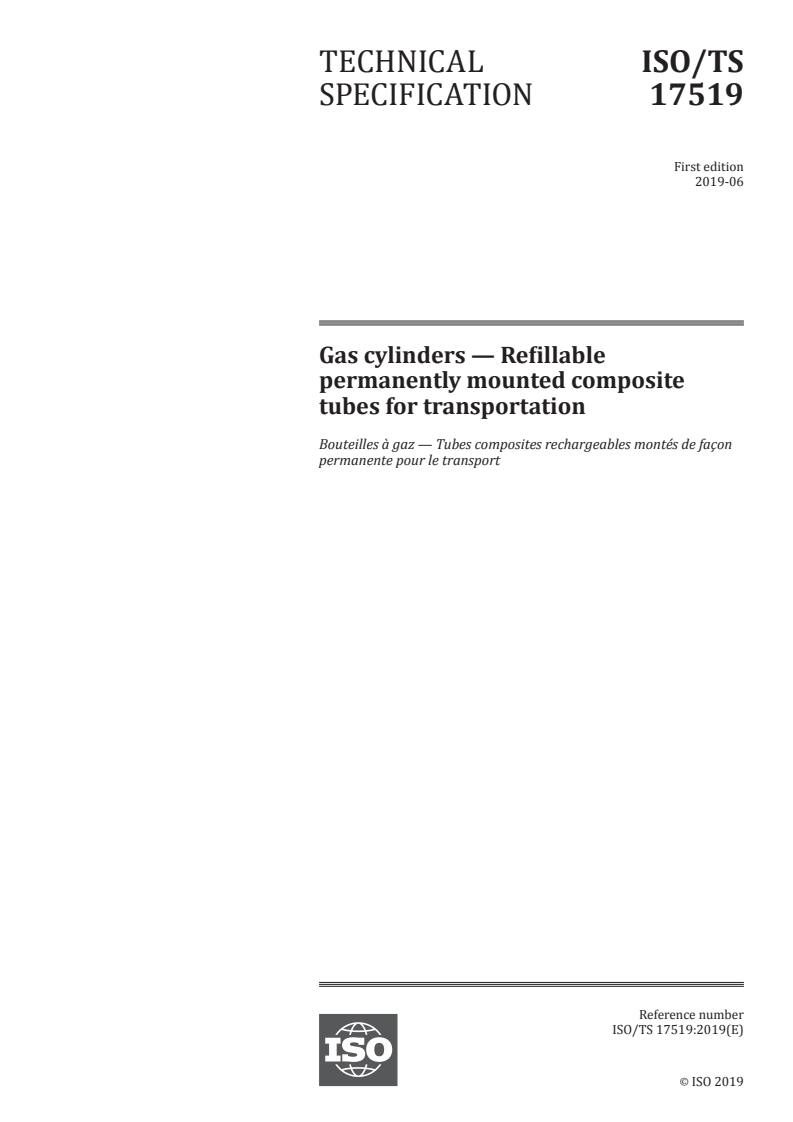
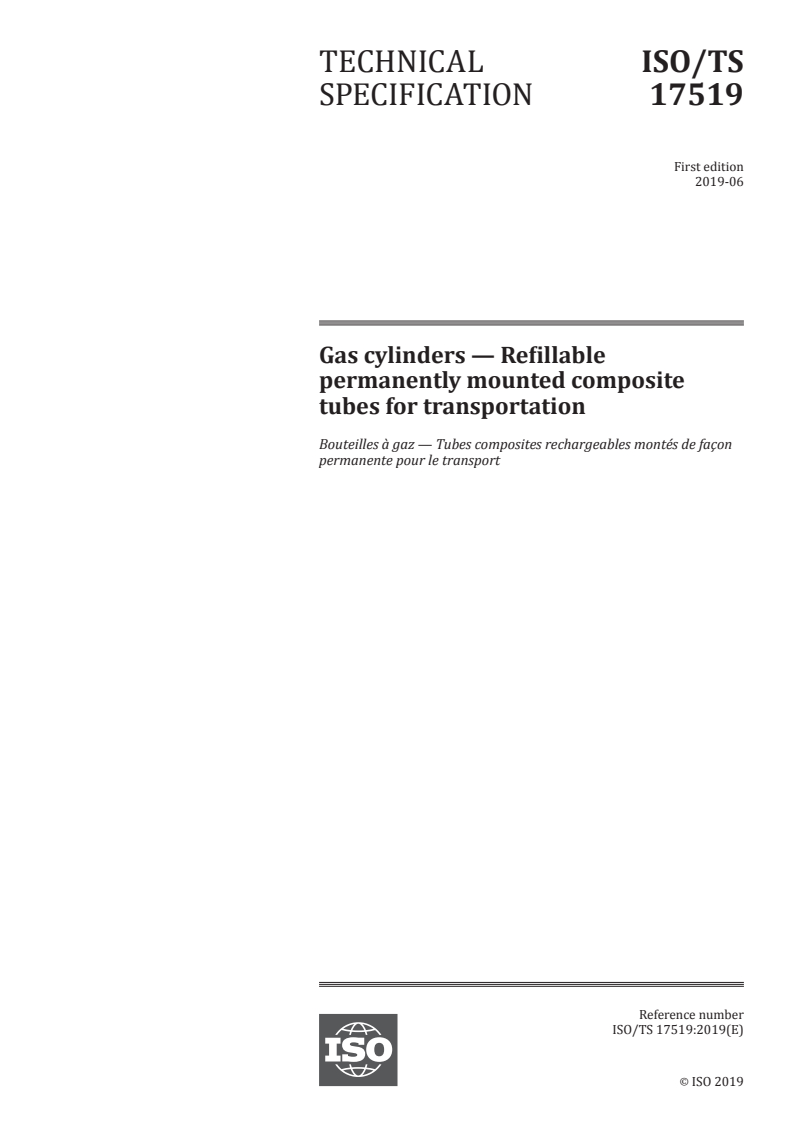
TECHNICAL ISO/TS
SPECIFICATION 17519
First edition
2019-06
Gas cylinders — Refillable
permanently mounted composite
tubes for transportation
Bouteilles à gaz — Tubes composites rechargeables montés de façon
permanente pour le transport
Reference number
©
ISO 2019
© ISO 2019
All rights reserved. Unless otherwise specified, or required in the context of its implementation, no part of this publication may
be reproduced or utilized otherwise in any form or by any means, electronic or mechanical, including photocopying, or posting
on the internet or an intranet, without prior written permission. Permission can be requested from either ISO at the address
below or ISO’s member body in the country of the requester.
ISO copyright office
CP 401 • Ch. de Blandonnet 8
CH-1214 Vernier, Geneva
Phone: +41 22 749 01 11
Fax: +41 22 749 09 47
Email: copyright@iso.org
Website: www.iso.org
Published in Switzerland
ii © ISO 2019 – All rights reserved
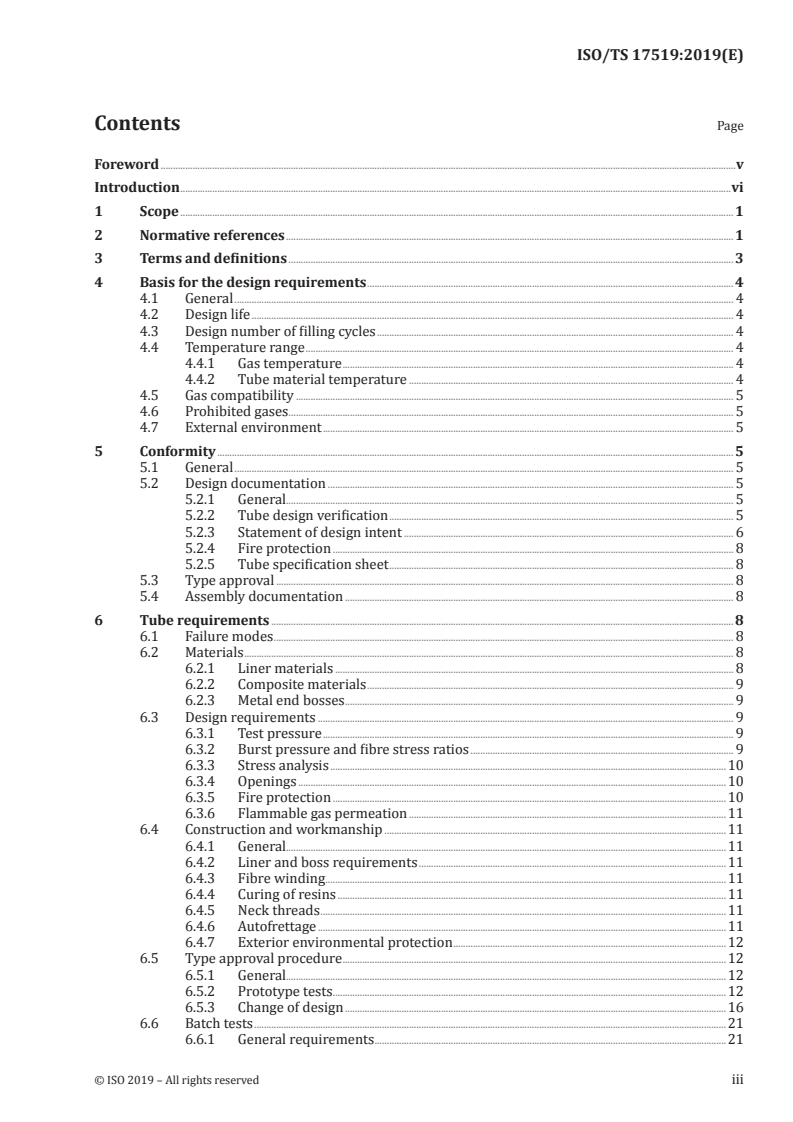
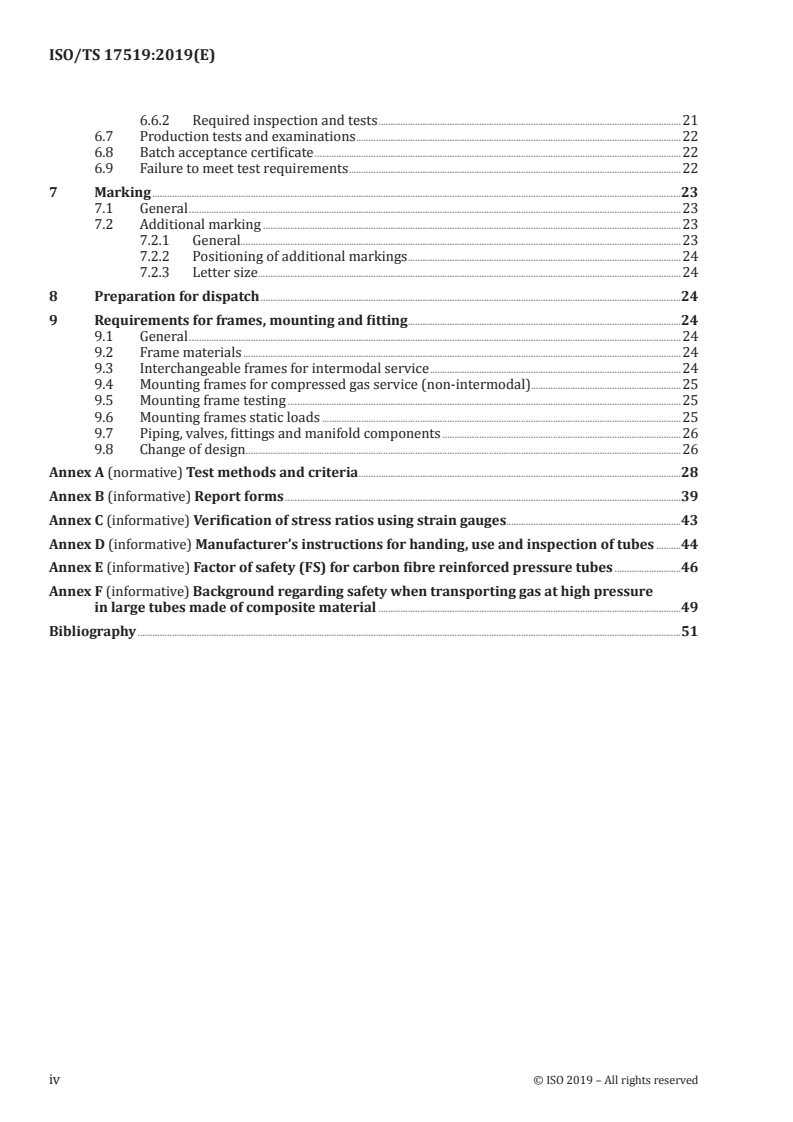
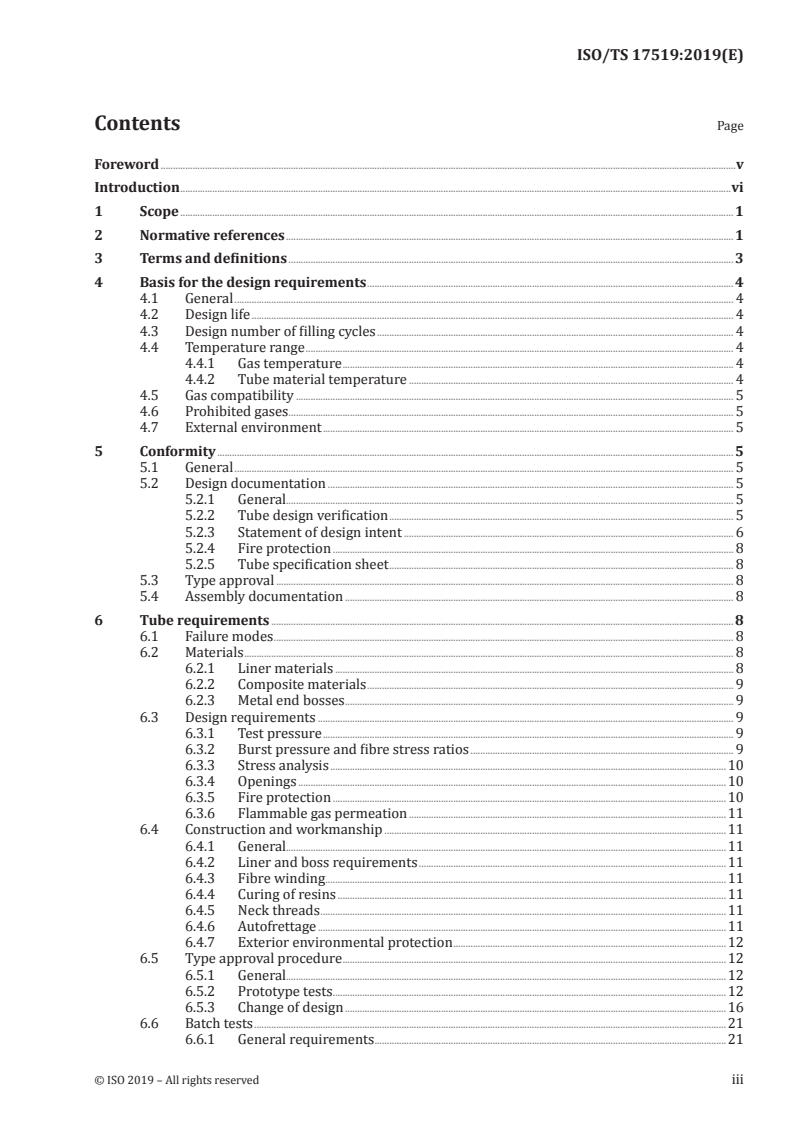
Contents Page
Foreword .v
Introduction .vi
1 Scope . 1
2 Normative references . 1
3 Terms and definitions . 3
4 Basis for the design requirements . 4
4.1 General . 4
4.2 Design life . 4
4.3 Design number of filling cycles . 4
4.4 Temperature range . 4
4.4.1 Gas temperature . 4
4.4.2 Tube material temperature . 4
4.5 Gas compatibility . 5
4.6 Prohibited gases . 5
4.7 External environment . 5
5 Conformity . 5
5.1 General . 5
5.2 Design documentation . 5
5.2.1 General. 5
5.2.2 Tube design verification . 5
5.2.3 Statement of design intent . 6
5.2.4 Fire protection . 8
5.2.5 Tube specification sheet . 8
5.3 Type approval . 8
5.4 Assembly documentation . 8
6 Tube requirements . 8
6.1 Failure modes . 8
6.2 Materials . 8
6.2.1 Liner materials . 8
6.2.2 Composite materials . 9
6.2.3 Metal end bosses . 9
6.3 Design requirements . 9
6.3.1 Test pressure . 9
6.3.2 Burst pressure and fibre stress ratios . 9
6.3.3 Stress analysis .10
6.3.4 Openings .10
6.3.5 Fire protection .10
6.3.6 Flammable gas permeation .11
6.4 Construction and workmanship .11
6.4.1 General.11
6.4.2 Liner and boss requirements .11
6.4.3 Fibre winding .11
6.4.4 Curing of resins .11
6.4.5 Neck threads .11
6.4.6 Autofrettage .11
6.4.7 Exterior environmental protection .12
6.5 Type approval procedure .12
6.5.1 General.12
6.5.2 Prototype tests . .12
6.5.3 Change of design .16
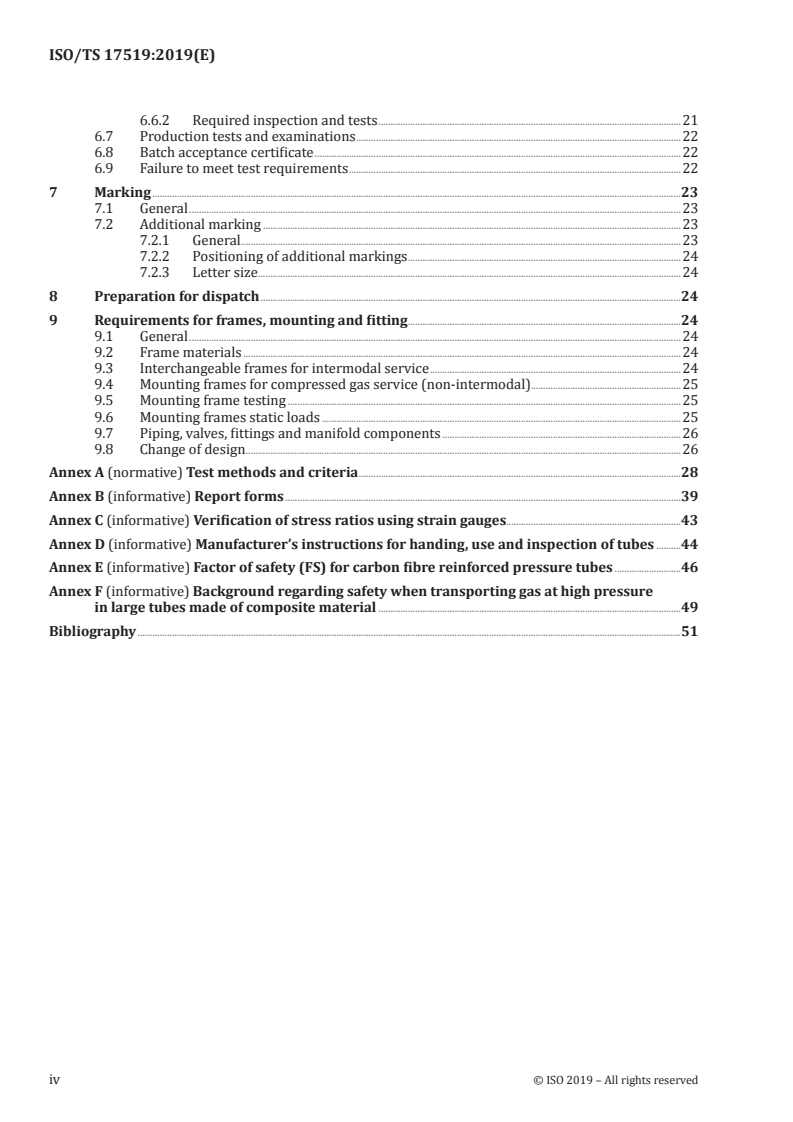
6.6 Batch tests .21
6.6.1 General requirements .21
6.6.2 Required inspection and tests .21
6.7 Production tests and examinations .22
6.8 Batch acceptance certificate .22
6.9 Failure to meet test requirements .22
7 Marking .23
7.1 General .23
7.2 Additional marking .23
7.2.1 General.23
7.2.2 Positioning of additional markings .24
7.2.3 Letter size . .24
8 Preparation for dispatch .24
9 Requirements for frames, mounting and fitting .24
9.1 General .24
9.2 Frame materials .24
9.3 Interchangeable frames for intermodal service .24
9.4 Mounting frames for compressed gas service (non-intermodal) .25
9.5 Mounting frame testing .25
9.6 Mounting frames static loads .25
9.7 Piping, valves, fittings and manifold components .26
9.8 Change of design .26
Annex A (normative) Test methods and criteria .28
Annex B (informative) Report forms .39
Annex C (informative) Verification of stress ratios using strain gauges .43
Annex D (informative) Manufacturer’s instructions for handing, use and inspection of tubes .44
Annex E (informative) Factor of safety (FS) for carbon fibre reinforced pressure tubes .46
Annex F (informative) Background regarding safety when transporting gas at high pressure
in large tubes made of composite material .49
Bibliography .51
iv © ISO 2019 – All rights reserved
Foreword
ISO (the International Organization for Standardization) is a worldwide federation of national standards
bodies (ISO member bodies). The work of preparing International Standards is normally carried out
through ISO technical committees. Each member body interested in a subject for which a technical
committee has been established has the right to be represented on that committee. International
organizations, governmental and non-governmental, in liaison with ISO, also take part in the work.
ISO collaborates closely with the International Electrotechnical Commission (IEC) on all matters of
electrotechnical standardization.
The procedures used to develop this document and those intended for its further maintenance are
described in the ISO/IEC Directives, Part 1. In particular, the different approval criteria needed for the
different types of ISO documents should be noted. This document was drafted in accordance with the
editorial rules of the ISO/IEC Directives, Part 2 (see www .iso .org/directives).
Attention is drawn to the possibility that some of the elements of this document may be the subject of
patent rights. ISO shall not be held responsible for identifying any or all such patent rights. Details of
any patent rights identified during the development of the document will be in the Introduction and/or
on the ISO list of patent declarations received (see www .iso .org/patents).
Any trade name used in this document is information given for the convenience of users and does not
constitute an endorsement.
For an explanation of the voluntary nature of standards, the meaning of ISO specific terms and
expressions related to conformity assessment, as well as information about ISO's adherence to the
World Trade Organization (WTO) principles in the Technical Barriers to Trade (TBT) see www .iso
.org/iso/foreword .html.
This document was prepared by Technical Committee ISO/TC 58, Gas cylinders, Subcommittee SC 3,
Cylinder design.
Any feedback or questions on this document should be directed to the user’s national standards body. A
complete listing of these bodies can be found at www .iso .org/members .html.
Introduction
This document provides a specification for the design, manufacture and initial inspection and testing of
composite tubes permanently mounted in a transport frame for worldwide usage. Current standards, such
as ISO 11515 and ISO 11119, do not address the interaction between the tubes and the transport frame.
This document aims to eliminate existing concerns about duplicate inspection and restrictions because
of the lack of International Standards and should not be construed as reflecting on the suitability of the
practice of any nation or region.
[6]
This document has been written so that it is suitable to be referenced in the UN Model Regulations .
This document addresses tubes of larger volume than previous documents.
This document is not applicable to on-board fuel cylinders in natural gas vehicles.
Annexes B to F are informative. Annex A is normative.
vi © ISO 2019 – All rights reserved
TECHNICAL SPECIFICATION ISO/TS 17519:2019(E)
Gas cylinders — Refillable permanently mounted
composite tubes for transportation
1 Scope
This document specifies the minimum requirements for the material, design construction and
workmanship, manufacturing processes, examination and testing at time of manufacture of an
assembly of permanently mounted composite tube(s) in a frame with associated components.
Tubes covered by the requirements of this document are:
a) of composite construction, permanently mounted in a transport frame and suitable for specified
service conditions, designated as:
1) Type 3 — a fully wrapped tube with a seamless metallic liner and composite reinforcement on
both the cylindrical part and the dome ends; or
2) Type 4 — a fully wrapped tube with a non-load sharing liner and composite reinforcement on
both the cylindrical part and the dome ends.
b) with water capacities from 450 l up to and including 10 000 l;
c) containing compressed gases but excluding:
1) liquefied gases,
2) dissolved gases, and
3) gases and gas mixtures which are classified for transport as toxic or oxidizing;
d) with working pressure up to 1 000 bar.
This document does not address tubes with working pressure times water capacity (p × V) more than
3 000 000 bar∙l.
2 Normative references
The following documents are referred to in the text in such a way that some or all of their content
constitutes requirements of this document. For dated references, only the edition cited applies. For
undated references, the latest edition of the referenced document (including any amendments) applies.
ISO 306, Plastics — Thermoplastic materials — Determination of Vicat softening temperature (VST)
ISO 527-2, Plastics — Determination of tensile properties — Part 2: Test conditions for moulding and
extrusion plastics
ISO 1496-3:1995, Series 1 freight containers — Specification and testing — Part 3: Tank containers for
liquids, gases and pressurized dry bulk
ISO 2808, Paints and varnishes — Determination of film thickness
ISO 4624, Paints and varnishes — Pull-off test for adhesion
ISO 7866:2012, Gas cylinders — Refillable seamless aluminium alloy gas cylinders — Design, construction
and testing
ISO 9227, Corrosion tests in artificial atmospheres — Salt spray tests
ISO 9809-1, Gas cylinders — Refillable seamless steel gas cylinders — Design, construction and testing —
Part 1: Quenched and tempered steel cylinders with tensile strength less than 1 100 MPa
ISO 9809-2, Gas cylinders — Refillable seamless steel gas cylinders — Design, construction and testing —
Part 2: Quenched and tempered steel cylinders with tensile strength greater than or equal to 1 100 MPa
ISO 9809-3, Gas cylinders — Refillable seamless steel gas cylinders — Design, construction and testing —
Part 3: Normalized steel cylinders
ISO 10156, Gas cylinders — Gases and gas mixtures — Determination of fire potential and oxidizing ability
for the selection of cylinder valve outlets
ISO 10286, Gas cylinders — Terminology
ISO 10298, Gas cylinders — Gases and gas mixtures — Determination of toxicity for the selection of cylinder
valve outlets
ISO 11114-1, Gas cylinders — Compatibility of cylinder and valve materials with gas contents —
Part 1: Metallic materials
ISO 11114-2, Gas cylinders — Compatibility of cylinder and valve materials with gas contents — Part 2: Non-
metallic materials
ISO 11120:2015, Gas cylinders — Refillable seamless steel tubes of water capacity between 150 l and
3000 l — Design, construction and testing
ISO 11439:2013, Gas cylinders — High pressure cylinders for the on-board storage of natural gas as a fuel
for automotive vehicles
ISO 13341, Gas cylinders — Fitting of valves to gas cylinders
ISO 13769, Gas cylinders — Stamp marking
ISO 14130, Fibre-reinforced plastic composites — Determination of apparent interlaminar shear strength
by short-beam method
ISO 14456, Gas cylinders — Gas properties and associated classification (FTSC) codes
ASTM D522, Standard Test Methods for Mandrel Bend Test of Attached Organic Coatings
ASTM D1308, Standard Test Method for Effect of Household Chemicals on Clear and Pigmented Organic
Finishes
ASTM D2794, Standard Test Method for Resistance of Organic Coatings to the Effects of Rapid Deformation
(Impact)
ASTM D3170, Standard Test Method for Chipping Resistance of Coatings
ASTM D3418, Standard Test Method for Transition Temperatures and Enthalpies of Fusion and
Crystallization of Polymers by Differential Scanning Calorimetry
ASTM D4814, Standard Specification for Automotive Spark-Ignition Engine Fuel
ASTM G154, Standard Practice for Operating Fluorescent Light Apparatus for UV Exposure of Nonmetallic
Materials
1)
NACE/TM 0177-2016 , Laboratory Testing of Metals for Resistance to Sulfide Stress Cracking and Stress
Corrosion Cracking in H2S Environments
International Maritime Organization. International Convention for Safe Containers, 1972
1) NACE standards are available from NACE International, PO Box 218340 Houston, Texas 77218-8340, U.S.A.
2 © ISO 2019 – All rights reserved
3 Terms and definitions
For the purposes of this document, the terms and definitions in ISO 10286 and the following apply.
ISO and IEC maintain terminological databases for use in standardization at the following addresses:
— IEC Electropedia: available at http: //www .electropedia .org/
— ISO Online browsing platform: available at https: //www .iso .org/obp
3.1
autofrettage
pressure application procedure which strains the metal liner past its yield strength sufficient to cause
permanent plastic deformation, and results in the liner having compressive stresses and the fibres
having tensile stresses when at zero internal gauge pressure
3.2
autofrettage pressure
pressure within the over-wrapped tube at which the required distribution of stresses between the liner
and the over-wrap is established
3.3
composite tube
tube made of resin-impregnated continuous filament wound over liner
3.4
finished tubes
completed tubes which are ready for use, typical of normal production, complete with identification
marks and external coating including integral insulation specified by the manufacturer, but free from
non-integral insulation or protection
3.5
liner
inner portion of a composite tube, comprising a metallic (seamless) or non-metallic (seamless or
welded) vessel, whose purpose is both to contain the gas and transmit the gas pressure to the composite
overwrap
3.6
overwrap
reinforcement system of filament and resin applied over the liner
3.7
test pressure
required pressure applied during a pressure test
3.8
working pressure
settled pressure at uniform temperature of 15 °C
3.9
oxidizing gas
gas containing more than the equivalent of 30 bar partial pressure of oxygen
Note 1 to entry: See ISO 14456.
3.10
non-load sharing liner
non-metallic liner that has a burst pressure less than 5 % of the nominal burst pressure of the finished
composite tube
3.11
load sharing liner
liner that has a burst pressure greater than or equal to 5 % of the nominal burst pressure of the finished
composite tube
3.12
permanently mounted composite tubes
tubes mounted in an ISO frame or tube trailer for transportation as a unit, such that tools are required
to remove them, and not intended to be transported or used outside of the ISO frame or tube trailer
3.13
settled pressure
pressure of the contents of a pressure receptacle in thermal and diffusive equilibrium
3.14
polymer
large, chain-like molecule made up of monomers, which are small molecules, and can be naturally
occurring or synthetic
Note 1 to entry: For use in this document, includes polymer mixtures, additives, plastics, and other non-metallic
materials suitable for use as a non-load sharing liner.
4 Basis for the design requirements
4.1 General
WARNING — The combination of pressure and volume up to 3 000 000 bar∙l represents a
substantial amount of energy that has to be taken into consideration with regard to the intended
service (e.g. safety distances to be established in case of an incident).
The requirements specified in this clause are provided as the basis for the design, manufacture,
inspection, testing and approval of tubes that are to be permanently mounted in a frame and used to
transport gases at ambient temperatures. The requirements do not include vacuum service.
4.2 Design life
Design life shall be specified by the manufacturer and demonstrated by design prototype testing. The
minimum design life shall be 15 years and the maximum design life shall be 30 years, except that the
maximum design life for Type 3 tubes with carbon steel liners shall be 20 years.
4.3 Design number of filling cycles
Tubes shall be designed to be filled 750 times per year of design life.
4.4 Temperature range
4.4.1 Gas temperature
Tubes shall be designed to have a settled gas temperature of not less than –40 °C and not more than +65 °C.
NOTE Developed gas temperatures in the tubes during filling and discharge can vary beyond these limits.
4.4.2 Tube material temperature
Tubes shall be designed to be suitable for external exposure to temperatures from –40 °C to 82 °C.
Temperatures over +65 °C shall be sufficiently local, or of short duration, such that the bulk temperature
of gas in the tube does not exceed +65 °C.
4 © ISO 2019 – All rights reserved
4.5 Gas compatibility
Compatibility of the liner shall be demonstrated for the intended content for all pressure and
temperature ranges (e.g. by reference to ISO 11114-1, ISO 11114-2, reference to current use, or
verification of key properties following exposure).
Type 3 tubes with steel liners shall not carry CNG for which the chemical composition is not in
accordance with ISO 11439:2013, 4.5.
NOTE See ISO 11120:2015, Clause 12 for additional guidance on requirements for embrittling gases.
4.6 Prohibited gases
The tubes shall not be filled with oxidizing gas, with toxic gases, or with dissolved or liquified gases as
specified in ISO 10156, ISO 10298 and ISO 14456.
4.7 External environment
General compatibility with environmental fluids shall be demonstrated by conducting testing as
specified in A.8.
5 Conformity
5.1 General
To ensure that the tubes conform to the requirements of this document, they shall be subject to
inspection and testing in accordance with Clauses 5, 6, and 7.
Equipment used for measurement, testing and examination during production shall be maintained and
calibrated.
5.2 Design documentation
5.2.1 General
Type approval consists of:
a) Tube design approval, comprising submissions of information by the manufacturer to the inspector,
as detailed in 5.2.2.
b) Prototype testing of the tube, in accordance with Annex A, comprising testing carried out under
the supervision of the inspector. The tube material, design, manufacture and examination shall be
shown to be satisfactory for the intended service by meeting the requirements of 6.5.
c) Frame design approval, comprising submissions of information by the manufacturer to the
inspector, as detailed in 5.2.3.3.
d) Prototype testing for the mounting frame. The mounting frame material, design, manufacture and
examination shall be proved to be adequate for its intended service by meeting the requirements of
Clause 9.
The test data shall also document the dimensions and weights of each of the test tubes.
5.2.2 Tube design verification
Design verification shall include a review of the:
a) statement of service, in accordance with the requirements of 5.2.3.1;
b) design data, in accordance with the requirements of 5.2.3.2, 5.2.3.3, 5.2.3.4, and 5.2.3.5;
c) fire protection, in accordance with the requirements of 5.2.4
provided by the manufacturer who can then request the inspector to provide a design conformance
report.
The title, reference number, revision number and dates of original issue and version issues of each
document shall be given.
5.2.3 Statement of design intent
NOTE The purpose of this design statement is to provide guidance to the installers of tubes and users.
5.2.3.1 Statement of service
The statement of service shall include:
a) a statement that the tube design is suitable for use in the service conditions defined in Clause 4 for
the service life of the tube;
b) a statement of the design life;
c) a specification for fire protection, such as the pressure relief devices, and insulation if provided;
d) a specification for the support methods (i.e. boss or strap mount) and protective coatings if
applicable;
e) a description of the tube design;
f) a description of the filling/emptying interfaces (e.g. threaded interfaces), with specifications as
required;
g) a reference to operational controls required for filling and emptying;
h) a statement of the impact resistance level.
5.2.3.2 Tube drawings
Drawings and supporting documents shall include at least:
a) a title, reference number, date of issue, and revision numbers with dates of issue if applicable;
b) a reference to this document (ISO/TS 17519:2019);
c) all dimensions and tolerances, including key subcomponents (e.g. liners and bosses);
d) mass, complete with tolerance of finished tubes;
e) all material specifications, including fibres, resins, and key subcomponents (e.g. bosses, liner),
complete with minimum mechanical or tolerance ranges, and heat treatment;
f) method of manufacture for subcomponents and overwrap, including key process specifications, the
number and type of strands used in the winding band, number of layers, and layer orientation;
g) test pressure and working pressure of the tube, and minimum burst pressure of the liner for Type
3 tubes;
h) autofrettage pressure and approximate duration (if applicable);
i) maximum developed pressure at 65 °C for specific gas to be transported (if applicable);
j) details of the fire protection system and of any exterior protective coating;
6 © ISO 2019 – All rights reserved
k) the design life in years (minimum 15 years and maximum 30 years);
l) manufacturer’s recommended time in the fire if a thermally activated pressure relief device (PRD)
is not used (based on time to burst during qualification testing, see A.9.6 for acceptable results and
minimum time);
m) port details including thread form, sealing method, seal specification (0-ring specification if used),
and installation instructions;
n) water volume of finished tube with a stated acceptance tolerance;
o) list of intended contents if intended for dedicated gas service;
p) other data required for safe operational use.
5.2.3.3 Frame drawings
Drawings shall include at least:
a) a title, reference number, date of issue, and revision numbers with dates of issue if applicable;
b) a reference to this document (ISO/TS 17519:2019);
c) all dimensions and tolerances;
d) mass, complete with tolerance of finished frames;
e) material specifications, complete with minimum mechanical properties or tolerance ranges;
f) other data required for safe operational use.
5.2.3.4 Stress analysis report
A stress analysis shall be carried out so as to demonstrate that the tube meets the requirements of 6.3.3.
A stress analysis shall be carried out so as to demonstrate that the frame can withstand the forces
developed from the loading prescribed in 9.5, and shall show a safety factor as appropriate:
— for steels having a clearly defined yield point, a safety factor of 1,5 in relation to minimum yield
strength;
— for steels with no clearly defined yield point, a safety factor of 1,5 in relation to the minimum 0,2 %
offset yield strength;
— for austenitic steels, a safety factor of 1,5 in relation to the 1 % offset yield strength;
— for materials other than steel, design practices shall ensure a level of safety equivalent to those
established for steel.
A table summarizing the calculated stresses shall be provided.
5.2.3.5 Material property data
A detailed description of the materials and material properties (with tolerances) used in the preparation
of the stress analysis report, including any modification of material properties caused by the tube
fabrication processes (e.g. heat treatment specification if applicable), including the hardness of the
metallic liner, shall be provided.
Test data from samples manufactured by filament winding (or an equivalent process, to be described)
shall be provided and shall at least include:
a) glass transition temperature in case of thermoset resin (ASTM D3418);
b) interlaminar shear strength of the cured composite material (ISO 14130); and
c) the suitability of the materials for service under the conditions specified in Clause 4.
5.2.4 Fire protection
The arrangement of the pressure relief and fire detection systems, and/or insulation if provided,
that protects the tube from sudden rupture when it is exposed to the tests described in A.9, shall be
specified. To pass the test, the tube shall meet the requirements of A.9.6.
5.2.5 Tube specification sheet
A summary of the documents providing the information required in 5.2.2 shall be listed on a
specification sheet for each tube design.
5.3 Type approval
An example of a type approval document is given in the Annex B.
5.4 Assembly documentation
The assembler permanently mounting the tube in the frame, the frame manufacturer and the tube
manufacturer can be separate companies. When more than one company is involved, responsibility for
the final product shall be agreed between the parties involved.
Where tubes are transported to the frame manufacturer or assembler, precautions shall be taken to
avoid any external impact on the tube. If it is suspected or known that the tube has had an external
impact, it shall be inspected prior to assembly so as to ensure that its in-service use has not been
compromised.
6 Tube requirements
6.1 Failure modes
The tube shall be designed to meet the requirements described in A.1 and A.7, thereby demonstrating
either a “leakage-before-break” failure mode or the ability to cycle to test pressure a total of 3 times the
expected number of pressure cycles to be seen during the lifetime of the tube.
6.2 Materials
Materials used shall meet the service conditions specified in Clause 4. The design shall ensure that
incompatible materials do not come in contact with each other.
6.2.1 Liner materials
6.2.1.1 Metal liners
Seamless steel liners shall conform to the chemical composition, heat treatment, tensile test, and impact
test requirements of ISO 9809-1, ISO 9809-2, ISO 9809-3 or ISO 11120, as appropriate for the steel used,
and shall meet the requirements of A.20, and A.21.
Seamless aluminium alloy liners shall conform to the requirements of ISO 7866 for chemical
composition, thermal treatment, tensile test, corrosion resistance (ISO 7866:2012, Annex A), and
sustained load cracking resistance (ISO 7866:2012, Annex B).
Liner burst pressure shall not be more than 30 % of the minimum design burst pressure of the
finished tube.
8 © ISO 2019 – All rights reserved
6.2.1.2 Polymer liners
The polymeric material shall be compatible with the service conditions specified in Clause 4 and the
relevant requirements of ISO 11114-2.
6.2.2 Composite materials
6.2.2.1 Resins
Thermosetting or thermoplastic resins may be used. Examples of suitable matrix materials are
epoxy, modified epoxy, polyester and vinyl-ester, polyurethane thermosetting resin and polyethylene,
polypropylene and polyamide thermoplastic.
The glass transition temperature of a thermosetting resin material used shall be determined in
accordance with the requirements of ASTM D3418 and checked against the test requirements in 6.5.2.9.
The Vicat softening point of a thermoplastic resin material used shall be determined in accordance with
the requirements of ISO 306.
6.2.2.2 Fibres
The structural reinforcing filament materials to be used shall be glass fibre, aramid fibre or carbon
fibre or a combination of these fibres. If carbon fibre reinforcement is used, the design shall address the
prevention of galvanic corrosion when it is in contact with metallic components of the tube.
The tube manufacturer shall retain:
a) specifications for composite materials;
b) the material manufacturer’s recommendations for storage, conditions and shelf life; and
c) the fibre manufacturer’s written confirmation that each shipment conforms to the specification
requirements.
6.2.3 Metal end bosses
The metal end bosses connected to the liner shall be of a material compatible with the service conditions
specified in Clause 4 and meet the relevant requirements of ISO 11114-1.
6.3 Design requirements
6.3.1 Test pressure
Test pressure shall be 1,5 times working pressure.
6.3.2 Burst pressure and fibre stress ratios
The composite over-wrap shall be designed for high reliability under sustained loading and cyclic
loading and these requirements shall be achieved by meeting or exceeding the composite reinforcement
stress ratio values given in Table 1.
Stress ratio is defined as the stress in the fibre at the specified minimum burst pressure divided by the
stress in the fibre at working pressure.
The burst ratio is defined as the minimum design burst pressure of the tube divided by the working
pressure.
The tube manufacturer may choose to use the reference burst ratio in place of the minimum stress ratios.
In that case, the minimum burst ratio requirements shown in Table 1 shall apply in place of the stress
ratios. Verification, either by analysis or test, of the stress ratio used is required for each tube design.
NOTE 1 For Type 3 tubes, the stress ratio is generally not linear with pressure and is not the same as the
burst ratio. The nonlinear behaviour is due to the yielding of the metallic liner during autofrettage and during
subsequent burst testing. The nonlinear behaviour is affected by the liner and composite thickness and modulus
of elasticity, by liner plastic behaviour and by autofrettage pressure.
When analysing tubes with hybrid reinforcement (two or more different fibres), calculation of the load
share between the different fibres is based on the different elastic moduli and cross-sectional area of
the fibres, e.g. calculate strains based on fibre areas and modulus, and from the resulting strain, and
the modulus for each fibre, calculate the stress in the fibre.
NOTE 2 Confirmation with strain gages is possible.
The strength of individual types of fibres used in hybrid construction may be verified by testing of
containers reinforced with a single type of fibre. In a hybrid construction, the applicable stress ratio
requirements shall be met in one of the two following ways.
a) If load sharing between the various fibre reinforcing materials is considered a fundamental part of
the design, each fibre shall meet the stated stress ratios.
b) If load sharing between fibres is not considered as a fundamental part of the design, then one of the
reinforcing fibres shall be capable of meeting the stress ratio requirements even if all other fibre
reinforcing materials are removed.
Table 1 — Minimum burst ratios and stress ratios for tubes
Fibre type Minimum Minimum
stress ratio burst ratio
Glass 3,65 3,65
Aramid 3,10 3,10
Carbon 2,35 2,35
6.3.3 Stress analysis
A stress analysis shall be performed.
The stress analysis shall use suitable techniques to be able to establish the stress distribution
throughout the tube. For Type 3 designs, the analysis shall take account of nonlinear material behaviour
of the liner including manufacturing induced stresses (e.g. due to wind tension and autofrettage).
The pressures used in the stress analysis shall be working pressure, test pressure and design burst
pressure. For Type 3 tubes the stress analysis shall also take account of the autofrettage pressure and
zero pressure after autofrettage.
NOTE Annex C gives examples of how the stress ratios can be verified using strain gauges.
The requirements shown in Table 1 shall be met.
6.3.4 Openings
Openings are only allowed in the end bosses or necks of liners, not through the composite laminate. End
bosses or necks of liners are only allowed on the longitudinal axis of the tube.
6.3.5 Fire protection
A bonfire test is required for all tube assemblies.
10 © ISO 2019 – All rights reserved
A fire protection system shall be provided, and it shall meet the requirements of A.9. A fire protection
system either allows gas to escape from the tube(s) to prevent rupture, and/
...
TECHNICAL ISO/TS
SPECIFICATION 17519
First edition
2019-06
Gas cylinders — Refillable
permanently mounted composite
tubes for transportation
Bouteilles à gaz — Tubes composites rechargeables montés de façon
permanente pour le transport
Reference number
©
ISO 2019
© ISO 2019
All rights reserved. Unless otherwise specified, or required in the context of its implementation, no part of this publication may
be reproduced or utilized otherwise in any form or by any means, electronic or mechanical, including photocopying, or posting
on the internet or an intranet, without prior written permission. Permission can be requested from either ISO at the address
below or ISO’s member body in the country of the requester.
ISO copyright office
CP 401 • Ch. de Blandonnet 8
CH-1214 Vernier, Geneva
Phone: +41 22 749 01 11
Fax: +41 22 749 09 47
Email: copyright@iso.org
Website: www.iso.org
Published in Switzerland
ii © ISO 2019 – All rights reserved
Contents Page
Foreword .v
Introduction .vi
1 Scope . 1
2 Normative references . 1
3 Terms and definitions . 3
4 Basis for the design requirements . 4
4.1 General . 4
4.2 Design life . 4
4.3 Design number of filling cycles . 4
4.4 Temperature range . 4
4.4.1 Gas temperature . 4
4.4.2 Tube material temperature . 4
4.5 Gas compatibility . 5
4.6 Prohibited gases . 5
4.7 External environment . 5
5 Conformity . 5
5.1 General . 5
5.2 Design documentation . 5
5.2.1 General. 5
5.2.2 Tube design verification . 5
5.2.3 Statement of design intent . 6
5.2.4 Fire protection . 8
5.2.5 Tube specification sheet . 8
5.3 Type approval . 8
5.4 Assembly documentation . 8
6 Tube requirements . 8
6.1 Failure modes . 8
6.2 Materials . 8
6.2.1 Liner materials . 8
6.2.2 Composite materials . 9
6.2.3 Metal end bosses . 9
6.3 Design requirements . 9
6.3.1 Test pressure . 9
6.3.2 Burst pressure and fibre stress ratios . 9
6.3.3 Stress analysis .10
6.3.4 Openings .10
6.3.5 Fire protection .10
6.3.6 Flammable gas permeation .11
6.4 Construction and workmanship .11
6.4.1 General.11
6.4.2 Liner and boss requirements .11
6.4.3 Fibre winding .11
6.4.4 Curing of resins .11
6.4.5 Neck threads .11
6.4.6 Autofrettage .11
6.4.7 Exterior environmental protection .12
6.5 Type approval procedure .12
6.5.1 General.12
6.5.2 Prototype tests . .12
6.5.3 Change of design .16
6.6 Batch tests .21
6.6.1 General requirements .21
6.6.2 Required inspection and tests .21
6.7 Production tests and examinations .22
6.8 Batch acceptance certificate .22
6.9 Failure to meet test requirements .22
7 Marking .23
7.1 General .23
7.2 Additional marking .23
7.2.1 General.23
7.2.2 Positioning of additional markings .24
7.2.3 Letter size . .24
8 Preparation for dispatch .24
9 Requirements for frames, mounting and fitting .24
9.1 General .24
9.2 Frame materials .24
9.3 Interchangeable frames for intermodal service .24
9.4 Mounting frames for compressed gas service (non-intermodal) .25
9.5 Mounting frame testing .25
9.6 Mounting frames static loads .25
9.7 Piping, valves, fittings and manifold components .26
9.8 Change of design .26
Annex A (normative) Test methods and criteria .28
Annex B (informative) Report forms .39
Annex C (informative) Verification of stress ratios using strain gauges .43
Annex D (informative) Manufacturer’s instructions for handing, use and inspection of tubes .44
Annex E (informative) Factor of safety (FS) for carbon fibre reinforced pressure tubes .46
Annex F (informative) Background regarding safety when transporting gas at high pressure
in large tubes made of composite material .49
Bibliography .51
iv © ISO 2019 – All rights reserved
Foreword
ISO (the International Organization for Standardization) is a worldwide federation of national standards
bodies (ISO member bodies). The work of preparing International Standards is normally carried out
through ISO technical committees. Each member body interested in a subject for which a technical
committee has been established has the right to be represented on that committee. International
organizations, governmental and non-governmental, in liaison with ISO, also take part in the work.
ISO collaborates closely with the International Electrotechnical Commission (IEC) on all matters of
electrotechnical standardization.
The procedures used to develop this document and those intended for its further maintenance are
described in the ISO/IEC Directives, Part 1. In particular, the different approval criteria needed for the
different types of ISO documents should be noted. This document was drafted in accordance with the
editorial rules of the ISO/IEC Directives, Part 2 (see www .iso .org/directives).
Attention is drawn to the possibility that some of the elements of this document may be the subject of
patent rights. ISO shall not be held responsible for identifying any or all such patent rights. Details of
any patent rights identified during the development of the document will be in the Introduction and/or
on the ISO list of patent declarations received (see www .iso .org/patents).
Any trade name used in this document is information given for the convenience of users and does not
constitute an endorsement.
For an explanation of the voluntary nature of standards, the meaning of ISO specific terms and
expressions related to conformity assessment, as well as information about ISO's adherence to the
World Trade Organization (WTO) principles in the Technical Barriers to Trade (TBT) see www .iso
.org/iso/foreword .html.
This document was prepared by Technical Committee ISO/TC 58, Gas cylinders, Subcommittee SC 3,
Cylinder design.
Any feedback or questions on this document should be directed to the user’s national standards body. A
complete listing of these bodies can be found at www .iso .org/members .html.
Introduction
This document provides a specification for the design, manufacture and initial inspection and testing of
composite tubes permanently mounted in a transport frame for worldwide usage. Current standards, such
as ISO 11515 and ISO 11119, do not address the interaction between the tubes and the transport frame.
This document aims to eliminate existing concerns about duplicate inspection and restrictions because
of the lack of International Standards and should not be construed as reflecting on the suitability of the
practice of any nation or region.
[6]
This document has been written so that it is suitable to be referenced in the UN Model Regulations .
This document addresses tubes of larger volume than previous documents.
This document is not applicable to on-board fuel cylinders in natural gas vehicles.
Annexes B to F are informative. Annex A is normative.
vi © ISO 2019 – All rights reserved
TECHNICAL SPECIFICATION ISO/TS 17519:2019(E)
Gas cylinders — Refillable permanently mounted
composite tubes for transportation
1 Scope
This document specifies the minimum requirements for the material, design construction and
workmanship, manufacturing processes, examination and testing at time of manufacture of an
assembly of permanently mounted composite tube(s) in a frame with associated components.
Tubes covered by the requirements of this document are:
a) of composite construction, permanently mounted in a transport frame and suitable for specified
service conditions, designated as:
1) Type 3 — a fully wrapped tube with a seamless metallic liner and composite reinforcement on
both the cylindrical part and the dome ends; or
2) Type 4 — a fully wrapped tube with a non-load sharing liner and composite reinforcement on
both the cylindrical part and the dome ends.
b) with water capacities from 450 l up to and including 10 000 l;
c) containing compressed gases but excluding:
1) liquefied gases,
2) dissolved gases, and
3) gases and gas mixtures which are classified for transport as toxic or oxidizing;
d) with working pressure up to 1 000 bar.
This document does not address tubes with working pressure times water capacity (p × V) more than
3 000 000 bar∙l.
2 Normative references
The following documents are referred to in the text in such a way that some or all of their content
constitutes requirements of this document. For dated references, only the edition cited applies. For
undated references, the latest edition of the referenced document (including any amendments) applies.
ISO 306, Plastics — Thermoplastic materials — Determination of Vicat softening temperature (VST)
ISO 527-2, Plastics — Determination of tensile properties — Part 2: Test conditions for moulding and
extrusion plastics
ISO 1496-3:1995, Series 1 freight containers — Specification and testing — Part 3: Tank containers for
liquids, gases and pressurized dry bulk
ISO 2808, Paints and varnishes — Determination of film thickness
ISO 4624, Paints and varnishes — Pull-off test for adhesion
ISO 7866:2012, Gas cylinders — Refillable seamless aluminium alloy gas cylinders — Design, construction
and testing
ISO 9227, Corrosion tests in artificial atmospheres — Salt spray tests
ISO 9809-1, Gas cylinders — Refillable seamless steel gas cylinders — Design, construction and testing —
Part 1: Quenched and tempered steel cylinders with tensile strength less than 1 100 MPa
ISO 9809-2, Gas cylinders — Refillable seamless steel gas cylinders — Design, construction and testing —
Part 2: Quenched and tempered steel cylinders with tensile strength greater than or equal to 1 100 MPa
ISO 9809-3, Gas cylinders — Refillable seamless steel gas cylinders — Design, construction and testing —
Part 3: Normalized steel cylinders
ISO 10156, Gas cylinders — Gases and gas mixtures — Determination of fire potential and oxidizing ability
for the selection of cylinder valve outlets
ISO 10286, Gas cylinders — Terminology
ISO 10298, Gas cylinders — Gases and gas mixtures — Determination of toxicity for the selection of cylinder
valve outlets
ISO 11114-1, Gas cylinders — Compatibility of cylinder and valve materials with gas contents —
Part 1: Metallic materials
ISO 11114-2, Gas cylinders — Compatibility of cylinder and valve materials with gas contents — Part 2: Non-
metallic materials
ISO 11120:2015, Gas cylinders — Refillable seamless steel tubes of water capacity between 150 l and
3000 l — Design, construction and testing
ISO 11439:2013, Gas cylinders — High pressure cylinders for the on-board storage of natural gas as a fuel
for automotive vehicles
ISO 13341, Gas cylinders — Fitting of valves to gas cylinders
ISO 13769, Gas cylinders — Stamp marking
ISO 14130, Fibre-reinforced plastic composites — Determination of apparent interlaminar shear strength
by short-beam method
ISO 14456, Gas cylinders — Gas properties and associated classification (FTSC) codes
ASTM D522, Standard Test Methods for Mandrel Bend Test of Attached Organic Coatings
ASTM D1308, Standard Test Method for Effect of Household Chemicals on Clear and Pigmented Organic
Finishes
ASTM D2794, Standard Test Method for Resistance of Organic Coatings to the Effects of Rapid Deformation
(Impact)
ASTM D3170, Standard Test Method for Chipping Resistance of Coatings
ASTM D3418, Standard Test Method for Transition Temperatures and Enthalpies of Fusion and
Crystallization of Polymers by Differential Scanning Calorimetry
ASTM D4814, Standard Specification for Automotive Spark-Ignition Engine Fuel
ASTM G154, Standard Practice for Operating Fluorescent Light Apparatus for UV Exposure of Nonmetallic
Materials
1)
NACE/TM 0177-2016 , Laboratory Testing of Metals for Resistance to Sulfide Stress Cracking and Stress
Corrosion Cracking in H2S Environments
International Maritime Organization. International Convention for Safe Containers, 1972
1) NACE standards are available from NACE International, PO Box 218340 Houston, Texas 77218-8340, U.S.A.
2 © ISO 2019 – All rights reserved
3 Terms and definitions
For the purposes of this document, the terms and definitions in ISO 10286 and the following apply.
ISO and IEC maintain terminological databases for use in standardization at the following addresses:
— IEC Electropedia: available at http: //www .electropedia .org/
— ISO Online browsing platform: available at https: //www .iso .org/obp
3.1
autofrettage
pressure application procedure which strains the metal liner past its yield strength sufficient to cause
permanent plastic deformation, and results in the liner having compressive stresses and the fibres
having tensile stresses when at zero internal gauge pressure
3.2
autofrettage pressure
pressure within the over-wrapped tube at which the required distribution of stresses between the liner
and the over-wrap is established
3.3
composite tube
tube made of resin-impregnated continuous filament wound over liner
3.4
finished tubes
completed tubes which are ready for use, typical of normal production, complete with identification
marks and external coating including integral insulation specified by the manufacturer, but free from
non-integral insulation or protection
3.5
liner
inner portion of a composite tube, comprising a metallic (seamless) or non-metallic (seamless or
welded) vessel, whose purpose is both to contain the gas and transmit the gas pressure to the composite
overwrap
3.6
overwrap
reinforcement system of filament and resin applied over the liner
3.7
test pressure
required pressure applied during a pressure test
3.8
working pressure
settled pressure at uniform temperature of 15 °C
3.9
oxidizing gas
gas containing more than the equivalent of 30 bar partial pressure of oxygen
Note 1 to entry: See ISO 14456.
3.10
non-load sharing liner
non-metallic liner that has a burst pressure less than 5 % of the nominal burst pressure of the finished
composite tube
3.11
load sharing liner
liner that has a burst pressure greater than or equal to 5 % of the nominal burst pressure of the finished
composite tube
3.12
permanently mounted composite tubes
tubes mounted in an ISO frame or tube trailer for transportation as a unit, such that tools are required
to remove them, and not intended to be transported or used outside of the ISO frame or tube trailer
3.13
settled pressure
pressure of the contents of a pressure receptacle in thermal and diffusive equilibrium
3.14
polymer
large, chain-like molecule made up of monomers, which are small molecules, and can be naturally
occurring or synthetic
Note 1 to entry: For use in this document, includes polymer mixtures, additives, plastics, and other non-metallic
materials suitable for use as a non-load sharing liner.
4 Basis for the design requirements
4.1 General
WARNING — The combination of pressure and volume up to 3 000 000 bar∙l represents a
substantial amount of energy that has to be taken into consideration with regard to the intended
service (e.g. safety distances to be established in case of an incident).
The requirements specified in this clause are provided as the basis for the design, manufacture,
inspection, testing and approval of tubes that are to be permanently mounted in a frame and used to
transport gases at ambient temperatures. The requirements do not include vacuum service.
4.2 Design life
Design life shall be specified by the manufacturer and demonstrated by design prototype testing. The
minimum design life shall be 15 years and the maximum design life shall be 30 years, except that the
maximum design life for Type 3 tubes with carbon steel liners shall be 20 years.
4.3 Design number of filling cycles
Tubes shall be designed to be filled 750 times per year of design life.
4.4 Temperature range
4.4.1 Gas temperature
Tubes shall be designed to have a settled gas temperature of not less than –40 °C and not more than +65 °C.
NOTE Developed gas temperatures in the tubes during filling and discharge can vary beyond these limits.
4.4.2 Tube material temperature
Tubes shall be designed to be suitable for external exposure to temperatures from –40 °C to 82 °C.
Temperatures over +65 °C shall be sufficiently local, or of short duration, such that the bulk temperature
of gas in the tube does not exceed +65 °C.
4 © ISO 2019 – All rights reserved
4.5 Gas compatibility
Compatibility of the liner shall be demonstrated for the intended content for all pressure and
temperature ranges (e.g. by reference to ISO 11114-1, ISO 11114-2, reference to current use, or
verification of key properties following exposure).
Type 3 tubes with steel liners shall not carry CNG for which the chemical composition is not in
accordance with ISO 11439:2013, 4.5.
NOTE See ISO 11120:2015, Clause 12 for additional guidance on requirements for embrittling gases.
4.6 Prohibited gases
The tubes shall not be filled with oxidizing gas, with toxic gases, or with dissolved or liquified gases as
specified in ISO 10156, ISO 10298 and ISO 14456.
4.7 External environment
General compatibility with environmental fluids shall be demonstrated by conducting testing as
specified in A.8.
5 Conformity
5.1 General
To ensure that the tubes conform to the requirements of this document, they shall be subject to
inspection and testing in accordance with Clauses 5, 6, and 7.
Equipment used for measurement, testing and examination during production shall be maintained and
calibrated.
5.2 Design documentation
5.2.1 General
Type approval consists of:
a) Tube design approval, comprising submissions of information by the manufacturer to the inspector,
as detailed in 5.2.2.
b) Prototype testing of the tube, in accordance with Annex A, comprising testing carried out under
the supervision of the inspector. The tube material, design, manufacture and examination shall be
shown to be satisfactory for the intended service by meeting the requirements of 6.5.
c) Frame design approval, comprising submissions of information by the manufacturer to the
inspector, as detailed in 5.2.3.3.
d) Prototype testing for the mounting frame. The mounting frame material, design, manufacture and
examination shall be proved to be adequate for its intended service by meeting the requirements of
Clause 9.
The test data shall also document the dimensions and weights of each of the test tubes.
5.2.2 Tube design verification
Design verification shall include a review of the:
a) statement of service, in accordance with the requirements of 5.2.3.1;
b) design data, in accordance with the requirements of 5.2.3.2, 5.2.3.3, 5.2.3.4, and 5.2.3.5;
c) fire protection, in accordance with the requirements of 5.2.4
provided by the manufacturer who can then request the inspector to provide a design conformance
report.
The title, reference number, revision number and dates of original issue and version issues of each
document shall be given.
5.2.3 Statement of design intent
NOTE The purpose of this design statement is to provide guidance to the installers of tubes and users.
5.2.3.1 Statement of service
The statement of service shall include:
a) a statement that the tube design is suitable for use in the service conditions defined in Clause 4 for
the service life of the tube;
b) a statement of the design life;
c) a specification for fire protection, such as the pressure relief devices, and insulation if provided;
d) a specification for the support methods (i.e. boss or strap mount) and protective coatings if
applicable;
e) a description of the tube design;
f) a description of the filling/emptying interfaces (e.g. threaded interfaces), with specifications as
required;
g) a reference to operational controls required for filling and emptying;
h) a statement of the impact resistance level.
5.2.3.2 Tube drawings
Drawings and supporting documents shall include at least:
a) a title, reference number, date of issue, and revision numbers with dates of issue if applicable;
b) a reference to this document (ISO/TS 17519:2019);
c) all dimensions and tolerances, including key subcomponents (e.g. liners and bosses);
d) mass, complete with tolerance of finished tubes;
e) all material specifications, including fibres, resins, and key subcomponents (e.g. bosses, liner),
complete with minimum mechanical or tolerance ranges, and heat treatment;
f) method of manufacture for subcomponents and overwrap, including key process specifications, the
number and type of strands used in the winding band, number of layers, and layer orientation;
g) test pressure and working pressure of the tube, and minimum burst pressure of the liner for Type
3 tubes;
h) autofrettage pressure and approximate duration (if applicable);
i) maximum developed pressure at 65 °C for specific gas to be transported (if applicable);
j) details of the fire protection system and of any exterior protective coating;
6 © ISO 2019 – All rights reserved
k) the design life in years (minimum 15 years and maximum 30 years);
l) manufacturer’s recommended time in the fire if a thermally activated pressure relief device (PRD)
is not used (based on time to burst during qualification testing, see A.9.6 for acceptable results and
minimum time);
m) port details including thread form, sealing method, seal specification (0-ring specification if used),
and installation instructions;
n) water volume of finished tube with a stated acceptance tolerance;
o) list of intended contents if intended for dedicated gas service;
p) other data required for safe operational use.
5.2.3.3 Frame drawings
Drawings shall include at least:
a) a title, reference number, date of issue, and revision numbers with dates of issue if applicable;
b) a reference to this document (ISO/TS 17519:2019);
c) all dimensions and tolerances;
d) mass, complete with tolerance of finished frames;
e) material specifications, complete with minimum mechanical properties or tolerance ranges;
f) other data required for safe operational use.
5.2.3.4 Stress analysis report
A stress analysis shall be carried out so as to demonstrate that the tube meets the requirements of 6.3.3.
A stress analysis shall be carried out so as to demonstrate that the frame can withstand the forces
developed from the loading prescribed in 9.5, and shall show a safety factor as appropriate:
— for steels having a clearly defined yield point, a safety factor of 1,5 in relation to minimum yield
strength;
— for steels with no clearly defined yield point, a safety factor of 1,5 in relation to the minimum 0,2 %
offset yield strength;
— for austenitic steels, a safety factor of 1,5 in relation to the 1 % offset yield strength;
— for materials other than steel, design practices shall ensure a level of safety equivalent to those
established for steel.
A table summarizing the calculated stresses shall be provided.
5.2.3.5 Material property data
A detailed description of the materials and material properties (with tolerances) used in the preparation
of the stress analysis report, including any modification of material properties caused by the tube
fabrication processes (e.g. heat treatment specification if applicable), including the hardness of the
metallic liner, shall be provided.
Test data from samples manufactured by filament winding (or an equivalent process, to be described)
shall be provided and shall at least include:
a) glass transition temperature in case of thermoset resin (ASTM D3418);
b) interlaminar shear strength of the cured composite material (ISO 14130); and
c) the suitability of the materials for service under the conditions specified in Clause 4.
5.2.4 Fire protection
The arrangement of the pressure relief and fire detection systems, and/or insulation if provided,
that protects the tube from sudden rupture when it is exposed to the tests described in A.9, shall be
specified. To pass the test, the tube shall meet the requirements of A.9.6.
5.2.5 Tube specification sheet
A summary of the documents providing the information required in 5.2.2 shall be listed on a
specification sheet for each tube design.
5.3 Type approval
An example of a type approval document is given in the Annex B.
5.4 Assembly documentation
The assembler permanently mounting the tube in the frame, the frame manufacturer and the tube
manufacturer can be separate companies. When more than one company is involved, responsibility for
the final product shall be agreed between the parties involved.
Where tubes are transported to the frame manufacturer or assembler, precautions shall be taken to
avoid any external impact on the tube. If it is suspected or known that the tube has had an external
impact, it shall be inspected prior to assembly so as to ensure that its in-service use has not been
compromised.
6 Tube requirements
6.1 Failure modes
The tube shall be designed to meet the requirements described in A.1 and A.7, thereby demonstrating
either a “leakage-before-break” failure mode or the ability to cycle to test pressure a total of 3 times the
expected number of pressure cycles to be seen during the lifetime of the tube.
6.2 Materials
Materials used shall meet the service conditions specified in Clause 4. The design shall ensure that
incompatible materials do not come in contact with each other.
6.2.1 Liner materials
6.2.1.1 Metal liners
Seamless steel liners shall conform to the chemical composition, heat treatment, tensile test, and impact
test requirements of ISO 9809-1, ISO 9809-2, ISO 9809-3 or ISO 11120, as appropriate for the steel used,
and shall meet the requirements of A.20, and A.21.
Seamless aluminium alloy liners shall conform to the requirements of ISO 7866 for chemical
composition, thermal treatment, tensile test, corrosion resistance (ISO 7866:2012, Annex A), and
sustained load cracking resistance (ISO 7866:2012, Annex B).
Liner burst pressure shall not be more than 30 % of the minimum design burst pressure of the
finished tube.
8 © ISO 2019 – All rights reserved
6.2.1.2 Polymer liners
The polymeric material shall be compatible with the service conditions specified in Clause 4 and the
relevant requirements of ISO 11114-2.
6.2.2 Composite materials
6.2.2.1 Resins
Thermosetting or thermoplastic resins may be used. Examples of suitable matrix materials are
epoxy, modified epoxy, polyester and vinyl-ester, polyurethane thermosetting resin and polyethylene,
polypropylene and polyamide thermoplastic.
The glass transition temperature of a thermosetting resin material used shall be determined in
accordance with the requirements of ASTM D3418 and checked against the test requirements in 6.5.2.9.
The Vicat softening point of a thermoplastic resin material used shall be determined in accordance with
the requirements of ISO 306.
6.2.2.2 Fibres
The structural reinforcing filament materials to be used shall be glass fibre, aramid fibre or carbon
fibre or a combination of these fibres. If carbon fibre reinforcement is used, the design shall address the
prevention of galvanic corrosion when it is in contact with metallic components of the tube.
The tube manufacturer shall retain:
a) specifications for composite materials;
b) the material manufacturer’s recommendations for storage, conditions and shelf life; and
c) the fibre manufacturer’s written confirmation that each shipment conforms to the specification
requirements.
6.2.3 Metal end bosses
The metal end bosses connected to the liner shall be of a material compatible with the service conditions
specified in Clause 4 and meet the relevant requirements of ISO 11114-1.
6.3 Design requirements
6.3.1 Test pressure
Test pressure shall be 1,5 times working pressure.
6.3.2 Burst pressure and fibre stress ratios
The composite over-wrap shall be designed for high reliability under sustained loading and cyclic
loading and these requirements shall be achieved by meeting or exceeding the composite reinforcement
stress ratio values given in Table 1.
Stress ratio is defined as the stress in the fibre at the specified minimum burst pressure divided by the
stress in the fibre at working pressure.
The burst ratio is defined as the minimum design burst pressure of the tube divided by the working
pressure.
The tube manufacturer may choose to use the reference burst ratio in place of the minimum stress ratios.
In that case, the minimum burst ratio requirements shown in Table 1 shall apply in place of the stress
ratios. Verification, either by analysis or test, of the stress ratio used is required for each tube design.
NOTE 1 For Type 3 tubes, the stress ratio is generally not linear with pressure and is not the same as the
burst ratio. The nonlinear behaviour is due to the yielding of the metallic liner during autofrettage and during
subsequent burst testing. The nonlinear behaviour is affected by the liner and composite thickness and modulus
of elasticity, by liner plastic behaviour and by autofrettage pressure.
When analysing tubes with hybrid reinforcement (two or more different fibres), calculation of the load
share between the different fibres is based on the different elastic moduli and cross-sectional area of
the fibres, e.g. calculate strains based on fibre areas and modulus, and from the resulting strain, and
the modulus for each fibre, calculate the stress in the fibre.
NOTE 2 Confirmation with strain gages is possible.
The strength of individual types of fibres used in hybrid construction may be verified by testing of
containers reinforced with a single type of fibre. In a hybrid construction, the applicable stress ratio
requirements shall be met in one of the two following ways.
a) If load sharing between the various fibre reinforcing materials is considered a fundamental part of
the design, each fibre shall meet the stated stress ratios.
b) If load sharing between fibres is not considered as a fundamental part of the design, then one of the
reinforcing fibres shall be capable of meeting the stress ratio requirements even if all other fibre
reinforcing materials are removed.
Table 1 — Minimum burst ratios and stress ratios for tubes
Fibre type Minimum Minimum
stress ratio burst ratio
Glass 3,65 3,65
Aramid 3,10 3,10
Carbon 2,35 2,35
6.3.3 Stress analysis
A stress analysis shall be performed.
The stress analysis shall use suitable techniques to be able to establish the stress distribution
throughout the tube. For Type 3 designs, the analysis shall take account of nonlinear material behaviour
of the liner including manufacturing induced stresses (e.g. due to wind tension and autofrettage).
The pressures used in the stress analysis shall be working pressure, test pressure and design burst
pressure. For Type 3 tubes the stress analysis shall also take account of the autofrettage pressure and
zero pressure after autofrettage.
NOTE Annex C gives examples of how the stress ratios can be verified using strain gauges.
The requirements shown in Table 1 shall be met.
6.3.4 Openings
Openings are only allowed in the end bosses or necks of liners, not through the composite laminate. End
bosses or necks of liners are only allowed on the longitudinal axis of the tube.
6.3.5 Fire protection
A bonfire test is required for all tube assemblies.
10 © ISO 2019 – All rights reserved
A fire protection system shall be provided, and it shall meet the requirements of A.9. A fire protection
system either allows gas to escape from the tube(s) to prevent rupture, and/
...