

ISO 11119-3:2020/Amd 1:2023
(Amendment)Gas cylinders — Design, construction and testing of refillable composite gas cylinders and tubes — Part 3: Fully wrapped fibre reinforced composite gas cylinders and tubes up to 450 l with non-load-sharing metallic or non-metallic liners or without liners — Amendment 1
General Information
- Abstract
- Status
- Published
- Publication Date
- 10-Jul-2023
- Technical Committee
- ISO/TC 58/SC 3 - Cylinder design
- Drafting Committee
- ISO/TC 58/SC 3 - Cylinder design
- Current Stage
- 6060 - International Standard published
- Start Date
- 11-Jul-2023
- Due Date
- 22-Dec-2023
- Completion Date
- 11-Jul-2023
Buy Documents

ISO 11119-3:2020/Amd 1:2023 - Gas cylinders — Design, construction and testing of refillable composite gas cylinders and tubes — Part 3: Fully wrapped fibre reinforced composite gas cylinders and tubes up to 450 l with non-load-sharing metallic or non-metallic liners or without liners — Amendment 1 Released:7/11/2023
Overview
ISO 11119-3:2020/Amd 1:2023 is an important international standard published by the International Organization for Standardization (ISO), focusing on the design, construction, and testing of refillable composite gas cylinders and tubes. This amendment updates Part 3 of ISO 11119-3, which specifically addresses fully wrapped fibre reinforced composite gas cylinders and tubes with capacities up to 450 liters. These cylinders may have non-load-sharing metallic or non-metallic liners or no liners at all. The amendment introduces refinements to safety testing protocols and manufacturing requirements to enhance cylinder reliability and safety.
This standard is vital for manufacturers, testing bodies, and regulatory authorities involved in the production and certification of composite gas cylinders, ensuring compliance with international safety and performance regulations.
Key Topics
Composite Cylinder Construction
Focuses on fully wrapped fibre reinforced composite materials, providing high strength-to-weight ratios suitable for gas storage up to 450 liters.Non-Load-Sharing Liners
Covers design allowances for cylinders equipped with metallic or non-metallic liners that do not bear load, or cases where the cylinder has no liner.Testing Procedures
Introduces stringent testing methods including:- Drop tests from calculated heights to simulate accidental impacts on concrete or steel surfaces, ensuring structural integrity.
- Burst tests to verify pressure resistance, requiring burst pressure to meet or exceed 100% of minimum requirements.
- Pressure cycling tests, mandating cylinders withstand 3,000 cycles at two-thirds test pressure without failure by burst or leakage, and up to 12,000 cycles without burst failure.
Safety Enhancements
Mandates fitting cylinders with steel or aluminum plugs to protect critical sealing surfaces and threads during testing and handling.Calculation Methods
Provides formulas for calculating drop height based on cylinder volume and empty mass, to tailor testing conditions realistically for each cylinder size.
Applications
ISO 11119-3:2020/Amd 1:2023 is essential for industries requiring safe and reliable gas storage solutions, particularly where lightweight yet durable cylinders are necessary. Typical applications include:
Industrial Gas Supply
High-pressure gas cylinders for welding, manufacturing, and chemical processing.Medical Gas Delivery
Lightweight composite cylinders for portable oxygen and other medical gases.Transportation and Logistics
Refillable composite cylinders used in mobile gas delivery systems, benefiting from reduced weight and enhanced safety during transport.Energy Sector
Storage of compressed natural gas (CNG) or hydrogen in composite cylinders for clean energy applications.Safety Verification
Helps regulatory bodies and testing agencies prescribe consistent and rigorous testing practices for certification of composite gas cylinders worldwide.
Related Standards
To complement the requirements of ISO 11119-3:2020/Amd 1:2023, the following related standards are often referenced:
ISO 11119-1 & ISO 11119-2
Cover design and testing of other types of composite gas cylinders, including those with load-sharing liners.ISO 9809
Specifies requirements for seamless steel gas cylinders, often used as a benchmark for traditional metallic cylinders.ISO 11623
Details periodic inspection and testing procedures for composite gas cylinders, supporting ongoing safety compliance.ISO 11114
Addresses compatibility between gas cylinders and cylinder valve and valve installation, essential for safety in gas handling.
Conclusion
The ISO 11119-3:2020/Amd 1:2023 amendment enhances global standards for refillable composite gas cylinders, emphasizing improved safety, durability, and testing accuracy. By adhering to these guidelines, manufacturers can ensure their composite cylinders meet international quality benchmarks, while users benefit from safer and more reliable gas storage solutions. This standard is a cornerstone reference for anyone involved in the lifecycle of composite gas cylinders up to 450 liters capacity.
Relations
- Effective Date
- 30-Jul-2022
Buy Documents
ISO 11119-3:2020/Amd 1:2023 - Gas cylinders — Design, construction and testing of refillable composite gas cylinders and tubes — Part 3: Fully wrapped fibre reinforced composite gas cylinders and tubes up to 450 l with non-load-sharing metallic or non-metallic liners or without liners — Amendment 1 Released:7/11/2023
Get Certified
Connect with accredited certification bodies for this standard

Institut za varilstvo d.o.o. (Welding Institute)
Slovenia's leading welding institute since 1952. ISO 3834, EN 1090, pressure equipment certification, NDT personnel, welder qualification. Only IIW Au
Sponsored listings
Frequently Asked Questions
ISO 11119-3:2020/Amd 1:2023 is a standard published by the International Organization for Standardization (ISO). Its full title is "Gas cylinders — Design, construction and testing of refillable composite gas cylinders and tubes — Part 3: Fully wrapped fibre reinforced composite gas cylinders and tubes up to 450 l with non-load-sharing metallic or non-metallic liners or without liners — Amendment 1". This standard covers: Gas cylinders — Design, construction and testing of refillable composite gas cylinders and tubes — Part 3: Fully wrapped fibre reinforced composite gas cylinders and tubes up to 450 l with non-load-sharing metallic or non-metallic liners or without liners — Amendment 1
Gas cylinders — Design, construction and testing of refillable composite gas cylinders and tubes — Part 3: Fully wrapped fibre reinforced composite gas cylinders and tubes up to 450 l with non-load-sharing metallic or non-metallic liners or without liners — Amendment 1
ISO 11119-3:2020/Amd 1:2023 is classified under the following ICS (International Classification for Standards) categories: 23.020.35 - Gas cylinders. The ICS classification helps identify the subject area and facilitates finding related standards.
ISO 11119-3:2020/Amd 1:2023 has the following relationships with other standards: It is inter standard links to ISO 11119-3:2020. Understanding these relationships helps ensure you are using the most current and applicable version of the standard.
ISO 11119-3:2020/Amd 1:2023 is available in PDF format for immediate download after purchase. The document can be added to your cart and obtained through the secure checkout process. Digital delivery ensures instant access to the complete standard document.
Standards Content (Sample)
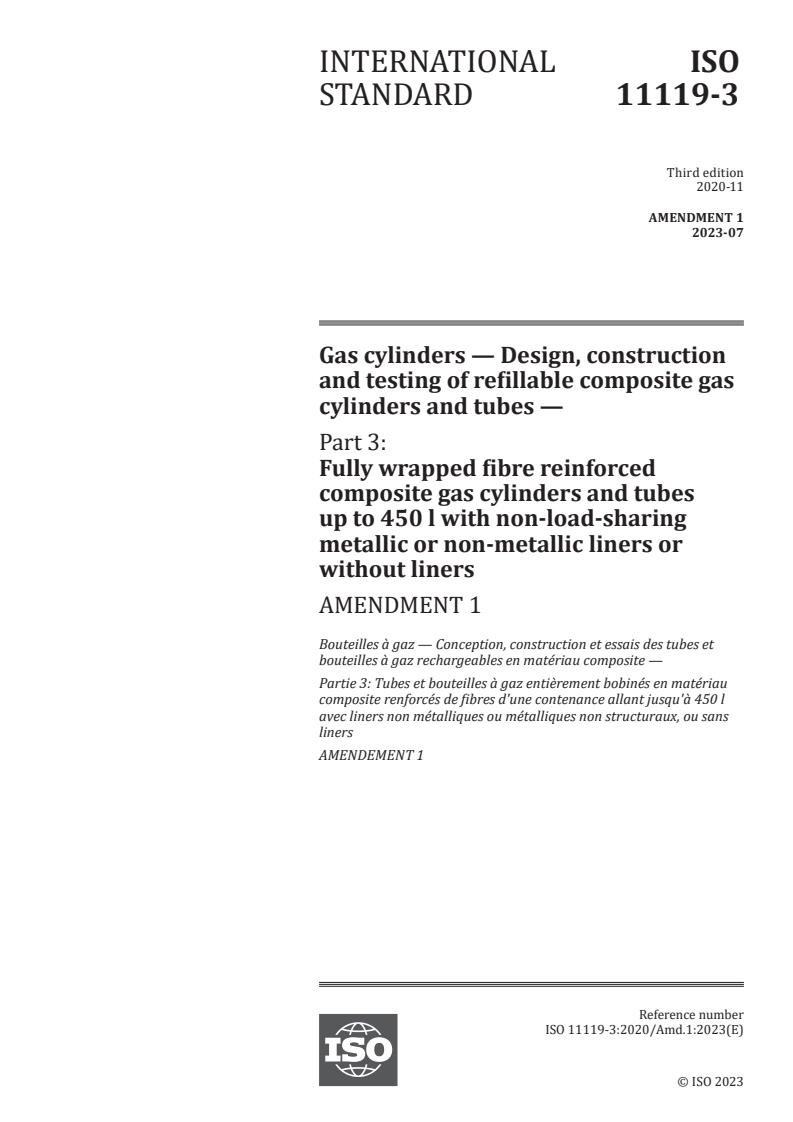
INTERNATIONAL ISO
STANDARD 11119-3
Third edition
2020-11
AMENDMENT 1
2023-07
Gas cylinders — Design, construction
and testing of refillable composite gas
cylinders and tubes —
Part 3:
Fully wrapped fibre reinforced
composite gas cylinders and tubes
up to 450 l with non-load-sharing
metallic or non-metallic liners or
without liners
AMENDMENT 1
Bouteilles à gaz — Conception, construction et essais des tubes et
bouteilles à gaz rechargeables en matériau composite —
Partie 3: Tubes et bouteilles à gaz entièrement bobinés en matériau
composite renforcés de fibres d'une contenance allant jusqu'à 450 l
avec liners non métalliques ou métalliques non structuraux, ou sans
liners
AMENDEMENT 1
Reference number
ISO 11119-3:2020/Amd.1:2023(E)
ISO 11119-3:2020/Amd.1:2023(E)
© ISO 2023
All rights reserved. Unless otherwise specified, or required in the context of its implementation, no part of this publication may
be reproduced or utilized otherwise in any form or by any means, electronic or mechanical, including photocopying, or posting on
the internet or an intranet, without prior written permission. Permission can be requested from either ISO at the address below
or ISO’s member body in the country of the requester.
ISO copyright office
CP 401 • Ch. de Blandonnet 8
CH-1214 Vernier, Geneva
Phone: +41 22 749 01 11
Email: copyright@iso.org
Website: www.iso.org
Published in Switzerland
ii
ISO 11119-3:2020/Amd.1:2023(E)
Foreword
ISO (the International Organization for Standardization) is a worldwide federation of national standards
bodies (ISO member bodies). The work of preparing International Standards is normally carried out
through ISO technical committees. Each member body interested in a subject for which a technical
committee has been established has the right to be represented on that committee. International
organizations, governmental and non-governmental, in liaison with ISO, also take part in the work.
ISO collaborates closely with the International Electrotechnical Commission (IEC) on all matters of
electrotechnical standardization.
The procedures used to develop this document and those intended for its further maintenance are
described in the ISO/IEC Directives, Part 1. In particular, the different approval criteria needed for the
different types of ISO document should be noted. This document was drafted in accordance with the
editorial rules of the ISO/IEC Directives, Part 2 (see www.iso.org/directives).
ISO draws attention to the possibility that the implementation of this document may involve the use
of (a) patent(s). ISO takes no position concerning the evidence, validity or applicability of any claimed
patent rights in respect thereof. As of the date of publication of this document, ISO had not received
notice of (a) patent(s) which may be required to implement this document. However, implementers are
cautioned that this may not represent the latest information, which may be obtained from the patent
database available at www.iso.org/patents. ISO shall not be held responsible for identifying any or all
such patent rights.
Any trade name used in this document is information given for the
...