


ISO/IEC 9594-6:2008
(Main)Information technology — Open Systems Interconnection — The Directory: Selected attribute types — Part 6:
Information technology — Open Systems Interconnection — The Directory: Selected attribute types — Part 6:
ISO/IEC 9594-6:2008 defines a number of attribute types and matching rules which may be found useful across a range of applications of the Directory. Attribute types and matching rules fall into the following three categories: Some attribute types and matching rules are used by a wide variety of applications or are understood and/or used by the Directory itself. (It is recommended that an attribute type or matching rule defined in ISO/IEC 9594-6:2008 be used, in preference to the generation of a new one, whenever it is appropriate for the application.) Some attribute types and matching rules are internationally standardized, but are application-specific. These are defined in the standards associated with the application concerned. Any administrative authority can define its own attribute types and matching rules for any purpose. These are not internationally standardized, and are available to others beyond the administrative authority which created them only by bilateral agreement.
Technologies de l'information — Interconnexion de systèmes ouverts (OSI) — L'annuaire: Types d'attributs sélectionnés — Partie 6:
General Information
- Status
- Withdrawn
- Publication Date
- 14-Dec-2008
- Withdrawal Date
- 14-Dec-2008
- Current Stage
- 9599 - Withdrawal of International Standard
- Start Date
- 25-Feb-2014
- Completion Date
- 12-Feb-2026
Relations
- Effective Date
- 06-Sep-2025
- Effective Date
- 31-Aug-2013
- Effective Date
- 18-Dec-2008
Get Certified
Connect with accredited certification bodies for this standard

BSI Group
BSI (British Standards Institution) is the business standards company that helps organizations make excellence a habit.

NYCE
Mexican standards and certification body.
Sponsored listings
Frequently Asked Questions
ISO/IEC 9594-6:2008 is a standard published by the International Organization for Standardization (ISO). Its full title is "Information technology — Open Systems Interconnection — The Directory: Selected attribute types — Part 6:". This standard covers: ISO/IEC 9594-6:2008 defines a number of attribute types and matching rules which may be found useful across a range of applications of the Directory. Attribute types and matching rules fall into the following three categories: Some attribute types and matching rules are used by a wide variety of applications or are understood and/or used by the Directory itself. (It is recommended that an attribute type or matching rule defined in ISO/IEC 9594-6:2008 be used, in preference to the generation of a new one, whenever it is appropriate for the application.) Some attribute types and matching rules are internationally standardized, but are application-specific. These are defined in the standards associated with the application concerned. Any administrative authority can define its own attribute types and matching rules for any purpose. These are not internationally standardized, and are available to others beyond the administrative authority which created them only by bilateral agreement.
ISO/IEC 9594-6:2008 defines a number of attribute types and matching rules which may be found useful across a range of applications of the Directory. Attribute types and matching rules fall into the following three categories: Some attribute types and matching rules are used by a wide variety of applications or are understood and/or used by the Directory itself. (It is recommended that an attribute type or matching rule defined in ISO/IEC 9594-6:2008 be used, in preference to the generation of a new one, whenever it is appropriate for the application.) Some attribute types and matching rules are internationally standardized, but are application-specific. These are defined in the standards associated with the application concerned. Any administrative authority can define its own attribute types and matching rules for any purpose. These are not internationally standardized, and are available to others beyond the administrative authority which created them only by bilateral agreement.
ISO/IEC 9594-6:2008 is classified under the following ICS (International Classification for Standards) categories: 35.100.70 - Application layer. The ICS classification helps identify the subject area and facilitates finding related standards.
ISO/IEC 9594-6:2008 has the following relationships with other standards: It is inter standard links to ISO/IEC 9594-6:2005/Cor 4:2012, ISO/IEC 9594-6:2014, ISO/IEC 9594-6:2005. Understanding these relationships helps ensure you are using the most current and applicable version of the standard.
ISO/IEC 9594-6:2008 is available in PDF format for immediate download after purchase. The document can be added to your cart and obtained through the secure checkout process. Digital delivery ensures instant access to the complete standard document.
Standards Content (Sample)
INTERNATIONAL ISO/IEC
STANDARD 9594-6
Sixth edition
2008-12-15
Information technology — Open Systems
Interconnection — The Directory:
Selected attribute types
Technologies de l'information — Interconnexion de systèmes ouverts
(OSI) — L'annuaire: Types d'attributs sélectionnés
Reference number
©
ISO/IEC 2008
PDF disclaimer
This PDF file may contain embedded typefaces. In accordance with Adobe's licensing policy, this file may be printed or viewed but
shall not be edited unless the typefaces which are embedded are licensed to and installed on the computer performing the editing. In
downloading this file, parties accept therein the responsibility of not infringing Adobe's licensing policy. The ISO Central Secretariat
accepts no liability in this area.
Adobe is a trademark of Adobe Systems Incorporated.
Details of the software products used to create this PDF file can be found in the General Info relative to the file; the PDF-creation
parameters were optimized for printing. Every care has been taken to ensure that the file is suitable for use by ISO member bodies. In
the unlikely event that a problem relating to it is found, please inform the Central Secretariat at the address given below.
© ISO/IEC 2008
All rights reserved. Unless otherwise specified, no part of this publication may be reproduced or utilized in any form or by any means,
electronic or mechanical, including photocopying and microfilm, without permission in writing from either ISO at the address below or
ISO's member body in the country of the requester.
ISO copyright office
Case postale 56 • CH-1211 Geneva 20
Tel. + 41 22 749 01 11
Fax + 41 22 749 09 47
E-mail copyright@iso.org
Web www.iso.org
Published by ISO in 2009
Published in Switzerland
ii © ISO/IEC 2008 – All rights reserved
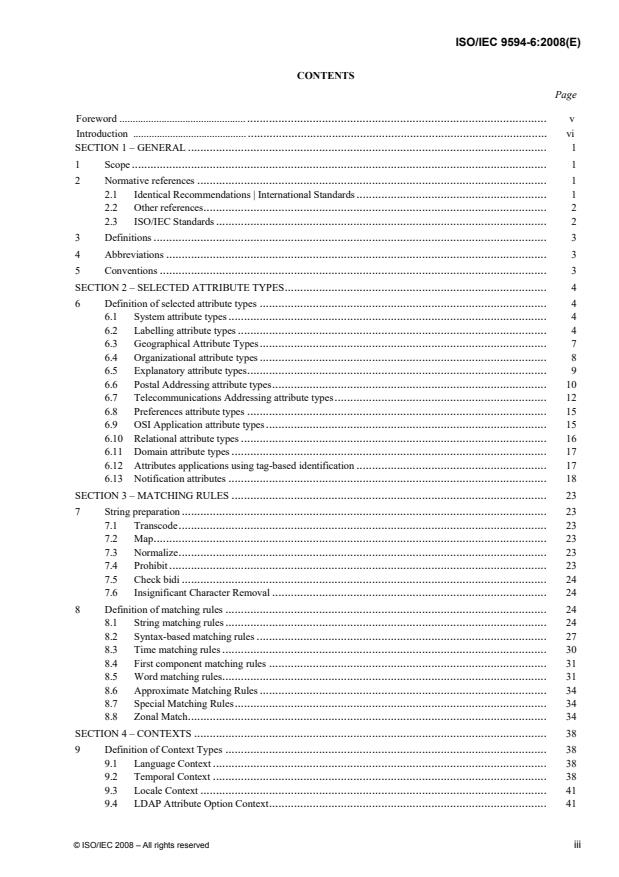
CONTENTS
Page
Foreword . v
Introduction . vi
SECTION 1 – GENERAL . 1
1 Scope. 1
2 Normative references . 1
2.1 Identical Recommendations | International Standards. 1
2.2 Other references. 2
2.3 ISO/IEC Standards . 2
3 Definitions . 3
4 Abbreviations . 3
5 Conventions . 3
SECTION 2 – SELECTED ATTRIBUTE TYPES. 4
6 Definition of selected attribute types . 4
6.1 System attribute types . 4
6.2 Labelling attribute types . 4
6.3 Geographical Attribute Types. 7
6.4 Organizational attribute types . 8
6.5 Explanatory attribute types. 9
6.6 Postal Addressing attribute types. 10
6.7 Telecommunications Addressing attribute types. 12
6.8 Preferences attribute types . 15
6.9 OSI Application attribute types. 15
6.10 Relational attribute types . 16
6.11 Domain attribute types . 17
6.12 Attributes applications using tag-based identification . 17
6.13 Notification attributes . 18
SECTION 3 – MATCHING RULES . 23
7 String preparation. 23
7.1 Transcode. 23
7.2 Map. 23
7.3 Normalize. 23
7.4 Prohibit. 23
7.5 Check bidi . 24
7.6 Insignificant Character Removal . 24
8 Definition of matching rules . 24
8.1 String matching rules. 24
8.2 Syntax-based matching rules . 27
8.3 Time matching rules . 30
8.4 First component matching rules . 31
8.5 Word matching rules. 31
8.6 Approximate Matching Rules . 34
8.7 Special Matching Rules. 34
8.8 Zonal Match. 34
SECTION 4 – CONTEXTS . 38
9 Definition of Context Types . 38
9.1 Language Context . 38
9.2 Temporal Context . 38
9.3 Locale Context . 41
9.4 LDAP Attribute Option Context. 41
© ISO/IEC 2008 – All rights reserved iii
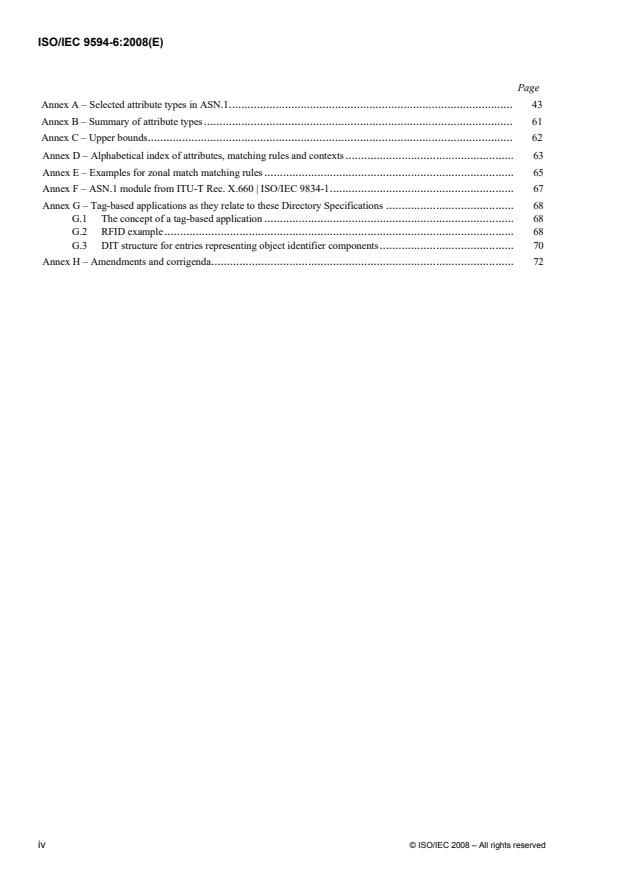
Page
Annex A – Selected attribute types in ASN.1. 43
Annex B – Summary of attribute types. 61
Annex C – Upper bounds. 62
Annex D – Alphabetical index of attributes, matching rules and contexts . 63
Annex E – Examples for zonal match matching rules . 65
Annex F – ASN.1 module from ITU-T Rec. X.660 | ISO/IEC 9834-1. 67
Annex G – Tag-based applications as they relate to these Directory Specifications . 68
G.1 The concept of a tag-based application . 68
G.2 RFID example. 68
G.3 DIT structure for entries representing object identifier components. 70
Annex H – Amendments and corrigenda. 72
iv © ISO/IEC 2008 – All rights reserved
Foreword
ISO (the International Organization for Standardization) and IEC (the International Electrotechnical
Commission) form the specialized system for worldwide standardization. National bodies that are members of
ISO or IEC participate in the development of International Standards through technical committees
established by the respective organization to deal with particular fields of technical activity. ISO and IEC
technical committees collaborate in fields of mutual interest. Other international organizations, governmental
and non-governmental, in liaison with ISO and IEC, also take part in the work. In the field of information
technology, ISO and IEC have established a joint technical committee, ISO/IEC JTC 1.
International Standards are drafted in accordance with the rules given in the ISO/IEC Directives, Part 2.
The main task of the joint technical committee is to prepare International Standards. Draft International
Standards adopted by the joint technical committee are circulated to national bodies for voting. Publication as
an International Standard requires approval by at least 75 % of the national bodies casting a vote.
Attention is drawn to the possibility that some of the elements of this document may be the subject of patent
rights. ISO and IEC shall not be held responsible for identifying any or all such patent rights.
Subcommittee SC 6, Telecommunications and information exchange between systems, in collaboration with
ITU-T. The identical text is published as ITU-T Rec. X.520 (11/2008).
This sixth edition cancels and replaces the fifth edition (ISO/IEC 9594-6:2005), which has been technically
revised.
ISO/IEC 9594 consists of the following parts, under the general title Information technology — Open Systems
Interconnection — The Directory:
⎯ Part 1: Overview of concepts, models and services
⎯ Part 2: Models
⎯ Part 3: Abstract service definition
⎯ Part 4: Procedures for distributed operation
⎯ Part 5: Protocol specifications
⎯ Part 6: Selected attribute types
⎯ Part 7: Selected object classes
⎯ Part 8: Public-key and attribute certificate frameworks
⎯ Part 9: Replication
⎯ Part 10: Use of systems management for administration of the Directory
© ISO/IEC 2008 – All rights reserved v
Introduction
This Recommendation | International Standard, together with other Recommendations | International Standards, has
been produced to facilitate the interconnection of information processing systems to provide directory services. A set of
such systems, together with the directory information that they hold, can be viewed as an integrated whole, called the
Directory. The information held by the Directory, collectively known as the Directory Information Base (DIB), is
typically used to facilitate communication between, with or about objects such as application entities, people, terminals,
and distribution lists.
The Directory plays a significant role in Open Systems Interconnection, whose aim is to allow, with a minimum of
technical agreement outside of the interconnection standards themselves, the interconnection of information processing
systems:
– from different manufacturers;
– under different managements;
– of different levels of complexity; and
– of different ages.
This Recommendation | International Standard defines a number of attribute types which may be found useful across a
range of applications of the Directory, as well as a number of standard attribute syntaxes and matching rules. One
particular use for many of the attributes defined herein is in the formation of names, particularly for the classes of object
defined in ITU-T Rec. X.521 | ISO/IEC 9594-7.
This Recommendation | International Standard provides the foundation frameworks upon which industry profiles can be
defined by other standards groups and industry forums. Many of the features defined as optional in these frameworks
may be mandated for use in certain environments through profiles. This sixth edition technically revises and enhances,
but does not replace, the fifth edition of this Recommendation | International Standard. Implementations may still claim
conformance to the fifth edition. However, at some point, the fifth edition will not be supported (i.e., reported defects
will no longer be resolved). It is recommended that implementations conform to this sixth edition as soon as possible.
This sixth edition specifies versions 1 and 2 of the Directory protocols.
The first and second editions specified only version 1. Most of the services and protocols specified in this edition are
designed to function under version 1. However some enhanced services and protocols, e.g., signed errors, will not
function unless all Directory entities involved in the operation have negotiated version 2. Whichever version has been
negotiated, differences between the services and between the protocols defined in the six editions, except for those
specifically assigned to version 2, are accommodated using the rules of extensibility defined in ITU-T Rec. X.519 |
ISO/IEC 9594-5.
Annex A, which is an integral part of this Recommendation | International Standard, provides the ASN.1 notation for
the complete module which defines the attributes, attribute syntaxes, and matching rules.
Annex B, which is not an integral part of this Recommendation | International Standard, provides a table of attribute
types, for easy reference.
Annex C, which is not an integral part of this Recommendation | International Standard, provides an example of upper
bounds value constraints.
Annex D, which is not an integral part of this Recommendation | International Standard, lists alphabetically the
attributes and matching rules defined in this Directory Specification.
Annex E, which is not an integral part of this Recommendation | International Standard, gives examples relevant to the
definition of zonal matching.
Annex F, which is not an integral part of this Recommendation | International Standard, provides a copy of an ASN.1
module specified in ITU-T Rec. X.660 | ISO/IEC 9834-1.
Annex G, which is not an integral part of this Recommendation | International Standard, provides a short tutorial on
ID-based applications.
Annex H, which is not an integral part of this Recommendation | International Standard, lists the amendments and
defect reports that have been incorporated to form this edition of this Recommendation | International Standard.
vi © ISO/IEC 2008 – All rights reserved
INTERNATIONAL STANDARD
ITU-T RECOMMENDATION
Information technology – Open Systems Interconnection –
The Directory: Selected attribute types
SECTION 1 – GENERAL
1 Scope
This Recommendation | International Standard defines a number of attribute types and matching rules which may be
found useful across a range of applications of the Directory.
Attribute types and matching rules fall into three categories, as described below.
Some attribute types and matching rules are used by a wide variety of applications or are understood and/or used by the
Directory itself.
NOTE – It is recommended that an attribute type or matching rule defined in this Recommendation | International Standard be
used, in preference to the generation of a new one, whenever it is appropriate for the application.
Some attribute types and matching rules are internationally standardized, but are application-specific. These are defined
in the standards associated with the application concerned.
Any administrative authority can define its own attribute types and matching rules for any purpose. These are not
internationally standardized, and are available to others beyond the administrative authority which created them only by
bilateral agreement.
2 Normative references
The following Recommendations and International Standards contain provisions which, through reference in this text,
constitute provisions of this Recommendation | International Standard. At the time of publication, the editions indicated
were valid. All Recommendations and Standards are subject to revision, and parties to agreements based on this
Recommendation | International Standard are encouraged to investigate the possibility of applying the most recent
edition of the Recommendations and Standards listed below. Members of IEC and ISO maintain registers of currently
valid International Standards. The Telecommunication Standardization Bureau of the ITU maintains a list of currently
valid ITU-T Recommendations.
2.1 Identical Recommendations | International Standards
– ITU-T Recommendation X.200 (1994) | ISO/IEC 7498-1:1994, Information technology – Open Systems
Interconnection – Basic Reference Model: The Basic Model.
– ITU-T Recommendation X.500 (2008) | ISO/IEC 9594-1:2008, Information technology – Open Systems
Interconnection – The Directory: Overview of concepts, models and services.
– ITU-T Recommendation X.501 (2008) | ISO/IEC 9594-2:2008, Information technology – Open Systems
Interconnection – The Directory: Models.
– ITU-T Recommendation X.509 (2008) | ISO/IEC 9594-8:2008, Information technology – Open Systems
Interconnection – The Directory: Public-key and attribute certificate frameworks.
– ITU-T Recommendation X.511 (2008) | ISO/IEC 9594-3:2008, Information technology – Open Systems
Interconnection – The Directory: Abstract service definition.
– ITU-T Recommendation X.518 (2008) | ISO/IEC 9594-4:2008, Information technology – Open Systems
Interconnection – The Directory: Procedures for distributed operation.
– ITU-T Recommendation X.519 (2008) | ISO/IEC 9594-5:2008, Information technology – Open Systems
Interconnection – The Directory: Protocol specifications.
– ITU-T Recommendation X.521 (2008) | ISO/IEC 9594-7:2008, Information technology – Open Systems
Interconnection – The Directory: Selected object classes.
– ITU-T Recommendation X.525 (2008) | ISO/IEC 9594-9:2008, Information technology – Open Systems
Interconnection – The Directory: Replication.
ITU-T Rec. X.520 (11/2008) 1
– ITU-T Recommendation X.530 (2008) | ISO/IEC 9594-10:2008, Information technology – Open Systems
Interconnection – The Directory: Use of systems management for administration of the Directory.
– ITU-T Recommendation X.660 (2008) | ISO/IEC 9834-1:2008, Information technology – Open Systems
Interconnection – Procedures for the operation of OSI Registration Authorities: General procedures and
top arcs of the ASN.1 Object Identifier tree.
– ITU-T Recommendation X.667 (2008) | ISO/IEC 9834-8:2008, Information technology – Open Systems
Interconnection – Procedures for the operation of OSI Registration Authorities: Generation and
registration of Universally Unique Identifiers (UUIDs) and their use as ASN.1 object identifier
components.
– ITU-T Recommendation X.668 (2008) | ISO/IEC 9834-9:2008, Information technology – Open Systems
Interconnection – Procedures for the operation of OSI Registration Authorities: Registration of object
identifier arcs for applications and services using tag-based identification.
– ITU-T Recommendation X.680 (2008) | ISO/IEC 8824-1:2008, Information technology – Abstract Syntax
Notation One (ASN.1): Specification of basic notation.
– ITU-T Recommendation X.681 (2008) | ISO/IEC 8824-2:2008, Information technology – Abstract Syntax
Notation One (ASN.1): Information object specification.
– ITU-T Recommendation X.682 (2008) | ISO/IEC 8824-3:2008, Information technology – Abstract Syntax
Notation One (ASN.1): Constraint specification.
– ITU-T Recommendation X.683 (2008) | ISO/IEC 8824-4:2008, Information technology – Abstract Syntax
Notation One (ASN.1): Parameterization of ASN.1 specifications.
2.2 Other references
– ITU-T Recommendation E.123 (2001), Notation for national and international telephone numbers, e-mail
addresses and Web addresses.
– ITU-T Recommendation E.164 (2005), The international public telecommunication numbering plan.
– ITU-T Recommendation F.1 (1998), Operational provisions for the international public telegram service.
– CCITT Recommendation F.31 (1988), Telegram retransmission system.
– CCITT Recommendation F.401 (1992), Message handling services: Naming and addressing for public
message handling services.
– ITU-T Recommendation T.30 (2005), Procedures for document facsimile transmission in the general
switched telephone network.
– ITU-T Recommendation T.62 (1993), Control procedures for teletex and Group 4 facsimile services.
– ITU-T Recommendation X.121 (2000), International numbering plan for public data networks.
– ITU-T Recommendation Y.2213 (2008), NGN service requirements and capabilities for network aspects
of applications and services using tag-based identification.
– ISO 3166-1:2006, Codes for the representation of names of countries and their subdivisions – Part 1:
Country codes.
– ISO 3166-3:2006, Codes for the representation of names of countries and their subdivisions – Part 3:
Code for formerly used names of countries.
– ISO 639-2:1998, Codes for the representation of names of languages – Part 2: Alpha-3 code.
– ISO/IEC 9945-3:2003, Information technology – Portable Operating System Interface (POSIX) – Part
3: Shell and Utilities.
– IETF RFC 3377 (2002), Lightweight Directory Access Protocol (v3): Technical Specification.
– IETF RFC 3454 (2002), Preparation of Internationalized Strings (stringprep).
– The Unicode Consortium. The Unicode Standard, Version 4.0, defined by: The Unicode Standard,
Version 4.0 (Reading, MA, Addison-Wesley, 2003. ISBN 0-321-18578-1).
– Unicode Standard Annex #15: Unicode Normalization Forms, by Mark Davis and Martin Dürst. An
integral part of The Unicode Standard, Version 4.0.
2.3 ISO/IEC Standards
– ISO/IEC 10646:2003, Information technology – Universal Multiple-Octet Coded Character Set (UCS).
2 ITU-T Rec. X.520 (11/2008)
3 Definitions
For the purposes of this Recommendation | International Standard, the following definitions apply:
The following terms are defined in ITU-T Rec. X.501 | ISO/IEC 9594-2:
a) attribute type;
b) object class;
c) matching rule;
d) context.
4 Abbreviations
For the purposes of this Recommendation | International Standard, the following abbreviations apply:
LDAP Lightweight Directory Access Protocol
RFID Radio Frequency Identification
UII Unique Item Identifier
URL Uniform Resource Locator
URN Uniform Resource Name
UUID Universally Unique Identifier
5 Conventions
The term "Directory Specification" (as in "this Directory Specification") shall be taken to mean ITU-T Rec. X.520 |
ISO/IEC 9594-6. The term "Directory Specifications" shall be taken to mean the X.500-series Recommendations and all
parts of ISO/IEC 9594.
This Directory Specification uses the term first edition systems to refer to systems conforming to the first edition of the
Directory Specifications, i.e., the 1988 edition of the series of CCITT X.500 Recommendations and the
ISO/IEC 9594:1990 edition.
This Directory Specification uses the term second edition systems to refer to systems conforming to the second edition of
the Directory Specifications, i.e., the 1993 edition of the series of ITU-T X.500 Recommendations and the
ISO/IEC 9594:1995 edition.
This Directory Specification uses the term third edition systems to refer to systems conforming to the third edition of the
Directory Specifications, i.e., the 1997 edition of the series of ITU-T X.500 Recommendations and the ISO/IEC
9594:1998 edition.
This Directory Specification uses the term fourth edition systems to refer to systems conforming to the fourth edition of
the Directory Specifications, i.e., the 2001 editions of ITU-T Recs X.500, X.501, X.511, X.518, X.519, X.520, X.521,
X.525, and X.530, the 2000 edition of ITU-T Rec. X.509, and parts 1-10 of the ISO/IEC 9594:2001 edition.
This Directory Specification uses the term fifth edition systems to refer to systems conforming to the fifth edition of the
Directory Specifications, i.e., the 2005 edition of the series of ITU-T X.500 Recommendations and the
ISO/IEC 9594:2005 edition.
This Directory Specification uses the term sixth edition systems to refer to systems conforming to the sixth edition of the
Directory Specifications, i.e., the 2008 edition of the series of ITU-T X.500 Recommendations and the
ISO/IEC 9594:2008 edition.
This Directory Specification presents ASN.1 notation in the bold Helvetica typeface. When ASN.1 types and values are
referenced in normal text, they are differentiated from normal text by presenting them in the bold Helvetica typeface.
The names of procedures, typically referenced when specifying the semantics of processing, are differentiated from
normal text by displaying them in bold Times. Access control permissions are presented in italicized Times.
If the items in a list are numbered (as opposed to using "–" or letters), then the items shall be considered steps in a
procedure.
Attribute types, matching rules and context types are defined in this Recommendation | International Standard by use of
the ATTRIBUTE, MATCHING-RULE and CONTEXT information object classes defined in ITU-T Rec. X.501 |
ISO/IEC 9594-2.
ITU-T Rec. X.520 (11/2008) 3
Examples of the use of the attribute types are described using an informal notation, where attribute type and value pairs
are represented by an acronym for the attribute type, followed by an equals sign ("="), followed by the example value for
the attribute.
SECTION 2 – SELECTED ATTRIBUTE TYPES
6 Definition of selected attribute types
This Directory Specification defines a number of attribute types which may be found useful across a range of
applications of the Directory.
Many of the attribute types defined in this Directory Specification are based on a common ASN.1 syntax:
UnboundedDirectoryString ::= CHOICE {
teletexString TeletexString (SIZE(1.MAX)),
printableString PrintableString (SIZE (1.MAX)),
bmpString BMPString (SIZE (1.MAX)),
universalString UniversalString (SIZE (1.MAX)),
uTF8String UTF8String (SIZE (1.MAX)) }
A few attribute types are based on the following syntax:
DirectoryString { INTEGER : maxSize } ::= CHOICE {
teletexString TeletexString (SIZE (1.maxSize)),
printableString PrintableString (SIZE (1.maxSize)),
bmpString BMPString (SIZE (1.maxSize)),
universalString UniversalString (SIZE (1.maxSize)),
uTF8String UTF8String (SIZE (1.maxSize)) }
NOTE – The above syntaxes are also used in other parts of these Directory Specifications.
Some implementations of the Directory may not support UniversalString, BMPString, or UTF8String, and may not be
able to generate, match, shadow, or display attributes with these syntax types.
6.1 System attribute types
6.1.1 Knowledge Information
The Knowledge Information attribute type specifies a human readable accumulated description of knowledge mastered
by a specific DSA.
NOTE – This attribute is now obsolete.
knowledgeInformation ATTRIBUTE ::= {
WITH SYNTAX UnboundedDirectoryString
EQUALITY MATCHING RULE caseIgnoreMatch
ID id-at-knowledgeInformation }
6.2 Labelling attribute types
These attributes type are concerned with information about objects which has been explicitly associated with the objects
by a labelling process.
6.2.1 Name
The Name attribute type is the attribute supertype from which string attribute types typically used for naming may be
formed.
name ATTRIBUTE ::= {
WITH SYNTAX UnboundedDirectoryString
EQUALITY MATCHING RULE caseIgnoreMatch
SUBSTRINGS MATCHING RULE caseIgnoreSubstringsMatch
ID id-at-name }
4 ITU-T Rec. X.520 (11/2008)
6.2.2 Common Name
The Common Name attribute type specifies an identifier of an object. A Common Name is not a directory name; it is a
(possibly ambiguous) name by which the object is commonly known in some limited scope (such as an organization) and
conforms to the naming conventions of the country or culture with which it is associated.
An attribute value for common name is a string chosen either by the person or organization it describes or the
organization responsible for the object it describes for devices and application entities. For example, a typical name of a
person in an English-speaking country comprises a personal title (e.g., Mr., Ms., Rd, Professor, Sir, Lord), a first name,
middle name(s), last name, generation qualifier (if any, e.g., Jr.) and decorations and awards (if any, e.g., QC).
Examples
CN = "Mr. Robin Lachlan McLeod BSc(Hons) CEng MIEE";
CN = "Divisional Coordination Committee";
CN = "High Speed Modem".
Any variants should be associated with the named object as separate and alternative attribute values.
Other common variants should also be admitted, e.g., use of a middle name as a preferred first name; use of "Bill" in
place of "William", etc.
commonName ATTRIBUTE ::= {
SUBTYPE OF name
WITH SYNTAX UnboundedDirectoryString
ID id-at-commonName }
6.2.3 Surname
The Surname attribute type specifies the linguistic construct which normally is inherited by an individual from the
individual's parent or assumed by marriage, and by which the individual is commonly known.
An attribute value for Surname is a string, e.g., "McLeod".
surname ATTRIBUTE ::= {
SUBTYPE OF name
WITH SYNTAX UnboundedDirectoryString
ID id-at-surname }
6.2.4 Given Name
The Given Name attribute type specifies the linguistic construct which is normally given to an individual by the
individual's parent, or is chosen by the individual, or by which the individual is commonly known.
An attribute value for Given Name is a string, e.g., "David", or "Jean Paul".
givenName ATTRIBUTE ::= {
SUBTYPE OF name
WITH SYNTAX UnboundedDirectoryString
ID id-at-givenName }
6.2.5 Initials
The Initials attribute type contains the initials of some or all of an individual's names, but not the surname(s).
An attribute value for Initials is a string, e.g., "D" or "D." or "J.P.".
initials ATTRIBUTE ::= {
SUBTYPE OF name
WITH SYNTAX UnboundedDirectoryString
ID id-at-initials }
6.2.6 Generation Qualifier
The Generation Qualifier attribute type contains a string which is used to provide generation information to qualify an
individual's name.
ITU-T Rec. X.520 (11/2008) 5
An attribute value for Generation Qualifier is a string, e.g., "Jr." or "II".
generationQualifier ATTRIBUTE ::= {
SUBTYPE OF name
WITH SYNTAX UnboundedDirectoryString
ID id-at-generationQualifier }
6.2.7 Unique Identifier
The Unique Identifier attribute type specifies an identifier which may be used to distinguish between object references
when a distinguished name has been reused. It may be, for example, an encoded object identifier, certificate, date,
timestamp, or some other form of certification on the validity of the distinguished name.
An attribute value for Unique Identifier is a bit string.
uniqueIdentifier ATTRIBUTE ::= {
WITH SYNTAX UniqueIdentifier
EQUALITY MATCHING RULE bitStringMatch
ID id-at-uniqueIdentifier }
UniqueIdentifier ::= BIT STRING
6.2.8 DN Qualifier
The DN Qualifier attribute type specifies disambiguating information to add to the relative distinguished name of an
entry. It is intended to be used for entries held in multiple DSAs which would otherwise have the same name, and that its
value be the same in a given DSA for all entries to which this information has been added.
dnQualifier ATTRIBUTE ::= {
WITH SYNTAX PrintableString
EQUALITY MATCHING RULE caseIgnoreMatch
ORDERING MATCHING RULE caseIgnoreOrderingMatch
SUBSTRINGS MATCHING RULE caseIgnoreSubstringsMatch
ID id-at-dnQualifier }
6.2.9 Serial Number
The Serial Number attribute type specifies an identifier, the serial number of an object.
An attribute value for Serial Number is a printable string.
serialNumber ATTRIBUTE ::= {
WITH SYNTAX PrintableString (SIZE (1.MAX))
EQUALITY MATCHING RULE caseIgnoreMatch
SUBSTRINGS MATCHING RULE caseIgnoreSubstringsMatch
ID id-at-serialNumber }
6.2.10 Pseudonym
The Pseudonym attribute type specifies a pseudonym for an object. It is used for naming an object when it is to be made
clear that its name is a pseudonym.
pseudonym ATTRIBUTE ::= {
SUBTYPE OF name
WITH SYNTAX UnboundedDirectoryString
ID id-at-pseudonym }
6.2.11 Universal Unique Identifier Pair
The Universal Unique Identifier Pair attribute type specifies a pair of Universal Unique Identifiers (UUID), as specified
in ITU-T Rec. X.667 | ISO/IEC 9834-8. The pair collectively represents an issuer/subject relationship, the nature of
which is outside the scope of this Directory Specification. The initial UUID in the pair represents the issuer, and the
trailing UUID in the pair represents the subject of the issuer/subject relationship. An example of such a relationship is a
user account.
uUIDPair ATTRIBUTE ::= {
WITH SYNTAX UUIDPair
EQUALITY MATCHING RULE uUIDPairMatch
ID id-at-uuidpair }
6 ITU-T Rec. X.520 (11/2008)
UUIDPair ::= SEQUENCE {
issuerUUID UUID,
subjectUUID UUID }
UUID ::= OCTET STRING (SIZE(16)) -- UUID format only
6.3 Geographical Attribute Types
These attribute types are concerned with geographical positions or regions with which objects are associated.
6.3.1 Country Name
The Country Name attribute type specifies a country. When used as a component of a directory name, it identifies the
country in which the named object is physically located or with which it is associated in some other important way.
An attribute value for country name is a string chosen from ISO 3166-1 alpha-2 or ISO 3166-3 alpha-2.
countryName ATTRIBUTE ::= {
SUBTYPE OF name
WITH SYNTAX CountryName
SINGLE VALUE TRUE
ID id-at-countryName }
CountryName ::= PrintableString (SIZE(2)) -- ISO 3166-1/3 alpha-2 codes only
6.3.2 Locality Name
The Locality Name attribute type specifies a locality. When used as a component of a directory name, it identifies a
geographical area or locality in which the named object is physically located or with which it is associated in some other
important way.
An attribute value for Locality Name is a string, e.g., L = "Edinburgh".
localityName ATTRIBUTE ::= {
SUBTYPE OF name
WITH SYNTAX UnboundedDirectoryString
ID id-at-localityName }
The Collective Locality Name attribute type specifies a locality name for a collection of entries.
collectiveLocalityName ATTRIBUTE ::= {
SUBTYPE OF localityName
COLLECTIVE TRUE
ID id-at-collectiveLocalityName }
6.3.3 State or Province Name
The State or Province Name attribute type specifies a state or province. When used as a component of a directory name,
it identifies a geographical subdivision in which the named object is physically located or with which it is associated in
some other important way.
An attribute value for State or Province Name is a string, e.g., S = "Ohio".
stateOrProvinceName ATTRIBUTE ::= {
SUBTYPE OF name
WITH SYNTAX UnboundedDirectoryString
ID id-at-stateOrProvinceName }
The Collective State or Province Name attribute type specifies a state or province name for a collection of entries.
collectiveStateOrProvinceName ATTRIBUTE ::= {
SUBTYPE OF stateOrProvinceName
COLLECTIVE TRUE
ID id-at-collectiveStateOrProvinceName }
6.3.4 Street Address
The Street Address attribute type specifies a site for the local distribution and physical delivery in a postal address, i.e.,
the street name, place, avenue, and the house number. When used as a component of a directory name, it identifies the
street address at which the named object is located or with which it is associated in some other important way.
ITU-T Rec. X.520 (11/2008) 7
An attribute value for Street Address is a string, e.g., "Arnulfstraße 60".
streetAddress ATTRIBUTE ::= {
WITH SYNTAX UnboundedDirectoryString
EQUALITY MATCHING RULE caseIgnoreMatch
SUBSTRINGS MATCHING RULE caseIgnoreSubstringsMatch
ID id-at-streetAddress }
The Collective Street Address attribute type specifies a street address for a collection of entries.
collectiveStreetAddress ATTRIBUTE ::= {
SUBTYPE OF streetAddress
COLLECTIVE TRUE
ID id-at-collectiveStreetAddress }
6.3.5 House Identifier
The House Identifier attribute type specifies a linguistic construct used to identify a particular building, for example a
house number or house name relative to a street, avenue, town or city, etc.
An attribute value for House Identifier is a string, e.g., "14".
houseIdentifier ATTRIBUTE ::= {
WITH SYNTAX UnboundedDirectoryString
EQUALITY MATCHING RULE caseIgnoreMatch
SUBSTRINGS MATCHING RULE caseIgnoreSubstringsMatch
ID id-at-houseIdentifier }
6.4 Organizational attribute types
These attribute types are concerned with organizations and can be used to describe objects in terms of organizations with
which they are associated.
6.4.1 Organization Name
The Organization Name attribute type specifies an organization. When used as a component of a directory name, it
identifies an organization with which the named object is affiliated.
An attribute value for OrganizationName is a string chosen by the organization (e.g., O = "Scottish Telecommunications
plc"). Any variants should be associated with the named Organization as separate and alternative attribute values.
organizationName ATTRIBUTE ::= {
SUBTYPE OF name
WITH SYNTAX UnboundedDirectoryString
ID id-at-organizationName }
The Collective Organization Name attribute type specifies an organization name for a collection of entries.
collectiveOrganizationName ATTRIBUTE ::= {
SUBTYPE OF organizationName
COLLECTIVE TRUE
ID id-at-collectiveOrganizationName }
6.4.2 Organizational Unit Name
The Organizational Unit Name attribute type specifies an organizational unit. When used as a component of a directory
name, it identifies an organizational unit with which the named object is affiliated.
The designated organizational unit is understood to be part of an organization designated by an organizationName
attribute. It follows that if an Organizational Unit Name attribute is used in a directory name, it shall be associated with
an organizationName attribute.
An attribute value for Organizational Unit Name is a string chosen by the organization of which it is part (e.g., OU =
"Technology Division"). Note that the commonly used abbreviation "TD" would be a separate and alternative attribute
value.
Example
O = "Scottel", OU = "TD"
8 ITU-T Rec. X.520 (11/2008)
organizationalUnitName ATTRIBUTE ::= {
SUBTYPE OF name
WITH SYNTAX UnboundedDirectoryString
ID id-at-organizationalUnitName }
The Collective Organizational Unit Name attribute type specifies an organizational unit name for a collection of entries.
collectiveOrganizationalUnitName ATTRIBUTE ::= {
SUBTYPE OF organizationalUnitName
COLLECTIVE TRUE
ID id-at-collectiveOrganizationalUnitName }
6.4.3 Title
The Title attribute type specifies the designated position or function of the object within an organization.
An attribute value for Title is a string.
Example
T = "Manager, Distributed Applications"
title ATTRIBUTE ::= {
SUBTYPE OF name
WITH SYNTAX UnboundedDirectoryString
ID id-at-title }
6.5 Explanatory attribute types
These attribute types are concerned with explanations (e.g., in a natural language) of something about an object.
6.5.1 Description
The Description attribute type specifies text that describes the associated object.
For example, the object "Standards Interest" might have the associated description "distribution list for exchange of
information about intra-company standards development".
An attribute value for Description is a string.
description ATTRIBUTE ::= {
WITH SYNTAX UnboundedDirectoryString
EQUALITY MATCHING RULE caseIgnoreMatch
SUBSTRINGS MATCHING RULE caseIgnoreSubstringsMatch
ID id-at-description }
6.5.2 Search Guide
The Search Guide attribute type specifies information of suggested search criteria which may be included in some entries
expected to be a convenient base-object for the search operation, e.g., country or organization.
Search criteria consist of an optional identifier for the type of object sought and combinations of attribute types and
logical operators to be used in the construction of a filter. It is possible to specify for each search criteria item the
matching level, e.g., approximate match.
The Search Guide attribute may recur to reflect the various types of requests, e.g., search for a Residential Person or an
Organizational Person, which may be fulfilled from the given base-object where the Search Guide is read.
searchGuide ATTRIBUTE ::= {
WITH SYNTAX Guide
ID id-at-searchGuide }
Guide ::= SET {
objectClass [0] OBJECT-CLASS.&id OPTIONAL,
criteria [1] Criteria }
Criteria ::= CHOICE {
type [0] CriteriaItem,
and [1] SET OF Criteria,
or [2] SET OF Criteria,
not [3] Criteria }
ITU-T Rec. X.520 (11/2008) 9
CriteriaItem ::= CHOICE {
equality [0] AttributeType,
substrings [1] AttributeType,
greaterOrEqual [2] AttributeType,
lessOrEqual [3] Attribute
...
Questions, Comments and Discussion
Ask us and Technical Secretary will try to provide an answer. You can facilitate discussion about the standard in here.
Loading comments...