


ISO/IEC 9318-4:1990
(Main)Information technology — Intelligent Peripheral Interface — Part 4: Device generic command set for magnetic tape drives
Information technology — Intelligent Peripheral Interface — Part 4: Device generic command set for magnetic tape drives
La présente partie de l'ISO/CEI 9318 décrit l'interface de niveau logique 3 (niveau générique) pour les unités de bandes magnétiques. Voir l'article 6 de l'ISO/CEI 9318-1 pour une explication des niveaux. Les caractéristiques physiques, électriques et celles de la configuration ainsi que les protocoles de transmission de cette interface sont conformes à l'ISO/CEI 9318-1. L'interface est capable de gérer les vitesses de transfert de données de 0 à 10 Moctets/s, en fonction de la classe du contrôleur et du récepteur. L'objet de la présente partie de l'ISO/CEI 9318 est de faciliter le développement et l'utilisation d'une interface intelligente qui permet la connexion à un contrôleur de périphériques de plusieurs types tels que disques, imprimantes, bandes, communications. La présente partie de l'ISO/CEI 9318 ne remplace pas des normes existantes mais apporte un complément aux autres normes d'interface pour périphériques intelligents (IPI) (voir article 2). La présente partie de l'ISO/CEI 9318 fournit une définition d'une partie générique appareil, d'une famille de normes appelées «interface pour périphériques intelligents (IPI)», interface parallèle tous usages, à hautes performances. L'intention de IPI est d'isoler l'hôte (CPR), autant du point de vue matériel que logiciel, des changements dans les périphériques, en fournissant un jeu de commandes de «fonctions géné 1585riques» permettant le connexion de multiples types de périphériques (disques, imprimantes, bandes, communications). Pour assouplir la transition entre la méthode actuelle et l'approche générique, IPI supporte des jeux de commandes spécifiques à un appareil, comme celui-ci, pour aider à établir une passerelle entre les deux approches. Pour réaliser cet ensemble d'objectifs, la définition de IPI inclut des jeux de commandes spécifiques appareil et génériques appareil, utilisant tous les deux le même bus commun. Le jeu de commandes spécifiques appareil fournit : des co
Technologies de l'information — Interface pour les périphériques intelligents — Partie 4: Jeu de commandes génériques pour les unités de bandes magnétiques
General Information
- Status
- Withdrawn
- Publication Date
- 19-Dec-1990
- Withdrawal Date
- 19-Dec-1990
- Technical Committee
- ISO/IEC JTC 1/SC 25 - Interconnection of information technology equipment
- Current Stage
- 9599 - Withdrawal of International Standard
- Start Date
- 30-Jan-2003
- Completion Date
- 12-Feb-2026
Relations
- Effective Date
- 15-Apr-2008
Get Certified
Connect with accredited certification bodies for this standard

BSI Group
BSI (British Standards Institution) is the business standards company that helps organizations make excellence a habit.

NYCE
Mexican standards and certification body.
Sponsored listings
Frequently Asked Questions
ISO/IEC 9318-4:1990 is a standard published by the International Organization for Standardization (ISO). Its full title is "Information technology — Intelligent Peripheral Interface — Part 4: Device generic command set for magnetic tape drives". This standard covers: La présente partie de l'ISO/CEI 9318 décrit l'interface de niveau logique 3 (niveau générique) pour les unités de bandes magnétiques. Voir l'article 6 de l'ISO/CEI 9318-1 pour une explication des niveaux. Les caractéristiques physiques, électriques et celles de la configuration ainsi que les protocoles de transmission de cette interface sont conformes à l'ISO/CEI 9318-1. L'interface est capable de gérer les vitesses de transfert de données de 0 à 10 Moctets/s, en fonction de la classe du contrôleur et du récepteur. L'objet de la présente partie de l'ISO/CEI 9318 est de faciliter le développement et l'utilisation d'une interface intelligente qui permet la connexion à un contrôleur de périphériques de plusieurs types tels que disques, imprimantes, bandes, communications. La présente partie de l'ISO/CEI 9318 ne remplace pas des normes existantes mais apporte un complément aux autres normes d'interface pour périphériques intelligents (IPI) (voir article 2). La présente partie de l'ISO/CEI 9318 fournit une définition d'une partie générique appareil, d'une famille de normes appelées «interface pour périphériques intelligents (IPI)», interface parallèle tous usages, à hautes performances. L'intention de IPI est d'isoler l'hôte (CPR), autant du point de vue matériel que logiciel, des changements dans les périphériques, en fournissant un jeu de commandes de «fonctions géné 1585riques» permettant le connexion de multiples types de périphériques (disques, imprimantes, bandes, communications). Pour assouplir la transition entre la méthode actuelle et l'approche générique, IPI supporte des jeux de commandes spécifiques à un appareil, comme celui-ci, pour aider à établir une passerelle entre les deux approches. Pour réaliser cet ensemble d'objectifs, la définition de IPI inclut des jeux de commandes spécifiques appareil et génériques appareil, utilisant tous les deux le même bus commun. Le jeu de commandes spécifiques appareil fournit : des co
La présente partie de l'ISO/CEI 9318 décrit l'interface de niveau logique 3 (niveau générique) pour les unités de bandes magnétiques. Voir l'article 6 de l'ISO/CEI 9318-1 pour une explication des niveaux. Les caractéristiques physiques, électriques et celles de la configuration ainsi que les protocoles de transmission de cette interface sont conformes à l'ISO/CEI 9318-1. L'interface est capable de gérer les vitesses de transfert de données de 0 à 10 Moctets/s, en fonction de la classe du contrôleur et du récepteur. L'objet de la présente partie de l'ISO/CEI 9318 est de faciliter le développement et l'utilisation d'une interface intelligente qui permet la connexion à un contrôleur de périphériques de plusieurs types tels que disques, imprimantes, bandes, communications. La présente partie de l'ISO/CEI 9318 ne remplace pas des normes existantes mais apporte un complément aux autres normes d'interface pour périphériques intelligents (IPI) (voir article 2). La présente partie de l'ISO/CEI 9318 fournit une définition d'une partie générique appareil, d'une famille de normes appelées «interface pour périphériques intelligents (IPI)», interface parallèle tous usages, à hautes performances. L'intention de IPI est d'isoler l'hôte (CPR), autant du point de vue matériel que logiciel, des changements dans les périphériques, en fournissant un jeu de commandes de «fonctions géné 1585riques» permettant le connexion de multiples types de périphériques (disques, imprimantes, bandes, communications). Pour assouplir la transition entre la méthode actuelle et l'approche générique, IPI supporte des jeux de commandes spécifiques à un appareil, comme celui-ci, pour aider à établir une passerelle entre les deux approches. Pour réaliser cet ensemble d'objectifs, la définition de IPI inclut des jeux de commandes spécifiques appareil et génériques appareil, utilisant tous les deux le même bus commun. Le jeu de commandes spécifiques appareil fournit : des co
ISO/IEC 9318-4:1990 is classified under the following ICS (International Classification for Standards) categories: 35.200 - Interface and interconnection equipment. The ICS classification helps identify the subject area and facilitates finding related standards.
ISO/IEC 9318-4:1990 has the following relationships with other standards: It is inter standard links to ISO/IEC 9318-4:2002. Understanding these relationships helps ensure you are using the most current and applicable version of the standard.
ISO/IEC 9318-4:1990 is available in PDF format for immediate download after purchase. The document can be added to your cart and obtained through the secure checkout process. Digital delivery ensures instant access to the complete standard document.
Standards Content (Sample)
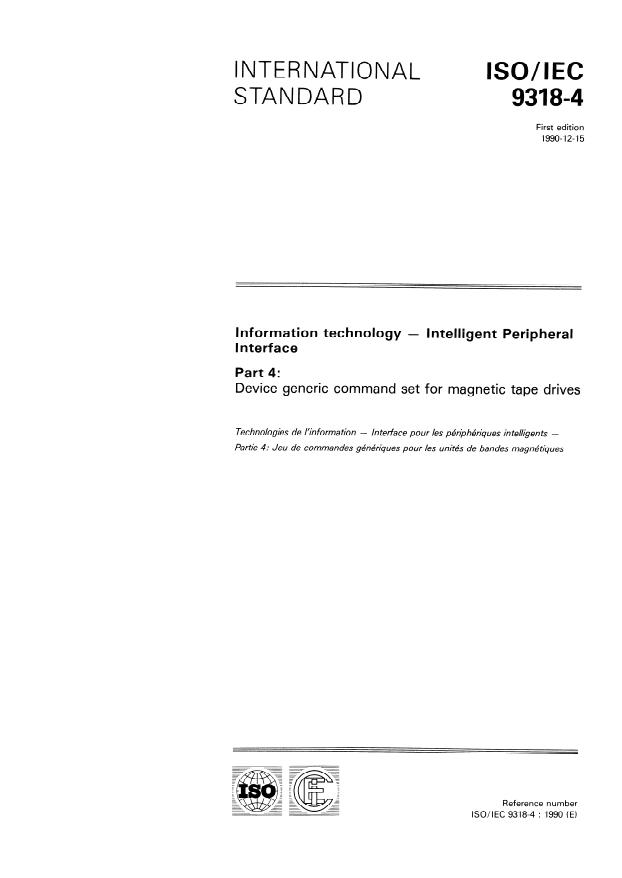
INTERNATIONAL
lSO/IEC
STANDARD
9318-4
First edition
1990-12-15
Information technology - Intelligent Peripheral
Interface
Part 4:
Device generic command set for magnetic tape drives
Technologies de I ‘in formation - Interface pour les p&iph&iques in telligen ts -
Partie 4: Jeu de commandes g&Griques pour les unit& de bandes magn&iques
Reference number
ISO/IEC 9318-4 : 1990 (E)
ISO/IEC 9318-4 : 1990 (E)
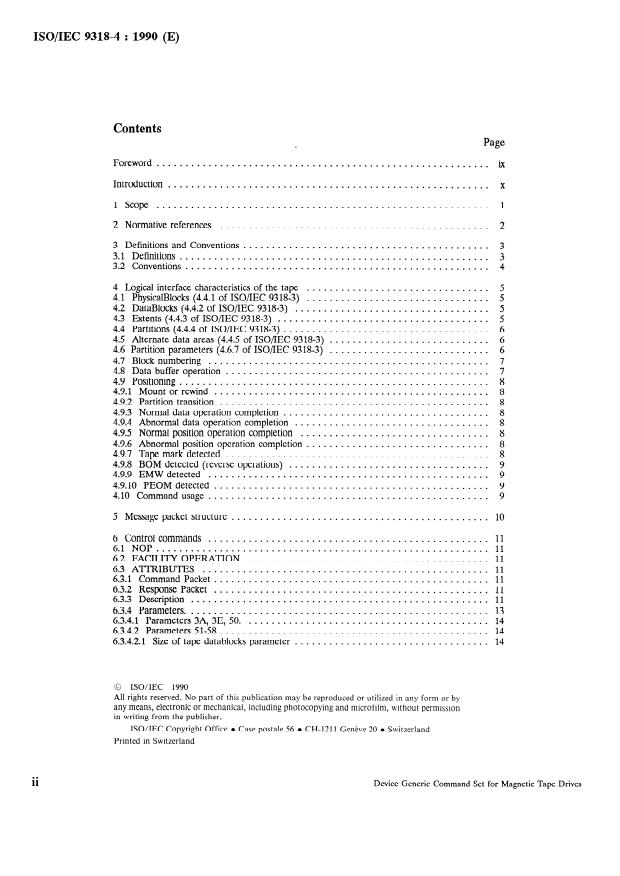
Contents
Page
.
Foreword . . . . . . . . . . . . . . . . . . . . . . . . . . . . . . . . . . . . . . . . . . . . . . . . . . . . . . . . . .
ix
Introduction . . . . . . . . . . . . . . . . . . . . . . . . . . . . . . . . . . . . . . . . . . . . . . . . . . . . . . . .
x
1 scope . . . . . . . . . . . . . . . . . . . . . . . . . . . . . . . . . . . . . . . . . . . . . . . . . . . . . . . . . . 1
2 Normative references . . . . . . . . . . . . . . . . . . . . . . . . . . . . . . . . . . . . . . . . . . . . . . . 2
3 Definitions and Conventions .
....................... 3
3.1 Definitions . 3
3.2 Conventions . 4
4 Logical interface characteristics of the tape . 5
4.1 PhysicalBlocks (4.4.1 of ISO/IEC 9318-3) . 5
4.2 DataBlocks (4.4.2 of ISO/IEC 9318-3) . 5
4.3 Extents (4.4.3 of ISO/IEC 9318-3) . 5
4.4 Partitions (4.4.4 of ISO/IEC 9318-3) . 6
4.5 Alternate data areas (4.4.5 of ISO/IEC 9318-3) . 6
4.6 Partition parameters (4.6.7 of ISO/IEC 9318-3) . 6
4.7 Block numbering . 7
4.8 Data buffer operation . 7
4.9 Positioning .
4.9.1 Mount or rewind .
4.9.2 Partition transition .
4.9.3 Normal data operation completion . 8
4.9.4 Abnormal data operation completion . 8
4.9.5 Normal position operation completion . 8
4.9.6 Abnormal position operation completion . 8
4.9.7 Tape mark detected . 8
4.9.8 BOM detected (reverse operations) . 9
4.9.9 EMW detected . 9
4.9.10 PEOM detected . 9
4.10 Command usage . 9
5 Message packet structure . . . . . . . . . . . . . . . . . . . . . . . . . . . . . . . . . . . . . . . . . . . . . 10
6 Control commands . 11
6.1 NOP . 11
6.2 FACILITY OPERATION . 11
6.3 ATTRIBUTES 11
6.3.1 ComrnandPackk;:::::::::::::::::::::::::::::::::::::::::::::::: 11
6.3.2 Response Packet 11
................................................
6.3.3 Description 11
....................................................
6.3.4 Parameters. . 13
6.3.4.1 Parameters 3A, 3E, 50. . 14
6.3.4.2 Parameters 51-58 . 14
6.3.4.2.1 Size of tape datablocks parameter . 14
0 ISO/IEC 1990
All rights reserved. No part of this publication may be reproduced or utilized in any form or by
any means, electronic or mechanical, including photocopying and microfilm, without permission
in writing from the publisher.
ISO/IEC Copyright Office l Case postale 56 l CH-1211 Geneve 20 l Switzerland
Printed in Switzerland
Device Generic Command Set for Magnetic Tape Drives
ISO/IEC 931%4 :1990 (E)
6.3.4.2.2 Size of tape physicalblocks parameter . 14
6.3.4.2.3 Variable datablock sizes supported parameter .
..............
6.3.4.2.4 Variable PhysicalBlock sizes supported parameter 15
6.3.4.2.5 Fixed DataBlock size(s) supported parameter .
6.3.4.2.6 Fixed PhysicalBlock size(s) supported parameter .
6.3.4.3 Parameters 59-5A . 15
6.3.4.4 Parameters 5B-5D . 16
6.3.4.5 Parameter 5E - Multi-port characteristics . 16
6.3.4.6 Parameter 61 - Transfer rate . 16
6.3.4.7 Parameters 64-65 . 16
6.3.4.7.1 Physical interface attributes parameter . 16
6.3.4.7.2 Addressee configuration parameter . 17
6.3.4.8 Parameter 66 - Slave configuration (bit significant) . 17
.............................
6.3.4.9 Parameter 67 - Slave configuration (fields) 17
6.3.4.10 Parameter 68 - Facilities attached to slave .
6.3.4.11 Parameters 69-6A . 17
6.3.4.11.1 Parameter 69 . 17
6.3.4.11.2 Command supported parameter . 17
6.3.4.12 Parameter 6B - Masks of octets supported . 18
6.3.4.13 Parameters 6C-6D . 18
6.3.4.13.1 Request parm parameter . 18
6.3.4.13.2 Parm Length parameter . 18
6.3.4.14 Parameter 6E - Slave reconfiguration (bit significant) . 18
6.3.4.15 Parameter 6F - Slave reconfiguration (fields) . 18
6.3.4.16 Parameters 70-71 . 18
6.3.4.16.1 Size of data buffer blocks parameter . 19
6.3.4.16.2 Data buffer block size supported parameter . 19
6.3.4.17 Parameter 72 - Tape characteristics (bit significant) . 19
6.3.4.18 Parameter 73 - Tape characteristics (fields) . 22
6.3.4.19 Parameters 74 and 75 . 23
6.3.4.19.1 Current tape configuration (bit significant) . 23
6.3.4.19.2 Current tape configuration (fields) . 23
6.3.4.20 Parameters 76-79 . 24
6.3.4.20.1 Block numbering parameter . 24
6.3.4.20.2 Encryption parameter . 24
6.3.4.20.3 Translation Table parameter . 25
6.3.4.20.4 Translation parameter . 25
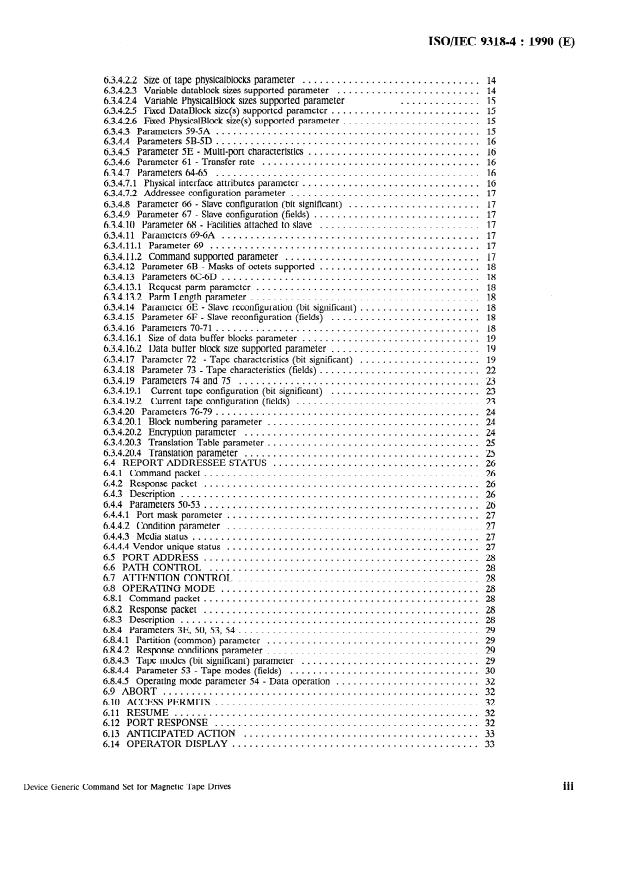
6.4 REPORT ADDRESSEE STATUS .
6.4.1 Command packet . 26
6.4.2 Response packet 26
................................................
6.4.3 Description . 26
6.4.4 Parameters 50-53 .
6.4.4.1 Port mask parameter .
6.4.4.2 Condition parameter . 27
6.4.4.3 Media status . 27
6.4.4.4 Vendor unique status .
6.5 PORT ADDRESS . 28
6.6 PATH CONTROL 28
6.7 ATTENTION CON+&’ : : : : : : : : : : : : : : : : : : : : : : : : : : : : : : : : : : : : : : : : : : 28
6.8 OPERATING MODE . 28
6.8.1 Command packet . 28
6.8.2 Response packet 28
................................................
6.8.3 Description . 28
6.8.4 Parameters 3E, 50, 53, 54 . 29
6.8.4.1 Partition (common) parameter . 29
6.8.4.2 Response conditions parameter . 29
6.8.4.3 Tape modes (bit significant) parameter .
6.8.4.4 Parameter 53 - Tape modes (fields) . 30
6.8.4.5 Operating mode parameter 54 - Data operation . 32
6.9 ABORT . 32
6.10 ACCESS PERMITS . 32
6.11 RESUME . 32
6.12 PORT RESPONSE . 32
6.13 ANTICIPATED ACTION . 33
6.14 OPERATOR DISPLAY . 33
. . .
Device Generic Command Set for Magnetic Tape Drives
ISO/IEC 9318-4 :1990 (E)
.................................................
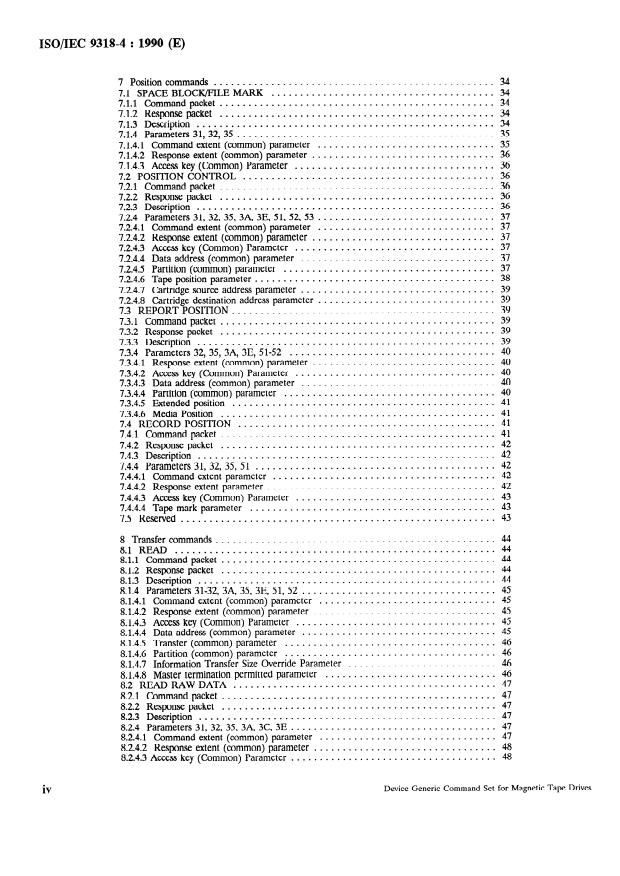
7 Position commands
....................................... 34
7.1 SPACE BLOCK/FILE MARK
................................................ 34
7.1.1 Command packet
................................................ 34
7.1.2 Response packet
....................................................
7.1.3 Description
.............................................
7.1.4 Parameters 31,32,35
............................... 35
7.1.4.1 Command extent (common) parameter
................................ 36
7.1.4.2 Response extent (common) parameter
................................... 36
7.1.4.3 Access key (Common) Parameter
............................................ 36
7.2 POSITION CONTROL
................................................ 36
7.2.1 Command packet
................................................
7.2.2 Response packet
....................................................
7.2.3 Description
............................... 37
7.2.4 Parameters 31, 32, 35, 3A, 3E, 51, 52, 53
............................... 37
7.2.4.1 Command extent (common) parameter
................................ 37
7.2.4.2 Response extent (common) parameter
................................... 37
7.2.4.3 Access key (Common) Parameter
................... 37
.............. ;
7.2.4.4 Data address (common) parameter
.....................................
7.2.4.5 Partition (common) parameter
..........................................
7.2.4.6 Tape position parameter
..................................
7.2.4.7 Cartridge source address parameter
............................... 39
7.2.4.8 Cartridge destination address parameter
..............................................
7.3 REPORT POSITION
................................................
7.3.1 Command packet
................................................ 39
7.3.2 Response packet
....................................................
7.3.3 Description
.................................... 40
7.3.4 Parameters 32, 35, 3A, 3E, 51-52
................................ 40
7.3.4.1 Response extent (common) parameter
................................... 40
7.3.4.2 Access key (Common) Parameter
.................................. 40
7.3.4.3 Data address (common) parameter
..................................... 40
7.3.4.4 Partition (common) parameter
.............................................. 41
7.3.4.5 Extended position
................................................ 41
7.3.4.6 Media Position
............................................. 41
7.4 RECORD POSITION
................................................
7.4.1 Command packet
................................................ 42
7.4.2 Response packet
.................................................... 42
7.4.3 Description
.......................................... 42
7.4.4 Parameters 31, 32, 35, 51
....................................... 42
7.4.4.1 Command extent parameter
........................................ 42
7.4.4.2 Response extent parameter
................................... 43
7.4.4.3 Access key (Common) Parameter
........................................... 43
7.4.4.4 Tape mark parameter
7.5 Reserved .
.................................................
8 Transfer commands
8.1 READ .
................................................
8.1-l Command packet
................................................ 44
8.1.2 Response packet
.................................................... 44
8.1.3 Description
..................................
8.1.4 Parameters 31-32, 3A, 35, 3E, 51, 52
............................... 45
8.1.4.1 Command extent (common) parameter
................................
8.1.4.2 Response extent (common) parameter
...................................
8.1.4.3 Access key (Common) Parameter
..................................
8.1.4.4 Data address (common) parameter
..................................... 46
8.1.4.5 Transfer (common) parameter
..................................... 46
8.1.4.6 Partition (common) parameter
.......................... 46
8.1.4.7 Information Transfer Size Override Parameter
.............................. 46
8.1.4.8 Master termination permitted parameter
..............................................
8.2 READ RAW DATA
................................................ 47
8.2.1 Command packet
................................................
8.2.2 Response packet
....................................................
8.2.3 Description
.................................... 47
8.2.4 Parameters 31, 32, 35, 3A, 3C, 3E
...............................
8.2.4.1 Command extent (common) parameter
................................ 48
8.2.4.2 Response extent (common) parameter
....................................
8.2.4.3 Access key (Common) Parameter
Device Generic Command Set for Magnetic Tape Drives
iv
ISO/IEC 9318-4 :1990 (E)
8.2.4.4 Data address (common) parameter
.................................. 48
8.2.4.5 Transfer (common) parameter
..................................... 48
8.2.4.6 Partition (common) parameter
..................................... 48
8.3 Reserved. .
8.4 SEARCH
...................................................... 48
8.5 WRITE .
8.5.1 Command packet . 49
8.5.2 Response packet
................................................ 49
8.5.3 Description
.................................................... 49
8.5.4 Parameters 31-32, 35, 3A, 3C, 3E, 51, 52
............................... 50
8.5.4.1 Command extent (common) parameter
............................... 50
8.5.4.2 Response extent (common) parameter
................................ 50
8.5.4.3 Access key (Common) Parameter
................................... 50
8.5.4.4 Data address (common) parameter
.................................. 50
8.5.4.5 Transfer (common) parameter . 50
8.5.4.6 Partition (common) parameter
..................................... 50
8.5.4.7 Information transfer size override parameter
........................... 50
8.5.4.8 Master termination permitted parameter
.............................. 51
8.6 WRITE PATTERN
............................................... 52
8.7 Reserved. .
9 Combination commands
............................................. 53
9.1 COPY .
9.2 COMPARE SLAVE DATA
......................................... 53
9.3 COMPARE DATA
............................................... 53
9.4 Reserved.
.....................................................
9.5 Reserved. .
9.6 SHADOW READ .
9.7 SHADOW WRITE .
9.8 SHADOW RESTORE
............................................. 53
10 Other transfer commands
........................................... 54
10.1 READVERIFY
................................................ 54
10.1.1 Command packet
............................................... 54
10.1.2 Response packet
............................................... 54
10.1.3 Description
................................................... 54
10.1.4 Parameters 31, 32, 35, 3A, 3C, 3E
...................................
10.1.4.1 Command extent (common) parameter
.............................. 55
10.1.4.2 Response extent (common) parameter
............................... 55
10.1.4.3 Access key (Common) Parameter
.................................. 55
10.1.4.4 Data address (common) parameter
.................................
10.1.4.5 Transfer (common) parameter
....................................
10.1.4.6 Partition (common) parameter
.................................... 56
10.2 Reserved .
10.3 READ FROM BUFFER
.......................................... 56
10.3.1 Command packet
............................................... 56
10.3.2 Response Packet.
............................................... 56
10.3.3 Description
................................................... 56
10.3.4 Parameters 31, 32, 35, 3A, 3E, 50
................................... 57
10.3.4.1 Command extent (common) parameter
.............................. 58
10.3.4.2 Response extent (common) parameter
............................... 58
10.3.4.3 Access key (Common) Parameter
.................................. 58
10.3.4.4 Data address (common) parameter
................................. 58
10.3.4.5 Partition (common) parameter
.................................... 58
10.3.4.6 Buffer address parameter
........................................ 58
10.4 READ FACILITY DATA TO BUFFER 58
...............................
10.5 READ PHYSICAL DATA AND ECC
................................ 58
10.6 READ PHYSICAL HEADER
...................................... 58
10.7 READ IPL .
10.7.1 Command packet
............................................... 59
10.7.2 Response packet
............................................... 59
10.7.3 Description
................................................... 59
10.8 READ PHYSICAL HEADER AND ECC
.............................. 59
10.9 WRITE TO BUFFER
............................................ 59
10.10 WRITE BUFFER TO FACILITY
................................... 59
10.11 WRITE PHYSICAL DATA AND ECC
............................... 60
Device Generic Command Set for Magnetic Tape Drives
V
ISO/IEC 9318-4 : 1990 (E)
10.12 WRITE PHYSICAL HEADER . 60
10.13 LOAD SLAVI!! IML . 60
10.14 ERASE .
10.14.1 Command packet . 60
10.14.2 Response Packet. . 60
10.14.3 Description .
10.14.4 Parameters 31, 32, 35, 3A, 3E .
10.14.4.1 Command extent (common) parameter .
10.14.4.2 Response extent (common) parameter .
10.14.4.3 Access key (Common) Parameter . . 61
10.14.4.4 Data address (common) parameter . 61
10.14.4.5 Partition (common) parameter . . . 61
10.15 WRITE PHYSICAL HEADER AND -ii&i l : : : : : : : : : : : : : : : : : : : : : : : : : : : : 62
11 Diagnostic Commands . . . . . . . . . . . . . . . 63
11.1 PERFORM SLAVE DIAGNOSTICS . . 63
11.2 PERFORM FACILITY DIAGNOSTICS . 63
11.3 Reserved . 63
11.4 Reserved . 63
11.5 READ ERROR LOG .
11.5.1 Command Packet .
11.5.2 Response Packet .
11.5.3 Description . 64
11.6 WRITE ERROR LOG . 65
11.7 DIAGNOSTIC CONTROL .
12 Command summary . 66
12.1 Control commands 66
...............................................
12.2 Position commands .
12.3 Transfer commands 67
...............................................
12.4 Combination commands . 68
12.5 Other transfer commands . 69
12.6 Diagnostic commands . 70
AnnexA .
A.1 Interface levels 71
..................................................
A.2 Concepts . 71
A-2.1 Relationship of master, slave, and facility . 71
A.2.2 Relationship of facilities and partitions . 72
A.2.3 Command structure . 72
A.3 Application environments . 72
A-3.1 Control of facilities by the master . 72
A.3.2 Shared Control of Facilities . 73
A.3.3 Control of Facilities by the Slave . 73
AnnexB . 74
B.l Informative references 74
.............................................
B.2 Equivalent ANSI standards . 74
Device Generic Command Set for Magnetic Tape Drives
vi
ISO/IEC 9318-4 : 1990 (E)
Figures
Page
Figure 1 - Command packet for attributes . 11
...................................
Figure 2 - Response packet for attributes 11
......................... 26
Figure 3 - Command packet for report addressee status
.........................
Figure 4 - Response packet for report addressee status 26
.............................. 28
Figure 5 - Command packet for operating mode
Figure 6 - Response packet for operating mode . 28
Figure 7 - Command packet for space block/file mark . 34
........................... 34
Figure 8 - Response packet for space block/file mark
.............................. 36
Figure 9 - Command packet for position control
.............................. 36
Figure 10 - Response packet for position control
Figure 11 - Command packet for report position . 39
Figure 12 - Response packet for report position . 39
.............................. 41
Figure 13 - Command packet for record position
Figure 14 - Response packet for record position . 42
15 - Command packet for read . . . . . . . . 44
Figure
.............................. 44
Figure 16 - Response packet for read . . . . . . . .
.............................. 47
Figure 17 - Command packet for read raw data
.............................. 47
Figure 18 - Response packet for read raw data .
.............................. 49
Figure 19 - Command packet for write . . . . . . .
Figure 20 - Response packet for write . . . . . . . . 49
.............................. 54
Figure 21 - Command packet for read verify . . .
Figure 22 - Response packet for read verify . . . .
............................ 56
Figure 23 - Command packet for read from buffer
............................. 56
Figure 24 - Response packet for read from buffer
Figure 25 - Command Packet for read ipl . 59
Figure 26 - Response packet for read ipl . 59
Figure 27 - Command packet for erase . 60
..................................... 60
Figure 28 - Response packet for erase
Figure 29 - Command packet for read error log . 64
............................... 64
Figure 30 - Response packet for read error log
vii
Device Generic Command Set for Magnetic Tape Drives
ISO/IEC 9318-4 :1990 (E)
Tables
Page
Table 1 - Attributes parameters 3A, 3E, 50
.................................. 14
Table 2 - Attributes parameters 51-58
.....................................
Table 3 - Attributes parameters 59.5A
..................................... 16
Table 4 - Attributes parameters 5B-5D
..................................... 16
Table 5 - Attributes parameters 5E-65
.....................................
Table 6 - Attributes parameters 66-67 17
.....................................
Table 7 - Attributes parameter 68 17
........................................
Table 8 - Attributes parameters 69.6A
.....................................
Table 9 - Attributes parameters 6B-6F
.....................................
Table 10 - Attributes parameters 70-71
.....................................
Table 11 - Attributes parameter 72 20
.......................................
Table 12 - Attributes parameter 73 22
.......................................
Table 13 - Attributes parameters 74-75 24
.....................................
Table 14 - Attributes parameters 76-79
.....................................
Table 15 - Report addressee status parameters 50-53
........................... 27
Table 16 - Operating mode parameters 3E, 50, 52
............................. 30
Table 17 - Operating mode parameter 53
...................................
Table 18 - Operating mode parameter 54
................................... 32
Table 19 - Space block/file mark parameters 31, 32, 35
......................... 35
Table 20 - Position control parameters 31-32, 35, 3A, 3E, 51-53
................... 38
Table 21 - Report position parameters 32, 35, 3A, 3E, 51-52
..................... 40
Table 22 - Record position parameters 31, 32, 35, 51
........................... 42
Table 23 - Read parameters 31, 32, 35, 3A, 3C, 3E, 51, 52
...................... 46
Table 24 - Read raw data parameters 31, 32, 35, 3A, 3C, 3E
..................... 48
Table 25 - Write parameters 31-32, 35, 3A, 3C, 3E, 51, 52
....................... 50
Table 26 - Read verify parameters 31, 32, 35, 3A, 3C, 3E 55
.......................
Table 27 - Read from buffer parameters 31, 32, 35, 3A, 3E, 50
................... 57
Table 28 - Erase parameters 31, 32, 35, 3A, 3E
............................... 61
. . .
Device Generic Command Set for Magnetic Tape Drives
VIII
ISO/IEC 931th4 :1990 (E)
Foreword
IS0 (the International Organization for Standardization) and IEC (the International
Electrotechnical Commission) form the specialized system for worldwide standardiz-
ation. National bodies that are members of IS0 or IEC participate in the development
of International Standards through technical committees established by the respective
organization to deal with particular fields of technical activity. IS0 and IEC technical
committees collaborate in fields of mutual interest. Other international organizations,
governmental and non-governmental, in liaison with IS0 and IEC, also take part in the
work.
In the field of information technology, IS0 and IEC have established a joint technical
committee, ISO/IEC JTC 1. Draft International Standards adopted by the joint
technical committee are circulated to national bodies for voting. Publication as an
International Standard requires approval by at least 75 % of the national bodies casting
a vote.
International Standard ISO/IEC 9318-4 was prepared by Joint Technical Committee
ISO/IEC JTC 1, Information technology.
ISO/IEC 93 18 consists of the following parts, under the general title Information
technology - In telligen t Periphera I Interface :
- Part I: Physical level
Part 2: Device specific command set for magnetic disk drives
Part 3: Device generic command set for magnetic and optical disk drives
Part 4: Device generic command set for magnetic tape drives
Annex A forms an integral part of this part of B is for
ISO/IEC 93 18. Annex
information only.
Device Generic Command Set for Magnetic Tape Drives
ISO/IEC 931%4 : 1990 (E)
Introduction
This part of ISO/IEC 9318 does not replace any existing standard, but it does
complement other Intelligent Peripheral Interface (IPI) standards (see clause 2).
This part of ISO/IEC 9318 provides a definition of the device-generic command set
portion of a series of standards called the Intelligent Peripheral Interface (IPI), a high
performance, general-purpose parallel peripheral interface. This part of ISO/IEC 9318,
responds to an industry market need (expressed both by users and manufacturers) to
limit the increasing costs in hosts associated with changes in peripherals.
The first five clauses of this part of ISO/IEC 9318-4 contain material that is useful
across all classes of device that the device-generic command sets can support. Clauses
6 to 12 are oriented to particular device classes and in this document these clauses are
intended for use with Magnetic Tape Drives.
Clause 1 describes the scope
Clause 2 lists the normative references
Clause 3 provides descriptions of conventions
Clause 4 describes the Environment of Use and projected application areas.
Clause 5 describes the Message Packet structure used for commands and responses.
Clause 6 describes Control commands.
Clause 7 describes Position commands.
Clause 8 describes the most generic Transfer commands.
the tion Transfer commands, which require a minimum
Clause 9 describes Combina
of two se ts 0 f extents.
describes the other Transfer commands, which are more
Clause 10 device specific than
those in clause 6.
Clause 11 describes the Diagnostic commands.
Clause 12 summarizes the commands defined in the document.
Device Generic Command Set for Magnetic Tape Drives
ISO/IEC 9318-4 : 1990 (E)
INTERNATIONAL STANDARD
Intelligent Peripheral Interface -
Information technology -
Part 4 :
Device generic command set for magnetic tape drives
1 Scope
This part of ISO/IEC 9318 describes the Logical Level 3 (generic level) Interface for tape drives. See clause 6 of the
ISO/IEC 9318-l for an explanation of the levels.
The physical, electrical, and configuration characteristics and the transmission protocol of this interface are in accordance
with ISO/IEC 9318-1. The interface is capable of handling data rates from 0 to at least 10 Moctets/s per second, depending
on driver and receiver classes.
The purpose of this part of ISO/IEC 9318 is to facilitate the development and utilization of an intelligent interface which
permits the interconnection of multiple peripheral types such as disk, tape, communications, to a controller.
This part of ISO/IEC 9318 does not replace any existing standard, but it does complement other Intelligent Peripheral
Interface (IPI) standards (see clause 2).
This part of ISO/IEC 9318 provides a definition of the device-generic portion of a family of standards called the Intelligent
Peripheral Interface (IPI), a high performance, general-purpose parallel peripheral interface.
The intent of the IPI is to isolate the host (CPU), both hardware and software, from changes in peripherals by providing
a “function-generic” command set to allow the connection of multiple types of peripherals (disks, printers, tapes,
the IPI supports
communications). To smooth the transition from the current methods to the generic approach,
device-specific command sets to aid in bridging the gap between the two approaches.
To accomplish this set of goals, the design of the IPI includes device-specific and device-generic command sets, both
utilizing a common physical bus. The device-specific command set provides
- device-oriented control;
- physical data addressing;
- timing critical operations;
- lower device cost.
The device-generic command set provides a higher level of functionality and portability. It includes
- host/device independence;
- logical data addressing;
- timing independence;
- command queuing capability.
A system is not restricted to the use of one level of command set or the other. It is possible that both levels of command
sets will be utilized with a given system’s architecture to balance such parameters as system performance, cost, and
peripheral availability. It is also possible for the host to provide for the migration from device-specific to device-generic
levels while still retaining the same physical interface.
Device Generic Command Set for Magnetic Tape Drives
ISO/IEC 9318-4 : 1990 (E)
2 Normative references
The following standards contain provisions which, through reference in this text, constitutes provisions of this part of
ISO/IEC 9318. At the time of publication, the editions indicated were valid. All standards are subject to revision, and
parties to agreements based on this part of ISO/IEC 9318 are encouraged to investigate the possibility of applying the most
recent editions of the standards listed below. Members of IEC and IS0 maintain registers of currently valid International
Standards.
- Information technology - Intelligent Peripheral Inteqace
ISO/IEC 9318-l:-‘)
- Part I: Physical Level.
ISO/IEC 9318-3: 1990 - Information technology - Intelligent Peripheral Inteqace
- Part 3: Device Generic Command Set for Magnetic and Optical Disk Drives.
1) To be published.
Device Generic Command Set for Magnetic Tape Drives
ISO/IEC 931%4 : 1990 (E)
3 Definitions and Conventions
3.1 Definitions
For the purpose of this part of ISO/IEC 9318 the definitions in ISO/IEC 9318-3 and the following definitions apply.
3.1.1 beginning of file: A recorded mark on the medium that marks the beginning of a file.
This media position is usually marked by
3.1.2 beginning of media (BQM): The beginning of the default data partition.
some physical (not recorded) marker on the medium. The marker is detectable by a facility and allows the tape to be
automatically positioned at the beginning of the default data partition and to be properly positioned to the beginning of
the default data partition when rewound. The implementation of the BOM marker is defined in the vendor specification.
contain physical requirements for the position of the BOM marker in the default data
NOTE - Certain IS0 Information Processing Systems standards
partition (Beginn ing-of-Tape (BOT) marker on reel-to-reel tape)
3.1.3 end-of-media warning (EMW): Usually a physical marker on the medium that indicates the end of the normal
recording area of a partition.
NOTE - Certain IS0 Informa tion Processing Systems standards contain physical requirements for the position of the EMW marker in the default data
partition (End-of-Tape (EOT) marker on reel -to-reel tape).
3.1.4 end of file: A mark recorded on the medium to mark the end of a file detectable by a facility.
3.1.5 erase gap: The physical sections of the medium that contain no recognizable data. An Erase Gap may be used to
overcome media defects by extending an interblock gap such that the next recorded element occurs past the defect on the
medium.
3.1.6 file mark: See tape mark.
3.1.7 forward motion: The tape motion logically proceeding from BOM toward Physical End of Media (PEOM).
3.1.8 ID burst: A burst of special recorded data that may be used by the facility to identify the recording format or density
of data written on the medium - usually occurring as the first recorded element on a volume. The ID Burst content is an
attribute of a volume and not considered part of any partition.
3.1.9 interblock gap: A physical section of the medium that contains no recognizable data and separates adjacent recorded
elements (i.e., PhysicalBlocks and file marks). Interblock gaps are automatically introduced by a facility between adjacent
recorded elements without explicit action by a master.
3.1.10 partition: This term defines a recording area that may be logically addressed. A partition may be slave defined (e.g.,
data area, CE area, IML area) or may be master defined (e.g., an addressable set of contiguous blocks within the data area).
A partition may be defined to exist within a tape volume by the slave, the master, or both. Since tape volumes are
removable, such a partition will be removed with the volume. A slave or facility may define other partitions that are not
associated with a volume and that may or may not be removable. Typically, such partitions may be used for Maintenance
partitions as defined in ISO/IEC 9318-3, but are not limited to such use.
Device Generic Command Set for Magnetic Tape Drives
ISO/IEC 9318-4 : 1990 (E)
3.1.11 PhysicalBlock This term is uniquely defined in this part of ISO/IEC 9318 as meaning the physical representation
of data on the media (e.g., sectors or records on disk and blocks or records on tape). It is used to prevent confusion
between industry usage of terms.
A facility may record any two adjacent blocks with different physical lengths, depending upon the capability of the facility
and the selection of a master. Tape volumes typically are not preformatted, as disks are, so that references to DataBlocks
or PhysicalBlocks within a partition that has not been previously written usually fail.
preformatted PhysicalBlocks is very similar to a fixed-block disk volume and may be used in a similar
A tape volume having
fashion.
3.1.12 physical end of media (PEOM): A position on the medium beyond which normal tape operation is impossible (i.e.,
data cannot be written or the medium cannot be positioned ).
3.1.13 reverse motion: The tape motion contrary to forward motion (i.e., logical motion from PEOM toward BOM).
3.1.14 tape mark= A recorded element on the medium, not containing data that is used to separate or otherwise identify
groups of DataBlocks on the medium. The most common tape mark is known as a file mark.
3.1.15 volume: A removable entity of tape media.
3.1.16 write protect: An attribute of a tape volume, usually requiring some physical sensing by a facility, indicating whether
the facility is allowed to write data on the medium. When a volume is write protected, the facility is prevented from writing
on the medium.
3.2 Conventions
In this part of ISO/IEC 9318, certain terms that are proper names of signals are printed in uppercase to avoid possible
confusion with other uses of the same words (e.g., ATTENTION IN). Any lowercase uses of these words have the normal
English meaning.
A number of conditions, sequence parameters, events, English text, states or similar terms are printed with the first letter
of each word in uppercase and the rest lowercase (e.g., In, Out, Selective Reset, Bi-directional, Bus Control, Operation
Response). Any lowercase uses of these words have the normal English meaning.
Device Generic Command Set for Magnetic Tape Drives
ISO/IEC 9318-4 : 1990 (E)
4 Logical interface characteristics of the tape
The descriptions in clause 4 of ISO/IEC 9318-3 (Device Generic Command Set for Magnetic and Optical Disk Drives) shall
apply to this part of ISO/IEC 9318, plus the information provided in the following subclauses. To assist the user, the
equivalent subclauses of ISO/IEC 9318-3 are given in parenthesis. Only the subclauses which have complementary
information are included here.
4.1 PhysicalBlocks (4.4.1 of ISO/IEC 9318-3)
Tape PhysicalBlocks may be fixed or variable. In the case of fixed PhysicalBlocks, the block size may be preset in
manufacture or may be specified by the master using the OPERATING MODE command. A tape recording fixed blocks
shall pad to the end of the block if the master does not supply enough information in a transfer command to fill the block.
Once recorded, the size of fixed PhysicalBlocks shall become an attribute of the volume (or partition, if applicable).
A slavelfa .cili ty that adds padding octets shall be capable of removing such padding when the PhysicalBlocks are
read and thus uire some co ntro 1 inform ation to be added to the PhysicalBlock
su bsequen may req contents.
tlY
Tapes that record variable PhysicalBlocks shall record blocks of anv size within the bounds reported in ATTRIBUTES.
The master may record multiple equal length blocks by setting the’block size with the OPERATING MODE command
and transferring data. However, it is then the responsibility of the master to pad any blocks that do not contain enough
data to fill the block. Variable PhysicalBlock Size is not an attribute of the volume (or the partition, if applicable). If the
master does not transfer enough information to fill a variable PhysicalBlock, the addressee shall record a short
PhysicalBlock.
Facilities may be implemented to record PhysicalBlocks of the exact size specified by the master or may record the
PhysicalBlock size plus some control information (e.g., data plus a block numbering field).
The relationship between PhysicalBlock and DataBlock size is not fixed, the DataBlock being the master-defined unit of
preference. Depending on addressee implementation, DataBlock size may be the same as PhysicalBlock size, an integer
multiple of the PhysicalBlock size, or a non-integer multiple.
4.2 DataBlocks (4.4.2 of ISO/IEC 9318-3)
DataBlock size is not an attribute of a volume or a partition. It specifies the master-to-slave transfer unit size (not to be
confused with Burst Size) until changed by the ATTRIBUTES or OPERATING MODE command or overridden in a data
transfer Command Extent parameter (when transferring in Octet mode).
4.3 Extents (4.4.3 of ISO/IEC 9318-3)
The general definition of an extent applies to tape. However, a slave/facility may have no method for knowing in advance,
when reading, that all blocks defined for an extent are present. When writing, the slave/facility may not be able to
determine in advance of beginning data transfer whether all blocks can be transferred to the medium. Thus, Command
Exceptions resulting from detection of an invalid data extent are infrequent.
The Incomplete Major Status is used in most instances instead of Command Exception with indications such as File Mark,
End of Media Warning, and the like, indicated in the Incomplete parameter.
Device Generic Command Set for Magnetic Tape Drives
ISO/IEC 9318-4 : 1990 (E)
4.4 Partitions (4.4.4 of ISO/IEC 9318-3)
Historically, tape volumes have been considered as having only one data partition (the default data partition), starting at
BOM at one end of the medium and continuing until EMW at the other end of the medium. The size of this default data
partition varied with the density and recording format of the slave/facility.
With the advent of track-addressable tape devices and serpentine recording, it may be possible to defi
...
Questions, Comments and Discussion
Ask us and Technical Secretary will try to provide an answer. You can facilitate discussion about the standard in here.
Loading comments...