


ISO 7942:1985
(Main)Information processing systems — Computer graphics — Graphical Kernel System (GKS) functional description
Information processing systems — Computer graphics — Graphical Kernel System (GKS) functional description
Systèmes de traitement de l'information — Infographie — Système graphique de base (GKS) — Description fonctionnelle
General Information
- Status
- Withdrawn
- Publication Date
- 31-Jul-1985
- Withdrawal Date
- 31-Jul-1985
- Current Stage
- 9599 - Withdrawal of International Standard
- Start Date
- 27-Oct-1994
- Completion Date
- 12-Feb-2026
Relations
- Effective Date
- 06-Jun-2022
- Effective Date
- 15-Apr-2008
- Effective Date
- 15-Apr-2008
ISO 7942:1985 - Information processing systems -- Computer graphics -- Graphical Kernel System (GKS) functional description

ISO 7942:1985 - Systemes de traitement de l'information -- Infographie -- Systeme graphique de base (GKS) -- Description fonctionnelle
Get Certified
Connect with accredited certification bodies for this standard

BSI Group
BSI (British Standards Institution) is the business standards company that helps organizations make excellence a habit.

NYCE
Mexican standards and certification body.
Sponsored listings
Frequently Asked Questions
ISO 7942:1985 is a standard published by the International Organization for Standardization (ISO). Its full title is "Information processing systems — Computer graphics — Graphical Kernel System (GKS) functional description". This standard covers: Information processing systems — Computer graphics — Graphical Kernel System (GKS) functional description
Information processing systems — Computer graphics — Graphical Kernel System (GKS) functional description
ISO 7942:1985 is classified under the following ICS (International Classification for Standards) categories: 35.140 - Computer graphics. The ICS classification helps identify the subject area and facilitates finding related standards.
ISO 7942:1985 has the following relationships with other standards: It is inter standard links to ISO 7942:1985/Amd 1:1991, ISO/IEC 7942-1:1994; is excused to ISO 7942:1985/Amd 1:1991. Understanding these relationships helps ensure you are using the most current and applicable version of the standard.
ISO 7942:1985 is available in PDF format for immediate download after purchase. The document can be added to your cart and obtained through the secure checkout process. Digital delivery ensures instant access to the complete standard document.
Standards Content (Sample)
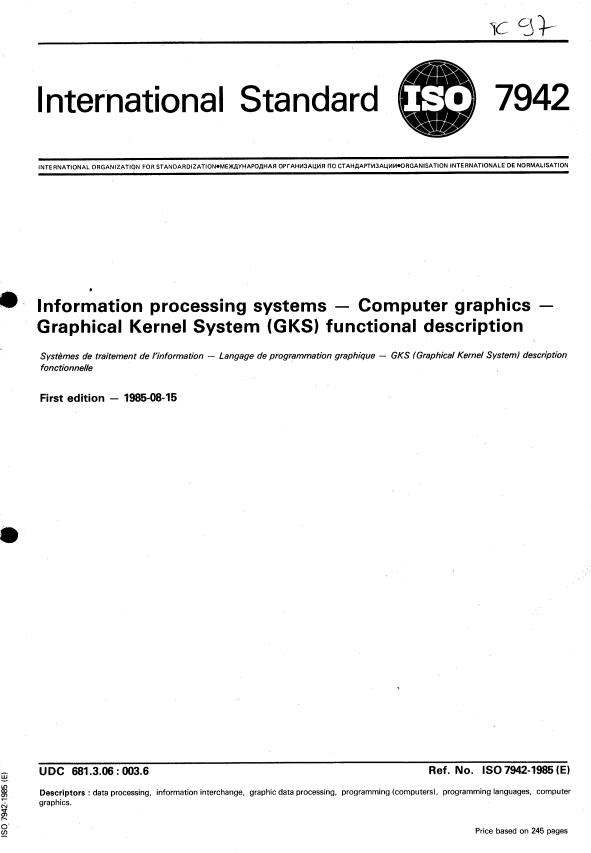
International Standard @ 7942
INTERNATIONAL ORGANIZATION FOR STANDARDIZATIONOMEXAYHAPOAHAR OPrAHHSAllMR Il0 CTAHLlAPTH3AllHMOORGANlSATlON INTERNATIONALE DE NORMALISATION
e Information processing systems - Computer graphics -
Graphical Kernel System (GKS) functional description
Systèmes de traitement de I'information - Langage de programmation graphique - GKS (Graphical Kernel System) description
fonctionnelle
First edition - 1985-08-15
- UDC 681.3.06:003.6 Ref. No. IS0 7942-1985 (E)
E
Ln
Descriptors : data processing, information interchange, graphic data processing, programming (computers), programming languages, computer
graphics.
Price based on 245 pages
Foreword
IS0 (the International Organization for Standardization) is a worldwide
federation of national standards bodies (IS0 member bodies). The work of
preparing International Standards is normally carried out through IS0
technical committees. Every member body interested in a subject for which
a technical committee has been established has the right to be represented on
that committee. International organizations, governmental and non-
governmental, in liaison with ISO, also take part in the work.
Draft International Standards adopted by the technical committees are cir-
culated to the member bodies for approval before their acceptance as Inter-
national Standards by the IS0 Council. They are approved in accordance
with IS0 procedures requiring at least 75% approval by the member bodies
voting.
International Standard IS0 7942 was prepared by Technical Committee
ISO/TC 97, Information processing systems.
O International Organization for Standardization, 1985 O
I Printed in Switzerland
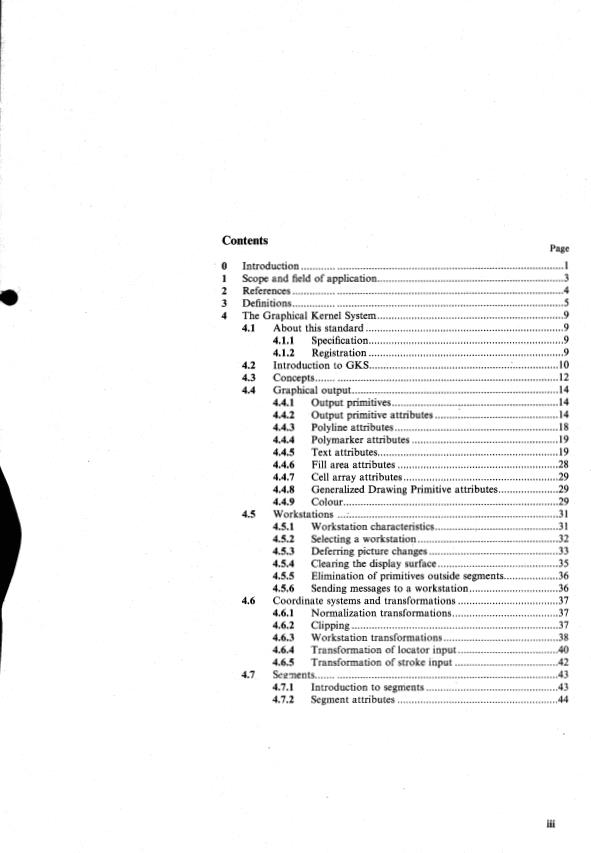
Contents
Page
O Introduction . 1
Scope and field of application . 3
2 References . 4
3 Definitions . 5
4 The Graphical Kernel System . 9
4.1 About this standard . 9
4.1.1 Specification . 9
4.1.2 Registration . 9
Introduction to GKS . .’. 10
4.2
4.3 Concepts . 12
4.4 Graphical output . 14
4.4.1 Output primitives . 14
Output primitive attributes . 14
4.4.2
4.4.3 Polyline attributes . 18
4.4.4 Polymarker attributes . 19
4.4.5 Text attributes . 19
Fill area attributes . 28
4.4.6
4.4.7 Cell array attributes . 29
4.4.8 Generalized Drawing Primitive attributes . 29
4.4.9 Colour . 29
4.5 Workstations . 31
4.5.1 Workstation characteristics . 31
Selecting a workstation . 32
4.5.2
Deferring picture changes . 33
4.5.3
Clearing the display surface . 35
4.5.4
4.5.5 Elimination of primitives outside segments . 36
4.5.6 Sending messages to a workstation . 36
4.6 Coordinate systems and transformations . 37
4.6.1 Normalization transformations . 37
4.6.2 Clipping . 37
4.6.3 Workstation transformations . 38
4.6.4 Transformation of locator input . 40
4.6.5 Transformation of stroke input . 42
4.7 Sernents . 43
4.7.1 Introduction to segments . 43
4.7.2 Segment attributes . 44
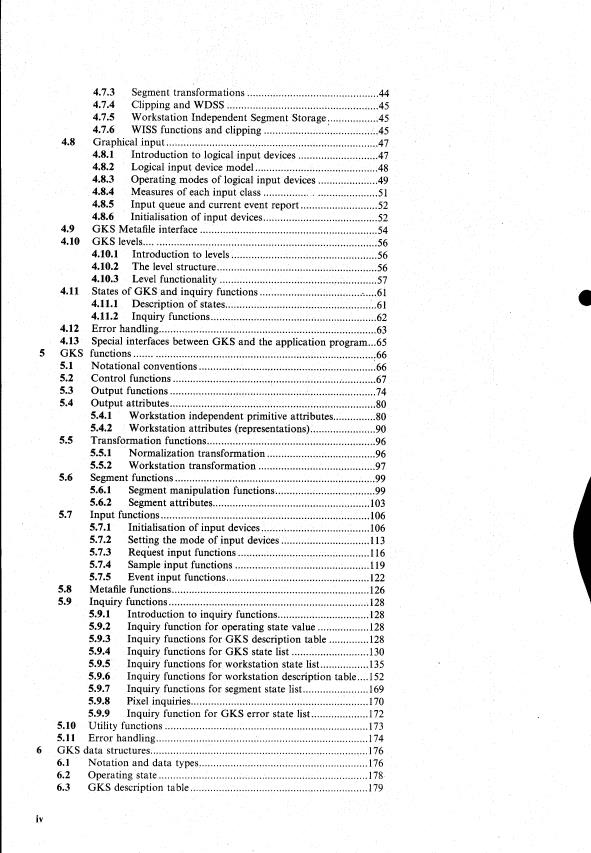
4.7.3 Segment transformati s . 44
4.7.4 Clipping and WDSS . 45
4.7.5 Workstation Independent Segment Storage . 45
4.7.6 WISS functions and clipping . 45
4.8 Graphical input . 47
4.8.1 Introduction to logical input devices . 47
4.8.2 Logical input device model . 48
4.8.3 Operating modes of logical input devic
4.8.4 Measures of each input class .
4.8.5 Input queue and current event report .
4.8.6 Initialisation of input devices . 52
4.9 GKS Metafile interface . 54
4.10 GKS levels . . 56
4.10.1 Introduction to levels . 56
4.10.2 The level structure .
4.10.3 Level functionality .
4.11
States of GKS and inquiry functions .
4.11.1 Description of states .
4.1 1.2 Inquiry functions .
4.12 Error handling . 63
4.13 Special interfaces between GKS and the application program . 65
GKS functions . 66
5.1 Notational conventions . 66
5.2 Control functions . 67
5.3 Output functions . 74
5.4 Output attrib . 80
ion independent primitive attributes . 80
5.4.2 Workstation attributes (representations) . 90
5.5 Transformation functions . 96
5.5.1 Normalization transformation . 96
5.5.2 Workstation transformation . 97
5.6 Segment functions . 99
5.6.1 Segment manipulation functions . 99
5.6.2 Segment attributes . 103
5.7 Input functions . 106
5.7.1 Initialisation of input devices . 106
5.7.2 Setting the mode of input devices . 113
5.7.3 Request input functions . 116
5.7.4 Sample input functions . 119
5.7.5 Event input functions . 122
5.8 Metafile functions . 126
5.9 Inquiry functions . 128
5.9.1 Introduction to inquiry functions . 128
5.9.2 Inquiry function for operating state value . 128
5.9.3 Inquiry functions for GKS description table . 128
5.9.4 Inquiry functions for GKS state list . 130
5.9.5 Inquiry functions for workstation state list . 135
5.9.6 Inquiry functions for workstation description table . 152
5.9.7 Inquiry functions for segment state list . 169
5.9.8 Pixel inquiries . 170
5.9.9 Inquiry function for GKS error state list . 172
5.10 Utility functions . 173
5.1 1 Error handling . 174
GKS data structures .
6.1 Notation and data types .
6.2 Operating state . . 178
6.3 GKS description table
6.4 GKS state list . 180
6.5 Workstation state list . 182
6.6 Workstation description table . 185
6.7 Segment state list . 189
6.8 GKS error state list . 190
Annexes
A Function lists . 191
A.l Alphabetic . 191
A.2 Order of appearance . 194
A.3 Ordered by level . 199
A.3.1 Level Oa . 199
A.3.2 Level Ob . 200
A.3.3 Level Oc . 201
A.3.4 Level la . 201
A.3.5 Level lb . 202
A.3.6 Level IC . 202
A.3.7 Level 2a . 202
A.4 Ordered by state . 202
A.4.1 Functions allowed in state GKCL . 202
AA2 Functions allowed in state GKOP . 203
A.4.3 Functions not allowed in state WSOP . 203
A.4.4 Functions not allowed in state WSAC . 204
A.4.5 Functions not allowed in state SGOP . 204
A.5 Applicability to workstation groups . 204
B Error list . 208
B.l Implementation dependent . 208
B.2 States . 208
B.3 Workstations . 208
B.4 Transformations . 208
B.5 Output attributes . 209
B.6 Output primitives . 209
B.7 Segments . 209
B.8 Input . 210
B.9 Metafiles . 210
B.10 Escape . 210
B.ll Miscellaneous . 210
B.12 System . 210
B.13 Reserved errors . 210
C Interfaces . 212
C . 1 General . 212
C.2 Language binding . 212
C.3 Implementation . 213
.................................. 214
D Allowable differences in GKS implementations
D.l General . 214
D.2 Global differences . 214
D.3 Workstation dependent differences . 215
E Metafile structure . 217
E.l Metafiles . 217
E.l.l General . 217
E.1.2 IS0 8632 Metafile . 217
E.1.3 Metafile designed for GKS . 217
File format and data format . 218
E.2
Generation of metafiles . 219
E.3
E.4 Interpretation of metafiles . 222
E.4.1 General . 222
E.4.2 Control items . 222
E.4.3 Output primitives . . 222
E.4.4 Output primitive attributes . 222
E.4.5 Workstation attributes . 222
E.4.6 Transformations . 222
E.4.7 Segment manipulation . 222
E.4.8 Segment attributes . 222
E.5 Control items . 222
E.6 Items for output primitives . 225
E.7 Items for output primitive attributes . 226
E.8 Items for workstation attributes . 228
E.9 Items for transformations . 230
E.10 Items for segment manipulation . 230
E.ll Items for segment attributes . 230
E.12 User items . 231
F Sample programs . 232
G GKS functions summary . 239
G.l Control functions . 239
G.2 Output functions . 239
G.3 Output attributes . 240
G.3.1 Workstation independent primitive attributes . 240
G.3.2 Workstation attributes (representations) . 241
G.4 Transformation functions . 241
G.4.1 Normalization transformation . 241
GA2 Workstation transformation . 241
G.5 Segment functions . 242
G.5.1 Segment manipulation functions . 242
G.5.2 Segment attributes . 242
G.6 Input functions . 242
Initialisation of input devices . 242
G.6.1
Setting mode of input devices . 243
G.6.2
Request input functions . 243
G.6.3
Sample input functions . 243
G.6.4
Event input functions . 244
G.6.5
G.7 Metafile functions . 244
G.8 Inquiry functions . 244
G.9 Utility functions . 245
G.10 Error handling . 245
vi
INTERNATIONAL STANDARD IS0 7942-1985 (E)
Information processing systems - Computer graphics -
Graphical Kernel System (GKS) functional description
O Introduction
The Graphical Kernel System (GKS) provides a set of functions for computer graphics programming. GKS is
a basic graphics system that can be used by the majority of applications that produce computer generated
pictures.
The main reasons for standardizing basic computer graphics are:
a) to allow application programs involving graphics to be easily portable between different installations;
b) to aid the understanding and use of graphics methods by application programmers;
c) to serve manufacturers of graphics equipment as a guideline in providing useful combinations of graph-
ics capabilities in a device.
In order to reach these main objectives, the GKS design was based on the following requirements:
d) GKS should include all the capabilities that are essential for the whole spectrum of graphics, from sim-
ple passive output to highly interactive applications.
e) The whole range of graphics devices, including vector and raster devices, microfilm recorders, storage
tube displays, refresh displays and colour displays should be controllable by GKS in a uniform way.
f) GKS should provide all the capabilities required by a majority of applications without becoming unduly
large.
These requirements were used to formulate a number of principles that were used to judge specific design
alternatives. Thus it was possible to contribute to the overall design goals while focussing on certain aspects.
Five design aspects were identified, each having a group of principles
g) Design goals: The following principles should not be violated by any technical design:
1) consistency: the mandatory requirements of GKS should not be mutually contradictory;
2) compatibility: other standards or commonly accepted rules of practice should not be violated;
3) orthogonality: the functions or modules of GKS should be independent of each other, or the depen-
dency should be structured and well defined.
h) Functional capabilities: The following principles were used to define the extent of GKS:
1) completeness: all functions that a majority of applications want to use on a given level of func-
tionality should be included;
2) minimality: functions that are unnecessary for applications of a given level of functionality should
not be provided;
3) compactness: an application should be able to achieve a desired result by a set of functions and
parameters that is as small as possible;
IS0 7942- 1985( E)
Introduction
4) richness: a rich set of functions offers an extensive range of facilities that stretches beyond the basic
functions and includes higher order capabilities.
It is obvious that there is a trade off between the principles in this group. Therefore, the functions of GKS
are organized in nine levels. An implementation of GKS provides precisely the functions of one of these lev-
els. While the lowest level contains only a minimal set of functions, higher levels are allowed to extend
beyond the basic needs towards greater richness.
i) User interface design: The following principles were used to define the user interface design:
1) user friendliness: GKS should allow the design of a desirable user interface;
2) clarity: the concepts and functional capabilities of GKS should be easily understandable, especially
by the application programmer;
3) error handling: failure of system functions or modules, caused by errors of the system itself or by
the application program, should be treated in such a way that the error reaction is clearly understand-
able and informative to the application programmer and that the impact on the system and the appli-
cation program is as small as possible.
Clarity and sound error handling are essential parts of user friendliness. Error handling is an integral part
of GKS. To aid clarity, the system and its state can be presented to the user in an easily comprehensible
manner.
Clarity applies not only to the system design but also to the system description. To this end, the GKS
specification is divided into a general description, a description of the underlying logical data structures
a description of the functions and their effects on these data
representing the state of the system, and
structures.
j) Graphics devices: The following principles are associated with the range of graphics devices that can be
addressed by GKS:
1) device independence: GKS functions should be designed to allow an application program, using
these functions, to address facilities of quite different graphics output and input devices without
modification of the program structure;
2) device richness: the full capabilities of a wide range of different graphics output and input devices
should be accessible from the functions of GKS.
These principles led to a fundamental concept underlying the GKS architecture: the concept of multiple
independent graphical workstations connected to and driven by GKS. The application program can
inquire the capabilities of every workstation. The GKS design includes escape functions that are easily
identifiable within an application program and can be used to access special facilities of a particular dev-
ice.
k) Implementation: The last group of principles is related to the implementation of GKS:
1) implementability: it should be possible to support the GKS functions in most host languages, on
most operating systems and with most graphics devices;
2) language independence: it should be possible to access the standard facilities of GKS from all IS0
standard programming languages;
3) efficiency: GKS should be capable of being implemented without time consuming algorithms;
4) robustness: the operator and application programmer should be protected in the best possible way
from hardware or software failure of the system.
The five groups of principles are interconnected. For example, design goals and functional capabilities both
contribute to user friendliness. Efficiency is also important when considering response time in an interactive
environment. Some principles may be conflicting, such as richness versus minimality, comprehensive error
handling versus efficiency, and compactness versus device richness. Compromises needed to be made to
achieve the overall design objective: GKS should have an easily comprehensible structure and a set of func-
tions that enables a vast majority of computer graphics users to design portable, device independent applica-
tion programs addressing the whole range of computer graphics equipment.
IS0 7942-1985(E)
1 Scope and field of application
This International Standard specifies a set of functions for computer graphics programming, the Graphical
Kernel System (GKS). GKS is a basic graphics system for applications that produce computer generated two
dimensional pictures on line graphics or raster graphics output devices. It supports operator input and
interaction by supplying basic functions for graphical input and picture segmentation. It allows storage and
dynamic modification of pictures. A fundamental concept in GKS is the workstation, consisting of a number
of input devices and a single output device. Several workstations can be used simultaneously. The application
program is allowed to adapt its behaviour at a workstation to make best use of workstation capabilities. This
International Standard includes functions for storage on and retrieval from an external graphics file. Last but
not least, the functions are organized in upward compatible levels with increasing capabilities.
NOTE - For certain parameters of the functions, GKS defines value ranges as being reserved for registration (see 4.1.2). The meanings
of these values will be defined using the established procedures.
GKS defines a language independent nucleus of a graphics system. For integration into a programming
language, GKS is embedded in a language dependent layer obeying the particular conventions of that
language.
Annexes C to G are given for information; they do not form part of the specification.
IS0 7942-1985(E)
2 References
IS0 646, Information processing - IS0 7-bit coded character set for information interchange.
IS0 2022, Information processing - IS0 7-bit and %bit coded character sets - Code extension techniques.
IS0 2382113, Data processing - Vocabulary - Part 13: Computer graphics.
IS0 6093, Information processing - Representation of numerical values in character strings for information inter-
change.')
.IS0 8632, Information processing systems - Computer Graphics - Metajile for transfer and storage of picture
description information
- Part 1 : Functional description.')
- Part 2 : Character encoding.')
- Part 3 : Binary encoding.')
- Part 4 : Clear text encoding. ')
IS0 7942-1985(E)
3 Definitions
This clause gives the definition of the important terms of the Graphical Kernel System (GKS).
NOTE - As far as possible, commonly accepted graphics terminology is used
3.1 acknowledgemenk Output to the operator of a logical input device indicating that a trigger has fired.
3.2 aspect ratio: A ratio of x to y used to describe the shape of a rectangle in a particular coordinate system
(for example, of a workstation window or a workstation viewport).
3.3 aspects of primitives: Ways in which the appearance of a primitive can vary. Some aspects are controlled
directly by primitive attributes, some are controlled indirectly through a bundle table. Primitives inside seg-
ments have an aspect controlled through the segment containing them, for example highlighting; primitives
outside segments do not.
3.4 attribute: A particular property that applies to a display element (output primitive) or a segment. Exam-
ples: highlighting, character height. In GKS, some properties of workstations are called workstation attri-
butes.
3.5 baseline: A horizontal line within a character body (see figure 3) which, for many character definitions,
has the appearance of being a lower limit of the character shape. A descender passes below this line. All
baselines in a font are in the same position in the character bodies.
3.6 bundle index: An index into a bundle table for a particular output primitive. It defines the workstation
dependent aspects of the primitive.
3.7 bundle table: A workstation dependent table associated with a particular output primitive. Entries in the
table specify all the workstation dependent aspects of a primitive. In GKS, bundle tables exist for the follow-
ing output primitives: polyline, polymarker, text and fill area.
3.8 capline: A horizontal line within a character body (see figure 3) which, for many character definitions, has
the appearance of being the upper limit of the character shape. An ascender may pass above this line and in
some languages an additional mark (for example an accent) over the character may be defined above this line.
All caplines in a font are in the same position in the character bodies.
3.9 cell array: A GKS output primitive consisting of a rectangular grid of equal size rectangular cells, each
having a single colour.
NOTE - These cells do not necessarily map one-to-one with pixels.
3.10 centreline: A vertical line bisecting the character body (see figure 3).
3.11 character body: A rectangle used by a font designer to define a character shape (see figure 3). All charac-
ter bodies in a font have the same height.
3.12 choice device: A GKS logical input device providing a non-negative integer defining one of a set of alter-
natives.
3.13 clipping: Removing parts of display elements that lie outside a given boundary, usually a window or
viewport.
3.14 colour table: A workstation dependent table, in which the entries specify the values of the red, green and
blue intensities defining a particular colour.
3.15 coordinate graphics; line graphics: Computer graphics in which display images are generated from display
commands and coordinate data.
3.16 device coordinate (DC): A coordinate expressed in a coordinate system that is device dependent. In
GKS, DC units are metres on a device capable of producing a precisely scaled image and appropriate works-
tation dependent units otherwise.
3.17 device driver: The device dependent part of a GKS implementation intended to support a graphics dev-
ice. The device driver generates device dependent output and handles device dependent interaction.
3.18 device space: The space defined by the addressable points of a display device.
3.19 display device; graphics device: A device (for example refresh display, storage tube display, plotter) on
which display images can be represented.
IS0 7942-1985(E)
Definitions
3.20 display image; picture: A collection of output primitives or segments that are represented together at any
one time on a display surface.
3.21 display space: (1) That portion of the device space corresponding to the area available for displaying
images. (2) The working space of an input device such as a digitiser.
3.22 display surface; view surface: In a display device, that medium on which display images may appear.
3.23 echo: The immediate notification of the current value provided by an input device to the operator at the
display console.
3.24 escape: A function in GKS used to access implementation or device dependent features, other than for
the generation of graphical output, that are not otherwise addressed by GKS.
3.25 feedback: Output indicating to the operator the application program’s interpretation of a logical input
value.
3.26 fill area: A GKS output primitive consisting of a polygon (closed boundary) which may be hollow or
may be filled with a uniform colour, a pattern, or a hatch style.
3.27 fill area bundle table: A table associating specific values for all workstation dependent aspects of a fill
area primitive with a fill area bundle index. In GKS, this table contains entries consisting of interior style,
style index, and colour index.
3.28 Generalized Drawing Primitive (GDP): An output primitive used to address special geometrical worksta-
tion capabilities such as curve drawing.
3.29 GKS level: Two values in the range O to 2 and a to c which together define a set of functional capabili-
ties of GKS. An implementation of GKS provides precisely the functions of one level.
3.30 GKS Metafile (GKSM): A sequential file that can be written or read by GKS and is used for long-term
storage (and for transmittal and transferral) of graphical information.
3.31 halfline: A horizontal line between the capline and the baseline within the character body (see figure 3),
about which a horizontal string of characters in a font would appear centrally placed in the vertical direction.
All halfiines in a font are in the same position in the character bodies.
3.32 hatch: One possible method of filling the interior of a polygon specified by a fill area primitive. The inte-
rior is filled with an arrangement of one or more sets of parallel lines.
3.33 highlighting: A device independent way of emphasizing a segment by modifying its visual attributes. For
example, blinking.
3.34 implementation mandatory: Implementation mandatory describes a property that is required to be real-
ized identically on all workstations of all implementations of GKS.
3.35 input class: A set of input devices that are logically equivalent with respect to their function. In GKS,
the input classes are: LOCATOR, STROKE, VALUATOR, CHOICE, PICK and STRING.
3.36 inquiry function: A GKS function whose purpose is to return values depending on the current state of
GKS or on some fixed property of the GKS implementation. There is no effect on the state of GKS or on
the display image.
3.37 locator device: A CKS logical input device providing a position in world coordinates and a normaliza-
tion transformation number.
3.38 logical input device: A logical input device is an abstraction of one or more physical devices that delivers
of type LOCATOR, STROKE,
logical input values to the program. Logical input devices in GKS can be
VALUATOR, CHOICE, PICK and STRING.
3.39 logical input value: A value delivered by a logical input device.
3.40 marker: A glyph with a specified appearance which is used to identify a particular location.
3.41 measure: A value (associated with a logical input device), which is determined by one or more physical
input devices and a mapping from the values delivered by the physical devices. The logical input value
delivered by a logical input device is the current value of the measure.
3.42 MI: An abbreviation for GKS metafile input, a category of workstation.
3.43 MO: An abbreviation for GKS metafile output, a category of workstation.
3.44 normalization transformation; viewing transformation; window-to-viewport transformation: A transforma-
tion that maps the boundary and interior of a window to the boundary and interior of a viewport. In GKS,
IS0 7942-1985(E)
Definitions
this transformation maps positions in world coordinates to normalized device coordinates.
3.45 normalized device coordinates (NDC): A coordinate specified in a device independent intermediate coordi-
O to 1.
nate system, normalized to some range, typically In GKS, during an intermediate state the coordi-
nates may lie outside the defined range, but associated clipping information ensures that the output does not
[O, 11 x [O, 11.
exceed the coordinate range
3.46 operator: Person manipulating physical input devices so as to change the measures of logical input dev-
ices and cause their triggers to fire.
3.47 output primitive; graphic primitive; display element: A basic graphic element that can be used to construct
a display image. Output primitives in GKS are polyline, polymarker, text, fill area, cell array, and general-
ized drawing primitive.
3.48 pick device: A GKS logical input device providing the pick identifier attached to an output primitive and
the associated segment name.
3.49 pick identifier: A name, attached to individual output primitives within a segment, and returned by the
pick device. The same pick identifier can be assigned to different output primitives.
e 3.50 pixel; picture element: The smallest element of a display surface that can be independently assigned a
colour or intensity.
3.51 polyline: A GKS output primitive consisting of a set of connected lines.
3.52 polyline bundle table: A table associating specific values for all workstation dependent aspects of a poly-
line primitive with a polyline bundle index. In GKS, this table contains entries consisting of linetype,
linewidth scale factor, and colour index.
3.53 polymarker: A GKS output primitive consisting of a set of locations, each to be indicated by a marker.
3.54 polymarker bundle table: A table associating specific values for all workstation dependent aspects of a
polymarker primitive with a polymarker bundle index. In GKS, this table contains entries consisting of
marker type, marker size scale factor, and colour index.
3.55 primitive attribute: Primitive attribute values (for output primitives) are selected by the application in a
workstation independent manner, but can have workstation dependent effects.
3.56 prompt: Output to the operator indicating that a specific logical input device is available.
3.57 raster graphics: Computer graphics in which a display image is composed of an array of pixels arranged
in rows and columns.
3.58 rotation: Turning all or part of a display image about an axis. In GKS, this capability is restricted to
~e segments.
3.59 scaling; zooming: Enlarging or reducing all or part of a display image by multiplying the coordinates of
display elements by a constant value. In GKS, this capability is restricted to segments.
NOTE - For different scaling in two orthogonal directions two constant values are required.
3.60 segment: A collection of display elements that can be manipulated as a unit.
3.61 segment attributes: Attributes that apply only to segments. In GKS, segment attributes are visibility,
highlighting, detectability, segment priority, and segment transformation.
3.62 segment priority: A segment attribute used to determine which of several overlapping segments takes pre-
cedence for graphic output and input.
3.63 segment transformation: A transformation that causes the display elements defined by a segment to
appear with varying position (translation), size (scale), and/or orientation (rotation) on the display surface.
3.64 string device: A GKS logical input device providing a character string as its result.
3.65 stroke device: A GKS logical input device providing a sequence of points in world coordinates, and a
normalization transformation number.
3.66 text: A GKS output primitive consisting of a character string.
3.67 text bundle table: A table associating specific values for all workstation dependent aspects of a text prim-
itive with a text bundle index. In GKS, this table contains entries consisting of text font and precision, char-
acter expansion factor, character spacing and colour index.
IS0 7942-1985(E)
Definitions
3.68 text font and precision: An aspect of text in GKS, having two components, font and precision, which
together determine the shape of the characters being output, on a particular workstation. In addition, the
precision describes the fidelity with which the other text aspects match those requested by an application pro-
gram. In order of increasing fidelity, the precisions are: STRING, CHAR and STROKE.
3.69 translation; shift: The application of a constant displacement to the position of all or part of a display
image. In GKS, this capability is restricted to segments.
3.70 trigger: A physical input device or set of devices that an operator can use to indicate significant moments
in time.
3.71 valuator device: A GKS logical input device providing a real number.
3.72 viewport: An application program specified part of normalized device coordinate space. In GKS, this
definition is restricted to a rectangular region of normalized device coordinate space used in the definition of
the normalization transformation.
3.73 window: A predefined part of a virtual space. In GKS, this definition is restricted to a rectangular region
of the world coordinate space used for the definition of the normalization transformation.
3.74 workstation: GKS is based on the concept of abstract graphical workstations, which provide the logical
interface through which the application program controls physical devices.
3.75 Workstation Dependent Segment Storage (WDSS): Segment storage on a workstation that is used for
graphical output. Segments cannot be transferred from WDSS to another workstation.
3.76 Workstation Independent Segment Storage (WISS): A special workstation type, where segments can be
stored and later transferred to other workstations.
3.77 workstation mandatory: Workstation mandatory describes a property that is required to be realized ident-
ically on all workstations of a GKS implementation.
3.78 workstation transformation: A transformation that maps the boundary and interior of a workstation win-
dow into the boundary and interior of a workstation viewport (part of display space), preserving aspect ratio.
In GKS, this transformation maps positions in normalized device coordinates to device coordinates. The
effect of preserving aspect ratio is that the interior of the workstation window may not map to the whole of
the workstation viewport.
3.79 workstation viewport: A portion of display space currently selected for output of graphics.
3.80 workstation window: A rectangular region within the normalized device coordinate system which is
on a display space.
represented
3.81 world coordinate (WC): A device independent Cartesian coordinate system used by the application pro-
gram for specifying graphical input and output.
IS0 7942-1985(E)
4 The Graphical Kernel System
4.1 About this standard
4.1.1 Specification
The set of functions known as the Graphical Kernel System shall be as described in clauses 4, 5 and 6 and
annexes A and B. These functions are organized in nine upward compatible levels with increasing capabilities
An implementation of GKS shall implement precisely the functions of one level. A
as described in 4.10.
GKS implementation shall be invalid if it lies between two defined levels or outside the defined levels. In an
implementation, all graphical capabilities that can be addressed by GKS functions shall be used only via
GKS.
4.1.2 Registration')
For certain parameters of the functions, GKS defines value ranges as being reserved for registration. The
meanings of these values will be defined using the established procedures. These procedures do not apply to
values and value ranges defined as being workstation or implementation dependent; these values and ranges
are not standardized.
I) Information concerning the Registration Authority and its procedures may be obtdined on request to the
Secretay General, IS0 Centrai Secretaridi. cdse postale 56. CH-121 I Genève, Switzerland, quoting the number
of this Iiiterndtiondl Stnnddrd
Y
IS0 7942-1985(E)
Introduction to GKS The Graphical Kernel System
4.2 Introduction to GKS
The Graphical Kernel System (GKS) provides a functional interface between an application program and a
configuration of graphical input and output devices. The functional interface contains all basic functions for
interactive and non-interactive graphics on a wide variety of graphics equipment.
The interface is at such a level of abstraction that hardware peculiarities are shielded from the application
program. As a result a simplified interface presenting uniform output primitives (POLYLINE, POLY-
MARKER, TEXT, FILL AREA, CELL ARRAY, GENERALIZED DRAWING PRIMITIVE), and uni-
form input classes (LOCATOR, STROKE, VALUATOR, CHOICE, PICK, STRING) is obtained.
In 4.3 the concepts of basic output, input and the organization of input and output sequences are outlined.
A central concept both for structuring GKS and for realizing device independence is introduced, called the
workstation.
The facilities for picture manipulation and change are introduced via the seg
...
Norme internationale @ 7942
INTERNATIONAL ORGANIZATION FOR STANOAROIZATlONOME~YHAPO~HAR OPrAHHIAUMR no CTAHaAPTH3AUMH.ORGANlSATlON INTERNATIONALE DE NORMALISATION
Systèmes de traitement de l'information -
Infographie - Système graphique de base (GKS) -
Description fonction ne1 I e
Information processing systems - Computer graphics - Graphical Kernel System IGKSI functional description
Première édition - 1985-08-15
CDU ô81.3.06:003.6 Réf. no : IS0 7942-1985 (FI
Descripteurs : traitement de l'information, échange d'information, traitement de l'information graphique, description.
/
Prix basé sur 245 pages
Avant-propos
L'ISO (Organisation internationale de normalisation) est une fédération mondiale
d'organismes nationaux de normalisation (comités membres de I'ISO). L'élaboration
des Normes internationales est normalement confiée aux comités techniques de I'ISO.
Chaque comité membre intéressé par une étude a le droit de faire partie du comité
technique créé à cet effet. Les organisations internationales, gouvernementales et non
gouvernementales, en liaison avec I'ISO participent également aux travaux.
Les projets de Normes internationales adoptés par les comités techniques sont soumis
aux comités membres pour approbation, avant leur acceptation comme Normes inter-
nationales par le Conseil de I'ISO. Les Normes internationales sont approuvées confor-
mément aux procédures de I'ISO qui requièrent l'approbation de 75 % au moins des
comités membres votants.
La Norme internationale IS0 7942 a été élaborée par le comité technique ISO/TC 97,
Systèmes de traitement de I'information.
@ Organisation internationale de normalisation, 1985
Version française tirée en 1987
Imprimé en Suisse
IS0 7942-1985 (FI
Page
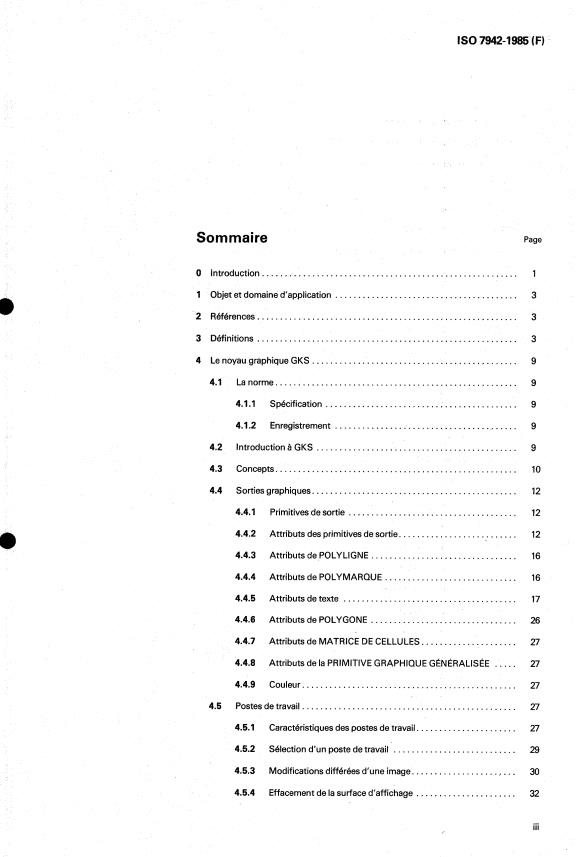
Sommaire
O Introduction . 1
1 Objet et domaine d'application . 3
2 Références . 3
3 Définitions . 3
.......................................
4 LenoyaugraphiqueGKS . 9
4.1 La norme . 9
. .
4.1 1 Spécification . 9
4.1.2 Enregistrement . 9
4.2 Introduction à GKS . 9
4.3 Concepts . . 10
4.4 Sorties graphiques . . 12
4.4.1 Primitives de sortie . 12
4.4.2 Attributs des primitives de sortie . 12
4.4.3 Attributs de POLYLIGNE . 16
4.4.4 Attributs de POLYMARQUE . 16
4.4.5 Attributs de texte . 17
4.4.6 Attributs de POLYGONE . 26
4.4.7 Attributs de MATRICE DE CELLULES . 27
4.4.8 Attributs de la PRIMITIVE GRAPHIQUE GÉNÉRALISÉE . 27
4.4.9 Couleur . 27
4.5 Postesdetravail .
4.5.1 Caractéristiques des postes de travail . 27
4.5.2 Sélection d'un poste de travail . 29
Modifications différées d'une image .
4.5.3 30
Effacement de la surface d'affichage .
4.5.4 32
iii
.
IS0 7W-1985 (FI
Page
4.5.5 Élimination de primitives à l'extérieur dm segments . 32
4.5.6 Transmission de messages à un poste de travail .
4.6 Systèmes de coardonnées et transformations . 33
4.6.1 Transformation de normalisation . 33
4.6.2 Découpage . 34
4.6.3 Transformation de poste de travail . 34
Transformation de l'entrée releveur de coordonnées .
4.6.4 36
Transformations de l'entrée releveur d'une suite
4.6.5
de coordonnées . 38
4.7 Segments . 38
4.7.1 Introduction aux segments . 38
4.7.2 Attributs des segments . 39
4.7.3 Transformation des segments . 40
4.7.4 Découpage et stockage dépendant du poste de
travail (WDSS) . 40
4.7.5 Stockage de segments indépendant du poste de
travail (WISS) . 41
4.7.6 Fonctions WISS et découpage . 41
4.8 Entrées graphiques . 42
Introduction aux appareils logiques d'entrée . 42
4.8.1
Modèle d'appareil logique d'entrée .
4.8.2 43
Modes opératoires des appareils logiques d'entrée . 44
4.8.3
4.8.4 Mesures de chaque classe d'entrée . 45
4.8.5 File d'attente d'entrée et compte rendu courant d'événements 47
4.8.6 Initialisation des appareils d'entrée . 48
4.9 Interface avec le métafichier GKS . 48
4.10 Niveaux de GKS . 50
4.10.1 Introduction . 50
4.10.2 Structure des niveaux . 50
4.10.3 Fonctionnalité . 52
4.11 États de GKS et fonctions d'interrogation . 55
4.11.1 Description des états . 55
4.11.2 Fonctions d'interrogation . 56
iv
4.13 Interfaces spéciales entre GKS et le programme d'application .
5 FonctionsGKS . 58
5.1 Conventions de notation . 58
5.2 Fonctions de contrôle . 59
5.3 Fonctions de sortie . 66
5.4 Attributs de sortie . 72
5.4.1 Attributs de primitives indépendants du poste de travail .
5.4.2 Attributs liés au poste de travail . 83
5.5 Fonctions de transformation . 88
5.5.1 Transformation de normalisation . 88
5.5.2 Transformation du poste de travail . 90
5.6 Fonctions relatives aux segments . 91
5.6.1 Fonctions de manipulation des segments . 91
5.6.2 Attributs des segments . 95
5.7 Fonctions d'entrée . 97
5.7.1 Initialisation des appareils d'entrée . 97
5.7.2 Établissement du mode des appareils d'entrée . 104
5.7.3 Fonctions requêtes . 106
5.7.4 Fonctions d'échantillonnage . 110
5.7.5 Fonctions d'événement . 113
5.8 Fonctions liées aux métafichiers . 116
5.9 Fonctions d'interrogation . 117
5.9.1 Introduction . 117
5.9.2 Fonction d'interrogation de l'état opératoire . 118
5.9.3 Fonctions d'interrogation de la table de description de GKS . . 118
5.9.4 Fonctions d'interrogation de la liste d'état de GKS . 120
Fonctions d'interrogation de la liste d'état des postes de travail 125
5.9.5
5.9.6 Fonctions d'interrogation de la table de description des postes
detravail . 140
Fonctions d'interrogation de la table d'état des segments . 156
5.9.7
5.9.8 Interrogation des pixels . 157
V
IS0 7942-1985 (F)
Page
B Liste des erreurs . . 189
B.l Erreurs dépendant de la réalisation . . 189
B.2 États . . 189
8.3 Postes de travail . . 189
8.4 Transformations . . 189
............... 190
B.5 Attributs de sortie .
B.6 Primitives de sortie . . 190
8.7 Segments . . 190
............... 191
B.8 Entrée .
B.9 Métafichiers . . 191
B.10 Échappement . . 191
............... 191
B.ll Diverses .
............... 191
B.12 Emurs systèmes .
B.13 Erreurs réservées . . 192
C Interfaces . . 193
C.l Généralités . . 193
............... 193
C.2 Interfacelangage .
C.3 Mise en œuvre . . 194
............... 195
D Différences autorisées dans les réalisations GKS .
D.l Généralités . . 195
D.2 Les différences de niveau général . . 195
Différences au niveau poste de travail . . 196
D.3
E Structure des métafichiers . . 198
E.l Métafichiers . . 198
E.l.l Généralités . . 198
E.1.2 Métafichier IS0 8632 . . 198
E.1.3 Métafichier concu pour GKS . . 199
Format des données et format des fichiers . . 199
E.2
E.3 Génération de métafichier . . 200
E.4 Interprétation des métafichiers . . 203
............... 203
E.4.1 Généralités .
............... 203
E.4.2 Les enregistrements de contrôle .
E.4.3 Primitives de sortie . . 203
vii
IS0 7942-1985 (F)
Page:
E.4.4 Attributs des primitives de smties . I . 203
E.4.5 Attributs du poste de travail . 203
E.4.6 Transformations . 203
E.4.7 Manipulation desements . 203
E.4.8 Attributs de segments . 203
E.5 Enregistrements de contrôle . 2@3
E.6 Enregistrements pour primitives de sortie . 205
E.7 Enregistrements attributs de primitives de sortie . 206
E.8 Enregistrements attributs de poste de travail . 209
E.9 Enregistrements descripteurs de transformations . 210
E.10 Enregistrements pour la manipulation des segments . 211
E.ll Enregistrements pour les attributs de segments . 211
E.12 Enregistrements utilisateur . 212
F Exemplesdeprogrammes . 213
G Résumé des fonctions GKS . 220
G.l Fonctions de contrôle . 220
G.2 Fonctions de sortie . 220
G.3 Attributs de sortie . . 221
G.3.1 Attributs des primitives indépendants des postes de travail . 221
G.3.2 Attributs de poste de travail (représentation) . 222
G.4 Fonctions de transformation . 222
6.4.1 Transformation de normalisation . 222
6.4.2 Transformation de poste de travail . 222
G.5 Fonctions de segments . . 222
G.5.1 Fonctions de manipulation des segments .
G.5.2 Attributs des segments . 223
viii
IS0 7942-1985 (FI
I
G.6 Fonctions d'entrée . UJ
G.6.1 Initialisation des appareils d'entrée . 223
6.6.2 Établissement du mode des appareils d'entrée . 223
G.6.3 Fonctions d'entrée en mode requête . 224
6.6.4 Fonctions d'entrée en mode échantillonnage . 224
G.6.5 Fonctions d'entrée en mode événement . 224
6.7 Fonctions de métafichier . 225
G.8 Fonctions d'interrogation . .
G.9 Fonctions utilitaires. . .
G.10 Traitement des erreurs . .
NORME INTERNATIONALE IS0 7942-1985 (F)
Systèmes de traitement de l'information -
Infographie - Système graphique de base (GKS) -
ûescri pt io n fonction ne1 le
O INTRODUCTION
Le système graphique GKS (Graphical Kernel System) est constitué d'un ensemble de fonctionsdestinées à la
programmation en infographie. GKS est un système graphique de base susceptible d'être utilisé dans la
majorité des applications produisant des images au moyen d'ordinateurs.
Les principales raisons pour l'introduction d'une norme en infographie sont :
a) permettre de transporter aisément des programmes d'applications utilisant l'infographie d'une installation
à une autre; .
b) aider les programmeurs d'application à comprendre et à utiliser les méthodes graphiques ;
c) servir de cahier des charges pour les constructeurs d'équipement graphique en fournissant les combinai-
sons utiles de fonctions graphiques pour un appareil.
Afin d'atteindre ces objectifs principaux, la conception du système GKS a été basée sur les exigences suivantes :
a) GKS doit inclure toutes les possibilités qui sont essentielles dans tout le spectre de l'infographie, des
sorties passives aux applications très interactives ;
b) toute la gamme des appareils graphiques, que ce soient les appareils à quadrillage ou à balayage cavalier,
les imprimantes sur microformes, les tubes à mémoire ou les consoles de visualisation à rafraîchissement
doivent être contrôlés par GKS de la même façon ;
GKS doit apporter toutes les fonctions requises par la majorité des applications sans devenir trop
c)
encombrant.
Ces exigences ont été utilisées pour formuler un certain nombre de principes, lesquels ont été ensuite
employés pour départager certains choix possibles de conception. Ainsi, il a été possible de contribuer aux
objectifs généraux de conception tout en insistant sur certains aspects. Cinq aspects de la conception ont été
identifiés, chacun d'eux étant caractérisé par un ensemble de principes.
a) objectifs de conception : les principes suivants doivent être respectés par tout choix technique '
1 - cohérence : les exigences obligatoires de GKS ne doivent pas être mutuellement contradictoires,
2 - compatibilité : aucune autre norme ou règle couramment acceptée ne doit être violée,
3 - orthogonalité : si lesfonctionsou modules de GKS sont dépendants les unsdeç autres, la dépendance
doit être bien définie et structurée, le cas normal étant l'indépendance ;
b) possibilités fonctionnelles : les principes suivants ont été utilisés pour définir le domaine de GKS :
1 - complétude : toutes les fonctions utiles à la majorité des applications d'un niveau de fonctionnalité
donné seront incluses,
2 - minimalite : les fonctions qui ne sont pas indispensables pour les applications d'un niveau de
fonctionnalité donné ne seront pas incluses,
3 - compacité : une application devra pouvoir atteindre le résultat désiré en utilisant un ensemble de
fonctions et de paramètres aussi réduit que possible,
4 - richesse : un ensemble large de fonctions offre des facilités importantes allant au-delà des fonctions
de base et comprend des possibilités d'ordre supérieur.
IS0 7942-1985
II est évident qu'un compromis doit être trouve entre les principes de cet ensemble. Par conséquent les
fonctions de GKS sont groupées en niveaux. Tandis que le niveau le plus bas contient seulement un jeu
minim'al de fonctions, les niveaux supérieurs peuvent aller au-delà des besoins fondamentaux, vers une plus
grande richesse.
c) conception de l'interface utilisateur : les principes suivants ont été utilisés dans la conception de l'interface
utilisateur :
1 - convivialité : GKS permettra la conception d'interfaces utilisateurs agréables,
2 - clarté : les concepts et les possibilités.fonctionne1les de GKS seront faciles à comprendre, en
particulier par les programmeurs d'applications,
3 - traitement des erreurs : les défaillances de modules ou de fonctions du système qu'elles soient
provoquées par les erreurs du système lui-même ou par le programme d'application, seront traitées
de façon telle que la réaction à l'erreur soit suffisamment compréhensible et informative pour le
programmeur d'application et que les conséquences sur le système et sur le programme d'application
soient aussi réduites que possible.
La clarté et un traitement correct des erreurs sont des aspects essentiels de la convivialité. Le traitement
des erreurs fait partie intégrante de GKS. Pour aider à la clarté, le système et son état peuvent être
présentés à l'utilisateur d'une manière aisément compréhensible. La clarté ne s'applique pas seulement à
la conception mais aussi à la description du système. Acet effet, la spécification de GKS est divisée en une
description générale, une description des structures de données sous-jacentes représentant l'état du
système et une description des fonctions et de leurs effets sur ces structures de données.
d) appareils graphiques : les principes suivants concernent les différents appareils graphiques qui peuvent
être utilisés par GKS :
1 - indépendance vis-à-vis des appareils : les fonctions de GKS seront conçues de façon à permettre aux
programmes d'applications utilisant ces fonctions d'adresser les facilités d'appareils graphiques
d'entrée ou de sortie très différents sans modification de la structure de ces programmes,
2 - richesse des appareils : toutes les possibilités d'une large gamme d'appareils graphiques d'entrée ou
de sortie seront accessibles à partir des fonctions de GKS,
Ces principes ont conduit au concept fondamental sous-jacent de l'architecture de GKS : le concept de
plusieurs postes de travail graphiques indépendants connectés KS et pilotés par ce système. Le
programme d'application peut s'enquérir des possibilités de cha poste de travail. Le système GKS
comprend des fonctions d'échappement qui sont aisément identifiables dans un programme d'application
et peuvent être utilisées pour accéder à des facilités particulières d'un appareil donné.
e) mise en œuvre : le dernier groupe de principes concerne la mise en œuvre de GKS :
1 - facilité de mise en œuvre : les fonctions de GKS devront pouvoir être supportées par la plupart des
langages hôtes sur la plupart des systèmes d'exploitation et avec la plupart des appareils graphiques,
2 - indépendance vis-à-vis du langage : il doit être possible d'accéder aux fonctions de GKS en utilisant
l'un quelconque des langages de programmation normalisés par I'ISO,
3 - efficacité : la norme doit pouvoir être mise en œuvre sans requérir l'utilisation d'algorithmes coûteux
en temps,
4 - robustesse : l'opérateur et le programmeur d'application seront protégés le mieux possible vis-à-vis
des défaillances matérielles ou logicielles du système.
Ces cinq groupes de principes sont reliés. Par exemple, les objectifs de la conception et les possibilités
fonctionnelles contribuent à la facilité d'emploi par l'utilisateur. L'efficacité est également importante si on
considère le tem environnement interactif. Certains principes peuvent donner lieu à
conflit, par exem ité, traitement détaillé des erreurs et efficacité, compacité et richesse
: GKS
desappareils. De re trouvés pour atteindre les objectifs gén e la conception
devra avoir une structure facile à comprendre et comporter un ensemble de fon qui permettent à une
vaste majorité d'utilisateurs de l'infographie de concevoir des programmes d'appl portables et indépen-
dants des terminaux susceptibles d'être mis en œuvre sur toute la gamme des appareils graphiques.
1 OBJET ET DOMAINE D'APPLICATION
Cette norme décrit un ensemble de fonctions destinées à la programmation en infographie. Elle constitue un
système graphique de base pour les applications qui produisent des images bi-dimensionnelles au moyen
d'ordinateurs sur des périphériques de sortie graphique de type vecteur ou quadrillage. Elle supporte les
entrees et les interactions avec un opérateur en fournissant lesfonctionsde base pour l'entrée graphique et les
modifications dynamiques des images. Un concept fondamental de GKS est la notion de poste de travail. Un
poste de travail comprend un seul organe de sortie et un certain nombre d'organes d'entrée. Plusieurs postes
de travail peuvent être utilisés simultanément. Le programme d'application peut adapter son comportement
vis-à-vis d'un poste de travail de façon à tirer le meilleur parti des possibilitésde ce poste. Cette norme contient
des fonctions de stockage et la restauration de données au moyen d'un fichier graphique externe. Enfin, les
fonctions sont regroupées en niveaux compatibles entre eux qui ont des possibilités qui s'accroissent avec les
niveaux.
NOTE - Pour certains paramètres de certaines fonctions, GKS définit un intervalle de valeur réservé pour I'enregistre-
ment (voir 4.1.2). Les significations de ces valeurs seront définies en utilisant les procédures établies.
GKS définit un noyau de système graphique indépendant des langages de programmation. Pour son intégration dans un
langage, GKS est plongé dans une couche dépendant du langage qui respecte les conventions particulières de ce lan-
gage.
Les annexes C à G fournissent des informations complémentaires et n'appartiennent pas à la norme.
2 RÉFÉRENCES
IS0 646, Jeux de caractères codés à 7 éléments pour l'échange d'informations.
IS0 2022, Traitement de l'information - Jeux IS0 de caractères codés à 7 et à 8 éléments - Techniques d'extension
de code.
IS0 2382-13, Traitement de l'information - Vocabulaire - Partie 13 : Infographie informatique.
IS0 6093, Traitement de l'information - Spécification pour la représentation des valeurs numériques dans les chaînes
de caractères pour l'échange d'information. l)
IS0 8632, Systèmes de traitement de l'information - Infographie - Métafichier pour le transfert et le stockage d'infor-
mations de description d'images
-
Partie 1 : Description fonctionnelle.
-
Partie 2 : Encodage mode caractère.
-
Partie 3 : Codage mode binaire.
-
Partie 4 : Encodage en texte clair.
3 DÉFINITIONS
Ce chapitre donne la définition des notions utilisées dans le système GKS.
NOTE - Dans la mesure du possible, la terminologie utilisée est celle employée couramment en infographie.
3.1 accusé de réception (acknowledgment) : Sortie indiquant à l'utilisateur d'un appareil logique d'entrée
qu'une gachette a été activée.
appareil de visualisation - dispositif graphique (display device- graphics device) : Un dispositif (par
3.2
exemple tube à rafraîchissement, tube à mémoire, traceur) sur lequel on peut afficher des images.
1) Actuellement au stade de projet.
IS0 7942-1985 (FI
3.3 d'ent&(logiczf$h"@utdmice) : Une abstraction réalisée par un ou plusieursdisposi-
tifs physiques qui semient des wleurs &mitrée Icsgique au programme. Dans GKS, les appareils fogiques
d'er itrée peuvent êtrdk Fi EEEV DQNNÉES, RELEVEUR D'UNE SUITE DE COORDONNÉES,
ENTRÉE DE SCALAIRE, CTWR, N'a ENTRÉE D€ CHAiNE DE CARACTÈRES.
3.4 aspects des primitives (aspects of primitives)) : Paçans dont R'appareme d'une primitive peut varier.
Ce r t a i n s asp e ct s sont d6f i n is di re ct e me n t pa r d ës at t r i i3uUs de pr i m it i ve ,, am t a i n s a u tr e s ço n t défi n is i n d i r ect ek
ment par une table de groupage. Un aspect, la mise ewvaleur, des p'cimitives: invernes à un seyment esr
commandé par le segment lui-même. Ceci ne s'applique pas aux\primitivm hors segment.
3.5 attribut (attribute) : Une propriété particulière qui s'applique A un élément graphique (prim
sortie) ou un segment. Exemples : hauteur des caractères, mise en valeur. Dans GKS, certaines caractéristi-
ques des postes de travail sont appelées attributs de poste de travail.
3.6 attribut de primitive (primitive attribute) : Les valeurs des attributs de primitive (primitives de sortie)
sont choisies par l'application de façon indépendante du poste de travail mais peuvent avoir des effets
dépendants du poste de travail.
3.7 attributs de segments (segment attributes) : Attributs qui ne s'appliquent qu'aux segments. Dans
GKS, les attributs de segment sont la visibilité, la mise en valeur, la détectabilité, la priorité de segment et la
i on de segment .
transform at
3.8 classe d'entrée (input class) : Un ensemble d'appareils d'entrée logiquement équivalents au niveau de
leur fonction. Dans GKS, les classes d'entrée sont: RELEVEUR DE COORDONNÉES, RELEVEUR D'UNE SUITE
DE COORDONNÉES, ENTRÉE DE SCALAIRE, SÉLECTEUR, DÉSIGNATION et ENTRÉE DE CHAINE DE
CARACTERES.
3.9 clôture (viewport) : Une partie de l'espace de coordonnées normées définie par le programme d'appli-
cation. Dans GKS, cette définition est limitée a une région rectangulaire de l'espace des coordonnées normées
utilisée pour définir la transformation de normalisation.
3.10 clôture du poste de travail (workstation viewport) : Une partie de l'espace de visualisation courant
pour les sorties graphiques.
3.1 1 coordonnée d"apparei1 (device coordinate) (DC) : Coordonnée exprimée dans un système de coor-
données dépendant de l'appareil. Dans GKS, l'unité de DC est le metre sur un appareil capable de produire une
image à une taille précise et, sinon, des unités adaptées et dépendantes du poste de travail.
e exprimée dans un
3.1 2 coordonneesnormées (normalized device coordinates) (NDC) : Une coord
système intermédiaire indépendan@& I'appareil et norme sur un certain domaine tell
édiaire, les coordonnées peuvent être hors du domaine spécifié, mais khformation de d6eau-
page associée assure que la sortie n'excédera pas le domainefO.1 J X [0,1].
3.1 3 coordonnées universelles (world coordinate) (WC) : Un système de coordonnées cartésiennes,
indépendant et utilisé par le pragramme d'application pour specifier les sorties et entrees.
corps du caractère (character body) : Rectangle utilisé par le concepteur de la police pour définir la
3.14
forme d'un caractère (voir figure 3). Tous les caractères d'une même police ont la même hauteur.
3.1 5 decoupage (clipping) : Suppression des parties d'éléments graphiques situées à l'extérieur d'une
limite, habituellement une fenêtre ou une clôture.
dispositif de désignation (pick device) : Un appareil logique d'entrée de GKS retournant I'identifica-
3.1 6
teur de désignation de la primitive désignée et le nom du segment associé.
IS0 7942-1985 (FI
dispositif d'entrée de chaîne de caractères (string device) : Un appareil logique d'entrée de GKS
3.17
fournissant en retour une chaîne de caractères.
3.1 8 dispositif d'entrée logique (logical input device) :Abstraction d'un ou plusieursdispositifs physiques
qui retournent des valeurs d'entrée logiques au programme. Les dispositifs d'entrée logiques dans GKS sont
du type : releveur de coordonnées, releveur d'une suite de coordonnées, entrée de scalaire, sélecteur,
désignation ou entrée de chaîne de caractères.
3.1 9 échappement (escape) : Une fonction de GKS utilisée pour accéder à des facilités dépendantes de la
réalisation ou de l'appareil autres que la génération de sortie graphique et inaccessibles autrement par GKS.
écho (echo) : La notification immédiate à l'opérateur, par l'intermédiaire de la console de visualisation,
3.20
de la valeur courante produite par un dispositif d'entrée.
3.21 entrée de scalaire (valuator device) : Un appareil d'entrée logique de GKS retournant un nombre réel.
3.22 espace d'affichage (display space) : La portion de l'espace d'appareil correspondant à la surface
disponible pour afficher des images. Dans GKS, le terme espace d'affichage est aussi utilisé pour désigner
l'espace de travail d'un dispositif d'entrée de coordonnées.
3.23 espace d'appareil (device space) : L'espace défini par les points adressables d'un dispositif de
visualisation.
3.24 fenêtre (window) : Une région prédéfinie d'un espace virtuel. Dans GKS, cette définition est limitée à
une région rectangulaire de l'espace des coordonnées universelles utilisées pour définir la transformation de
normalisat ion.
3.25 fenêtre du poste de travail (workstation window) : Une zone rectangulaire du système de coordon-
nées normées projetée sur un espace de visualisation.
3.26 fonction d'interrogation (inquiry function) : Une fonction GKS qui sert à retourner des valeurs
dépendant de l'état actuel de GKS ou de propriétés de la mise en œuvre de GKS. Elles n'ont pas d'effet sur l'état
de GKS ou sur l'image affichée.
3.27 gâchette (trigger) : Un dispositif d'entrée physique ou un ensemble de dispositifs qu'un opérateur
peut utiliser pour indiquer des moments significatifs dans le temps.
3.28 gérant d'appareil (device driver) : La partie dépendante de l'appareil, dans une réalisation de GKS,
destinée $I piloter l'appareil graphique. Le gérant d'appareil génère les sorties, prend en charge les interactions
dépendantes de l'appareil.
3.29 graphiques par coordonnées et traits (coordinate graphics : line graphics) : Infographie dans
laquelle les images sont générées à l'aide de commandes et de coordonnées.
3.30 graphiques par quadrillage (raster graphics) : Infographie où l'image est composée d'une trame de
pixels disposés en lignes et colonnes.
3.31 hachurage (hatch) : Une des méthodes possible pour remplir l'intérieur d'un polygone. L'intérieur est
rempli par un ou plusieurs ensembles de lignes parallèles.
3.32 identificateur de désignation (pick identifier) : Un nom, lié à des primitives graphiques internes à un
segment et retourné par le dispositif de désignation. Le même identificateur de désignation peut être attaché à
p I usie u rs pri mit ives graphiques.
3.33 image (display image; picture) : L'ensemble des éléments graphiques ou des segments affichés a un
instant donné sur une surface de visualisation.
IS0 7942-1985 (FI
3.34 index de groupage (bundle index) : Un index dans une table de groupage associée à une primitive de
sortie particulière. L'index définit les aspects de la primitive qui dépendent du poste de travail.
ligne centre (centreline) : Une ligne verticale partageant en deux parties égales le corps du caractère
3.35
(voir figure 3).
3.36 ligne de base (baseline) : Une ligne horizontale à l'intérieur du corps du caractère qui pour beaucoup
de caractères est la limite inférieure. Un descendant peut passer en dessousde cette ligne. Toutes les ligneçde
base d'une police occupent la même position dans les corps de caractère d'une même police.
3.37 lignedecrête (capline) : Une ligne horizontale à l'intérieur du corpsdu caractère qui pour beaucoup de
caractères est la limite supérieure. Un ascendant peut passer au-dessus de cette ligne et dans certains
langages une marque additionnelle (par exemple, un accent) peut être définie au-dessus de cette ligne.
3.38 ligne de mi-hauteur (halfline) : Une ligne horizontale entre la ligne de base et la ligne de crête (voir
figure 3) telle qu'une chaîne de caractères horizontale apparaîtra centrée dans la direction verticale. Toutes les
lignes de mi-hauteur occupent la même position dans les corps de caractère d'une même police.
3.39
marque (marker) : Un symbole graphique d'allure spécifique utilisé pour repérer une position
particulière.
3.40
matrice de pixels (cell array) : Une primitive de sortie de GKS consistant en une grille rectangulaire de
cellules rectangulaires et égales, chacune ayant sa propre couleur.
NOTE - Ces cellules ne sont pas forcément projetées de façon biunivoque sur les pixels de la surface de
visualisation.
3.41 mesure (measure) : Un& valeur (associée à un appareil logique d'entrée) déterminée par un ou
plusieurs appareils physiques d'entrée et obtenue à partir des valeurs provenant des appareils physiques. La
valeur d'entrée logique rendue par un appareil logique d'entrée est la valeur courante de cette mesure.
3.42 métafichier GKS (GKS metafile) (GKSM) : Un fichier séquentiel qui peut être écrit et lu par GKS ;
utilisé pour le stockage d'informations graphiques à long terme (également pour les transmettre et les
t ra nsfé rer ).
3.43 MI : Une abréviation pour la catégorie de poste de travail métafichier de GKS en entrée.
3.44 mise à l'échelle, zoom (scaling - zooming) : Agrandir ou réduire tout ou partie de l'image en
multipliant les coordonnéesdes élémentsgraphiques par une constante. Dans GKS, cette transformation n'est
applicable qu'aux segments.
NOTE - Par des échelles férentes sur les deux directions orthogonales, on doit utiliser deux constantes
différentes.
3.45 mise en valeur (highlighting) : Une possibilité, indépendante des appareils, d'attirer l'attention sur un
segment en modifiant ses attributs visuels (une généralisation du clignotement).
3.46 niveau de GKS (GKS level) : 2 valeursda
es domaines [0,2] et [a,c] qui, ensemble, définissent un
sous-ensemble de possibilités fonctionnelles de G GKS fournit précisément toutes
Une mise en œuvre de
les fonctions d'un niveau.
3.47 MO: Une
catégorie de poste de travail métafichier GKS en sortie.
3.48 : Sortie indiquant a l'opérateur qu'un dispositif logique d'entrée donné est
notification (prompt)
disponible.
IS0 7942-1985 (FI
obligatoire pour les postes de travail (workstation mandatory) : Se dit d'une caractéristique qui doit
3.49
être réalisée de manière identique sur tous les postes de travail d'une réalisation de la norme.
opérateur, utilisateur (operator) : La personne qui manipule les moyens d'entrée physiques afin de
3.50
changer leur ((mesure. et qui actionne leurs gâchettes.
pixel ; élément d'image (pixel ; picture element) : Le plus petit élément d'une surface de visualisation
3.57
auquel on puisse assigner une couleur et une intensité.
police et précision du texte (text font and precision) : Un aspect du texte dans GKS, à deux
3.52
composants, qui déterminent ensemble la forme des caractères à afficher sur un poste de travail particulier.
En plus, la précision décrit la fidélité de reproduction des autres attributs d'aspect du texte demandés par le
programme d'application. Dans l'ordre de fidélité croissante, les précisions sont : CHAiNE, CARACTÈRE et
HAUTE QUALITÉ.
3.53 polygone (fill area) : Une primitive graphique de GKS consistant en une frontière polygonale fermée
qui peut être transparente ou remplie par une couleur uniforme, un motif répété ou des hachures d'un certain
type.
polyligne (polyline) : Une primitive de GKS consituée par une suite de segments de droite connectés.
3.54
3.55
polymarque (polymarker) : Une primitive graphique de GKS consistant en un ensemble de positions
indiquées par une marque.
3.56 poste de travail (workstation) : GKS est basé sur la notion de postes de travail abstraits, assurant
l'interface logique par laquelle le programme d'application contrôle les appareils physiques.
3.57 primitive de sortie, primitive graphique (output primitive, graphic primitive) : Un élément graphi-
: la POLYLIGNE, la POLYMARQUE, le TEXTE, le POLYGONE, la
que. Les primitives de sortie dans GKS sont
MATRICE DE PIXELS et la PRIMITIVE GRAPHIQUE GÉNÉRALISÉE.
3.58 primitive Graphique Généralisée (Generalised Drawing primitive) (GDP) : Une primitive graphique
utilisée pour accéder à des facilités géométriques spéciales de poste de travail comme la génération de
courbes.
3.59 priorité de segment (segment priority) : Un attribut de segment utilisé pour savoir, lorsqu'ils se
recouvrent, quels segments ont préséance pour la sortie graphique et l'entrée.
ratio d'aspect (aspect ratio) : Un rapport entre xet yqui ont à décrire la forme d'un rectangle dans un
3.60
système de coordonnées particulier (par exemple pour une fenêtre ou une clôture de poste de travail).
3.61 réalisation obligatoire (implementation mandatory) : Une réalisation obligatoire décrit une propriété
qui doit être réalisée de façon identique pour tous les postes de travail de toutes les réalisations de la norme.
3.62 releveur de coordonnées (locator device) : Un appareil d'entrée logique de GKS fournissant une
position en coordonnées universelles et un numéro de transformation de normalisation.
releveur d'une suite de coordonnées (stroke device) : Un appareil logique d'entrée de GKS fournis-
3.63
sant une suite de positions en coordonnées universelles et un numéro de transformation de normalisation.
3.64 3.64 retour retour (feedback) (feedback) : : Sortie Sortie indiquant indiquant a a l'opérateur l'opérateur l'interprétation l'interprétation d'une d'une valeur valeur d'entrée d'entrée logique logique
interprétée interprétée par par le le programme programme d'application. d'application.
3.65 rotation (rotation) : Faire subir une rotation a tout ou partie de l'image autour d'un axe. Dans GKS,
cette transformation n'est applicable qu'aux segments.
3.66 segment (segment) : Enwmbk de primitives graphiques manipulables comme un tout.
Uin; appareil logique d'entrée de GKS fournissant un entier non négatif
3.67 sélecteur (choice devic
représentant une sélection par enlsemble de choix.
3.68 stockage de segments dépendant du poste de travail (WDSS) (Woskstation Depeetdent Segment
Storage) : Un stockage de segments sur un poste de travail, u@jilisé pour les sarties graphiques. Les segments
ne peuvent pas être transférés depuis un WDSS vers un autre poste de trav
3.69 stockage de segments indépendant des postes de travail (WISS) (Workstation Independent Seg-
ment Storage) : Un type de poste de travail particulier où les segments peuvent être stockés puis transférés
plus tard vers d'autres postes de travail.
surface de visualisation - surface d'affichage (display surface - view surface) : Sur un appareil
3.70
d'affichage, le support sur lequel peuvent apparaître les images.
3.51 tableau de cellules (cell array) : Une primitive GKS de sortie formée d'une grille rectangulaire de
cellules rectangulaires toutes de même taille, ayant chacune une couleur.
NOTE - Ces cellules ne correspondent pas nécessairement à un pixel.
3.72 table de groupage (bundle table) : Une table dépendante du poste de travail et associée à une
primitive de sortie particulière. Les entrées de la table donnent tous les aspects de primitive dépendants du
poste de travail. Dans GKS, des tables de groupage existent pour les primitives de sortie suivantes : polyligne,
polymarque, texte et polygone.
3.73 table de groupage de polygone (fill area bundle table) : Une table associant à un index de polygone
des valeurs spécifiques des attributs d'aspects de polygone dépendants du poste de travail. Dans GKS, cette
table contient, pour chaque entrée, le style de remplissage, l'index de style et l'index de couleur.
3.74 table de groupage de polyligne (polyline bundle table) : Une table associant à un index de polyligne
des valeurs spécifiques de tous les attributs de polyligne dépendants du poste de travail. Dans GKS, une entrée
de cette table comprend le type de trait, le coefficient d'épaisseur de trait et l'index de couleur,
3.75 table de groupage de polymarque (polymarker bundle table) : Une table associant à un index de
polymarque des valeurs spécifiques de tous les attributs d'aspect de polymarque dépendants du poste de
travail. Dans GKS, une entrée de cette table comprend le type de marque, le coefficient de taille de marque et
l'index de couleur.
3.76 table de growpage de texte (text bundle table) : Une table associant a un index de texte des valeurs
spécifiques de tous les attributs d'aspect de texte dépendants du poste de travail. Dans GKS, une entrée de
cette table comprend la police et la précision du texte, le facteur d'agrandissement des caractères, l'espace-
ment inter-caractères et l'index de couleur.
table des couleurs (colour table) : Une table dQpendant du poste de travail dontchaque entrée définit
3.77
une couleur particulière à l'aide de valeurs des intensités de rouge, vert et bleu.
texte (text) : Une primitive graphique de GKS consistant en une chaîne de caractères.
3.78
3.79 transformation de normalisation -transformation de visualisation - transformation defenêtreà
clôture (normalization transformation - viewing transformation - window-to-viewport transformation) :
Une transformation qui fait correspondre la limite et l'intérieur de la fenêtre à la limite et l'intérieur de la
à des
clôture. Dans GKS, cette transformation fait correspondre des positions en coordonnées universelles
positions en coordonnées normées.
IS0 7942-1985 (FI
3.80 transformation de poste de travail (workstation trahsformation) : Une transformation qui projette la
limite et l'intérieur de la fenêtre du poste de travail sur la limite et l'intérieur de la clôture du poste de travail
(partie de la surface d'affichage) en préservant les proportions en x et y. Dans GKS, cette transformation
projette des coordonnées normées en coordonnées d'appareil. Le résultat du respect des proportions en x et y
est que l'intérieur de la fenêtre du poste de travail peut ne pas recouvrir toute la clôture du poste de travail.
3.81 transformation de segment (segment transformation) : Une transformation qui est telle que les
primitives du segment peuvent apparaître dans des positions (translation), tailles (échelle) et/ou orientations
(rotation) variables sur la surface d'affichage.
3.82 translation (translation ; shift) : L'application d'un déplacement constant aux positions de tout ou
partie de l'image affichée. Dans GKS, cette transformation n'est applicable qu'aux segments.
valeur d'entrée logique (logical input value) : Une valeur rendue par un appareil logique d'entrée.
3.83
4 LE NOYAU GRAPHIQUE GKS
4.1 La norme
4.1.1 Spécification
GKS est constitué par l'ensemble des primitives décrites dans les chapitres 4,5 et 6 et dans les annexesA et B.
Ces fonctions sont organisdes en neuf niveaux compatibles avec des possibilités croissantes décrits dans le
paragraphe 4.1 O. Une mise en œuvre de GKS réalisera exactement toutes lesfonctionsd'un niveau.Une mise
en œuvre de GKS ne sera pas conforme à la norme si elle se trouve entre deux niveaux ou à l'extérieur des
niveaux définis. Dans une mise en œuvre de GKS, toutes les possibilités graphiques qui peuvent être
adressées par des fonctions GKS devront être utilisées uniquement par GKS.
4.1.2 Enregistrement')',
Pour certains paramètres de certaines fonctions, GKS définit des ensembles de valeurs comme réservés pour
l'enregistrement. Les significations de ces valeurs seront définies en utilisant les procédures établies. Ces
procédures ne s'appliqueront pas aux valeurs ou intervalles définis comme dépendant de la réalisation ou du
poste de travail, lesquels ne sont pas normalisés.
4.2 Introduction à GKS
Le système GKS constitue une interface fonctionnelle entre un programme d'application et une configuration
de dispositifs d'entrée et de sortie graphique. L'interface contient toutes les fonctions de base des opérations
graphiques interactives et non interactives d'un grand nombre d'équipements graphiques.
L'interface se sit
...
Questions, Comments and Discussion
Ask us and Technical Secretary will try to provide an answer. You can facilitate discussion about the standard in here.
Loading comments...