

ISO/IEC TR 49794:2022
(Main)Information technology — Transition examples from the ISO/IEC 19794:2005 series to the ISO/IEC 39794 series for ID documents
General Information
- Abstract
This document provides transition examples from ISO/IEC 19794-4:2005 and ISO/IEC 19794-5:2005 formats to ISO/IEC 39794-4:2019 and ISO/IEC 39794-5:2019 formats for eMRTD application. This document also provides an implementation example for the ISO/IEC 39794-6:2021 format. This document includes: — information for eMRTD issuers and eMRTD-reader vendors; — summarized tables of data elements of ISO/IEC 19794-4:2005 and ISO/IEC 19794-5:2005 and ISO/IEC 39794-4:2019, ISO/IEC 39794-5:2019 and ISO/IEC 39794-6:2021; — correspondence tables of data elements between ISO/IEC 19794-4:2005 and ISO/IEC 19794-5:2005 and ISO/IEC 39794-4:2019 and ISO/IEC 39794-5:2019, providing: — information on whether each data element is normative or optional, and — a brief note of each data element from the viewpoint of transition; — tag, length, value (TLV) data examples of ISO/IEC 39794-4:2019, ISO/IEC 39794-5:2019 and ISO/IEC 39794-6:2021 for implementation, and, — tag lists of ISO/IEC 39794-4:2019, ISO/IEC 39794-5:2019 and ISO/IEC 39794-6:2021, and an extended example of ISO/IEC 39794-5 as informative annexes. The following are not within the scope of this document: — second and later editions of the ISO/IEC 19794 series (2011 and after), and, — ASN.1 formats and XML formats specified in the ISO/IEC 39794 series.
- Status
- Published
- Publication Date
- 16-Jan-2022
- Technical Committee
- ISO/IEC JTC 1/SC 37 - Biometrics
- Drafting Committee
- ISO/IEC JTC 1/SC 37/WG 4 - Technical Implementation of Biometric Systems
- Current Stage
- 6060 - International Standard published
- Start Date
- 17-Jan-2022
- Completion Date
- 17-Jan-2022


Overview
ISO/IEC TR 49794:2022 provides practical transition guidance for moving eMRTD biometric data from the first-generation ISO/IEC 19794:2005 formats to the third‑generation ISO/IEC 39794 series (2019/2021). It targets identity documents (eMRTDs) and supplies migration examples, summarized data‑element tables, correspondence mappings, and Tag‑Length‑Value (TLV) implementation examples to help issuers and reader vendors achieve interoperability between legacy and modern biometric interchange formats.
Key Topics
- Scope of transition: Examples converting ISO/IEC 19794‑4:2005 (finger) and ISO/IEC 19794‑5:2005 (face) to ISO/IEC 39794‑4:2019 and ISO/IEC 39794‑5:2019; implementation example for ISO/IEC 39794‑6:2021 (iris).
- Data groups (DG2/DG3/DG4): Guidance for DG2 (face), DG3 (finger), DG4 (iris) in the eMRTD Logical Data Structure (LDS), including TLV tags and structure (e.g., DO '7F61' group template, DO '5F2E' vs '7F2E' choices).
- Correspondence tables: Mappings between 19794:2005 and 39794:2019 data elements showing which elements are normative or optional and transition notes.
- Implementation examples: TLV (Tag, Length, Value) encodings, tag lists and extended examples (informative annexes) to support real implementations and parsing.
- Internal consistency checks: Advice on validating biometric data groups and header templates (BHT) and biometric data blocks (BDB).
- What is not included: Second (2011+) editions of ISO/IEC 19794 and ASN.1/XML encodings specified in the ISO/IEC 39794 series are out of scope.
Applications
Who uses ISO/IEC TR 49794:2022 and why:
- Passport authorities & eMRTD issuers: to plan and execute migration of stored biometric records without breaking international interoperability.
- eMRTD‑reader and border control vendors: to update parsing logic and decoding for TLV BDB formats and new 39794 tag lists.
- System integrators & biometric solution providers: to map legacy data elements to extensible 39794 structures and implement consistency checks.
- Standards implementers & auditors: to reference correspondence tables, mandatory vs optional element status, and TLV examples during certification or upgrade projects.
Practical benefits include reduced integration risk, concrete TLV/ tag examples for implementation, and clear guidance for converting face, fingerprint and iris image encodings used in eMRTDs.
Related Standards
- ISO/IEC 19794 series (2005) - legacy biometric interchange formats
- ISO/IEC 39794 series (2019, 2021) - extensible biometric formats (target formats)
- ICAO Doc 9303 - eMRTD Logical Data Structure (DG2/DG3/DG4)
- ISO/IEC 7816‑11 - referenced for constructed data object templates (informative)
Get Certified
Connect with accredited certification bodies for this standard

BSI Group
BSI (British Standards Institution) is the business standards company that helps organizations make excellence a habit.

NYCE
Mexican standards and certification body.
Sponsored listings
Frequently Asked Questions
ISO/IEC TR 49794:2022 is a technical report published by the International Organization for Standardization (ISO). Its full title is "Information technology — Transition examples from the ISO/IEC 19794:2005 series to the ISO/IEC 39794 series for ID documents". This standard covers: This document provides transition examples from ISO/IEC 19794-4:2005 and ISO/IEC 19794-5:2005 formats to ISO/IEC 39794-4:2019 and ISO/IEC 39794-5:2019 formats for eMRTD application. This document also provides an implementation example for the ISO/IEC 39794-6:2021 format. This document includes: — information for eMRTD issuers and eMRTD-reader vendors; — summarized tables of data elements of ISO/IEC 19794-4:2005 and ISO/IEC 19794-5:2005 and ISO/IEC 39794-4:2019, ISO/IEC 39794-5:2019 and ISO/IEC 39794-6:2021; — correspondence tables of data elements between ISO/IEC 19794-4:2005 and ISO/IEC 19794-5:2005 and ISO/IEC 39794-4:2019 and ISO/IEC 39794-5:2019, providing: — information on whether each data element is normative or optional, and — a brief note of each data element from the viewpoint of transition; — tag, length, value (TLV) data examples of ISO/IEC 39794-4:2019, ISO/IEC 39794-5:2019 and ISO/IEC 39794-6:2021 for implementation, and, — tag lists of ISO/IEC 39794-4:2019, ISO/IEC 39794-5:2019 and ISO/IEC 39794-6:2021, and an extended example of ISO/IEC 39794-5 as informative annexes. The following are not within the scope of this document: — second and later editions of the ISO/IEC 19794 series (2011 and after), and, — ASN.1 formats and XML formats specified in the ISO/IEC 39794 series.
This document provides transition examples from ISO/IEC 19794-4:2005 and ISO/IEC 19794-5:2005 formats to ISO/IEC 39794-4:2019 and ISO/IEC 39794-5:2019 formats for eMRTD application. This document also provides an implementation example for the ISO/IEC 39794-6:2021 format. This document includes: — information for eMRTD issuers and eMRTD-reader vendors; — summarized tables of data elements of ISO/IEC 19794-4:2005 and ISO/IEC 19794-5:2005 and ISO/IEC 39794-4:2019, ISO/IEC 39794-5:2019 and ISO/IEC 39794-6:2021; — correspondence tables of data elements between ISO/IEC 19794-4:2005 and ISO/IEC 19794-5:2005 and ISO/IEC 39794-4:2019 and ISO/IEC 39794-5:2019, providing: — information on whether each data element is normative or optional, and — a brief note of each data element from the viewpoint of transition; — tag, length, value (TLV) data examples of ISO/IEC 39794-4:2019, ISO/IEC 39794-5:2019 and ISO/IEC 39794-6:2021 for implementation, and, — tag lists of ISO/IEC 39794-4:2019, ISO/IEC 39794-5:2019 and ISO/IEC 39794-6:2021, and an extended example of ISO/IEC 39794-5 as informative annexes. The following are not within the scope of this document: — second and later editions of the ISO/IEC 19794 series (2011 and after), and, — ASN.1 formats and XML formats specified in the ISO/IEC 39794 series.
ISO/IEC TR 49794:2022 is classified under the following ICS (International Classification for Standards) categories: 35.240.15 - Identification cards. Chip cards. Biometrics. The ICS classification helps identify the subject area and facilitates finding related standards.
ISO/IEC TR 49794:2022 is available in PDF format for immediate download after purchase. The document can be added to your cart and obtained through the secure checkout process. Digital delivery ensures instant access to the complete standard document.
Standards Content (Sample)
TECHNICAL ISO/IEC TR
REPORT 49794
First edition
2022-01
Information technology — Transition
examples from the ISO/IEC
19794:2005 series to the ISO/IEC
39794 series for ID documents
Technologies de l'information — Exemples de passage de la série
ISO/IEC 19794:2005 à la série ISO/IEC 39794 pour les documents
d'identité
Reference number
© ISO/IEC 2022
© ISO/IEC 2022
All rights reserved. Unless otherwise specified, or required in the context of its implementation, no part of this publication may
be reproduced or utilized otherwise in any form or by any means, electronic or mechanical, including photocopying, or posting on
the internet or an intranet, without prior written permission. Permission can be requested from either ISO at the address below
or ISO’s member body in the country of the requester.
ISO copyright office
CP 401 • Ch. de Blandonnet 8
CH-1214 Vernier, Geneva
Phone: +41 22 749 01 11
Email: copyright@iso.org
Website: www.iso.org
Published in Switzerland
ii
© ISO/IEC 2022 – All rights reserved
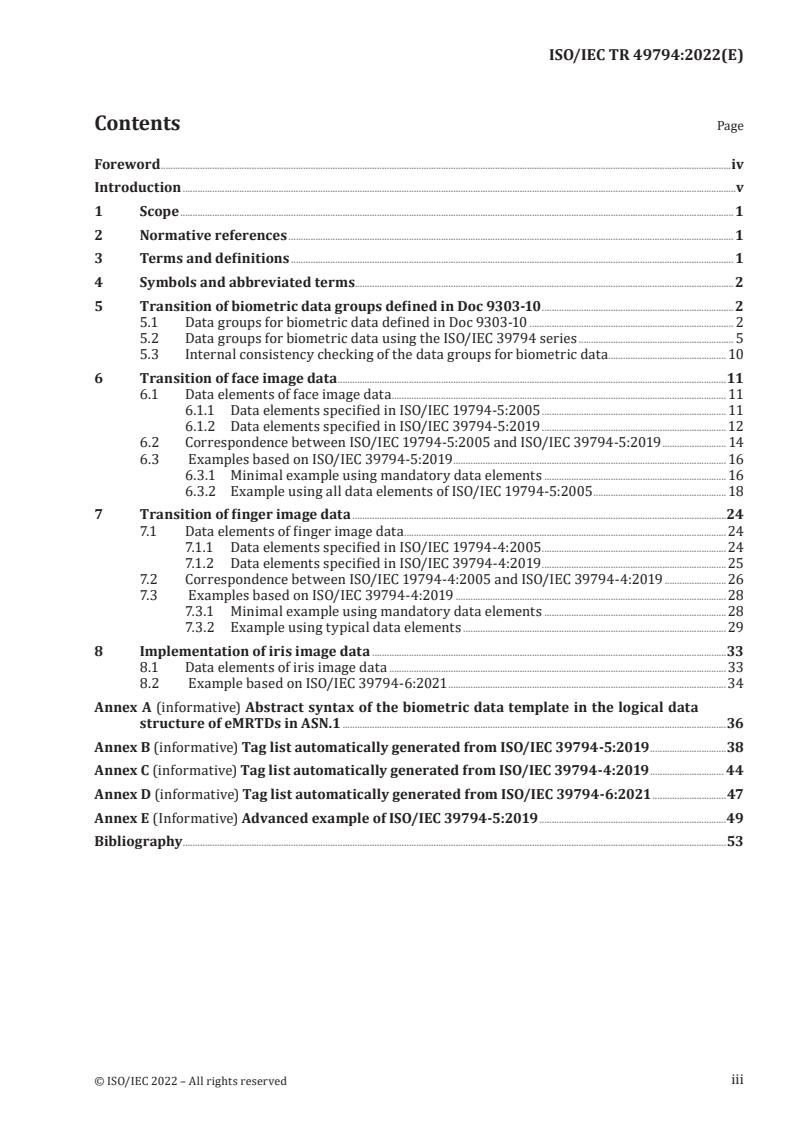
Contents Page
Foreword .iv
Introduction .v
1 Scope . 1
2 Normative references . 1
3 Terms and definitions . 1
4 Symbols and abbreviated terms.2
5 Transition of biometric data groups defined in Doc 9303-10 . 2
5.1 Data groups for biometric data defined in Doc 9303-10 . 2
5.2 Data groups for biometric data using the ISO/IEC 39794 series . 5
5.3 Internal consistency checking of the data groups for biometric data. 10
6 Transition of face image data .11
6.1 Data elements of face image data . 11
6.1.1 Data elements specified in ISO/IEC 19794-5:2005 . 11
6.1.2 Data elements specified in ISO/IEC 39794-5:2019 .12
6.2 Correspondence between ISO/IEC 19794-5:2005 and ISO/IEC 39794-5:2019 . 14
6.3 Examples based on ISO/IEC 39794-5:2019 . 16
6.3.1 Minimal example using mandatory data elements . 16
6.3.2 Example using all data elements of ISO/IEC 19794-5:2005 . 18
7 Transition of finger image data .24
7.1 Data elements of finger image data . 24
7.1.1 Data elements specified in ISO/IEC 19794-4:2005 . 24
7.1.2 Data elements specified in ISO/IEC 39794-4:2019 . 25
7.2 Correspondence between ISO/IEC 19794-4:2005 and ISO/IEC 39794-4:2019 .26
7.3 Examples based on ISO/IEC 39794-4:2019 .28
7.3.1 Minimal example using mandatory data elements .28
7.3.2 Example using typical data elements .29
8 Implementation of iris image data .33
8.1 Data elements of iris image data . 33
8.2 Example based on ISO/IEC 39794-6:2021 .34
Annex A (informative) Abstract syntax of the biometric data template in the logical data
structure of eMRTDs in ASN.1 .36
Annex B (informative) Tag list automatically generated from ISO/IEC 39794-5:2019 .38
Annex C (informative) Tag list automatically generated from ISO/IEC 39794-4:2019 . 44
Annex D (informative) Tag list automatically generated from ISO/IEC 39794-6:2021 .47
Annex E (Informative) Advanced example of ISO/IEC 39794-5:2019 .49
Bibliography .53
iii
© ISO/IEC 2022 – All rights reserved
Foreword
ISO (the International Organization for Standardization) and IEC (the International Electrotechnical
Commission) form the specialized system for worldwide standardization. National bodies that are
members of ISO or IEC participate in the development of International Standards through technical
committees established by the respective organization to deal with particular fields of technical
activity. ISO and IEC technical committees collaborate in fields of mutual interest. Other international
organizations, governmental and non-governmental, in liaison with ISO and IEC, also take part in the
work.
The procedures used to develop this document and those intended for its further maintenance
are described in the ISO/IEC Directives, Part 1. In particular, the different approval criteria
needed for the different types of document should be noted. This document was drafted in
accordance with the editorial rules of the ISO/IEC Directives, Part 2 (see www.iso.org/directives or
www.iec.ch/members_experts/refdocs).
Attention is drawn to the possibility that some of the elements of this document may be the subject
of patent rights. ISO and IEC shall not be held responsible for identifying any or all such patent
rights. Details of any patent rights identified during the development of the document will be in the
Introduction and/or on the ISO list of patent declarations received (see www.iso.org/patents) or the IEC
list of patent declarations received (see https://patents.iec.ch).
Any trade name used in this document is information given for the convenience of users and does not
constitute an endorsement.
For an explanation of the voluntary nature of standards, the meaning of ISO specific terms and
expressions related to conformity assessment, as well as information about ISO's adherence to
the World Trade Organization (WTO) principles in the Technical Barriers to Trade (TBT) see
www.iso.org/iso/foreword.html. In the IEC, see www.iec.ch/understanding-standards.
This document was prepared by Technical Committee ISO/IEC JTC 1, Information technology,
Subcommittee SC 37, Biometrics.
Any feedback or questions on this document should be directed to the user’s national standards
body. A complete listing of these bodies can be found at www.iso.org/members.html and
www.iec.ch/national-committees.
iv
© ISO/IEC 2022 – All rights reserved
Introduction
Face images, fingerprints and iris patterns have been used for many decades to verify the identity of
individuals. In recent years, digital face images have been used in many applications of automated
face recognition. Photographic formats are standardized, for example for electronic machine-readable
travel documents (eMRTDs), identity documents and driver's licences.
Biometric data interchange formats enable the interoperability of different biometric systems. The
first generation of biometric data interchange formats was published in 2005 with the first edition of
the ISO/IEC 19794 series. From 2011 onwards, the second generation of biometric data interchange
formats was published, in which new data elements related to biometric sample quality were added and
header data structures were harmonized across all parts of the ISO/IEC 19794 series, along with XML
(Extensible Markup Language) encoding.
To meet new and emerging market demands and to avoid future compatibility issues, ISO/IEC JTC 1/
SC 37 developed the ISO/IEC 39794 series. This was the third generation of biometric data interchange
formats, defining extensible biometric data interchange formats capable of including future extensions
in a structured manner. Extensible specifications in ASN.1 (Abstract Syntax Notation One) and the
Distinguished Encoding Rules of ASN.1 form the basis for encoding biometric data in binary tag-length-
value formats. XML Schema Definitions form the basis for encoding biometric data in XML.
The extended and new data formats documented in the ISO/IEC 39794 series specify application-
specific profiles. The structure of the data format in this series is not backward compatible with the
previous generations. However, this new generation addresses, for the first time, a mechanism for
maintaining future extensions in a backwards and forwards compatible manner.
This document, ISO/IEC TR 49794, is intended to assist organizations in moving from the first edition
of the ISO/IEC 19794 series (2005) to the current edition of the ISO/IEC 39794 series (2019) for ID
documents by providing transition examples.
v
© ISO/IEC 2022 – All rights reserved
TECHNICAL REPORT ISO/IEC TR 49794:2022(E)
Information technology — Transition examples from the
ISO/IEC 19794:2005 series to the ISO/IEC 39794 series for
ID documents
1 Scope
This document provides transition examples from ISO/IEC 19794-4:2005 and ISO/IEC 19794-5:2005
formats to ISO/IEC 39794-4:2019 and ISO/IEC 39794-5:2019 formats for eMRTD application. This
document also provides an implementation example for the ISO/IEC 39794-6:2021 format.
This document includes:
— information for eMRTD issuers and eMRTD-reader vendors;
— summarized tables of data elements of ISO/IEC 19794-4:2005 and ISO/IEC 19794-5:2005 and
ISO/IEC 39794-4:2019, ISO/IEC 39794-5:2019 and ISO/IEC 39794-6:2021;
— correspondence tables of data elements between ISO/IEC 19794-4:2005 and ISO/IEC 19794-5:2005
and ISO/IEC 39794-4:2019 and ISO/IEC 39794-5:2019, providing:
— information on whether each data element is normative or optional, and
— a brief note of each data element from the viewpoint of transition;
— tag, length, value (TLV) data examples of ISO/IEC 39794-4:2019, ISO/IEC 39794-5:2019 and
ISO/IEC 39794-6:2021 for implementation, and,
— tag lists of ISO/IEC 39794-4:2019, ISO/IEC 39794-5:2019 and ISO/IEC 39794-6:2021, and an
extended example of ISO/IEC 39794-5 as informative annexes.
The following are not within the scope of this document:
— second and later editions of the ISO/IEC 19794 series (2011 and after), and,
— ASN.1 formats and XML formats specified in the ISO/IEC 39794 series.
2 Normative references
There are no normative references in this document.
3 Terms and definitions
No terms and definitions are listed in this document.
ISO and IEC maintain terminology databases for use in standardization at the following addresses:
— ISO Online browsing platform: available at https:// www .iso .org/ obp
— IEC Electropedia: available at https:// www .electropedia .org/
© ISO/IEC 2022 – All rights reserved
4 Symbols and abbreviated terms
BDB biometric data block
BHT biometric header template
CBEFF Common Biometric Exchange Format Framework
DER distinguished encoding rules
DG data group
DO ber-tlv data object
eMRTD electronic machine-readable travel document
LDS logical data structure
PID product identifier
TLV tag, length, value
5 Transition of biometric data groups defined in Doc 9303-10
5.1 Data groups for biometric data defined in Doc 9303-10
Doc 9303-10 specifies the LDS of eMRTDs. This includes DG 2 for face (mandatory), DG 3 for fingerprint
(optional) and DG 4 for iris (optional). Each DG contains biometric data encoded in accordance with the
relevant International Standards in order to maintain international interoperability.
DG 2 is TLV encoding and its tag is shown in Table 1 (see also Doc 9303-10:2021, Table 43). A Biometric
Information Template Group Template is DO '7F61' as shown in Table 2, which is located under DO
'75' (see Doc 9303-10:2021, Table 44). DO '88' (light grey-highlighted) in Table 2 is a format type; the
number assigned respectively to the biometric data formats is stored in it. DO '5F2E' or DO '7F2E'
(dark grey-highlighted) contain biometric data. If this biometric data is plain binary data, as in
ISO/IEC 19794-5:2005 encoding, DO '5F2E' is chosen. If it is a constructed DO, as in ISO/IEC 39794-5
encoding, DO '7F2E' is chosen.
Table 1 — Data group 2 — Tags of logical data structure (SOURCE: Doc 9303-10:2021, Table 43)
Tag L Value
75 Var See encoding of EF.DG2 (Table 2)
Table 2 — Data group 2 — Biometric encoding tags of logical data structure
(SOURCE: Doc 9303-10:2021, Table 44)
Tag L Value
7F61 Var Biometric information template group template
Tag L Value
02 01 Integer — Number of instances of this type of biometric
st
7F60 Var 1 Biometric information template
Tag L Value
A1 Var Biometric header template (BHT)
Tag L Value
NOTE In case of '5F2E', the biometric data block is encoded according to the format owner and format type. In case of
'7F2E', the biometric data template is defined in ISO/IEC 7816-11.
© ISO/IEC 2022 – All rights reserved
Table 2 (continued)
ICAO header version 0101 (Optional) – Version of the
80 02
CBEFF patron header format
81 01-03 Biometric type (Optional)
82 01 Biometric subtype (Optional for DG2)
83 07 Creation date and time (Optional)
85 08 Validity period (from through) (Optional)
Creator of the biometric reference data (PID) (Option-
86 04
al)
87 02 Format owner (REQUIRED)
88 02 Format type (REQUIRED)
5F2E or Biometric data (encoded according to format owner) also called
Var
7F2E the biometric data block (BDB)
NOTE In case of '5F2E', the biometric data block is encoded according to the format owner and format type. In case of
'7F2E', the biometric data template is defined in ISO/IEC 7816-11.
DG 3 has the same structure as DG 2 and its details are shown in Table 3 (see Doc 9303-10:2021,
Table 46) and Table 4 (see Doc 9303-10:2021, Table 47). The roles of DO '88' and DO '5F2E' / DO '7F2E'
are identical to those of DG 2.
Table 3 — Data group 3 — Tags of logical data structure (SOURCE: Doc 9303-10:2021, Table 46)
Tag L Value
63 Var See encoding of EF.DG3 (Table 4)
Table 4 — Data group 3 — Biometric encoding tags of logical data structure (SOURCE:
Doc 9303-10:2021, Table 47)
Tag L Value
7F61 Var Biometric information template group template
Tag L Value
02 01 Integer – Number of instances of this type of biometric
st
7F60 Var 1 Biometric information template
Tag L Value
A1 Var Biometric header template (BHT)
Tag L Value
ICAO header version 0101 (Optional) – Version of the
80 02
CBEFF patron header format
81 01-03 Biometric type (Optional)
82 01 Biometric subtype (REQUIRED for DG 3)
83 07 Creation date and time (Optional)
85 08 Validity period (from through) (Optional)
Creator of the biometric reference data (PID) (Option-
86 04
al)
87 02 Format owner (REQUIRED)
88 02 Format type (REQUIRED)
5F2E or Biometric data (encoded according to format owner) also called
Var
7F2E the biometric data block (BDB)
Tag L Value
NOTE In case of '5F2E' the biometric data block is encoded according to the format owner and format type. In case of
'7F2E', the biometric data template is defined in ISO/IEC 7816-11.
© ISO/IEC 2022 – All rights reserved
Table 4 (continued)
nd
7F60 Var 2 Biometric information template
Tag L Value
A1 Var Biometric header template (BHT)
Tag L Value
ICAO header version 0101 (Optional) – Version of the
80 02
CBEFF patron header format
81 01-03 Biometric type (Optional)
82 01 Biometric subtype (REQUIRED for DG 3)
83 07 Creation date and time (Optional)
85 08 Validity period (from through) (Optional)
Creator of the biometric reference data (PID) (Option-
86 04
al)
87 02 Format owner (REQUIRED)
88 02 Format type (REQUIRED)
5F2E or Biometric data (encoded according to format owner) also called
Var
7F2E the biometric data block (BDB)
NOTE In case of '5F2E' the biometric data block is encoded according to the format owner and format type. In case of
'7F2E', the biometric data template is defined in ISO/IEC 7816-11.
DG 4 also has the same structure as DG 2 and its details are shown in Table 5 (see Doc 9303-10:2021,
Table 53) and Table 6 (see Doc 9303-10:2021, Table 54). The roles of DO '88' and DO '5F2E' / DO '7F2E'
are identical to those of DG 2.
Table 5 — Data group 4 — Tags of logical data structure (SOURCE: Doc 9303-10:2021, Table 53)
Tag L Value
76 Var See Biometric encoding of EF.DG4 (Table 6)
Table 6 — Data group 4 — Biometric encoding tags of logical data structure
(SOURCE: Doc 9303-10:2021, Table 54)
Tag L Value
7F61 Var Biometric information template group template
Tag L Value
02 01 Integer — Number of instances of this type of biometric
st
7F60 Var 1 Biometric information template
Tag L Value
A1 Var Biometric header template (BHT)
Tag L Value
ICAO header version 0101 (Optional) — Version of the
80 02
CBEFF patron header format
81 01-03 Biometric type (Optional)
82 01 Biometric subtype (REQUIRED for DG 4)
83 07 Creation date and time (Optional)
85 08 Validity period (from through) (Optional)
Creator of the biometric reference data (PID) (Option-
86 04
al)
87 02 Format owner (REQUIRED)
NOTE In case of '5F2E' the biometric data block is encoded according to the format owner and format type. In case of
'7F2E', the biometric data template is defined in ISO/IEC 7816-11.
© ISO/IEC 2022 – All rights reserved
Table 6 (continued)
88 02 Format type (REQUIRED)
5F2E or Biometric data (encoded according to format owner) also called
Var
7F2E the biometric data block (BDB)
Tag L Value
nd
7F60 Var 2 Biometric information template
Tag L Value
A1 Var Biometric header template (BHT)
Tag L Value
ICAO header version 0101 (Optional) — Version of the
80 02
CBEFF patron header format
81 01-03 Biometric type (Optional)
82 01 Biometric subtype (REQUIRED for DG 4)
83 07 Creation date and time (Optional)
85 08 Validity period (from through) (Optional)
Creator of the biometric reference data (PID) (Option-
86 04
al)
87 02 Format owner (REQUIRED)
88 02 Format type (REQUIRED)
5F2E or Biometric data (encoded according to format owner) also called
Var
7F2E the biometric data block (BDB)
NOTE In case of '5F2E' the biometric data block is encoded according to the format owner and format type. In case of
'7F2E', the biometric data template is defined in ISO/IEC 7816-11.
5.2 Data groups for biometric data using the ISO/IEC 39794 series
eMRTD issuers essentially maintain the data structures as shown in Table 7, Table 10 and Table 12.
DG 2 is shown in Table 7. DO '88' (light grey-highlighted) in Table 7 is the identifier of format type,
which indicates ISO/IEC 39794-5:2019 instead of ISO/IEC 19794-5:2005 (see Table 8).
Table 7 — Data group 2 — Biometric encoding tags of logical data structure for
ISO/IEC 39794-5:2019
Tag L Value Notes
7F61 Var. Biometric information template group template
Tag L Value
Integer — Number of instances of this type of biom-
02 01
etric
st
7F60 Var. 1 Biometric information template
Tag L Value
A1 Var. Biometric header template (BHT)
Tag L Value
ICAO header version 0101
(Optional) – Version of
80 02
the CBEFF patron header
format
81 01-03 Biometric type (Optional)
Biometric subtype (Op-
82 01
tional for DG 2)
© ISO/IEC 2022 – All rights reserved
Table 7 (continued)
Creation date and time
83 07
(Optional)
Validity period (from
85 08
through) (Optional)
Creator of the biometric
86 04 reference data (PID) (Op-
tional)
Format owner (RE- '0101' is stored, which is the
87 02
QUIRED) ID of ISO/IEC JTC 1/SC 37
'002A' is stored when ISO/
IEC 39794-5:2019 is used.
88 02 Format type (REQUIRED)
See Table 8.
Tag L Value
'7F2E' is used when ISO/
IEC 39794-5:2019 is con-
Biometric data template defined in ISO/
7F2E Var.
tained under it.
IEC 7816-11.
See Table 9.
Table 8 — CBEFF BDB format types for face image data
Format type
Data group Modality International Standard No.
Hex Decimal
ISO/IEC 19794-5:2005 0x0008 8
DG 2 Face
ISO/IEC 39794-5:2019 0x002A 42
Biometric data encoded according to the ISO/IEC 19794 series (2005 edition) is stored in DO '5F2E'.
Biometric data encoded according to the ISO/IEC 39794 series is constructed, so eMRTD issuers use
DO '7F2E' instead of DO '5F2E' (see Table 9).
Table 9 — Tag number for storing biometric data in biometric information template
Tag International Standard No.
5F2E ISO/IEC 19794 series (2005 edition)
7F2E ISO/IEC 39794 series
DG 3 is shown in Table 10. DO '88' (light grey high-lighted) in Table 10 is the identifier of format type,
which indicates ISO/IEC 39794-4 instead of ISO/IEC 19794-4:2005 (see Table 11).
Table 10 — Data group 3 — Biometric encoding tags of logical data structure
for ISO/IEC 39794-4:2019
Tag L Value Notes
7F61 Var. Biometric information template group template
Tag L Value
Integer — Number of instances of this type of biom-
02 01
etric
st
7F60 Var. 1 Biometric information template
Tag L Value
A1 Var. Biometric header template (BHT)
Tag L Value
© ISO/IEC 2022 – All rights reserved
Table 10 (continued)
ICAO header version 0101
(Optional) — Version of
80 02
the CBEFF patron header
format
81 01-03 Biometric type (Optional)
Biometric subtype (RE-
82 01
QUIRED for DG 3)
Creation date and time
83 07
(Optional)
Validity period (from
85 08
through) (Optional)
Creator of the biometric
86 04 reference data (PID) (Op-
tional)
Format owner (RE- '0101' is stored, which is the
87 02
QUIRED) ID of ISO/IEC JTC 1/SC 37
'0028' is stored when ISO/
IEC 39794-4:2019 is used.
88 02 Format type (REQUIRED)
See Table 11.
Tag L Value
'7F2E' is used when ISO/
IEC 39794-4:2019 is con-
Biometric data template defined in ISO/
7F2E Var.
tained under it.
IEC 7816-11.
See Table 9.
Tag L Value
nd
7F60 Var. 2 Biometric information template
Tag L Value
A1 Var. Biometric header template (BHT)
Tag L Value
ICAO header version 0101
(Optional) — Version of
80 02
the CBEFF patron header
format
81 01-03 Biometric type (Optional)
Biometric subtype (RE-
82 01
QUIRED for DG 3)
Creation date and time
83 07
(Optional)
Validity period (from
85 08
through) (Optional)
Creator of the biometric
86 04 reference data (PID) (Op-
tional)
Format owner (RE- '0101' is stored, which is the
87 02
QUIRED) ID of ISO/IEC JTC 1/SC 37
'0028' is stored when ISO/
IEC 39794-4:2019 is used.
88 02 Format type (REQUIRED)
See Table 11.
Tag L Value
© ISO/IEC 2022 – All rights reserved
Table 10 (continued)
'7F2E' is used when ISO/
IEC 39794-4:2019 is con-
Biometric data template defined in ISO/
7F2E Var.
tained under it.
IEC 7816-11.
See Table 9.
Table 11 — CBEFF BDB format types for fingerprint image data
Format type
International Standard
Data group Modality
No.
Hex Decimal
ISO/IEC 19794-4:2005 0x0007 7
DG 3 Fingerprint
ISO/IEC 39794-4:2019 0x0028 40
DG 4 is shown in Table 12. DO '88' (light grey highlighted) in Table 12 is the identifier of format type,
which indicates ISO/IEC 39794-6 instead of ISO/IEC 19794-6:2005 (see Table 13).
Table 12 — Data group 4 — Biometric encoding tags of logical data structure
for ISO/IEC 39794-6:2021
Tag L Value Notes
7F61 Var. Biometric information template group template
Tag L Value
Integer — Number of instances of this type of biom-
02 01
etric
st
7F60 Var. 1 Biometric information template
Tag L
A1 Var. Biometric header template (BHT)
Tag L Value
ICAO header version 0101
(Optional) — Version of
80 02
the CBEFF patron header
format
81 01-03 Biometric type (Optional)
Biometric subtype (RE-
82 01
QUIRED for DG 4)
Creation date and time
83 07
(Optional)
Validity period (from
85 08
through) (Optional)
Creator of the biometric
86 04 reference data (PID) (Op-
tional)
Format owner (RE- '0101' is stored, which is the
87 02
QUIRED) ID of ISO/IEC JTC 1/SC 37
'002C' is stored when ISO/
IEC 39794-6:2021 is used.
88 02 Format type (REQUIRED)
See Table 13.
Tag L Value
'7F2E' is used when ISO/
IEC 39794-6:2021 is con-
Biometric data template defined in ISO/
7F2E Var.
tained under it.
IEC 7816-11.
See Table 9.
© ISO/IEC 2022 – All rights reserved
Table 12 (continued)
Tag L Value
nd
7F60 Var. 2 Biometric information template
Tag L Value
A1 Var. Biometric header template (BHT)
Tag L Value
ICAO header version 0101
(Optional) — Version of
80 02
the CBEFF patron header
format
81 01-03 Biometric type (Optional)
Biometric subtype (RE-
82 01
QUIRED for DG 4)
Creation date and time
83 07
(Optional)
Validity period (from
85 08
through) (Optional)
Creator of the biometric
86 04 reference data (PID) (Op-
tional)
Format owner (RE- '0101' is stored, which is ID of
87 02
QUIRED) ISO/IEC JTC 1/SC 37
'002C' is stored when ISO/
IEC 39794-6:2021 is used.
88 02 Format type (REQUIRED)
See Table 13.
Tag L Value
'7F2E' is used when ISO/
IEC 39794-6:2021 is con-
Biometric data template defined in ISO/
7F2E Var.
tained under it.
IEC 7816-11.
See Table 9.
Table 13 — CBEFF BDB format types for iris image data
Format type Notes
International Standard
Data group Modality
No.
Hex Decimal
Rectilinear coordi-
0x0009 9
nates
ISO/IEC 19794-6:2005
DG 4 Iris
0x000B 11 Polar coordinates
ISO/IEC 39794-6:2021 0x002C 44
ISO/IEC JTC 1/SC 17 is responsible for the biometric data template DO '7F2E', whereas the tag allocation
authority of ISO/IEC 39794-4, ISO/IEC 39794-5 and ISO/IEC 39794-6 is ISO/IEC JTC 1/SC 37. For DOs
that are nested into a biometric information template DO '7F60' and whose tag is not allocated by ISO/
IEC JTC 1/SC 17, the tag allocation authority is ISO/IEC JTC 1/SC 37, because eMRTD implementation
assigns ISO/IEC JTC 1/SC 37 as default tag allocation authority.
The ASN.1 module in Annex A describes the syntax of the biometric data template (DO '7F2E') in the
LDS of eMRTDs, based on ISO/IEC 7816-11. The biometric data template is encoded by applying the
ASN.1 distinguished encoding rules (DERs) defined in ISO/IEC 8825-1. Table 14 shows the resulting
encoding.
DO '7F2E' contains biometric data encoded in ISO/IEC 39794-4, ISO/IEC 39794-5 and ISO/IEC 39794-6,
of which the top tag numbers are shown in Table 15. Examples of detailed data elements are described
© ISO/IEC 2022 – All rights reserved
in Clauses 6, 7, and 8. Tag lists automatically generated from ASN.1 definitions of ISO/IEC 39794-4,
ISO/IEC 39794-5 and ISO/IEC 39794-6 are shown in Annex B, C and D.
Table 14 — Data structure under DO '7F2E' for the ISO/IEC 39794 series
Tag L Value
7F2E Var. Biometric data template defined in ISO/IEC 7816-11.
Tag L Value
A1 Var. Biometric data in standardized format (Constructed)
Tag L Value
64, DO defined in the ISO/IEC 39794 series.
65 or Var
See Table 15.
Table 15 — Top tag numbers of DOs encoded in the ISO/IEC 39794 series
International Standard No. Tag
ISO/IEC 39794-4 64
ISO/IEC 39794-5 65
ISO/IEC 39794-6 66
5.3 Internal consistency checking of the data groups for biometric data
eMRTD readers can discriminate which International Standard was applied to encode a presented
eMRTD: one from the ISO/IEC 19794 series (2005) or the ISO/IEC 39794 series. They can also check
consistency among data elements. The following points can be considered when discriminating and
checking:
— The value of DO '88' can be used to identify which International Standard has been applied. See
Table 8 for DG 2, Table 11 for DG 3, and Table 13 for DG 4.
EXAMPLE 1 If 0x0008 is read in DG 2, ISO/IEC 19794-5:2005 encoded data would be found. If 0x002A is
read in DG 2 , ISO/IEC 39794-5:2019 would be found.
— The value of DO '88' can be used to check consistency of the tag numbers for storing biometric data
in the biometric information template:
— The top tag number for storing biometric data depends on either the ISO/IEC 19794 series
(2005) or the ISO/IEC 39794 series. See Table 9.
EXAMPLE 2 If DO '5F2E' is read in DG 2, ISO/IEC 19794-5:2005 encoded data would be found under
it. If DO '7F2E' is read in DG 2, ISO/IEC 39794-5:2019 would be found.
— The tag number of biometric data under DO '7F2E' depends on which part of the ISO/IEC 39794
series is used. See Table 14 and Table 15.
EXAMPLE 3 If 0x002A is read in DO '88' of DG 2, and 0x65 is read as the tag number under DO 'A1',
then this is consistent.
© ISO/IEC 2022 – All rights reserved
6 Transition of face image data
6.1 Data elements of face image data
6.1.1 Data elements specified in ISO/IEC 19794-5:2005
Table 16 shows data elements specified in ISO/IEC 19794-5:2005. Note that several mandatory elements
allow “unspecified” values. If eMRTD issuers set “unspecified” values in these elements, they can omit
such elements from biometric data encoded ISO/IEC 39794-5:2019 when transitioning.
Table 16 — Data elements specified in ISO/IEC 19794-5:2005
Clause No. of ISO/
Block name Data element name M / O Notes
IEC 19794-5:2005
1 Format identifier M 5.4.1
2 Version number M 5.4.2
3 Length of record M 5.4.3
Facial re-
This defines the number of “facial
cord header
record data” that consists of “facial in-
Number of facial im-
4 M 5.4.4 formation block”, “feature point block”
ages
(if it exists), “image information block”,
and “image data block”.
Facial record data
5 M 5.5.1
length
Number of feature If zero is set, there is no “feature point
6 M 5.5.2
points block”.
7 Gender M 5.5.3
8 Eye colour M 5.5.4
Facial
If zero is set, this indicates “unspeci-
9 information Hair colour M 5.5.5
fied”.
block
10 Property mask M 5.5.6
11 Expression M 5.5.7
If "181" is set, this indicates “unspeci-
12 Pose angle M 5.5.8
fied”.
If zero is set, this indicates “unspeci-
13 Pose angle uncertainty M 5.5.9
fied”.
14 Feature point type O 5.6.1
The number of feature point blocks is
15 Feature point code O 5.6.2
Feature equal to the “number of feature points”
Horizontal and vertical
point block element. If this number is zero, no fea-
16 O 5.6.2
position
ture point block exists.
17 Reserved O —
18 Face image type M 5.7.1
19 Image data type M 5.7.2
20 Width M 5.7.3
Image
21 Height M 5.7.4
information
22 Image colour space M 5.7.5
block
23 Source type M 5.7.6
If zero is set, it indicates “unspecified”.
24 Device type M 5.7.7
25 Quality M 5.7.8
Image data
26 Data structure M 5.8.1
block
NOTE “M / O” means mandatory / optional.
© ISO/IEC 2022 – All rights reserved
6.1.2 Data elements specified in ISO/IEC 39794-5:2019
Table 17 shows data elements specified in ISO/IEC 39794-5:2019. Each data element has its own tag
number that can be found in Annex B.
Table 17 — Data elements specified in ISO/IEC 39794-5:2019
Clause No. Clause No.
of ISO/ of ISO/
Block / Element name M / O Notes
IEC 39794- IEC 39794-
5:2019 1:2019
1 Face image data block M 7.2 —
This block is under “Face image data
block” (No. 1).
This block is a sequence of two integers:
one is the generation of biometric data
2 Version block M 7.3 8.2
and the other is the year of the Interna-
tional Standard publication. In the case
of ISO/IEC 39794-5:2019, the genera-
tion is “3” (0x3) and the year is “2019”
(0x7E3).
This block is under “Face image data
block” (No. 1).
3 Representation block M 7.4 —
Multiple representation blocks can exist.
This DO is under “Representation block”
(No. 3).
Representation iden-
The non-negative unique number is as-
4 M 7.5 —
tifier
signed on each representation block. For
example, the first identifier is “0” (0x0)
followed by increments of one.
Capture date/time This block is under “Representation
5 O 7.6 8.3.2
block block” (No. 3).
This block is under “Representation
block” (No. 3)
This is expanded from ISO/IEC 19794-
6 Quality blocks O 7.7 8.3.3
5:2005 and can contain multiple
qualities generated by multiple quality
evaluation algorithms respectively.
This block is under “Representation
block” (No. 3)
7 PAD data block O 7.8 8.3.4
This is newly added for presentation
attack detection.
8 Session identifier O 7.9 —
These DOs are under “PAD data block”
9 Derived from O 7.10 —
(No. 7).
10 Capture device block O 7.11 8.3.1
11 Model identifier block O 7.12 8.3.1.1
These DOs are under “Capture device
Certification identifier
block” (No. 10).
12 O 7.13 8.3.1.3
blocks
Identity metadata This DO is under “Representation block”
13 O 7.14 —
block (No. 3).
NOTE 1 “M / O” means mandatory / optional.
NOTE 2 3D shape representation block, specified in ISO/IEC 39794-5:2019, is not shown in this table.
© ISO/IEC 2022 – All rights reserved
Table 17 (continued)
Clause No. Clause No.
of ISO/ of ISO/
Block / Element name M / O Notes
IEC 39794- IEC 39794-
5:2019 1:2019
14 Gender O 7.15 —
15 Eye colour O 7.16 —
These DOs are under “Identity metadata
block” (No. 13).
16 Hair colour O 7.17 —
17 Subject height O 7.18 —
This DO is under “Identity metadata
block” (No. 13).
“Blink” and “Feature distorting medical
18 Properties block O 7.19 —
condition” in ISO/IEC 19794-5:2005 are
changed to “pupil or iris not visible” and
“biometric absent” respectively in ISO/
IEC 39794-5:2019.
19 Expression block O 7.20 —
These DOs are under “Identity metadata
block” (No. 13).
20 Pose angle block O 7.21 —
Yaw/pitch/roll angle These DOs are under “Pose angle block”
21 O 7.22 —
data block (No. 20).
Yaw/pitch/roll angle
22 O 7.23 —
value
These DOs are under “Yaw/pitch/roll
angle data blocks” (No. 21) respectively.
Yaw/pitch/roll angle
23 O 7.24 —
uncertainty
This block is under “Representation
24 Landmark block O 7.25 —
block” (No. 3).
Image representation This block is under “Representation
25 M 7.30 —
block block” (No. 3).
This block is under “Image representa-
tion block” (No. 25).
2D image representa-
26 M 7.31 —
If 2D image representation is chosen,
tion block
this element is mandatory. See NOTE 2 at
the end of this table.
27 2D representation data M 7.32 —
These DOs are under “2D image rep-
2D capture device
resentation block” (No. 26).
28 O 7.33 —
block
2D capture device This block is under “2D capture device
29 O 7.34 —
spectral block block” (No. 28).
2D capture device This DO is under “2D capture device
30 O 7.35 —
technology identifier block” (No. 28).
2D image information This block is under “2D image rep-
31 M 7.36 —
block resentation block” (No. 26).
This DO is under “2D image information
32 2D face image kind O 7.37 —
block” (No. 31).
Post-acquisition pro- This block is under “2D image informa-
33 O 7.38 —
cessing block tion block” (No. 31).
NOTE 1 “M / O” means mandatory / optional.
NOTE 2 3D shape representation block, specified in ISO/IEC 39794-5:2019, is not shown in this table.
© ISO/IEC 2022 – All rights reserved
Table 17 (continued)
Clause No. Clause No.
of ISO/ of ISO/
Block / Element name M / O Notes
IEC 39794- IEC 39794-
5:2019 1:2019
Lossy transformation
34 O 7.39 —
attempts
35 Image data format M 7.40 —
These DOs is under “2D image informa-
Camera to subject
36 O 7.41 — tion block” (No. 31).
distance
37 Sensor diagonal O 7.42 —
38 Lens focal length O 7.43 —
This block is under “2D image informa-
39 Image size block O 7.44 —
tion block” (No. 31).
40 Width O 7.45 —
These DOs are “Image size block” (No.
39).
41 Height O 7.46 —
Image face measure- This block is under “2D image informa-
42 O 7.47 —
ments block tion block” (No. 31).
This DO is under “2D image information
43 Image colour space O 7.52 —
block” (No. 31).
Reference colour map- This block is under “2D image informa-
44 O 7.53 —
ping block tion block” (No. 31).
NOTE 1 “M / O” means mandatory / optional.
NOTE 2 3D shape representation block, specified in ISO/IEC 39794-5:2019, is not shown in this table.
6.2 Correspondence between ISO/IEC 19794-5:2005 and ISO/IEC 39794-5:2019
Table 18 shows the correspondence of mandatory data elements in ISO/IEC 19794-5:2005 and data
elements in ISO/IEC 39794-5:2019. Both structures are different and the "facial record header" block
in ISO/IEC 19794-5:2005 does not have an exact correspondence in ISO/IEC 39794-5:2019. Additional
points for consideration are shown at the end of the table.
Table 18 — Correspondence table of data elements in ISO/IEC 19794-5:2005 and
ISO/IEC 39794-5:2019
ISO/IEC 19794-5:2005 ISO/IEC 39794-5:2019
Notes
No. in Data element No. in
Block name Block/data element name M / O
Table 16 name Table 17
Format iden-
tifier
These data elements are general infor-
Version num-
2 — — — mation, so their correspondence will not
ber
be considered.
Facial record
Length of
header
record
Multiple face images can be encoded by
Number of
4 — — — multiple representation blocks (See No.3,
facial images
Table 17).
NOTE 1 “M / O” means mandatory / optional.
NOTE 2 Feature point block of ISO/IEC 19794-5:2005 is omitted.
© ISO/IEC 2022 – All rights reserved
Table 18 (continued)
ISO/IEC 19794-5:2005 ISO/IEC 39794-5:2019
Notes
No. in Data element No. in
Block name Block/data element name M / O
Table 16 name Table 17
Facial record The role of this data element is trans-
5 — — —
data length ferred to “L” of TLV format.
If zero (“unspecified”) is set in ISO/IEC
Number of Landmark block in rep- 19794-5:2005 encoding, the correspond-
6 3, 24 O
feature points resentation block ence data element in ISO/IEC 39794-
5:2019 is omitted. See NOTE 2.
Gender in identity metadata
7 Gender 13, 14 O
block
If zero (“unspecified”) is set in ISO/IEC
Eye colour in identity metada- 19794-5:2005 encoding, the correspond-
8 Eye colour 13, 15 O
ta block ence data elements in ISO/IEC 39794-
5:2019 are omitted.
Hair colour in identity meta-
9 Hair colour 13, 16 O
data block
If zero (“unspecified”) is set in ISO/
IEC 19794-5:2005 encoding, the
correspondence data elements in ISO/
Facial infor-
IEC 39794-5:2019 are omitted.
mation block Property Property block in identity
10 13, 18 O
“Blink” and “Feature distorting medical
mask metadata block
condition” in ISO/IEC 19794-5:2005 are
changed to “pupil or iris not visible” and
“biometric absent” respectively in ISO/
IEC 39794-5:2019.
If zero (“unspecified”) is set in ISO/
Expression block in identity IEC 19794-5:2005 encoding, the
11 Expression 13, 19 O
metadata block correspondence data elements in ISO/
IEC 39794-5:2019 are omitted.
Yaw/pitch/roll angle value If '181' (“unspecified”) is set in ISO/
12 Pose angle 21, 22 in yaw/pitch/roll angle data O IEC 19794-5:2005 encoding, this data
block element is omitted.
If zero (“unspecified”) is set in ISO/
Yaw/pitch/roll angle uncer-
Pose angle IEC 19794-5:2005 encoding, the
13 21, 23 tainty in Yaw/pitch/roll angle O
uncertainty correspondence data elements in ISO/
data block
IEC 39794-5:2019 are omitted.
If needed, "MRTD" may be set in ISO/
Face image 2D face image kind in 2D IEC 39794-5:2019 encoding, instead
18 31, 32 O
type image representation block of, for example, "Full frontal" in ISO/
IEC 19794-5:2005.
“JPEG2000” in ISO/IEC 19794-5:2005
Image data Image data format in 2D
19 31, 35 M is expanded to “JPEG2000 lossy” and
type image information lock
“JPEG2000 lossless”.
20 Width 39, 40 Width in image size block O
—
21 Height 39, 41 Height in image size lock O
Image infor-
mation block
Image colour Image colour space in 2D
22 31, 43 O
space image information block
2D capture device technol-
If zero (“unspecified”) is set in ISO/
23 Source type 28, 30 ogy identifier in 2D capture O
IEC 19794-5:2005 encoding, the cor-
device block
respondence data elements may be
Model identifier block in
omitted.
24 Device type 10, 11 O
capture device block
Quality blocks in 2D image
25 Quality 3, 6 O
information block
Image data Data struc- 2D representation data in 2D
26 26, 27 M —
block ture image representation block
NOTE 1 “M / O” means mandatory / optional.
NOTE 2 Feature point block of ISO/IEC 19794-5:2005 is omitted.
© ISO/IEC 2022 – All rights reserved
6.3 Examples based on ISO/IEC 39794-5:2019
6.3.1 Minimal example using mandatory data elements
Table 19 is a minimal example using only mandatory data elements.
© ISO/IEC 2022 – All rights reserved
© ISO/IEC 2022 – All rights reserved
Table 19 — Example coding in ISO/IEC 39794-5:2019, using minimal (mandatory only) data elements
Tag L Value
0x65 Var. Face image data block.
Tag L Value
0xA0 7 Version block.
Tag L Value
0x80 1 Generation number of the International Standard. “3” (0x3) is set if ISO/IEC 39794-5:2019 is used. See ISO/IEC 39794-1:2019.
Publication year of the International Standard. “2019” (0x7E3) is set if ISO/IEC 39794-5:2019 is used. See ISO/IEC 39794-
0x81 2
1:2019.
Tag L Value
0xA1 Var. Representation blocks.
Tag L Value
0x30 Var. Representation block.
Tag L Value
Representation identifier. The non-negative unique number is assigned on each representation block. For exam-
0x80 Var.
ple, the first identifier is zero (0x0), followed by increments of one.
0xA1 Var. Image representation.
Tag L Value
0xA0 Var. Image representation base.
Tag L Value
0xA0 Var. Image representation 2D block.
Tag L Value
Representation data 2D, containing image data, for example, JPEG image data,
0x80 Var.
as octet string.
0xA1 5 Image information 2D block.
Tag L Value
0xA0 3 Code of image data format.
Tag L Value
Code of Image data format. "2" (0x2) i
...