

ISO/TS 14076:2025
(Main)Environmental management — Environmental techno-economic assessment — Principles, requirements and guidance
General Information
- Abstract
This document provides principles, requirements and guidance for performing an environmental techno-economic assessment (eTEA). eTEAs provide economic analyses combined with an assessment of environmental impacts. This document specifies requirements for documenting the results, underlying assumptions, parameters and methodologies used in an eTEA. This document is applicable to process systems of any size or production scale.
- Status
- Published
- Publication Date
- 01-Jun-2025
- Technical Committee
- ISO/TC 207/SC 5 - Life cycle assessment
- Drafting Committee
- ISO/TC 207/SC 5 - Life cycle assessment
- Current Stage
- 6060 - International Standard published
- Start Date
- 02-Jun-2025
- Due Date
- 15-Mar-2025
- Completion Date
- 02-Jun-2025

Overview
ISO/TS 14076:2025 - Environmental management - Environmental techno‑economic assessment (eTEA): Principles, requirements and guidance - defines a standardized approach for combining economic analysis with environmental impact assessment for process systems. Applicable to processes of any size or production scale, the Technical Specification helps practitioners produce transparent, reproducible eTEAs that support decision making across design, development and commercialization phases.
Key search terms: ISO/TS 14076:2025, environmental techno‑economic assessment, eTEA, TEA, LCA, process systems, documentation, transparency
Key Topics and Requirements
ISO/TS 14076:2025 structures eTEAs around clear principles and a methodological framework that aligns techno‑economic analysis (TEA) with life cycle assessment (LCA). Main technical topics and requirements include:
- Principles: iterative approach, transparency, comprehensiveness, and prioritizing sound scientific and economic methods.
- Goal and scope definition: define the purpose, system boundaries, functional unit, basis of production and reference flows.
- Technical analysis (TEA): collection of technological parameters, process modelling and calculation of performance metrics.
- Economic analysis: defining financial parameters, computing cost and profitability metrics, and incorporating influences outside process boundaries when relevant.
- Life cycle assessment (LCA): integration of ISO 14040/14044 LCA methods to quantify environmental impacts across the product system’s life cycle.
- Sensitivity analysis: evaluate how key assumptions affect results and robustness of conclusions.
- Documentation: explicit requirements to record results, assumptions, parameters, methodologies and digital files to ensure reproducibility and effective interpretation.
- Guidance and examples: Annexes provide an illustrative eTEA and guidance for selecting basis of production.
Applications and Who Uses It
ISO/TS 14076:2025 is designed for practitioners who perform eTEAs, including professionals in:
- Industry (process design, product development, sustainability teams)
- Government agencies (policy analysis, regulatory assessment)
- Academia and research organizations (techno‑economic and environmental studies)
- Consultants providing lifecycle, cost‑benefit and sustainability services
Practical uses: compare alternative processes or technologies, inform investment and scale decisions, support environmental product declarations, and improve transparency in sustainability reporting.
Related Standards
- ISO 14040:2006 - Life cycle assessment - Principles and framework
- ISO 14044:2006 - Life cycle assessment - Requirements and guidance
ISO/TS 14076:2025 complements LCA standards by prescribing how to integrate economic and environmental perspectives into a single, well‑documented eTEA for better decision support.
Get Certified
Connect with accredited certification bodies for this standard

BSI Group
BSI (British Standards Institution) is the business standards company that helps organizations make excellence a habit.

Bureau Veritas
Bureau Veritas is a world leader in laboratory testing, inspection and certification services.

DNV
DNV is an independent assurance and risk management provider.
Sponsored listings
Frequently Asked Questions
ISO/TS 14076:2025 is a technical specification published by the International Organization for Standardization (ISO). Its full title is "Environmental management — Environmental techno-economic assessment — Principles, requirements and guidance". This standard covers: This document provides principles, requirements and guidance for performing an environmental techno-economic assessment (eTEA). eTEAs provide economic analyses combined with an assessment of environmental impacts. This document specifies requirements for documenting the results, underlying assumptions, parameters and methodologies used in an eTEA. This document is applicable to process systems of any size or production scale.
This document provides principles, requirements and guidance for performing an environmental techno-economic assessment (eTEA). eTEAs provide economic analyses combined with an assessment of environmental impacts. This document specifies requirements for documenting the results, underlying assumptions, parameters and methodologies used in an eTEA. This document is applicable to process systems of any size or production scale.
ISO/TS 14076:2025 is classified under the following ICS (International Classification for Standards) categories: 13.020.10 - Environmental management. The ICS classification helps identify the subject area and facilitates finding related standards.
ISO/TS 14076:2025 is available in PDF format for immediate download after purchase. The document can be added to your cart and obtained through the secure checkout process. Digital delivery ensures instant access to the complete standard document.
Standards Content (Sample)
Technical
Specification
ISO/TS 14076
First edition
Environmental management —
2025-06
Environmental techno-economic
assessment — Principles,
requirements and guidance
Management environnemental — Évaluation technico-
économique environnementale — Principes, exigences et
recommandations
Reference number
© ISO 2025
All rights reserved. Unless otherwise specified, or required in the context of its implementation, no part of this publication may
be reproduced or utilized otherwise in any form or by any means, electronic or mechanical, including photocopying, or posting on
the internet or an intranet, without prior written permission. Permission can be requested from either ISO at the address below
or ISO’s member body in the country of the requester.
ISO copyright office
CP 401 • Ch. de Blandonnet 8
CH-1214 Vernier, Geneva
Phone: +41 22 749 01 11
Email: copyright@iso.org
Website: www.iso.org
Published in Switzerland
ii
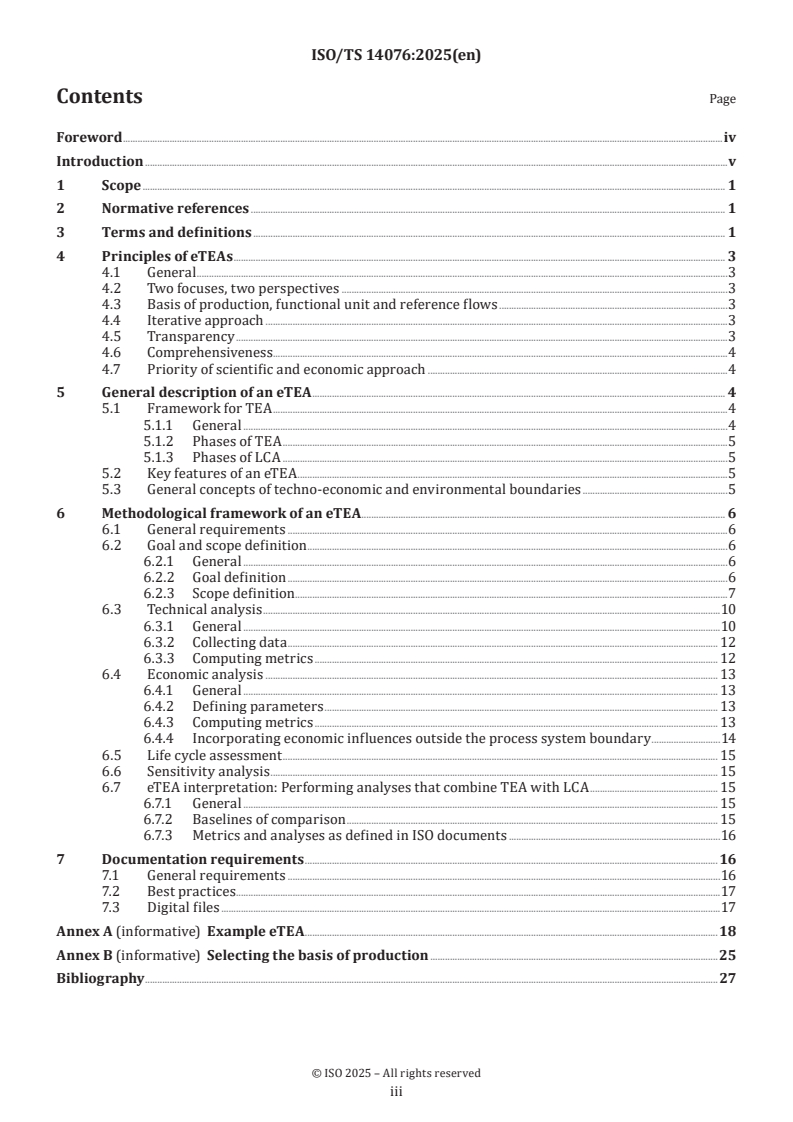
Contents Page
Foreword .iv
Introduction .v
1 Scope . 1
2 Normative references . 1
3 Terms and definitions . 1
4 Principles of eTEAs . 3
4.1 General .3
4.2 Two focuses, two perspectives .3
4.3 Basis of production, functional unit and reference flows .3
4.4 Iterative approach .3
4.5 Transparency .3
4.6 Comprehensiveness .4
4.7 Priority of scientific and economic approach .4
5 General description of an eTEA . 4
5.1 Framework for TEA .4
5.1.1 General .4
5.1.2 Phases of TEA .5
5.1.3 Phases of LCA .5
5.2 Key features of an eTEA .5
5.3 General concepts of techno-economic and environmental boundaries .5
6 Methodological framework of an eTEA . 6
6.1 General requirements .6
6.2 Goal and scope definition .6
6.2.1 General .6
6.2.2 Goal definition .6
6.2.3 Scope definition .7
6.3 Technical analysis .10
6.3.1 General .10
6.3.2 Collecting data . 12
6.3.3 Computing metrics . 12
6.4 Economic analysis . 13
6.4.1 General . 13
6.4.2 Defining parameters . 13
6.4.3 Computing metrics . 13
6.4.4 Incorporating economic influences outside the process system boundary .14
6.5 Life cycle assessment . 15
6.6 Sensitivity analysis . 15
6.7 eTEA interpretation: Performing analyses that combine TEA with LCA . 15
6.7.1 General . 15
6.7.2 Baselines of comparison . 15
6.7.3 Metrics and analyses as defined in ISO documents .16
7 Documentation requirements .16
7.1 General requirements .16
7.2 Best practices . .17
7.3 Digital files .17
Annex A (informative) Example eTEA .18
Annex B (informative) Selecting the basis of production .25
Bibliography .27
iii
Foreword
ISO (the International Organization for Standardization) is a worldwide federation of national standards
bodies (ISO member bodies). The work of preparing International Standards is normally carried out through
ISO technical committees. Each member body interested in a subject for which a technical committee
has been established has the right to be represented on that committee. International organizations,
governmental and non-governmental, in liaison with ISO, also take part in the work. ISO collaborates closely
with the International Electrotechnical Commission (IEC) on all matters of electrotechnical standardization.
The procedures used to develop this document and those intended for its further maintenance are described
in the ISO/IEC Directives, Part 1. In particular, the different approval criteria needed for the different types
of ISO document should be noted. This document was drafted in accordance with the editorial rules of the
ISO/IEC Directives, Part 2 (see www.iso.org/directives).
ISO draws attention to the possibility that the implementation of this document may involve the use of (a)
patent(s). ISO takes no position concerning the evidence, validity or applicability of any claimed patent
rights in respect thereof. As of the date of publication of this document, ISO had not received notice of (a)
patent(s) which may be required to implement this document. However, implementers are cautioned that
this may not represent the latest information, which may be obtained from the patent database available at
www.iso.org/patents. ISO shall not be held responsible for identifying any or all such patent rights.
Any trade name used in this document is information given for the convenience of users and does not
constitute an endorsement.
For an explanation of the voluntary nature of standards, the meaning of ISO specific terms and expressions
related to conformity assessment, as well as information about ISO’s adherence to the World Trade
Organization (WTO) principles in the Technical Barriers to Trade (TBT), see www.iso.org/iso/foreword.html.
This document was prepared by Technical Committee ISO/TC 207, Environmental management,
Subcommittee SC 5, Life cycle assessment.
Any feedback or questions on this document should be directed to the user’s national standards body. A
complete listing of these bodies can be found at www.iso.org/members.html.
iv
Introduction
During the process of researching, designing, developing and commercializing process systems, many
decisions must be made concerning details such as the selection of unit operations, equipment types and
sizes, operating conditions and procedures, mass and energy flows, financing contracts, sales prices and
environmental releases. These decisions are made based on many indicators, especially technical indicators
(e.g. product yield, process efficiency, quality), economic indicators (e.g. cost, profitability, returns on
investment) and environmental indicators (e.g. greenhouse gas (GHG) emissions, resource depletion,
freshwater consumption). These ultimately affect the total value of the process system to companies, clients,
consumers, government and society.
An environmental techno-economic assessment (eTEA) characterizes process systems in terms of key
environmental, technical (“techno”) and economic factors. These characteristics are represented by a
collection of commonly understood metrics that can then be interpreted for decision-making purposes. Many
assumptions must be made as a part of an eTEA can have a major impact on the results, with financial and
environmental consequences throughout the life cycle of the process and its products. These assumptions
can include the values of key parameters, analysis boundaries and the methods themselves. Because of its
importance and the wide variability in methods for eTEAs, there is a need for practical guidance on their
performance. Organizations can benefit significantly by providing clear and consistent guidance on how to
conduct an eTEA.
Therefore, this document:
— establishes terminology and key definitions of common metrics used in eTEAs;
— provides requirements and guidance on how to conduct eTEAs;
— provides a framework for clearly documenting the results and the underlying assumptions used in an
eTEA so that others can effectively interpret the results.
This document is intended for eTEA practitioners (i.e. people who conduct eTEAs, such as data gathering,
making calculations or assessing and interpreting the results). Practitioners can include industry,
government or academia.
An illustrative example of an eTEA is given in Annex A.
v
Technical Specification ISO/TS 14076:2025(en)
Environmental management — Environmental techno-
economic assessment — Principles, requirements and
guidance
1 Scope
This document provides principles, requirements and guidance for performing an environmental
techno-economic assessment (eTEA). eTEAs provide economic analyses combined with an assessment of
environmental impacts.
This document specifies requirements for documenting the results, underlying assumptions, parameters
and methodologies used in an eTEA.
This document is applicable to process systems of any size or production scale.
2 Normative references
The following documents are referred to in the text in such a way that some or all of their content constitutes
requirements of this document. For dated references, only the edition cited applies. For undated references,
the latest edition of the referenced document (including any amendments) applies.
ISO 14040:2006, Environmental management — Life cycle assessment — Principles and framework
ISO 14044:2006, Environmental management — Life cycle assessment — Requirements and guidelines
3 Terms and definitions
For the purposes of this document, the following terms and definitions apply.
ISO and IEC maintain terminology databases for use in standardization at the following addresses:
— ISO Online browsing platform: available at https:// www .iso .org/ obp
— IEC Electropedia: available at https:// www .electropedia .org/
3.1
environmental techno-economic assessment
eTEA
eco-technoeconomic analysis
compilation and evaluation of technological parameters, environmental impacts and economic performance
of a process system (3.13) and an associated product system (3.12)
3.2
basis of production
quantified performance of a process system (3.13), reflecting its specific scale, size or rate
3.3
process
set of interrelated or interacting activities that uses or transforms inputs to deliver a result
Note 1 to entry: The process can be physical or conceptual.
[SOURCE: ISO 14050:2020, 3.1.9, modified — Note 1 to entry added.]
3.4
functional unit
quantified performance of a product system (3.12) for use as a reference unit
Note 1 to entry: The functional unit reflects the size of the process system (3.13).
[SOURCE: ISO 14040:2006, 3.20, modified — Note 1 to entry added.]
3.5
reference flow
measure of the outputs from processes (3.3) in a given product system (3.12) required to fulfil the function
expressed by the functional unit (3.4)
[SOURCE: ISO 14040:2006, 3.29]
3.6
life cycle assessment
LCA
compilation and evaluation of the inputs, outputs and the potential environmental impacts of a product
system (3.12) throughout its life cycle
[SOURCE: ISO 14040:2006, 3.2]
3.7
life cycle impact assessment
LCIA
phase of life cycle assessment (3.6) aimed at understanding and evaluating the magnitude and significance of
the potential environmental impacts for a product system (3.12) throughout the life cycle of the product (3.9)
[SOURCE: ISO 14040:2006, 3.4]
3.8
techno-economic analysis
TEA
compilation and evaluation of technological parameters and economic performance of a process system (3.13)
3.9
product
any goods or service
[SOURCE: ISO 14050:2020, 3.5.12]
3.10
environment
surroundings in which an organization operates, including air, water, land, natural resources, flora, fauna,
humans and their interrelationships
[SOURCE: ISO 14050:2020, 3.2.2]
3.11
business unit
discrete and accountable function or sub-function within an organization
[SOURCE: ISO/TS 21089:2018, 3.28, modified — Note 1 to entry deleted.]
3.12
product system
collection of unit processes (3.3) with elementary and product flows, performing one or more defined
functions, and which models the life cycle of a product (3.9)
[SOURCE: ISO 14040:2006, 3.28]
3.13
process system
system of one or more interlinked unit processes (3.3) over which the business unit (3.11) has control
Note 1 to entry: In the life cycle assessment (3.6) part of the environmental techno-economic assessment (3.1), up and
downstream processes are normally added.
Note 2 to entry: The process system is part of the product system (3.12).
4 Principles of eTEAs
4.1 General
eTEAs are the combination of a techno-economic analysis (TEA) and a life cycle assessment (LCA). eTEAs
include economic, technical and environmental considerations that can inform decision-making.
These principles are fundamental and should be used as guidance for decisions relating to both the planning
and conducting of an eTEA.
4.2 Two focuses, two perspectives
eTEA considers the combination of the following two focuses with two different perspectives:
— The techno-economic focus considers the mass flows, energy flows and economic value of a process
system from the perspective of a business unit that has control over the process system. The economic
boundary is usually defined by the boundary of the business unit of relevance and includes all expenses,
costs or revenues directly associated with the process system of interest, typically incurred by the
business unit only, such as those associated with manufacturing, operation, commissioning, startup and
decommissioning.
— The environmental focus of the analysis considers the life cycle of a product system associated with a
process system from the perspective of the environment. The LCA follows the principles described in
ISO 14040, generally beginning at raw material extraction and acquisition, including the manufacture of
products, and final use and end of life or disposal.
4.3 Basis of production, functional unit and reference flows
Since eTEAs typically support specific decisions with nonlinear consequences, the basis of production for
the process system and the functional unit for the corresponding product system should have the same size
as the expected outcome of the decision regarding the process system.
Information on selecting the basis of production is given in Annex B.
4.4 Iterative approach
eTEA is an iterative approach. The individual phases within the LCA use the results of other phases, and
have iterative approaches within them as well. Similarly, the TEA directly influences the LCA, and vice versa,
as technical and economic decisions can be made considering their environmental impacts.
4.5 Transparency
Due to the complexity of eTEA studies, it is important that assumptions and limitations are documented
transparently, and that information is provided in an open and comprehensive manner to enable
accurate interpretation of results and understanding of trade-offs. Aim for transparency by ensuring that
documentation are available, comprehensive and understandable to allow the intended audience to use the
eTEA results and/or facilitate replicability of the eTEA.
4.6 Comprehensiveness
eTEA considers a wide range of technical, economic and environmental indicators:
— the technical indicators include mass flows, energy flows and performance metrics;
— the economic indicators include costs, revenues, investments, shareholders, debts, equity, liability,
taxation, regulation, time valuation and others;
— the environmental indicators include the impacts on the natural environment, human health and
resources.
By considering all of these indicators in a comprehensive analysis, trade-offs can be identified, processes
can be improved and responsible decisions can be made that directly affect the business unit and indirectly
affect the rest of the world.
4.7 Priority of scientific and economic approach
The technological and environmental portions of the eTEA are preferably based on natural sciences. The
economic portion of the eTEA is preferably based on economics, vendor quotes or knowledgeable estimates.
5 General description of an eTEA
5.1 Framework for TEA
5.1.1 General
eTEA consists of the integration of TEA with LCA. The relationship between TEA and LCA is described in
Figure 1. The phases of the eTEA framework are:
— the goal and scope definition;
— TEA;
— LCA;
— interpretation.
Figure 1 — Framework for an eTEA
5.1.2 Phases of TEA
In addition to the goal and scope and interpretation of the general eTEA framework, TEA comprises:
— technical determination of mass and energy flows;
— economic analysis.
5.1.3 Phases of LCA
The LCA is conducted in accordance with the framework, guidelines, principles and requirements given
in ISO 14040 and ISO 14044. In addition to the goal and scope and interpretation of the general eTEA
framework, LCA comprises:
— inventory analysis;
— impact assessment.
5.2 Key features of an eTEA
The key features of the eTEA methodology are as follows:
a) An eTEA incorporates both a TEA and an LCA.
b) An eTEA assesses, in a systematic way, the technical, economic and environmental impacts of a product
and its product system, in accordance with the stated goal and scope.
c) eTEAs are influenced by the size, capacity or production rate of the processes of interest as defined by
the basis of production, because of the effects of economies of scale.
d) The depth of detail and time frame of an eTEA is defined by the goal and scope definition.
e) Specific requirements are applied to eTEA that are intended to be used for comparative analyses.
f) There is no single method for conducting an eTEA. Organizations have the flexibility to implement eTEA
as established in this document, in accordance with the intended application and the requirements of
the organization.
g) Outcomes of the eTEA are naturally uncertain; there is an inherent uncertainty in the measurement
or prediction of technical aspects, economic aspects and environmental impacts. The uncertainty is
generally the lowest for the portions of product system that are directly related to the business unit,
and larger for the portions outside of it.
h) There is no scientific basis for reducing all metrics obtained in an eTEA to a single number for decision-
making purposes. Attempts to combine subsets of metrics typically involve weights which are value
choices. However, such combinations can be useful in some circumstances, when considered in the
context of value choices, assumptions and uncertainty.
5.3 General concepts of techno-economic and environmental boundaries
The LCA portion of an eTEA uses the concept of the product system as defined in ISO 14040 and ISO 14044,
which describes the life cycle of a product. The TEA portion uses economic boundaries which are the portion
of the product system in which a business unit has direct control, such as in the purchase or sale of resources,
goods or services, and the actual manufacture of the product. The economic boundary, which is called the
“process system boundary”, can include elementary, product and intermediate/waste flows across it.
An example is shown in Figure 2. In this example, the business unit (a printer ink manufacturer) is directly
responsible for material pre-treatment, the commissioning and decommissioning of the manufacturing
facilities, the production of the product, and also a recycling programme where consumers return spent ink
cartridges for recycle or reuse. The upstream and downstream aspects of the product system occur outside
of the direct control of the business unit.
Figure 2 — Product system and process system boundaries —Example of a printer ink
manufacturer with a recycling programme
6 Methodological framework of an eTEA
6.1 General requirements
The eTEA shall include a goal and scope definition, a TEA, an LCA and interpretation of results.
6.2 Goal and scope definition
6.2.1 General
The goal and scope of an eTEA, which includes the TEA and LCA, shall be clearly defined and shall be
consistent with the intended application. Due to the iterative nature of the eTEA, the scope can be redefined
during the study.
The goal and scope of the LCA portion is defined in ISO 14044.
Those portions of the goals and scope of the LCA or TEA that are the same as the goals and scope of the eTEA
do not need to be repeated. eTEAs can be carried out for internal or external purposes of an organization.
6.2.2 Goal definition
In defining the goal of an eTEA, the following items shall be unambiguously stated:
— the intended application;
— the reasons for carrying out the study;
— the intended audience;
— whether the results are intended to be used in comparative assertion intended to be disclosed to the public.
6.2.3 Scope definition
6.2.3.1 General
In defining the scope of an eTEA, the following items shall be considered and clearly described:
— the product system to be studied;
— the business unit;
— the process system to be studied;
— the functional unit;
— the basis of production;
— the boundaries of the product system analysed in the LCA and the process system analysed in the TEA;
— the allocation procedures;
— the currency unit for results presentations and associated currency date or year;
— the technical assessment methodology;
— the economic analysis methodology;
— the types of environmental impact categories and the assessment methodology;
— prior assumptions made;
— limitations of scope;
— data quality requirements;
— the type of critical review, if any;
— the type and format of the report required for study.
Any of the above cases that relate to the LCA shall be defined and described in accordance with ISO 14040
and ISO 14044.
In some cases, the goal and scope of the study may be revised due to unforeseen limitations, constraints or as
a result of additional information. Such modifications, together with their justification, shall be documented.
If relevant to the goal and scope, the geographical location used in the TEA shall be defined and described.
The geographical location can be specific, general, national or regional.
EXAMPLE For a process that uses water, geographical specification will be important for the quantification of a
water scarcity footprint (see ISO 14046:2014).
6.2.3.2 Function, functional unit and basis of production
6.2.3.2.1 General
The function of the product system and its corresponding functional unit shall be the same as the function of
the LCA portion of the eTEA and shall be clearly described according to the requirements in ISO 14040 and
ISO 14044.
The function of the business unit shall be consistent with the larger product system and shall be clearly
described in terms of the role of the process in the function of the product system.
The basis of production defines the set of primary goods or services produced by the business unit. The basis
of production can include materials (e.g. chemicals, fuels, manufactured products), energy (e.g. light, heat,
electricity), services (e.g. delivered goods, tasks accomplished, waste disposal) or abstract forms of value
(e.g. capacity, capability, money, time). The basis of production should not include waste or environmental
releases unless specifically relevant to the goal and scope. The basis of production shall define scale, size
capacity, or rate information associated with the materials, energy, services or value produced.
Comparisons between systems shall be made on the basis of the same function(s), quantified by the same
functional unit(s) and basis of production.
6.2.3.2.2 Allocations for defining the basis of production with multiple determining products
For processes which produce multiple determining products, an allocation method may be used to define
the basis of production.
The allocation method for the TEA shall be selected following the stepwise allocation procedure of ISO 14044.
6.2.3.3 Product system boundary
The product system boundary shall be defined in accordance with ISO 14040 and ISO 14044.
6.2.3.4 Process system boundary
6.2.3.4.1 General
The process system boundary determines which unit processes shall be included in the TEA. The process
system boundary is usually a subset of the product system and shall consist of at least one unit process. The
process system boundary shall not include any unit process that is not also included in the product system
boundary.
The process system boundary shall include the unit processes that the business unit directly affects, such as
through direct ownership, direct operation, direct management or otherwise having a very strong influence
on the process through strong relationships, subsidiaries and close partnerships. Costs related to energy
and materials entering the process system boundary are also captured.
It is helpful to describe the process system boundary using a process flow diagram that describes both the
process system boundary and the product system boundary. The process flow diagram can be drawn using
the same principles as described in ISO 14040 and ISO 14044. An example is shown in Figure 2.
6.2.3.4.2 Cash flows
Cash, money or financial transactions are usually outside the scope of an eTEA. Examples of exceptions
include:
— when cash is the product itself (e.g. in the minting of coins or printing of bank notes);
— when cash services are a key part of a product flow or process (e.g. in the operation of an automatic
banking machine or transportation of cash in an armoured vehicle);
— when financial transactions significantly affect the LCA due to high accompanying environmental
impacts (e.g. in the case of some cryptocurrencies that require large amounts of electricity).
6.2.3.4.3 Selection relative to product system boundary
The selection of the process system boundary and product system boundary will be determined by the goals
and scope of the eTEA.
One often has a higher confidence in data for process units inside the process system boundary than for
process units outside the process system boundary. The certainty, confidence, quality or availability of data
can be a consideration when determining these boundaries.
A boundary in which the process system boundary and product system boundary are the same is sometimes
called a “gate-to-gate” boundary. It is rare that the boundary includes the entire product life cycle in this
case. Some scenarios where this approach is appropriate can include:
— in a comparative assertion where all process units that are upstream of the business unit are identical in
all scenarios;
— to meet external requirements concerning reporting, regulation or taxation of direct environmental
impacts;
— when data for unit processes outside the business unit are difficult to obtain;
— when the goal and scope of the eTEA require a high certainty or quality of data.
A boundary in which there are no process units downstream of the process system boundary, but there
are process units upstream of the process system boundary is sometimes called a “cradle-to-exit-gate” or
“cradle-to-product” boundary if the input flows across the product system boundary are mostly elementary
flows. Some scenarios where this approach is appropriate can include:
— in a comparative assertion where the end use of the final product cannot easily be determined because
it is general in nature or has many possible uses (e.g. electricity);
— when the goal and scope of the eTEA requires consideration of direct and upstream indirect impacts
of the activity of the business unit, on the assumption that upstream processes would not occur if the
business activity did not require it.
A boundary in which the product system boundary includes the entire product life cycle is sometimes called
a “cradle-to-grave” boundary. Process units exist both upstream and downstream of the process system
boundary in most cases. Some scenarios where this approach is appropriate can include:
— in a comparative assertion where the end use of the product made by the business unit can be reasonably
anticipated;
— when the goal and scope of the eTEA includes the direct and indirect impacts of the business unit across
the entire life cycle.
6.2.3.5 Technical assessment methodology
It shall be determined which technical assessment methodology shall be included in the study. The selection
of parameters, metrics, definitions and other economic factors shall be consistent with the goal of the study
and documented.
6.2.3.6 Economic assessment methodology
It shall be determined which economic assessment methodology shall be included in the study. The selection
of parameters, metrics, definitions and other technical factors shall be consistent with the goal of the study
and documented.
6.2.3.7 Comparison between systems
In a comparative study, the equivalence of the systems being compared shall be evaluated before
interpreting the results. Consequently, the scope of the study shall be defined in such a way that the systems
can be compared. Systems shall be compared using the same functional unit, same basis of production and
equivalent methodological considerations, such as performance, product system boundary, process system
boundary, data quality, allocation procedures, decision rules on evaluating inputs and outputs, and impact
assessment. Any differences regarding these parameters shall be identified and reported. If the study is
intended to be used for a comparative assertion intended to be disclosed to the public, interested parties
shall conduct this evaluation as a critical review.
In some cases, it is difficult or impossible to define a consistent basis of production when examining multiple
process options in a comparative study. This can happen when technology limitations restrict production
rates to certain discrete sizes or amounts. In these cases, allowing the basis of production to be flexible
within a reasonable range can be acceptable.
For studies intended to be used in comparative assertions intended to be disclosed to the public, the LCA
portion of the eTEA shall include a life cycle impact assessment (LCIA).
6.2.3.8 Critical review considerations
The same critical review requirements as described for LCA in ISO 14040:2006 and ISO 14044:2006 shall be
applied in eTEAs.
6.3 Technical analysis
6.3.1 General
The quantitative and qualitative data necessary to perform the economic analysis of the business unit shall
be determined. Other relevant data of a technical nature may also be determined and used for analysis or
decision-making purposes as defined in the goal and scope that are not specifically required for the economic
or LCA portions.
The definition of the goal and scope of the eTEA provides the initial plan for conducting the technical portion
of the TEA phase of the eTEA. When executing the plan for the technical analysis, the operational steps
outlined in Figure 3 should be performed. The technical analysis is iterative in nature because the economic
analysis and LCA can iteratively affect decisions concerning the technical analysis.
NOTE Some iterative steps not shown.
Figure 3 — Simplified procedures for TEA
6.3.2 Collecting data
Any of the following techniques can be used to compute the required data, depending on the nature of the
study and its goals and scope:
— direct measurement of mass and energy flows of different process units or subunits;
— using computer simulations, mathematical models or engineering techniques to estimate, predict or
approximate mass flows, energy flows, costs, design information and relevant performance metrics;
— approximating mass flows, energy flows and performance metrics based on published literature data;
— estimation of capital or operating costs through vendor quotes or historical records;
— estimation of costs through predictive cost models, empirical cost models, business models or
reference cases;
— making assumptions based on engineering expertise.
When data have been collected from third-party sources, the source shall be referenced. For data that is
possibly significant for the conclusions of the study, details about the relevant data collection process, the
applicable time frame for the data (if applicable) and further information about data quality indicators shall
be referenced. If such data do not meet the quality specifications, this shall be stated.
A description of each process unit shall be recorded with a level of detail appropriate to the data collection
mechanism.
The data collected shall be reported at the scale of the basis of production.
The mass and energy balance data used for the TEA shall be the same as the data used for the LCA, including
the determination of product and elementary flows, where relevant.
NOTE In some cases, the data collection step of the technical analysis requires the design or synthesis of one or
more process units, using engineering best practices. This is commonly done iteratively with the economic analysis
and LCA phases of the eTEA, since economic or environmental information can be used to influence design decisions.
6.3.3 Computing metrics
The technical analysis may include the computation of relevant analytical metrics related to the business
unit and the unit processes contained within its boundary. These metrics are in addition to the information
required for the economic analysis and LCA. These metrics shall be described in the goal and scope. They
provide useful information for interpretation and decision-making purposes.
The metrics shall be provided related to the basis of production and may also be provided related to other
bases of production for informative purposes.
The definition for metrics and how they are computed shall be described.
Common examples of technical metrics include:
— efficiency of a process or unit process (e.g. energy efficiency, exergy efficiency, engine cycle efficiency,
heat transfer efficiency, other kinds of thermodynamic efficiencies);
— quantity, amount or flow rate of mass or energy;
— physical and chemical state information for any object or stream (e.g. composition, temperature,
pressure, crystallization state, equilibria, thermodynamic properties, other phenomena);
— product property information (e.g. dimensions, shape, colour, texture, taste, functionality, quality, purity,
other characteristics);
— process performance metrics (e.g. yield ratios, reagent consumption percentages, deviations from
theoretical ideal states, success rates, reliability metrics, other factors).
6.4 Economic analysis
6.4.1 General
The economic analysis shall use the information collected or computed in the technical analysis to determine
a valuation of the business unit within the context of the eTEA.
6.4.2 Defining parameters
The important parameters used as inputs into the economic analysis shall be defined and justified. Common
economic parameters include:
— project timeline;
— financing information;
— tax parameters;
— inflation rates;
— prices of goods and services.
As a best practice, a sensitivity analysis should be used to identify the impact of these parameters on the
eTEA and/or identify the most impactful parameters.
6.4.3 Computing metrics
6.4.3.1 General
The economic analysis may include the computation of relevant analytical metrics related to the business
unit and the unit processes contained within its boundary. These metrics are in addition to the information
required for the technical analysis and LCA. These metrics shall be described in the goal and scope. They
provide useful information for interpretation and decision-making purposes.
The metrics shall be provided relative to the basis of production.
The definition for metrics and how they are computed shall be described.
Common examples of economic metrics include:
— costs of various kinds;
— profit, profitability and related business metrics.
6.4.3.2 Estimating method of scaling ETAs
The capital costs of equipment or processes at one particular scale can be used to estimate the capital costs
of that same equipment or proce
...