

ISO 9845-1:2022
(Main)Solar energy — Reference solar spectral irradiance at the ground at different receiving conditions — Part 1: Direct normal and hemispherical solar irradiance for air mass 1,5
General Information
- Abstract
This document provides an appropriate reference spectral irradiance distribution to be used in determining relative performance of solar thermal, photovoltaic, and other systems, components and materials where the direct or hemispherical irradiance component is desired. This document provides one reference hemispherical irradiance spectrum, one reference direct normal irradiance spectrum and 171 subordinate hemispherical tilted irradiance spectra. The reference spectral irradiance presented in this document defines an air mass 1,5 solar spectral irradiance, for use in solar applications where a reference spectral irradiance is required, for the direct normal radiation 5,8° field-of-view angle and hemispherical radiation on an equator-facing, 37° tilted plane for albedo corresponding to a light sandy soil. The reference spectral irradiance are intended to represent ideal clear sky conditions. The reference spectra and the subordinate spectral irradiances representing different sky conditions are provided in .xls files available at https://standards.iso.org/iso/9845/-1/ed-2/en/
- Status
- Published
- Publication Date
- 11-Aug-2022
- Technical Committee
- ISO/TC 180/SC 1 - Climate - Measurement and data
- Drafting Committee
- ISO/TC 180/SC 1/WG 2 - Revision of ISO 9845-1
- Current Stage
- 6060 - International Standard published
- Start Date
- 12-Aug-2022
- Due Date
- 18-Nov-2022
- Completion Date
- 12-Aug-2022
Buy Documents
ISO 9845-1:2022 - Solar energy — Reference solar spectral irradiance at the ground at different receiving conditions — Part 1: Direct normal and hemispherical solar irradiance for air mass 1,5 Released:12. 08. 2022
Overview
ISO 9845-1:2022 - "Solar energy - Reference solar spectral irradiance at the ground at different receiving conditions - Part 1" defines standardized reference solar spectral irradiance distributions for air mass 1.5. The standard provides one direct normal spectrum (5.8° field-of-view centered on the sun), one hemispherical spectrum on an equator‑facing plane tilted 37°, and 171 subordinate hemispherical tilted spectra for varying atmospheric and tilt conditions. Spectral data (280 nm to 4 000 nm) are supplied as downloadable .xls files from ISO.
Download data: https://standards.iso.org/iso/9845/-1/ed-2/en/
Key topics
- Spectral range & resolution: 280 nm to 4 000 nm with improved wavelength sampling (high-resolution dataset covering UV through near‑IR).
- Air mass: Reference spectra are defined for AM 1.5, the common reference for terrestrial solar applications.
- Receiver geometry: Direct normal irradiance for a 5.8° FOV; hemispherical irradiance on an equator‑facing plane tilted 37° (albedo = light sandy soil).
- Subordinate spectra: 171 hemispherical tilted irradiance spectra covering multiple atmospheric conditions and tilt angles (useful for realistic sky/receiver scenarios).
- Modelling & validation: Reference spectra generated with the SMARTS radiative transfer model (versions 2.9.2 and 2.9.5). SMARTS performance has been validated against spectroradiometric data and compared to other models (differences typically small; up to ~5% in some UV comparisons).
- Spectral weighting & integration: The standard provides formulas and procedures for calculating spectrum‑weighted properties (e.g., absorptance, responsivity) and integrated irradiances from the tabulated spectral data.
Applications
ISO 9845-1:2022 is directly applicable to:
- Photovoltaic (PV) system testing and rating - determining relative spectral performance and spectral mismatch corrections.
- Solar thermal design and materials testing - evaluating wavelength‑dependent absorptance, transmittance and reflectance.
- Solar simulation and optical modelling - input spectra for ray‑tracing, sensor simulation, and radiative transfer studies.
- Laboratory accreditation and product comparison - standardized reference for performance comparisons under ideal clear‑sky AM 1.5 conditions.
- Research & development - spectral analyses for materials, coatings, and concentrator optics.
Who should use this standard
- PV and solar thermal engineers
- Test laboratories and certification bodies
- Materials scientists and optical engineers
- Solar resource analysts and modelers
- Manufacturers of solar components and solar simulators
Related standards
- ISO 9488 (solar energy vocabulary) and other ISO/IEC documents on solar measurements can be used alongside ISO 9845-1 for terminology and measurement practice.
ISO 9845-1:2022 provides comprehensive, high‑resolution reference spectra and subordinate cases critical for accurate, reproducible spectral analysis in solar energy engineering and testing.
Relations
- Effective Date
- 25-Aug-2026
- Effective Date
- 25-Aug-2026
- Effective Date
- 23-Apr-2020
Buy Documents
ISO 9845-1:2022 - Solar energy — Reference solar spectral irradiance at the ground at different receiving conditions — Part 1: Direct normal and hemispherical solar irradiance for air mass 1,5 Released:12. 08. 2022
Get Certified
Connect with accredited certification bodies for this standard

DNV
DNV is an independent assurance and risk management provider.

Lloyd's Register
Lloyd's Register is a global professional services organisation specialising in engineering and technology.
DNV Energy Systems
Energy and renewable energy certification.
Sponsored listings
Frequently Asked Questions
ISO 9845-1:2022 is a standard published by the International Organization for Standardization (ISO). Its full title is "Solar energy — Reference solar spectral irradiance at the ground at different receiving conditions — Part 1: Direct normal and hemispherical solar irradiance for air mass 1,5". This standard covers: This document provides an appropriate reference spectral irradiance distribution to be used in determining relative performance of solar thermal, photovoltaic, and other systems, components and materials where the direct or hemispherical irradiance component is desired. This document provides one reference hemispherical irradiance spectrum, one reference direct normal irradiance spectrum and 171 subordinate hemispherical tilted irradiance spectra. The reference spectral irradiance presented in this document defines an air mass 1,5 solar spectral irradiance, for use in solar applications where a reference spectral irradiance is required, for the direct normal radiation 5,8° field-of-view angle and hemispherical radiation on an equator-facing, 37° tilted plane for albedo corresponding to a light sandy soil. The reference spectral irradiance are intended to represent ideal clear sky conditions. The reference spectra and the subordinate spectral irradiances representing different sky conditions are provided in .xls files available at https://standards.iso.org/iso/9845/-1/ed-2/en/
This document provides an appropriate reference spectral irradiance distribution to be used in determining relative performance of solar thermal, photovoltaic, and other systems, components and materials where the direct or hemispherical irradiance component is desired. This document provides one reference hemispherical irradiance spectrum, one reference direct normal irradiance spectrum and 171 subordinate hemispherical tilted irradiance spectra. The reference spectral irradiance presented in this document defines an air mass 1,5 solar spectral irradiance, for use in solar applications where a reference spectral irradiance is required, for the direct normal radiation 5,8° field-of-view angle and hemispherical radiation on an equator-facing, 37° tilted plane for albedo corresponding to a light sandy soil. The reference spectral irradiance are intended to represent ideal clear sky conditions. The reference spectra and the subordinate spectral irradiances representing different sky conditions are provided in .xls files available at https://standards.iso.org/iso/9845/-1/ed-2/en/
ISO 9845-1:2022 is classified under the following ICS (International Classification for Standards) categories: 27.160 - Solar energy engineering. The ICS classification helps identify the subject area and facilitates finding related standards.
ISO 9845-1:2022 has the following relationships with other standards: It is inter standard links to EN 13655:2025, EN 14932:2025, ISO 9845-1:1992. Understanding these relationships helps ensure you are using the most current and applicable version of the standard.
ISO 9845-1:2022 is available in PDF format for immediate download after purchase. The document can be added to your cart and obtained through the secure checkout process. Digital delivery ensures instant access to the complete standard document.
Standards Content (Sample)
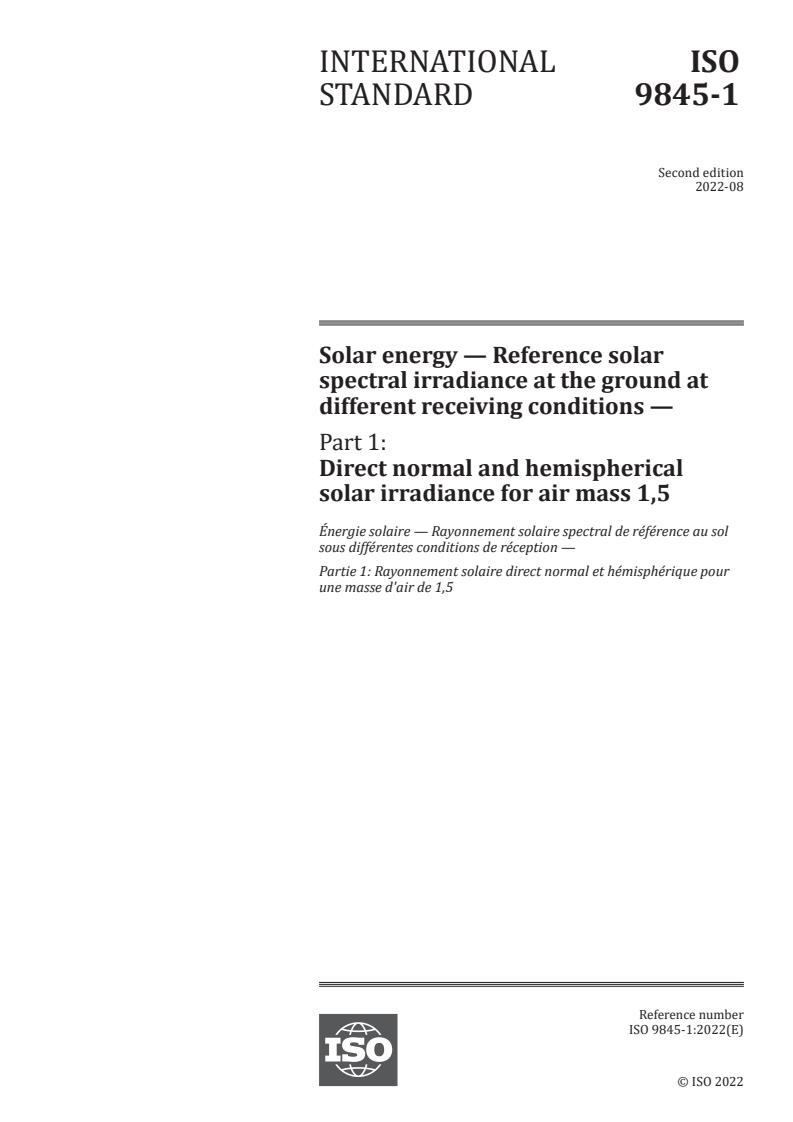
INTERNATIONAL ISO
STANDARD 9845-1
Second edition
2022-08
Solar energy — Reference solar
spectral irradiance at the ground at
different receiving conditions —
Part 1:
Direct normal and hemispherical
solar irradiance for air mass 1,5
Énergie solaire — Rayonnement solaire spectral de référence au sol
sous différentes conditions de réception —
Partie 1: Rayonnement solaire direct normal et hémisphérique pour
une masse d'air de 1,5
Reference number
© ISO 2022
All rights reserved. Unless otherwise specified, or required in the context of its implementation, no part of this publication may
be reproduced or utilized otherwise in any form or by any means, electronic or mechanical, including photocopying, or posting on
the internet or an intranet, without prior written permission. Permission can be requested from either ISO at the address below
or ISO’s member body in the country of the requester.
ISO copyright office
CP 401 • Ch. de Blandonnet 8
CH-1214 Vernier, Geneva
Phone: +41 22 749 01 11
Email: copyright@iso.org
Website: www.iso.org
Published in Switzerland
ii
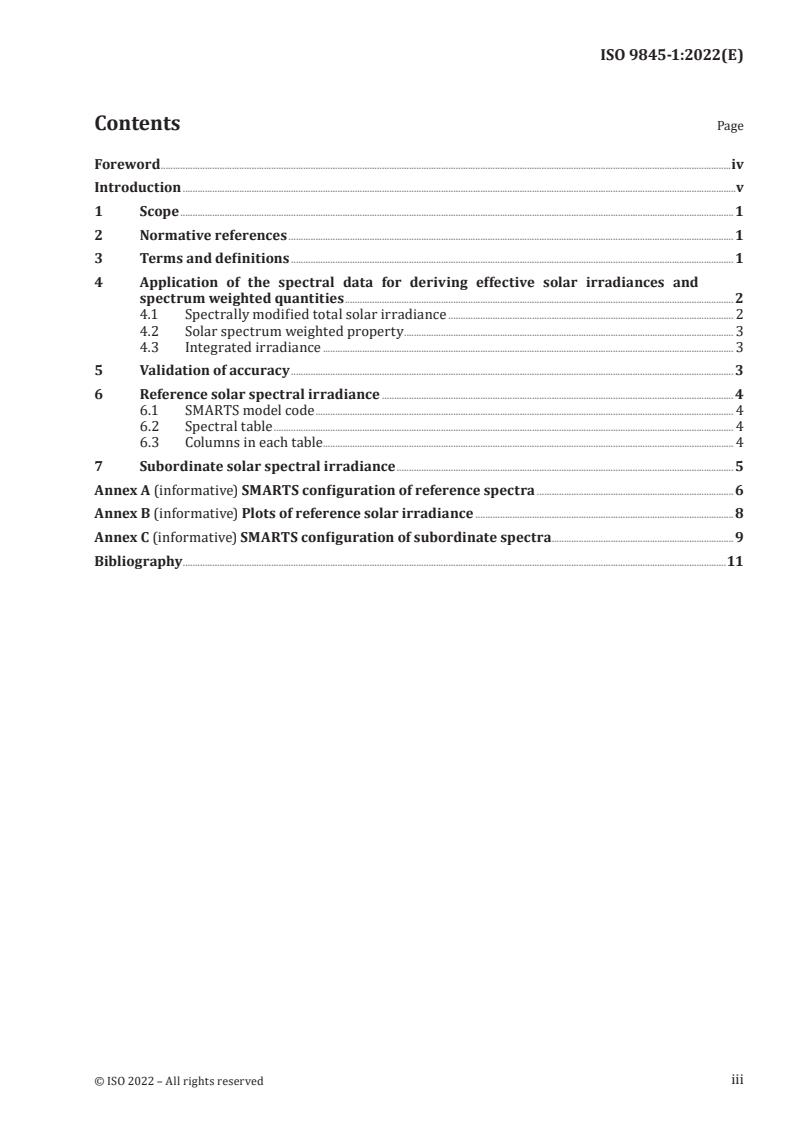
Contents Page
Foreword .iv
Introduction .v
1 Scope . 1
2 Normative references . 1
3 Terms and definitions . 1
4 Application of the spectral data for deriving effective solar irradiances and
spectrum weighted quantities . 2
4.1 Spectrally modified total solar irradiance . 2
4.2 Solar spectrum weighted property . 3
4.3 Integrated irradiance . 3
5 Validation of accuracy . 3
6 Reference solar spectral irradiance . 4
6.1 SMARTS model code . 4
6.2 Spectral table . 4
6.3 Columns in each table . . 4
7 Subordinate solar spectral irradiance . 5
Annex A (informative) SMARTS configuration of reference spectra . 6
Annex B (informative) Plots of reference solar irradiance . 8
Annex C (informative) SMARTS configuration of subordinate spectra. 9
Bibliography .11
iii
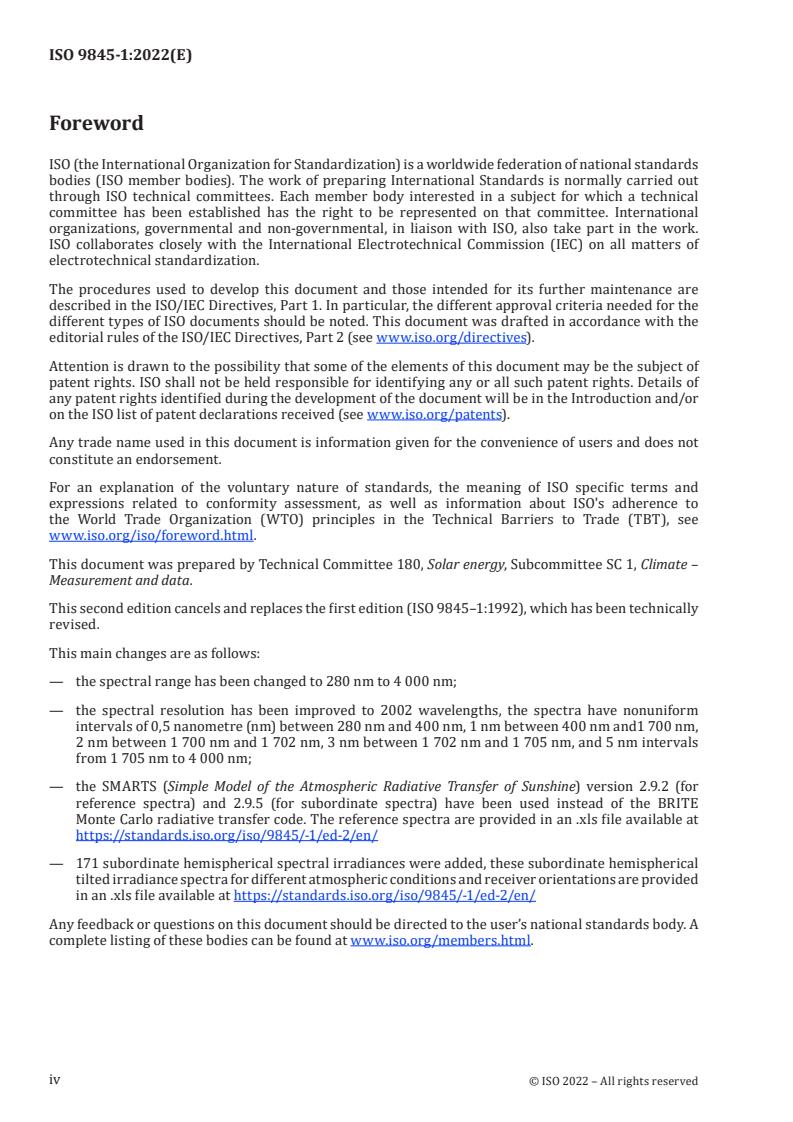
Foreword
ISO (the International Organization for Standardization) is a worldwide federation of national standards
bodies (ISO member bodies). The work of preparing International Standards is normally carried out
through ISO technical committees. Each member body interested in a subject for which a technical
committee has been established has the right to be represented on that committee. International
organizations, governmental and non-governmental, in liaison with ISO, also take part in the work.
ISO collaborates closely with the International Electrotechnical Commission (IEC) on all matters of
electrotechnical standardization.
The procedures used to develop this document and those intended for its further maintenance are
described in the ISO/IEC Directives, Part 1. In particular, the different approval criteria needed for the
different types of ISO documents should be noted. This document was drafted in accordance with the
editorial rules of the ISO/IEC Directives, Part 2 (see www.iso.org/directives).
Attention is drawn to the possibility that some of the elements of this document may be the subject of
patent rights. ISO shall not be held responsible for identifying any or all such patent rights. Details of
any patent rights identified during the development of the document will be in the Introduction and/or
on the ISO list of patent declarations received (see www.iso.org/patents).
Any trade name used in this document is information given for the convenience of users and does not
constitute an endorsement.
For an explanation of the voluntary nature of standards, the meaning of ISO specific terms and
expressions related to conformity assessment, as well as information about ISO's adherence to
the World Trade Organization (WTO) principles in the Technical Barriers to Trade (TBT), see
www.iso.org/iso/foreword.html.
This document was prepared by Technical Committee 180, Solar energy, Subcommittee SC 1, Climate –
Measurement and data.
This second edition cancels and replaces the first edition (ISO 9845–1:1992), which has been technically
revised.
This main changes are as follows:
— the spectral range has been changed to 280 nm to 4 000 nm;
— the spectral resolution has been improved to 2002 wavelengths, the spectra have nonuniform
intervals of 0,5 nanometre (nm) between 280 nm and 400 nm, 1 nm between 400 nm and1 700 nm,
2 nm between 1 700 nm and 1 702 nm, 3 nm between 1 702 nm and 1 705 nm, and 5 nm intervals
from 1 705 nm to 4 000 nm;
— the SMARTS (Simple Model of the Atmospheric Radiative Transfer of Sunshine) version 2.9.2 (for
reference spectra) and 2.9.5 (for subordinate spectra) have been used instead of the BRITE
Monte Carlo radiative transfer code. The reference spectra are provided in an .xls file available at
https://standards.iso.org/iso/9845/-1/ed-2/en/
— 171 subordinate hemispherical spectral irradiances were added, these subordinate hemispherical
tilted irradiance spectra for different atmospheric conditions and receiver orientations are provided
in an .xls file available at https://standards.iso.org/iso/9845/-1/ed-2/en/
Any feedback or questions on this document should be directed to the user’s national standards body. A
complete listing of these bodies can be found at www.iso.org/members.html.
iv
Introduction
Absorptance, reflectance and transmittance of terrestrial solar energy are important factors in solar
thermal system performance, photovoltaic system performance, materials studies, biomass studies
and solar simulation activities. These optical properties are normally functions of wavelength, which
requires that the spectral distribution of the solar flux be known before the solar weighted property
can be calculated. In order to compare the performance of competitive products, a reference standard
solar spectral irradiance distribution is desirable.
This document greatly expands the original ISO 9845–1:1992, which provides 2 reference solar
spectral irradiance and 171 subordinate solar spectral irradiances. The reference solar spectral
distributions include direct normal spectral irradiance with a 5,8° field of view centered on the sun
and hemispherical solar spectral irradiance on an equator-facing, 37° tilted plane. The subordinate
solar spectral distributions include nine atmospheric conditions, 19 tilt angles, and a total of 171
hemispherical irradiance spectra.
Further parts of the standard consider recent improvements in the basic data and modelling techniques
leading to better accuracy.
v
INTERNATIONAL STANDARD ISO 9845-1:2022(E)
Solar energy — Reference solar spectral irradiance at the
ground at different receiving conditions —
Part 1:
Direct normal and hemispherical solar irradiance for air
mass 1,5
1 Scope
This document provides an appropriate reference spectral irradiance distribution to be used in
determining relative performance of solar thermal, photovoltaic, and other systems, components and
materials where the direct or hemispherical irradiance component is desired.
This document provides one reference hemispherical irradiance spectrum, one reference direct normal
irradiance spectrum and 171 subordinate hemispherical tilted irradiance spectra. The reference
spectral irradiance presented in this document defines an air mass 1,5 solar spectral irradiance, for use
in solar applications where a reference spectral irradiance is required, for the direct normal radiation
5,8° field-of-view angle and hemispherical radiation on an equator-facing, 37° tilted plane for albedo
corresponding to a light sandy soil. The reference spectral irradiance are intended to represent ideal
clear sky conditions.
The reference spectra and the subordinate spectral irradiances representing different sky conditions
are provided in .xls files available at https:// standards .iso .org/ iso/ 9845/ -1/ ed -2/ en/
2 Normative references
There are no normative references in this document.
3 Terms and definitions
For the purposes of this document, the following terms and definitions apply.
ISO and IEC maintain terminological databases for use in standardization at the following addresses:
— ISO Online browsing platform: available at https:// www .iso .org/ obp
— IEC Electropedia: available at https:// www .electropedia .org/
3.1
air mass
AM
measure of the length of the path through the atmosphere to sea level traversed by light rays from a
celestial body, expressed with reference to the path length along the vertical
3.2
direct solar irradiance
G
b
quotient of the radiant flux on a given plane receiver surface received from a small solid angle centred
on the sun's disk to the area of that surface, when the plane is perpendicular to the axis of the solid
angle
[SOURCE: ISO 9488:2022, 3.2.28, modified — "when the plane is perpendicular to the axis of the solid
angle" was added.]
3.3
hemispherical solar irradiance
G
hem
quotient of the radiant flux on a given plane receiver surface received from a solid angle of 2π sr to the
area of that surface
Note 1 to entry: The tilt angle and the azimuth of the surface should be specified, e.g. horizontal.
-2
Note 2 to entry: Hemispherical irradiance is expressed in watts per square metre (W∙m ).
Note 3 to entry: Examples for hemispherical irradiance are global irradiance and the irradiance received in the
plane of solar collector [Plane of Array (POA) irradiance], also called "global tilted irradiance".
[SOURCE: ISO 9488:2022, 3.2.29]
3.4
spectral solar irradiance
E
λ
solar irradiance per unit wavelength interval at a given wavelength
-2 -1
Note 1 to entry: Spectral solar irradiance is expressed in watts per square metre per nanometre (W∙m ∙nm ).
[SOURCE: ISO 9488:2022, 3.2.32, modified — The unit "µm" was changed to "nm".]
4 Application of the spectral data for deriving effective solar irradiances and
spectrum weighted quantities
4.1 Spectrally modified total solar irradiance
If R is the wavelength-dependent property of a device (such as responsivity, transmittance,
λ
reflectance, absorptance) and E represents the solar spectral irradiance, then G , the effective total
λ s
solar irradiance weighted with the spectral property of this device, can be calculated as an integral of
the product of E and R as given by Formula (1)
λ λ
4 000nm
GR= E dλ (1)
s λλ
∫
280nm
4.2 Solar spectrum weighted property
The mean value R of the property R , which is effective if the total solar spectrum is applied, can in
s λ
general be calculated by the following Formula (2):
4 000nm
RE dλ
λλ
∫
280nm
R = (2)
S
4 000nm
E dλ
λ
∫
280nm
Since the spectral property and the spectral irradiance are usually known as discrete values, the
integration shall be performed as summations so that Formulae (1) and (2) become, respectively,
Formulae (3) and (4):
N
GR= E Δλ (3)
si∑ λλ
ii
i=1
and
G
s
R = (4)
S
N
E Δλ
λ
∑ i
i
i=1
th
Where λ is the wavelength of the i point out of N for which the spectral data are known. The values
i
represent the practical limits of the summation.
4.3 Integrated irradiance
The integrated irradiance values G 0→λ , were computed using a modified trapezoidal integration
()
i
technique. More specifically as given in Formula (5):
EE+
λλ
i−1
jj+1
GG()00→ λλ=→ () + Δλ (5)
ij1 ∑
j=1
where Δ−λλ = λ
jj+1 j
G 0→λ is the contribution before the first tabulated wavelength. T
...