

ISO 28981:2009/Amd 1:2015
(Amendment)Mopeds - Methods for setting the running resistance on a chassis dynamometer — Amendment 1
General Information
- Abstract
- Status
- Published
- Publication Date
- 05-Nov-2015
- Technical Committee
- ISO/TC 22/SC 38 - Motorcycles and mopeds
- Drafting Committee
- ISO/TC 22/SC 38 - Motorcycles and mopeds
- Current Stage
- 6060 - International Standard published
- Start Date
- 06-Nov-2015
- Due Date
- 07-Feb-2016
- Completion Date
- 07-Feb-2016

Overview
ISO 28981:2009/Amd 1:2015 is an amendment to the international standard that defines methods for setting the running resistance of mopeds on a chassis dynamometer. Issued by the International Organization for Standardization (ISO), this amendment provides updated specifications specifically regarding the ambient conditions required during road testing. The standard is crucial for manufacturers, testing laboratories, and regulatory bodies involved in performance evaluation and compliance testing of mopeds.
Key Topics
- Running Resistance Measurement: This standard amendment ensures precise calibration methods for running resistance on chassis dynamometers used for mopeds, enhancing testing accuracy.
- Ambient Conditions for Road Tests: The amendment updates standard ambient conditions necessary to conduct reliable road tests, including:
- Pressure: 100 kPa
- Temperature: 293 K (20°C)
- Relative air density: 0.9197
- Air volumetric mass: 1.189 kg/m³
- Technical Committee Involvement: Prepared by ISO Technical Committee 22 (Road vehicles), Subcommittee SC 38 (Motorcycles and mopeds), ensuring alignment with industry needs and technological advances.
- Standardization Process: Complies with ISO/IEC Directives, illustrating transparent and structured development procedures, including consideration of patent rights and global trade principles.
Applications
- Moped Manufacturers: Utilize this standard to calibrate chassis dynamometers accurately, ensuring mopeds meet performance and emission regulations.
- Testing Laboratories: Apply the specified ambient conditions to validate dynamometer results, improving test reproducibility and reliability across different laboratories.
- Regulatory Bodies: Adopt the standard to enforce uniform measurement methods, facilitating fair compliance assessments on running resistance-a critical factor influencing fuel efficiency.
- Research and Development: Employ the standard’s methods during vehicle development phases to evaluate drivetrain performance and rolling resistance under controlled conditions.
Related Standards
- ISO 28981:2009: The base standard describing initial methods for setting running resistance on mopeds’ chassis dynamometers.
- ISO 8712 Series: Standards concerning dynamometer testing procedures for motorcycles and mopeds.
- ISO/IEC Directives, Part 1 and Part 2: Provide editorial and procedural rules governing the preparation and maintenance of ISO standards.
- ISO 39001: Road traffic safety management systems, often intersecting with vehicle performance testing standards for regulatory compliance.
By adhering to ISO 28981:2009/Amd 1:2015, stakeholders benefit from standardized testing methods that improve consistency and reliability in the measurement of running resistance, supporting enhanced vehicle performance evaluations, regulatory compliance, and industry innovation.
Relations
- Effective Date
- 04-Sep-2021
Get Certified
Connect with accredited certification bodies for this standard

TÜV Rheinland
TÜV Rheinland is a leading international provider of technical services.

TÜV SÜD
TÜV SÜD is a trusted partner of choice for safety, security and sustainability solutions.

DEKRA Certification Inc.
DEKRA US certification services.
Sponsored listings
Frequently Asked Questions
ISO 28981:2009/Amd 1:2015 is a standard published by the International Organization for Standardization (ISO). Its full title is "Mopeds - Methods for setting the running resistance on a chassis dynamometer — Amendment 1". This standard covers: Mopeds - Methods for setting the running resistance on a chassis dynamometer — Amendment 1
Mopeds - Methods for setting the running resistance on a chassis dynamometer — Amendment 1
ISO 28981:2009/Amd 1:2015 is classified under the following ICS (International Classification for Standards) categories: 43.140 - Motorcycles and mopeds. The ICS classification helps identify the subject area and facilitates finding related standards.
ISO 28981:2009/Amd 1:2015 has the following relationships with other standards: It is inter standard links to ISO 28981:2009. Understanding these relationships helps ensure you are using the most current and applicable version of the standard.
ISO 28981:2009/Amd 1:2015 is available in PDF format for immediate download after purchase. The document can be added to your cart and obtained through the secure checkout process. Digital delivery ensures instant access to the complete standard document.
Standards Content (Sample)
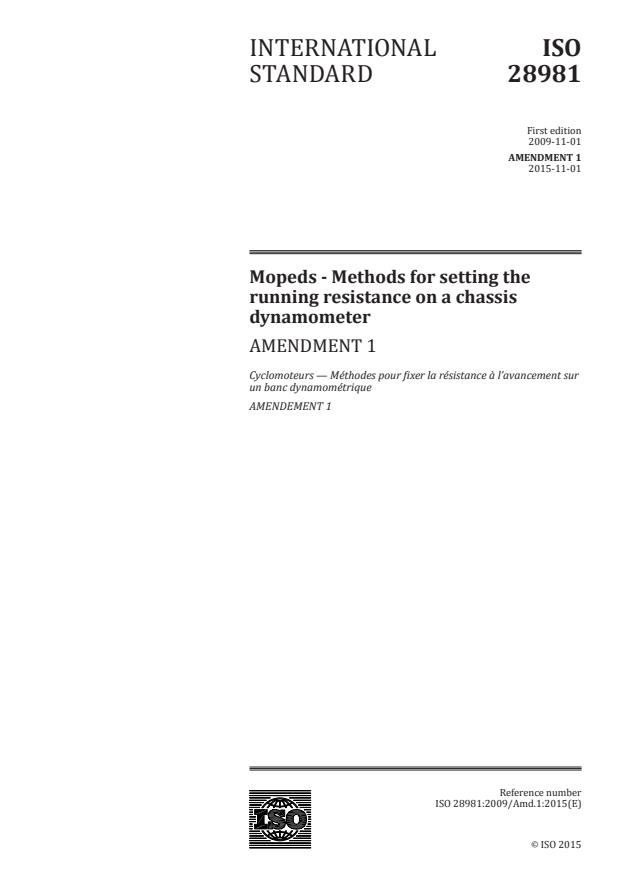
INTERNATIONAL ISO
STANDARD 28981
First edition
2009-11-01
AMENDMENT 1
2015-11-01
Mopeds - Methods for setting the
running resistance on a chassis
dynamometer
AMENDMENT 1
Cyclomoteurs — Méthodes pour fixer la résistance à l’avancement sur
un banc dynamométrique
AMENDEMENT 1
Reference number
ISO 28981:2009/Amd.1:2015(E)
©
ISO 2015
ISO 28981:2009/Amd.1:2015(E)
© ISO 2015, Published in Switzerland
All rights reserved. Unless otherwise specified, no part of this publication may be reproduced or utilized otherwise in any form
or by any means, electronic or mechanical, including photocopying, or posting on the internet or an intranet, without prior
written permission. Permission can be requested from either ISO at the address below or ISO’s member body in the country of
the requester.
ISO copyright office
Ch. de Blandonnet 8 • CP 401
CH-1214 Vernier, Geneva, Switzerland
Tel. +41 22 749 01 11
Fax +41 22 749 09 47
copyright@iso.org
www.iso.org
ii © ISO 2015 – All rights reserved
ISO 28981:2009/Amd.1:2015(E)
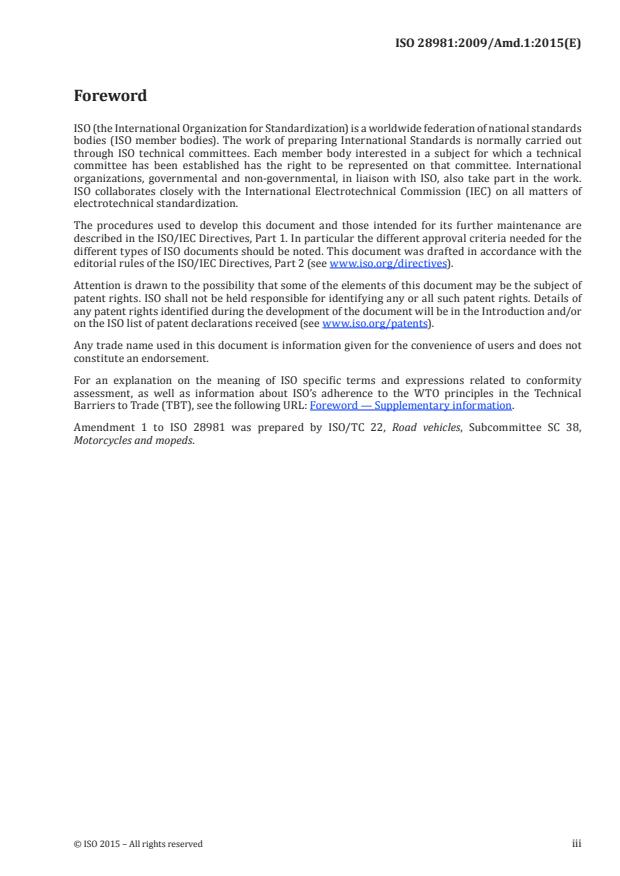
Foreword
ISO (the International Organization for Standardization) is a worldwide federation of national standards
bodies (ISO member bodies). The work of preparing International Standards is normally carried out
through ISO technical committees. Each member body interested in a subject for which a technical
committee has been established has the right to be represented on that committee. International
organizations, governmental and non-governmental, in liaison with ISO, also take part in the work.
ISO collaborates closely with the International Electrotechnical Commission (IEC) on all matters of
electrotechnical standardization.
The procedures used to develop this document and those intended for its further maintenance are
described in t
...